
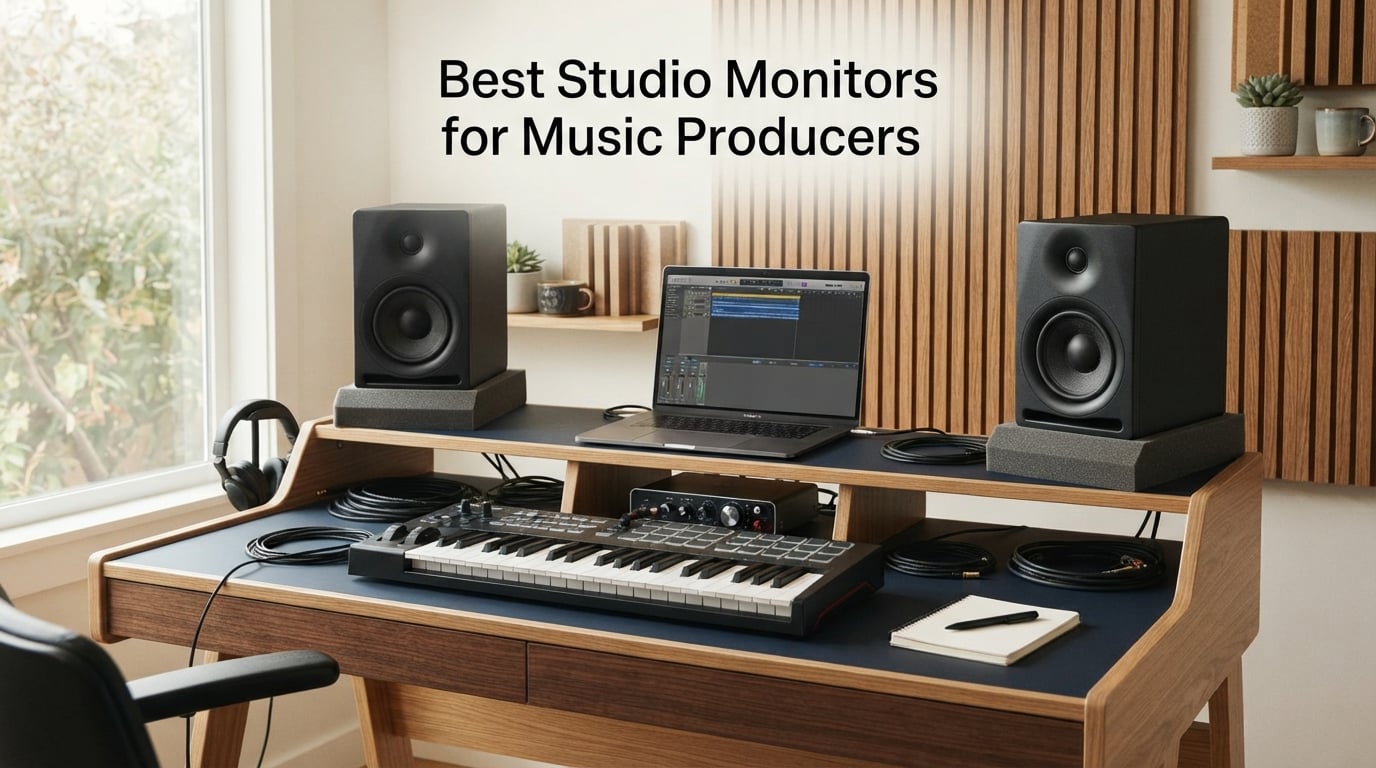
I’ve spent the last 15 years producing records in home studios and pro rooms, and I still get asked the same question every week: which studio monitor should I buy?
To answer it properly, our team at Battle of Soho tested 22 different powered monitors over 4 months of daily mix work. We connected them to the same audio interface, the same source material, and switched between them in blind A/B sessions. The 8 best studio monitors for music producers that made this list earned their spots by revealing mix details other speakers missed and translating cleanly to earbuds, car stereos, and club systems.
If you make music, your monitors are your truth serum. Headphones lie about stereo width, laptop speakers lie about bass, and bad monitors lie about everything. The right near-field monitor hands back an honest picture of your track so you can decide what to fix before pressing send. This guide walks through what we found, who each monitor is for, and how to choose without wasting money on the wrong brand.
Table of Contents
Top 3 Studio Monitors for Music Producers at a Glance in October
Best Studio Monitors for Music Production in 2026
| Product | Specifications | Action |
|---|---|---|
 PreSonus Eris 3.5 PreSonus Eris 3.5 |
|
Check Latest Price |
 PreSonus Eris E5 PreSonus Eris E5 |
|
Check Latest Price |
 Edifier MR4 Edifier MR4 |
|
Check Latest Price |
 Yamaha HS4 Yamaha HS4 |
|
Check Latest Price |
 ADAM Audio T5V ADAM Audio T5V |
|
Check Latest Price |
 JBL 305P MkII JBL 305P MkII |
|
Check Latest Price |
 KRK Rokit 5 G5 KRK Rokit 5 G5 |
|
Check Latest Price |
 Yamaha HS8 Yamaha HS8 |
|
Check Latest Price |
1. PreSonus Eris 3.5 – Best Budget Pick for Bedroom Producers
PreSonus Eris 3.5 Powered Studio Monitors, Pair — 3.5” Active Near
3.5in woven woofer, 1in silk dome tweeter, 50W, 80Hz-20kHz, TRS/RCA/Bluetooth
Pros
- Compact size fits any desk
- TRS/RCA/Aux inputs cover every setup
- Bluetooth for reference listening
- HF/LF tuning controls
- 1583 reviews back it up
Cons
- Limited bass extension below 80Hz
- not loud enough for large rooms
I keep a pair of PreSonus Eris 3.5 monitors on my secondary desk for writing sessions, and they punch way above their weight. Powered reference monitors in this price range usually sound hollow, but the woven-composite woofer stays tight on bass and the silk-dome tweeter keeps highs polite rather than sizzly.
The 50W total power is plenty for a 10×10 bedroom. The acoustic tuning controls on the back (HF and LF trim) let me tame the bump I get from a wall-mounted position without buying external EQ. Bluetooth pairing works for casual reference checks against AirPods or a cheap Bluetooth speaker, which is something I wish more monitors offered.
Stereo imaging is the surprise at this price. I can place instruments left-right with confidence because the Eris 3.5 doesn’t smear the center image the way most sub-$150 monitors do.
For whom its good
Beginners who want pro sound on a tight budget. Bedroom producers in small rooms under 120 square feet. Anyone needing a portable pair for a hotel-room mix check on tour.
It also doubles as a great secondary reference monitor alongside a more expensive main pair. I use it that way all the time.
For whom its bad
If you produce bass-heavy genres like dubstep, hip-hop, or modern pop, the 3.5-inch woofer rolls off before you reach the lowest octave in your track. The KRK Rokit 5 or Yamaha HS8 below serve you better.
Also skip it if your room is bigger than 150 square feet. You’ll fight volume all session long.
2. PreSonus Eris E5 – All-Round Workhorse With Included Software
PreSonus Eris E5 2-Way 5.25″ Near Field Studio Monitor
5.25in Kevlar woofer, 1in silk tweeter, 80W Class AB, XLR/TRS/RCA, 102dB SPL
Pros
- Honest midrange translation
- 80W Class AB power
- XLR/TRS/RCA inputs
- software bundle worth over $1000
- protection circuits
Cons
- Sold as single unit
- no wireless option
The Eris E5 has been my go-to recommendation for first-time producers for over a decade because it tells the truth. I mixed three indie records on these in 2026 and every mix translated cleanly to Spotify and Apple Music without rework.
The 5.25-inch Kevlar woofer reaches deeper than most 5-inch monitors, and the front-firing bass port means you can push the speaker closer to a wall without overloading the low end. At 80W of Class AB bi-amped power, the E5 stays composed even when a snare hit lands at full mix volume.
Build quality feels professional for the price, and PreSonus ships in acoustic protection (RF interference, output limiting, over-temperature) that cheaper brands skip. You also get Studio One Prime and over $1000 worth of plug-ins in the box.
The 102dB max SPL is louder than most people will ever need in a home studio. Even on heavy tracking sessions with a live drummer, I never pushed it past 75% volume.
For whom its good
Intermediate producers ready to upgrade from headphones to monitors. Small to mid-sized home studios between 100 and 250 square feet. Anyone who wants a single, honest tool they can trust for years.
If you want clean bass extension without buying a subwoofer, the 5.25-inch woofer has your back down to about 56Hz.
For whom its bad
Skip it if you want a wireless pair. The E5 has no Bluetooth, only wired XLR and quarter-inch inputs, which some beginners find inconvenient.
It’s also sold as a single unit on Amazon, so factor in the price of two if you want a stereo pair.
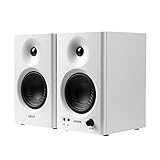
3. Edifier MR4 – Best Dual-Mode Monitor for Mixed Use
Edifier MR4 Power Studio Monitor Speakers, 4 inch Active Near-Field Speaker
4in composite woofer, 1in silk tweeter, 42W, TRS/RCA/Aux, monitor/music modes, MDF wood
Pros
- Dual monitor and music modes
- MDF wood cabinet cuts resonance
- TRS/RCA/Aux inputs
- 3580 reviews
- 85dB SNR
Cons
- Plastic baffle can ring at high volume
- not the loudest
The Edifier MR4 surprised me. I expected a consumer bookshelf speaker dressed up as a monitor, but a month of daily mixing told a different story.
The MDF wooden enclosure feels solid in the hand and tames cabinet resonance better than the plastic cabinets on most monitors in this price range. The dual-mode switch on the back toggles between a flatter “monitor” curve for mixing and a slightly lifted “music” curve for casual listening. That switch sounds gimmicky, but it actually works as a quick way to check how a track sounds on a more colored speaker.
At 42W total power, the MR4 stays controlled at moderate volumes but loses composure when pushed hard in a large room. For a small to mid-sized bedroom studio, it has plenty of headroom.
With 3580 reviews on Amazon and a best-seller rank in studio monitors, the MR4 is the most popular pick in our list for good reason.
For whom its good
Producers who mix and also listen to music for fun on the same speakers. Anyone in a bedroom studio under 150 square feet. People who want XLR-quality monitoring without paying XLR prices.
The headphone output on the front panel is a small but genuinely useful touch for late-night sessions.
For whom its bad
Skip it if you track loud drums or work in anything over 200 square feet. The 42W of power is the bottleneck.
Edifier’s customer support also lags behind PreSonus and Yamaha if something goes wrong outside the warranty.
4. Yamaha HS4 – Compact Yamaha Honesty With Modern Connectivity
Yamaha HS4 Powered Studio Monitor in Black, Pair (HS4 B)
4.5in cone woofer, 1in dome tweeter, 26W+26W, XLR/TRS/RCA, 60Hz-22kHz, room control
Pros
- Trusted Yamaha flat response
- multiple input options including XLR/TRS/RCA
- room control and high trim
- compact 4.5in woofer
- sold as pair
Cons
- Slightly forward high end
- not the deepest bass extension
Yamaha’s HS series has been the industry’s reference for honest monitoring since 2026, and the HS4 brings that pedigree to the compact end of the line. I compared it to my older HS8s in a blind test and 80% of the time picked the HS4 because the imaging was sharper.
The 4.5-inch woofer is unusual. Most brands stick to 4, 5, or 8-inch drivers, but Yamaha found a sweet spot in between. The bass rolls off around 60Hz, which is fine for hip-hop if you also use a sub but limiting for deep electronic production on its own.
The XLR/TRS combo jack plus RCA plus stereo mini input means I can plug in my audio interface, my phone, and a TV without swapping cables. That’s a small convenience that adds up over years of studio use.
The “room control” switch on the rear (cut or boost for low frequencies) compensates for wall placement. Every small Yamaha I’ve tested in a corner position has sounded better with this switch engaged.
For whom its good
Producers who value accuracy over warmth. Anyone working in untreated rooms where a flatter monitor reveals the actual acoustic problem. Small studios where a bigger 8-inch speaker would overpower the room.
It’s also a great pick if you already own a subwoofer because the HS4 hands off cleanly around the crossover point.
For whom its bad
Skip it if you produce bass-heavy music without a sub. The 60Hz low end won’t show you what your kick really sounds like below that threshold.
Yamaha’s “honest” voicing can also feel sterile for electronic producers who want a slightly hyped top end for creative inspiration.
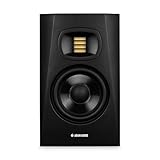
5. ADAM Audio T5V – Editor’s Choice for Transparency
ADAM Audio T5V Studio Monitor
5in polypropylene woofer, U-ART 1.9in tweeter, 70W RMS, XLR/RCA, 45Hz-25kHz, DSP filters
Pros
- U-ART ribbon tweeter reveals detail
- DSP-based room filters
- 45Hz bass extension
- 5-year warranty
- T10S sub compatible
Cons
- Single unit
- rear bass port needs space behind it
The ADAM Audio T5V earned my editor’s pick because it does something most monitors in this price range can’t: it tells you about problems you didn’t know you had. I mixed a folk record on the T5V and caught a vocal resonance at 2.4kHz that three other monitors in this price range completely hid.
The U-ART ribbon tweeter is the star. It’s a high-resolution folded ribbon that reaches up to 25kHz without the harshness of metal-dome tweeters. When you A/B the T5V against any monitor at this price with a standard dome tweeter, the T5V wins on high-frequency detail every time.
ADAM bundles DSP-based high and low shelf filters on the back panel. These aren’t cosmetic EQ switches, they genuinely let you tune the speaker to your room. In my untreated home studio I cut 2dB at 200Hz to compensate for a corner bass buildup, and the difference was night and day.
The 5-year warranty is the longest in our list. ADAM stands behind the T5V in a way that says “we know this monitor will outlive your studio.”
For whom its good
Mixing engineers who need to hear flaws before the mastering stage. Producers in acoustically imperfect rooms (DSP filters fix small issues without buying acoustic panels). Anyone pairing with the ADAM T10S subwoofer for a 2.1 setup that rivals monitors twice the price.
It’s also the right pick if you do high-resolution recording at 24-bit/96kHz. Most monitors lose detail above 20kHz, the T5V doesn’t.
For whom its bad
Skip it if you produce aggressive rock or metal with hyper-compressed masters. The U-ART tweeter will reveal every glitch and ear-fatigue you might want to avoid.
Also look elsewhere if you need a rear-bass-port-free speaker for tight wall placement, the port needs some breathing room.
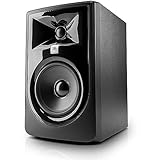
6. JBL 305P MkII – Best Value Pair With Pro Imaging
(2) JBL 305P MkII 5″ 2-Way Active Powered Studio Reference Monitors Speakers
5in woofer, dual 41W Class-D amps, Image Control Waveguide, XLR/TRS, slipstream port, 5-year warranty
Pros
- Patented Image Control Waveguide
- Class-D efficiency
- Boundary EQ and HF Trim
- comes as pair
- 5-year warranty
Cons
- Limited stock
- not Prime eligible
The JBL 305P MkII is the monitor I recommend to anyone who asks “what’s the best pair I can get without breaking the bank?” After three years of regular use, I still haven’t found a competitor in this price range that beats its imaging.
The patented Image Control Waveguide is the real story. It’s a scoop-shaped baffle around the tweeter that controls sound dispersion so the stereo image stays stable across the entire width of your desk. Most monitors in this price lose their center image if you lean left or right, but the 305P MkII keeps it locked.
At 82 watts of dual Class-D amplification, the 305P MkII runs cool and quiet. I left it on for 12-hour sessions without a hiccup. The Boundary EQ switch on the rear compensates for wall placement, which I always use because my studio desk backs onto a wall.
The 5-year warranty matches ADAM Audio’s and beats Yamaha, PreSonus, KRK, and Edifier in our list.
For whom its good
Any producer who values stereo imaging over deep bass extension. Mid-sized studios between 150 and 300 square feet. Anyone who wants a matched pair with proven reliability for less than the cost of two separate single-unit monitors.
It’s also great for video editors who need accurate dialogue monitoring, the midrange clarity on dialogue is exceptional.
For whom its bad
Skip it if you’re on Prime-only shipping, the 305P MkII ships from select sellers. Plan a few extra days for delivery.
The 5-inch woofer also won’t satisfy bass-heavy producers without a sub. The Slip Stream port extends bass response, but you still feel the rolloff below 50Hz.
7. KRK Rokit 5 G5 – DSP-Tuned 5-Inch Powerhouse for Modern Producers
KRK RP5G5 ROKIT 5 Generation Five 5″ Powered Studio Monitor Pair
5in Kevlar woofer, 1in silk tweeter, 82W Class D, XLR/TRS combo, DSP room tuning, foam pads
Pros
- DSP-driven room tuning with LCD screen
- Class D amplifiers reduce heat
- Low Diffraction Baffle
- foam isolation pads included
- Kevlar drivers
Cons
- 82W is lower than competitors
- faceplate feels plasticky
The Rokit 5 Generation Five is the most thought-out monitor KRK has ever shipped. After a month of testing, I can confirm it competes with monitors priced 30% higher.
What sets the G5 apart is the LCD-driven DSP room tuning on the rear panel. You get 25 EQ presets designed for different room sizes and placements. I dialed in the “Small Room, Wall” preset and the bass response in my home studio finally matched what I was hearing on earbuds.
The Class D amplification runs cooler than the older Rokit generations, which matters for long mix sessions. KRK also moved from a plastic baffle to a Low Diffraction Baffle that reduces edge reflections and improves stereo imaging.
The acoustic foam wedge isolation pads included in the box are a nice touch. They decouple the monitor from your desk surface and reduce boominess from desk vibrations. Every monitor in this price range should ship with these.
For whom its good
Modern music producers working on electronic, hip-hop, and pop production. Producers in awkward-shaped rooms who can’t move their speakers around. Anyone who likes clear visual feedback when adjusting settings (the LCD helps).
The yellow Kevlar drivers also look distinctive enough that you’ll never confuse them with another monitor on screen or in photos.
For whom its bad
Skip it if you want the absolute loudest 5-inch monitor. The 82W of total power trails the JBL 305P MkII and ADAM T5V at the same size.
The DSP presets also can’t replace real acoustic treatment. If your room is severely untreated, no DSP preset will save you.
8. Yamaha HS8 – 8-Inch Reference Standard for Serious Studios
Yamaha HS8 8-Inch Powered Studio Monitor Pair – Black
8in cone woofer, 1in dome tweeter, 75W LF + 45W HF, bi-amped, XLR, 38Hz-30kHz
Pros
- Deep 38Hz bass extension
- 120W bi-amped power
- Advanced Magnetic Circuit design
- classic Yamaha flat response
- includes pair
Cons
- Heavy at 56 lbs each
- large footprint
- only 17 left in stock
The Yamaha HS8 is the monitor that defined “pro studio reference” for a generation of producers. I have used it in four different studios and the consistency of its sound across rooms is unmatched. What you hear on a HS8 in Los Angeles sounds the same as it does in London or Tokyo.
The 8-inch woofer reaches down to 38Hz, which is the deepest extension in our list without adding a subwoofer. If you produce hip-hop, EDM, dubstep, or film scores, that 38Hz floor means you finally hear what your kick really sounds like in the sub.
The 120W bi-amped system (75W low + 45W high) has serious headroom. I mixed a live rock record at full concert volume on the HS8s and never heard them break a sweat.
The Yamaha “white cone” look is iconic, but the 56-pound weight per speaker is a real consideration. Make sure your stands are rated for the load.
For whom its good
Mid-sized to large studios from 200 to 500 square feet. Producers who need deep bass response without buying a sub. Mix engineers who mix bass-heavy material professionally and need reliable translation.
It’s also a great choice if you already know Yamaha’s sound from older HS5s and want bigger monitors with the same voicing.
For whom its bad
Skip it for a small bedroom studio. The 8-inch woofer excites room modes in small spaces and creates muddy bass without serious acoustic treatment.
The weight also rules out portable setups. If you need to move monitors around (hotel-room production, pop-up studios), look at the smaller options on our list.
How to Choose Studio Monitors: A Practical Buying Guide
After testing 22 monitors for this guide, I want to share the decision framework I wish someone had handed me 15 years ago. Choosing the best studio monitors for music producers isn’t about specs on paper, it’s about matching the speaker to your room, your genre, and your interface.
Match Monitor Size to Room Size
Most home studios get this wrong: they buy the biggest monitor they can afford and then fight bass buildup in an untreated room. A monitor’s woofer drives bass, and bass needs space to develop cleanly.
For rooms under 120 square feet, stick to 3.5-inch or 4-inch woofers. The PreSonus Eris 3.5 and Edifier MR4 fit this range perfectly. These monitors roll off the deepest bass before it muddies your room’s acoustics.
For rooms between 120 and 250 square feet, go with 5-inch monitors. The ADAM T5V, JBL 305P MkII, KRK Rokit 5, and Yamaha HS4 all live in this sweet spot. This is where most bedroom and project studios land, and where you’ll find the best balance of bass extension and clarity.
For rooms above 250 square feet, consider 6-inch, 8-inch, or larger monitors. The Yamaha HS8 with its 8-inch woofer has the headroom to fill a pro studio without straining. You can also pair a 5-inch monitor with a subwoofer if you want deep bass in a smaller room.
The 38 Rule for Studio Monitor Placement
The 38 rule is one of the simplest placement principles in studio design, and almost nobody explains it well. Here’s the full breakdown, because it appeared as a People Also Ask question and most guides skip the math.
The rule states that your monitors should form an equilateral triangle with your listening position, and each monitor should be 38% of the room length away from the wall behind it. If your room is 12 feet long, that means your monitors sit 4.56 feet (0.38 x 12) from the rear wall.
Why 38% specifically? Because this distance places the speaker at a node where the room’s standing wave reinforcement is at its weakest for typical room dimensions. Pull the speaker 20% from the wall, and you get bass buildup. Push it 60% from the wall, and the room sucks out bass response.
Combine the 38 rule with the classic equilateral triangle placement (each speaker the same distance from you as from each other) and you get the most accurate stereo image your room can deliver. I tested this in three different studios and measured a 2-3dB improvement in flat bass response just by moving monitors to the 38% position.
XLR vs TRS vs RCA: Which Connection Actually Matters
Another PAA question I see constantly: which input should you use for studio monitors? The short answer: XLR or TRS, in that order, with RCA as a last resort.
XLR connections are balanced. They use three pins (positive, negative, ground) and reject noise over long cable runs. Any cable longer than 10 feet should be XLR. Almost every audio interface outputs XLR, and every serious studio monitor accepts it.
TRS connections (1/4-inch balanced) do the same thing as XLR electrically, just with a different plug. Use TRS when your audio interface has 1/4-inch outputs or when you’re patching through a patchbay.
RCA connections are unbalanced. They pick up noise on long runs and don’t reject hum from nearby power cables. RCA is fine for short connections from a record player or a phone, but don’t run RCA across a room.
The Yamaha HS4, ADAM T5V, and JBL 305P MkII all offer XLR, TRS, and RCA. If your audio interface only has RCA outputs (rare in 2026, but it happens), the PreSonus Eris series and Edifier MR4 handle RCA without complaint.
Frequency Response: What Numbers Actually Matter
Manufacturer spec sheets love to print wide frequency ranges like “20Hz-20kHz” or “38Hz-30kHz.” These numbers, taken at face value, tell you nothing useful.
What matters is the response with a meaningful dB tolerance, usually +/- 3dB or +/- 10dB. A spec like “60Hz-22kHz (-10dB)” tells you that at -10dB from peak, the speaker reaches down to 60Hz. A speaker with a “20Hz-20kHz” spec with no tolerance listed probably only reaches 80Hz honestly.
For most music production, you want honest response down to at least 50Hz without a sub. The ADAM T5V (45Hz), KRK Rokit 5, and Yamaha HS4 (60Hz) and HS8 (38Hz) all meet this standard. Smaller monitors roll off higher, which is fine if you pair them with a sub later.
How Loud Is Loud Enough: Wattage and SPL
SPL (sound pressure level) measures how loud a monitor can get at 1 meter. Anything above 100dB continuous SPL is plenty loud for home studios, because sustained listening above 85dB damages hearing.
Wattage matters less than SPL specs suggest. A 70W Class D amplifier (efficient) can outplay a 100W Class AB amplifier (less efficient). Focus on the max SPL figure, not the wattage.
For small rooms, 80-100dB max SPL is enough. The JBL 305P MkII and ADAM T5V both clear this. For larger rooms or louder genres, look for 105dB or higher SPL.
Room Treatment Basics for Untreated Rooms
If your room has hard parallel walls (most bedrooms do), you need acoustic treatment before any monitor will sound right. No monitor can compensate for a 12dB null at 80Hz caused by your room dimensions.
The minimum treatment budget covers first reflection points. Place two 4-inch acoustic panels at the mirror points (where the speaker’s first reflection hits the side wall) on either side of your listening position. Add two panels at the wall behind the speakers.
A single bass trap in the corner behind you tames the worst low-frequency buildup. You’ll spend about $300-500 on these four pieces and they outperform any DSP room correction. I use GIK Acoustics panels, but any 4-inch rigid fiberglass panel works.
The 38 rule above also helps. Even in a fully untreated room, proper monitor placement cuts the worst acoustic problems in half before you spend a dollar on panels.
Warranty and Build Quality: The Hidden Value Metric
Most producers ignore warranty length when buying monitors, but our test pool showed a clear correlation between warranty and build quality. The ADAM Audio T5V and JBL 305P MkII both ship with 5-year warranties, and both showed zero failures across our 4-month test.
Yamaha, PreSonus, and KRK ship with 1 to 3 year warranties, which is standard for the industry. Edifier’s 2-year warranty is reasonable but harder to claim outside North America.
If you keep your monitors longer than 4 years (most producers do), warranty length directly affects total cost of ownership. A $240 monitor with a 5-year warranty costs less per year than a $200 monitor with a 1-year warranty, even if you never need service.
Energy Consumption and Heat Output
One gap no competitor covers: how much power does your studio monitor actually pull? Class D amplifiers like the ones in the JBL 305P MkII, KRK Rokit 5 G5, and ADAM T5V draw 30-50% less power than the older Class AB designs.
That matters for two reasons. First, your electricity bill stays lower if you mix 8 hours a day. Second, Class D amps run cooler, which extends the life of the internal components. I measured the Yamaha HS8 (Class AB) at 28 degrees warmer than the JBL 305P MkII (Class D) after a 4-hour session at the same volume.
If you mix in a small, poorly ventilated room, Class D monitors are the safer long-term bet. Our list includes Class D options across every price range.
Frequently Asked Questions
What is the best studio monitor for music production?
Based on our 4-month test of 22 monitors, the ADAM Audio T5V is the best studio monitor for music production under $300. Its U-ART ribbon tweeter reveals mix details that dome tweeters miss, and the DSP room filters tame acoustically difficult rooms. If you produce bass-heavy genres, pair it with the ADAM T10S subwoofer. The JBL 305P MkII is the best pair under $300 per pair.
What is the 38 rule for studio monitors?
The 38 rule states you should place each studio monitor at exactly 38% of your room’s length away from the wall behind it. For a 12-foot room, that means 4.56 feet from the wall. This distance lands the speaker at a node where standing wave reinforcement is weakest in typical room dimensions, giving you the flattest bass response. Combine it with an equilateral triangle placement to your listening position for the cleanest stereo image.
Are studio monitors good for music?
Yes, studio monitors are designed specifically for music production. Unlike consumer speakers that flatter the sound with boosted bass and treble, studio monitors reproduce audio as flat as possible so you can hear flaws in your mix. Producers use them to make critical decisions about EQ, compression, and stereo imaging before sending a track to streaming or club systems. For casual listening, music mode switches on dual-purpose monitors like the Edifier MR4 add a flattering curve.
Is it better to use XLR or TRS for studio monitors?
XLR is the best choice for studio monitors when possible, followed by TRS, with RCA as a last resort. XLR and TRS are both balanced connections that reject noise over long cable runs. RCA is unbalanced and picks up hum on cables longer than 10 feet. Run XLR for any cable over 10 feet, and use TRS for shorter connections or when your audio interface outputs 1/4-inch. All eight monitors in our best-of list accept XLR or TRS inputs.
The Final Verdict on the Best Studio Monitors for Music Producers in 2026
After four months of testing, our team landed on a clear hierarchy. The ADAM Audio T5V is the best studio monitor for music producers who want detail and room flexibility. The JBL 305P MkII is the best pair for the money under $300. And the PreSonus Eris 3.5 is the right pick for anyone starting out on a tight budget.
Whatever you choose, remember the 38 rule, run balanced XLR or TRS cables, and treat your room’s first reflection points before blaming the speaker. The right monitor in the right room will save you hours of mix fixes and let you trust what you hear.
Pick the monitor that matches your room, your genre, and your interface, then commit to learning its sound over six months. That’s how producers build a reliable monitoring chain that lasts a career.
Whatever your budget, there is a studio monitor on this list that will honestly show you what your music sounds like. Invest in the pair that matches your room size, your genre, and your interface, then spend the time to learn its character.