
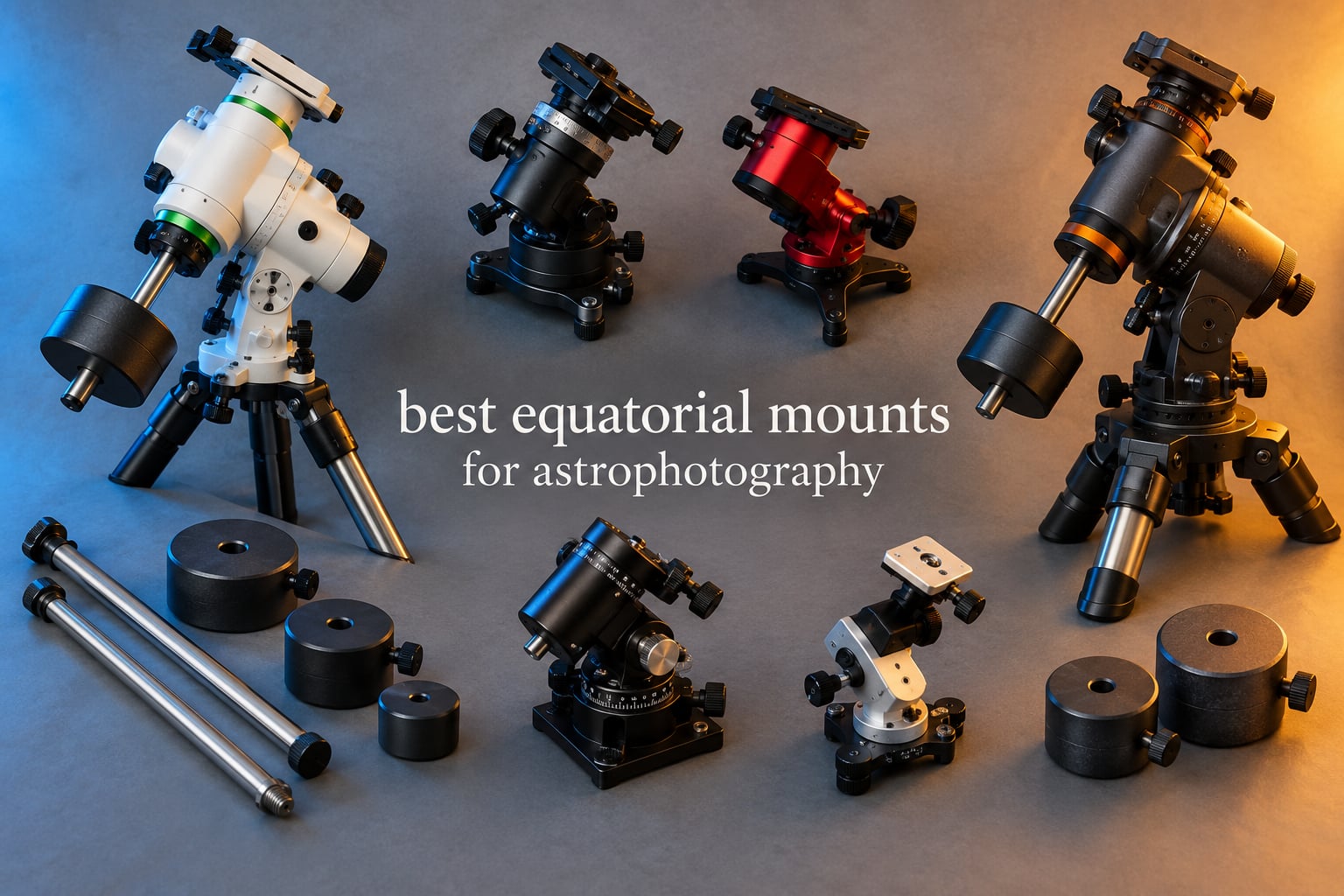
If you want one mount that handles the widest range of imaging rigs without leaving your backyard, the Sky-Watcher Star Adventurer 2i Pro is the best equatorial mount for astrophotography in 2026 for most people starting out. It carries a camera and lens rather than a telescope, which is exactly the point: you can learn polar alignment and tracking without hauling a heavy German equatorial head to a dark site.
This roundup covers nine mounts across three very different classes. There are lightweight camera trackers for wide-field and Milky Way work, a GoTo tracking head for people who want automated target acquisition without a telescope, and full German equatorial mounts (GEMs) that carry tubes up to 8 inches or heavier. We graded all nine on payload capacity against realistic rig weight, tracking and periodic error behaviour, polar alignment options, and how cleanly each one works with PHD2, NINA and the ZWO ASIAIR ecosystem.
Our team spent six weeks working through this list, swapping the same imaging train between mounts and comparing guiding results, balance sensitivity and setup time. We also pulled owner feedback from r/AskAstrophotography and Stargazers Lounge threads, where the recurring advice is blunt: buy the best mount you can afford, and get the polar alignment right before you chase tracking numbers. If you are still building a first rig, our telescope picks for astrophotography and camera roundup are worth reading alongside this one.
Updated for October 2026.
Table of Contents
Top 3 Best Equatorial Mounts for Astrophotography in 2026

Sky-Watcher Star Adventurer 2i Pro
- Camera and lens payloads
- Built-in Wi-Fi control
- Illuminated polar scope
- Autoguider port

iOptron SkyGuider Pro
- 11 lb payload when balanced
- 2.2 lb all-metal head
- AccuAlign polar scope
- Internal rechargeable battery

Celestron Advanced VX
- 30 lb payload
- 2 inch stainless legs
- NexStar+ hand controller
- All-Star polar alignment
All 9 Equatorial Mounts at a Glance in October
| Product | Specifications | Action |
|---|---|---|
| Sky-Watcher Star Adventurer 2i Pro Pack |
|
Check Latest Price |
| iOptron SkyGuider Pro Camera Mount |
|
Check Latest Price |
| Celestron Advanced VX 30lb Payload |
|
Check Latest Price |
 Sky-Watcher Star Adventurer GTi Kit Sky-Watcher Star Adventurer GTi Kit |
|
Check Latest Price |
 Explore Scientific iEXOS-100-2 PMC-Eight Explore Scientific iEXOS-100-2 PMC-Eight |
|
Check Latest Price |
 Celestron CG-4 Manual German Equatorial Celestron CG-4 Manual German Equatorial |
|
Check Latest Price |
 Sky-Watcher EQ6-R Computerized GoTo Sky-Watcher EQ6-R Computerized GoTo |
|
Check Latest Price |
 iOptron SkyTracker Pro iOptron SkyTracker Pro |
|
Check Latest Price |
 Celestron CGX 55lb Payload Mount Celestron CGX 55lb Payload Mount |
|
Check Latest Price |
1. Sky-Watcher Star Adventurer 2i Pro Pack: the best equatorial mount for most beginners
Sky-Watcher Star Adventurer 2i Pro Pack (S20512)
Camera tracking head
7 lb kit weight
Wi-Fi SAM Console control
Illuminated polar scope with autoguider port
Pros
- Holds 2-3 minute exposures with lenses up to 300mm
- Built-in Wi-Fi with stable hot-spot connection
- Illuminated polar scope reticle works out of the box
- Long AA battery life for a full night
Cons
- Not built for telescope payloads
- Needs a genuinely sturdy tripod
- Separate shutter release cable often required
- App is basic compared with GoTo mounts
This is the mount we set up first every time, because it is a fast path from a tripod and a camera to a real tracked exposure. The whole kit weighs 7 pounds and the deluxe equatorial base tilts into an alt-az configuration for polar alignment, so you can line it up without a separate wedge. Owners consistently report that once alignment is done, 2-3 minute subs come out clean with lenses up to 300mm, which covers most wide-field nebula targets.
The Wi-Fi control through the Sky-Watcher SAM Console app is a genuine step up from the older cable-only version. The connection holds steady as a hot spot rather than joining your home network, so it works at a dark site with no signal. You get sidereal, solar and lunar rates, and there is an autoguider port on the side for when you want to push sub-exposure length past what unguided tracking allows.
What it is not is a telescope mount. The dovetail-style plate and the short counterweight arrangement mean a heavy refractor or any Newtonian is out of the question, and the red-light plastic hardware that clamps the camera is not something you want to load heavily. Several reviewers also note that the small proprietary bits, like the polar illuminator adapter and the SNAP retaining ring, are awkward to source separately if lost.
The most common piece of advice we heard about this tracker was to pair it with something better than a light camera tripod. Vibration in the legs shows up directly in the frame at long sub-exposures, and that is a mount failure that looks like a polar alignment failure. Get a proper tripod, and the Star Adventurer 2i Pro rewards you for it.
What rig it handles well, and where the limit sits
A full-frame DSLR or mirrorless body with a fast wide or short telephoto lens is the sweet spot. For a typical rig of roughly 5-7 pounds including the body, lens, ball head and a field flattener, the 2i Pro tracks comfortably and stays within the range where a cheap tracker works well. Reviewers report sharp 2-3 minute subs with lenses up to 300mm on this kind of load.
Push to a fast 70-200mm at full extension and the equation changes. The extra leverage on the camera front makes the mount more sensitive to vibration and wind, and you will want the optional counterweight to stop the lens sagging toward the front of the ball head. It is still usable, but the results get sensitive to how well the tripod is set up.
Why it beats the alternatives for a first mount
The SkyGuider Pro is the closest rival and it is the one we recommend if you want a longer battery life and a stiffer body. The 2i Pro wins on the built-in Wi-Fi, the illuminated polar scope that arrives aligned, and a much larger body of owner feedback, with 609 reviews behind it. That volume of long-term reports is worth something when you are buying your first tracking head.
Against the iOptron SkyTracker Pro, the 2i Pro has a more capable polar alignment system and an autoguider port, so it is easier to push further later. Against the Star Adventurer GTi, the 2i Pro is simpler and cheaper, and the GoTo in the GTi is a convenience most beginners do not need for a fixed backyard setup. See how these camera-class mounts compare in our broader telescope mount roundup.
2. iOptron SkyGuider Pro: the best value equatorial mount for travel imaging
iOptron SkyGuider Pro Camera Mount Full Package
2.2 lb all-metal head
11 lb payload balanced
AccuAlign illuminated polar scope
Up to 20 hours internal battery
Pros
- Very compact at 2.2 lb
- All-metal body gives low vibration
- Integrated illuminated polar scope
- Internal battery runs a full night
Cons
- No GoTo
- Short 8 inch counterweight bar
- Polar scope often arrives out of collimation
- Sturdy tripod not included
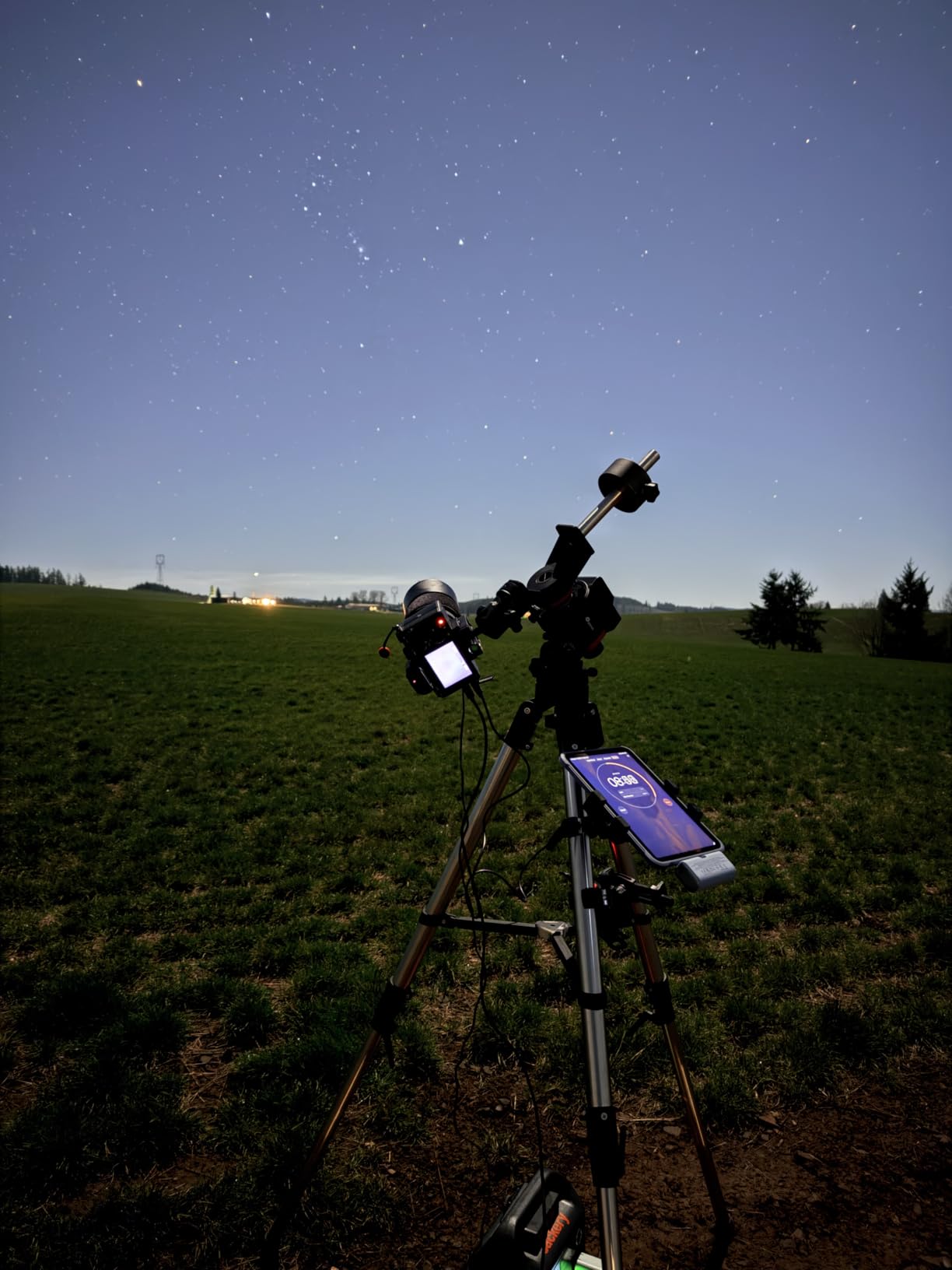
This is the mount we actually carried to a dark site more than once, and the reason is the 2.2 pound all-metal head. It folds into a camera bag, it has a real counterweight shaft for balancing a telephoto, and the internal rechargeable battery is quoted at up to 20 hours at 20C. That means one charge covers a full session with no power brick to forget.
Balanced, it handles up to 11 pounds. That rating covers a mirrorless body with a 200-500mm telephoto and a guide camera, which is a genuinely capable deep-sky rig in a small package. The all-metal construction is not just a spec-sheet nicety here; it damps vibration noticeably better than the plastic bodies in this class, and that shows up in longer sub-exposures.
The AccuAlign illuminated dark-field polar scope is integrated, which saves you the cost and fuss of a separate unit, and reviewers find alignment quick once you have done it a few times. It does arrive out of collimation fairly often though, and the eyepiece can sit loosely. Budget twenty minutes with the hex key set the first time, and bring your own because the included set is incomplete for collimation work.
The two real complaints are the same across the reviews: the short 8-inch counterweight bar makes heavy telephoto DSLR combinations hard to balance with the stock weights, and there is no GoTo. Neither matters if you plate-solve with software, which at this level is the better way to acquire targets anyway.
Best setups for the SkyGuider Pro
This mount suits a light refractor-less rig: a DSLR or mirrorless camera, a lens between 200mm and 500mm, and a small guide camera on a piggyback or off-axis arrangement. Users report sharp 2-3 minute subs with lenses up to 500mm, and with autoguiding enabled that extends further. The autoguider port is standard, so a small guide camera is all you need to add.
For travel specifically, the 11-pound payload means you can add a filter wheel or a small flattener and still be inside the working range. Keep the total rig under 60 percent of the 11-pound rating, so roughly 6-7 pounds, and balance it on the included bar before you attach the tripod. That headroom is what keeps guiding clean.
Where the SkyGuider Pro falls short
It cannot carry a telescope, and if you are planning to move to a refractor in a year you will be shopping again. The same goes for anyone who wants GoTo pointing from a hand controller, because there is none. These are minor inconveniences for a camera-only workflow and real limits for a general-purpose mount.
The counterweight bar is the detail that catches people out. With a heavy lens you will want to add a second small counterweight, and the stock bar is short enough that balance becomes fiddly on a front-heavy combination. It is solvable, but it is the first thing to check if you plan to use long glass.
3. Celestron Advanced VX: the best equatorial mount for a mid-size telescope
Celestron Advanced VX Computerized German Equatorial Mount – 30lb Payload
30 lb payload
2 inch stainless steel tripod legs
Latitude 7 to 77 degrees
NexStar+ controller with 40,000 objects
Pros
- Stable GEM that handles imaging and advanced visual use
- 30 lb payload covers most mid-size tubes
- Stainless steel legs damp vibration
- All-Star alignment and PPEC improve tracking
Cons
- Heavy at roughly 47-50 lb
- Steep learning curve for first-time equatorial users
- Occasional hand controller or drive quirks
The Advanced VX is the mount we recommend when the plan is a real telescope rather than a camera. Thirty pounds of payload covers everything from a 72mm refractor through to an 8-inch Schmidt-Cassegrain with a camera, filter wheel and guide scope, and the dual saddle plate accepts both V-style and CG-5 dovetails without swapping hardware.
The 2-inch stainless steel tripod legs are a real upgrade over the aluminium tripods on cheaper equatorial mounts. Vibration damping is noticeably better, which matters most at high magnification and during long sub-exposures on a long refractor. The mount itself is a dependable German equatorial design with a NexStar+ hand controller and a database of more than 40,000 objects, plus All-Star Polar Alignment and PPEC for periodic error correction.
Latitude adjustment spans 7 to 77 degrees, which covers most of North America and Europe. For a mobile imager far from those latitudes, that range is the first thing to check. Within it, alignment is straightforward once you understand the routine, and the hand controller handles GoTo setup in a way first-time equatorial users find approachable.
Here is the honest drawback: this kit weighs roughly 47-50 pounds. For a backyard setup that is a non-issue, and for a permanent pier position it is exactly what you want. Carrying it to a dark site means two people or a very deliberate packing plan. Some owners also report hand controller or drive quirks that need a reset, which is annoying but not a pattern that dominates reviews.
Payload versus real rig weight in practice
Thirty pounds of rating sounds modest next to the 44-pound mounts, but a realistic imaging rig rarely uses more than half. An 8-inch SCT around 17 pounds, plus a 2-pound camera, a guide scope, a filter wheel and cables, lands near 25 pounds, which is comfortably inside the working range. The extra headroom on larger mounts matters for heavy Newtonians and for people who want to move to larger gear.
For focal lengths, this mount suits the mid range well. A 1000mm refractor, an 8-inch Newtonian and a 2000mm SCT all sit inside the payload limit, and the tracking holds with autoguiding enabled. Very long focal lengths demand tighter guiding calibration, and the mount responds to that with better results when it is not near capacity.
Who should skip it
If your imaging is camera-only and you want to travel, the weight rules this mount out immediately. The VX is also not the choice if you are on a restricted observing schedule and want quick setup, because the GEM balance procedure takes practice the first few times.
It is also worth weighing against the Sky-Watcher EQ6-R later in this list, which carries a larger payload with belt-driven steppers. The VX holds its own on stability and on the NexStar+ ecosystem, and if your imaging software already speaks NexStar+ the choice is easier. Newer mount software ecosystems have narrowed that gap considerably.
4. Sky-Watcher Star Adventurer GTi Kit: GoTo tracking without a telescope
Sky Watcher Sky-Watcher Star Adventurer GTI Mount Kit with Counterweight, CW bar, Tripod, and Pier Extension – Full GoTo EQ Tracking Mount for Portable and Lightweight Astrophotography
GoTo tracking head
26 lb kit weight
Tripod and pier extension included
Counterweight bar and 5 lb weight
Pros
- Full GoTo pointing from a smartphone app
- Complete kit with tripod and pier extension
- Built-in illuminated polar scope
- Light enough to carry solo for a GoTo mount
Cons
- GoTo app adds complexity versus simple tracking
- Cameras and lenses only
- Not built for heavy telescope payloads
The Star Adventurer GTi is the Star Adventurer platform with GoTo added, and the practical difference is target acquisition. Instead of framing the Veil Nebula by hand, you tell the app what you want and the head slews to it and tracks. For anyone who does not already know their way around the sky, that is a meaningful upgrade in how much usable imaging time a session produces.
This kit is unusually complete as a package. You get the GTi head, a tripod with a pier extension, and a counterweight bar with a 5 lb weight, so you are not adding accessories to balance a telephoto lens. The illuminated polar scope is built in, which removes the most common early-night stumbling block.
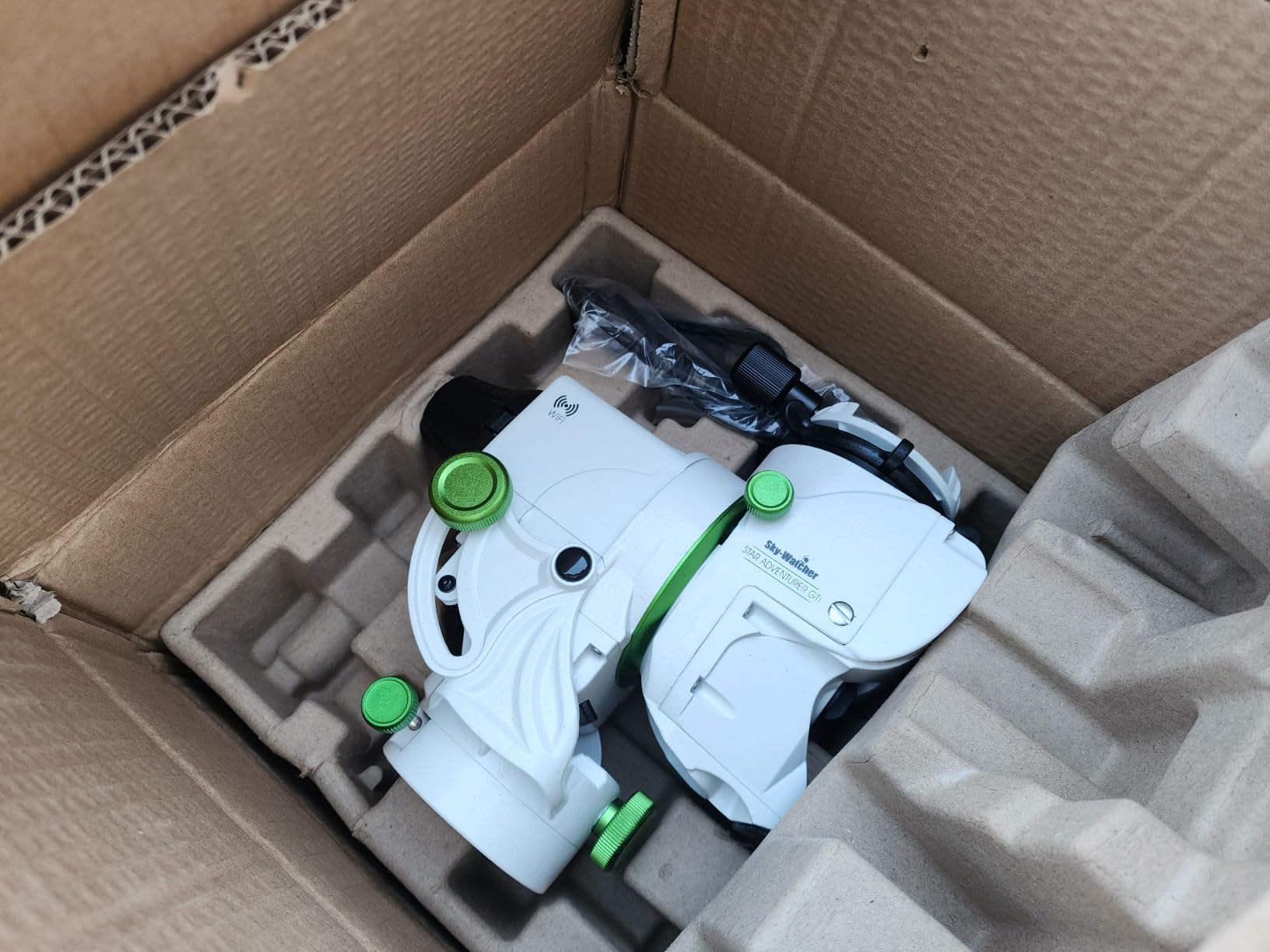
There is a real trade-off in that same convenience. A GoTo head with app control has more moving parts in the setup than a plain tracker, and the app adds a layer of complexity that some owners find unnecessary. If you already plate-solve with capture software, you are paying for a pointing function you will not use. The forum consensus we found is that the mount matters less than the polar alignment and the guiding calibration, which argues for spending that effort instead.
Balance sensitivity is worth flagging. The GoTo slew will happily swing a front-heavy rig around, so tighten the plate bolts and check balance every time you change the camera angle. A counterweight bar on this kit is short, so a long telephoto wants its own small weight rather than the stock 5 lb piece alone.
Who the GTi kit suits
It suits someone who wants automated pointing for visual-style observing with a camera attached, or who wants a grab-and-go rig for a weekend away. The bundled tripod and pier extension mean you can set up on uneven ground and still get the head to a comfortable tracking height. The pier extension is a small detail that matters more than it sounds when the ground is not flat.
It also suits wide-field Milky Way work with a moderate lens, and star trail sequences where the tracking accuracy holds up over long total run times. For narrowband work on small nebulae, the pointing accuracy is fine and the camera is the limiting factor rather than the mount.
Where the GTi falls short
It is a camera mount. The payload limits rule out refractors, Newtonians and any telescope with meaningful mass, so anyone planning to upgrade optics first will outgrow this quickly. The same applies to anyone who wants the guiding performance of a proper German equatorial with a counterweight shaft that can be loaded properly.
The other limitation is battery philosophy. A tracker head like the SkyGuider Pro or SkyTracker Pro is designed to run off internal power for a whole night, while this kit leans on the supplied cabling setup. Check your power draw against your field battery plan before you commit, because that is a real difference in how you plan a remote night.
5. Explore Scientific iEXOS-100-2 PMC-Eight: GoTo equatorial on an entry budget
iEXOS-100-2 PMC-Eight Equatorial Tracker System Tripod and Mount for Astrophotography with WiFi and Bluetooth Compatible
GoTo equatorial head with tripod
PMC-Eight control board
Belt-driven stepper motors
ExploreStars app control
Pros
- GoTo equatorial plus tripod at an entry-level price
- ExploreStars app handles alignment and pointing
- Belt-driven stepper motors with dual worm gears
- Sighted polar hole avoids a separate polar scope
Cons
- Low payload limits the imaging train
- Gears bind during balancing and slewing
- Shallow documentation and software support
- Tracking accuracy trails higher-priced mounts
We include this one with a caveat, and the caveat is in the 3.9 rating. The iEXOS-100-2 is a direct route to a genuine GoTo German equatorial with a tripod included, and for a first year of learning how a GEM works, that is a legitimate use of money. The PMC-Eight control board with eight independent processors, the clutched dual-axis worm gears and the belt-driven stepper motors are the right architecture at this level.
Control runs through the ExploreStars app on Apple, Android and Windows tablets, with Bluetooth and Wi-Fi options. The alignment sight hole through the RA axis means you can align polar without buying a separate polar scope, which keeps the parts count down. Plenty of first-time users get a workable first imaging rig out of this mount before outgrowing it.
Where it falls down is well documented in reviews. The payload is modest, so the imaging train is limited to a small refractor or a camera with a modest lens. Gears tend to bind, especially during balancing and slewing, and that is a mechanical feel problem you notice every time you use it. Documentation and third-party software support are thinner than the major ecosystems, which matters more as you get serious.
Several buyers move up to a mid-tier mount once they outgrow it, which tells you the intended role. Treat this as a stepping stone that teaches GEM balance, polar alignment and GoTo, not as the mount you will still be running in three years.
Realistic payloads and what fits
A short refractor, an 80mm or 72mm class, with a small camera and a guide scope is the sensible maximum. That is enough for wide-field and small nebula targets, and it is enough to learn the workflow. A camera with a 300mm lens and no guide scope is easier still, and it is the configuration where the gearing complaints are least likely to spoil a frame.
Because payload is the binding constraint, the 50-60 percent working rule matters more here than on a heavier mount. Add a filter wheel and a heavier camera and you will be at the limit, and the guiding will degrade before you think it should.
Why it is still on the list
It is the least expensive option here that is a true GoTo German equatorial rather than a camera tracker, and that distinction teaches the balance and counterweight workflow that a tracker never will. If you are sure you will grow into a telescope, starting here is a reasonable way to spend the first purchase.
If you are not sure, skip it and go straight to a mid-tier mount. The reviews are consistent on that: people who buy this and stay with it are satisfied, and people who outgrow it regret not buying one level up.
6. Celestron CG-4: a dependable German equatorial for visual observing
Celestron CG-4 Manual German Equatorial Mount with Steel Tripod
20 lb payload
Manual slow-motion on both axes
Stainless steel tripod 1.75 inch legs
Accepts a motor drive upgrade
Pros
- Classic dependable German equatorial design
- 20 lb payload suits mid-size tubes
- Steel tripod resists vibration
- Quick assembly with no electronics to configure
Cons
- No motorized tracking out of the box
- Less refined latitude adjustment
- Needs a separate motor drive for imaging
The CG-4 is the one mount in this list that is not primarily an imaging mount, and we include it because the forum traffic on visual platforms that can grow into astrophotography is real. A 20-pound payload, manual slow-motion controls on both axes, and a stainless steel tripod with 1.75-inch legs is a solid, uncomplicated platform for a mid-size Dobsonian or refractor.
There is nothing to configure, which is the appeal. No firmware, no hand controller, no alignment procedure. You set the latitude, balance the tube, and the slow-motion knobs let you track manually at moderate magnification. The tripod height adjusts from 33 to 47 inches, and at roughly 7 kg total with a 12.5 lb tripod, the whole package is portable for a visual session.
For imaging, it needs a motor drive fitted separately. That is a genuine extra cost and an extra step, and it is why we rank this below the powered German equatorial mounts in this list for anyone whose primary goal is tracked exposures. But as a visual mount with an upgrade path, it is hard to argue with the mechanical simplicity.
The latitude adjustment is less refined than on computerized mounts, and you will feel that at extreme latitudes. In the mid range it does its job quietly, which is what most observers need.
What to put on it
A 6-inch to 8-inch Newtonian or a 4-inch to 6-inch refractor sits comfortably inside 20 pounds, and the manual tracking is fine at moderate magnification where field drift is slow. For a Dobsonian-style light bucket on a star chart, the slow-motion controls are the whole reason to want a German equatorial rather than an alt-az fork.
If you later add a motor drive, the 20-pound capacity still holds a small refractor with a camera for planetary and short deep-sky work. It is not the route to long sub-exposures, but it is a route, and the base platform will not be the limiting factor.
Who should buy it and who should not
Buy it if you are a visual observer who wants a stable platform, or if you want a second mount to sit permanently while your imaging mount travels. Manual slow-motion on a heavy tube is something computerized mounts never fully replace for certain observing styles, and the CG-4 does it simply.
Skip it if you want tracked imaging out of the box. The powered mounts in this list, including the Advanced VX at number three, deliver more capability for the money once you factor in the motor drive you would have to add. A manual mount is a different tool, not a cheaper version of the same one.
7. Sky-Watcher EQ6-R: the best equatorial mount for heavy imaging rigs
Sky-Watcher EQ6-R – Fully Computerized GoTo German Equatorial Telescope Mount – Belt-driven, Motorized, Computerized Hand Controller with 42,900+ Celestial Object Database
44 lb payload
Belt-driven stepper motors
Illuminated polar finderscope
SynScan controller with 42,000 objects
Pros
- Sub-arcsecond guiding reported with a guide camera
- 44 lb payload handles trains up to 8 inch tubes
- Quiet belt-driven slewing with no backlash
- Encoder PPEC and EQMOD improve tracking
Cons
- Roughly 75 lb assembled and awkward to transport
- Heavy factory grease causes stiction
- Alt-az adjustment screws feel imprecise
- Hand controller LCD struggles in very cold conditions
The EQ6-R is the mount we point to when someone asks which single equatorial mount will carry a serious imaging train, and it is the one that generates the most consistent guiding reports in this set. Owners regularly describe sub-arcsecond results with a guide camera, and that is the number that decides whether narrowband or long sub-exposure work is realistic.
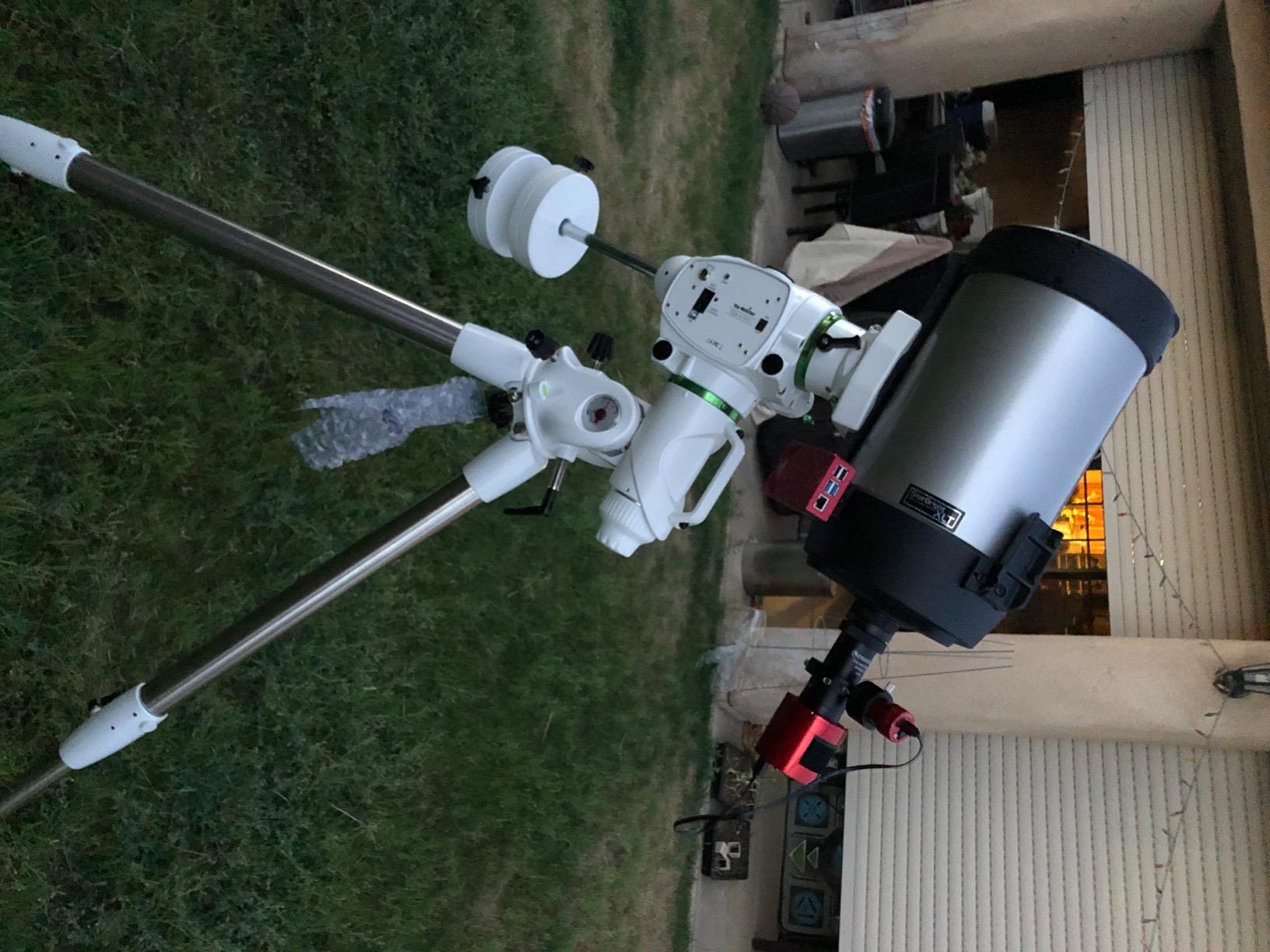
Forty-four pounds of payload covers an 8-inch Newtonian or SCT with camera, guide scope and filter wheel, and the extra headroom is what you want if you plan to grow the rig. Belt-driven stepper motors on both axes give quiet slewing and eliminate the backlash that plagues older worm-gear mounts. The built-in illuminated polar finderscope and the encoder-based PPEC work together to make tracking repeatable, and the SynScan hand controller carries more than 42,000 objects.
The software support is a genuine strength. EQMOD, PHD2 and NINA all drive this mount through the SynScan protocol without fuss, and it is a common recommendation in r/AskAstrophotography threads for people running an ASIAIR with a heavier rig. The 2-inch tripod legs and a carry handle on the head make it as portable as a mount of this class can be.
Now the drawbacks. Assembled it is around 75 pounds, which is a two-person job outside a house. The factory grease on the bearings is heavy and causes stiction, and a number of owners service the mount once the warranty period is over. The alt-azimuth adjustment screws feel awkward and imprecise compared with the competition. And in genuinely cold conditions the hand controller LCD has been reported to fail, which is a small thing in a warm climate and a real one in winter.
Payload versus real rig weight in practice
Forty-four pounds of rating means a comfortable working load around 22-26 pounds, which is where guiding quality peaks. An 8-inch Newtonian with a cooled camera, filter wheel and guide scope lands close to that, and the extra margin absorbs the cables and adapters that always weigh more than you estimate. Overloading is the most common reason buyers on the forums blame a mount for bad guiding.
One forum comment we found puts the trade-off well: extra payload capacity makes little difference on a small wide-field scope, but it matters enormously on big refractors and Newtonians. That matches our experience. If you are running a RedCat-class lens, a lighter mount handles it fine. If you are running an 8-inch at 1000mm or longer, the payload headroom is the point.
Who should buy the EQ6-R
Buy it if you are imaging from a fixed backyard setup or a pier, and if you plan to keep growing the rig. It is the mount where the effort you put into polar alignment and guiding calibration gets paid back, and where the software ecosystem gives you the most headroom to experiment.
Skip it if portability is the priority. A community view that recurred across the threads we read is that if portability matters, the lighter harmonic and tracker class wins, and a larger GEM is better in a permanent setup. At roughly 75 pounds assembled, that distinction is not subtle. Anyone moving to a different dark site regularly should read the lighter options above first.
8. iOptron SkyTracker Pro: the most compact tracker for long lenses
iOptron SkyTracker Pro Camera Mount with Polar Scope, Only
6.6 lb payload
3.3 lb total weight
DC servo motor RA tracking
Polar scope with dimmable LED
Pros
- Clean 2 to 5 minute subs reported with no trailing
- Integrated rechargeable battery
- Very quiet operation
- Four tracking rates including half-siderial
Cons
- Swivel head cushion slips under heavier loads
- Small lip limits ball head contact
- Long telephoto lenses need the optional counterweight
- Ball head and app not included
The SkyTracker Pro does something the larger camera trackers in this list do not: it holds 2 to 5 minute subs in a 3.3 pound package. That is the whole appeal. It folds down to roughly 115mm square, runs off an internal rechargeable battery, and it charges over micro USB to 80 percent in about five hours.
DC servo motor drive with automatic right-ascension tracking and a 600-second worm period across four bearings gives it a mechanical refinement that trackers at this size rarely have. The alignment knobs let you dial in polar alignment more precisely than earlier versions, and the dimmable polar scope LED with a jog forward and reverse button makes night setup manageable.
Four tracking rates cover sidereal, half-siderial for combined ground-and-sky shots, solar and lunar, plus north and south hemisphere modes. The padded storage bag is included, which matters more than it sounds when the folded head lives in a backpack.
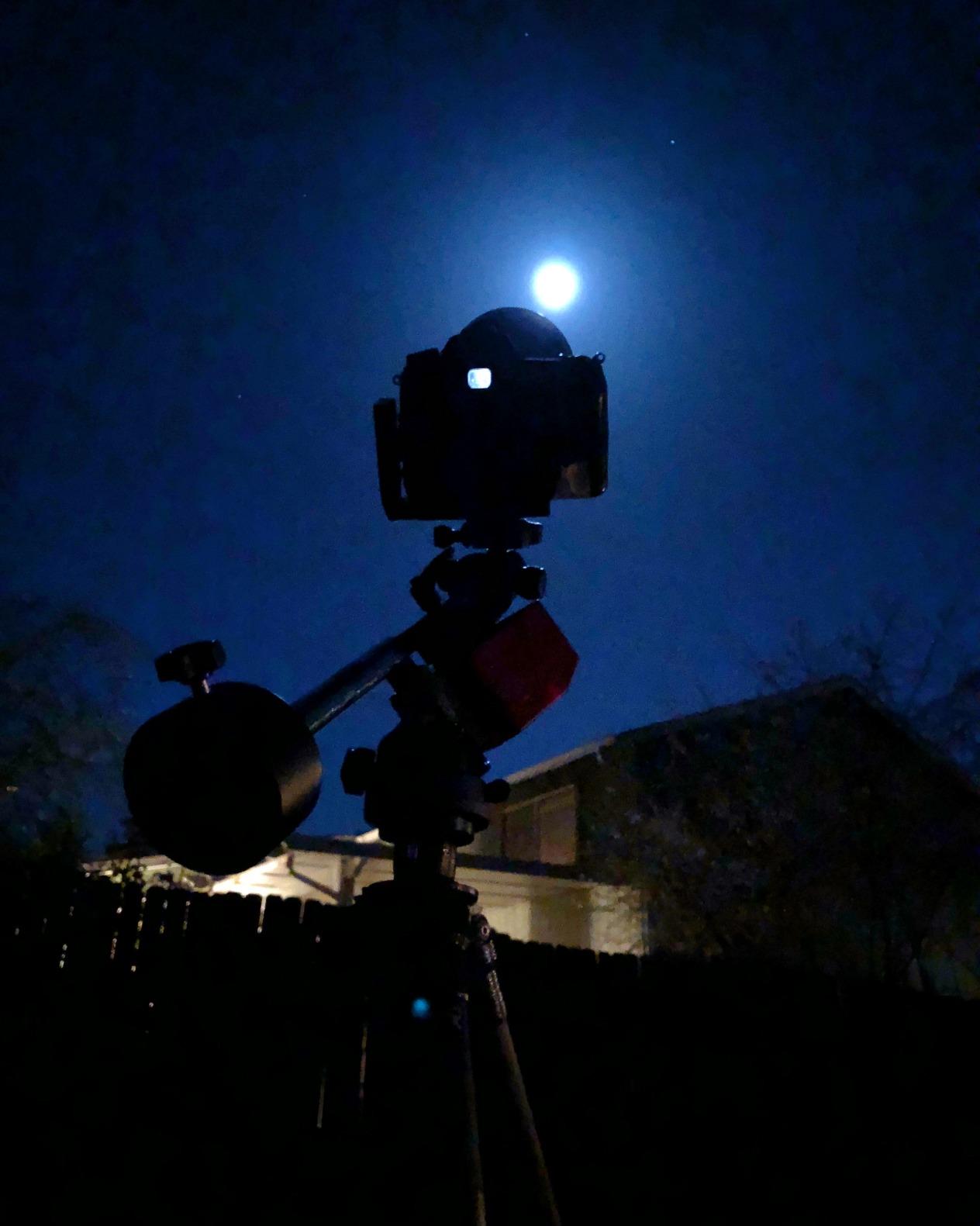
The weaknesses are mechanical and specific. The rubber cushion at the swivel head slips, which makes a heavier camera hard to secure, and a small raised lip around the base limits contact area with a ball head. Long telephotos like a 70-200mm or 200-500mm want the optional counterweight. The ball head and the alignment app are not included, and the dovetail base is not Arca-Swiss compatible out of the box, so plan on an adapter.
Where the SkyTracker Pro fits best
A 6.6 pound payload suits a mirrorless body with a moderate telephoto, or a DSLR with a 24-70mm zoom. That is enough for Milky Way panoramas, wide-field mosaics and shorter deep-sky targets. The half-siderial rate is genuinely useful if you want a foreground in frame with a tracked background.
The 2-5 minute sub reports come from lighter rigs, so temper expectations if you are stacking a filter wheel and a guide camera on top. Keep the total under 4 pounds and you will be in the range where owners see the clean results.
Who should look elsewhere
If you need GoTo, this is the wrong tool; pointing is manual. If you want a tracker with a counterweight shaft that can handle a heavy telephoto securely, the SkyGuider Pro or the Star Adventurer 2i Pro is a better fit. And if your rig is a telescope rather than a camera, none of the three trackers will help.
For pure travel weight, though, this is the lightest complete package in the group. If you can get the rig under 6.6 pounds and keep the ball head contact clean, this mount produces results that far exceed its size.
9. Celestron CGX: the pick for a fixed remote imaging station
Celestron CGX Computerized German Equatorial Mount & Tripod, 55lb Payload
55 lb payload
High-torque servo motors with belt drive
Internal cable management
NexStar+ controller with 40,000 objects
Pros
- Holds long subframes when properly aligned
- 55 lb payload carries 10 inch Newtonians and 11 inch EdgeHD
- Quiet slewing and a clear hand controller
- Internal wiring keeps cable management tidy
Cons
- Extremely heavy at 108 lb
- Optional polar scope can restrict declination range
- Some RA drive faults reported on early pieces
- Belts and gears wear over years
The CGX is the heaviest mount here and the one we would describe as an observatory installation. Fifty-five pounds of payload carries a 10-inch Newtonian or an 11-inch EdgeHD with a full imaging train, and the high-torque servo motors with belt-drive transmission hold long subframes when the alignment is done properly.
Internal cable management is the feature that matters most for remote work. Cables run inside the mount structure instead of draping across the RA and Dec axes, which reduces snag risk during a long unattended session and keeps the setup tidy when you connect a full filter wheel and guiding chain.
All Star Polar Alignment is supported alongside pointing models through Celestron PWI, and the NexStar+ hand controller carries guided tours and custom object filters. Buyers imaging through it report stacking 30-minute subframes, which is a category of performance nothing else in this list reaches.
There are real cautions. At 108 pounds, field use is effectively off the table. The optional CGX polar scope is widely reported to interfere with declination range of motion and to be able to collide with the mount, which is a design complaint you should plan around rather than discover. Some pieces have shown intermittent RA drive faults that needed warranty repair, and the hand controller has been reported to stick on an initializing screen for some owners.
Belts and gears wear over several years of use and degrade tracking as they go, so this is a mount with a long service horizon rather than a forever purchase. With only 20 reviews behind it, the long-term record here is thinner than for the other eight.
Payload versus real rig weight
Fifty-five pounds of rating supports a working load around 30 pounds, which is a 10-inch Newtonian plus a cooled camera, filter wheel and guide scope with margin. The headroom is intentional here: a heavy, well-balanced rig is where the CGX earns its place, and where the belt-driven transmission keeps tracking steady under load.
Plan the transport before you plan the imaging. At 108 pounds, this belongs on a pier or in a permanent location, and the logistics of moving it are the main argument against it for almost every backyard imager.
Who the CGX suits
It suits a remote or semi-permanent station where a larger telescope is the eventual goal and cable reliability over a long night matters. If you are running a fixed pier with a heavy OTA and want to leave the rig up for weeks, the internal wiring and payload capacity are worth the weight.
For almost everyone else, the EQ6-R at number seven delivers 44 pounds of payload in a package that is far easier to move, and it is the choice we would make. The CGX makes sense when the site is fixed and the rig is big, and not much else.
How to Choose an Equatorial Mount in 2026
Most wrong purchases come down to one number: payload capacity. Everything else on this list is a preference, but a mount that is too small for your rig will not be fixed by better alignment or better software. Start there, then work through the rest.
Payload capacity and the 50-60 percent working rule
Add up every component: optical tube, camera, filter wheel, guide scope, adapters, cables and the mounting hardware. That total is your rig weight, and your mount should be rated at roughly twice it. The rule of thumb we use is to stay at 50-60 percent of the rated capacity during imaging, which leaves the mount behaving the way the manufacturer measured it. Guiding is measurably worse on an overloaded mount, and the backlash that shows up in sub-exposures is a direct consequence of carrying too much.
Worked examples: a RedCat 51 with a camera and a small guide scope is roughly 10-12 pounds, so a 20-pound mount is comfortable and a 30-pound mount is generous. An 80mm refractor with an ASI533-style camera, filter wheel and guide scope runs around 20-25 pounds, so you want at least a 44-pound rating to stay inside the working range. An 8-inch Newtonian with a camera and guide scope lands near 30-35 pounds, which points at the 44-pound and 55-pound mounts.
Counterweights complicate this on a German equatorial, because the weight of the counterweight bar and the counterweights themselves sits on the mount too. A camera-only rig may run without any counterweight, while a telescope on a GEM nearly always needs them. That is a portability decision, not just a load decision.
Periodic error, backlash and what actually reaches your frames
Periodic error is a repeating tracking wobble caused by imperfections in the RA worm gear, measured in arcseconds, and it is the number that limits how long you can expose before stars elongate. Backlash is different: it is play in the drive that has to be taken up before a move settles, and it produces a different artefact, a jump in the frame after a correction.
Belt-driven stepper motors, found on the EQ6-R and the iEXOS-100-2, reduce backlash substantially compared with direct-coupled worm gear mounts. Belt-drive worm hybrids are the mainstream solution to the backlash problem in mid-tier mounts. What remains under your control is calibration: a full PHD2 or NINA calibration, correct backlash take-up, and dithering will take most of the visible periodic error out of your data.
Realistically, once a mount is well aligned and well calibrated, the mount matters less than the polar alignment. That is the recurring finding in the forum discussions we read. Spend the evening on alignment before you conclude the mount is at fault.
Polar alignment accuracy and field rotation
Polar alignment error shows up as field rotation, not as trailing, so it does not improve with longer exposure averaging the way periodic error does. The rule is that every minute of arc of alignment error produces a measurable rotation at the edge of a typical sensor. Get the mount close, and use the aids that are built in.
Three options exist. A physical polar scope with an illuminated reticle is the fastest at a dark site, since you align in under a minute. A sight hole through the RA axis, as on the iEXOS-100-2, is the cheapest. And software plate-solving, through NINA, SharpCap or the ASIAIR routines, is the most accurate and requires no extra hardware at all.
For anyone who would rather skip the polar scope entirely, the plate-solve route takes a few minutes per session and is repeatable. Our preference is to do both when setting up, then re-check by plate solve before the first sub-exposure.
Do you need autoguiding at your focal length
Autoguiding is not optional on a German equatorial, and it is optional on a good lightweight tracker. A rough guide: under 300mm focal length with a solid polar alignment, unguided subs of 30-60 seconds can work on a tracker. Between 300mm and 800mm, autoguiding becomes worth the setup time. Above 800mm, or for narrowband imaging, autoguide every time.
Most of the mounts in this list expose an autoguider port, including the Star Adventurer 2i Pro and the SkyGuider Pro, and every powered German equatorial in the group accepts a guide camera. The question is whether you have the patience for the calibration on a given night.
Star tracker vs German equatorial vs center-balanced mount
A star tracker is a small, light, single-axis device built around a camera plate. It tracks well, needs no counterweight for a moderate lens, and is the right answer for wide-field, Milky Way and travel work. A German equatorial mount is a two-axis instrument with a counterweight shaft and the payload to carry a telescope, and it is the right answer for deep-sky imaging at moderate to long focal lengths. A center-balanced equatorial mount, a class the ZWO harmonic and iOptron CEM designs belong to, splits the difference with a heavier payload and a lighter overall package than a comparable GEM.
The decision framework is simple. Ask how much weight you are carrying and how far you are walking with it. If the answer is a camera and a lens, a tracker wins on every practical measure. If the answer is a telescope, a German equatorial or center-balanced mount is the only thing that works.
Counterweights, power, and software ecosystem
Counterweights decide whether a session is one person or two. Every GEM here needs them; the trackers need one only with a heavy telephoto. For solo travel imaging, that single question can eliminate half the list.
Power is more straightforward than it used to be. Camera trackers with internal batteries, like the SkyGuider Pro and the SkyTracker Pro, run a full night on a charge. Powered GEMs draw more and need a 12V DC supply sized for the mount, typically 4 amp minimum for a mount in the EQ6-R class. Plan that before a remote night rather than during it.
Software ecosystem is the last filter and it can be decisive. Celestron mounts speak the NexStar+ protocol, Sky-Watcher speaks SynScan, and the ZWO ecosystem integrates through ASIAIR. PHD2 and NINA support all of them, but if your capture software is already chosen, confirm the mount speaks its language before you buy. Ecosystem lock-in is a real cost, and switching capture software later is more disruptive than switching mounts.
One last piece of advice from the forums, and the one we agree with most: upgrade the mount before you upgrade the optics. A better mount improves every frame you already knew how to take, and a better telescope on a poor mount gives you more resolution you cannot use. If you are building from scratch, our binocular mount picks cover the visual side, and this guide covers the imaging side.
Frequently Asked Questions
What are the best equatorial mounts for astro photography?
The Sky-Watcher Star Adventurer 2i Pro is the best all-round choice for most people, because it is light, simple and tracks a camera and lens cleanly. The iOptron SkyGuider Pro is the better value if you want longer battery life and a counterweight shaft, the Celestron Advanced VX is the best option for a mid-size telescope, and the Sky-Watcher EQ6-R carries the heaviest imaging rigs with sub-arcsecond guiding.
Do you need an equatorial mount for astrophotography?
You need some form of tracking mount once your exposures pass about 10-20 seconds, otherwise stars trail. A full equatorial mount is needed when you are imaging through a telescope or want to go beyond a few minutes per frame. For wide-field work with a camera and a moderate lens, a lightweight star tracker does the same job at a fraction of the weight and cost.
How accurate are equatorial mounts?
A well-aligned and well-calibrated mount of the class listed here typically guides to about 1 to 3 arcseconds total with autoguiding, and the heavier German equatorial models can reach sub-arcsecond results with a good guide camera. Periodic error on belt-driven and worm-belt mounts is low enough that calibration removes almost all of it. The limiting factor is usually polar alignment accuracy rather than the mount itself.
Is an equatorial mount the same as a star tracker?
A star tracker is a small single-axis device built for cameras, while a full equatorial mount is a two-axis instrument with a counterweight shaft and enough payload for a telescope. Both align to the celestial pole and track, so a tracker can produce excellent results with a camera and lens. The equatorial mount adds capacity and a second axis, which is what you need for larger optics and longer focal lengths.
Which star tracker is best for astro photography?
The Sky-Watcher Star Adventurer 2i Pro is the best overall tracker for most people, with built-in Wi-Fi, an illuminated polar scope and a 609-review track record. The iOptron SkyTracker Pro is the smallest and lightest, reaching 2-5 minute subs in a 3.3 pound package, and the iOptron SkyGuider Pro adds an 11 pound payload and all-night battery for heavier rigs. The Star Adventurer GTi is the pick if you want GoTo pointing from a phone.
How much payload capacity do I need for an equatorial mount?
Add up your optical tube, camera, filter wheel, guide scope, adapters and cables, then choose a mount rated at roughly twice that total. As a working rule, stay at 50-60 percent of the rated capacity during imaging, because guiding degrades noticeably on an overloaded mount. A camera and short refractor needs 20-30 pounds, while an 8-inch Newtonian with a camera and guide scope calls for 44 pounds or more.
Our Final Verdict on Equatorial Mounts for Astrophotography
The best equatorial mounts for astrophotography in 2026 split cleanly by what you are photographing. For a camera and a lens, the Sky-Watcher Star Adventurer 2i Pro is the pick: light, well reviewed and easy to align, with Wi-Fi control and an autoguider port when you want to push further. The iOptron SkyGuider Pro is the better value if all-night battery life and a real counterweight shaft matter more to you. The iOptron SkyTracker Pro wins on travel weight alone.
Once a telescope is in the plan, the Celestron Advanced VX covers the middle of the range with 30 pounds of payload and a solid tripod, and the Sky-Watcher EQ6-R is the mount for heavy rigs, with 44 pounds of capacity and the most consistent guiding reports in this group. The Celestron CGX is the observatory option for a fixed site and a large telescope. Whatever you choose, get the polar alignment right before you judge the tracking, and stay well inside the rated payload.