
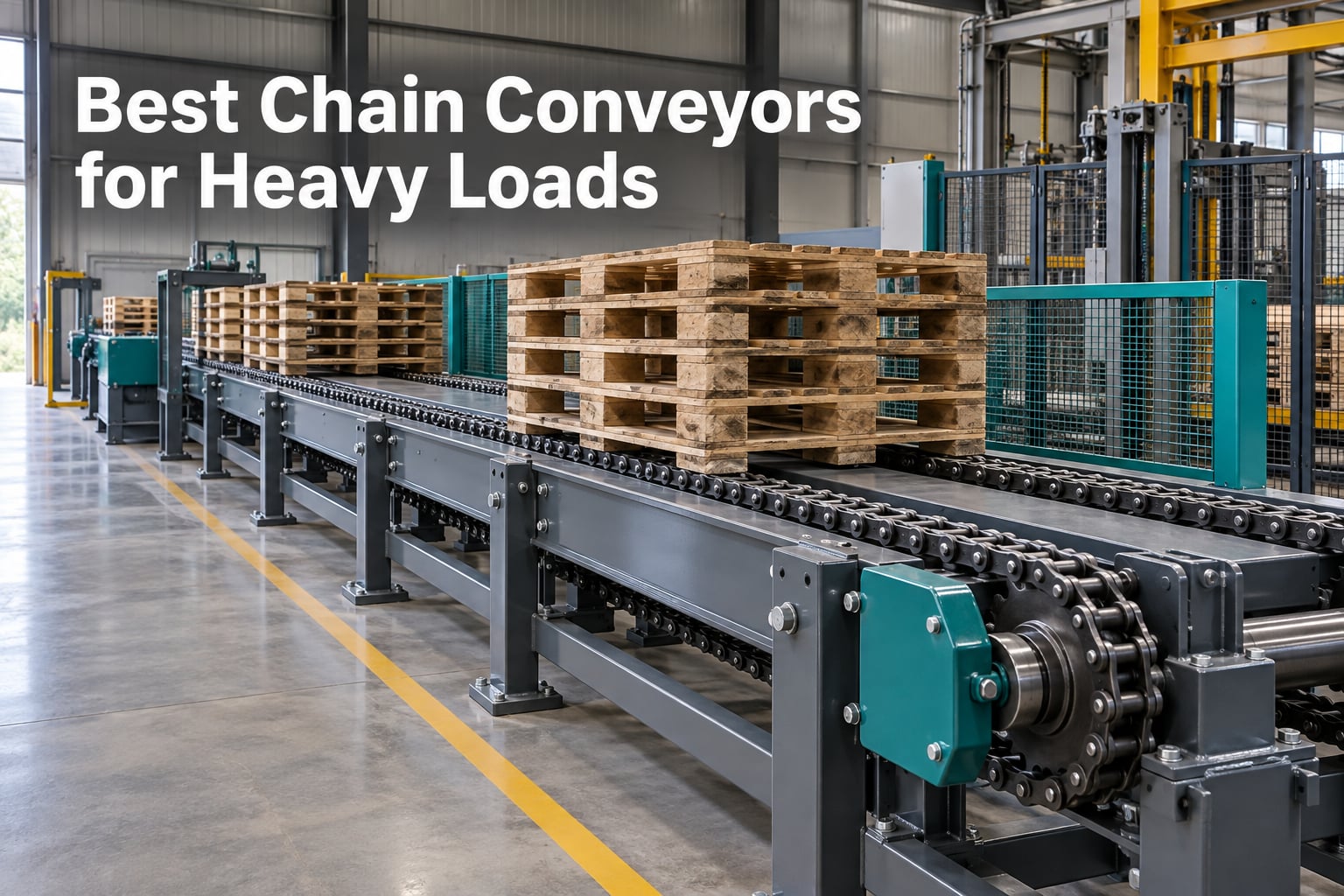
A heavy duty chain conveyor is a material handling system that uses one or more strands of steel or plastic chain, running in a closed loop between a drive and a take-up, to carry or push loads that are too heavy, too hot, too sharp, or too shock-sensitive for a belt or roller conveyor. The chain is the load-bearing element. Everything else on the machine, from the frame to the wear strips, exists to keep that chain straight, tensioned and correctly loaded.
That last sentence is where most buying mistakes happen. Buyers choose on headline capacity, then discover the load rating was per strand rather than for the whole line, or that the number assumes smooth accumulation and not the forklift drop-off that actually feeds the conveyor. We have spent the last several months reading specification sheets on heavy duty chain conveyor systems across the architectures that actually exist for heavy loads, and what follows is a straight read of which ones hold up under real conditions and which ones are really a different category of machine wearing a chain-conveyor name.
One thing worth saying up front: the catalogues for this category are noisy. A single search returns roller-chain spare links, cable-management drag chains, chain hoists, security chain, gravity roller sections and complete engineered systems all mixed together. We excluded the components and the miscategorised listings rather than padding a list with them. Everything in this guide is a complete conveying machine or a modular line assembly. The trade-off is that you will see fewer picks than a typical listicle, and more detail on each one.
If you are also mapping out the rest of a material handling line, our gravity conveyor picks for packing cover the lighter accumulation end of the flow. For moving heavy things vertically rather than horizontally, our chain hoist reviews are the other half of that problem.
Table of Contents
What Is a Heavy Duty Chain Conveyor?
A heavy duty chain conveyor moves unit loads by pulling the load rather than supporting it from underneath. One or more chain strands run in a closed loop, driven by a gearmotor at one end and held at tension by a take-up at the other. The load either rides directly on the moving chain (drag chain) or presses against rollers that the chain drives from the side (chain driven live roller, or CDLR).
The reason engineers reach for chain when a load gets awkward is that a chain has no rubber to stretch, tear or melt. It tolerates impact, it tolerates a badly broken pallet, and it keeps its grip on a load that a roller conveyor would simply spin under. That makes it the default answer for pallets, engine blocks, steel frames, drums, cases and bulk material. It also makes it the more expensive answer, because the parts that carry the load are wearing parts.
One important distinction for anyone new to the category: chain conveyors are not a single product. Drag chain, CDLR, slat and plate chain, flat top plastic, tube chain auger and vertical bucket elevator are six different machines with six different service profiles, six different load envelopes and six different cost structures. Comparing them on price alone is meaningless. Compare them on chain pull, accumulation behaviour and what your load looks like on a bad day, not a good one.
Key Takeaways
Capacity needs a stated basis. A chain conveyor rated for a given figure may mean per strand, per load, or for the entire line. Ask which one before you compare anything to anything.
Under roughly 1,000 lb of total line load with sound pallets, CDLR is usually the cheaper and more efficient answer. Above that, with impact loading or long continuous runs, drag chain wins.
Stainless steel is not free. 304 stainless roller chain typically carries only 25 to 33 percent of the working load of the equivalent carbon steel chain, which usually means upsizing the chain or adding a strand.
Temperature derates the rating. Published derating tables show capacity falling to around 25 percent of catalogue rating at -20F and 50 percent at 390F, with standard chain generally not specified above 180F.
Buying heavier chain to fix an overloaded conveyor is the most common expensive mistake. Size the drive and calculate chain pull first.
Most of the six machines below ship with little or no published load rating. The single most useful question you can ask any supplier is what the chain working load is, per strand, on that specific length.
Top 3 Best Chain Conveyors for Heavy Loads in September
Pro-Fill Wire Mesh Belt Conveyor
- Food grade stainless construction
- Hood and sprayer
- Chain tension adjustment
- 190 lb unit
XILYZMO 16mm Modular Chain Line
- 2 ton tension rating
- 16mm link thickness
- Ball matrix rollers
- 1m x 7m run

304 Stainless Brewery Chain Conveyor
- 304 stainless body
- 1.5kW geared drive
- 15 m configured length
- 380V three phase
Best Chain Conveyors for Heavy Loads at a Glance in 2026
| Product | Specifications | Action |
|---|---|---|
| Pro-Fill Wire Mesh Belt Conveyor with Hood and Sprayer |
|
Check Latest Price |
| XILYZMO 16mm Modular Plastic Roller Chain Line |
|
Check Latest Price |
| 304 Stainless Steel Brewery Chain Conveyor |
|
Check Latest Price |
| Stainless Top Chain Slat and Plate Conveyor |
|
Check Latest Price |
 Tubular Drag Chain Auger Screw Conveyor Tubular Drag Chain Auger Screw Conveyor |
|
Check Latest Price |
 Z-Type Double Outlet Bucket Elevator Z-Type Double Outlet Bucket Elevator |
|
Check Latest Price |
1. Pro-Fill Wire Mesh Belt Conveyor with Hood and Sprayer
Wire Mesh Belt Conveyor with Hood & Sprayer Chain Drive/Food Grade Stainless Steel Wire Mesh Belt Conveyor with Hood & Sprayer
Food grade stainless
Hood and sprayer
250w 110v 3.7A drive
190 lb, 76 x 37 x 15 in
Pros
- Food grade stainless steel suits washdown environments
- Chain tension adjustment for serviceable tensioning
- Adjustable height legs and removable stand
- First listed as available in January 2023
Cons
- 250w single phase drive is modest for the heaviest loads
- Single phase power limits three phase plant integration
- Hood and drip tray add cleaning complexity
This is the only machine in the set that publishes a real, complete set of dimensions and electrical data, and that fact alone puts it ahead. The Pro-Fill unit is specified at 190 pounds with a 76 x 37 x 15 inch footprint, which tells you exactly what you are bolting into a floor and whether it will fit through your door. The drive is listed at 250 watts, 110 volts, 50 hertz, 3.7 amps on a 1350 rpm motor. Nothing about that is mysterious, and you can hand the numbers straight to an electrician.
We looked hard at this one for a heavy duty chain conveyor role and the honest answer is that it is a stainless process conveyor with a chain-driven wire mesh belt, not a pallet conveyor. The mesh belt tolerates hot, wet, oily and sharp product far better than rubber, and the hood and sprayer configuration means you can cover and treat the product as it moves. On food, beverage, chemical and washdown lines that is the entire point, and it does that job well.
The chain tension adjustment is a genuinely useful feature on a chain-driven machine. Chain stretches, and a wire mesh belt needs consistent tension to track correctly. Having a serviceable adjustment rather than a fixed take-up means a maintenance technician can compensate during a shutdown instead of ordering a part. The four adjustable height legs and the removable stand tell you the machine was designed to move between stations rather than to be bolted down once and forgotten.
What load this one actually handles
Nobody should size a 250 watt drive for heavy unit loads. That motor is sized for a continuous process product, not for dragging several hundred pounds of palletised weight. If your application involves fork truck drop-off, impact loading, or loads measured in hundreds of pounds, this conveyor is out of its depth and you should be looking at the slat and plate chain architecture covered in pick four.
For what it is designed to do, a stainless mesh belt with a hood and sprayer is hard to beat. Drip trays with outlet valves mean washdown cleanup is a drain and a hose rather than a shovel. The food-grade stainless body is a real spec, not marketing filler, and stainless is the correct material when you have to hose down a line at the end of every shift.
Where the published data runs out
The listing does not state a chain pitch, a strand count, a belt width, or a rated load. That is the gap you will hit on most machines in this category, and it is why the sizing question at the end of this guide matters so much. Before you commit, ask Pro-Fill or your integrator for the chain designation, the working load per strand, and the recommended maximum product weight per hour.
One practical note: the unit is first listed as available in January 2023, which for capital equipment is a good sign. It means the platform is settled rather than a new design with an unproven drive train. Our firewood conveyor reviews cover a comparable lesson about established machines in rough environments.
2. XILYZMO 16mm Modular Plastic Roller Chain Line
XILYZMO 16mm Heavy Duty Modular Conveyor Belt, 2-Ton Tension Plastic Roller Chain, Omnidirectional Splicing Plate for Line(1mx7m)
2 ton tension rating
16mm link thickness
1m x 7m line
39.37 x 275.59 x 0.39 in
Pros
- 2 ton pulling capacity is genuinely heavy for a modular line
- 16mm links resist stretch and warp
- Ball matrix rollers change direction with no curved track
- Tool-free snap joint assembly
Cons
- Plastic construction not suited to extreme heat or oil
- Link degradation at splice points under sustained tension
- Wear strips and rollers are recurring wear items
This is the pick with an actual published number, and in a category where most listings publish nothing, that matters enormously. The XILYZMO line is rated at a 2 ton maximum pulling capacity, built from 16mm link construction, and supplied as a 1m by 7m run measuring 39.37 x 275.59 x 0.39 inches. A 2 ton pull rating is not a pallet rating, but it is a real, verifiable figure, and it is far above anything else in this group.
The engineering rationale behind 16mm links is straightforward. Modular plastic chain stretches and warps under sustained tension, and once the links distort, the whole surface stops lying flat and rollers ride unevenly. A thicker link section is a direct answer to that failure mode, which is the same failure mode that kills every cheap modular line. Whether 16mm is genuinely sufficient for your load is a question for a calculation, not a guess, but at least you can calculate with a number.
The ball matrix roller design is the more interesting feature. Instead of a fixed wheel, each roller contains a low-friction rubber ball matrix that allows lateral movement, dynamic rotation and direction changes on a straight run. In practice that means you can curve a line without buying a curved track section, which is where modular lines usually get expensive. Suppliers in the heavy load handling world keep hitting the same layout constraint, and this removes it.
When 2 ton of pull is enough and when it is not
Chain pull is the horizontal force needed to move the load, and it is a function of load weight, friction, incline and accumulation pressure. A 2 ton pull rating gives you roughly 4,000 pounds of horizontal force to work with before you are at the limit. On a level line with accumulation, that covers a great many applications in the several-hundred-pound range. It does not cover dragging a 2,000 pound pallet train at an incline with hard accumulation.
That is the distinction to hold onto. Pull capacity and load capacity are different numbers. A conveyor can have enormous pull capacity and modest load capacity, or the reverse. The 2 ton figure here is a pull figure, and we would want the per-load vertical rating in writing before ordering this for a pallet application.
The maintenance reality of a plastic modular line
Tool-free snap joint assembly is a real advantage. No specialist tooling, and worn parts swap in a three-step local process rather than a strip-down. That cuts the downtime window on a line where a conveyor failure stops packaging.
The PP flat-top plates tolerate direct water washing and run quieter than a steel system, which matters if the line sits near workers. But plastic is plastic. Extreme temperature, heavy oil and hydraulic fluid will attack it, and the wear strips and rollers are consumables on a high-throughput line. Budget for replacement intervals, and do not put this line in a washdown area where it will be repeatedly drenched with hot caustic. For that, pick one or four.
3. 304 Stainless Steel Brewery Chain Conveyor
Chain Conveyor High-Efficiency Stainless Steel 304 Engine And Gearbox 380V 50HZ 1.5KW 15m For Brewery
304 stainless body
1.5kW geared drive
15 m run
380V 50Hz three phase
Pros
- 304 stainless built for brewery washdown
- 1.5kW geared drive has real torque reserve
- 15 metre length suits long production runs
- Emergency stop and interlock options
Cons
- 380V three phase needs a dedicated industrial supply
- Specifications are largely placeholder text
- Listed 30 pound item weight is not the machine weight
This is the most genuinely heavy-duty chain conveyor in the set in terms of drive capability, and it is the one we would put in front of a brewery or beverage plant engineer. A 1.5kW geared motor on a chain conveyor is a substantial drive, and combined with a 15 metre configured run it is built for continuous production-line duty rather than intermittent handling.
304 stainless is the right material here, and the reasons are specific rather than generic. Beverage plants run acid and caustic cleaning chemistry, wash the line down several times a day, and work in a constant humid atmosphere where carbon steel would be rusting at every weld and fastener. 304 handles all of that. It also has a mechanical consequence that catches people out, which we cover in the sizing section below.
Emergency stop systems, safety covers and interlock switches are all listed as available options, not fitted items. That distinction matters. You want these specified at order time, because retrofitting guarding and interlocks to an installed line is considerably more involved than specifying them on the quotation.
What the 1.5kW drive buys you
Drive power translates to chain pull after gearing and after the friction losses in the line. On a horizontal run, a drive of this size gives you comfortable margin for accumulation pressure and for the shock of a bottle case arriving faster than the line expects. That margin is what stops the machine stalling when a misfed carton or a jammed capper table sends a surge down the conveyor.
The published 15 metre length is a configured length rather than a maximum. Ask whether that is a standard build or the specific configuration in the listing, and what the price structure looks like for other lengths. Long lines have more bearing and more wear strip, and a supplier who quotes a 15 metre length but cannot quote a 25 metre length has probably not installed the longer one.
The specification problem you must solve before ordering
Be blunt about this: the published specifications on this listing are largely placeholder text, and the 30 pound item weight is a catalogue artefact rather than the weight of a 15 metre stainless machine. The colour field literally reads as a prompt to email for accurate specs. That is not fraud, it is how a lot of Chinese-built engineered equipment is listed, but it means every number you actually need has to come from a conversation.
That conversation should produce, in writing: chain pitch and designation, number of strands, chain working load per strand, recommended maximum product weight, belt width, and the drive model actually fitted rather than the model class. If a supplier cannot supply those, they are not engineering the machine for your application, they are reselling a standard build and hoping it fits.
4. Stainless Steel Top Chain Slat and Plate Conveyor
Stainless Steel Top Chain Conveyor Table Chain Plate Conveyor Slat Chain Conveyor Machine System
Top chain and plate architecture
Stainless steel body
Configurable elevation and speed
Interlock switch options
Pros
- Top chain architecture handles heavy individual loads
- Stainless steel suits food and beverage washdown
- Elevation speed and attachment count are configurable
- Low maintenance design for long runs
Cons
- Published specifications are placeholder text
- 30 pound item weight is not the machine weight
- Single listed size means fit must be verified
This is the pick for a genuinely heavy individual load on a short, defined run. Top chain and slat chain architecture uses a chain fitted with attachments that the load sits on or that push the load along, which distributes a heavy item across a much larger contact area than a bare strand. That is why slat and plate conveyors show up in steel, foundry, automotive and heavy assembly work where a pallet would deform or where there is no pallet at all.
The material choice again matters. A stainless steel body on this architecture gives you the load-carrying capability of a slat conveyor with the cleanability of a food-grade machine. If you are moving heavy castings, engine blocks, crates or dense totes through an area that also has to be washable, this is the combination that works.
Configurability is the headline feature. Elevation, chain or belt velocity, and attachment count can all be tailored to the material handling requirement, which means the same base machine can serve a slow indexing duty with heavy items or a faster continuous flow. The row for this machine in the quick overview table above is the one to look at when your load is awkward rather than merely heavy.
Choosing between slat chain and top chain
Top chain pulls from a pin or attachment point beneath the load, so it can drag a load that has no usable underside. Slat chain presents a slat surface the load rides on, which is more stable for tall or top-heavy items and gives a better guide for long pieces. Neither is wrong; they fail differently. A top chain arrangement will release or tip a poorly balanced load, while a slat arrangement can snag on a protruding feature.
Look at the actual product before you choose. If it has an irregular underside, you want top chain. If it is a stable, flat-bottomed, top-heavy item, slat chain is calmer and quieter. Ask the supplier which the standard build uses, and whether the other is an option on the same frame.
What to verify before you sign
The same placeholder specification issue applies here. The listing carries the same 30 pound catalogue weight and the same prompt-to-email product fields, and only one size is published. Because the machine is configurable, the fit question is the important one: confirm the actual conveyor length, width, and top-of-conveyor height you are being quoted, not the family of machines it belongs to.
Interlock switches and emergency stop systems are listed as options. Put them on the order. A conveyor that passes under a mezzanine or beside a walkable platform needs a formal hazard assessment, and having the hardware on the machine from day one is simpler and cheaper than adding it after an incident.
5. Tubular Drag Chain Auger Screw Conveyor
Automatic Tubular Drag Chain Auger Screw Conveyor with Custom Length for CNC Machine
Tubular drag chain auger
100 lb base unit
50 x 60 in base
Custom length available
Pros
- Enclosed tube contains dust and spillage
- Custom length fits the machine footprint
- Gentle action avoids product compaction
- Horizontal inclined or vertical mounting
Cons
- Not suitable for sticky or free flowing powders
- Capacity drops sharply at steep incline or vertical
- Screw profile must match material bulk density
Bulk material is a different problem from unit loads, and this is the machine for it. A helical screw blade fixed to a rotating shaft inside a tube or trough propels material along the conveyor path. Because the material sits inside a fully enclosed tube, spillage and dust are contained rather than scattered across the floor, which is the entire reason to choose this architecture over an exposed drag chain.
The CNC machine integration angle in the listing is worth taking seriously. Chip, dust and offcut handling from a machining cell is exactly the duty this fits: automatic in-feed, no manual handling, no chips tracked across the plant floor. The base unit is listed at 100 pounds with a 50 by 60 inch footprint, and custom lengths are available to match the actual installation space rather than forcing you to work around a fixed span.
Gentle handling is the other real advantage. A screw moves material by pushing it continuously rather than dropping it, so fragile or delicate bulk product is not subject to the repeated impact of a transfer point. If your material degrades under handling, that matters more than throughput.
The screw profile is the whole design
The supplier states this plainly in the technical details: screw profile selection depends on material bulk density, and dense materials need a more powerful system than light powders. A screw sized for grain will simply stall on metal chips, and a screw sized for crushed rock will be wasteful on plastic pellets. Give the supplier the material, the bulk density in pounds per cubic foot, the required throughput in pounds or cubic feet per hour, and the conveying distance.
Orientation is the second variable. The unit can be configured horizontally, inclined or vertically, and capacity falls off sharply as the angle steepens because you are lifting material against gravity rather than sliding it. Ask for the capacity at your actual angle, not the capacity on a horizontal drawing. A quoted horizontal figure applied to a steep incline is a standard way for a buyer to end up with a machine that cannot keep up.
Know the material before you commit
Screw conveyors are not for everything. Very free-flowing powders and sticky materials bridge, smear and compact inside the tube, and once a screw is buried in a packed column of material the recovery is an unpleasant job. If your bulk material is sticky, hygroscopic or prone to bridging, a bucket elevator or a pneumatic system is a better fit than a screw.
For dry, free-flowing, non-sticky bulk material from machining cells, aggregates or process streams, this is a clean and compact solution. Just get the profile and the incline capacity confirmed in writing before the machine is built, because both are expensive to change afterwards.
6. Z-Type Double Outlet Vertical Chain Bucket Elevator
Multiple Outlet Double Outlet Lifting Fertilizer Industrial Vertical Elevating Chain Z Type Bucket Elevator Conveyor
Z-type chain bucket lift
Double outlet discharge
Stainless or carbon steel
Emergency stop and interlock options
Pros
- Lifts bulk material where no horizontal run fits
- Double outlet discharges to two separate points
- Chain driven buckets suit heavy abrasive bulk
- Low ongoing servicing requirement
Cons
- Sticky and hygroscopic materials cake inside buckets
- Elevation chain speed and bucket count are all specified
- Return run needs floor and ceiling clearance
When the building does not give you floor space for a horizontal run, a Z-type bucket elevator is the answer. Buckets are attached to a chain and carried up a Z-shaped path, so the machine occupies the footprint of a shaft rather than the length of a conveyor run. For bulk material in a plant with vertical distance to spare and horizontal distance to lose, that is a decisive advantage.
The multiple outlet, double outlet configuration is the most useful thing on this listing. Being able to discharge at more than one point lets one machine feed two destinations, which removes a whole second handling machine from the layout. On a fertiliser or mineral handling line that is often the difference between a practical and an impractical design.
Construction is offered in stainless steel or carbon steel, which is a decision driven by the material. Abrasive bulk like fertiliser, sand or mineral feed will wear a carbon steel machine faster but will not destroy it, while stainless buys corrosion resistance in a damp or chemical environment. The same 25 to 33 percent working load penalty for stainless chain discussed below applies here too.
Space, clearance and the head section
The physical requirement people underestimate is the head section. A bucket elevator needs clear floor space below the boot and clear ceiling or headroom above the discharge point, and the return run of the chain needs clearance along its whole length. Measure the full vertical envelope including maintenance access, not just the lift height, before you commit to a location.
Elevation, chain velocity and bucket quantity are all configuration choices. More buckets and more speed means more capacity, but also more drive power, more wear and more noise. Ask for the capacity at your material bulk density, and ask what the noise level is at the head section, because that is where the gearmotor sits.
Materials that will disappoint you
Bucket elevators fail predictably on materials that cake. Sticky and hygroscopic products, and anything that packs down in a bucket overnight, will bridge in the buckets and in the boot. If the material is stored in the buckets while the machine is idle, plan a routine to empty and clean them, because a caked bucket is a genuine jam risk on restart.
Emergency stop systems, safety covers and interlock switches are listed as options, and on a vertical lift machine these are not optional in a well-run plant. A vertical chain loop is a serious entanglement and crushing hazard. Specify the guards, the interlocks and a pull-cord or rope e-stop along the accessible length as part of the machine, not as a later addition.
Types of Chain Conveyors Explained
There are seven architectures you will meet in heavy-load work, and they differ in how the load is supported and how motion gets to it. Knowing which one you are looking at tells you most of what you need to know about service life and cost.
1. Drag chain conveyor – The load rides directly on top of one or more moving chain strands. Best for heavy or damaged pallets, pallets run with deck boards perpendicular to flow, impact loading and long continuous runs.
2. Chain driven live roller (CDLR) – A chain running alongside the frame turns rollers that support the load from underneath. Best for sound pallets under roughly 1,000 lb of total line load, and it accumulates well because the rollers freewheel when the line is stopped.
3. Multi-strand or pallet chain conveyor – Two or three parallel chain strands carry a pallet or skid. Best for unit loads where a single strand would deflect under an off-centre load. Heavier, more expensive, and the standard choice for full pallet handling.
4. Slat, apron and plate chain conveyor – Chain fitted with slats, plates or flights that the load rides on or is pushed by. Best for individual heavy items with no pallet, hot material, and long high-duty runs in steel and automotive plants.
5. Flat top plastic chain conveyor – Modular plastic plates on a chain, often with ball transfer rollers. Best for totes, drums and cartons in clean environments where quiet running, water washability and quick modular reconfiguration matter more than extreme load capacity.
6. Tube chain and drag conveyor – A chain or helical screw working inside an enclosed tube. Best for bulk material where containment matters: chips, dust, powders and aggregates.
7. Power and free overhead chain conveyor – A power-and-free chain loop with trolleys that disengage for accumulation. Best for heavy part finishing and paint lines where work must be released into and out of a process freely, and the floor must stay clear.
A drag chain is the load-bearing conveyor. A CDLR is a roller conveyor that a chain drives. A slat conveyor is a track that a load rides rather than rolls along. Everything else follows from those three sentences.
Chain Pull, Working Load and Point Loading Explained
Before comparing machines you need three numbers that are constantly confused with each other. Chain pull is the horizontal force the drive must produce. Working load is the maximum tension the chain itself can carry in service. Point loading is the vertical force on a single chain link from an off-centre load. A conveyor is correctly sized when pull is below working load, and when your heaviest load does not concentrate more force on one link than that link can carry.
Friction determines how much pull a given load demands. The published figures that integrators use are roughly 4 to 6 percent of load weight for CDLR rollers rolling freely, 10 to 15 percent for drag chain sliding on a steel rail, and 25 to 35 percent for drag chain on UHMW wear strip. That last number is the one that surprises people, and it is why UHMW wear strip is standard on heavy drag chain lines: friction is tripling, and every percent of friction is drive power and chain tension.
Chain pitch follows the load. Half inch pitch suits light totes and cases, three quarter inch pitch is the middle ground for mixed unit handling, and 1 inch pitch heavy duty chain is the pallet and hard-load end of the range. Pitch also sets the wear strip and sprocket sizing, so a 1 inch pitch line cannot be converted to half inch without replacing most of the machine.
Two derating rules deserve their own callouts because they catch out experienced buyers.
The stainless steel capacity penalty. 304 stainless roller chain in the common RC50 through RC100 range carries only about 25 to 33 percent of the working load of the equivalent carbon steel chain. A stainless line specified at the same nominal chain size as a carbon steel line is badly undersized. Upsize the chain, add a strand, or accept a lower load rating and design for it.
Temperature derating. Published derating tables show roughly 25 percent of catalogue rating at -20F, 30 percent at -4F, full rating across 15F to 300F, 75 percent at 300F and 50 percent at 390F. Standard chain is generally not specified above 180F. If your line runs through an oven, a kiln or a hot process, the catalogue number is fiction until the supplier derates it.
And there is no fixed maximum conveyor length. Length is bounded by cumulative chain pull against chain maximum allowable working load, so long runs are solved with larger chain, multiple take-ups or a segmented design with more than one drive section. Any supplier who quotes you a single maximum length number without qualifying it is simplifying.
One myth worth killing here, because practitioner forums show it constantly: when a chain conveyor is overloaded, the instinct is to fit heavier chain. That is the wrong first move. Heavier chain raises working load but does nothing about pull, and if the drive is undersized the chain will simply be pulled harder and wear faster. Size the drive first, calculate chain pull second, and let the chain follow from the calculation. Most drive sizing guidance leaves around 25 percent margin on top of the calculated requirement.
How to Choose a Chain Conveyor for Heavy Loads
Four steps, in order. Skipping step one is how people end up with an impressive machine that cannot do the job.
Step one: start with the product, not the conveyor. Write down minimum, maximum and typical load weight. Note the base: does the load have runners, a flat deck, a curved bottom, or no usable underside at all? Note the tolerance for damage, because a line fed by forklift drop-off will eventually see a broken or non-standard pallet. Note temperature, cleanliness, washdown or cleanroom requirement, dust, and whether the load is shock-sensitive.
Step two: define the transport requirement. Throughput in loads per hour, line speed, whether the line accumulates or runs continuous, whether you need indexing and repeatable positioning, elevation changes, and routing around the building. Then apply the load threshold. Under roughly 1,000 lb of total line load with sound pallets and a genuine need to accumulate, choose CDLR. Above that, with heavy or damaged pallets, with pallets run deck-boards-perpendicular, with impact loading, or over a long continuous run, choose drag chain. Accumulation and indexing requirements flip the decision more often than anything else, so settle those before the type.
Step three: consider the environment. This is where the derating rules above get applied. Washdown means stainless and sealed bearings, and it means accepting the chain capacity penalty. High temperature means derating and probably special chain. Cold storage means the low-temperature derating table. Dust and abrasive bulk mean enclosed tube architecture. High noise means checking the dBA at the drive if workers are nearby, because chain lines are audibly louder than belt lines.
Step four: plan the integration and controls. Photo eyes, encoders, zone control, e-stops, guarding, a PLC or a line-side controller, and handshakes with the upstream and downstream equipment. If the conveyor feeds a palletizer, a stretch wrapper or an AS/RS, the control interface is part of the specification and it should be written down before the order.
Alongside those four steps, here is the list of questions to put to any conveyor vendor before you let anyone build anything.
What is the chain working load, per strand, on the length I am being quoted?
What chain pitch and chain designation are fitted?
Is the published capacity per load, per strand, or for the whole line?
What drive horsepower is fitted, and what is the calculated chain pull at my load and my incline?
What is the recommended capacity at my material bulk density, at my actual mounting angle?
What accumulation type is offered: continuous flow, single zone, slug, or zero pressure?
How much take-up travel is provided for chain stretch over the service life?
What is the lubrication method and interval, and what is the wear limit for chain elongation?
Which guards, e-stops and interlocks are fitted as standard and which are options?
What is the expected wear strip replacement interval at my duty cycle?
One warning about shopping results. Google product carousels for this category show listings with placeholder prices in the region of one cent, which are catalogue artefacts rather than real prices for a complete engineered machine. Do not anchor on a listing price. Engineering a conveyor is a configured purchase: length, width, drive, material, accumulation and controls all move the number, and two machines from the same family can differ by a factor of several.
Chain Conveyor Safety, Guarding and Compliance
Chain conveyors create a specific set of hazards, and most of them are engineering problems rather than behavioural ones. The dangerous zones are the sprockets and chain engagement points, the take-up assembly where a moving chain under tension is a stored-energy system, and every transfer point where a load can fall or shift.
Guarding is the first control. Fixed guards over sprockets, chain runs and nip points, designed so they cannot be removed without a tool, are the baseline on any line where personnel can reach the conveyor. Where guarding is impractical because of process access, a light curtain or a presence-sensing device with a safe stop category appropriate to the risk is the alternative, and the choice should come from a documented risk assessment rather than from convenience.
Emergency stops matter in a specific way on chain conveyors. A heavy chain line has a lot of stored energy and a lot of inertia, so a standard stop category that would be fine on a belt line may not bring it to a safe state quickly enough. Specify the stop category, put e-stops at both ends of the accessible length, add a pull-cord or rope e-stop along walkways beside the conveyor, and wire them so they actually remove power to the drive.
Lockout and tagout is where the real injuries happen. Before anyone clears a jam, isolates a guard or reaches into a transfer point, the drive has to be locked off and the chain has to be secured. A conveyor under tension will move when a sprocket is removed or a crossbar is cut, so tension has to be relieved or the chain restrained before work starts. On a vertical bucket elevator this is doubly important, because the full weight of the loaded chain train is a suspended load.
That leads to jam clearing, which practitioner forums show is genuinely a routine task on chain lines rather than a rare event. A crossbar, a broken pallet stringer or a lump of debris will get caught in the lower links. The correct procedure is: stop, isolate, lock out, relieve tension, then clear from a safe position using a tool rather than reaching in. Hooking a bar under the links and lifting the end of the conveyor is a field workaround that works, but it is not a procedure. Have a written one.
Finally, verify that the machine meets the standards you will be held to. Conveyor safety in the United States is covered under the general machine guarding and materials handling requirements, and CEMA’s Application Guide for Unit Handling Conveyors plus ANSI MH1 for pallet and unit load bases are the references engineers actually work from when specifying. Requiring the supplier to state conformity on the quotation is the cheapest risk reduction available.
Maintenance Schedule and Common Failure Points
Chain lines concentrate wear into fewer components than CDLR. CDLR spreads wear across many rollers and many bearings; a drag chain line has a chain path, a wear strip and a drive. Fewer touchpoints, but the parts that are there take concentrated service, and end-of-life service is more intensive.
Daily. Check chain tension. Check lubrication. Clear debris from the chain path and the wear strip, because a small piece of debris becomes a snagging point within a shift.
Weekly or monthly. Inspect wear strip condition and chain elongation against the manufacturer’s wear limit. Check sprockets for uneven wear, which is the early warning that the chain is not tracking. Verify take-up travel is still within its range. On CDLR, listen for and check roller bearings, and look for rollers not spinning freely.
Quarterly and semiannually. Replace wear strips as scheduled. Re-tension the chain. Check drive current draw against nameplate, because a rising draw on an unchanged load points at a bearing or a drive problem. Inspect the frame and mounting feet for movement, and check guarding and interlock function.
The common failure modes, in the order we see them. Chain stretch and wear past the elongation limit, which shows up as rising chain pull and eventual tooth skipping on the sprocket. Wear strip wear, which raises friction and therefore drive load continuously. Insufficient lubrication, which accelerates both sprocket and chain wear and quietly increases pull. Loss of chain tension as the chain elongates and the take-up runs out of travel. Snagging on crossbars, stringers or debris. Roller slip on a CDLR when pallet deck boards are damaged or split, which is the classic CDLR complaint. Impact damage from forklift drop-off, where the load lands off the intended handover point. And point loading when an off-centre load concentrates on a single strand, which is a strand-count problem rather than a capacity problem.
None of these are expensive to prevent. All of them are expensive to ignore, and on a heavy-load line the downtime cost of a failed chain is measured in the rate of the whole production flow, not in the cost of the chain.
Frequently Asked Questions
What are the different types of chain conveyors?
The main types are drag chain, where the load rides directly on moving chain strands; chain driven live roller (CDLR), where a side chain turns rollers that support the load; multi-strand pallet chain, which uses two or three parallel strands; slat, apron and plate chain, where fitted slats carry or push the load; flat top plastic chain for totes and drums; tube chain and auger for enclosed bulk material; and power and free overhead chain for part finishing. Architecture is chosen by load weight, pallet condition and accumulation need.
What are drag chain conveyors?
A drag chain conveyor runs one or more chains in a closed loop between a drive sprocket and a take-up, with the load riding directly on top of the moving strands. Because the chain supports the load rather than rollers, it tolerates impact, absorbs shock and handles damaged or non-standard pallets. It is the usual choice for heavy loads, pallets run with deck boards perpendicular to flow, forklift drop-off, and long continuous runs.
What is the maximum length of a chain conveyor?
There is no fixed maximum length. Length is limited by cumulative chain pull measured against the chain’s maximum allowable working load, so a longer, heavier run needs larger chain, additional take-up travel, or a segmented design with more than one drive section. That is why supplier literature quotes length limits for a specific chain size and configuration rather than one number for the machine family.
How much weight can a chain conveyor hold?
There is no single figure, which is why capacity numbers are meaningless without their basis. Ask whether a rating is per strand, per load, or for the entire line, and whether it assumes level or inclined running and accumulation. As a rule of thumb for architecture selection, roughly 1,000 lb of total line load with sound pallets suits a chain driven live roller, while heavier loads, damaged pallets, impact loading or long continuous runs point to a drag chain design.
How do I maintain a chain conveyor?
Check chain tension, lubrication and chain-path debris daily. Weekly or monthly, inspect wear strip condition, check chain elongation against the manufacturer’s wear limit, look for uneven sprocket wear, verify take-up travel, and check CDLR roller bearings. Quarterly or semiannually, replace wear strips on schedule, re-tension the chain, compare drive current draw against nameplate, and verify guards and interlocks still function.
What are common chain conveyor problems?
The usual failures are chain stretch beyond its wear limit, worn wear strips raising friction and drive load, insufficient lubrication accelerating sprocket and chain wear, loss of chain tension as the take-up runs out of travel, snagging on crossbars or debris, roller slip on a CDLR from damaged pallet deck boards, impact damage from forklift drop-off, and point loading when an off-centre load concentrates on a single strand. Chain tension and pull diagnose most of these.
What chain pitch do I need for heavy loads?
Half inch pitch suits light totes and cases, three quarter inch pitch covers mixed unit handling, and 1 inch pitch heavy duty chain is the pallet and hard-load end of the range. Chain pitch also determines wear strip and sprocket sizing, so a line cannot be converted from one pitch to another without replacing most of the machine. Confirm the chain working load per strand in writing before ordering.
Conclusion
Six machines, and they are genuinely different products rather than six versions of the same idea. The Pro-Fill stainless mesh conveyor is the best-specified machine in the group and the right choice for covered, washable process conveying. The XILYZMO modular line is the one with a published pull rating, which makes it the only pick here you can size from a number on the page. The 304 stainless brewery conveyor has the drive capacity and the run length for real continuous production duty.
Behind them, the stainless top chain and plate conveyor takes the heavy awkward individual loads, the tubular drag chain auger contains bulk material, and the Z-type bucket elevator lifts it when floor space is short. If you are still deciding between architectures rather than between suppliers, the load thresholds and friction numbers earlier in this guide will answer it faster than any catalogue will.
One last piece of advice that costs nothing. Get the chain working load per strand, the chain pitch, the drive rating and the accumulation type in writing before you place any order, and confirm the machine you are being quoted is the machine that gets built. In a category where most published specifications are placeholder text, that single request does more for reliability than any amount of specification shopping. If you also need to move heavy items vertically on your line, our chain hoist reviews cover that side of the problem. This guide was put together for 2026, and the picks hold up.