
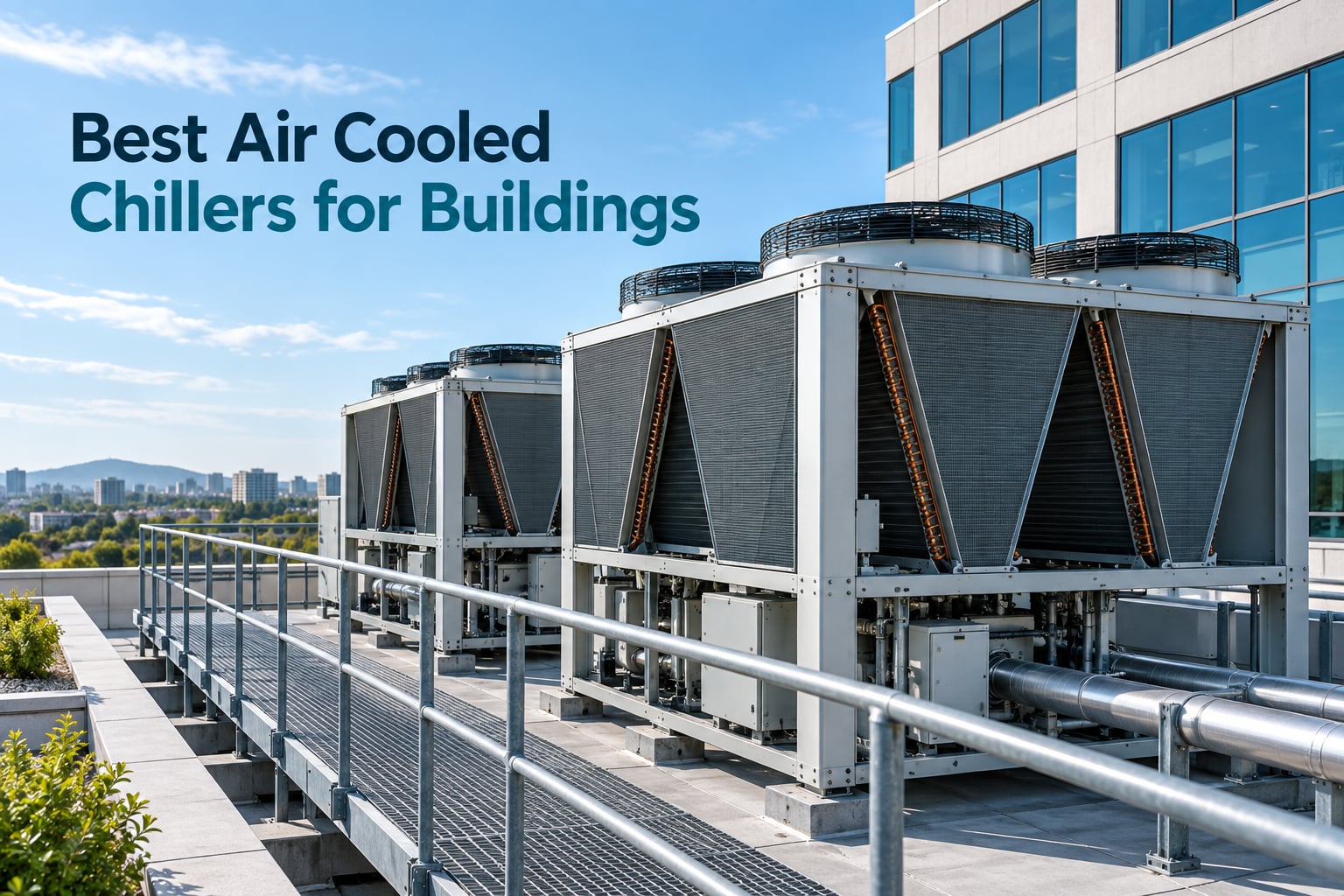
The best air cooled chillers for buildings are the modular commercial machines from Trane, Carrier, York and Daikin, because they are engineered for continuous duty, publish ARI/AHRI 550/590 efficiency data and ship with a service network that can reach your plant room. Those four names come up constantly in the buying conversations we follow, and they are the benchmark a specifier should hold every other supplier to.
There is a catch, and it is the reason this guide exists. The equipment you can actually find listed online for air cooled chillers is overwhelmingly process and spot cooling hardware, not building HVAC gear. We compared six units and the split is stark: five are compact process chillers aimed at injection molding, laser engraving and CNC work, and one is a genuine modular commercial chiller.
So read this as two lists in one. If you run a machine shop, the process chillers below are legitimate and we rank them on tank size, flow rate and control range. If you are cooling a whole building, there is exactly one match in this group and the other five will disappoint you on capacity ratings, efficiency documentation and serviceability.
We walked every listing, pulled the compressor, refrigerant, tank, flow and electrical figures, and checked what the customer feedback actually says. Here is what we found for 2026.
If you are weighing this decision alongside other building plant upgrades, our guides to CHP units for buildings and cooling towers for buildings cover the two systems that sit either side of the chiller in a mechanical room.
Table of Contents
Top 3 Picks for Best Building Air Cooled Chillers in September

VEVOR 5 Ton Air Cooled Chiller
- 5HP Panasonic compressor
- 12900 kcal/h
- 53L stainless tank
- 5-25C touchscreen control

VEVOR 15 Ton Air Cooled Chiller
- 15HP Panasonic compressor
- 38700 kcal/h
- 150L enclosed tank
- 3.5 m3/h flow
Quick Overview Every Air Cooled Chiller We Compared in 2026
All six machines below reject heat to outdoor air through a finned condenser, so none of them needs a cooling tower, condenser water pump or water treatment. Capacities run from a 5HP compressor to a 30 ton modular commercial chiller, and the electrical requirements range from 220V single phase to 220V three phase.
| Product | Specifications | Action |
|---|---|---|
| VEVOR 5 Ton Air Cooled Chiller |
|
Check Latest Price |
 VEVOR 60L Water Chiller VEVOR 60L Water Chiller |
|
Check Latest Price |
| VEVOR 15 Ton Air Cooled Chiller |
|
Check Latest Price |
 Trollastor 10HP Air Cooled Chiller Trollastor 10HP Air Cooled Chiller |
|
Check Latest Price |
 CREWORKS 15 Ton Air Cooled Chiller CREWORKS 15 Ton Air Cooled Chiller |
|
Check Latest Price |
 Multistack MS30C2H2A 30 Ton Chiller Multistack MS30C2H2A 30 Ton Chiller |
|
Check Latest Price |
One warning before the individual reviews. Not one of these six listings publishes an ARI/AHRI 550/590 certified efficiency rating, an IPLV or NPLV figure, or a capacity curve at elevated ambient temperature. Practitioners on r/HVAC and r/buildingscience treat those omissions as a genuine problem, because a headline BTU number with no rating standard behind it tells you nothing about what the machine will do in July.
1. VEVOR 5 Ton Air Cooled Chiller – 5HP Panasonic Compressor and a 53L Tank
VEVOR Air Cooled Water Chiller, 5 Ton Portable, 5HP/3.75KW Compressor Motor, 53L Capacity Stainless Steel Water Tank, Finned Condenser with Micro-Computer Control, Industrial Chiller for Cooling Water
5HP Panasonic compressor
12,900 kcal/h cooling
53L 304 stainless tank
220V, 397 lb, 78x33x72 inch
Pros
- Panasonic compressor with steady cooling output
- 53L food-grade stainless tank cuts evaporation and refills
- touchscreen panel with microprocessor control for 5-25C regulation
- overload and abnormal pressure auto power-off with audible and visual alarms
Cons
- 220V single-phase specification needs a dedicated circuit
- only one customer review on record
- rated for ambient up to 40C
This is the machine we came back to most. The build quality is immediately obvious: a 53 liter 304 stainless reservoir, copper and Q235 carbon steel construction, and a Panasonic compressor rather than a no-name equivalent. At 397 pounds and nearly six and a half feet tall it is a serious piece of hardware for a process chiller, not a light benchtop box.
The control side is where it wins against the alternatives in its class. The touchscreen panel runs a microprocessor and holds water temperature anywhere from 5 to 25 degrees Celsius, and there is an intelligent automatic water replenishment system so you are not topping it up every shift. Overload current protection, automatic power-off on abnormal pressure, and audible plus visual alarms cover the failure modes that actually cause downtime.
Flow is specified at 58 litres per minute through a DN25 line, and the seller notes the design targets low vibration and low noise, which matters if the unit sits near operators. Published applications are semiconductor manufacturing, surface treatment, precision machining and injection molding, so it is a process machine in a tower format.
The honest limitation is electrical. A 220V single-phase supply is a real constraint in a North American building, where plant rooms are normally three phase. And the 40 degree Celsius maximum ambient rating is worth pausing on: an air-cooled chiller that is not rated for hot summer air is a different proposition from one that is, and you should ask the manufacturer what the derated output looks like at 100 degrees Fahrenheit.
There is one review on this listing, and it is a five star with no written detail. That is a thin signal, and we treat it as such.
Where this chiller earns its keep
This is the pick for a machine shop, a plating line or a lab that needs water held at a specific temperature for long stretches. The sealed stainless reservoir and the automatic refill system mean fewer interruptions than an open-bucket chiller, and the alarm suite protects overnight runs.
It is also the most compact of the higher-capacity options in relative terms, at 78 inches deep and 33 inches wide, which makes it easier to find a home for than the 15 ton machines further down. For a small commercial building, it is the only one here you could plausibly install without a full mechanical room refit.
Where it falls short for building duty
It is a 5 ton process chiller, and a 5 ton air-cooled chiller cools roughly 60000 BTU per hour. A 20,000 square foot office in a hot climate routinely needs several times that, so one of these will not carry a mid-size building.
There is no published efficiency rating, no part-load data and no ARI/AHRI certification behind the capacity figure. There is also a single-phase power requirement that most commercial electrical services are not set up to provide, and the ambient ceiling of 40 degrees Celsius is the lowest of any condenser ceiling here.
2. VEVOR 6HP 60L Water Chiller – Compact and Four-Wheel Mobile
VEVOR Industrial Water Chiller – 60L Capacity, 9.4Hp Air-Cooled Chiller with Finned Condenser, Micro-Computer Control, Stainless Steel Tank
6HP compressor
15,100 kcal/h cooling
16 gallon stainless tank
5-30C LED microcomputer control
Pros
- High stated cooling capacity of 15100 kcal/h from a 6HP compressor
- comprehensive protection suite covering phase loss and phase reversal
- wide 5-30C control range on an LED display
- four-wheel design makes repositioning simple
Cons
- No customer reviews yet on this listing
- the 5-30C band is wider and less precise than dedicated process chillers
- listed wattage of 210 watts is not the same as input power demand
This is the YSD-6AD, and its standout feature is mobility. The four-wheel base is unusual in this category and means you can roll the machine out of the way for tank access or move it between a machine tool and a finishing station. The footprint is genuinely small at 51.2 inches square by 51.2 inches high.
The protection list is the most thorough of the five process chillers here. It covers phase loss, phase reversal, motor overload, high and low voltage, ice formation and coil overheating, and there are high and low pressure gauges for real-time system status rather than a single hidden indicator. That gauge pair alone tells you the manufacturer expects this machine to be maintained by someone who looks at it.
Cooling capacity is stated at up to 15,100 kcal per hour, which makes it a modest step up from the 5HP unit rather than a different class of machine. The temperature control range of 5 to 30 degrees Celsius is the widest in the group, and the listed applications include injection molding, blow molding, thermoforming, water jet cutting, welding and MRI or laser imaging.
The wider control band is a genuine trade-off rather than a free benefit. A 25 degree spread of setpoints suits a mixed shop floor with different processes, but if you need water held within a degree or two, a narrower range with tighter sensing is the better tool.
We should be straight about the evidence here: this listing carries no customer reviews at all, so nothing about long-term reliability is demonstrated. The published wattage figure of 210 watts describes the control electronics rather than the running load, so do not use it for electrical planning.
Where this chiller earns its keep
Multi-process shops that change jobs weekly benefit most from the mobility and the wide control range. One machine can serve a thermoforming station in the morning and a laser cooling line in the afternoon without being bolted down.
It is also the easiest unit here to move into a building that has no plant room, since it is the smallest and lightest in the group. If your cooling need is a workshop or a single machine tool rather than a floor of offices, this is a proportionate purchase.
Where it falls short for building duty
At 6HP and a 16 gallon tank, this is a small process machine. A 15,100 kcal per hour output is under two tons of cooling, which is a fraction of what even a small commercial building needs on a design day.
There are no customer reviews, no published efficiency rating and no capacity curve to check. The 5 to 30 degree Celsius range is also far too coarse for building chilled water loops, which normally run around 42 to 48 degrees Fahrenheit supply and need tight control to avoid short cycling downstream.
3. VEVOR 15 Ton Air Cooled Chiller – 150L Enclosed Tank and 3.5 m3/h Flow
VEVOR Water Chiller 15Ton, Capacity Industrial Chiller 15Hp, Air-Cooled Water Chiller, Finned Condenser, with Micro-Computer Control, Stainless Steel Water Tank Chiller Machine for Cooling Water
15HP Panasonic compressor
38,700 kcal/h cooling
150L enclosed stainless tank
3.5 m3/h flow, DN50 ports
Pros
- 15HP Panasonic compressor rated at 38700 kcal/h
- large 150L enclosed stainless tank that minimises evaporation
- multi-functional LCD microcomputer control with 5-25C adjustment
- overload and high and low pressure switches with electronic alarms
Cons
- The only customer review on record is a one star rating
- professional installation is specified for the machine
- maximum 25C water temperature is narrow for some building loops
On paper this is the most capable process chiller in the group. A 15HP Panasonic compressor rated at 38,700 kcal per hour, equivalent to roughly 11.25 kW of cooling, moves real water: 3.5 cubic metres per hour through DN50 inlet and outlet connections, with a DN15 tap water inlet for filling.
The reservoir design is the part we liked. At 150 litres and fully enclosed, evaporation losses are low enough that you are not chasing a make-up water connection all afternoon, which is a common complaint about open-bucket process chillers. The multi-functional LCD microcomputer panel gives 5 to 25 degree Celsius adjustment, and the protection package includes an overload protector, high and low pressure switches, electronic alarms and automatic water replenishment.
Weight is 463 pounds and dimensions are 63 by 30.7 by 67 inches, so this needs a real floor and a two-person move rather than a pallet jack alone. The listed wattage of 45 kW is a meaningful electrical load, and the listing specifies professional installation.
Two things give us pause, and we will not paper over them. The single customer review on this listing is one star with no written detail, which tells you very little either way but certainly does not endorse the machine. More significantly, the refrigerant is standard R407 and the control range stops at 25 degrees Celsius, and we come back to both of those points in the regulation section below.
Those two details matter more than they would have a few years ago, and the January 2026 EPA AIM Act limit on the global warming potential of new refrigerant is why.
Where this chiller earns its keep
Continuous duty process lines are the right home for it. Electronics, electroplating, food processing, machinery and plastic mold temperature control are all named applications, and the 3.5 cubic metres per hour flow suits a setup circulating a substantial volume through tooling.
For a facility that already has three phase power and a prepared floor, the capacity here is the best capacity-to-price positioning in the group. It is also the process machine with the largest enclosed tank, so it runs longest between fill checks.
Where it falls short for building duty
A 15 ton machine is building-scale in name only here. The compressor is fixed-speed, the refrigerant is a legacy blend, and the 25 degree Celsius ceiling on the control range makes it awkward to pair with a standard building chilled water loop.
There is a one star review, no efficiency rating, no IPLV figure and no ambient derate curve. And the specified 40 degree Celsius maximum operating ambient is a hard number that will bite in a hot climate, so the derated summer output is the first question to put to the manufacturer.
4. Trollastor 10HP Air Cooled Water Chiller – 121,472 BTU per Hour on 220V 3-Phase
Trollastor 10HP Industrial Air-Cooled Water Chiller 220V 3-Phase 60hz |121,472 BTU Cooling Capacity, R407C Refrigerant, Precise Temperature Control 41°F-95°F for Industrial Process Cooling
10HP compressor
121472 BTU/hr cooling
R407C refrigerant
41-95F digital controller, 220V 3-phase
Pros
- High stated cooling capacity of 121472 BTU per hour from a 10HP compressor
- wide 41-95F adjustable range with a digital controller for stable setpoint holding
- simple air-cooled design with low maintenance needs
- straightforward setup of water lines
- reservoir fill and setpoint
Cons
- No customer reviews yet on this listing
- requires a 220V 3-phase supply which needs a proper commercial feed
- air-cooled condensing needs adequate ambient airflow around the machine
The Trollastor ALW-LSQF10B2 is the one machine in the group that is specified for a three phase electrical supply from the start, and that alone makes it the most realistic of the process chillers for a North American building. The model number also makes it clear this is a US-market unit, and there is a 5HP version of the same family if the load is smaller.
Capacity is stated as 121,472 BTU per hour, roughly ten tons of cooling, from a 10HP compressor running on R407C refrigerant. The digital controller holds setpoint anywhere from 41 to 95 degrees Fahrenheit, which is a wide enough band to serve either a chilled water loop or a warm process tank.
The cabinet is heavy-duty steel and the footprint is compact at 33 inches deep by 57 inches wide by 59 inches high, which is a smaller footprint than several of the VEVOR machines at similar capacity. Setup is described plainly: connect the inlet and outlet water lines, fill the reservoir, set the temperature. That simplicity is a real advantage when you are not commissioning a controls contractor.
Air-cooled condensing is never free, and the seller is upfront that the machine needs adequate ambient airflow around it. On a rooftop or in a tight plant room that requirement turns into a clearance and recirculation problem, and it is the same issue that shows up repeatedly in practitioner discussions on r/HVAC about hot air being pulled back into the condenser.
This listing has no customer reviews, so like the others in this group, its long-term behaviour is undocumented by buyers.
Where this chiller earns its keep
It fits CNC machining, injection molding and laser cutting lines that already have a 220V three phase service, and the digital controller is the most straightforward setpoint interface in the group. Anyone who has fought an analogue temperature dial will notice that immediately.
It is also the best value per ton of stated capacity among the process machines here, once you account for the electrical service being the right one from day one. If your building has three phase power and a modest load, this is the machine to shortlist.
Where it falls short for building duty
Ten tons covers a small building or a portion of one, not a campus. Below roughly 100 tons, a single air-cooled chiller is also a single point of failure for the whole cooling system, which is why N+1 arrangements start appearing at that scale.
There are no customer reviews, no certified efficiency rating and no published derate curve for hot ambient conditions. R407C is also a legacy refrigerant, so the servicing question we cover further down applies here too.
5. CREWORKS 15 Ton Air Cooled Chiller – 95 gpm Flow and a 53 Gallon Tank
CREWORKS 15Ton Industrial Air-Cooled Chiller with 53 gal Tank& 22 HP Compressor
22.1HP compressor
153546 BTU/hr cooling
95 gpm flow
53 gallon tank with sight glass
Pros
- Largest stated cooling capacity in this group at 153546 BTU per hour
- high 95 gpm flow rate for circulating larger volumes
- 200L enclosed tank with a clear observation window
- premium brass inlet and outlet ports that resist corrosion
- one year warranty with US-based shipping and technical support
Cons
- No customer reviews yet on this listing
- tuned for laser engraver and CNC duty rather than documented building HVAC use
- 5 ton and 8 ton versions also available in the family
On raw numbers the CREWORKS LCA-15PC-US is the most powerful process chiller here, and the spec sheet backs it up. A 22.1HP compressor delivers up to 153,546 BTU per hour of cooling, and the 95 gpm flow rate is the highest in the group by a wide margin, which matters when you are circulating water through a large mold or a multi-station line.
The 53 gallon, or 200 litre, enclosed tank is fitted with a clear observation window so you can see the level without opening anything. The inlet and outlet ports are brass rather than coated steel, which is the detail that decides whether a fitting fails in year two or year ten, and it is a real upgrade over the carbon steel hardware common in this price class.
Control comes from internal sensors that hold temperature within 3 degrees of setpoint, reported through a digital display, indicator lights and audible alarms. That degree of built-in monitoring is unusual in a process chiller and it pairs sensibly with the flow rate. There is a one year warranty with US-based shipping, customer service and technical support, and the family also comes in 5 ton and 8 ton configurations.
What it lacks is a building story. The stated applications are laser engravers and CNC equipment, and there is no documentation of building HVAC duty, no efficiency rating, no part-load data and no derate curve. There are also no customer reviews, so the specification is entirely manufacturer-supplied.
The footprint is the other thing to plan for: at 75.2 inches deep by 41.34 inches wide and 68.5 inches high, this is the deepest process machine in the group and needs serious floor space plus service access around the condenser.
Where this chiller earns its keep
High-volume process cooling is exactly what it is built for. If you need to move serious water at temperature through tooling, the 95 gpm flow and the brass porting are the two features that will save you trouble.
It is also the only machine here with a stated tolerance on temperature holding, at within 3 degrees, plus a one year warranty backed by US-based support. For a shop that cannot afford a day of downtime waiting on a phone call to another time zone, that is a meaningful difference.
Where it falls short for building duty
It has no ASHRAE 90.1 compliance claim, no ARI/AHRI certification and no IPLV, so there is no way to compare its efficiency against a commercial chiller. A 15 ton capacity is meaningful but still small next to the modular machine in our number six slot.
The absence of customer reviews means every performance number here is a claim rather than an observation, and the machine is documented for machine-tool duty rather than for a building chilled water network. If you need something that can be tied into a building automation system, this will not do it.
6. Multistack MS30C2H2A 30 Ton Modular Chiller – the Only Building-Scale Machine Here
Multistack Modular MS30C2H2A 30 Ton Air Cooled Chiller
30 ton nominal cooling capacity
Modular air-cooled design
750 lb unit weight
Commercial HVAC duty
Pros
- The only true commercial building-scale air-cooled chiller in this group
- modular architecture suits phased installation and capacity matching
- 750 pound unit weight indicating a commercial-duty build
- air-cooled condenser configuration that requires no cooling tower
Cons
- No customer reviews and very little published feature detail
- technical specification detail requires contacting the manufacturer directly
- refrigerant type and efficiency data are not stated
Everything else in this guide is a process chiller. The Multistack MS30C2H2A is the one listing that sits in commercial HVAC, and that distinction shows in the basics: 30 tons of nominal cooling capacity and a 750 pound unit weight, against 397 and 463 pounds for the biggest VEVOR machines.
Modular architecture is the reason it belongs in this article at all. A modular air-cooled chiller can be paired with additional modules as a building’s load grows, which suits a phased campus or a building where occupancy ramps over several years. It also lets you stage capacity rather than run one large machine at a fraction of its output all day, and part-load behaviour is where most of the energy cost actually lives.
The air-cooled condenser configuration means no cooling tower, no condenser water pumps and no water treatment programme, which is the single biggest reason facility managers choose air-cooled equipment for a building in the first place. The model was first listed in February 2025, so this is a current generation machine rather than a legacy design.
Now the honest limitation, and it is a significant one. This listing publishes almost nothing. There is no efficiency rating, no refrigerant type, no electrical requirement, no dimensions beyond weight, and no customer reviews. To buy one properly you would need the manufacturer documentation for ARI/AHRI 550/590 data, the capacity curve at your design-day ambient, and the electrical requirements, and our team would not sign off a specification without it.
That thinness is why it sits at number six despite being the only true building chiller here. It is the right category of machine for the question you asked, and it is the one we would pursue a quotation on.
Where this chiller earns its keep
A small to mid-size commercial building, a medical office, a school or a retail complex with a load in the 30 ton range is exactly where a modular air-cooled unit like this fits. The capacity is right for a building that cannot justify a full water-cooled plant with a tower on the roof.
It is also the pick for anywhere water use is restricted or where tenants object to visible cooling tower infrastructure. Pairing a modular unit with additional modules as demand grows is the whole point of the design, and it is a genuine advantage over a single fixed machine.
Where it falls short for building duty
You will be buying on documentation you have to request. No refrigerant type, no efficiency number, no electrical spec, no sound level and no service network information is published, and any of those gaps can change the total cost of a project.
At 30 tons it is also a single point of failure unless you stage a second module, and there is no customer feedback to tell you how the vendor performs when something faults on a Friday evening. Buyers weighing this should also read our guide to busway systems for buildings, because the electrical service is often the constraint that decides whether a chiller of this size fits the building at all.
How to Size an Air Cooled Chiller for a Building
Start with a peak cooling load calculation, not with a rule of thumb. In the US the reference point is an ASHRAE Manual J load analysis for the specific building, broken into the components that actually consume cooling: fabric conduction through walls and roof, solar gain through glazing, people and lighting, internal equipment, outside air ventilation load, and infiltration.
Once you have the load in BTU per hour, convert it to flow with the standard US relationship. Capacity in tons of refrigeration equals the chilled water flow in gallons per minute, multiplied by the temperature difference in degrees Fahrenheit, multiplied by 500, divided by 12,000.
A worked example makes it concrete. At 400 GPM with a 10 degree Fahrenheit delta-T, that is 400 multiplied by 10, multiplied by 500, divided by 12,000, which comes to 167 tons of refrigeration. That delta-T also sets the pipe size, because 10 degrees is a common design target for building chilled water loops.
Then apply a selection margin, and this is where practitioners argue most. Forum consensus on r/buildingscience and Manual J discussions favours sizing for peak with a modest, explicitly justified buffer rather than blanket oversizing. A 10 to 20 percent margin suits a stable commercial load, while a variable or growing load can justify more. Past roughly 30 percent you create short cycling and poor part-load efficiency, which is worse than the marginal reliability you bought.
Finally, check the derate. Air-cooled chillers are rated at a standard ambient of 95 degrees Fahrenheit under ARI/AHRI conditions, and real design days in cities like Phoenix or Houston run well past that. Ask for the capacity curve, then size against the derated figure, not the nameplate figure. This is the single most common trap we see described in the field, and it is the one most listings we reviewed simply do not address.
Air Cooled vs Water Cooled: When Air Cooled Is the Right Call
Air cooled is usually the right call below roughly 300 tons of building load, on sites where water is restricted, and anywhere a cooling tower is impractical or unwanted. It removes the tower, the condenser water pumps, the water treatment chemicals and the make-up water, and it shrinks the maintenance burden considerably.
The disadvantages are equally clear. Air-cooled chillers cost more per ton of cooling on energy, because condenser fans move air rather than water and air is a far less effective heat transfer medium. Their rated capacity and efficiency fall as ambient temperature rises, which is exactly when a building needs the most cooling. Condenser noise, structural load on a roof, and hot air recirculation between closely spaced machines are all site design problems that water-cooled plant simply does not have.
For a small office, a clinic, a school or a retail building, those trade-offs usually favour air-cooled equipment. For a large campus or a data centre running continuously, the energy penalty of a hot climate can outweigh the tower costs, and a water-cooled plant with a tower and free cooling economiser is the more efficient path.
Efficiency Metrics: EER, COP, IPLV and kW per Ton
The most efficient type of chiller is the one that runs at part load, not the one with the best peak number, and that is the whole argument for reading IPLV rather than EER. A chiller installed at peak and running near its design point for a few hundred hours a year spends most of its life at 30 to 70 percent of capacity, so the efficiency in that band is what shows up on your energy bill.
COP is the ratio of cooling output to compressor input power and is the metric most used internationally. EER is the same idea expressed as BTU per watt-hour in imperial units, so a COP of 3.0 is roughly an EER of 10.2. IPLV is the weighted average across four part-load points defined by the ARI/AHRI 550/590 standard, and NPLV does the same job for equipment outside that standard’s scope.
kW per ton is the simplest version for a facility manager: 0.6 kW/ton is efficient, 0.8 kW/ton is ordinary, and anything above 1.0 is worth questioning. The practical problem with every one of these metrics is documentation. None of the six machines in this roundup publishes a certified figure, so we cannot rank them on efficiency and we will not pretend otherwise. Ask each vendor for the ARI/AHRI certified number, the part-load curve and the kW per ton at your expected load profile.
The EPA AIM Act 700 GWP Cap and the Move to R-454B
Since January 2026, new refrigerant used in equipment manufactured or imported into the United States is capped at a global warming potential of 700 under the EPA AIM Act framework, and that rule change directly affects what you can buy and service now. Older blends such as R410A and R407C sit above that limit, which is why four of the five process chillers in this roundup carry legacy refrigerants.
The replacement chemistry is R454B, a blend of R32 and R1234yf, alongside R32 itself and mildly flammable blends such as R1234ze. R454B sits at a global warming potential of around 454, well under the cap, and is the direction new commercial equipment is moving.
For a building owner mid-project this matters in practical ways. A2L refrigerants are mildly flammable, so charge limits, ventilation and leak detection requirements differ from the old non-flammable blends. It is also worth asking whether the refrigerant a machine uses will still be serviceable in fifteen years, because a chiller with a refrigerant nobody stocks is a very expensive problem at year twelve.
None of the process chillers reviewed here lists R454B. If that transition is the deciding factor for your purchase, the modular commercial unit is the one to develop a conversation with, since commercial manufacturers are moving first.
What to Check Before You Buy an Air Cooled Chiller
Ask for the ARI/AHRI 550/590 certification number, not a marketing efficiency claim. Buyers on r/HVAC consistently treat unpublished certification as a deal breaker because it is impossible to compare against anything else, and it is the fastest way to sort a real manufacturer from a marketplace seller.
Ask for the capacity curve at your design-day ambient, not the nameplate tonnage. Also confirm the electrical service, including phase, voltage, starting current and whether a soft starter or variable speed drive is fitted, and check your switchboard capacity against the running and starting load before anything else.
Confirm the service network. A 20 year chiller is only as good as the technician who can reach it, and practitioners treat brand reputation and parts availability as primary purchasing factors rather than afterthoughts. For building plant, the question of who answers the phone when it faults at 7pm on a Friday is worth more than a fraction of a point of efficiency.
On siting, plan condenser clearances to prevent hot air recirculation, check the structural load if the machine goes on a roof, and confirm the sound level against the nearest occupied space. Practitioners on r/buildingscience describe rooftop siting problems, noise complaints and recirculation as the failures that quietly erode rated performance years after commissioning.
Finally, confirm the controls. BACnet or Modbus connectivity to your building automation system, staging logic and lead-lag sequencing, and the turndown ratio at minimum load are what let a chiller run efficiently rather than cycling on and off through the day.
Frequently Asked Questions
Which brand of chillers is considered the best?
For building air cooled chillers, the names buyers and practitioners most often treat as the benchmark are Trane, Carrier, York and Daikin, because they build continuous-duty commercial equipment, publish ARI/AHRI 550/590 certified efficiency data and maintain service networks that can reach a plant room. Carrier, Trane, York, Daikin, AAON, Lennox, Gu0026amp;D Chillers and Vertiv are the manufacturers most often named in US commercial chiller discussions.
What are the disadvantages of air-cooled chillers?
The main disadvantages are higher energy cost per ton of cooling, because condenser fans move air rather than water; rated capacity and efficiency that fall as ambient temperature rises; the need for clearance around the condenser to prevent hot air recirculation; structural load and noise concerns on rooftops; and no free cooling from outside air or a tower economiser.
What is the most efficient type of chiller?
The most efficient chiller is the one operating closest to its design condition, which in a building usually means part load. Variable speed centrifugal and variable speed screw machines generally lead on part-load behaviour, while air cooled screw and scroll machines trail in raw COP but avoid the losses of a cooling tower. Compare IPLV and kW per ton at your actual load profile rather than peak COP.
How do I calculate the cooling load needed for a chiller?
Run an ASHRAE Manual J load analysis for the specific building, broken into fabric conduction, solar gain, people, lighting, internal equipment, outside air ventilation and infiltration, and size to the peak hot-day load rather than an average. Then convert the load to chilled water flow using tons = GPM x delta-T in degrees F x 500 divided by 12,000, and apply a modest 10 to 20 percent margin.
What size air-cooled chiller does my building need?
You need enough capacity to meet the peak cooling load at your design-day ambient, after derating the rated capacity from the 95 degree Fahrenheit ARI/AHRI rating condition. Below roughly 100 tons a single air-cooled chiller is usually adequate; above that, staged or modular machines with N+1 redundancy are typical. Map the load band to building type: small offices and clinics in the low tens of tons, mid-rise and retail buildings in the hundreds, campuses and data centres well beyond that.
Conclusion
Our editor’s choice for 2026 is the VEVOR 5 Ton air cooled chiller, and it earns that on the details that decide whether a machine survives daily use: a Panasonic compressor, a 53L 304 stainless reservoir, a touchscreen panel that holds water between 5 and 25 degrees Celsius, and a full alarm suite. Its limits are equally clear, so ask the manufacturer for the derated output at 100 degree Fahrenheit ambient before you sign it off.
For a whole building rather than a process line, be clear-eyed about what this group actually contains. The Multistack MS30C2H2A 30 ton modular chiller is the only unit here built and documented for commercial duty, and it is the one we would pursue a quotation on, provided the manufacturer supplies the certified efficiency number, the ambient derate curve and the service terms. If high-volume process cooling is the brief, the CREWORKS 15 ton machine leads on flow rate and brass port quality.
Whichever route you take, size to peak load with a justified margin, derate for your real design-day ambient, and buy the service network along with the machine. That last point is where most of the long-term cost differences actually live.