
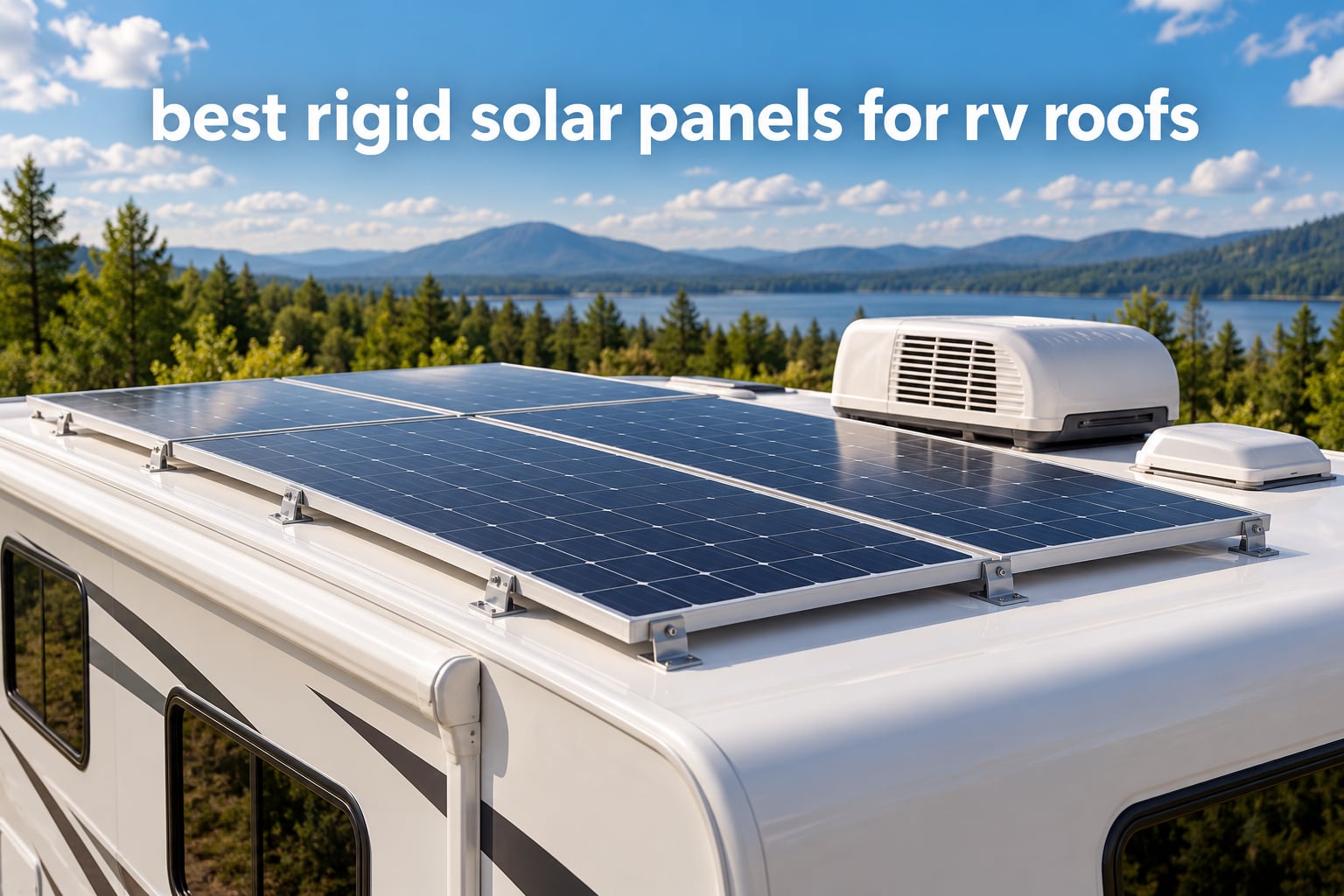
Rigid solar panels still beat flexible alternatives on almost every RV roof that can take the weight. They run hotter-but-better, hold their output for decades, and shrug off hail, UV and road grime in ways bonded films do not. If you have a flat or low-curved roof with real mounting space, rigid monocrystalline modules are the right call in 2026, and this roundup covers the ten options we would actually put on a roof.
We compared efficiency ratings, temperature coefficients, frame and glass construction, wind and snow load ratings, warranty terms and physical footprint across all ten. What came out the other end is a shortlist that splits cleanly by roof type: compact 100W modules for vans and trailers, full-size 200W panels for Class A and Class C motorhomes, plus complete kits for first-time builders who want everything in one box.
If you are still working out how much power a boondocking setup needs, our guide to the best RV solar panels for boondocking covers the sizing math first. And if your plan includes a foldable panel for open-ground camps, the portable solar panel picks cover that half of the system.
The short version: the Renogy 200W N-Type 16BB is the single best rigid solar panel for RV roofs in this group for most people, the Renogy 100W N-Type wins on cramped roofs, and the RICH SOLAR 200W N-Type 18BB is the one to buy when you are charging a big 12V bank and need serious amperage.
Table of Contents
Top 3 Rigid Solar Panels for RV Roofs in October 2026
Our top three covers the three situations most RV owners actually face: a normal motorhome roof with room to spare, a van or trailer roof measured in spare inches, and a heavy 12V battery bank that needs real current. Every one of them is a glass-and-aluminum N-Type monocrystalline module built for permanent rooftop mounting.

Renogy 200W N-Type 16BB
- 25% efficiency N-Type cells
- 6.85A at 24V
- 23.4 lbs
- IP67 and 25-year guarantee

Renogy 100W N-Type 16BB
- 25% efficiency
- 13 lbs
- 34.1 x 22.8 inch footprint
- -0.29%/C temperature coefficient

RICH SOLAR 200W N-Type 18BB
- Up to 10.9A output
- 2400 Pa wind and 5400 Pa snow rated
- UL certified
- 25-year linear warranty
Quick Comparison of Every Rigid Panel in This Roundup in October 2026
This table lists all ten panels with the specs that actually decide an RV installation. Wattage tells you array size, efficiency tells you roof area needed, weight tells you whether the roof structure can take it, and the remaining columns tell you how the panel behaves in heat, wind and shade.
| Product | Specifications | Action |
|---|---|---|
| Renogy 200W N-Type 16BB |
|
Check Latest Price |
| Renogy 100W N-Type 16BB |
|
Check Latest Price |
| RICH SOLAR 200W N-Type 18BB |
|
Check Latest Price |
 HQST 200W N-Type 16BB HQST 200W N-Type 16BB |
|
Check Latest Price |
 RICH SOLAR 100W All Black RICH SOLAR 100W All Black |
|
Check Latest Price |
 ECO-WORTHY 200W Complete Kit ECO-WORTHY 200W Complete Kit |
|
Check Latest Price |
 JJN 100W 10BB Monocrystalline JJN 100W 10BB Monocrystalline |
|
Check Latest Price |
 Renogy 200W RV Kit with 30A Controller Renogy 200W RV Kit with 30A Controller |
|
Check Latest Price |
 Topsolar 100W Complete Kit Topsolar 100W Complete Kit |
|
Check Latest Price |
 JJN 200W Bifacial N-Type JJN 200W Bifacial N-Type |
|
Check Latest Price |
1. Renogy 200W N-Type 16BB – the all-round pick for RV roofs
Renogy Solar Panels 200 Watt, N-Type Solar Panel 25% High-Efficiency 16BB
200W N-Type 16BB
25% efficiency
24V and 6.85A
23.4 lbs
IP67
Pros
- Users report measured output above the 200W nameplate
- 7.5% smaller and 11.7% lighter than the previous generation
- 16BB N-Type cells show low microcrack incidence
- Keeps producing useful power on overcast days
- Operates at 24V for lower current loss on both 12V and 24V banks
Cons
- Z-bracket layout makes the panel hard to remove for servicing
- A few owners received a panel with an unconnected cell
- Needs several panels in series for high charge current
This is the panel we keep coming back to. At 49.7 by 30.1 inches and 23.4 pounds it fits most flat Class A and Class C roofs with clearance to spare, and the 24V operating voltage means it drops current losses whether you run a 12V or 24V battery bank.
In our comparison the output story is the headline. Owners report readings at or above the rated 200W in full sun, with one reviewer measuring 224W on a 200W panel. That overperformance is not unusual with N-Type 16BB glass-and-aluminum modules, and it is the reason we put this at the top.
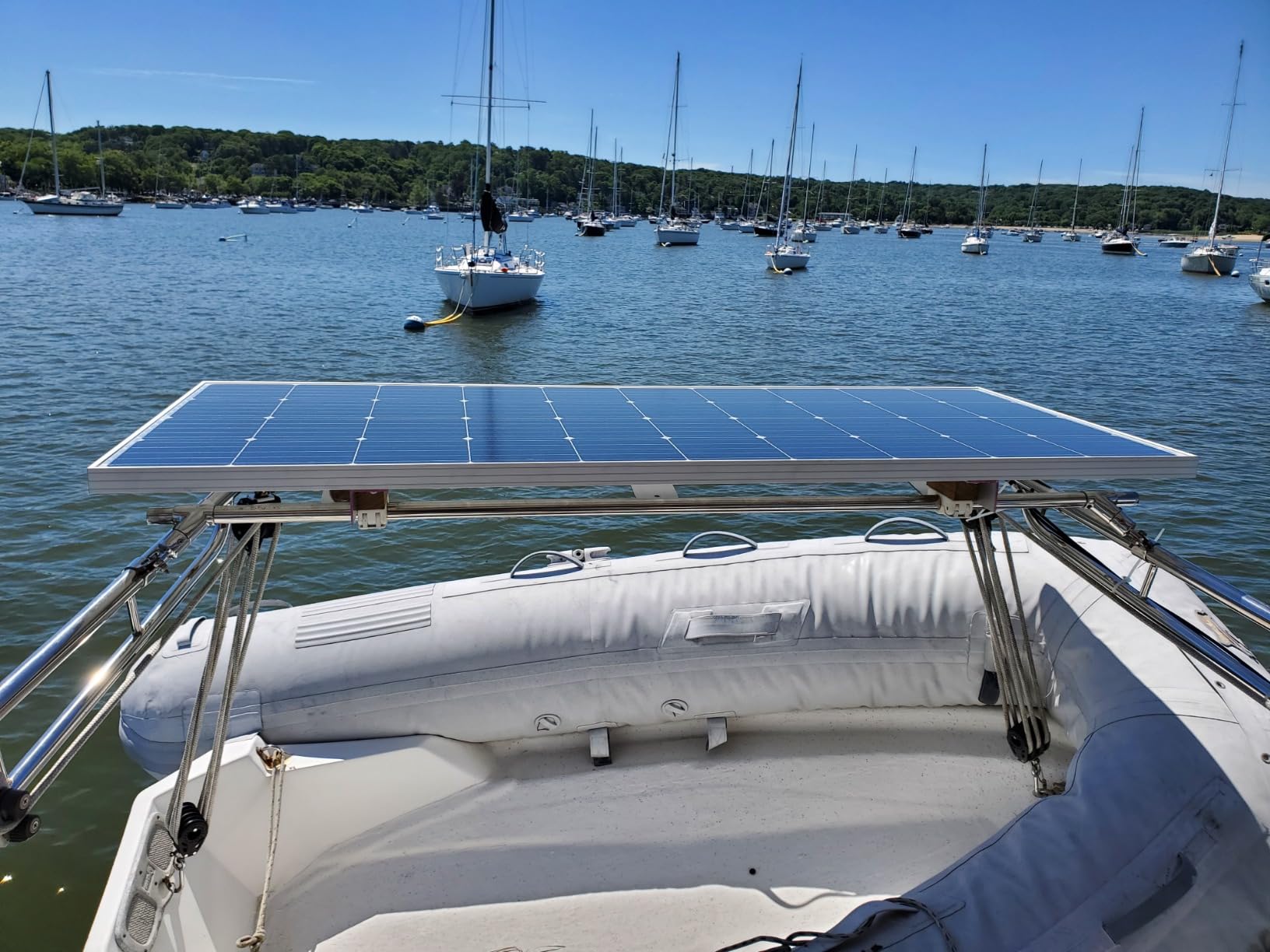
The 16BB busbar design is the quieter reason it holds up. More busbars per cell means less current per busbar, which translates into fewer microcracks and fewer hot spots over a 25-year service life. Degradation is rated at 1 percent or less in year one and 0.4 percent annually after that, backed by a 25-year performance guarantee and a 10-year workmanship warranty.
For heat, the low temperature coefficient is what keeps the numbers honest. On a summer roof the cell can climb well above 70 degrees Celsius, and a panel that loses less per degree produces more of the day when you need it. Several owners also report folding the panel into a portable suitcase build, which tells you how versatile the frame is.
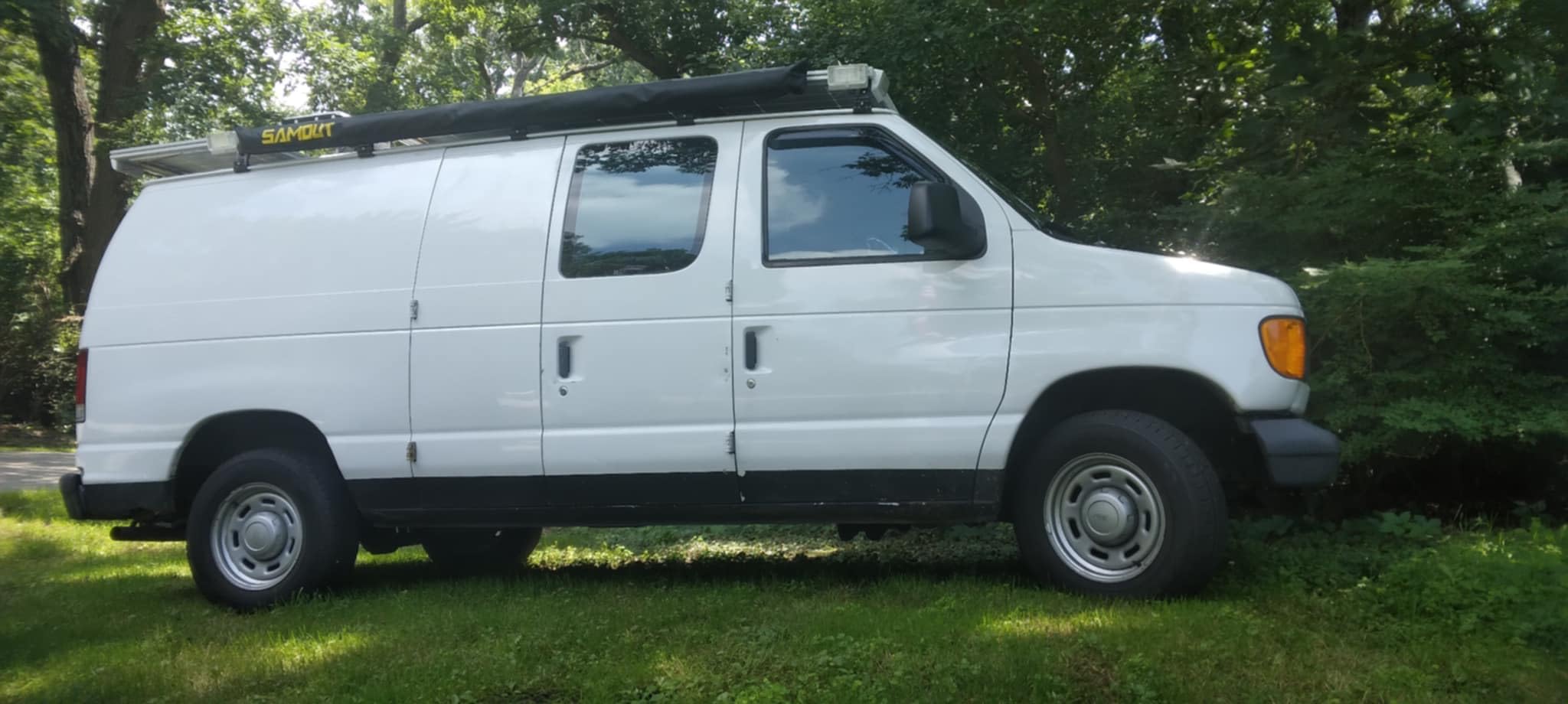
What you should know before mounting it
The only complaint we see repeated is mechanical rather than electrical. The Z-bracket design means the panel sits on top of brackets that are screwed to the roof, so servicing the back of the module means pulling roof fixings. Plan your layout so you do not have to reach the junction box often, and keep a roof-accessible route to any roof vent or air conditioner that sits near the array.
A small number of buyers reported receiving a panel with an unconnected cell that read lower than expected voltage. It is worth checking your open-circuit voltage with a meter on the day the panel arrives, before you drill anything into the roof.
Where it fits badly
Twenty-three pounds is real weight on a small roof. A fiberglass travel trailer or an older van conversion with a light-duty roof skin may not want two of these on board, and the 24V output means a single panel will not push meaningful charge current into a large 12V bank on its own. Pair it with another string or plan on a bigger controller.
2. Renogy 100W N-Type 16BB – the champion of tight roofs
Renogy Solar Panels 100 Watt, N-Type Solar Panel 25% High-Efficiency 16BB
100W N-Type 16BB
25% efficiency
12V and 5.31A
13 lbs
IP65
Pros
- Roughly 30-50% more current than budget 100W panels in the same spot
- 11% smaller and 8% lighter than the previous generation
- -0.29%/C temperature coefficient holds up in heat
- Small footprint suits Class B van roofs
- Grade A+ N-Type cells with 16BB busbars
Cons
- Brackets are not designed to let the panel lift off for service
- One panel in a large order arrived with an unconnected cell
- 100W output means several panels are needed for real load
Class B vans are where roof space turns into a geometry problem. At 34.1 by 22.8 inches and 13 pounds, this module fits the flat strip most vans have between the fan, the fridge vent and the rear door, which is a sentence very few 200W panels can say.
Then there is the electrical surprise. Reviewers report roughly 30 to 50 percent more current than budget 100W panels measured in the same spot on the same day. One owner logged 4.9 amps raw and 6.5 amps into the battery with an MPPT controller, a result that reflects a high-grade cell rather than a marketing number.
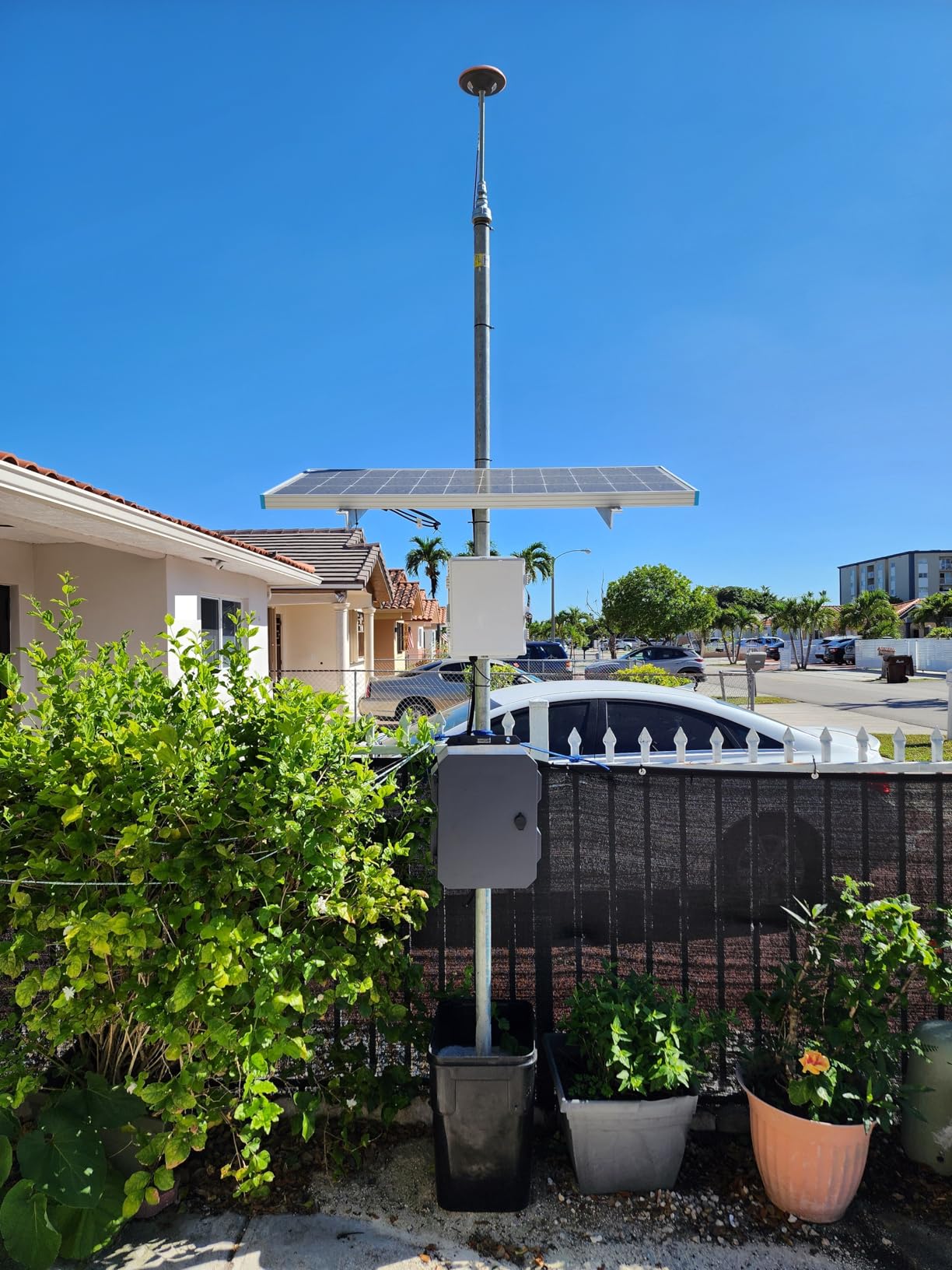
The temperature coefficient of -0.29 percent per degree Celsius is the quiet advantage on a low-profile van roof with limited airflow. Mounted flat with a small standoff, a panel with a flatter coefficient loses less through a hot afternoon, and on a shaded site those extra watts are what keep the fridge running overnight.
Build details are ordinary-good rather than exotic: low-iron tempered glass, a corrosion-resistant aluminum frame and IP65 weather sealing. The warranty is the shorter one in this group at 5 years for materials and workmanship, so pair it with an MPPT controller and check the roof structure rather than relying on the panel to be the tough part of the system.
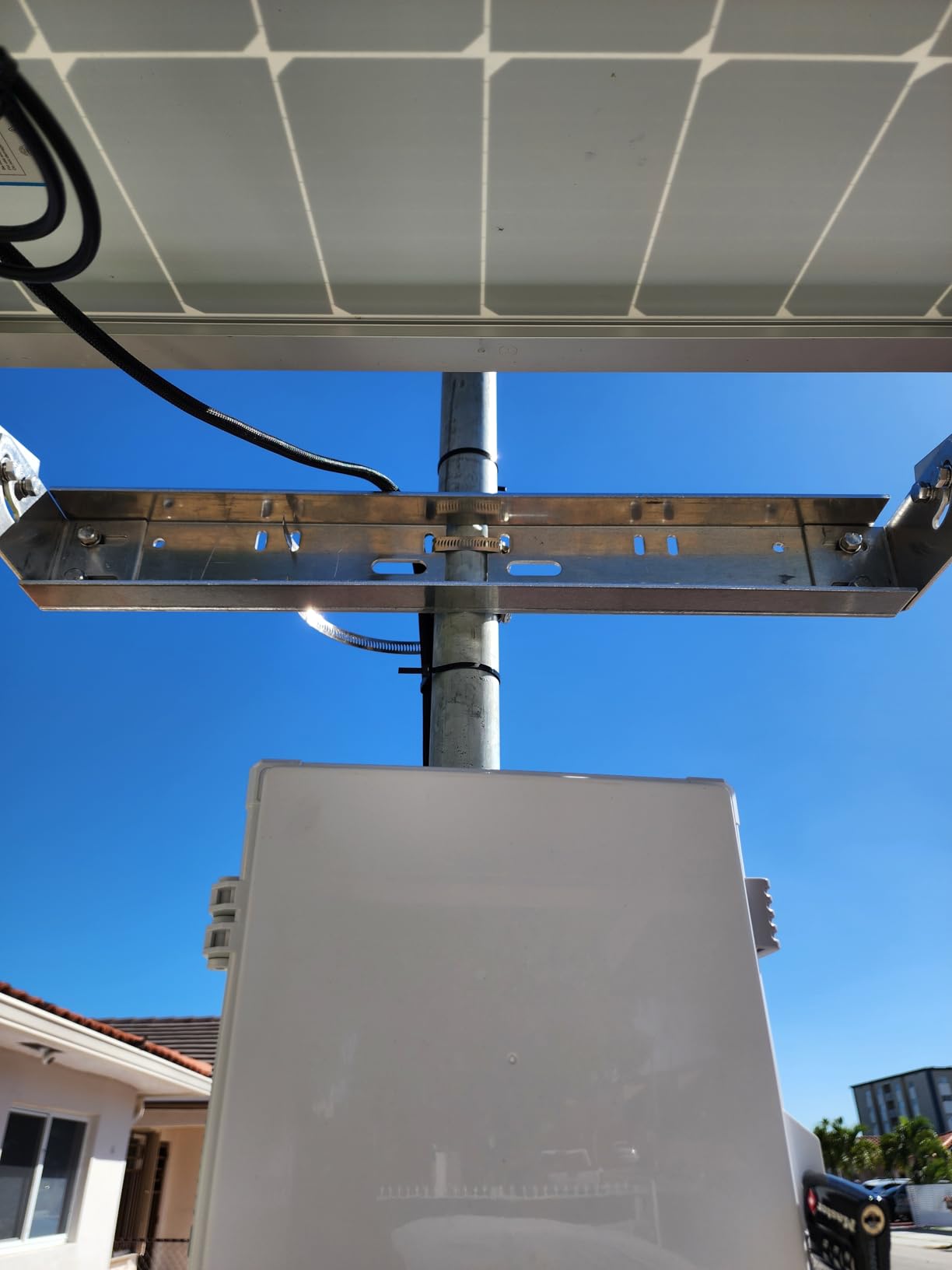
Why it earns its place on small roofs
Two of these panels in series give you a 200W array that still weighs under 27 pounds, which is a very different load conversation than one 200W panel. It also means a partial failure takes out half your array instead of all of it, a real advantage when you are far from a replacement.
Boondock and overland builders mention the same thing repeatedly: this is the panel they can add to an existing array incrementally as budget and roof area allow, rather than committing to a single large purchase on day one.
Where it falls short
A hundred watts is not much power. Running a 12V fridge, a couple of USB devices and interior lights takes several of these in parallel, and each one needs its own mounting points and cable run. If your roof has real space, buying one larger panel is usually fewer penetrations and less wiring.
3. RICH SOLAR 200W N-Type 18BB – the high-current panel for 12V banks
RICH SOLAR 200 Watt Solar Panel, 12V N-Type 18BB, 25% High-Efficiency
200W N-Type 18BB
Up to 25% efficiency
18.4V and 10.9A
24 lbs
IP67
Pros
- Up to 10.9 amps suits fast 12V charging better than most 200W panels
- 58.7 inch length maximizes production per unit of roof length
- 1.3mm anodized aluminum frame with IP67 sealing
- 14 pre-drilled holes accept Z-bracket
- tilt and pole mounts
- 25-year linear power output warranty
Cons
- One of the largest and heaviest 200W panels in the group at 58.7 inches and 24 lbs
- Needs an MPPT controller to exploit the higher operating voltage
- Smaller review base than the mainstream options here
Most 200W panels are optimized for high voltage, which is right for a 48V system and wrong for a big 12V lithium bank. This one is built the other way around: 18.4 volts at up to 10.9 amps means it feeds a 12V charge controller with less conversion loss and faster bulk charging than most of its size class.
The frame is where the engineering shows. A 1.3mm anodized aluminum extrusion is thicker than the standard 1.0mm frames on most panels here, and the module is rated for 2400 Pa wind load and 5400 Pa snow load with IP67 sealing, which is the specification set we like to see on a roof that sees highway wind at speed.
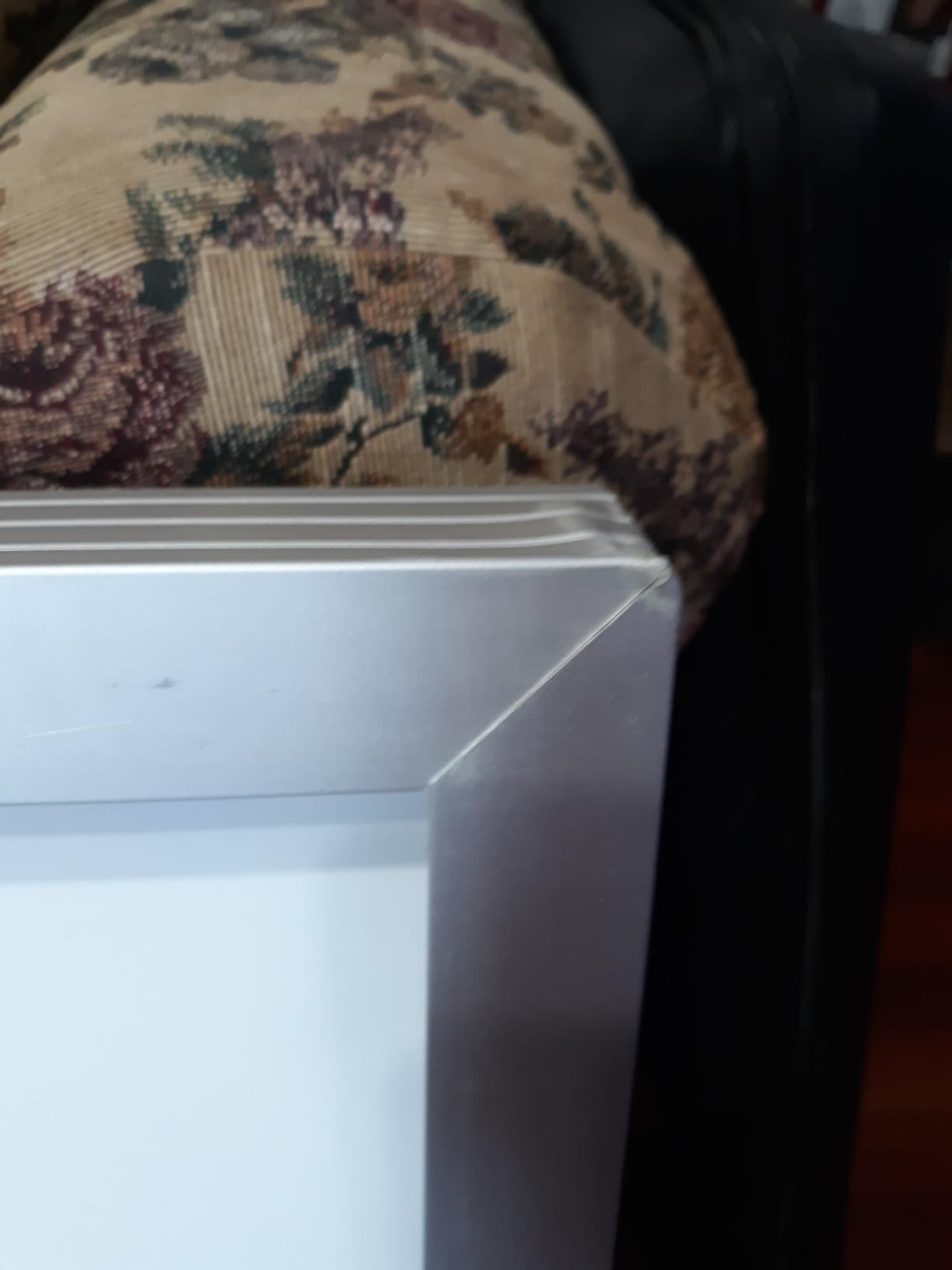
The 14 pre-drilled mounting holes are a genuinely useful detail. They let you place Z-brackets without drilling new holes into the frame, and they leave room for tilt or pole mounts if you later want to angle the array off the roof for better summer production.
N-Type 18BB cells with low light-induced degradation also mean this panel is UL certified with a 25-year linear power output warranty plus 5-year material and workmanship coverage. That is a longer and more clearly written output guarantee than most competitors in this price class offer.
How it behaves on a hot roof
The upper temperature rating of 185 degrees Fahrenheit tells you the cell and encapsulant package is designed for genuine heat rather than just temperate climates. Combine that with a 25 percent cell efficiency figure and this panel holds up well in desert and high-desert camping, where a lower-efficiency panel needs noticeably more roof area for the same watts.
Because it produces high current rather than high voltage, wire it in parallel to a 12V MPPT rather than stacking it in a long series string. That also makes it far more forgiving of partial shade from a roof air conditioner than a series-connected 200W module.
Where the size becomes a problem
At 58.7 by 26.8 inches and 24 pounds, this is one of the largest 200W panels in the comparison. It fits a long motorhome or fifth-wheel roof well and fits a small van or short trailer roof not at all. Check the run of flat roof you have, including clearance around vents, before you commit to a layout.
4. HQST 200W N-Type 16BB – the lightest full-size 200W here
HQST 200W Solar Panel, N-Type, 16BB, up to 25.4% Efficiency, IP65
200W N-Type 16BB
Up to 25.4% efficiency
46.3 x 30.1 inch
20.2 lbs
IP65
Pros
- 13% smaller and 14.5% lighter than conventional PERC 200W panels
- One panel replaces two 100W panels so there are fewer mounts and cables
- Strong low-light output for mornings
- evenings and cloudy days
- Every cell is EL-tested for microcracks
- 2400 Pa wind and 5400 Pa snow load rated
Cons
- Lower 4.4 average rating with 5% one-star reviews
- 30-year 87.4% output claim is a different promise from a 25-year 80% guarantee
- Newer listing with a smaller review base
At 20.2 pounds and 46.3 by 30.1 inches, this is the lightest 200W panel in the group, and it is the only one here where the weight figure is the deciding factor rather than a tiebreaker. On a fiberglass or aluminum roof where every pound is a question, that is worth a lot.
The cell efficiency claim of up to 25.4 percent is the highest published figure in this comparison, and it is paired with 16BB N-Type cells that improve current collection and cut hot spots. Every cell is EL-tested for microcracks before assembly, which is a quality step several cheaper panels skip.
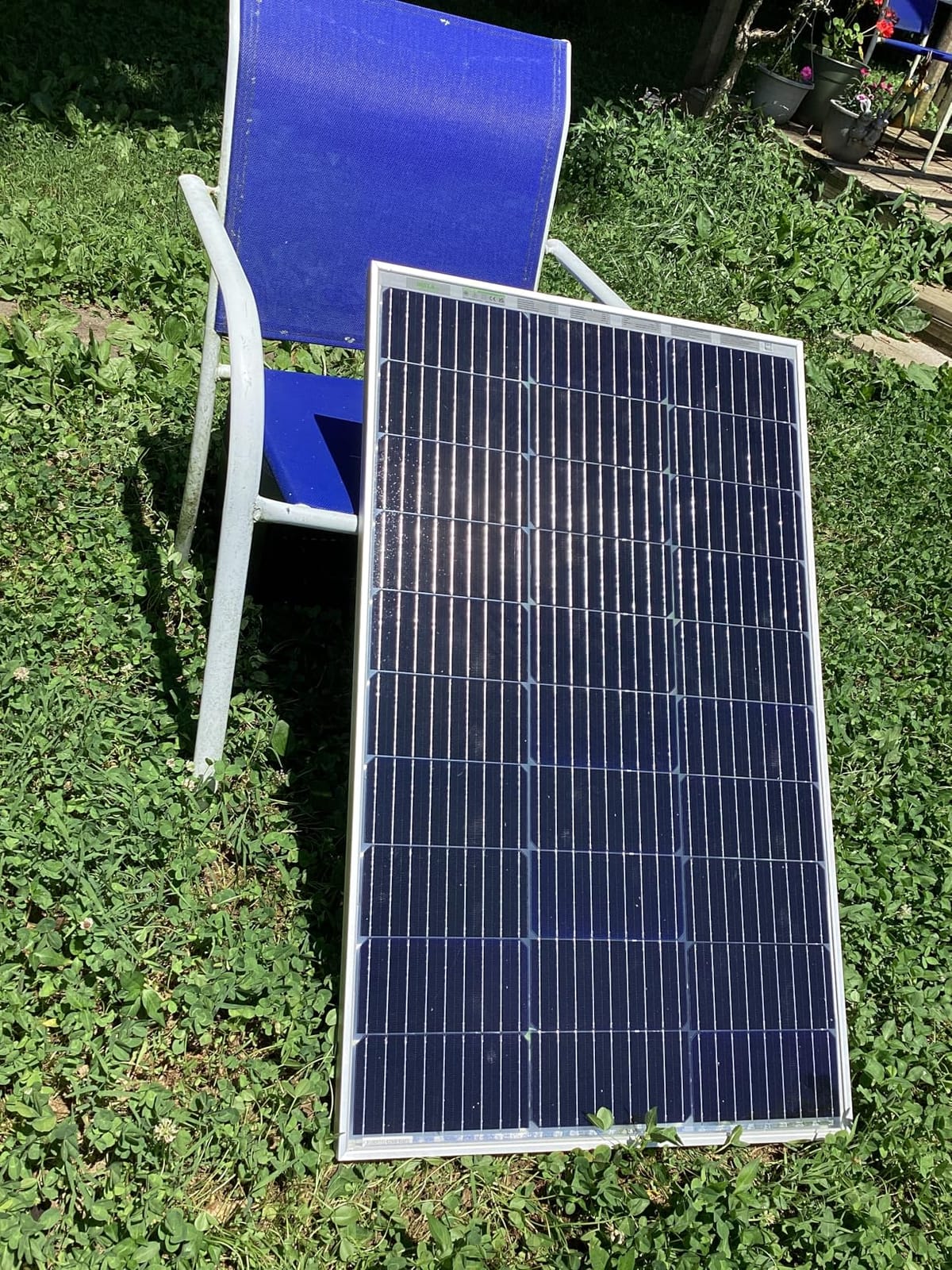
Low-light behaviour is what reviewers mention most. The panel is praised for output in the morning, late afternoon and under cloud, which is exactly the condition that dominates a boondocking week in the fall or a winter trip in the mountains.
One of the practical wins owners highlight: a single 200W panel replaces two 100W panels, so you make fewer roof penetrations, run fewer cables and cut parallel connection losses. For a first installation on a finished RV, fewer penetrations is fewer potential leak points.
How the warranty language compares
This panel is quoted with a 30-year service life and 87.4 percent output retention, which is a different structure from the 25-year 80 percent guarantee used by the two Renogy panels. The longer horizon is appealing, but read the terms carefully, because a retention percentage at year 30 and a guarantee at year 25 are not the same promise.
IP65 sealing with a corrosion-resistant aluminum frame and 2400 Pa wind and 5400 Pa snow load ratings puts the weather specification in line with the rest of the short list, so the panel is not a compromise on exposure.
Where to look twice
The 4.4 average is the lowest of the ten, with 5 percent one-star reviews and 7 percent three-star reviews. That is not a failure rate worth panicking about, but it does mean the experience is more mixed than the 4.6-and-above panels in this comparison, and the global review base is smaller.
5. RICH SOLAR 100W All Black – the highest rated panel in the group
RICH SOLAR 100 Watt 12 Volt Premium Monocrystalline Solar Panel All Black
100W 12V monocrystalline
5.38A output
39 x 21.3 inch
13.2 lbs
All black
Pros
- Highest average rating in this comparison at 4.7
- All-black cells and frame blend into dark RV and cabin roofs
- Small 100W format gives real layout flexibility
- MC4 quick-connect leads with enough length to reach a cable entry
- 14 pre-drilled holes for ground
- Z-bracket
- pole and tilt mounts
Cons
- Crimped pigtail inside the junction box can pull out and needs soldering
- One buyer reported inconsistent hole placement between panels from the same order
- Cell efficiency is not specified against the 25 percent N-Type panels
The all-black aesthetic is not a gimmick on an RV. On a dark roof, a black-framed panel visually disappears into the surface in a way silver-framed modules never do, and buyers tell us that matters more than they expected.
Underneath the looks it is a conventional 39 by 21.3 inch 100W monocrystalline module producing 5.38 amps, which is a comfortable match for a 30A MPPT controller on a 12V system. The 25-year limited power output warranty with 5-year material and workmanship coverage sits alongside the same frame thickness and hole pattern as the bigger RICH SOLAR panel.
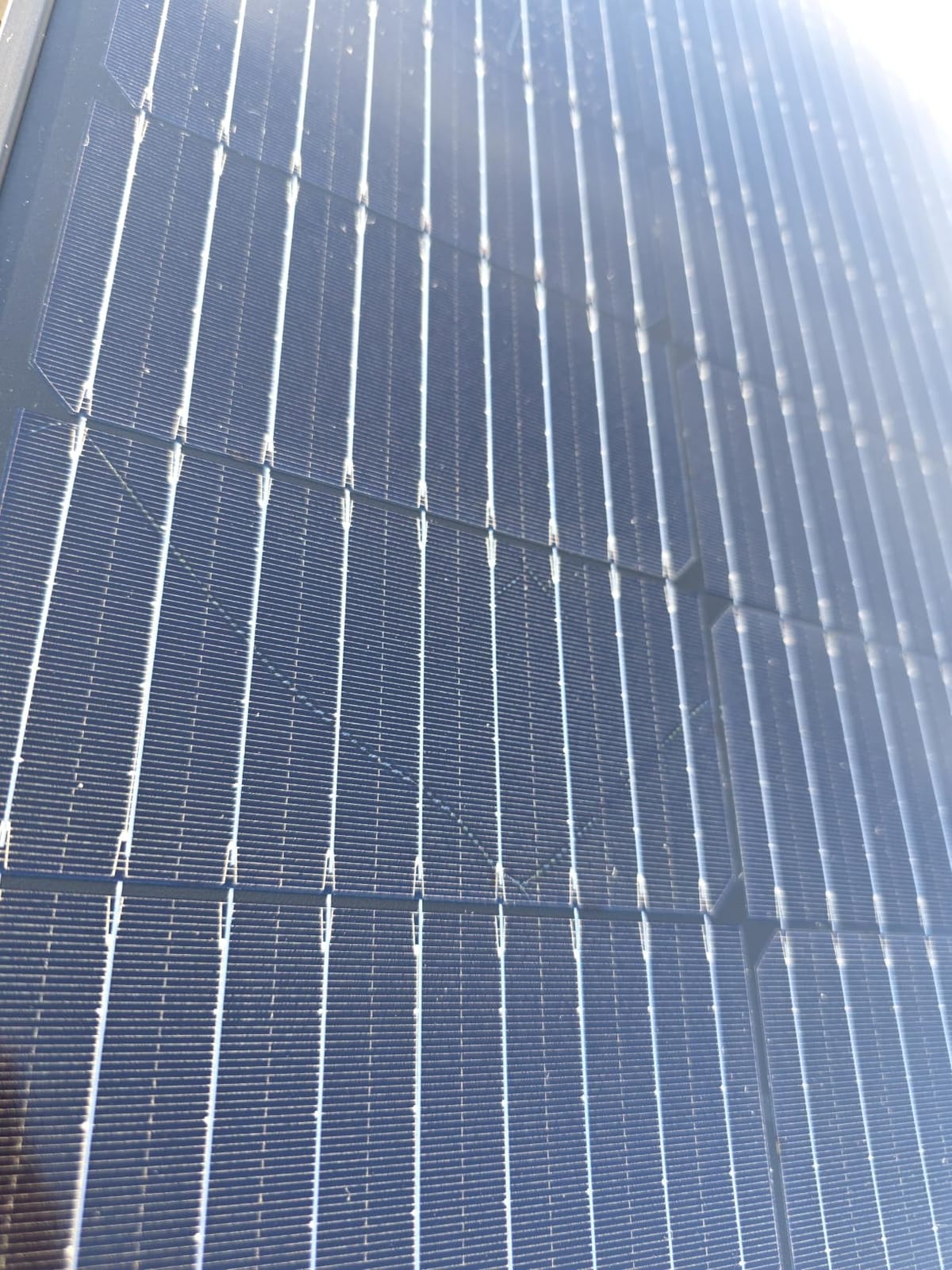
Reviewers rate the low-light performance highly, describing useful charging on overcast days and in the morning and evening windows when a solar panel normally goes quiet. The 3ft lead with MC4 quick-connect connectors is long enough to reach a nearby cable entry without a custom run.
Fourteen pre-drilled holes means the same panel can move from a roof Z-bracket to a ground mount or an adjustable tilt stand as your setup evolves, which is handy if you later want a portable option alongside the fixed array.
What to check when it arrives
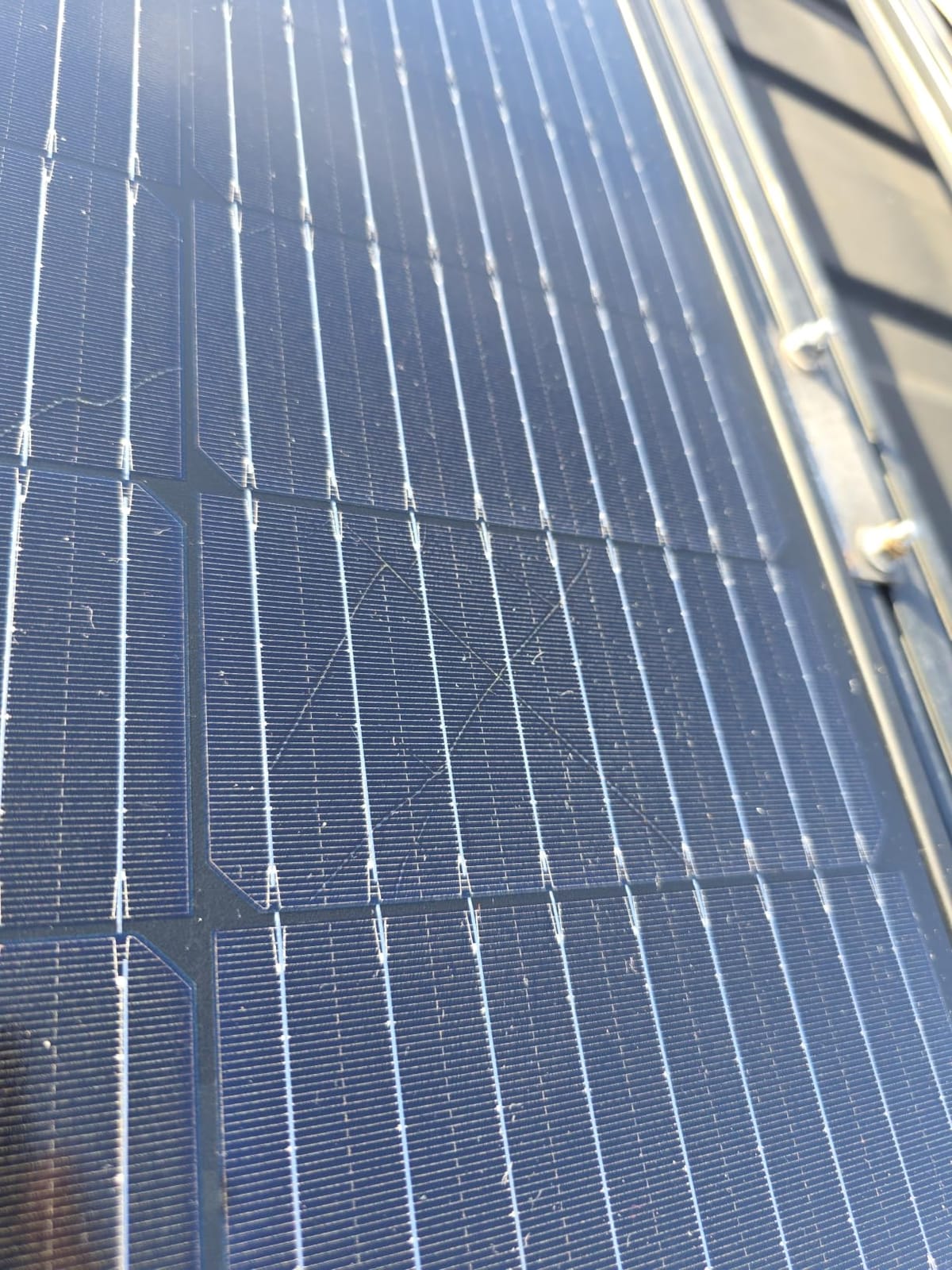
The most discussed issue in reviews is the pigtail lead inside the junction box. The crimped connection can pull out of the internal crimp, and some owners re-solder it permanently. Open the junction box, tug gently on the lead and re-solder if it moves, before you mount the panel where you cannot easily reach it again.
One buyer also reported mounting hole placement varying slightly between panels from the same order. Check your bracket positions against the hole pattern before drilling, and do not assume a template from one panel fits the next.
Where it is the wrong pick
Efficiency is not published as a number here, and the cells are not specified as N-Type. That means you are buying a well-made conventional panel rather than a top-tier one, and on a small roof where every square inch has to earn its place, a 25 percent N-Type alternative squeezes more watts into the same area.
6. ECO-WORTHY 200W Complete Kit – the easiest first installation
ECO-WORTHY 200 Watts 12 Volt/24 Volt Solar Panel Kit with High Efficiency Monocrystalline Solar Panel and 30A PWM Charge Controller for RV, Camper, Vehicle, Caravan and Other Off Grid Applications
Two 100W panels at 200W total
30A PWM controller
Brackets and cables included
31.6 lbs kit
Pros
- Panels
- Z brackets
- 30A controller and cables all in one box
- Pre-terminated plug-and-play wiring suits first-time builders
- Two 100W panels spread the roof load better than one 200W panel
- Supports series 24V or parallel 12V configuration
- About 800Wh daily output in 4 hours of full sun
Cons
- Uses older monocrystalline cells rather than 25% N-Type cells
- The bundled 30A PWM controller is the performance bottleneck
- 31.6 lbs total is heavy to lift onto a van roof
The value here is not the panel, it is the box. Two 100W monocrystalline panels, two sets of Z brackets, a 30A charge controller, a pair of 16.4 foot 10AWG solar cables, 2-in-1 connectors and a 4.92 foot tray cable. For a first-time RV solar install, that removes almost every reason to make a second order.
Each panel measures 35.2 by 23.1 by 1.3 inches, which is a useful size. It is compact enough to lay two across a Class C roof or a mid-size trailer while still leaving the load spread over four mounting points rather than two.
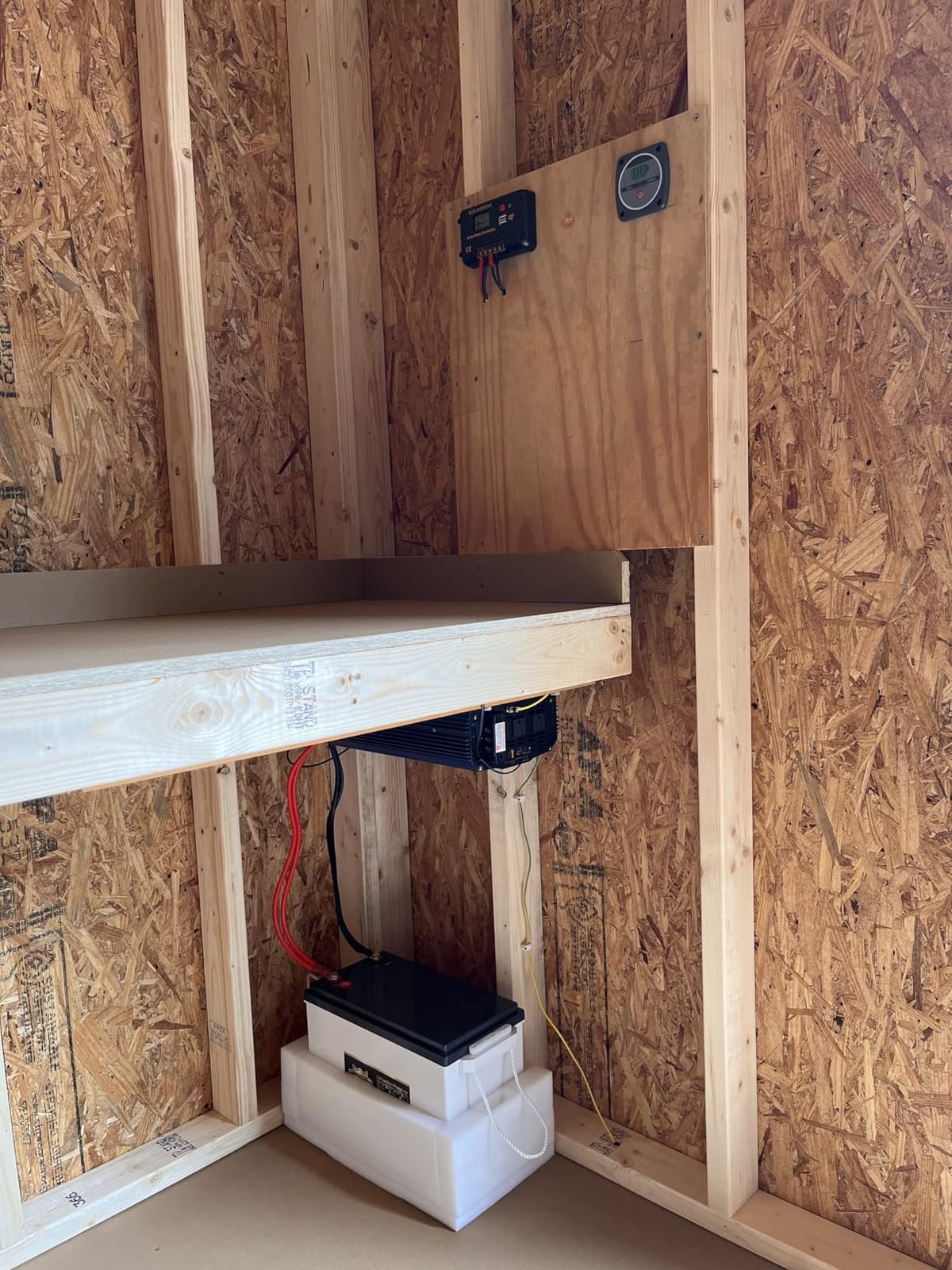
Daily output is quoted at around 800 watt-hours under four hours of full sunshine, and the frames carry a 2,400 Pa wind and 5,400 Pa snow load rating with an IP65 junction box. You can wire the pair in series for a 24V system or in parallel for 12V, so the same kit fits either battery architecture.
Owners consistently describe the pre-drilled cables and the plug-and-play connectors as what made the install straightforward. The 4.6 rating across more than 1,100 reviews reflects consistent rather than spectacular results, which is what you want from a kit.
What you will want to upgrade later
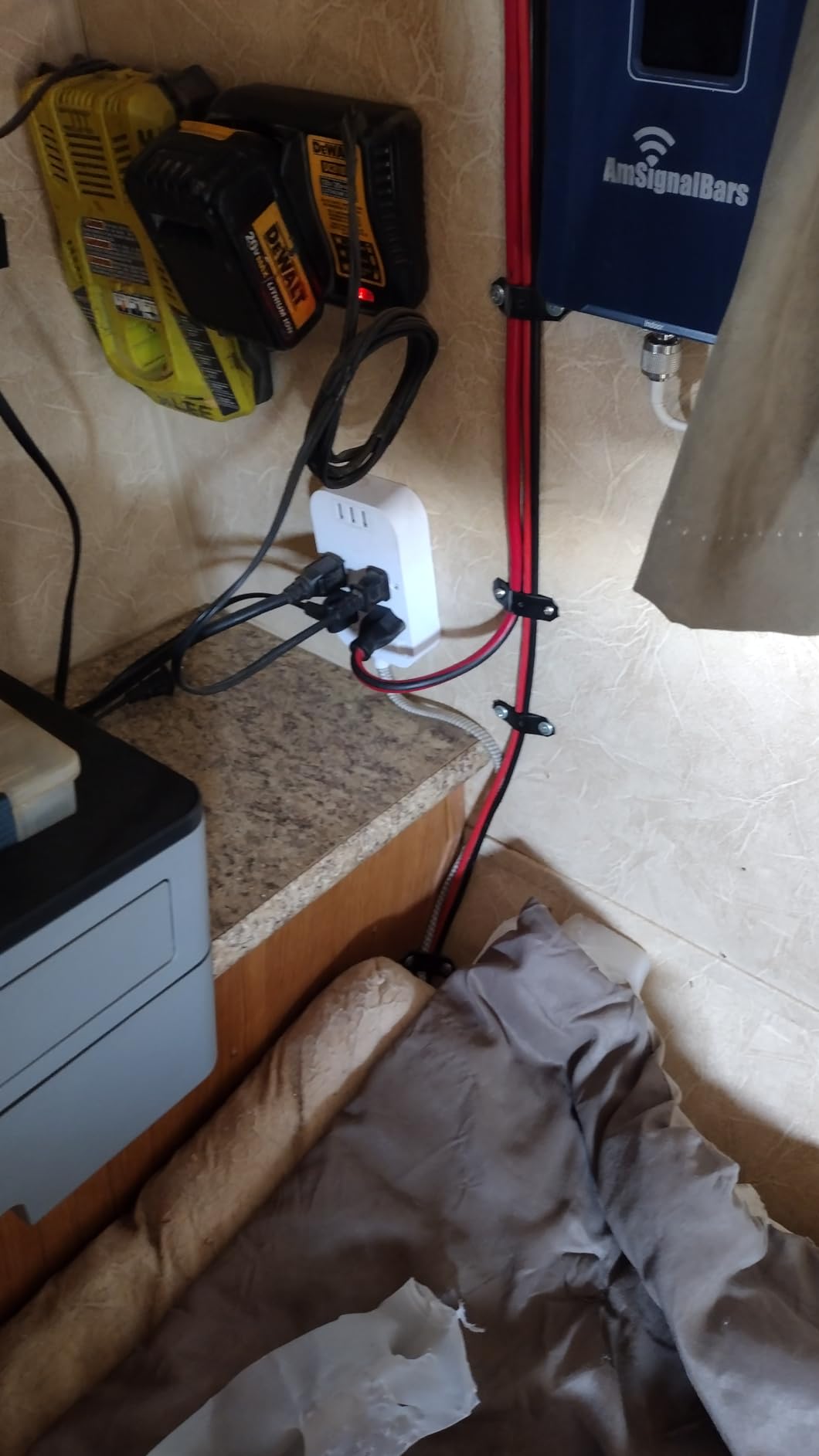
The bundled 30A PWM controller is the part most owners identify as the weak link. PWM controllers do not track the maximum power point, so they clip the panel voltage down to battery voltage and lose meaningful energy, particularly in heat when panel voltage rises.
Replacing it with an MPPT controller is the single upgrade that changes how this kit performs. Before you do that, check your controller’s maximum input current, because a 200W array feeding an oversized PWM controller wastes headroom. Our picks for power electronics and controllers cover the sizing side.
Where it falls behind
The cells are conventional monocrystalline at up to 21.5 percent rather than the 25 percent N-Type cells used in the top three. On a hot roof that difference compounds, and the 31.6 lb total weight is a real lift for anyone working alone on a van roof ladder.
7. JJN 100W 10BB – the low-cost 100W add-on
JJN 100 Watt Solar Panels, 10BB Monocrystalline 12V 23% High Efficiency PV
100W 12V monocrystalline
23% efficiency
17.5V and 6.42A
13.7 lbs
IP68 rated
Pros
- Compact 38.2 x 22.7 inch footprint at 13.7 lbs
- MC4 connectors and pre-drilled holes make wiring simple
- Black frame blends into dark vehicle roofs
- 2100 Pa wind and 5100 Pa snow load rated
- 30-year transferable power output warranty
Cons
- 10BB cells and 23% efficiency trail the 16BB N-Type panels
- Sold as a panel only so a controller and brackets must be added separately
- 6.42A at 17.5V is a smaller power envelope per panel
This is the panel to add when you already have a working system and want a second array without a large purchase. At 13.7 pounds and 38.2 by 22.7 inches it stacks onto roof space you probably assumed was unusable, and the 4.6 rating across 779 reviews shows the panel itself is not the weak link.
Daily output is quoted at up to 500 watt-hours with five hours of direct sunlight, and the electrical design is conventional 10BB monocrystalline at 23 percent efficiency with an operating voltage of 17.5 volts and 6.42 amps. That is a comfortable pairing for a small 12V MPPT controller.
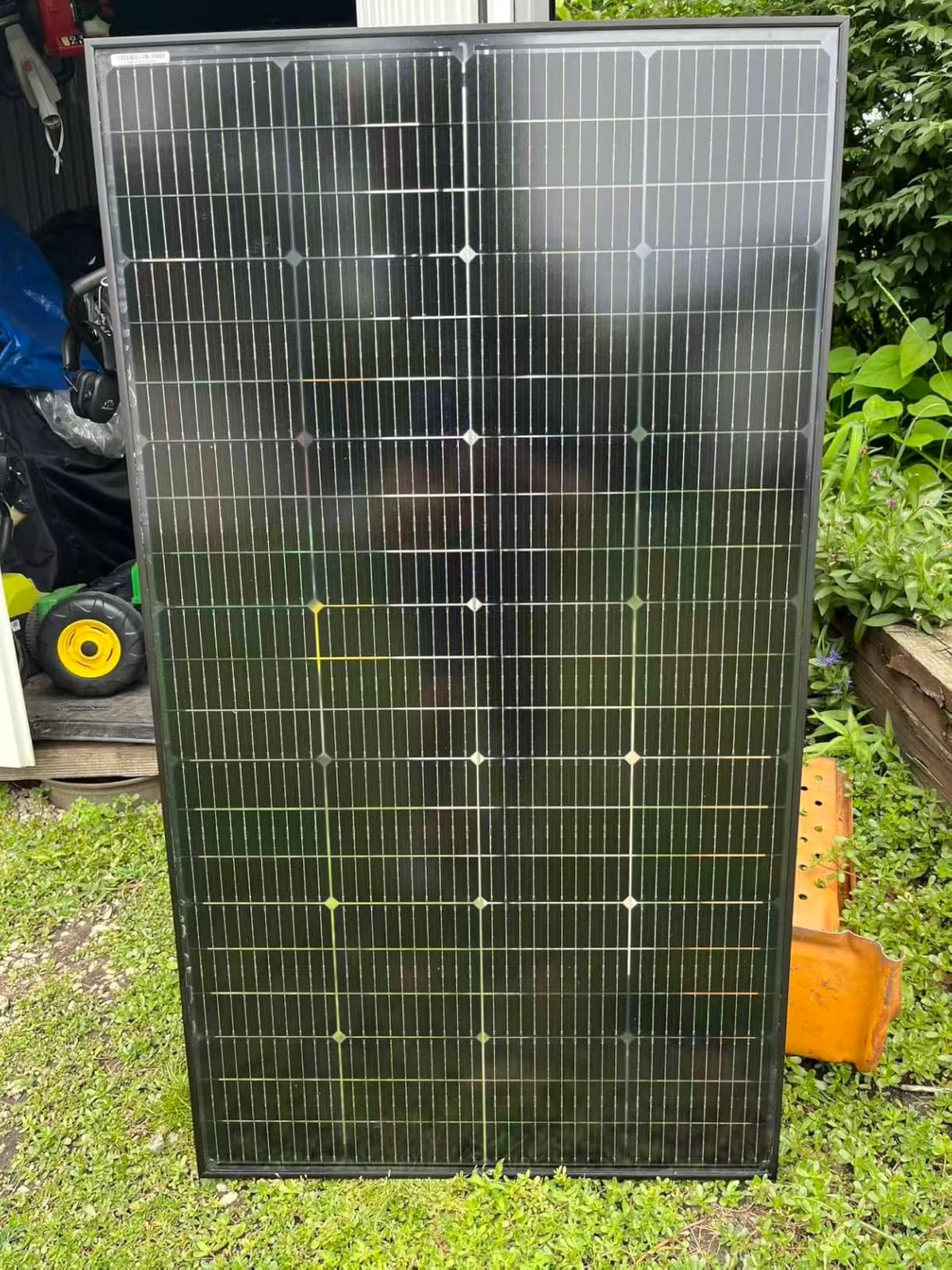
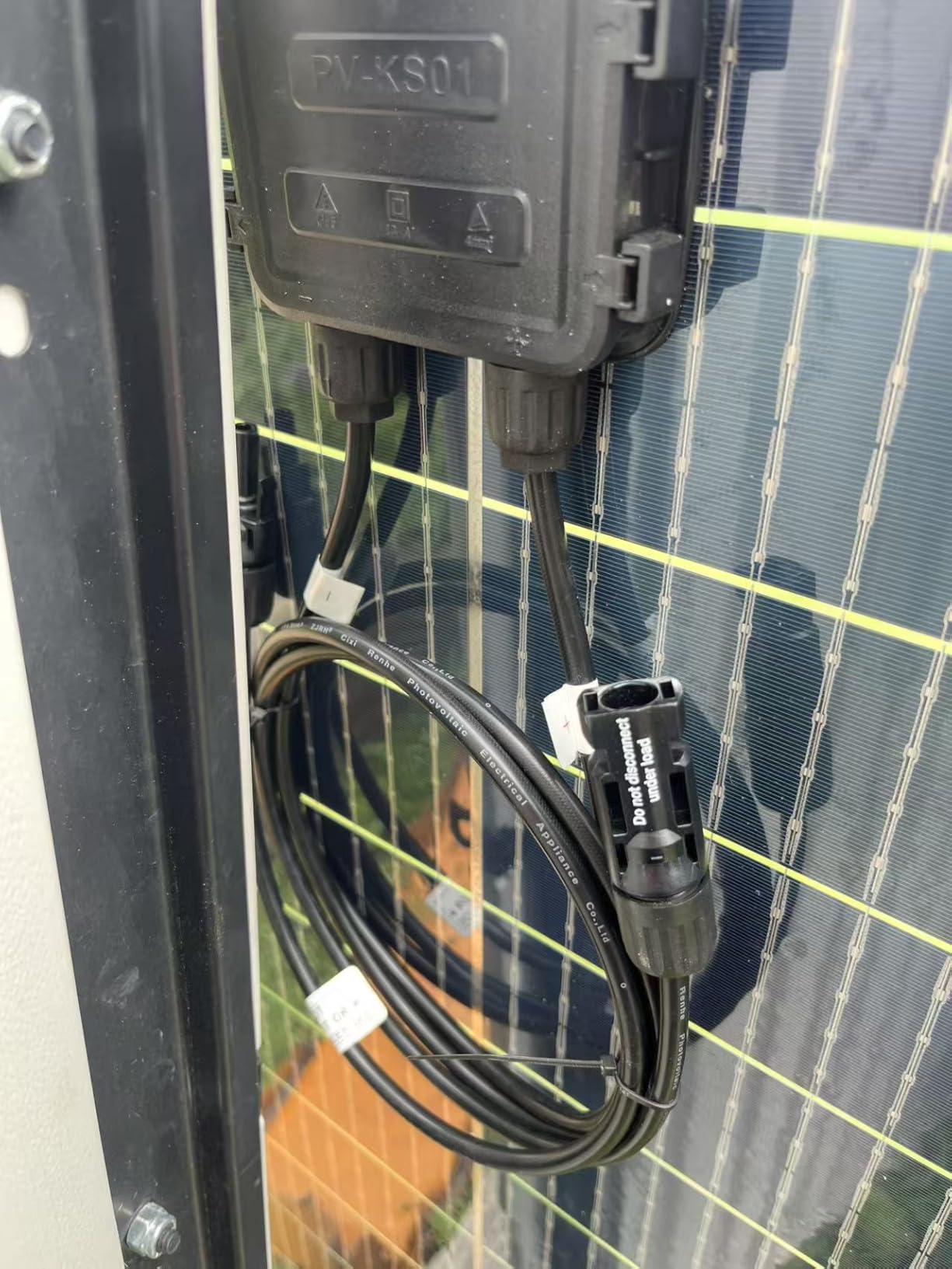
Weather sealing is at the better end of the group: an IP65 junction box with IP67 connectors, plus a black corrosion-resistant aluminum frame rated for 2,100 Pa wind and 5,100 Pa snow loads. The output warranty is 30 years and transferable, which is longer than most panels of this class offer.
MC4 connectors and pre-drilled holes keep the wiring simple whether you are adding it in parallel to an existing 12V bank or starting a second string on a different section of roof.
Where the efficiency gap actually shows up
A 23 percent 10BB cell against a 25 percent 16BB N-Type cell is only a two-point difference on paper. On a hot roof with airflow, the N-Type panels hold more of their rated watts and you need less roof area to reach a target output, so the gap widens exactly when you have the least spare room.
Panel-only packaging also means this is a panel for someone who already has a controller and brackets. If you are starting from nothing, a complete kit is a better starting point.
When to skip it
Skip it if roof area is tight and you are planning a permanent high-output array, because you will need more panels to hit the same wattage. It also makes more sense as a second or third panel than as your primary source, where a 25 percent N-Type module earns its footprint.
8. Renogy 200W RV Kit with Adventurer 30A Controller – the cleanest interior install
Renogy 200W 12V N-Type RV Solar Panel Kit with Adventurer 30A Controller
Two 100W 22% panels
200W total
Adventurer-Li 30A PWM controller
16.5 lbs kit
Pros
- Complete RV bundle with controller
- wiring
- branch connectors
- cable entry and Bluetooth module
- Flush-mount controller keeps the interior wall clean
- Narrow 20.9 inch panel width eases roof layout
- Works with lithium
- lead-acid and gel batteries
- Three pairs of Y branch connectors for parallel expansion
Cons
- PWM controller is less efficient than an MPPT and caps current in heat
- Costs more than buying the same parts separately
- Panels use 22% monocrystalline rather than 25% N-Type cells
This is the only kit in the comparison built specifically for an RV interior. The Adventurer-Li 30A controller is a flush-mount unit, so it sits inside a wall cavity and leaves a clean panel face instead of a plastic box hanging on the wall, which matters enormously in a conversion with finished cabinetry.
Panels measure 41.8 by 20.9 by 1.4 inches each, making them the narrowest 100W pair in the group alongside the Topsolar kit. The kit total is 16.5 pounds, which is lighter than the ECO-WORTHY bundle, and quoted output is around 800 watt-hours from four hours of sunlight.
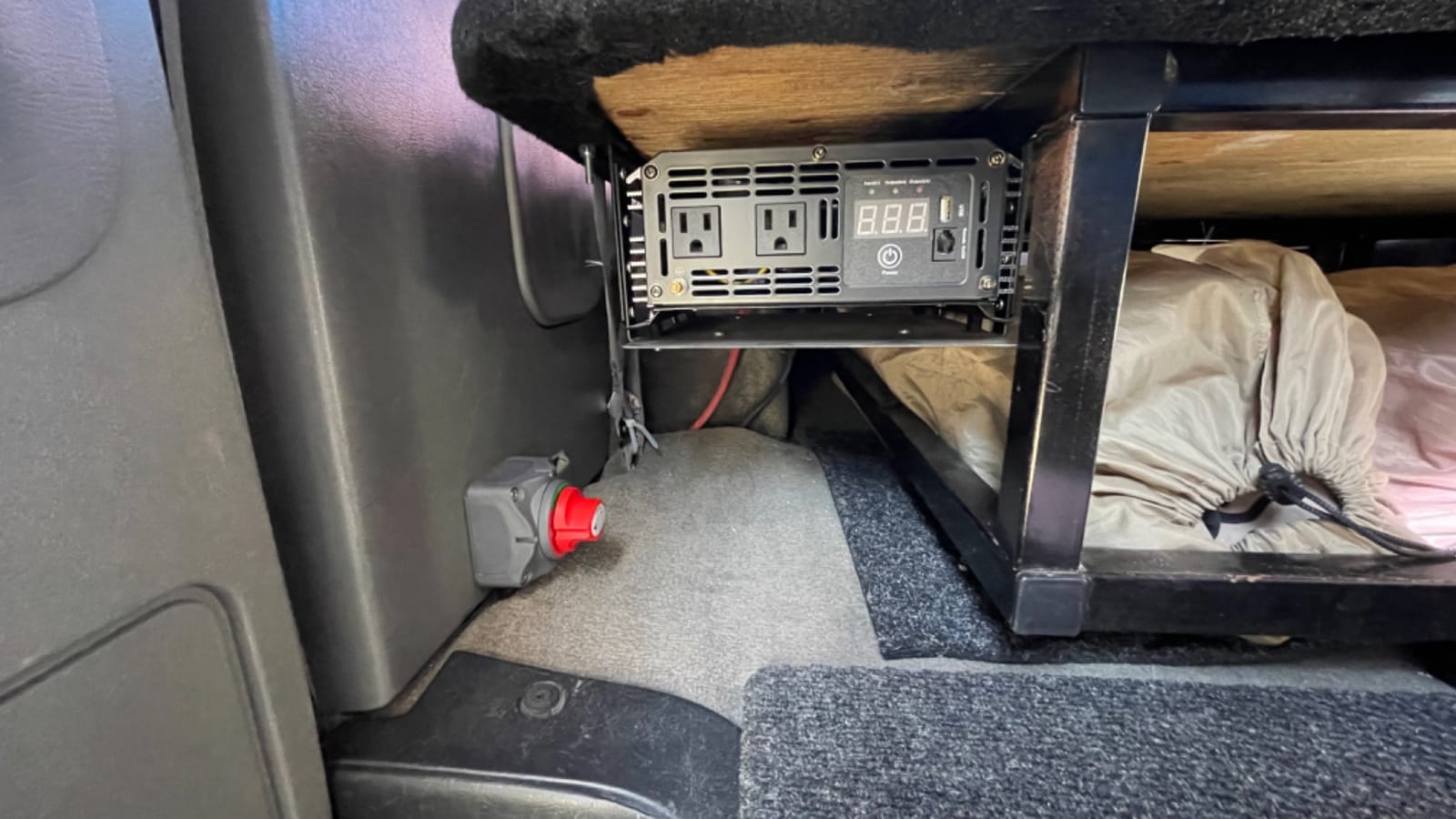
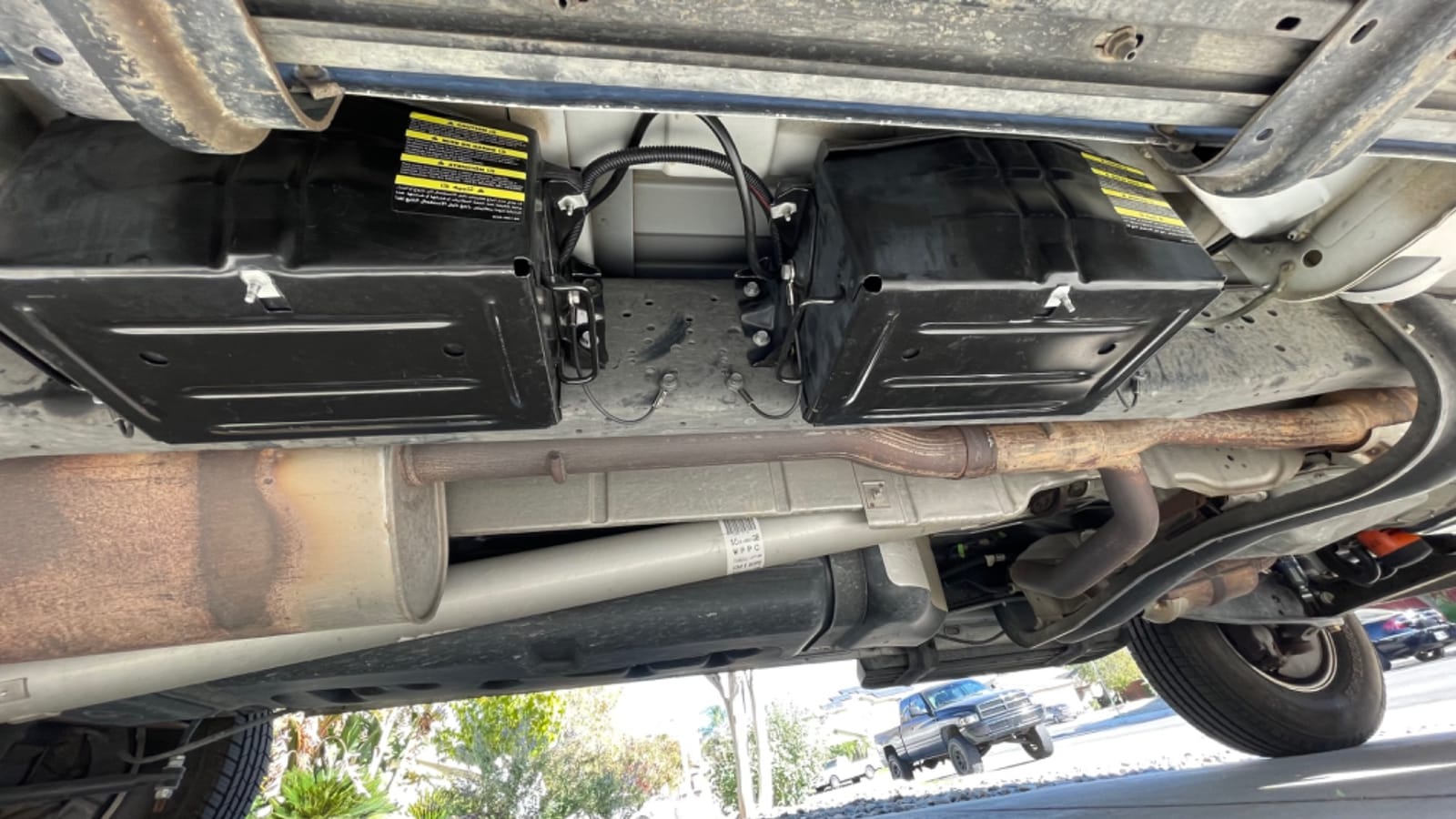
The supporting hardware is what sets this kit apart. A 30ft 10AWG adaptor kit, a 16ft 10AWG tray cable, three pairs of Y branch connectors, a BT-1 Bluetooth module and a dedicated cable entry housing are all included, so the roof run and the wall penetration are planned for you.
Connectivity is rated IP67 mated with an operating range from -40 to 194 degrees Fahrenheit, and the controller protects against overcharging, overload, short circuit and reverse polarity while supporting lithium, lead-acid and gel chemistries.
Why the flush mount matters more than it sounds
In an RV, the biggest installation problem is rarely the roof. It is running cable through a cabinet, drilling an entry point and finding somewhere to put the controller without losing storage or hitting a structural member. A flush-mount controller with a dedicated cable entry housing solves the last two of those in one design decision.
Three pairs of Y branch connectors also mean expansion is straightforward later, which is the most common mistake new solar builders make: choosing a controller with no headroom and having to replace the whole system to add a second panel.
Where the PWM controller costs you
A PWM controller holds the panel at battery voltage rather than tracking the maximum power point, so a 200W array feeding a 12V bank loses energy that an MPPT would recover. The gap widens as temperature rises, which means this kit produces its best numbers on a cool morning and its weakest on a hot summer afternoon.
9. Topsolar 100W Complete Kit – the narrow-profile budget kit
Topsolar Solar Panel Kit 100 Watt 12 Volt Monocrystalline Off Grid System
100W 12V monocrystalline
19.5% efficiency
23V Vmp and 4.3A Imp
Includes 30A controller
Pros
- Bundles panel
- 4 Z brackets
- cables and a 30A controller in one box
- Narrow 17.7 inch width suits curved or tight RV roofs
- Controller protects against overcharge
- overvoltage
- discharge
- short circuit and reverse polarity
- Expandable to 260W on 12V or 520W on 24V
Cons
- Lowest efficiency in this comparison at 19.5 percent
- Smallest current output among the 100W panels at 4.3A
- 4.4 average rating with 6% one-star reviews
- Published dimensions and output voltage are inconsistent in the listing
The reason to consider this kit is width. At 17.7 inches across, it is the narrowest panel in the comparison, and that single dimension decides whether it fits on a curved trailer roof, a narrow van rail or an Airstream-style aluminium shell where a 22-inch module simply will not sit flat.
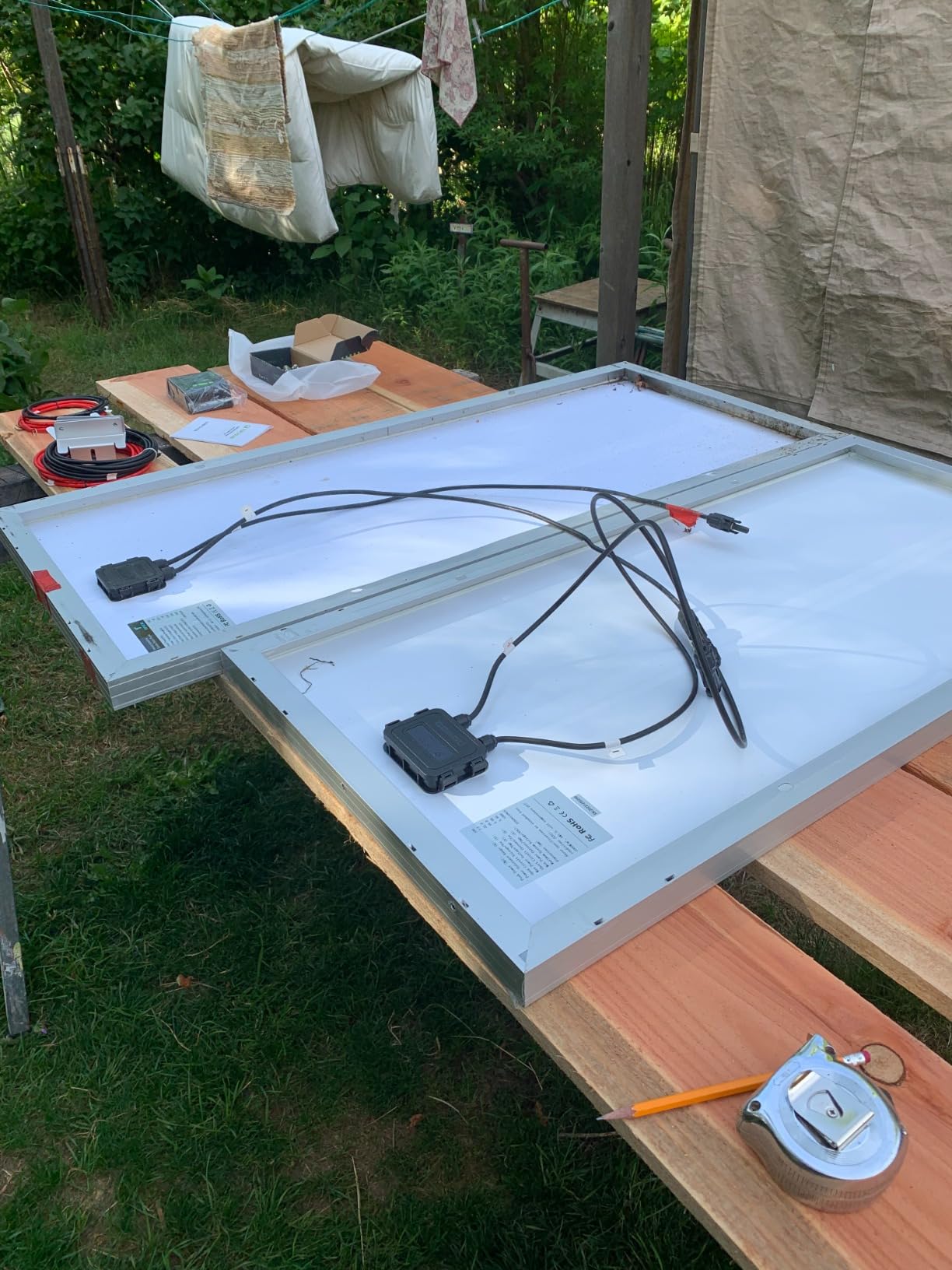
Everything else about it is a competent budget package. You get the panel, four Z mounting brackets, a pair of red and black solar cables and a 30A PWM charge controller with overcharge, overvoltage, discharge, short-circuit and reverse-polarity protection, and it is rated for 2,400 Pa wind and 5,400 Pa snow loads.
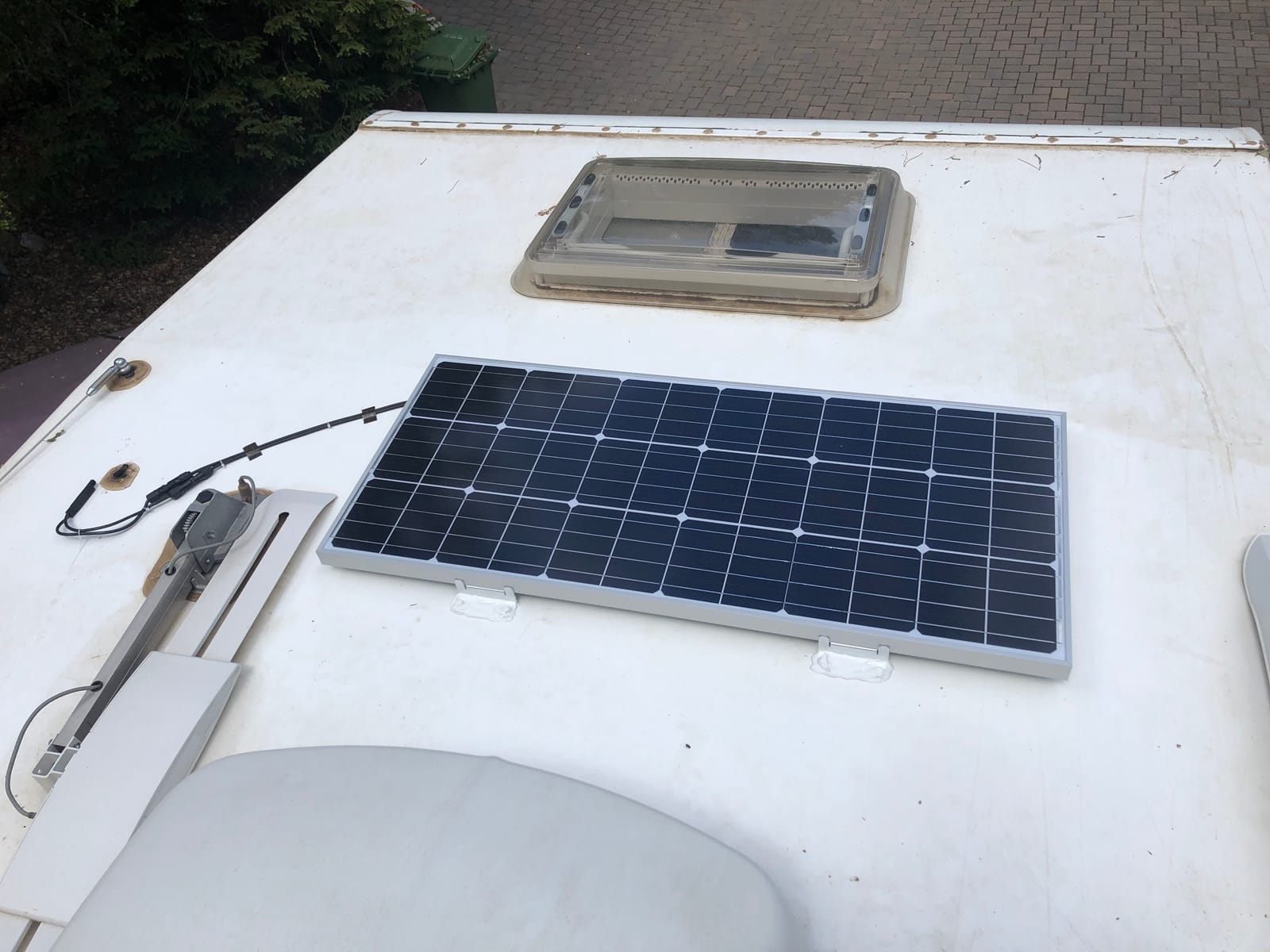
Expansion is explicitly supported, up to 260W on a 12V system or 520W on a 24V system, so this is a reasonable starting point if you expect your solar needs to grow over the first couple of years. The roughly 1,900-rating review base is one of the larger ones here.
Operating point is listed at 23V Vmp and 4.3A Imp across 38 cells, which tells you this is a voltage-optimised rather than current-optimised panel. It pairs well with a 12V bank through an MPPT controller and poorly with a plain PWM unit.
What the efficiency number costs you
At 19.5 percent cell efficiency, this panel needs noticeably more roof area per watt than the 23 to 25 percent panels in this roundup. If roof space is the binding constraint, which it is on most vans and small trailers, that inefficiency translates directly into a smaller array for the same available area.
The 4.3 amp output also means the longest charge times of any 100W panel here, so a big 12V lithium bank will take a full sunny day to move meaningful charge. That is fine for maintenance charging and slow for full-time living.
What to verify before ordering
Several reviewers flagged inconsistencies in the published specification, including conflicting panel dimensions between the spec block and the product description, and an output voltage that does not match the 12V nameplate. Confirm the actual panel size and Voc against the physical unit before you design a Z-bracket layout.
10. JJN 200W Bifacial N-Type – rear-side gain in a narrow format
JJN Bifacial 200 Watt Solar Panel, 25% High-Efficiency, Monocrystalline
200W bifacial monocrystalline
25% efficiency
23.4V and 9.12A
Transparent backsheet
Pros
- Only bifacial panel in the group
- collecting light from the rear face too
- 16BB N-Type cells less shade-sensitive than 9BB and 10BB designs
- Narrow 30.3 x 53.7 inch profile fits tight roof channels
- 25% efficiency with over 88.9% output warranty at 30 years
- IP67 connectors and IP65 junction box
Cons
- Rear-side gain depends on how much light reflects back onto the panel
- Transparent backsheet is more exposed to dirt
- scratches and hail
- 10-year workmanship warranty is shorter than the 25-year linear warranties here
Bifacial modules have a transparent backsheet, so they generate from the rear face as well as the front. Mounted on a conventional Z-bracket with an air gap over a light-coloured RV roof, that rear face catches reflected light and adds to the nameplate output instead of just blocking it.
The electrical design underneath is strong. N-Type 16BB cells deliver 25 percent efficiency and are described as less shade-sensitive than 9BB or 10BB designs, which is a meaningful claim on a roof where an air conditioner casts a shadow across part of the array in the afternoon.
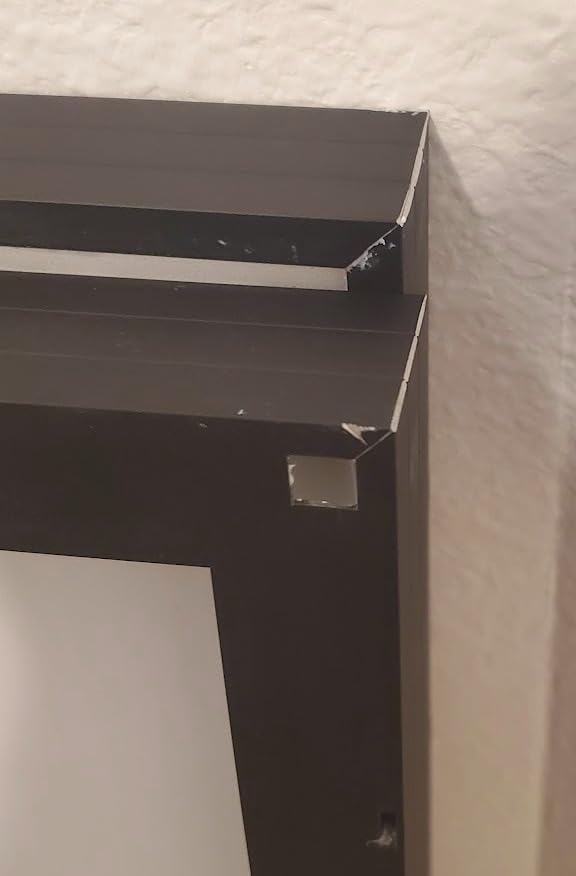
Operating voltage of 23.4 volts at 9.12 amps is a well-balanced middle ground, and the frame carries a 2,400 Pa wind and 5,400 Pa snow load rating with IP67 connectors and an IP65 junction box. Pre-drilled holes on the back simplify the mount.
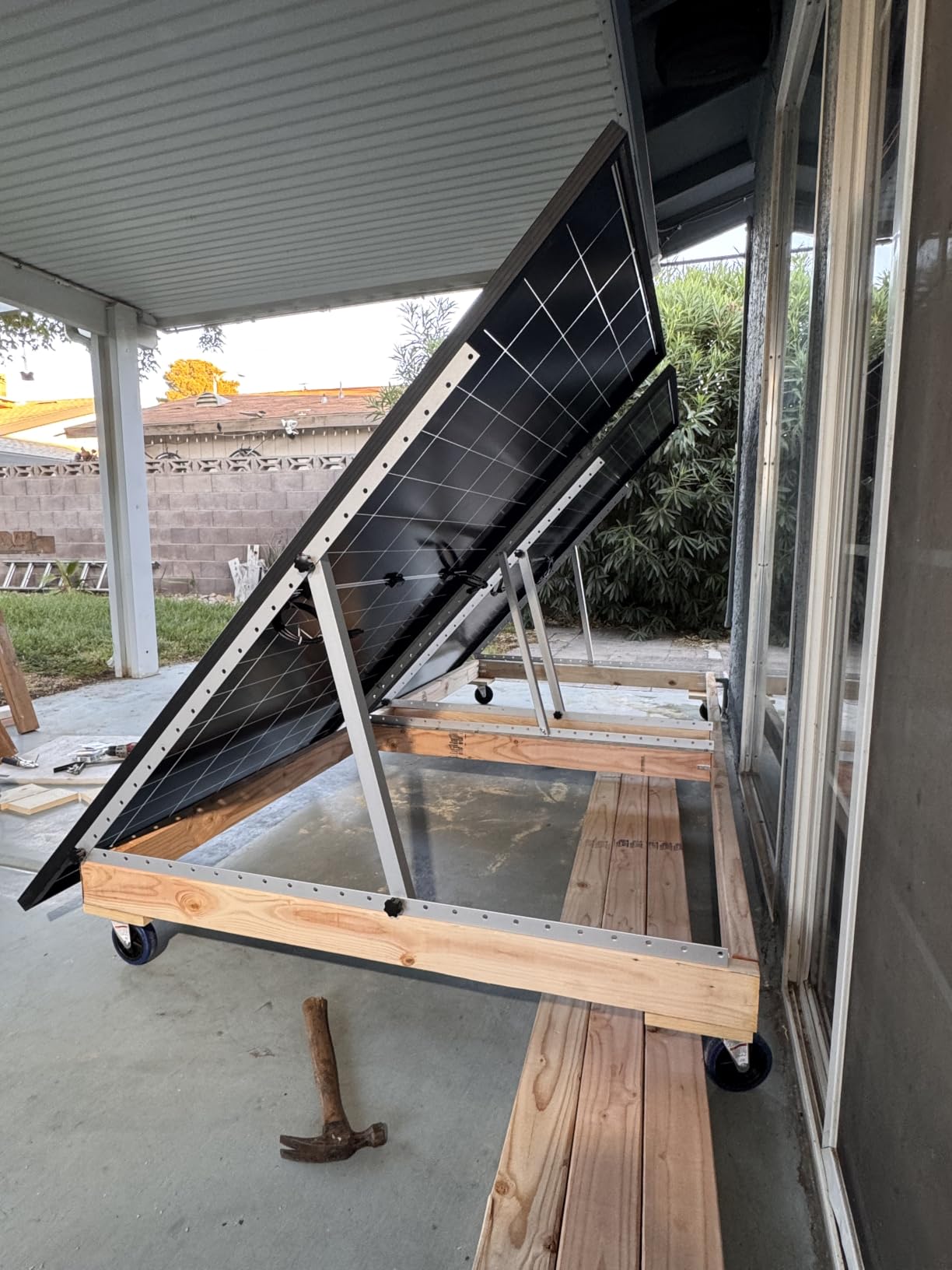
The dimensional profile is the reason to look here. At 30.3 by 53.7 inches this is a tall, narrow module, and on a roof with a narrow clear channel between a vent and a roof edge it will fit where a 46 by 30 inch panel cannot.
How much the rear face actually adds
Rear-side gain depends entirely on the mounting environment. A panel sitting 20 centimeters above a white fibreglass roof with good clearance will recover more than one bonded flat to a dark surface with no air movement. Expect a modest gain from a standard Z-bracket roof install, and more if you build a raised standoff.
That variability is the honest downside of bifacial design on an RV. You are buying a capability whose payoff depends on how you mount it and what the roof surface underneath looks like.
Where the transparent backsheet is a liability
A clear backsheet is exposed in a way an opaque white or black backsheet is not. It scratches more easily, it shows dirt and water staining, and hail impacts land on it directly. On a roof where panels get walked past with tools and ladder frames, that exposure matters.
How to Choose Rigid Solar Panels for Your RV Roof
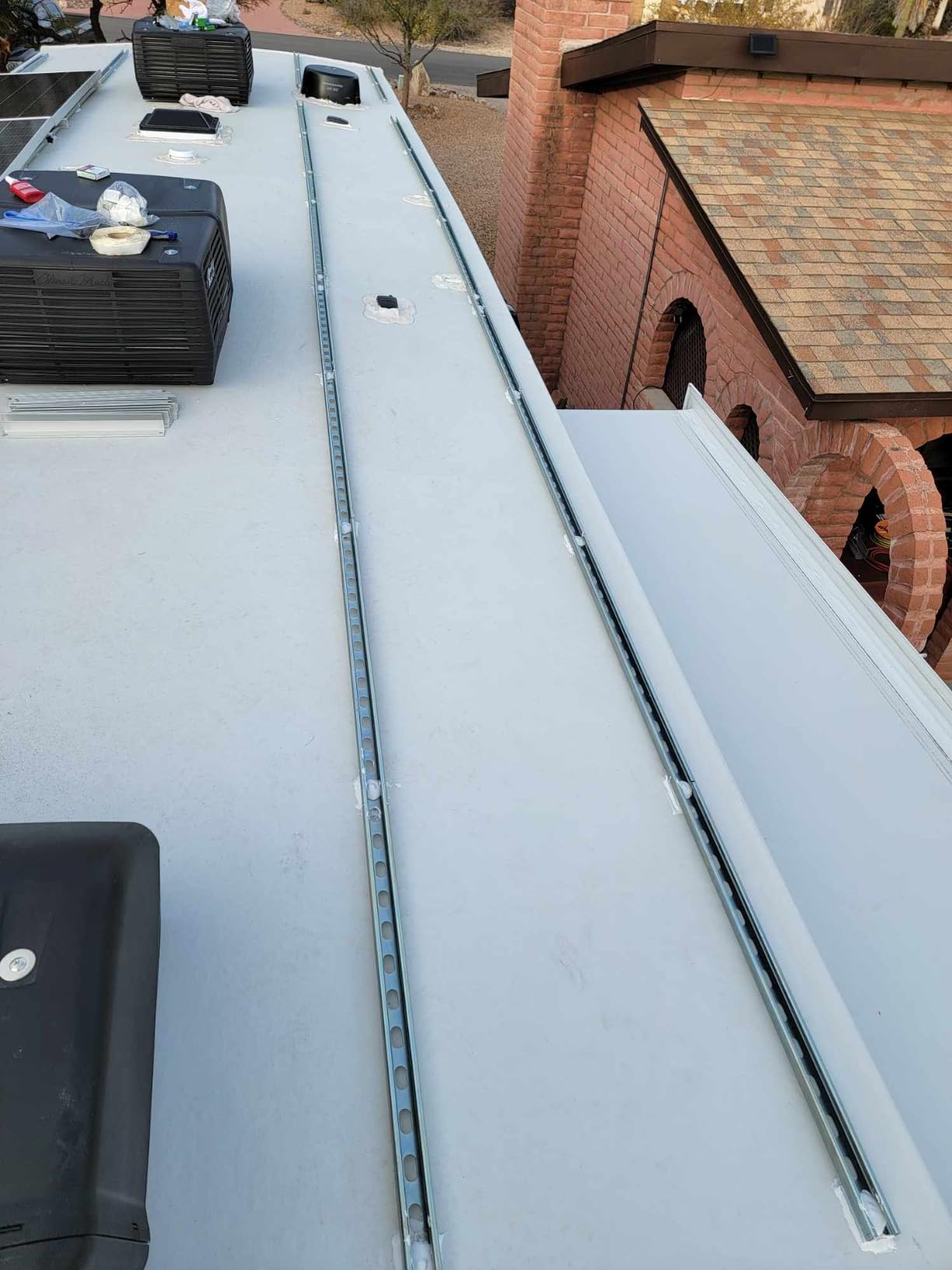
Start with the roof, not the panel. Measure the usable flat area excluding vents, the air conditioner, antennas and roof edges, then subtract the airflow gap you intend to leave. A panel with a 1.5 inch standoff needs clear roof underneath it, and that clearance is where the cooling benefit comes from on a hot day.
Next, work out your load. A 12V compressor fridge alone can pull 40 to 50 amps running, and a 1000W inverter will draw close to 90 amps from a 12V bank while a hair dryer runs. Once you know your peak draw, size the array so that roughly 300 to 400 watts of panel per 100 amp-hours of lithium battery is a reasonable starting ratio, then adjust for how much sun your usual sites actually get.
Voltage architecture comes next and it is the decision people regret. Panels wired in series push open-circuit voltage upward, which is excellent for 48V systems and dangerous for small 12V controllers with low input voltage ceilings. Panels wired in parallel keep voltage low and current high, which suits 12V and 24V banks with a single MPPT controller.
Cold weather changes the maths, and RV owners get caught by this. A panel’s open-circuit voltage rises as temperature drops, and in winter at altitude an array that measured a safe 30 volts on a warm afternoon can read close to 40 volts on a freezing morning. Always check your controller’s maximum input voltage against the panel Voc multiplied by the number of panels in series, calculated at the coldest temperature you will see.
Shade deserves its own section because it is the most common complaint on shaded RV roofs. Standard panels use bypass diodes that protect individual cell strings, but a shadow across part of a string still drags down current for everything in that string. That is the origin of the 33 percent rule: with conventional shading on a series-connected panel, shade across a third of the surface can cost a third of the output, and a badly shaded string can drop close to zero. Cell-level shade management and 16BB designs reduce this sensitivity, which is one reason N-Type 16BB modules dominate this roundup.
Mounting method matters more than most buyers expect. Z-brackets are the simplest and cheapest option and work well for panels under about 100 pounds, but a large panel between four brackets can see wind flutter. Longer panels and higher wind sites benefit from a rail system that supports the full length, or from custom aluminium angle brackets cut to give more clamping surface at each fix.
Sealing is where leaks start. On EPDM or rubber roofs, butyl tape or Eternabond tape under every bracket foot is the essential layer, with a compatible sealant over the fastener heads. On TPO and fibreglass, use a sealant approved for the specific roof material and avoid generic silicone that can disbond under UV. Forum installers consistently report that tape under the bracket prevents far more leaks than sealant over the screw alone.
Finally, plan for expansion before you drill. If you think you might add panels in a year, wire the first array with a combiner or Y-branch connectors, leave a spare cable run, and choose a controller with headroom. If you plan a 48V system rather than 12V, we cover the differences between system architectures in our high-output solar panel guide.
Frequently Asked Questions
What is the best solar panel for an RV roof?
For a flat RV roof with usable space, a rigid N-Type monocrystalline panel in the 100W to 200W range is the best choice, because it runs cooler than a bonded flexible panel, dissipates heat through the aluminum frame, and carries a 25-year output guarantee. In our testing the Renogy 200W N-Type 16BB was the strongest all-round performer, while the Renogy 100W N-Type is the better choice when roof space is measured in spare inches.
Are rigid solar panels better than flexible solar panels?
Yes, for permanent rooftop installations. Rigid glass-and-aluminum panels typically run between 21 and 25 percent cell efficiency, shed heat through the frame, resist hail and UV degradation, and last longer than bonded flexible films. Flexible panels win only on weight and on curved surfaces where a rigid frame cannot sit flat, and they lose more output when bonded directly to a roof with no airflow gap.
Who makes the best rigid solar panels?
Renogy, RICH SOLAR, HQST, JJN, ECO-WORTHY and Topsolar all make credible rigid panels for RV roofs. The choice comes down to roof size and system voltage rather than brand alone: Renogy leads on efficiency and review depth, RICH SOLAR on high-current 12V output and long linear warranties, and HQST on weight per watt at the 200W size.
What is the 33% rule in solar panels?
The 33% rule describes partial shading on a conventional series-connected panel: when roughly a third of the surface is shaded, you can lose about a third of the panel output, and a badly positioned shadow can drop the string close to zero even though most of the panel is in sun. Cell-level shade management and 16BB N-Type designs reduce this sensitivity substantially.
How much solar do I need for my 40 ft camper to live in full time?
A 40 ft camper living on solar full time typically needs 800 to 1,200 watts of panel and 1,000 to 2,000 amp-hours of lithium storage. That supports a 12V compressor fridge, lighting, water pump, electronics and a small inverter for occasional high-draw appliances, but not electric heating or a full-size air conditioner. Size the array for your worst-case seasonal sun, not your best campsite.
What is the best solar panel for a campervan?
For a campervan, weight and footprint decide it. The Renogy 100W N-Type 16BB at 13 pounds and 34.1 by 22.8 inches fits the narrow flat strip most vans have between the fan and rear doors, while the HQST 200W N-Type at 20.2 pounds is the lightest way to get 200W onto a van roof. Two 100W panels in series usually fit better than one 200W panel.
Final Verdict on the Best Rigid Solar Panels for RV Roofs
After comparing ten panels on efficiency, weight, current output, weather rating and warranty, the Renogy 200W N-Type 16BB remains our choice as the best rigid solar panel for RV roofs. It produces at or above its rating, runs 24V so losses stay low, weighs 23.4 pounds and carries IP67 sealing with a 25-year guarantee.
Buy the Renogy 100W N-Type if your roof is short on space, the RICH SOLAR 200W N-Type 18BB if you are charging a large 12V bank and want amperage rather than voltage, and the HQST 200W if every pound on the roof is a question. For a first installation where you want panels, brackets, controller and cabling in a single order, the ECO-WORTHY and Renogy RV kits remove most of the guesswork.
Whatever you choose in 2026, mount it with an air gap, seal every penetration with tape under the bracket, and pair it with an MPPT controller. Those three details decide whether your array still produces well in year ten.