
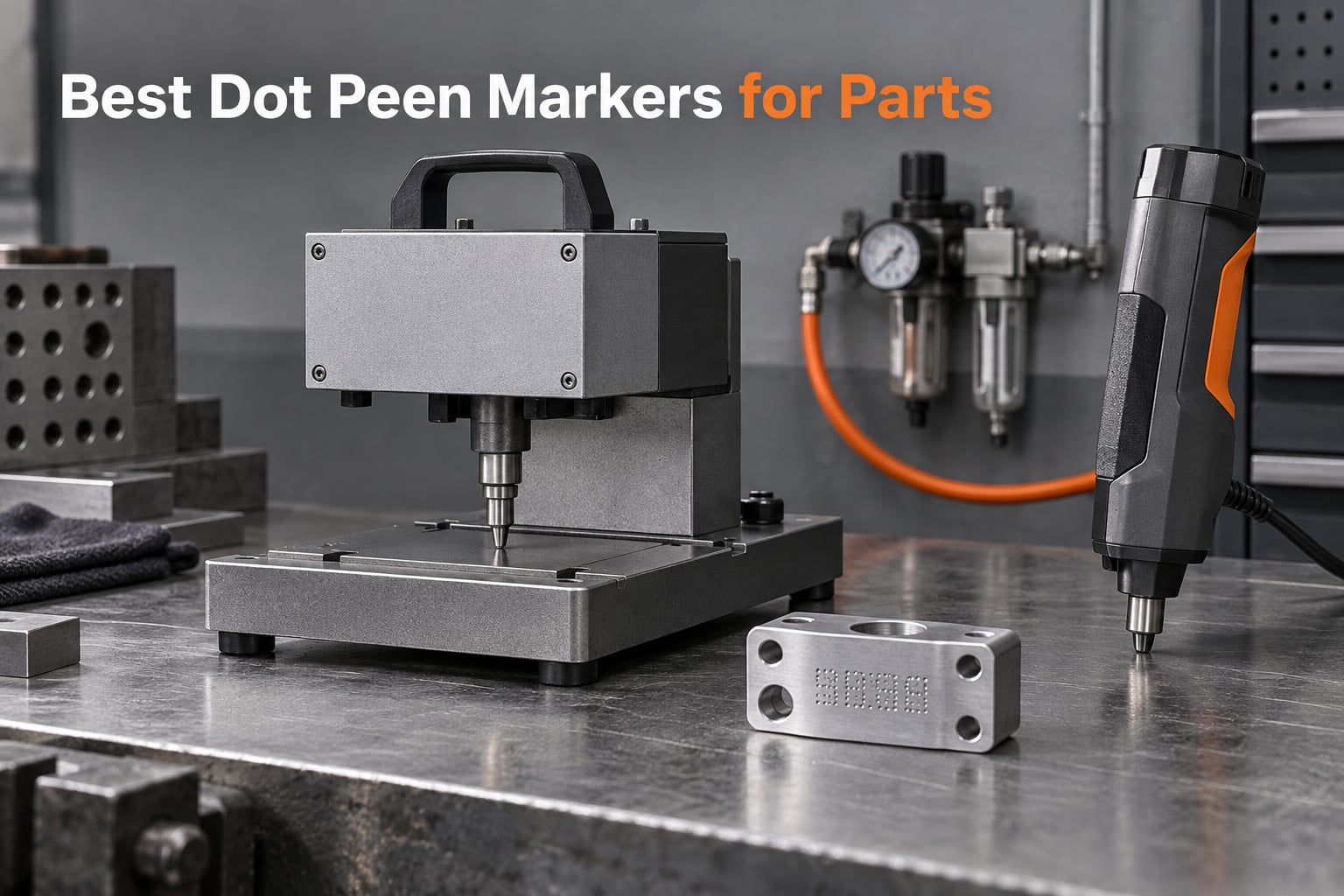
If you mark serial numbers, part numbers or VINs onto metal, the machine you pick decides whether the mark is still readable after ten years of heat, wash cycles and abuse. Dot peen is the process that answers that problem, and choosing among the best dot peen markers for parts is mostly a decision about drive type, marking window and how much abuse the mark has to survive.
I have spent the last few months reading spec sheets, owner reviews and shop-floor threads in this niche, then matching them against the machines below. What stands out immediately is how thin the editorial coverage is. Almost every page ranking for this topic is a vendor listing or a generic electric-versus-pneumatic explainer, and almost none of them name a model with honest limitations.
So this guide does. Every unit here is written up with its real marking window, its stated depth range, whether it needs an air compressor, and whether it needs a computer. Where a product has almost no owner feedback, I say so rather than borrowing confidence from the spec sheet. If you are also planning the rest of your shop, our vibratory feeder buyer guide covers the other half of small-part handling.
Updated for September 2026.
Table of Contents
What Is a Dot Peen Marker?
A dot peen marker is a machine that drives a tungsten carbide stylus into metal, plastic or composite, physically indenting a pattern of closely spaced dots that spell out characters, logos or Data Matrix codes. Because the mark is a physical impression rather than ink, pigment or a chemical change, it cannot be removed without destroying the part underneath.
That permanence is the whole point. A dot peen mark survives heat, solvents, abrasion, galvanic wear and cleaning, which is why it dominates automotive, aerospace, oil and gas, and anti-theft marking work where traceability is a legal requirement rather than a nicety.
There are two drive types, and they behave very differently:
Electric units use an electromagnetic solenoid or a stepper-driven head to fire the stylus. They need only mains power, run quietly, and are the simpler install for a shop without a suitable compressor.
Pneumatic units use a compressed-air piston. They deliver a heavier hit at the tip, which is where the extra marking depth on hard steel comes from, and they need a filtered, regulated air supply.
One more term you will meet constantly: the marking window is the rectangular area the machine can reach, quoted in millimetres or inches. A 125 by 50 mm window handles a serial number on a housing. It will not handle a nameplate.
Top 3 Best Dot Peen Markers for Parts in 2026

LYXC Pneumatic 125x50mm Dot Peen
- 125x50mm marking window
- Pneumatic drive
- 7 inch touchscreen
- No PC required

DNYSYSJ 400W Electric Marker
- 400W electric drive
- No air compressor
- Adjustable depth and speed
- Windows software
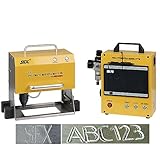
XINCHENG 150x80mm Pneumatic
- 150x80mm marking area
- Electromagnetic base
- Depth up to 1mm
- HRC65 needle
Those three cover the most common shop configurations. The rest of the list adds a benchtop system, a nameplate specialist, a high-throughput electric unit and two compact electric machines aimed at small workspaces.
All 10 Dot Peen Markers Compared in September
| Product | Specifications | Action |
|---|---|---|
| LYXC Pneumatic Dot Peen 125x50mm |
|
Check Latest Price |
| DNYSYSJ 400W Electric Metal Marker |
|
Check Latest Price |
| XINCHENG Pneumatic 150x80mm Marker |
|
Check Latest Price |
 INPTNOV Handheld Electric Dot Peen INPTNOV Handheld Electric Dot Peen |
|
Check Latest Price |
 BYOIPLOI 1000W Electric Nameplate Marker BYOIPLOI 1000W Electric Nameplate Marker |
|
Check Latest Price |
 KTZDH Handheld Pneumatic PB01 Marker KTZDH Handheld Pneumatic PB01 Marker |
|
Check Latest Price |
 KTZDH PS04R Benchtop Pneumatic KTZDH PS04R Benchtop Pneumatic |
|
Check Latest Price |
 NEATOOM 200x130mm Pneumatic Marker NEATOOM 200x130mm Pneumatic Marker |
|
Check Latest Price |
| LYNICESHOP 110V Electric Dot Peen |
|
Check Latest Price |
| Dlinanta 400W Electric Auto-Serial Marker |
|
Check Latest Price |
1. LYXC Pneumatic Dot Peen Marker 125x50mm – Best Overall
US Stock Pneumatic Dot Peen Marking Machine Metal Engraving Machine Pneumatic Marking Machine Marking Field 120×50mm for Letters, Serial Numbers, VIN Code, Chassis Number, Date, Graphics,etc.
Pneumatic drive
125x50mm window
Depth 0.02-1.0mm
7 inch touchscreen, no PC
Pros
- Large 125x50mm marking field in a compact body
- Integrated 7 inch touch screen removes the need for a computer
- 3-5 characters per second marking speed
- Hard alloy needle handles material up to HRC60
- Verified stable operation at 40C ambient
Cons
- Requires a connected air source to operate
- 23 percent of ratings sit at one star
- Software learning curve reported by some first-time users
This is the unit I keep coming back to for a general-purpose shop machine. The 125 by 50 mm window is the sweet spot between a serial number and a decent-size data block, and the body is small enough at 28.5 pounds that one person can carry it to a bench or a parts cage.
Its most useful feature is the integrated 7-inch touch screen. You program characters, serial sequences and graphics on the machine itself, so there is no PC to find, network to join or software licence to expire. In a shop where the marking station is shared by two shifts, that removes a whole category of friction.
Marking speed runs 3 to 5 characters per second and the depth range is 0.02 to 1.0 mm, with a hard alloy needle rated to HRC60. The manufacturer also states verified stable operation at 40C ambient, which matters if you are marking parts that come off a hot line.
It is a pneumatic machine, so plan for a compressor. Owners also report a genuine learning curve on the software, so budget a morning for setup rather than an afternoon.
When the 125x50mm window is enough
If your work is serial numbers, part numbers, dates and short codes on flat steel, aluminium or hard plastic, this window is generous. It comfortably fits a full alphanumeric code with a date block beside it.
The 100W power draw and 3-5 characters per second throughput also mean it keeps up with a job shop that marks dozens of parts a day rather than fighting it on every cycle.
When it is the wrong machine
It cannot cover a nameplate. A 125 mm-wide field is a serial number, not a data plate, and trying to mark a full nameplate means repositioning the part many times.
Be honest about the review signal too. Twelve ratings averaging 4.0 with a 23 percent one-star share is a mixed bag, and that share is the single largest reason I did not rank it higher despite the strong spec sheet.
2. DNYSYSJ 400W Electric Metal Marker – Best Value
400W Electric Metal Marking Machine Steel Plate Engraving Machine for Metal Nameplate Tag Marking 110V
400W electric drive
110V
No air compressor
Adjustable range, depth and speed
Pros
- Electric marking needs no air compressor
- Adjustable marking range depth and speed
- Windows software handles Chinese characters letters and graphics
- Owners report it engraves as expected and is simple to learn
Cons
- Software install and first setup take a few minutes
- 31 percent of a very small rating pool sits at three stars
If your shop has no compressed air infrastructure and you only want to start marking, this is the machine I would put in the corner first. It runs from a standard 110V socket and needs no pump, no FRL unit and no airline.
The 400W electric head marks with an adjustable range, depth and speed, which sounds basic until you realise it means one machine covers mild steel and aluminium without swapping setups. The Windows editing software handles letters, numbers, Chinese characters and graphics from the same window.
At 33 pounds and roughly 16.5 inches square, it is a bench machine rather than a handheld. That is fine for repeat work on the same station, and it becomes a disadvantage the moment you want to walk it to the parts rack.
Owners describe it as straightforward to learn. The most common complaint is the software install taking a few minutes at the start, which is a one-time cost rather than a running annoyance.
Why electric wins in a small shop
No compressor means no dryer, no FRL unit, no airline to plumb and no compressor maintenance schedule. For a shop marking a few parts a day, that removes an entire support chain for a machine that only needs a socket.
Electric marks are also repeatable day to day. A solenoid driven at a fixed frequency and depth setting does not drift with air pressure the way a pneumatic piston can.
Where you will feel the limits
Electric heads are generally shallower than pneumatic heads on hard steel. If you need deep marks on 304 stainless or tool steel, you will end up pushing the force setting or moving to a pneumatic unit.
Chinese character support is genuinely useful for export work, but the software is Windows-only, which is another reason the touchscreen units on this list are worth considering.
3. XINCHENG Pneumatic 150x80mm Marker – Best for Field Service
Pneumatic Metal Dot Peen Marking Machine Metal Maker Pneumatic Marking Machine with Powerful Electromagnetic Base 150x80mm(5.9×3.15inch) Pneumatic Portable Marking Machine for Serial Numbers VIN
Pneumatic drive
150x80mm area
Depth up to 1mm
Electromagnetic base
Pros
- Large 150x80mm marking area suits on-site part tagging
- Electromagnetic base holds firmly on metal surfaces
- 7 inch touch screen removes the need for a computer
- High-precision linear guide for consistent mark depth
- One-year warranty with lifetime online support
Cons
- Pneumatic design requires an external air supply
- Review base is only 4 ratings
This one is built for the technician who marks on the customer’s site rather than in a factory. The electromagnetic base is the reason: it clamps to a steel frame or a machine base and holds while you mark, with no fixture and no part shifting.
The 150 by 80 mm window is the largest in the handheld group here, so a full VIN, a serial number and a date fit in one pass. Depth is stated up to 1 mm, and the hard alloy needle is rated to HRC65, the highest hardness rating among the handheld units on this list.
It runs on 0.4 to 0.6 MPa air, draws 100W, and marks 3 to 5 characters per second. The 7-inch built-in touchscreen means no laptop in the van, and the housing is described as explosion-proof, anti-static and resistant to impact and scratching, which is the vocabulary you want to see on a field tool.
A standard 6 by 110 mm pneumatic marking needle is included. The warranty is one year with lifetime online support, which in this segment is better than most and far better than none.
Why the magnetic base changes the job
Marking a part in place means you are not bringing the part to the machine. On a machine base, a gearbox housing or a steel handrail, the base holds the unit still while the stylus does its work.
That removes fixture design from most field jobs entirely, and it removes the most common source of a smeared or half-legible mark: the workpiece moving between strokes.
What to check before you commit
You need a compressor that can hold 0.4 to 0.6 MPa continuously, plus an FRL unit. A small pancake compressor will not keep up with a piston head.
Four ratings is not a track record. The spec sheet is strong and the warranty terms are clear, but nobody has yet posted a long-term report on needle wear or controller longevity.
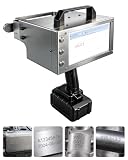
4. INPTNOV Handheld Electric Dot Peen – Best for Mobile Repair
INPTNOV Handheld Electric Dot Peen Marking Machine, 150W Portable Metal Engraver with Touch Screen Force Adjustment, 4.7″x2″ Marking Area for VIN Code, Serial Numbers and Metal Plates
150W handheld electric
4.7x2 inch window
Depth up to 1.5mm
7 inch touchscreen
Pros
- Electric operation removes the need for an air compressor
- Compact and lighter than traditional pneumatic machines
- 7 inch touch screen with built-in memory and serial generation
- Electromagnetic adsorption with anti-vibration base
- Ergonomic non-slip handle reduces fatigue on long jobs
Cons
- Only one review posted so owner feedback is thin
- 4.7x2 inch marking area is small next to the pneumatic units
This is the answer for a van or a service truck where there is no compressor and no room for a laptop. A 150W electric drive, a 7-inch touchscreen and built-in serial number generation cover the two things a field technician actually does: read a part and write a code onto it.
Depth is adjustable up to 1.5 mm, which is the deepest stated maximum in this group, though on a handheld the real limit is the surface and the material rather than the headline figure. The electromagnetic adsorption plus anti-vibration base holds a ferrous workpiece while you mark.
At 9.9 by 8.2 by 12.6 inches it is genuinely portable, and the non-slip handle is a real consideration when you are leaning over a machine base to read a number.
Terms are 30-day return, one-year warranty and lifetime technical support. I would still treat the single 5-star rating as unproven rather than as evidence.
When a small window is a feature
A 4.7 by 2 inch window is enough for a serial number or a short part code, and small windows are the point on a handheld. The whole unit stays light enough to control one-handed over an awkward workpiece.
Built-in memory and automatic serial generation matter more than usual here, because a technician marking the same housing ten times a day should never have to re-type the base code.
Where it will disappoint you
If you mark nameplates, multi-line blocks or anything wider than a code, the window is too small and you will be repositioning constantly.
One review is one review. The design, the interface and the claimed depth all come from the listing rather than from owners, and I would not commit a production line to it without a test on your own parts.
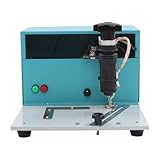
5. BYOIPLOI 1000W Electric Nameplate Marker – Best for Throughput
BYOIPLOI 110V 1000W Electric Metal Marking Machine, Electric Marking Machine, Industrial Metal Plate Nameplate Marker, Adjustable Depth 0.01-1.5mm for Equipment Valves Signs Labels
1000W electric
6.69x3.94 inch area
1.18-7.87 in/s
Depth 0.01-1.5mm
Pros
- High-output 1000W motor with 1.18-7.87 in/s marking speed
- Wide 6.69x3.94 inch marking area with depth up to 1.5mm
- USB interface and software with auto memory and QR code support
- Alloy and steel build with scratch and impact-resistant coating
- T-slot platform with one-click switching
Cons
- Only 2 reviews so owner feedback is minimal
- A connected computer is required for the software workflow
Throughput is the reason to look at this one. The marking speed band of 1.18 to 7.87 in/s is a real adjustment range, and combined with a 6.69 by 3.94 inch area it can put a full data plate down in one pass rather than three.
Depth adjusts from 0.01 to 1.5 mm, which is unusually wide, so you can mark a hairline reference code or a deep tag number on the same machine. The 1000W figure is the motor rating rather than a depth rating, but it is the power head behind that range.
Software comes over USB, with automatic memory and QR code support alongside letters, numerals, symbols and graphics. The T-shaped groove in the bed is for fixture fixation, which is what separates a machine meant for production from one meant for a workbench.
It weighs 27.2 pounds and runs on 110V, so no compressor and no three-phase supply. Two 5-star ratings are not evidence of reliability, and the computer requirement is a genuine addition to the install.
What the T-slot bed buys you
A grooved platform lets you bolt a fixture or a stop into position and mark the same part the same way every time. Repeatability comes from the fixture, not from the machine.
On repeat work, that consistency is worth more than a bigger window, and it is why bench units like this sit in production cells while handheld units sit in toolbags.
Where the compromises sit
There is no built-in touchscreen, so your PC has to be present, powered and connected every time you mark. In a shared or dusty environment that is a reliability risk.
Two reviews means we have no long-term picture of stylus wear, controller life or software updates. Treat the 5.0 rating as a starting point and test before standardising.
6. KTZDH Handheld Pneumatic PB01 – Best for File-Based Graphics
Handheld Pneumatic Dot Peen Marking Machine for VIN Code,Chassis Number,Manufacture Date,Portable,Heavy-Duty Engraver-PB01 Panel Included
Pneumatic drive
0.01-1mm depth under HRC60
DXF JPG KMF import
Panel or PC versions
Pros
- Four marking area options and panel or no-panel configurations
- Electromagnetic base on the PH01 and PB01 variants
- App accepts JPG DXF and KMF files plus custom designs
- Wide 100-240V input for international use
Cons
- Some variants need a Windows PC which adds setup complexity
- The panel battery is not included in the package
This is the most flexible listing in the handheld pneumatic group, and the flexibility is the point. Four marking area options and a choice of panel-equipped or panel-free configurations mean you can specify the machine for the work rather than compromise on one size.
The PB01 configuration includes a 7-inch touch screen panel and needs no PC, while the PH-series runs the marking software from a Windows machine on a supplied USB disk. If your shop already has a dedicated PC at the marking station, the PH version is cheaper and perfectly reasonable.
File support is the differentiator: JPG, DXF, KMF and custom designs all load through the app, so a logo or a CAD-derived part number goes on the part without being redrawn by hand.
Depth is stated at 0.01 to 1 mm on material under HRC60, air input 0.2 to 0.6 MPa and mains input 100-240V, so it works internationally. There are no owner reviews at all on this listing, so treat it as a specification-led purchase.
Why file import matters for real work
Typing characters one by one is fine for a single serial number and painful for anything else. DXF import means a part number that already exists in your CAD file arrives as a mark, with no retyping and no transcription error.
That is the difference between a marking machine that gets used and one that gets bypassed with a scribe after a month of friction.
Where to be careful
Because there are no owner reviews, you are buying a manufacturer specification rather than a field-proven record. Ask directly about stylus availability and controller parts before you commit.
Decide the panel-versus-PC question early. Mixing both conventions across a shop is a common source of confusion for whoever ends up doing the marking.
7. KTZDH PS04R Benchtop Pneumatic – Best for Batch and Rotary Work
Kuntai Pneumatic Engraver Bench Top Dot Peen Marking Machine Industrial Engraving Equipment-PS04R
Benchtop pneumatic
12x8 inch marking area
Rotary chuck included
Depth 0.1-1mm
Pros
- Largest marking area in this group at 12x8 inches
- Benchtop format suits repeat batch production work
- Integrated operating panel with mouse and keyboard support
- Rotary chuck handles round parts to 4 inch diameter and 11 lbs
Cons
- 132 pound unit that needs a stable bench and floor space
- Rotary chuck adds a size and weight limit on round workpieces
- No owner reviews posted yet
This is the only true benchtop machine in the list and the only one with a 12 by 8 inch marking window, which is roughly 10 times the area of the small handheld units. Nameplates, data plates and multi-line blocks are the natural work for it.
The included rotary chuck is what separates it from a large-window portable. It takes round workpieces from 1 to 4 inches in diameter up to 11 pounds, so you can wrap a mark around a short tube or a ring without buying a separate 4th axis fixture.
Depth runs 0.1 to 1 mm depending on material hardness, and the operating panel takes a mouse and keyboard for the marking app, which is how you set up multi-part programs. Custom content can be imported into the app.
It is 132 pounds and 28.7 inches tall. You are buying a permanent floor position, a dedicated air supply and a one-year warranty, and there are no owner reviews to tell you how the panel holds up over years.
When a 12×8 inch window is the whole point
If you mark OEM nameplates, equipment tags or multi-line instruction blocks, a handheld window means re-originating the part four or five times. This window does it in one pass.
It also gives you room to build a layout with a logo, a code block and a date, which is what most nameplate work actually requires.
Before you buy, plan the floor space
At 132 pounds this is not a bench you move around. It needs a stable table rated for the load, an air line capable of feeding a piston continuously, and somewhere it will live for years.
The rotary chuck limit is real too. Parts above 4 inches in diameter or over 11 pounds need a different fixture, so check your part range against that ceiling first.
8. NEATOOM 200x130mm Pneumatic Marker – Best for Nameplates and PVC
Pneumatic Dot Peen Marking Machine, 200x130mm Marking Area, Computer Controlled Metal Engraver for Nameplates, Hard Plastics, PVC, 1-2 Characters/s, 0.1-1mm Marking Depth
Pneumatic drive
200x130mm area
HRC98 needle
Depth 0.1-1mm
Pros
- Large 200x130mm field for a compact-format machine
- Dual-guide rail system keeps mark depth even
- HRC98 needle handles stainless brass copper hard plastics and PVC
- Included magnetic clamp and pressure gauge simplify setup
- Adjustable needle height up to 7.87 inches
Cons
- A computer and an air pump must be supplied separately
- Slower at 1-2 characters per second
This unit targets the middle ground: a genuinely large 200 by 130 mm marking field in a body far smaller and lighter than the 12×8 inch benchtop. At 35.3 pounds it is still a bench machine, but a bench machine you can actually reposition.
The HRC98 super-hard needle is the number to notice. It is specified for stainless steel, brass, copper, hard plastics and PVC, which makes it the unit here with the broadest stated material range for a mixed shop.
The dual-guide rail system is what keeps depth even across a 130 mm span, and the needle height adjusts up to 7.87 inches so you can mark on a thicker workpiece without a riser. A magnetic clamp and a clear pressure gauge are included.
Two things you must supply: a computer and an air pump. That is fine if you already have both, and it is a bad surprise if you assumed the package was complete. Marking speed is 1 to 2 characters per second, the slowest on this list.
Why the needle hardness decides your material list
Stylus hardness is the specification that quietly limits what you can mark. A lower-grade needle rounds off quickly on stainless and your depth drops with it.
HRC98 is what allows the same machine to handle hard stainless and softer PVC without a second head, which matters when your parts come from several customers rather than one production run.
Where the slow speed bites
At 1 to 2 characters per second, a long serial plus a date block takes noticeably longer than on the 3 to 5 character units. Fine for a batch marked once, tiring for a hundred marked an hour.
With no reviews and no bundled computer or pump, the real cost of this machine is the working day around it, not the box.
9. LYNICESHOP 110V Electric Dot Peen – Best for Small Workspaces
110V Electric Marking Machine, 6.7×3.9″ Dot Peen Engraver, USB, Adjustable Depth, Metal Non-Metal Nameplate Marking, Plate Tag Engraving
110V electric
6.7x3.9 inch area
Depth 0.01-1.5mm
1.18-7.87 in/s
Pros
- Compact 10.6x14.2x7.9 inch footprint suits small workspaces
- Adjustable depth from 0.01 to 1.5mm
- Marking speed adjustable from 1.18 to 7.87 in/s
- T-slot platform and one-touch control simplify fixture setup
- Alloy and steel build with scratch and wear resistant coating
Cons
- No owner reviews yet to confirm performance
- 4.92 ft cord length limits reach in larger setups
Most electric bench markers are cubes. This one is a 10.6 by 14.2 by 7.9 inch footprint at 28.7 pounds, which is the honest reason to choose it: it fits on a small bench beside a vise and a deburring wheel.
Underneath, the specification is not a compromise. The 6.7 by 3.9 inch window, the 0.01 to 1.5 mm depth range and the 1.18 to 7.87 in/s speed band match the higher-powered 1000W unit on this list.
It runs from 110V with USB connectivity for computer-driven marking, a T-slot platform, one-touch control and secure foot pads. Alloy and steel construction with a spray-painted finish takes the wear of a working shop.
There are no owner reviews on this listing, so the case for it rests on the specification and the footprint. The 4.92 ft cord is a genuine limitation in a large setup.
When footprint beats features
Space is the constraint in a lot of small job shops, and a machine you cannot fit is a machine you do not buy. This one fits where most 400W to 1000W units do not.
Keeping the marking station next to the work also shortens the handling loop, which matters when the operator is the one carrying parts back and forth.
Where to push back before buying
With no reviews, the depth and speed figures are manufacturer claims. Mark a scrap piece of the same alloy you actually use before it goes near production parts.
The cord length is the practical limit. If your fixtures are more than about five feet from a socket, this stops being the compact choice and becomes the awkward one.
10. Dlinanta 400W Electric Auto-Serial Marker – Best for Auto Serial Numbers
Electric Metal Marking Machine, Dot Peen Metal Engraving Machine for Metal Nameplate Tag Marking, 110V Industrial Engraver for Steel, Aluminum, Plastic, with X9 Software & Auto-Date/Serial Number
400W electric
200 strikes per second
7.9x5.9 inch area
Depth 0.05-1mm
Pros
- No air compressor needed and it runs on 110V
- High striking rate of 200 strikes per second
- Large 7.9x5.9 inch work area
- X9 software auto-generates dates and serial numbers
- Electromagnetic controller designed for burn-free marking
Cons
- No owner reviews posted yet
- Software limited to Windows 7-10
Serial number generation is the reason to look here. The X9 software produces automatic date and serial sequences, so a batch of a hundred parts gets a hundred unique codes without anybody typing one of them.
That pairs well with a striking rate of 200 per second and a 7.9 by 5.9 inch work area, which is a large window for an electric unit. Depth runs 0.05 to 1 mm on steel, aluminium and plastic.
It needs no air compressor and runs on 110V, and the third-generation electromagnetic controller is specified for burn-free operation, meaning it displaces material rather than heating the surface. Construction is aluminium alloy and cold-rolled steel at 18 by 18 by 15 inches.
Anti-slip feet keep it planted during a fast sequence. Two constraints to note: the software is stated for Windows 7 to 10, and there are no owner reviews on this listing yet.
Why automatic serials change the workflow
Manual entry is where marking errors come from. A transposition in a serial number can mean scrapping a part, and on regulated work it can mean a traceability failure.
Automatic generation with an incrementing counter removes the typing step entirely, and the date function means the mark and the production record cannot drift apart.
Where it falls short
Windows 7 to 10 is a narrow lane. Newer Windows versions are not covered, so a shop that upgrades its machines may be left with a PC that cannot run the software.
With no owner feedback, the striking rate and depth are claims to test on your own alloys. A quick trial on scrap stock is the cheapest insurance here.
Electric vs. Pneumatic Dot Peen Markers: Which Do You Need?
Electric units fit shops with a socket and no air. Pneumatic units fit shops that need deeper marks on hard steel. That is the short version, and the rest is detail on install, noise, depth and portability.
Drive mechanism. Electric units fire the stylus with a solenoid or a stepper head. Pneumatic units drive it with an air piston. The piston delivers more energy per stroke, which is the entire reason pneumatic machines still set the depth standard.
Air supply. A pneumatic unit needs a compressor, a filter-regulator-lubricator unit and an airline, and it needs the compressor to keep up with continuous firing. Electric units need a mains socket and nothing else. On a shop with no air infrastructure, that is a large hidden cost.
Marking depth. Pneumatic heads push deeper on hard metals. Electric heads with electromagnetic drive have narrowed the gap on mild steel and aluminium, but on 304 stainless and tool steel the pneumatic advantage shows clearly.
Noise. Electric marking is quiet. A pneumatic head is a percussion event, and if the marking station is a few feet from someone’s desk that becomes a workplace problem.
Portability. Handheld electric units are the most portable option, since there is no compressor to haul. Pneumatic handhelds are portable relative to their class but need a hose.
Repeatability. Electric units are consistent run to run. Pneumatic marks vary with air pressure, so a well-maintained FRL unit is not optional.
Maintenance and running cost. Electric units have almost none. Pneumatic units have a filter, a lubricant charge and a piston to keep clean. Stylus replacement is a cost on both.
My rule of thumb: if your parts are mild steel, aluminium or nameplate material and you have no air, buy electric. If your parts are stainless, tool steel or you need marks that will survive handling, buy pneumatic and budget for the compressor.
How to Choose a Dot Peen Marker for Parts
Seven criteria decide this purchase. Work through them in order, because the first two eliminate most of the list before you fall in love with a spec sheet.
1. Drive type and your air supply. Decide this first, not last. If you already have a compressor and an FRL unit, pneumatic is on the table. If you do not, adding a compressor, dryer and airline can rival the cost of a different machine entirely.
2. Marking window. Measure the largest thing you need to mark, then buy a window larger than it. A serial number needs something like 125 by 50 mm. A nameplate needs 12 by 8 inches. There is no universal right size, only the size that fits your largest job.
3. Does it need a computer? A self-contained touchscreen controller means no PC, no OS updates and no software licence. A PC-driven machine gives you better file import and layout control. Pick based on who is doing the marking, not on the spec page.
4. Material range and stylus hardness. Check the stated hardness rating against your hardest material. Below HRC60, stainless and tool steel are out of reach. HRC98 opens up stainless, brass, copper and hard plastics on the same machine.
5. Depth range versus material. The stated maximum is a ceiling, not a working figure. On 304 stainless, real depth is a fraction of the headline number unless you tune the machine properly.
6. Portability and fixtures. Bench or handheld? If marking happens in place, a magnetic or electromagnetic base saves more time than any window upgrade. If repeat work happens at a bench, a T-slot bed and a rotary chuck matter more.
7. Support and spares. Ask what a replacement stylus costs, whether a controller is repairable, and who answers the phone in three years. A long-running Practical Machinist thread on dot peen systems is full of owners whose machines stopped working when a controller box died and no parts existed.
That thread also names the manufacturers most practitioners regard as current leaders: Darpa, Mecco and Pannier, with Telesis respected for a large installed base. None of those brands appear in the listings above, which is a fair reflection of what is available through this channel.
On the used market, older pneumatic units from brands like Schmidt and Telesis do turn up and often still work, sometimes with legacy PC-driven controllers running obsolete operating systems. That is a real budget strategy, but buy it knowing the software will likely never be updated and the controller will be the first thing to fail.
If you are also fitting out the shop, our parts washer comparison covers cleaning parts properly before they come to the marking station, which affects how cleanly the stylus bites.
How to Get Deeper Marks on Stainless and Hard Steel
Deeper marks come from four levers: standoff distance, stylus mass, force and surface preparation. None of them requires a more expensive machine, and most shops only ever adjust the first one.
Increase the standoff distance. The gap between the marking head and the part controls how far the stylus travels before it hits. More travel means the stylus arrives with more momentum and a deeper impression. This is the single most effective change, and it is free.
Fit a heavier carbide stylus. A heavier pin produces a deeper mark by the same logic as a longer travel. It also wears faster, so keep spares in both sizes.
Raise force or air pressure. On pneumatic units, more air pressure means more energy per stroke. Do not skip the regulator, since inconsistent pressure produces inconsistent depth part to part.
Prepare the surface. Scale, rust, paint, zinc phosphate and a heavy weld bead all absorb the first strokes. Clean the marking area before you mark it, and the depth you get afterwards is noticeably better.
One caveat worth stating plainly: on 304 stainless, a small pin and a light piston setup will produce a mark that is too faint to read after handling. That is a geometry problem, not a brand problem, and it is fixed with standoff and stylus mass.
Dot Peen vs. Laser vs. Scribe vs. Paint Marker
Dot peen is the right answer for permanent, tamper-resistant identification on metal. It is not the right answer for everything, and choosing the wrong process is the most expensive mistake in this article.
Dot peen. A physical impression, roughly 0.01 to 1.5 mm deep depending on machine and material. Survives heat, abrasion, solvents and corrosion. Cannot be removed without destroying the part. Works on coated and uncoated metal alike.
Laser marking. Fast, high resolution, and clean on bare metal. It changes the surface rather than displacing material, so on zinc phosphate coated or heavily anodised parts the mark can be obscured by the coating itself. A shop in a Practical Machinist thread rejected laser marking for exactly this reason and moved to dot peen.
Scribing. A manual steel scribe is effectively a one-stroke dot peen mark. It costs almost nothing, needs no power, and it is unbeatable for a single code on a part that is already on the bench. It is not repeatable at volume and the mark quality depends entirely on the operator.
Paint markers and soapstone. A permanent paint marker is cheap and fast, and it will fail. Heat, solvents, weather and handling take it off. If the mark must survive, it is not a substitute.
For mixed work, many shops end up running two methods: a permanent dot peen for anything regulated or traceable, and a scribe or paint marker for temporary shop-floor identification that nobody needs to keep.
Frequently Asked Questions
What is a dot peen marker?
A dot peen marker is a machine that drives a tungsten carbide stylus into metal, plastic or composite to physically indent a pattern of closely spaced dots spelling out serial numbers, part numbers, logos or Data Matrix codes. Because the mark is an impression rather than ink or pigment, it cannot be removed without destroying the part.
What marker stays on metal?
A dot peen machine is the most permanent option because the mark is a physical indentation. Laser marking also lasts well on bare metal but can be obscured on coated parts. A permanent paint marker works for months, not years. A scribe stays indefinitely but is a manual, one-stroke mark with no repeatability.
What can I use to mark stainless steel?
For a permanent mark, use a dot peen marker with a stylus rated for the hardness. Below HRC60 the achievable depth on 304 stainless is limited and the mark can be too faint for field use. A needle rated around HRC98 gives you a usable depth. Keep the stylus in firm contact and increase the gap between the head and the part for deeper impressions.
Do I need an air compressor for a pneumatic dot peen marker?
Yes. Every pneumatic unit in this guide needs a connected air supply, and units in this class typically want 0.2 to 0.6 MPa. You also want a filter-regulator-lubricator unit, because inconsistent air pressure produces inconsistent mark depth. Electric units need only a mains socket and skip the whole air chain.
Is dot peen better than laser marking for metal parts?
Dot peen wins on coated parts, on tamper resistance and where the mark must survive handling indefinitely. Laser marking wins on speed, resolution and fine graphics on bare metal. Shops marking zinc phosphate coated components frequently choose dot peen precisely because the coating would obscure a laser mark.
Do I need a computer to run a dot peen marker?
It depends on the model. Several machines here have a built-in 7 inch touchscreen and need no computer at all, while others run marking software from a Windows PC over USB. Touchscreen units are simpler for shared shops. PC-driven units usually give you better file import, including DXF graphics, and automatic serial generation.
Which Dot Peen Marker Should You Buy?
The LYXC pneumatic 125x50mm unit takes our Editor’s Choice because it pairs a generous marking window with a self-contained touchscreen, and it has the largest body of owner feedback of anything in this guide. For a shop with no air supply, the DNYSYSJ 400W electric gets you marking this week. For deep marks on hard steel, go pneumatic and budget for the compressor.
Whatever you pick, test it on the exact alloy and the exact part you mark most. Marking depth, stylus life and repeatability all shift with material, and the spec sheet will not tell you where your own work sits. If you run a parts washer in the same shop, cleaning is the cheapest way to improve mark depth before you touch any settings.
That is the short version of the best dot peen markers for parts in 2026. Check current specifications and seller support before you order, because availability in this niche changes often.