
Searching for the best barcode readers for production usually means one of two very different jobs, and most shopping lists blur them together. A fixed-mount inline reader is bolted over a conveyor and wired to a PLC, while a rugged handheld travels with an operator through a plant. The unit that works at end-of-line pack-out is often useless at a receiving dock, and the reverse is just as common.
We spent the last several weeks working through spec sheets, review data and forum threads on industrial scanning to separate those two jobs, and this roundup covers the twelve units that hold up best when a real production environment gets involved. Every product listed here decodes 1D and 2D symbologies including Data Matrix, and every one carries either an IP rating, a drop specification or both. Nothing in this guide is a thin-client USB stick pretending to be industrial hardware.
If you are outfitting a warehouse rather than a plant, our guide to barcode scanners for inventory covers the retail and cycle-counting end of the market. What follows is the manufacturing answer, including the honest gaps.
Table of Contents
What a Barcode Reader for Production Actually Does
A barcode reader for production is a ruggedized optical scanning device, fixed-mount, handheld, or mobile computer, that decodes 1D and 2D codes on parts, cartons and packaging as they move through a manufacturing line, then sends the decoded data to a PLC, MES, ERP or WMS for verification, traceability and error proofing. On a line, the reader is the sensing layer that turns physical parts into digital records.
That last sentence is why reader selection is not a purchasing decision. If a code fails to decode, the part moves downstream unscanned and the failure is silent. No alarm, no reject, just a traceability record with a hole in it. On a regulated line that hole is a compliance problem long after the shift ends.
Production readers differ from retail scanners in three ways that matter. They carry sealing ratings that survive washdown, dust and coolant. They offer trigger, strobe and continuous scan modes so the PLC can decide exactly when a part is in position. And they speak industrial protocols rather than typing characters into a text box.
Top 3 Best Barcode Readers for Production in 2026
The three units below are the strongest combination of rating, review volume and feature depth in the group, and they cover the three most common production tasks.
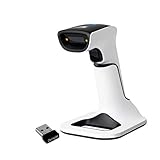
ScanAvenger 3-in-1 Wireless 1D and 2D
- Bluetooth
- USB and wireless in one body
- 1D and 2D plus Data Matrix
- Vibration and audible scan alerts
- Rechargeable battery with charging stand

Zebra Symbol DS2278-SR Wireless
- Zebra Wi-Fi Friendly Bluetooth mode
- 0.5 to 14.5 inch scanning range
- Omni-directional scanning
- Remote management via mobile app

Zebra DS2208 Corded Standard Range
- Corded USB with auto-host detection
- Omni-directional 1D and 2D scanning
- Aim line for correct scan distance
- Shielded USB cable included
Best Barcode Readers for Production in September
All twelve readers sit in the table below, with the features that drove our ranking. Use it to narrow the field, then read the full review for the two or three that survive.
| Product | Specifications | Action |
|---|---|---|
| ScanAvenger 3-in-1 Wireless 1D and 2D Scanner |
|
Check Latest Price |
 Tera 8100 Industrial Wireless 2D Scanner Tera 8100 Industrial Wireless 2D Scanner |
|
Check Latest Price |
 Tera HW0009 Wireless Scanner with Screen Tera HW0009 Wireless Scanner with Screen |
|
Check Latest Price |
 Alacrity 2D Industrial Wireless Scanner Alacrity 2D Industrial Wireless Scanner |
|
Check Latest Price |
| Zebra DS2278-SR Wireless 2D and 1D |
|
Check Latest Price |
| Zebra DS2208 Corded Standard Range Imager |
|
Check Latest Price |
 Eyoyo 2D Industrial Scanner with Stand Eyoyo 2D Industrial Scanner with Stand |
|
Check Latest Price |
 NetumScan RD-1288 IP67 Wireless Scanner NetumScan RD-1288 IP67 Wireless Scanner |
|
Check Latest Price |
 NETUM RD-1200 Upgraded IP67 Scanner NETUM RD-1200 Upgraded IP67 Scanner |
|
Check Latest Price |
 Vanquisher Android 13 Mobile Computer Vanquisher Android 13 Mobile Computer |
|
Check Latest Price |
 Honeywell Voyager XP 1472g Corded Scanner Honeywell Voyager XP 1472g Corded Scanner |
|
Check Latest Price |
 MUNBYN MC005P Android 14 PDA MUNBYN MC005P Android 14 PDA |
|
Check Latest Price |
What Is Actually Available: Handhelds and Mobile Computers, Not Inline Fixed Mount
You will not find a true inline fixed-mount reader in this roundup, and we would rather say so than pad the list. The products that qualified here are handheld scanners, rugged wireless scanners and mobile computers, because those are the form factors available in this category at the level of detail we could verify.
That is not a small limitation. If your requirement is a reader mounted above a conveyor, triggered by a photoeye and reporting results over PROFINET, you are in the Cognex DataMan, SICK or KEYENCE inline range, not here. Members of r/PLC ask this exact question constantly, and the honest answer is that the brands worth knowing for inline work are a different list from the one below.
What the handhelds here do cover well is the other half of production scanning. Line-side kitting, inbound receiving, cycle counting, pack-out verification, end-of-line label checks and mobile data entry on the floor. If that is your work, the picks below are the right shortlist.
One useful cross-reference: if the parts moving through your plant are on a conveyor, our conveyor equipment guide covers the transport side, which is where fixed-mount readers usually get specified.
1. ScanAvenger 3-in-1 Wireless 1D and 2D Scanner – Most Flexible General-Purpose Unit
ScanAvenger Wireless Portable 1D&2D with Stand Bluetooth Barcode Scanner: 3-in-1 Handheld Scanner, Rechargeable Battery for Inventory – USB Bar Code/QR Reader (1D&2D with Next Gen Stand)
1D and 2D plus Data Matrix
Bluetooth, USB and wireless
Rechargeable battery
1.1 lb body
Pros
- Bluetooth
- USB cable and wireless in one body
- Works with Windows Mac Android iOS and POS
- No software or driver install needed
- Charging stand with wireless transmission
- Vibration and audible scan alerts
Cons
- Does not decode Maxicode
- Some POS systems needing proprietary integrations will reject it
- Warranty is not specified in the listing
This is the unit we kept coming back to while comparing this group, because it removes the most common purchasing mistake in this category, which is buying a scanner that only works over one connection type. The ScanAvenger carries Bluetooth, a USB cable and a wireless mode in the same body, so it moves from a receiving desk to a tablet cart to a laptop on a line without anyone re-pairing anything.
Decoding coverage is the 1D set most plants actually use, UPC, EAN, Code 128, Code 39, Code 11 and Codabar, plus PDF417, Aztec, Data Matrix and QR for 2D work. The one genuine gap is Maxicode, which will not decode, and that matters only if you handle parcel sorting with that symbology. At 1.1 pounds it is one of the lighter bodies in this group, which pays off across a full shift of line-side counting.
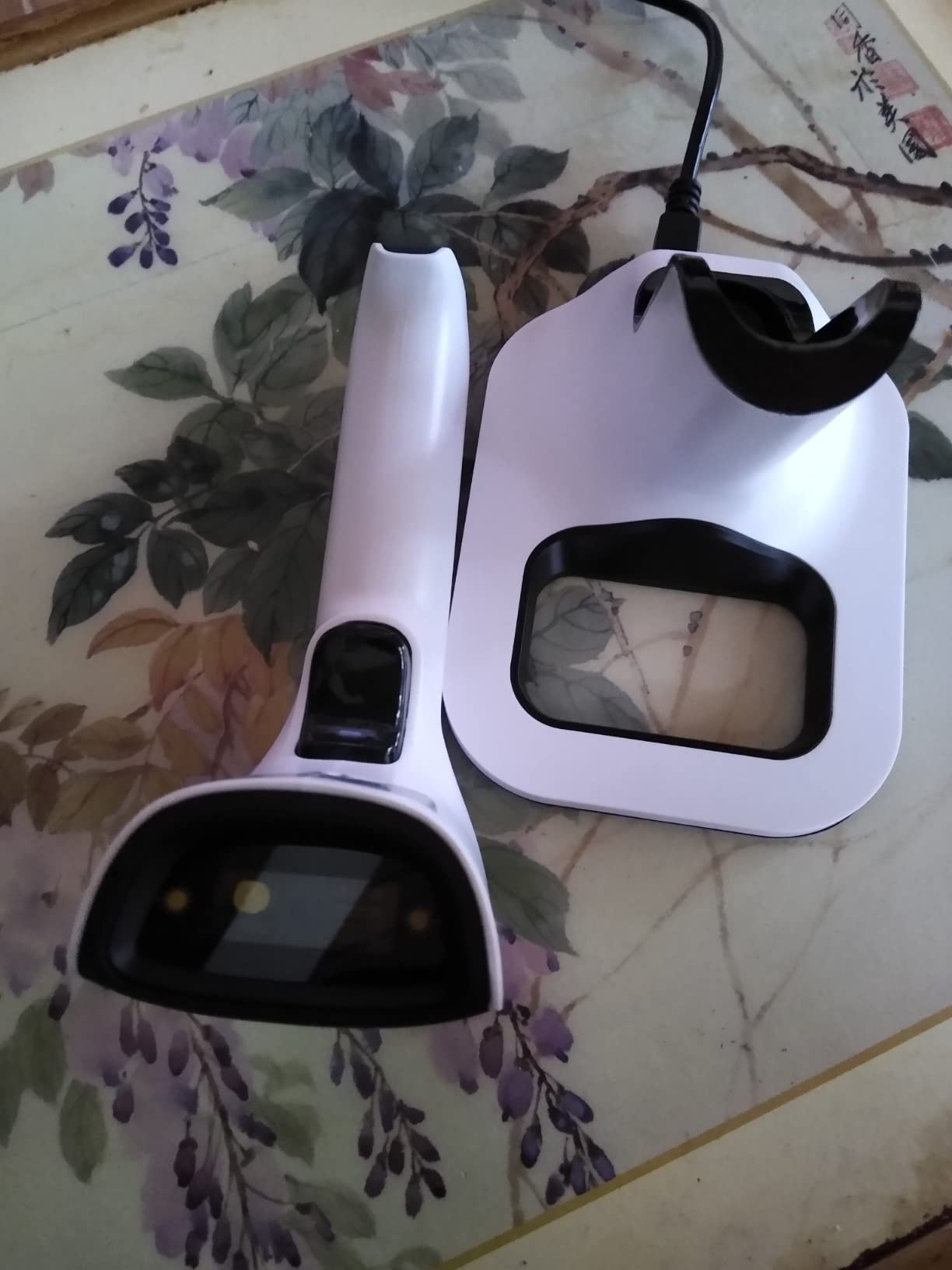
The charging stand is the part we would defend hardest. It transmits wirelessly and keeps the scanner off the bench, so it stops becoming a shared object that goes missing. Scan modes cover manual trigger, continuous and auto sense, and auto sense is the one to use when a part presentation angle varies and an operator is not holding the trigger deliberately.
Reviewers consistently point to the vibration motor, and for a production floor that is not a gimmick. On a loud pack-out line an audible beep is often swallowed, while a vibration in the hand confirms the read without adding noise. The screen-free design also means there is nothing to crack, which is why it suits shop-floor use better than the screen-equipped units further down this list.
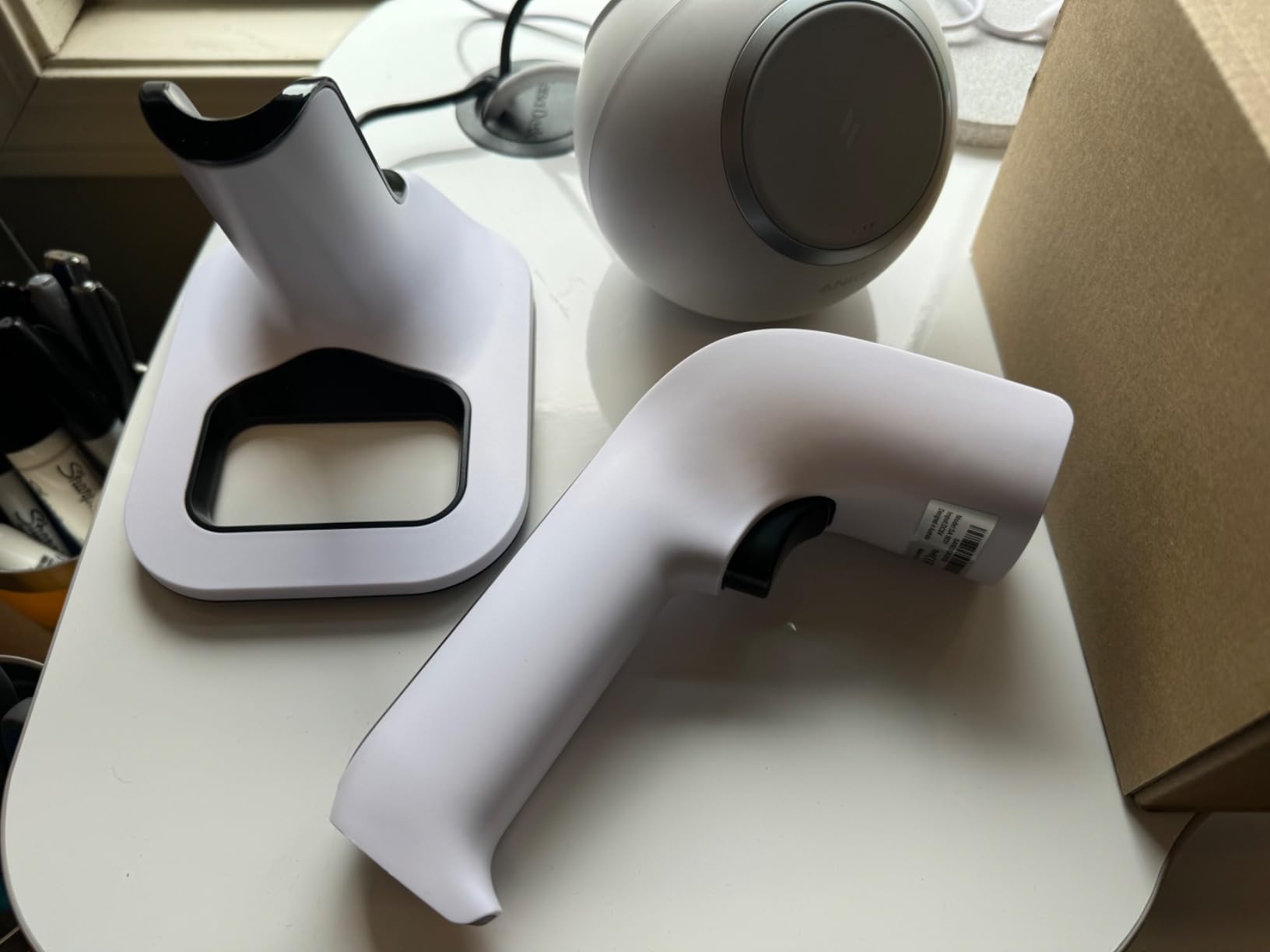
Where the ScanAvenger earns its place on a line
This is the scanner to buy when scanning is a supporting task rather than the whole job. Receiving, putaway, cycle counts, pack-out label confirmation and part kitting all fall here. Because it types decoded data like a keyboard, it works with any system that accepts keyboard input, which includes most WMS and MES screens without custom integration work.
It is the first scanner to consider for a plant that has never deployed scanning and does not know which direction it is heading. One scanner covering three connection modes means you are not locked into a workflow choice before you have data on how people actually use it.
Where the ScanAvenger falls short
It has no sealing rating in the specification, so it is not a washdown or freezer-zone unit. If your scanning happens next to open product, coolant spray or a cleaning cycle, that is the wrong tool. The same goes for any line where codes are direct part marked rather than printed on a label.
For fixed-position inline verification, it is also the wrong shape entirely. A trigger-and-go handheld cannot be photoeye-synchronised to a moving part, so it cannot deliver the error proofing an assembly line needs. It reads codes a person points it at, which is a different job.
2. Tera 8100 Industrial Wireless 2D Scanner – Most Configurable Rugged Handheld
Tera Barcode Scanner 2D Wireless with Stand: Industrial Drop-resistant 8100
IP66 sealed
100m barrier-free range
2500mAh battery
650 scans per second
Pros
- IP66 dust and water sealing
- 100m barrier-free 2.4G transmission
- Programmable symbology settings
- 2500mAh battery
- Strong magnetic holder for the USB dongle
Cons
- Will not pair with Square POS
- Default scan speed is slower until reconfigured via control barcodes
- Some reviewers report random failures after months of use
The Tera 8100 is one of the most heavily sealed handhelds in this group, and the IP66 rating is the reason it is here. IP66 means dust-tight plus protection against powerful water jets, which covers the realistic worst case in a machine shop or a washdown-adjacent pack-out area.
It also has one of the widest 1D symbology lists in this group, including Industrial 25, 2/5 Matrix and ITF-14, and it decodes MaxiCode where several rivals do not. The 2.4G link reaches 100 metres barrier-free, and the 2500mAh battery covers a full shift without a mid-shift cradle stop.
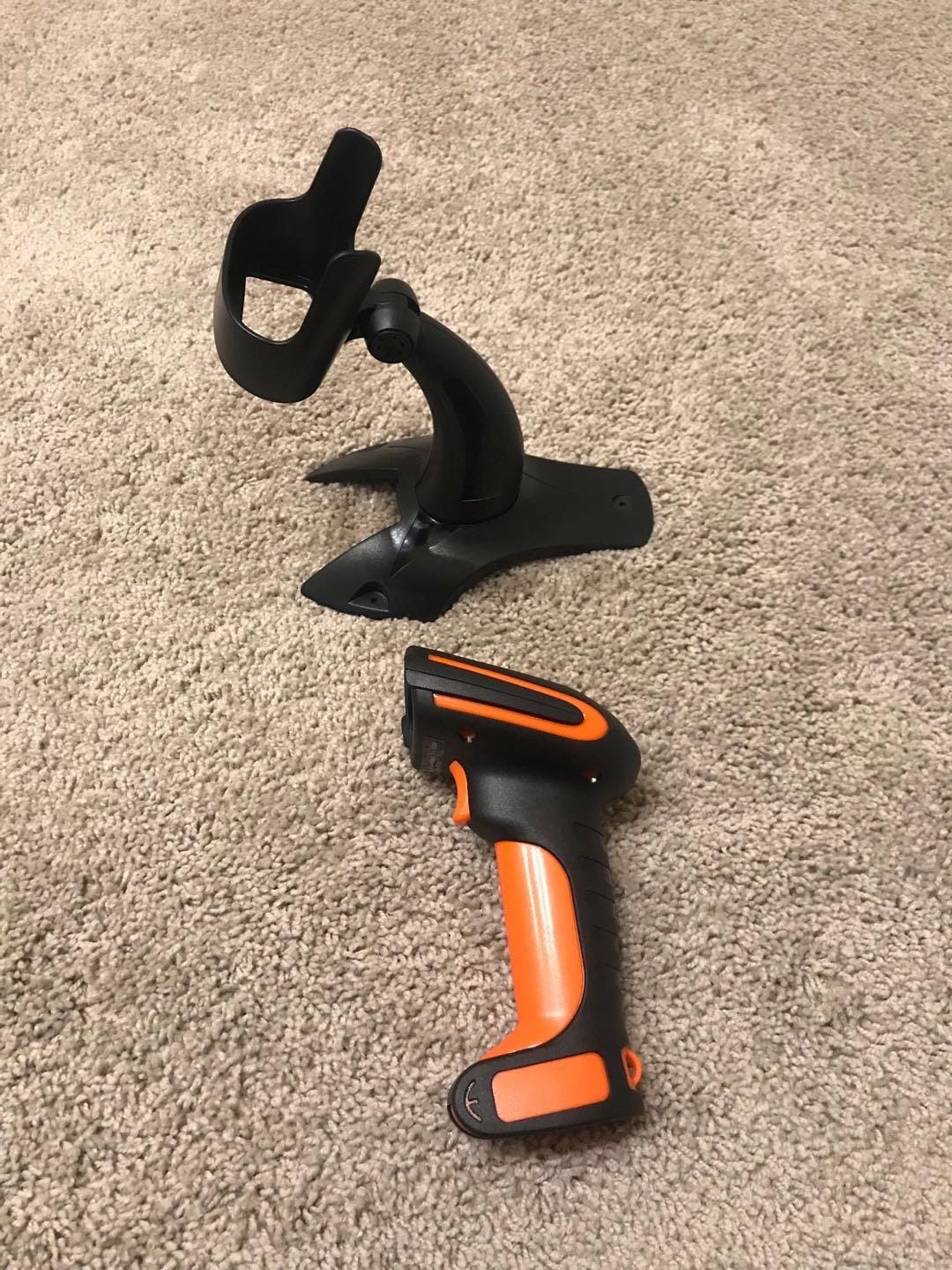
The deciding feature for production work is configurability. Everything is set by scanning control barcodes from the manual rather than through a configuration utility, which means a technician can change trigger behaviour, symbology sets and suffixes on a line-side laptop with no software deployment. On a plant where IT approval takes a week, that removes a real bottleneck.
The 640 by 480 global shutter sensor handles motion better than most budget imagers, which matters when a part is moving through the read zone rather than being held still. Reviewers also highlight the magnetic dongle holder, which keeps the USB receiver attached to the workstation instead of lost in a drawer.
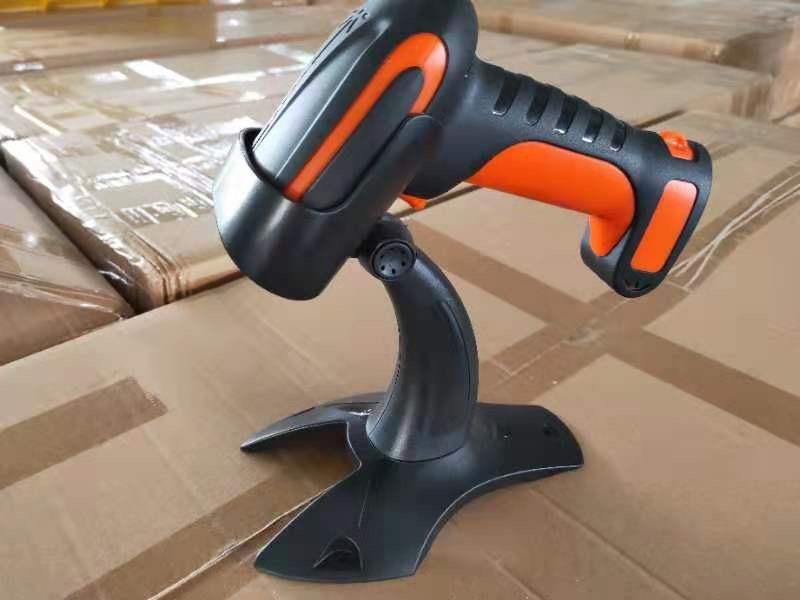
Where the Tera 8100 fits production duty
This is the pick for line-side kitting and mobile verification where parts are handled in motion and nobody is setting up a fixed station. Vibration and audible alert modes cover noisy environments, and the programmable symbology settings let you lock down exactly which codes are allowed, which is a useful error-proofing measure on a mixed label stream.
Pick it when washdown resistance matters more than screen-based verification, and when the environment involves vibration, dust or coolant mist. The IP66 seal and the 100 metre range also make it a natural fit for yard-side and material-side counting.
Where the Tera 8100 falls short
It will not work with Square POS, and it does not report a weight, so we cannot judge handling comfort across a long shift from the data available. Reviewers do raise reliability concerns, including random failures appearing after months of service, which is a reason to keep a spare in the drawer on a critical line.
The default scan speed is slower than the hardware is capable of until someone reconfigures it, so an out-of-the-box install will feel sluggish in a high-count operation. Budget thirty minutes for that first configuration pass, and record the settings somewhere other than the memory of whoever did it.
3. Tera HW0009 Wireless Scanner with Screen – Best for On-Screen Scan Verification
Tera Barcode Scanner Wireless with Screen: Pro Version 1D 2D QR with Setting Keypad Charging Cradle Works with Bluetooth 2.4G Wireless USB Wired Handheld Bar Code Reader HW0009
Built-in color screen
Cradle with 2.4G receiver
328ft range
2500mAh battery
Pros
- Color screen shows the decoded value and settings
- Cradle has the 2.4G receiver built in so no separate dongle
- PDF417 including driver license formats
- 328ft barrier-free range
- One year warranty
Cons
- Cannot decode USPS IMb barcodes
- Screen settings are not lockable so they can be changed accidentally
- Time setting needs sync software with non-English error messages
A screen changes what a scanner is for. With the Tera HW0009 an operator can confirm the decoded string before it is submitted, which turns a blind scan into a checked one. On a line where a wrong part number means a scrapped assembly five stations later, that verification step is worth a lot.
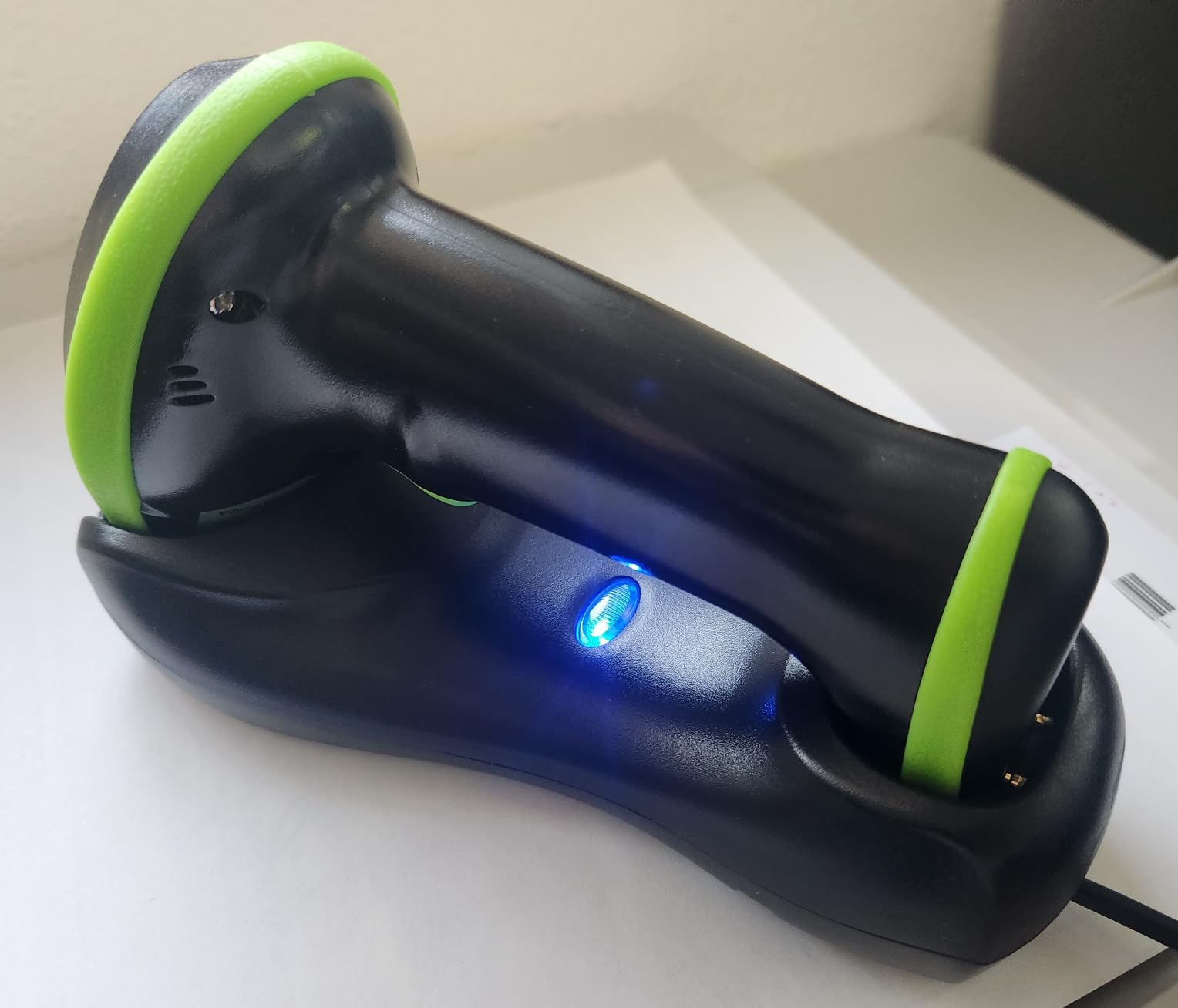
The cradle is unusually well thought out. The 2.4G receiver lives inside the charging base, so the dock is the receiver and there is no USB stick to lose. Wireless range is quoted at 328 feet barrier-free and 114 feet with obstacles, which covers most plant floor layouts from a single base.
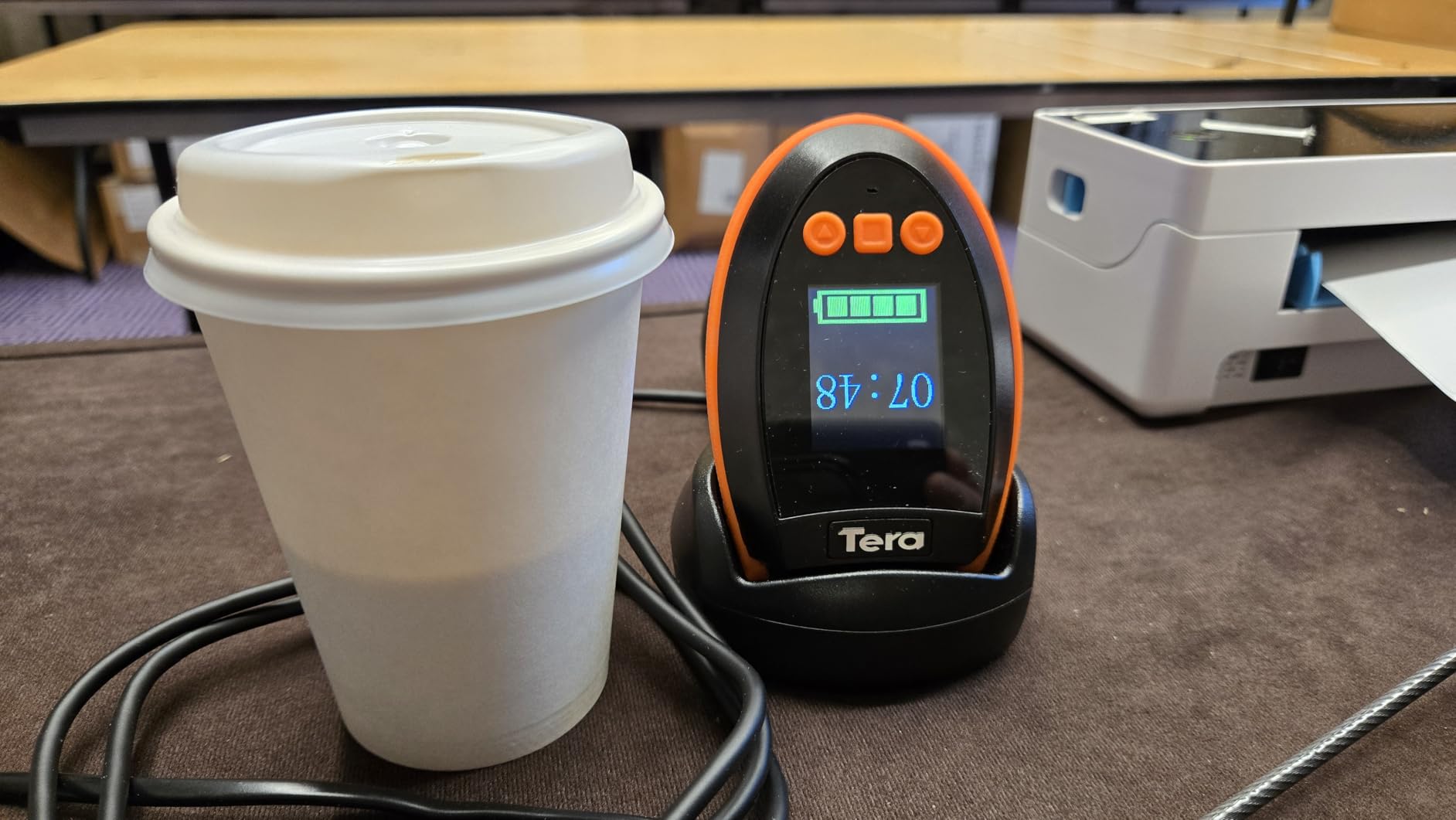
Symbology support is broad, with GS1-128, ISBT-128, ITF-14 and GS1 Databar alongside the standard 1D set, and the 2D side covers QR, Data Matrix, PDF417, Aztec, Maxicode and Micro formats. The keypad on the cradle handles settings without waking the handheld, so configuration happens at the base rather than in the hand.
Two practical details are worth knowing before you commit. The screen cannot be locked against accidental changes, so an operator can alter a setting mid-shift without realising it. And the clock needs sync software, which surfaces non-English error messages that can stall a first-time setup.
Where the Tera HW0009 fits production duty
Choose it wherever the scan must be confirmed visually, such as pack-out verification, returns processing or any task where a misread has an expensive downstream cost. The screen also makes it the better pick for training new operators, because a new hire can see what the code should have decoded to.
It suits mixed environments where a cradle-based station is realistic. A dedicated bench for charging, verification and configuration is easy to justify on a receiving dock or in a quality cage.
Where the Tera HW0009 falls short
It will not read USPS Intelligent Mail barcodes, which removes it from parcel and returns operations that rely on that symbology. The unlockable screen is a genuine production risk on a shared unit, and there is no stated IP rating, so it is not a wet-area scanner.
Reviewers report mixed early reliability, with some failures appearing after about a month. That pattern argues for a pilot on one station rather than a fleet-wide rollout on day one.
4. Alacrity Upgraded 2D Industrial Scanner – Best for Concrete and Steel Environments
Alacrity Upgraded 2D Industrial Barcode Scanner with Wireless Charging Stand, 1968 Feet Transmission Distance 433Mhz Wireless & Bluetooth 2in1 Barcode Reader, Shock Dust Proof Hands Free, Green
433MHz wireless to 1968ft
Global shutter sensor
Wireless charging stand
Shock and dust proof
Pros
- 433MHz wireless with a quoted 1968ft range
- Global shutter sensor tolerates fast-moving parts
- Wireless charging stand
- Strong PDF417 parsing
- Reads damaged and poorly printed codes
Cons
- Not intended for long-distance reading beyond 20ft of code size
- Some units lose Bluetooth connection frequently
- Stand is unstable at a 45 degree angle
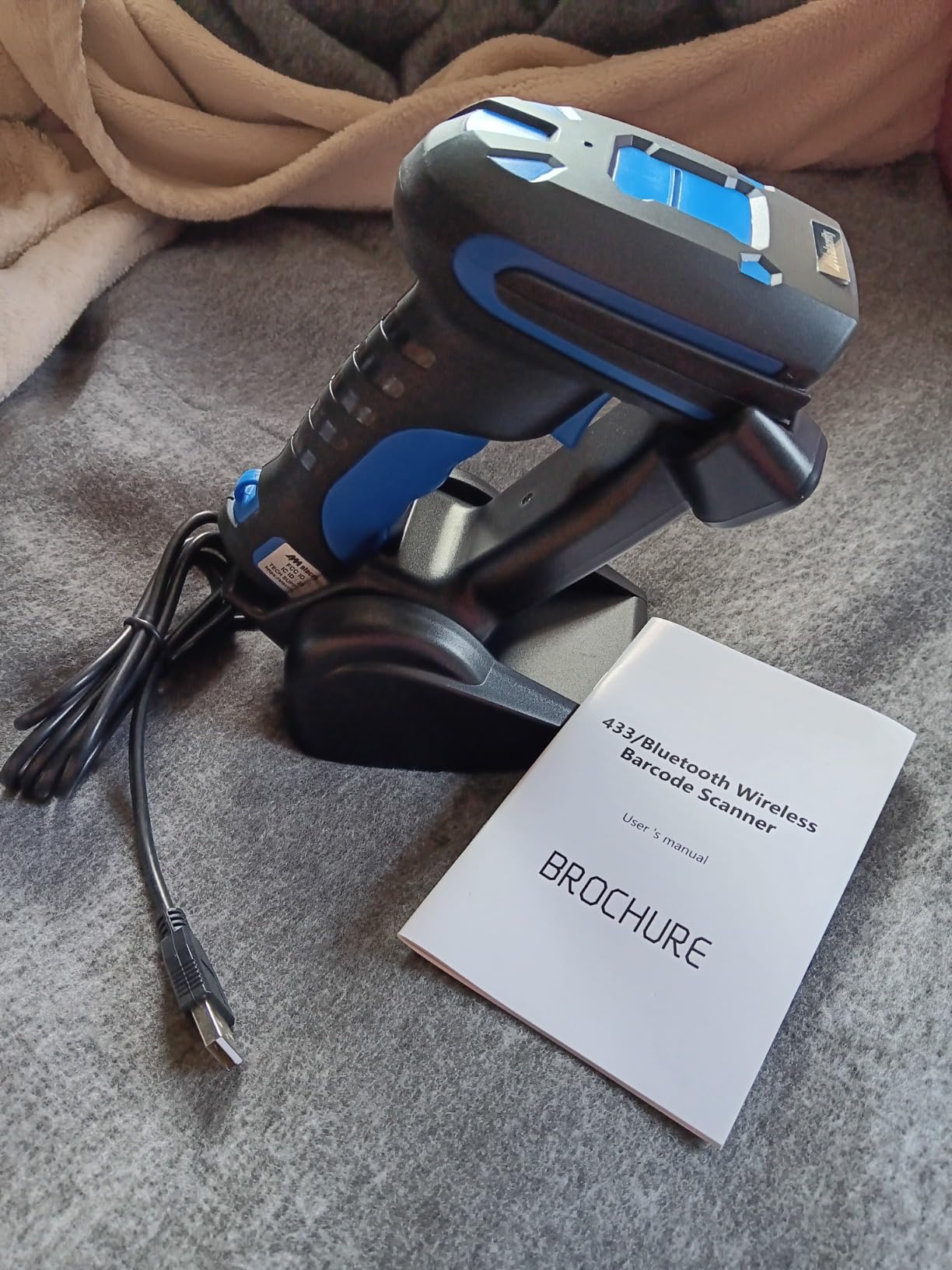
The Alacrity is the odd one out in this group on radio. It runs a 433MHz link rather than 2.4GHz, and that choice is the whole reason to buy it. 433MHz penetrates concrete, steel mesh and racking far better than 2.4GHz, so this is the scanner that still works when the base station is on the other side of a plant wall.
Motion tolerance comes from the global shutter sensor, which processes a code in a single instant rather than rolling across it. On a fast line that is the difference between a clean read and a partially captured code, and reviewers single out its ability to handle damaged and dirty labels.
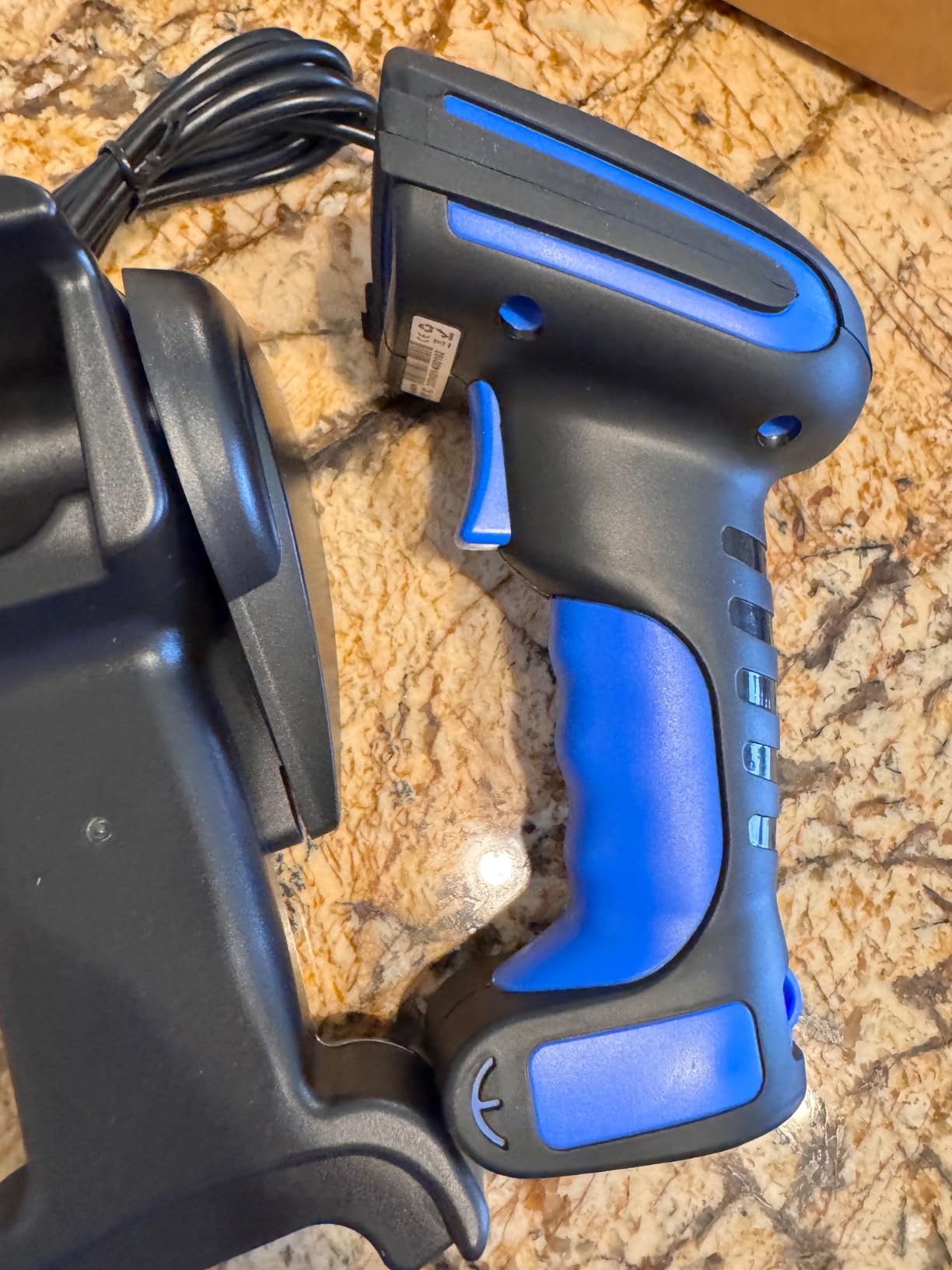
It is also one of the stronger PDF417 parsers in this group, which matters if you scan driver licenses or the long stacked codes used on identity and compliance documents. The wireless charging stand keeps the unit on base between tasks, and the housing is described as shock and dust proof for line conditions.
Certification is listed as CE, FCC and RoHS, and it reads barcodes displayed on a phone or laptop screen as well as printed codes, which is convenient when a customer sends a photo of a damaged label.
Where the Alacrity fits production duty
This is the pick for large buildings with poor wireless conditions, from multi-level plants to warehouses with dense racking between the operator and the base. It is also a strong choice anywhere damaged or low-quality labels are common, since the decoder is tuned for exactly that failure mode.
For line-side work where parts move quickly through a scan zone, the global shutter gives it an edge over the rolling-shutter sensors used by the entry-level units. The stand is also genuinely wireless, so there is no cradle cable to snag.
Where the Alacrity falls short
Be clear on the range claim. The 1968ft figure is radio distance, not reading distance, and the listing states plainly that the scanner is not designed for long-distance code reading beyond about 20ft. Reviewers also report intermittent Bluetooth drops and a double-scan behaviour in some setups.
The cable position makes the stand wobble when the unit is returned at an angle, which is a small irritation that becomes a bigger one on a busy bench. There have also been reports of refurbished bodies turning up in new packaging, so inspect the unit as soon as it is delivered.
5. Zebra Symbol DS2278-SR Wireless 2D and 1D – Best Enterprise-Grade Wireless Handheld
Zebra Symbol DS2278-SR Wireless 2D/1D Bluetooth Barcode Scanner
0.5 to 14.5 inch scan range
Zebra Wi-Fi Friendly mode
Cradle and battery included
16 oz body
Pros
- Wi-Fi Friendly mode prevents Bluetooth interference
- Wide 0.5 to 14.5 inch scanning range
- Pre-configured and working out of the box
- Remote management from phone tablet or PC
- Shielded 7ft USB cable and cradle included
Cons
- Bluetooth and USB only with no 2.4G option
- Costs more than generic handhelds
- Small review sample of 131 ratings
The DS2278-SR is the most conventional enterprise choice here, and it earns its place on two details rather than headline specs. The first is Zebra’s Wi-Fi Friendly mode, which shifts the Bluetooth channel away from congested Wi-Fi bands so a shared RF environment does not produce dropouts mid-shift.
The second is remote management. From a phone, tablet or PC you can change the beeper, the LED behaviour and the symbology set on a deployed scanner without walking to it with a cable. On a line with a dozen units, that turns a maintenance afternoon into a two-minute job.
Scanning range runs from 0.5 to 14.5 inches, which covers both a label held in the hand and one on a pallet at the end of a rack. Scanning is omni-directional, so an operator does not have to line up an aim line on a fast-moving carton, and the kit ships pre-configured and ready to use.
Build quality is the other story. It weighs 16 ounces, ships with a cradle, battery and a heavy-duty shielded 7ft USB cable, and the whole package is the kind of kit that gets handed to a new operator without a briefing.
Where the DS2278-SR fits production duty
Pick it when you are running a fleet and RF contention is real, which is the norm in a plant with a lot of wireless access points. The Wi-Fi Friendly mode is the differentiator in a shared 2.4GHz environment where cheaper scanners drop out during peak shift change.
It is a good fit for line-side receiving, putaway and pack-out stations, and for any operation that will eventually want device management rather than manual reconfiguration. The out-of-box configuration means a new unit can be working the same morning it arrives.
Where the DS2278-SR falls short
It connects over Bluetooth and USB only, with no 2.4G option. If you need a longer radio link than Bluetooth gives you across a plant, that is a real ceiling, and it is one of the reasons the Alacrity appears in this list.
There is no IP rating quoted, and the review base of 131 ratings is thinner than the entry-level units higher up. It also costs more than the commodity handhelds, which is defensible over a service life but harder to justify for a single station.
6. Zebra DS2208 Corded Standard Range Imager – Best Corded Verification Station
Zebra DS2208 Series Handheld Standard Range Corded Imager Kit with Shielded USB Cable, Black (DS2208-SR7U2100AZW)
Corded USB with auto-host detection
162 g body
1D and 2D omni-directional
Aim line for scan distance
Pros
- Excellent PDF417 and driver license decoding
- Auto-host detection makes setup plug and play
- Light at 162 g for all-day handling
- Shielded USB cable included
- Built for production lines as well as retail
Cons
- Corded only with no wireless option
- Cable is a trip and snag hazard on a moving line
- Counterfeit units appear from some third-party sellers
The DS2208 is the most straightforward way to put a genuine enterprise imager on a bench, and the reason is the auto-host cable detection. Plug the shielded USB cable into any PC and the unit identifies the host type on its own, so there is no driver stack and no configuration utility to deploy before the first scan.
Decoding is where the DS2208 separates from entry-level handhelds. Reviewers consistently praise its PDF417 performance, which is the symbology used on driver licenses and on the long data strings found in compliance labelling. At 162 grams it is the lightest body we could weigh in this roundup, which reduces wrist fatigue over a full verification shift.
It is also honest about what it is not. There is no wireless, no battery and no sealing rating. That is a limitation at a receiving dock and a non-issue at a fixed bench where the scanner lives on a cradle and plugs into a machine.
For fixed verification at the end of a packing line, this is close to ideal. The cord keeps the unit alive indefinitely, the aim line helps an operator hold the correct distance, and omni-directional scanning removes the need to align precisely on a moving carton. There is no battery to rotate through three shifts and no charging dock to sit in a spill zone.
One more production-specific point: corded scanners are the easiest to deploy in a hazardous-area review because there is no lithium battery in the handheld body to raise. The battery sits in the cradle instead, and a battery-free tool is easier to certify for a controlled area.
It suits end-of-line label checks, pack-out verification and any static bench where a technician confirms a code against a work order. Because it is plug and play, a maintenance technician can replace a failed unit during a shift and have it working immediately, with no software to deploy first.
Where the DS2208 falls short
Corded means the cable is a physical liability on a line with moving arms, robot mounts or cable chains, and that is one of the durability complaints that comes up repeatedly with fixed-mount and bench scanning in general. Plan the cable route before you mount it.
There is no wireless and no sealing, so it will not survive a wet or dusty washdown zone. Some third-party listings sell counterfeits, so confirm the seller, and note that a stand is usually sold separately even where a listing image suggests otherwise.
7. Eyoyo 2D Industrial Scanner with Wireless Charging Stand – Best for Drop-Prone Zones
Eyoyo 2D QR Industrial Barcode Scanner with Wireless Charging Stand
IP65 sealed
100 drops from 3m
7000 tumbles from 1m
100000 barcode storage mode
Pros
- Survives 100 drops from 3m and 7000 tumbles from 1m
- IP65 waterproof and dustproof
- Storage mode holds 100000 barcodes offline
- No dongle needed for wireless
- One year manufacturer warranty
Cons
- Large and clunky in the hand
- Difficult to remove from the stand
- Cannot read USPS labels
- Some units fail after 9 to 12 months
The Eyoyo EY-037 is the one to choose when scanners get thrown. Its quoted endurance is 100 drops from 3 metres and 7000 tumbles from 1 metre, and that tumble figure matters more than the drop figure in a plant where a unit gets knocked off a bench or clipped by a pallet truck a hundred times a year.
The IP65 rating covers dust and water ingress protection, which sits a step below the IP66 on the Tera 8100 but above every uncategorised unit in this group. Connectivity is 2.4G wireless, Bluetooth 6.0 and USB wired, and the dock carries the wireless receiver so no separate dongle is needed.
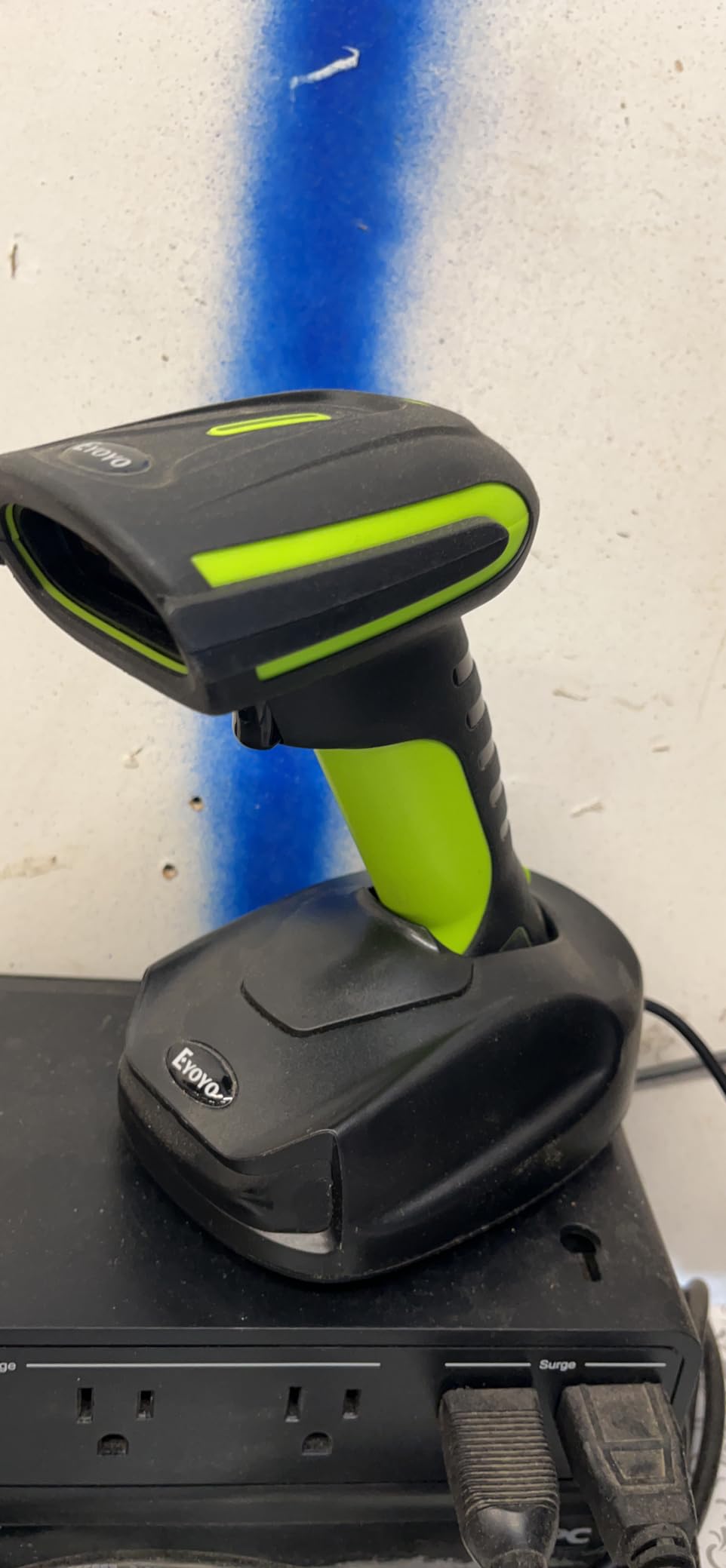
The offline storage mode is the sleeper feature here. It holds up to 100000 barcodes with no connection to the host, which is the answer to the dead-zone problem in a plant with a metal cage or a basement store. An operator scans through the outage and the data uploads when the unit reconnects.
Reviewers mention battery life of roughly a week on typical use, the damping trigger and wrist strap, and fast warranty replacements when a unit does fail. Those three together are what you want from a scanner that will be dropped regularly.
Where the Eyoyo fits production duty
It suits receiving docks, yard work and any scanning area where the unit is handled roughly or carried on a lanyard all day. The storage mode makes it a good companion for inventory work in areas with poor RF coverage, where a batch upload later is more reliable than a live connection.
It is a sensible choice for multi-site rollouts where the units travel between plants. The warranty replacement service is the deciding factor when a failure means a scanner is out of service for a shift.
Where the Eyoyo falls short
The body is large. Reviewers describe it as clunky, and on a long counting task that is a real comfort cost compared with the lighter units here. Getting it out of the stand is also awkward, which is irritating on a high-frequency pack-out bench.
It cannot read USPS labels, and there are reports of units failing between nine and twelve months, which is faster than the drop ratings suggest it should manage. Treat the warranty as essential rather than optional if you deploy more than a handful.
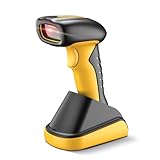
8. NetumScan RD-1288 IP67 Wireless Scanner – Best Sealed Option with Offline Storage
NetumScan Industrial Bluetooth QR Barcode Scanner, IP67 Waterproof & 7M Drop Proof, 2600mAh Wireless 1D 2D Bar Code Scanner with Charging Stand for Store, POS, Computer, iPhone, Android RD-1288(NS)
IP67 sealed
7m drop proof
2600mAh battery
300m wireless range
Pros
- IP67 sealing with a 7m drop rating
- 2600mAh battery quoted at 11 to 12 hours intensive use
- Storage mode holds 100000 barcodes offline
- 300m 2.4G range
- Vibration motor for silent confirmation
Cons
- Configuration is by barcode manual only with a steep learning curve
- The cradle cable is fixed and cannot be replaced
- Bluetooth mode can drop other devices on iPhone
IP67 sealing with a 7 metre drop rating is the hardest combination in this roundup, and it comes with a 2600mAh battery quoted at 11 to 12 hours of intensive use. The high-resolution scan engine is tuned for damaged and poorly printed codes, which is the failure mode that actually stops a line.
Symbology coverage is broad, including Direct Part Mark in the 2D list, and that matters if any of your identifiers are marked into the metal rather than printed on a label. Connectivity covers 2.4G at 300 metres plus Bluetooth in HID, SPP and BLE modes.
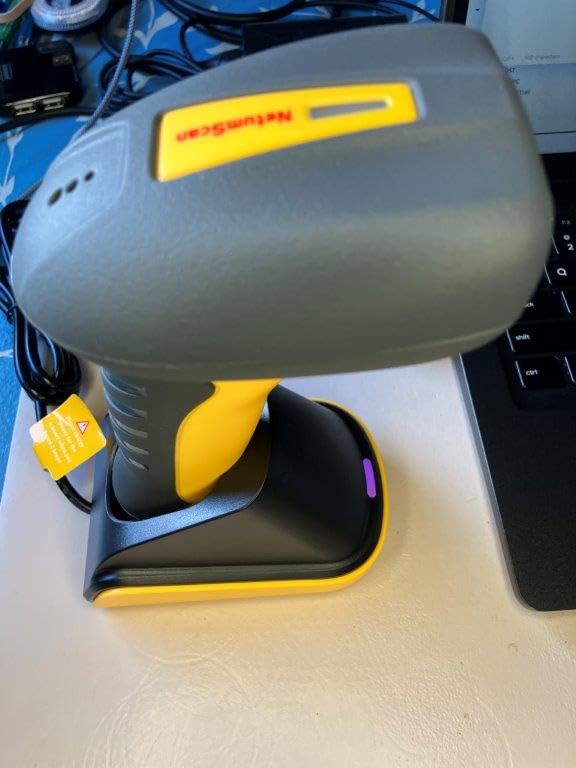
Two details set it apart on a production floor. The vibration motor confirms a read silently, which matters on a loud line where a beep is lost. And the storage mode buffers up to 100000 barcodes offline, so work continues through an RF outage rather than stopping at the first dead zone.
The high-resolution engine is the other reason to shortlist it. Reviewers report it holding up on codes that other units in this group simply could not decode, particularly labels that have been scuffed, partially peeled or printed on a curved surface.
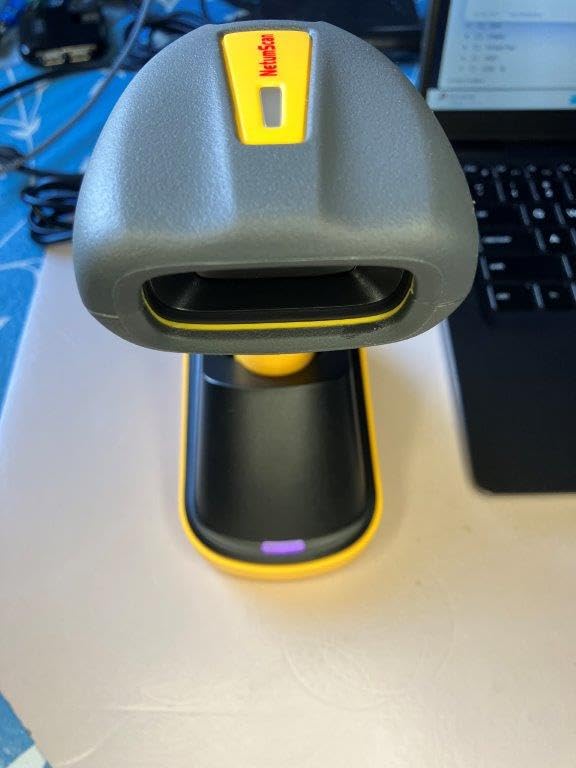
Where the NetumScan fits production duty
This is the pick for dry, dusty or genuinely harsh environments, including areas with washdown pressure, food processing adjacency and outdoor storage areas. The IP67 seal is a step above the IP65 units here and the drop rating means it tolerates a fall from a loading platform.
It also suits plants with unreliable wireless coverage, because the offline buffer decouples scanning from connectivity. For a line that cannot stop for an RF problem, that buffer is worth more than a faster radio.
Where the NetumScan falls short
Configuration is entirely by scanning barcodes from the manual, and reviewers describe the learning curve as steep. Budget real time for the first setup and write the resulting configuration down, because a factory reset costs you all of it.
The cradle cable is hardwired and not replaceable, which is a genuine design weakness on a unit that will be used for years. Bluetooth mode is slower than 2.4G, and there have been some early failure reports involving chemical exposure and charging faults, so keep a spare on any critical line.
9. NETUM RD-1200 Upgraded IP67 Scanner – Solid Rugged Performer with a Small Sample
NETUM Upgraded QR Industrial Bluetooth Barcode Scanner with Charging Dock
IP67 sealed
12ft drop rating
2600mAh battery
Cradle built-in 2.4G receiver
Pros
- IP67 dust and water protection with a 12ft drop rating
- Cradle carries the 2.4G receiver for plug and play pairing
- Storage mode holds 100000 barcodes
- 2600mAh battery with charging dock
- Rugged integrated silicone housing
Cons
- Only 31 ratings so long-term reliability is unproven
- Listing shows a pack quantity of 10 which is a data error
- Limited long-term field history
The RD-1200 sits in the same class as the NetumScan above it, with IP67 sealing and a 2600mAh battery, but the drop rating is quoted at 12 feet rather than 22. It is a slightly softer chassis with the same sealing story, and it carries a 4.6 rating from 31 ratings with no one-star feedback recorded.
The cradle contains the 2.4G receiver, so pairing is plug and play while the unit sits in the dock. Scan modes cover manual, continuous and auto-sensing, and the offline buffer takes 100000 barcodes, which gives you the same dead-zone tolerance as the unit above.
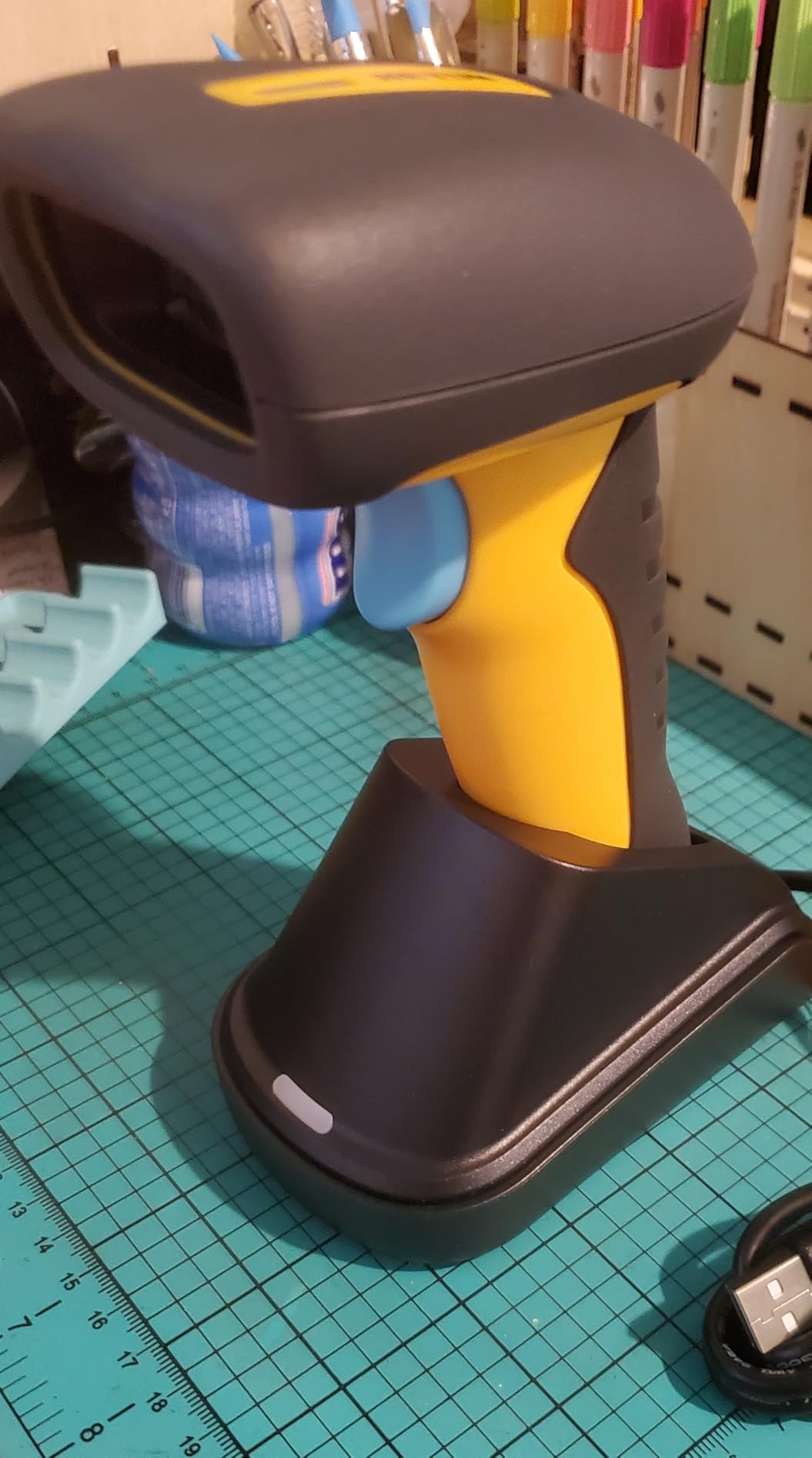
The 1D list is thorough, covering UPC-A and E, EAN-8 and 13, Code 128, Code 39, Codabar, Interleaved 2 of 5, Code 93, MSI, Code 11, ISBN, ISSN, GS1 Databar and Code 32. The 2D side adds QR, Data Matrix, PDF417, Aztec and Maxicode, which is a fuller set than several higher-priced units here.
The housing is described as rugged integrated silicone plastic, which is the construction that absorbs the drop that would otherwise crack an internal board. It is the reason a 12-foot drop rating is credible rather than a marketing number.
Where the RD-1200 fits production duty
Choose it when a dock-based station is the plan, since the cradle receiver makes the base a self-contained access point. It suits receiving counters, pack-out benches and quality stations where the scanner lives in the dock between uses.
It is also a reasonable second unit for a fleet where you want IP67 sealing and offline buffering without stepping up to a full mobile computer. The symbology coverage is broad enough to handle mixed label formats in one pass.
Where the RD-1200 falls short
The honest caveat is the sample size. Thirty-one ratings tells you very little about a three-year service life, and this unit has no long-term field history in the data. Pilot it on one station before a wider rollout, which is the only sensible way to buy an unproven chassis.
The listing also shows a pack quantity of 10, which is almost certainly a data error rather than what arrives in the box, so confirm contents on receipt. And with a 12-foot drop rating it is the wrong choice for a scanner that gets thrown off a loading platform.
10. Vanquisher Android 13 Mobile Computer – Best for Android Fleet Deployments
Vanquisher Android 13 Barcode Scanner Handheld Mobile Computer, 5.5-inch Touchscreen PDA Scanner with Integrated Honeywell 1D & 2D Bar Code Scan Engine, WiFi & 4G LTE, for Warehouse & Logistics
Android 13 with Honeywell engine
5.5 inch touchscreen
IP65 and 1.5m drop
WiFi and 4G LTE
Pros
- Full Android 13 computer with an integrated Honeywell scan engine
- 5.5 inch touchscreen with 4800mAh detachable battery
- IP65 sealing and 1.5m drop resistance
- WiFi plus 4G LTE for coverage outside WiFi range
- MS Intune compatible for fleet management
Cons
- Screen timeout defaults to 1 minute and must be changed
- Screen glass can shatter on drops despite the case rating
- Small review sample of 24 ratings
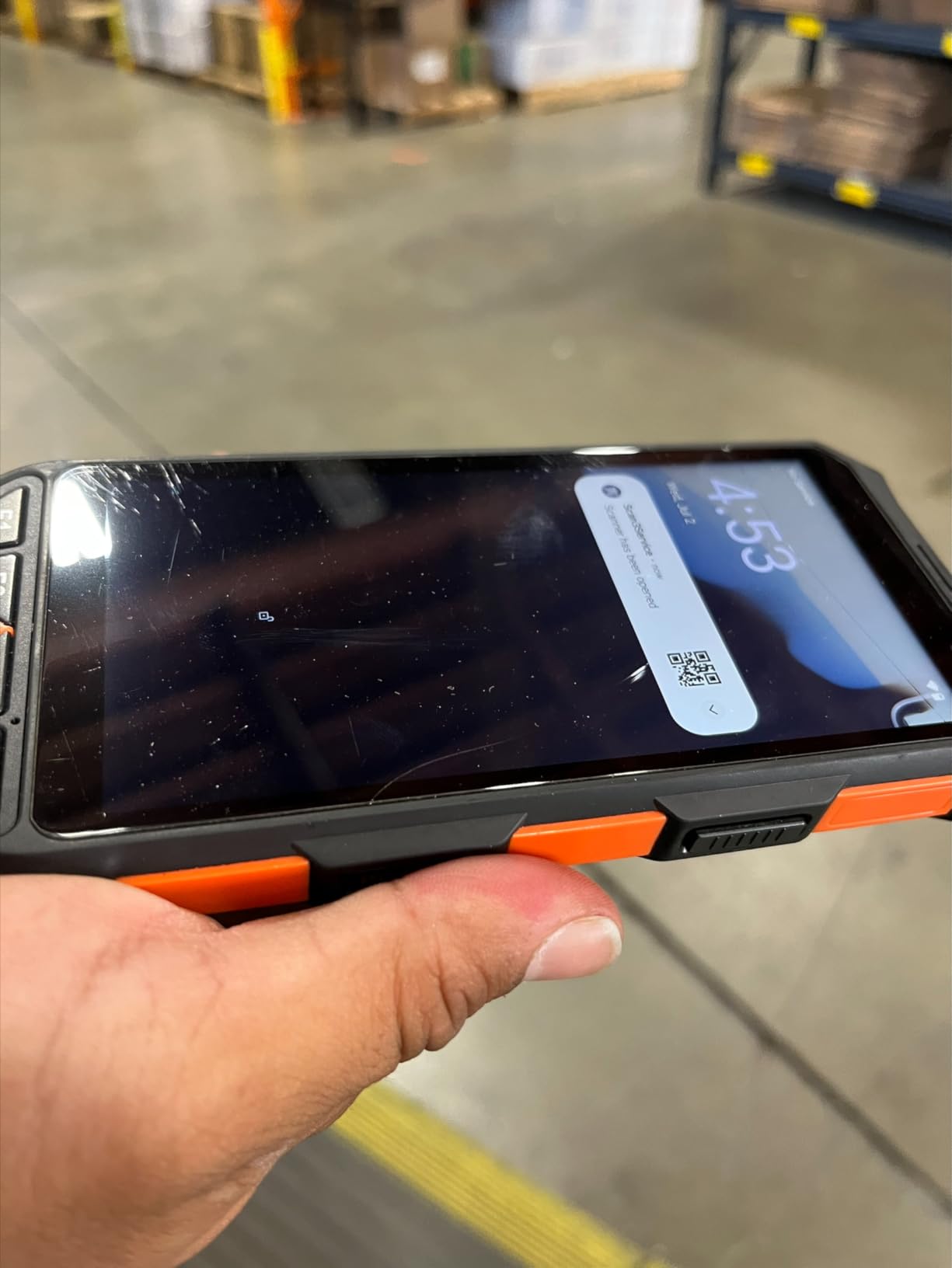
This is a different class of device from everything above it. The Vanquisher is an Android 13 handheld computer with a Honeywell 1D and 2D scan engine integrated into the body, which means it is not just a reader but a terminal running the applications your team already uses.
That changes the use case. An operator can open a work order, scan a part, view the drawing and record a result without a separate device, and the 13MP camera handles the photographic evidence that quality systems increasingly expect. The 4800mAh battery is detachable, so a spare can be carried rather than the unit being taken off the line to charge.
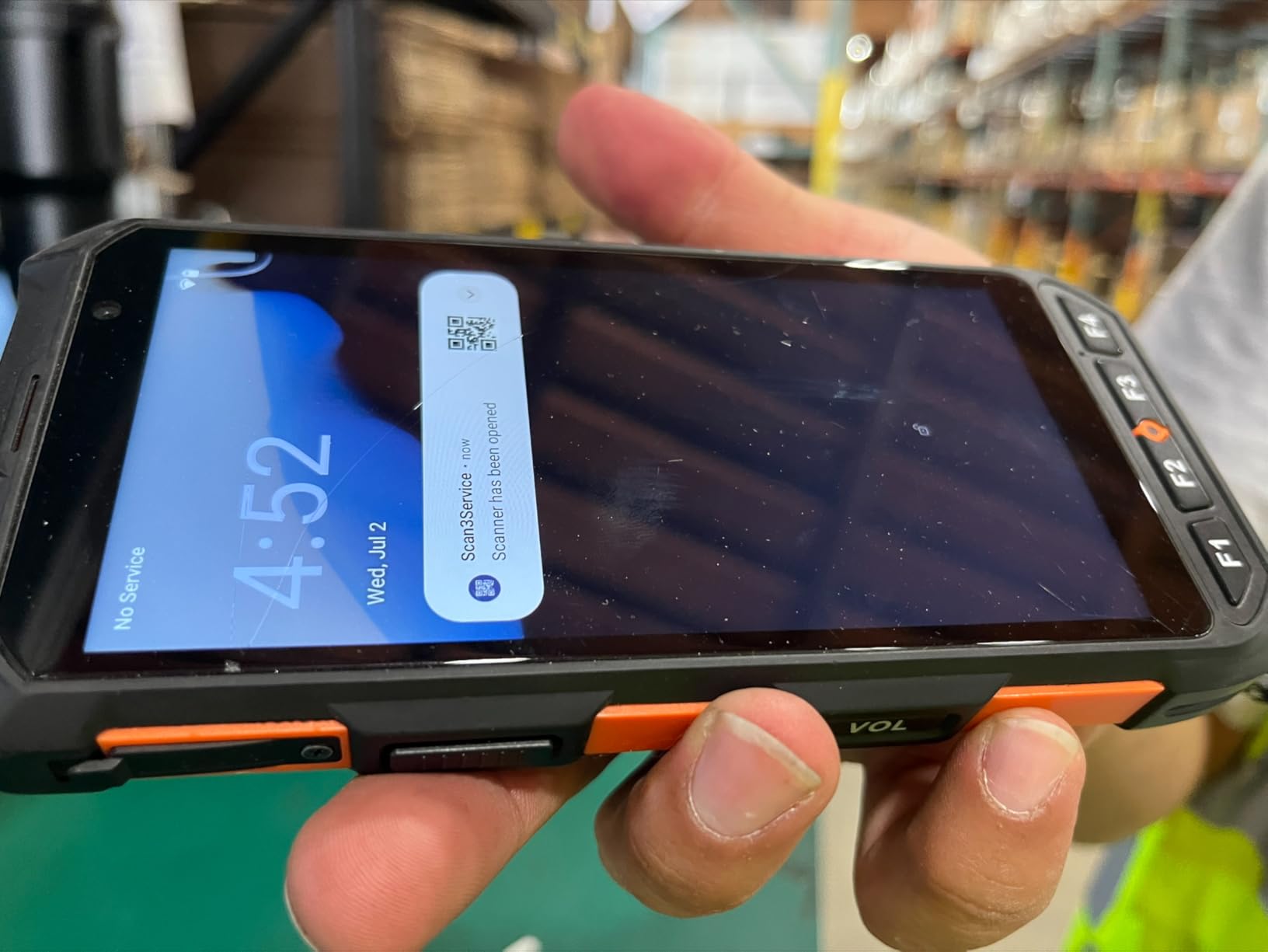
Connectivity is the strongest part of the package, with WiFi and 4G LTE alongside Bluetooth and USB, It keeps working in a yard or a remote part of the plant where WiFi does not reach. The IP65 rating and 1.5 metre drop resistance give it the same class of physical protection as the rugged handhelds, with more inside.
For fleet management, MS Intune compatibility is the detail that matters. It means these devices can be enrolled, profiled and updated centrally alongside the rest of your mobile estate, which removes the biggest operational objection to Android-based scanning.
Where the Vanquisher fits production duty
Pick it when scanning is one step in a larger digital workflow rather than a standalone act. Assembly verification, in-process quality capture, field service and internal logistics all benefit from a real computer with an app rather than a keyboard-emulating reader.
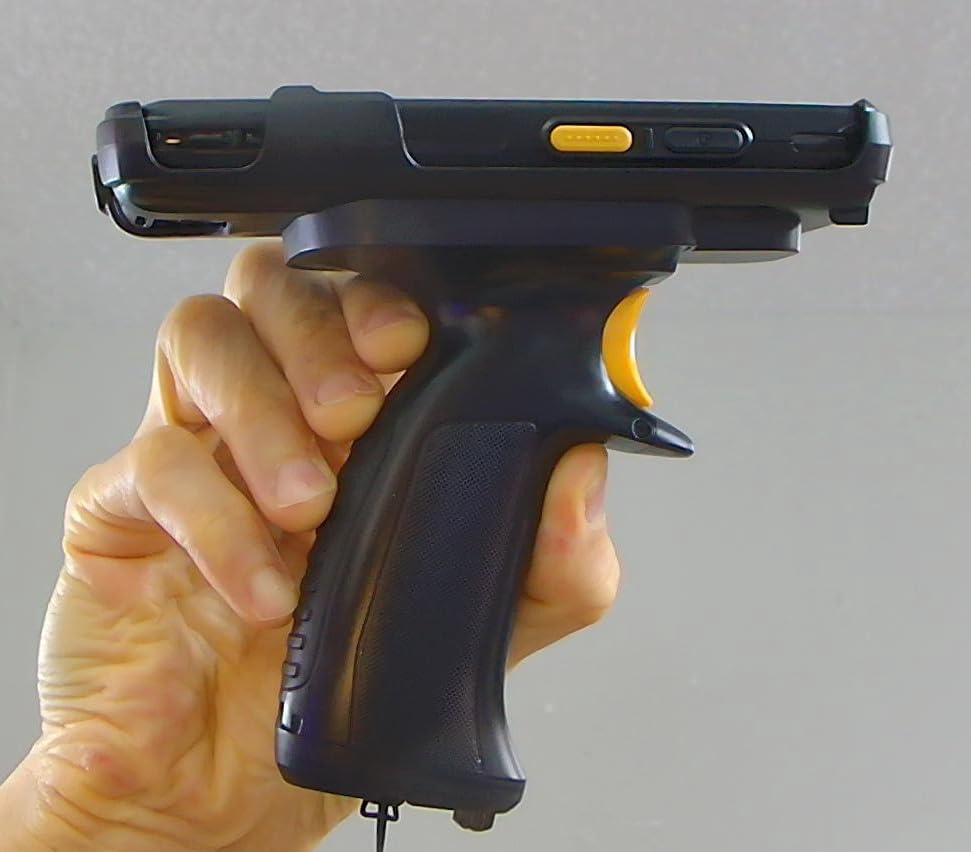
It is also the right choice where a site has poor WiFi coverage but has cellular service, since LTE keeps the unit online outside the building. A pistol grip variant and an optional dock charger are available for shift-based use, and spare batteries can be stocked independently.
Where the Vanquisher falls short
The screen timeout defaults to one minute, which is badly wrong for a production terminal and has to be changed during setup. It is an easy fix that is very easy to forget, and reviewers report it causing interrupted work in ticket-scanning use cases.
Screen durability is the weak point. Reviewers report the protector shattering on drops even where the case body survived, so a screen film and a spare unit in the charging cradle are sensible precautions. With 24 ratings, treat it as a pilot product for serious deployments.
11. Honeywell Voyager XP 1472g Corded Scanner – Best for Broad Symbology Support on a Bench
Honeywell Voyager Extreme Performance (XP) 1472g Barcode Scanner (2D, 1D, PDF, Postal), Includes Cradle and USB Cord
Honeywell 1472g scan engine
1D 2D PDF and Postal
Cradle and USB cord included
Corded power
Pros
- Honeywell Voyager XP enterprise scan engine
- Reads 1D 2D PDF and postal symbologies
- Cradle and USB cord included in the kit
- Corded power means no battery degradation
- REACH certified
Cons
- Corded only with no wireless option
- Sold through a third-party listing so verify the seller
- Only 16 ratings gives a very thin sample
- Listed compatibility is limited to smartphone
The Voyager XP 1472g is a Honeywell enterprise engine, and that matters more here than any specification on the sheet. Honeywell scan engines appear inside a lot of other manufacturers products, so buying the original is the direct route to the Honeywell decoder and its symbology coverage rather than a licensed copy of it.
Symbology breadth is the headline here, covering 1D, 2D, PDF and postal formats in one unit. Postal support in particular is rare in this roundup and is a genuine differentiator for anyone handling carrier or return labelling rather than parts.
It is corded, with the cradle and USB cord included, and that is a feature rather than a compromise on a bench. There is no battery to age, no dock charge time and no scan interruption when the battery dies mid-count, and the 39.2 degree field of view covers a reasonably wide read zone without aiming precision.
It is also REACH certified, which is worth noting for plants where chemical compliance documentation is audited rather than assumed.
Where the Honeywell Voyager XP fits production duty
It suits fixed verification stations, quality benches and pack-out checkpoints where a technician confirms a code against a work order and the unit then lives in a cradle. Corded power suits a station that runs all day without interruption.
It is the pick if postal or return-label symbologies appear in your workflow, or if you want a Honeywell decoder specifically rather than an OEM engine inside someone else’s housing.
Where the Honeywell Voyager XP falls short
It is sold under a third-party listing rather than through Honeywell directly, so confirm the seller is authorised before buying a device your traceability records will depend on. Corded only, it has no wireless option at all, and the listed device compatibility is narrow.
With 16 ratings, there is very little field history to judge long-term reliability from, and corded-only means the cable is exposed to the same wear as any other bench scanner. Spec it against a genuine Honeywell channel before committing a whole station to it.
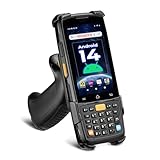
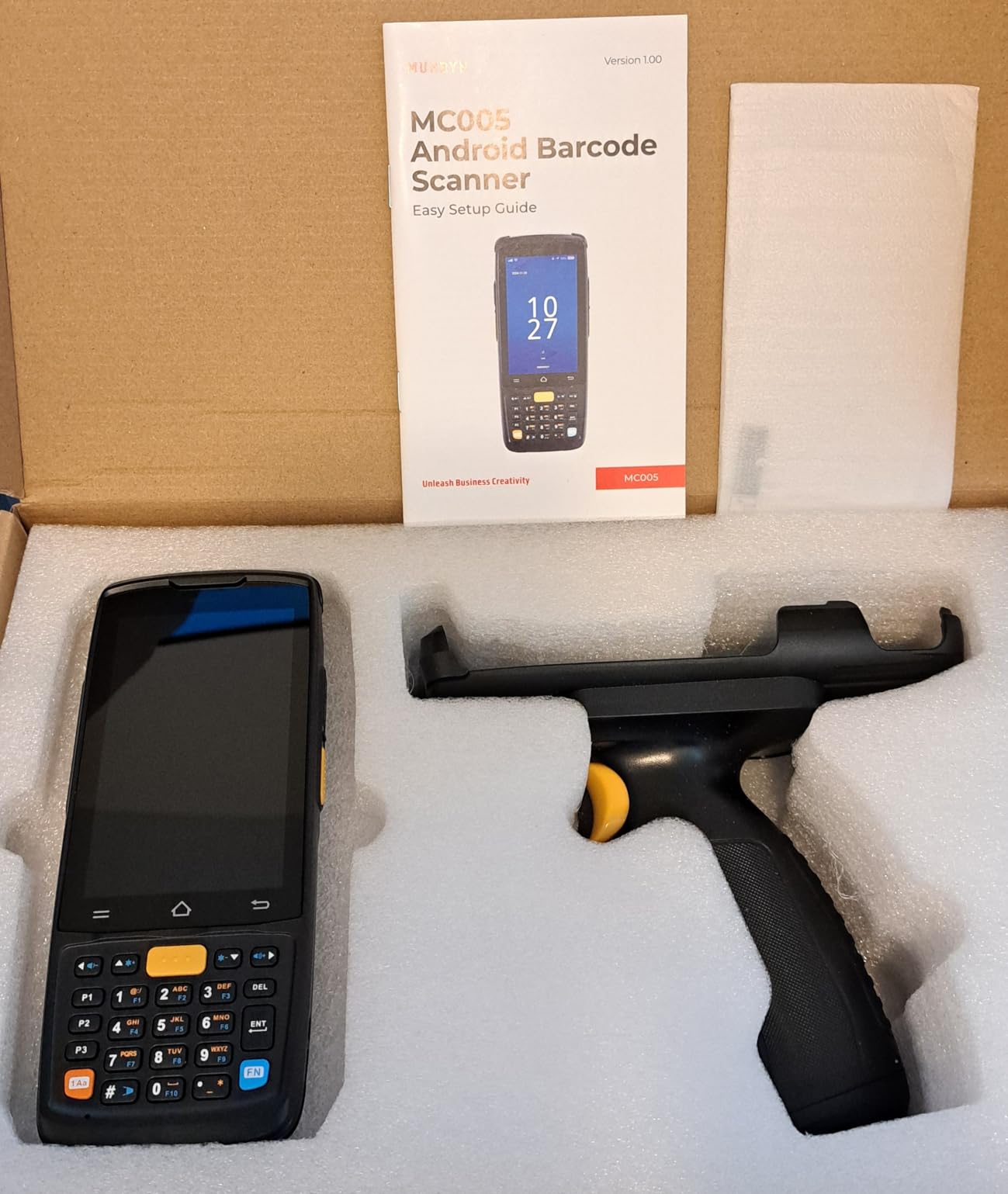
12. MUNBYN MC005P Android 14 PDA – Best for Glove-Friendly Mobile Data Collection
MUNBYN Android 14 Barcode Scanner with Trigger Handle, Works with HW HS7 1D/2D Scanner, 4GB+64GB Handheld PDA, 4-inch Touchscreen, IP65 Rugged, 5000mAh for Inventory Warehouse Logistics MC005P
Android 14 octa-core
4GB RAM and 64GB storage
IP65 and 1.5m drop
5000mAh battery
Pros
- Android 14 with a MediaTek MT8786 octa-core at 2.0GHz
- 4GB RAM and 64GB storage handles 15 to 20 apps
- HW HS7 engine reads to 80cm with 6m/s motion tolerance
- Physical keyboard and numeric keypad with glove touch support
- Two year manufacturer warranty
Cons
- Trigger handle adds bulk and weight
- Four inch screen is small beside 5.5 inch units
- Only 16 ratings gives a very thin sample
The MC005P carries the most processing power in this group, and the physical keyboard is the reason it is worth a separate recommendation. Glove touch support on a four inch screen with a real keypad means an operator in cold storage or wearing cut-resistant gloves can enter a quantity without removing them, which removes a whole category of mis-keyed entries.
The HW HS7 scan engine reads to 80 centimetres and tolerates motion up to 6 metres per second, which is a meaningful figure for a line-side application where a part is being carried rather than presented. The MediaTek MT8786 octa-core at 2.0GHz with 4GB of RAM and 64GB of storage runs fifteen to twenty applications at once.
It is on Android 14, the newest platform in this roundup, which matters for security patching and app compatibility over a service life. The 5000mAh battery, IP65 sealing and 1.5 metre drop resistance put it in the same physical class as the Vanquisher, with more endurance behind it.
App support is broad, with compatibility cited across inFlow, Zoho, Sortly, Odoo and Orcascan, so it can drop into most existing inventory workflows rather than requiring a custom build. A two year manufacturer warranty is the longest here.
Where the MUNBYN fits production duty
Choose it for mobile work where gloved data entry is routine, including cold storage, food processing and any environment with a hand-wash or cut glove requirement. The keypad makes it equally useful for cycle counts that need a quantity typed as well as a code scanned.
It suits operators who need more than one application open, since the memory and processor allow fifteen to twenty apps running at once. It is also a good fit for a production or warehouse team that wants a terminal capable of replacing a handheld and a tablet together.
Where the MUNBYN falls short
The trigger handle adds bulk, and a four inch screen is small next to the 5.5 inch Android 13 unit. It is the largest device in this roundup and that is a fair trade for the keyboard, but it is not subtle in a hand for an entire shift.
It is also the most expensive unit in this roundup, and with 16 ratings there is very little long-term data behind a 4.8 average. Specify it for a genuine multi-app requirement rather than choosing it on rating alone, because a simpler Android unit covers most scanning-only work without the extra spend.
How Reader Technology Works: Laser vs Image-Based
Every reader in this roundup is image-based. Laser scanners still exist for 1D-only work at very long range, but for production lines with Data Matrix and QR codes the camera-based imager has replaced them almost entirely, and that is why none of the twelve above is a laser unit.
The principle is the same in every case. An LED or laser light source floods the code, a sensor captures the reflected pattern, and an onboard decoder compares that pattern against the rules of each symbology to reconstruct the data. The reflected light is what carries the information, which is why lighting, glare and surface finish matter as much as the hardware.
That is the single most useful thing to understand about production scanning. When a code will not read, the cause is far more often the code and the light than the reader. Image-based readers are simply better at compensating for bad conditions, because their algorithm can reconstruct a damaged or low-contrast symbol that a laser would simply miss.
IP Ratings and Production Environments Decoded
An IP rating is two numbers after the letters IP. The first covers solids, from 6 meaning dust-tight down to 4 meaning protection against objects over 1mm. The second covers water, and that is the number that matters on a production floor.
IP54 means dust protected and splash resistant, which covers a dry indoor shop floor and nothing more. IP65 adds protection against water jets, which is the standard for a machine shop or a washdown-adjacent area. IP67 means dust-tight and temporary immersion, and it is the practical choice for food processing, freezers and outdoor storage. IP68 is continuous immersion and is rarely relevant to scanning.
Map that to your actual environment rather than to the worst case you can imagine. If a reader sits under a canopy, IP54 is probably enough. If it lives where the floor is hosed down at the end of every shift, anything below IP65 will eventually fail.
One adjacent consideration: coatings, paint and wash environments put a solvent on the housing as well as water. Our powder coating production guide covers the kind of aggressive environments where chemical compatibility of the housing matters as much as the seal.
Battery is the other environmental limit. A unit rated to minus twenty degrees and one rated to plus fifty are not the same purchase, and a lithium pack will not perform at the bottom of a freezer. Cold chain work needs a rating stated for the temperature, not inferred from the IP number.
Why Barcodes Fail on the Line and How to Fix It
Forums consistently say the same thing about no-reads, and it is worth repeating because it saves real money: most of the time, hardware is not the problem. Damaged labels, low-contrast printing, curved surfaces and glare defeat readers that would decode the same code perfectly on a bench.
Use this five-step sequence before you blame the scanner. First, read the code manually on the same part and confirm it decodes. If it does not read by hand, replace the label and the investigation is finished.
Second, check the print contrast. A grey thermal transfer ribbon on a grey label sits near the noise floor of any decoder, and no amount of sensor quality will fix it. Third, look at the code in raking light for damage, a partial peel or a crease through the bars.
Fourth, eliminate glare. Machined and anodised metal reflects the illumination straight back at the reader, so a change of presentation angle or a different lighting geometry solves reads that a better camera cannot. Fifth, only then look at distance, focus and trigger timing, which is where the remaining no-reads usually sit.
Two structural settings cause a surprising share of production no-reads. A reader left on continuous scan will fire between parts and read nothing, and a trigger set to the wrong phase reads before the part is centred. Both look identical from the PLC side, which is a single missed bit per part.
Wiring and Integration: Trigger Modes, Protocols and Lifespan Cost
Fixed and semi-fixed readers expose three scan behaviours, and picking the wrong one is a common source of integration grief. Trigger mode reads only when the trigger is pulled. Strobe mode fires on a timing signal, typically from a photoeye, which is how a moving part is synchronised. Continuous mode reads as fast as it can with no gating at all.
On a line, strobe is what you want, because it ties the read to part position rather than to a timer. For a handheld, auto-sensing and continuous cover most day-to-day work, since the operator is not going to pull a trigger on every pick.
For PLC connectivity, the protocol question comes up constantly on r/PLC and it is worth getting right early. Discrete input and output wiring is the simplest path and often the most dependable. PROFINET, EtherNet/IP and plain TCP/IP cover the networked cases, and readers that support them report the decoded string and the read status as separate signals, which is what lets a PLC reject rather than ignore.
The error people report most often is not a protocol failure but a missing confirmation signal. If the PLC has no way to know a scan happened, a no-read and a failed read look identical, and the part continues. Verify the handshake in commissioning with the line empty, not during production.
On lifespan cost, plan for a five to seven year life rather than a purchase. Batteries are the recurring line item on wireless models, and the offline storage mode in the Eyoyo and NetumScan units exists precisely because operators keep scanning when the network drops. Add cradle replacements, spare handhelds for a coverage pool, and configuration labour, then divide by scans per year. A corded model often works out cheaper per scan despite a higher unit price, which is worth checking against your own volumes rather than assuming.
The same arithmetic applies to the transport equipment around your scanning points, and the conveyor line equipment guide covers the mechanical side where part presentation actually happens.
How to Choose a Barcode Reader for Production
Work through these nine criteria in order, and stop at the first one that eliminates a candidate. Buying against the wrong requirement early is how plants end up with scanners that look right on paper and fail on the floor.
Decide the form factor first. A hand-held for line-side and stock work, a dock-based scanner for verification benches, or a mobile computer when scanning is one step in a larger app-based workflow. Inline fixed-mount readers are a separate category, from brands like Cognex, SICK and KEYENCE.
Match the sealing to the environment. IP54 for dry indoor work, IP65 for machine shops and washdown-adjacent areas, IP67 for food processing, freezers and outdoor yards. Check the stated operating temperature for cold chain specifically.
List your symbologies before you compare anything. Code 128 and GS1-128 for labels, Data Matrix and QR for 2D, and PDF417 for compliance and identity documents. Then check the exclusions, because Maxicode, USPS IMb and DPM support are the three most common gaps.
Decide between label reading and direct part marking. If identifiers are etched, dot-peened or laser marked into metal, you need DPM capability and a lighting approach built for low contrast. Label-only readers will read most of those parts as nothing.
Work out the read distance from the code size, not the headline range. Production buyers specify by bar width, and a code with a small X-dimension needs a tighter working range and a narrower field of view than a large pallet label.
Choose connectivity based on how the unit will be carried. Bluetooth for close work, 2.4G for longer range across a plant floor, and 433MHz where concrete and steel are in the way. Add offline storage if RF coverage has dead zones.
Check the confirm-scan feedback. Vibration matters more than a beep on a loud production line, and a screen matters when a human needs to verify the decoded value before it is submitted.
Plan the power and the shift pattern. Corded for fixed benches with no battery to age, battery plus cradle for single-shift mobile work, and detachable or hot-swappable batteries for anything running multi-shift without a pause.
Price the service life, not the unit. Add batteries, spare units, cradles and configuration labour across five to seven years, then divide by annual scan volume to get a true cost per scan.
How to Test a Reader on Your Own Parts Before Buying
Ask any vendor for a trial unit and test it on the parts you actually run. The sample code they send will read on anything, and tells you nothing about your line.
Bring fifty or more real parts, including the worst ones: the label with the scuff, the code on a curved surface, the part with the oily film, the batch printed with the faint ribbon. Put them in a box and treat any that fail to read as failures, not as a setup problem.
Then test under the real variables. Present the part at the worst angle your line produces, not the best. Run it at line speed rather than hand speed. Test it in the worst lighting at that station, including the shift where the overheads are switched off. A reader that only reads on a bench under office lighting has told you what you needed to know.
Measure the result as a first-read percentage, not a pass or fail. Write down how many scans were needed for fifty parts, how many failed, and what the operator had to do about each failure. That number, repeated at the same station after a month, is a far better buying guide than any specification sheet.
Brands Worth Knowing in Production Scanning
For inline fixed-mount readers on conveyors, the names that matter are Cognex with its DataMan range, SICK, KEYENCE, Omron and Datalogic, alongside Honeywell in the mobile computer space. Members of r/PLC regularly discuss Dataman units and the DataLogix controllers behind them, and these vendors are the reference point for anyone specifying reader-to-PLC integration.
For hazardous areas, Extronics comes up repeatedly in production contexts on r/PLC, with users citing it for assembly line and robotic device control in classified areas. If your line is in a classified zone, that conversation with a specialist distributor is where the specification belongs.
Zebra, Honeywell and Datalogic are the three to know for handheld and mobile work, and all three appear in this roundup. The rest of the field competes largely on sealing, battery capacity and configuration convenience, and the review data in the sections above is the most useful guide to how each holds up in service.
One forum answer is worth carrying with you. Users on r/Odoo point out that any USB barcode scanner can be configured by scanning barcodes from the manual, and that is true. It is also true that a commodity HID scanner will not survive a plant environment, which is the whole subject of this guide.
Frequently Asked Questions
What is the best barcode scanner for industrial use?
For most production duties, a wireless image-based handheld that reads 1D and 2D symbologies and carries at least an IP65 sealing rating is the best balance of capability and cost. A corded Zebra-class unit is better for a fixed verification bench, and an Android mobile computer is better when scanning is one step in a larger digital workflow. The reader must match the environment, not the other way around.
Who makes the best barcode scanners?
Zebra, Honeywell, Datalogic and Cognex are the four names most often specified in industrial settings. Zebra and Honeywell lead in handheld and mobile computer work, while Cognex dominates inline fixed-mount readers for conveyor and assembly verification. SICK, KEYENCE, Omron and Extronics matter for inline, machine vision and hazardous-area applications respectively.
What are the different types of barcode scanners?
There are four broad types. Laser scanners sweep a single line and read 1D symbologies at long range. Image-based imagers capture the whole symbol with a camera and decode 1D and 2D codes. Fixed-mount readers are installed permanently over a conveyor or station and triggered by a sensor. Mobile computers are handheld terminals with an integrated scan engine, screen and operating system.
What are the four types of scanners?
By technology and mounting, the four types are laser, image-based handheld, fixed-mount, and mobile computer. Laser reads 1D at long range, image-based handheld reads 1D and 2D while being carried, fixed-mount is bolted above a line and sensor-triggered, and a mobile computer adds a screen and operating system for app-based workflows.
What IP rating do I need for a factory barcode scanner?
IP54 suits a dry indoor shop floor. IP65 covers machine shops and areas near washdown. IP67 is the right choice for food processing, freezers, and outdoor yards where dust and water are both present. Below IP65, expect ingress-related failures in any environment that gets hosed down or washed regularly.
Can a barcode reader read a Data Matrix code?
Yes, as long as the reader has a 2D imaging engine rather than a laser-only scan engine. All twelve readers in this roundup decode Data Matrix, but some exclude specific symbologies, and the NetumScan RD-1288 additionally lists direct part marking, which matters if your identifiers are marked into metal rather than printed on a label.
How do I stop barcode no-reads on my line?
Check the code before the reader. Read it by hand on the same part, and if that fails, replace the label. Then check print contrast, look for physical damage in raking light, and eliminate glare from machined or anodised surfaces. Only after those four steps should you investigate distance, focus and trigger timing on the reader itself.
Conclusion
The best barcode readers for production depend less on specification than on environment. The ScanAvenger 3-in-1 is the strongest all-round pick for line-side and stock work, the Zebra DS2278-SR leads on wireless management in a busy plant, and the Zebra DS2208 is the most reliable way to put a proper imager on a fixed verification bench.
For harsh floors, the NetumScan RD-1288 and the Tera 8100 carry the sealing you need, while the MUNBYN and Vanquisher cover the case where scanning is part of a larger digital workflow. Whichever you choose, test it on your own parts before you commit, and check the symbology exclusions rather than assuming coverage.