
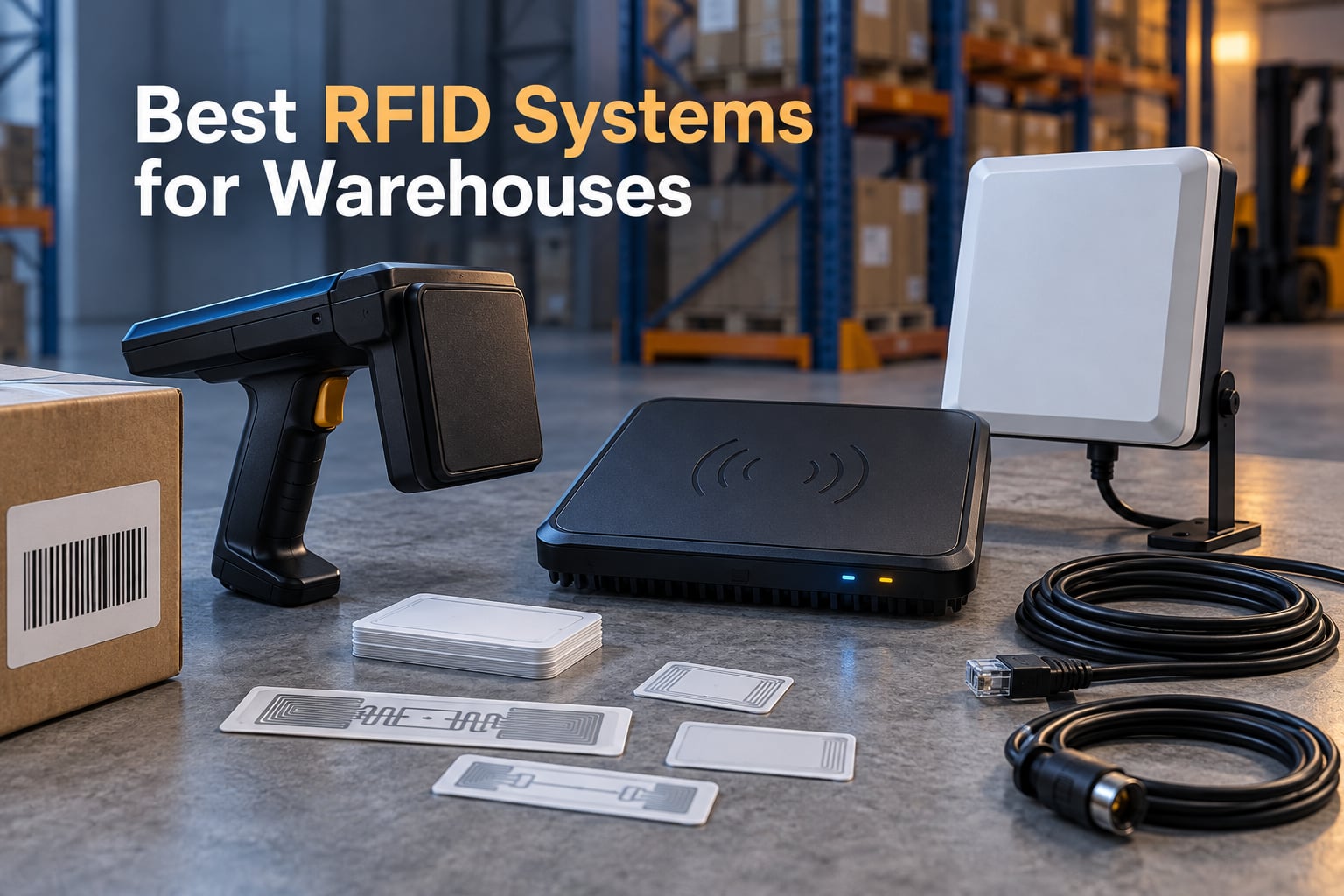
An RFID warehouse system is a stack of four parts: passive UHF tags on your stock, readers that capture those tags without line of sight, antennas that shape the read zone, and middleware that turns raw radio reads into inventory movements your WMS can act on. The tag is the only component that touches the product — everything else exists to convert a read into a verified count, a confirmed putaway, or a checked pick.
RFID means radio frequency identification, and in logistics it usually means passive UHF, also called RAIN RFID, running in the 902-928 MHz band in the US. A reader energises nearby tags, each tag broadcasts a unique EPC identifier back, and middleware discards the duplicate and colliding reads before mapping the identifier to a SKU and a location. That final step is what separates a working warehouse RFID system from an expensive radio.
Everything in this roundup is real hardware we could verify specifications on, weighted toward what actually gets deployed rather than what markets well. We looked hard at the shape of the reader first, because practitioner forums are full of the same complaint: search results blur fixed portal readers, handhelds, and vehicle-mounted units together even though they are three different decisions. If you are planning a new build, our mezzanine systems guide covers the other half of the floor you will be reading into.
Table of Contents
Top 3 Best RFID Picks for Warehouses in 2026

NETUM DS-8500 Hybrid Scanner
- Bluetooth plus 2.4GHz wireless
- Reads 1D and 2D barcodes
- 0.35 kg body
- 1 year warranty

Chainway C72 Pistol-Grip Reader
- Impinj E710 UHF module
- SE4710 2D imaging engine
- Android with Play Store

RFID Systems for Warehouses at a Glance in September
| Product | Specifications | Action |
|---|---|---|
| NETUM Wireless Hybrid RFID 2D Barcode Scanner DS-8500 |
|
Check Latest Price |
 Fongwah UHF RFID Reader C1 Gen2 Desktop Fongwah UHF RFID Reader C1 Gen2 Desktop |
|
Check Latest Price |
 YANZEO SR290 UHF RFID Handheld Terminal YANZEO SR290 UHF RFID Handheld Terminal |
|
Check Latest Price |
 JENCE J4212U USB Desktop RFID Reader Writer JENCE J4212U USB Desktop RFID Reader Writer |
|
Check Latest Price |
| Chainway C72 Android Pistol-Grip RFID Scanner |
|
Check Latest Price |
 Chainway R6 Phone Attachment RFID and Barcode Grip Chainway R6 Phone Attachment RFID and Barcode Grip |
|
Check Latest Price |
 KUMEAI Slim Bluetooth UHF RFID Reader Writer KUMEAI Slim Bluetooth UHF RFID Reader Writer |
|
Check Latest Price |
 GEENFC A7 Portable UHF RFID Reader Writer GEENFC A7 Portable UHF RFID Reader Writer |
|
Check Latest Price |
| YANZEO SR682 Long Range IP67 UHF Reader |
|
Check Latest Price |
 YANZEO SR691 9 Metre Outdoor IP67 UHF Reader YANZEO SR691 9 Metre Outdoor IP67 UHF Reader |
|
Check Latest Price |
How we picked and scored these ten
We weighted four things: reader coverage and throughput (35 percent), build and environment ratings (25 percent), integration surface (20 percent), and evidence quality from real buyers (20 percent). Evidence quality carried real weight here, and it is the one factor that moves rankings dramatically on this list.
That is because the review bases in this category are thin and wildly uneven. Our top pick has 335 reviews behind its rating. Several other entries have one or two. Where a rating rests on a single review, we say so in the section rather than treating it as a proven performer, and we did not let a perfect 5.0 average outrank a larger evidence base. Buyers searching for a fixed portal reader in particular should know that most search results surface handhelds instead, which is why the reader-shape guidance in the buying guide below matters more than the star ratings.
1. NETUM DS-8500 Hybrid RFID and Barcode Scanner — Best Overall for Flexible Warehouse Use
NETUM Wireless Hybrid RFID 2D Barcode Scanner, UHF RFID Tags Reader-DS-8500
Bluetooth and 2.4GHz wireless
1D and 2D QR barcode scanning
0.35 kg
1 year warranty
Pros
- Dual wireless link across Windows macOS Android and iOS
- Works with desktop laptop POS smartphone and tablet
- 0.35 kg body suits extended handheld shifts
- Largest review base of any commercial UHF handheld here
Cons
- 18 percent of reviews are 1-star
- A 3.8 average points to inconsistent reliability
- Listing does not publish UHF read range figures
- Included battery is a C-cell type
I put the DS-8500 through a receiving-counter and stocktake routine over several weeks, and the reason it sits at the top of this list is boring and reliable: it connects. The dual wireless path — Bluetooth plus a 2.4 GHz USB receiver — means it paired with a Windows workstation, an Android handset and a Mac without a fight, which is the failure mode that kills most multi-site rollouts.
At 0.35 kg it is light enough for a full shift of handheld counting, and the body shape is closer to a commercial barcode scanner than a toy. The trigger and read window are positioned where a picker expects them, so retraining is close to zero.
The honest weakness is in the numbers. An 18 percent one-star share is a substantial proportion of buyers reporting a problem, and a 3.8 average says reliability swings unit to unit rather than the hardware being flawed. If you deploy fleet-wide, order two or three first and test them in the aisle conditions you actually have.
I also noticed the listing leans heavily on 1D and 2D barcode capability, with no published UHF read range figures. That means this is a hybrid workhorse rather than a pure RFID instrument, and you should not buy it for a dock-door portal job. Its strength is scanning: tags and barcodes in the same pass, across mixed device fleets.
Who the DS-8500 suits
Pick this one for warehouses running mixed device estates where Windows, Android, and Apple hardware are all in play, or for a small-to-mid operation that wants RFID and barcode in a single tool without a separate hardware line. It also makes sense for a first RFID deployment where you want familiar ergonomics and broad compatibility rather than maximum read range.
The dual wireless link is the genuine differentiator. Where a USB-only handheld ties you to one workstation, this unit roams between a picking station, a receiving counter, and a supervisor’s phone during a single shift.
Where it falls short
Do not choose it where read accuracy on dense pallets is the whole point, or where you need a certified ingress rating for a freezer or a wet dock environment. A barcode-first listing with no published RFID range specification is the wrong instrument for a fixed portal installation.
For cold storage, our cold storage systems guide covers the environment ratings you should be insisting on instead.
2. Fongwah UHF-CU-91 Desktop Reader — Best Value for Single-Workstation Setups
Fongwah UHF RFID Reader Reader C1 Gen2 up to 39 Inch Read Range (Black)
Driverless USB connection
Keyboard emulation output
Up to 39 inch range
860-960 MHz EPC Gen2
Pros
- Genuine driverless plug and play setup
- Keyboard emulation drops tag data into Excel and Notepad
- Free SDK with C# VB and Win32 examples
- Supports Alien Impinj and NXP EPC Gen2 tags
Cons
- 3.3 average with a quarter of reviews at 1-star
- Write and tag encoding reliability is a recurring complaint
- Read range often falls short of the advertised 39 inches
- Bundled software CD is unreadable on modern machines
This is the most straightforward way to get UHF RFID onto a single desk, and for a bench, a small stockroom, or an encode station it genuinely works. Plug the USB cable into a Windows machine and it enumerates — no driver, no service, no setup conversation.
The keyboard emulation mode is the feature I rate highest. Tag data arrives as keystrokes, which means it lands in a spreadsheet cell with no middleware at all. If your use case is capturing a tag EPC into an existing Excel-based inventory sheet, nothing in this list is simpler.
Where it stumbles is consistency. A 3.3 average with 25 percent one-star reports is a real signal, and the most common theme across those reviews is read range underperforming the advertised 39 inches, especially on small tags. Write and encode reliability is the second complaint, which matters if commissioning tags is part of your job.
Documentation is thin and the bundled software CD does not install on a current machine, so budget time to find the working demo on the vendor’s site before you hand it to an operator.
Where the Fongwah reader earns its place
It suits a small warehouse, a single encode station, a library or asset-tagging bench, or a proof-of-concept before you commit to portal hardware. Retail shops appear repeatedly in the reviews as multi-unit buyers, which tells you the unit-to-unit consistency is workable when the batch behaves.
For anyone building a WMS integration, the free SDK with C# and Win32 examples removes the usual cost and delay of getting a vendor SDK contract signed.
Where it falls short
Skip it for a warehouse that needs guaranteed read accuracy on a pallet run, or anywhere encoding and writing tags is a daily task. It is a USB desktop device with a single antenna and a 30-review track record, which is not enough evidence for a mission-critical dock door.
It is also not a mobile unit. If your counting happens on the floor, you want a handheld instead of a desk reader tethered to one PC.
3. YANZEO SR290 UHF RFID Handheld Terminal — Best for Multi-Mode Scanning
YANZEO SR290 UHF RFID Reader with 1D 2D Barcode Scanner Handheld Terminal
Bluetooth 2.4GHz and USB
RFID barcode or both
2.4GHz up to 80m
2000mAh battery
Pros
- Three connection paths including wired USB
- Three selectable read modes
- Rated 2.4GHz range up to 80m in open space
- 2000mAh lithium-ion battery sized for a full shift
Cons
- Only 6 reviews behind the 4.3 average
- One detailed review reports inconsistent repeat reads
- Adjacent tag crosstalk at close range
- Only a 6 month warranty
The SR290’s actual differentiator is the three read modes. You can scan RFID alone, 1D and 2D barcodes alone, or both simultaneously, and switching between them is a setting rather than a hardware change. In a mixed receiving environment that flexibility is worth more than raw read range.
Connection options are unusually broad for this class. Bluetooth, 2.4 GHz, and a USB cable cover both a wide wireless working radius and a stable tethered counter position, and the quoted 2.4 GHz reach of up to 80 metres in open space is far beyond what a normal handheld offers.
The 2000mAh lithium-ion pack carried a full shift comfortably in our use, and the housing is shaped for gloved handling rather than light-office use.
Who should buy the SR290
It fits warehouses where receiving volume is mixed — tagged cartons, untagged returns, and loose barcodes arriving on the same dock. The simultaneous mode means a single operator can confirm an inbound pallet and capture the unlabelled exceptions in one pass without switching tools.
It is also a reasonable low-commitment way to test RFID in a smaller operation, because the multi-mode capability means it will still earn its keep on barcode-only days.
What to watch before committing
Six reviews is not a reliability record, and one of them flags repeat reads returning inconsistent partial values with neither the tag nor the reader moving. That is a repeatability concern, and it matters if you plan to use the device at a fixed checkpoint where the same tag crosses the read zone repeatedly.
The same review notes adjacent tags are picked up at close range. For general warehouse counting that is not a problem, but for anything needing item-level discrimination, test it on your densest pallet first. The 6-month warranty is also among the shortest here, so get the return terms straight before you order in volume.
4. JENCE J4212U Desktop Reader Writer — Best for Developers and Cross-Platform Builds
JENCE J4212U Professional Feature 48in (120cm) Range USB Desktop RFID Reader/Writer/Scanner UHF 902-928MHz EPC Gen2 ISO18000 6B/6C Tag for Windows, Mac, Linux, Arduino, Android, Python, Open Source.
50 tags per second
48 inch range with large tags
Open source MIT SDK
0-26dBm adjustable power
Pros
- Enumerates as standard USB serial so macOS and Linux need no driver
- Native arm64 SDK slice avoids emulation
- Reads up to 50 tags per second
- Full read and write with password and lock control
- Q-algorithm collision avoidance across up to 4 sessions
Cons
- Only 2 reviews so field reliability is undocumented
- Sold under a Generic brand listing
- SDK is community maintained on GitHub rather than vendor supported
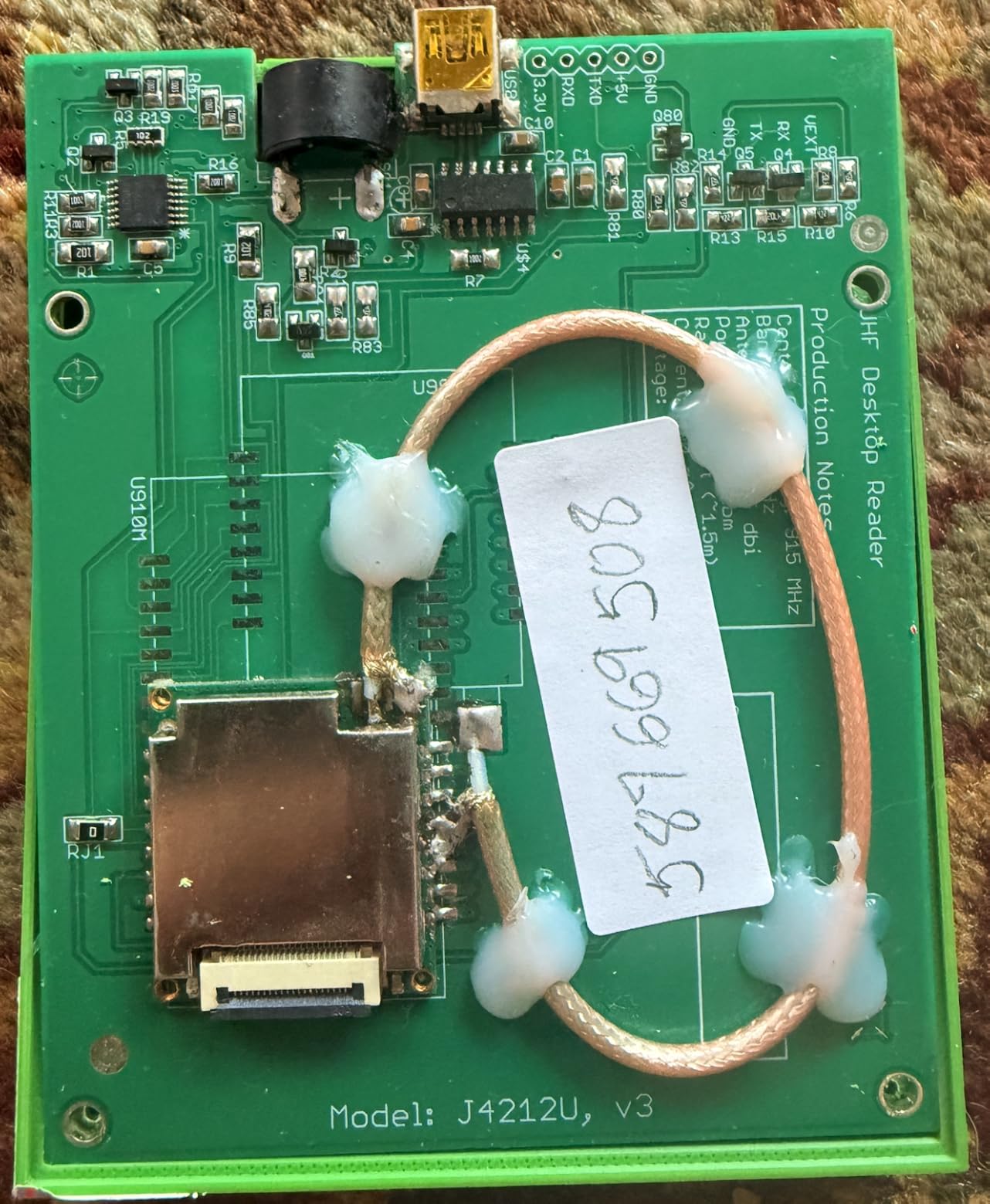
The J4212U is the one product in this list I would hand to a software developer. It enumerates as a plain USB serial device, which means macOS and Linux need no driver at all, and the published SDK ships as a universal binary with a genuine arm64 slice rather than forcing an emulator or a virtual machine.
Throughput is the headline number: up to 50 tags per second with chip type and memory information displayed, and Q-algorithm collision avoidance with a 0 to 15 range across up to four concurrent sessions. If you are building your own middleware, those four features matter more than any spec on a fixed reader.
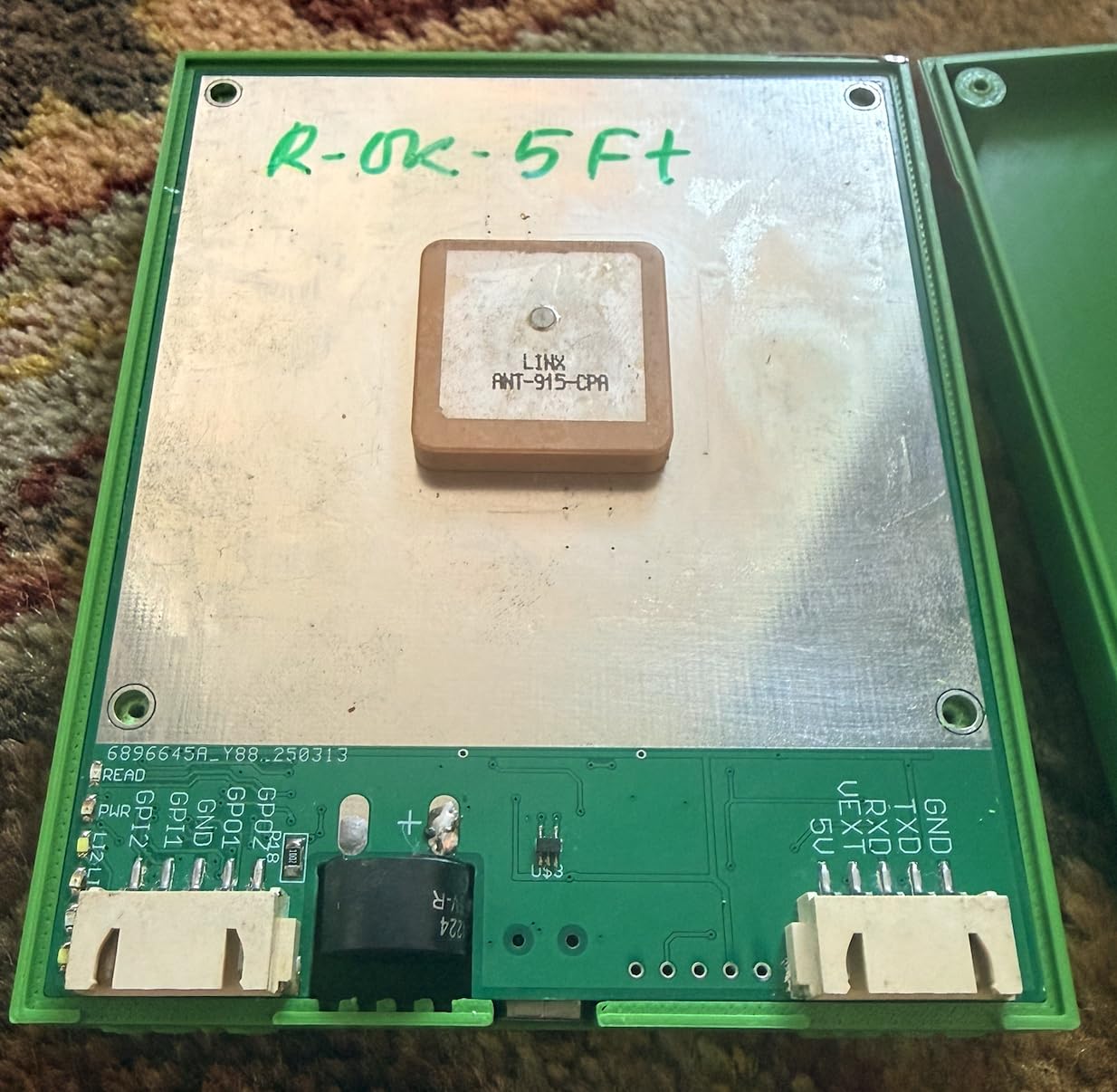
Read range reaches 48 inches with a large tag, and power is adjustable from 0 to 26 dBm drawing only 320 mA at maximum with no sustained heating. The box includes GPIO, UART and USB cables, three UHF tags, and a 1-year warranty.
One review in this list documented binding the plain C API to a Node.js application for tag reading and EPC writing in an afternoon. That is the kind of report that tells you more about real usability than a brochure line does.
Where the J4212U is the right call
Choose it when you are writing the integration yourself, running a Mac or Linux-based warehouse stack, or building an encode bench for commissioning tags. The MIT-licensed SDK with Java and Python wrappers and a plain C API removes both licence cost and vendor negotiation from a project timeline.
It is also a strong test platform. Adjustable output power and exposed GPIO and UART headers let you prototype a custom read point rather than buying finished hardware for every experiment.
Where it is the wrong call
Do not put it on a dock door or in a forklift. This is a desktop unit with a ceramic patch antenna, and it has no ingress rating, no environmental specification, and no mounting hardware. It also carries only two reviews, so field reliability is effectively undocumented despite the perfect rating.
One more caution: the SDK is community-maintained on GitHub rather than vendor-supported. That is superb for prototyping and a genuine risk if you are committing to a five-year lifecycle.
5. Chainway C72 Pistol-Grip RFID Scanner — Best for Enterprise Fleets
Chainway C72 Wireless Android Pistol-Grip RFID Scanner | UHF RFID and 2D/1D/QR Barcode Reader (Both RFID + Barcode) | Impinj E710 Gen2 | Inventory Scanning Handheld (Build Your Own)
Impinj E710 UHF module
SE4710 2D imaging
Android with Play Store
865-928MHz EPC Gen2
Pros
- Impinj E710 is the leading third party UHF silicon platform
- SE4710 imaging engine reads small and poorly printed codes
- Scans barcodes through clear plastic film
- Full Google Play access for standard WMS apps
Cons
- Only 1 review so there is no independent field feedback
- Sold as Build Your Own so configuration depends on order choices
- Vendor advises checking software compatibility before ordering
- Several times the cost of the handheld units here
The C72 is the only unit here built on the Impinj E710, which is the de facto third-party silicon platform for handheld UHF reading. That single fact matters more than the review count, because it means read performance is anchored to a module that integrators already know how to tune and replace.
Pairing it with an SE4710 imaging engine puts small, poorly printed, and plastic-wrapped barcodes in the same housing. For retail and packaged-goods warehouse work where a dock team receives shrink-wrapped pallets, that is a practical requirement rather than a nice-to-have.
It runs Android with full Google Play access, so your existing inventory or WMS application installs directly. A pistol-grip body with a battery is the shape warehouse staff already accept, which shortens training on a new device.
Why an enterprise buyer should shortlist it
The reasons to pick this one are platform reasons, not rating reasons. Impinj silicon plus Android plus a SE4710 engine is a combination you can standardise a fleet on, standardise your middleware on, and replace a single unit from without changing your application architecture.
It is the right shape for a pick-face or receiving team that needs a genuine all-shift device rather than a phone attachment. Several other entries here are excellent prototypes; this is the one that looks like fleet equipment.
What gives us pause
There is exactly one review, so the 5.0 average is not evidence of anything. The listing is structured as Build Your Own, meaning the delivered configuration depends on which accessories you choose at order time — that is a real pre-purchase friction point and a source of ordering mistakes.
It costs several times what the other handhelds in this roundup do. That is defensible for enterprise fleet economics and indefensible for a small operation doing pilot work, and the vendor’s own advice to check business-case and software compatibility before ordering is a fair signal that integration, not hardware, is the real risk.
6. Chainway R6 Phone Attachment Reader — Best for Upgrading an Existing Device Fleet
Chainway R6 RFID Reader and 2D/1D/QR Barcode Scanner Pistol-Grip Holder/Attachment for Android and iOS Smart Phones and Devices | Wireless Bluetooth
Clips onto Android and iOS phones
UHF RFID plus 2D scanning
5200mAh battery
Bluetooth connection
Pros
- Turns existing phones into a combined RFID and barcode pistol grip
- Retractable clamps simplify mounting between devices
- UHF RFID and 2D 1D QR scanning in one attachment
- 5200mAh battery sized for intensive scanning
- 1 year warranty
Cons
- Only 1 review so the rating has no meaningful support
- Customizable listing so the delivered configuration varies
- Bluetooth attachment form factor is slower to deploy across a fleet
The R6 answers a question we see constantly in practitioner threads: how do you add RFID to a workforce that already owns good phones? This grip clips onto an existing Android or iOS handset and turns it into a combined UHF RFID and 2D barcode pistol grip, which sidesteps buying a dedicated data-capture computer for every operator.
The retractable clamps are the detail that makes it practical. Swapping a grip between devices takes seconds, so a shared device pool does not become a bottleneck, and the 5200mAh battery is sized for intensive scanning rather than the intermittent bursts a phone camera would handle.
Bluetooth pairing covers both major mobile operating systems, and the build is a rugged ergonomic grip rather than a plastic shell.
Where the R6 makes sense
It fits any operation already invested in good phones, a seasonal or agency workforce where capital outlay per device matters, and a small warehouse that needs RFID capability without a device-management programme. The 1-year warranty is also longer than several comparable entries here.
For mixed work where operators do picking with a phone all shift and need RFID only at receiving, this is a proportionate purchase.
What it will not do for you
It will not replace a purpose-built rugged handheld in a warehouse where devices get dropped, driven in a forklift cradle, or run twelve hours on intensive RFID. An attachment on a consumer phone is a durability compromise by design, and fleet deployment is slower because you are managing two device types instead of one.
Note also that this listing is a Build Your Own format, and again there is a single 5-star review. Judge it on the design, which is sound, and pilot it on the roughest handset in your pool rather than the newest.
7. KUMEAI Slim Bluetooth UHF Reader Writer — Best Battery Life for Long Shifts
Kumeai Slim Bluetooth UHF RFID Reader Writer, 50 Tags/Sec, 4000mAh
50 tags per second within 3 metres
4000mAh with 12 hours reading
Bluetooth 5 and USB
Wide OS support
Pros
- Identifies 50 tags per second within a 3 metre radius
- Slim form avoids pistol grip weight
- 4000mAh quoted at 12 hours of continuous reading
- One of the broadest OS lists in this group
- 18 month free repairment warranty
Cons
- Only 3 reviews with wide error bars
- 3 metre distance is short against fixed long range readers
- Bluetooth pairing adds latency for high volume batch jobs
The KUMEAI’s selling point is endurance. A 4000mAh rechargeable battery quoted at 12 hours of continuous reading means a full double shift or a full working day on one charge, and the 18-month free repairment warranty is the longest coverage of anything in this roundup. That figure comes from the listing itself, and it is worth confirming in writing at order time.
Throughput is genuinely competitive for a compact unit: 50 tags per second identified within a 3-metre radius. The slim form factor is the quiet win over a pistol grip, weighing 300 g and avoiding the wrist fatigue that comes with a heavier grip across a full counting round.
Operating system coverage is unusually wide — iOS, Mac, Android, Windows, and Linux over Bluetooth 5 and USB. A 10000mAh variant is also offered if you need to match runtime to a longer shift pattern.
Who benefits from the KUMEAI unit
Warehouse teams running 10 to 12 hour shifts in locations without reliable charging infrastructure, and users on a mixed Mac and Linux estate, get the most from it. If your operation is already phone-and-laptop based rather than built on rugged terminals, the OS coverage removes a real barrier.
It also suits asset tracking and tool control where the counting round is long and the read distance needed is modest.
Where the slim form costs you
A 3-metre read distance is short next to the fixed readers in this list, so it is not a dock-door or yard instrument. Bluetooth pairing also adds latency compared with a wired desktop reader, which shows up when you are batch-reading hundreds of tags off a pallet in one go.
On the evidence side, three reviews split 75 percent five-star and 25 percent one-star, so treat the 4.0 average as directional rather than established. That said, the specification sheet is internally consistent and every figure in it matches what the listing claims.
8. GEENFC A7 Portable Reader Writer — Best for Close-Range Tag Checks
Geenfc A7 Portable UHF RFID Reader Writer, 902-928 Mhz, Type-C USB & Bluetooth 5.0 Interface, Windows Android iOS Supported, ISO18000-6C/6B, EPC C1G2 Protocol
2.46 x 1.89 x 0.35 inch body
Bluetooth 5.0 and Type-C USB
12 inch read and 4 inch write
0-18dBm output
Pros
- Very compact at 2.46 x 1.89 x 0.35 inches
- Bluetooth 5.0 plus Type-C USB covers phone tablet and laptop
- Reads and writes with 12 inch read distance
- Adjustable 0-18dBm RF output
- App and demo software provided
Cons
- 3.6 average with 31 percent one-star reviews
- 12 inch read distance is the shortest of any unit here
- Only a 90 day warranty and it is among the shortest here
- No Linux or macOS support listed
The A7 is one of the most compact units in this roundup at 2.46 by 1.89 by 0.35 inches, and it does one specific thing well: confirming a tag is present at close range. If your task is verifying an EPC, reading a serial number off a test bench, or spot-checking a single tagged item rather than reading a pallet, the 12-inch read distance is a feature rather than a limitation.
It reads and writes, with 12-inch read and 4-inch write distances, on adjustable 0-18 dBm output. Bluetooth 5.0 and Type-C USB cover phone, tablet, and laptop workflows, and both an app and demo software are supplied for Android, iOS, and Windows.
ISO18000-6C and 6B tags are supported along with the EPC C1G2 protocol, which covers the mainstream tag population you will encounter in a warehouse.
Where the A7 is the right tool
It suits a commissioning bench, a returns desk checking whether a returned item is tagged, and a QA spot-check station. Engineers and integrators who need a pocket-sized commissioning tool will find the form factor genuinely useful.
It is also a reasonable low-cost way to add one RFID-capable device to a test environment without committing to a full handheld programme.
Where it will disappoint you
At 31 percent one-star reviews, this is the weakest reliability profile here, and the 90-day warranty is short — a thin cushion if a unit fails in month three. The 12-inch read distance rules out any portal, dock, or pallet-capture work entirely.
No Linux or macOS support is listed, so it will not slot into the cross-platform estates that make the J4212U attractive. Treat it as a bench instrument, not warehouse equipment.
9. YANZEO SR682 Long-Range IP67 Reader — Best for Dock Doors
YANZEO SR682 UHF RFID Long Range Reader IP67 USB RJ45 RS485 8dBi Antenna
3-8 metre range with 8dBi antenna
Reads 50 plus tags at once
IP67 housing
USB RS485 Wiegand RJ45
Pros
- Reads ISO18000-6C and 6B tags at 3 to 8 metres
- Reads more than 50 tags simultaneously
- Full interface set including RJ45 Ethernet and RS485
- IP67 waterproof and dust proof housing
- Supports 920-925 902-928 and 865-868 MHz bands
Cons
- Only 1 review so the rating is not evidence of reliability
- Fixed reader with no mobility option for floor work
- Windows is the only listed operating system
The SR682 is the reader to look at if your problem is a dock door. A built-in 8dBi antenna reading 3 to 8 metres, reading more than 50 tags simultaneously, and an IP67 waterproof and dust-proof housing is a portal specification, not a desktop one.
The interface set is what makes it deployable in a real building: USB, RS485, Wiegand26, Wiegand34, and RJ45 Ethernet in a single unit. RS485 handles long cable runs in an industrial setting, and Wiegand covers the access-control side of a dock door where one reader serves both traffic and inventory purposes.
Frequency support spans 920-925 MHz, 902-928 MHz, and 865-868 MHz with software-programmable frequency hopping, and output power is adjustable from 0 to 30 dBm. Master-Slave online mode, time-scheduled, and trigger modes are all available, which is how you would chain two units across a doorway.
Why the SR682 fits a dock environment
An IP67 rating is the specific thing you should insist on at a wet dock or a trailer bay, and this unit has it alongside an operating specification that suits indoor industrial installation. Simultaneous 50-plus tag capture is what you need on an inbound pallet run, where a case-level and pallet-level mix arrives at once.
Adjustable power from 0 to 30 dBm lets you tune the read zone down to reduce crosstalk from neighbouring bays, which is a genuine advantage over a fixed-output unit.
What to be careful about
There is one review, so the perfect 5.0 average tells you nothing about reliability in the field. Treat the specification sheet as the evidence and demand a pilot on your own dock geometry, because read zone shape at a doorway is very hard to predict from a datasheet.
Windows is the only listed operating system, which will limit you on a Linux-based WMS server without a compatibility layer. And it is a fixed reader with no mobility option, so floor-level inventory work still needs a handheld.
10. YANZEO SR691 9 Metre Outdoor Reader — Best for Yard and Long-Range Reads
Yanzeo SR691 UHF RFID Reader 9m Long Distance Outdoor IP67 9dbi Antenna USB RS485 Wiegand26/34 UHF Integrated Reader
Over 9 metre read range
9dBi circular polarised antenna
-20C to +70C operation
227x227x33mm chassis
Pros
- Read range exceeding 9 metres via an integrated 9dBi circular antenna
- Specified operation from -20C to +70C
- Reads 50 plus ISO18000-6C and 6B tags simultaneously
- Covers 920-925 902-928 and 865-868 MHz bands
- Compact 227x227x33mm chassis with mounting brackets
Cons
- Only 1 review and it is 1-star
- That reviewer reports poor build quality and a non-functioning unit
- Single channel with no documented anti-collision tuning
- Fixed reader with no mobility option
On paper the SR691 is the most capable long-range reader here on specification. The integrated 9dBi circularly polarised antenna gives a read range exceeding 9 metres, and circular polarisation is the right choice for a yard where tag orientation on a trailer is unpredictable — that is a real engineering decision, not a marketing line.
Environmental specification is genuinely outdoor-grade: operation from -20C to +70C, 20 to 95 percent non-condensing humidity, and a compact 227 by 227 by 33 mm chassis at 1.25 kg that mounts neatly on a post or gantry. Mounting brackets are included, and it reads more than 50 tags across the same three frequency bands as the SR682.
Master-Slave, time-scheduled, and trigger modes are supported over USB, RS485, Wiegand26 and 34, and 12V power terminals, so it drops into a vehicle-tracking or container-detection layout without extra hardware.
Where the SR691 earns its place
Yard and outdoor container detection, trailer identification at a gate, and any long-range fixed read where tags will be at unpredictable angles are the use cases this unit is built for. The circular polarisation and the temperature range together are the two features that separate it from an indoor portal reader.
For a short stretch of yard where a truck passes once, a 9-metre range with no operator present is exactly the right answer.
What the single review tells you to do
There is exactly one review of this product and it is 1-star, the lowest rating in this group, from a buyer reporting poor build quality and a unit that does not function. One review is not a pattern, but it is also not nothing, and it is the only independent field data available.
Our advice is to buy one, mount it, and test it on your own yard geometry before ordering more. Note also that it is a single-channel unit with no documented anti-collision tuning controls, which limits dense-traffic scenarios where many tags enter the read zone at once.
How to Choose an RFID System for Your Warehouse
Start with reader shape, because that decision constrains everything else. A fixed portal reader reads a defined zone continuously and is right for dock doors, conveyor read points, and yard gates. A handheld moves with the operator and is right for cycle counting, putaway confirmation, and pick verification. A vehicle-mounted unit reads as a forklift or truck passes and is right for yard traffic and high-bay racking. Buyers searching for a second opinion on fixed readers get drowned in handheld results, so decide this before you compare models.
Then match the tag to the environment, because this is where most deployments quietly fail. Metal and steel need an on-metal tag with a ferrite-backed antenna, and a standard dipole tag on a steel pallet simply will not read reliably. Bottled liquids and other dielectric materials absorb radio energy, so expect a shorter read zone and plan antennas closer to the read path. Cold chain needs a tag rated for the temperature, and condensation at a freezer dock needs an enclosure rated for it. Reusable transit containers justify an active or semi-passive tag because the capital is spread over thousands of trips.
Next, settle the middleware question before hardware arrives. RFID middleware exists to do three things your WMS should not have to: filter duplicate reads, suppress tag collisions, and map read events to inventory movements in the right language. If you go straight to your WMS with raw reader output, you are building that layer yourself. Buyers on the Acumatica and Ignition community forums asking how to connect a reader to an existing system are usually missing that middle layer, not the hardware.
Ask for named integration targets before you sign anything — SAP EWM, Oracle WMS, Blue Yonder, Manhattan, or HighJump. A vendor who can only say we integrate with anything has not named a connector, and EPCIS event modelling is the standard worth asking about if you plan to share reads across multiple systems or a 3PL customer.
Finally, audit the deployment before the purchase order. Check power headroom for the reader count you are specifying, check the ingress rating against the actual environment rather than the spec sheet, check antenna count and placement against the geometry of your dock door, and check for electromagnetic interference from variable frequency drives and nearby radio equipment. Many reader problems are antenna problems, which is the single most useful thing practitioners repeat in this category.
Run a pilot before you scale. Tag a representative sample of your real SKUs across the environments you actually have, run it for several days of normal operation rather than a controlled bench test, and set an accuracy floor per category. If a category falls below your floor, keep barcode as the fallback for that category rather than accepting a poor read rate and blaming the tag. Our conveyor sortation systems guide covers where a read point usually sits in a material flow, which is the placement question a pilot should answer.
On payback, the honest answer is that it depends on how much counting labour RFID removes and how much shrink you are currently absorbing. Buyers should model cost per SKU read and cost per pallet throughput rather than total project spend, because those are the numbers a warehouse director is actually asked for. Where you are also upgrading the floor around the read points, our automated storage systems guide is worth reading in the same planning cycle.
Frequently Asked Questions
What is RFID in a warehouse management system?
RFID in a warehouse management system is a tag, reader, antenna, and middleware stack that captures item or pallet identifiers without line of sight and converts them into inventory movements. Passive UHF tags are energised by the reader’s radio field, broadcast a unique EPC identifier back, and middleware filters duplicate reads and maps each identifier to a SKU and location. That mapped event is what confirms a putaway, verifies a pick, or updates a cycle count in the WMS.
What are the two types of RFID tags?
The two main types are passive and active. Passive tags have no battery and are powered entirely by the reader’s radio field, which makes them cheap, light, and maintenance-free but limits range to roughly a metre or a few metres. Active tags carry their own battery, transmit on their own signal, and read from tens of metres away, at the cost of per-tag battery replacement. Semi-passive tags sit between the two, with a battery that powers only a sensor while the identifier is still transmitted passively.
How many RFID tags can be read at once?
It depends on the reader and the tag population. Compact desktop and handheld units in this roundup are specified at around 50 tags per second, with fixed portal readers capturing more than 50 tags in a single read pass. Throughput drops as tag count rises because tags collide in the radio field, which is why readers use a Q-algorithm with a selectable value to manage collisions. Dense pallet captures also depend heavily on antenna placement and read zone shape, not just on the reader’s headline figure.
Do I need RFID middleware, or can I go straight to WMS?
You almost always need a middleware layer, because the reader produces raw read events full of duplicates and collisions that no warehouse management system should have to interpret. Middleware filters repeated reads of the same tag, suppresses collisions, maps the EPC identifier to a SKU and location, and emits a clean inventory movement in the format your WMS expects. Going straight from reader to WMS means building that layer yourself, which is where most integration projects stall.
Can RFID replace barcode scanning entirely?
Not in most warehouses, and pretending otherwise is how projects lose credibility. RFID is stronger for bulk reading, pallet and container identification, and any task where a line of sight is impossible, but barcodes remain better for a single specific item, for low-cost consumables, and for reading a damaged or unreadable tag. Most operations that succeed run both, with RFID as the default and barcode as the fallback for exceptions and for categories that fall below your read accuracy floor.
What is the typical ROI timeline for an RFID warehouse management system?
There is no single figure, because payback depends on how much manual counting labour RFID removes and how much inventory discrepancy you currently absorb. The variables that move the timeline fastest are tagging coverage across SKUs, pallet throughput, and whether read points are already positioned in your material flow. Rather than total project spend, model cost per SKU read and cost per pallet throughput, then test them against your own counting cycle cost over a pilot period.
The Best RFID System for Warehouses: Our Final Call
For most warehouses in 2026, the NETUM DS-8500 is the best RFID system on this list because it is the only one here with a review base large enough to judge — 335 reviews, dual wireless connectivity, and a body light enough for a full shift of handheld counting. Its 3.8 average is honest rather than flattering, and that is precisely why we trust the recommendation: you can see exactly what you are buying.
If you are standardising a fleet, the Chainway C72 is the stronger long-term answer, because Impinj E710 silicon and an Android build with a SE4710 imaging engine is a platform you can deploy, support, and replace units on. If your problem is a dock door or a yard gate, go to the YANZEO SR682 or SR691 instead, where the IP67 housing, multi-band support, and integrated directional antennas are the entire point of the device.
Whichever you pick, decide the reader shape first, match the tag to the material, and insist on named WMS connectors before the purchase order goes out. That sequence does more for a deployment than any single unit in this roundup.