
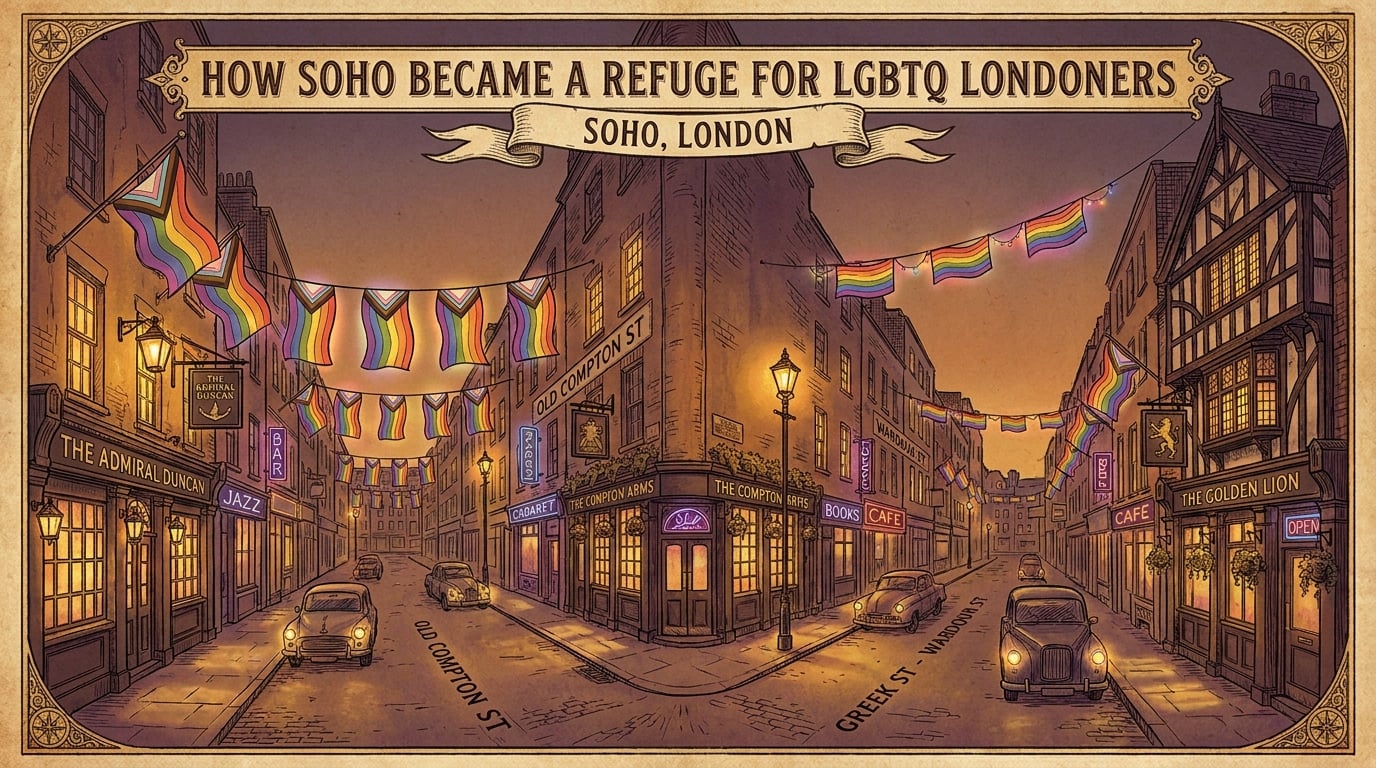
Soho became a refuge for LGBTQ Londoners because its dense, maze-like streets and mixed-use character allowed underground venues, private clubs, and coded gathering spaces to operate continuously from the 1700s onward, creating one of the world’s longest-surviving queer communities despite centuries of criminalisation, police raids, and social persecution.
That short answer only scratches the surface. The full story spans more than 300 years, from secret molly houses in the early 1700s to the gay bars, clubs, and community spaces that still line Old Compton Street today. It is a story of resilience, creativity, and defiance that shaped not just a neighbourhood but an entire community’s sense of home.
London is the most queer city in the UK, with 5.2% of adults identifying as LGB+ according to ONS data. Within London, Soho has served as the beating heart of queer life for generations. But calling it a “gay capital” or an “entertainment district” misses something more profound. Soho was, at its core, a refuge, a place where people who faced arrest, ruin, and violence for being themselves could find each other.
This article traces that journey chronologically, from the Huguenot refugees who first gave Soho its outsider character, through the molly houses, the wartime crackdowns, the golden era of the 1970s and 1980s, the 1999 bombing that united the community, and the gentrification pressures that threaten its future. We will also address the question many LGBTQ Londoners are asking right now: is Soho still a refuge in 2026?
Table of Contents
The 1600s: Soho Before It Was Queer
To understand how Soho became a refuge for LGBTQ Londoners, you have to go back to before it was anything recognisable as a neighbourhood. In the 1600s, the land we now call Soho was open farmland and hunting grounds on the edge of a rapidly expanding London. The name “Soho” itself is thought to originate from a hunting cry, the call used when pursuing game across these fields.
Everything changed in the 1670s and 1680s, when the area began to be developed and a wave of Huguenot refugees, French Protestants fleeing religious persecution, settled in the streets around Soho and Spitalfields. These were people who knew what it meant to be outcasts. They brought their language, their churches, their trades, and a deep understanding of what it means to build community in a place that is not quite your own.
This origin as a refugee settlement matters enormously for the queer history that followed. Soho was born as a place of outsiders. Its streets were laid out in an irregular, tangled pattern that was never fully planned, creating the kind of dense, hidden, hard-to-police geography that would later make it attractive to people who needed to meet in secret.
By the late 1600s, Soho sat in a unique position geographically. To the west lay the wealthy, respectable West End. To the east sat the poorer districts of St Giles and Holborn. Soho occupied the space between, a transitional zone where different classes, nationalities, and subcultures mixed. This in-between quality, being neither fully respectable nor fully marginal, would define Soho for the next three centuries and create the conditions for queer life to take root.
Even in this early period, historical records suggest that men were seeking out other men in the Soho area. The Londonist’s research, drawing on Alim Kheraj’s book Queer London, notes that by the 1600s Soho already had a reputation as a place where men would solicit other men for sex. The foundations were being laid, quietly and at great risk, for what would become one of the world’s most significant queer neighbourhoods.
Molly Houses and the Birth of Queer Soho (1700s-1800s)
The first true queer venues in Soho and the surrounding areas were molly houses. These were taverns, inns, and private rooms where men who were attracted to other men could gather, socialise, and express themselves in ways that were impossible anywhere else in 18th-century England. The term “molly” was a slang word used at the time for effeminate men, and molly houses became the earliest known queer community spaces in British history.
The most famous of these was Mother Clap’s molly house, which operated in the Holborn area just east of Soho in the early 1720s. Margaret Clap, known as Mother Clap, ran a coffee house that served as a meeting place for a community of men who would otherwise have had no way to find each other. These spaces were not just about sex. They were about companionship, identity, and belonging. Men adopted female names, wore clothing that expressed their inner selves, and built relationships that sustained them in a hostile world.
The danger was extreme. Homosexual acts between men were punishable by death in 18th-century England, and molly houses were targets for informants and undercover officers. In 1726, a police raid on Mother Clap’s molly house led to multiple arrests, and three men were executed at Tyburn. The trial records, preserved in court archives, provide some of the earliest documentary evidence of an organised queer community in London.
Soho itself had its share of molly houses and meeting spots throughout the 1700s and 1800s. The area’s tangled streets, numerous taverns, and transient population made it a natural location for discreet gatherings. Men cruising for partners around Soho Square and the surrounding streets was a well-known phenomenon to the authorities, who periodically attempted to crack down through campaigns of entrapment and surveillance.
The Victorian era intensified both the danger and the need for secrecy. The Criminal Law Amendment Act of 1885, known after its sponsor as the Labouchere Amendment, criminalised “gross indecency” between men, essentially making any expression of male homosexuality illegal regardless of whether a physical act could be proven. This was the law under which Oscar Wilde was prosecuted in 1895, and it drove queer life further underground.
Oscar Wilde had deep connections to Soho. He dined at Kettner’s on Romilly Street, socialised in the area’s restaurants and private dining rooms, and moved through the same bohemian circles that made Soho a haven for anyone who did not fit the Victorian mould. Wilde’s trial and imprisonment sent a chill through the entire queer community, but it also highlighted how visible and organised that community had already become in and around Soho.
The lesson of the molly house era is clear. Even under the threat of execution, queer people found ways to build community. Soho’s geography, its culture of anonymity, and its position as a liminal space between respectability and the underworld made it the natural location for that community to take root. The molly houses were the seed from which everything else grew.
Victorian Vice and Bohemian Freedom (1800s-1900s)
By the mid-1800s, Soho had become firmly established as London’s red-light district. The question of why Soho became a red-light district has a straightforward answer rooted in geography and economics. Its position between wealthy West End theatres and the poorer eastern districts created a constant flow of men with money to spend. Its maze of narrow streets and courtyards provided privacy. And its existing culture of bohemian tolerance meant that activities pushed out of more respectable areas found a home here.
The area’s first recorded brothel opened in 1778, according to historical research cited in the SERP data. By the Victorian era, Soho was synonymous with London’s sex industry. But this reputation for vice, while often harmful, also created the conditions that allowed queer spaces to survive. A neighbourhood already known for transgression, already accustomed to police attention, already populated by people who lived outside mainstream respectability, was naturally more tolerant of difference.
Sex work venues, bottle parties, and so-called “bogus hotels” operated throughout Soho in the late 1800s and early 1900s. These were semi-legal establishments that served as fronts for all kinds of activities that could not be conducted openly. Queer men used these same networks of coded spaces to find each other. A man who knew which pubs, clubs, and rooms were safe could build an entire social life in Soho without ever being visible to the outside world.
The transition from pure underground to something approaching a visible subculture began in 1912 with the Cave of the Golden Calf. Located on Heddon Street, just south of Regent Street, this was an avant-garde nightclub that embraced sexual freedom, artistic experimentation, and bohemian values. It was not exclusively a queer venue, but its ethos of radical openness made it a space where queer people could exist more freely than anywhere else in London at the time.
The Cave of the Golden Calf was short-lived, closing in 1914, but it established a template. Soho could host venues that operated at the edge of respectability, serving communities that had nowhere else to go. This template would be expanded dramatically in the decades that followed.
The 1920s-1930s: The Caravan Club, Shim Sham, and Hidden Freedom
The interwar period saw Soho’s queer community take a significant step forward. Venues became more organised, more social, and more explicitly oriented toward LGBTQ people, even if they still required careful discretion. Two venues from this era stand out as particularly important: the Caravan Club and the Shim Sham Club.
The Caravan Club operated on Endell Street in Covent Garden, just east of Soho, in the mid-1930s. It was an openly queer venue in everything but name, a place where men could dance together, socialise, and build relationships in a setting that felt, for a few hours, like freedom. The club’s existence was remarkable given the legal context. Homosexual acts remained criminal, and venues that facilitated same-sex socialising were constantly at risk.
That risk materialised in August 1934, when police raided the Caravan Club. Undercover officers had infiltrated the venue, gathering evidence of men dancing together and engaging in affectionate behaviour. The raid led to multiple arrests and a sensational trial. Court records from the case, preserved in the National Archives, contain vivid descriptions of the club’s interior and its clientele, providing a rare window into interwar queer life.
The Caravan Club raid was devastating for those involved, but it also demonstrated how established queer social networks had become. This was not a handful of men meeting in secret. It was a fully functioning social venue with regular clientele, staff, and a sense of community. The infrastructure of queer Soho was becoming harder to suppress.
Equally significant, though less frequently discussed, was the Shim Sham Club. Located in Soho, the Shim Sham was a jazz club that served as a meeting point for queer people and the Black jazz musicians who performed there. This intersectional history is critically important and is one of the most underexplored aspects of Soho’s queer story. The Shim Sham brought together queer identity, Black culture, and anti-fascist politics in a way that prefigured the intersectional movements of later decades.
The Shim Sham Club’s connection to Black jazz history is not incidental. Soho’s music scene in the 1930s and 1940s was built substantially on the contributions of Black musicians from the Caribbean, Africa, and the United States. These performers, many of whom faced racism and segregation in other parts of London, found a more welcoming atmosphere in Soho’s clubs. The overlap between Black cultural spaces and queer spaces created a unique environment of mutual support and shared otherness.
This interwar era showed that Soho’s queer community was becoming increasingly visible and organised, even under constant threat of police action. The coded spaces of the 1920s and 1930s were the direct ancestors of the openly gay venues that would emerge in the second half of the 20th century.
World War II: Suppression and Silent Resilience
World War II is one of the least explored periods in Soho’s queer history, and that gap is a missed opportunity. The war years were a time of paradox for LGBTQ Londoners. On one hand, the upheaval of wartime, the mixing of millions of people from different backgrounds, and the loosening of some social norms created opportunities for queer people to find each other. On the other hand, the authorities used wartime emergency powers to increase surveillance and prosecution of homosexual acts.
Soho during the Blitz was a place of intense activity. The area’s pubs, clubs, and basements served as gathering points during air raids, bringing together people who might never have met otherwise. Service members on leave, foreign soldiers stationed in London, evacuees, and local residents all crammed into Soho’s entertainment venues. For queer people, the chaos of wartime provided a kind of cover. With so many people displaced and social norms disrupted, there were more opportunities for same-sex encounters and relationships.
But the wartime years also saw intensified policing. The military authorities were particularly concerned about homosexuality within the armed forces, and civilian police continued to target known queer venues. Blackout conditions, while providing some cover for clandestine meetings, also created dangers. Queer people who were caught could face not only criminal prosecution but also the additional suspicion of being security risks or enemy sympathisers.
After the war ended in 1945, the mood shifted again. There was a concerted effort to return to “normality,” which for the authorities meant a crackdown on the behaviours that had flourished during the war years. The Street Offences Act of 1959 gave police new powers to arrest people for loitering and soliciting, powers that were disproportionately used against queer men cruising in and around Soho.
The post-war period was a quiet but dangerous time for queer Soho. Venues operated discreetly, community networks maintained themselves through word of mouth and trusted intermediaries, and the constant threat of arrest shaped every aspect of queer social life. This period of suppressed resilience set the stage for the explosive changes that would come in the 1960s.
The 1967 Turning Point: Sexual Offences Act and Its Paradox
The Sexual Offences Act of 1967 is often presented as a moment of liberation for queer Britain, and in important ways it was. The Act partially decriminalised homosexual acts between men over the age of 21, conducted in private, in England and Wales. For the first time in centuries, it was not automatically a crime for two men to be intimate together.
But the reality was more complicated, and in some ways more dangerous. The 1967 Act only applied to men, leaving lesbian and bisexual women entirely without legal recognition or protection. It required privacy, which was narrowly defined, meaning that acts in premises where more than two people were present could still be prosecuted. And it set the age of consent at 21, significantly higher than the 16 that applied to heterosexual couples.
The paradox of the 1967 Act was that it both liberalised and intensified prosecution. By defining the boundaries of legality more precisely, the Act gave police clearer guidance on what was still illegal. In the years immediately following 1967, prosecutions for “gross indecency” actually increased. Men who had previously existed in a grey area of legal ambiguity now found themselves more clearly on the wrong side of defined legal lines.
For Soho, the impact was mixed. The partial decriminalisation emboldened some venue operators to be slightly more open about their clientele. Paul Raymond, the nightclub and property magnate, opened the Raymond Revuebar on Walker’s Court in 1958, and by the late 1960s it had become a fixture of Soho’s entertainment landscape. While primarily known as a strip club, the Revuebar also hosted events and attracted a bohemian, sexually diverse crowd that contributed to Soho’s reputation as a place where anything went.
The 1967 Act did not create gay Soho overnight. But it did begin a slow process of change that would accelerate dramatically in the following decade. The knowledge that same-sex relationships were no longer universally criminal, even with all the Act’s limitations, changed the psychological landscape for queer people. It became possible to imagine a future in which openly gay venues could exist.
1970s-1980s: Heaven, Comptons, Madame Jojo’s, and the Pink Pound
The period from the late 1970s through the 1980s was the golden age of gay Soho. This is the era that most people picture when they think of Soho’s queer history, and for good reason. It was during these years that Soho transformed from a neighbourhood with hidden queer spaces into a visibly, proudly gay district with a constellation of venues that served every segment of the community.
The transformation began with Jeremy Norman. In 1979, Norman opened Heaven nightclub underneath Charing Cross Station, just a short walk from Soho. Heaven was revolutionary. It was not a small, discreet, members-only club. It was a massive, spectacular, unapologetically gay superclub that attracted thousands of people every week. Heaven’s opening sent a message that gay nightlife could be big, bold, and mainstream.
Heaven’s influence rippled through Soho itself. In 1986, Comptons of Soho opened on Old Compton Street as the area’s first purpose-built gay pub. Unlike the clubs that came before it, Comptons was a traditional pub with a gay clientele, a place where men could meet for a drink in a relaxed, social setting without the intensity of a nightclub. Comptons became an institution, and it remains one of Soho’s most trusted and longest-running LGBTQ venues today.
Old Compton Street became the backbone of gay Soho during this period. The Admiral Duncan pub, the Village Soho, and numerous other venues lined the street, creating a critical mass of queer spaces that gave the area its identity as London’s gay village. Walking down Old Compton Street on a Friday night, you were surrounded by your community. That experience of visibility and belonging was something previous generations could only dream of.
Madame Jojo’s, which operated on Brewer Street, became another Soho institution. Known for its drag performances and cabaret nights, Madame Jojo’s hosted performers like Lily Savage, the drag persona of Paul O’Grady, and Ruby Venezuela. These performers became cultural icons who brought drag and queer performance into the mainstream of British entertainment. Madame Jojo’s was forced to close in 2014 after a violent incident outside the venue led to the revocation of its licence, a loss that the community still feels.
Lesbian and bisexual women carved out their own spaces within this landscape, though they were always fewer and more vulnerable. She Soho, a lesbian and bisexual women’s venue on Old Compton Street, provided a dedicated space for women in a scene that was overwhelmingly male. The Lady Garden club night, held at various Soho venues, created community for queer women. But the chronic underrepresentation of women’s spaces was a persistent issue that the community never fully resolved.
The economic engine driving much of this expansion was the pink pound. By the 1980s, businesses recognised that LGBTQ consumers represented a significant, often affluent, and brand-loyal market. The pink pound, sometimes estimated at six to seven billion pounds in annual spending power in the UK, transformed how corporations viewed the queer community. In Soho, this meant investment in venues, marketing, and events that catered specifically to LGBTQ customers.
But this golden era was shadowed by two devastating forces. The AIDS crisis, which began to devastate gay communities in the early 1980s, hit Soho hard. Venues lost staff, clientele, and performers to the disease. Community solidarity was tested as never before, and the stigma surrounding HIV and AIDS added another layer of discrimination to lives already burdened by homophobia. Soho’s queer community responded with activism, fundraising, and mutual support, but the losses were staggering.
In 1988, Margaret Thatcher’s government introduced Section 28, a law that prohibited local authorities from “promoting homosexuality” or teaching about same-sex relationships in schools. Section 28 was a direct attack on LGBTQ visibility and had a chilling effect on community organisations, youth services, and public funding for queer arts and culture. In Soho, the response was defiance. Venues became even more important as community hubs, places where LGBTQ people could be open and supported in the face of government hostility.
The 1999 Admiral Duncan Bombing: Soho Fights Back
On the evening of Friday, 30 April 1999, a nail bomb exploded inside the Admiral Duncan pub on Old Compton Street. The pub was packed with customers enjoying a spring Friday evening. The bomb, planted by David Copeland, a neo-Nazi who had already detonated devices in Brixton and Brick Lane, killed three people: Andrea Dykes, Nick Moore, and John Light. It injured 79 others, some catastrophically.
Copeland’s motive was explicitly homophobic and racist. He targeted the Admiral Duncan because it was a well-known gay pub in the heart of Soho. His intention was to spread fear, to drive LGBTQ people out of public spaces, and to make the very act of gathering together feel dangerous. In that immediate goal, he failed completely.
The community response was immediate and powerful. Within hours of the bombing, hundreds of people gathered at the site of the Admiral Duncan to mourn, to protest, and to declare that they would not be driven from their streets. A vigil organised by the LGBTQ community drew thousands. The bombing, intended to terrorise, instead became a rallying point that solidified Soho’s identity as a queer stronghold.
The Admiral Duncan bombing occurred in a specific context. It was part of a wave of homophobic violence that LGBTQ people faced daily, but its scale and its location, the heart of gay Soho, made it a defining moment. It demonstrated that the community’s visibility was both a strength and a vulnerability. Being visible meant being a target, but it also meant being able to mobilise, to support each other, and to demand justice in a way that was impossible from the shadows.
The pub itself reopened and continues to operate today. A plaque at the site commemorates the victims and serves as a permanent reminder of the price that has been paid for the freedom to gather openly. For many LGBTQ Londoners, the Admiral Duncan is not just a pub. It is a monument to resistance.
This moment of violence and solidarity also reinforced something important about how Soho became a refuge for LGBTQ Londoners. A refuge is not a place where you are safe from attack. It is a place where, when attack comes, you are not alone. Soho’s value as a refuge has always been about community, about having people around you who understand what you are going through and who will stand with you.
21st Century Soho: Gentrification, Crossrail, and Venue Closures
The story of Soho in the 21st century is one of relentless pressure on the spaces that made it a refuge. Gentrification, property development, infrastructure projects, and changing social patterns have combined to reduce the number of queer venues in Soho dramatically. The community that fought so hard to build a visible presence is now fighting to maintain it.
The first major blow came with the Crossrail project, now known as the Elizabeth Line. Construction of the new rail link, which required massive demolition in the Soho area, destroyed several historic LGBTQ venues. The Astoria, a legendary music and club venue on Charing Cross Road, was demolished in 2009. The Ghetto, a queer club night that operated beneath the Astoria, was lost with it. First Out, a pioneering queer cafe and community space on St Giles High Street, closed in 2011 after its building was earmarked for redevelopment.
These were not just nightlife venues. They were community infrastructure. First Out was a place where queer people could go during the day, where you could have a coffee and be surrounded by your community without the pressure of a nightclub environment. The loss of daytime and early-evening queer spaces has been particularly damaging, as it leaves fewer options for people who need community at times when drinking and clubbing are not appropriate.
The losses continued through the 2010s and into 2026. Madame Jojo’s was forced to close in 2014. The Joiner’s Arms, the Green Carnation, and numerous other venues shut their doors. In 2026, G-A-Y Late, one of the most popular queer club nights in Soho, announced its closure. The venue operated by Jeremy Joseph, who also runs G-A-Y Bar on Old Compton Street, was a fixture of London’s LGBTQ nightlife. Community members on Reddit described the loss as feeling like “losing a community centre.”
In early 2026, the announcement that G-A-Y Bar itself was up for sale sent shockwaves through the community. Jeremy Joseph spoke openly about the financial pressures, the rising costs of operating in central London, and the challenges of running an LGBTQ venue in an era when dating apps have reduced demand for meeting spaces and when post-COVID attendance patterns have shifted. The anxiety was palpable. If G-A-Y Bar, one of the most successful and well-known queer venues in the world, could not survive, what hope was there for smaller spaces?
Westminster Council has been both a help and a hindrance. On one hand, the council has designated some venues, including Heaven, with “historic gay venue” status, providing a degree of protection against redevelopment. The Westminster LGBT Forum has advocated for the preservation of queer spaces. On the other hand, the council’s broader planning and licensing policies have often prioritised luxury development and residential use over nightlife and community venues.
The result has been a shift in London’s queer geography. Many LGBTQ Londoners now look eastward rather than to Soho. Dalston Superstore in Hackney, the Eagle in Vauxhall, and various venues in East London have absorbed some of the community energy that once concentrated in Soho. Reddit users report feeling safer and more welcome in these newer venues, particularly trans and BIPOC community members who have reported discrimination in some traditional Soho establishments.
This is not simply a story of Soho declining and other areas rising. It is more complex. London’s queer community has always been distributed across multiple neighbourhoods. Earl’s Court was a major gay hub before Soho, and Vauxhall has been a significant queer destination since the early 2000s. What is changing is the specific role that Soho plays. It is no longer the only option, or even the primary option, for many LGBTQ Londoners. But it remains an important one.
Is Soho Still a Refuge for LGBTQ Londoners?
This is the question that LGBTQ Londoners and visitors are actively asking, and it deserves a direct answer. The honest response is that Soho in 2026 is still a refuge, but a changed one. It is no longer the sole or even the primary queer destination in London, and the venues that remain face serious pressures. But the community infrastructure, the history, and the symbolic importance of Soho endure.
Several factors support Soho’s continued relevance. London Pride, which draws hundreds of thousands of people each year, culminates in Soho and fills its streets with celebration. Comptons, which has served the community since 1986, continues to operate. The Yard, the Admiral Duncan, and other venues on and around Old Compton Street maintain a visible queer presence. For visitors to London, Soho remains the most recognisable and accessible gay district.
But the challenges are real. Rising costs have made Soho’s venues expensive, pricing out younger LGBTQ people and those with lower incomes. Multiple Reddit users describe Soho as “not very talkative” and “expensive” compared to venues in East London. Reports of discrimination, particularly against trans people and people of colour, have damaged trust in some Soho establishments. The concentration of venues in a small area means that a few closures can dramatically change the character of the neighbourhood.
What “refuge” means in 2026 is also different from what it meant in 1986 or 1967 or 1726. For the molly house patrons, refuge meant a place where you would not be arrested for existing. For the post-1967 generation, it meant a place where you could be openly gay without fear of prosecution. For the Section 28 generation, it meant a place where community could resist government hostility. Today, for many LGBTQ Londoners, refuge means something more nuanced: a place where you can be your full self, where intersectional identities are respected, and where community is built not just through nightlife but through ongoing support and connection.
Soho meets some of these criteria better than others. Its history gives it a depth and a symbolic weight that newer queer spaces cannot match. Its surviving venues provide real community value. But its limitations, the cost, the commercialisation, the gaps in diversity, are real and worth acknowledging honestly.
The most accurate description may be this: Soho is no longer the refuge for LGBTQ Londoners, singular and unquestioned. It is one refuge among several. It is a historic refuge, a symbolic refuge, and for many people still a practical refuge. But it shares that role now with Dalston, Vauxhall, online communities, and the broader cultural shift toward LGBTQ acceptance that means queer people can exist openly in spaces that were once hostile.
FAQs
What is the most queer city in the UK?
London is the most queer city in the UK, with 5.2% of adults identifying as LGB+ according to 2026 ONS data. Soho in central London has long been the heart of the capital’s LGBTQ+ scene, often called London’s gay village, though queer communities are now distributed across multiple neighbourhoods including Dalston, Vauxhall, and Clapham.
Is Soho still seedy?
Soho has undergone significant gentrification since the 2000s, with many of its former sex shops and adult venues replaced by luxury flats, Michelin-starred restaurants, and chain stores. While some of its bohemian and edgy character remains, particularly around its LGBTQ+ venues on Old Compton Street, it is no longer the red-light district it was in the mid-20th century.
When did Soho become gentrified?
Soho has experienced multiple waves of gentrification. The first major wave came in the late 1980s when Westminster Council cracked down on sex shops, making way for new venues. A second wave accelerated in the 2000s with property development, and the Crossrail and Elizabeth line project in the 2010s and 2026 demolished several historic LGBTQ+ spaces including the Astoria, Ghetto, and First Out cafe.
Why was Soho a red light district?
Soho became London’s red-light district due to its position between the wealthy West End and poorer districts, which created demand for commercial sex. Its maze-like streets provided cover for illicit activity, and its history as a destination for bohemians, theatre workers, and immigrants created a culture of tolerance for transgression. The area’s first recorded brothel opened in 1778.
Why Soho’s Legacy as a Refuge Endures
The story of how Soho became a refuge for LGBTQ Londoners is not just a history lesson. It is a living narrative that continues to unfold. From the molly houses of the 1720s to the drag nights of the 1980s, from the community solidarity after the 1999 bombing to the activism around venue closures in 2026, Soho has been a place where queer people built something real against enormous odds.
That legacy cannot be erased by a single venue closure or a wave of gentrification. The community bonds forged in Soho’s streets and venues endure in the people who lived there, the relationships that started there, and the culture that was created there. Whether Soho remains the centre of queer London or becomes one node in a broader network of LGBTQ spaces, its role in shaping queer British identity is permanent.
The question for the future is not whether Soho will survive as a queer space, but how its community will adapt to new challenges. The same resilience that sustained the molly house patrons, the Caravan Club revellers, the Heaven regulars, and the Admiral Duncan survivors will be needed again. If three centuries of history are any guide, that resilience will not be found wanting.