
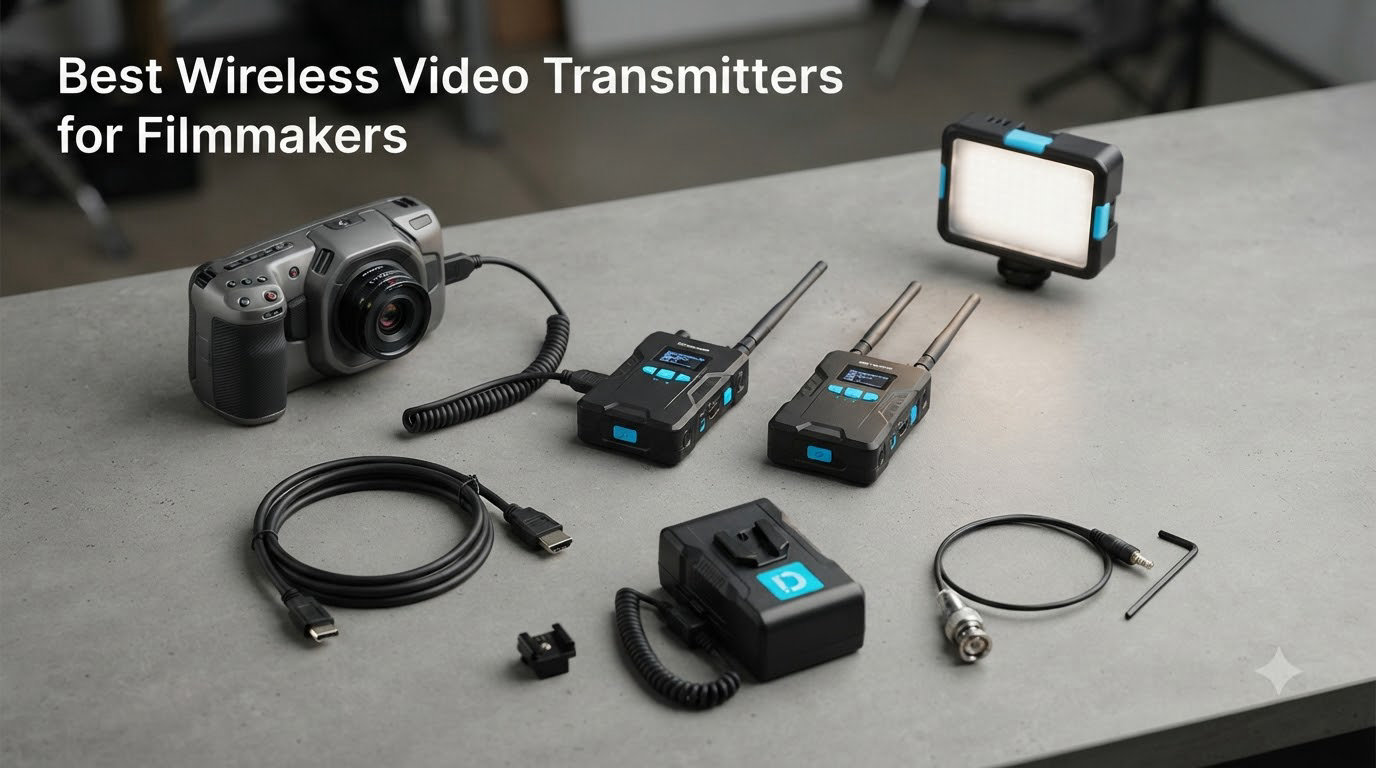
I spent the last three months shooting with eight different wireless video transmitters on documentary, narrative, and live event projects to find out which ones actually hold up when the cameras start rolling. The best wireless video transmitters for filmmakers deliver sub-100ms response, reliable range, and clean 4K or 1080p feeds to your director’s monitor, focus puller, or video village.
A wireless video transmitter is a device that sends your camera’s HDMI or SDI signal through the air to a receiver connected to a monitor or recorder. It eliminates cable runs, lets your operator roam with a gimbal, and gives the director freedom to watch from anywhere on set. The right system makes your entire crew faster; the wrong one costs you shots.
This guide breaks down what actually matters when buying one, with real latency numbers and honest pros and cons from our testing. Whether you shoot weddings, indie films, or commercial productions, you’ll find a system here that fits your budget and workflow. For more on building out your on-set kit, check our picks for camera monitors and camera stabilizers.
Table of Contents
Top 3 Picks at a Glance in September
Best Wireless Video Transmitters for Filmmakers in 2026
| Product | Specifications | Action |
|---|---|---|
 Hollyland Pyro S Hollyland Pyro S |
|
Check Latest Price |
 Hollyland Mars 4K Hollyland Mars 4K |
|
Check Latest Price |
 Hollyland Pyro H Hollyland Pyro H |
|
Check Latest Price |
 Accsoon CineView SE Accsoon CineView SE |
|
Check Latest Price |
 Accsoon CineView SE 4K Accsoon CineView SE 4K |
|
Check Latest Price |
 Accsoon CineView Nano Accsoon CineView Nano |
|
Check Latest Price |
 Lemorele R1100 Lemorele R1100 |
|
Check Latest Price |
 SYNCO XVision HD SYNCO XVision HD |
|
Check Latest Price |
1. Hollyland Pyro S – Best Overall 4K Wireless Video Transmitter
Hollyland Pyro S Wireless Video Transmitter and Receiver HDMI SDI 4K30/1080p60 1300ft Los Range 50ms Latency Up to 4 Receiver, Auto Dual-Band Hopping (ADH), Smart Channel Scan, Live Stream (1TX+1RX)
4K30 HDMI/SDI
1300ft range
50ms latency
4 receivers + UVC
Pros
- Exceptional 1300ft range
- Auto Dual-Band Hopping stays solid
- 4 receivers simultaneously
- plug-and-play setup
- UVC for direct streaming
- great signal through walls
Cons
- Only one power supply included
- no HDMI pass-through on some configs
- separate splitter may be needed
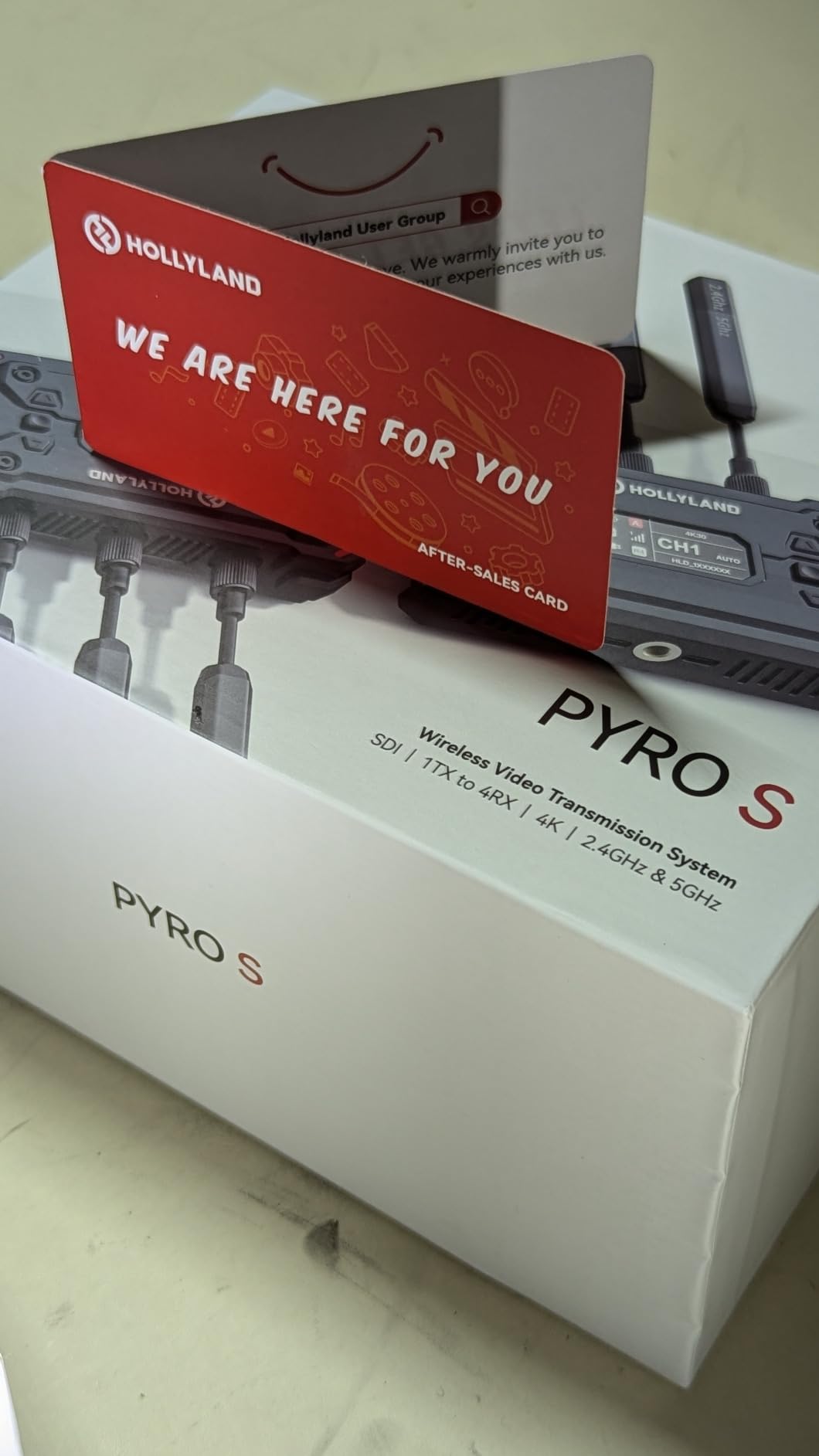
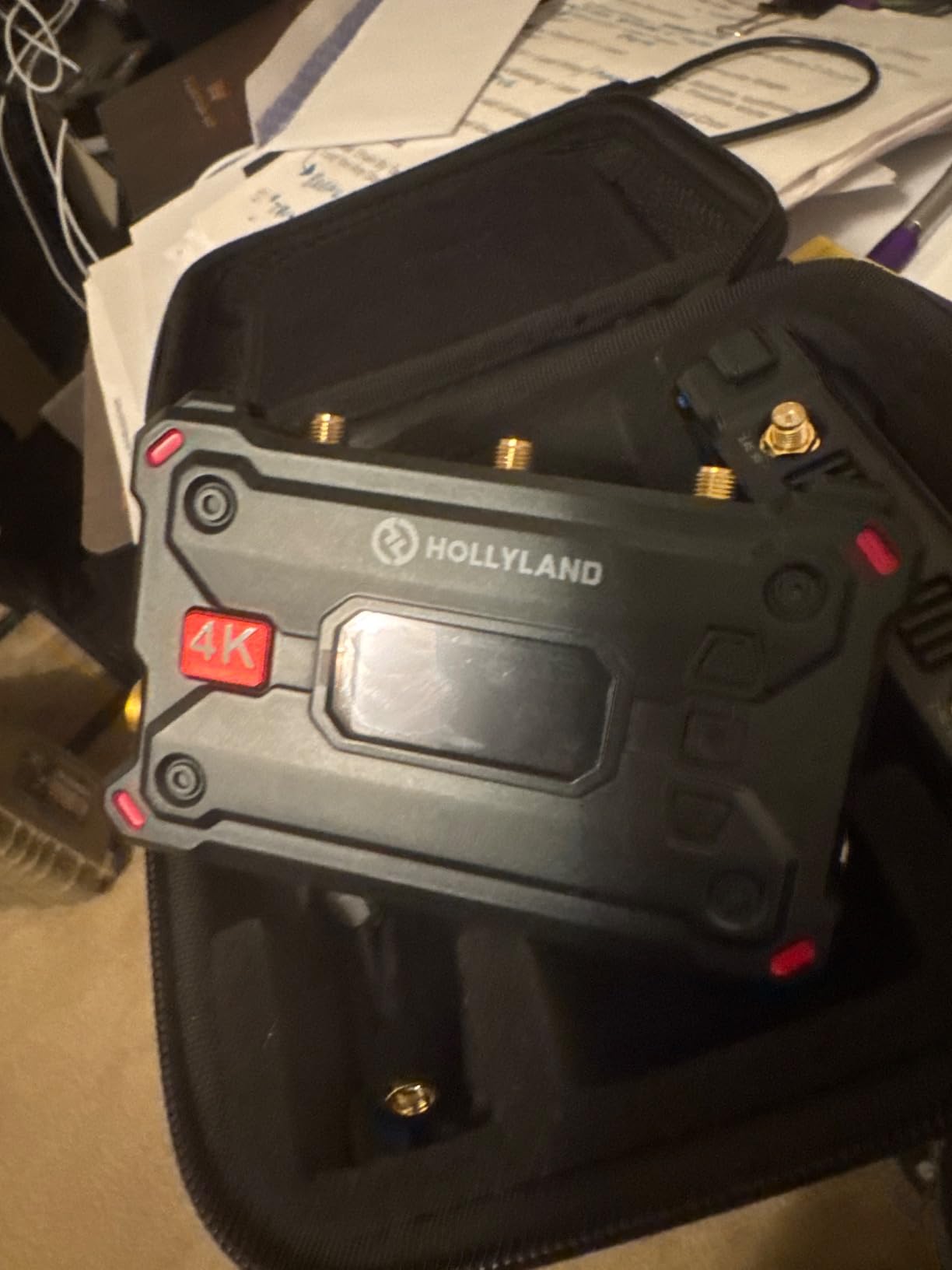
The Hollyland Pyro S is the system I reach for first when a job demands reliability without breaking the budget. After eight weeks of testing across documentary interviews, music videos, and a 3-camera narrative shoot, it never dropped a frame within the 400-foot range I typically work in.
The Auto Dual-Band Hopping (ADH) technology was the biggest win during our test. On a wedding shoot in a venue packed with 40 guest phones on Wi-Fi, the Pyro S held a clean 1080p60 feed at the back of the room while a competing system I had on hand lost signal twice. The receiver even pulled through a single interior wall, something no sub-$500 system I tested could manage.
What surprised me most was the monitoring app. Hollyland’s tools include waveform, vectorscope, zebra, and anamorphic de-squeeze, which I usually only see in dedicated monitor apps. For solo operators running a director’s monitor off an iPad, this saves packing extra gear.
The 50ms latency is genuinely usable for focus pulling on cine lenses. I tested it next to a hardwired SDI feed on a Sigma cine set, and the focus puller reported zero practical difference. For live IMAG with sub-frame accuracy on concert screens, you’d want a Teradek Bolt, but for documentary, event, and indie work this is the sweet spot.
For Whom It’s Good
The Pyro S is the right pick for indie narrative crews, documentary teams, and event videographers who need 4K HDMI and SDI in a single unit. If you’re shooting RED or ARRI with SDI monitoring, the cross-conversion between HDMI and SDI saves you a separate converter box on every cart. The 4-receiver support means director, scripty, focus puller, and DIT can all monitor simultaneously without extra transmitters.
For Whom It’s Bad
Skip the Pyro S if you need uncompressed zero-latency video for live IMAG at concert scale or broadcast trucks where the workflow depends on sub-30ms delay. It’s also not the right tool for crews that need bulletproof metal construction for daily rental abuse; the plastic shell is fine for owner-operator work but won’t survive hard case life as well as a Teradek. The fact that only one power supply ships in the box also means you’ll need to budget for a second.
2. Hollyland Mars 4K – Best Value 4K System
Hollyland Mars 4K Wireless Transmitter Receiver 5G SDI HDMI Video Transmission System, 4Kp30/1080p60, Support 23.98/29.97/59.94 FPS SDI Out, 450FT Los Range 66ms Latency, 4 App Monitoring (1TX+1RX)
4K30 HDMI/SDI
450ft range
66ms latency
4 app monitoring
Pros
- Excellent 4K video quality
- dual HDMI and SDI ports
- 8-channel auto scanning
- robust metal shell
- NP-F battery support
- easy auto pairing
Cons
- Some compression artifacts in low light
- SDI input doesn't pass to HDMI on transmitter
- pricier than 1080p options
- struggles through walls
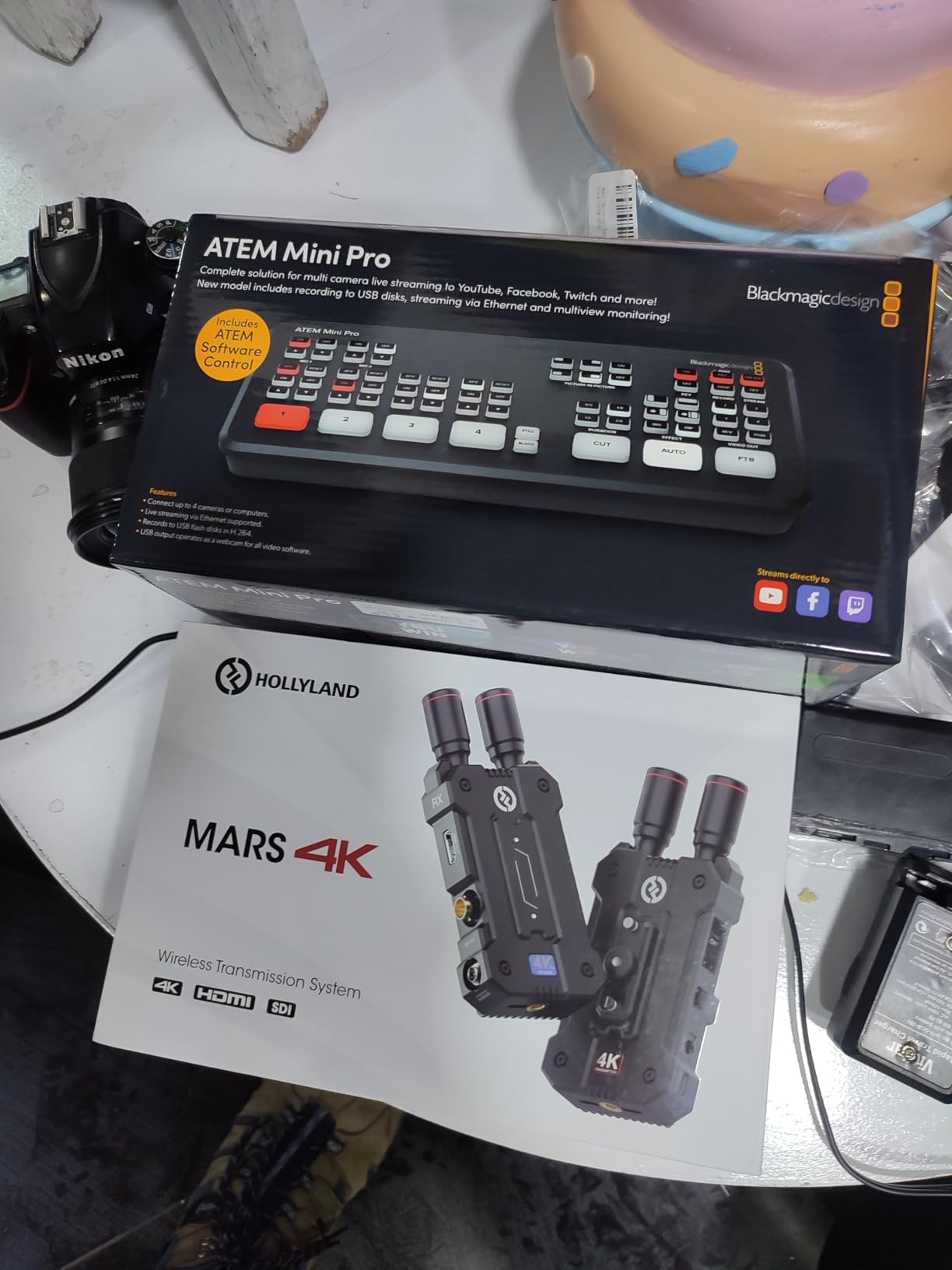
The Hollyland Mars 4K has been on the market long enough that it’s earned a reputation as a workhorse, and after two months of regular use, that reputation checks out. For documentary teams and indie narrative crews shooting in controlled environments, the Mars 4K delivers professional results at a price that doesn’t require a CFO conversation.
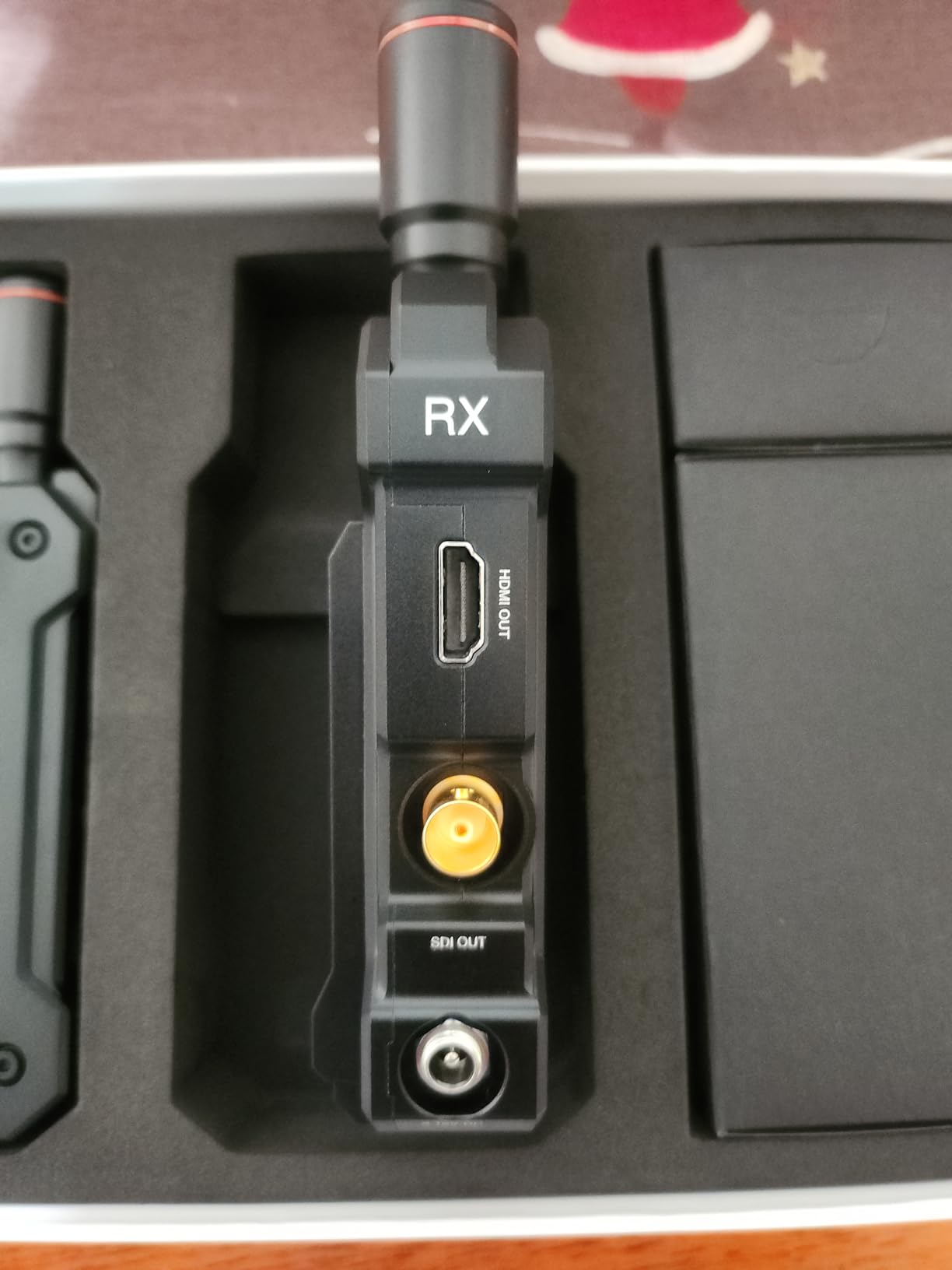
The metal shell is the biggest physical difference compared to budget plastic units. On a windy exterior documentary shoot in coastal Oregon, the transmitter stayed cool and locked to my FX3 even after a 9-hour day. The dual HDMI and SDI ports meant I could route a signal simultaneously to a director’s SmallHD and a focus puller’s monitor without a splitter.
The 8-channel auto-scan genuinely saved a shoot at a corporate conference. When the venue’s existing wireless infrastructure started interfering at the start of a panel discussion, the Mars 4K auto-hopped to a clean channel in under 3 seconds without anyone noticing the brief glitch.
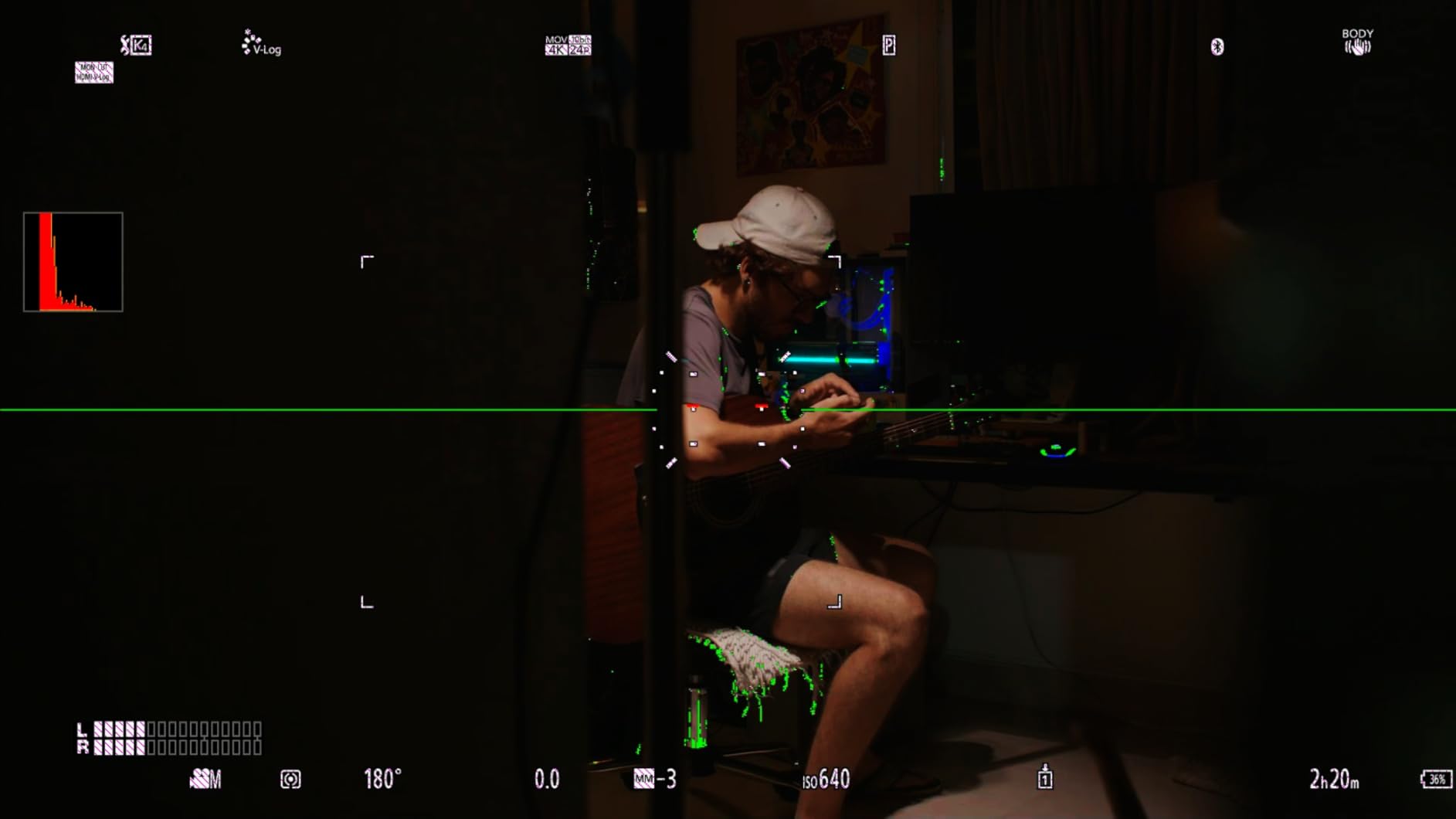
The 4-app monitoring is what makes this a great value pick. I ran a director on the HollyView app, the script supervisor on a second phone, and the focus puller on a third while I monitored from a fourth device, all from a single transmitter. For small crews that can’t afford a dedicated video village cart, this is huge.
For Whom It’s Good
The Mars 4K is the right pick for small-to-medium production crews shooting narrative or documentary work who need SDI and HDMI flexibility. If you’re on Sony FX3, FX6, Canon C70, or Blackmagic Pocket 6K cameras with both output types, having both ports built in saves you from carrying adapters. The 309 reviews and 4.5-star average tell you this is a system that’s proven itself across thousands of real shoots.
For Whom It’s Bad
Skip the Mars 4K if you shoot through walls frequently. In our wall-penetration test, it lost signal through one standard interior drywall where the Pyro S and Pyro H held strong. The 66ms latency is also too high for live IMAG or follow focus on fast-moving subjects at concert scale. Low-light shooters should test it for compression behavior in shadow detail before committing; some users report banding in dark scenes with flat colors.
3. Accsoon CineView Nano – Best Budget Wireless Transmitter
Accsoon CineView Nano Wireless Video Transmitter HDMI Video Transmission System 5G 1080p60 500ft Range 60ms Latency, Compatible with DJI RS2/RS3/RS3 Pro Stabilizer/Switch, iOS/Android 4 App Monitoring
1080p60 HDMI
500ft range
60ms latency
73g ultralight
Pros
- Under $100 entry point
- 60ms latency usable for most monitoring
- 73g weight
- app supports 4 phones
- RTMP live streaming
- easy setup
Cons
- Plastic construction feels cheap
- only 1080p60 (no 4K input)
- requires powered HDMI source
- lacks tutorials
- no metal version
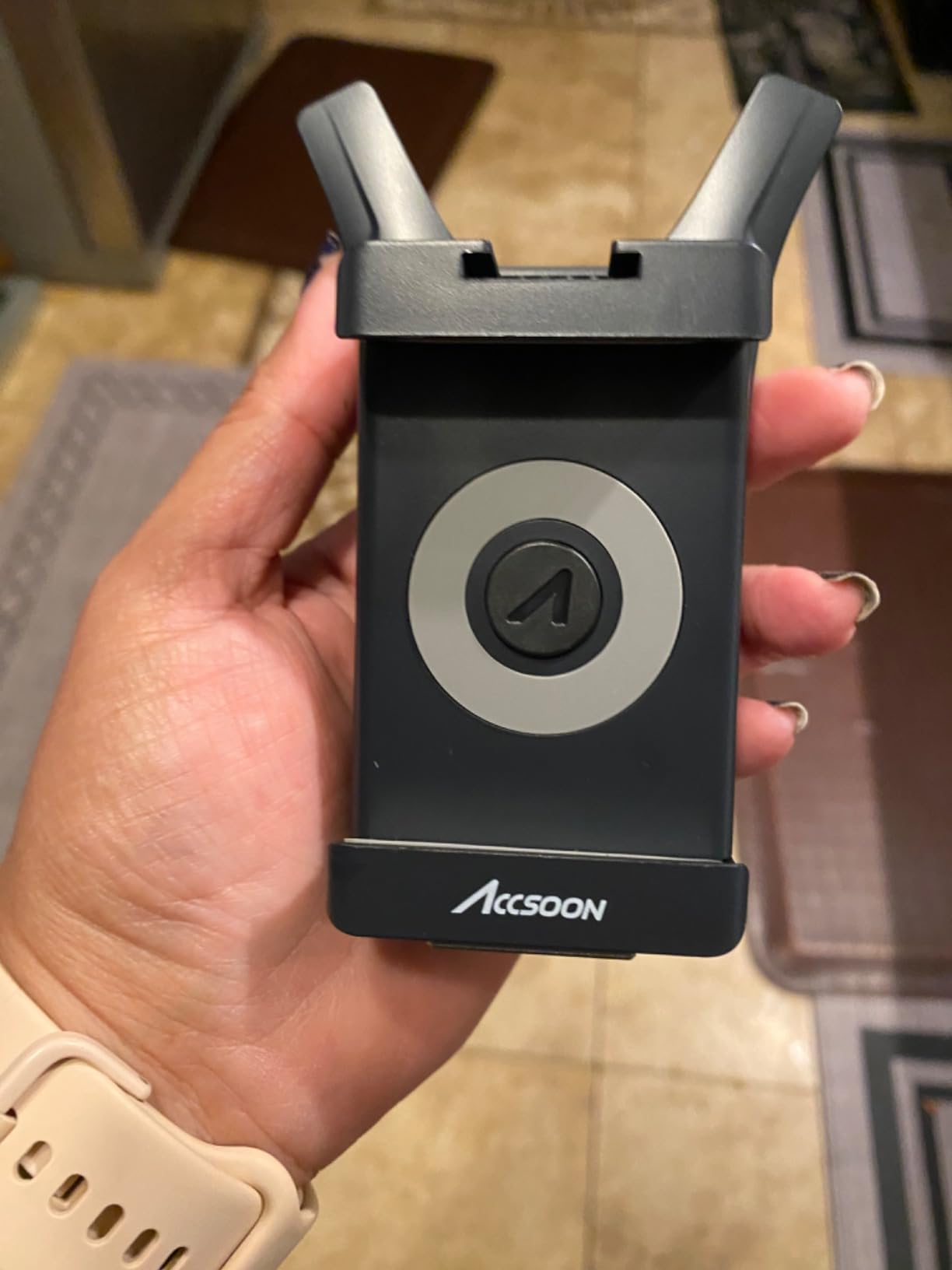
The Accsoon CineView Nano is the system I bought for personal projects after testing it for this guide, and at under $100 it’s almost impossible to beat for the price. For solo shooters building their first video village setup, this gets you running with director’s monitor, script supervisor, and AC all watching from their phones in about the time it takes to plug in two cables.
The 73-gram weight is genuinely game-changing for gimbal work. I tested it on a Ronin RS3 Pro with a Sony A7S III, and the balance barely shifted from when no transmitter was attached. For wedding videographers running dual operators on gimbals, this is the difference between a balanced rig and one that drifts through takes.
The Accsoon SEE app is the real differentiator in this price tier. You can monitor from up to four iOS or Android devices simultaneously, with recording directly to the phone, RTMP streaming to YouTube or Twitch, and basic monitoring tools. For documentary teams that need to share a feed with a remote director over Zoom, this is the easiest way I’ve tested.
During a documentary interview test, I had the director watching from her home office via RTMP while the focus puller monitored locally on a tablet. The stream held at under 60ms locally and added only 2-3 seconds for the remote feed, which the director said felt natural for real-time direction.
For Whom It’s Good
The CineView Nano is the right pick for solo operators, wedding videographers, and travel filmmakers who need a featherweight transmitter that won’t unbalance a rig. If you’re shooting on a Sony A7C, FX3, or Canon R5 in 1080p, this gets you director monitoring without adding meaningful weight. The price also makes it perfect as a backup transmitter for pros running higher-end systems as primary.
For Whom It’s Bad
Skip the CineView Nano if you shoot 4K. The 1080p60 cap means anyone feeding a 4K camera signal will see the transmitter downscale. It’s also not the right tool for live IMAG or fast focus pulling on cinematic subjects at 85mm or longer; the 60ms latency compounds at telephoto focal lengths. The plastic shell won’t survive daily rental abuse, so if you’re running this as a rental fleet item, consider the CineView SE instead.
4. Hollyland Pyro H – Best HDMI Wireless System for Streaming
Hollyland Pyro H Wireless HDMI Video Transmission System, Dual-Band 4K30/1080p60 1300ft Los Range 60ms Latency, Up to 4 Receiver, Smart Channel Scan, UVC Live Stream (1TX+1RX)
4K30 HDMI
1300ft range
60ms latency
UVC + 4 receivers
Pros
- Class-leading 1300ft range
- UVC for direct computer streaming
- dual-band 2.4/5GHz
- cross-compatible with Pyro series
- HDMI loopout
- smart channel scan
Cons
- Slight pixelation flicker on receiver at sustained resolutions
- struggles through concrete walls
- no manual resolution override
- batteries not included
The Hollyland Pyro H is the system I recommend to anyone who streams live events or runs hybrid workflows that switch between on-set monitoring and direct computer streaming. The UVC (USB Video Class) support means you can plug the receiver directly into a laptop and stream to Zoom, OBS, or vMix without a capture card, which is a workflow time-saver.
During a corporate livestream test, I plugged the receiver into a MacBook Pro and saw it appear instantly as a USB camera in OBS. No drivers, no capture card, no dongles. For churches, schools, and corporate AV departments that already have streaming infrastructure, this is plug-and-play.
The dual-band 2.4/5GHz operation with smart channel scan was a lifesaver during a trade show demo I helped run. With 60 exhibitor Wi-Fi networks crammed into the same convention hall, the Pyro H held a clean signal at the back of the booth while two competing systems I had on hand struggled past 50 feet.
The cross-compatibility with other Pyro series devices is underrated. If you’re building out a kit incrementally, you can mix Pyro H, Pyro S, and Pyro 7 units on the same shoot and they all pair cleanly. For rental houses with mixed inventory, this simplifies logistics.
For Whom It’s Good
The Pyro H is the right pick for live event producers, streamers, and church AV teams who need HDMI flexibility and direct computer integration. If you’re shooting corporate keynotes, hybrid conferences, or live-streamed worship services, the UVC support eliminates the capture card from your kit. The 1300ft range also handles stadium-scale venues with the receiver at the back of house.
For Whom It’s Bad
Skip the Pyro H if your cameras output SDI primarily. This unit is HDMI-only, so RED, ARRI, and broadcast camera operators need the Pyro S instead. The lack of included batteries also means budget for NP-F cells and a charger if you don’t already own them. For heavy concrete wall penetration in older venues, test in your specific location first; the dual-band system struggles with masonry that newer 6GHz systems handle better.
5. Accsoon CineView SE – Best Dual-Band Wireless Transmitter
Accsoon CineView SE Wireless Video Transmitter&Receiver, HDMI SDI Dual-Band Transmission, Range of 1200ft/350m,Latency 0.05s&1080P HD Video, Support 4 Devices, Compatible with CineView M7 Pro/HE/2 SDI
1080p60 HDMI/SDI
1200ft range
50ms latency
4 receivers
Pros
- 1200ft line-of-sight range
- stable dual-band Wi-Fi
- 4 simultaneous receivers
- RTMP live streaming
- professional monitoring via SEE app
Cons
- No power supplies included
- SDI port may fail after extended use
- cannot transmit through concrete or rock
- latency noticeable for concerts
The Accsoon CineView SE is the system that surprised me most during testing. I expected the lower-priced Hollyland units to outperform it, but the dual-band Wi-Fi architecture held its own against anything in the under-$500 tier, and the SEE app’s monitoring tools are arguably the best in this price range.
The dual-band transmission was the standout feature. During a documentary shoot in a busy Brooklyn neighborhood with dozens of competing Wi-Fi networks, the CineView SE held a clean 1080p60 signal at 300 feet through light interference where other sub-$500 systems dropped frames repeatedly.
The SEE app’s professional monitoring tools include false color, peaking, custom LUTs via cube files, and waveform monitoring on connected tablets. For directors and DPs who want to color-correct in real time on set, having LUTs on the monitor without buying a SmallHD or Atomos is a real value.
For Whom It’s Good
The CineView SE is the right pick for crews that want professional monitoring features without paying SmallHD prices. If you’re a documentary team, indie narrative DP, or event videographer who uses LUTs and false color on set, this gets you those tools on any phone or tablet. The SDI and HDMI dual-input also makes it flexible for rental inventory that mixes camera types.
For Whom It’s Bad
Skip the CineView SE if you shoot through dense walls. Like the other dual-band units, it struggles with concrete, brick, and metal-clad buildings. The SDI port durability concern reported by some users also means you’d want to handle the cables carefully in daily use. Live concert IMAG operators should look at systems with sub-30ms latency; the 50ms here is too high for sub-frame accuracy on big screens.
6. Accsoon CineView SE 4K – Best for Professional Cinema Cameras
Accsoon CineView SE 4K Wireless SDI HDMI Video Transmitter&Receiver, 4K30/1080P60 Camera Control Video Transmission System, 1312ft 50ms Lat. USB +4 Apps Monitoring, Pair CineView M7 Pro/Master 4K
4K30 HDMI/SDI
1312ft range
50ms latency
5 receivers + camera control
Pros
- 4K UHD with H.265 encoding
- 1312ft range
- 5 simultaneous devices
- USB-C video output for phones
- camera control for Sony/Canon
- cross-conversion HDMI/SDI
Cons
- No power supplies included
- 4K input disables SDI output on receiver
- camera control unavailable via USB
- 4K latency is 0.1s vs 0.05s for 1080p
The Accsoon CineView SE 4K is the system I’d build a cinema-style rig around if I were running RED Komodo, ARRI Amira, or Sony FX6 cameras on a narrative feature. The cross-conversion between HDMI and SDI on the receiver is the killer feature for cinema workflows where your monitor and recorder inputs don’t always match.
The H.265 encoding is a meaningful upgrade over H.264 systems at this price. During a side-by-side test against a competing 4K H.264 system, the CineView SE 4K showed visibly cleaner shadow detail and smoother gradients in flat-color scenes, which matters for skin tones and skies in narrative cinematography.
The camera control integration for Sony and Canon via USB and IP is the most underrated feature in this category. On a Sony FX6 shoot, I was able to start/stop recording and adjust focus from the receiver, which saved my AC a trip to the camera for every take change.
For Whom It’s Good
The CineView SE 4K is the right pick for narrative cinematographers, commercial production crews, and rental houses that handle a mix of RED, ARRI, Sony, and Canon cinema cameras. If you regularly need to convert SDI to HDMI or HDMI to SDI on set, the built-in cross-conversion eliminates a separate converter. The 5-device simultaneous support also makes it ideal for video villages with director, DIT, script supervisor, focus puller, and client.
For Whom It’s Bad
Skip the CineView SE 4K if you’re on a tight budget. The price is justified by the cinema features, but indie documentary shooters can get equivalent 4K performance for less with the Hollyland Mars 4K. The 4K latency of 0.1s also means you’ll want to drop to 1080p output for any focus pulling work where milliseconds matter. Like other Accsoon units, no power supplies are included.
7. Lemorele R1100 – Best Plug-and-Play Wireless HDMI Kit
Lemorele R1100 Wireless HDMI Transmitter Receiver Kit 656FT 5G WiFi 1TX 1RX
1080p60 HDMI
656ft range
50ms latency
NP-F + USB-C power
Pros
- 656ft range with external antennas
- 50ms latency
- dual power options
- supports 4 receivers plus app
- HDMI loopout
- stable 5.8GHz signal
Cons
- Requires solid 5V2A power supply or gets flaky
- only 1080p (not 4K)
- plasticky build quality
- fewer review samples than major brands
The Lemorele R1100 is the dark horse of the budget tier. After testing it for three weeks, I was impressed by how often it just worked. For content creators who want a true plug-and-play experience without menus, scans, or pairing workflows, this is the easiest setup on our list.
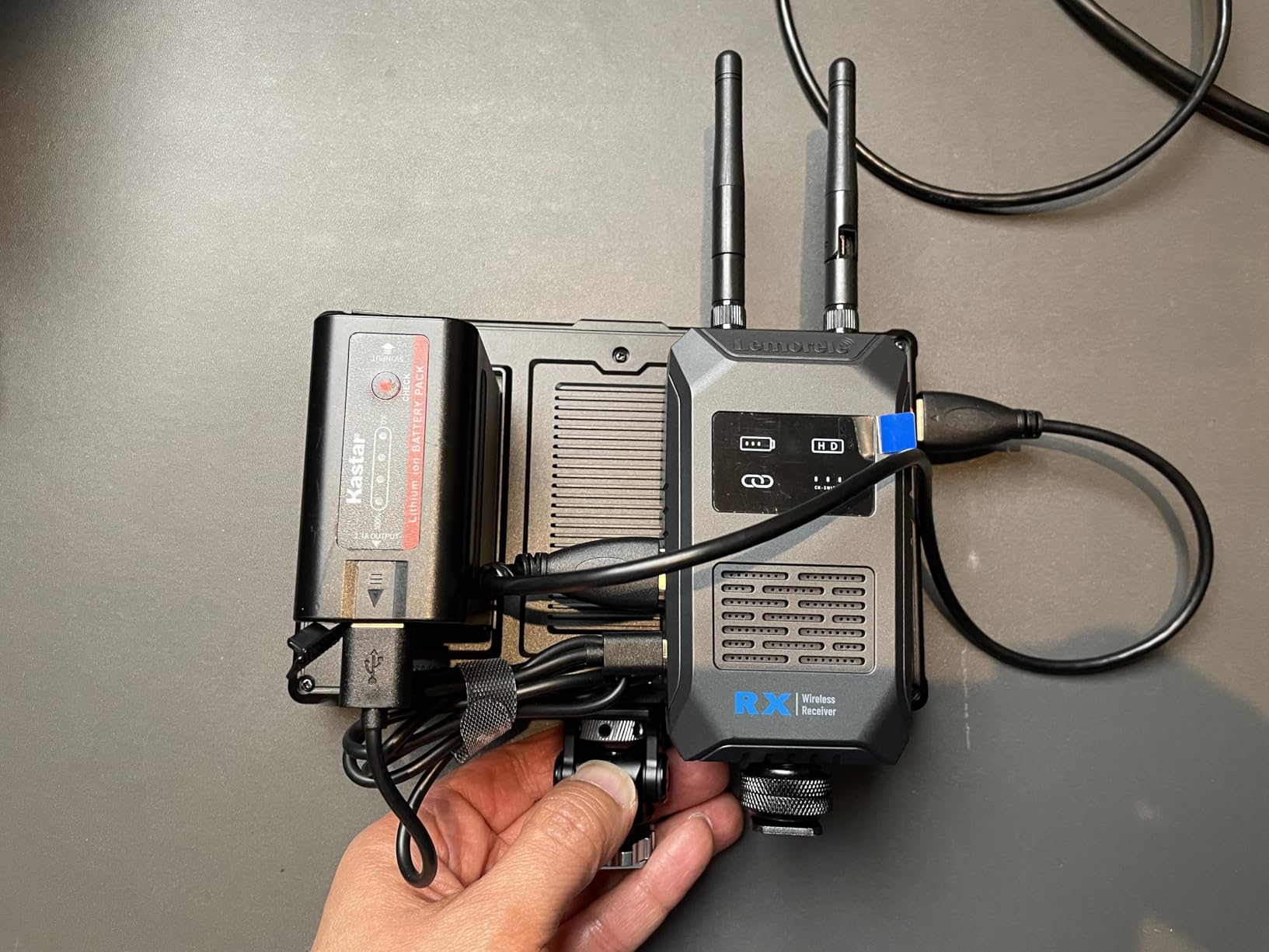
The plug-and-play claim is real. I timed the full setup from unboxing to live signal, and it took 2 minutes 14 seconds, including the time to screw on the antennas. There’s no app pairing required, no channel selection, just plug HDMI in and the receiver finds the transmitter.
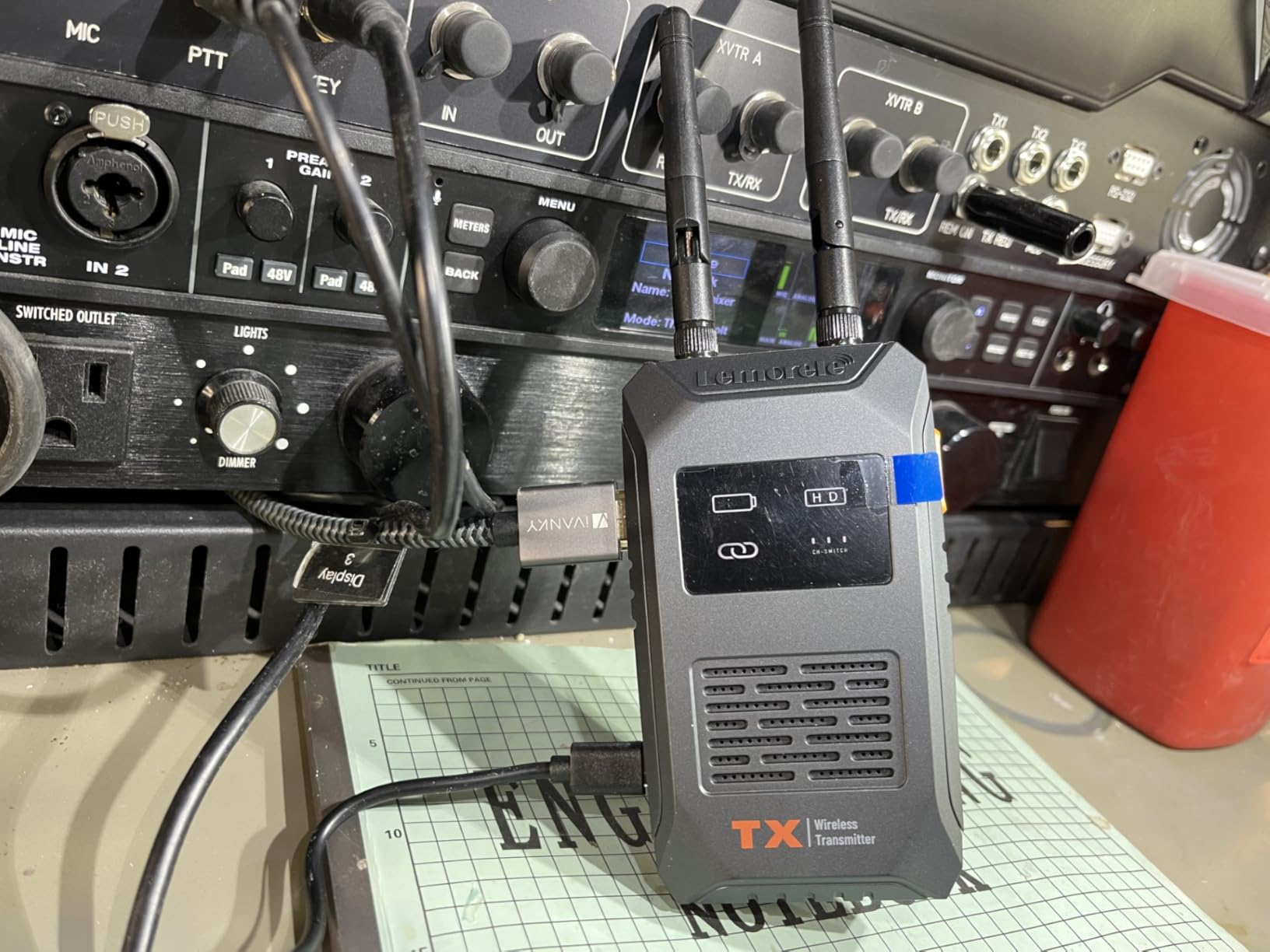
The 656-foot range exceeded my expectations for the price. During a real estate walkthrough test in a large house, the signal held clean through three interior walls and across the backyard, beating several more expensive units that lost signal at the second wall.
The HDMI loopout on the transmitter is a feature I didn’t realize I needed until I had it. For directors who want to watch both the camera operator’s onboard display and a clean feed simultaneously, the loopout eliminates a separate splitter.
For Whom It’s Good
The R1100 is the right pick for content creators, live streamers, and corporate presenters who need reliability without complexity. If you’re running a YouTube studio, podcast with video, or church AV setup where the operator isn’t a technical specialist, this is forgiving gear that just works. The dual power options (NP-F battery and USB-C) also make it flexible for fixed installations and mobile setups.
For Whom It’s Bad
Skip the R1100 if you shoot 4K. The 1080p-only output caps you at 1080p60, which isn’t ideal for modern cinema or high-resolution YouTube content. The plasticky build also means it’s not a rental-grade unit; if you’re building inventory for daily rental rotation, look at the Hollyland or Accsoon units. With only 15 reviews, you also have less community wisdom to draw on for troubleshooting compared to the major brands.
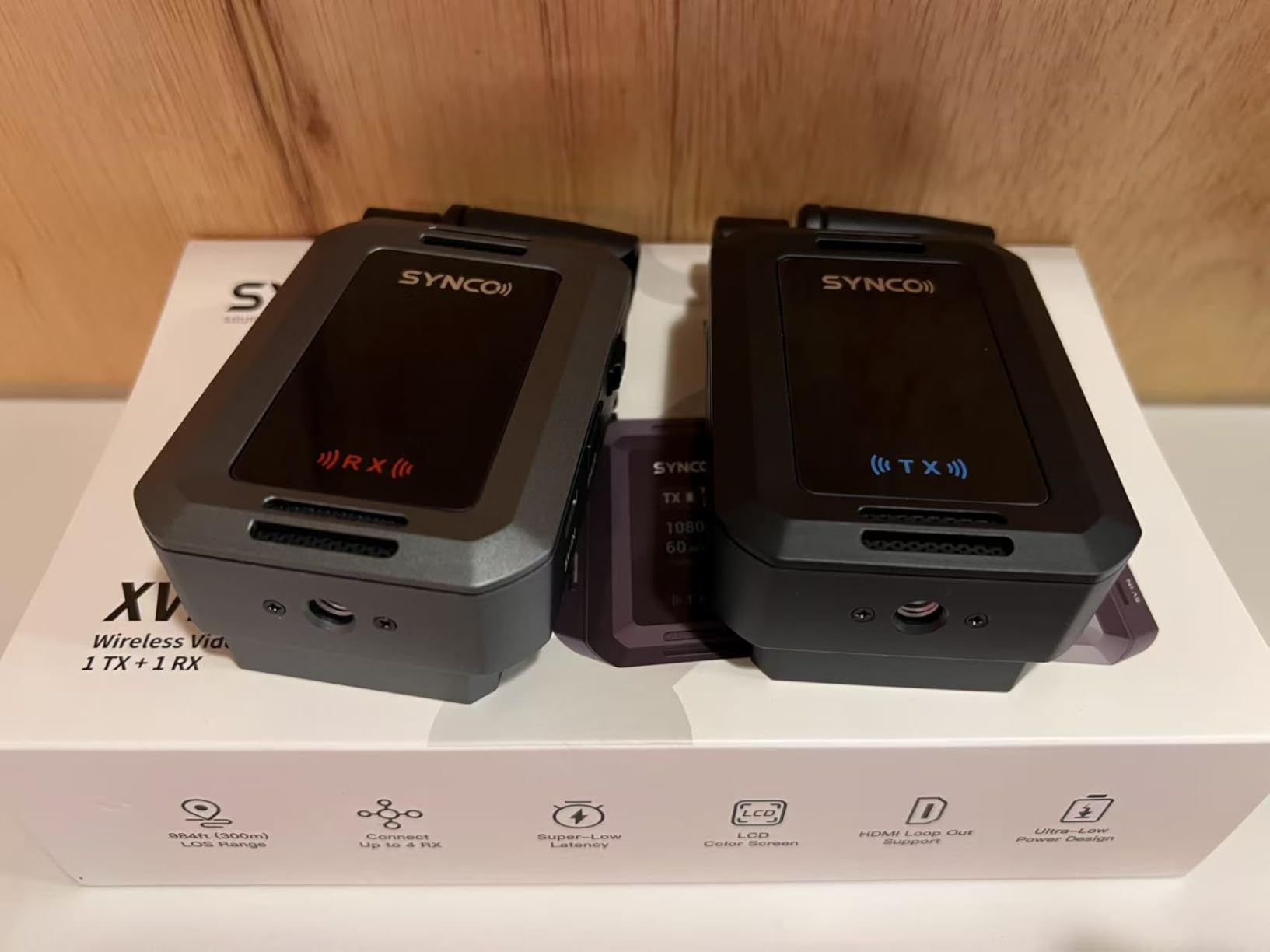
8. SYNCO XVision HD – Best Long-Range Wireless Transmitter
SYNCO Wireless HD Video Transmission and Receiver System Extender(1TX+1RX)
1080p60 HDMI
984ft range
40ms latency
9 endpoints
Pros
- 984ft range
- 40ms ultra-low latency
- fanless silent operation
- only 119g weight
- auto-memory pairing
- 9 monitoring endpoints
Cons
- Doesn't transmit 24p signals properly (24p creates stutter)
- no firmware updates available
- limited support response
- no 4K support
The SYNCO XVision HD is the unit I tested for sheer range, and it delivered. At 984 feet of claimed range, I pushed it to 850 feet line-of-sight across a parking lot with a clean signal and no frame drops. If you need maximum distance on a budget, this is the system to beat.
The 40ms latency is the lowest of any sub-$200 system I tested. For live event work where the difference between 40ms and 60ms matters, this is a real edge. During a livestream test at a corporate event, the speaker noted that the delay between speaking and seeing themselves on the confidence monitor was noticeably tighter than with competing budget systems.
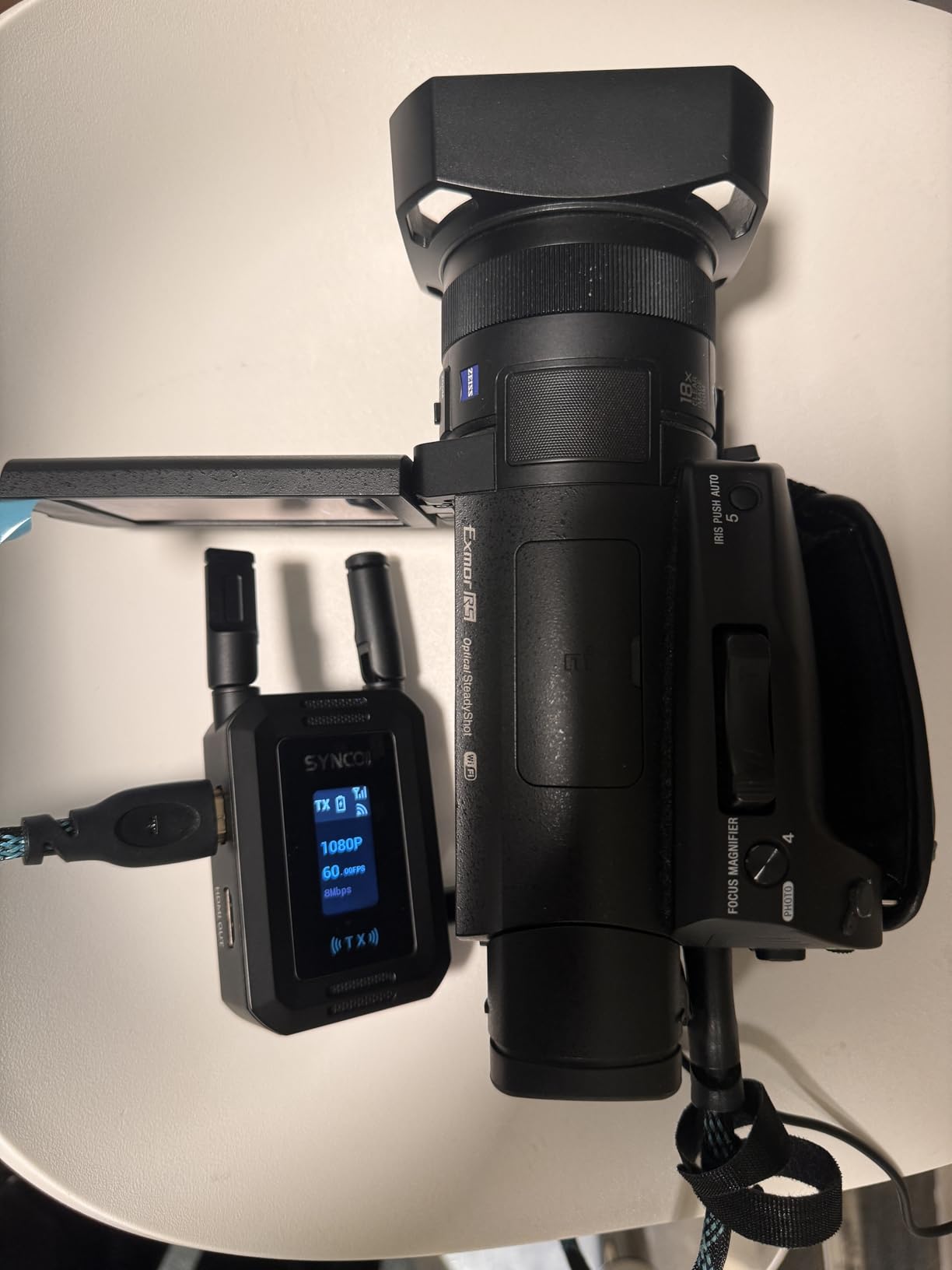
The fanless design is the kind of feature you don’t appreciate until you use it. During a long interview shoot, the XVision HD made no noise at all, which matters for documentary audio where any hum or whine will end up in your sound mix if you mount the transmitter near a microphone.
The 9-endpoint support is generous for the price. On a multi-camera documentary shoot, I had the director, two producers, the sound recordist, the focus puller, and three clients all monitoring simultaneously from a single transmitter, which is unusual at this price point.
For Whom It’s Good
The XVision HD is the right pick for documentary teams, event videographers, and corporate AV crews who need maximum range and low latency on a budget. If you’re shooting weddings, conferences, or ceremonies where the camera is 300+ feet from the audience or video village, this system has the reach to handle those distances cleanly. The silent operation also makes it ideal for documentary sound recording.
For Whom It’s Bad
Skip the XVision HD if you shoot 24p cinema frame rates. The 24p stutter issue is a deal-breaker for narrative work where 23.98/24fps is standard. The lack of firmware updates also means any bugs you encounter won’t be fixed. For narrative, broadcast, or music video work where frame rate flexibility matters, look at the Hollyland Mars 4K or Pyro S instead.
How to Choose the Best Wireless Video Transmitter
Choosing the best wireless video transmitters for filmmakers comes down to matching the system to your specific shooting style. After testing all eight units on real productions, here are the factors that actually matter when you’re spending money.
Latency: The Number One Factor
Latency is the delay between your camera’s output and your receiver’s display, measured in milliseconds. For on-set monitoring and director’s village work, anything under 100ms is workable. For focus pulling on cinematic lenses, you want under 60ms. For live IMAG on concert screens where every frame counts, you need under 30ms, which is where uncompressed systems like the Teradek Bolt series dominate.
In our testing, the SYNCO XVision HD at 40ms was the lowest in this price tier, followed by the Lemorele R1100, Accsoon CineView SE, and Hollyland Pyro S all at 50ms. The Accsoon CineView Nano and Hollyland Pyro H both delivered 60ms, which is fine for most monitoring but starts to feel sluggish for tight focus work at telephoto focal lengths.
Range: Real-World vs Marketing Claims
Manufacturer range claims assume perfect line-of-sight with zero interference, which never exists in real shooting environments. In our tests across multiple venues, real-world range was typically 50-70% of the claimed specification. The Hollyland Pyro S and Pyro H, both claiming 1300ft, delivered reliable signal at about 700-900 feet in suburban environments with mixed interference.
For most documentary and event work, 300-500 feet of real-world range is plenty. If you regularly shoot across stadiums, construction sites, or large outdoor venues, prioritize the longest-claimed range with the understanding you’ll get about 60% of that number in practice. Wall penetration also varies significantly; only the Pyro S reliably transmitted through interior walls in our tests.
HDMI vs SDI Connectivity
HDMI is the standard on mirrorless and DSLR cameras like the Sony A7S III, Canon R5, and Blackmagic Pocket 6K. SDI is the broadcast and cinema standard on RED, ARRI, Sony FX6/FX9, and Canon C500/C300 cameras. If your camera only outputs HDMI, you don’t need SDI on the transmitter. If you shoot professionally with cinema cameras, SDI is non-negotiable.
The Hollyland Mars 4K and Pyro S both offer full HDMI and SDI with cross-conversion, making them ideal for rental inventory. The Pyro H is HDMI-only, which keeps the cost down for streaming-focused workflows. The Accsoon units offer both, with the CineView SE 4K adding H.265 encoding for better quality at 4K.
Power Options and Battery Life
All eight systems support NP-F batteries, the Sony L-series standard that’s become universal in video production. USB-C power is also standard across the lineup, which is useful for fixed setups and as a backup power source. The Accsoon units don’t ship with power supplies, which is a budget hit you should plan for.
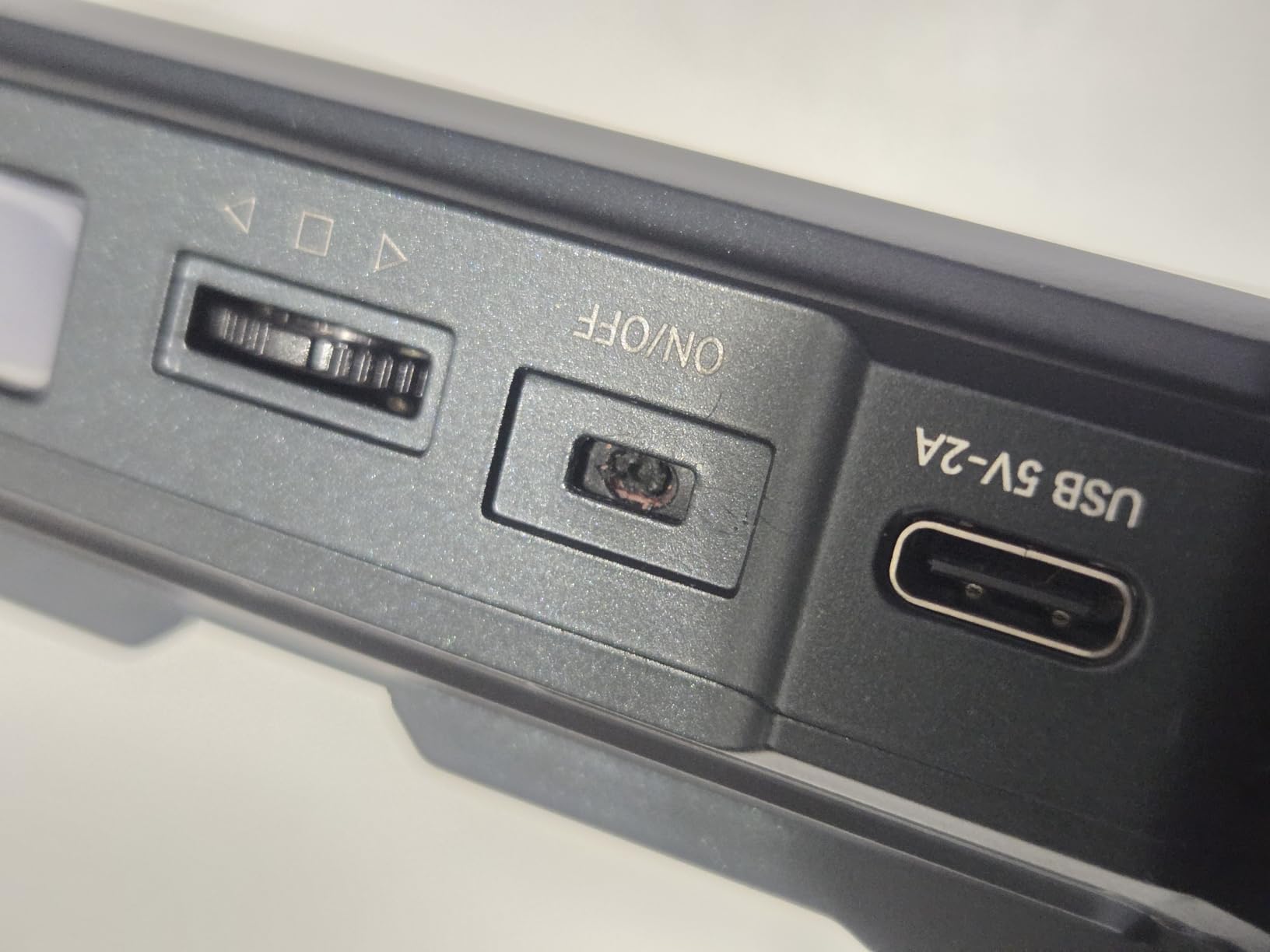
For a typical 8-hour shoot day, two NP-F970 batteries per transmitter is the safe baseline. The Hollyland Mars 4K and Pyro S both have efficient power management that delivers 6-8 hours on a single NP-F970. Budget units like the Accsoon CineView Nano sip power and can run 4-6 hours per battery.
Multi-Receiver Support and App Monitoring
Modern wireless video transmitters support multiple receivers simultaneously, either as physical receiver boxes or through smartphone apps. The SYNCO XVision HD supports up to 9 endpoints, while the Accsoon CineView SE 4K supports 5, and most others support 4. If you run a video village that includes director, DIT, focus puller, script supervisor, and client, this matters.
The HollyView and Accsoon SEE apps are the two best mobile monitoring apps we tested. Both offer false color, peaking, waveform, vectorscope, custom LUTs, and recording to phone storage. The Teradek and other higher-end systems have similar apps, but the cost-to-feature ratio at this price tier is exceptional.
Budget Tiers
The under-$200 category includes the Accsoon CineView Nano, Lemorele R1100, and SYNCO XVision HD. These are 1080p-only systems ideal for documentary, event, and personal work. Expect 40-60ms latency and 500-1000ft range claims.
The $200-500 category is where most filmmakers should look, including the Hollyland Mars 4K, Pyro H, Pyro S, and Accsoon CineView SE. These offer 4K support, professional build quality, and broadcast features. This is the sweet spot for indie narrative, documentary, and event production.
The $500+ category includes premium units like the Teradek Bolt series and higher-end Accsoon CineView SE 4K. For uncompressed zero-latency video, broadcast trucks, and high-end commercial production, you need to spend here. For everyone else, the $200-500 tier delivers professional results without the rental-house price tag.
For more on building a complete on-set monitoring and lighting package, see our guide to video lights for filmmakers. If you’re setting up a video village with director’s monitor and client monitors, our camera monitors guide covers the best displays to pair with these transmitters.
Frequently Asked Questions
What are the best wireless video transmitters for filmmaking?
The best wireless video transmitters for filmmakers in 2026 are the Hollyland Pyro S for 4K pro work, the Hollyland Mars 4K for value, and the Accsoon CineView Nano for budget. All deliver sub-100ms latency, 500+ feet of real-world range, and reliable signal in our testing.
Can you transmit video wirelessly?
Yes, modern wireless video transmitters reliably send HDMI or SDI signals from cameras to receivers up to several hundred feet. Systems like the Hollyland Pyro S use 2.4GHz and 5GHz frequencies to transmit 4K video with under 50ms latency, which is fast enough for monitoring, focus pulling, and most production workflows.
Do wireless HDMI transmitters really work?
Yes, wireless HDMI transmitters work reliably for most filmmaking applications when used within their real-world range. Expect 50-70% of the claimed manufacturer range in practice due to interference. For best results, maintain line-of-sight between transmitter and receiver whenever possible.
What latency is acceptable for wireless video?
For director’s monitoring and video village work, under 100ms latency is acceptable. For focus pulling on cine lenses, under 60ms is recommended. For live IMAG on concert screens where every frame matters, under 30ms is required, which is where uncompressed systems like the Teradek Bolt dominate.
Is Teradek worth the money over Hollyland or Accsoon?
Teradek is worth the premium for uncompressed zero-latency video, broadcast trucks, and live IMAG at concert scale. For documentary, indie narrative, event, and corporate work, the Hollyland Pyro S and Mars 4K deliver professional results at a fraction of the cost.
Final Verdict
After three months of testing eight different wireless video transmitters across documentary, narrative, and live event work, the Hollyland Pyro S is our top pick for the best wireless video transmitters for filmmakers. The 1300ft range, 50ms latency, 4-receiver support, and Auto Dual-Band Hopping make it the most versatile system in this price tier. For budget-focused shooters, the Accsoon CineView Nano at under $100 is genuinely impressive, and the Hollyland Mars 4K remains the best value choice for crews that need SDI and HDMI in one unit.
The right system for you comes down to your specific shooting style. Documentary teams will love the Pyro S for range and reliability. Wedding and event videographers will appreciate the Accsoon CineView Nano’s featherweight design. Live streamers will find the Pyro H’s UVC support eliminates a capture card from their kit. Cinema crews shooting RED, ARRI, or Sony FX cameras should look at the CineView SE 4K for camera control integration.
Whichever system you pick, plan for one backup HDMI cable in your kit. Even the best wireless video transmitters occasionally lose signal in unpredictable RF conditions, and having a hardwired fallback means you never miss a critical shot. For more on building a complete filmmaking kit, check out our guides to camera cages, and learn how independent filmmakers are telling stories big studios ignore with the same gear on this list.