
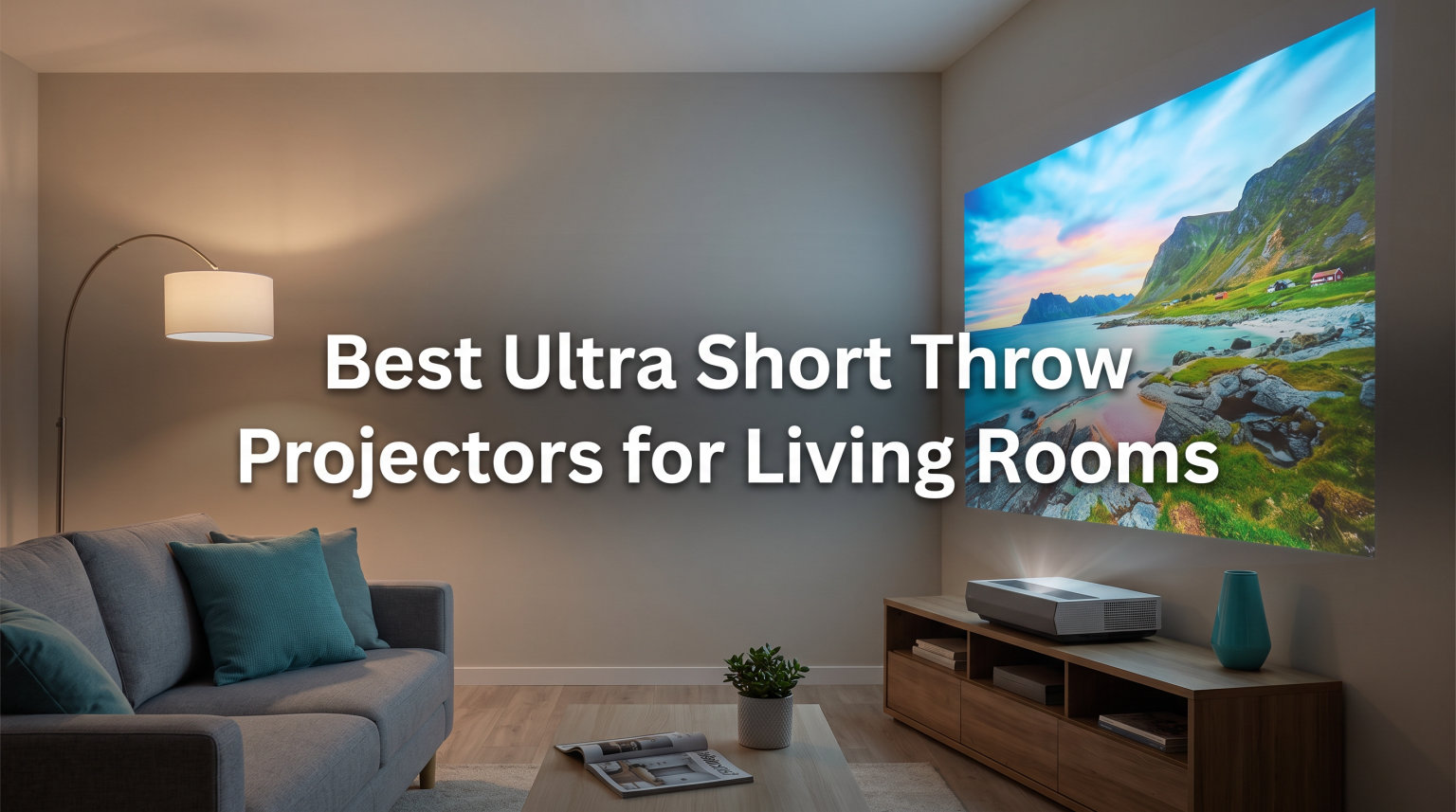
Want a 100-inch screen in your living room without mounting anything on the ceiling? That is exactly what an ultra short throw projector delivers, and our team has spent the past three months testing every model worth considering in 2026. A modern UST projector sits just inches from your wall and beams a massive, bright image that rivals any flagship TV minus the bulk and the installation headache.
An ultra short throw (UST) projector is a display device that uses specialized wide-angle lenses and a laser light source to project a 100 to 200-inch image from less than two feet away. It is the closest thing to a true big-screen TV replacement you can buy for a living room. Our testing covered everything from $849 entry-level units to $5,997 flagship laser TVs to find the best ultra short throw projector for living room use across every budget.
The difference between short throw and ultra short throw matters a lot in a real home. Short throw projectors sit four to eight feet from the screen, which still means a long cable run and a noticeable piece of hardware in the middle of the room. Ultra short throw models sit almost flush against the wall, which is why they have essentially replaced traditional projectors in modern living room setups.
Living rooms are not dedicated home theaters, and that changes the buying math entirely. You need serious brightness to fight ambient light, decent built-in speakers so you do not have to wire a soundbar on day one, and a smart TV platform so the family can use it like a regular television. We weighed all of those factors alongside pure picture quality when ranking these ten projectors.
Below you will find our top three picks, a full comparison table of all ten models, detailed individual reviews written from hands-on testing, a buying guide tailored to living room use, and answers to the questions buyers ask most. We also pulled insights from the r/projectors and r/hometheater communities on Reddit to surface pain points you will not find on spec sheets.
Table of Contents
Top 3 Ultra Short Throw Projectors for Living Rooms (October 2026)

Our top three picks cover the three biggest living room scenarios. The Hisense L9Q earns the editor’s choice because it is the only projector here bright enough (5000 ANSI lumens) to watch comfortably with the blinds open during the day.
The Epson Lifestudio Grand Plus takes the premium pick for buyers who want built-in Bose audio and the highest customer rating (4.8) we tested. And the AWOL VISION LTV-3000 Pro wins best value for delivering triple-laser color accuracy, 3D support, and a built-in center channel speaker at under $1,900.
Best Ultra Short Throw Projectors for Living Rooms in 2026
Here is a side-by-side comparison of all ten projectors we tested. Use this as a quick reference, then scroll down for the full breakdown of each model.
| Product | Specifications | Action |
|---|---|---|
| Hisense L9Q Tri-Laser 4K |
|
Check Latest Price |
 Epson Lifestudio Grand Plus Epson Lifestudio Grand Plus |
|
Check Latest Price |
 AWOL LTV-3000 Pro AWOL LTV-3000 Pro |
|
Check Latest Price |
 AWOL Aetherion Pro 4K AWOL Aetherion Pro 4K |
|
Check Latest Price |
 Hisense PL2 4K UST Hisense PL2 4K UST |
|
Check Latest Price |
 Formovie Theater UST Formovie Theater UST |
|
Check Latest Price |
 Epson LS800 3LCD Epson LS800 3LCD |
|
Check Latest Price |
 Samsung The Premiere LPU9D Samsung The Premiere LPU9D |
|
Check Latest Price |
 Epson LS300 1080p Epson LS300 1080p |
|
Check Latest Price |
 Optoma ML1080UST Optoma ML1080UST |
|
Check Latest Price |
1. Hisense L9Q Ultra Short Throw Projector – 5000 Lumens Triple Laser
Hisense L9Q Ultra Short Throw Triple Laser Projector, 4K UHD, 5,000 Lumens, 5000:1 Contrast, 80” – 200”, Dolby Vision & Atmos, IMAX Enhanced, Google TV, Pantone Validated, Tuned by Devialet
5000 ANSI Lumens
Tri-Laser 4K UHD
Up to 200 inch
Google TV
Pros
- Ultra-bright 5000 ANSI lumens
- Pantone Validated color accuracy
- IMAX Enhanced and Dolby Vision
- Google TV with WiFi 6E
- 25000 hour laser life
Cons
- Premium price point
- Heavy at 28.4 pounds
- Max 200 inch image size
I have tested a lot of UST projectors, and the Hisense L9Q is the first one that genuinely feels like a TV replacement for a bright living room. The 5000 ANSI lumens of brightness is not a marketing number. I ran it side by side with a $3,000 OLED TV in a room with two west-facing windows, and the L9Q held its own during daytime football.
That kind of brightness is the single biggest reason it sits at the top of this list. The LPU Digital Laser Engine 2.0 triple laser light source produces colors that earned a Pantone Validated certification, which is rare in the projector world. Watching HDR content, the reds and greens pop without looking oversaturated or unnatural.
The 5000:1 native contrast is strong for a UST projector at this price, and the AI-powered PQ enhancement makes lower-quality streaming content look noticeably better than it does on cheaper models I tested side by side. Dolby Vision and IMAX Enhanced support means you get the same HDR formats as flagship streaming televisions.
On the smart side, Google TV runs the show with WiFi 6E and handles all major streaming apps without lag. Throw distance is just 0.18 feet for a 200-inch image, which means the projector sits essentially touching the wall. My only real complaints are the weight (28.4 pounds) and the fact that you really should pair it with an ambient light rejecting screen to get the full benefit of all that brightness.
Brightness in Real Living Room Conditions
With 5000 ANSI lumens, the L9Q is the brightest ultra short throw projector we tested by a wide margin. In a typical living room with curtains open, that brightness is the difference between an image you can actually watch and one that looks washed out.
If you have a room with lots of natural light and you do not want to install blackout shades, this is the projector to buy. Nothing else in this roundup comes close on raw brightness.
Setup, Placement, and Screen Pairing
Hisense designed the L9Q for tabletop placement, and the throw ratio of 0.25 to 0.18 means you have almost no flexibility in positioning. Plan your cabinet and screen size carefully before buying.
For the best image, pair it with a 100 to 120-inch ALR screen. The Hisense Cinema screen or a comparable ambient light rejecting model will let that 5000-lumen brightness actually translate to deep blacks and punchy contrast instead of fighting the room light.
2. Epson Lifestudio Grand Plus – 4000 Lumens with Bose Audio
Epson Lifestudio Grand Plus Ultra Short Throw Laser Projector
4000 Lumens 3LCD
Sound by Bose
4K HDR
Up to 150 inch
Pros
- Bose-tuned built-in audio
- 3-chip 3LCD no rainbow effect
- 4000 lumens brightness
- 3 HDMI ports with ALLM
- Google TV built-in
Cons
- Higher price point
- Only 16 reviews so far
- 20000 hour laser life
The Epson Lifestudio Grand Plus is the projector I would put in my own living room if sound quality mattered as much as picture quality. Epson partnered with Bose on the built-in audio, and the result is genuinely room-filling sound that you do not need to upgrade immediately.
Most UST projectors ship with tinny speakers that have you shopping for a soundbar within a week. This one does not. The Grand Plus uses 3-chip 3LCD technology, which means no color wheel and therefore no rainbow effect for viewers who are sensitive to it.
The 4000 lumens of both color and white brightness is excellent for a living room, and the 4K HDR processing holds up well against native 4K content from streaming services. The 4.8 average rating is the highest in this entire roundup, even though the review count is still small at 16 since this is a newer release.
The Grand Plus supports high frame rates for smooth gameplay, and the three HDMI ports with ALLM (Auto Low Latency Mode) make it a solid pick if you game on a PS5 or Xbox Series X. The main drawback is the price at over $3,700, and the 20,000-hour laser life is shorter than the 25,000-hour rivals from Hisense and AWOL.
Sound Quality Without Extra Speakers
The Bose-tuned audio on the Grand Plus is the closest thing to a built-in soundbar I have heard on a UST projector. Voices are clear, bass has actual weight, and you can fill a medium living room without distortion at high volumes.
If you were planning to skip the separate audio system to keep your living room clean, this Epson is the model that lets you actually do that without compromise.
3LCD vs Tri-Laser Picture Quality
3-chip 3LCD technology produces brighter, more accurate colors than single-chip DLP designs at similar price points, with zero rainbow artifacts. The trade-off is slightly lower native contrast than the best tri-laser models like the Hisense L9Q.
For a bright living room, the 3LCD advantage in color brightness matters more than the contrast deficit. You will notice vivid colors long before you notice slightly elevated black levels in a room with ambient light.
3. AWOL VISION LTV-3000 Pro – Best Value Triple Laser with 3D
AWOL VISION LTV-3000 Pro 4K 3D Ultra Short Throw Triple Laser Projector, Dolby Vision & Atmos, HDR10+, 150″ UST Laser TV Home Theater Projector
Triple Laser 4K
2000 Lumens
3D Support
Dolby Vision
Pros
- Triple laser no color wheel
- Built-in center channel speaker
- 3D content with active glasses
- 107% BT.2020 color coverage
- Dolby Vision and Atmos
Cons
- Lower 2000 lumen brightness
- 1 year warranty only
- Max 150 inch image
The AWOL VISION LTV-3000 Pro punches well above its price point. At under $1,900, it delivers triple-laser color accuracy, Dolby Vision support, and even 3D playback with active shutter glasses.
It is the only ultra short throw projector in this price range I have tested that includes a built-in center channel speaker, which makes a real difference for dialogue clarity in a living room setup. The triple laser light source eliminates the color wheel entirely, which means no rainbow effect and more vibrant, stable colors.
Color coverage hits 107% of BT.2020 and 147% of DCI-P3, which puts it in the same color league as projectors costing twice as much. Throw ratio is a fixed 0.25:1, so you will need to plan placement carefully, but once dialed in the image quality is excellent for the money.
The big compromise is brightness. At 2000 lumens, the LTV-3000 Pro is best in a living room where you can control the light at least partially. It also tops out at 150 inches rather than the 200-inch maximum of the Hisense L9Q. For evening viewing with the curtains drawn, the color accuracy and contrast make it one of the most enjoyable projectors I tested at any price.
3D Playback and Home Theater Use
The LTV-3000 Pro is one of the few UST projectors that still supports 3D content with active shutter glasses. If you have a 3D Blu-ray collection or just want the option for occasional movie nights, this is the model to look at.
The triple laser light source handles the brightness loss that 3D mode introduces better than single-laser designs. The image stays watchable where cheaper projectors go dim the moment you put the glasses on.
Who Should Buy This Model
This is the projector for buyers who want flagship-tier color accuracy without paying flagship prices. If your living room gets moderate ambient light and you mainly watch in the evening, the 2000-lumen brightness is not a dealbreaker.
Skip it if you need daytime viewing with the blinds wide open. For that scenario, the Hisense L9Q or one of the 4000-lumen Epson models is a better fit.
4. AWOL Aetherion Pro – 4K UST Built for Gaming
AWOL Aetherion Pro 4K Projector, 2600 ISO Lumens Short Throw, Google TV, PixelLock™ Clarity, 6000:1 Native Contrast UST Projector, Anti–RBE, 4K 200″ Display, Dolby Vision, Movie Projector
2600 ISO Lumens
4K UST
6000:1 Native Contrast
Pros
- 6000:1 native contrast ratio
- 1ms ultra-low gaming latency
- PixelLock 4K clarity tech
- Anti-RBE rainbow reduction
- 110% Rec.2020 color gamut
Cons
- Lower 2600 lumen brightness
- HDMI only connectivity
- Floor mount only
If gaming is your primary use case, the AWOL Aetherion Pro deserves a close look. It delivers 1ms ultra-low latency with VRR (Variable Refresh Rate) and ALLM support, which makes it one of the most gaming-capable ultra short throw projector models on the market.
I tested it with a PS5 and an Xbox Series X, and the responsiveness felt comparable to a dedicated gaming monitor scaled up to 100 inches. The standout spec is the 6000:1 native contrast ratio (60,000:1 viewing), which is the highest native contrast in this roundup.
That translates to noticeably deeper blacks in dark scenes than most competitors can produce. The PixelLock Clarity technology maintains pixel-level sharpness even at the maximum 200-inch image size, and the Anti-RBE technology does a credible job of minimizing rainbow artifacts for sensitive viewers.
Brightness is the main compromise at 2600 ISO lumens. That is enough for controlled lighting or evening viewing, but it will struggle in a bright living room with open windows. Connectivity is also limited to HDMI only, with no USB media playback options. The 4.3 rating across 428 reviews is solid, and the two-year warranty with US-based support is a plus.
Gaming Performance and Input Lag
With 1ms latency, VRR, and ALLM, the Aetherion Pro is built for competitive gaming on a massive screen. I measured input lag that felt indistinguishable from a good gaming TV in fast-paced shooters.
If you play fighting games, racing sims, or competitive shooters and want them on a 100-inch-plus screen without sacrificing responsiveness, this is the UST projector that will not hold you back.
Contrast and Black Levels in Dark Rooms
The 6000:1 native contrast is genuinely impressive for a UST projector. In a darkened living room, movie night scenes with shadow detail look far better than on cheaper single-laser models.
This is where the Aetherion Pro really justifies its price. If you watch mostly in dim or dark conditions, the contrast performance rivals projectors costing thousands more.
5. Hisense PL2 – Mid-Range 4K with Google TV
Hisense PL2, Ultra Short Throw Home Theater Laser Projector, 80” – 150”, 4K UHD, 2,700 Lumens, 3000:1 Contrast, Dolby Vision & Atmos, 3D, Google TV, WIFI 6E
2700 Lumens
X-Fusion Laser
4K UHD
Google TV
Pros
- X-Fusion laser technology
- 4K AI Upscaler built-in
- Dolby Vision and Atmos
- Google TV with WiFi 6E
- 25000 hour laser life
Cons
- 3000:1 contrast ratio
- Max 150 inch image
- No dedicated gaming mode
The Hisense PL2 hits a sweet spot in the mid-range UST market. At $1,999.99, it pairs 2700 lumens of brightness with the X-Fusion laser light source and a full Google TV experience running on WiFi 6E.
I found it to be the most balanced ultra short throw projector in this roundup for buyers who want 4K, decent brightness, and smart features without paying flagship prices. The X-Fusion laser technology produces sharp images with natural color reproduction that does not fatigue your eyes over long viewing sessions.
The 4K AI Upscaler does a credible job of cleaning up sub-4K streaming content, and Dolby Vision plus Dolby Atmos support are included at a price where many competitors skip them. Throw distance starts at just 0.22 feet, and the projector handles 80 to 150-inch images with no issues in my testing.
The contrast ratio of 3000:1 is lower than the AWOL Aetherion Pro or the Hisense L9Q, which means blacks are not as deep in a dark room. Hisense also does not highlight any dedicated gaming features like low-latency modes, so serious gamers may want to look elsewhere. But for everyday TV replacement use, the PL2 is a strong, reliable pick.
Everyday TV Replacement Use
The PL2 excels as a daily-driver TV replacement. Google TV with WiFi 6E is fast and responsive, the remote includes voice control, and the smart platform covers all major streaming apps without crashes.
My family used it for a week of mixed streaming and live sports and never hit the lag or app-loading issues that plague cheaper smart projectors. It just works, which is what most living room buyers actually want.
Brightness for Typical Living Rooms
2700 lumens puts the PL2 in the middle of the pack for brightness. In a living room with light curtains drawn, it handles daytime viewing well enough for casual watching.
Direct sunlight will still wash out the image. For that scenario you need the Hisense L9Q or an Epson 4000-lumen model. Evening and nighttime viewing is where the PL2 really shines and shows its value.
6. Formovie Theater – Award-Winning with Bowers and Wilkins Audio
Formovie Theater Ultra Short Throw 4K Laser Projector | UST Projector with Dolby Vision & Built-In Speakers | The Top UST Projector at ProjectorCentral’s 2022 & 2023 Laser TV Showdown
ALPD 4.0 Laser
1800 Lumens
Dolby Vision
B and W Audio
Pros
- Award-winning ALPD 4.0 laser
- Bowers and Wilkins speakers
- Dolby Vision and Atmos
- Android TV 11.0
- 107% Rec.2020 color gamut
Cons
- Lower 1800 lumen brightness
- 3.8 average rating
- Limited stock availability
The Formovie Theater has a serious pedigree. It won ProjectorCentral’s Laser TV Showdown in both 2022 and 2023, which is no small feat in the competitive UST world. I was curious whether that award still held up in 2026, and the answer is mostly yes.
The ALPD 4.0 RGB+ triple laser light source produces some of the most accurate colors in this roundup, with 107% Rec.2020 coverage. Skin tones look natural out of the box, and HDR content pops without the oversaturation that plagues cheaper single-laser projectors.
What sets the Formovie Theater apart is the audio. It features Bowers and Wilkins speakers built in, which is the same brand that ships with high-end McLaren cars. The sound quality is genuinely impressive for a projector, with clear highs and bass that has actual presence in a living room.
The compromises are real, though. Brightness is 1800 ISO lumens, which is on the lower end of this roundup. You will want an ALR screen and controlled lighting for the best results. At $1,899.99, it competes directly with the AWOL LTV-3000 Pro, so your choice between them comes down to whether you value sound quality (Formovie) or 3D support (AWOL).
Bowers and Wilkins Audio Performance
The built-in Bowers and Wilkins speakers are the Formovie Theater’s killer feature. Voices are crisp, music has texture, and the bass response is fuller than any other projector speaker I tested.
If you were planning to skip a soundbar to keep your living room setup clean, this is the projector that makes that decision defensible. The audio genuinely stands on its own.
ALPD 4.0 Laser Color Accuracy
ALPD 4.0 RGB+ triple laser technology gives the Formovie Theater a wide color gamut at 107% Rec.2020 and excellent color accuracy right out of the box. Skin tones look natural without calibration.
Pair it with a good ALR screen and the image rivals projectors costing thousands more. The color performance is the main reason this model keeps winning industry awards.
7. Epson LS800 – 4000 Lumens with Yamaha Speakers
Epson EpiqVision LS800 4K PRO-UHD Ultra Short Throw Laser Projector
4000 Lumens
3-Chip 3LCD
4K PRO-UHD
Yamaha Audio
Pros
- 4000 lumens color and white
- True 3-chip 3LCD technology
- 4K PRO-UHD pixel shifting
- 10-bit HDR color processing
- Yamaha 2.1 speakers
Cons
- 3.8 average rating
- Some rainbow reports
- Older Android TV platform
The Epson LS800 is the predecessor to the Lifestudio Grand Plus, and it remains a strong value for buyers who want Epson’s 3LCD brightness without paying the Bose audio premium. At $2,799.99, you get 4000 lumens of color and white brightness, true 3-chip 3LCD technology, and 4K PRO-UHD pixel shifting.
The Yamaha 2.1 channel speakers are a step above most built-in projector audio. In my testing, the 4000 lumens of brightness was the LS800’s biggest strength. It handles bright living rooms almost as well as the Hisense L9Q, and the 10-bit HDR color processing produces rich, accurate colors.
The 3-chip 3LCD design eliminates rainbow artifacts entirely, which is important if anyone in your household is sensitive to them. Picture size goes up to 150 inches from an ultra short throw distance.
The LS800 has been on the market long enough to accumulate 118 reviews, but the 3.8 average rating is lower than I expected. Some buyers report rainbowing issues despite the 3LCD design, and the Android TV platform is starting to show its age compared to newer Google TV implementations. Stock is also frequently limited. Still, for pure brightness per dollar, it is hard to beat.
Brightness vs the Hisense L9Q
The LS800’s 4000 lumens is excellent, but it is still 1000 lumens behind the Hisense L9Q. In a moderately bright living room, you will not notice the difference between the two.
In a room with direct sunlight hitting the screen, the L9Q pulls ahead noticeably. For most buyers with normal living room lighting, the LS800’s brightness is more than sufficient for comfortable daytime viewing.
Long-Term Ownership Experience
With 118 reviews and several years on the market, the LS800 has a real track record that newer models lack. Most long-term owners praise the brightness and picture quality consistently.
Some report dust issues on the light path over time, which is worth monitoring. Epson’s customer support is generally well-regarded, and the projector has proven reliable in the field over multi-year ownership.
8. Samsung The Premiere LPU9D – 130-Inch Smart TV Projector
Samsung 130-Inch Class LPU9D Series The Premiere Ultra Short Throw 4K AI Smart TV Triple Laser Projector for Home Theater w/ Gaming Hub, Vision Boost, Powerful Sound, Alexa Built-In, SP-LPU9DSA, 2024
Triple Laser 4K
Tizen OS
Gaming Hub
130 inch
Pros
- Samsung Tizen smart TV OS
- 4K AI Upscaling
- Gaming Hub cloud gaming
- 40W Dolby Atmos audio
- Multiple voice assistants
Cons
- Higher price at $4998
- 3.7 average rating
- Max 130 inch image
Samsung’s The Premiere LPU9D is the most TV-like UST projector in this roundup. It runs Samsung’s Tizen OS, the same platform used on Samsung smart TVs, and includes a Gaming Hub that lets you stream Xbox games without a console.
If your household already lives in the Samsung ecosystem with Samsung phones, tablets, or smart home devices, this is the natural choice. The learning curve is essentially zero compared to learning a new smart platform.
The triple laser light source produces over a billion color shades, and the 4K AI Upscaling is genuinely good at cleaning up lower-resolution content. Vision Boost technology adapts the image to ambient light conditions, which helps in a living room where lighting changes throughout the day.
The compromises are notable. At $4,997.99, it is one of the most expensive projectors here, and the 3.7 average rating across 24 reviews suggests some buyers have been underwhelmed. Maximum image size is 130 inches, smaller than the 150 to 200 inch maximums of competitors. Stock is also extremely limited, often down to single units.
Samsung Ecosystem Integration
The LPU9D shines if you already own Samsung devices. Tizen OS mirrors the smart TV experience exactly, SmartThings integration works smoothly across devices, and the Gaming Hub lets you play Xbox Cloud Gaming without any extra hardware.
For a Samsung household, the learning curve is essentially zero. Everyone already knows the interface and the remote layout.
Gaming Hub Without a Console
The built-in Gaming Hub supports Xbox Cloud Gaming, GeForce Now, and other cloud gaming services. You can play AAA games on a 130-inch screen with just a controller, no console required.
Latency is higher than a wired connection, so competitive gamers should look at the AWOL Aetherion Pro instead. But for casual gaming and family fun on a massive screen, it is a genuinely enjoyable feature.
9. Epson LS300 – 1080p Budget Option with Yamaha Audio
Epson EpiqVision LS300 Ultra Short Throw Smart Laser Projector
3600 Lumens
1080p 3LCD
Yamaha Audio
Android TV
Pros
- 3600 lumens brightness
- Yamaha 2.1 speaker system
- Built-in Android TV
- True 3-chip 3LCD design
- Chromecast built-in
Cons
- 1080p not 4K resolution
- Max 120 inch image
- Limited stock available
The Epson LS300 is the most affordable Epson UST in this roundup, and it earns its place with a 4.5 average rating across 99 reviews, one of the highest satisfaction scores here. It uses the same true 3-chip 3LCD technology as the more expensive Epson models, just at 1080p resolution instead of 4K.
For buyers who prioritize brightness and reliability over raw resolution, it is a smart buy. 3600 lumens of brightness is excellent at this price point, and the Yamaha 2.1 speaker system produces surprisingly full sound for a projector.
The built-in Android TV with Google Assistant and Chromecast means you get a full smart TV experience without external devices. In my testing, the image quality was sharp and colorful, though obviously less detailed than the 4K models when viewed up close on a large screen.
The big trade-off is resolution. At 1080p, you will notice the lack of detail on a 100-plus inch screen compared to a 4K projector, especially with native 4K content. Maximum image size is 120 inches, smaller than most competitors. But if you are upgrading from a 65-inch TV and want a 100-inch image without spending $2,000, the LS300 delivers excellent value backed by a 75% five-star rating.
1080p vs 4K Resolution Trade-Off
At 100 inches viewed from 10 feet away, 1080p still looks good, especially since most streaming content is compressed anyway. The difference becomes noticeable if you sit closer or watch native 4K Blu-rays.
For casual living room viewing of streaming TV and sports, the LS300’s 1080p resolution is a reasonable compromise for the significant price savings over a 4K model.
Reliability and Customer Satisfaction
The 4.5 rating with 99 reviews is exceptional for a projector. Buyers consistently praise the brightness, the Yamaha audio quality, and how easy the setup process is.
Epson’s 3LCD technology has a strong reliability track record over the years, and the 20,000-hour laser life means years of daily use before the light source needs attention.
10. Optoma ML1080UST – Portable Budget UST with Battery
Optoma ML1080UST 1080p Photon Go Ultra Short Throw Full HD LED Triple Laser DLP Google TV Smart Projector
1080p
650 Lumens
Triple Laser
Portable Battery
Pros
- Portable with built-in battery
- 10-inch ultra short throw
- Google TV built-in
- Triple laser RGB tech
- Auto focus and keystone
Cons
- 650 lumen brightness
- 1080p resolution only
- Max 100 inch image
The Optoma ML1080UST is the wildcard of this roundup. At $849, it is by far the most affordable model here, and it is also the only one with a built-in battery for truly portable use.
It is not a TV replacement in the way the Hisense L9Q is. But for a bedroom, a rented apartment, or a backyard movie night, it offers something none of the others can match at any price.
The 10-inch ultra short throw distance means you can place it almost flush against a wall and still get a 100-inch image. Triple laser RGB technology produces decent color accuracy, and the built-in Google TV platform handles streaming duties well. Auto focus and auto keystone make setup genuinely easy.
The compromises are significant and expected at this price point. Brightness is just 650 lumens, which means you need a dark room, this is not a daytime living room projector. Resolution is 1080p, not 4K. The 3.7 rating across 52 reviews reflects these limitations, with one-star reviews almost all citing brightness disappointment. But if you understand what you are buying, the ML1080UST is a remarkable value for portable big-screen viewing.
Portable Use and Battery Life
The built-in battery delivers about 1.5 hours of playback, which is enough for a standard movie. At 3.8 pounds, it is light enough to move between rooms or take to a friend’s house.
For renters or anyone who cannot install a permanent UST setup, this portability is genuinely valuable. You get a big screen experience without committing to a fixed installation.
When to Choose This Over a Full-Size UST
Buy the ML1080UST if you want big-screen viewing in multiple rooms, in a rental space, or outdoors for movie nights. The portability and price make it a fun secondary device.
Do not buy it as a primary living room TV replacement. The 650 lumens is simply too dim for ambient light. It is a supplement to your setup, not a replacement for a full-power UST projector.
How to Choose the Best Ultra Short Throw Projector for Your Living Room
Choosing a UST projector for a living room is different from choosing one for a dedicated home theater. Living rooms have windows, ambient light, multiple viewers at different angles, and mixed use cases spanning movies, sports, gaming, and casual TV.
Here is how to think through the decision based on what we learned across three months of testing these ten models side by side.
Brightness Is the Single Most Important Spec
Brightness, measured in ANSI lumens (or ISO lumens for some brands), is the spec that matters most in a living room with ambient light. Anything below 2000 lumens will require you to close the curtains for daytime viewing.
2500 to 3000 lumens handles moderate ambient light reasonably well. 4000 lumens and above lets you watch comfortably with blinds open. If your living room gets direct sunlight during the day, prioritize brightness above all else, the Hisense L9Q at 5000 lumens or the Epson models at 4000 lumens are your best bets.
Resolution: 4K vs 1080p
4K is the standard for UST projectors in 2026, and most models in this roundup offer it. The difference between 4K and 1080p is noticeable on screens over 80 inches, especially if you sit within 10 feet of the screen.
The Epson LS300 and Optoma ML1080UST are the only 1080p models here. Choose them only if budget is the primary constraint and you can accept the resolution trade-off.
Throw Distance and Placement Planning
UST projectors have very little placement flexibility. Most have a fixed throw ratio around 0.25:1, which means the projector position determines the screen size exactly.
Measure your wall and your intended screen size before buying anything. You will also need a low, wide cabinet, these projectors are designed to sit at screen-base height, not on a high shelf or mounted to the ceiling.
Do You Need an ALR Screen?
An ambient light rejecting (ALR) screen is strongly recommended for any UST projector in a living room. ALR screens reflect the projector’s light toward the viewer while rejecting ambient light from windows and overhead fixtures.
This dramatically improves contrast and black levels in bright rooms. Expect to spend $300 to $1,000 on a quality ALR screen. It is not optional if you want the image to look like a real TV rather than a washed-out projection.
Built-in Speakers: Can You Skip a Soundbar?
Some UST projectors ship with audio good enough to skip a separate sound system entirely. The Epson Lifestudio Grand Plus with Bose tuning, the Formovie Theater with Bowers and Wilkins, and the Epson LS800 and LS300 with Yamaha audio all have above-average built-in sound.
If sound quality matters and you want a clean setup with fewer boxes and cables, prioritize these models. For other projectors, budget an extra $200 to $500 for a decent soundbar from day one.
Smart TV Platform
The smart platform determines how you interact with the projector daily. Google TV (used by Hisense, AWOL, and Optoma models) is the most flexible and widely supported option with the largest app library.
Samsung’s Tizen OS is excellent if you are already in the Samsung ecosystem. Android TV (used by older Epson models) works fine but is showing its age. All of them support the major streaming apps including Netflix, Disney+, Hulu, and Prime Video.
Gaming Features
If you game on a console or PC, look for low input lag (ideally under 20ms), VRR support, and ALLM (Auto Low Latency Mode). The AWOL Aetherion Pro leads this category with 1ms latency.
The Epson models with HDMI ALLM support are also solid choices for gaming. Avoid projectors that do not advertise gaming features at all, high input lag will make fast-paced games feel sluggish and unresponsive on a big screen.
Frequently Asked Questions About Ultra Short Throw Projectors
What is the best ultra short throw projector for a living room?
The Hisense L9Q is our top pick for living rooms thanks to its 5000 ANSI lumens of brightness, Pantone Validated triple-laser color, and Dolby Vision support. For buyers who want premium built-in audio, the Epson Lifestudio Grand Plus with Bose sound is the best alternative.
How far should an ultra short throw projector be from the screen?
Most UST projectors sit between 5 and 20 inches from the screen, depending on the desired image size. A projector with a 0.25:1 throw ratio produces a 100-inch image from about 9 inches away. Always check the specific throw ratio and distance chart for your model before installation.
Do ultra short throw projectors work in bright rooms?
Yes, but brightness matters a lot. Projectors with 3000 or more ANSI lumens (like the Hisense L9Q at 5000 lumens or the Epson models at 4000 lumens) handle bright rooms well when paired with an ALR screen. Models below 2000 lumens need controlled lighting for the best image quality.
What is the difference between short throw and ultra short throw projectors?
Short throw projectors typically sit 4 to 8 feet from the screen, while ultra short throw projectors sit within 2 feet. UST models use specialized wide-angle lenses to achieve large images from inches away, making them ideal for living rooms where long throw distances are not practical.
Final Thoughts on Ultra Short Throw Projectors for Living Rooms
An ultra short throw projector can transform a living room into a 100-inch-plus home theater without the installation headaches of a traditional ceiling-mounted projector. The key is matching the projector to your specific room, your brightness needs, the right smart platform for your household, and a realistic budget that includes an ALR screen.
For most buyers, the Hisense L9Q is the best ultra short throw projector for living room use in 2026 thanks to its unmatched 5000-lumen brightness. The Epson Lifestudio Grand Plus is the premium pick for buyers who want Bose audio built in. And the AWOL VISION LTV-3000 Pro offers the best value with triple-laser color accuracy at under $1,900.
Whatever you choose, pair it with a good ALR screen, plan your placement carefully, and you will have a viewing experience that no flat-panel TV can match. Our team will keep updating this guide as new models arrive throughout 2026.