
Apartment living removes most of the choices open water heating. There is usually no gas line, no flue to run through a shared wall, and often not enough spare amperage on a 60A or 100A panel to add a whole-unit electric heater without an upgrade nobody wants to fund.
That is why searching for the best electric tankless water heaters for apartments feels more restrictive than it should. The heaters themselves are compact, efficient and genuinely good at what they do. The constraint is the building, not the hardware.
We compared ten electric tankless water heaters against the realities renters and condo owners actually face: panel capacity, breaker size, fitting sizes, cold inlet water, and whether a landlord will sign the paperwork. Every unit below is a genuine option for at least one apartment layout, and the best one for you depends almost entirely on your electrical panel and who owns the walls.
If your building has no gas service at all, start with our guide to the best water heaters for small apartments so you know how an electric tankless unit compares to the mini-tank it would replace.
Table of Contents
Top 3 Best Electric Tankless Water Heaters for Apartments in October


CAMPLUX TE05N4 4.5kW
- 120V hardwired under-sink install
- 1.0 GPM at 50F rise
- 0.26 GPM activation flow
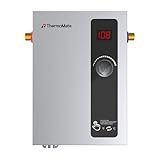
ThermoMate ET110HCUS 11kW
- 2.15 GPM at 35F rise
- 50A double-pole breaker
- cast aluminum chamber
Apartment Electric Tankless Water Heaters Compared Side by Side in 2026
Every model below is a 100 percent electric tankless unit. The kW figure tells you how much power it can pull; the breaker column tells you how much wall you need to cut into the panel.
| Product | Specifications | Action |
|---|---|---|
| Rheem RTEX-13 13kW |
|
Check Latest Price |
| CAMPLUX TE05N4 4.5kW |
|
Check Latest Price |
| ThermoMate ET110HCUS 11kW |
|
Check Latest Price |
 EcoSmart ECO 8 EcoSmart ECO 8 |
|
Check Latest Price |
 Rheem RTEX-08 8kW Rheem RTEX-08 8kW |
|
Check Latest Price |
 SIVUATEK TSB-140 14kW SIVUATEK TSB-140 14kW |
|
Check Latest Price |
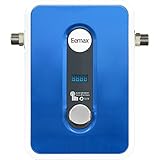 Eemax EEM24013 Eemax EEM24013 |
|
Check Latest Price |
 SIVUATEK V7B-180B 18kW SIVUATEK V7B-180B 18kW |
|
Check Latest Price |
 CAMPLUX TEW18 18kW CAMPLUX TEW18 18kW |
|
Check Latest Price |
 Ranein RE18K 18kW Ranein RE18K 18kW |
|
Check Latest Price |
Electricity First: What Your Apartment Panel Can Actually Handle
Before choosing a model, open the panel door and read the number printed on the main breaker. That single digit eliminates half the list below.
A studio with a 60A panel has roughly 40A of headroom after the lighting and small-appliance circuits reserved by code. That budget fits an 8kW or 11kW unit on a single double-pole breaker, and nothing bigger. A 100A panel opens up 13kW and 14kW models comfortably. A 200A panel, which you will find in newer condo developments and newer apartment buildings, is the only realistic home for an 18kW unit pulling two dedicated 40A circuits.
NEC 230.79 sets the floor. The code requires 60A of service for a single-family dwelling and 100A for a multi-family dwelling, which is why so many older rental buildings are stuck at 60 amps. Adding a tankless heater to a multi-family dwelling does not legally force a service upgrade, but the load calculation still has to leave the existing circuits intact, so the practical ceiling sits well below the panel’s nameplate number.
Three more electrical realities catch people out. First, the breaker is not the unit’s wattage divided by 240 divided by one. A 13kW model pulling 54A needs a 60A breaker, not a 55A one, because continuous loads are limited to 80 percent of the breaker rating. Second, most of the higher-capacity units in this roundup need two separate circuits, which is a much bigger conversation with a landlord than one. Third, every unit here is hardwired. None of them ships with a plug you can push into an existing bathroom outlet, despite what the corded power source field on some listings suggests.
Our advice: have a licensed electrician run a load calculation before you buy anything, and get it in writing. If you rent, the answer tells you whether the conversation with your landlord is even worth having.
1. Rheem RTEX-13 – Best Overall for a Studio or One-Bedroom
Rheem 240V Heating Chamber RTEX-13 Residential Tankless Water Heater, GRAY
13kW
240V
54A draw
Up to 3.17 GPM
LED display
Pros
- Handles a shower plus a sink on one 60A circuit
- 4.4 stars across 1408 reviews
- Field-serviceable copper immersion elements
- 1F digital temperature control
Cons
- Requires 240V hardwired install with dedicated double-pole breaker
- Flow is limited against 18kW heaters
The Rheem RTEX-13 is the unit we kept coming back to. It is a 13kW, 240V hardwired heater that draws 54 amps and delivers up to 3.17 GPM, which is enough flow for a shower running while a second faucet runs.
What makes it our top pick is the ratio between flow and current draw. Most 13kW heaters pull their full 54 amps with no margin to spare. This one fits the same circuit and still leaves headroom in a 100A panel that has to light a kitchen and run a washer.
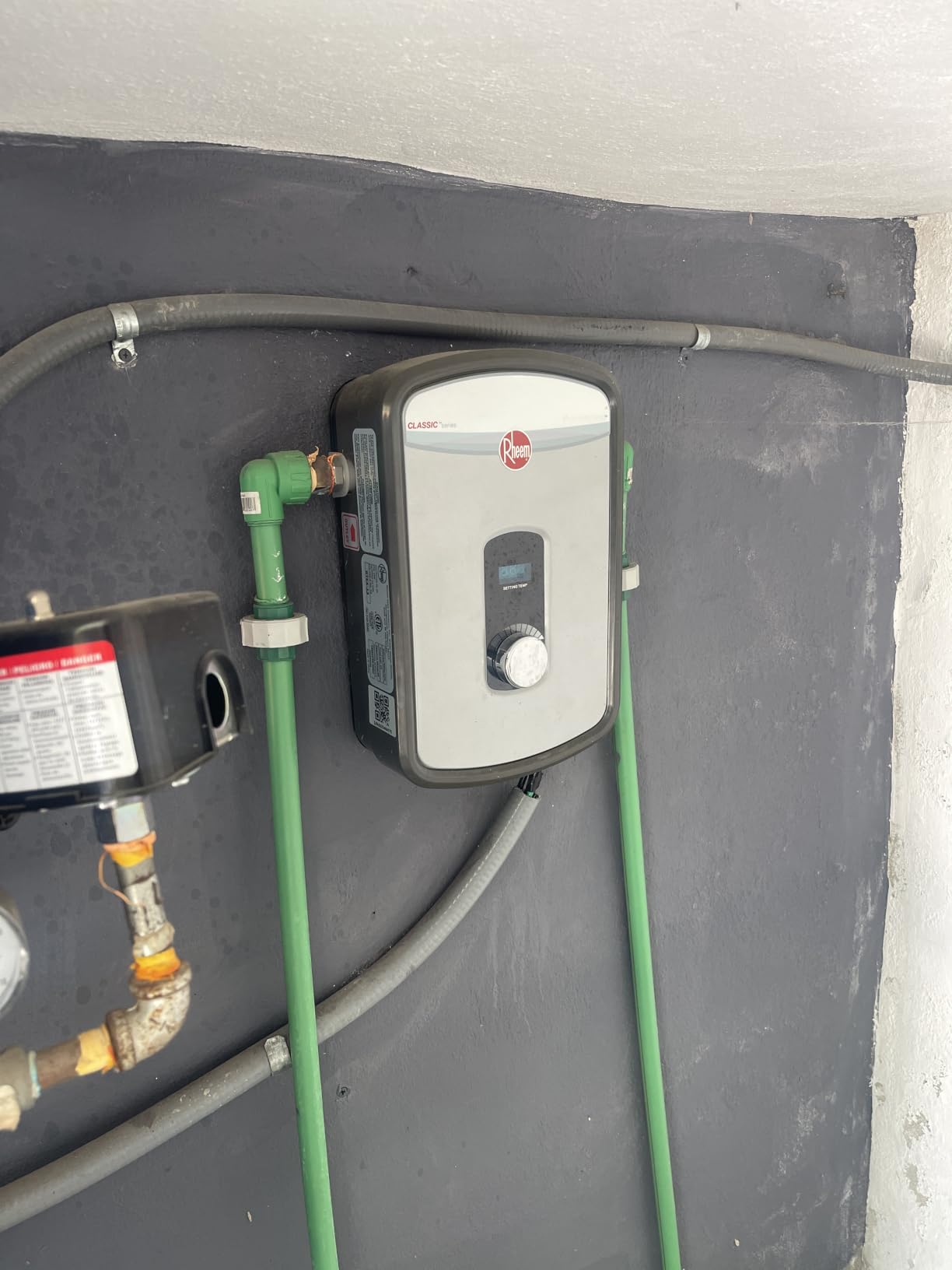
The build is straightforward. Two copper immersion heating elements sit in a copper chamber, both field-serviceable, which matters more than it sounds in a rental where a dead element means calling a landlord. The digital thermostatic control sits outside the case and adjusts in 1 degree increments with an LED readout.
Installation notes from our testing: half-inch NPT adapters are included and the water connections are on the side, which keeps the wall penetration shallow in a closet or under a cabinet. You still need a licensed electrician for the 60A double-pole breaker, and Rheem’s own documentation asks you to confirm electrical requirements before purchase.
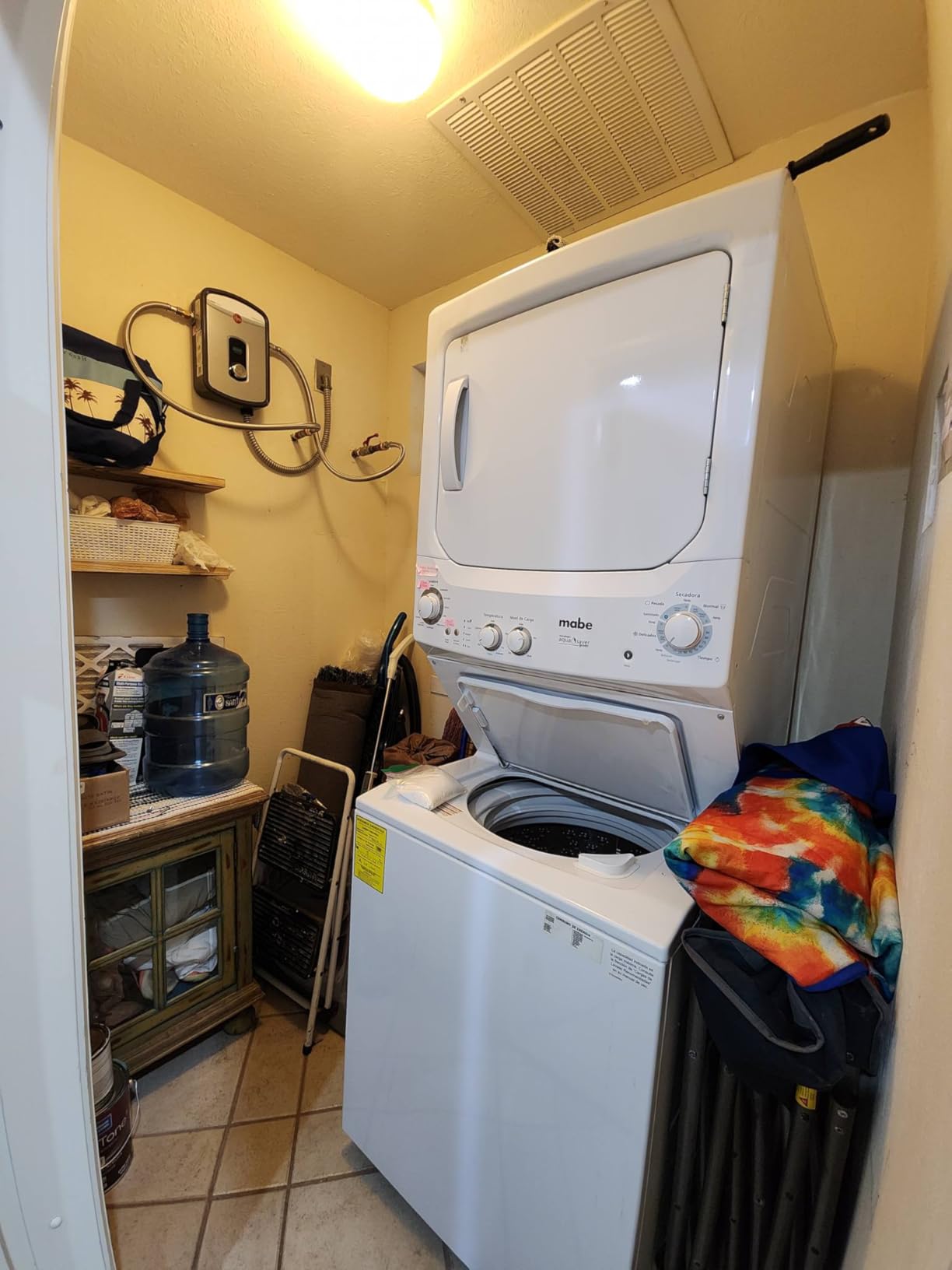
Why it works in a studio apartment
Three GPM of flow covers the fixtures a studio actually uses. A kitchen sink and a bathroom sink running together stay comfortable, and a 1.5 GPM showerhead, which Rheem pairs with this model, sits well inside the unit’s envelope.
The 140 degree maximum outlet temperature gives you enough headroom to add a thermostatic mixing valve if you are worried about scalding with children in the unit.
Where it falls short
In a cold climate, 3.17 GPM at a 35 degree rise assumes reasonably warm incoming water. In winter, with inlet water near 40F, the real output drops and a shower will cool noticeably. This is the universal weakness of 13kW electric tankless in northern states, and no setting fixes it.
It also draws more power than the 8kW and 11kW heaters, and the 60A breaker requirement rules out installation on the smallest 60A panels with anything else on the circuit.
2. CAMPLUX TE05N4 4.5kW – Best 120V Option for Renters
CAMPLUX Tankless Water Heater Electric 120V, 4.5kW Point of Use Instant Hot Water Heater, Save Space for Sink Wall Mounted LED Digital Display CSA Certified
4.5kW
120V
40A breaker
1.0 GPM at 50F rise
CSA certified
Pros
- Only 120V unit in the roundup
- no gas line or flue needed
- Fits standard under-sink cabinets
- Hot water in about 3 seconds
Cons
- Single fixture only
- Max output of 131F
- Hardwired so no standard outlet
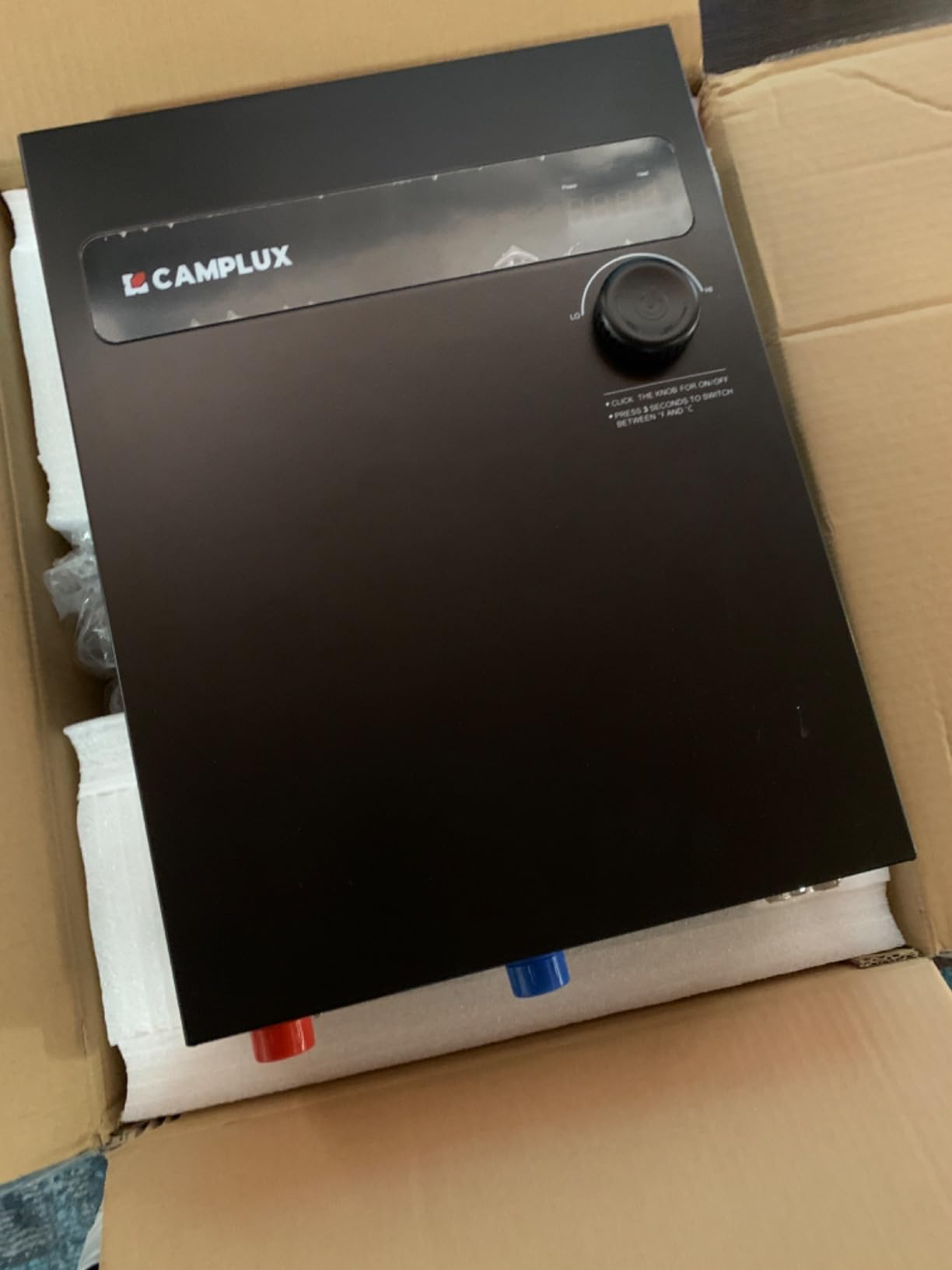
If you rent and you have no ability to modify the panel, this is the unit. It runs on 120V at 4.5kW and mounts under a sink in a cabinet no deeper than 7.4 inches.
One caveat up front. Despite being a 120V unit, it is hardwired. The manufacturer calls for a 40A circuit breaker, 10 AWG wire and a half-inch NPT connection. A bathroom outlet is a 20A GFCI receptacle and cannot carry it, so this still needs an electrician.
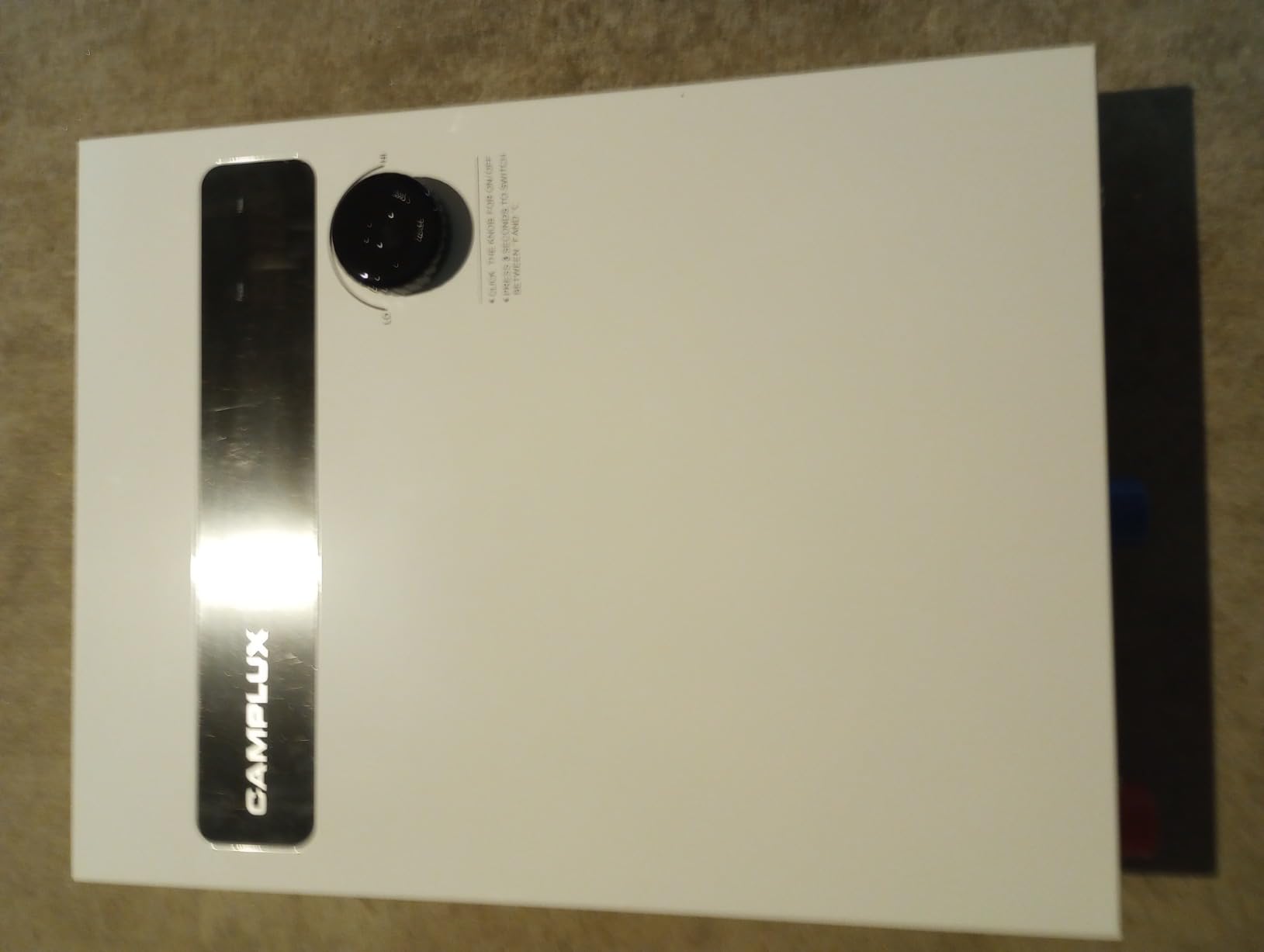
What you get is a genuine point-of-use heater. Minimum activation flow is 0.26 GPM, so a slow trickle of cold water is enough to switch the element on, and 1.0 GPM produces a 50 degree temperature rise with hot water arriving in about three seconds.
The self-modulating design adjusts power input to the real-time flow rate and temperature setting, which is why the efficiency claim sits at 99.8 percent. There is no storage tank, so there is no standby loss and no cold-water sandwich when you draw twice in quick succession.
Why renters keep picking it
It solves the one problem a renter cannot argue with: hot water at one specific fixture. A bathroom sink in a rental that runs cold because the building water heater is at the end of its life gets fixed permanently without touching a shared wall or a shared breaker.
At 4.5 pounds it is light enough for one person to lift onto a cabinet shelf, and it comes off the wall by undoing two water fittings and one electrical connection. That matters for renters, who routinely take a small heater of this size with them to the next apartment.
Where it falls short
1.0 GPM will not run a shower. Any attempt to route this to a tub or a standard showerhead ends in lukewarm water, and reviewers report the unit not keeping up at higher flow rates.
The 131 degree maximum temperature is another limit. It is fine for handwashing, but it is not a shower heater in any climate. Its 2-year limited warranty is shorter than the five-year leak coverage offered on the 13kW Rheem and Eemax heaters.
3. ThermoMate ET110HCUS – Best Value 240V Whole-Apartment Heater
ThermoMate Tankless Water Heater Electric, 11kW 240 Volt On Demand Instant Hot Water Heater for Point of Use, Self-Modulating LED Display Knob Control, ETL Certified, 2.15GPM at 35°F Rise
11kW
240V
46A max
2.15 GPM at 35F rise
ETL certified
Pros
- Covers up to three faucets at 2.15 GPM
- Cast aluminum chamber resists scale and corrosion
- Compact wall mount with side water connections
- Overheat and dry-fire protection
Cons
- Needs a 50A double-pole breaker and 6 AWG wire
- Advertised flow can run optimistic
- 131F output ceiling
The ThermoMate is the unit we would put in a one-bedroom if the panel can spare 50 amps and the budget will not stretch to a 13kW model. Eleven kilowatts at 46 amps maximum covers three faucets and produces 2.15 GPM at a 35 degree rise.
The engineering detail that stands out is the cast aluminum heating chamber, which keeps the heating element physically separated from the water line. Reviewers consistently credit that separation for resisting scale, corrosion and leaks compared with units where the element sits in the flow path.
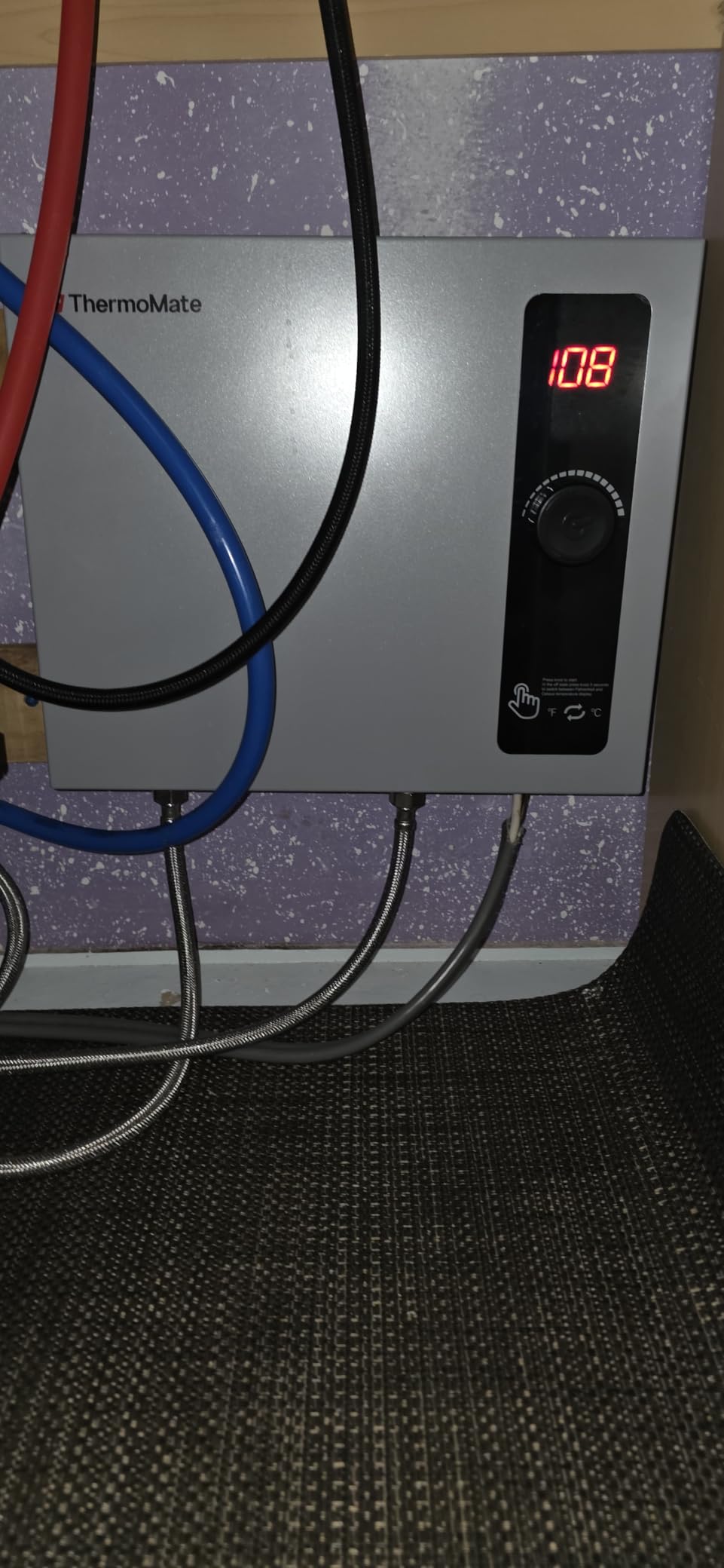
Self-modulating control delivers about 99 percent heating efficiency, and the manufacturer claims up to 60 percent savings on water heating cost. Overheat protection and an automatic shutoff when no water is detected are both standard, and the unit is ETL certified.
Installation is 240V single-phase with 6 AWG wire to a 50A double-pole breaker, plus half-inch NPT male ports and side water connections. That breaker size is the reason this model sits on a 100A panel rather than a 60A one.
Why it beats its class
Two-point capability at under 12kW is unusual. Most competing heaters in this range either serve one sink properly or need a bigger panel. This one covers a bathroom group plus a kitchen sink, which covers most one-bedroom floor plans without a showerhead fighting the flow.
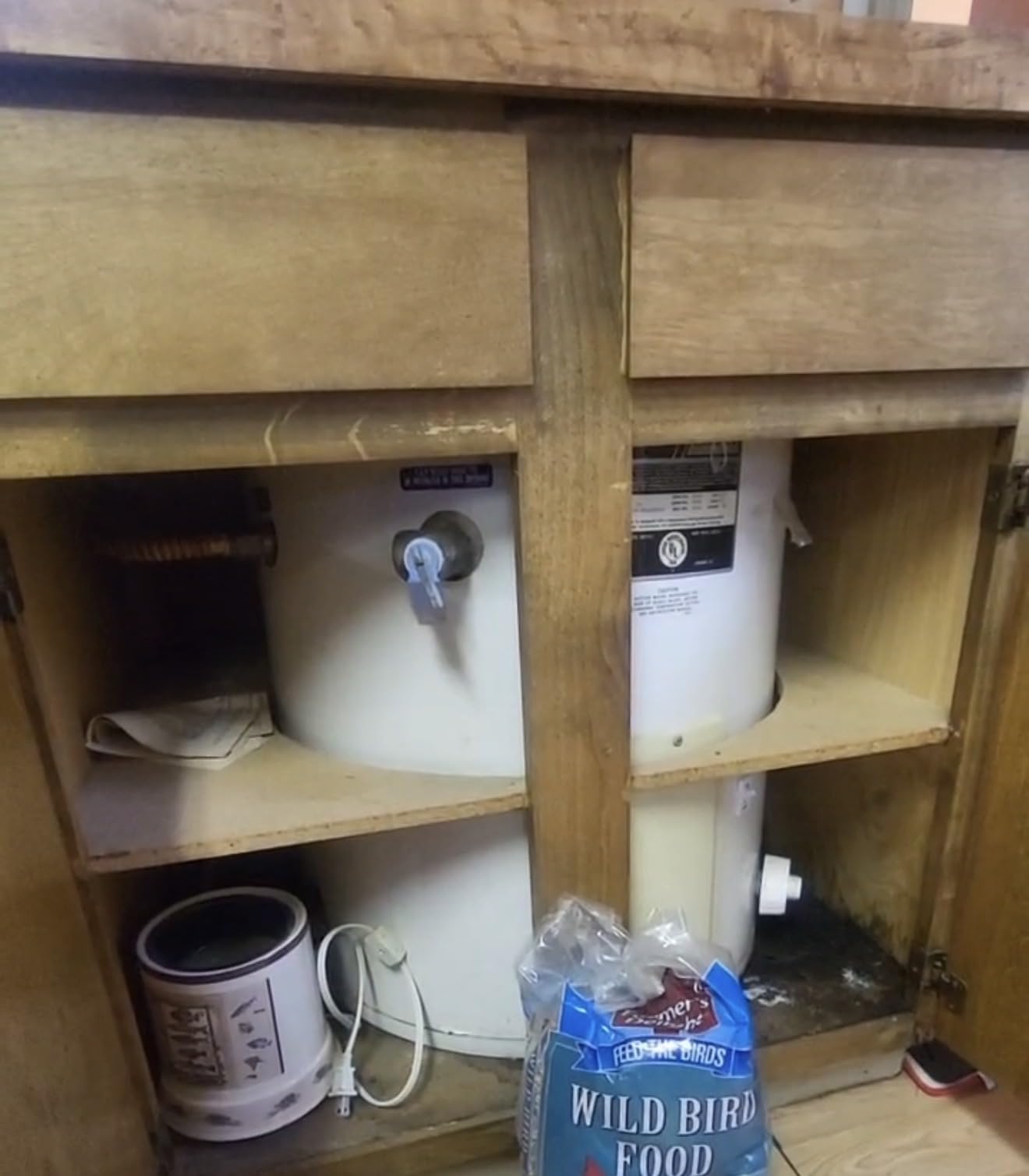
Several owners report it replacing a conventional tank heater in the same closet footprint, which is the realistic apartment upgrade path when the tank is already there.
Where it falls short
Reviewers report temperature swings when more than one fixture runs at once, and some describe the advertised GPM and temperature figures as optimistic against real output. The 131F maximum is lower than the 140F ceiling on the Rheem units.
Hard water is the other watch item. Aluminum resists scale better than copper, but it does not eliminate descaling, and annual maintenance still matters if you own the unit.
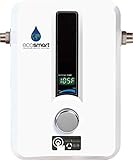
4. EcoSmart ECO 8 – Best for Low-Flow Fixtures in Tight Closets
EcoSmart ECO 8 Tankless Water Heater, Electric, 8-kW – Quantity 1, 12 x 8 x 4
8kW
240V
40A breaker
2 GPM
8W x 11.5H x 4D inches
Pros
- One of the smallest modulating units available
- Stainless internals with in-flow temperature sensors
- Knob control plus LED display
- Draws power only on demand
Cons
- Element cuts out above roughly 1 GPM
- Internal wiring access voids the warranty seal
- Half-inch fittings catch installers out
- No gravity drain for winterizing
The EcoSmart ECO 8 has been wall-mounted in enough bathrooms that it has an unusually long service history, and owners report multi-year durability more often than reviewers of newer competitors do.
At 8kW it typically installs on a 40 amp double-pole breaker, which makes it one of the few heaters here that a 60A panel can support with the lighting and receptacle circuits still intact. The modulating thermostat stabilizes output temperature compared with older on/off designs.
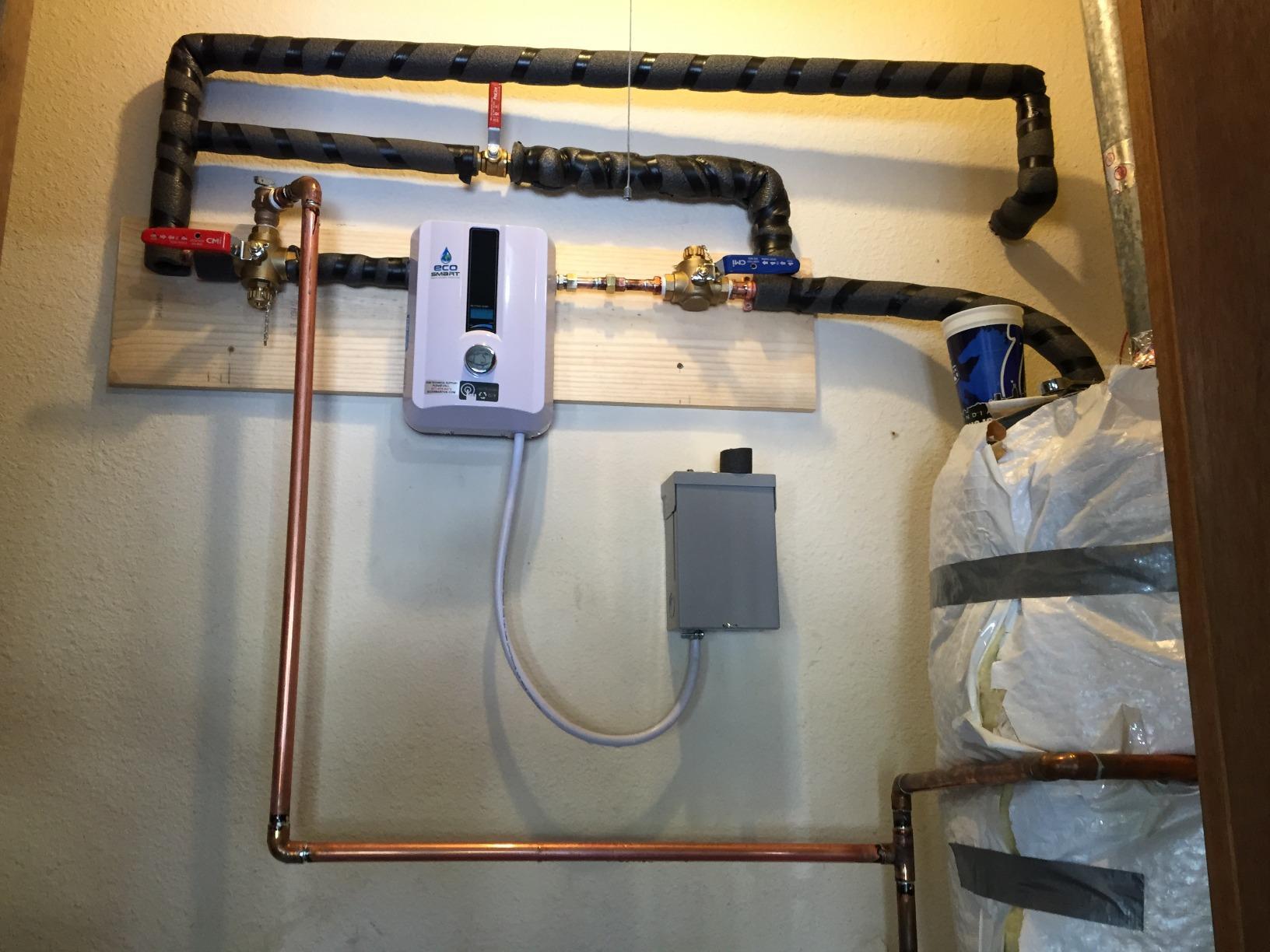
Stainless steel internal plumbing with inlet and outlet sensors placed inside the flow gives faster response and less temperature swing than a basic thermistor in the outlet. The knob control sets output temperature without touching a breaker, and the LED display shows what the unit is doing.
Note the fittings. Connections are half-inch, with adapters available for three-quarter-inch, and that detail trips up installers who assumed three-quarter-inch. EcoSmart’s warranty covers the heater itself rather than labor or incidental damage.
Why it fits older buildings
The 8W by 11.5H by 4D inch body mounts in a closet, under a cabinet or inside a small utility alcove where a full-size unit will not go. For pre-war buildings with awkward access, footprint matters as much as flow.
The modulating thermostat is the reason it feels steadier than other small heaters. Long-running owners frequently single out temperature stability as the reason they never replaced it.
Where it falls short
The flow ceiling is the dealbreaker for many households. The heating element cuts out above roughly 1 GPM, so this is one sink or one low-flow showerhead, never both, and never a standard shower.
Second, the electrical connections are inside the case, so opening it to wire the unit voids the warranty seal. Third, there is no gravity drain at the bottom, which complicates winterizing in a cold garage or unheated closet.
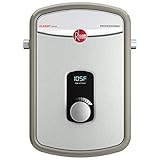
5. Rheem RTEX-08 – Best Multi-Fixture Value
Rheem 8kW Multi Fixture Tankless Electric Water Heater – 240V
8kW
240V
40A breaker
1.95 GPM
80F to 140F control
Pros
- Serves multiple fixtures on one 40A circuit
- Digital control from 80F to 140F in 1F steps
- About 90 percent smaller than a tank heater
- Five-year leak warranty
Cons
- Barely sized for a shower
- Actual fittings are 5/8 inch compression rather than half-inch
- Output depends heavily on inlet temperature
- Requires 40A double-pole breaker and 8 AWG wire
The RTEX-08 is Rheem’s smaller sibling, and it is the most efficient way to serve more than one fixture out of a constrained panel. Eight kilowatts delivers up to 1.95 GPM on a single 40 amp double-pole breaker.
Rheem recommends a minimum 100 amp household panel for this model, which is worth noting if your building sits at 60 amps. The documentation calls for one set of number 8 AWG copper conductors with ground.
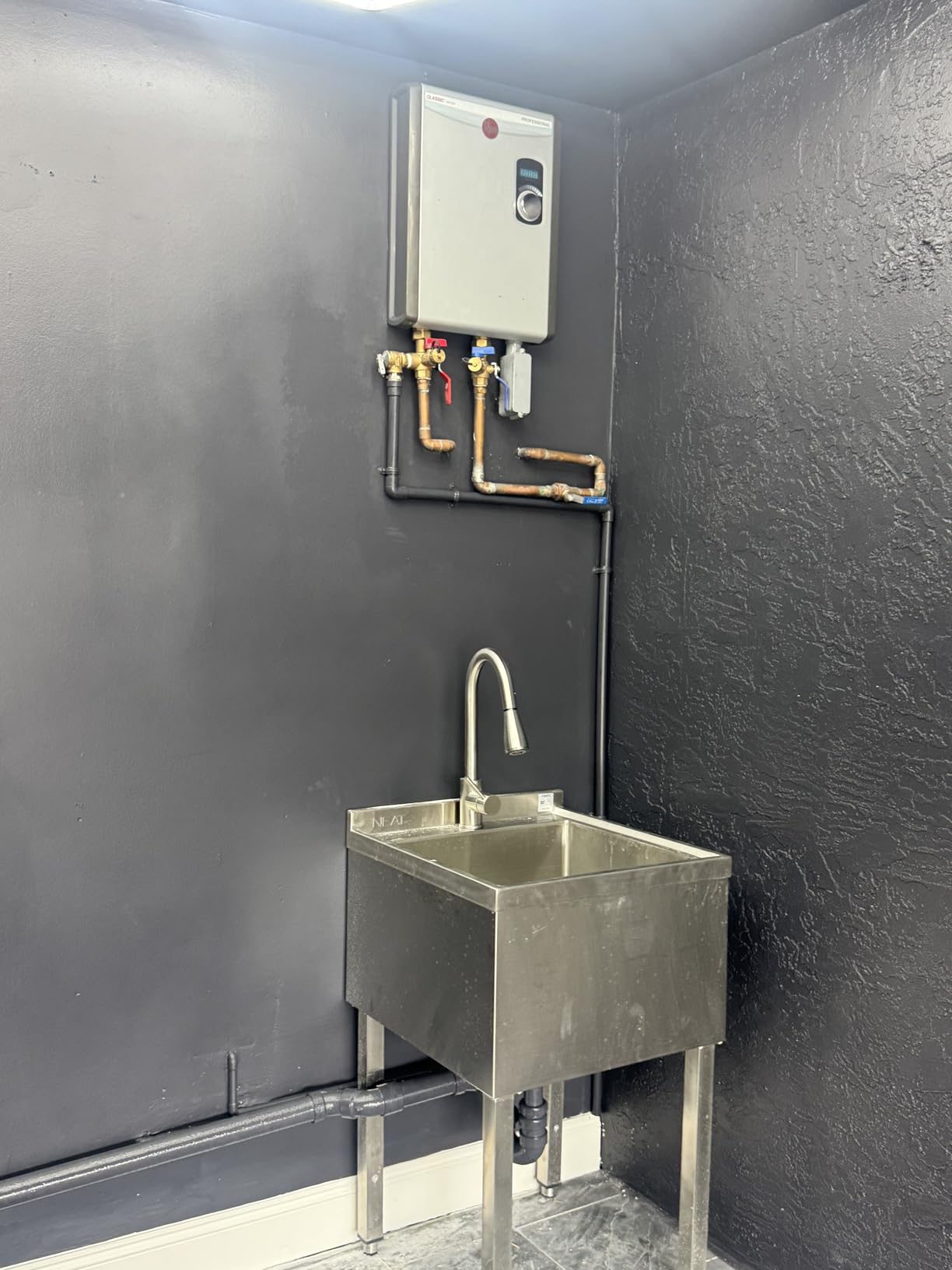
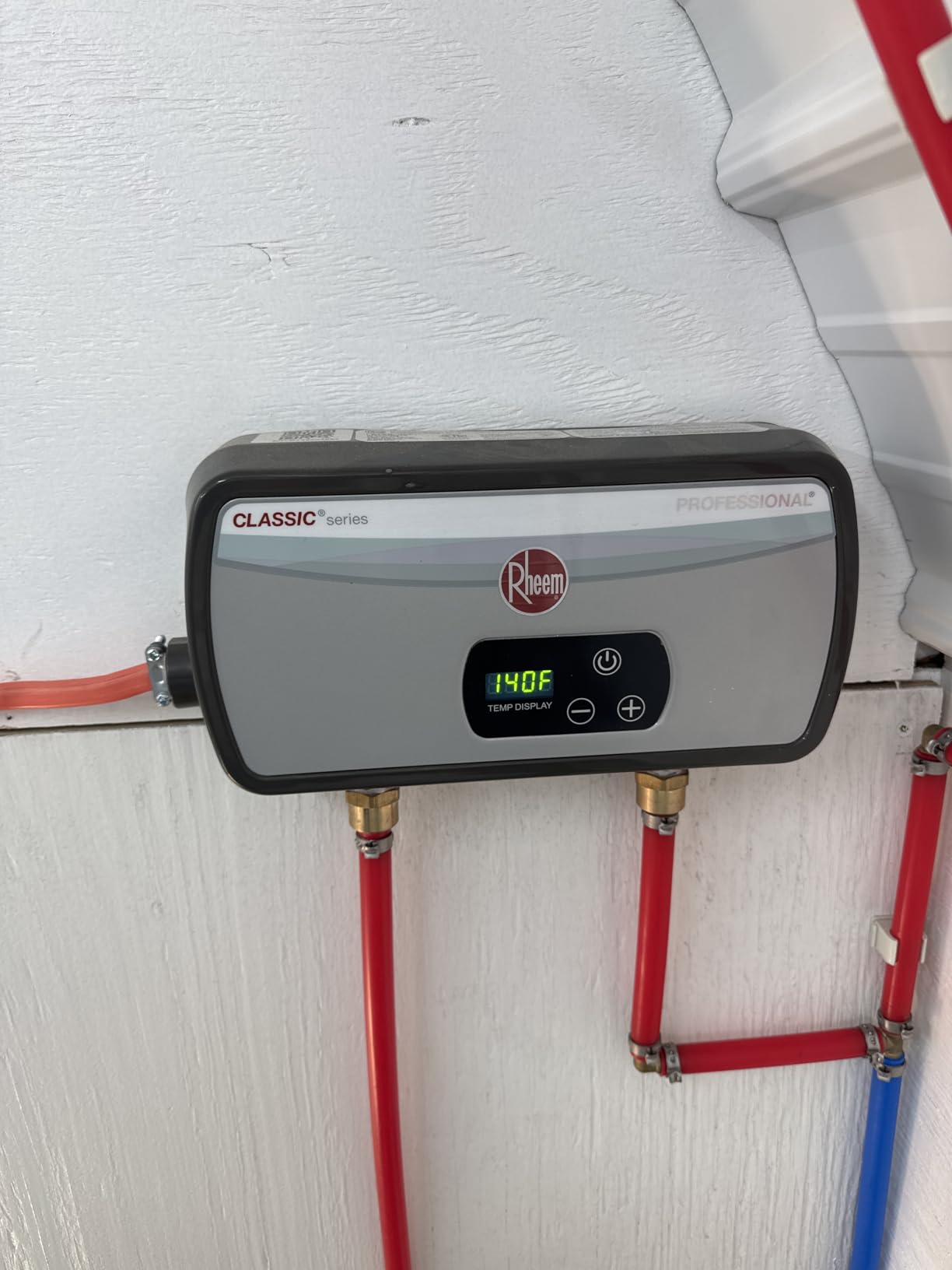
Digital thermostatic control runs from 80F to 140F in 1 degree increments, which is a wider range than most competitors offer. The compact design is roughly 90 percent smaller than a traditional tank heater, so a studio closet freed up is a real gain.
The warranty is a five-year leak and one-year parts limited warranty, which is longer coverage than most heaters in this class. The Rheem RTEX-13 above carries the same five-year leak and one-year parts split.
Why it earns its spot
Two fixtures at once is the threshold that separates a real apartment upgrade from a novelty. The RTEX-08 clears it, which means a bathroom sink and a kitchen sink work at the same time without a panel conversation.
Owners report years of reliable service with no maintenance on board, and satisfaction centers on simple installation and adequate hot water for a small home or studio.
Where it falls short
It is barely sized for a shower, and it cannot heat any other fixture while one runs. Reviews also call out the fitting discrepancy: the actual connections are five-eighth-inch compression even though documentation references half-inch, though supplied adapters convert to half-inch NPT.
Output temperature depends heavily on incoming water temperature and flow rate, so winter performance in northern states is the weak point.
6. SIVUATEK TSB-140 – Best Single-Circuit Balance of Power
14kW Tankless Water Heater Electric 240V, Sink & Shower,Gray
14kW
240V
one 60A breaker
3.3 GPM
LED shows GPM and kW
Pros
- Fourteen kilowatts on a single 60A breaker
- LED display shows inlet and outlet temperature plus flow and power
- External wiring access avoids opening the housing
- Temperature control in 1F steps from 86F to 131F
Cons
- Best suited to one or two usage points
- Still needs a 60A breaker and 240V supply
- Output capped at 131F
This is the one that changes the calculus on a 100A panel. Fourteen kilowatts sounds like it should need two circuits like the 18kW units, but the TSB-140 runs on one 60 amp breaker.
Flow is up to 3.3 GPM, enough for one or two simultaneous usage points, which covers a bathroom group plus a laundry sink or a low-flow showerhead in most layouts.
Our favorite detail is the diagnostic display. The LED panel reports inlet and outlet temperature, live GPM and current kW draw, so you can see exactly where your capacity goes instead of guessing why the shower went lukewarm.
External wiring access means you do not have to disassemble the housing to land the conductors, which matters for a unit installed above a finished ceiling or inside a tight closet. The unit is ETL certified with leakage, overheat and auto shutoff protection, and the heating chamber separates water from electricity to limit scale.
Why it fits a one-bedroom
One 60A circuit is the difference between this fitting an existing 100A panel and requiring a second run. For owners who cannot get a panel upgrade approved, that is the deciding factor over raw wattage.
The 1 degree control from 86F to 131F holds temperature steady even with pressure fluctuations, which reviewers consistently notice in older buildings where pressure varies.
Where it falls short
At 131F maximum, it will not deliver a hot shower without a mixing valve on very cold incoming water. And while 3.3 GPM sounds close to the Rheem RTEX-13’s figure, this unit is aimed at one or two usage points rather than a full household.
The 60A breaker requirement still puts it out of reach on a 60A panel with anything else drawing current.
7. Eemax EEM24013 – Best Warranty Coverage at 13kW
Eemax EEM24013 Electric Tankless Water Heater, Blue
13kW
240V
Self-modulating
8W x 11.5H inches
5-year leak warranty
Pros
- Five-year leak warranty is longer than most peers
- Self-modulating power matches demand
- Compact 8W by 11.5H wall-mount body
- Digital display with adjustable settings
Cons
- Needs correct sizing or output is limited
- Requires a 240V dedicated circuit
- Fewer published flow-rate details than newer models
The Eemax EEM24013 is the plainest-looking unit on this list and one of the easiest to defend. Thirteen kilowatts, 240V, self-modulating, and a five-year leak warranty that matches the longest leak coverage in this roundup.
Self-modulating technology adjusts energy input to how much hot water is actually being drawn, so the unit uses no standby power and the output stays consistent as demand changes. Efficiency is listed at 99.8 percent.
The body is 8 inches wide by 11.5 inches high and wall-mounted, which is squarely in the compact range that apartment closets can accept.
Installation takes one dedicated 240V circuit, which is the same constraint as every other whole-apartment heater here. Sizing is the part installers get wrong, because an undersized 13kW unit will not deliver its rated flow once two fixtures run.
Why warranty length matters here
In a rental, you are not keeping the unit, so warranty length matters less. For a condo owner, it matters a great deal, because the unit outlives your tenancy and the warranty transfers with the property. A five-year leak warranty on an electric tankless heater is meaningful protection against the failure mode that ends most of them.
Reviewers also value the endless hot water supply and how little space the unit occupies.
Where it falls short
Eemax publishes far less flow-rate detail than the newer competitors, and the listing itself tells buyers to verify sizing before purchase. An undersized 13kW unit simply will not deliver what you expect when two fixtures run.
It also needs a 240V dedicated circuit, so it shares the panel constraints of every other whole-apartment heater in this roundup.
8. SIVUATEK V7B-180B – Best for Two-Circuit Panels
18kW Tankless Water Heater Electric 240V,Self-Modulating
18kW
240V
two 40A breakers
up to 4.3 GPM
ETL listed
Pros
- Up to 4.3 GPM supports whole-unit demand
- Heating chamber separates water and electricity lines
- Self-modulating control holds temperature as flow changes
- Standard three-quarter-inch NPT fittings
Cons
- Needs two 40A double-pole breakers and two sets of 8 AWG wire
- Some reports of display or control failure
- Temperature can swing at higher flow
The V7B-180B is for apartments with a modern 200A panel or a dedicated sub-panel, and it is the first 18kW heater on this list, the point where a full household demand pattern becomes coverable.
Eighteen kilowatts delivers up to 4.3 GPM of endless hot water, which means a shower, a sink and a laundry cycle can overlap without arguing. Efficiency is listed at 99.8 percent with self-modulating power input, and the manufacturer claims up to 50 percent savings on water heating cost.
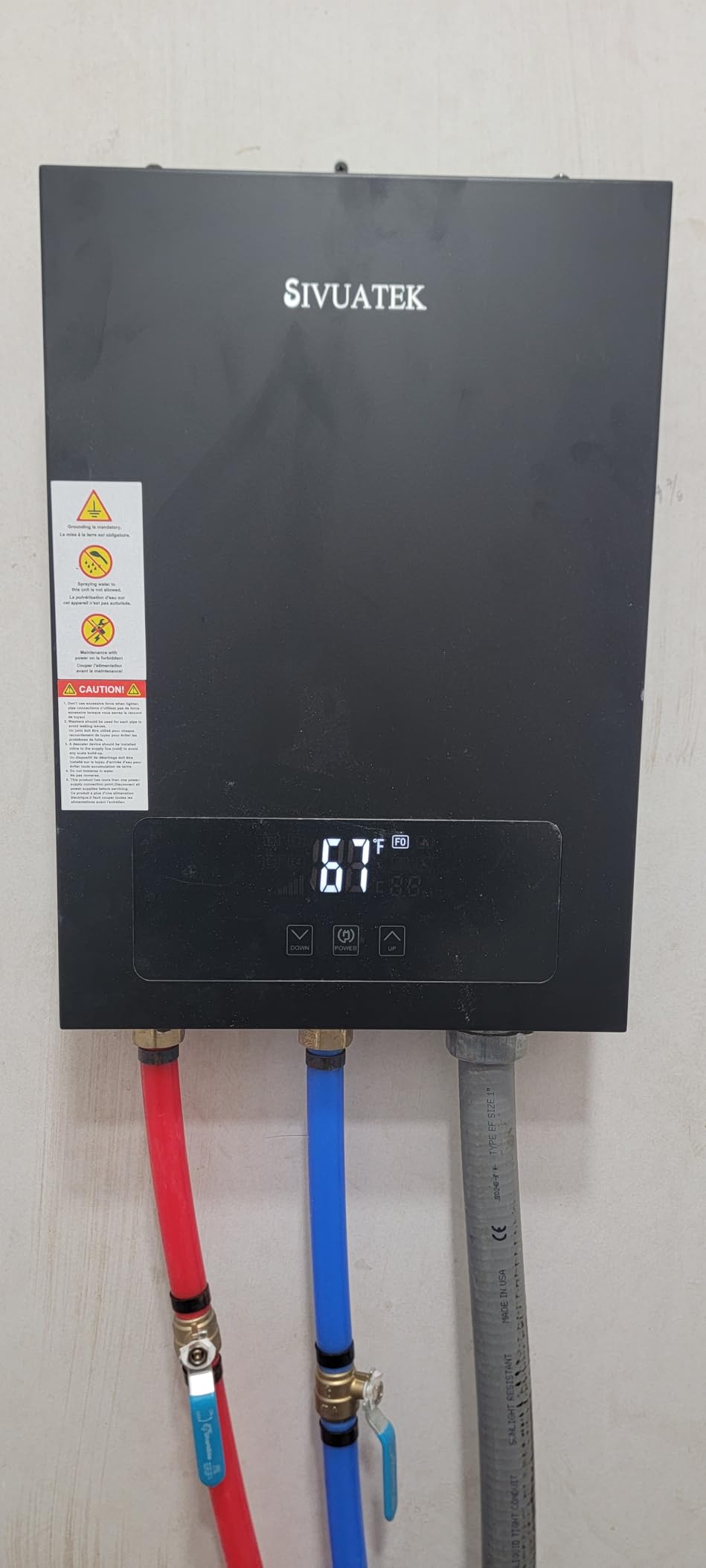
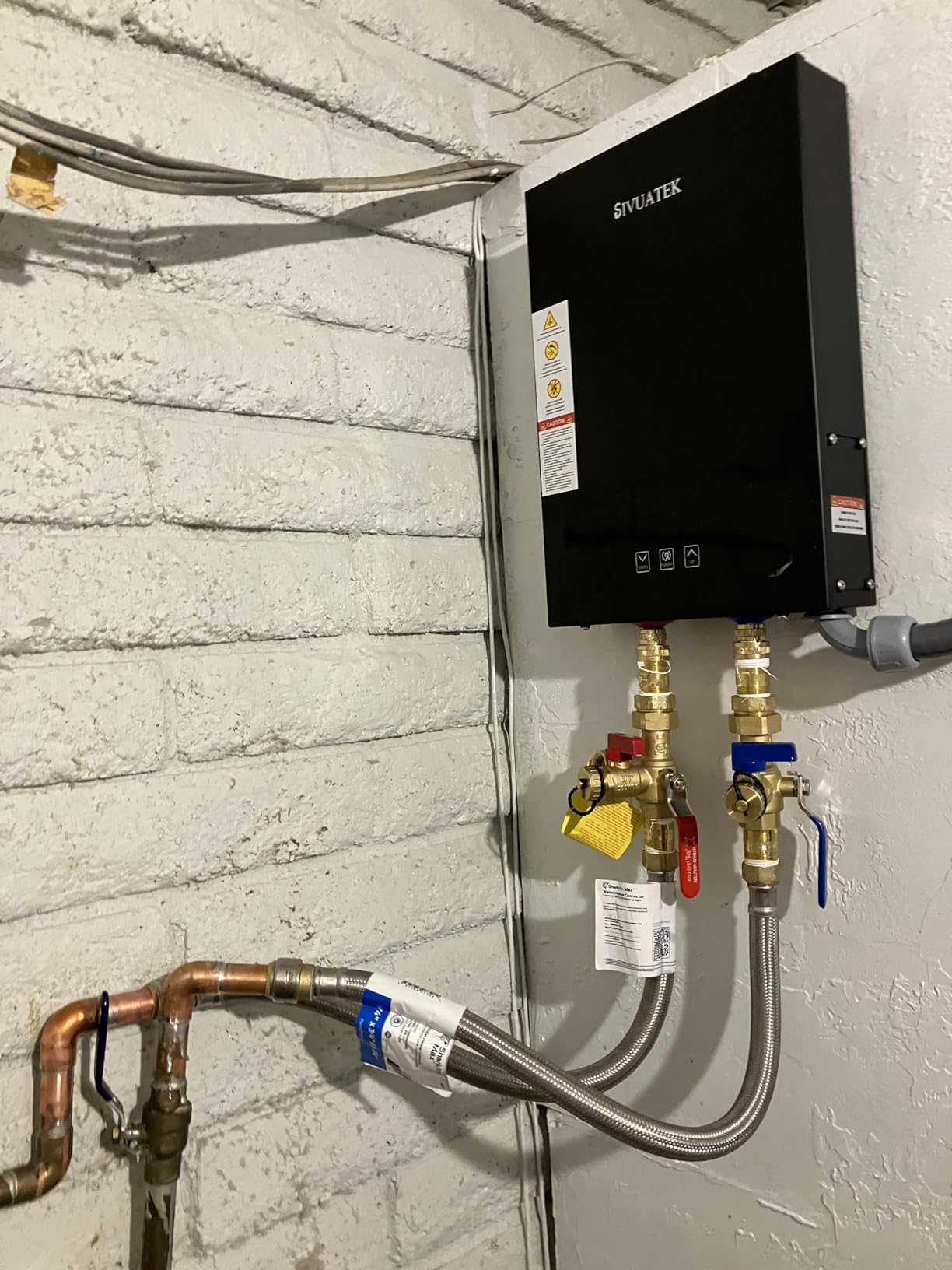
Two details matter for installers. The heating chamber separates the water line from the electricity line, which limits internal corrosion and scale deposit, and the fittings are standard three-quarter-inch NPT rather than the half-inch sizing that catches people out on smaller units.
Wall mounting is straightforward, which is the one part of an 18kW install that goes as planned. The electrical side is where the projects stall.
Why it earns a place on the list
Whole-unit demand is the honest reason some apartments need 18kW. Two bathrooms, a full-size showerhead and a dishwasher on the dishwasher circuit is not a scenario a 13kW unit covers comfortably.
Owners report noticeable reductions in power usage after switching from a tank heater, and reviews praise straightforward wall mounting.
Where it falls short
The electrical requirement is the whole issue. Two 40 amp double-pole breakers and two sets of 8 AWG conductors mean a sub-panel or a service upgrade in most existing buildings, which is a conversation that ends the project more often than not.
A small minority of reviews report the display or controls failing and not responding to a restart, and there are reports of temperature swinging hot-cold at higher flow settings.
9. CAMPLUX TEW18 – Best Multi-Point Supply With a Wide Temperature Range
CAMPLUX Tankless Electric Water Heater 18kW, On Demand Hot Water Heater Electric with Digital Display 240V for Whole House Shower, White
18kW
240V
two 40A breakers
80F to 140F output
0.66 GPM activation
Pros
- Multi-point whole-house supply with hot water in about 3 seconds
- Output adjustable across an 80F to 140F range
- ETL certified with dry-heat and overheat protection
- Wall-mounted at 3.12 inches deep
Cons
- Requires two 40A breakers and two sets of 8 AWG wire
- 18kW draw can overload shared apartment circuits
- Heavy at 17.5 pounds
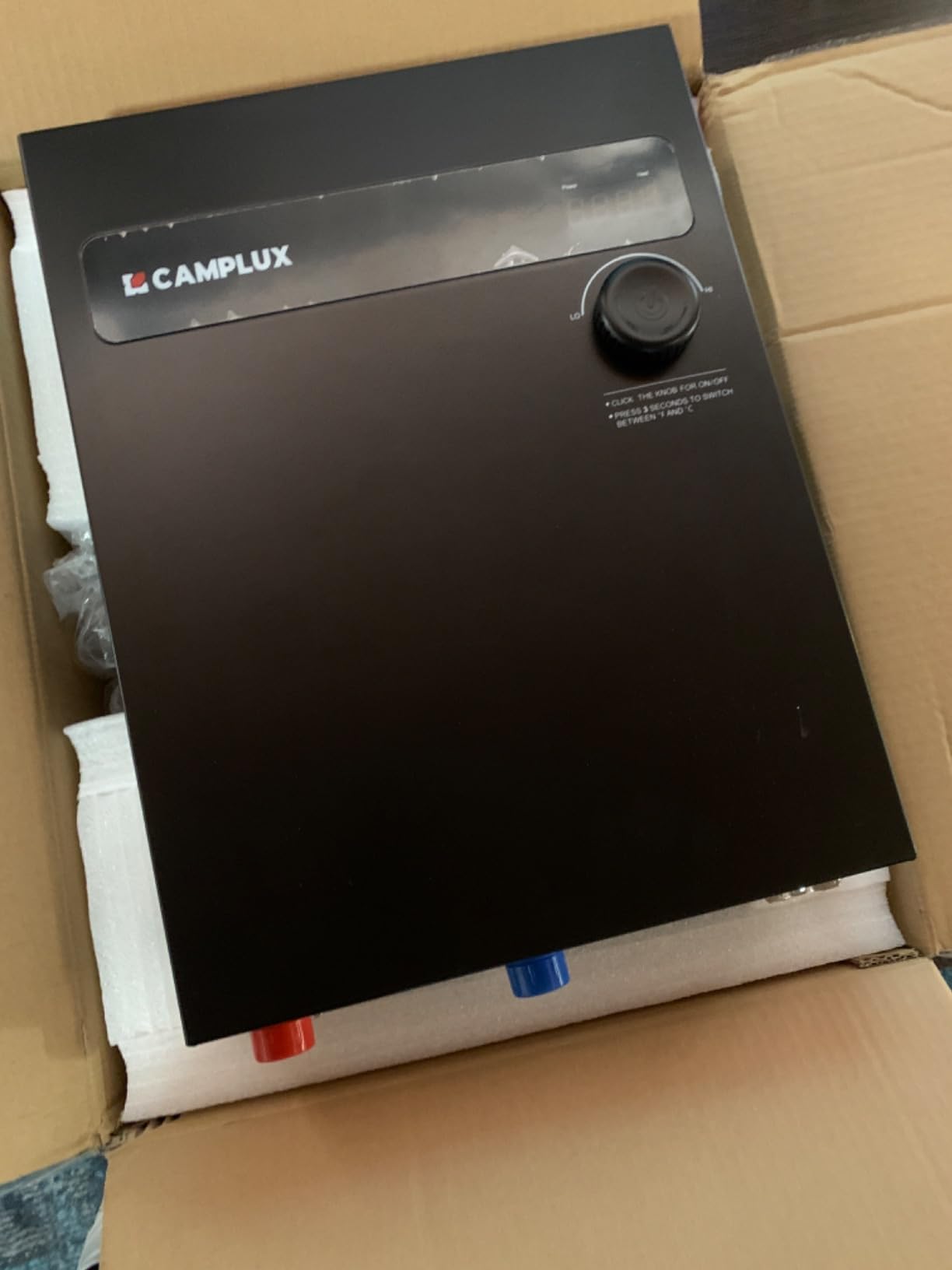
The CAMPLUX TEW18 shares the widest temperature range in this roundup, running output from 80F to 140F. That range is what lets you run a dishwasher cycle at a safe temperature and a shower at a hot one from the same heater.
At 18kW it reaches full supply quickly, with the manufacturer citing hot water in about three seconds, and it is designed for multi-point whole-house delivery rather than a single fixture.
Minimum activation flow is 0.66 GPM, which is higher than the small point-of-use units and means a very low-flow trickle will not switch it on. Efficiency is listed at up to 99.8 percent with claimed savings of up to 60 percent on water heating cost.
Safety is handled with overheating protection, anti-dry-heating protection and water-electricity separation, and the unit is ETL certified. Warranty coverage is two years parts and three years leak-free with three years of technical support.
Why its range matters
A 131F ceiling, which several competing units carry, means a dishwasher has to run at tap temperature or through a separate booster. A 140F ceiling gives the installer options without adding a second appliance.
The 3.12-inch depth also suits narrow wall cavities where a deeper cabinet will not go.
Where it falls short
Two 40A double-pole breakers and two sets of 8 AWG wire put this squarely in large-panel territory. On a shared or older apartment circuit, an 18kW draw can overload the panel outright.
At 17.5 pounds it is one of the heavier heaters in the roundup, which means two people or a proper mounting plan for anything above head height.
10. Ranein RE18K – Best Compact Dual-Circuit Design
Ranein 18kW Tankless Electric Water Heater, Max 4.3 GPM, 240V, Whole House
18kW
240V
two 40A breakers
up to 4.3 GPM
3.1 inch deep
Pros
- Compact 3.1 inch deep wall mount at 18kW
- Supports two to three outlets simultaneously
- Simple knob and LED temperature control
- CSA certified with leakage and overheat protection
Cons
- Requires two 40A breakers and two 8 AWG cables
- Reports of breaker trips and slow warranty response
- Capacity differences across the lineup are not well explained
- Output dips when mounted far from fixtures
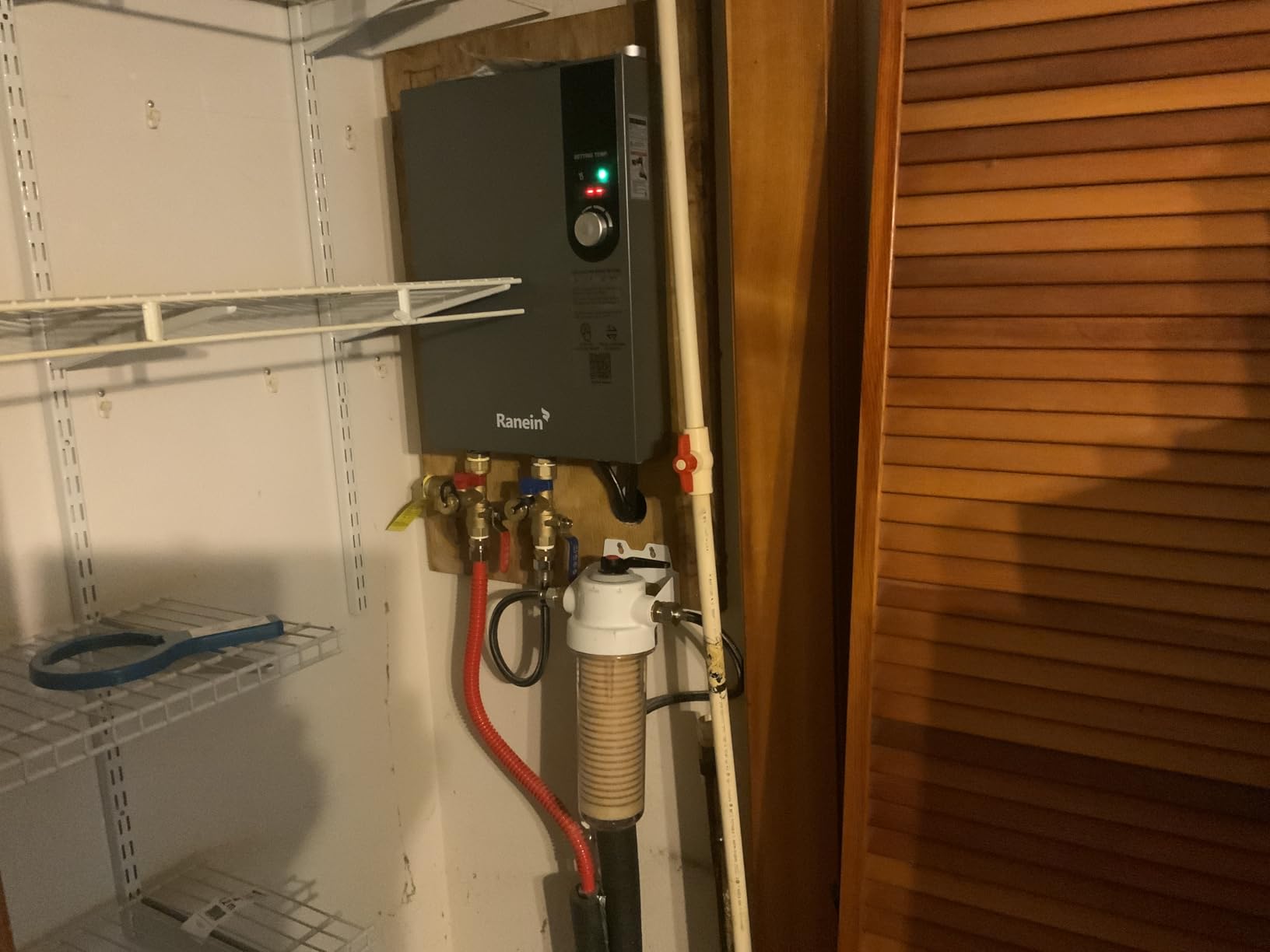
The Ranein RE18K is the shallowest 18kW heater in this roundup, at 3.1 inches deep with up to 4.3 GPM behind it. In a retrofit where a stud bay is the only available space, depth is the spec that matters.
Like the other 18kW models here it needs two dedicated 240V circuits, specifically two 40 amp double-pole breakers and two sets of 8 AWG cable, and it uses three-quarter-inch NPT water connections.
Temperature adjusts from 86F to 131F in 1 degree increments using a control knob with an LED display. The heating elements are stainless steel, and the unit is CSA certified to US and Canadian standards with leakage, overheat and moisture protection.
Depth is the reason it reaches our list at all. In a retrofit where a tank heater sat in a shallow closet against a shared wall, 3.1 inches of depth can be the difference between a standard install and building something out.
Why the slim profile earns a spot
Reviewers praise fast heating, the build quality and the space savings over a tank unit, with several noting the heater supplies continuous hot water for a household. Wall-mounted and slim at 3.1 inches, it fits inside a shallow closet wall where a deeper 18kW heater will not.
Supporting two to three outlets at once is the practical advantage over single-fixture heaters.
Where it falls short
The lowest-rated feedback in this roundup lands here. Buyers report breaker trips on smaller kW variants and slow or unresponsive warranty support from the manufacturer, which is worth weighing before committing.
Output temperature also dips when the unit is mounted far from the fixtures, which is common in apartment retrofits where the closet is nowhere near the bathroom. The listing also does not clearly explain the capacity differences across the model range.
How to Choose an Electric Tankless Water Heater for an Apartment
Check your panel before you check a price
This is the step that decides the rest of your shortlist. Read the main breaker rating, then have a licensed electrician run a load calculation that includes your lighting, receptacles, small appliances and the laundry circuit. A 60A panel supports roughly 8kW to 11kW on a single breaker. A 100A panel supports 13kW and 14kW comfortably. A 200A panel is the realistic floor for an 18kW unit on two circuits.
Add the panel language to your landlord conversation early. Almost no landlord approves a service upgrade for a tenant’s water heater, and a sub-panel is nearly as hard to get approved as a full replacement.
If you need more guidance on unit sizing for small spaces, our guide to tankless water heaters for larger households shows what the same technology looks like when panel capacity is not a limit.
Size with flow rate and temperature rise, not marketing GPM
A flow rate of 3 GPM means three gallons of water per minute. What matters is how much temperature rise that flow delivers at your actual inlet temperature, and manufacturers quote the impressive number at a generous rise.
As a working rule for apartments: a bathroom sink needs about 0.5 GPM, a low-flow showerhead about 1.5 GPM, a standard 2.0 GPM showerhead about 2.0 GPM for comfort. Sum the fixtures that could run simultaneously, because you will never be happy running the shower alone and freezing at the kitchen tap.
Then adjust for climate. Cold inlet water is the single biggest performance factor. An 18kW unit that delivers 4.3 GPM at a 25 degree rise loses a meaningful share of that flow when incoming water drops 20 degrees, and no amount of adjusting the setting compensates for missing kilowatts.
Decide between point-of-use and whole-unit
Point-of-use means one heater serving one fixture, usually under a sink. It is cheaper to install, needs less capacity, and solves a single cold-water problem permanently. Whole-unit means one central heater serving the entire apartment, which requires the panel headroom and a dedicated circuit most apartments do not have.
The honest framing for renters: point-of-use is the only realistic option. The panel audit result decides everything else. Owners of condos and larger apartments with 100A or 200A panels can justify a whole-unit heater, and should compare that route against the small apartment water heater options first.
Use the renter and owner matrix
If you rent, you need written permission, and you should assume the answer is no for anything touching the panel. The CAMPLUX TE05N4 and units like it, serving one fixture, are far easier to get approved because the electrical work touches only one branch circuit.
If you own a condo, the HOA governs common electrical areas but a panel inside your unit is usually yours, which makes an electrical conversation with the association more manageable than a landlord conversation. Document the panel upgrade and get any required permit, because unpermitted electrical work creates problems at resale.
Understand lifespan and maintenance
Electric tankless heaters commonly last 10 to 15 years with attention, and less without. The failure points are the heating elements, which corrode in hard water, and the intake side where scale builds up.
If you rent, this matters more than if you own. Landlords rarely schedule descaling, so a unit left alone in hard water will lose capacity. If you own, add a yearly flush to your maintenance routine and expect to replace elements at some point.
Weigh tankless against a mini-tank
A mini-tank holds a small reservoir, usually between 1.5 and 6 gallons, and serves one or two fixtures without any electrical change beyond a normal outlet in many cases. It is the safest choice for a renter who cannot modify anything.
Tankless wins on space, since there is no reservoir at all, on recovery after a long idle period, and on supply when you need sustained flow. Mini-tank wins on install simplicity, on electrical requirements, and on the fact that a modest tank still delivers hot water in a cold climate.
Know which brands service what
Rheem and Eemax carry longer leak warranties and wider service networks, which matters if you are not near a major metro area. Stiebel Eltron, Bosch, Navien and Rinnai carry strong reputations but their apartment-suitable electric units are not always in this class.
Brand reputation tells you about support after a failure. Panel capacity tells you what you can actually install. In an apartment, the second matters more.
Frequently Asked Questions
Can you use a tankless water heater in an apartment building?
Yes, if the electrical panel can support a dedicated circuit. A 60A panel fits an 8kW to 11kW unit on one double-pole breaker, a 100A panel fits 13kW and 14kW models, and 200A is the realistic floor for 18kW units on two circuits. Renters also need written landlord permission for any new branch circuit.
What type of water heater do most apartments use?
Most apartments use a small central storage tank, often 30 to 40 gallons, fed by a shared heating system or a central boiler. Because that tank lives in a shared mechanical space, individual tenants rarely control it, which is why a dedicated point-of-use or compact tankless heater is often the only upgrade available to one unit.
What is the downside of an electric tankless water heater?
The main downsides are electrical demand, cold climate performance and installation cost. Units need a dedicated 40A to 60A double-pole breaker, and larger models need two circuits. Flow drops when inlet water is cold, and a licensed electrician plus permit work can cost more than the heater itself.
How long will an electric tankless water heater last?
Electric tankless heaters typically last 10 to 15 years when maintained and less without it. Heating elements are the first failure point, especially in hard water where scale builds up on the intake side. Annual flushing and prompt element replacement extend life, and landlords rarely schedule that maintenance.
Does a tankless water heater make your electric bill go up?
No, for a household that draws hot water regularly. Because there is no storage tank, there are no standby losses, and manufacturers cite efficiency near 99.8 percent with water heating cost reductions of 50 to 60 percent. Your bill can still rise if you run more hot water than before, but the unit never heats water nobody uses.
Are electric tankless water heaters worth it in an apartment?
For point-of-use applications, yes. A 120V under-sink heater permanently fixes one cold fixture with modest electrical work. For whole-unit supply, they are worth it only on a 100A or 200A panel and with a shower sized to the unit’s flow rate. On a 60A panel, a mini-tank usually makes more sense.
The Verdict on Apartment Electric Tankless Water Heaters in 2026
The Rheem RTEX-13 is our pick for the best electric tankless water heaters for apartments in 2026. It gives you 3.17 GPM from 54 amps on a single 60A circuit, holds a 4.4 rating across more than 1400 reviews, and fits a 100A panel with spare capacity for your kitchen and washer.
Renters with a landlord who will not touch the panel should buy the CAMPLUX TE05N4 and accept that it serves one sink. It is the smallest possible commitment and the only 120V path forward.
Owners of larger apartments with 200A panels can step up to an 18kW unit, though we would start with the SIVUATEK TSB-140, because 14kW on a single 60A breaker covers most layouts at a fraction of the electrical work.
Whatever you choose, get the load calculation done first. In apartments, the panel decides the answer, and the heater is the easy part.