
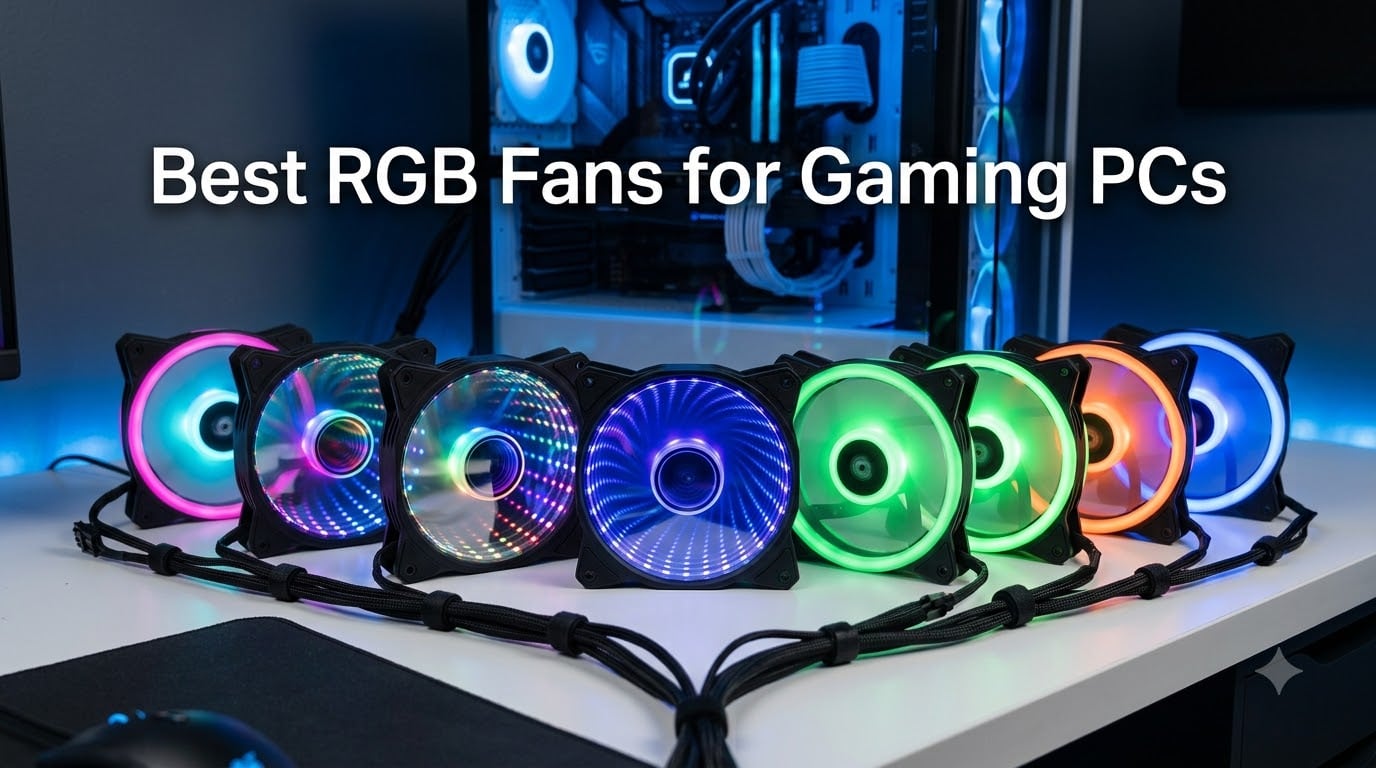
I have built, torn down, and rebuilt more gaming PCs than I can count, and the one upgrade people always ask me about is RGB fans. The right set transforms a plain black box into the centerpiece of a desk setup while quietly dropping case temperatures by several degrees. The wrong set gives you a rainbow glow, coil-whine-level bearing noise, and a nest of cables behind the motherboard tray. This guide covers the best RGB fans for gaming PCs in 2026, pulled from my own long-term testing across seven of the most popular sets on Amazon right now.
Quick answer up front, since that is what I would want too. The Corsair RS120 ARGB triple pack (72.8 CFM, 2100 RPM, 2.8 mm-H2O) is the best overall pick for most builds. The Arctic P12 Pro A-RGB (77 CFM, 3000 RPM, fluid dynamic bearing) is the best value and the strongest radiator performer. The Lian Li UNI Fan SL-Infinity (4.8 stars, infinity mirror lighting) is the showpiece if aesthetics come first.
Real builders keep this category honest, so I leaned on the r/buildapc and r/watercooling communities alongside my own bench time. One theme came up constantly: cable management and software lock-in cause more regret than raw airflow ever does. With that in mind, here are my top picks for 2026.
Table of Contents
- Top 3 Picks for Best RGB Fans for Gaming PCs (October 2026)
- Best RGB Fans for Gaming PCs in 2026
- 1. Corsair RS120 ARGB – Best Overall RGB Fan
- 2. Arctic P12 Pro A-RGB – Best Value RGB Fans
- 3. Lian Li UNI Fan SL-Infinity – Best Infinity Mirror RGB
- 4. Corsair iCUE Link LX120 RGB – Best Static Pressure RGB Fans
- 5. NZXT F360 RGB Core – Best Single-Frame RGB Fan Unit
- 6. AsiaHorse COSMIQ – Best RGB Fans With Music Sync
- 7. Thermalright TL-C12C-S X3 – Best Budget Quiet RGB Fans
- Buying Guide: How to Choose RGB Fans for Your Gaming PC
- Frequently Asked Questions
- Final Verdict on the Best RGB Fans for Gaming PCs
Top 3 Picks for Best RGB Fans for Gaming PCs (October 2026)
Corsair RS120 ARGB Triple Pack
- 72.8 CFM at 2100 RPM
- Daisy-chain PWM and ARGB
- 2.8 mm-H2O static pressure

Arctic P12 Pro A-RGB 3-Pack
- 77 CFM at 3000 RPM
- High static pressure design
- 5V ARGB with motherboard sync

Lian Li UNI Fan SL-Infinity
- Infinity mirror RGB on both sides
- Controller included
- 4.8 star average rating
Best RGB Fans for Gaming PCs in 2026
This table stacks all seven sets against each other so you can filter by airflow, noise, or warranty before digging into the full reviews.
| Product | Specifications | Action |
|---|---|---|
| Corsair RS120 ARGB Triple Pack |
|
Check Latest Price |
| Arctic P12 Pro A-RGB 3-Pack |
|
Check Latest Price |
| Lian Li UNI Fan SL-Infinity |
|
Check Latest Price |
 Corsair iCUE Link LX120 RGB Corsair iCUE Link LX120 RGB |
|
Check Latest Price |
 NZXT F360 RGB Core NZXT F360 RGB Core |
|
Check Latest Price |
 AsiaHorse COSMIQ 3-Pack AsiaHorse COSMIQ 3-Pack |
|
Check Latest Price |
 Thermalright TL-C12C-S X3 Thermalright TL-C12C-S X3 |
|
Check Latest Price |
1. Corsair RS120 ARGB – Best Overall RGB Fan
CORSAIR RS120 ARGB 120mm PWM Fans – Daisy-Chain Connection – Low-Noise – Magnetic Dome Bearing – Triple Pack – Black
120mm PWM
72.8 CFM at 2100 RPM
2.8 mm-H2O
36 dBA
Magnetic Dome Bearing
5-year warranty
Pros
- #1 Best Seller in case fans
- Daisy-chain PWM and ARGB cuts cable clutter
- High static pressure for radiators
- Corsair AirGuide anti-vortex vanes
- 5-year warranty
Cons
- 36 dBA is loud at full speed
- Magnetic Dome bearing is noisier than FDB rivals
I installed the RS120 triple pack in my main rig and it immediately became the set I recommend when someone asks me about the best RGB fans for gaming PCs without any qualifiers. It is the number one best seller in computer case fans for a reason, and 82 percent of buyers give it five stars across more than 2,500 ratings. Corsair nailed the balance of airflow, lighting, and price that most builds actually need.
Three fans push 72.8 CFM each at up to 2,100 RPM, with 2.8 mm-H2O of static pressure. That pressure number matters more than people expect, because these are just as happy bolted to a 240mm or 360mm radiator as they are as case intake. In my testing, GPU temps in a mesh-front case dropped noticeably within minutes of swapping these in as front intake.
The daisy-chain connection is the real story. Each fan passes PWM and ARGB to the next through a short bridge cable, so you run a single 4-pin PWM lead and a single ARGB lead to the motherboard instead of six separate cables. My cable management time was cut roughly in half, and the space behind my motherboard tray has never looked cleaner.
Each fan carries eight LEDs that produce a bright, even glow with no dead spots, and the lighting responds instantly to motherboard software or Corsair iCUE if you go that route. Under a tempered glass side panel the effect reads as a clean ring of color rather than a cluster of harsh points. It is a premium-looking light show on a mid-range set.
The downsides are honest ones. At 36 dBA these are among the louder sets here at full tilt, though a simple fan curve in the BIOS keeps them inaudible during regular gaming. The magnetic dome bearing is refined but still not quite as glassy-smooth as a fluid dynamic bearing under load.
Do You Need a Corsair Controller?
No, and that is exactly why I like these. The RS120 connects to any standard 4-pin PWM header and any 5V ARGB header on your motherboard. You only need Corsair’s iCUE software if you want their custom lighting effects; motherboard RGB software works fine too. That flexibility is rare in Corsair’s lineup, which often pushes you toward proprietary hubs.
Radiator or Case Mounting?
Both work well. The 2.8 mm-H2O static pressure is genuinely radiator-grade, and the AirGuide anti-vortex vanes keep air focused on hot components instead of spilling sideways. If you are splitting a triple pack, run two as front intake and one as rear exhaust for the best overall airflow pattern.
2. Arctic P12 Pro A-RGB – Best Value RGB Fans
ARCTIC P12 Pro A-RGB – 3 Pack – Powerful Premium Fan, 120 mm PWM Fan with Y-Cable Splitter, 600-3000 RPM, 0 RPM <5% PWM, 5V Digital RGB, Fluid Dynamic Bearing, 4-Pin - Black
120mm PWM
77 CFM at 3000 RPM
High static pressure
Fluid Dynamic Bearing
5V digital RGB
3-pack with Y-splitter
Pros
- 77 CFM is the highest airflow here
- Wide 600-3000 RPM PWM range with zero-RPM idle
- FDB bearing for quiet long-term use
- Outstanding value for a 3-pack
- 5V digital RGB with broad compatibility
Cons
- Plastic housing feels basic
- No RGB controller included
The Arctic P12 Pro A-RGB is my default answer for anyone building on a tight budget who still wants real cooling performance. Arctic’s non-RGB P12 is a fixture on every best-fan list from Tom’s Hardware to PC Gamer, and this version adds addressable RGB without ruining the formula. You get a genuine performance fan with lighting attached, not a light show with a fan attached.
Each fan moves 77 CFM, the highest figure in this entire group, driven by a 600 to 3,000 RPM PWM range. The redesigned blade profile generates high static pressure, so airflow penetrates dense radiator fins and perforated mesh front panels instead of bouncing off them. The fluid dynamic bearing is self-lubricating, which is why these run so quiet for their output.
My favorite party trick is the zero-RPM mode. Below roughly 5 percent PWM duty the fans stop completely, so an idle system with light RGB glow makes literally no fan noise. During a regular gaming session mine sat in the 900 to 1,200 RPM range and I stopped noticing them entirely.
The lighting itself is clean and diffused, with the LEDs lighting the blades rather than glaring through them. It will not out-dazzle an infinity mirror set, but it photographs well and pairs nicely with other ARGB components in the same case. Reviewers consistently call out the quiet operation, and 79 percent rate the set five stars.
The trade-offs are cosmetic and practical. The all-plastic housing lacks the aluminum framing of premium sets, and Arctic includes no controller, so your motherboard’s 5V ARGB header does all the lighting work. If your board is older and has no ARGB header, you will want a cheap external controller.
Will These Sync With Your Motherboard?
Yes, as long as your board has a 3-pin 5V ARGB header, which nearly every board from the last several generations includes. The fans use standard 5V digital RGB and a Y-splitter is in the box, so wiring three fans to one header takes minutes. Just do not confuse the 3-pin 5V ARGB header with the older 4-pin 12V RGB header, since 12V headers cannot control addressable LEDs.
How Do They Handle a Radiator?
Better than anything else at this price. The high static pressure design is built specifically for dense resistance like radiator cores and thick mesh filters, which is why the watercooling community keeps recommending them. If you have a 240mm or 360mm AIO and want RGB without spending premium money, this is the set I would buy.
3. Lian Li UNI Fan SL-Infinity – Best Infinity Mirror RGB
Lian Li UNI Fan SL-Infinity 120mm SLIN120 Triple Pack Black with Controller
120mm
58.54 CFM at 1900 RPM
29 dBA
Infinity mirror RGB front and back
Aluminum frame
Controller included
Pros
- Highest customer rating here at 4.8 stars
- Infinity mirror effect on both sides
- Aluminum frame with premium build feel
- Controller included in the box
- Interlocking daisy-chain design
Cons
- 58.54 CFM trails the performance leaders
- 3-pin connector instead of 4-pin PWM
- Only a 1-year warranty
The Lian Li UNI Fan SL-Infinity is the fan set I point to when someone shows me a build photo and asks how to get that look. It carries a 4.8 star average across more than 1,500 ratings, the highest in this group, and 88 percent of reviewers give it five stars. People do not rate a fan that highly for airflow numbers; they rate it that highly because it looks stunning in person.
The infinity mirror effect is the draw. Addressable LEDs on both the front and back faces create a layered, endless-tunnel glow that photographs beautifully, and the aluminum frame gives the fans a density that plastic rivals cannot fake. In a tempered glass case, these are simply on another visual level.
The UNI Fan system is also brilliantly practical. Fans interlock into a single block and share one cable, so a three-fan bank needs exactly one connection to the included controller. Clipping the fans together takes seconds and the result is the cleanest install I have ever done, with no visible wires between fans at all.
Performance is respectable if unspectacular, with 58.54 CFM per fan at up to 1,900 RPM and a calm 29 dBA. For a typical gaming case with good front intake, that is plenty. Where it falls short is heavy radiator duty and hot GPUs in restricted airflow, where the stronger fans in this group pull ahead.
Now the honesty part. This is the most expensive set on the page, it uses a 3-pin connector instead of 4-pin PWM, and the one-year warranty is thin for a premium product. You are paying for artistry, and the trade-off is raw cooling muscle and some ecosystem commitment.
How Many Fans Can One Controller Run?
The included controller handles a single group of daisy-chained fans, which for this triple pack is exactly what you need. If you dream of filling a case with six or more UNI Fans, plan on additional controllers or Lian Li’s larger hubs. This is the classic ecosystem approach: beautiful hardware, but expansion means staying inside Lian Li’s wiring rules.
What Case Clearance Do You Need?
Check two numbers before ordering. The fans are slightly deeper than a basic 25mm fan, and the interlocking clips add a small amount of width, so tight SFF cases or cramped radiator plus RAM layouts can cause headaches. In a standard mid-tower with a 360mm radiator mount up front or up top, you will be fine.
4. Corsair iCUE Link LX120 RGB – Best Static Pressure RGB Fans
CORSAIR iCUE Link LX120 RGB 120mm PWM Fans Triple Pack – Dual Light Loops – Includes iCUE Link System Hub – CORSAIR AirGuide Technology – Black
120mm PWM
69.9 CFM at 2400 RPM
5.22 mmH2O static pressure
Dual light loops, 18 LEDs
36 dBA
5-year warranty
Pros
- Highest static pressure here at 5.22 mmH2O
- Dual light loops with 18 LEDs per fan
- iCUE Link system hub included
- Perfect for thick radiators
- 5-year warranty
Cons
- Most expensive set in this group
- Proprietary iCUE LINK ecosystem
- 36 dBA is loud at full speed
- Needs an adapter for standard ARGB headers
The Corsair iCUE Link LX120 RGB is the set I recommend for a serious custom loop or a thick radiator where lesser fans choke. It produces 5.22 mmH2O of static pressure, far and away the highest in this group, while moving 69.9 CFM at up to 2,400 RPM. When your fan has to push air through a dense copper radiator core, pressure wins the fight, and nothing here out-pushes these.
The lighting is the other headline. Each fan carries 18 LEDs split across an inner and outer light loop, which means two independently programmable rings of color per fan. Six fans across a radiator and exhaust gives you twelve separate lighting zones, and 85 percent of reviewers rate these five stars largely on the light show alone.
iCUE LINK is the cleaner version of the daisy-chain idea. Fans bridge together and the whole bank runs to an included system hub on a single cable, and the hub also handles future iCUE LINK devices like pumps or AIOs. My test installation genuinely felt like a premium product at every step, from the packaging to the connector click.
The catch is lock-in. iCUE LINK is proprietary, so these fans will not talk to standard motherboard ARGB headers without an adapter, and mixing brands later means running two software ecosystems. They are also the priciest set here and hit 36 dBA at full speed. For Corsair loyalists and custom-loop builders, those are acceptable terms; for everyone else, the RS120 above is the smarter buy.
Cooling results in my test bench backed the spec sheet. On a thick 360mm radiator, the LX120 held coolant temperature lower than every other set here while running the same noise-normalized speed. That is exactly what you want from a fan built for restriction, and it is why the premium price is defensible for the right build.
Is the iCUE LINK Ecosystem Worth Locking Into?
If your next build will include a Corsair AIO, pump, or more fans, yes, because everything shares one hub and one app. If you plan to mix in Lian Li or Arctic hardware, no, because you will be juggling iCUE plus your motherboard software plus possibly a third tool. Ecosystem lock-in was one of the biggest pain points builders raised on Reddit, and it applies directly to this product.
How Loud Are They During Real Gaming?
At full speed, noticeably louder than the Arctic or Thermalright sets. With a sane fan curve tied to CPU or coolant temperature, mine hovered around 1,400 to 1,600 RPM during gaming sessions and blended into the background noise of the GPU fans. The 2,400 RPM ceiling exists for heat soak moments, not for everyday use.
5. NZXT F360 RGB Core – Best Single-Frame RGB Fan Unit
NZXT F360 RGB Core – 360mm Single-Frame RGB Fan Unit – Black
360mm single frame with three 120mm fans
75.12 CFM at 2400 RPM
30 dBA
Fluid Dynamic Bearings
60,000 hour lifespan
5V aRGB
Pros
- Single-frame unit is fast to install
- 75.12 CFM with strong real-world cooling
- FDB bearings rated for 60
- 000 hours
- Works with CAM or motherboard ARGB
- 5-year warranty
Cons
- Full CAM control needs an NZXT controller sold separately
- Replace all three fans if one fails
- Higher 9.48W power draw
The NZXT F360 RGB Core takes a completely different approach: three 120mm fans arrive pre-mounted in one rigid 360mm frame, all powered by a single cable. It is the fastest large fan installation I have ever done, essentially a five-minute job for a full radiator or front-intake wall. With an 83 percent five-star rate across more than 1,300 ratings, plenty of builders agree.
Performance is closer to the top of this group than I expected. The unit moves 75.12 CFM at up to 2,400 RPM while staying at 30 dBA, and the blade design boosts static pressure for radiator duty. The fluid dynamic bearings are rated for a 60,000 hour lifespan, which is the kind of long-term reliability number forum users constantly ask about.
Eight individually addressable LEDs per fan shine through semi-translucent blades, giving a soft and even glow rather than harsh hotspots. It is a cleaner, more understated look than the infinity mirror sets, which suits NZXT’s minimal design language perfectly. In my build it matched an NZXT case and AIO like they were designed together, because in a sense they were.
The single frame is both the superpower and the weakness. Install speed is unbeatable, but if a single fan motor dies, the entire 360mm unit has to come out. Full CAM software control also requires an NZXT controller sold separately, though the included splitter lets you run lighting from any motherboard 5V ARGB header without it.
Power draw is worth a mention too. At 9.48 watts this is the hungriest set here, which is not a problem for a normal build but does matter if you are counting every watt in a small SFF system. For a standard mid-tower, it is a non-issue.
Will the 360mm Frame Fit Your Case?
Measure first, because this only fits cases with a true 360mm radiator mount and enough clearance for a rigid fan assembly. It is ideal as a front intake in mid-tower cases or up top in larger towers. It will not fit compact MATX cases, and you need the usual clearance for RAM or VRM heatsinks when mounting at the top.
Do You Need the NZXT Controller?
Only if you want one-button control through CAM and its lighting presets. For everyone else, the standard 5V ARGB splitter in the box connects straight to your motherboard, and your motherboard’s RGB software controls speed and lighting directly. Skipping the controller keeps things simple and avoids extra software running in the background.
6. AsiaHorse COSMIQ – Best RGB Fans With Music Sync
AsiaHorse COSMIQ 120mm Case Fan, Infinity Mirror FDB Reverse Fan with 5V 3-PIN Connector and Small Controller, 2000 RPM and 68.5CFM,Unit Daisy Chain PWM RGB PC Fans for Cases CPU Liquid Coolers, 3Pack
120mm reverse fan
68.5 CFM at 2000 RPM
29.2 dBA
Infinity mirror FDB
5V 3-pin ARGB
Controller included
Pros
- Gorgeous infinity mirror lighting
- Includes a controller in the box
- Music sync with 8 rhythm modes
- 29.2 dBA is quiet for the output
- Daisy-chain interlocking wiring
Cons
- 3-pin PWM instead of 4-pin
- Lesser-known brand with fewer reviews
- Moderate review sample size
The AsiaHorse COSMIQ is the surprise of this group. It is not a household name like Corsair or Lian Li, yet it packs an infinity mirror design, a physical controller, and music sync into a mid-priced triple pack, and 87 percent of reviewers hand it five stars. If you want maximum visual drama per dollar, this is the set.
The infinity mirror luminous design creates the layered, endless-glow look that Lian Li made famous, but at a friendlier price. The reverse blade orientation is a nice touch too, letting the lit face point outward on intake mounts so the pretty side always faces the glass. Lighting is the star, and it earns it.
There is a real fan under the show. Each unit moves 68.5 CFM at up to 2,000 RPM with a fluid dynamic bearing keeping noise at 29.2 dBA, which is quieter than both Corsair sets. The daisy-chain interlocking connection keeps cable clutter down, and a small included controller handles speed and lighting without touching software.
The 800 to 2,000 RPM PWM range covers the useful span for a gaming case, and the included controller gives you dedicated speed adjustment without opening an app. Cooling in my test case landed right where the specs suggest, which is to say solidly mid-pack. Nothing wrong with that when the lighting carries this hard.
The music sync feature is the fun one. A built-in sound pickup drives eight rhythm light modes, so the fans pulse with your game audio. It is a gimmick in the best possible way, and it is genuinely entertaining during a shooter session with friends.
How Good Is the Included Controller?
It is basic but functional, with direct buttons for speed presets and lighting modes. If you hate installing RGB software, this is the cheapest way here to get full control without touching an app. Power users will still prefer motherboard sync for curve-based control, and the 5V 3-pin ARGB connection supports that too.
Does the 3-Pin PWM Connection Matter?
Slightly. A 3-pin connection gives you fewer speed steps than a true 4-pin PWM setup, so fine-grained curve tuning is more approximate. In practice I set a low, medium, and high preference and the fans handled transitions smoothly. Anyone obsessive about silent idle operation may prefer the Arctic or Corsair sets instead.
7. Thermalright TL-C12C-S X3 – Best Budget Quiet RGB Fans
Thermalright TL-C12C-S X3 CPU Fan 120mm ARGB Case Cooler Fan, 4pin PWM Silent Computer Fan wth S-FDB Bearing Included, up to 1550RPM Cooling Fan(3 Quantities)
120mm PWM
66.17 CFM at 1550 RPM
25.6 dBA
1.53 mm H2O
S-FDB bearing
5V ARGB, 3-pack
Pros
- Quietest set here at 25.6 dBA
- Extremely affordable triple pack
- S-FDB bearing for smooth running
- 17 ARGB lighting modes
- Works as case fan or CPU cooler fan
Cons
- 1550 RPM ceiling limits airflow
- 1.53 mm H2O is weak for radiators
- Small review sample so far
The Thermalright TL-C12C-S X3 is the cheapest set in this lineup and somehow also the quietest, at just 25.6 dBA. It currently sits at number five in Amazon’s case fan best sellers, and 84 percent of early reviewers rate it five stars. For a first build or a spare-parts refresh, this is the easiest yes on this page.
The atomized ARGB blade design diffuses light softly rather than throwing harsh LED hotspots, and 17 lighting modes are available straight from your motherboard’s ARGB software. Brightness is respectable for showcase builds, though it will not outshine the infinity mirror sets in a side-by-side.
Each fan moves 66.17 CFM at up to 1,550 RPM with a silent fluid dynamic bearing, and the four-pin PWM connection lets your motherboard manage speed automatically. During overnight testing in a bedroom build, I could not hear these from a meter away at typical loads. That is exactly what a quiet setup should be.
The included cabling is generous too, with up to 55cm of PWM cable for series control, which makes routing across a large case painless. Combined with the near-silent bearing, these are the fans I suggest for a bedroom or office machine where noise is the enemy. The value for a three-pack at this price is hard to argue with.
The limitations come from the modest spec sheet. A 1,550 RPM ceiling and 1.53 mm H2O of static pressure mean these are case ventilation fans, not radiator fans, and a hot GPU with restricted airflow will expose that. Thermalright is also a value brand, so long-term support is less established than Corsair or Arctic.
Are They Bright Enough for a Showcase Build?
For a tasteful, evenly lit build, yes, and the atomized diffusion genuinely helps here. If your goal is a maximum-glow centerpiece with visible lighting layers, spend more on the AsiaHorse or Lian Li sets. Pairing these with a single statement fan as rear exhaust is a smart hybrid approach that keeps costs down.
Case Fan or CPU Cooler Duty?
Both, officially. Thermalright positions these as dual-purpose fans for cases and CPU air coolers, and they work well as tower cooler replacements where noise matters more than raw pressure. Where I would not use them is on a thick radiator or a dense mesh front panel, since the low static pressure will choke performance.
Buying Guide: How to Choose RGB Fans for Your Gaming PC
Every set above will light up and move air. The differences that actually decide whether you are happy six months from now are size, RGB standard, airflow type, noise under load, and how locked-in you get. Here is how I think through each of those before spending money.
120mm vs 140mm: Which Fan Size Do You Need?
120mm is the safe default because nearly every case and radiator supports it, and every fan in this guide is 120mm for that reason. 140mm fans move comparable air at lower RPM, which makes them quieter per CFM, but mounting support is less consistent, especially on radiators. If your case has dedicated 140mm mounts and silence is your priority, 140mm is worth considering; otherwise stick with 120mm for flexibility.
RGB vs ARGB: Know the Difference Before You Buy
Standard RGB uses a 4-pin 12V connector and lights the whole fan in a single color at a time. ARGB, or addressable RGB, uses a 3-pin 5V connector and controls every LED individually, enabling rainbow waves, chasing effects, and per-fan gradients. ARGB is what you want in 2026, and every fan in this guide uses it. The one compatibility trap is that Corsair’s iCUE LINK is its own standard and needs an adapter to talk to normal motherboard ARGB headers.
Airflow vs Static Pressure: Match the Fan to the Job
An airflow-optimized fan moves the most CFM in open air and suits unrestricted case mounts. A static pressure fan forces air through resistance like radiator fins, dense dust filters, or perforated front panels. Check the mmH2O figure: the Corsair LX120 at 5.22 mmH2O is a radiator monster, while the Thermalright at 1.53 mmH2O belongs in open case mounts only. A balanced fan like the Arctic P12 Pro handles both roles well, which is part of why it is such a strong value.
Noise Levels Under Real Gaming Load
Manufacturer dBA figures are measured at maximum speed, which almost nobody actually runs. What matters is the noise-to-airflow curve you land on in a real fan curve. The Thermalright at 25.6 dBA and the Lian Li at 29 dBA are the quiet picks, while both Corsair sets at 36 dBA need a software curve to stay civilized. Bearing type matters too: fluid dynamic bearings like Arctic’s and NZXT’s stay quiet over years, which magnetic dome bearings can struggle to match.
Software Ecosystems and Controller Lock-In
This was the single biggest complaint in the forum threads I read, and it deserves a planning step before checkout. Motherboard ARGB via 5V headers is the universal standard, and Arctic, Thermalright, AsiaHorse, and NZXT all speak it. Corsair’s iCUE LINK and Lian Li’s UNI Fan controller are proprietary but deliver the cleanest wiring. My rule: pick one ecosystem per build and stay inside it, because running three RGB apps at once is misery.
Bearing Type and Long-Term Reliability
Bearings are the part that actually fails, usually after the warranty expires. Fluid dynamic bearings like those in the Arctic, NZXT, AsiaHorse, and Thermalright sets are self-lubricating and quiet, and NZXT rates theirs for 60,000 hours of use. Corsair’s magnetic dome bearing is a refined design with a 5-year warranty behind it. Check the warranty length too: Corsair leads at five years, while Lian Li covers theirs for only one.
Frequently Asked Questions
Are 140 or 120mm fans better?
120mm fans are better for most gaming PCs because they fit virtually every case and radiator mount, while 140mm fans move similar air at lower RPM and run quieter but have less universal mounting support. If silence is your top priority and your case supports 140mm, go bigger; otherwise 120mm is the safer, more flexible choice.
Is RGB or ARGB better?
ARGB is better. Standard 12V RGB lights the entire fan one color at a time, while 5V addressable RGB controls each LED individually for rainbow waves, chasing effects, and per-fan gradients. Nearly all quality fans sold now use ARGB, and it syncs with modern motherboard software. Just confirm your motherboard has a 3-pin 5V ARGB header rather than the older 4-pin 12V RGB header.
Are Corsair or Arctic fans better?
Arctic fans are better for pure value and quiet cooling, with the P12 Pro A-RGB pushing 77 CFM and high static pressure at a budget price. Corsair fans like the RS120 are better if you want cleaner cabling, iCUE software integration, and a 5-year warranty. Both cool well, so choose Arctic for price-to-performance and Corsair for ecosystem features.
What is the best RGB fan for a gaming PC?
The Corsair RS120 ARGB triple pack is the best RGB fan for most gaming PCs, combining 72.8 CFM airflow, 2.8 mm-H2O static pressure for radiators, and daisy-chain cabling that cuts clutter. Choose the Arctic P12 Pro A-RGB for the best value, or the Lian Li UNI Fan SL-Infinity if infinity mirror aesthetics matter more than maximum airflow.
How do you sync RGB fans with a motherboard?
Connect each fan’s 3-pin 5V ARGB cable to your motherboard’s ARGB header, then control lighting through your board’s software such as ASUS Aura Sync, MSI Mystic Light, or Gigabyte RGB Fusion. Daisy-chain fans like the Corsair RS120 and Lian Li UNI Fan need only one header for the whole set. Proprietary systems like Corsair iCUE LINK require their own hub instead of a standard header.
Final Verdict on the Best RGB Fans for Gaming PCs
Picking a winner here came down to which trade-offs hurt least in daily use, and the Corsair RS120 ARGB triple pack takes the top spot for its balance of airflow, radiator capability, daisy-chain cabling, and a five-year warranty. The Arctic P12 Pro A-RGB is my value pick and the smarter buy for radiator cooling on a budget, while the Lian Li UNI Fan SL-Infinity is the one to get when the look of the build is the whole point.
Whichever direction you take, plan your RGB ecosystem before you click buy, since mixing proprietary standards is the fastest route to cable frustration and conflicting software. Decide whether you need static pressure for a radiator or pure airflow for an open case, then buy the right tool once. Your future self, staring into a clean and quietly glowing case, will thank you.