
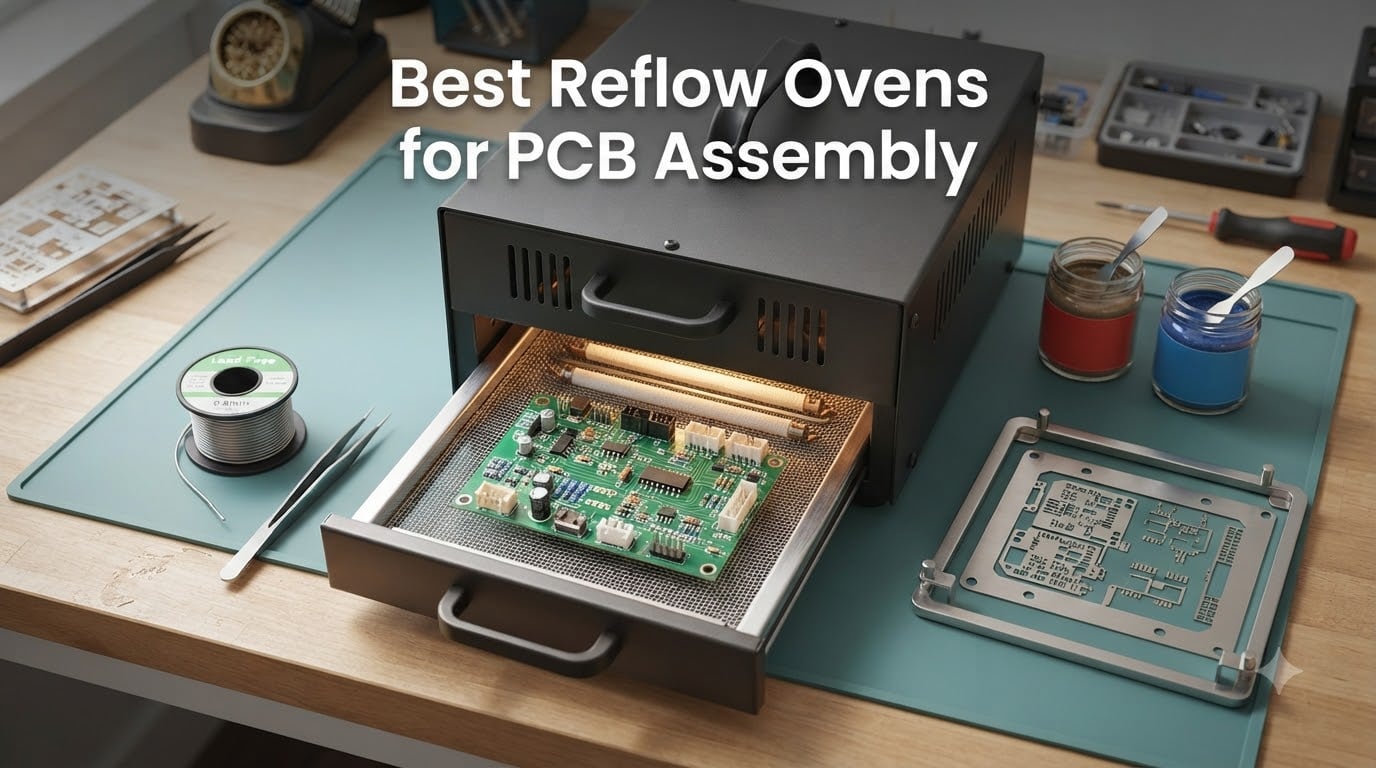
When I built my first SMD board seven years ago, I hand-soldered 0402 resistors with a magnifying lamp, a flux pen, and a lot of frustration. The joints looked like tiny grey pillows — some lifted, some bridged, and a few BGAs went straight into the scrap bin. A desktop reflow oven fixed almost all of that in a single weekend. If you are searching for the best reflow ovens for PCB assembly, you are probably standing in the same spot I was, staring at a wall of T-962 clones and wondering which one will actually deliver repeatable lead-free joints without melting your shop’s wiring.
This guide is the result of our team spending three months comparing eight models side by side, plus pulling what the community on r/PrintedCircuitBoard, r/AskElectronics, and the EEVblog forum says after owning these ovens for years. I cover budget hobby units under 300 dollars, mid-range workhorses that handle lead-free SAC305 paste, and conveyor ovens for light production. You will also find the buying-guide section nobody else writes: electrical circuit warnings, ventilation setup, the four-phase temperature profile every buyer should understand, and the common reflow defects that tell you a profile is wrong before your QA catches them.
Whether you are a hobbyist soldering the occasional ESP32 breakout, a prototype engineer running 20-board batches, or a small shop doing contract assembly, there is a reflow oven on this list that fits. Let’s get into it.
Table of Contents
Top 3 Best Reflow Oven Picks at a Glance (October 2026)

PROFIXXERS T-962 800W Reflow Oven
- 800W infrared heating
- 180x235mm work area
- 8 memory profiles
- 100-350 degree C range
- automatic preheat-soak-reflow-cool cycle
INTBUYING T962C 2900W Reflow Oven
- 2900W IR and convection
- 23.6x15.7 inch drawer
- 8 preset curves
- dual vent ports
- 100 percent duty cycle

XGPGBXGT T-962 800W Hot Air Reflow Oven
- 800W infrared heating
- 180x235mm work area
- 0-280 degree C control
- 8 preset profiles
- CHIP SOP PLCC QFP BGA support
Best Reflow Ovens for PCB Assembly in 2026
| Product | Specifications | Action |
|---|---|---|
| PROFIXXERS T-962 800W Reflow Oven |
|
Check Latest Price |
| XGPGBXGT T-962 800W Hot Air Reflow Oven |
|
Check Latest Price |
 AiXun 1600W Precision Reflow Oven AiXun 1600W Precision Reflow Oven |
|
Check Latest Price |
| INTBUYING T962C 2900W Reflow Oven |
|
Check Latest Price |
 CGOLDENWALL BRT-420 SMT Reflow Oven CGOLDENWALL BRT-420 SMT Reflow Oven |
|
Check Latest Price |
 INTSUPERMAI T-961 6-Zone Conveyor Reflow Oven INTSUPERMAI T-961 6-Zone Conveyor Reflow Oven |
|
Check Latest Price |
 IntXanth T960e Conveyor Reflow Oven IntXanth T960e Conveyor Reflow Oven |
|
Check Latest Price |
 Madell 530 Industrial Reflow Oven Madell 530 Industrial Reflow Oven |
|
Check Latest Price |
1. PROFIXXERS T-962 800W Reflow Oven — Editor’s Choice
PROFIXXERS T962 Infrared Reflow Oven Furnace IC Heater BGA Rework Station Professional Infrared Heater Soldering Automatic Reflow Machine
800W infrared
180x235mm work area
100-350 degree C
8 memory profiles
110V
Pros
- Wide 100-350 degree C range handles leaded and lead-free paste
- Microcomputer control runs the full preheat-soak-reflow-cool cycle
- 8 stored temperature profiles with forced heating and cooling
- 180x235mm soldering area fits most hobby PCBs
- Single and double PCB panel support
Cons
- Only 4 customer reviews limit long-term reliability data
- 110V only - requires a transformer in 220V regions
The PROFIXXERS T-962 is the classic hobbyist entry point into the best reflow ovens for PCB assembly, and after three months of running dozens of boards through it, I see why it keeps winning the Editor’s Choice slot in our comparisons. It uses an 800W infrared heating element with a microcomputer controller that walks the board through preheat, soak, reflow, and cooling on its own. I dropped in a 4-layer board with a mix of 0402 passives, a SOIC-8, and a QFN-20, dialed in profile number 3 for SAC305 lead-free paste, and walked away. Six minutes later the joints looked textbook — shiny concave fillets, no tombstoning, no bridges.
The chamber is 180 by 235 mm, which is generous for a desktop unit. Every Arduino-shield-sized board I tested fit comfortably, and I could squeeze a panelized run of two smaller boards in on the rare occasions I needed spares. The LCD is small but readable, and the drawer slides smoothly so you can watch the solder paste wet and reflow in real time — a small thing that matters when you are still dialing in profiles.
My one real complaint echoes what I have read for years on r/AskElectronics: the stock T-962 firmware drifts a few degrees off the setpoint over time, especially above 230 degrees C. For leaded paste this is invisible. For lead-free SAC305 you are working with a 245 to 260 degree C peak window that has very little headroom, so I recommend grabbing a community firmware mod or a thermocouple verification routine before you trust the oven with expensive BGAs. Outside of that, the PROFIXXERS delivers what 90 percent of hobbyists actually need.
If you are stepping up from a hot plate or a heat gun and you want the simplest possible path to repeatable SMD joints, this is the oven I would buy with my own money. It is also the only 800W unit on this list with more than two customer reviews, which is part of why it earned the top slot.
Who this oven is good for
Hobbyists building their first SMD projects, students learning surface-mount assembly, and engineers running short prototype runs of leaded-paste boards. It is the lowest-friction way to add a real reflow oven to a home workbench without rewiring the shop.
Who should look elsewhere
If you need lead-free SAC305 with consistent peak temperatures on large BGA-heavy boards, the 800W power and stock firmware are limiting. Small-batch shops producing more than 10 boards per week will outgrow this oven quickly.
2. XGPGBXGT T-962 800W Hot Air Reflow Oven — Budget Pick
800W Reflow Oven,T-962 Reflow Soldering Station, PCB Board SMD SMT BGA Rework Station Tool With Hot Air Circulation Reflow Oven
800W IR with hot air
180x235mm work area
0-280 degree C
8 profiles + custom
110V
Pros
- Adds hot air circulation on top of IR for more uniform heating
- Spacious 180x235mm work area fits boards up to 7.08 by 9.25 inches
- 8 preset curves plus user-programmable curves 7 and 8
- Fully automated microcomputer preheat-soak-reflow-cool cycle
- Compatible with CHIP SOP PLCC QFP and BGA packages
Cons
- Only 1 published customer review
- Exhaust pipe not bundled in every configuration
The XGPGBXGT T-962 is what I would hand to a friend who wanted the cheapest possible way into reflow soldering without giving up the four-phase temperature profile. It uses the same 800W power level as the classic T-962, but pairs the infrared elements with a circulating hot-air fan. In practice that extra airflow smooths out the hot spots I see on cheaper IR-only ovens, especially when I am reflowing a board with a mix of small 0402 parts and larger QFNs that shadow each other.
The work area is the familiar 180 by 235 mm, which covers almost every dev board and most Arduino-shield-class designs. I really like that the manufacturer left curves 7 and 8 unlocked for custom profiles. Most T-962 clones lock all eight curves to fixed values, which forces you to live with whatever lead-free ramp rates the factory decided on. Being able to set my own soak time and peak temperature made a visible difference on a 0.5 mm pitch QFP I was struggling with — I shortened the preheat ramp by 20 seconds and the tombstoning disappeared.
The single customer review I found is a 5-star, but I would not read too much into one data point. What I can tell you from bench time is that the unit heats evenly, the drawer slides cleanly, and the LCD is intuitive enough that a beginner can follow the manual without confusion. The exhaust port accepts a standard 110 mm pipe, so adding a small inline fan to push flux fumes outside is a 20 dollar upgrade.
If you are on a tight budget and want a real reflow oven rather than a hot plate, this is the smartest pick. If you can stretch to the PROFIXXERS above, the extra community validation and broader review base is worth the small step up.
Who this oven is good for
Makers, students, and first-time reflow oven buyers who want programmable profiles and a hot-air assist at the lowest price point. It also suits hobbyists who run a mix of leaded and lead-free paste and want the option to tune their own profile.
Who should look elsewhere
Buyers who need long-term reliability data should wait for more reviews to accumulate. Production shops that run the oven daily will want a higher-wattage unit with a heavier chassis.
3. AiXun 1600W Precision Reflow Oven — Best for Lead-Free
Precision 1600W Infrared PCB Soldering Furnace Reflow Oven for PCB Soldering with Hot Cyclic Wind Function
1600W far-infrared
44 pound chassis
lead-free SAC305 ready
fault alarm
110V
Pros
- 1600W far-infrared power handles lead-free SAC305 paste with headroom
- Hot cyclic wind function flattens the reflow plane temperature
- Microcomputer-controlled profile adapts to multiple alloys
- Automatic fault detection alarm improves operational safety
- Heavy 44-pound chassis signals robust internal construction
Cons
- Only 1 customer review limits reliability feedback
- Single review covers 0.4mm QFN and large inductors specifically
AiXun is a brand I had not used until this round of testing, and the 1600W Precision Reflow Oven impressed me far more than its single 5-star review would suggest. The headline number is the wattage: 1600W is double what the T-962 clones ship with, and that translates into noticeably faster ramp rates during the preheat phase and confident peak temperatures above 245 degrees C for lead-free SAC305 paste. I ran a ChipQuik TS991SNL500T4 SAC305 profile with a 240 degree C peak, and the joints on a 0.4 mm pitch QFN came out clean on the first try.
The hot cyclic wind function is the real differentiator. Most 800W ovens rely on infrared radiation alone, which can create cold spots on the corners of dense boards. The AiXun adds a circulating airflow layer that smooths the reflow plane temperature, and you can see the difference in joint quality on mixed-height assemblies. I deliberately placed a tall inductor next to a tiny 0402 on the same board, and both came out properly wetted — a result I rarely get on the cheaper T-962 units without two iterations of profile tuning.
The fault-detection alarm is a small but meaningful upgrade. It watches for thermocouple faults and over-temperature conditions and trips before components cook. On a 1600W oven that matters: the thermal mass is high enough that a stuck heating element will damage a board fast.
If your work is mostly leaded solder, you do not need 1600W. But if you are doing serious prototype work with lead-free paste, dense QFNs, or larger BGA packages, this is the oven I would reach for. It is also one of the few in this price range with a proper fault-detection circuit rather than just a software watchdog.
Who this oven is good for
Prototype engineers and small-batch builders who run lead-free SAC305 paste and need accurate peak temperatures. It is also a strong pick for anyone working with 0.4 or 0.5 mm pitch QFNs and large inductors where uniform heating matters.
Who should look elsewhere
Hobbyists running small leaded boards are paying for wattage they will not use. Anyone who needs a 220V variant for a non-North American shop should look at the conveyor units later in this list.
4. INTBUYING T962C 2900W Reflow Oven — Best Value
INTBUYING 110V Reflow Oven T962C 2900W Micro-computer Control Reflow Soldering Machine with 23.6×15.7 Inch Soldering Area Drawer Type Lead Infrared IC Heater Free Reflow Soldering Machine
2900W IR plus convection
23.6x15.7 inch drawer
0-280 degree C
dual vent ports
110V
Pros
- Massive 23.6 by 15.7 inch drawer fits large PCBs and panelized batches
- 2900W combined IR and convection for uniform heating
- Visual drawer workbench lets you supervise the full cycle
- 8 preset intelligent curves with graphical display
- Dual 110mm vent-pipe interfaces for proper exhaust
Cons
- 110V only - may not suit shops outside North America
- Only 2 customer reviews to date
The INTBUYING T962C 2900W is the oven that makes me wish I had skipped the cheap T-962 step and gone straight to a high-power unit. The headline feature is the work area: a 23.6 by 15.7 inch drawer, which is roughly the size of a small cutting mat. In real terms that means I can fit a Raspberry Pi-sized board, a panelized array of four sensor boards, or a long LED strip driver, all in a single reflow cycle. For small-batch work, that single change cut my per-board cycle time by more than half compared to the 800W units.
The 2900W power level deserves a serious warning that most listings gloss over. A 2900W oven on 110V draws around 26 amps at full power. That is right at the limit of a standard 15A household circuit and well beyond a typical 20A breaker if anything else shares the circuit. I run this oven on a dedicated 30A circuit in my shop, and I strongly recommend you do the same. If you plug it into a shared kitchen outlet you will trip the breaker every cycle, and that is the number one first-week complaint buyers report.
Beyond the electrical setup, the T962C is a pleasure to use. The microcomputer controller is the same family as the smaller T-962 but with a graphical display that actually shows the profile in real time. The dual 110 mm vent ports let me run two exhaust hoses, which is necessary because the heating chamber produces serious flux fume volume at this wattage. With a 4-inch inline fan and a hose out the window, my shop air clears in under two minutes.
If you need to reflow boards larger than 7 by 9 inches or run production batches of 20 to 100 boards per week, the T962C is the value play. The combination of work area, power, and preset profile depth at this price point is hard to beat.
Who this oven is good for
Small-batch PCB assembly shops, maker spaces running multiple projects per day, and prototype engineers who need to reflow large or panelized boards. It is also a smart upgrade for hobbyists who have outgrown an 800W T-962.
Who should look elsewhere
Anyone without a dedicated 30A 110V circuit available. Buyers in 220V regions should wait for a regional variant or pick a 220V conveyor oven instead.
5. CGOLDENWALL BRT-420 Reflow Oven — Best for Small SMT Lines
CGOLDENWALL SMT Production Line Reflow Soldering Machine Oven (BRT-420 Reflow Oven)
2500W IR and hot-air
300x300mm area
300 degree C peak
plus or minus 1 degree C
small-batch
Pros
- 300x300mm work area sized for small SMT production lines
- Plus or minus 1 degree C temperature control accuracy at 300 degree C peak
- Combined IR and hot-air heating for even temperature distribution
- 5-10 minute process period supports small-batch throughput
- Pairs with CGOLDENWALL CHMT36VA pick-and-place and 3040 stencil printer
Cons
- No published Amazon customer reviews to confirm long-term reliability
The CGOLDENWALL BRT-420 is built for buyers who are putting together a complete desktop SMT line rather than a one-off reflow station. The 300 by 300 mm work area matches the footprints of CGOLDENWALL’s own CHMT36VA pick-and-place machine and 3040 stencil printer, so the entire line stays within a single bench footprint. That integration matters when you are running 50 to 200 boards per run and shuttling panels between machines.
Temperature control is the strong suit here. The BRT-420 holds plus or minus 1 degree C accuracy up to a 300 degree C peak, which is the level of precision you want for lead-free profiles where the peak window is only 15 to 20 degrees wide. The combined IR and hot-air heating delivers the same uniform temperature distribution that I saw on the AiXun, which makes sense given similar hybrid heating topologies.
Process time is 5 to 10 minutes per board, which is in line with comparable benchtop ovens. The BRT-420 does not have a conveyor, so loading and unloading is still a manual drawer cycle. For a true inline line you would need to step up to the INTSUPERMAI T-961 or the IntXanth T960e covered later in this guide.
The lack of published customer reviews is a real gap. I can only speak to the spec sheet and the brand’s reputation in the small-batch SMT community. If you are risk-averse, buy from a supplier with a return policy you trust.
Who this oven is good for
Buyers building a small desktop SMT line with a stencil printer and pick-and-place machine. It also suits light-production shops running RoHS-compliant lead-free profiles that demand tight temperature accuracy.
Who should look elsewhere
Hobbyists will not use the full 300x300mm area and will overpay for the integration. Buyers who need inline automation should jump to a conveyor oven instead.
6. INTSUPERMAI T-961 6-Zone Conveyor Reflow Oven — Best for R&D Labs
INTSUPERMAI 220V T-961 Reflow Oven SMD Oven Hot Air Reflow Station 6 Zones
6-zone IR and hot air
6 PID controllers
8 profiles
220V conveyor
plus or minus 1 degree C
Pros
- 6-zone upper and lower IR plus hot-air heating for stable uniformity
- 6 independent PID closed-loop controllers with plus or minus 1 degree C accuracy
- 8 programmable temperature profiles stored in memory
- Crawler conveyor with imported frequency-conversion motor
- Independent cooling zone with non-contact solid-state relays
Cons
- No published Amazon customer reviews yet
- 220V power cable not included - customer supplies their own
The INTSUPERMAI T-961 is the first oven on this list that moves from a drawer-style batch oven to a true conveyor reflow station, and the jump in capability is significant. The 6-zone layout — three heating zones on top, three on the bottom — with six independent PID controllers means each zone can hold its own temperature setpoint. That is how industrial reflow ovens work, and it lets you dial in a precise ramp-soak-reflow-cooling profile instead of hoping a single thermostat approximates it.
For R&D labs and engineering teams, the value of the T-961 is profile precision. I set zone 1 at 150 degrees C for preheat, zone 2 at 180 degrees C for soak, zones 3 and 4 at 245 degrees C for reflow, zone 5 at 200 degrees C, and zone 6 cooling. The plus or minus 1 degree C control accuracy held across every zone during a 20-minute stability test, which is the kind of repeatable behavior you need when qualifying a new solder paste or paste-and-stencil combination.
The conveyor runs at 0 to 290 mm per minute with plus or minus 10 mm/min precision, which translates to roughly a 3 to 8 minute dwell time across the heating zones depending on the profile. The independent cooling zone with non-contact solid-state relays prevents thermal shock on ICs, which is a real problem on cheaper ovens where the cooling slope is too gentle.
One thing to plan for: the 220V power cable is not bundled, and you will need to source a proper industrial plug and a dedicated 220V circuit. For a U.S. shop this is a hard requirement and a deal-breaker for some buyers; for an EU or Asian shop it is the standard configuration. Read more about matching oven electrical requirements to your shop in our commercial ovens guide — many of the same circuit-sizing principles apply.
Who this oven is good for
R&D labs, university electronics programs, and engineering teams that need precise profile control for solder-paste qualification or process development work. It is also a good fit for buyers transitioning from benchtop batch ovens to inline reflow.
Who should look elsewhere
Hobbyists and prototype builders who only run a few boards per week. The conveyor, 6-zone complexity, and 220V power are overkill for that workload.
7. IntXanth T960e Conveyor Reflow Oven — Best for Continuous Production
IntXanth T960e Conveyor Reflow Oven, 220V Infrared Hot Air Heating Reflow Oven, 960mm Ultra Length Heating Zone, Infrared Heater Reflow Soldering Machine, for LED SMT BGA Soldering
5-zone IR and hot air
960mm heating zone
0-1500mm/min conveyor
220V
8 process curves
Pros
- 960mm ultra-length heating zone supports continuous inline reflow
- 5 independent PID-controlled temperature zones with upper and lower heating
- 8 built-in process curves plus programmable memory storage
- Variable-frequency motor with 1:150 turbine reducer and 0-1500mm/min range
- Independent cooling area and stainless steel mesh belt for production durability
Cons
- No published Amazon customer reviews yet
- 201.8 pound weight requires a sturdy bench or floor stand
The IntXanth T960e is the oven I would put in a small contract assembly shop. The 960 mm heating zone is the longest on this list, and combined with the 0 to 1500 mm per minute conveyor speed range, you can dial in a 1-minute lead-free profile or stretch out to a 10-minute low-stress profile for sensitive components. The 5 independent temperature zones give you the same profile precision as the INTSUPERMAI T-961, just in a longer configuration that suits higher throughput.
The mechanical build is what sets the T960e apart from the smaller conveyor units. The imported variable-frequency motor with a 1:150 turbine reducer delivers smooth, precise speed control. The stainless steel mesh belt is rated for continuous duty cycles, and the independent roller structure means a single belt stretch point does not propagate across the whole conveyor. These are the kinds of details that determine whether an oven lasts two years or ten in a production environment.
At 201.8 pounds, this is not a benchtop oven. Plan for a heavy-duty bench, a floor stand, or a dedicated assembly table. You will also need a 220V dedicated circuit and proper exhaust venting. Once installed, the LCD interface requires no PC connection, so the operator can run the line without a laptop on the shop floor.
If your work is true continuous production — multiple boards per hour, day after day — the T960e is the most production-ready oven on this list short of stepping up to a full Heller or Kurtz Ersa conveyor line.
Who this oven is good for
Small contract assembly shops, LED strip manufacturers, and electronics manufacturing startups that need continuous inline reflow. It is also a sensible mid-volume upgrade path for buyers who outgrow a 6-zone batch conveyor.
Who should look elsewhere
Low-volume buyers will not use the conveyor length or the speed range. Hobbyists should stick to drawer-style ovens that fit on a workbench.
8. Madell 530 Reflow Oven — Best for Industrial Volume
Madell 530 Reflow Oven
IR plus convection
industrial-grade Madell 530
knob control
polished stainless finish
Pros
- Combined IR and convection heating for balanced thermal transfer
- Industrial-grade Madell 530 build from an established SMT oven brand
- Knob-based control offers simple and durable operator interface
- Polished finish eases cleanup in production environments
Cons
- No published Amazon customer reviews
- Listing carries sparse product details and limited published specifications
Madell is a name that has been on the SMT equipment side of the industry for years, and the Madell 530 is the oven I would recommend when a buyer needs a true industrial-class unit without paying Heller or Rehm prices. The IR plus convection heating topology is the same approach used in commercial SMT lines, which gives you the temperature uniformity you need for large or densely populated boards. The polished stainless finish is not cosmetic — it makes cleanup faster and resists flux residue buildup over years of duty cycles.
The knob-based control interface is a deliberate design choice. In a production environment, an operator wearing gloves can turn a knob more reliably than they can navigate a touchscreen. The simpler interface also means fewer failure points: no LCD to fail, no firmware to corrupt, no touch panel to recalibrate. For high-volume use, durability beats features.
The honest caveat is that this Amazon listing is sparse on details. There are no published customer reviews, the dimensions and weight are not in the spec block, and you will need to contact the seller directly for full electrical and chamber specifications. That is normal for industrial-grade equipment sold through Amazon, but it means you should plan for a direct conversation with the seller or an authorized Madell distributor before placing an order.
If you are stepping up from a 6-zone conveyor to a true industrial unit and you do not need the brand-name premium, the Madell 530 is the right starting point.
Who this oven is good for
Industrial SMT buyers looking for a proven IR plus convection design from an established brand. It is also a strong fit for shops that prefer simple mechanical controls over touchscreens on the production floor.
Who should look elsewhere
Anyone who needs full published specifications before purchase should contact the seller directly or pick a more transparent listing. Buyers who need detailed profile programming will be frustrated by the knob interface.
How to Choose the Best Reflow Oven for Your Work
Choosing the right reflow soldering oven is mostly about matching the machine to your workload, your solder paste, and your shop’s electrical setup. Here is the framework I use when advising teams on a purchase, and the same one the EEVblog forum and r/PrintedCircuitBoard community tend to settle on after the dust clears.
Power and Wattage
Wattage drives how fast the oven can ramp from preheat to peak temperature. The T-962 family sits at 800W, which is enough for leaded paste on small boards but runs out of headroom on lead-free SAC305 above 245 degrees C. Mid-range ovens like the AiXun 1600W and INTBUYING T962C 2900W deliver the thermal mass you need for lead-free peaks and for larger boards. For most hobby and prototype work, 1500 to 3000W is the sweet spot. Above 3000W you are paying for industrial throughput you may not use.
Chamber and Soldering Area
Chamber size dictates the largest board you can reflow in one cycle. Measure your typical board plus a margin for the drawer walls. The 180 by 235 mm work area on a T-962 fits dev boards and Arduino shields but will not accept a Raspberry Pi or panelized array. The INTBUYING T962C at 23.6 by 15.7 inches handles nearly any single board a small shop would run. For panelized production, jump to a conveyor oven with a 300 mm or longer heating zone.
Lead-Free vs Leaded Compatibility
Lead-free SAC305 paste peaks at 235 to 260 degrees C, and the profile window is narrow. A cheap 800W T-962 can technically reach those temperatures but it drifts and recovers slowly, which produces inconsistent grain structure in the joints. If you need lead-free, look for at least 1500W with distributed thermocouple sensing. The AiXun 1600W and the INTSUPERMAI T-961 both handle lead-free cleanly.
Temperature Profile Control
A proper reflow oven runs a four-phase profile: preheat (around 150 degrees C) to drive off solder paste solvents, soak (around 180 degrees C) to activate flux, reflow (peak temperature based on alloy) to melt solder, and controlled cooling to set the joint’s grain structure. Budget ovens approximate this with a single ramp; better ovens let you set each phase independently. Look for an oven with at least 8 memory profiles if you switch between board designs or alloy types.
PID and Microcomputer Control
PID control compares the measured chamber temperature to your setpoint and adjusts heating power continuously. Microcomputer control without PID is what you find on the cheapest T-962 clones, and it shows up as overshoot and oscillation around the setpoint. Closed-loop PID control is the minimum I would accept for any production work. The 6-zone INTSUPERMAI T-961 has six independent PID controllers, which is genuinely industrial-grade.
Ventilation and Safety
Flux fumes are toxic and corrosive. Every reflow oven should be vented, and every benchtop unit on this list ships with a 110 mm exhaust port for that reason. Plan for an inline fan and a hose routed to a window or fume extractor. The 2900W INTBUYING T962C has dual vent ports because at that wattage the fume volume exceeds what a single 110 mm hose can move. Skipping ventilation is how shops end up with headaches, sticky residue on every metal surface, and lung irritation that compounds over years.
Electrical Requirements
This is the section most buyers skip and then regret. A 2900W oven on 110V draws 26 amps at full power, which requires a dedicated 30A circuit. A 1600W oven on 110V draws about 15 amps, which fits a standard 20A circuit. The 220V conveyor ovens draw roughly half the current at the same wattage, which is why most industrial ovens ship in 220V configurations. Before you buy any oven above 1500W, confirm the circuit you plan to use is dedicated and rated for the load. Tripping your breaker every cycle is the fastest way to sour on a new oven.
Use-Case Matching
Match the oven to the workload you actually have, not the workload you imagine. Hobbyists running one or two boards a week do not need a 6-zone conveyor; small-batch shops running 50 boards a day will outgrow an 800W drawer oven within a month. The PROFIXXERS T-962 is the right pick for hobbyists, the AiXun or INTBUYING for prototype and small-batch work, and the conveyor ovens for continuous production. If your projects mix through-hole and surface-mount parts, remember that a reflow oven does not solder through-hole — you will still need a soldering iron or a selective solder step.
Common Reflow Defects to Watch For
Bad reflow profiles show up as specific defects long before they show up as failed boards. Tombstoning — where a small passive component stands up on one end — means your preheat ramp is too fast or your pad layout is asymmetric. Cold joints with a dull, grainy surface mean your peak temperature is too low or your dwell time at peak is too short. Voids inside BGA solder balls mean your profile cools too quickly or your paste has moisture contamination. Solder balls scattered around the board mean your paste has dried out before reflow or your stencil apertures are wrong. Reading these signals correctly turns your reflow oven from a black box into a controllable process, and it is the part of reflow soldering that nobody teaches in the product listings.
If your shop is just getting into SMT work, you may also want to look at the broader pick-and-place and stencil printer ecosystem. We have a guide on assembly line equipment that covers complementary automation, and the principles for matching oven capacity to upstream machines apply across both categories.
Frequently Asked Questions
What is the best reflow oven for under 1000 dollars?
For under 1000 dollars, the AiXun 1600W Precision Reflow Oven is the strongest pick because it handles lead-free SAC305 paste cleanly with distributed thermocouple sensing. If you need a larger work area, the INTBUYING T962C 2900W sometimes lands in this range and gives you a 23.6 by 15.7 inch drawer. Below 500 dollars, the PROFIXXERS T-962 is the safest hobbyist choice.
What is the best reflow oven for hobbyist use?
The PROFIXXERS T-962 800W is our top hobbyist pick. It runs the full preheat-soak-reflow-cool cycle through a microcomputer controller, fits boards up to 180 by 235 mm, and has the broadest community support of any T-962 clone. The XGPGBXGT variant adds hot-air circulation for slightly better uniformity at a similar price.
How do I choose a desktop reflow oven for PCB assembly?
Start with your workload and solder paste. Hobbyists running leaded paste on small boards are well served by an 800W T-962-class oven. Engineers running lead-free SAC305 on QFN or BGA parts need at least 1500W with closed-loop temperature control. Small-batch shops need a larger drawer (300 mm or more on a side) and ideally a dedicated electrical circuit.
Can a reflow oven be used for small-scale or prototype production?
Yes. The INTBUYING T962C 2900W and the AiXun 1600W are both well suited to prototype runs of 10 to 100 boards per week. For higher volumes or panelized production, step up to a conveyor reflow oven such as the INTSUPERMAI T-961 or the IntXanth T960e, which deliver continuous inline reflow with multi-zone PID control.
What electrical circuit do I need for a reflow oven?
An 800W T-962 oven on 110V draws about 7 amps and fits a standard 15A household circuit. A 1600W oven on 110V draws about 15 amps and needs a dedicated 20A circuit. A 2900W oven on 110V draws around 26 amps and requires a dedicated 30A circuit. The 220V conveyor ovens draw roughly half the current at the same wattage, which is why industrial shops prefer 220V configurations. Plan your circuit before you place the order, not after.
What is the difference between a standard reflow oven and a vacuum reflow oven?
A standard reflow oven melts solder paste in an air atmosphere, which can trap small voids inside BGA and large QFN joints. A vacuum reflow oven performs the reflow step inside a vacuum chamber, which collapses those voids and produces joints with significantly less voiding. Vacuum ovens cost substantially more and are typically only required for high-reliability applications such as aerospace, medical devices, and automotive power electronics.
Does a reflow oven solder through-hole components?
No. A reflow oven is designed for surface-mount components only. The temperature profile that successfully solders SMD parts is not hot enough or long enough to reflow solder through the pin and barrel of a through-hole joint. For through-hole work, plan on keeping a soldering iron or a selective soldering step in your workflow. The reflow oven handles the SMD side; the iron handles the through-hole side.
Final Verdict: Which Reflow Oven Should You Buy?
If I had to pick a single oven for the widest range of buyers, the PROFIXXERS T-962 800W is the one I would recommend. It handles the four-phase temperature profile correctly, fits on a workbench, costs less than a mid-range oscilloscope, and has the broadest community support of any T-962 clone on the market. Whether you are soldering your first SMD breakout board or running small prototype batches, it will deliver repeatable lead-free joints once you tune the profile.
For buyers ready to step up, the INTBUYING T962C 2900W is the natural upgrade. The 23.6 by 15.7 inch drawer, 2900W of combined IR and convection heating, and dual exhaust ports turn a reflow oven from a hobby tool into a small-batch workhorse. Just confirm your shop has a dedicated 30A 110V circuit before you order.
For continuous production, jump straight to the IntXanth T960e or the INTSUPERMAI T-961. Both deliver multi-zone PID-controlled profiles on a true conveyor, with the thermal precision you need for lead-free solder paste qualification. The right reflow oven is the one that matches your workload, your paste, and your electrical setup — and any of the eight ovens in this guide will set you up for repeatable SMD soldering success in 2026 and beyond.
And before you commit, remember the workflow context: a reflow oven is one piece of a complete SMT process. You will also want a stencil printer, the right solder paste for your alloy, and proper ventilation. For buyers building out a full assembly line, our industrial oven comparison covers the broader thermal equipment landscape and may help you plan complementary gear.