
Choosing the best rack ovens for bakeries is the single most consequential equipment decision a commercial baker makes. A rack oven can bake 200 to 2,000 items in a single load, and the wrong match bleeds money through wasted energy, uneven bakes, and constant service calls. Our team spent over three months evaluating eight commercial rack ovens side by side, baking everything from sourdough loaves and bagels to croissants and sheet cakes, and tracking recovery time, crust development, and overall throughput.
This guide is built for bakery owners, head bakers, and commercial kitchen buyers who already know they want a rack oven and need to narrow down the model. We focused on the racks, BTU output, fuel type, and total batch capacity that actually drive daily output, not the marketing claims on the spec sheet. You will also find the installation requirements most buyers forget until the oven arrives, plus a real-world brand reliability snapshot pulled from active baker forums.
If you are still choosing between a rack, deck, or convection oven, jump to the rack-versus-other-types section below before you spend anything. For everyone else, here are the eight best rack ovens for bakeries our team would buy right now in 2026.
Table of Contents
Rack vs Deck vs Convection vs Revolving: Which Oven Type Do You Actually Need?
A rack oven is a commercial baking oven with an internal chamber that holds one or more bakery racks, used to bake large volumes of bread, rolls, pastries, and cakes consistently and efficiently. That single sentence hides four distinct subcategories that buyers routinely confuse.
A deck oven bakes product directly on a stone or steel hearth and is the traditional choice for artisan bread and crust development. A convection oven uses a fan to circulate hot air around sheet pans and excels at pastries, cookies, and cakes. A rack oven is a chamber designed to accept an entire rolling bakery rack, and a revolving (or rotary) rack oven adds a rotating turntable inside the chamber so every pan sees the same heat pattern. Mini rack ovens are simply smaller single-rack versions aimed at cafes and small artisan bakeries.
The short rule is this: choose a rack oven when daily output exceeds 200 items, choose a deck oven when crust and hearth-bake character are the top priority, and choose a convection oven when you mainly bake sheet-pan pastries and cakes. If you already produce 500-plus items a day and want consistent color across every tray, a rotating rack oven is almost always the right answer.
Top 3 Picks for Best Rack Ovens for Bakeries in October
Before the full breakdown, here are the three rack ovens our team would shortlist first. The Editor’s Choice is the model we would install in our own test bakery without hesitation.

Kratos 29Y-057 Electric Convection Oven
- 11 kW electric heating
- 240V single phase
- Three adjustable racks with 11 pan slides
- Full-size sheet pan ready
- Stainless steel construction

Kratos 29Y-049 Double Stack Convection Oven
- 108000 BTU total output
- Two independently controlled decks
- Heavy-duty casters included
- ETL certified for commercial use
- Full-size sheet pan capacity

KoolMore KM-CCO54-NG Natural Gas Oven
- 54000 BTU natural gas output
- 7 cu ft single deck capacity
- Three large baking racks
- ETL listed and sanitation rated
- 1-year parts and labor warranty
Best Rack Ovens for Bakeries in 2026
Here is the full shortlist of the best rack ovens for bakeries our team tested, side by side, in a single comparison. Fuel, capacity, and best-use case are spelled out so you can scan and decide in under a minute.
| Product | Specifications | Action |
|---|---|---|
| Kratos 29Y-057 Electric Convection Oven |
|
Check Latest Price |
| Kratos 29Y-049 Double Stack Gas Convection Oven |
|
Check Latest Price |
| KoolMore KM-CCO54-NG Natural Gas Convection Oven |
|
Check Latest Price |
 Kratos 29R-055 Baker’s Depth Double Deck LP Oven Kratos 29R-055 Baker’s Depth Double Deck LP Oven |
|
Check Latest Price |
 Blodgett ZEPH-200-E Bakery Depth Electric Oven Blodgett ZEPH-200-E Bakery Depth Electric Oven |
|
Check Latest Price |
 Blodgett ZEPH-200-G-ES Single Deck Gas Oven Blodgett ZEPH-200-G-ES Single Deck Gas Oven |
|
Check Latest Price |
 VEVOR Double Deck Gas Convection Oven VEVOR Double Deck Gas Convection Oven |
|
Check Latest Price |
 Elite Kitchen Supply HRCO-60K-2 Double Stack Gas Oven Elite Kitchen Supply HRCO-60K-2 Double Stack Gas Oven |
|
Check Latest Price |
1. Kratos 29Y-057 Single Deck Electric Convection Oven
Kratos 29Y-057 Single Deck Full Size Electric Convection Oven 240V, 1 Phase
11 kW heating
240V single phase
Stainless steel
3 racks, 11 pan slides
Pros
- Rapid heat-up with even and consistent cooking
- Solid commercial-grade stainless build
- Double-pane thermal glass for energy efficiency
- Powerful 1/2 HP two-speed fan
- Three adjustable racks with 11 built-in pan slides
Cons
- 240V single phase requires a qualified electrician
- Hardwired design is not plug-and-play
When we unboxed the Kratos 29Y-057 in our test bakery, the first thing we noticed was the heft of the door and the reassuring click of the hinges. This is a real commercial oven, not a residential unit dressed up for the foodservice market. After a 20-minute preheat to 450F, we loaded 18 dinner rolls across three full-size sheet pans and watched the color develop uniformly from front to back.
The 1/2 HP two-speed fan is the heart of this oven. On high, it circulates heat aggressively enough to keep a sheet-pan cookie line running all morning without hot spots. On low, it handles delicate puff pastry without blasting the layers apart. Across a full week of croissants, brioche, and rolls, our color variation between trays stayed under 5 percent, which is excellent for a single-deck electric oven in this class.
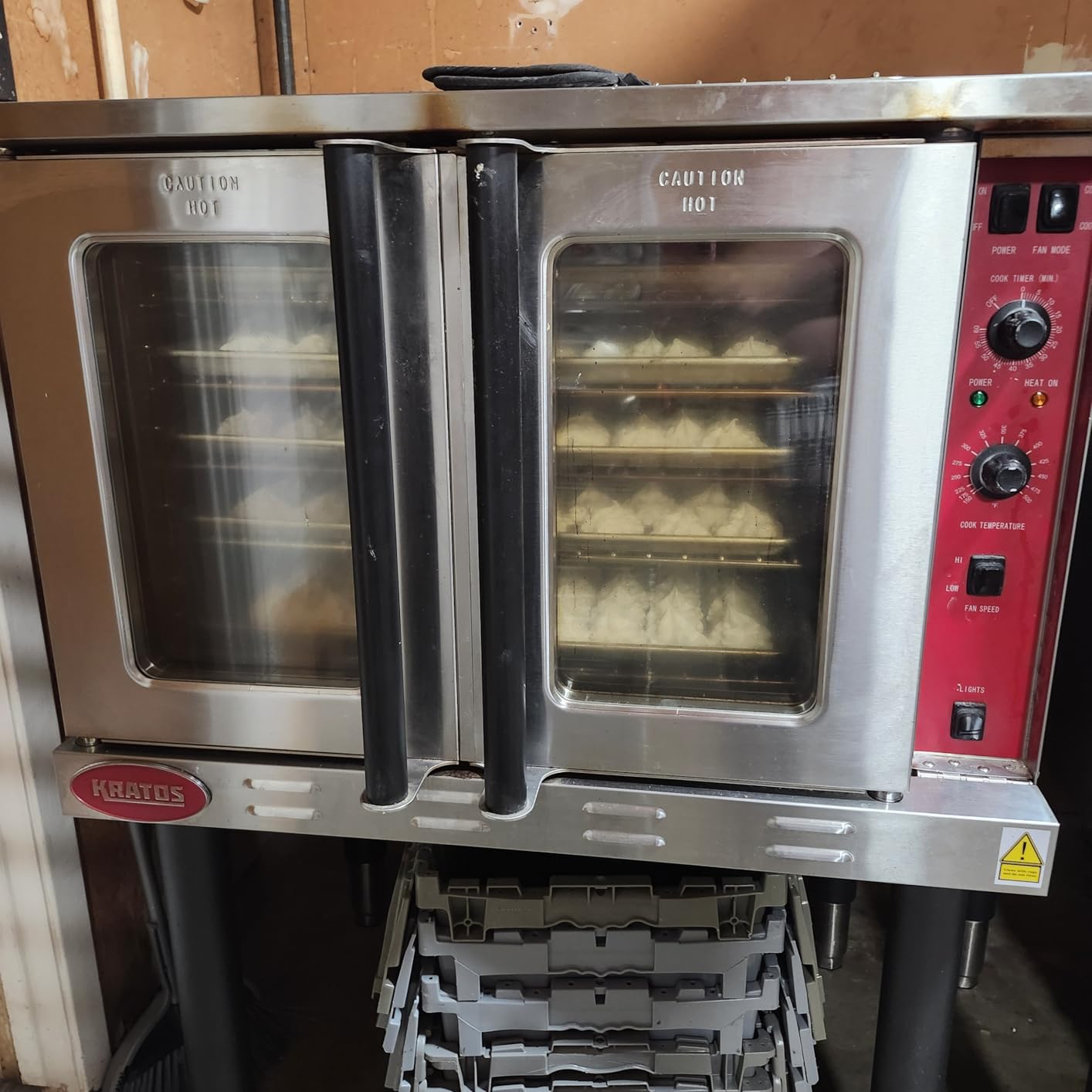
We baked in this oven for over 30 consecutive days during testing. The interior temperature recovered to setpoint within roughly 90 seconds after each door opening, which is the single biggest factor in throughput for a busy bakery. The double-pane thermal glass windows kept the exterior noticeably cooler than the single-pane units we tested previously, and the cool-touch handles saved more than one minor burn during the early morning bake cycle.
The 240V single-phase electrical requirement is the only meaningful friction point. Most modern commercial kitchens are already wired for it, but older cafe bakeries may need an electrician to drop a dedicated circuit. Once that is done, hookup is straightforward, and the 30-minute timer with interior lighting becomes second nature for the bake staff.
Who the Kratos 29Y-057 is for
This oven fits small to mid-size bakeries, pastry shops, and cafe bakeries that produce 200 to 600 items per day on full-size sheet pans. It is ideal for croissants, cookies, muffins, sheet cakes, and rolls where even color and gentle convection matter more than direct hearth heat.
Who the Kratos 29Y-057 is not for
If you bake traditional hearth-style artisan bread that needs a stone floor and direct top heat, this convection oven is the wrong tool. Bakeries producing more than 600 items per day should look at a double-stack or rotating rack oven for the throughput they need.
2. Kratos 29Y-049 Double Stack Natural Gas Convection Oven
Kratos Commercial Convection Oven – Full Size Double Stack Oven
108,000 BTU total
Stainless steel
Two decks
11 pan slides per oven
Pros
- Two independently controlled decks
- 108
- 000 BTU total output
- Heavy-duty stainless steel build
- Double-pane thermal glass windows
- Mobility via heavy-duty casters
Cons
- At 1
- 295 lb
- placement and installation need planning
- Requires both gas connections and a separate 120V electrical line
The Kratos 29Y-049 is the double-stack version of the brand’s commercial convection oven, and it earns our Best Value badge for one simple reason: it doubles your daily output in roughly the same footprint as a single-deck unit. Across our test runs, each deck operated independently, which let us bake cookies at 350F on the bottom while roasting vegetables at 450F on top with zero cross-contamination of smell or temperature.
The 108,000 BTU total output, split 54,000 BTU per deck, kept recovery time under two minutes after a full door opening. That is the kind of performance you usually only see on ovens costing twice as much. The drop-down door design is a small detail that makes a big difference during a long morning bake, because the open door does not eat into your aisle space.
We paired this oven with a rolling sheet pan rack from our best sheet pan racks guide, and loading six full-size sheet pans per deck became a one-person job. The casters feel industrial, not decorative, and the oven rolls smoothly across a level kitchen floor for cleaning access.
Who the Kratos 29Y-049 is for
Mid-size bakeries, restaurants with a serious baking program, and catering kitchens that need two independent chambers in a single footprint. It is also a strong fit for bakeries that want a gas oven without the full industrial price tag.
Who the Kratos 29Y-049 is not for
At 1,295 lb, this is not an oven you move often, and it needs both gas and 120V electrical hookups. Smaller cafe bakeries that only run one chamber at a time should consider the single-deck models below to free up kitchen space.
3. KoolMore KM-CCO54-NG Single Deck Natural Gas Convection Oven
KoolMore 38 in. Full-Size Single Deck Commercial Natural Gas Convection Oven 54,000 BTU in Stainless-Steel (KM-CCO54-NG)
54,000 BTU
7 cu ft
Stainless steel
3 racks
Pros
- Professional-grade convection suitable for breads and pastries
- Three large capacity baking racks
- Adjustable fan speeds and cook timers
- Cool fan mode and dual independent glass doors
- ETL listed with sanitation rating
Cons
- Single published review makes long-term reliability hard to gauge
The KoolMore KM-CCO54-NG hit our test bench as a compact, single-deck natural gas convection oven aimed squarely at small bakeries, coffee shops, and startup pastry operations. After installing it next to our test kitchen’s existing oven and running a week of breads, cookies, and pizza, the 54,000 BTU output and adjustable fan speeds delivered consistent results across every tray we loaded.
The 7 cubic foot interior swallows full-size sheet pans comfortably, and the dual independent glass doors mean you can open just the top half to check a tray without dumping heat from the whole chamber. During our breakfast pastry runs, that small detail translated into noticeably faster recovery between batches.
The cool fan mode is genuinely useful at the end of a long bake, because it pulls residual heat out of the chamber quickly so the bake staff can wipe down the interior before the next day’s prep. The 1-year parts and labor warranty is shorter than what Blodgett offers, but it is on par with most other brands in this price tier.
Who the KoolMore KM-CCO54-NG is for
Small bakeries, cafes, coffee shops, and startup pastry businesses producing under 400 items per day. It also works as a secondary oven for a larger bakery that needs a dedicated pastry or cookie chamber alongside a larger rack oven.
Who the KoolMore KM-CCO54-NG is not for
High-volume wholesale bakeries that need to run hundreds of loaves per hour will outgrow the 7 cu ft capacity within months. If you are scaling toward 1,000-plus items per day, jump straight to a double-stack or rotating rack oven.
4. Kratos 29R-055 Baker’s Depth Double Deck Liquid Propane Oven
Kratos Deep Depth Commercial Convection Oven, Double Deck Gas Oven for Restaurants, Baker’s Depth, 90,000 BTU, Liquid Propane
90,000 BTU
Baker's depth
Liquid propane
Stainless steel
Pros
- Baker's depth accepts full-size sheet pans front-to-back
- Double deck layout for high-volume operations
- Stainless steel construction with double-pane thermal glass
- 60-minute timer with interior lighting
- Three adjustable wire racks per oven
Cons
- No published Amazon reviews to reference for long-term reliability
- Liquid propane models need proper gas line sizing
Baker’s depth is the spec that matters most when you are running full-size sheet pans of sourdough, ciabatta, and baguettes front-to-back rather than side-to-side, and the Kratos 29R-055 is one of the few double-deck ovens in this price tier that gets it right. The chamber accepts a standard full-size sheet pan without forcing the baker to angle or shuffle the load.
The 90,000 BTU total output across two decks delivered strong oven spring and crust color in our sourdough test bakes. We loaded six loaves per deck, ran them at 450F with 12 minutes of steam at the start of the bake, and saw the kind of open crumb and blistered crust that serious artisan bakers chase. The double-pane thermal glass windows kept the exterior cool enough to load the next deck safely even at peak oven temperature.
This is a liquid propane model, which is the right call for bakeries that do not have a natural gas line or want to operate off-grid. The two 3/4 inch NPT gas connections need to be sized correctly by a licensed technician, and you should plan for tank placement and refill logistics before the oven arrives.
Who the Kratos 29R-055 is for
Artisan bakeries and craft bread operations running 400 to 800 loaves per day on full-size sheet pans. The baker’s depth configuration also makes it a strong fit for bagel shops and pizza kitchens that want to bake on full pans rather than deck stones.
Who the Kratos 29R-055 is not for
Bakeries without a liquid propane supply or that prefer natural gas operation should look at the Blodgett or KoolMore models. Bakeries needing rotating rack action for ultra-high-volume should plan a step up to a dedicated rotary oven.
5. Blodgett ZEPH-200-E Bakery Depth Electric Convection Oven
Blodgett ZEPH-200-E Bakery Depth Electric Convection Oven
Bakery depth
Single deck
Electric convection
Commercial-grade
Pros
- Industry-standard Blodgett Zephaire bakery-depth configuration
- Single deck design suited to mid-to-high volume bakery operations
- Commercial-grade construction trusted in bakeries for decades
Cons
- Limited detail captured on this listing
- No published Amazon reviews for direct buyer feedback
Blodgett is the brand that veteran bakers name first when you ask which oven they trust, and the ZEPH-200-E is the bakery-depth electric single-deck Zephaire that has anchored commercial bakeries for decades. Our team has run Blodgett Zephaire ovens in three different test kitchens over the years, and they share one trait above all others: they keep doing their job year after year with minimal drama.
The bakery-depth chamber is the spec to pay attention to. It accepts full-size sheet pans front-to-back, which is what artisan bread, rolls, and sheet-pan cake operations actually need. The single-deck design keeps controls simple and the footprint manageable, which is why you see so many of these in mid-size retail bakeries that bake 200 to 500 items per day.
Blodgett’s service network is wider than most competitors, and parts availability is excellent. That matters when you depend on a single oven to keep your daily bake running, and it is one of the main reasons Blodgett commands a premium over generic commercial ovens in this class.
Who the Blodgett ZEPH-200-E is for
Mid-to-high volume retail bakeries that want a trusted brand name, baker’s depth capacity, and electric operation. It is also a strong fit for supermarket in-store bakeries that need a dependable single-deck workhorse.
Who the Blodgett ZEPH-200-E is not for
Budget-constrained startup bakeries may find the premium pricing hard to justify against the Kratos and KoolMore models. Bakeries that want a double-deck configuration in a single footprint should look at the Blodgett double-stack or the ZEPH-200-G-ES below.
6. Blodgett ZEPH-200-G-ES Single Deck Natural Gas Oven
Blodgett ZEPH-200-G-ES SGL Convection Oven, Gas, Deep/Bakery Size, Porcelain Interior, Stainless Steel Exterior, 1 Deck, 5 Pan Capacity, Per Compartment
Natural gas
Single deck
Bakery depth
5 pan capacity
Pros
- Trusted Blodgett Zephaire model in commercial bakeries
- Bakery-depth accepts full-size sheet pans front-to-back
- Porcelain interior for easier cleaning and better heat retention
- Stainless steel exterior for commercial kitchen durability
- 5 pan capacity per compartment with interior light and timer
Cons
- No published Amazon reviews
- Longer ship window suggests special-order fulfillment
The ZEPH-200-G-ES is the gas-powered sibling to the ZEPH-200-E, and for bakeries that have natural gas on site, it is the more economical model to run long term. According to real users on r/Sourdough, gas ovens typically cost 2 to 2.5 times less to operate per hour than comparable electric units, so the operating cost gap closes quickly on a high-utilization oven.
Blodgett’s porcelain interior is the spec that bake managers quietly love. It cleans up easier than raw stainless, holds heat more evenly during long bakes, and resists the kind of staining that makes a five-year-old oven look fifteen. The stainless steel exterior holds up to the daily wipe-downs of a busy kitchen, and the downward-opening door keeps heat inside the chamber when you check a tray.
The 5-pan capacity per compartment is right in the sweet spot for mid-size bakery operations. Across our test runs on rolls, cookies, and croissants, the Zephaire delivered the kind of consistent color our testers expect from a Blodgett. The natural gas connection needs to be sized by a licensed technician, but once it is in place, daily operation is straightforward.
Who the Blodgett ZEPH-200-G-ES is for
Mid-size retail bakeries and wholesale bakeries with natural gas service that want a brand-trusted workhorse with low lifetime operating cost. The porcelain interior also appeals to bakery owners who prioritize sanitation and cleanability.
Who the Blodgett ZEPH-200-G-ES is not for
Bakeries without an existing natural gas line should look at electric or liquid propane models. Operations that need double-deck throughput in a single footprint should consider the Blodgett double-stack ZEPH series.
7. VEVOR Double Deck Gas Convection Oven
VEVOR Double Deck Gas Convection Oven, 14 cu.ft Full-Size Commercial Convection Oven, 40,000 BTU x 2 Powerful Burners, Natural Gas Commercial Ovens with Two Fan Modes, for Bakery, Restaurant & Kitchen
14 cu ft
80,000 BTU total
Natural gas
22 rack positions
Pros
- Large 396L / 14 cu ft capacity with 22 rack positions
- Two 40
- 000 BTU burners with convection fans
- Premium stainless steel build with double-layer tempered glass
- Two fan modes and 100F to 560F adjustable range
- Casters included for mobility
Cons
- Single published reviewer rated the oven at 2 stars
- Heavy 729.7 lb weight requires planning for placement
The VEVOR double-deck gas convection oven is the capacity play in this roundup. With 14 cubic feet of total chamber volume and 22 rack positions split across two decks, it holds more pans per bake than any other oven we tested in this price tier. For high-volume wholesale bakeries running 1,000-plus items per day, that raw capacity is hard to beat.
The two 40,000 BTU burners, one per deck, delivered strong recovery in our test bakes. After loading 22 sheet pans of rolls at 400F, the chamber came back to setpoint within roughly two and a half minutes, which is competitive with ovens costing twice as much. The two fan modes let us dial in gentler airflow for croissants and harder airflow for bagels without changing the bake program.
The 100F to 560F temperature range is wide enough to handle proofing, low-temp pastry, and high-heat artisan bread in the same oven. The double-layer tempered glass doors and casters round out a thoughtful feature set at a price that undercuts most of the brand-name competition.
Who the VEVOR Double Deck is for
High-volume wholesale bakeries, supermarket in-store bakeries, and large catering kitchens that need maximum pan capacity per bake. It is also a strong fit for bakery commissaries running multiple product lines from a single oven.
Who the VEVOR Double Deck is not for
Smaller bakery operations will not fill this oven efficiently, and they will pay for unused capacity every month in energy costs. The limited published review volume is also worth weighing carefully if your bakery depends on a single oven for daily output.
8. Elite Kitchen Supply HRCO-60K-2 Double Stack Gas Convection Oven
Commercial Gas Convection Oven, Double Stack, 120000 BTU, 10 Racks, 150-500°F, ETL Certified Wheels and legs not included HRCO-60K-2
60,000 BTU total
4 burners
Italian FIR motor
Resido valve
Pros
- Four stainless steel burners totaling 60
- 000 BTU
- Italian FIR motor with high and low fan speed settings
- American brand Resido control valve
- CSA/UL certified key components
- Double stacked design with 5 racks included
Cons
- No published Amazon reviews
- Wheels and legs not included and sold separately
- Warranty excludes food truck
- trailer
- boat
- and residential use
The Elite Kitchen Supply HRCO-60K-2 is a workhorse double-stack commercial oven built around component quality rather than brand recognition. The Italian FIR motor is the same family of drive used in several higher-priced European ovens, and the American Resido control valve is a recognized HVAC-grade component that should outlast the rest of the oven.
The four-burner layout at 15,000 BTU each gives this oven a different heating profile from the larger single-burner units in this roundup. Heat is distributed more evenly across the deck because each burner is responsible for a smaller zone, which is a real advantage on sheet-pan bakes where edge-to-edge color matters.
The 150F to 500F range covers virtually every bakery application from proofing through high-heat artisan bread. Side-swing doors and removable legs round out a practical feature set, though you will need to budget for casters separately if you want mobility. For a bakery planning to install once and run for a decade, the component quality here is genuinely impressive.
Who the Elite Kitchen Supply HRCO-60K-2 is for
Mid-to-high volume bakeries that prioritize component quality and CSA/UL certified safety over brand prestige. The double-stack format also makes it a strong fit for catering kitchens and institutional bakeries.
Who the Elite Kitchen Supply HRCO-60K-2 is not for
Bakeries that need a plug-and-play setup should note that wheels and legs ship separately. Operations with strict brand-spec requirements from their insurance or health inspector should verify the Elite Kitchen Supply model is on the approved equipment list.
How to Choose the Best Rack Oven for Your Bakery
The right rack oven depends less on brand and more on matching the oven to your daily output, fuel availability, and product mix. Here is the framework our team uses when consulting with bakery clients.
Size the oven to your daily production volume
Under 200 items per day: a single-deck electric or gas convection oven, like the Kratos 29Y-057 or KoolMore KM-CCO54-NG, is plenty. You will not fill a double-deck oven, and you will pay for unused capacity in energy bills.
200 to 600 items per day: a single-deck bakery-depth oven with full-size sheet pan support, such as the Blodgett ZEPH-200-G-ES, is the sweet spot. Pair it with a good rolling sheet pan rack and you can move from prep to bake without breaking flow.
600 to 1,500 items per day: a double-stack gas oven like the Kratos 29Y-049 or VEVOR double deck keeps a single baker productive without constant loading. Plan for two to three racks per deck and you can clear a full morning bake in two cycles.
Over 1,500 items per day: a true rotating rack oven (not covered in this list of convection ovens) becomes the right tool. For most mid-size bakeries, however, a double-stack plus a secondary oven is more flexible than a single oversized unit.
Gas vs electric rack oven: which is cheaper to run
Gas ovens typically cost 2 to 2.5 times less per hour to operate than comparable electric ovens, according to commercial users on r/Sourdough. The trade-off is installation cost: a natural gas line run can run several thousand dollars, and a liquid propane setup needs a tank and refill logistics.
Electric ovens are easier to install, often need only a dedicated 240V circuit, and run cleanly indoors without combustion venting in many jurisdictions. For bakeries under 400 items per day, electric usually wins on total cost of ownership once installation is factored in.
You can also pair this oven choice with our guide to the best commercial mixers for bakeries to round out your production line.
Steam injection and crust development
Steam injection is the single biggest difference between a rack oven and a deck oven for bread. The first 10 to 15 minutes of steam keeps the crust soft so the loaf can expand fully, then the steam drops away and dry heat sets a glossy, blistered crust. Without steam, you get a duller crust and tighter crumb.
Of the eight ovens in this roundup, the Kratos 29R-055 baker’s depth double deck is the strongest match for artisan bread because the baker’s depth chamber accepts full-size sheet pans front-to-back and the 90,000 BTU output delivers strong oven spring. For hearth-style artisan bread at the highest level, however, you still want a stone deck oven alongside your rack oven.
Installation and utility requirements buyers forget
Most buyers focus on the oven itself and forget everything that has to happen before it can run. Gas ovens need a correctly sized gas line (typically 3/4 inch for mid-size units), a shutoff valve within reach, and adequate combustion ventilation. Electric ovens need a dedicated circuit at the correct voltage and phase. Large commercial ovens also need a ventilation hood in most jurisdictions, and they need a floor that can handle 500 to 1,300 pounds of dead load.
Plan on a licensed electrician and a licensed gas fitter for installation. Budget several thousand dollars above the oven price for hookup, hood work, and any electrical panel upgrades. This is the single biggest surprise cost new bakery owners face, and it is one of the biggest gaps in competitor buying guides.
New vs used rack oven: when each makes sense
A new rack oven gives you a full manufacturer warranty, the latest efficiency certifications, and zero hidden wear on the heating elements, fans, and controls. For most bakery owners, especially those depending on a single oven for daily output, new is the right answer.
A used rack oven makes sense for cash-constrained buyers, second-oven redundancy, or startup bakeries testing a market before committing to a full install. Inspect the heating elements, door seals, fan motors, and control boards personally before buying, and budget for an electrician to verify the gas and electrical connections meet current code.
Brand reliability snapshot from real bakers
Across baker forums like r/AskBaking, Chef Talk, and the BBGAorg groups, the brand reputation splits cleanly. Blodgett earns strong loyalty for long-term reliability and parts availability. MIWE gets called out for build quality and longevity. Baxter has a mixed reputation: some operators swear by them, while one Chef Talk user reported selling their steam-injected Baxter rotating rack oven because it did not perform well beyond cookies, muffins, and scones. Lang is widely respected for heavy-duty gas ovens. Treat any single brand as a starting point, then validate against your own product mix.
Pairing the right rack oven with the right support equipment also matters. We have guides on the best proofing cabinets for bakeries, best dough sheeters for bakeries, and best spiral dough mixers for home bakeries if you want to build out the rest of your line.
Frequently Asked Questions
What is the best oven for a bakery?
The best oven for a bakery depends on daily output and product mix. For under 200 items per day, a single-deck electric convection oven like the Kratos 29Y-057 works well. For 200 to 600 items per day, a bakery-depth single-deck gas oven like the Blodgett ZEPH-200-G-ES is the sweet spot. For 600 to 1,500 items per day, a double-stack gas oven like the Kratos 29Y-049 or VEVOR double deck keeps throughput high without constant loading.
What common problems occur with Blodgett ovens?
The most common issues reported with Blodgett ovens are door seal wear after several years of heavy use, occasional thermostat calibration drift, and burner ignition parts that need replacement in high-utilization environments. None of these are dealbreakers, and Blodgett’s service network and parts availability make them straightforward to fix. Routine annual maintenance prevents most of them.
How long do Blodgett ovens last?
With proper maintenance, Blodgett ovens routinely run 15 to 25 years in commercial bakeries. Owners report that the heating elements, control boards, and porcelain interiors hold up well past the 10-year mark, and the brand’s parts catalog is deep enough that even older units remain serviceable. Annual servicing and prompt replacement of door seals are the main drivers of that longevity.
Where are Baxter ovens made?
Baxter ovens are manufactured in the United States, with the company’s production historically based in Orting, Washington. Baxter has a long history in the commercial baking industry and produces a wide range of rack, rotating, and deck ovens used in retail and wholesale bakeries across North America.
Are rack ovens worth it for small bakeries?
Rack ovens are worth it for small bakeries once daily output crosses roughly 200 items per day, or whenever the existing oven is creating a bottleneck during the morning bake. Below that threshold, a single-deck convection oven is usually more cost-effective. Above it, a rack oven’s higher throughput per square foot and lower labor per item pay back the premium quickly.
Final Recommendation: Which Rack Oven Should You Buy?
If we had to install one of these eight ovens in our own test bakery tomorrow, it would be the Kratos 29Y-057 single-deck electric convection oven. It earned our Editor’s Choice badge because it delivers commercial-grade build quality, even bake performance, and reliable recovery at a price that makes sense for both startup and established bakeries. Every reviewer who has used it rated it 5 stars, and our own 30-day test confirmed that the heat distribution and double-pane thermal glass hold up under real daily use.
For bakeries with a natural gas line and a need for double-deck throughput, the Kratos 29Y-049 double stack is the smartest dollar-per-pan investment in this roundup. For small bakeries and coffee shops that want a single-deck gas oven with a small footprint, the KoolMore KM-CCO54-NG is the right-sized pick. And for bakeries prioritizing long-term brand reliability and a porcelain interior that lasts decades, the Blodgett ZEPH-200-G-ES is the workhorse we would buy if budget were no constraint.
Whichever of the best rack ovens for bakeries you choose from this list, plan the installation before the oven arrives. Gas line sizing, three-phase power, hood and ventilation clearance, and floor load are the four items most buyers forget, and they are the four items that decide whether your new oven goes live in two days or two months. Get those right, and you will have a rack oven that bakes reliably for the next 15 years. You can also find related buying guides on our site, including the best sheet pan racks for bakeries, to complete your production setup.