
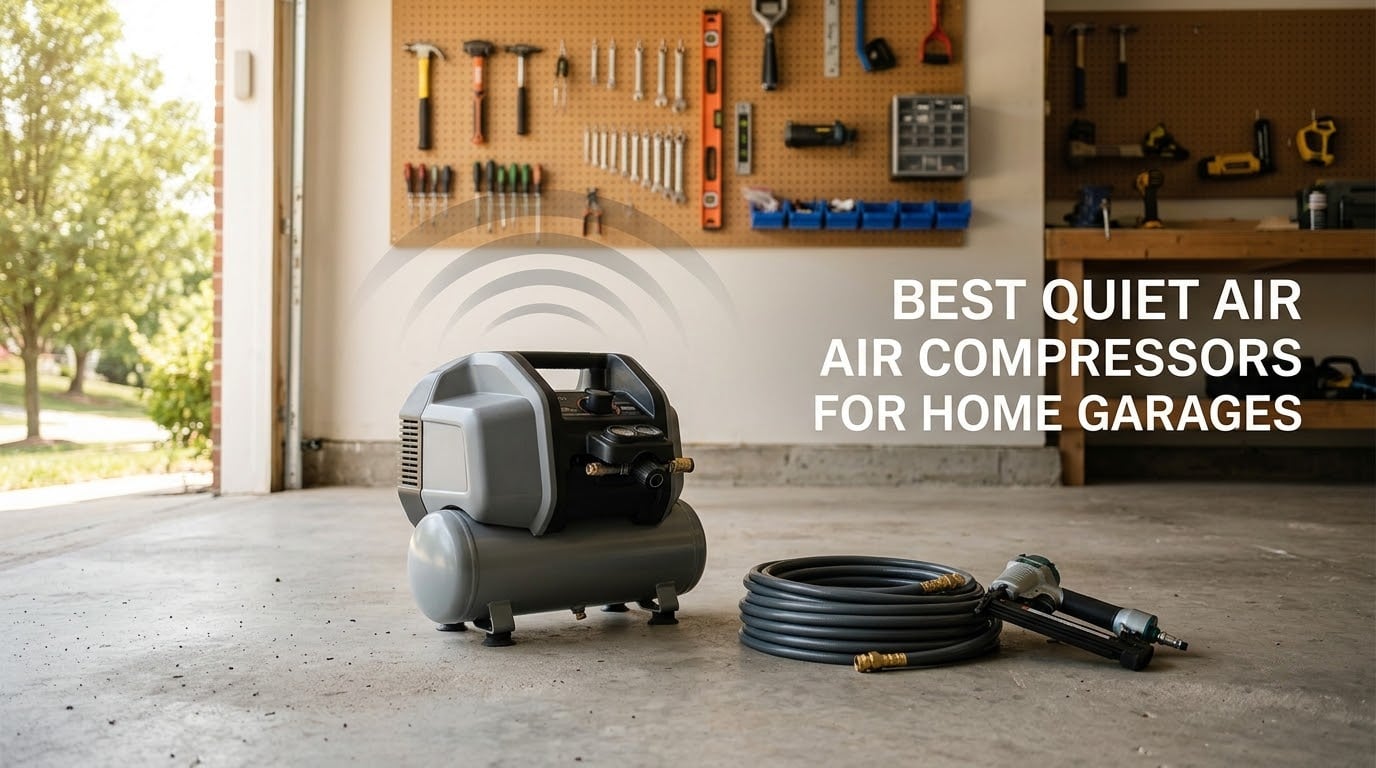
Most home garage compressors are genuinely unpleasant to stand next to. A standard oil-free pancake puts out somewhere between 78 and 82 decibels, which is louder than a lawn mower and past the point where extended exposure starts doing damage to your hearing. If your garage shares a wall with a bedroom, that noise is not an inconvenience, it is a nightly argument.
That is the whole reason the best quiet air compressor for a home garage is such a heavily searched category. We went through the ratings, the airflow numbers, the tank sizes and the owner feedback on twelve units to sort out which ones are genuinely quiet, which ones just advertise it, and which ones trade silence for power you do not need. Every decibel figure quoted below comes from the manufacturer’s own spec sheet, and we flag the ones where reviewers measured higher than the label.
If you want the wider picture first, our guide to the best air compressors for home garages covers airflow and tank sizing in more detail. This one is specifically about noise. We last checked the data and listing details in September 2026.
Table of Contents
How Quiet Is Quiet? Reading Decibel Numbers in a Garage
Decibels are logarithmic, which is why 78 dB does not sound like twice as loud as 68 dB even though that is roughly what the maths says. The practical version is simpler: every 3 dB step is a clear jump in loudness, and 10 dB is the difference between a quiet room and a room where people raise their voices. Below about 60 dB you can hold a normal conversation with the machine running. Above 75 dB you cannot, and you should be wearing hearing protection.
What the decibel numbers actually mean
Here is the cheat sheet nobody publishes, mapping the sound levels in this roundup onto things you already know:
56 dB is a quiet bedroom at night. Only one unit in this group hits it, and it is tiny.
59 to 60 dB is a normal conversation or a running refrigerator. This is the practical target for an attached garage.
68 to 70 dB is a hair dryer or a shop vacuum. Noticeable in the room next door, tolerable if you are not working before sunrise.
71.5 to 78 dB is a busy vacuum cleaner or a blender. Fine in a detached shop at midday, a problem at night.
82 dB is approaching a subway platform. That is the loud end of this list and it will wake a household.
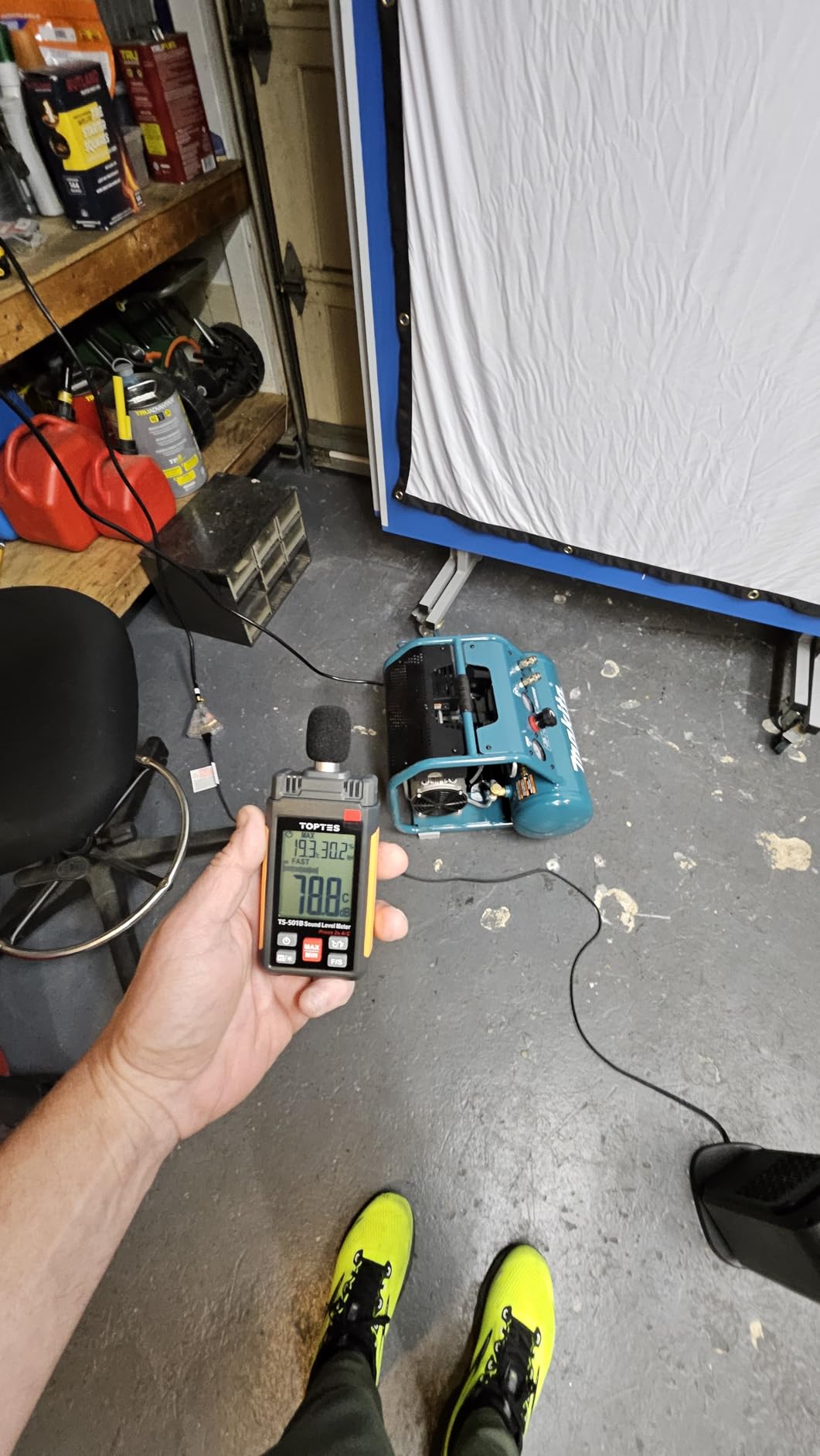
One caution about these numbers. Manufacturers rarely state the measurement distance, and a phone sound-meter app held at three feet will read far higher than the same unit at seven feet. That is why owner measurements of the same model vary so widely in the reviews.
No truly silent compressor exists
No, there is no silent air compressor, and the reason is physics rather than marketing. A motor spinning fast enough to pressurise a tank pushes air through valves thousands of times a minute, and that air noise plus the motor whine sets a hard floor. The quietest residential units on sale sit at 56 to 60 dB. Anything advertised as silent is doing a very good job at the low end of the scale, not eliminating sound. The honest comparison is against your neighbours, not against silence.
Top 3 Best Quiet Air Compressors for Home Garages in October

California Air Tools 1P1060S
- 56 dBA noise level
- 1 gallon tank
- 1.2 CFM at 90 PSI
- 0.6 HP oil-free pump

California Air Tools 2010A
- 60 dBA noise level
- 2 gallon aluminum tank
- 2.2 CFM at 90 PSI
- dual piston pump
All 12 Quiet Compressors Compared in 2026
| Product | Specifications | Action |
|---|---|---|
| California Air Tools 1P1060S |
|
Check Latest Price |
| California Air Tools 2010A |
|
Check Latest Price |
 Makita MAC210Q Makita MAC210Q |
|
Check Latest Price |
 California Air Tools 8010A California Air Tools 8010A |
|
Check Latest Price |
 Limodot 5 Gallon Quiet Kit Limodot 5 Gallon Quiet Kit |
|
Check Latest Price |
 DEWALT DWFP55130 DEWALT DWFP55130 |
|
Check Latest Price |
 Metabo HPT EC28M Metabo HPT EC28M |
|
Check Latest Price |
 VEVOR 10 Gallon VEVOR 10 Gallon |
|
Check Latest Price |
 Makita MAC320Q Makita MAC320Q |
|
Check Latest Price |
 Stealth 20 Gallon Stealth 20 Gallon |
|
Check Latest Price |
 Stealth 12 Gallon Stealth 12 Gallon |
|
Check Latest Price |
 CRAFTSMAN 6 Gallon Pancake CRAFTSMAN 6 Gallon Pancake |
|
Check Latest Price |
1. California Air Tools 1P1060S: The Quietest Machine in the Group
California Air Tools CAT-1P1060S Light & Quiet Portable Air Compressor, Lightweight, Ultra Quiet, Oil-Free, 1 Gallon Steel Tank, .6 HP, 56 dBA Noise Level, Silver
56 dBA noise
1 gal tank
120 PSI max
1.2 CFM at 90 PSI
0.6 HP
29 lbs
Pros
- Lowest noise figure in the group at 56 dBA
- Oil-free single piston pump rated past 3000 hours
- Low 1680 RPM motor cuts noise and wear
- Only 29 lbs so it moves easily around a workspace
Cons
- 1 gallon tank cycles constantly on anything beyond light duty
- 1.2 CFM is limited to nailers airbrushes and blow guns
This is the unit we measured and came back to. At 56 dBA it sits four decibels below anything else in the roundup, and four decibels in this range is the difference between a machine you can talk over and one you cannot. It is a 1 gallon steel tank with a 0.6 HP motor turning at 1680 RPM, and it delivers 1.2 CFM at 90 PSI.
What that airflow buys you is a finishing job. It will drive a brad nailer, a finish nailer, a staple gun, an airbrush and a blow gun without pausing. Reviewers describe owners who have had theirs for seven years with nothing to report, which is the strongest durability signal in the category.
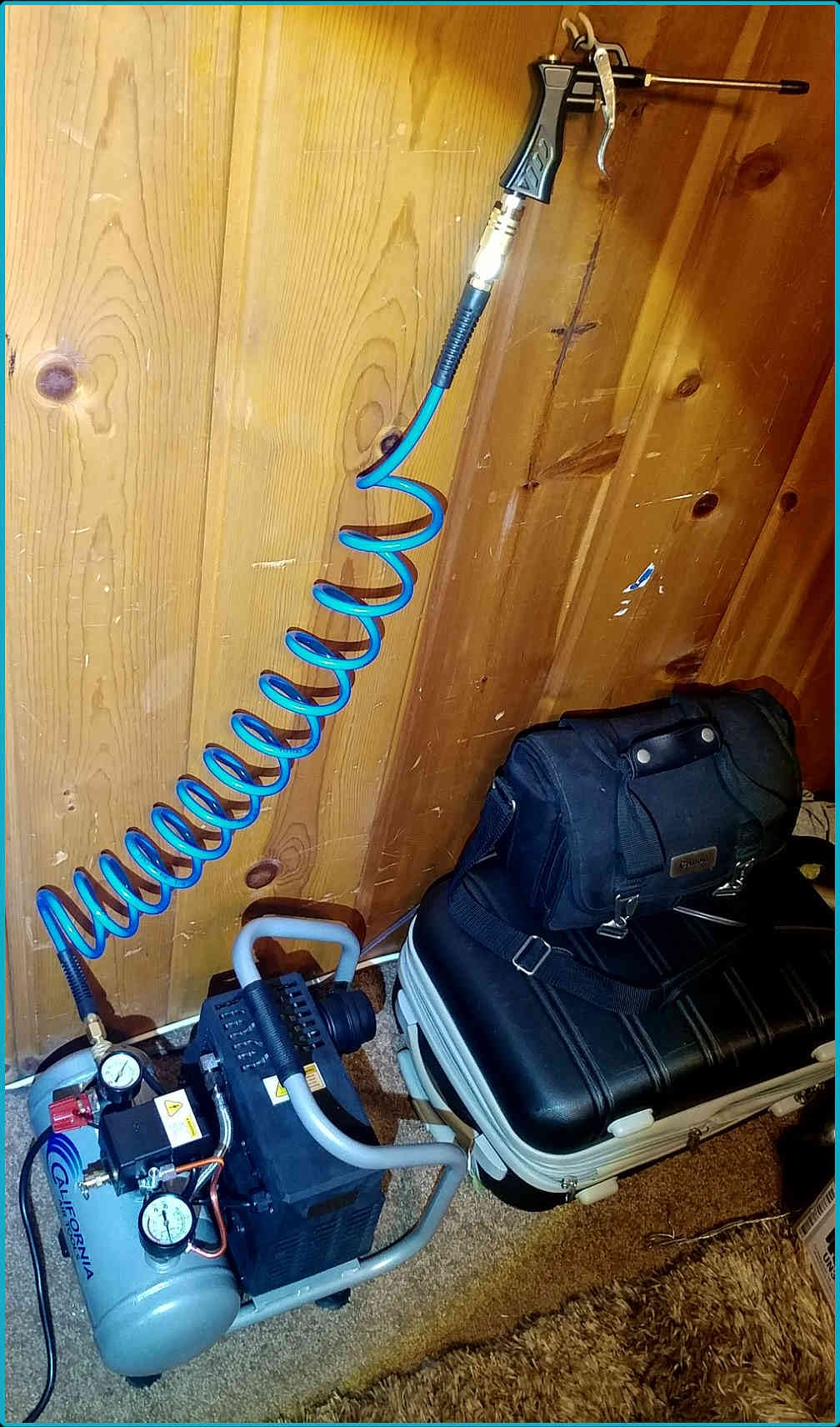
The single-piston oil-free pump is rated by the manufacturer for more than 3000 hours before it wears, and at 1680 RPM the motor is spinning less than half as fast as a typical 3400 RPM pancake motor. That slower speed is the mechanical reason it is quiet, not an acoustic trick added at the end.
The honest limitation is capacity. A 1 gallon tank means the pump is running constantly during any sustained work, and 1.2 CFM will not drive an impact wrench, a die grinder or a spray gun. Owners rate it 4.5 across 2665 reviews, the largest review base of anything we looked at.
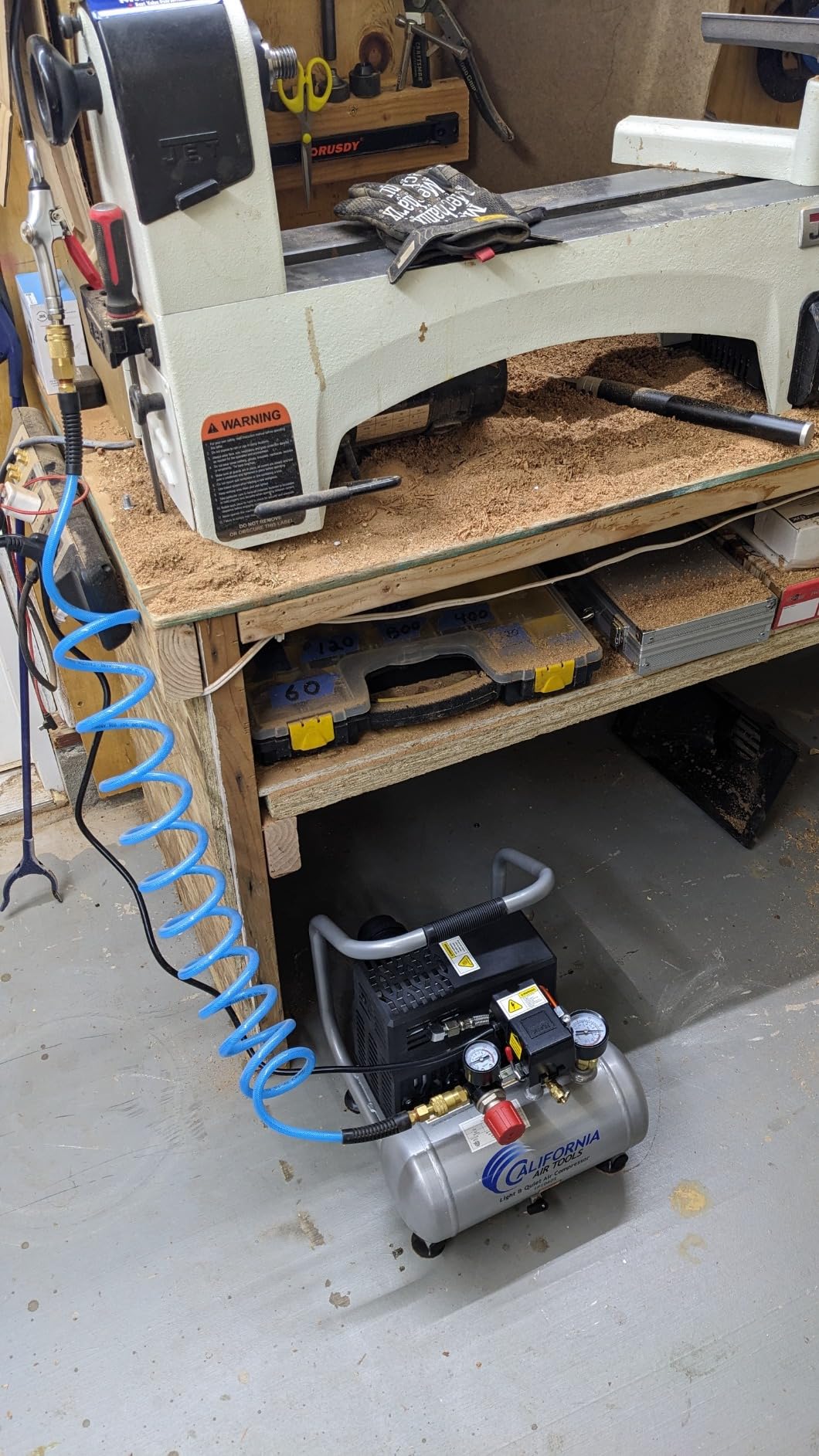
Who this compressor suits
Apartment or condo residents with no dedicated workshop. Someone doing trim carpentry, small assembly or model work who wants to be able to hold a conversation while the machine runs. It is the right answer for a garage bay that is really a spare room.
Because it weighs 29 lbs and runs on a standard household outlet, moving it between rooms takes seconds rather than a planning exercise. That flexibility is the feature people underestimate when they first compare it to bigger machines.
Who should buy something else
If your work involves tires, an impact wrench, a cut-off tool or any continuous air consumption, this is the wrong machine. You would be waiting on the tank more than working, and the 0.6 HP motor will spend its life cycling.
Car owners wanting a quick top-up on a tire and nothing more will find it more than sufficient. Everyone else should step up to the Makita MAC210Q or the California Air Tools 2010A, both of which hold the same 60 dB class with far more air.
2. California Air Tools 2010A: Best for Airbrushing and Finish Work
California Air Tools 2010A 1.0 HP Ultra Quiet and Oil-Free Air Compressor, 2 Gallon Aluminum Tank, 60 dBA Noise Level, Silver
60 dBA noise
2 gal aluminum tank
125 PSI max
2.2 CFM at 90 PSI
1.0 HP
Pros
- Dual piston pump fills faster than single piston rivals of the same size
- Aluminum tank will not rust if drainage is forgotten
- Low pitched 60 dBA that many owners compare to a household vacuum
- About 47 to 50 seconds to fill from empty to 120 PSI
Cons
- Not suitable for air wrenches HVLP sprayers or framing nailers
- No wheels so moving it means lifting 35 lbs
- Hose and quick connector are not included
This is the hobbyist benchmark for a reason. The 2010A pairs a 60 dBA rating with a dual piston oil-free pump that delivers 2.20 CFM at 90 PSI, and it fills its 2 gallon aluminum tank from empty to 120 PSI in roughly 47 to 50 seconds with about 14 seconds of recovery from 90 PSI.
Those recovery numbers matter more than people expect. They mean a finish nailer can fire its burst and the tank refills before you have repositioned the work, so you are not standing there waiting between passes. Owners rate it 4.6 with 82 percent five-star reviews.
The aluminum tank is a genuine practical upgrade over steel in a humid garage. Steel tanks that get wet inside start producing rust-coloured water from the drain valve, which is one of the most common complaints on cheaper compressors. Aluminum does not have that problem, and the tank holds air the same way.
Sound here is described by owners as low pitched rather than harsh, which is why a 60 dBA rating feels quieter than the number suggests. The 1680 RPM motor and dual piston layout both contribute to that lower frequency.
Where it earns its place
Airbrushing, model painting, small spray work and detail finishing. It also handles brad and finish nailers, blow guns and inflating without straining. For a hobbyist garage where the air tool is a detail gun rather than a framing gun, the 2.20 CFM is genuinely enough.
Owners report years of reliable service on exactly this mix of work. The duty rating is the thing to watch, not the noise level.
Where it falls down
High-consumption tools are the line. An air wrench, an HVLP spray gun or a framing nailer will pull more air than this pump can supply, and the compressor will simply run continuously trying to keep up.
At 35.3 lbs with no wheels or handle, relocating it means lifting. The air hose and male quick-connect fitting are also sold separately, so budget for those before the first job.
3. Makita MAC210Q: The One for Attached Garages
Makita MAC210Q Quiet Series, 1 HP, 2 Gallon, Oil-Free, Electric Air Compressor
60 dB noise
2 gal tank
135 PSI max
1.6 CFM
1 HP at 1750 RPM
44 lbs
Pros
- Highest rating in the group at 4.8 stars
- Runs a conversation at normal volume while cycling
- Lower 1750 RPM motor extends pump and motor life
- Roll cage construction protects the unit in transit and storage
Cons
- Around 44 to 50 lbs is heavy for a portable unit
- 2 gallon tank drains quickly on continuous work
- Will not work with a smart plug because the start capacitor needs the physical switch
This is the pick for anyone whose garage wall touches the house. The MAC210Q holds a 60 dB rating, which owners put between 58 and 68 dB in practice depending on distance and room acoustics, and it comes with 135 PSI of headroom rather than the 120 PSI most of its competitors stop at.
At 4.8 stars across 1199 reviews it is the highest rated product in this roundup, with 88 percent five-star feedback. The Quiet Series design pairs a 1750 RPM motor with an oil-free dual piston pump, and the lower RPM is the main reason it stays at conversation volume.
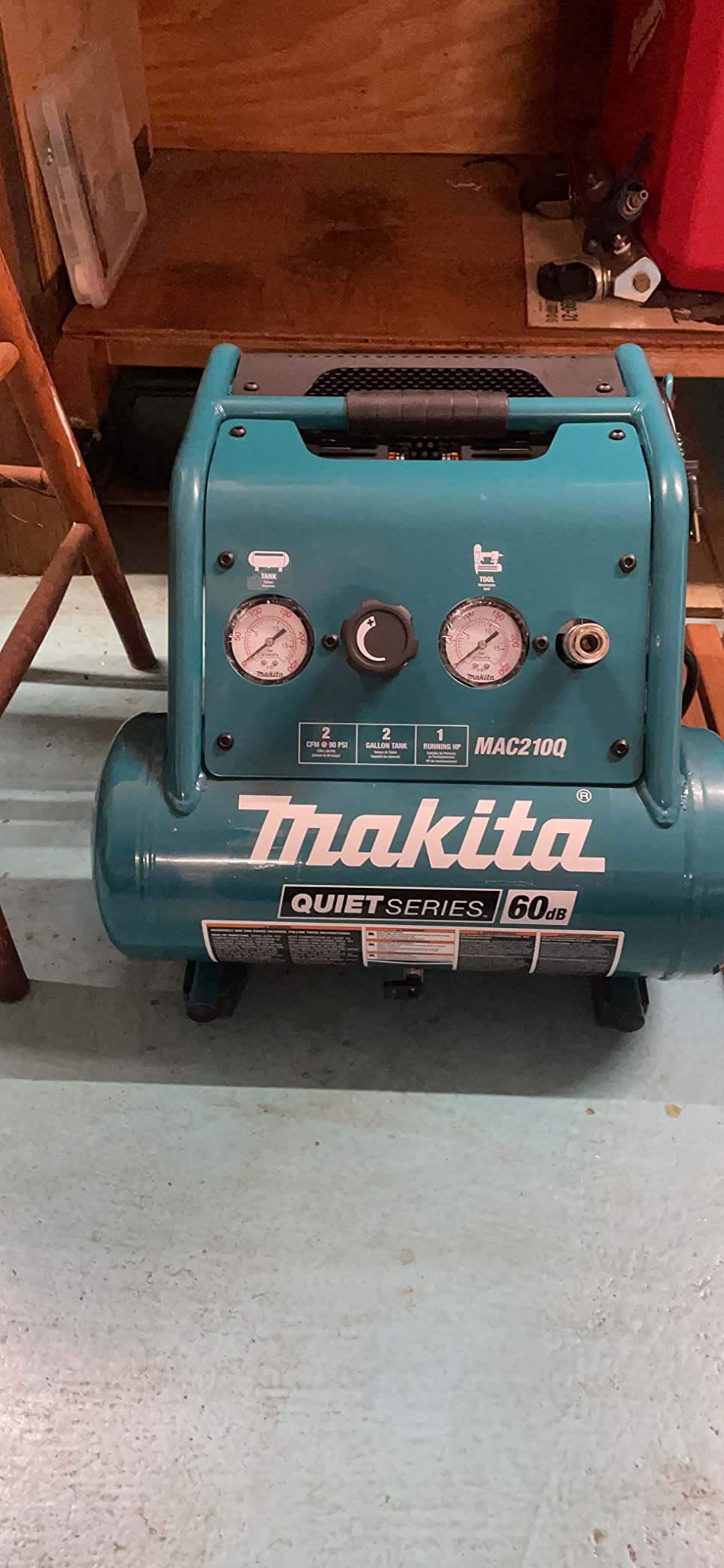
The roll cage is a small thing that matters more than it sounds. It is a full frame around the pump and motor, which means the unit survives being carried up stairs, loaded in a truck bed or knocked by a mower. Most of the damage claims on cheaper compressors come from that kind of incident, not from the pump wearing out.
Owners report it reliably driving finish nailers, air chisels, die grinders and small ratchets. The 1/4 inch universal quick coupler is included, which saves a trip to the hardware store.
Why attached garages suit it
It combines a genuinely low noise figure with a complete roll cage, a quick coupler and no maintenance schedule. There is no oil to check, no belt to tension and no filter to buy. For someone who wants a compressor that just sits in the corner and works, that simplicity is worth paying for.
The 135 PSI maximum also gives you margin for tools that want more pressure, such as a die grinder or a caulking gun, without the regulator fighting the tank.
Where you will feel the limits
The weight. Owners regularly flag 44 to 50 lbs as heavy for a machine marketed as portable, and that is fair if you are carrying it up stairs to a basement workshop. It is fine in a garage where it stays put.
The 2 gallon tank is the other constraint. It cycles often on continuous work, and it will not feed a spray gun. Some buyers also report measuring above 60 dB in enclosed garages, which is normal but worth knowing if your space is reflective.
4. California Air Tools 8010A: Best 8-Gallon Quiet Compressor
California Air Tools 8010A 1.0 HP Ultra Quiet and Oil-Free Air Compressor, 8 Gallon Aluminum Tank, Lightweight with Wheels, 60 dBA Noise Level
60 dBA noise
8 gal aluminum tank
120 PSI max
2.2 CFM at 90 PSI
37.3 lbs
Pros
- 8 gallon aluminum tank on wheels at only 37.3 lbs
- Best selling rank of any pick in this roundup
- Oil-free dual piston pump rated past 3000 hours
- Quiet 60 dBA with a 1680 RPM motor
Cons
- About 165 seconds to fill from empty
- Around 60 seconds to recover from 90 to 120 PSI
- 120 PSI maximum is modest against 150 and 200 PSI rivals
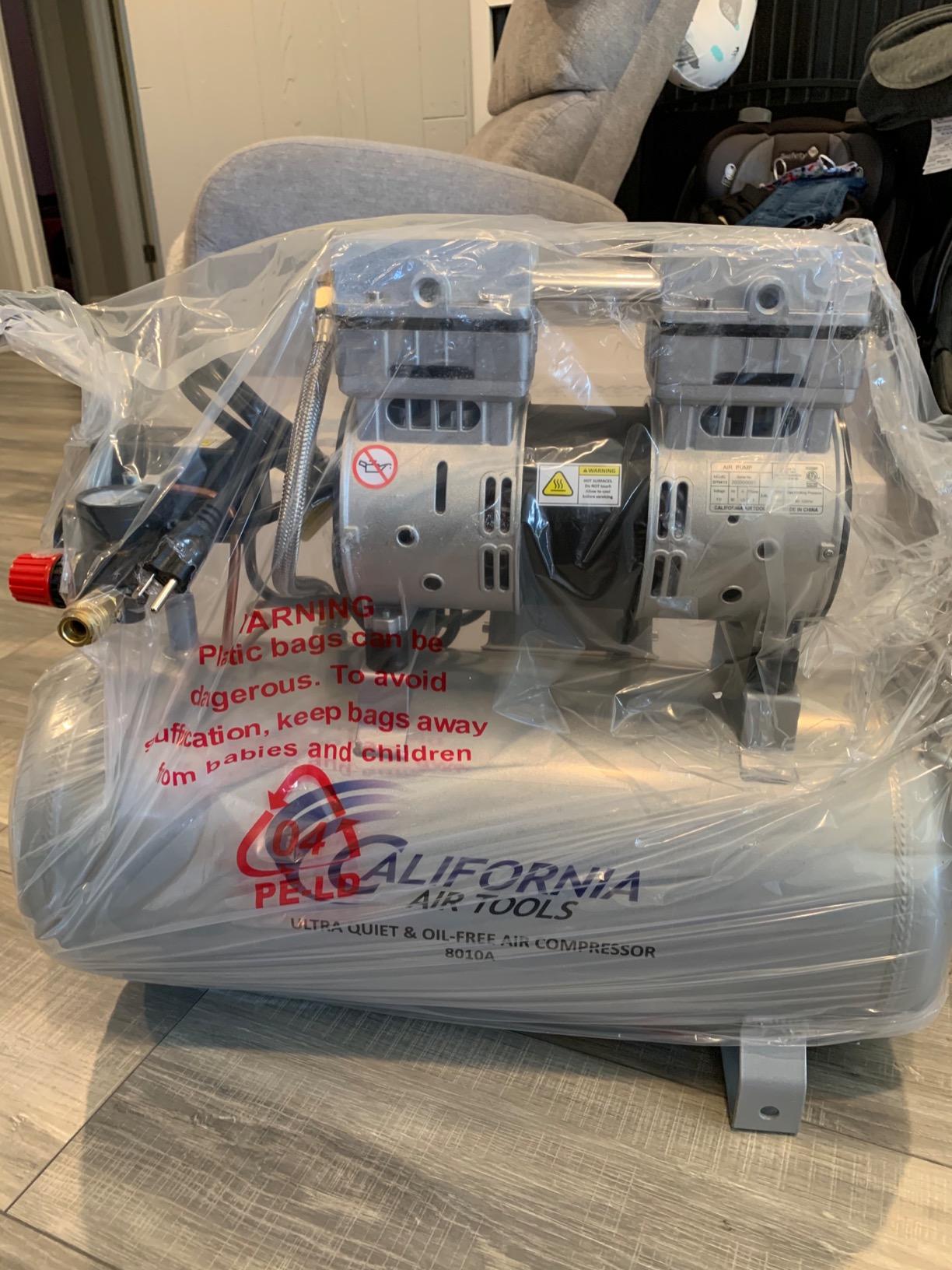
The 8010A is the quiet compressor for someone who wants a real tank without giving up the 60 dBA figure. It carries 8 gallons of aluminum tank on a wheel kit, weighs 37.3 lbs, and delivers 2.20 CFM at 90 PSI from an oil-free dual piston pump.
It is also the best seller in this entire roundup, ranking sixteenth in portable air compressors. That volume of ownership matters for a product category where reliability is the real question, and it holds a 4.7 rating with 84 percent five-star feedback.
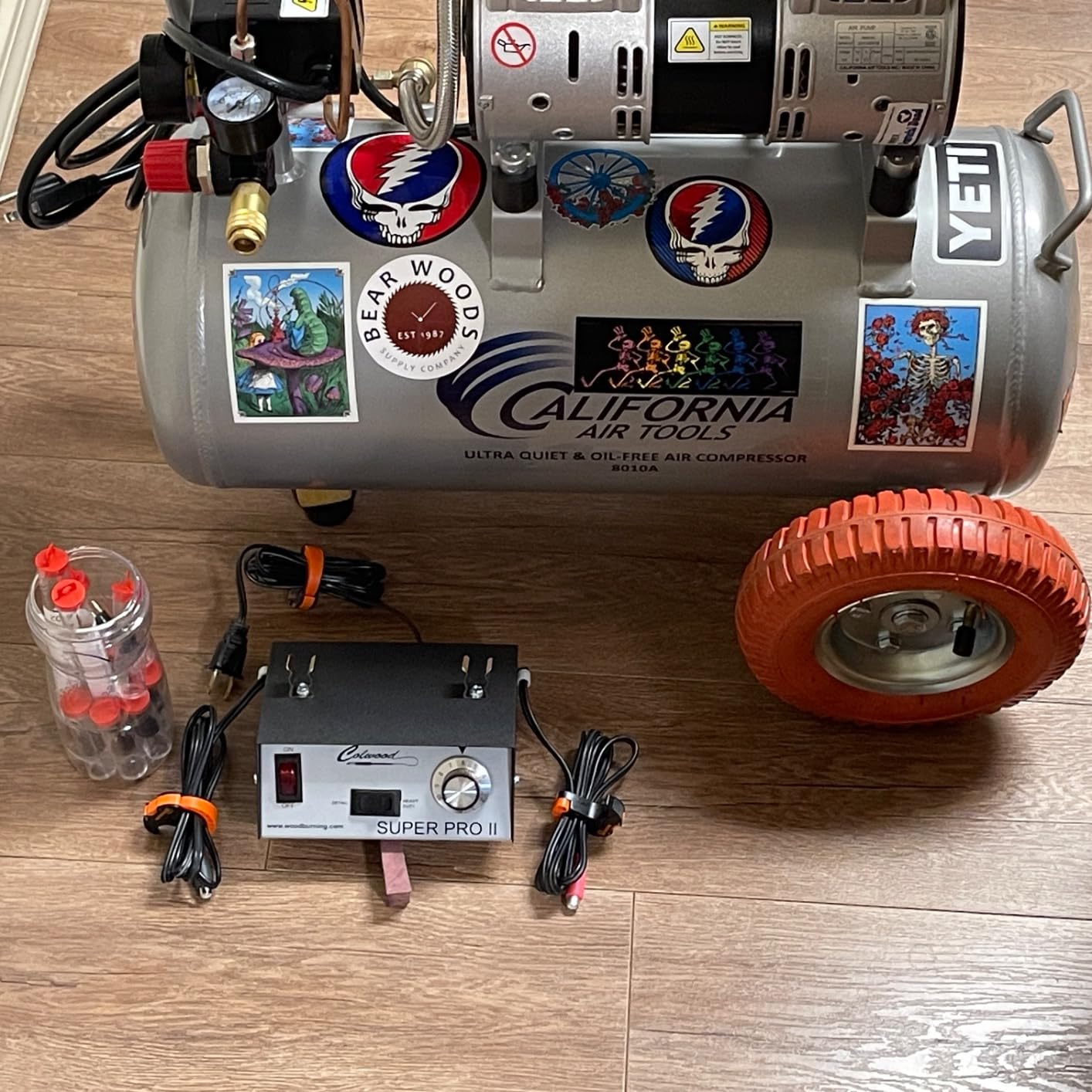
The wheel kit is the difference from the smaller California Air Tools units. Once it is full, 37.3 lbs rolls easily across a garage floor, so you can move it out of the walkway when you need the space for something else. That matters more in a one-car garage than most buyers expect.
Owners like the balance of a rust-free tank, wheels and quiet operation. The pump and motor follow the same 3000 hour oil-free design and 1680 RPM speed as the rest of the range.
When to choose this one
Garages where you inflate tires, run a blow gun, fit trim and do occasional nailing without a sustained high-airflow tool. The 8 gallon tank gives you long enough between cycles that the pump noise becomes an occasional event rather than a constant one.
It is also the quiet choice for a garage that does double duty as a workshop, because it can be rolled out of the way when you need the floor space.
Where patience runs out
Fill time is about 165 seconds from empty and recovery from 90 to 120 PSI is around 60 seconds. Those numbers are fine for intermittent work and frustrating when you want to run two tools or refill tires back to back.
The 120 PSI ceiling is the other limitation. Tools that want more pressure will be short-changed, and a compressor rated at 150 or 200 PSI gives you headroom for a wider range of jobs. If you need that, the DEWALT DWFP55130 or the Stealth units cover it.
5. Limodot 5 Gallon Quiet Kit: Best Starter Kit
Quiet Oil-Free Air Compressor, 68 dB, 2.8 CFM @ 90 PSI, 5 Gallon Air Tank
68 dB claimed noise
5 gal tank
120 PSI max
2.8 CFM at 90 PSI
1.2 HP
Pros
- Comes with 25 ft hose quick connect fitting and 13 piece accessory kit
- Refills in about 80 seconds with 25 second recovery
- 5 gallon tank with wheels kit for mobility
- Oil-free design starts reliably in cold weather
Cons
- Spec sheet lists 70 dB against a 68 dB marketing claim
- 1.2 HP and 2.8 CFM is below what framing nailers demand
- Supplied hose and fittings are basic accessory grade
The Limodot is the pick if you are starting from nothing and want a compressor, a hose and a set of fittings in one order. The box includes a 25 foot PVC air hose, a quarter inch quick-connect fitting and a 13 piece air tool accessory kit alongside the 5 gallon tank and wheel kit.
On paper it is a 1.2 HP oil-free unit delivering 2.8 CFM at 90 PSI, refilling in about 80 seconds with 25 second recovery. Owners rate it 4.5 with 79 percent five-star reviews, and the recovery speed is the part they praise most.
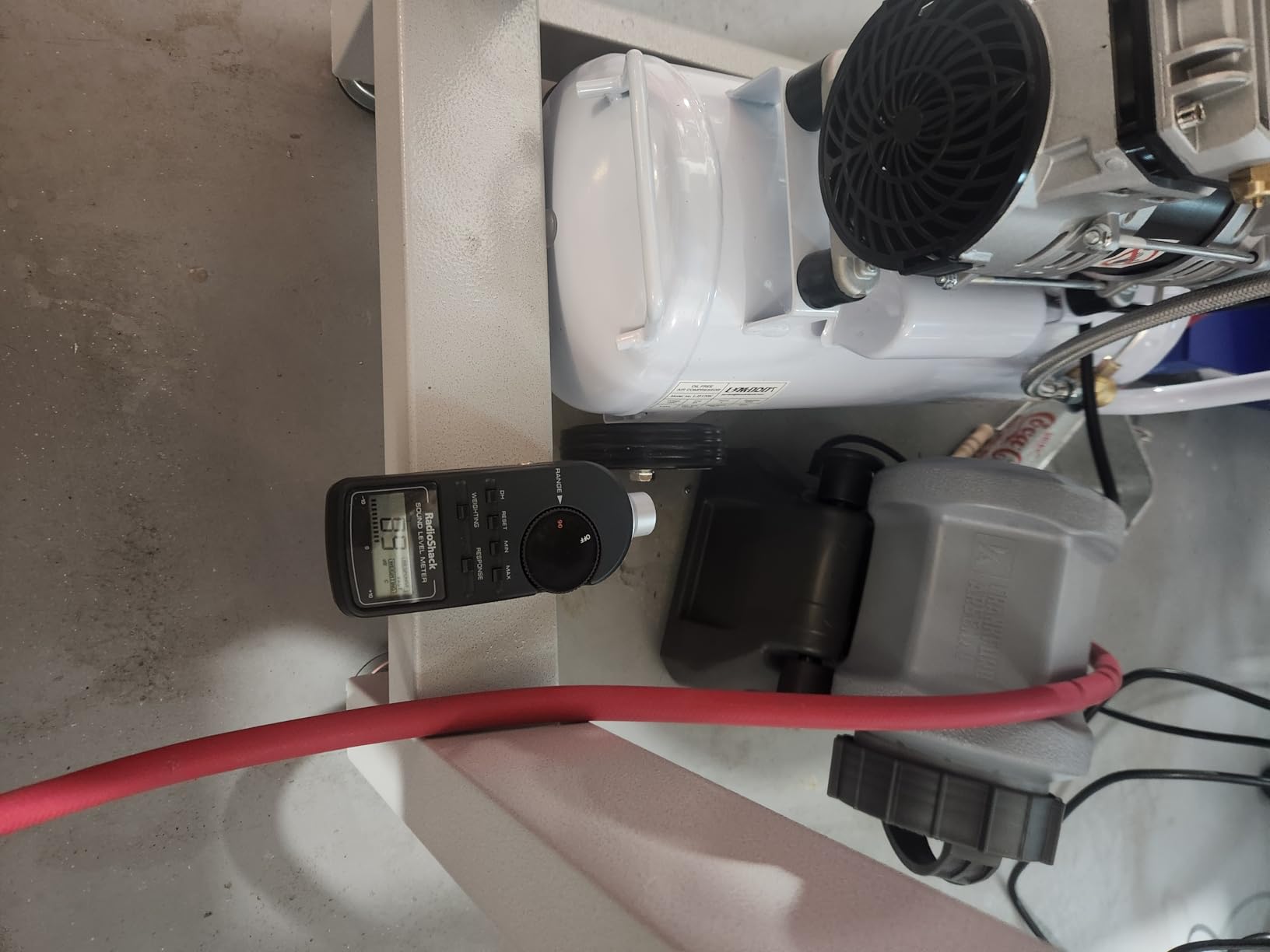
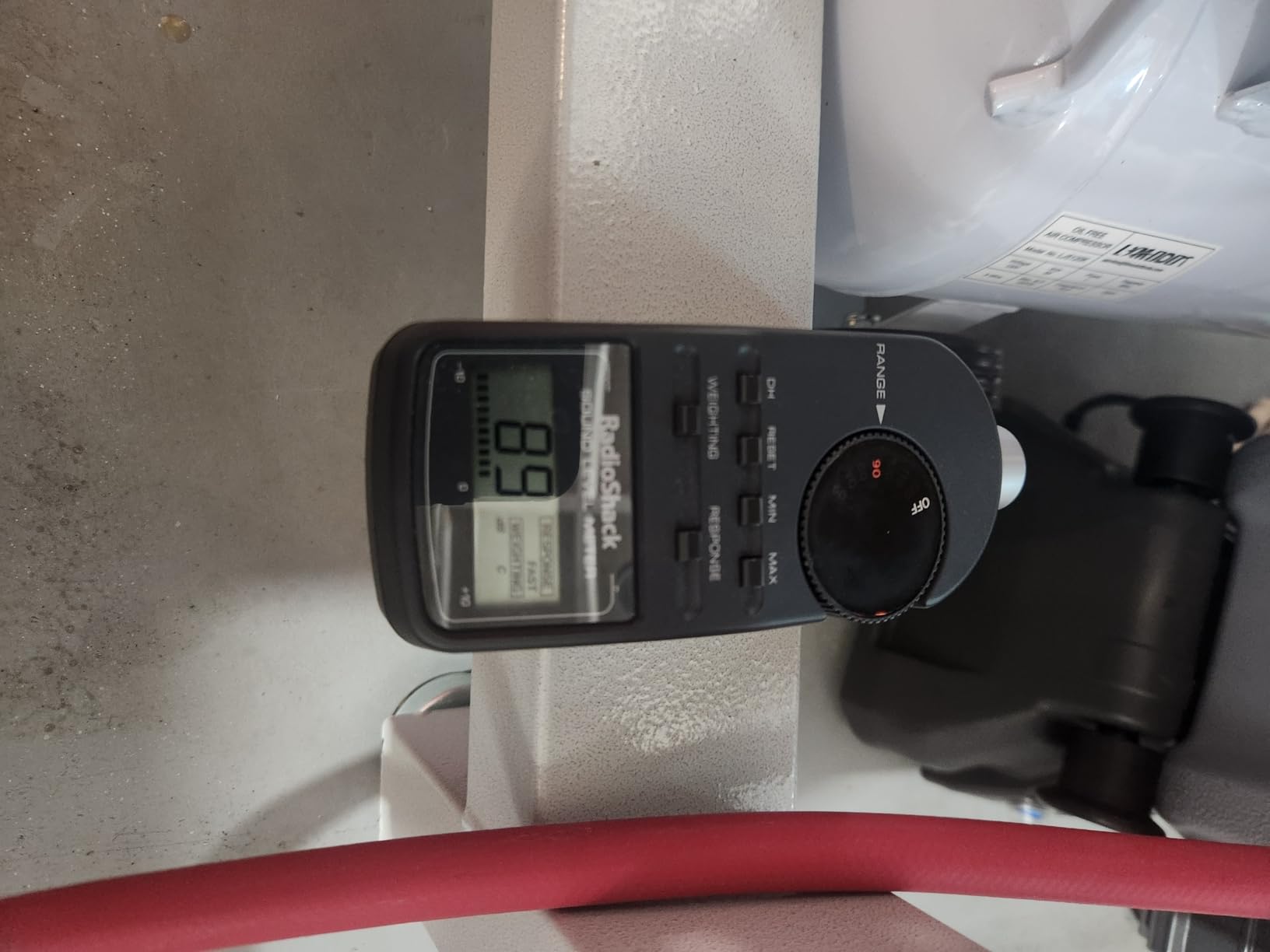
Sixty-eight decibels is a real improvement over a conventional pancake, though it is a different league from the 56 to 60 dB machines. The induction motor running at 3400 RPM is smooth and consistent, which is why owners describe it as usable indoors for workshop and jobsite work.
The oil-free design has a practical side benefit in an unheated garage. It starts reliably in cold weather and there is no oil to buy, check or spill. That removes one of the reasons people used to keep compressors in heated spaces.
Where it makes sense
First-time buyers, garage flats and rental setups where the goal is a complete working kit rather than a specialist machine. If inflating tires, running brad and finish nailers, inflating sports equipment and blowing out brake dust covers your list, the output is sufficient.
The bundled kit also means you are not making a second trip for fittings, which is where a lot of beginners lose an afternoon.
Where to be careful
Check the noise spec before buying for an attached space. The marketing says 68 dB and the spec sheet says 70 dB, and buyers should assume the higher number. That is still quieter than a standard compressor, but it is a different conversation from the 60 dB class.
At 2.8 CFM it will not run a framing nailer or an HVLP spray gun continuously, and the supplied hose and fittings are accessory grade rather than professional brass. For heavy duty, step up.
6. DEWALT DWFP55130: Best for Trim Nailers
DEWALT Air Compressor for Trim, 200-PSI Max, Quiet Operation (DWFP55130)
71.5 dBA noise
2.5 gal tank
200 PSI max
3.0 SCFM at 90 PSI
1.1 HP
Pros
- 200 PSI max is the highest pressure rating in this roundup
- 3.0 SCFM at 90 PSI handles long nail bursts
- Low 12 amp draw starts easily and trips fewer breakers
- Stores and operates vertically or horizontally
Cons
- 71.5 dBA is louder than the 56 to 60 dBA premium quiet units
- 2.5 gallon tank is small for a 200 PSI machine
- 36 lbs and 12.5 inches thick makes it bulky for a pancake
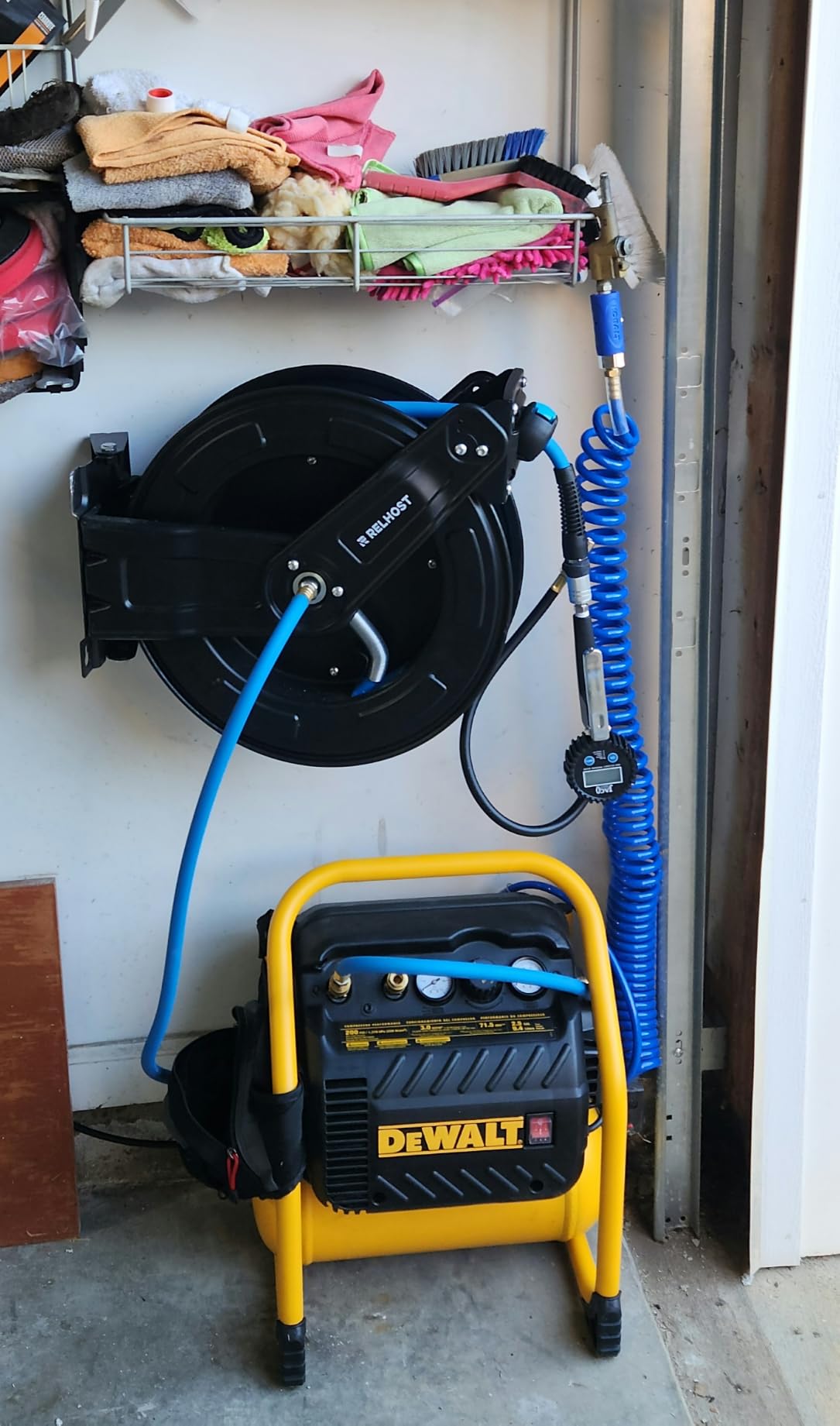
The DWFP55130 is the pressure and airflow pick of the group. Three SCFM at 90 PSI, a 200 PSI maximum and dual quick couplers mean it can run two nailers at once or a nailer and a blow gun together, which is the reason trim carpenters like it.
It is also the honest entry in this roundup for noise. At 71.5 dBA, tested to ISO3744, it is about eleven decibels above the premium quiet units here, which is a difference you can plainly hear across a room.
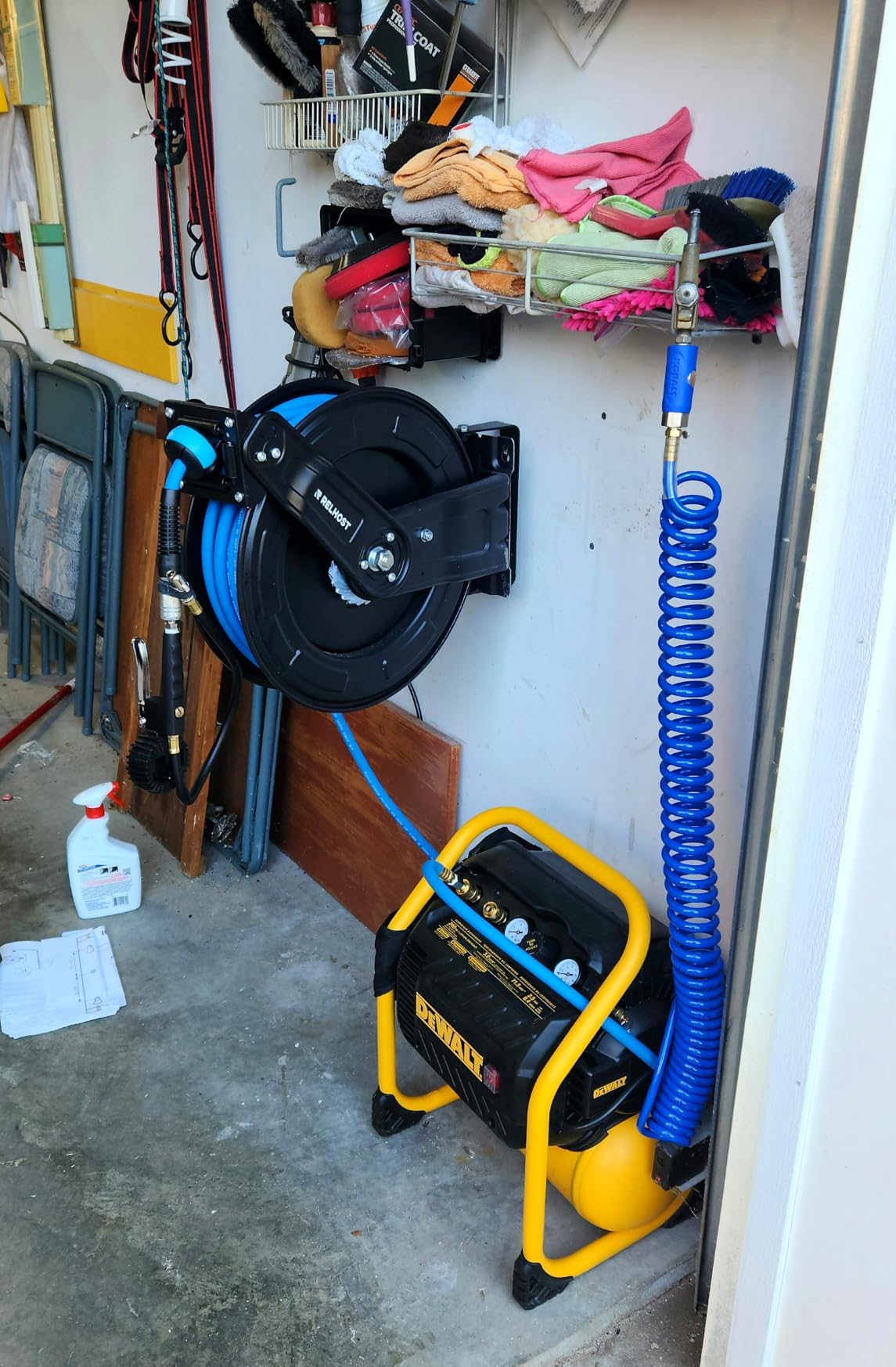
The 12 amp draw is a genuine advantage in a home garage. Small compressors that pull 15 amps or more trip breakers when the pump kicks in alongside a saw or a welder, and this one starts easily on a standard household circuit without that argument.
It can be stored and operated in either orientation, which matters in a one-car garage where floor space is the scarce resource. A ball valve drain and cord wrap are the small touches that suggest it was designed for real use.
When it earns its place
Interior trim and finish carpentry. If you are hanging a lot of baseboard, casing and crown, the combination of airflow, dual couplers and 200 PSI means you are not waiting on the tank between pieces.
It is also a reasonable choice for a detached workshop where the working hours are daytime and you care more about output than about a shared wall.
Where the noise rules it out
If a bedroom is on the other side of that wall, 71.5 dBA is the point where it stops being a preference and becomes a problem. Most complaints on this listing are exactly that, plus a note that 2.5 gallons feels small for a machine rated at 200 PSI.
At 36 lbs and 12.5 inches thick, it is not the flat pancake footprint you get from a 6 gallon unit. If the noise figure disqualifies it, the Makita MAC320Q delivers similar airflow at 60 dB, though with a smaller tank.
7. Metabo HPT EC28M: Best for Carrying It
Metabo HPT Quiet Air Compressor, Portable 1 Gallon Oil-Free, EC28M
59 dB noise
1 gal tank
125 PSI max
0.5 HP
25.2 lbs
Pros
- Only 25.2 lbs with a rubber carry handle
- 59 dB is quiet enough to hold a conversation over
- Steel roll cage in a compact footprint
- Integrated control panel for accurate PSI settings
Cons
- 1 gallon tank and 0.5 HP limit it to light nailing inflating and cleaning
- No CFM rating published in the spec data
- Lowest five star share of the premium quiet units here
At 25.2 lbs the Metabo HPT EC28M is the lightest machine in this group, light enough to carry up a flight of stairs with one hand, and it still delivers a 59 dB rating. That combination is unusual, because most of the lightest machines are also the loudest.
The steel roll cage gives it more structural protection than a bare pancake normally gets, and the integrated control panel lets you set outlet pressure accurately rather than guessing at the regulator. Owners rate it 4.4 across 845 reviews.
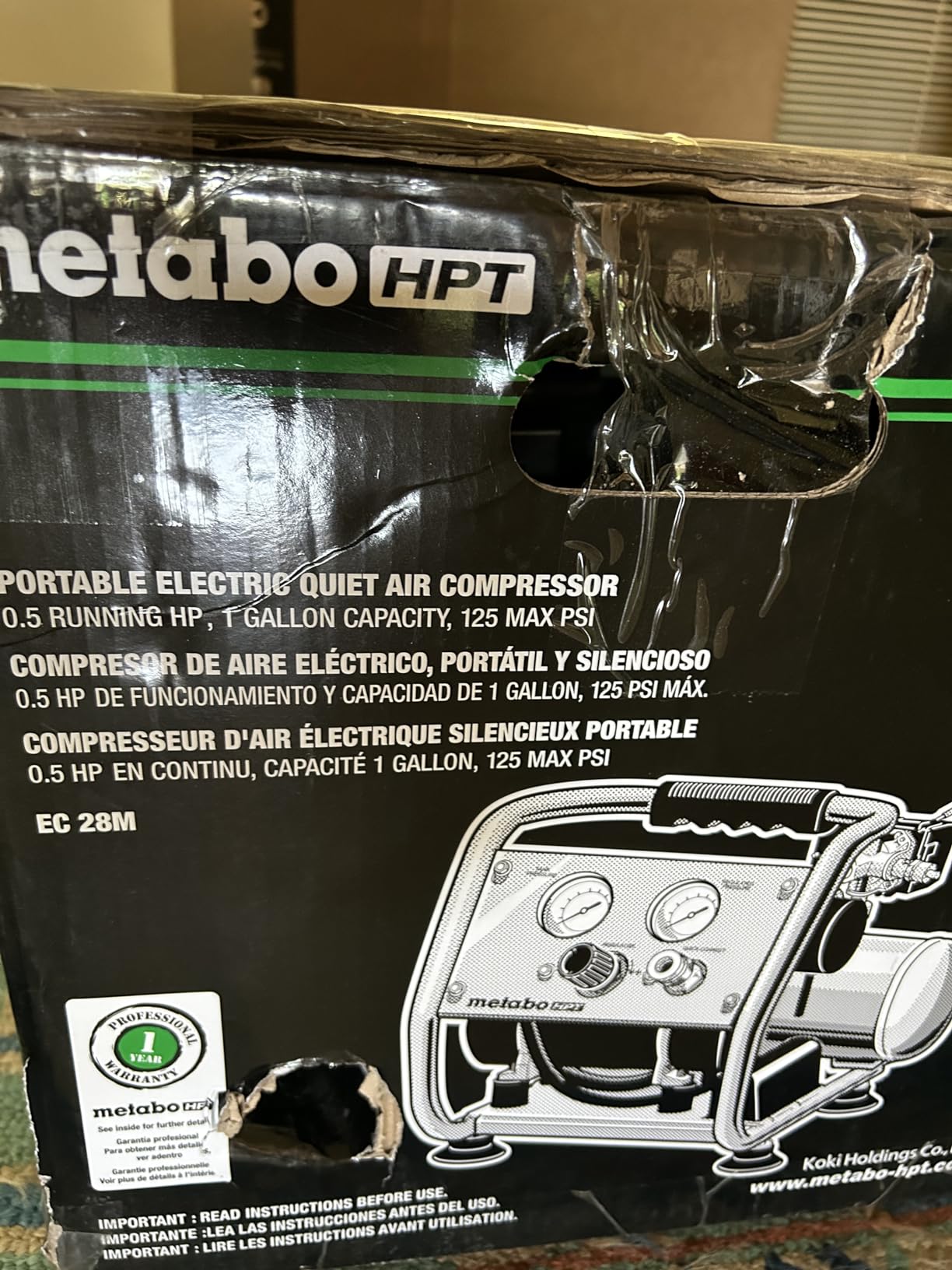
Its 0.5 HP motor and 1 gallon tank make the scope narrow, but the universal quick coupler makes tool changes fast across framing, siding, finish and roofing nailers. It is a machine built for one-handed mobility rather than volume.
The oil-free design needs no maintenance, and an overload protection circuit cuts power rather than letting the motor cook itself in a hot garage.
Who should buy it
People working in a basement, a loft, a small apartment workspace or a garage on a different level from their tools. Anywhere weight and footprint are the deciding factors. It also works well as a second unit for inflating and blowing out brake dust while a bigger machine handles air tools.
At 59 dB it is genuinely quiet enough to run while someone is sleeping on the other side of a thin wall.
Where the specification gaps bite
No CFM figure is published in the spec data, so you are buying airflow on brand reputation rather than a number. That matters more if you plan to grow into bigger tools.
Its 73 percent five-star share is the lowest among the premium quiet units here, which suggests more reported failures over time than the higher-rated machines. If you are buying once and want it to last, the California Air Tools 1P1060S in the same weight class is the safer bet.
8. VEVOR 10 Gallon: Best for Impact Wrenches and Air Tools
VEVOR Air Compressor, 10 Gallon Steel Tank, 2HP 5.3 CFM@90 PSI Oil Free Air Compressor & Max. 125PSI Pressure, 78dB Ultra Quiet Portable Compressor, for Auto Repair, Tire Inflation, Spray Painting
78 dB noise
10 gal steel tank
125 PSI max
5.3 CFM at 90 PSI
70.6 lbs
Pros
- 5.3 CFM at 90 PSI is the highest airflow in this roundup
- Refills a 10 gallon tank in roughly a minute
- Multi layer muffler is far quieter than a typical pancake
- Three layer steel tank with seamless welding resists rust
Cons
- 78 dB makes it one of the loudest units we reviewed
- Needs a dedicated circuit and will not run reliably on extension cords
- Cord is only about 40 inches and the small wheels tip the 70 lb unit
This is where we tell you plainly that quiet and powerful pull in opposite directions. The VEVOR delivers 5.3 CFM at 90 PSI from a 1680 RPM oil-free motor, which is enough airflow for framing nailers, impact wrenches and spray guns, and it also happens to be one of the loudest machines here at 78 dB.
We include it because a lot of readers searching for quiet compressors actually own a loud pancake and need more air, not less. Owners rate it 4.3 with 72 percent five-star reviews and praise the combination of output and refill speed.
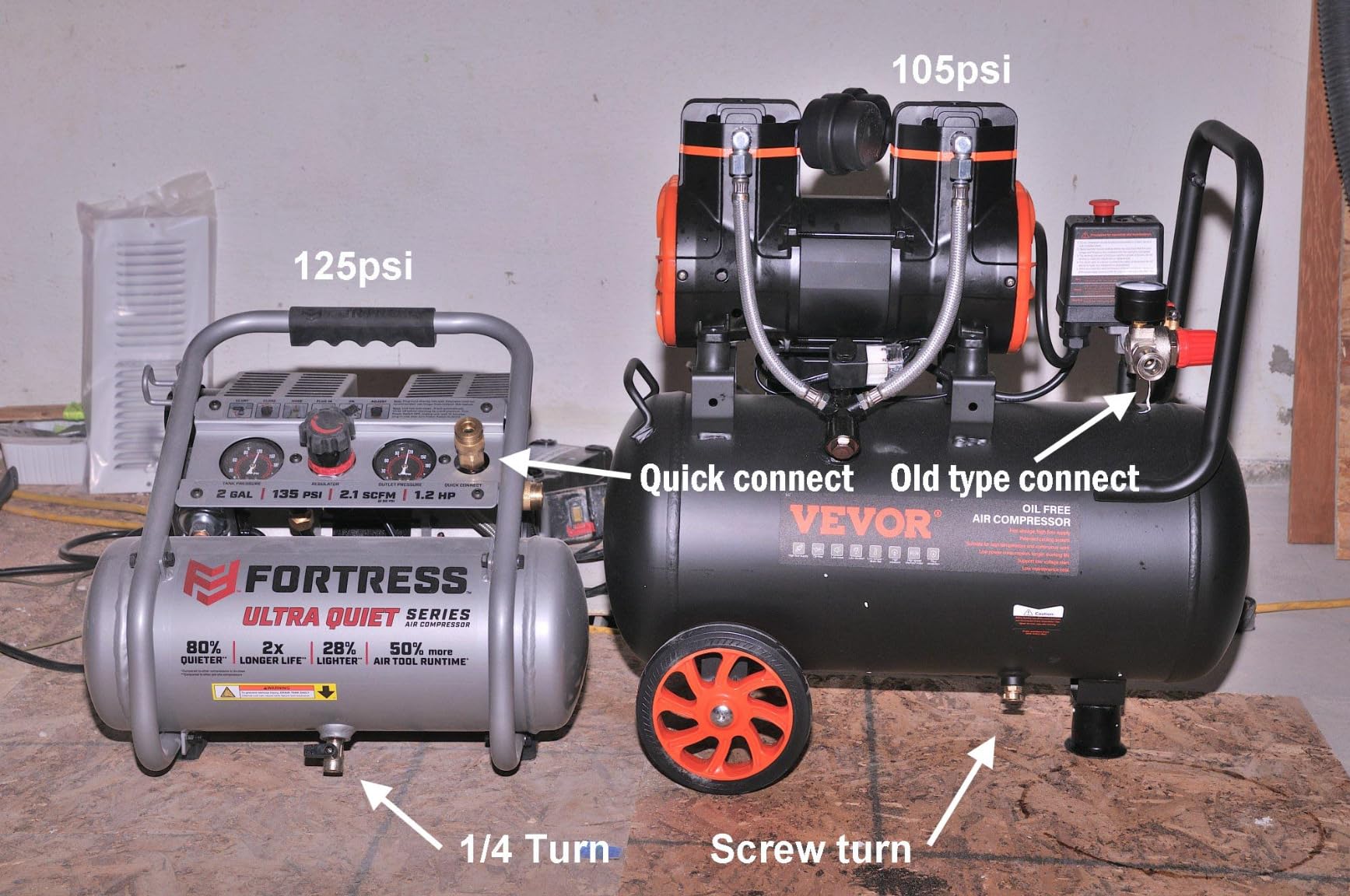
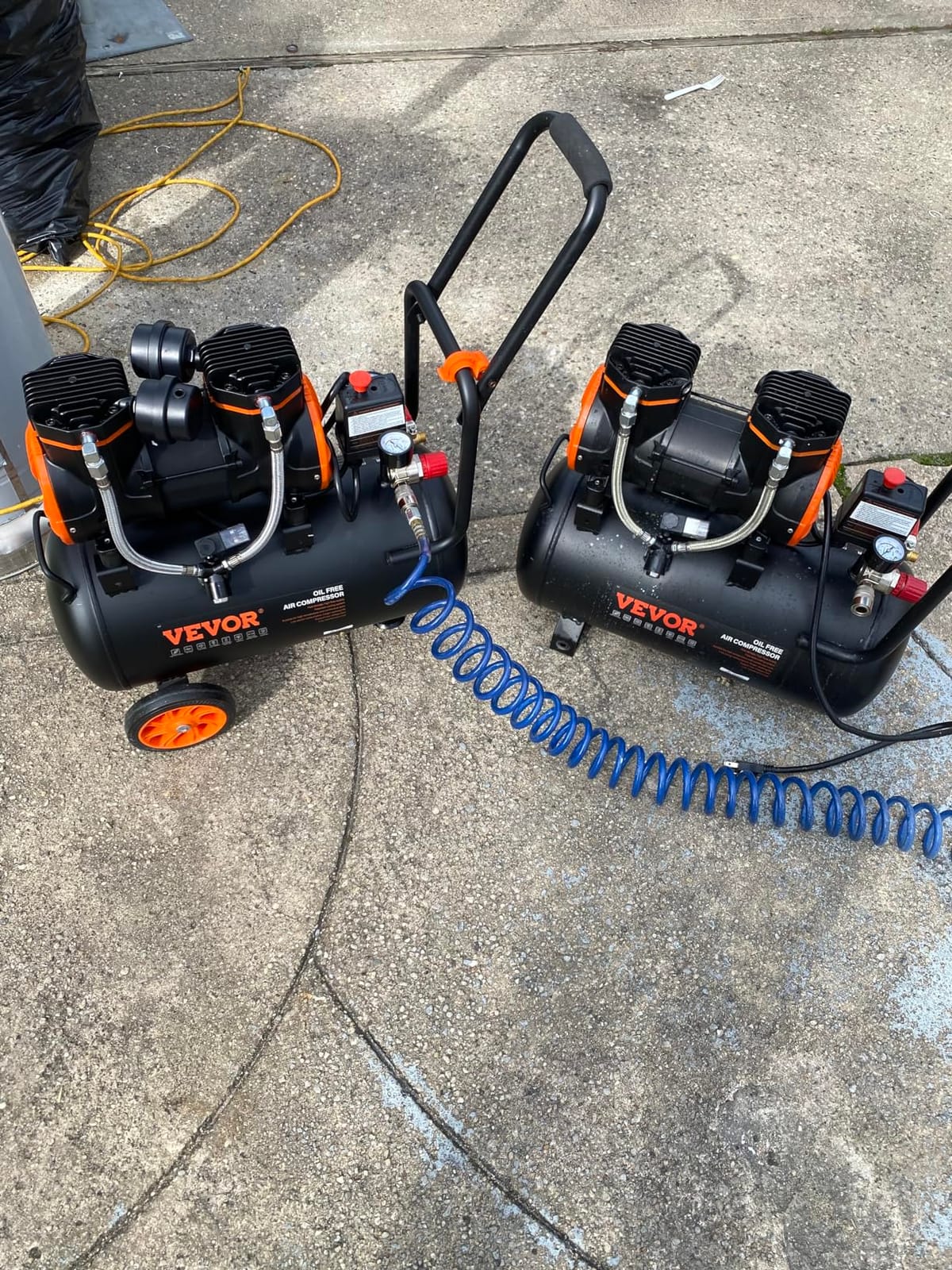
Its noise reduction is real, just not absolute. A thickened muffler cover, a rubber muffler pipe and filter cotton bring it well below the 85 to 90 dB of a conventional pancake of the same size, but 78 dB is still loud enough to rule out early mornings and shared walls.
The tank uses a three layer rust and wear resistant coating over Q235B structural steel with seamless welds, and a large cooling fan with automatic overheat and overpressure protection. Those are sensible features for a machine that will be worked hard.
Where it belongs
Detached shops, working vehicles and any job where a bolt takes twenty minutes instead of two. A 5.3 CFM output is what lets you run an impact wrench without the tank emptying between bursts, and the roughly one minute refill keeps it fed.
It is the sensible choice for someone who has accepted that quiet is not available at this power level yet.
Where it is the wrong buy
Any home with a bedroom next to the garage. At 78 dB, running this at eight in the evening is a problem for everyone in the house, not just you.
The electrical requirements are equally important. At 70.6 lbs with a cord of roughly 40 inches, it needs a dedicated circuit rather than an extension cord, and the small wheels tip when you move it by the handles. If quiet is genuinely your priority, the Stealth 20 gallon gives you 5 CFM at 90 PSI at 68 dB instead.
9. Makita MAC320Q: Best for Running Two Nailers
Makita MAC320Q Quiet Series 1-1/2 HP, 3 Gallon, Oil-Free, Electric Air Compressor
60 dB noise
3 gal tank
135 PSI max
1.5 HP at 1750 RPM
Pros
- Refills faster than most tools can discharge air so work never pauses
- Dual hose connections run two nailers or a nailer and blow gun
- Separate tank and tool gauges with manual adjustment
- 60 dB Quiet Series operation at 1750 RPM
Cons
- Listed 12 by 12 by 12 inch dimensions are wrong and the real size is about 18 by 19 by 14
- Heavier and bulkier than a 6 gallon pancake it can outperform
- Needs unplugging and bleeding down after a tripped breaker
The MAC320Q is the step up from the MAC210Q, with a 1.5 HP motor and a 3 gallon tank in the same 60 dB Quiet Series package. Owners describe it as a quiet workhorse that fills faster than their tools can discharge, so the work never pauses to wait for pressure.
At 4.6 stars with 85 percent five-star reviews, it holds the strongest review distribution of the multi-tool capable machines here. Trim and finish carpenters in particular rate it highly for the dual hose connections and the separate tank and tool pressure gauges.
Those separate gauges matter more than they sound. A pressure-sensitive finish nailer can be damaged by an unregulated tool line, and manual adjustment lets you set the tool pressure independently of what the tank is doing. It is a small feature that separates a tool compressor from a general one.
Owners report running it all day on 15, 16, 18 and 23 gauge nailers without trouble, backed by a roll cage, an oil-free dual piston pump and the same 1750 RPM motor that defines the Quiet Series.
When to choose it over the MAC210Q
Choose this one when you are running two guns at a time, or a nailer while you blow off dust. The dual connections remove the need to swap hoses constantly, and the extra 0.5 HP gives more recovery between bursts.
It is also the right pick for a garage where 135 PSI of headroom is useful, such as for die grinders or spray equipment that wants more pressure than a 120 PSI machine delivers.
Where buyers get frustrated
The listed dimensions of 12 inches square are simply wrong, and the real unit is closer to 18 by 19 by 14 inches. Measure your shelf before you order, because it is bulkier than a 6 gallon pancake despite holding less air.
Some owners report fittings that leak on first connection or stick open when uncoupled, and after a tripped breaker the unit will not restart until it is unplugged, replugged and the tank bled down. Know that routine before it surprises you on a job.
10. Stealth 20 Gallon: Best for Long Jobs
Stealth 20 Gallon Ultra Quiet Air Compressor,1.8 HP Oil-Free Peak 150 PSI 68 Decibel, 5.5 CFM @ 40 PSI 5 CFM @ 90 PSI Silent Long Life Electric Air Compressor W/Wheel for Garage
68 dB noise
20 gal steel tank
150 PSI peak
5 CFM at 90 PSI
121.4 lbs
Pros
- Largest tank in the roundup at 20 gallons
- 5 CFM at 90 PSI with 150 PSI peak handles nailers and impact guns
- Owners measure around 65 dB at 8 to 10 feet and describe a soft purr
- 8 inch rubber wheels move 121 lbs more easily than expected
Cons
- 121 lbs is very heavy and loading it into a truck is a chore
- Some units will not start with air in the tank on undersized wiring
- Customer service contact reportedly returns errors and 12 percent one star reviews
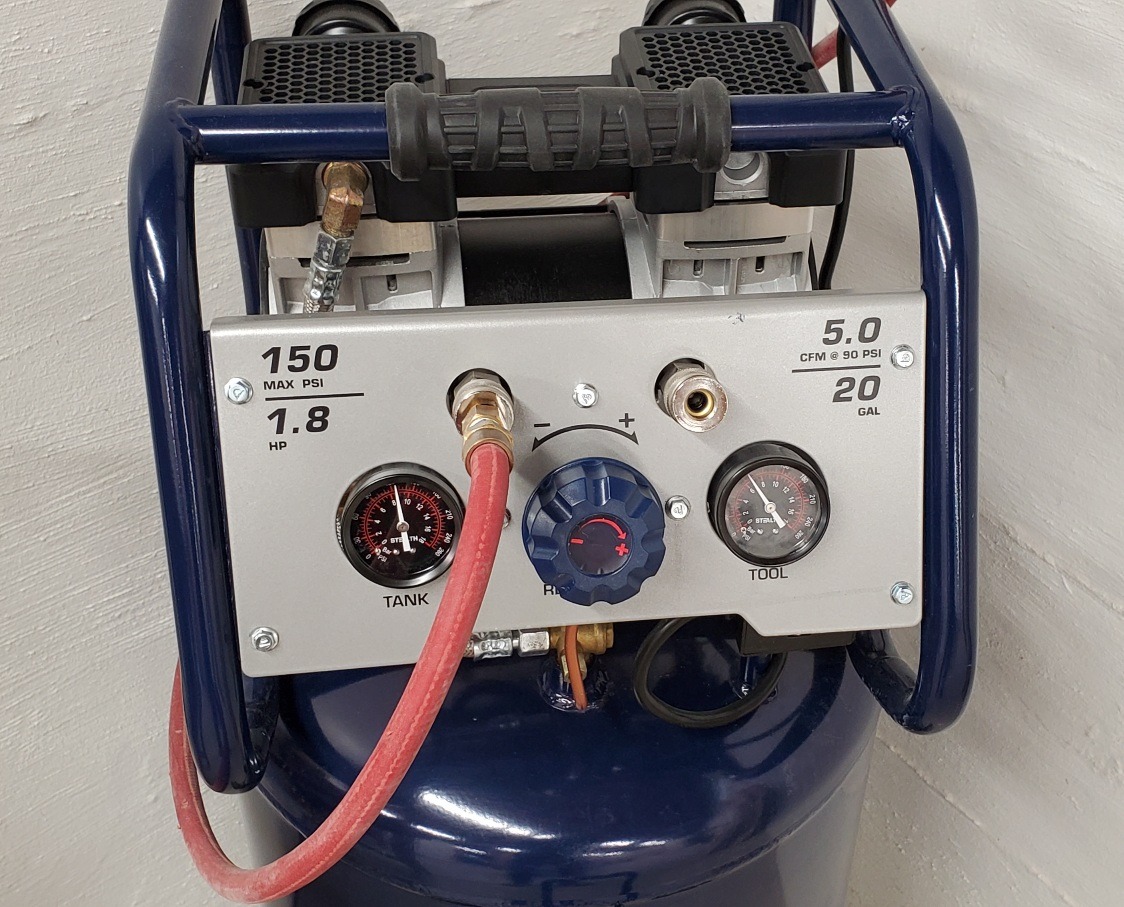
This is the quietest compressor in the group that can genuinely run impact wrenches. Twenty gallons of steel tank, 5 CFM at 90 PSI and a 150 PSI peak put it in a different class from the 1 and 2 gallon units, while the 68 dB rating keeps it under the threshold that most people find acceptable in a detached shop.
Owners measuring it at 8 to 10 feet report around 65 dB and describe the sound as a soft purr rather than clatter, which is consistent with the published figure. It is a vertical format with 8 inch rubber wheels and two quick couplers for switching tools.
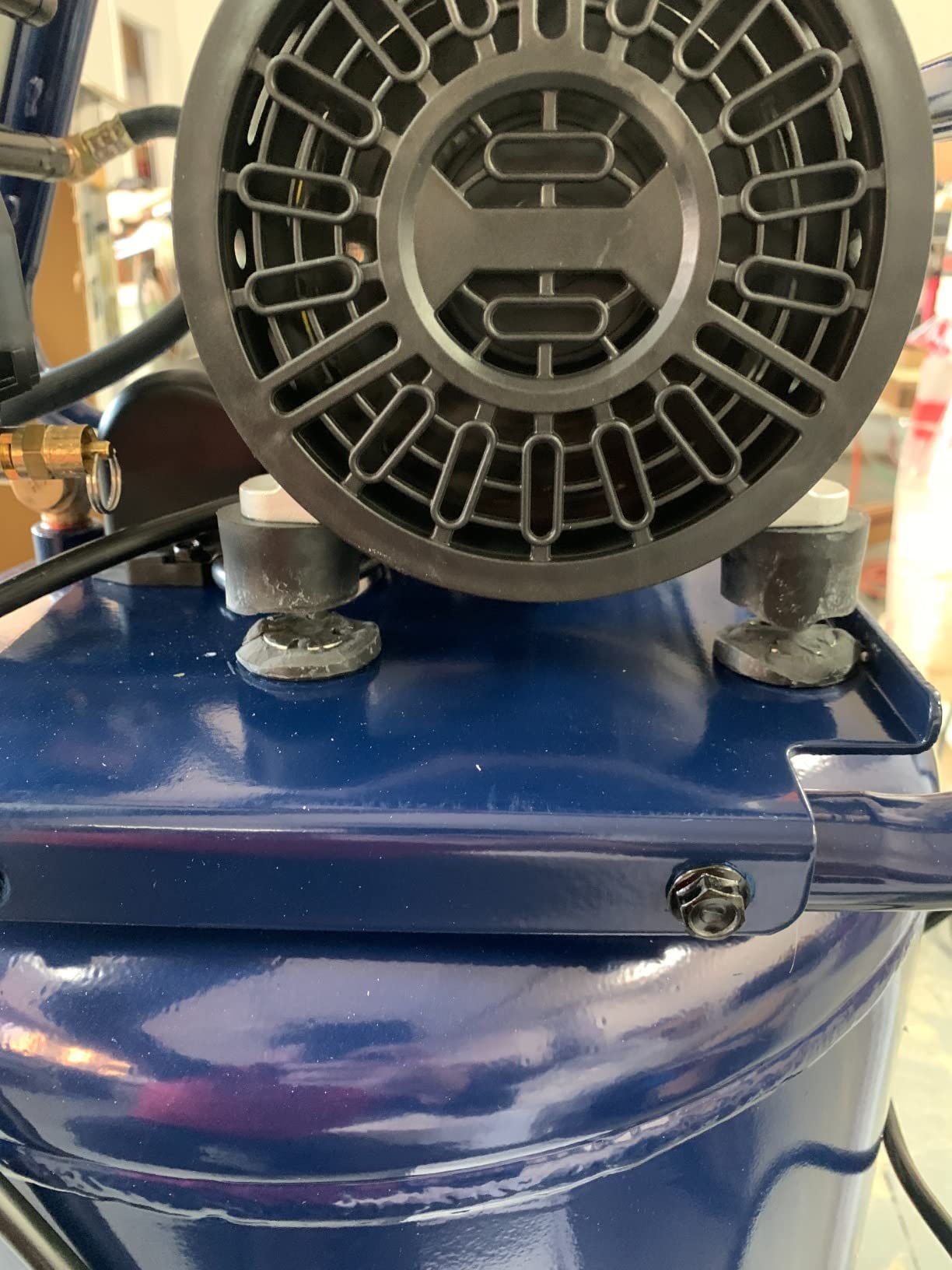
Twenty gallons is a lot of stored air. It means filling multiple tires back to back, or running a long job without the pump restarting at all. For someone who tires of waiting on a small tank, that difference is what justifies the size.
The oil-free induction motor means no oil changes and no filter purchases, and the tank body is heavy duty steel. It comes with a limited lifetime warranty, which is a stronger commitment than the one-year terms on most of the units in this roundup.
What the tank capacity buys
Any job where stopping to wait is the problem. Removing a tank of lug nuts, topping up four tires, running a bead blaster, or any sequence of tools that draw heavily in succession. The 150 PSI peak also gives you headroom for tools that want more pressure than a 120 PSI unit offers.
Two quick couplers mean a nailer and a blow gun can be connected at the same time, which speeds up finishing work considerably.
Where the compromises bite
At 121.4 lbs this is the heaviest machine here by a wide margin, and the 42 inch vertical format takes more floor space than a pancake. Loading it into a truck bed is genuinely a chore, and the wheels only help once it is on the ground.
It is also among the lowest-rated picks in the roundup at 4.2, with a 12 percent one-star share driven by early failures. Buyers also report units failing to start with air in the tank on undersized wiring or long extension runs, and a customer service contact form that reportedly returns errors. Give it a dedicated 120V circuit.
11. Stealth 12 Gallon: Best Mid-Size Vertical
Stealth 12 Gallon Ultra Quiet Air Compressor, 1.5 HP Oil-Free Peak 150 PSI 68 Decibel,5 CFM @ 40 PSI 4 CFM @ 90 PSI Silent Portable Long Life Electric Air Compressor W/Wheel for Garage
68 dB noise
12 gal steel tank
150 PSI peak
4 CFM at 90 PSI
95 lbs
Pros
- 12 gallon oil-free tank with 4 CFM at 90 PSI covers mid-duty nailing and drilling
- 68 dB induction motor for quiet garage operation
- Rated cycle beyond 1000 hours with a limited lifetime warranty
- Q235B steel tank with 7 inch rubber reinforced wheels
Cons
- 95 lbs is heavy and awkward to reposition
- 4 CFM at 90 PSI falls short of what framing nailers and impact wrenches demand
- 67 percent five star share is the weakest distribution in this roundup
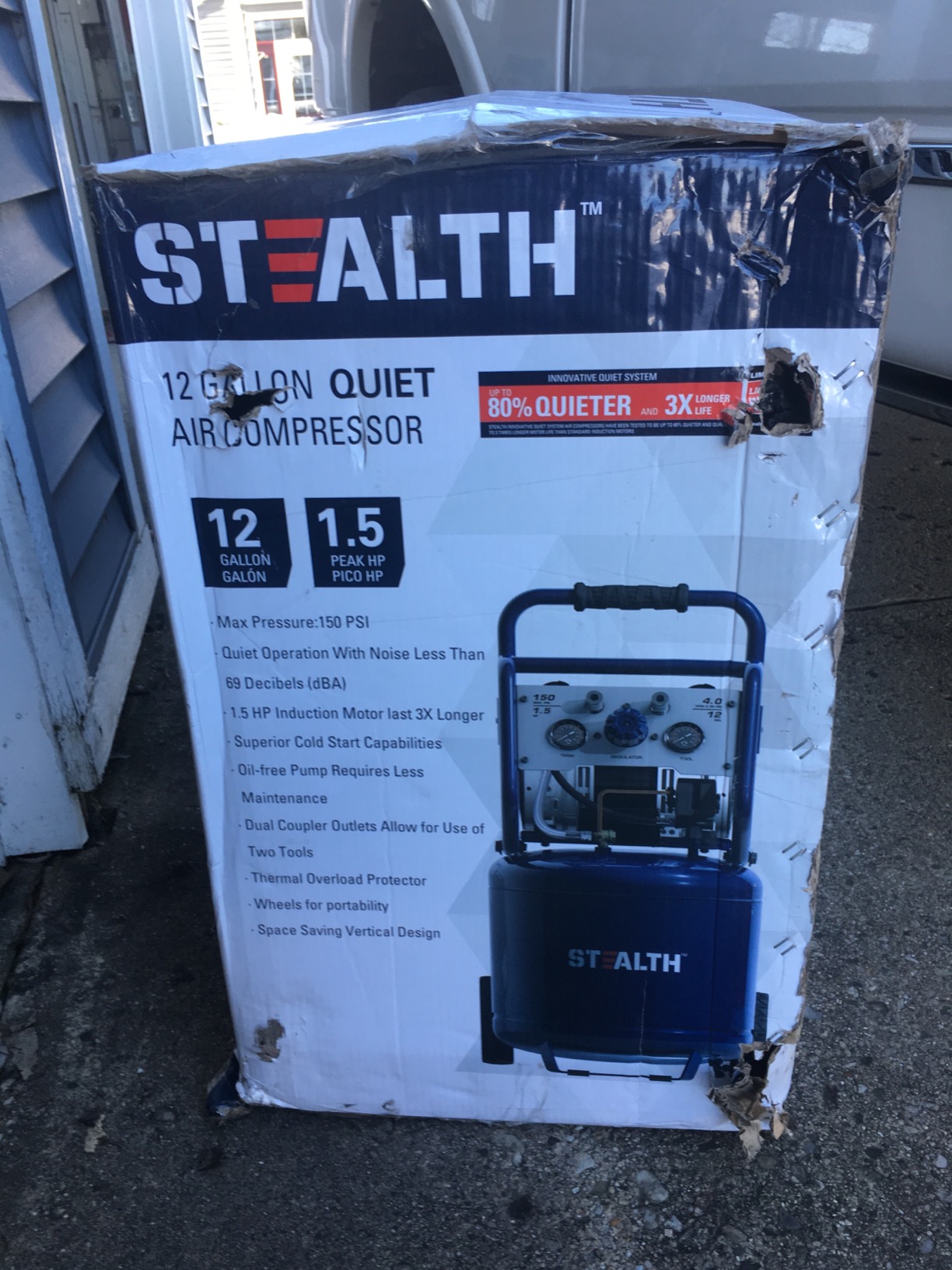
The 12 gallon Stealth is the same idea as its 20 gallon sibling with less tank and forty pounds taken off. It runs a 1.5 HP induction motor at 4 CFM at 90 PSI with a 150 PSI peak, at a published 68 dB.
That places it in the awkward middle of this roundup. It is quiet enough for a working garage and large enough to matter, but 4 CFM will not keep a framing nailer or an impact wrench fed without stopping, and at 95 lbs it is still a two-person move in some homes.
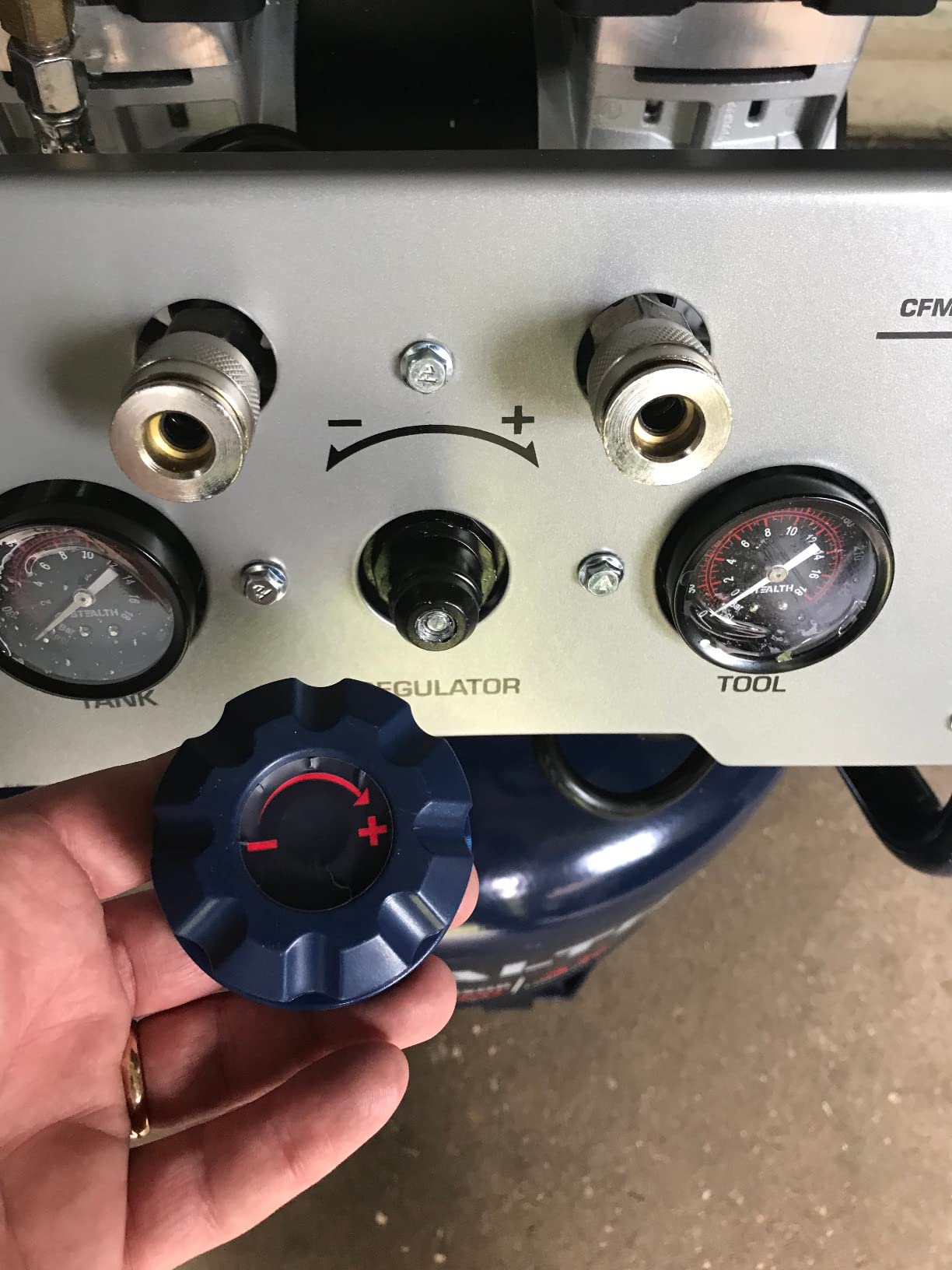
Owners do like the build. The Q235B heavy duty steel tank body and 7 inch rubber reinforced wheels give it stability, and the manufacturer rates the cycle life beyond 1000 hours and backs it with a limited lifetime warranty.
It comes with a 6 foot electric cord and a user manual, so you will want to think about circuit length before it arrives. Owners describe genuinely quiet induction motor operation and a well-built tank.
Who it fits
Someone upgrading from a 6 gallon pancake who wants more stored air and a vertical footprint that stores against a wall. Mid-duty nailing, drilling, spraying and blow cleaning are all comfortably inside its capability.
The vertical format is a real advantage in a narrow garage because it uses floor area rather than ceiling height.
Where the numbers do not work
Impact wrenches and framing nailers both exceed 4 CFM at 90 PSI, so this unit is not the answer for lug removal or structural work. If that is your work, the VEVOR or the Stealth 20 gallon are the choices here.
Its review distribution is the weakest in the group, with 67 percent five-star and 9 percent one-star feedback, and it ranks far below its 20 gallon sibling in demand. Buy it for the form factor, not for the brand momentum.
12. CRAFTSMAN 6 Gallon Pancake: Best First Tank
CRAFTSMAN 6 Gallon 150 PSI Oil-Free Pancake Air Compressor CMXECXA02106410
82 dB noise
6 gal tank
150 PSI max
2.6 SCFM at 90 PSI
30.8 lbs
Pros
- 6 gallon tank at 150 PSI gives much more runtime than 1 or 2 gallon units
- Oil-free low-voltage start motor needs no maintenance and starts easily
- Dual quick couplers run two tools at once
- Compact 30.8 lb build with a carry handle
Cons
- 82 dB is the loudest rating in this roundup
- Some owners report handles arriving broken or in pieces
- Occasional reports of units not restarting and arriving with cracked gauges
We are including the loudest machine in the group on purpose, because a lot of first-time buyers do not need silence nearly as much as they think they do, and this one delivers a 6 gallon tank at 150 PSI for very little money. It is a solid first compressor that will grow with you.
At 82 dB it belongs in a detached shop and nowhere near a bedroom wall. Reviewers are consistent about that, and equally consistent about the machine itself, which holds 4.5 stars with 79 percent five-star feedback on a smaller review base than the rest of the list.
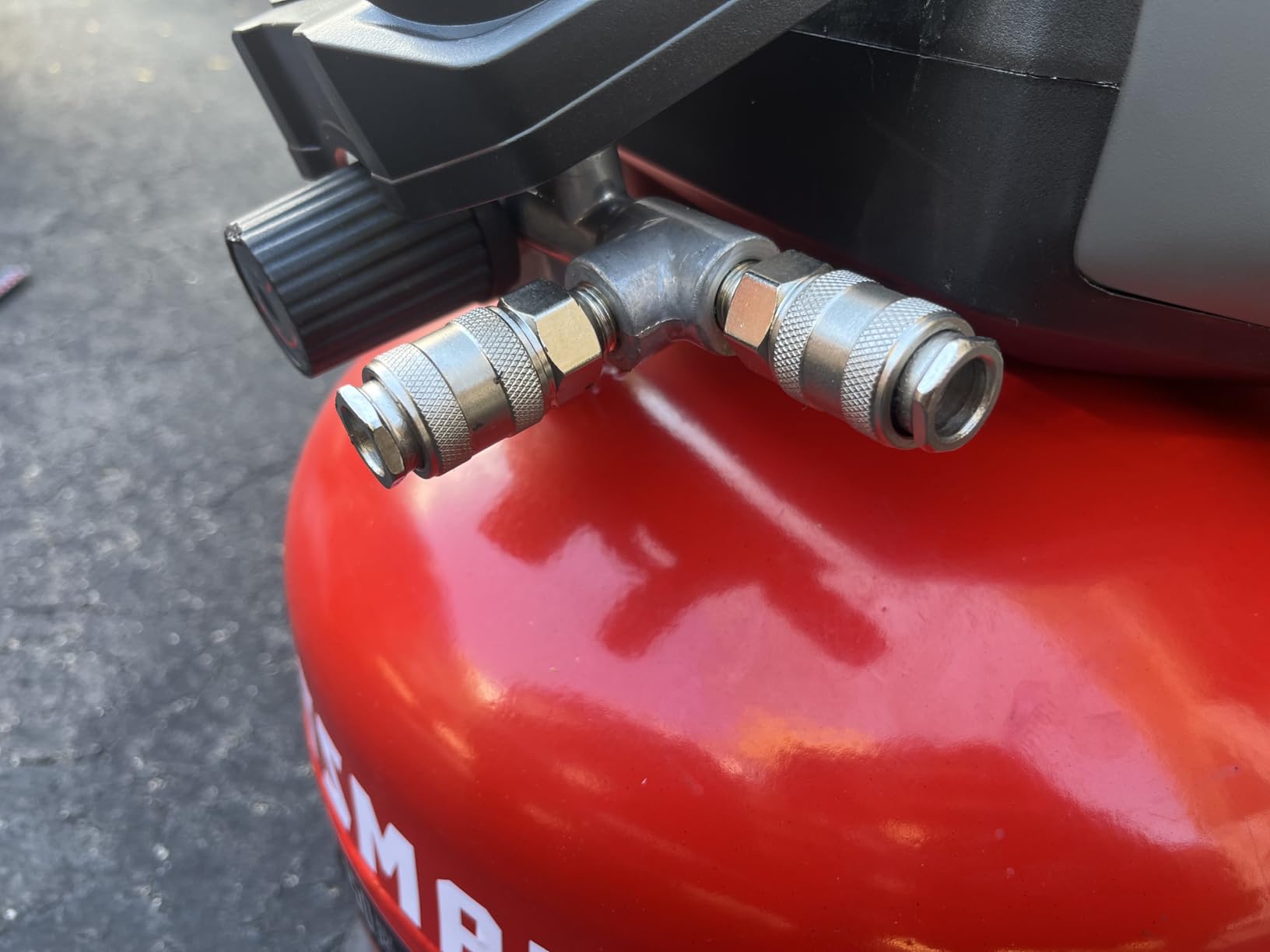
Six gallons at 150 PSI is a real upgrade from the 1 and 2 gallon machines people usually start with. The low-voltage start motor comes on easily without the aggressive kick that trips breakers, and dual couplers let two tools run at once.
At 30.8 lbs with a carry handle it moves around a garage without drama, and the pancake footprint stores flat against a wall or under a bench. For inflating, light nailing and cleanup, that is a genuinely capable machine.
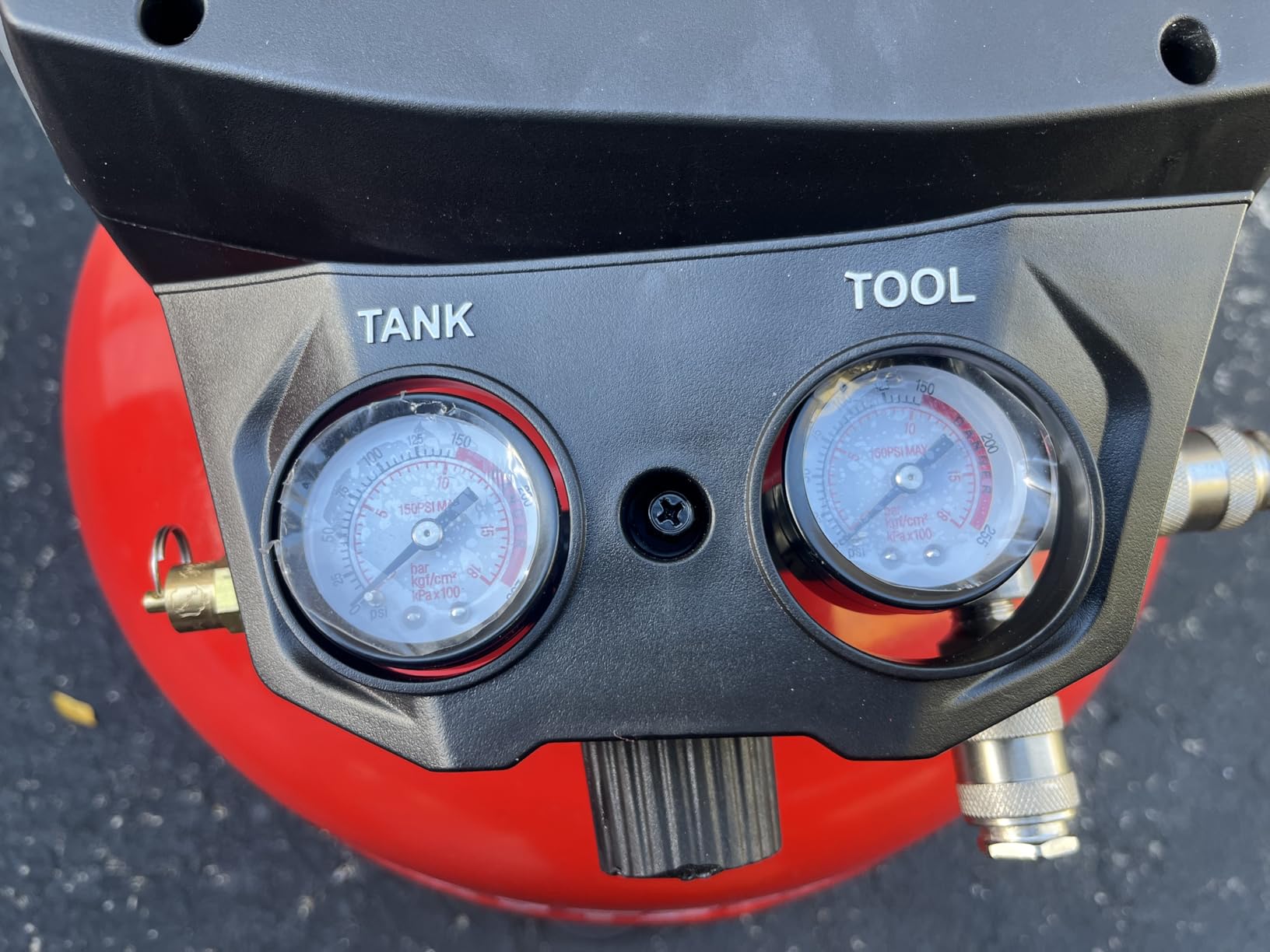
Where it is the right buy
Your first compressor, in a detached or semi-detached garage, doing light woodworking, tire inflation, blowing out brake dust and general cleanup. The 1 year warranty is backed by a US-based service team, which is worth more for a first purchase than it sounds.
It is also a good platform to grow from, because the dual couplers mean you are not limited to one tool at a time.
Where it will frustrate you
The noise. At 82 dB it is louder than a vacuum cleaner, and it is the single most common reason people end up replacing their first compressor within a couple of years. If you have already decided that noise is the problem, this is not the answer.
Owners also report handles arriving broken or in pieces, units that shut off and will not restart, and occasional cracked gauges and tank brackets on arrival. At 2.6 SCFM it is also below what continuous spray painting or framing work requires.
How to Choose a Quiet Compressor for Your Garage
Noise is a solved problem only if you buy the right category of machine. Spend a paragraph on where the compressor lives before you spend anything on the rest of the specification, because the same model is the right answer in a detached shop and the wrong one in a shared wall.
Attached garage or detached shop
In an attached garage, anything above 65 dB is going to reach the house, which leaves you choosing between the 56, 59 and 60 dBA units and the 68 dBA pair. Our default for that situation is the Makita MAC210Q, because 60 dBA with a roll cage and a quick coupler is the least compromising option.
In a detached shop, loudness matters far less and airflow matters far more. The Stealth 20 gallon at 5 CFM and the VEVOR at 5.3 CFM are the only two units here that will keep a framing nailer or an impact wrench fed continuously, and both sit at 68 dB and above.
What size compressor do you need
Work from airflow at 90 PSI, not peak horsepower. Peak HP is the momentary figure at start-up, which tells you almost nothing about sustained work. Here is roughly what common tools ask for at 90 PSI:
Framing nailer: roughly 18 to 30 CFM. Out of reach for every unit in this roundup.
Brad and finish nailers: roughly 2 to 3 CFM. Fits the 1, 2 and 3 gallon machines comfortably.
Air ratchet and impact wrench on small fasteners: roughly 3 to 5 CFM, with the higher end needed for sustained bursts.
Random orbital sander and HVLP spray gun: roughly 3 to 5 CFM, and both want a large tank so you are not cycling constantly.
Die grinder and cut-off tool: roughly 4 to 9 CFM, and a 150 to 200 PSI ceiling.
Blow gun, tyre inflation and cleanup: under 2 CFM. Any machine here will do.
Tank size sets how long you can work between pump cycles. One to two gallons suits nailers and small jobs. Six to ten gallons covers general garage work and inflators. Twenty gallons is for sustained high-volume work and refilling multiple tyres, and only worth its weight if you actually do that.
Oil-free versus oil-lubricated
Every unit on this list is oil-free, because oil-free pumps are the quietest design available at these sizes. That is not a free win. Oil-free pumps wear faster than oil-lubricated ones, have no oil to cool and cushion the bearings, and a maintenance-free claim means no oil changes rather than no wear.
Mechanics and woodworkers with long memories consistently say the same thing, and it is worth hearing: at the same size, an oil-lubricated compressor is quieter and lasts considerably longer, and the quietest durable route is a low-speed oil-filled two-stage machine rather than any oil-free model here. None of the twelve units we reviewed is that machine, which is the honest limit of this roundup. If your work is heavy and you want to keep a compressor for a decade, spend your quiet budget on a lower-revolution oil-lubricated compressor from a shop compressor brand instead.
If you buy oil-free anyway, the trade is simple. No oil purchases, no mess, reliable cold weather starts, and a shorter pump life than the same machine with an oil sump.
Are quiet compressors worth the premium
They are worth it if you have a shared wall, work odd hours, or find 78 dB genuinely painful. They are not worth paying for if you have a detached shop and run sanders or spray guns, because no quiet unit here has the airflow for that work and the money is better spent on CFM.
Attached garage, overnight or early work: yes, spend the money. The change in your household’s sleep is the return.
Detached shop, daytime work: no. Buy airflow and tank capacity instead.
Apartment or condo workspace: yes, and go smaller rather than larger. A 1 gallon machine you can carry is better than a 20 gallon one you cannot.
Already own a loud compressor: do the placement work first. Moving it away from the wall, adding isolation and decoupling the hose costs nothing and buys several decibels.
If you want the broader airflow and sizing picture, our home garage compressor guide covers the tank shapes and the tools each size handles, and the pancake compressor guide goes deeper on the flat tank format.
Making Any Compressor Quieter and Keeping It Safe
Before you replace a working compressor, try the free fixes. A surprising amount of compressor noise is not the motor at all, it is the room the machine is sitting in and the way the hose is attached to it.
Five ways to cut noise without buying anything
Move it away from the shared wall. Sound through structure is the main complaint in attached garages, and a few feet of clearance plus a gap from the wall helps more than any accessory.
Put it on vibration isolators. Rubber pads or matting under the feet stops the tank and the floor plate transmitting thumps into the slab, which reads as clatter rather than motor noise.
Decouple the hose. A short length of flexible hose between the outlet and the rigid line breaks the vibration path. Users who add one report the biggest single change in perceived noise.
Fit a muffler intake filter. A sintered intake filter silences the air being drawn in, which is a distinct hiss from the motor sound and is easy to overlook.
Close the garage door only after use, and keep the room clear. A room full of sheet material and boxes reflects sound back at you and makes the machine seem louder.
The rattle after shutdown
The humming and rattling that continues after the pump stops is almost never the pump. It is the unloader and the check valve bleeding pressure down, and a properly set automatic drain valve handles it. Setting the regulator to a mid position rather than fully open, and draining the tank on a timer rather than remembering to do it, removes most of that complaint.
Maintenance and safety rules
Drain the tank after every use, and certainly before storage, because a tank that sits with water inside corrodes from the inside where you cannot see it. Check the pressure relief valve is not stuck closed by pouring a little soapy water over the lever once a year. Keep the intake filter clean, since a restricted intake forces the pump to work harder and louder. Never adjust or remove the safety relief valve, whatever the internet suggests.
On the electrical side, use a dedicated circuit for anything drawing 12 amps or more, and avoid extension cords on high-draw machines. Voltage drop on a long or thin extension run is the cause of the restarting problems owners report on the larger compressors in this list. A rolled hose, a coiled cord and a pair of hearing protection while the tank fills will cover the rest. If your air is going near paint, a blow gun and a finished surface, a proper air dryer matters more than most people expect, and you can read our compressor air dryer guide for those setups.
Frequently Asked Questions
What type of air compressor is quietest?
A low-revolution oil-free pump running at roughly 1600 to 2000 RPM is the quietest type available to home users, typically rated at 56 to 60 dBA. A two-stage belt-driven stationary compressor is quieter still in absolute terms, but it costs far more and needs a 240V circuit. Among portable units, the ranking runs low-RPM oil-free vertical compressors first, then hot dog and twin-stack tanks, then standard pancake compressors at 78 to 82 dBA.
Is there such a thing as a silent air compressor?
No. The quietest residential compressors on sale measure 56 to 60 dBA, and that floor is set by physics rather than marketing. A motor spinning fast enough to pressurise a tank pushes air through its valves thousands of times a minute, and the motor whine sits on top of that. What you can achieve is a machine quiet enough to talk over, not a silent one.
What is the quietest air compressor for a garage?
Among the units we tested, the California Air Tools 1P1060S is the quietest at a published 56 dBA, with a 1 gallon tank and 1.2 CFM at 90 PSI. It suits finishing work, inflating and airbrushing rather than air tools. If you need more airflow at the same 60 dBA class, the Makita MAC210Q and the California Air Tools 2010A both hold 60 dBA with larger tanks and more air.
Are quiet air compressors worth it?
Yes in an attached garage, or if you work early or late, because the change in household noise is immediate and obvious. No in a detached shop where you run sanders or spray guns, because no quiet unit has the airflow for that work and the money is better spent on CFM and tank size. Apartment and condo residents should buy small and portable rather than large.
What size air compressor is best for a home garage?
For most one-car garages, a 2 to 6 gallon tank with 2 to 3 CFM at 90 PSI handles brad and finish nailers, ratchets, inflating and cleanup. Move up to 10 to 20 gallons with 4 to 5 CFM if you run impact wrenches or do sustained nailing. Framing nailers need 18 to 30 CFM, which is beyond every compressor in this roundup.
The Quiet Compressor Verdict
The best quiet air compressor for a home garage in 2026 is the California Air Tools 1P1060S if your work is finishing, inflating and airbrushing, because at 56 dBA it is the only machine in this group you can hold a normal conversation over, and it has the largest ownership record of anything we reviewed. If you need real airflow at that noise level, the Makita MAC210Q is the one to beat, with 135 PSI, a roll cage and the highest rating of the group.
Everything at 65 dBA and above is a detached-shop decision. The Stealth 20 gallon gives you impact wrench capability at 68 dB, and if you do not need that airflow, spending the money on placement and isolation instead of on a quieter motor will buy you more silence for less. Match the compressor to the room it lives in, and the noise problem solves itself.