
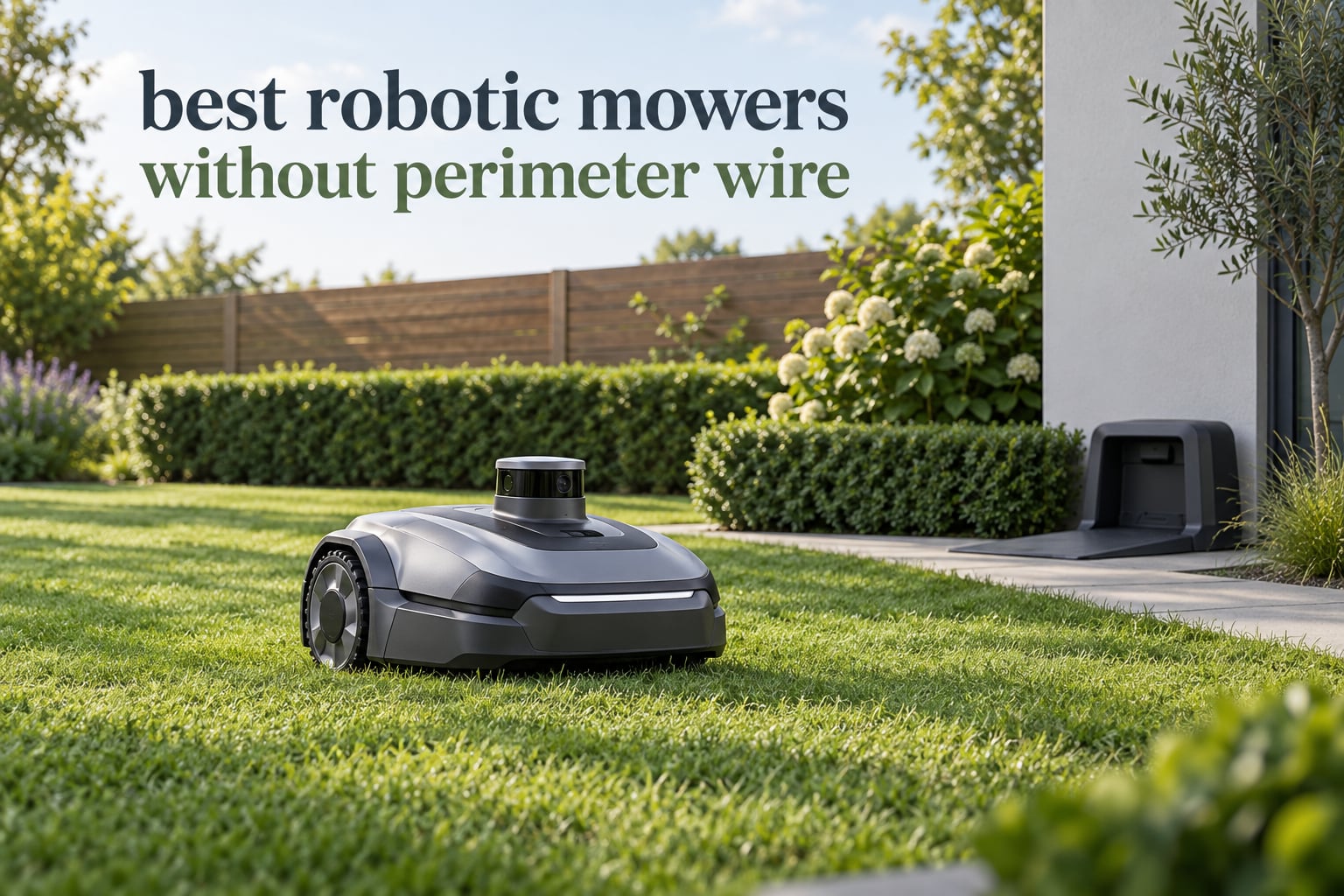
Yes, a robot mower can work without a perimeter wire. The wire-free models on this list draw a virtual boundary in the app, then use RTK satellite positioning, 3D LiDAR, or vision cameras to hold that line to within inches. Setup usually takes 30 to 45 minutes instead of a weekend of trenching.
That matters because the buried cable is the most common thing to fail on an older robotic mower. It gets cut by edging, aeration, digging and pets, and a repair means finding the break first. Owners on r/roboticLawnmowers describe the switch to wire-free as the point where lawn work stopped being a recurring chore. Our team spent weeks reading owner reports and spec sheets across the ten models below to separate the ones that hold a line from the ones that wander.
Before we get into the list, one distinction that gets confused constantly. No boundary wire means nothing is buried in your lawn. No RTK station is a separate claim: some wire-free mowers still need a GNSS antenna with a clear view of the sky, while others use LiDAR or stereo vision and need nothing mounted at all. If your yard is walled in, under heavy canopy, or in a valley, the antenna-free group is the safer bet. We flag which is which under every pick.
For bigger properties, our guide to the best robotic lawn mowers for large yards covers coverage and run-time in more depth, including models that still expect a wire.
Table of Contents
Top 3 Best Robotic Mowers Without Perimeter Wire for 2026

Quick Overview Wire-Free Robot Mowers in October
| Product | Specifications | Action |
|---|---|---|
| Segway Navimow i105N |
|
Check Latest Price |
 Mammotion LUBA mini 2 Mammotion LUBA mini 2 |
|
Check Latest Price |
 Mammotion LUBA 3 AWD Mammotion LUBA 3 AWD |
|
Check Latest Price |
 ANTHBOT M5 ANTHBOT M5 |
|
Check Latest Price |
 ECOVACS GOAT O1000 ECOVACS GOAT O1000 |
|
Check Latest Price |
 eufy E15 eufy E15 |
|
Check Latest Price |
 Sunseeker X3 Plus Sunseeker X3 Plus |
|
Check Latest Price |
 Roborock RockNeo Q110H Roborock RockNeo Q110H |
|
Check Latest Price |
 Segway Navimow i215 Segway Navimow i215 |
|
Check Latest Price |
 Sunseeker S4 3D LiDAR Sunseeker S4 3D LiDAR |
|
Check Latest Price |
How Wire-Free Navigation Works Without a Boundary Wire
A wire-free mower replaces one physical reference with a computed one. Instead of following a current in a cable, it works out where it is, works out where the lawn ends, and plans routes between those two points. There are four ways that happens, and the differences matter more than any other spec on the list.
RTK (Real-Time Kinematic) satellite positioning uses a GNSS antenna that measures its distance to several satellites at once. A correction signal, either from a network or from a reference station you mount yourself, tightens that position to centimetre-level accuracy. It is the most precise method on a flat open lawn. The catch is line of sight: mature tree canopy, tall walls and building eaves all block or reflect the signal, which is why owners repeatedly advise testing coverage before buying.
LiDAR spins or sweeps a laser to build a 3D point cloud of the yard, so it understands obstacles and edges by shape rather than by satellites. It keeps working under trees, at night and in enclosed yards. The trade is a higher price and usually a bulkier machine.
Pure vision uses stereo cameras and V-SLAM to build a map of what it sees, with no antenna and no base station. Setup is the fastest of all four, and it works where GPS fails. Vision needs light, so most of these machines cannot run more than a short while after sunset.
Hybrid systems fuse two or three of the above. A LiDAR-plus-vision machine keeps an eye out for obstacles while a satellite fix holds the position; an RTK-plus-vision mower uses cameras to bridge the signal gaps under canopy. In practice the hybrids are the ones that stop and ask for help least often.
One more question gets asked on every forum thread: does a wire-free mower need Wi-Fi? All ten need an app for mapping, scheduling and firmware updates. Most also continue mowing on a schedule when the phone is not on the network, though a few anti-theft features rely on cellular data instead.
1. Segway Navimow i105N – The Best All-Rounder With Wire-Free RTK Plus Vision
Segway Navimow i105N Robot Lawn Mower Perimeter Wire Free 1/8 Acre RTK+Vision Robotic Lawnmower, AI-Assisted Mapping, Virtual Boundary, APP Control, 58dB(A) Quiet, Multi-Zone Management
RTK plus vision,7.1 inch cut,1/8 acre,12 zones,58 dB,3-year warranty
Pros
- Holds its line under heavy tree cover
- Quiet at 58 dB for night mowing
- Accurate dock return and resume
- Well organised app with 12 zones
Cons
- RTK antenna and dock both need open sky
- Supplied wheels dig ruts on slopes
- Not a mulcher so clippings stay on top
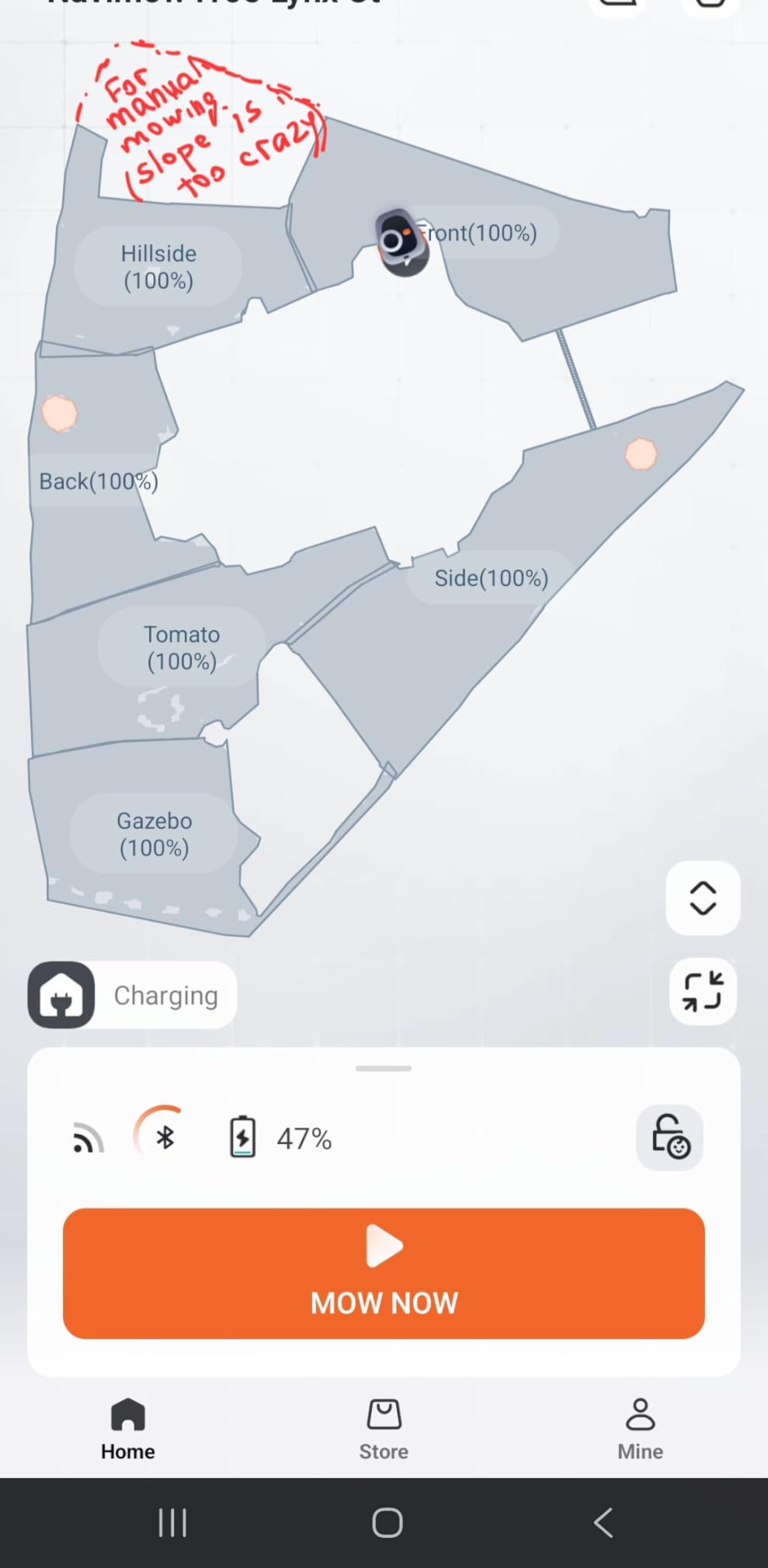
This is the mower I recommend first, and the reason is unglamorous: volume. With 391 owner reviews behind it, this is the model where you can actually read what breaks, and the pattern that comes out is favourable. Owners talk about a mower that starts, finds its dock, and finishes the job without a daily check-in.
The navigation stack is RTK with vision assist under the hood, branded as EFLS 2.0. That pairing is what makes it a reasonable buy for a yard with trees, because the cameras pick up the slack when the satellite signal degrades. The 140 degree camera recognises 150 or more obstacle types, which is fewer than some rivals here but more than most older wire-free machines.
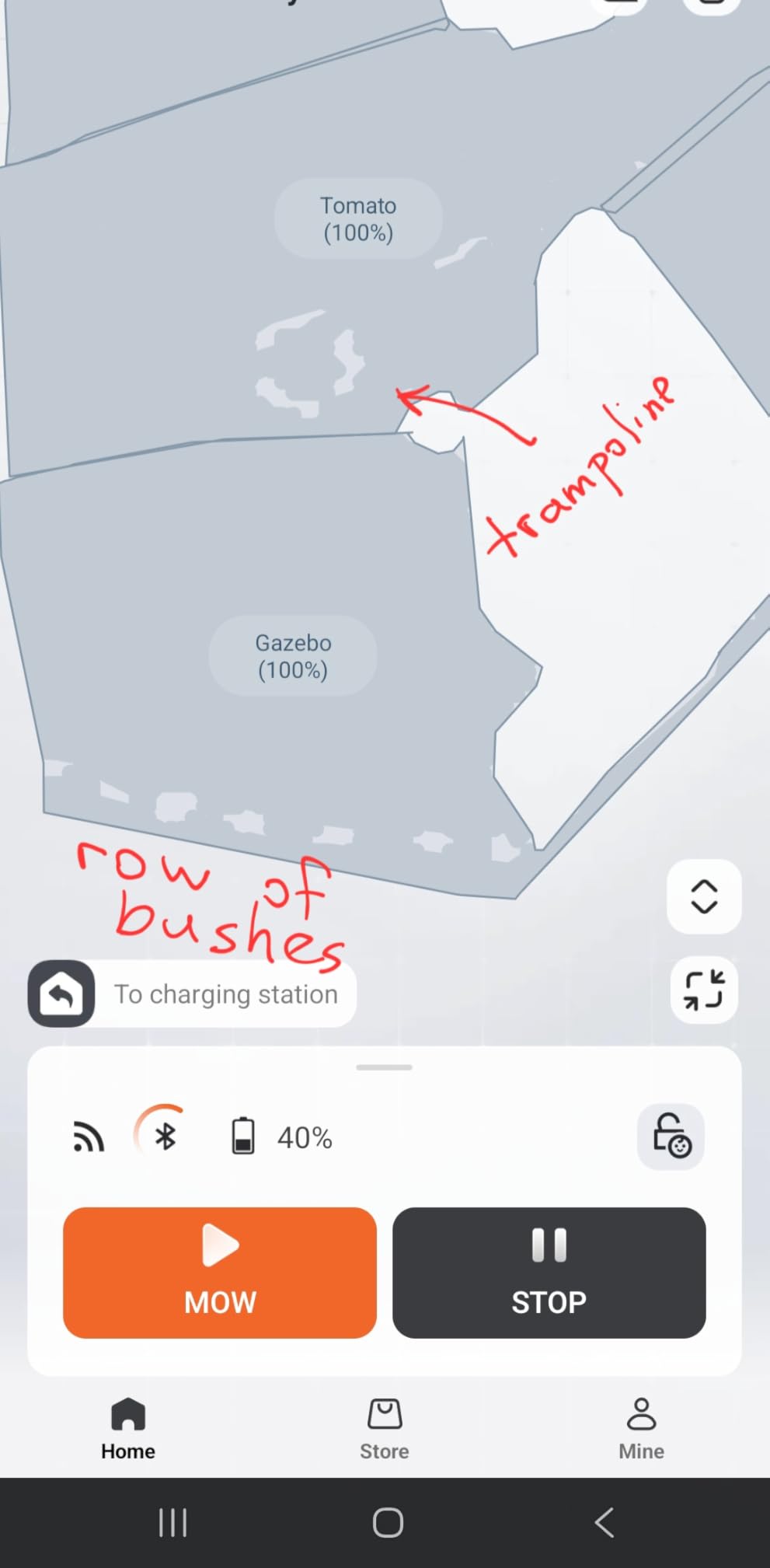
Coverage is 1/8 acre, with the map ceiling later raised to 1200 sq m. The cutting width is 7.1 inches, and height runs from 1.6 to 3.6 inches across five positions. Twelve independently scheduled zones is generous for a lawn this size, and each can get its own mowing direction, which reduces visible tracking.
At 58 dB(A) it is among the quietest machines we looked at, and owners on r/roboticLawnmowers single that out for early-morning and night schedules. The 4G anti-theft module is a separate add-on, and the charging station and GNSS antenna kit are in the box.
Where this mower makes sense
It suits a small-to-medium lawn with partial tree cover, a bordering wall or fence, and a household that wants scheduling handled in an app rather than with a buried cable. The 3-year full warranty is longer than most in this group. If you already own Navimow gear, the app learning curve is close to zero.
Where it will disappoint you
Placement is the hard part. Both the antenna and the dock want open sky, and if your best dock position sits under an eave you will lose signal. The supplied wheels have weak traction and can dig ruts when they spin on a slope, so the off-road wheel upgrade is worth considering. It also does not mulch, and VisionFence misses smaller items such as hoses, gates and sprinklers.
2. Mammotion LUBA mini 2 AWD 1500H – Best Wire-Free Mower for Steep Ground
(2026 NEW) Mammotion LUBA mini 2 AWD 1500H Robot Lawn Mower with Garage, for 0.37 Acres, 360° LiDAR+Dual-Camera AI Vision, 80% Slope, DropMow, 20 Multi-Zone Management
LiDAR plus dual cameras,AWD 80% slope,0.37 acre,20 zones,dedicated edge disc
Pros
- Climbs slopes up to 80 percent
- 360 degree LiDAR with 45 degree vertical view
- Dedicated edge disc cuts borders cleanly
- Very quiet for night running
Cons
- Map area hard-capped at 0.37 acre
- Slow mowing pace so jobs take half a day
- Long recharge time from a low battery
If your lawn has a serious gradient, this is the machine to look at. The AWD drivetrain runs two independent 88W motors and is rated to 80% climbing, a figure no other pick in this roundup matches. Owners on r/mammotion describe it walking up hills that stopped a push mower dead.
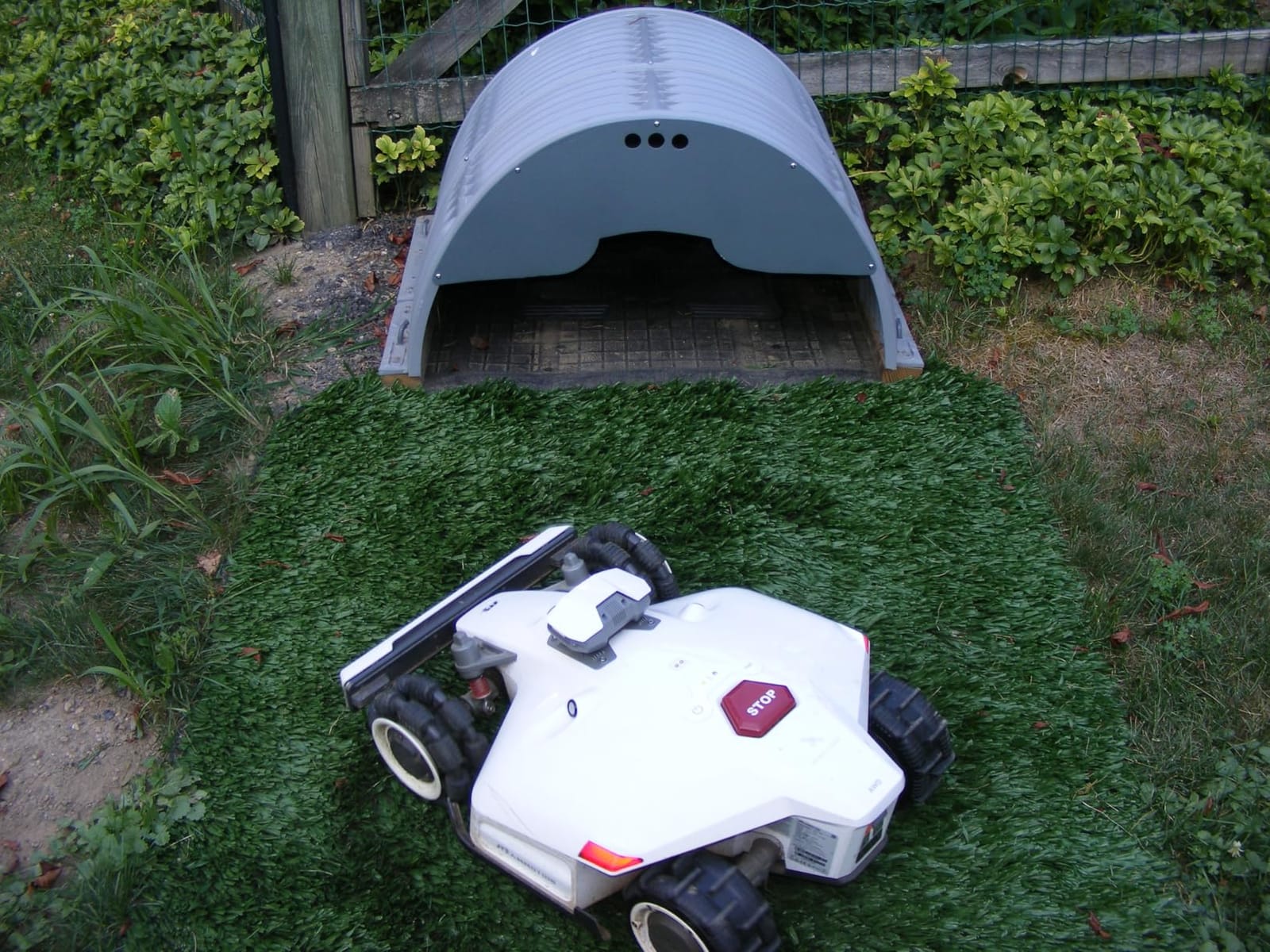
Navigation is a 360 degree x 45 degree LiDAR array fused with dual-camera AI vision, which is redundant sensing: geometry from the laser, object recognition from the cameras. The adaptive suspension steps over curbs, roots and thresholds up to 45 mm, which matters on a lawn with an uneven path back to the dock.
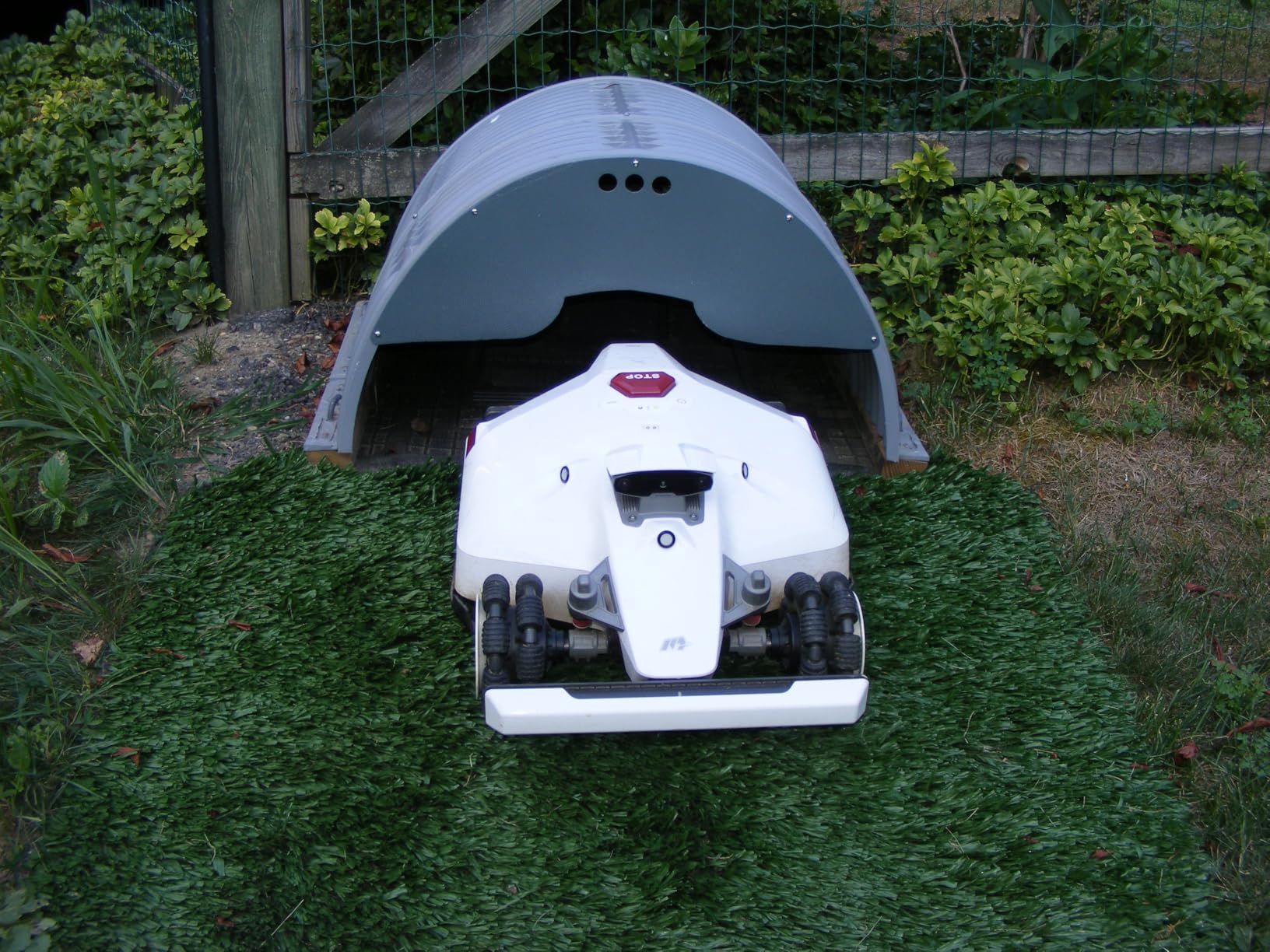
Cutting uses a main disc plus a dedicated edge disc, so borders come out cleaner than on machines with a single deck. Height adjustment runs across seven positions from 2.2 to 4 inches. You can run up to 20 independent zones, and DropMow mode lets you mow an area without saving a map at all.
The battery manages custom charge limits and off-peak scheduling, and 350 sq m per charge is the useful number to plan around. Reported running time on a quarter acre is a half day, which is the honest downside of the slow mowing speed and the narrow 5.5 inch blade cut.
Where this mower makes sense
A 0.37 acre lawn with hills, a couple of garden routes and enough time in the schedule to let a slow machine work. Edge quality is a real benefit if your lawn is bordered by paths and beds. Twenty zones let you exclude a play area or a patch that stays wet.
Where it will disappoint you
The 0.37 acre mapping cap is hard, with no way to extend it, so measure before you commit. At roughly walking pace, expect long sessions and multiple dock returns. The AI can be over-cautious at edges and refuse to traverse a corridor it has seen only once, and blades dull faster if you leave sticks on the lawn.
3. Mammotion LUBA 3 AWD 3000 – Best Wire-Free Choice for Large, Rough Lawns
Mammotion LUBA 3 AWD 3000 Robot Lawn Mower with Cleaning Stand (Ship Separately), 360° LiDAR+NetRTK+AI Vision, AWD for 80% Slopes, 5400 sq.ft/h, Cutting Height 1.0″-2.7″
Tri-fusion LiDAR+NetRTK+vision,15.7 inch cut,80% slope,30 zones
Pros
- Holds position without an RTK antenna
- Covers large lawns fast with a 15.7 inch deck
- Handles thick coarse turf on AWD
- Quiet enough to run overnight
Cons
- Documentation is thin and app pairing can be unstable
- Tunnels between separate areas often fail to establish
- Battery pack is not user-replaceable
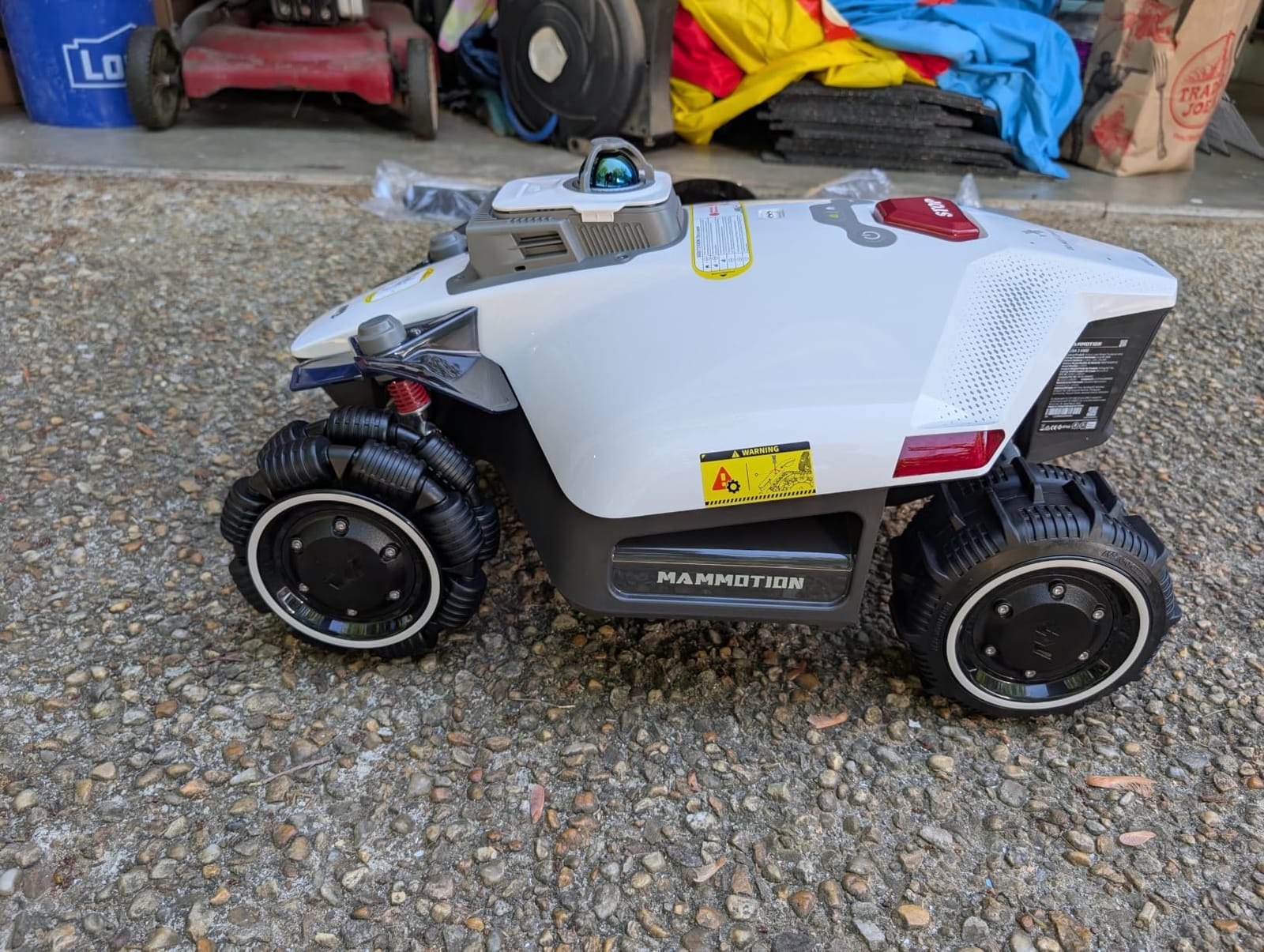
This is the big-lawn entry. The 15.7 inch cutting deck and a reported coverage of 500 sq m per hour mean a quarter acre or more gets done in a session rather than a weekend. Four independent motors give it the traction to handle thick, coarse turf and ground that wobbles under it.
Navigation is called Tri-Fusion: 360 degree LiDAR with a 59 degree vertical view and up to 230 ft of range, NetRTK corrections, and dual-camera vision. The LiDAR point cloud is the reason it holds position without a mounted antenna, and the AI processor identifies 300 or more obstacle types with live path recalculation.
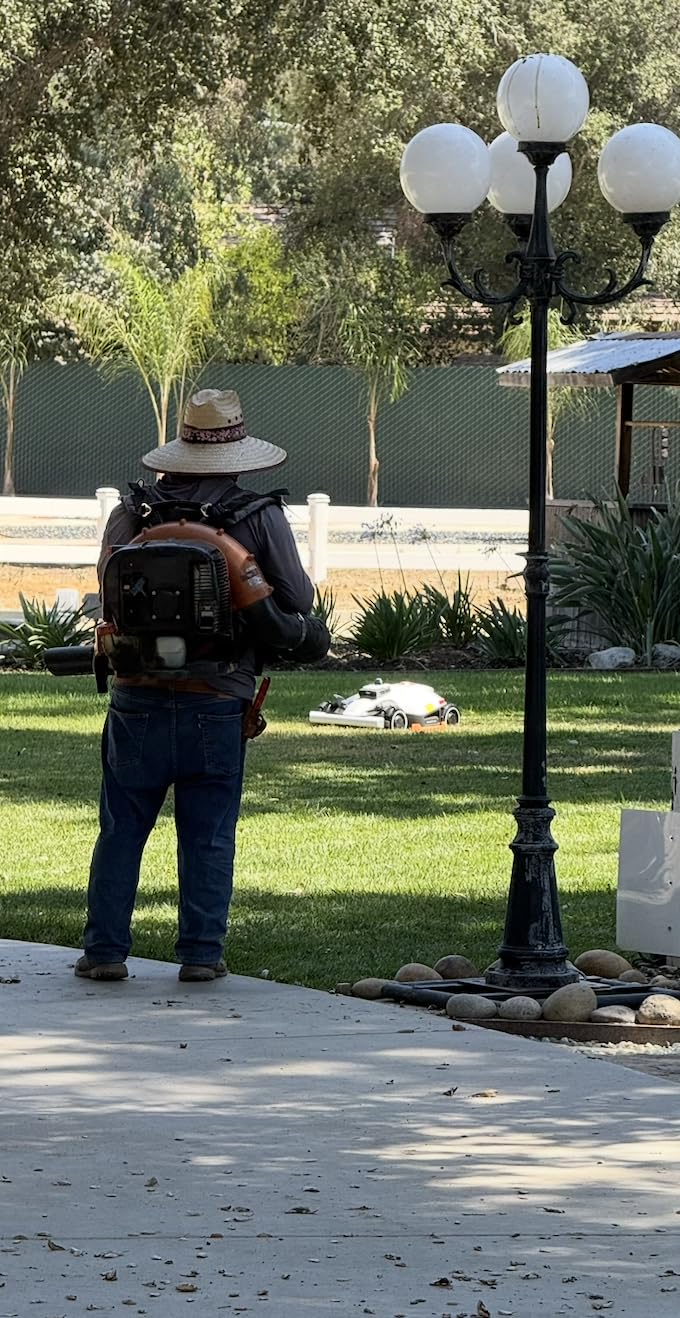
Two 165W cutting motors drive 6-blade discs, height adjustable from 1.0 to 2.7 inches. Up to 30 zones with no-go areas, and four path patterns including perimeter-only, zigzag, checkerboard and adaptive zigzag. Battery is up to 12Ah for about 175 minutes of runtime. A cleaning stand is included, and the stand arrives in a separate box.
Owners value the near-silent overnight running and report that regular software updates visibly improve behaviour. One owner of a mobility-limited household told us it reclaimed roughly 10 cents of electricity per 0.75 acre mow, which is negligible against the time saved.
Where this mower makes sense
Lawns at or above a quarter acre with uneven ground, coarse grass and long straight runs. The rain sensor, night operation and onboard camera make it easy to run unsupervised. Four independent motors and adaptive suspension over 50 mm obstacles suit lawns with roots and ruts.
Where it will disappoint you
Setup is the weak point. The online manual is thin, Bluetooth pairing can be unstable, and mapping is fiddly on a bright phone screen. There is no way to draw map lines by hand. Owners also report tunnels between areas separated by driveways or walkways frequently failing to establish, and the battery pack is not user-replaceable.
4. ANTHBOT M5 – Best Wire-Free Value for a Small Garden
ANTHBOT M5 Robot Lawn Mower 1/8 Acre, Dual Vision+Full-Band RTK Robotic Lawnmower, No Perimeter Wire, App Control Obstacle Avoidance, 45% Slope, Cutting Height, Multi-Zone Mapping
Dual 150 degree cameras plus full-band RTK,1/8 acre,45% slope,20 zones
Pros
- Quick setup with nothing to install
- Works on complex gardens with linked areas
- Quiet at 58 dB or below
- Reliable rain sensor
Cons
- Slow and needs several passes to cut evenly
- Recharges often and interrupts long sessions
- Several firmware updates needed before it settles
The M5 is the one we keep coming back to for value. At 370 reviews and a 4.2 rating, it has a proven owner base, and the hardware list reads like a much costlier machine: dual 150 degree HDR cameras, full-band RTK and Adaptive Cruise Control.
Full-band RTK means it locks onto every major satellite constellation rather than a subset, which helps in the outer suburbs where a standard antenna sees fewer satellites. The AI recognises more than 1000 common garden objects, the highest obstacle count among the picks that rely on cameras.
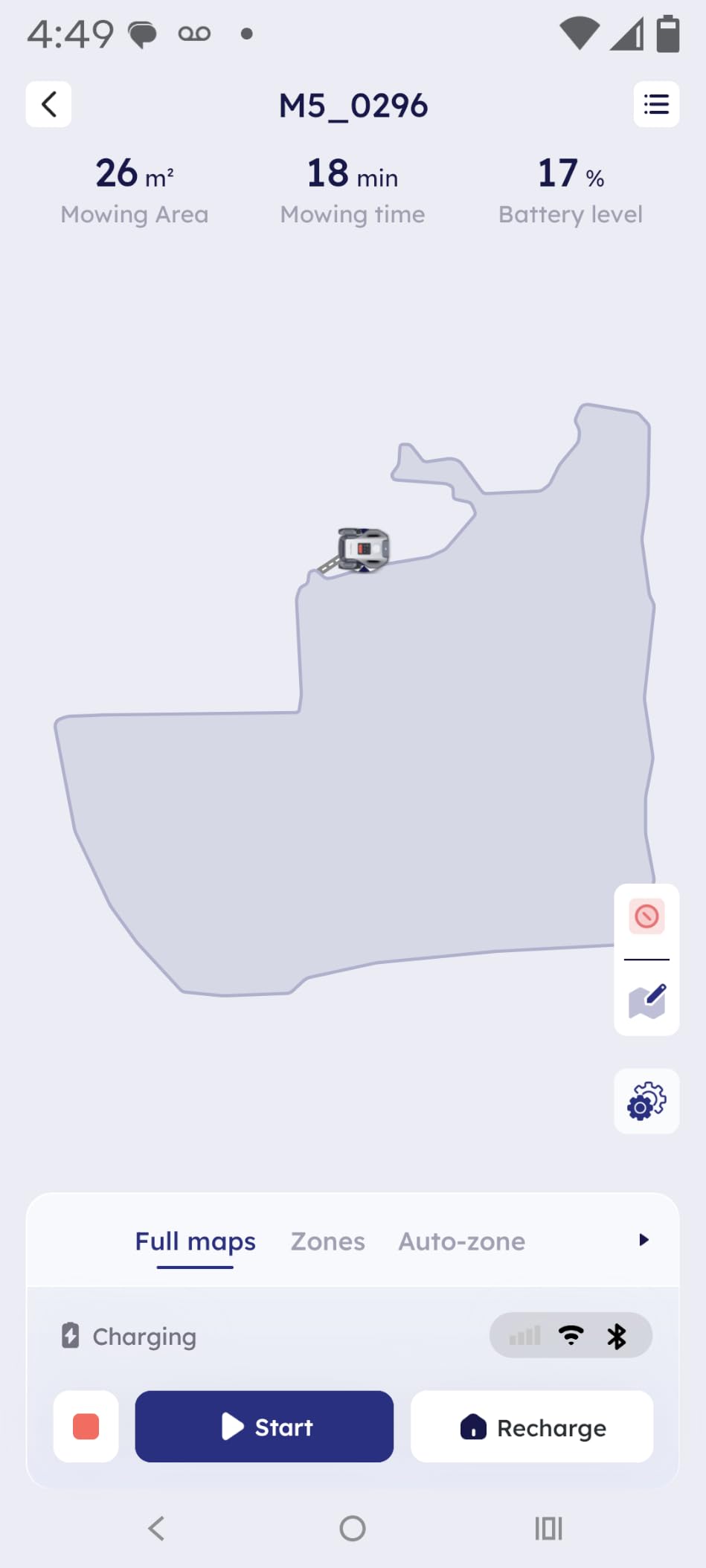
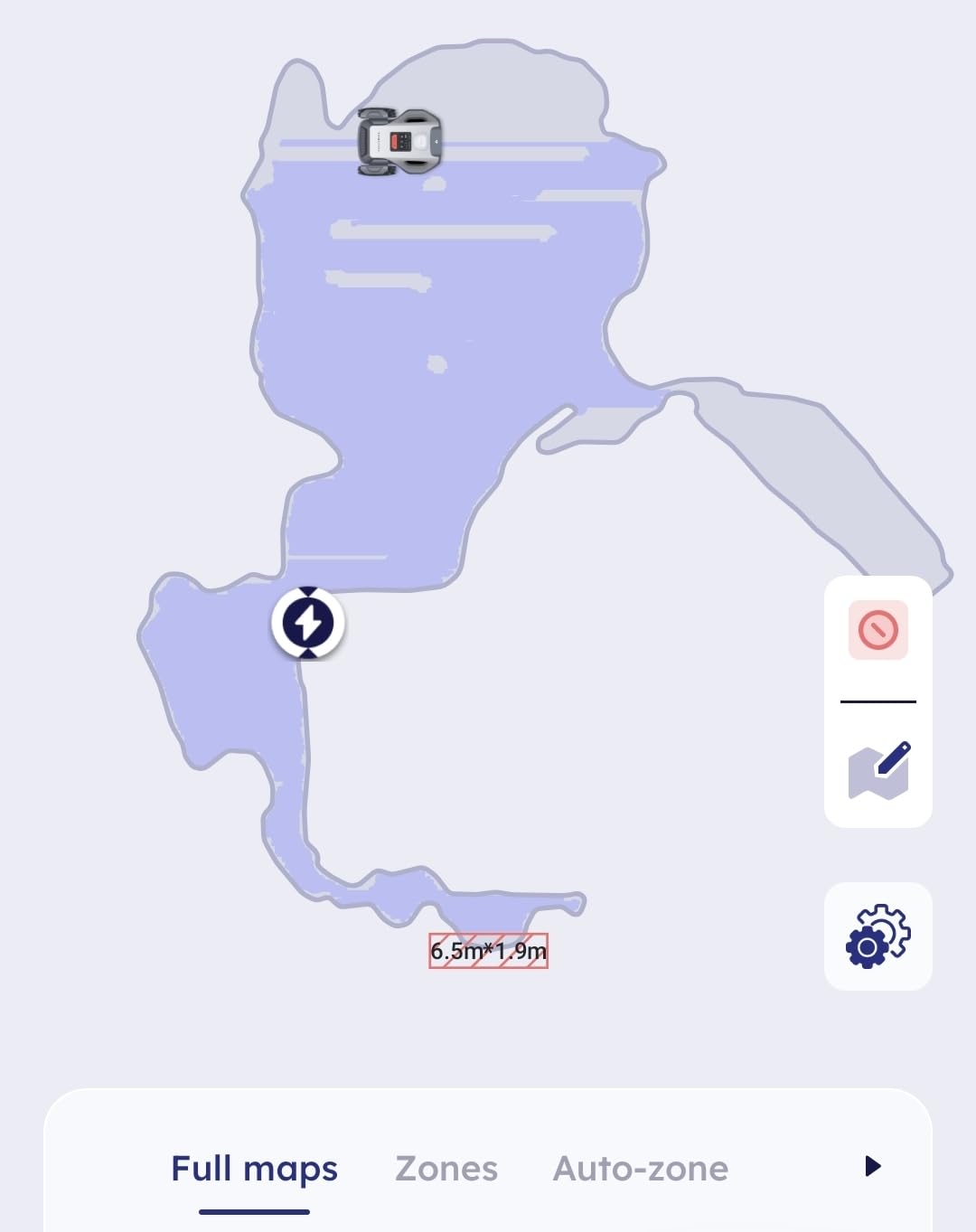
AI auto-mapping builds a virtual map in roughly 10 minutes without driving the mower, and up to 20 work zones can be linked by channels between separate areas. Cutting height runs 1.2 to 2.7 inches with five free-rotating blades, and slope handling is rated to 45%. Noise sits at or below 58 dB. The box includes the mower, base station, a 5-blade set and the RTK reference station.
That reference station is the piece worth flagging. It gives you a local RTK fix with no subscription, which is the arrangement a lot of owners on forums prefer over paying for network corrections each year.
Where this mower makes sense
A 1/8 acre garden with several separate areas joined by narrow paths, where you want a wired-free machine without a heavy setup cost. The rain sensor and quiet running suit households with neighbours close by. If you move house often or rent, there is no trenching to undo.
Where it will disappoint you
The M5 is slow. Owners report needing multiple passes for an even cut, frequent dock recharges, and occasional uncut strips or a thin uncut edge. Several buyers needed a few firmware updates before it ran smoothly, and a handful of reviews mention bundled accessories being slow to arrive.
5. ECOVACS GOAT O1000 LiDAR PRO – Best Wire-Free Mower With No Antenna at All
ECOVACS Goat O1000 LiDAR PRO Robot Lawn Mower, Wire-Free Robotic Lawn Mower with Dual-LiDAR Navigation, Built-in Edge Trimming, AI Obstacle Avoidance, App Control, for Lawns Up to 1/4 Acre
Dual LiDAR no antenna,built-in edge trimming,1/4 acre,31.5 inch passages
Pros
- No wire antenna or calibration to set up
- Near-silent for night running
- LiDAR holds up under trees and near fences
- Slim body fits narrow side-yard passages
Cons
- App joystick makes manual mapping produce zig-zags
- Edge trimming is hesitant and leaves work for you
- Front caster wheels too small for high grass or curbs
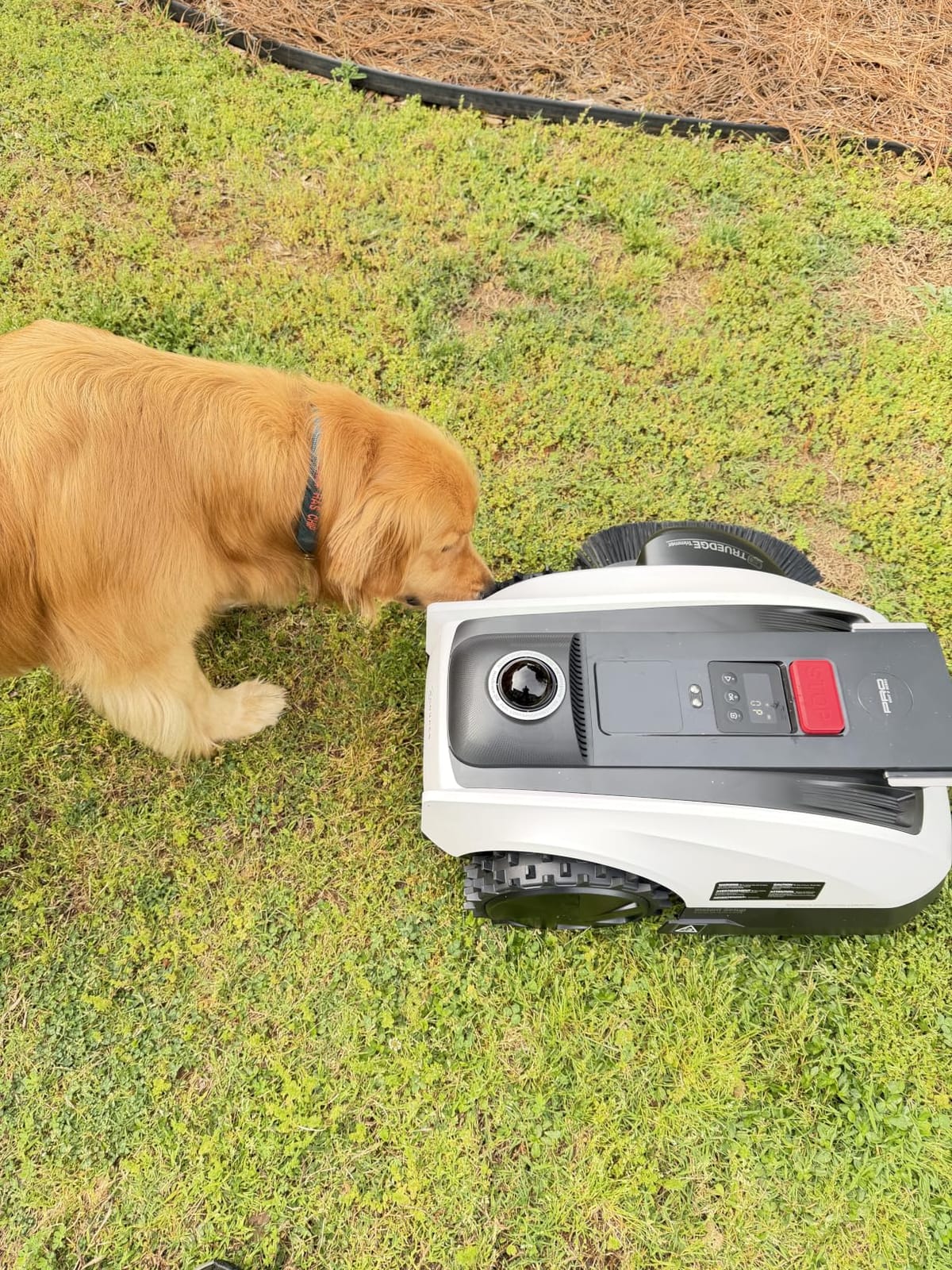
Nothing to install is the pitch, and the O1000 delivers it literally. There is no boundary wire, no RTK antenna and no base-station calibration. Owners report a working setup in well under an hour, which is the fastest of any antenna-free machine in this roundup.
ECOVACS calls the navigation HoloScope 360 degree dual-LiDAR. Two LiDAR units plus AI vision and 3D time-of-flight sensing detect 200 or more outdoor obstacle types. Because it does not lean on satellites, it keeps working under trees, beside fences and in yards where GPS solutions simply refuse to lock.
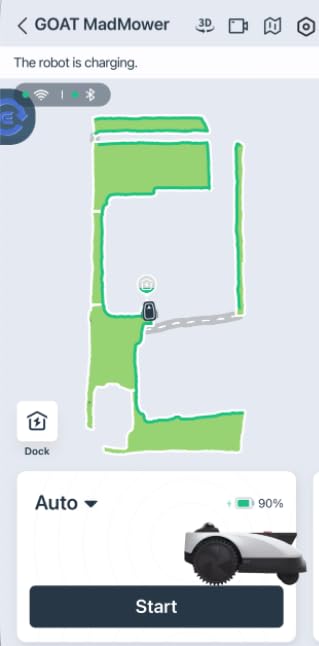
The slim body is a genuine feature. It passes through passages as narrow as 0.8 m, or 31.5 inches, which is a side-yard passage most competitors cannot manage. Built-in TrueEdge border trimming is meant to handle edges against driveways, walks and flower beds, and the app covers zones, schedules, cut preferences and no-go areas for lawns up to 1/4 acre.
Owners consistently praise the near-silence and clean straight cut lines, and several bought it specifically because RTK mowers struggled with a small or awkward shape. One owner with limited mobility said it ended a summer of pushing a mower.
Where this mower makes sense
A small or quarter-acre lawn with heavy tree cover, tight side-yard routes, or a spot where you would rather not mount an antenna at all. Near-silent running makes it good for early mornings. If you have been put off by cable repairs, the complete absence of installation is the appeal.
Where it will disappoint you
The app is the biggest complaint. The joystick is a single control with no dead zone, so manually mapped boundaries come out zig-zagged, and maps cannot be edited without physically driving the machine. Edge trimming is hesitant, areas under 10 sq ft cannot be deleted, and there is no border-lap or checkerboard pattern. Thin plastic shell and small front casters are build concerns too.
6. eufy E15 – Best Wire-Free Mower for a Small, Thick, Open Lawn
eufy Robot Lawn Mower E15, Auto Mapping, Pure Vision Navigation
Pure vision SLAM with stereo cameras,no antenna,0.2 acre,under 54 dB
Pros
- Setup takes 10 to 15 minutes
- Auto-mapping recognises edges and beds on its own
- Under 54 dB is among the quietest here
- Works in GPS dead zones
Cons
- Daylight only so no long night mowing
- Mapping struggles on sparse or sandy soil
- Wheels bury in soft sand and spin
The eufy E15 is the fastest entry in this roundup. Setup takes 10 to 15 minutes because there is no wire, no antenna and no base station. Auto-mapping uses dual-camera positioning and distance measurement to work out where the grass ends, the flower beds start and where the obstacles sit.
The navigation is called V-FSD 1.0, using high-precision stereo cameras and V-SLAM. It builds a 3D understanding of the yard, so it can see both low and tall obstacles, and it keeps working in places where an RTK mower would lose its fix entirely. Virtual walls are accurate to 0.2 m, with custom exclusion areas and multi-zone management.
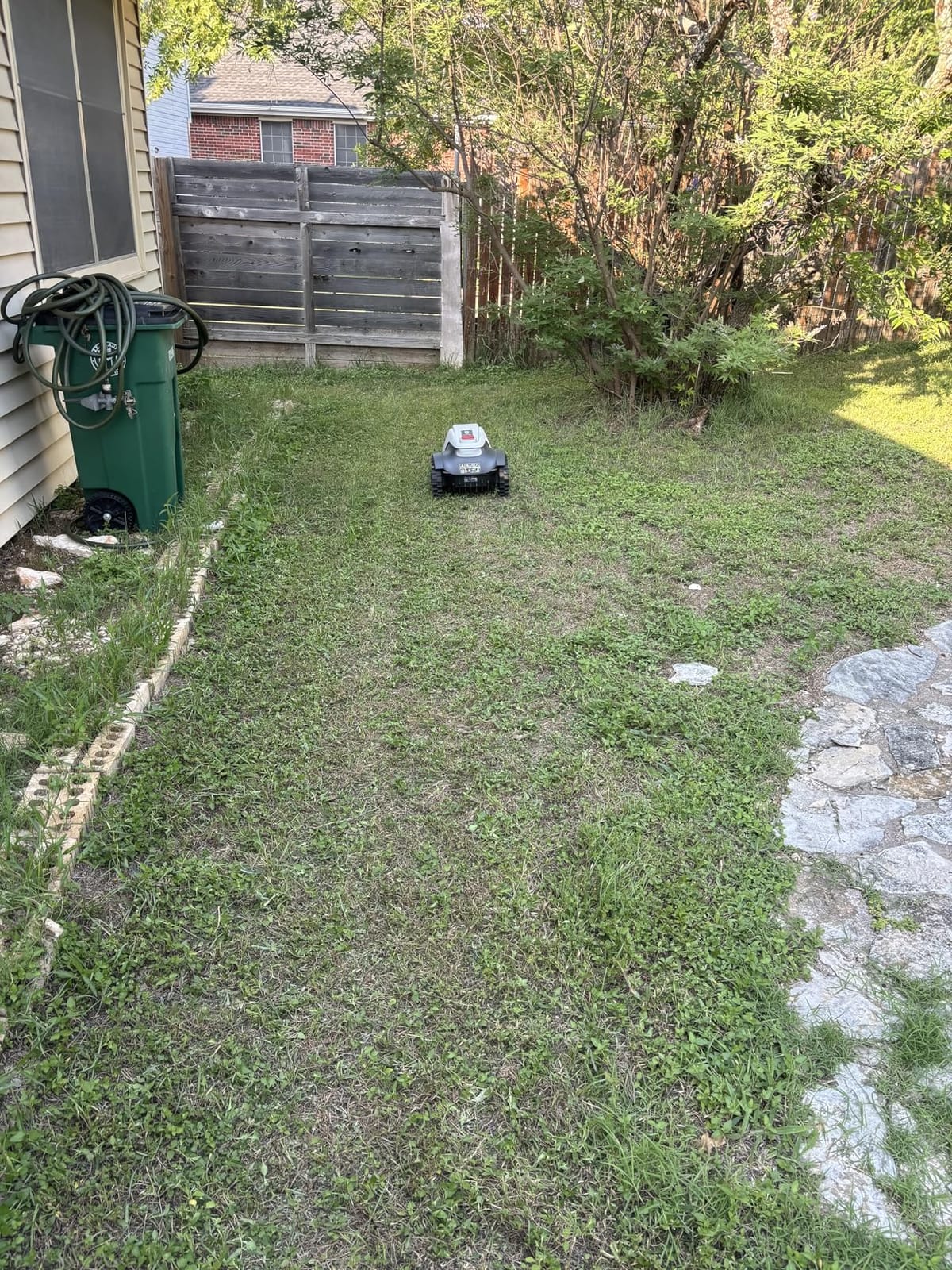
Ride-on Edge technology cuts close to lawn boundaries, and smart coverage detection re-mows any area it missed. Lawn limits are 0.2 acres, roughly 8700 sq ft, with slopes to 18 degrees and height differences under 1.2 inches. Built-in GPS anti-theft tracking will auto-recall the machine to base during rain or low light.
The one constraint to know before buying: the mower is not suited to St. Augustine or dense Zoysia grass, and if Wi-Fi does not reach the yard you will need the 4G subscription. On noise it is the quietest pick here, under 54 dB.
Where this mower makes sense
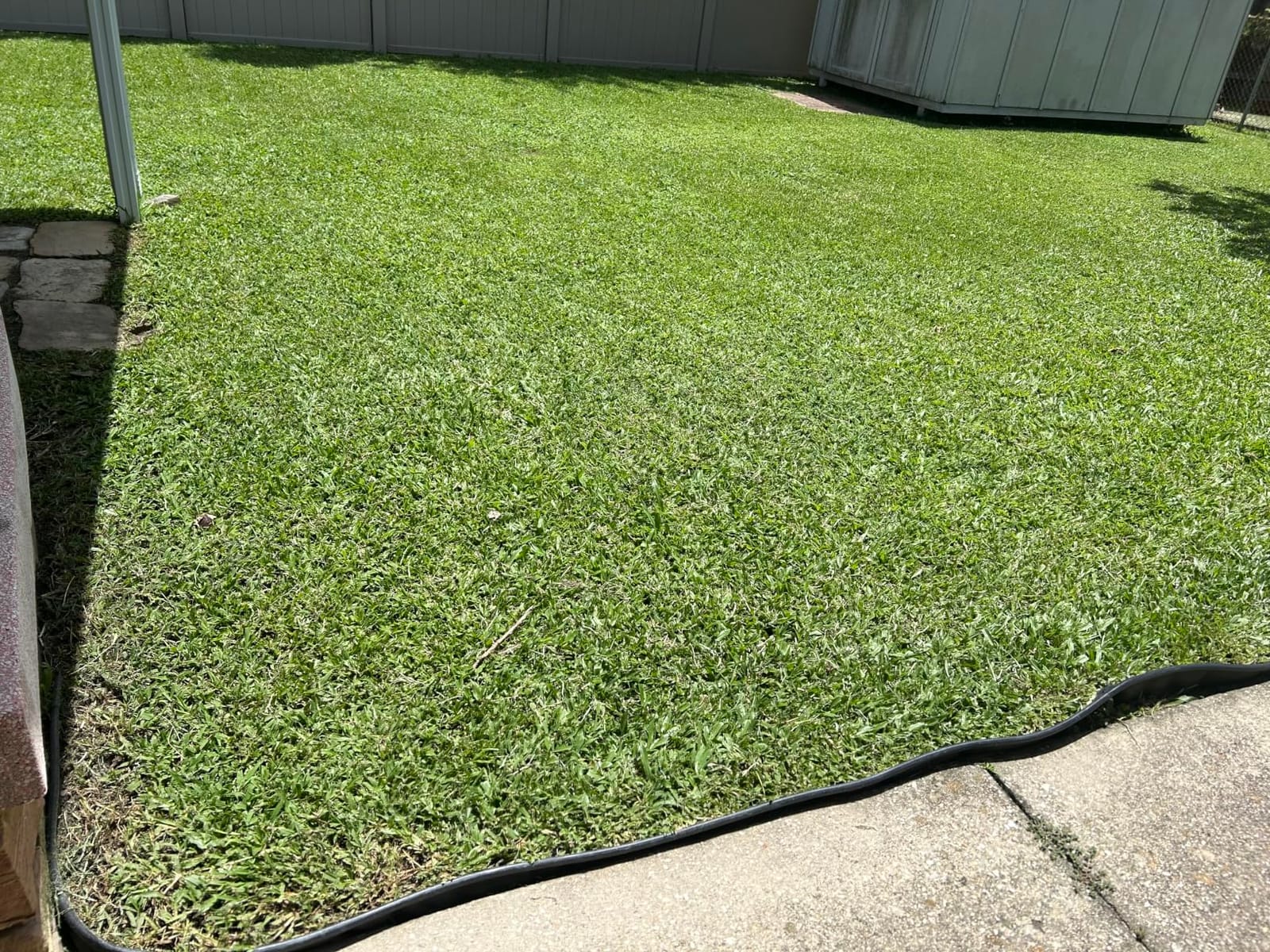
A small, dense, clearly edged lawn with healthy soil and an existing lawn rather than a neglected one. It handles up to 0.2 acres with a stainless steel deck and an 8 inch cut. Families with small children or pets get useful value from the quiet running and the 3D obstacle perception.
Where it will disappoint you
Vision navigation means daylight-only work, so it can mow roughly 30 minutes after sunset at most. Sparse, sandy or patchy lawns defeat the auto-mapping and turn into long manual redraw sessions, and the wheels bury themselves in soft sand. There is no spot-mowing mode, so one missed patch means re-running a whole zone.
7. Sunseeker X3 Plus – A Solid Wire-Free Mower for Open, Flat, Small Yards
Sunseeker X3 Plus Robot Lawn Mower, RTK, Vision AI, 0.3 Acre, Wire-Free
RTK plus VSLAM,0.3 acre,30% slope,six saved maps,60 dB,2-year warranty
Pros
- Steady under trees and near fences in a small yard
- Clean close border cutting on corners
- Quiet at 60 dB
- Light enough to carry between lawn sections
Cons
- Repeated satellite calibration failures and lock-ups
- Roams out of bounds and reports false stuck states
- False rain detections stop the mower when dry
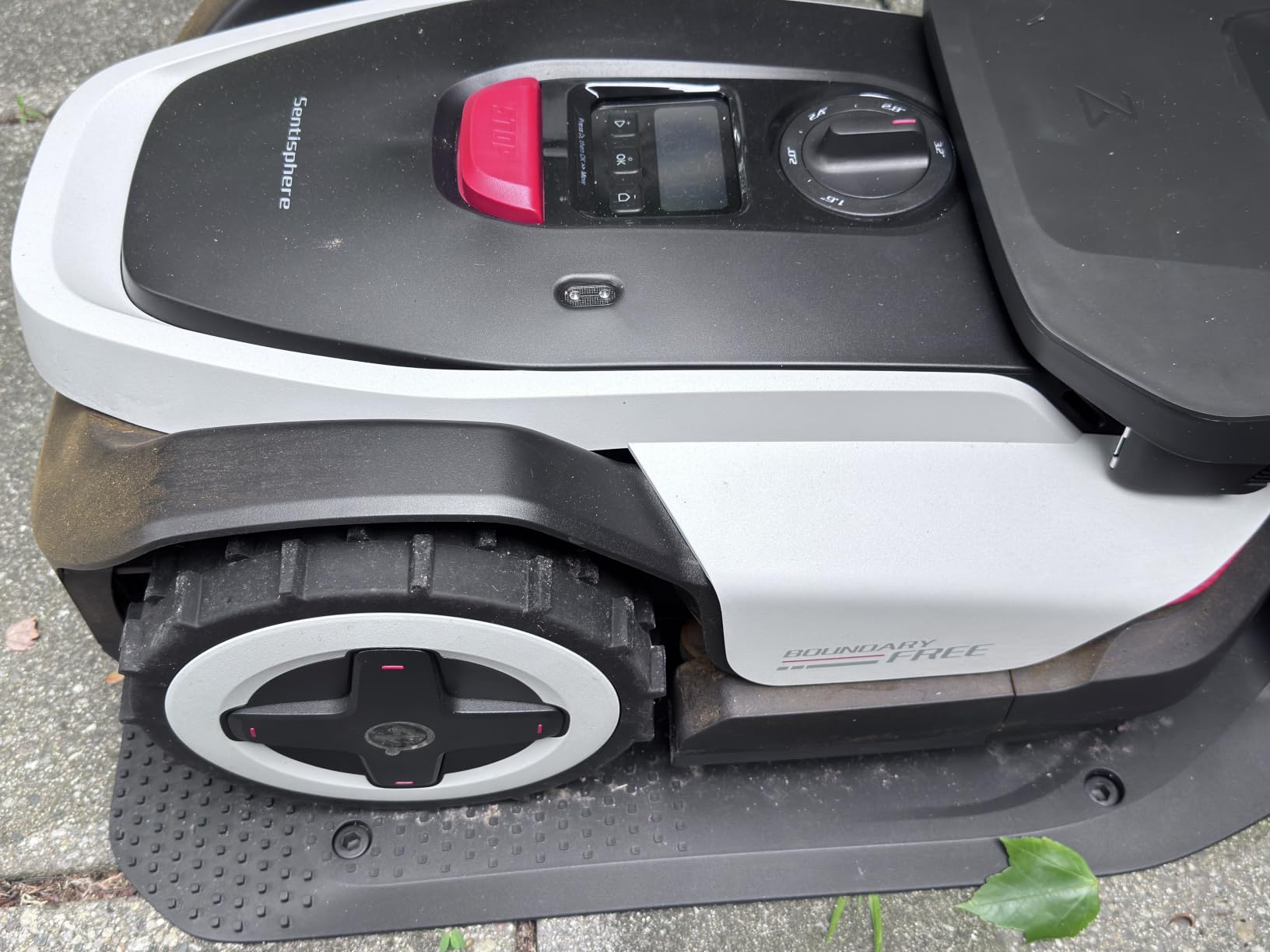
The X3 Plus covers 0.3 acre, or 13000 sq ft, across multiple areas using AONavi, a combination of RTK and VSLAM visual mapping. It cuts an 8 inch floating deck adjustable from 1.6 to 3.2 inches, and a Ride-on-Edge offset blade gets close to fences, walks and other hard edges.
Six saved maps with no-go zones and schedules is more map flexibility than most small mowers offer. Vision AI plus ultrasonic sensing handle obstacle detection in daylight, slopes run to 17 degrees or 30%, and voice control is supported. The 2-year warranty comes with US-based support.
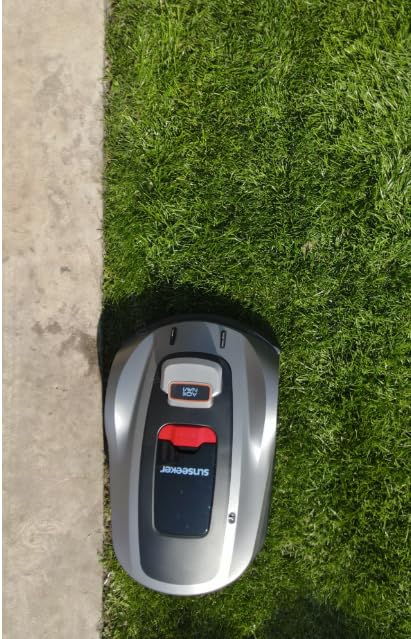
Where the cutting is concerned, owners report clean edges and steady passes through mixed native grass and ground cover, and a few note it is effectively inaudible at 3 a.m. At 19.9 pounds it is one of the lighter machines here and easy to carry between two lawn sections.
That is the good part. The problem is software. Owners repeatedly report satellite calibration failures, unexplained lock-ups, out-of-bounds wandering, false stuck states, false rain detections and deleted hazard zones reappearing on their own. Several also found the app shows errors in Chinese.
Where this mower makes sense
A simple, open, relatively flat yard where you can check the mower every day or two and correct the map when it drifts. The close border cutting suits lawns with many corners and walkways. If you want six separate maps on a small property, this is one of the few machines here that offers them.
Where it will disappoint you
The RTK cord must be suspended above the lawn, and the mounting hardware is advertised but not included, so budget for that. Signal dropouts in enclosed yards mean carrying the mower back to the dock. It also fails in deep or fast-growing grass, treating tall turf as an obstacle and wandering until it aborts.
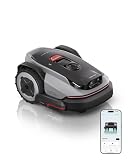
8. Roborock RockNeo Q110H – A Budget Wire-Free Mower for Existing Roborock Users
Roborock RockNeo Q110H Robot Lawn Mower, Wire-Free Robotic Lawn Mower with Full-Band RTK + VSLAM Navigation, Auto Mapping, AI Vision Obstacle Avoidance, App Control, 45% Slope, Covers Up to 1/4 Acre
Full-band RTK plus VSLAM,45% slope,1/4 acre,2.3 ft passages,night work
Pros
- Handles 30% slopes and uneven ground without getting stuck
- Works at night with headlights
- Whisper quiet on simple open lawns
- Three-screw assembly and quick app sync
Cons
- Despite the claim boundary mapping must be driven manually
- Leaves 1 to 1.5 ft unmowed along every boundary
- Refuses gates and narrow openings with clear space
- No LiDAR so vision misses some obstacles
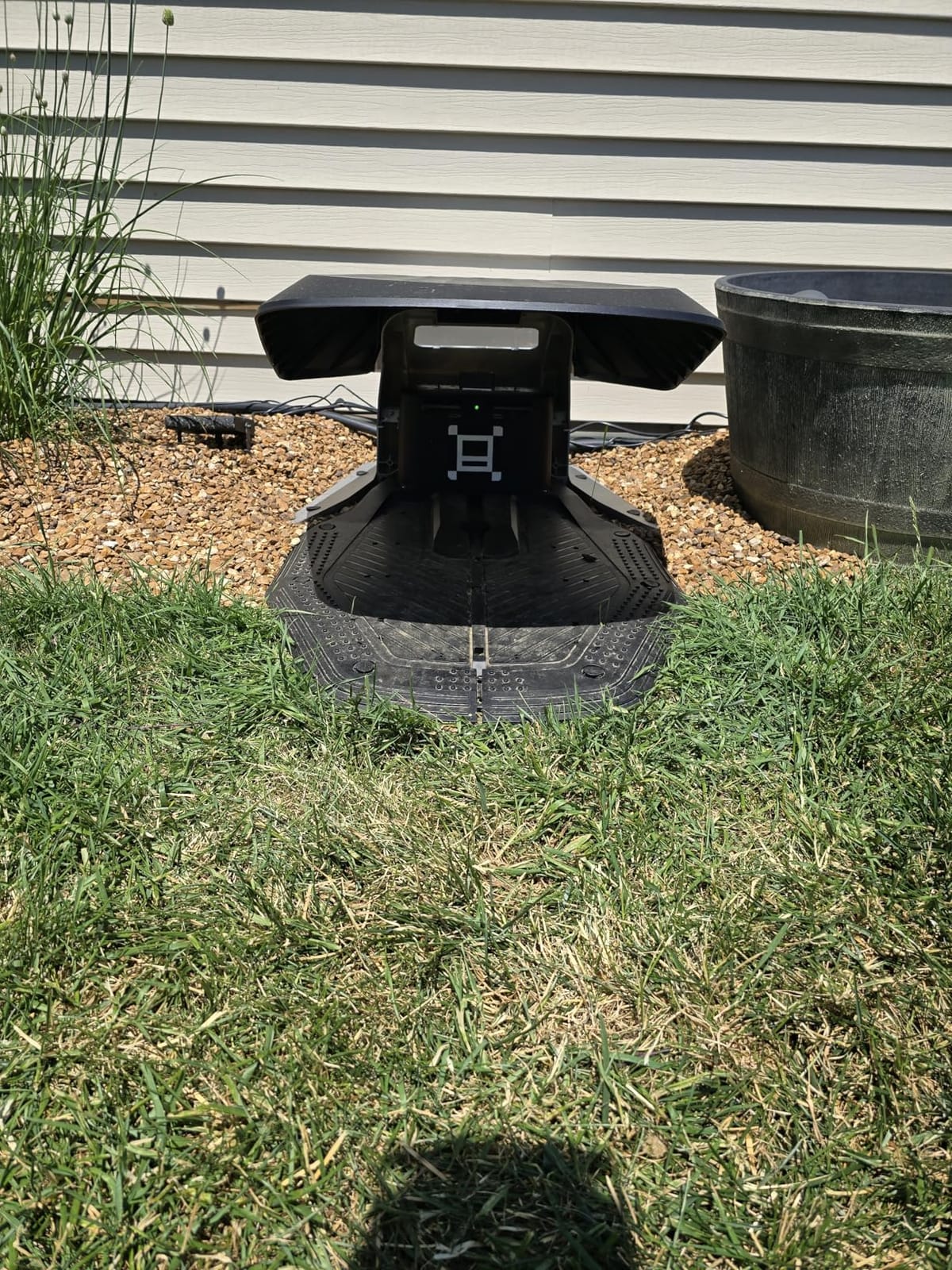
The RockNeo Q110H is the entry point here, and if you already live in the Roborock app ecosystem you will find it instantly familiar. Setup is three screws and a quick sync, and the robot vacuums’ app layout transfers straight across.
Navigation is full-band RTK plus VSLAM, with dual-camera AI vision and stereo obstacle recognition. It handles 45% slopes, clears obstacles of 1.57 inches, and fits through passages as narrow as 2.3 ft. The floating cutting deck with large-diameter wheels is adjustable from 1.6 to 3.1 inches. A PIN lockout and a high-decibel alarm are included, with a 4G tracking module sold separately.
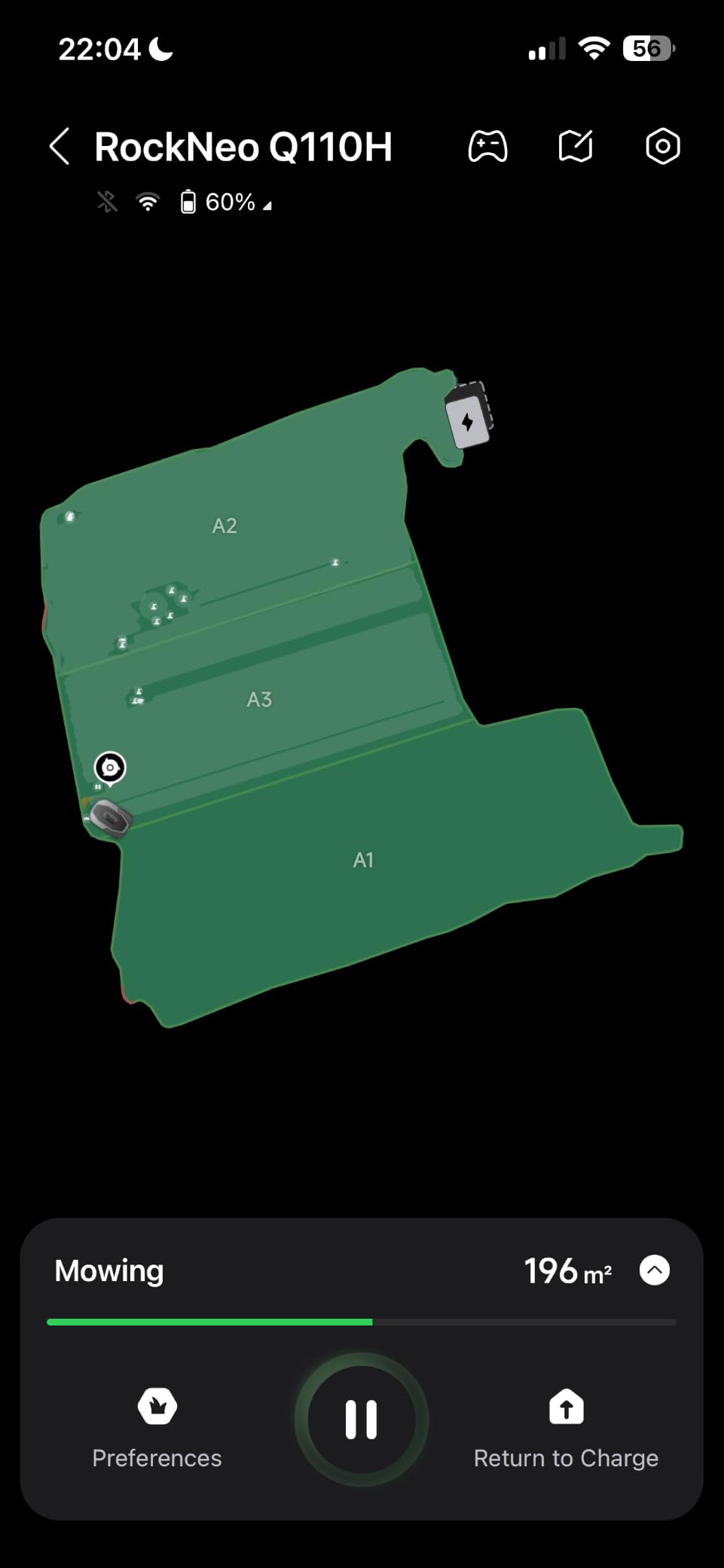
Owners report straight cut lines, dependable night running with headlights and good behaviour on open areas with mixed clover. The auto-mapping and manual mapping modes are both there, and the real-time progress dashboard plus Wildlife-Friendly mode are useful touches.
The catch is boundary conservatism. Owners report 1 to 1.5 ft unmowed along fences, trees, bushes and the antenna pole, and the mower refusing to enter gates and narrow openings even with ample clearance. Maps cannot be edited without walking the machine, and there is no partial or spot zone mowing.
Where this mower makes sense
A quarter-acre lawn that is mostly open, on a slope, on a household already using Roborock apps, and where budget matters more than finish quality. Night work with headlights and near-silent running make it easy to live with. Wildlife-Friendly mode is a genuine plus if birds visit the lawn.
Where it will disappoint you
There is no LiDAR, so vision sensors miss some obstacles, and a LiDAR-equipped model is the better choice for a cluttered yard. The optional edge module is not available in the US, so edge handling is poor. Traction wheels cannot handle St. Augustine, the deck reports itself lifted on small bumps, and the lawn needs pre-mowing.
9. Segway Navimow i215 LiDAR – Best Wire-Free Mower for Tree-Covered Yards
Segway Navimow i215 LiDAR Robot Lawn Mower, Wire Free Robotic Lawn Mower for 0.37 Acre, LiDAR & Vision Dual Fusion, Auto Mapping, Off-Road Wheels for 45% Slopes, Quiet 59 dB(A) Mowing
Solid-state LiDAR plus vision,no antenna,0.37 acre,45% slope,200+ obstacles
Pros
- No wire antenna or base-station calibration
- One-tap auto mapping
- LiDAR plus vision works day or night
- Off-road wheels with stability control
Cons
- Heaviest machine here at 32.4 pounds
- Costs more than RTK-only rivals in the same class
- Cutting height cannot go below 2 inches
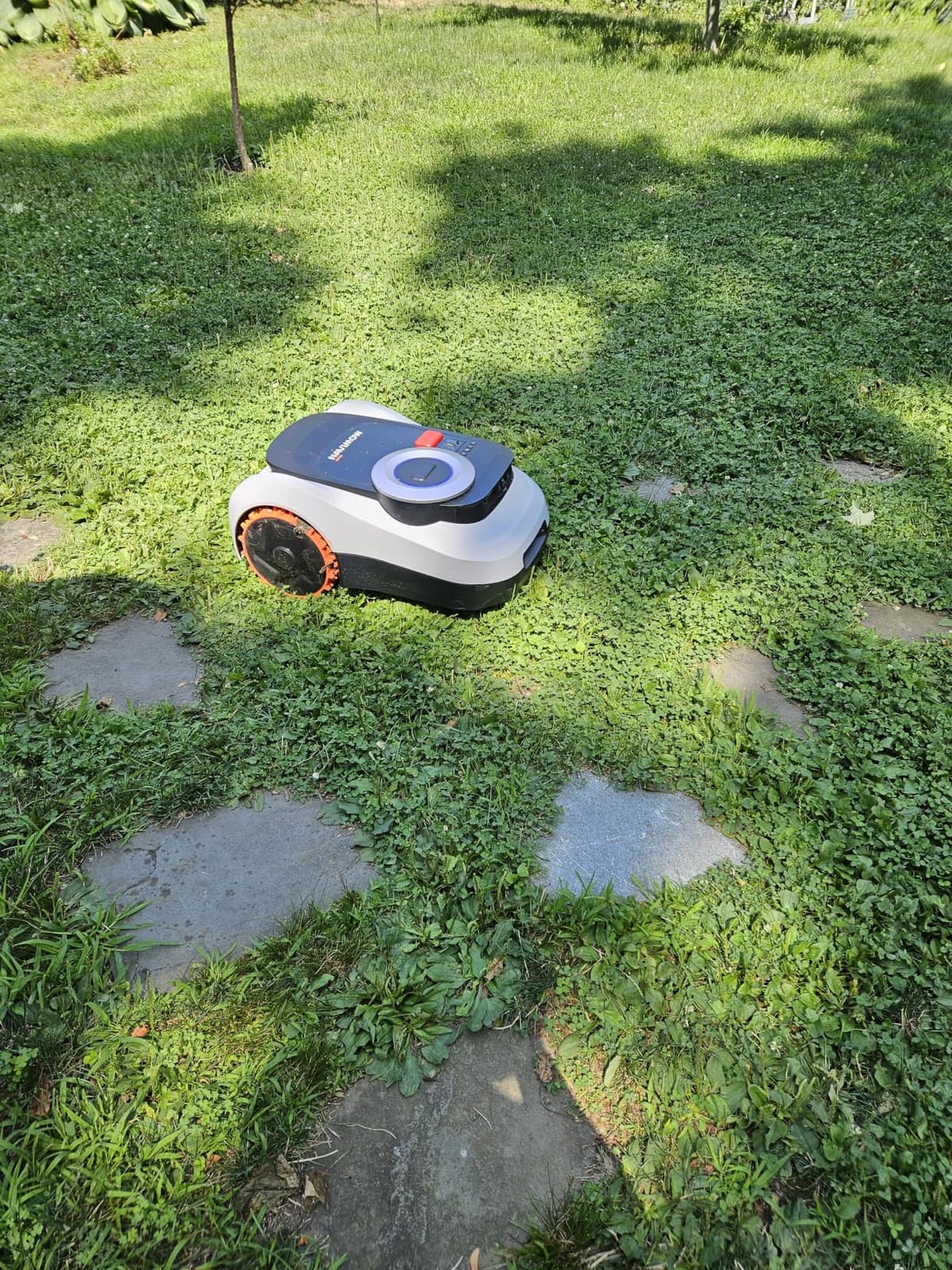
The i215 is the pick for a yard where satellites are a problem. Solid-state LiDAR fuses with onboard vision for satellite-free navigation, day and night, in three dimensions. No antenna, no base station, no calibration. One-tap auto mapping handles the setup.
AI VisionFence detects 200 or more obstacle types at 0.4 inch accuracy, and GeoSketch lets you edit up to 20 mowing zones. EdgeSense ride-on mode cuts along fences and pathways. Off-road wheels plus Electronic Stability Control handle slopes to 45%, and the machine covers up to 0.37 acre.
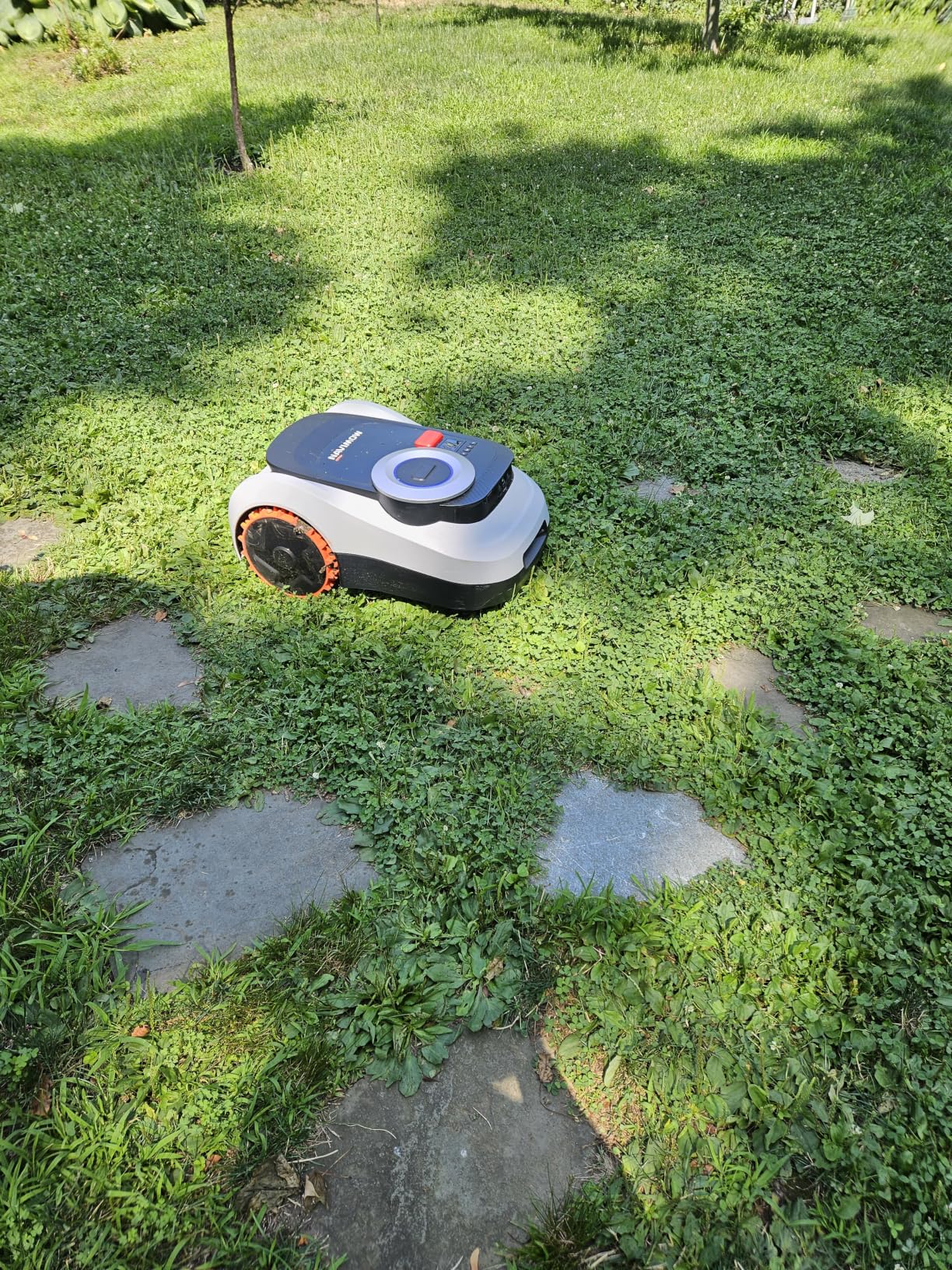
Theft protection is unusually thorough: GPS, geo-fence, lift detection and Apple Find My alerts, with auto-dock in extreme weather. Alexa and Google Home voice control are supported, and an in-app Doodle tool handles custom mowing patterns. Cut width is 7.1 inches from a 100W motor and 6-blade disc, with height from 2 to 4 inches across four positions.
With 46 reviews and 71% five-star, sentiment is strongly positive, but the listing is new enough that long-term durability is not yet established. That is worth weighing against the older i105N.
Where this mower makes sense
A 0.37 acre lawn under mature canopy, next to tall walls, or anywhere a GNSS antenna would struggle. Anti-theft matters if the mower sits outside on an open lot. Steering into voice control for schedules is straightforward once mapping is done.
Where it will disappoint you
It is the heaviest machine in this roundup at 32.4 pounds, so moving it is a two-person job. The LiDAR version costs more than RTK-only rivals in the same coverage class, and the 2 inch minimum cutting height means it cannot take a very short cut. Custom shapes need the Doodle tool rather than standard patterns.
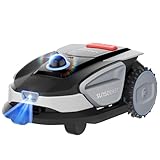
10. Sunseeker S4 3D LiDAR – Best Wire-Free Zone Control on a Quarter Acre
Sunseeker S4 Robot Lawn Mower, 3D LiDAR, Vision AI, 0.25 Acre, Wire-Free
3D LiDAR plus vision AI,0.25 acre,42% slope,100 zones,2-year warranty
Pros
- Handles dense trees eaves shade and weak-signal areas
- Works in daylight low light and at night
- Rear-wheel drive for ruts bumps and 42% slopes
- Up to 100 zones across five saved maps
Cons
- Mapping still requires driving the mower with the app
- Narrowest cut width in the range at 7 inches
- Newer listing with a small review base
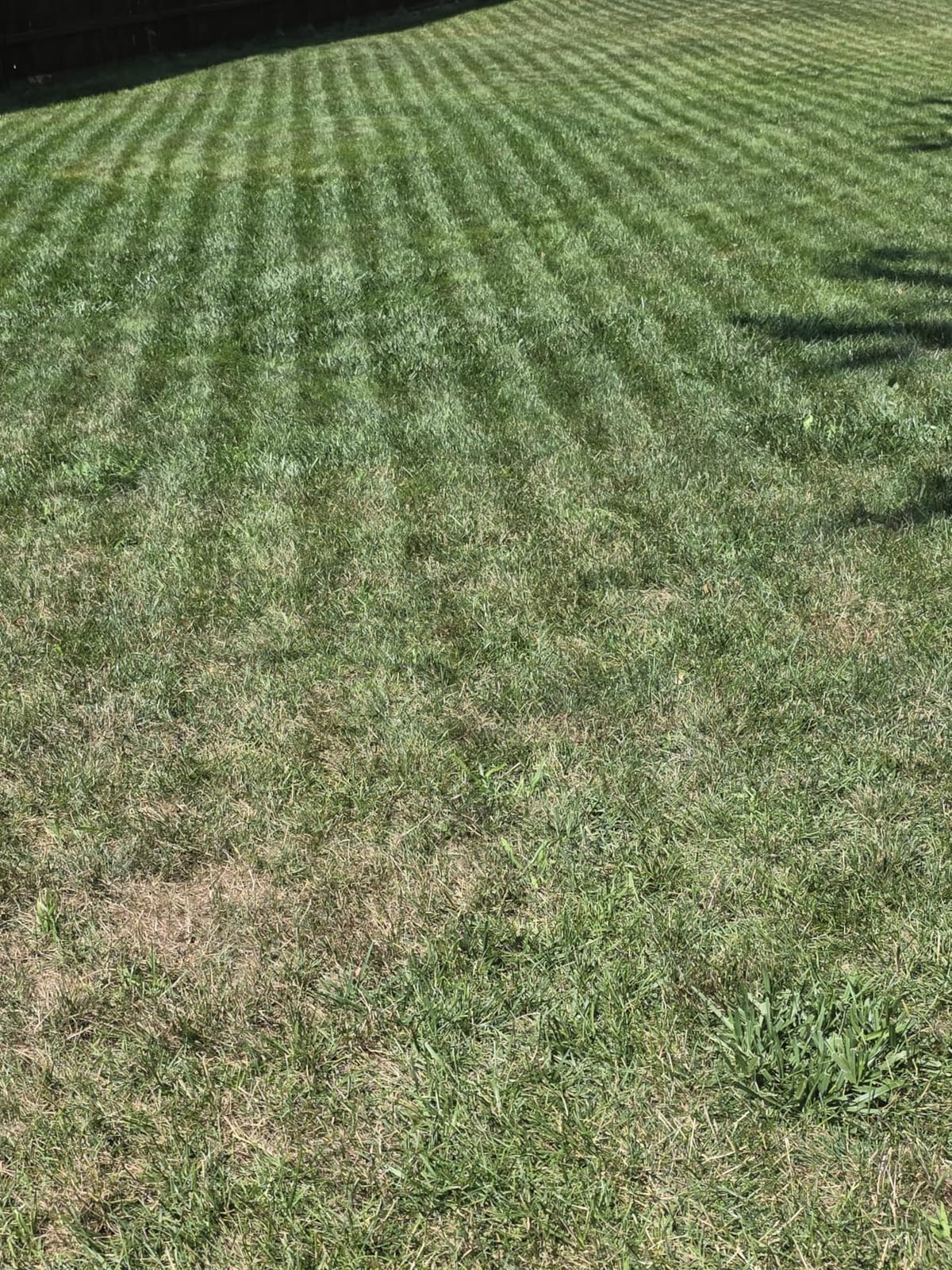
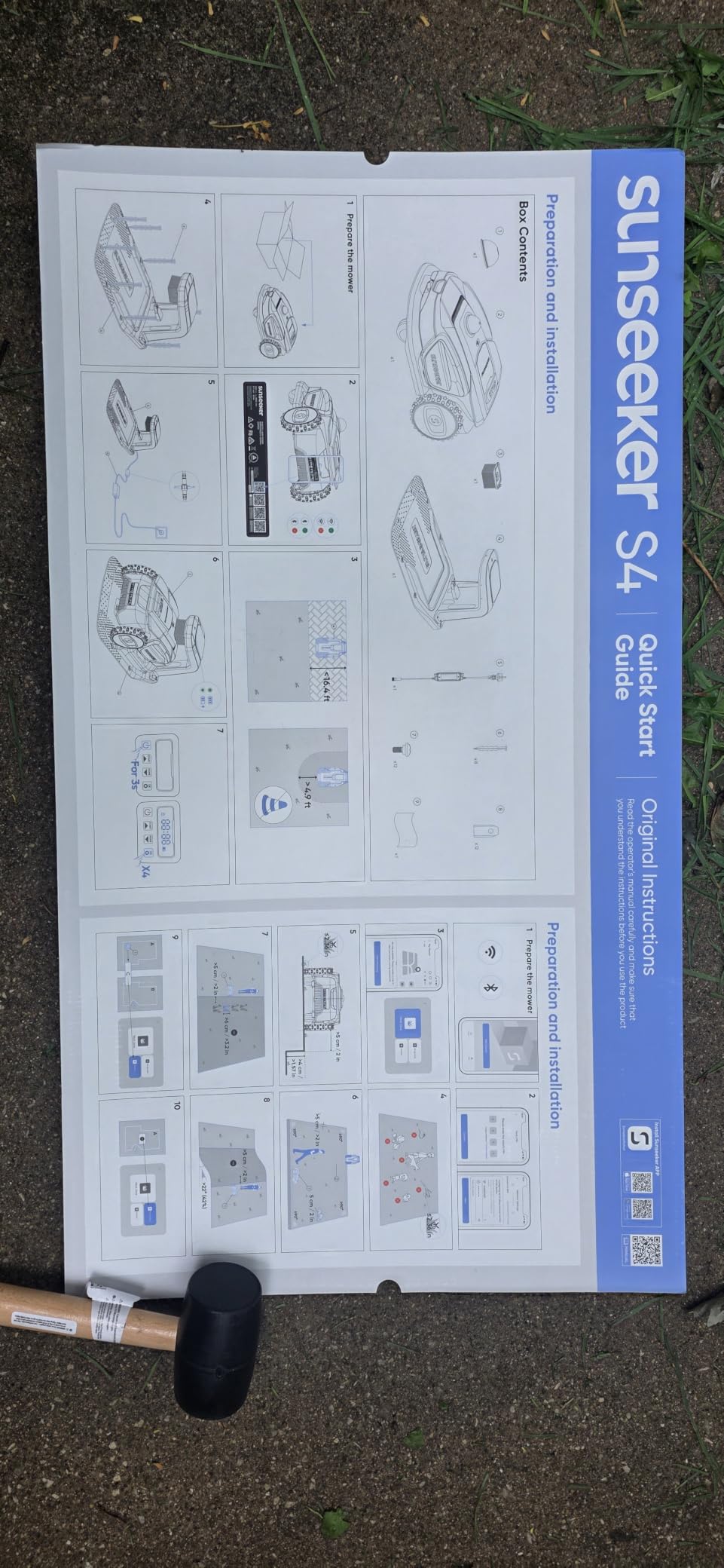
The S4 pairs 360 degree 3D LiDAR with vision AI to build a 3D yard map, backed by 10 TOPS of onboard compute for systematic parallel route planning. That compute is why the cut lines come out tidy rather than patchy, and it runs in daylight, low light, at night and in weak-signal areas.
Rear-wheel drive handles bumps, ruts and slopes to 22 degrees or 42%, and it fits through 31.5 inch passages. Mapping is wire-free in the app with no base-station calibration. Five saved maps carry up to 100 zones with no-go areas, which is the most granular zone control of any pick here, and it resumes after an interruption.
Cutting is six blades on a 7 inch floating deck with ride-on-edge mode, height adjustable 1.6 to 3.2 inches, at 60 dB. A rain sensor returns it to base, voice control works, and the 2-year warranty is backed by US support. Lawns up to 0.25 acre, or 10890 sq ft.
With 33 reviews and 72% five-star, this is the least-proven listing in the group. Buyers credit the LiDAR and vision pairing for coping with shaded, tree-dense, low-light and weak-signal lawns that trip up RTK and vision-only machines.
Where this mower makes sense
A quarter-acre lawn with heavy shade, dense trees, low eaves and poor reception, where you want dozens of separate zones. Rear-wheel drive helps on ground that has ruts or uneven patches. Night and low-light work suits anyone sleeping badly on early starts.
Where it will disappoint you
Mapping still means driving the mower with the app, so it is not the fully automatic setup some owners expect from a LiDAR machine. The 7 inch cut width is the narrowest here, which lengthens the job on a quarter acre. With 33 reviews, long-term durability and battery replacement routes through US support are both unproven.
How to Choose a Wire-Free Mower for Your Yard
Most wrong purchases come down to one variable: the navigation system does not match the shape of the property. Work through these in order and the choice usually makes itself.
Open lawn, good sky view: RTK with vision is the sweet spot. Accuracy is high, obstacle handling is decent, and you get no-go zones and multi-zone scheduling without the bulk of a LiDAR machine. The Navimow i105N and the ANTHBOT M5 both sit here.
Tree canopy, walls, or a valley: pick LiDAR or pure vision and accept the price or the daylight limits. The Navimow i215, the Sunseeker S4 and the ECOVACS GOAT O1000 all mount nothing and rely on shape rather than satellites. Forum advice is blunt on this: test your signal before buying rather than after.
Steep ground or uneven terrain: slope rating is the number to read. The two Mammotion AWD models claim 80% climbing, the Navimow i215, ANTHBOT M5 and Roborock Q110H sit at 45%, and the Sunseeker S4 reaches 42%. Pairs with less slope need careful terrain management.
Large lawns: coverage and cut width decide the day. A 7 inch or 8 inch deck on a quarter acre means many more passes than a 15.7 inch deck. If you want more, our large yard robotic mower guide goes deeper on run time.
Audit your property before you buy
1. Measure the lawn, including odd corners. Compare the number to the coverage rating, with a margin for the areas you will exclude.
2. Walk the boundary and note every wall, drop, water edge and paved route. Virtual boundaries are interpretation, not containment.
3. Map the sky. Stand where the antenna or dock would go and note canopy, eaves and building shadows.
4. Check the slope with a phone level at a few points. Compare with the rating and leave headroom.
5. Measure the narrowest route the mower must take. Anything under about 31 inches rules out several models.
6. Note grass height at the start. Every one of these mowers maintains an existing lawn. None of them cuts tall growth.
7. Confirm connectivity at the dock and along the route, and check whether your lawn type rules the model out. Some exclude St. Augustine or dense Zoysia.
8. Plan the first fortnight. Mapping, zone setup and a firmware pass take time before the machine runs unattended.
Ongoing costs and lifespan
Wire-free removes one running cost, the boundary wire repairs, and adds others. Network RTK services are usually a subscription; a local reference station, like the one bundled with the ANTHBOT M5, is a one-time purchase. Anti-theft 4G modules are typically sold as add-ons, and they carry their own data plan.
Budget for a battery replacement at some point in a machine’s life, and note that some packs are user-replaceable while others are not. Realistic service life for a well-maintained wire-free mower runs to several seasons of daily use before the pack weakens, though owner reports range widely and the sun exposure of the dock matters. Blades need swapping far more often than batteries.
On the downside side, wire-free mowers still need string-trimming on edges that the deck cannot reach, they cannot handle a neglected lawn, and the app is now the weakest link on most brands. Owners on r/roboticLawnmowers describe antenna placement, not hardware failure, as the most common cause of trouble.
When a Boundary Wire Is Still the Better Answer
Wire-free is the right default, but not in every yard. A buried cable is physical, and physical is predictable at a drop-off, a pond edge, a retaining wall or a busy road. If your lawn has a hard edge with a real fall on the other side, a virtual line that drifts by a few inches is a different proposition from a wire that never moves.
Enclosed courtyards with walls on all sides, indoor-outdoor sunrooms and yards with heavy permanent shade also favour a cable. So do very large, very simple lawns where the single biggest factor is coverage per dollar, and a wired machine gives it for less.
There is one more case. If you already have a working wired system with intact cable, replacing it with a wire-free mower is a downgrade in boundary certainty, not an upgrade. Repair the cable instead.
Frequently Asked Questions
Is there a robotic mower that doesn’t require perimeter wire?
Yes. Modern wire-free robot mowers map your yard and hold a virtual boundary using RTK satellite positioning, 3D LiDAR, vision cameras, or a combination of the three. Nothing is buried in the lawn, and setup usually takes 30 to 45 minutes instead of a full day of trenching.
Do all robot mowers need a boundary wire?
No. Only older models and budget mowers still rely on a buried cable. Every machine in this roundup runs wire-free, though some still require an RTK antenna with a clear view of the sky while others mount nothing at all.
What is the best robot mower without boundary wire?
For most yards the Segway Navimow i105N is the best all-rounder, with 391 owner reviews and RTK plus vision navigation. Steep ground suits the Mammotion LUBA mini 2 at 80% climbing, tree-covered lawns suit the Navimow i215 LiDAR, and large rough lawns suit the Mammotion LUBA 3 AWD.
Is RTK better than LiDAR for lawn mowers?
RTK is more accurate on open ground with a clear sky view, and costs less. LiDAR ignores satellites entirely, so it keeps working under tree canopy, beside tall walls and at night, but costs more and adds weight. Many owners pair both for redundancy.
Do wire free robot mowers work under trees?
It depends on the navigation. RTK-only machines lose accuracy under mature canopy, which is the most common complaint in owner forums. LiDAR and vision models read the yard by shape instead, so the Sunseeker S4, Navimow i215 and ECOVACS GOAT O1000 handle shade and eaves well. Test your signal before buying an RTK model.
Does a robot mower without a perimeter wire need Wi-Fi?
All of them need an app for mapping, scheduling and firmware updates, and most continue mowing on a stored schedule without a live connection. Some anti-theft and cellular features do need a 4G module and its data plan, and a few models require Wi-Fi to reach the whole lawn.
What is the average lifespan of a robot lawn mower?
Expect several seasons of daily use before the battery pack weakens noticeably, and treat the first blade swap as routine rather than a failure. Battery replacement is the most likely major cost in a machine’s life, and some packs are user-replaceable while others are not, so check that before you buy.
What are the downsides of using a robotic lawn mower?
You still string-trim edges the deck cannot reach, no wire-free model cuts tall or neglected growth, and setup depends on app software that varies in quality between brands. Antenna placement rather than hardware failure causes most reported problems. A virtual boundary is interpretation, not containment, so keep it well back from water and roads.
Final Verdict
The best robotic mowers without perimeter wire in 2026 depend far more on your yard than on any spec sheet. For an average small-to-medium lawn with partial shade, the Segway Navimow i105N is the pick we would buy first, backed by the widest owner base we found. Hills and coarse grass point to the Mammotion LUBA mini 2. Big lawns go to the Mammotion LUBA 3 AWD 3000, and dense tree cover or weak satellite reception goes to an antenna-free LiDAR machine.
Check the signal, measure the narrowest route, and count the zones you actually need before you order. Get the right machine for your ground and the wire-free advantage is real. Run through our 10 picks above and pick the navigation type that matches your yard.