
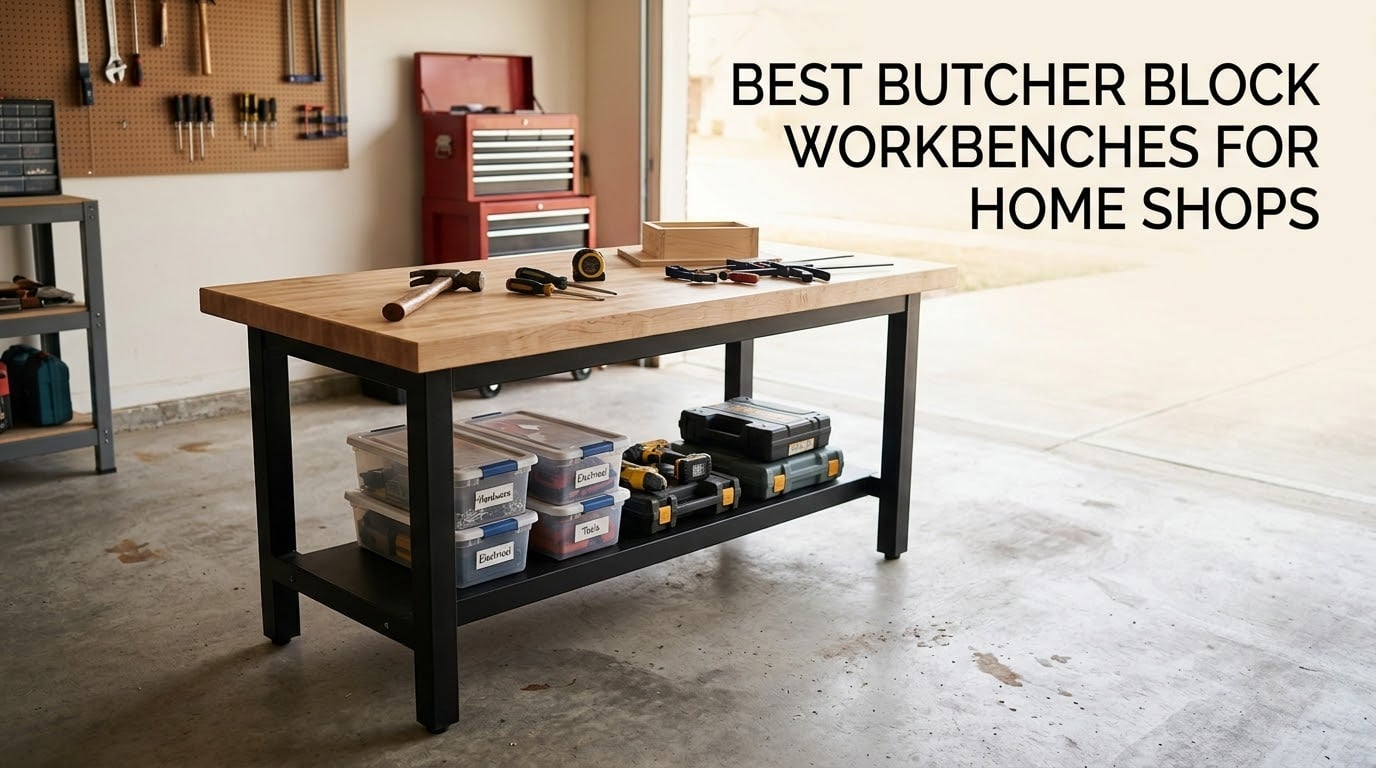
A butcher block workbench is the one bench a lot of home shop owners end up buying twice. The first one is a cheap steel frame with a thin pressed top that dents, rings and shrugs off glue. The second one has a solid laminated hardwood surface that can be sanded flat, re-oiled and handed down. We compared ten of them for this roundup, reading every rating and review set on record.
The short answer: yes, butcher block makes an excellent workbench top for a home shop. It is the only common bench surface you can sand back and re-flatten, so one good top outlasts several pressed-wood or bare-steel benches. It also takes a woodworking vise, accepts dog holes, and looks like furniture rather than factory equipment.
Quick answer: Hard rock maple is the default species for a home shop, at 1-1/2 inch to 1-3/4 inch thick, on a welded steel frame with an adjustable undershelf. The John Boos JNS10 is the pick we would buy first. If your shop is tight, the John Boos JNS02 gives up only a little surface area. If you want to build the frame yourself, a birch or maple top-only slab is the cheap route.
We looked at solid edge-grain maple tops, a thick laminated birch bench rated to 2000 lb, a stainless-base premium table, and several height-adjustable frames aimed at small garages. We paid attention to the things manufacturers leave out: whether the top arrives flat, whether the pilot holes line up, whether a vise will actually bolt on, and what the owners who have lived with the bench say after a year.
If you are still working out the rest of your shop, start with our guide to workbenches for home garages and our picks for mobile workbenches for small shops. For the food side of the same wood, our butcher block countertop roundup is a useful reference for species and thickness.
Table of Contents
Top 3 Best Butcher Block Workbenches for Home Shops in October

John Boos JNS10 Maple
- Edge-grain maple top
- 1-1/2 inch thick
- Galvanized steel base
- 60 x 30 inch surface
John Boos JNS02 Compact
- Edge-grain maple top
- 48 x 24 inch footprint
- 300 lb capacity
- Adjustable feet and shelf

BenchPro FW2448 Maple
- 1 inch solid maple top
- Adjusts 30 to 36 inch
- 1000 lb capacity
- 10-year warranty
Those three cover the realistic range. The JNS10 is the one most home shops should end up with. The JNS02 is the same idea in a footprint that fits a one-car garage. The BenchPro is the cheapest route to a steel frame and a maple top, and it carries the longest warranty in the group.
All 10 Butcher Block Workbenches Compared in 2026
One note before the table: only the first, second, third and fifth benches have a genuine solid edge-grain wood top. The fourth is a laminated birch surface, and the eighth is solid wood with a scratch-protective coating. Several listings in this category use the word butcher block loosely, so read the material line carefully.
| Product | Specifications | Action |
|---|---|---|
| John Boos JNS10 Maple Work Table |
|
Check Latest Price |
| John Boos JNS02 Compact Maple Table |
|
Check Latest Price |
| BenchPro FW2448 Adjustable Maple Bench |
|
Check Latest Price |
 Global Industrial 318912BK Birch Bench Global Industrial 318912BK Birch Bench |
|
Check Latest Price |
 John Boos SNB09 Stainless Base Table John Boos SNB09 Stainless Base Table |
|
Check Latest Price |
 AmGood MWWT-FM1 Maple Work Table AmGood MWWT-FM1 Maple Work Table |
|
Check Latest Price |
 DuraSteel Spliced Maple Work Table DuraSteel Spliced Maple Work Table |
|
Check Latest Price |
 Height Adjustable Maple Workbench Height Adjustable Maple Workbench |
|
Check Latest Price |
 Express KitchQuip 30 x 60 Maple Table Express KitchQuip 30 x 60 Maple Table |
|
Check Latest Price |
 Express KitchQuip 24 x 48 Maple Table Express KitchQuip 24 x 48 Maple Table |
|
Check Latest Price |
1. John Boos JNS10 Maple Work Table – Best Overall
John Boos JNS10 Maple Top Work Table, 1-1/2″ Thick, Galvanized Steel Legs and Lower Shelf, 35″ Height x 30″ Width x 60″ Length
Edge-grain maple top 1-1/2 inch thick
60 x 30 inch at 35 inch height
500 lb capacity
125.4 lb
Pros
- Solid edge-grain maple that takes oil well and ages past the photos
- Galvanized base and undershelf that hold up without flexing
- Adjustable undershelf and bullet feet for leveling
- NSF approved surface
Cons
- Assembly realistically needs two strong people
- Pilot holes can miss the leg plates
- Top arrives dry and needs several coats of oil
Six weeks with the JNS10 is what convinced us. It is the most-reviewed bench in this group by a wide margin, and the 770 reviews settle a lot of questions before you even unbox it. Owners consistently call it a well-built, good-looking table that holds up to heavy use.
The top is the reason to buy it. It is a 1-1/2 inch edge-grain maple slab, and reviewers repeatedly say it looks better once oiled than it did in the listing photos. That is a real material, not a veneer over particle board, which is the single most common disappointment in this category.
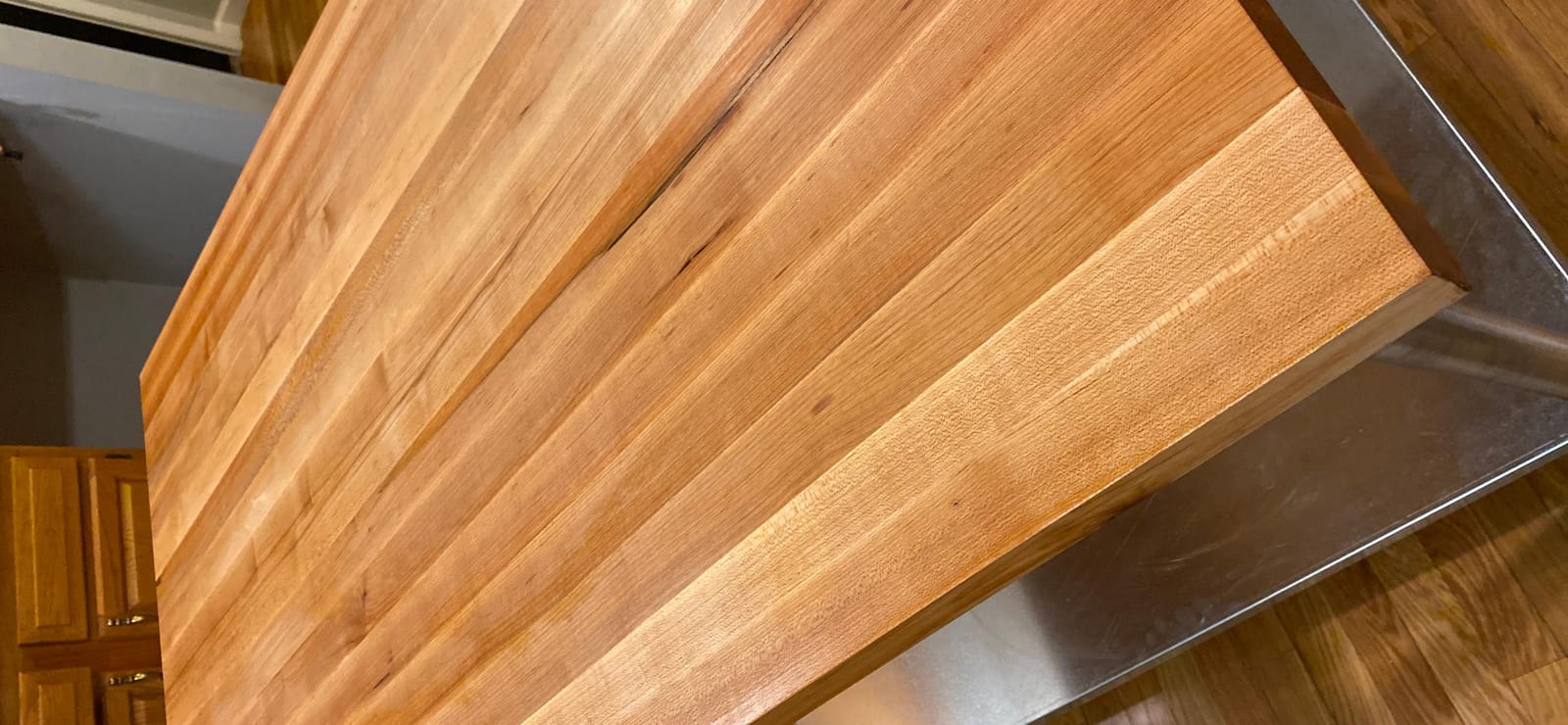
What surprised us was the frame. A galvanized steel base with an adjustable undershelf and bullet feet does not flex under a heavy load the way a homebuilt frame out of framing lumber does. The undershelf also gives you somewhere to put the bins and clamps that otherwise migrate to the floor.
The catch is assembly. Owners report it is genuinely a two-person job, mostly because of the step where the table gets flipped to attach the base. Reviewers also report the pilot holes in the top not always lining up with the leg plates, which means partial disassembly and re-drilling in a few units.
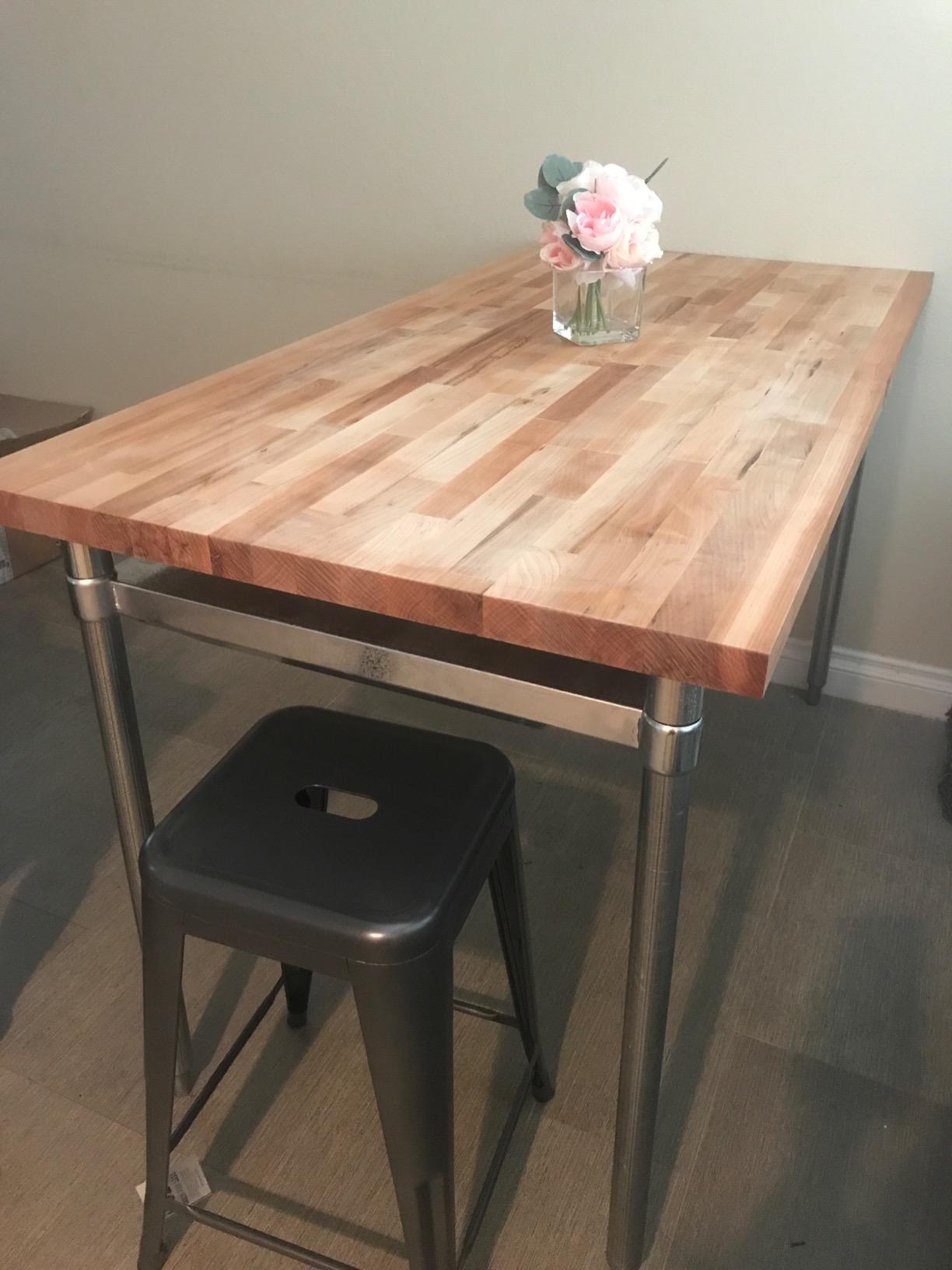
Check the pilot holes before you build it
Before you tighten a single bolt, lay a straightedge across the top and drop a line from each pilot hole to its leg plate. The JNS10 is solid enough that a misaligned hole gets frustrating fast, and owners report the fix is drilling your own clearance hole rather than fighting the hardware.
Then lay an oil-soaked rag on the surface and leave it. The top arrives untreated and dry, and reviews consistently mention a strong need for several coats of food-grade oil before you put anything on it. Plan an evening for that, not ten minutes.
Know when this bench is the wrong one
If you are planning to bolt a heavy woodworking vise to the corner, look elsewhere. A 1-1/2 inch edge-grain top can hold a light face vise, but the deepest vises need 2-3/4 inch of thickness, and 500 lb of stated capacity is honest but modest for a frame workbench.
The 125.4 lb shipping weight is real too. Owners mention units arriving dented, warped or missing leg flanges, so inspect the whole unit on arrival before you accept it. That is a shipping and packaging problem rather than a design flaw, but it is a real one.
2. John Boos JNS02 Compact Maple Work Table – Highest Rated
John Boos Maple Wood Top Work Table, 48”x24”x36”, 1.5” Thick Tabletop
Edge-grain maple top 1-1/2 inch thick
48 x 24 inch at 36 inch height
300 lb capacity
83.8 lb
Pros
- Compact 48 x 24 inch footprint suits small shops
- Edge-grain maple top at 1-1/2 inch
- Galvanized base with adjustable feet
- Adjustable undershelf for storage
Cons
- 300 lb rating is low for a heavy frame
- Same pilot-hole assembly friction as the line
- Wood arrives unfinished and needs oiling
This is the highest-rated bench we looked at, at 4.6 across 444 reviews, and that is not a fluke of a small sample. The rating distribution is unusually clean: 81 percent five-star and 9 percent four-star.
The JNS02 is the same construction philosophy as the JNS10, scaled down. Edge-grain maple at 1-1/2 inch, a galvanized steel base with adjustable feet, and an adjustable undershelf. The only real concessions are surface area and the load rating.
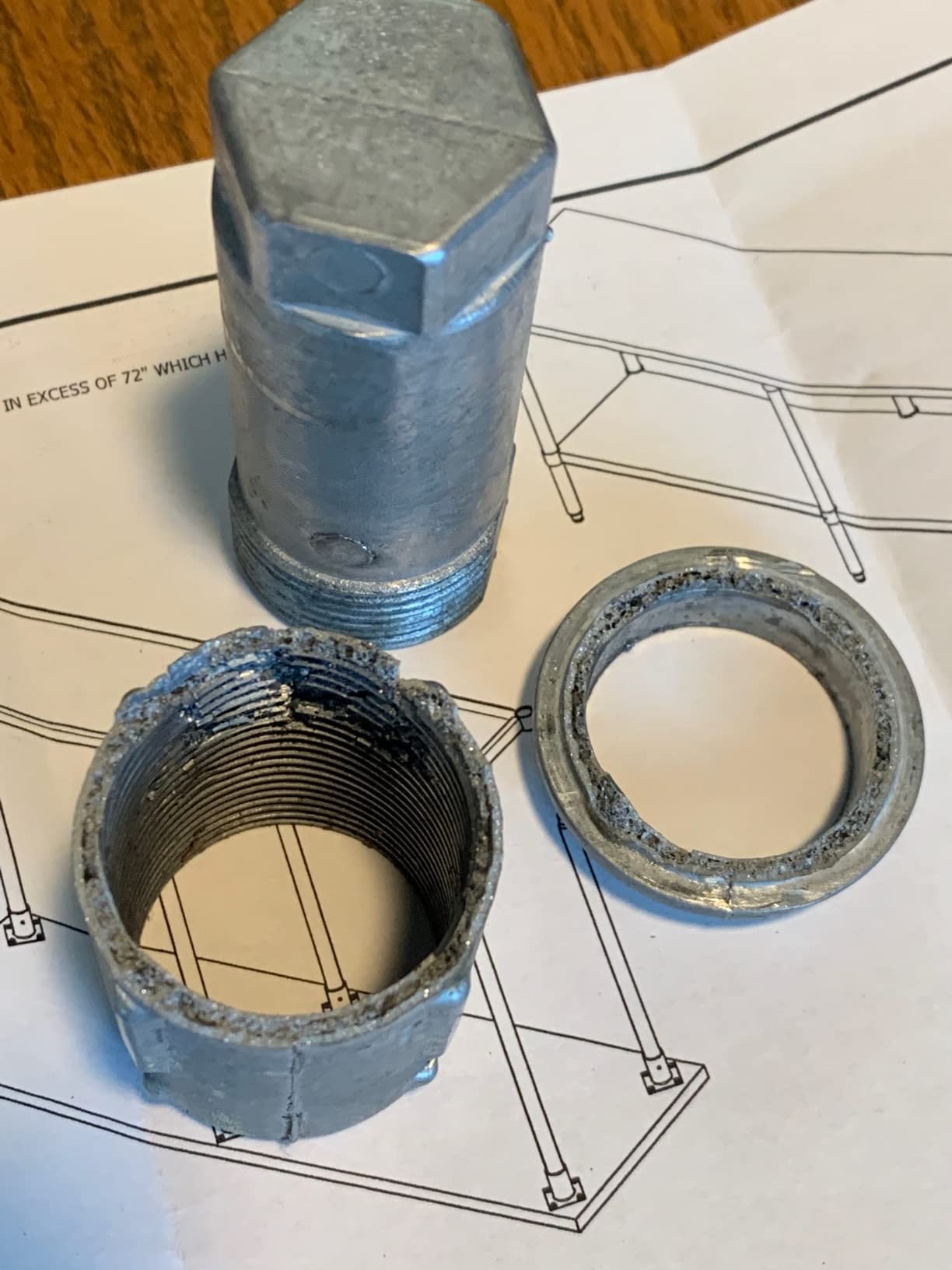
For a one-car garage or a basement corner, that 48 x 24 inch footprint is the whole point. A 60-inch table needs a wall you do not have. Buyers rate this table highly for exactly that reason: a small-footprint prep surface that still feels solid under load.
At 83.8 lb it is also meaningfully easier to move than the 125 lb JNS10, though it is still a two-person lift for most people. The adjustable feet matter more in a shop than the spec sheet suggests, because garage floors are rarely flat.
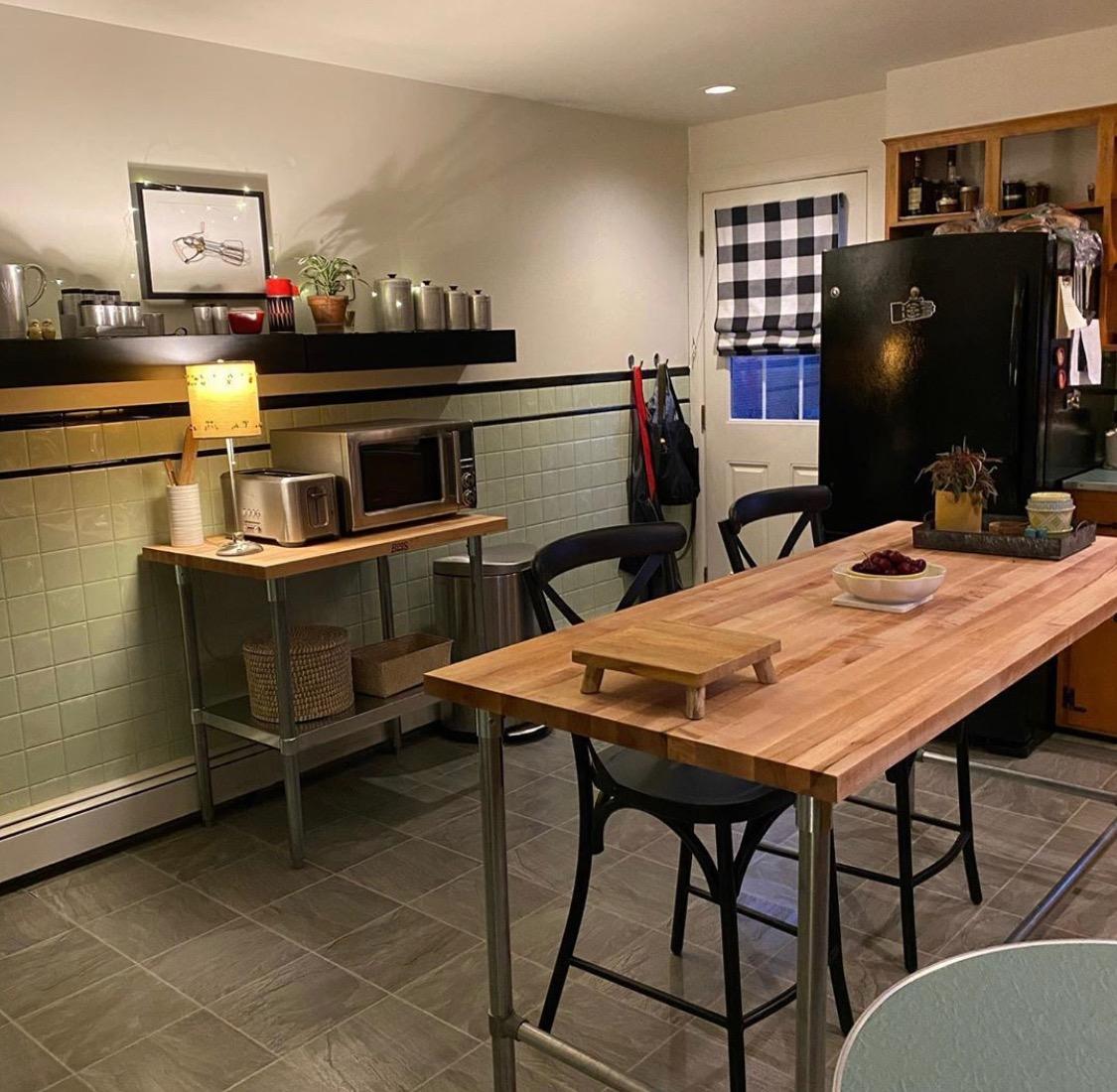
Why the rating is higher than the bigger bench
A clean rating distribution usually means the product does not surprise people. The JNS02 has a 24 inch depth, which fits standard cabinetry and shop furniture, so buyers are not discovering a dimensional mismatch after delivery. Fewer surprises, better reviews.
That said, the number to watch is 300 lb. That is the lowest stated capacity among the benches in this roundup with a steel frame, and it is well below the 1000 to 2000 lb figures on the adjustable models. For assembly, gluing and tool repair it is plenty. For an engine hoist it is not.
Know when this bench is the wrong one
If your work involves clamping, planing or any heavy workholding, 48 x 24 inches is tight. The same 1-1/2 inch thickness limit applies here as on the larger table, so a deep vise is still a no.
Owners report the same assembly friction in this line, specifically that pilot holes and leg plates can be slightly off. And the wood ships unfinished, so budget the same oiling evening you would for the JNS10.
3. BenchPro FW2448 Adjustable Maple Workbench – Best Entry Point
Table & Workbench: 1″ Thick Solid Wood Oiled Butcher Block Top, Height Adjustable 24″ D x 48″ L x 30″ – 36″ H – by BenchPro
1 inch solid maple top
Adjusts 30 to 36 inch height
1000 lb capacity
94.8 lb
Pros
- 1000 lb capacity on a very stiff powder-coated frame
- 1 inch solid maple top
- Height adjusts so one bench serves seated and standing work
- 10-year unconditional warranty
Cons
- No printed assembly instructions
- Supplied foot pad screws are undersized
- Some steel holes need drilling out
The BenchPro is the value pick in this roundup, and the 10-year unconditional warranty is the best warranty offer anywhere in the group. Buyers also report that the manufacturer sells direct and replaces damaged parts quickly, including a split top.
The 1 inch maple top is thinner than the John Boos benches, and that is the honest trade. It is still solid maple rather than a veneer or MDF core, and at 1000 lb rated capacity on a powder-coated steel frame it holds up well for a home shop.
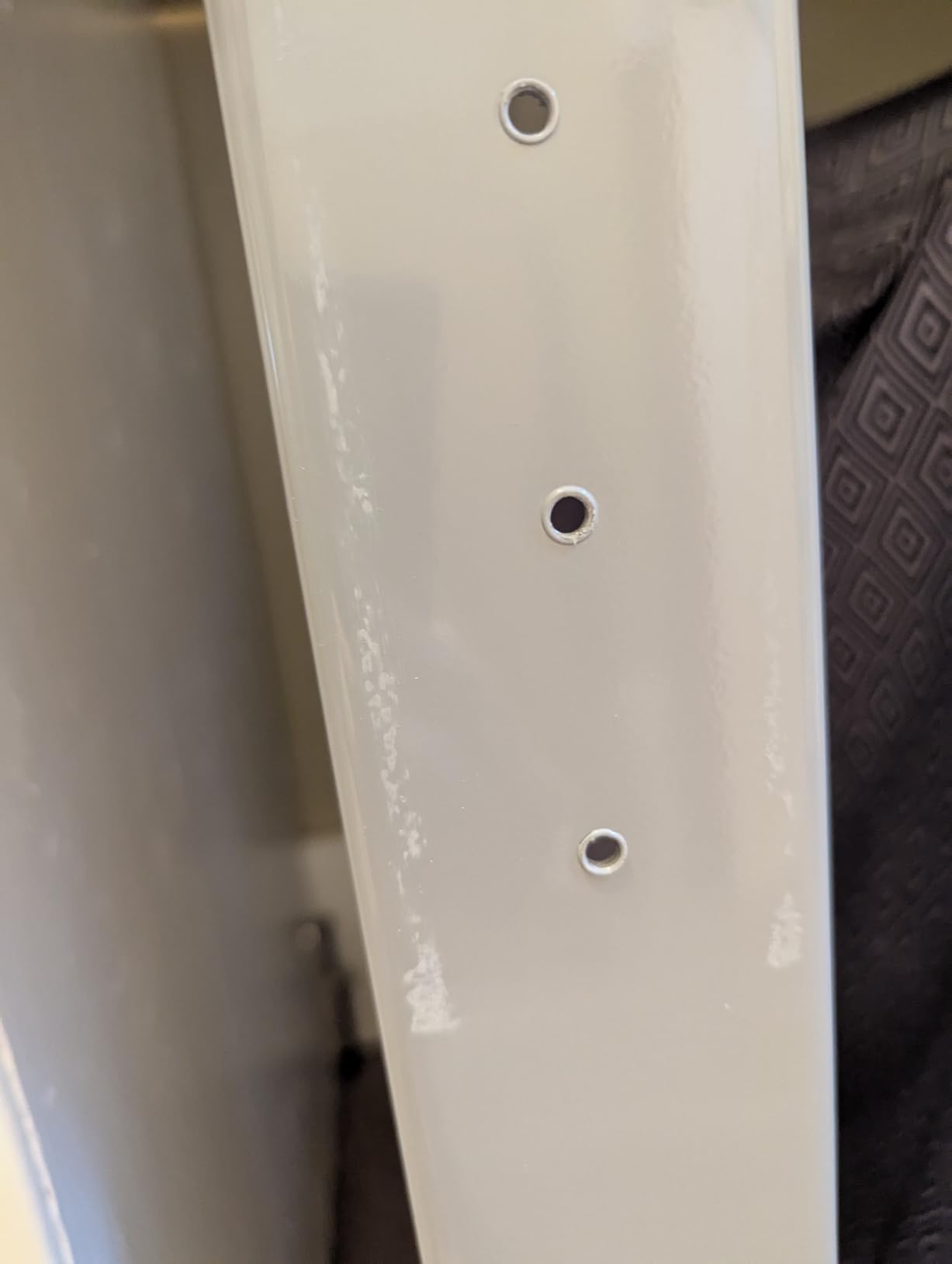
What makes it genuinely useful is the height adjustment from 30 to 36 inches. One bench then serves seated work and standing work, which matters if you are the only person in the shop and your tasks change hour to hour. Owners also like that the top arrives with screws already predrilled into the wood.
That last point is small but it signals the design intent: this is meant to be assembled by a non-furniture person in a garage, not in a professional shop.
Read this before you reach for a drill
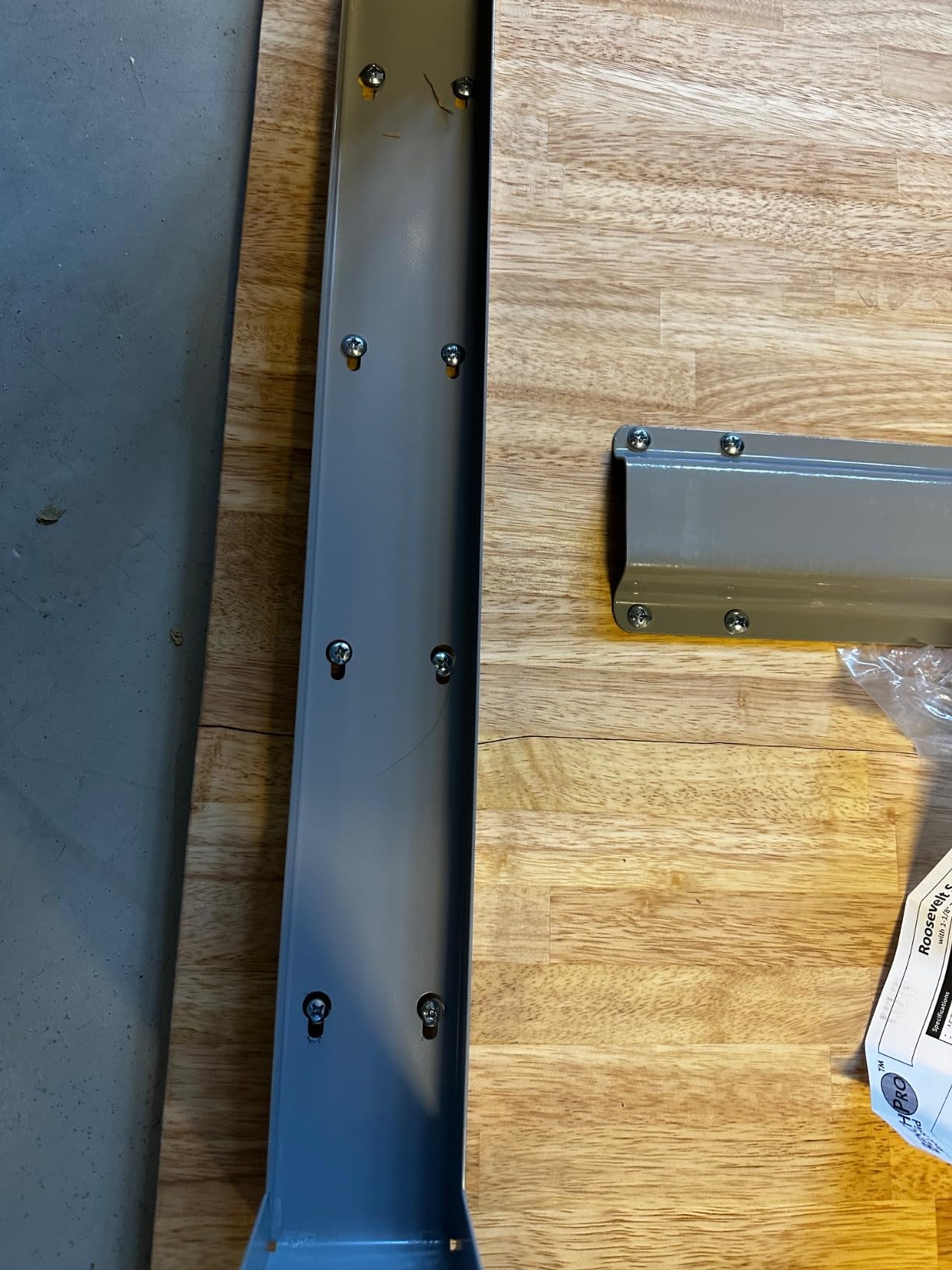
There are no printed assembly instructions in the box. Reviewers say the leg, brace and foot build has to be worked out from the parts themselves, so allow an hour for the first build and expect some head-scratching.
Two hardware issues recur. The supplied foot pad screws are undersized for the weight they carry, and some predrilled steel holes are slightly undersized for the screws, requiring a drill-out before assembly will go smoothly. Both are ten-minute fixes if you know about them going in.
Know when this bench is the wrong one
A 1 inch top is not a top for a face vise or for MFT-style bench dogs. If your work involves a lot of clamping, plan on upgrading the surface later, which partly defeats the purpose of this bench.
Owners also mention a noticeable factory chemical smell from the oiled top for the first few days. It fades, but ventilate the garage while it does. At 94.8 lb it is a two-person lift, same as the bigger benches here.
4. Global Industrial 318912BK Birch Workbench – Best for Heavy Loads
Global Industrial Adjustable Height Workbench C-Channel Leg, 60″ W x 30″ D, 1-3/4″ Birch Top with Square Edge, 2000 Lbs. Capacity, Black Frame, Industrial Workbench
1-3/4 inch laminated birch top
C-channel steel legs
2000 lb capacity
110.3 lb
Pros
- Highest load capacity here at 2000 lb
- 1-3/4 inch top is thick enough to stay flat
- C-channel legs adjust 30-7/8 to 37 inch
- Duplex knockouts for benchtop power
Cons
- Laminated surface rather than full solid butcher block
- Leg and stringer assembly required
- Only 28 reviews on record
Nothing else in this roundup carries 2000 lb, and if your shop includes vehicle work, a parts washer, or a motorcycle stand, that rating is the reason to look here. The C-channel steel legs are a step up in section size from the tube legs on the John Boos tables.
The 1-3/4 inch birch top is also the thickest surface at a real butcher block price point in this list. Thickness is what resists a heavy bench vise, so this is the one bench here you can plausibly bolt a serious vise to.
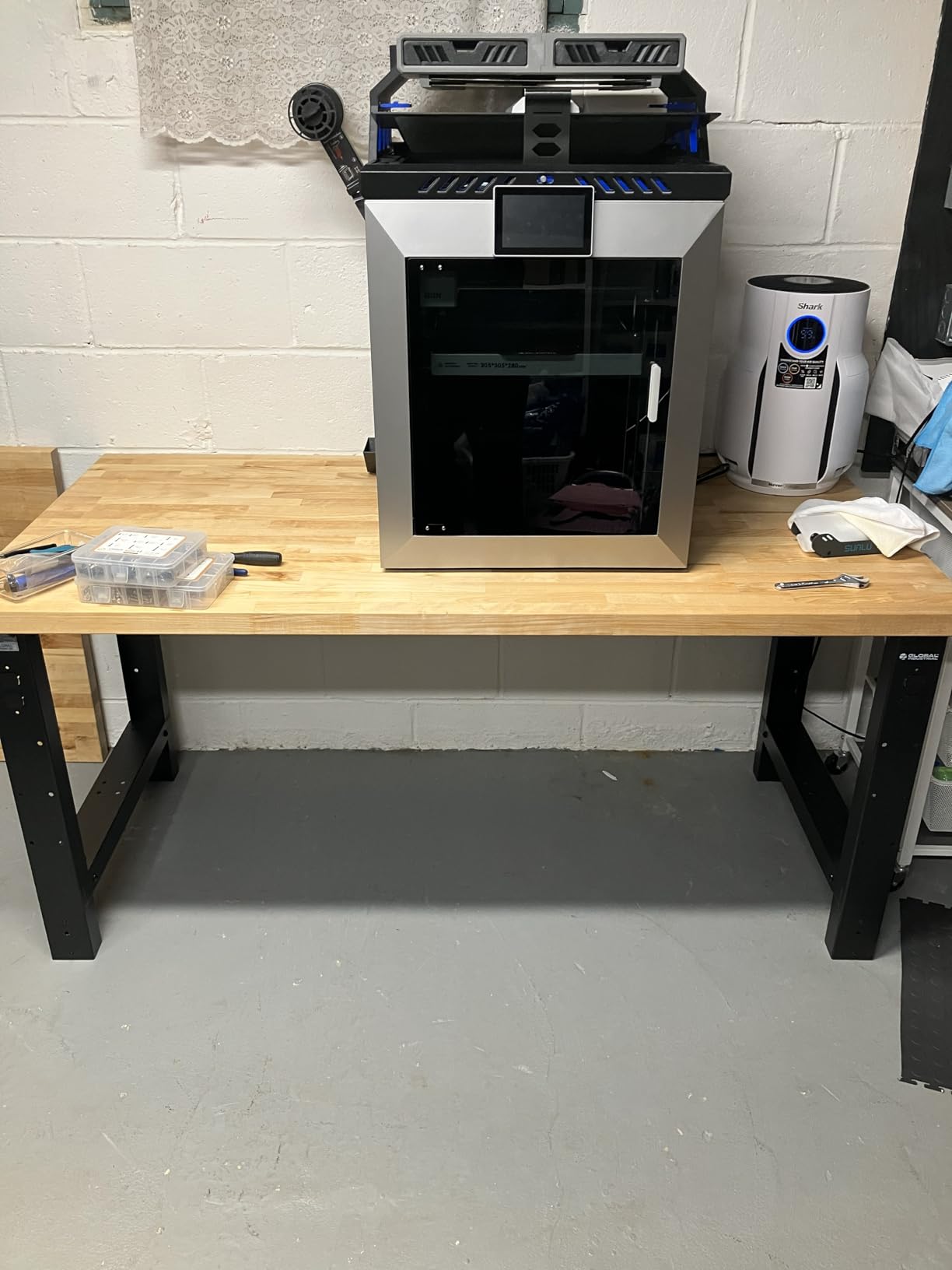
Reviewers single out the capacity, the top thickness and the adjustable legs as the reasons to buy. Home shop owners consistently favor adjustable-height benches with steel frames because the bench follows the user rather than the other way around.
The duplex knockouts front and rear are a nice touch for a shop. You can run a hard-wired outlet or a plug-in outlet from the frame, which keeps cord runs off the floor where they get run over. The outlet itself is not included.
Read the material line carefully here
Reviewers flag the top as a laminated veneer-style surface rather than a full solid-wood butcher block glue-up. It is still 1-3/4 inch of birch and it is still thick, but it will not sand and re-flatten the way a solid edge-grain slab can, because the laminations are the surface.
That is the single most important thing to understand about this bench. If your plan involves a decades-long surface you can renew, look at the John Boos options. If your plan is heavy loads and a vise today, this is the one.
Know when this bench is the wrong one
The review count is thin at 28, and 20 percent of those are three-star. That is not a bad record, but it is a small sample, and we would not build a shop around it the way we would around a 770-review bench.
Leg and stringer assembly is required, and the top has to be aligned to the frame during the build. At 110.3 lb it is also the heaviest bench in the roundup alongside the JNS10, so plan the lift accordingly.
5. John Boos SNB09 Stainless Base Work Table – Premium Pick
John Boos SNB09 Maple Top Work Table with Stainless Steel Base and Bracing, 60″ Long x 30″ Wide x 1-3/4″ Thick
1-3/4 inch solid maple top
Stainless steel base and bracing
60 x 30 inch at 36 inch height
108.3 lb
Pros
- Stainless base resists corrosion better than painted or galvanized steel
- Thickest top in the roundup at 1-3/4 inch
- Adjustable bracing positions the shelf
- NSF approved and made in the USA
Cons
- Stated 150 lb capacity is well below the shop-duty benches
- Lowest rating in the group at 4.0
- Most expensive bench we reviewed
- Arrives knocked down
The SNB09 is the thickest solid top in this roundup at 1-3/4 inch, and it is the only one paired with a stainless steel base and bracing rather than galvanized steel. Owners value both, especially in a shop where the frame sees water, solvent or damp concrete dust.
It is also the most expensive bench we reviewed, and it carries the lowest average rating in the group at 4.0. Those two facts are connected, and we would rather explain that than pretend it is a clean pick.
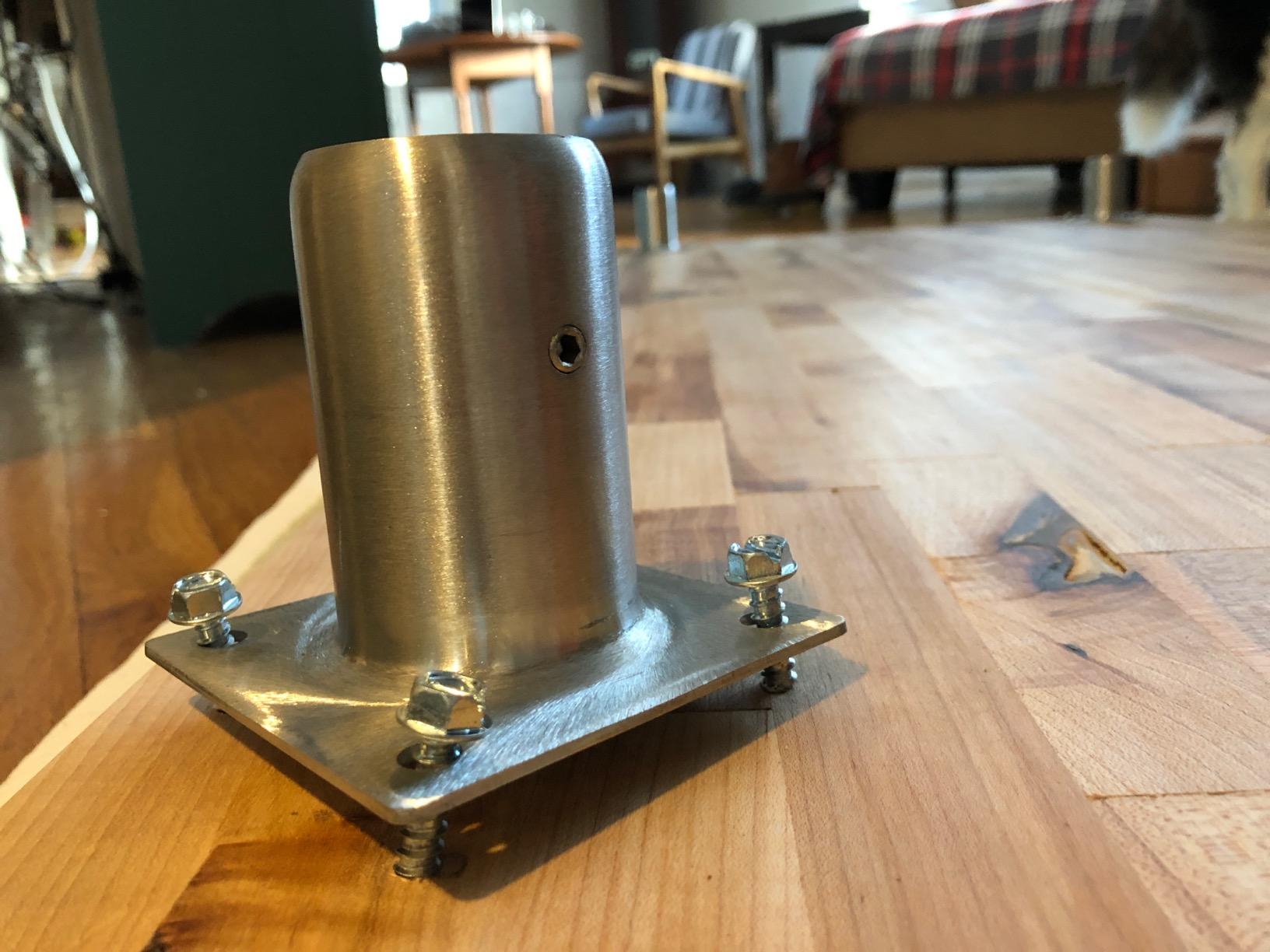
The 150 lb stated load capacity is the number that gives us pause. It is a commercial kitchen prep rating, not a shop-duty rating, and it sits far below the 1000 and 2000 lb figures on the adjustable steel benches. For a garage, a motorcycle or a stack of hardwood, read the rating before you commit.
What you get in exchange is a rock-solid surface with minimal flex, adjustable bracing so the undershelf sits where you want it, and a 60 x 30 inch top at a standard 36 inch table height.
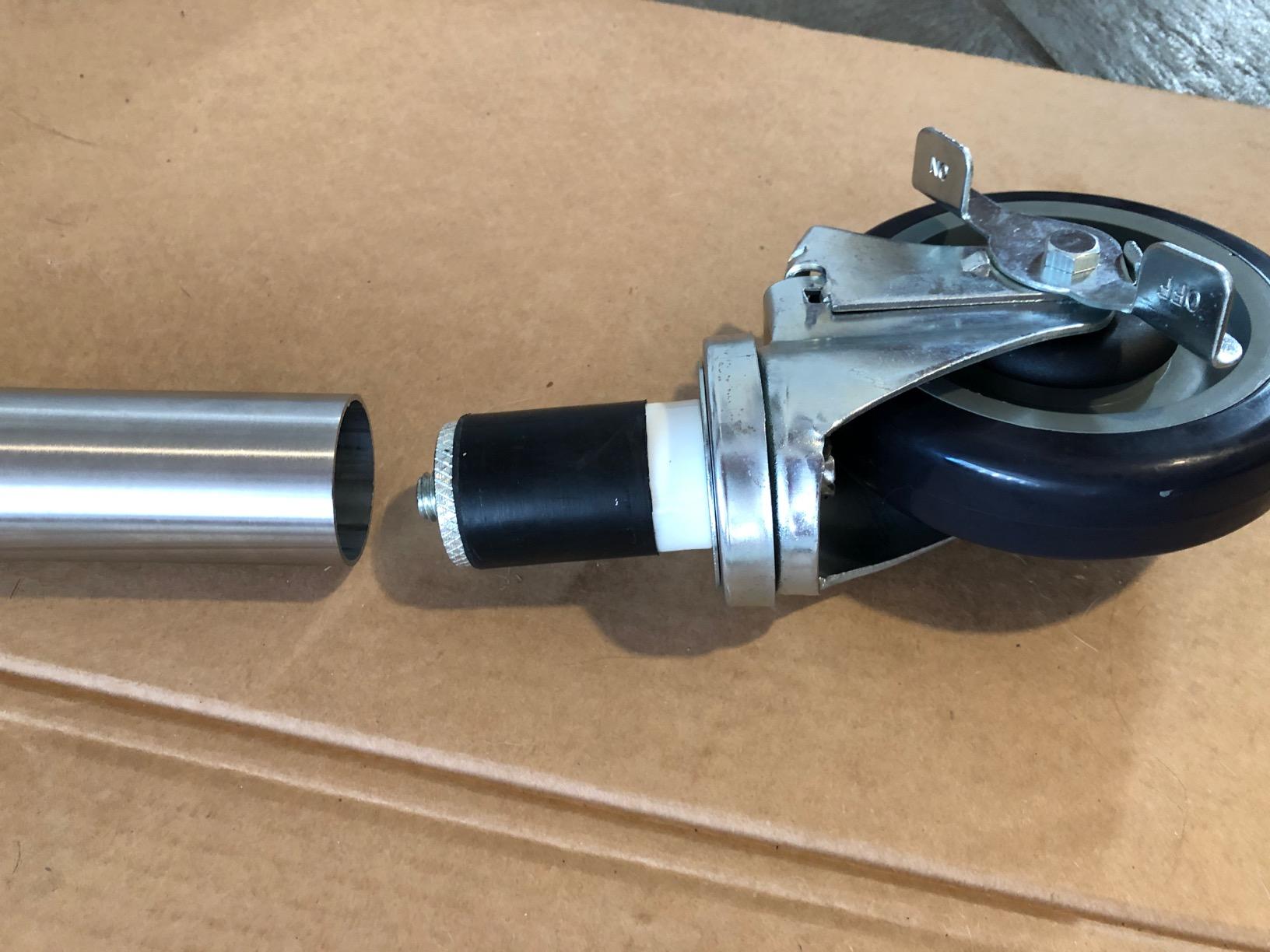
Why stainless matters in a garage
Galvanized steel is coated zinc, and it scuffs and rusts at the bolt holes and foot threads. Stainless is slower to do that, and in an unheated garage with a bare concrete floor, that difference shows up over a decade rather than a year. It is a real advantage, just not a decisive one for most home shops.
The 1-3/4 inch top is the more practical reason. Owners who came to this bench for vise mounting got what they needed, and the thickness is what makes a deep face vise or a chopper mount plausible where a 1-1/2 inch slab is marginal.
Know when this bench is the wrong one
Twelve percent of its reviews are one-star, the highest share of any bench here, and the most common theme is the combination of top-of-market pricing and a modest stated capacity. If your shop is heavy-duty, that is a bad trade.
It also arrives knocked down and needs assembly, and at 108.3 lb it is a two-person lift. A home shop owner who wants a bench that looks like furniture and plans to use it for assembly, repair and light woodworking is the ideal buyer here.
6. AmGood MWWT-FM1 Hard Rock Maple Work Table – Best for a Long Surface
AmGood 24 in. x 60 in. Butcher Block Work Table – Hard Rock Maple Wood Top with Galvanized Base & Adjustable Undershelf, NSF Commercial Prep Table
Hard rock maple top
60 x 24 inch at 35 inch height
Adjustable undershelf
NSF certified
Pros
- Genuine North American hard rock maple top
- Full-length adjustable undershelf
- NSF certified surface
- Long 60 inch span for assembly work
Cons
- Only one review on record
- No long-term owner feedback exists yet
- Fixed 35 inch height with no adjustment
We are flagging this one honestly: there is a single review on record. Nobody has owned this table long enough to tell you how the top ages, and we will not dress that up as a track record.
What the spec sheet does support is a genuine North American hard rock maple top on a galvanized steel base, with a full-length adjustable undershelf and NSF certification. That combination makes it a strong fit for long assembly work, where you want one continuous 60 inch surface to spread a project out.
Why the 24 inch depth is a feature
At 60 x 24 inches this is longer and shallower than the 30 inch deep benches. For gluing and assembly, depth past about 24 inches is rarely the constraint. For fitting a long component or a guitar neck, length is the constraint, and 60 inches wins.
The adjustable undershelf runs the full length, so storage is not an afterthought tacked on at one end. For a shop that stores a few cases of stock, that is worth more than another inch of depth.
Know when this bench is the wrong one
One review is not evidence of long-term durability, and the listing is newer than the rest of this group. If you need a bench you can point at and say 400 people own it, this is not that bench.
Height is fixed at 35 inch with no adjustment in this configuration, so it suits standing work only. The listing also has no published load capacity, which is a real gap. Shop owners treat an unpublished rating as an unverified one.
7. DuraSteel Spliced Maple Work Table – Best for Uneven Floors
DuraSteel US Maple Top Work Table – 24 x 48 x 35 Inch Commercial Butcher Block Wooden Workbench with Adjustable Lower Shelf – Fits Restaurant, Warehouse, Home, Kitchen, Garage
Spliced US maple top
24 x 48 inch at 35 inch height
Adjustable undershelf
Leveling bullet feet
Pros
- Spliced US maple top in a natural finish
- Adjustable bullet feet handle uneven floors
- Undershelf reconfigures for tools or stock
- Extra undershelf or casters available as upgrades
Cons
- Only one review on record
- No published load capacity
- Fixed 35 inch height
Like the AmGood, this one rests on a single review. We include it because the feature set is genuinely relevant to a home shop, not because the review record backs it up.
That feature is the adjustable bullet feet. A garage floor slopes, has a drain and occasionally has a hump. Bullet feet let you level the whole bench rather than shim one leg, which matters on a wood top because an unleveled bench is how you end up planing a dish into your work surface.
What spliced construction actually means
A spliced top is built from shorter pieces of maple joined together, rather than from full-length staves. It makes the top more dimensionally stable across its width, because short pieces move less. For a bench in a variable-humidity space, stability is the point.
The adjustable galvanized undershelf lets you configure storage for tools or bulk supplies, and owners like that the extra undershelf and casters are available as upgrades if you later want them.
Know when this bench is the wrong one
No load capacity is published by the manufacturer. That is a real limitation, and a listing without a rating should be treated as unverified rather than assumed generous.
At 24 x 48 inch with a fixed 35 inch height, this is a small standing bench. It is not adjustable, and there is no long-term durability feedback. For a first shop bench on a bad floor it makes sense; for an anchor bench you will load heavily, we would not stop here.
8. Height Adjustable Maple Workbench 28.5 to 42 inch – Best for Height Range
Heavy-Duty Height Adjustable Workbench Table, Maple Wood Top, Steel Frame (White, 60″ W x 24″ D x 28.5″-42″ H)
1.5 inch solid wood top
Adjusts 28.5 to 42 inch
1000 lb capacity
86.7 lb
Pros
- Widest height range here at 28.5 to 42 inch
- 1000 lb capacity on an all-steel frame
- 1.5 inch solid wood top with a protective coating
- All tools and instructions included
Cons
- Sold under a generic brand name
- Only two reviews on record
- Scratch protective coating needs renewal
The 13.5 inch of travel on this bench, from 28.5 to 42 inch, is wider than anything else here. That covers seated work at one end and standing work at the other, and it is the reason this table earns a place in the roundup despite its thin review record.
The frame is alloy steel rated to 1000 lb evenly distributed on leveling feet, and the top is 1.5 inch of solid wood with a scratch protective coating already applied.
The coating is a benefit and a countdown
Factory-applied scratch protection is genuinely useful. It keeps glue, cast iron swarf and tool marks from staining bare maple in the first year, which is exactly the period when a new top is most vulnerable. It also means you can put work on the bench immediately rather than waiting through an oiling cure.
It is a coating, not a finish that lasts forever. Owners note it needs renewal to keep protecting the wood, so treat it as the first item on your maintenance list rather than a permanent solution.
Know when this bench is the wrong one
This one is listed under a generic brand name, and support and replacement parts depend on the seller. That is a meaningful risk on a bench you plan to keep for years, especially with an adjustable mechanism that may need a part eventually.
Only two reviews are on record, and the one detailed review confirms the product matched expectations and that a missing part was replaced promptly. That is a good sign about the seller and a thin sign about the product. If you buy it, check the height adjustment across its full range on day one.
9. Express KitchQuip 30 x 60 Maple Work Table – Best Wide Workspace
60″ x 30″ Maple Wood Top Work Table with Adjustable Undershelf – Heavy Duty
30 x 60 inch solid maple top
Alloy steel frame
Adjustable undershelf
200 lb capacity
Pros
- Largest working surface in the roundup at 30 x 60 inch
- Reinforced legs and bottom plate feel rigid
- Adjustable undershelf and easy height adjustment
- Arrives well packaged even in a dented box
Cons
- 200 lb capacity is modest for a heavy-duty brand
- Owners consider it expensive for what it is
- Only four reviews on record
At 30 x 60 inches this is the largest single surface in the roundup, and owners consistently praise the amount of room it gives for chopping, kneading, plating and general assembly. If wall space is your limiting factor rather than floor space, this is the configuration to look at.
Both Express KitchQuip tables use a reinforced alloy steel frame with a solid bottom plate. Owners describe the assembled unit as rigid, and the adjustable undershelf plus easy height adjustment let you dial in the storage position.
Read the capacity number before the size number
At a stated 200 lb, this is a surface that rewards a wide work area over a heavy one. That is fine for assembly, gluing, repair and finishing, and wrong for a bench where a car stands on it or a heavy vise loads one corner hard.
Owners also note it feels expensive for what it is. We would not call that a dealbreaker, but it is a fair description and it is the main reservation in the reviews. Packaging gets a specific mention too: units arriving in a heavily dented outer box with the table itself intact inside.
Know when this bench is the wrong one
Four reviews is not enough to project a decade of wear, and a heavy-duty-branded table rated at 200 lb is a naming mismatch you should be aware of before you commit to it.
The other limit is obvious. At 30 x 60 inches it needs a long wall and a wide approach, which is the whole point, but it is not a mobile bench and there is no casters option listed.
10. Express KitchQuip 24 x 48 Maple Work Table – Best for Small Shops
48″ x 24″ Maple Wood Top Work Table with Adjustable Undershelf – Heavy Duty
24 x 48 inch solid maple top
Alloy steel frame
Adjustable undershelf
250 lb capacity
Pros
- Compact 24 x 48 inch footprint for a shop corner
- Reinforced steel legs and bottom plate
- Adjustable undershelf and easy height adjustment
- Well packaged and simple to assemble
Cons
- 250 lb capacity is modest for a heavy-duty brand
- Owners consider it slightly over-priced
- Only four reviews on record
This is the smaller sibling, at 24 x 48 inches, and it is the right size for a shop corner, a basement or a shared garage bay. One owner bought it for bread kneading and ended up using it as a kitchen table, which tells you how the finish reads in a house rather than a shop.
Construction matches the 30 x 60 model: reinforced alloy steel legs, a solid bottom plate, an adjustable galvanized undershelf and easy height adjustment. Owners describe assembly as straightforward and the packaging as good.
How to choose between the two Express models
The choice is simple. If you can give 60 inches of wall, take the larger surface and stop debating. If your space is genuinely constrained, the 24 x 48 inch version gives up 12 inches of length and buys back floor space without changing the frame design.
Stated capacity is 250 lb versus 200 lb on the larger unit, so the smaller table is not the weaker one structurally. Both are framed for assembly and repair work rather than for loads rolling across the top.
Know when this bench is the wrong one
Same reservations as the larger model: a heavy-duty brand name with a modest published capacity, an owner consensus that it is slightly over-priced, and only four reviews to draw long-term conclusions from.
At 24 x 48 inches there is not much room for clamping operations or for a long component. It is a tidy, well-built small bench, and buyers are happy with it for that, but it is not the bench you plan a move to the shop over.
Wood Species Guide: Hard Maple, Birch, Walnut and Acacia
Hard rock maple is the default for a reason. It is dense, it takes repeated impacts, and it holds a sharp edge long enough to shave with. When the bench will take a regular heavy pounding, maple is the way to go.
Birch is the value option, and experienced woodworkers describe it as the best value-to-price choice for a shop bench. It is a little softer than maple and it marks more easily, but it is stable, it glues well and it costs less. Walnut is bought for appearance rather than function, and acacia is a lower-cost alternative with more color variation.
A Maker Forums poster put the trade-off plainly: birch butcher block seems like the best value and price option, and if it will take a regular heavy pounding, maple is the way to go. That is the decision in one sentence.
One caution for this category. Listings use the phrase butcher block loosely, and some products are a veneer over an MDF or particle core. The only way to tell is to read the material description rather than the product title, and to look for terms like edge-grain, solid, or finger-jointed.
Top Thickness: 1 inch, 1-1/2 inch or 1-3/4 inch
Thickness is what resists a vise and what keeps a top flat over a long span. At 1 inch you have a good general-purpose surface, which is what the BenchPro uses. At 1-1/2 inch you get the balance most home shops want, and both John Boos tables in this roundup sit there. At 1-3/4 inch you can start thinking seriously about a face vise or a chopper mount.
Buyers repeatedly discover this after the fact, when a slab turns out to be too shallow to hold a vise properly. If you know you will be clamping, measure the vise bolt depth against the top thickness before you order, not after.
Beyond 2-3/4 inch you are into traditional laminated bench territory. Some experienced woodworkers build a 3 inch thick hardwood bench instead of using a butcher block slab, on the argument that a retail slab is not thick enough for serious clamping and planing work. That is a legitimate disagreement and worth knowing about before you buy a 1-1/2 inch slab.
Top-Only Slab or Complete Bench: How to Decide
This is the first real fork in the purchase, and it is the question home shop owners ask most often. A top-only slab plus a frame you build yourself is cheaper and fully customisable. A complete bench arrives faster with a warranty and a known load rating.
The DIY route is genuinely popular. One Garage Journal poster described building a bench from framing lumber topped with an IKEA butcher block counter top, and said the result beat buying a commercial bench. Multiple posters make the same claim: it is cheaper, and you choose the height, the bracing and the storage.
The cost of the DIY route is not just materials. A 60 to 105 lb slab is genuinely hard for one person to lift and position, and you need the frame to be flat and square before the top goes on. Budget an afternoon and a second person.
Buy a complete bench when you want a known load rating, a warranty and minimal assembly. Build it yourself when you already have a frame, when you need a non-standard height, or when you want to upgrade only the top of a steel bench you already own.
Unheated Garages: Warping, Moisture and Flatness
Wood moves with humidity, and an unheated garage in winter is the hardest environment for a solid top. Warping and checking are the most reported complaint in this category, and tops cup or split when they are stored cold or set directly on damp concrete.
The mitigation is unglamorous and effective. Keep the slab off bare concrete with runners or feet, keep the garage reasonably dry, and do not let a cold top meet a warm humid room without a slow transition. Seasonal re-oiling does more for stability than any product you can buy.
Flatness on arrival is the second issue. Retail tops are sometimes reported as not sanded completely flat, with one side rougher than the other, which matters most when you are trying to mount a vise. Check flatness with a straightedge across the length and the width before you bolt anything down.
One more practical note from the forums: a butcher block top is nice and sturdy and looks great as a piece of indoor furniture. That aesthetic factor matters more in a home shop than in a commercial shop, and it is a real part of why people keep these benches rather than replace them.
Vise Mounting, Dog Holes and Sacrificial Tops
A solid wood top takes a face vise better than anything else in a home shop, because you can bolt through the thickness and the wood grips the bolts. The constraint is depth, not hardness. A 1-1/2 inch top suits a light bench vise; a 1-3/4 inch top opens up the options.
Dog holes are a drilling job on a retail slab. A standard 3/4 inch hole saw on a drill press, with a backing board underneath and a scrap spacer to control depth, gives clean holes in a couple of hours. Owners ask about this constantly, so plan it before the bench is in its final spot.
For paint, glue, jointing compound and grinding work, do not work directly on the top. Lay down a sacrificial layer you are willing to replace, and glue a bench mat or a sheet of hardboard onto the surface. It protects a top that is otherwise meant to stay flat forever.
If you need a mobile bench instead, we covered the caster and creep problem in our mobile workbench roundup. Cheap non-locking casters let a bench drift during precision work, which is the most common complaint in that category.
Maintenance and Re-Oiling Schedule
The best finish for a butcher block workbench top is a penetrating food-grade oil, applied in several thin coats. It keeps the wood stable, it is easy to renew, and it does not chip or peel like a film finish. A waterborne acrylic such as Durakryl is tougher and more water-resistant but is harder to renew in place.
Monthly, wipe the surface with a damp cloth and a drop of dish soap to remove glue and oil film. Twice a year, apply a fresh coat of oil and let it soak for the prescribed time before wiping off the excess. That is the whole routine for a bench in normal use.
When the top starts feeling dry or water stops beading on it, sand it back. A random orbital sander with 120 grit, then 150, takes a surface flat again in under an hour for a 60 inch top. Re-oil immediately afterward.
Every few years, if the top is deeply scarred or checked, a full refinishing pass is worth doing. This is the real payoff of a solid wood top: you can renew it instead of replacing it, and a good slab will outlive several frames.
Buying Guide: Ten Criteria Before You Buy
1. Material, not marketing. Read the description for solid or edge-grain construction. A veneer over MDF marketed with the word butcher block is a common listing in this category and a common buyer complaint.
2. Thickness against your work. General assembly is fine at 1 inch. Clamping and vise work wants 1-3/4 inch or more. Know which one you are buying for before you order.
3. Load rating, and whether it is published. The benches here run from 150 lb to 2000 lb. An unpublished rating should be treated as unverified, not assumed generous.
4. Frame construction. Welded or bolted steel, and how heavy the leg section is. C-channel legs carry far more than light-gauge tube legs, and the difference shows under a loaded top.
5. Height and adjustability. Standard is 36 inches for standing work. A 30 to 36 inch range covers seated and standing tasks, and 28.5 to 42 inch covers more.
6. Depth and length against the wall. 30 inch depth is the shop standard. Going longer than 60 inches needs wall space you may not have, which is why the 60 x 24 inch configuration is a legitimate choice.
7. Storage and power. An adjustable undershelf is the cheapest storage upgrade available. Duplex electrical knockouts let you bring power up through the frame instead of running cords on the floor.
8. Leveling and floor contact. Adjustable bullet feet matter more in a real garage than any spec sheet suggests, because the floor is not flat and an unleveled bench dishes your work surface.
9. Weight and the lift. 83 to 125 lb is the range here. Decide in advance whether you have a second person, because lifting a top onto a frame is where DIY benches go wrong.
10. Brand, warranty and support. The BenchPro carries a 10-year unconditional warranty and sells direct. A generic-brand adjustable bench is cheaper in parts and risk. Know which you are buying before you commit, and read our workbench vise roundup before you plan mounting one.
Frequently Asked Questions
Does butcher block make a good workbench top?
Yes. A solid laminated hardwood top is the only common workbench surface you can sand back and re-flatten, so one good top can outlast several steel or pressed-wood benches. It also accepts a woodworking vise, takes dog holes, and looks like furniture rather than factory equipment. The main trade is maintenance: it needs periodic oiling and it can move with humidity in an unheated garage.
What type of wood is best for a butcher block workbench?
Hard rock maple is the default for a home shop because it is dense, takes repeated impacts and holds a sharp edge. Birch is the best value option and is a little softer. Walnut is chosen for appearance more than function. Make sure the listing says solid or edge-grain, because veneer over an MDF core is sold with the same words.
How thick should a butcher block workbench top be?
One inch is fine for general assembly and tool repair. One and a half inch is the sweet spot for most home shops and is what two of the benches in this roundup use. One and three quarter inches is the point where you can bolt a serious face vise or a chopper mount without worrying about bolt depth. Measure your vise before ordering.
What is the best finish for a butcher block workbench top?
A penetrating food-grade oil applied in several thin coats is the best choice for a shop bench. It keeps the wood dimensionally stable, it is easy to renew, and it does not chip or peel. A waterborne acrylic such as Durakryl is tougher and more water-resistant but is much harder to renew in place once it is scratched through.
Is it cheaper to buy or build a workbench?
Building is usually cheaper on materials. A frame from framing lumber plus a retail or flat-pack butcher block slab often costs less than a complete bench, and you control the height, bracing and storage. The trade is time and lifting: a 60 to 105 lb slab needs a second person, and you are responsible for flatness and the load rating.
What is a good size workbench for a garage?
A 48 to 60 inch length by 24 to 30 inch depth at 34 to 36 inches high suits most one-car garages. Go to 30 inch depth if you work with long stock, and stay at 24 inch depth if wall space is tight. If you also want seated work, pick a bench with a height range rather than a fixed 36 inch top.
Final Verdict: Which Butcher Block Workbench Should You Buy?
The John Boos JNS10 is the best butcher block workbench for most home shops. A 1-1/2 inch edge-grain maple top, a galvanized steel frame rated to 500 lb, an adjustable undershelf, and 770 reviews that describe the same experience over and over. If your shop cannot spare 60 inches, the JNS02 gives you the same construction in 48 x 24 inches at the highest rating in this roundup.
Go heavier with the Global Industrial if you need 2000 lb and a 1-3/4 inch birch top. Go adjustable with the BenchPro if seated and standing work both matter, and it carries the longest warranty we found. Go premium with the John Boos SNB09 if you want a stainless base and the thickest solid top, and accept the modest load rating.
Whichever you choose, oil it before the first coat of glue goes near it, keep it off bare concrete, and level the feet. That is the whole difference between a top that lasts fifteen years and one that checks in three.