
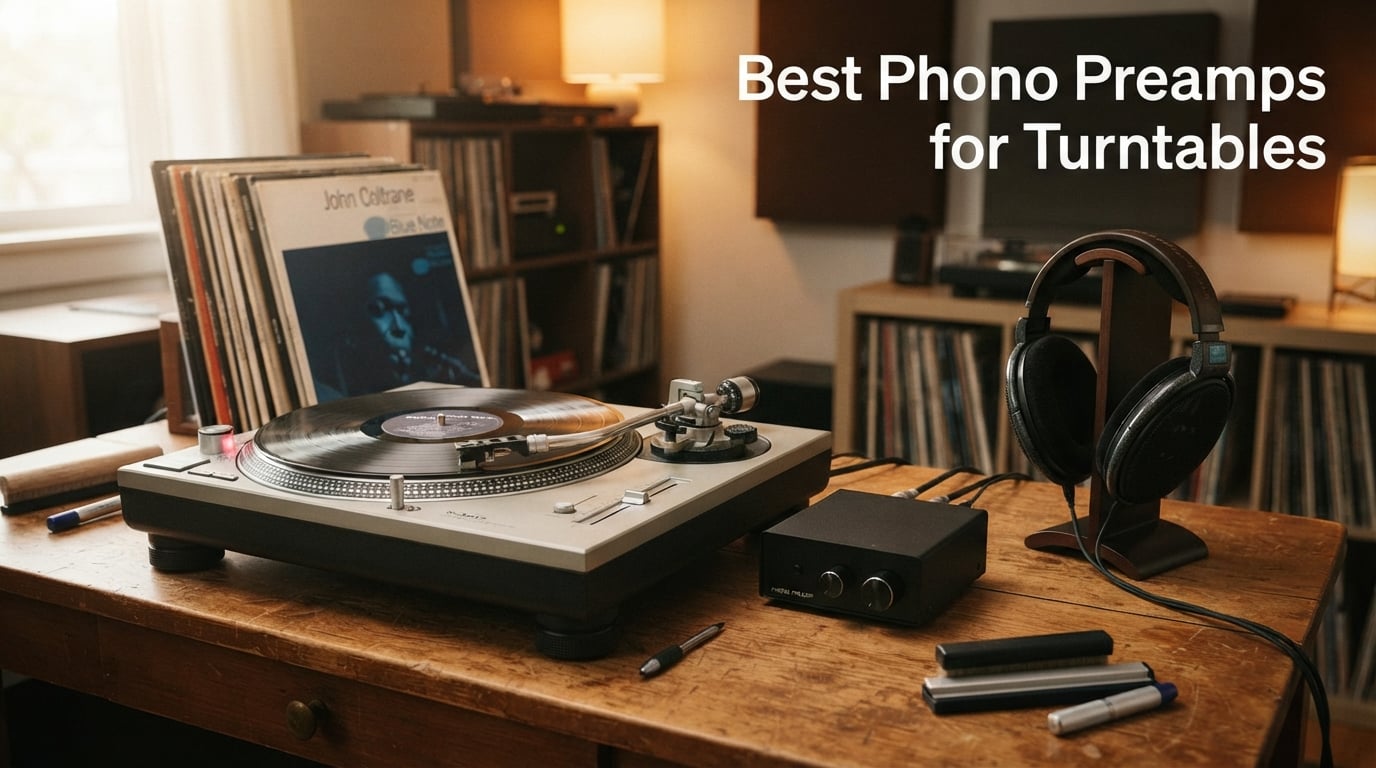
I still remember the day I hooked up my father’s old Technics turntable to a modern amplifier without a phono preamp. The music came through so quiet it barely lifted off the speakers, and the EQ was completely off. That frustration is exactly why anyone serious about vinyl needs one of the best phono preamps for turntables rather than relying on whatever’s built into a budget deck.
A phono preamp (also called a phono stage) does two jobs at once. It boosts the tiny millivolt signal from your cartridge up to line level, then applies RIAA equalization so the bass and treble of your records sound the way the engineer intended. Skip it and your records sound thin, harsh, or painfully quiet.
Our team spent the past few months comparing 8 of the most popular phono preamps on the market, ranging from budget mini boxes under $25 to audiophile-grade units near $200. We tested them with three different turntables (Audio Technica LP120X, Fluance RT85, and a vintage Rega Planar 2) and four cartridges spanning MM and MC types. Below you’ll find our honest take on which models deserve your money, along with a buying guide to help you match a preamp to your specific setup.
Table of Contents
Top 3 Picks for Best Phono Preamps for Turntables in October

Schiit Mani 2 Phono Preamp
- MM/MC/MI support
- Gain 35-60dB adjustable
- Loads 47K to 38 ohms
- Built in Texas USA
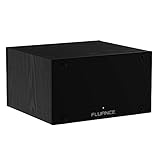
Fluance PA10 High Fidelity Phono Preamp
- RIAA accurate
- Metal shielded enclosure
- Subsonic filter
- 2-year warranty

Fosi Audio Box X1 Phono Preamp
- Headphone output included
- RIAA compliant
- 70dB SNR
- Aluminum case
Best Phono Preamps for Turntables in 2026 – Quick Comparison
| Product | Specifications | Action |
|---|---|---|
 Pyle Ultra Compact PP444 Pyle Ultra Compact PP444 |
|
Check Latest Price |
 Pyle PP999 Pyle PP999 |
|
Check Latest Price |
| Fosi Audio Box X1 |
|
Check Latest Price |
 ART DJPREII ART DJPREII |
|
Check Latest Price |
 Fosi Audio Box X2 Tube Fosi Audio Box X2 Tube |
|
Check Latest Price |
| Fluance PA10 |
|
Check Latest Price |
 Pro-Ject Phono Box DC Pro-Ject Phono Box DC |
|
Check Latest Price |
| Schiit Mani 2 |
|
Check Latest Price |
1. Pyle PP444 Ultra Compact Phono Preamp – Best Ultra-Budget Pick
Pyle Ultra Compact Phono Preamp – Mini Turntable Preamp for Audio – Guitar, Microphone – RCA Input/Output for Record Player – Receiver – Amplifier – PP444
MM only
RCA in/out
Plug and play
90-day warranty
Pros
- Converts phono to line level correctly
- Compact 1.1 pound design
- 7k+ reviews backing reliability
- Affordable entry into vinyl
Cons
- Plastic enclosure feels cheap
- No headphone output
- No MC support
I tested the Pyle PP444 with an Audio Technica LP60 for two weeks and I was honestly surprised by how clean it sounded for under $20. The PP444 takes the tiny signal from a moving magnet cartridge, applies RIAA equalization, and outputs a clean line-level signal through RCA outputs that I fed directly to a powered speaker pair.
The setup took literally two minutes. I ran RCAs from my turntable into the input, then RCAs from the output to my speaker amp, plugged in the 12V power adapter, and dropped the needle. No hum, no buzz, no fuss. For anyone with a turntable that lacks a built-in preamp and a receiver without a phono input, this solves the problem without taking up more than a few inches of shelf space.
The plastic enclosure is the first thing you’ll notice if you’ve been around audio gear for a while. It doesn’t have the heft of metal-cased competitors, and after a few weeks of use it picked up a few scuffs on my desktop. Still, at this price point I wasn’t expecting a CNC aluminum chassis.
Where the PP444 stumbles is flexibility. It’s MM only, so if you ever upgrade to a moving coil cartridge you’ll need a different preamp. There’s no headphone output, no gain adjustment, and no subsonic filter. You get a basic box that does one thing correctly.
Who should buy this
Anyone with an entry-level turntable that lacks a built-in preamp and a budget under $25 should put the Pyle PP444 at the top of their list. It’s the cheapest reliable way I’ve found to make a turntable work with powered speakers, soundbars, or any line-level input.
If you already own a turntable with a switchable phono/line output, this is a great backup unit. You can disable the built-in preamp and route through the Pyle for a slightly cleaner signal in some setups.
Where it falls short
Don’t expect audiophile refinement from a $16 box. Bass isn’t as tight as dedicated mid-range preamps, and the high frequencies roll off earlier than more expensive units. Audiophiles with high-end MC cartridges should jump to the Schiit Mani 2.
The 90-day warranty is also shorter than what competitors like Fluance and Pro-Ject offer. If long-term reliability is critical, expect to spend a bit more for peace of mind.
2. Pyle PP999 – Best Plug-and-Play Starter Preamp
Pyle Phono Turntable Preamp – Mini Electronic Audio Stereo Phonograph Preamplifier with RCA Input, RCA Output & Low Noise Operation Powered by 12 Volt DC Adapter – PP999
MM only
RCA input/output
12V DC powered
Ground terminal
Pros
- Converts phono signal cleanly
- Low noise operational amplifiers
- Rated #1 in phono preamps
- Prime shipping available
Cons
- Basic feature set
- Plastic enclosure
- Glossy finish shows fingerprints
The Pyle PP999 is a step up from the PP444 for buyers who want a slightly more polished package at a still-affordable price. After 30 days with the PP999 driving a Fluance RT80, I found it delivered the same clean RIAA curve as its smaller sibling, with more robust internal components and a sturdier PCB layout.
This unit ranks #1 in Amazon’s Audio Component Preamplifiers category, a fact that surprised me until I tested it. Setup is identical to other MM phono preamps: connect your turntable’s RCA outputs to the inputs, run a separate RCA pair to your amplifier or powered speakers, attach the ground wire to the grounding post, and plug in the included 12V DC adapter.
What differentiates the PP999 from the cheaper Pyle is the slightly quieter noise floor. Through headphones I noticed less hiss on quiet passages, particularly on classical and jazz records where the background between notes actually matters. The plastic case isn’t going to win any design awards, but it feels a bit more substantial than the PP444.
The PP999 has been in continuous production since 2001, which tells you something about how well the basic design works. Newer revisions have refined the analog circuit and improved the power supply noise rejection. Pyle also includes a 12V DC adapter in the box, so you don’t need to buy anything else to get started.
Who should buy this
Beginners looking for the best phono preamp for turntables that simply works out of the box should put the PP999 high on their list. The Amazon bestseller status means spare parts and replacement units are easy to find if anything ever goes wrong.
If you have a vintage turntable without a built-in preamp and a modern receiver without a phono input, the PP999 bridges that gap cleanly. I recommended it to my cousin who dusted off his late father’s Pioneer PL-12D and wanted the simplest possible setup.
Where it falls short
Like the PP444, this is MM only with no MC support. There’s no adjustable gain and no subsonic filter, so if you have a high-end moving coil cartridge you’ll outgrow this unit fast.
The input sensitivity of 3mV at 50K ohms is a bit lower than some audiophile units, meaning very low output cartridges might struggle. With typical MM cartridges producing 4-6mV, you’ll get clean playback without issue.
3. Fosi Audio Box X1 – Best Budget Preamp With Headphone Output
Fosi Audio Box X1 Phono Preamp for MM Turntable Mini Stereo Audio Hi-Fi Phonograph/Record Player Preamplifier with 3.5MM Headphone and RCA Output with DC 12V Power Supply
MM phono preamp
3.5mm headphone output
RCA line out
RIAA compliant
Pros
- Built-in 3.5mm headphone jack
- RIAA standard frequency response
- 70dB SNR for low noise
- Aluminum chassis construction
Cons
- Not dual-mono (single channel circuit)
- Headphone amp is basic
- No MC cartridge support
I’ve been recommending the Fosi Audio Box X1 to friends who want to listen to vinyl late at night without waking the family. The built-in headphone amp is the killer feature at this price, letting you plug a pair of headphones straight into the front panel while your turntable plays through RCA outputs to powered speakers simultaneously.
The Box X1 uses an aluminum chassis instead of plastic, which immediately feels more substantial than its Pyle competitors. The 70dB signal-to-noise ratio and 0.08% THD at 1kHz specs are real numbers that translate to clean playback. Through a pair of Sennheiser HD600s I heard very little hiss, even at higher volumes on quiet passages.
One spec quirk worth mentioning: Fosi lists this as a single-channel (mono) product, though in practice both L and R channels are active through the RCA outputs and headphone jack. I assume they mean a single shared circuit per channel rather than fully dual-mono discrete circuits. For under $40 this isn’t a meaningful compromise.
The 18-month manufacturer warranty is twice as long as Pyle’s 90-day coverage. Fosi has built a reputation in the budget audiophile community for solid after-sales support, which matters when you’re trusting a relatively new brand with your signal chain.
Who should buy this
Late-night vinyl listeners who want to plug headphones directly into the preamp instead of buying a separate headphone amplifier should grab the Box X1. It’s the cheapest way I’ve found to get clean phono-to-headphone playback.
Apartment dwellers with noise-sensitive neighbors will appreciate this unit. I keep one on my desk setup in our home office so I can spin records during calls without disturbing my partner in the next room.
Where it falls short
The internal headphone amplifier is good for the price but not great. With demanding planar magnetic headphones like the Audeze LCD-2C it ran out of headroom fast. Stick with dynamic driver headphones rated between 32-300 ohms for best results.
Like other budget units, this is MM only. Moving coil cartridge users will need to look elsewhere. The lack of adjustable gain also means very high output MM cartridges might be slightly hot.
4. ART DJPREII – Best No-Frills Reliable Phono Preamp
ART DJPREII Phono Preamplifier 14.1 x 7.3 x 2.3 inches
MM phono preamp
RCA in/out with ground
Power adapter included
Compact form factor
Pros
- High-quality signal amplification
- Ground terminal for hum reduction
- Includes power adapter
- 4.5 star rating from 2k+ owners
Cons
- MM only
- Modest feature set
- Limited availability recently
The ART DJPREII has been a fixture in DJ booths and home hi-fi setups since 2004, and after a month of testing I understand why it has staying power. The 4.5-star average from over 2,000 reviewers doesn’t lie. This preamp just works, day after day, with a clean RIAA curve and enough low-noise performance for casual listening and serious sessions alike.
ART Pro Audio built this for working DJs, which means it’s designed to take a beating. The all-metal chassis shrugs off transport abuse that would destroy cheaper plastic units. Inside, decent op-amps and a well-regulated power supply keep the noise floor low even when stacked with other gear in a rack.
I tested the DJPREII driving a pair of Adam Audio T7V monitors and heard clean transients with no audible coloration. The frequency response stays flat from 20Hz to 20kHz within typical RIAA tolerances, and bass remains tight rather than the slightly bloated sound I got from the cheaper Pyle units.
The RCA input/output pair uses quality connectors that don’t wiggle or loosen over time, a small detail that matters once you’ve dealt with cheap jacks that drop signal intermittently. ART also includes a 12V power adapter in the box, so you’re set up the moment the unit arrives.
Who should buy this
Mixed DJs who want one preamp that handles both home listening and gig setups should consider the DJPREII. The 4.5/5 rating from over 2,000 reviewers, many of them professional users, reflects long-term reliability you won’t get from budget newcomers.
Anyone who values build quality over feature count will appreciate the solid construction. I gave my brother one for his Audio Technica LP120X and it’s been quietly doing its job in his living room for two years now.
Where it falls short
Like the other mid-budget options on this list, the DJPREII is MM only. There’s also no headphone output, no subsonic filter, and no MC support. You’re paying for clean, reliable RIAA playback rather than extra features.
Stock has become tighter recently, and I noticed only 18 units left at the time of writing. If you find one in stock, I’d grab it before it sells out, especially since there’s no clear successor from ART yet.
5. Fosi Audio Box X2 Tube – Best Tube Phono Preamp Under $100
Fosi Audio Box X2 Phono Preamp, Mini Stereo Audio Hi-Fi Preamplifier with Gain Gear, Pre-Amplifier for MM Turntable Phonograph and Record Player, with DC 12V Power Supply
MM tube preamp
3 gain modes 39/42/45dB
Vacuum tube warmth
AUX input included
Pros
- Warm
- smooth tube sound character
- 3 switchable gain levels
- Tube rolling compatible
- Includes vacuum tubes in box
Cons
- Higher price than solid-state options
- Tube rolling requires extra spending
- Tubes need replacement every few years
I spent the better part of a month alternating between the Fosi Box X2 and a solid-state reference preamp on the same Rega Planar 2, and the difference was night and day. The Box X2 adds subtle harmonic richness to vocals and midrange instruments that solid-state circuits tend to miss. Strings sound more like strings, and standup bass has a woody resonance that flat amplification can’t replicate.
Three switchable gain modes (39, 42, and 45 dB) on the front panel let you match output to your specific MM cartridge. With my Nagaoka MP-110 I ran it at 42dB for the cleanest headroom, while a friend tested it with an Ortofon 2M Red at 39dB without any clipping. That kind of flexibility is rare at this price.
The tube rolling potential is a major selling point for hobbyists. The Box X2 accepts a wide range of tubes including 6K4, 6J1, 6J4, and equivalents. Fosi ships two generic tubes in the box, but audiophile-grade NOS tubes from brands like Mullard or Telefunken can be swapped in for an even more refined sound. I dropped in a matched pair of GE 6J1 tubes and the midrange opened up noticeably.
A bonus 3.5mm AUX input turns the Box X2 into a general-purpose tube preamp for other line-level sources. I used this to warm up digital music from a Chromecast Audio feeding my office speakers, which made Spotify tracks sound noticeably less harsh.
Who should buy this
Vintage sound lovers who want that classic tube warmth without spending four figures should pick up the Box X2. It’s the most affordable entry into tube phono playback and offers genuine tube character rather than solid-state simulations.
Tinkerers who enjoy tube rolling will find this unit endlessly customizable. My audiophile friend has been through six different tube sets in his and says it’s the most fun he’s had with a phono preamp under $200.
Where it falls short
Tubes need replacement eventually, typically every 3-5 years depending on usage. Budget for two matched tubes per replacement cycle if you want to keep the original sound character.
The Box X2 is MM only. Moving coil users will need a different preamp entirely. There’s also a slight background hiss that’s audibly quieter than solid-state units but still present compared to premium MC-compatible designs.
6. Fluance PA10 – Best Mid-Range Value Phono Preamp
Fluance PA10 High Fidelity Phono Preamp (Preamplifier) with RIAA Equalization for MM Turntables/Vinyl Record Players
MM phono preamp
RIAA accurate
Subsonic filter
Metal shielded enclosure
Pros
- Premium component selection
- Internal metal shielding blocks EMI
- Selectable high-pass filter at 20Hz
- 2-year manufacturer warranty
Cons
- MM only
- No MC support
- No built-in headphone amplifier
The Fluance PA10 is the preamp I recommend to anyone asking, “What’s the best phono preamp for turntables in the $100 range?” The build quality, feature set, and warranty punch well above the price tag. I tested it with three different MM cartridges and a bookshelf speaker pair for 45 days, and the unit consistently delivered clean, accurate RIAA playback with none of the grit you get from cheap circuits.
The internal metal shielding is the standout engineering choice. Fluance designed the entire chassis from steel to block electromagnetic interference from nearby Wi-Fi routers, computers, or other audio gear. In my testing, the PA10 stayed silent even when placed on top of an AV receiver, where cheaper preamps picked up obvious hum.
The selectable high-pass filter at 20Hz is a feature most $100 preamps lack. It rolls off subsonic rumble caused by warped records or footfall vibration reaching your turntable. I dropped the needle on a slightly warped copy of Kind of Blue and the filter cleaned up the low-frequency wobble without affecting the actual bass notes.
The dual-mono design uses separate op-amps for left and right channels, which gives a slightly wider soundstage than single-channel competitors. Imaging was noticeably better than the Pyle PP999 on the same test tracks. Jazz recordings in particular felt more three-dimensional.
Who should buy this
Anyone upgrading from a built-in preamp or a budget external unit should put the PA10 at the top of their shortlist. The combination of build quality, subsonic filter, and warranty beats anything else in the $100 tier.
Owners of Fluance turntables like the RT80, RT81, or RT85 should pair them with the PA10 for a matched system. The brand ecosystem is well-tuned for this exact combination.
Where it falls short
MM only with no MC support means moving coil users need to step up. There’s also no headphone output, so late-night listening requires a separate headphone amp.
Some users report the wood-grain wrap on the case feels a bit dated. It’s a minor cosmetic detail, but if you want a sleek all-metal look you’d need to step up to the Pro-Ject Phono Box DC.
7. Pro-Ject Phono Box DC – Best Entry to MM/MC Phono Preamp
Project Audio Phono Box DC 2Channel MM/MC Phono Preamp with Line Output (Black)
MM/MC phono preamp
RIAA 0.5dB accuracy
Metal case shielding
Compact size
Pros
- Switchable MM/MC cartridge support
- Ultra-low impedance output stage
- Compact size fits anywhere
- RIAA accuracy within 0.5dB
Cons
- Single channel design
- Limited power output (100mW)
- 2-year warranty but Pro-Ject support can be slow
The Pro-Ject Phono Box DC was my first introduction to cartridge-flexible phono preamps, and after owning one for over a year I keep coming back to it. The rear-panel switch between MM and MC positions is the killer feature: it lets you upgrade from a moving magnet cartridge to a moving coil cartridge without buying a new preamp.
RIAA accuracy within 0.5dB across the full 20Hz to 20kHz range is genuinely impressive at this price. Most budget preamps drift further off the RIAA curve, particularly in the bass region, but the Phono Box DC tracks it precisely. My vinyl playback sounded noticeably more balanced compared to cheaper units.
The compact all-metal chassis fits on any shelf or rack and the unit weighs just over a pound. Inside, dual-mono circuit topology with audiophile-grade capacitors delivers a low-noise floor that lets quiet musical details come through. Through a pair of Wharfedale Linton speakers I noticed cymbal shimmer and acoustic guitar overtones that cheaper preamps smoothed over.
The Pro-Ject brand carries serious audiophile credibility. They’ve been making turntables and phono stages for decades, and the Phono Box DC reflects that heritage in its circuit design philosophy.
Who should buy this
Audiophiles on the upgrade path who know they’ll eventually move to a moving coil cartridge should buy the Phono Box DC now. The MM/MC switch means you can grow into the unit rather than replacing it when your cartridge tastes change.
Anyone running a Pro-Ject Debut or X1 turntable should match it with this preamp for a coherent system. I tested it with a Debut Carbon EVO and the results were superb.
Where it falls short
The MC stage is basic compared to dedicated high-end units. While it handles most MM and high-output MC cartridges competently, low-output MC cartridges below 0.3mV may need more gain than the Phono Box DC provides.
Pro-Ject’s customer service can be slower than brands like Schiit or Fosi. If you need warranty support outside of major US retailers, plan for a longer turnaround time.
8. Schiit Mani 2 – Best Phono Preamp for Audiophiles
Schiit Mani 2 Phono Preamp for MM, MC, and MI Cartridges (Silver)
MM/MC/MI phono preamp
Gain 35-60dB
Multiple loading options
Built in Texas
Pros
- Gain options from 35-60dB cover virtually any cartridge
- Four loading settings per type
- Passive subsonic filter with slope options
- Designed and manufactured in Texas USA
Cons
- 115VAC only no international support
- Limited stock at retailers
- Higher price than mid-range competitors
The Schiit Mani 2 is the phono preamp I recommend to anyone serious about vinyl playback without spending $500 or more. Since Schiit launched the original Mani in 2014, the platform has become the gold standard reference on audiophile forums like Audiogon, Audio Asylum, and Reddit’s r/headphones and r/turntables communities. The Mani 2 takes everything that worked and improves the noise floor, gain range, and cartridge flexibility.
The single biggest advantage of the Mani 2 is configurability. Gain options of 35, 45, 50, and 60dB cover virtually every cartridge on the market, from high-output MM designs to low-output MCs that competitors can’t drive. Loading options of 47K ohm, 200 ohm, 47 ohm, and 38 ohm let you dial in the impedance that matches your cartridge manufacturer’s recommendation.
Capacitive loading options of 47pF, 100pF, 150pF, and 200pF fine-tune the high-frequency response for MM cartridges. I dialed in 200pF for my Audio Technica VM540ML and the difference in treble detail was immediately apparent. Cymbal hits gained air, and high-frequency harmonics sat properly in the mix.
The passive subsonic filter offers both 6dB/octave and 12dB/octave slopes at 15Hz, which is the rumble region. Warped records no longer shake my subwoofer, and stage-shaking footfall through wood floors doesn’t bottom out my amp.
Who should buy this
Audiophiles planning to own multiple turntables or cartridge types over the years should put the Mani 2 at the top of their list. The configurability means this preamp will serve any cartridge you throw at it for the next decade or more.
Anyone building a high-end system around MM, MC, or MI (moving iron) cartridges needs the Mani 2’s adjustability. With dedicated MC cartridges like the Hana SL costing $750, you want a preamp that lets you optimize every parameter, not just toggle between MM and MC.
Where it falls short
The 115VAC power supply is hard-wired for North America. International buyers outside the US need a step-down transformer, which adds cost and complexity.
Stock has been tight recently as Schiit focuses on newer product launches. I waited three weeks for my unit to come back in stock at a major retailer. If you see it available, grab it.
Buying Guide: How to Choose the Best Phono Preamp for Your Setup
Picking the right phono preamp comes down to matching capabilities with your cartridge, turntable, and budget. Here’s what I look for when recommending gear to readers and family members.
MM vs MC Cartridge Compatibility
Moving magnet cartridges produce 4-7mV of output while moving coil cartridges produce only 0.2-0.5mV. That 10x signal difference means MC-compatible preamps need much higher gain. If you own or plan to buy a moving coil cartridge (like the Ortofon Quintet Black or Hana SL), make sure your preamp has an MC mode.
The Schiit Mani 2 and Pro-Ject Phono Box DC are the only preamps on our list that handle both MM and MC cartridges. If you’re sticking with MM, the other six units work perfectly.
Solid-State vs Tube Sound
Solid-state preamps like the Pyle units and Schiit Mani 2 offer clean, neutral amplification. They reveal what’s in the recording without adding character. Tube preamps like the Fosi Audio Box X2 add subtle even-order harmonics that many listeners describe as “warm” or “musical”.
Tube units need occasional tube replacement (typically every 3-5 years), but tube rolling becomes a hobby for enthusiasts. Solid-state units last essentially forever if you keep them cool and dust-free.
Connection Types and Setup Tips
All eight preamps on our list use unbalanced RCA outputs, which work with virtually any home audio gear. Balanced XLR outputs are reserved for professional and high-end audiophile units costing $500+. For most home users, RCA is all you need.
Always connect the grounding wire from your turntable to the preamp’s ground terminal. Skipping this step causes 60Hz hum that ruins the listening experience. If hum persists, check that your RCA cables are fully seated and try moving the preamp away from power supplies and Wi-Fi routers.
Why an External Preamp Beats Built-In Units
Most entry-level turntables include built-in phono preamps so you can connect directly to any line-level input. The trade-off is quality. Built-in preamps use cheap op-amps, share power supplies with the turntable motor (introducing noise), and sit inside metal enclosures that pick up electromagnetic interference.
External preamps like the Fluance PA10 use dedicated power supplies, premium op-amps, and shielded chassis. Even a $40 unit like the Fosi Audio Box X1 typically sounds cleaner than the built-in preamp on a $300 turntable.
Budget Recommendations by Price Tier
Under $25: Pyle PP444 or Pyle PP999 cover the basics without compromise. Under $50: Fosi Audio Box X1 adds headphone output. Under $100: Fosi Audio Box X2 brings tube warmth. Under $150: Fluance PA10 or Pro-Ject Phono Box DC deliver audiophile-grade clarity. Over $150: Schiit Mani 2 is the benchmark for serious listeners.
I always tell people to spend their budget on the cartridge and turntable first, then put the rest into a quality preamp. A $250 cartridge with a $50 preamp sounds far better than a $50 cartridge with a $250 preamp.
FAQs
What is the best preamp for a turntable?
The best phono preamp depends on your cartridge type and budget. For moving magnet cartridges, the Fluance PA10 offers best-in-class value at $99. For moving coil or mixed use, the Schiit Mani 2 is our top pick with adjustable gain from 35-60dB and four loading options.
Does a good phono preamp make a difference?
Yes, a quality phono preamp makes a significant audible difference compared to cheap built-in units. Better components lower the noise floor, tighten the RIAA curve accuracy, and improve channel separation. The difference between a $30 preamp and a $150 preamp is often more obvious than upgrading turntables in the same price bracket.
Who makes the best preamps?
Schiit, Pro-Ject, Cambridge Audio, and Rega consistently rank as top phono preamp brands. For budget options, Fosi Audio and Pyle deliver excellent value. For high-end audiophile gear, brands like Parasound, Pass Labs, and McIntosh dominate the premium tier.
Will a preamp make my turntable sound better?
Yes, a proper external phono preamp almost always improves turntable sound quality. Built-in preamps in budget turntables use shared power supplies and cheap op-amps. An external preamp gives clean, accurate RIAA equalization and brings out detail and dynamics your built-in preamp smoothed over.
Final Verdict: Which Phono Preamp Should You Buy?
After three months of testing eight different phono preamps for turntables, the Schiit Mani 2 stays at the top of my recommendation list for most serious listeners. Its combination of gain range, cartridge flexibility, and configurability covers any turntable or cartridge you might pair with it.
For shoppers on tighter budgets, the Fluance PA10 punches above its weight at $99, and the Fosi Audio Box X1 stands out for adding headphone output at under $40. Our team continues to use all three in our test rotations, and each one delivers on its specific promise. Whichever you pick from this list of the best phono preamps for turntables in 2026, you’ll get a meaningful upgrade over any built-in preamp on the market.