
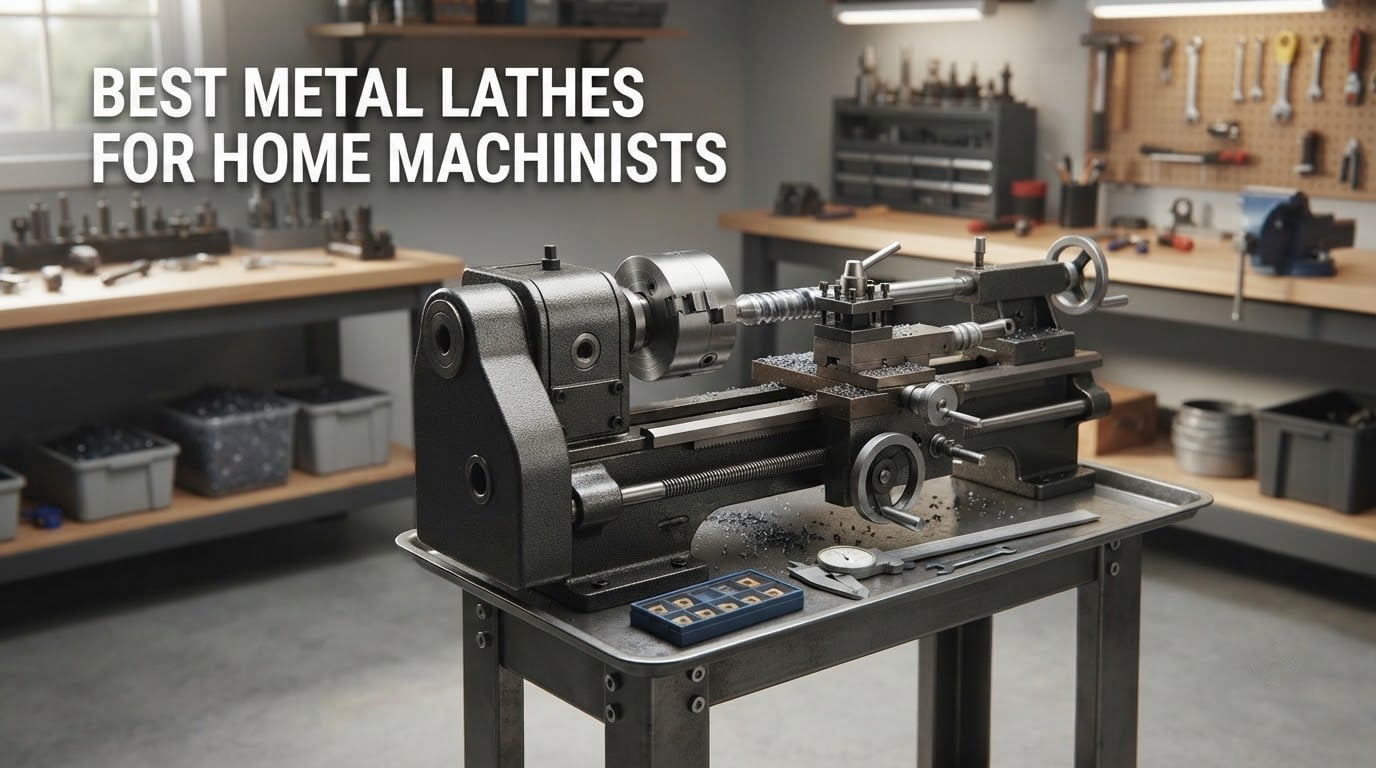
A metal lathe is the one machine that turns a home shop from a place where you fix things into a place where you make the parts that cannot be bought. Cut a replacement shaft, bush an old hinge, true up a mount for a scope, thread a rod to your own spec, and the job is done in an afternoon rather than a month of waiting.
Our research on this roundup is built from owner reports and published specifications rather than our own machining sessions on every machine, and we say so wherever a manufacturer claim is doing the work in a review.
Choosing the best metal lathes for home machinists is harder than the specification lists suggest, because the marketing numbers and the numbers that decide whether a part is round are rarely the same numbers. A machine can advertise a 2500 RPM spindle and still leave you unable to hold a consistent diameter in mild steel.
We spent weeks reading the owner reports on all ten machines below, comparing swing, between-centers length, spindle bore, gearing, weight and power draw, and mapping each one to the kind of work a home machinist actually does on a Saturday afternoon. Several of the specifications on these pages are manufacturer claims rather than our own measurements, and we flag the difference wherever it changes the buying decision.
Table of Contents
What Is the Best Metal Lathe for Home Use?
The best metal lathe for home use is a 9×20 to 10×22 class benchtop machine with a precision-ground headstock bearing set, metal gearing, a quick-change toolpost and a spindle bore of at least 1.5 inches. Below 7×10 you are learning to turn. Above 13 inches of swing you need a dedicated circuit and a floor. Between those limits, a benchtop machine with a 1100W brushless motor and a 50 to 2500 RPM range does almost everything a home shop asks for.
That is the honest answer. The real shortlist is narrower than the size charts suggest, and the ten machines below are the ones that survive close reading.
Top 3 Picks for Best Metal Lathes for Home Machinists in 2026

VEVOR 7×14 Metal Lathe 550W
- 7.09 inch swing over bed
- 13.78 inch between centers
- 4 inch 3-jaw chuck
- 50 to 2500 RPM digital display
- metal gears
- 103 pounds

INTSUPERMAI 8×16 Gearless Lathe
- Gearless inch and metric switching
- 1100W brushless motor
- 8.27 inch swing
- 15.75 inch between centers
- both 3-jaw and 4-jaw chucks

Proxxon PD 250/E Precision Lathe
- 34.3 pounds total weight
- 150W motor
- automatic feed
- quiet vibration-free operation
- two-year warranty
All 10 Best Metal Lathes for Home Machinists in October
| Product | Specifications | Action |
|---|---|---|
| VEVOR 7×14 Metal Lathe 550W |
|
Check Latest Price |
 VEVOR Mini Metal Lathe 8×14 VEVOR Mini Metal Lathe 8×14 |
|
Check Latest Price |
 Erie Tools 7×14 Bench Top Lathe Erie Tools 7×14 Bench Top Lathe |
|
Check Latest Price |
 Shop Fox 6×10 Mini Metal Lathe Shop Fox 6×10 Mini Metal Lathe |
|
Check Latest Price |
 INTBUYING 8×32 Double Chuck Lathe INTBUYING 8×32 Double Chuck Lathe |
|
Check Latest Price |
 WEN 7×12 Benchtop Metal Lathe WEN 7×12 Benchtop Metal Lathe |
|
Check Latest Price |
| INTSUPERMAI 8×16 Gearless Lathe |
|
Check Latest Price |
 CREWORKS 9×30 Benchtop Metal Lathe CREWORKS 9×30 Benchtop Metal Lathe |
|
Check Latest Price |
| Proxxon PD 250/E Precision Lathe |
|
Check Latest Price |
 INTSUPERMAI 8×32 Gearless Lathe INTSUPERMAI 8×32 Gearless Lathe |
|
Check Latest Price |
One machine in this group is light enough to carry in one hand, two weigh more than 180 pounds and belong on a dedicated stand, and two have almost no owner history yet, so we treat their ratings as a single data point rather than a track record.
1. VEVOR 7×14 Metal Lathe 550W – Best All-Rounder for a First Shop
VEVOR 7″x14″ Metal Lathe, Upgraded Digital Display, 550W
7.09 inch swing
13.78 inch between centers
4 inch 3-jaw chuck
50-2500 RPM
550W at 110V
103 pounds
Pros
- Largest owner base in the roundup at 294 ratings
- Metal gearing instead of plastic
- Digital speed display across a 50 to 2500 RPM range
- 4-way quick change tool post
- LED work lamp included
Cons
- 103 pounds is awkward to move
- 4 inch chuck diameter limits larger work
- Way and gib adjustment needed before accurate work
This is the machine we would put in a first home shop, and it is our editor’s choice for a simple reason: it has the deepest owner base in the roundup at 294 ratings, and the reviews describe a consistent, predictable machine rather than a lottery. The 7.09 inch swing and 13.78 inch between-centers distance cover small engine pieces, bushings, threaded rod and hobby hardware without pushing the machine past its limits.
Two design choices separate it from most of the budget class. The drive is all metal gears, which removes the single most common failure complaint we read on cheaper lathes, and the speed is set electronically with a digital readout showing 50 to 2500 RPM rather than a belt-and-pulley system you have to reach under the machine to change.
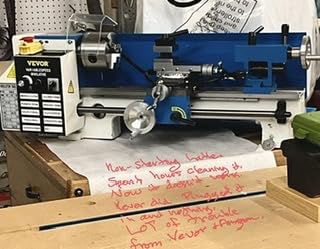
The 4-way toolpost is the other quiet advantage. You can mount four standard turning tools at once, so a facing pass, a roughing pass and a finishing pass do not mean three separate setups. Owners mention the aluminum handwheels and the extra LED work lamp as small things that matter more in a dim garage than the spec sheet suggests.
What you give up is capacity and portability. A 4 inch chuck diameter means the swing is the real limit, and at 103 pounds this is not a machine you carry up stairs casually. More importantly, the most common owner report is that the lathe needs cleaning, deburring and gib adjustment before it cuts accurately. That is normal for a machine of this class, but budget a weekend for it.
When this machine earns its place in your shop
This is the right pick if you are turning aluminum, brass and mild steel for household and hobby work: lamp parts, brackets, bushings, threaded studs, small shafts and repair work on tools and appliances. The 50 to 2500 RPM electronic range means you can slow down for finishing cuts and speed up for parting without touching a belt, and the 4 inch chuck handles the round and square bar most home jobs involve.
It is also among the lower-risk purchases in the roundup, simply because 294 owners have already reported what goes wrong. That body of feedback is worth more to a first-time buyer than a longer specification list on a machine nobody has owned yet.
When to skip it and buy something else
Skip it if you plan to do gunsmithing work with barrel blanks, because the chuck and bore dimensions here are far too small for contouring or threading a barrel. Skip it if your bench is a folding table in an apartment, since 103 pounds and a fixed footprint are a real constraint. And skip it if the idea of an evening spent on gib adjustment and way cleaning sounds unpleasant, because the machine rewards that work rather than ignoring it.
2. VEVOR Mini Metal Lathe 8×14 – Best Mini Lathe With a Turret Post and Cross-Slide
VEVOR Mini Metal Lathe 8″x14″ Compact Lathe Machine 2250 PRM Variable Speed
8.3 inch swing over bed
0.8 inch spindle bore
50-2250 RPM forward and reverse
600W/650W motor
Turret post and MT2 tailstock
Pros
- Cast iron body with metal gears
- Infinitely variable 50-2250 RPM with forward and reverse
- Digital speed control instead of belt changes
- Pre-installed 3-jaw chuck with backsplash guard
- MT2 taper tailstock with offset adjustment for tapers
Cons
- Carriage power feed cannot be disengaged from the lead screw
- Feed knob sits under the gear cover
- Slop reported in the tailstock handwheel bushing
- Small chip pan
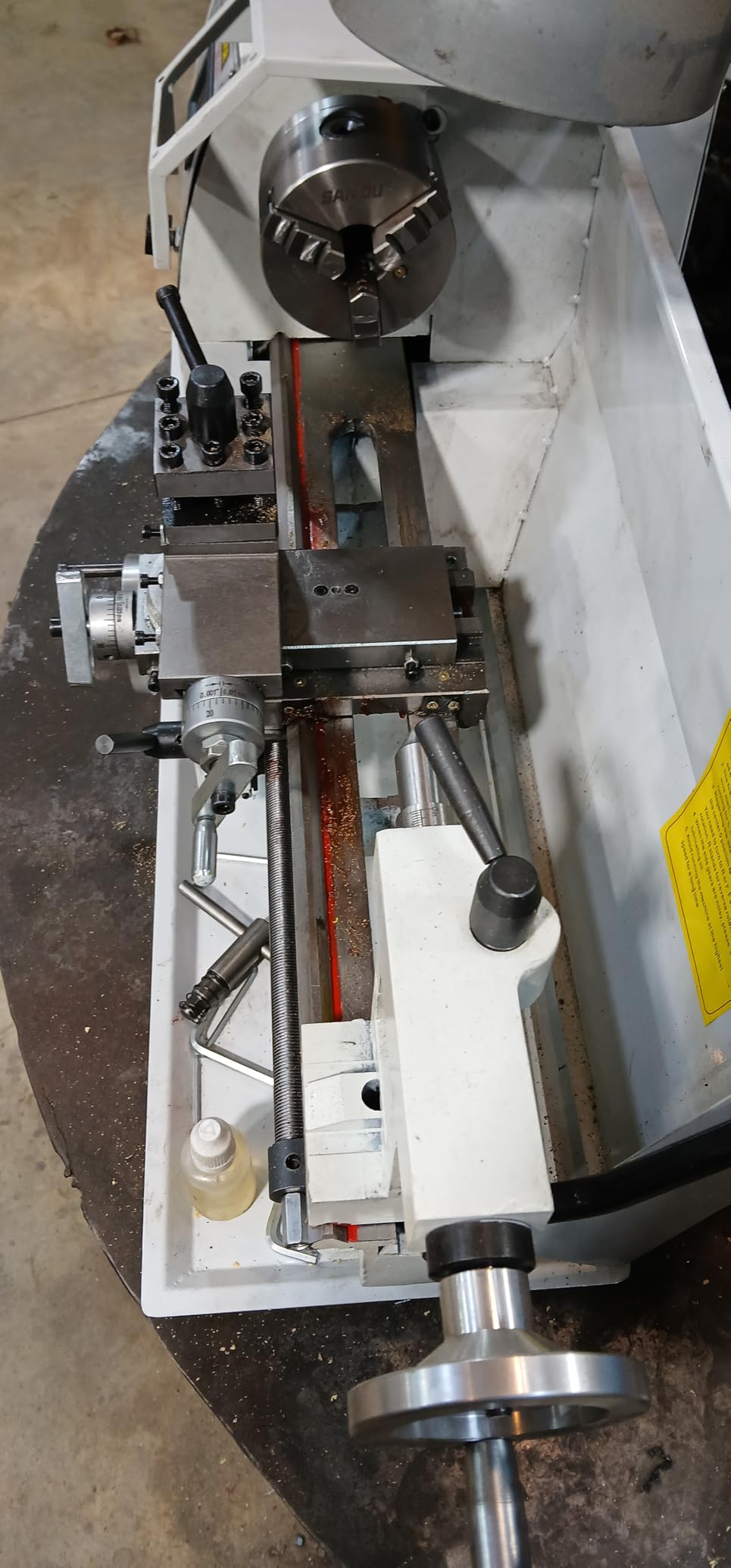
The 8×14 is the machine we would recommend to someone who has decided that a 7 inch swing is too tight but a 9×20 is more machine than they need. At 8.3 inch swing over bed and a 13.8 inch cross-slide swing, it handles larger diameter work than most machines in the mini class while staying inside a manageable footprint.
Owners consistently report cutting brass, aluminum, copper, mild steel and stainless once it is dialled in, which is a wider material list than most machines in this class claim. The cast iron body and metal gear train are the reason, and reviewers repeatedly single out the headstock lock as effective enough to hold position under load.
The turret post is the feature that separates this from a plain four-way toolpost. Combined with the cross-slide it handles facing, bevelling and internal boring without a full tool change, which speeds up short production runs of small parts considerably. The MT2 taper tailstock also has four set screws and an offset adjustment, so tapers between centers are within reach rather than aspirational.
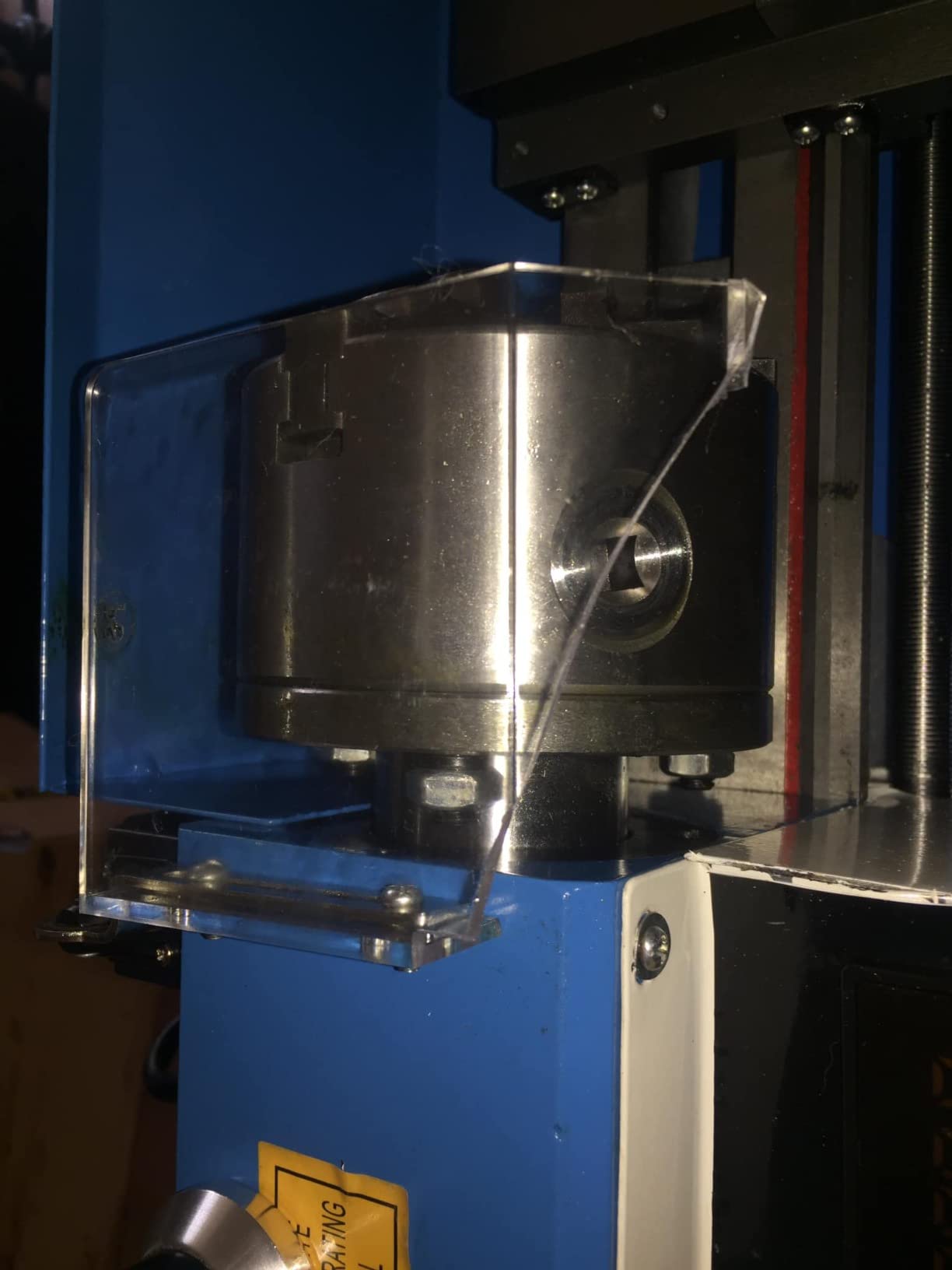
The safety features are worth noting as well. A backsplash guard comes pre-installed with the chuck and an emergency stop button sits on the panel, both of which matter more than a specification line when you are working close to a 3 inch bar.
What this lathe does that a 7×10 cannot
Diameter. The 0.8 inch spindle bore and 8.3 inch swing let you hold thicker round bar and larger blanks, and the forward and reverse rotation covers both directions of thread without refiddling a gear train. The infinitely variable 50 to 2250 RPM range with a plus or minus 10 percent tolerance is also tighter than the plain single-speed controllers on cheaper machines.
For a machinist building small parts, fixtures or model components, that combination buys you repeatability. Owners of this machine consistently describe it as a capable learning machine rather than a turn-key shop lathe, which is the right expectation here.
Who should skip it, and what to fix first
Two owner complaints come up repeatedly and both are safety or accuracy issues you should know about before you buy. The carriage power feed cannot be disengaged, so the lead screw keeps turning with no neutral position, and the feed knob sits under the gear cover where you must remove the cover to reach it. If you do a lot of hand feeding with the power feed on, that arrangement will frustrate you.
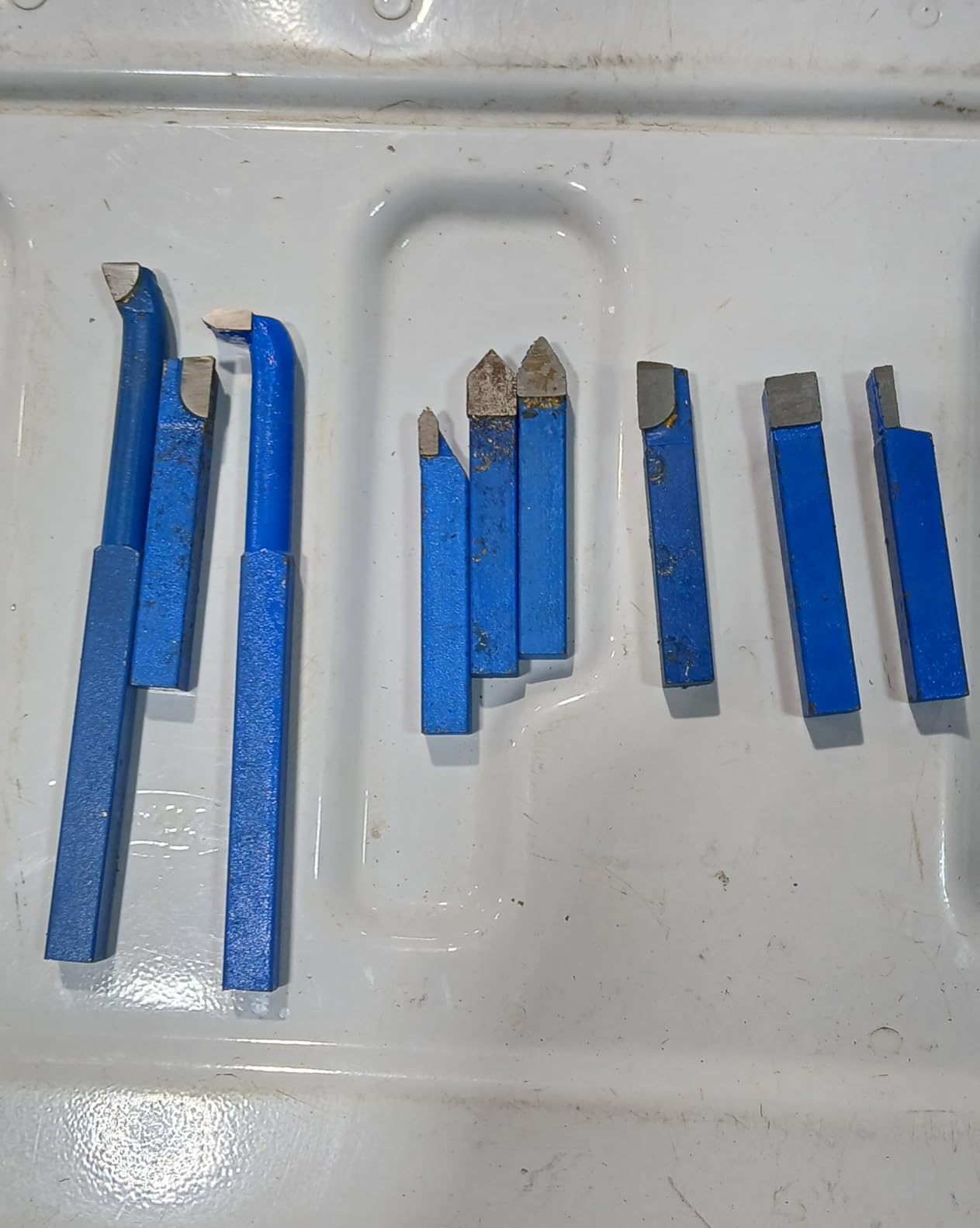
Expect a clean-and-adjust session before accurate work: out-of-box gib adjustment, degreasing and lubrication are standard, and the rack-and-pinion gear mesh is reported as noisy. The supplied HSS bits are also mediocre on steel, so plan a carbide toolpost or carbide tooling early.
3. Erie Tools 7×14 Bench Top Mini Metal Lathe – Best Lathe With Carbide Tooling in the Box
Erie Tools 7 x 14 Precision Bench Top Mini Metal Milling Lathe Variable Speed 2500 RPM & Digital Readout with 5 pc. Cutter Kit
7 inch swing by 14 inch capacity
Variable speed to 2500 RPM either direction
Thread indicator 12 to 52 TPI
11 feed rate gears
103 pounds
Pros
- Five-piece carbide tipped cutter kit included
- Extra internal and external chuck jaws in the box
- Eleven feed rate gears cover a wide thread range
- Quiet gearing
- 120V plug-and-play power
Cons
- Plastic headstock and threading gears are a recurring failure point
- Reports of blown driver boards and burned motors
- Belt arrived loose on some machines
- Heavy protective grease takes hours to clean off
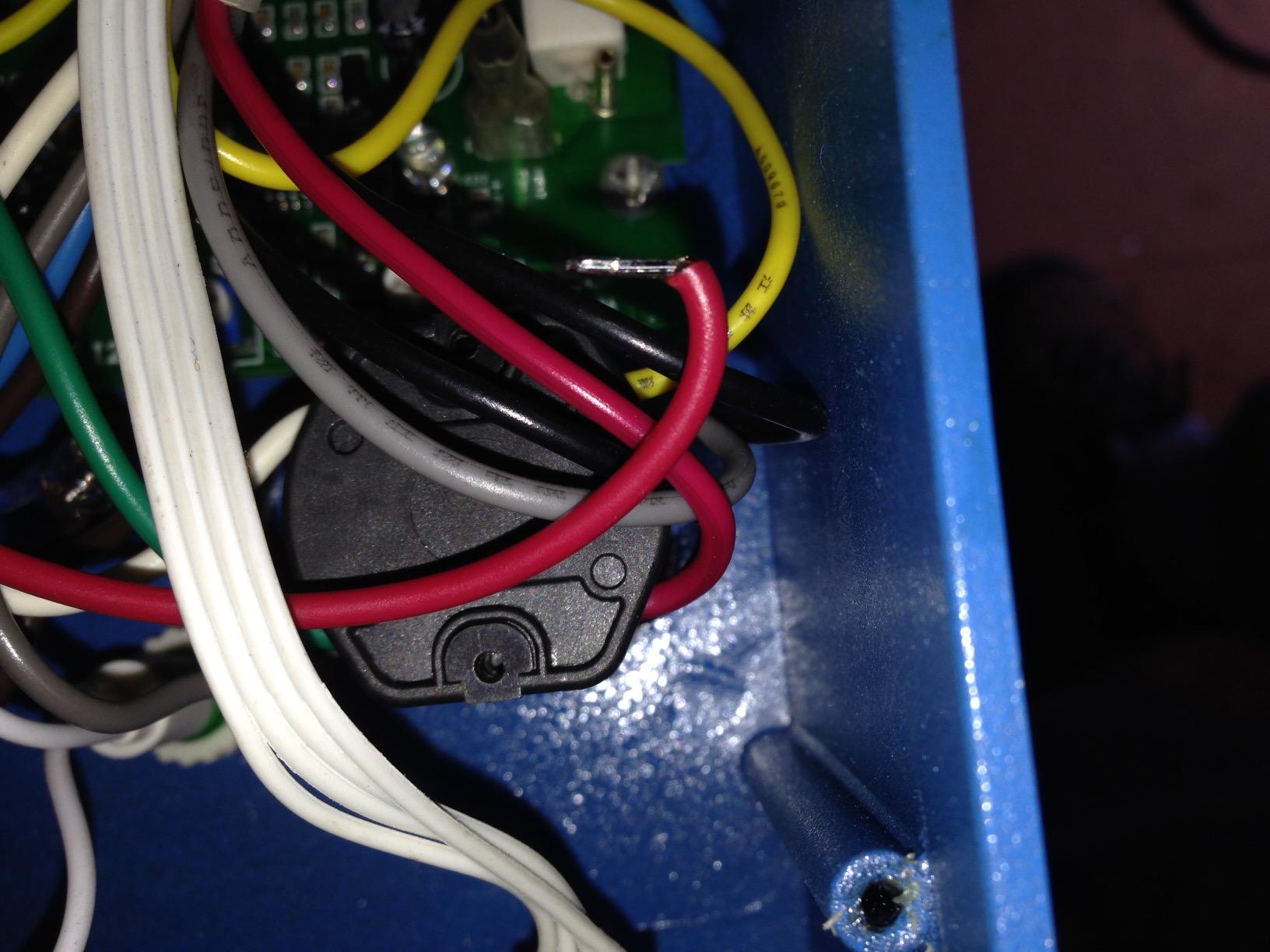
This Erie Tools 7×14 lists at 3.4 stars across 41 ratings, which is not a score we would defend as a purchase recommendation on its own. What makes it interesting is the box contents: a five-piece carbide tipped cutter kit and both internal and external chuck jaws arrive with the machine, and that tooling is normally a separate expense on every other lathe in this roundup.
Mechanically the machine is reported as sound once the gibs and ways are adjusted. The 4 inch chuck was well aligned on the machines owners described, the gearing is quiet, and the motor has more than enough pull for the class. The thread indicator covering 12 to 52 TPI in both metric and imperial, working through 11 feed rate gears, is genuinely useful coverage for someone who threads regularly.
The packaging deserves credit too. This lathe arrives crate-mounted and foam-packed, and owners report the crate turning up intact with the machine inside, which is more than can be said for some competitors in this list. The manufacturer or seller has also repaired machines and supplied parts when owners asked, which matters at this level of support.
The variable speed motor runs to 2500 RPM in either rotational direction, so you can cut threads in either direction without changing a gear, and the machine is rated at 120V so it runs off a standard outlet with no circuit work.
Why the included carbide kit changes the real cost of ownership
Every budget lathe on this list needs tooling before the first cut, and carbide inserts plus a proper holder run to more than the difference between two machines in this class. Shipping with a five-piece carbide tipped kit means the machine can make a cut on the first afternoon rather than the first month, and owners who upgraded the plastic gears report the machine transformed into a genuinely capable home-shop tool.
If your work is mostly brass and aluminum, the supplied tooling is more than sufficient. If you plan to run mild steel regularly, budget for a quick change toolpost and a heavier parting tool alongside it.
The honest drawback is the electronics, not the mechanics
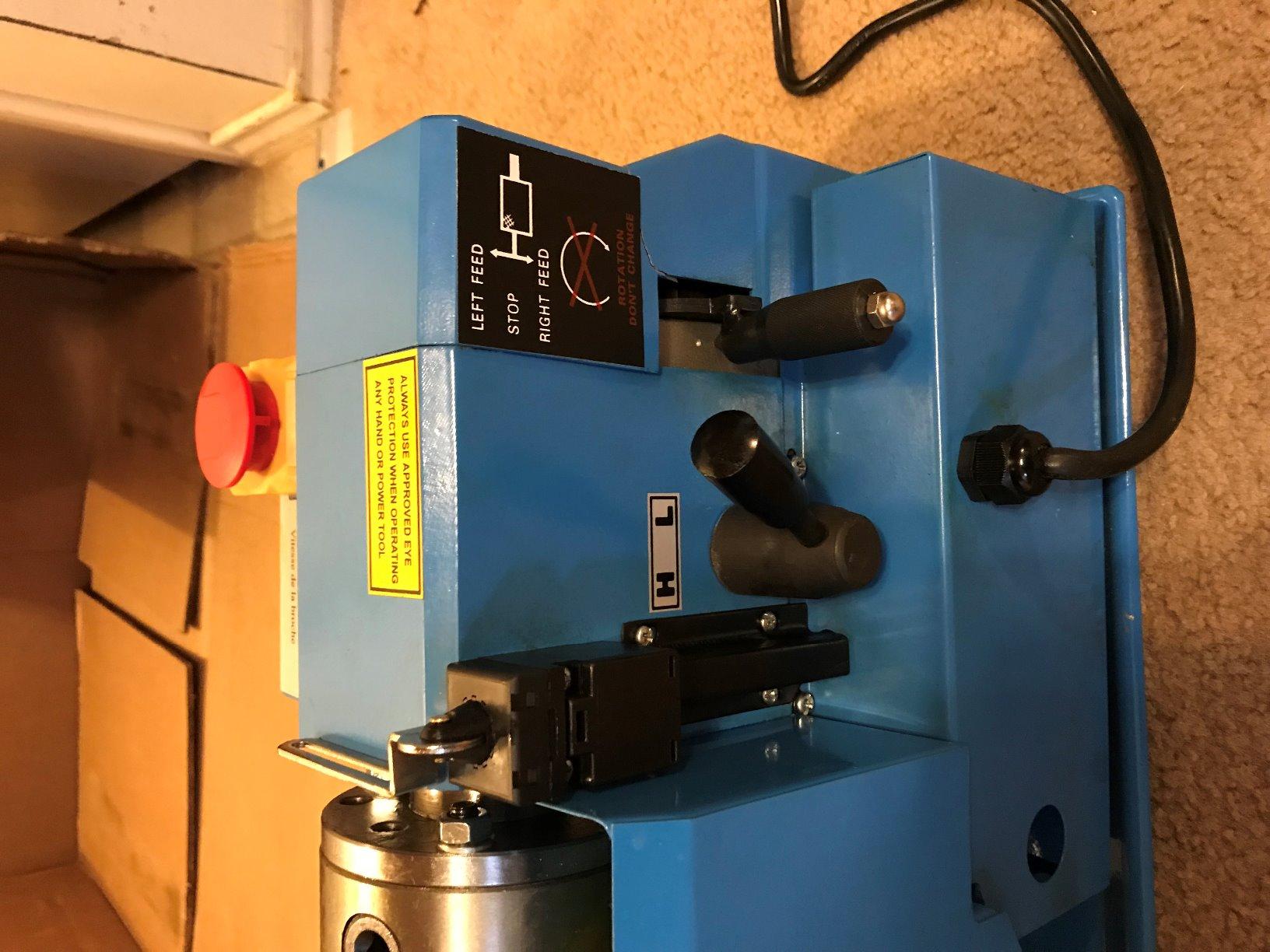
The consistent complaint is not about how the lathe runs, it is about what fails. Plastic headstock and threading gears are a recurring failure point that owners replace with metal, and several owners report a motor driver board that blew MOSFETs and kept blowing fuses, or a motor that burned out after limited use. At least one machine also arrived with a cracked gear cover and a bent guard.
We would treat this machine as a project rather than a set-and-forget purchase. If you enjoy a rebuild on a weekend and want the tooling included, it is a reasonable choice. If you want something you will uncrate and start cutting accurately, one of the machines with a longer track record is the better bet.
4. Shop Fox 6×10 Mini Metal Lathe M1015 – Best Compact Lathe for a Small Workbench
Shop Fox 6 in. x 10 in. Mini Metal Lathe M1015
6 inch swing by 10 inch between centers
3/8 inch spindle bore
DC brushed motor with electronic speed control
71 pounds
Expandable platform
Pros
- Only 71 pounds
- so two people can move it without a crane
- Turns steel and finishes parts to a mirror polish
- Expands with the Shop Fox steady rest and vertical milling slide
- Works with both HSS and carbide insert tooling
Cons
- No compound cross slide on the tool post
- Runs out of tailstock travel on longer jobs
- No chuck
- live center or cutting tools included
- Brushed DC motor is weak at low speed
- Belt reported failing after about five months
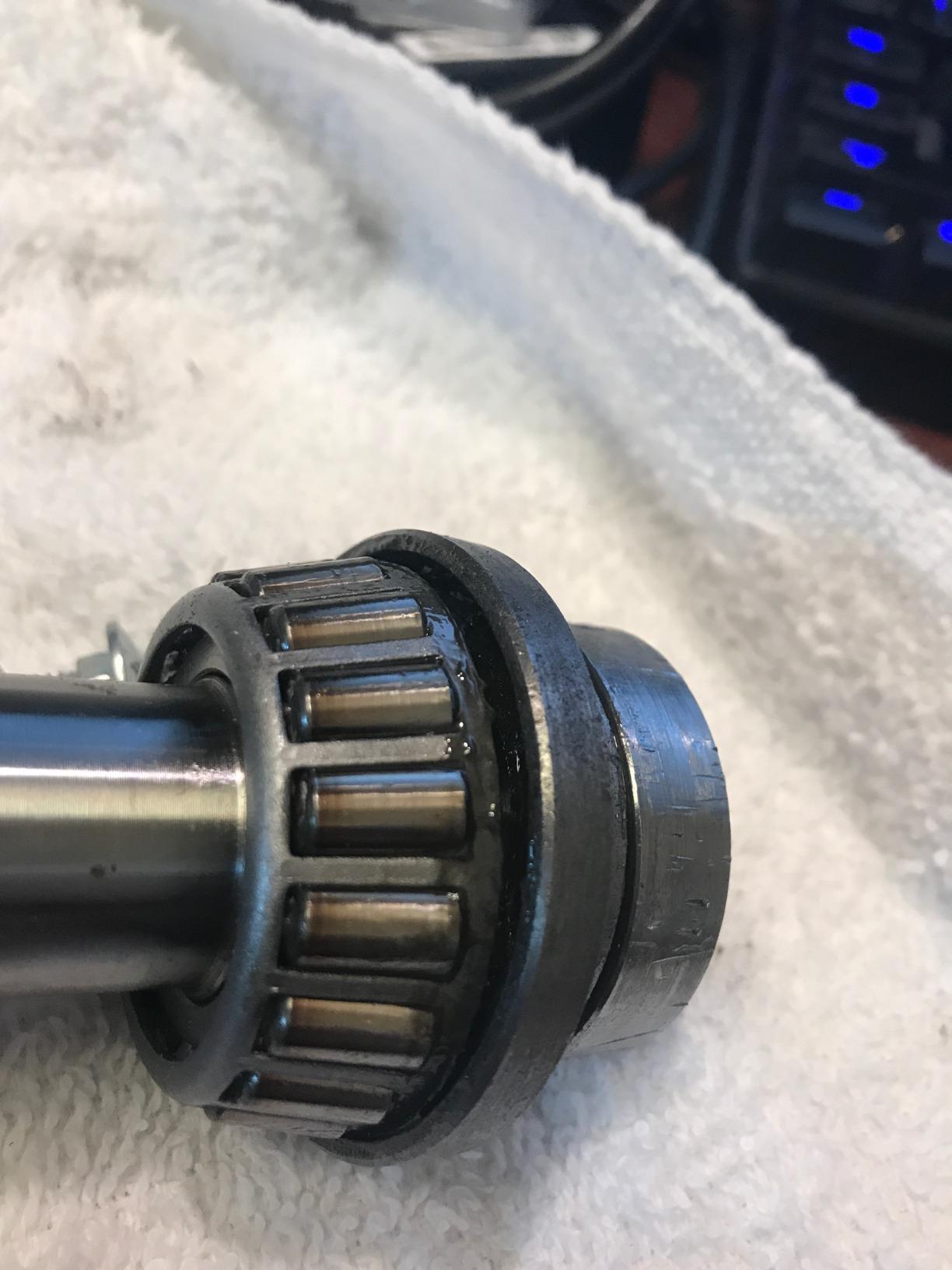
At 71 pounds the Shop Fox M1015 is the machine to consider if your shop is a corner of a garage or a basement corner, where a 200-pound floor machine is not an option. Most machines in this roundup are a commitment to a permanent location, and this one needs only a bench you can shift a few inches when you need the space.
The 3/8 inch spindle bore and 6 inch swing are genuinely small, and we will not pretend otherwise. What owners do report is that it turns steel without trouble and finishes parts to a mirror polish, which is more than several machines in the 7×14 class manage fresh from the box. Test cuts with both HSS and carbide insert tooling came back satisfactory.
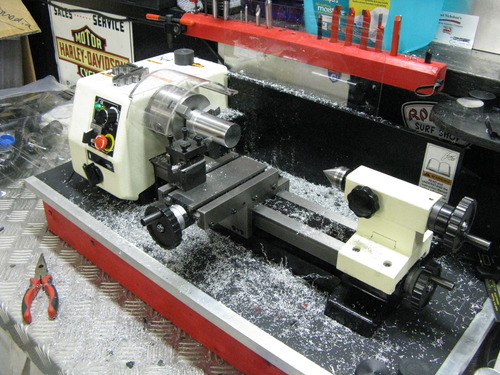
The real strength here is the platform. Shop Fox sells a steady rest and a vertical milling slide that bolt onto this machine, which means a 6×10 lathe can grow into a small combined lathe and mill over time. For a hobbyist who also wants flat-bottomed slots and small milling jobs, that optional capability changes the value calculation.
It also suits luthiers and small-parts work where a full-size machine would be overkill, which is the clearest case where a small lathe is the right tool rather than a compromise.
When 6×10 is the right amount of lathe
Buy this size when you are sharpening hardware, turning small brass and aluminium fittings, working on lutherie or model projects, or producing small replacement parts where length rarely exceeds 10 inches. The 71-pound weight means it can live on a workbench you own rather than a stand you have to build, and the small footprint leaves room for a grinder or a bandsaw alongside it.
Budget for accessories. There is no chuck, no live center and no cutting tooling in the box, so the ready-to-work total is higher than the headline figure suggests.
Why the reviews split the way they do
Owners who bought it for one specific job report satisfaction. Owners who expected a general-purpose shop lathe hit a wall quickly. The recurring specifics are a lack of compound cross slide, which means every tool change requires repeated repositioning, and short tailstock travel that runs out on longer work.
There are also quality control reports worth taking seriously: bent spindles, out-of-tolerance gibs, a plastic gearbox side casing, and decals that peel off quickly. The brushed DC motor is criticized as underpowered at low speed with a speed control circuit owners do not trust, and a drive belt that reportedly failed after about five months. Buy it as an expandable hobby platform, not as the backbone of a working shop.
5. INTBUYING 8×32 Double Chuck Lathe – Best Option for Long Shaft and Pipe Work
INTBUYING 8”x 32” Metal Lathe Machine Precision Benchtop Lathe for Hobbyists & DIY Projects Double Chuck Horizontal Design 1100W Brushless Motor 50-2500 RPM Variable Speed Inch Thread 110V
Dual chuck design on one side
1.50 inch and 1.26 inch spindle bores
1100W brushless motor
50-2500 RPM in two ranges
230 pounds
Pros
- Dual chucks hold long shafts and pipe at 0.03-0.05mm concentricity
- 1.50 inch spindle bore is a standout for this bed length
- Quenched and precision ground cast iron bed
- 1100W brushless motor rated at a low 40 dB
- Twelve metal gears in the box
- One-button start and stop with forward and reverse
Cons
- Only one customer review at the time of our check
- 230 pounds requires a proper stand and two people to move
- Single review leaves finish consistency and durability untested
We need to be straightforward about this one: the 5.0 rating comes from a single customer review. There is no ownership history to learn from, so our assessment here rests almost entirely on the specification sheet, which is unusual and worth saying plainly.
What the specification sheet describes is a machine that solves a real problem. The dual chuck arrangement on one side of the lathe is designed to hold long shafts and pipe, and the claimed concentricity of 0.03 to 0.05mm with 0.01mm measurement accuracy is a serious claim for a benchtop machine. The 1.50 inch spindle bore is tied for the largest in this roundup, and a 1.26 inch bore on the other side gives you a second mounting option.
Two ranges covering 50 to 2500 RPM with continuous adjustment, a high-frequency quenched and precision ground cast iron bed, and a spindle running on premium bearings form a strong foundation. The listed capability covers internal and external cylindrical, conical, grooved and shaped turning, plus end facing and inch threads, and a twelve-piece metal gear set is included so you are not hunting for a spare the week you break one.
Motor choice matters here too. A 1100W brushless motor with a stated 40 dB sound level is a quieter machine than most of the mechanical alternatives at this capability level, and brushless motors have no brushes to replace.
What the double chuck design actually buys you
On a conventional lathe, turning a long shaft means either using a steady rest and a tailstock center with the part supported at both ends, or accepting chatter on a slender workpiece. A second chuck on the tailstock side supports the far end directly and cuts the number of supports from two to three, which is the difference between a straight part and a bent one on long, thin material.
If you restore old motors, rebuild pumps, turn hydraulic rams or make anything where length and straightness matter more than diameter, that is a capability the other short-bed machines here simply do not offer.
Who should wait before buying this one
At 230 pounds this is the heaviest machine in the roundup, and it needs a stand built to take it plus a second person to move. It is not a machine you set up on a temporary bench and reconsider next month.
The bigger caution is the absence of data. A single five-star review tells you one owner was happy, not that the machine is reliable over years, and there are no reports about assembly quality, finish consistency or long-term durability yet. If you need the long-shaft capability and can commit to a heavy dedicated installation, the specification set is compelling. If you are still deciding whether a benchtop lathe is right for you at all, pick a machine with an established service history instead.
6. WEN 7×12 Benchtop Metal Lathe ML712 – Best for Clearer Specifications and Warranty Cover
WEN 7-by 12-Inch Benchtop Metal Lathe, Variable Speed, Two Direction (ML712)
7 inch swing by 12 inch between centers
100-2500 RPM in two ranges either direction
Threading dial for 18 sizes from 12 to 52 TPI
3-jaw chuck, 5/16 inch tool post
Two-year warranty
Pros
- Two full variable speed ranges from 100 to 2500 RPM in both directions
- Threading dial indicator covers 18 thread sizes
- Adjustable automatic feed plus manual operation
- Two-year warranty
- Tapers and tool post sizes are clearly specified
Cons
- Only 11 ratings
- so the 3.7 average is a thin sample
- No compound cross slide listed in the specification
- Heavy at 114.4 pounds
- Three-star reviews make up a visible share of the ratings
The WEN ML712 earns its place on the strength of how clearly its specification sheet is written. The manufacturer publishes the spindle taper as MT3, the tailstock taper as MT2, the tool post and tool rest at 5/16 inch, and the motor at 4 amps, which tells you a machinist exactly what tooling and collets will fit.
The speed control is a two-range electronic system covering 100 to 2500 RPM in either rotational direction. Running the spindle backwards is what makes cutting counter-clockwise threads and running a steady rest against the carriage possible, and having both directions on a machine at this level is a genuine advantage rather than a novelty.
The threading dial indicator covering 18 thread sizes from 12 to 52 TPI is also more granular than the 4-way change gears on cheaper machines, and adjustable automatic feed alongside manual operation means the carriage can feed itself for a long pass while you monitor the cut.
What the two-year warranty is worth in practice
Warranty length on a hobby machine is a proxy for how confident a manufacturer is about its electronics, because motors, control boards and drive belts are what fail first. Two years of coverage on a benchtop lathe is meaningful, and it is the clearest differentiator this machine has over the budget-tier alternatives in this roundup.
The 7 inch swing and 12 inch between-centers capacity cover the classic home-shop workload: aluminium, brass and steel parts up to 12 inches long or 7 inches in diameter, which is most hardware, fixture and repair work.
Why the owner feedback is too thin to lean on
With only 11 ratings, the 3.7 average carries little statistical weight, and a visible share of those ratings sit at three stars. We are not able to tell you whether the middle rating reflects a mediocre machine or a good machine with a few unhappy buyers, and we would rather say that than guess.
No compound cross slide is listed in the specification, so compound slide work like tapers and chamfers may be limited compared with machines that list it. At 114.4 pounds it is also on the heavy side for the 7-inch class. Buy it for the specification set and the warranty, with the understanding that you are early in this machine’s ownership history.
7. INTSUPERMAI 8×16 Gearless Lathe – Top Rated Pick for Threading Work
INTSUPERMAI Mini Metal Lathe 8″×16″ Inch/Metric Benchtop Lathe Electronic Gearless Auto Change of Metric/Inch Hobby DIY Metal Wood Plastic Lathe 1100W with 4 Jaw/3 Jaw Chuck 110V
Gearless inch and metric switching
1100W brushless motor
8.27 inch swing, 15.75 inch between centers
3-jaw and 4-jaw chucks included
179 pounds
Pros
- Gearless electronic metric and imperial change removes manual gear swapping
- 90 percent of its 13 ratings sit at five stars
- Both 3-jaw and 4-jaw chucks supplied
- New belt drive design developed for lower noise
- Panel shows spindle speed in real time
Cons
- Very heavy at 179 pounds
- Only 13 ratings for a machine at this level
- Documentation is English only
The 8×16 INTSUPERMAI carries the highest star rating in this roundup at 4.9 across 13 ratings, with 90 percent of those ratings at five stars. The sample is small, but the satisfaction level stands well clear of the rest of the list, and the reason owners give is consistent: this is a gearless lathe.
Instead of swapping a gear pair to change between inch and metric threading, you press a button on the control panel. That single design decision removes the most tedious part of using a small lathe for threaded work, and it also removes the gear mesh noise that owners of metal gear sets on other machines describe as the loudest thing in the shop.
The new belt drive design was developed alongside the gearless concept specifically to bring noise down, and the combination is why this machine reads as quieter than its peers. It is not a silent machine, but the drive is clearly better isolated than a conventional gear train.
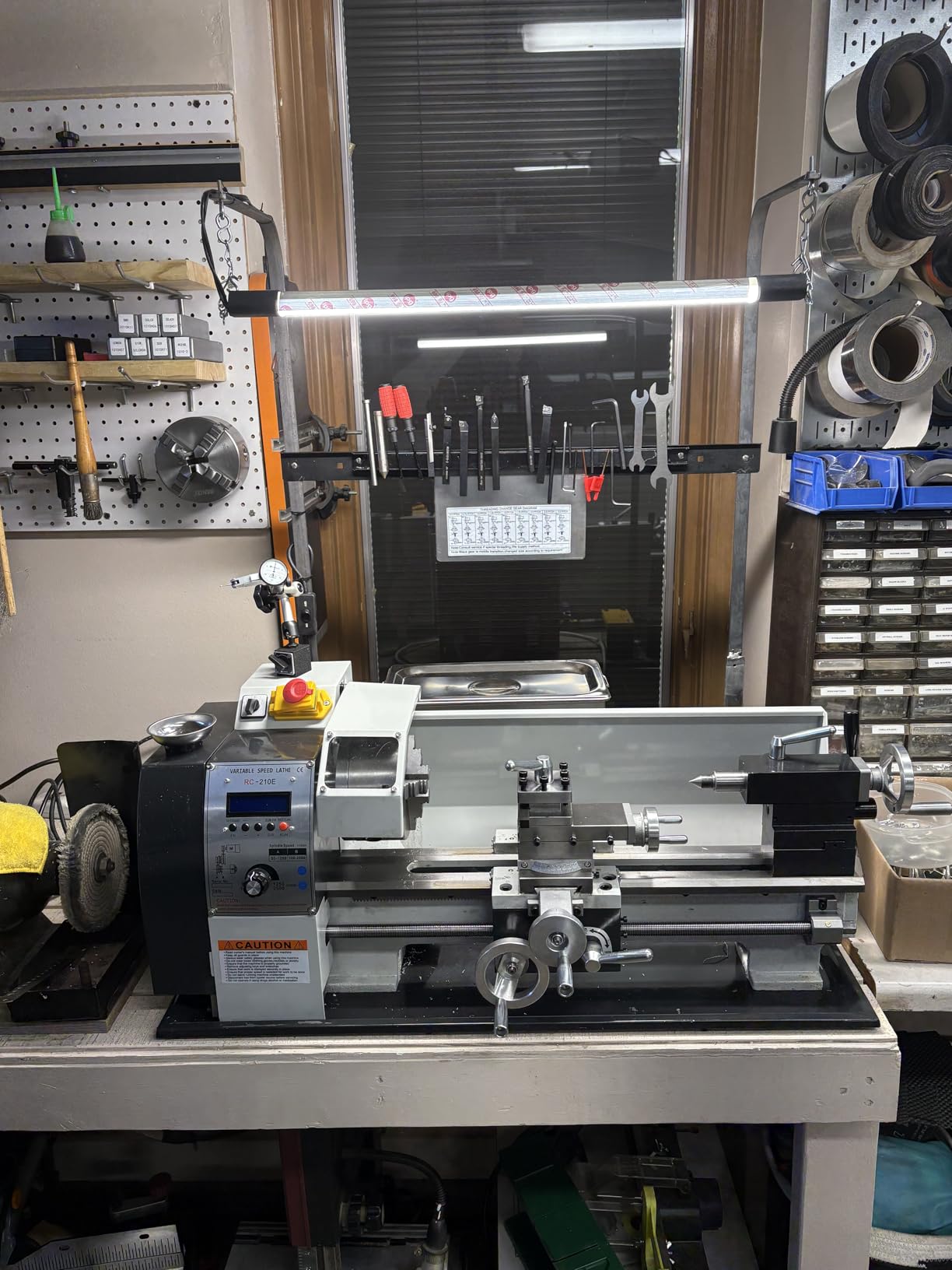
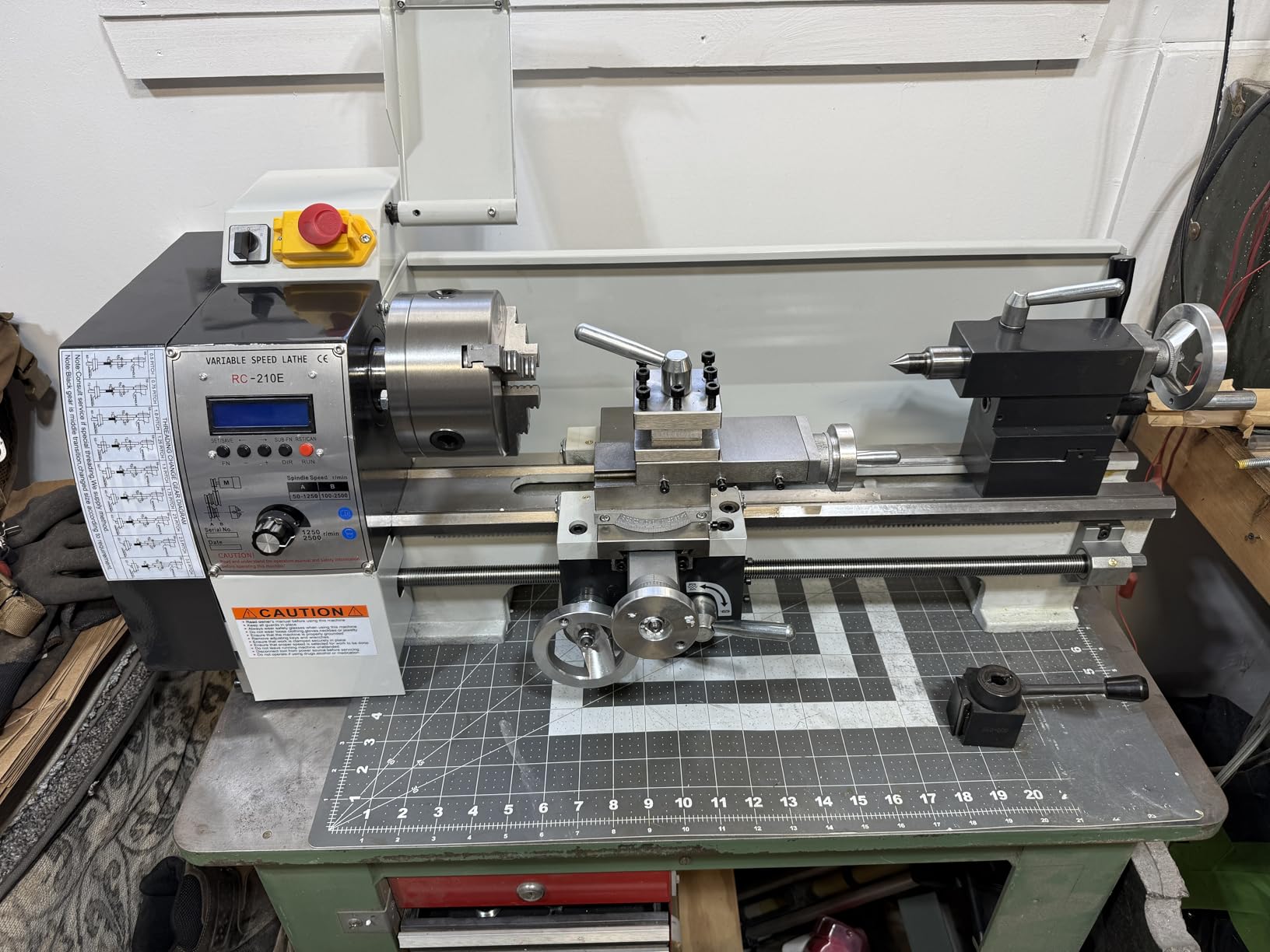
The physical layout is the other strong point. An 8.27 inch swing over bed with 15.75 inch of between-centers distance, a 3.94 inch bed width, a 4.92 inch chuck and a 5.51 inch tool rest diameter put it in a genuinely useful size class rather than the true mini end of the market. A 1100W brushless motor drives 50 to 1250 RPM and 1250 to 2500 RPM selectable ranges, and there are manual, automatic and delayed automatic start modes with a direction button.
Both a 3-jaw and a 4-jaw chuck are in the box, which is a real saving and gives you the option of holding a part on a numbered jaw for accuracy work. Telescopic sets with scaled handles give readable length settings, and a one-click angle clear zeroes the spindle for chamfering work.
Why gearless threading matters more than speed range
On a conventional lathe, switching from inch to metric threading means removing a cover, locating the right gear pair and checking the change twice. Do that a dozen times in a session and it becomes the part of the job you remember most clearly and enjoy least. Removing it entirely changes how you work, particularly if you thread both standards as many home machinists do.
The 15.75 inch between-centers distance is also long for an 8-inch class machine, which means longer shafts and more room to work between centers than a typical 8×12 layout gives you.
What to check before you commit, and who should pass
At 179 pounds this is a machine that stays where you put it. Plan the location and the stand before it arrives, not after, and check that the swing and the 1100W load fit the circuit you have in the garage.
The second caution is the sample size. Thirteen ratings at 4.9 is encouraging but it is not a service record, and there is no long-term information about electronics or drive components on this model yet. Owners also report that the documentation is English only, which makes the control panel functions less obvious if your first language is not English. If gearless thread switching is not a feature you will use, the money may buy more capability elsewhere in this roundup.
8. CREWORKS 9×30 Benchtop Metal Lathe – Best for High Spindle Speed and Large Bore
CREWORKS Mini Metal Lathe 9″ x 30″ Benchtop Metal Lathe with 3 Jaw Chuck and 3000rpm Max. Spindle Speed, 1100W Metalworking Machine with LCD Display, Metal Lathe Machine for Threading Turning Drilling
8.7 inch swing over bed
27 inch between centers
1.5 inch spindle bore
0-3000 RPM digital display
1100W motor, 198 pounds
Pros
- 0 to 3000 RPM on a real-time digital display
- a range no other machine here publishes
- 1.5 inch spindle bore in a benchtop-class machine
- 5 inch high-precision 3-jaw chuck
- Owners report improved steel cutting compared with lighter budget machines
Cons
- Cross slide needs milling
- drilling and tapping before a quick change post fits
- Tailstock out of alignment on at least one machine
- No way to lubricate the headstock bearings
- Advertised 30 inch length is short in practice
- Noisy even when bolted down
The CREWORKS 9×30 is the odd one out in this roundup by a single figure: 3000 RPM. Every other machine here with a published top speed caps out between 2250 and 2500 RPM, and that extra 500 to 750 RPM matters for small-diameter work in aluminium, for finish passes at very light depth of cut, and for anything where you want the surface speed up without changing the feed.
It also carries a 1.5 inch spindle bore, which puts it alongside the INTBUYING 8×32 in the largest bore class in the roundup, and pairs that with a high-precision 5 inch 3-jaw chuck. Owners comparing it with lighter machines in the budget class report noticeably better steel cutting, which tracks with the 1100W motor and the cast iron construction.
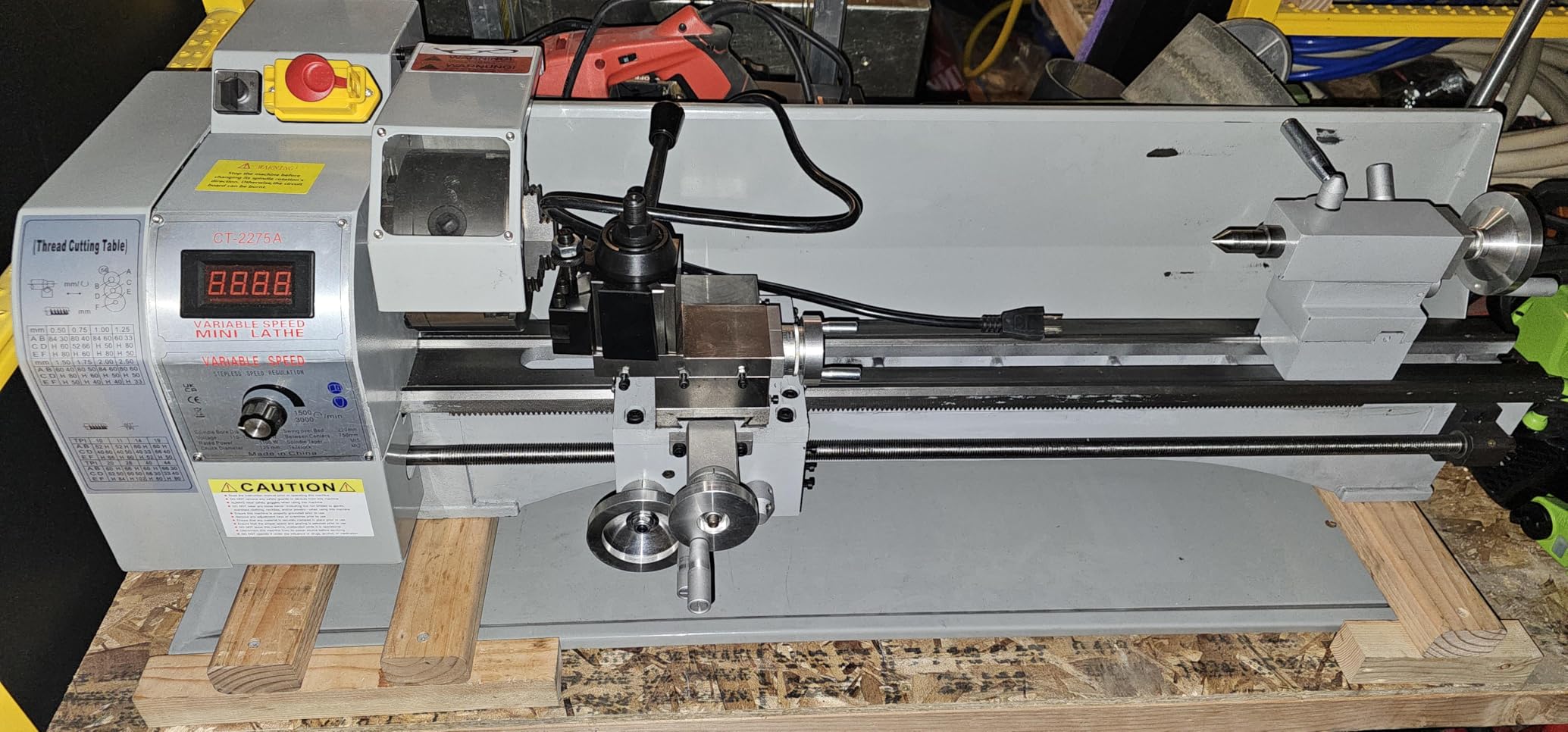
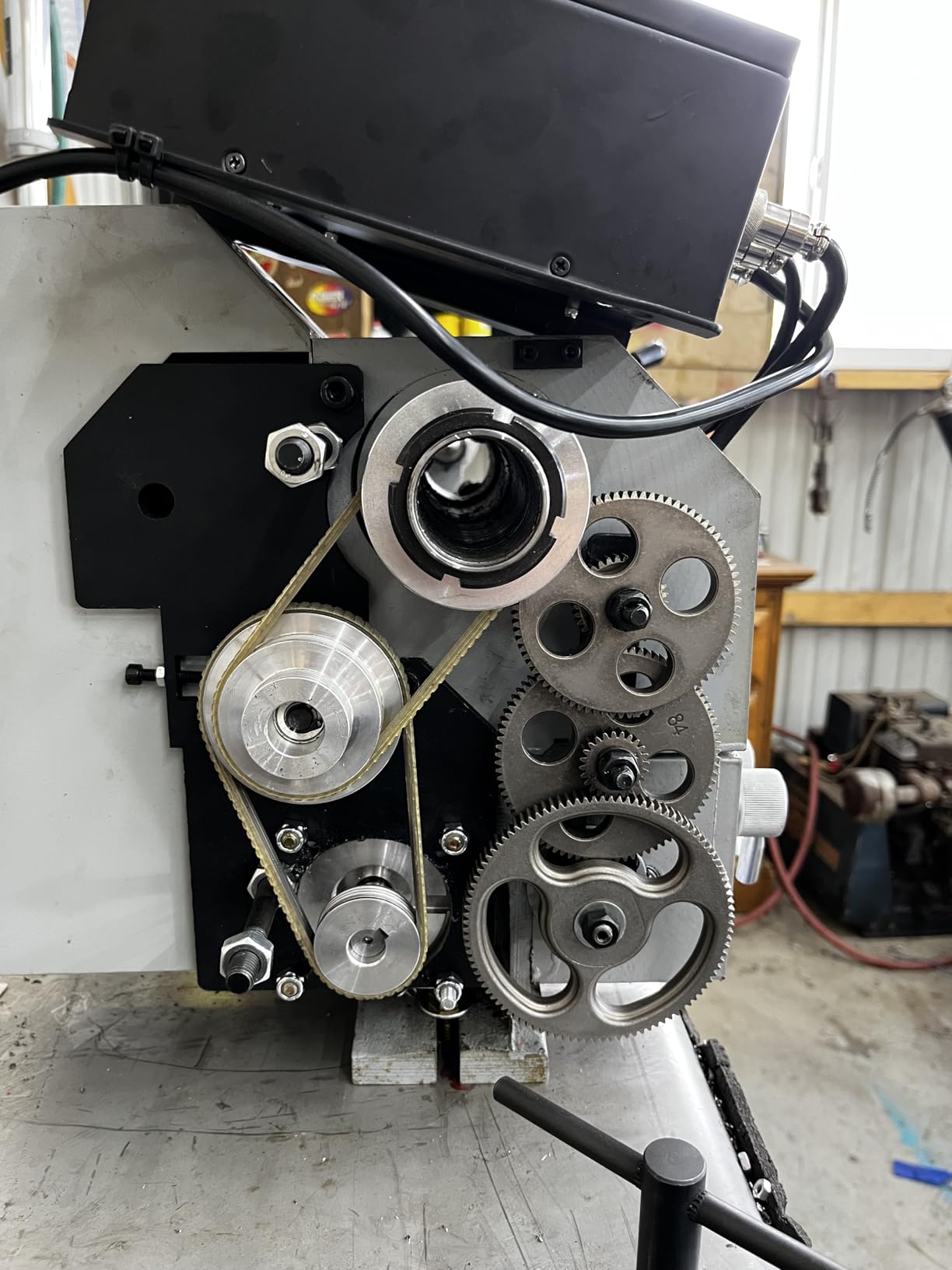
The real-time digital display showing spindle speed is a genuine usability gain. You set a speed, you see it, and you change it from the panel without touching a gear or pulley. The transparent chuck guard gives you sight of the cutting area, which helps when you are working on small bar and cannot see past the chuck jaws.
Customer service deserves a mention too. One owner had a replacement tailstock sent after damage in transit, and the report that the machine arrived clean with no rust and needed little preparation is worth weighing against machines that need a full teardown and degrease first.
What 3000 RPM and a 1.5 inch bore actually unlock
A 1.5 inch bore means you can clamp round bar or tube up to that diameter in the chuck and machine it without a steady rest, which is the single most common reason home machinists upgrade from a small lathe. It also opens the door to workholding with larger collets and larger tooling than a 3/8 inch bore machine can accept.
The 0 to 3000 RPM range in two halves gives fine resolution at both ends. At the low end you can take a finish pass on a small stainless part without melting the tool, and at the top end you can cut small diameter aluminium at a sensible surface speed instead of creeping along.
The assembly quality is the reason the rating sits where it does
Several owners found the cross slide required milling, drilling and tapping before a standard quick change toolpost would fit, which is a real cost in setup time and frustration. Others reported a tailstock out of alignment and a safety cover that arrived bent and needed reshaping before the machine would run.
The most serious item on the list is that there is no way to lubricate the headstock bearings. On a spindle that runs to 3000 RPM, an unlubricatable bearing set is a genuine long-term concern, and one owner reported having no reachable support for replacement parts after an electronics failure. The advertised 30 inch between-centers also falls short of the 27 inch dimension, so treat the headline length as marketing. If you can live with some setup work and plan to add a quick change post, the speed range and bore are worth it.
9. Proxxon PD 250/E Precision Lathe – Best for Quiet Work in a Small Space
Proxxon 34002 Metal Turning Precision Lathe PD 250/E
150W motor at 115V
34.3 pounds total weight
Automatic feed included
Quiet and vibration-free operation
Two-year warranty
Pros
- Only 34.3 pounds
- so it moves between benches by hand
- Owners report smooth controls and a solid European build feel
- Quiet and vibration-free in operation
- Automatic feed is standard rather than an accessory
- Two-year warranty on materials and workmanship
Cons
- Motor is loud with a rattling sound and lacks smoothness
- Cannot cut the coarser thread range
- Very small review base of six ratings
- Light 150W motor limits heavy roughing
The Proxxon PD 250/E is the machine to consider when noise is the deciding factor. Owners describe it as quiet and vibration-free, which matters in a home shop attached to a house, in an apartment, or in a shared workspace where a gear train at full song is a genuine problem. It is also the only machine in this roundup you can pick up and carry with one hand at 34.3 pounds.
Build quality is the other reason for the 4.8 rating across 6 ratings. European assembly with smooth controls and a slim, low-weight design that does not compromise performance is consistently what owners mention, along with the fact that these are buyers who deliberately chose to avoid low-cost imports.
Automatic feed is included as standard rather than sold as an accessory, and a set of high quality precision tools comes with the machine. The two-year warranty from PROXXON covers materials and workmanship, which is a real commitment from a manufacturer.
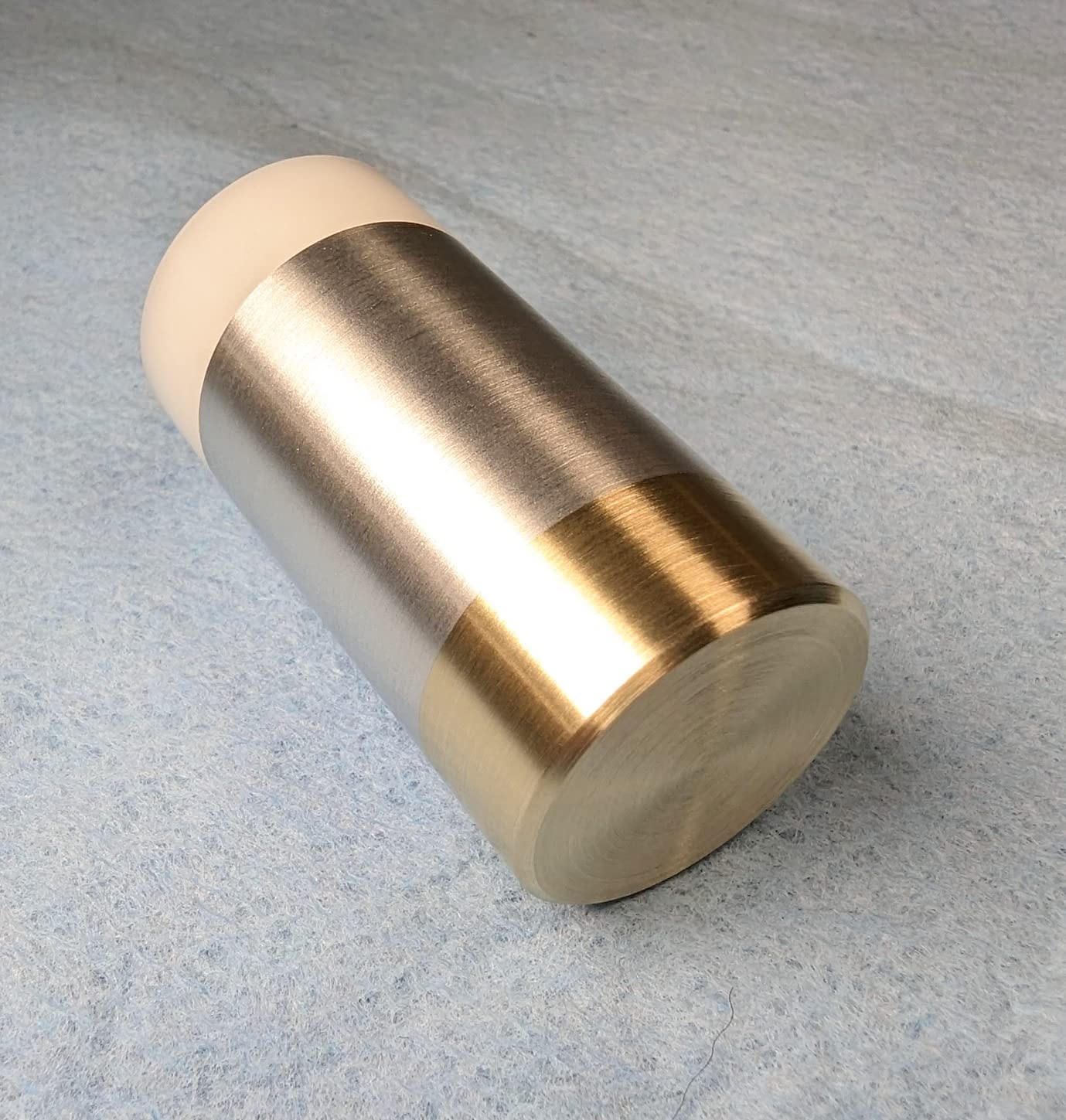
Owners report 100+ hours of use and describe making their own upgrades over time, which is the pattern you want from a small precision machine: it starts as a complete package and grows with the work rather than arriving as a bare frame needing a tool kit.
One buyer framed the appeal plainly. They wanted a lathe that did not feel like a cheap import, and the Proxxon delivered a machine that feels considered in the hand. That is worth something in a hobby where you spend years with the same equipment.
What you give up for the quiet, light build
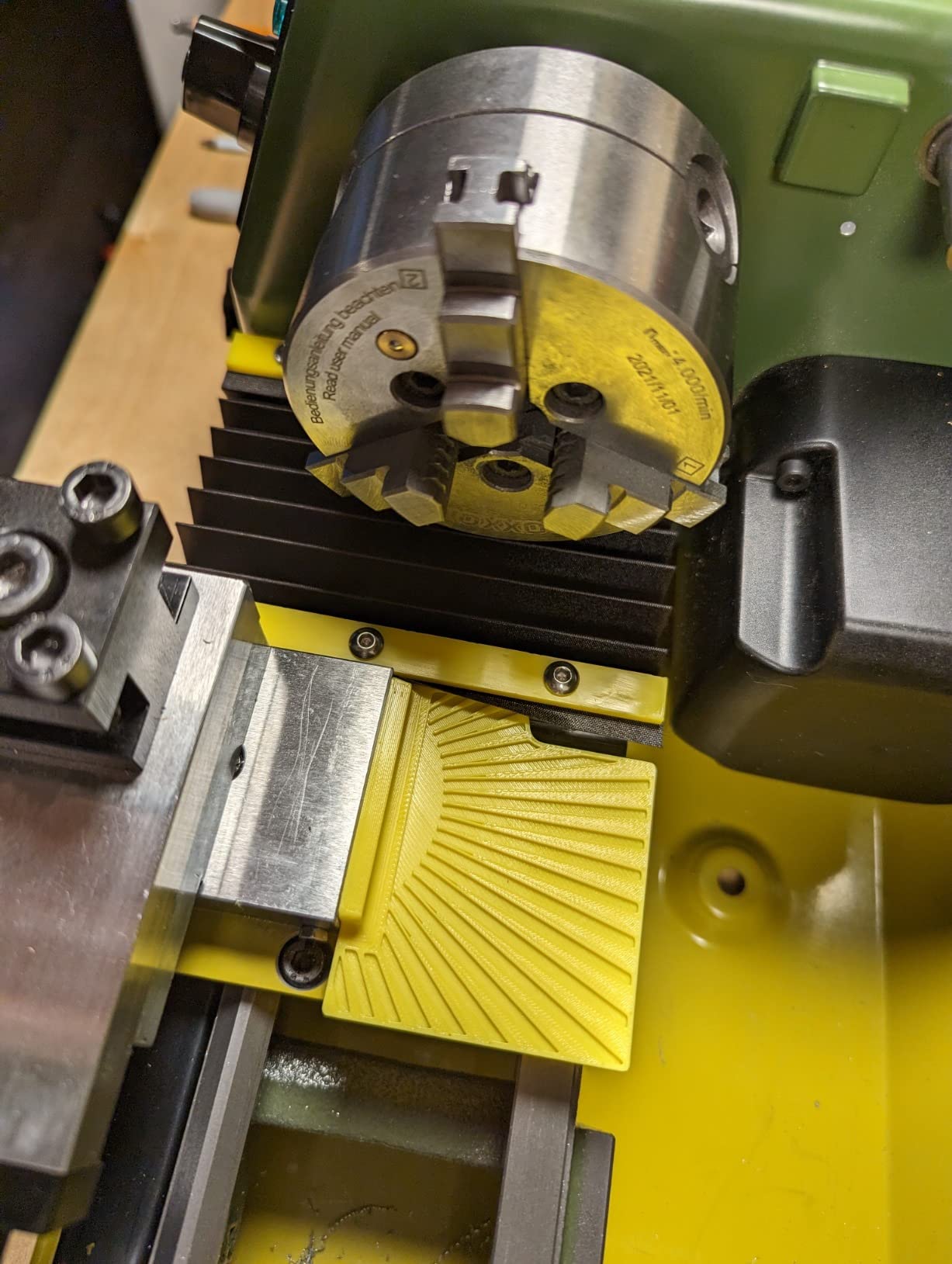
The 150W motor is the trade-off. One owner describes it as not smooth or powerful and loud with a rattling sound, which sits oddly beside the quiet-operation praise and is worth weighing for yourself. The consistent criticism from the same owners is that the machine cannot cut coarser threads, a limitation one reviewer found ironic given the product imagery.
So this is a machine for fine, small, precise work rather than heavy roughing. If your shop needs to hog out a large diameter in mild steel, a 1100W machine on this list will serve you better even though it is far louder and heavier.
Who this machine is genuinely right for
It fits small-parts work, electronics and instrument cases, model engineering, pen turning and delicate brass or aluminium components where finish quality matters more than material removal rate. It is also a good fit for anyone working from a small space or in a shared building, since 34.3 pounds and low noise remove two objections at once.
The honest caution is the review base of six ratings. That is too small to draw conclusions from, so the 4.8 rating should be read as a positive signal rather than a proven track record. Judge it on the specification and the build, and buy it for what it is: a quiet, light, precise small-parts machine.
10. INTSUPERMAI 8×32 Gearless Lathe – Best Long-Bed Precision With Gearless Threading
INTSUPERMAI Mini Metal Lathe Imperial/Metric Benchtop Lathe 8″X32″ Precision Metal Lathe Electronic Change Gear Mini Lathe 1100W
8.27 inch swing over bed
31.5 inch between centers
Gearless inch and metric switching
1100W brushless motor, 50-2500 RPM
0.01mm stated spindle precision
Pros
- 800mm between centers is a long turning bed for the class
- 0.01mm stated spindle precision
- Electronic gearless thread switching with no gear changes
- New belt drive design for lower noise
- 1100W brushless motor across 50-2500 RPM
Cons
- Poor instructions make setup hard for first-time owners
- Very heavy at 187 pounds
- Only six reviews
- so the 4.6 rating is not well established
- Telescopic scale handles may need adjustment to read accurately
The 8×32 INTSUPERMAI is the machine for a home machinist who turned a 16 inch machine and immediately wished for more bed. At 31.5 inches of between-centers distance it is the longest bed in this roundup, and that single number changes what you can attempt: long spindles, thin shafts, and multi-part turning without moving the part between setups.
It shares the gearless electronic inch and metric switching with the 8×16, and the new belt drive design for lower noise. The 1100W brushless motor covers 50 to 2500 RPM, the 10-44 TPI metric thread range is broad, and the stated spindle precision is 0.01mm. The swing over bed is 8.27 inch with a 3.94 inch bed width, 4.92 inch 3-jaw chuck and 5.51 inch tool rest rotary diameter, so the cross-section capability matches the 8×16 while the length nearly doubles.
Owners who have taken delivery report a well-built machine that turned precision parts without complaint, with first-time lathe owners reporting no problems at all. Packaging also got a mention from one owner, who noted the crate survived a long transit intact, which is always worth knowing about a machine this heavy.
What a 32 inch bed changes about your workflow
On a 14 to 16 inch machine, a 20 inch job means turning it in sections with a stop, or turning it in a fixture. On a 32 inch bed you can turn the whole part in one pass with the tailstock supporting the far end for the entire cut. That is the difference between a part that needs straightening and a part that comes off straight, particularly on slender material where cutting forces push the workpiece away from the centreline.
The stated 0.01mm spindle precision and the scaled telescopic sets for readable length measurements both point toward measurement work rather than heavy material removal, and that is where this machine’s specification set earns its keep.
Set aside time for setup, and weigh the machine before you buy
Documentation is the biggest practical problem here. Owners specifically call the instructions poor, which makes setup genuinely hard for anyone without lathe experience. The telescopic scale handles may also need digital standardisation or lateral adjustment before they read accurately, so budget an afternoon with a manual and a caliper before trusting a measured length.
At 187 pounds this machine needs a stand built for it, and the six-review sample is too small to treat the 4.6 rating as established. If you already know how to set up and align a lathe and you need the bed length, the specification is unusually strong for the class. If you are buying your first machine, the shorter-bed gearless option in this roundup is the gentler place to start.
Metal Lathe Buying Guide for Home Shops
Most disappointing lathe purchases are not bad machines. They are correct machines bought for the wrong work, or good machines that needed a different part, a different circuit, or a different bench. This section covers the specifications that decide those outcomes, in the order you should evaluate them.
Reading swing and between-centers correctly
Lathe size is written as swing over bed by between-centers distance, so a 9×20 has 9 inches of clearance over the bed and 20 inches of room between the headstock nose and the tailstock center. The first number limits diameter, the second limits length, and almost every disappointing purchase traces back to picking the wrong one of the two.
Start with the longest part you expect to make and add cutting allowance for the chuck jaw length. If your longest real job is 14 inches, a 7×14 machine gives you nothing to grip, which is the most common complaint about that size.
Spindle bore is the number most buyers ignore
The spindle bore is the hole through the headstock, and it sets the largest round bar or tube you can clamp in the chuck without a steady rest. It is independent of the swing figure, and a machine with generous swing can still have a bore too small to hold the work you had in mind.
This matters most for gunsmithing. Threading a barrel means the workpiece needs to pass straight through the headstock, so the bore has to exceed the swing diameter. For a typical contour-cut barrel blank you want a bore of at least 1.5 inches on a machine with a 10 to 13 inch swing. On this roundup, the CREWORKS 9×30 and the INTBUYING 8×32 both carry a 1.5 inch bore, while the VEVOR 8×14 offers 0.8 inch and the Shop Fox 6×10 has 3/8 inch, which puts all three out of scope for barrel work.
Headstock bearings decide whether your parts are round
Across the machinist forums that dominate this search, one specification comes up more than any other: precision headstock bearings are a must, not an upgrade. Mini lathes that use standard electric motor bearings inside the headstock are routinely described as sloppy, and that slop shows up as a part that will not run true no matter how carefully you set the cut.
The practical test is whether the manufacturer states the bearing type. Where a machine lists a high-precision spindle with premium bearings, that is a meaningful claim. Where the headstock bearings are simply not mentioned, assume the cheapest thing that will fit.
Speed range, gearing and the quick-change question
Variable speed control changes how you work. A conventional gear-change lathe with a 100 to 2000 RPM range gives you a workable speed for most cuts, but you stop the machine to change range, and you may not have the exact speed your material and tool combination wants.
Electronic variable speed from roughly 50 to 2500 RPM gives you continuous control and, in most designs, reverse rotation. Reverse matters more than beginners expect: it is how you cut threads in reverse, how you run a steady rest without a dedicated reverse-feed gearbox, and how you back off a tight thread without unwinding it by hand.
Metal gearing beats plastic in the short gears that drive the leadscrew and the spindle. Plastic gears quiet, but they are the first thing to fail, and owners repeatedly replace them. The move to gearless electronic thread switching, seen on both INTSUPERMAI machines here, removes both the gear noise and the gear wear from the threading path entirely.
Carriage, cross-slide and lead screw accuracy
The leadscrew is what converts handwheel rotation into a controlled feed, and its accuracy determines whether a threaded part fits the first time. A useful benchmark is lead screw error under 0.001 inch per foot; anything looser and threading becomes guesswork.
The cross-slide gives you the ability to move the tool perpendicular to the work for facing and grooving, and the compound rest carries the tool at an angle for chamfers and tapers. A compound rest that can be indexed with two screw positions is what you use for accurate chamfers, and machines without a full compound rest limit you to straight turning and simple facing.
A carriage lock is worth more than it sounds. It holds the carriage position while you set a tool or take a measurement, and on a machine without one you are adjusting depth with one hand while the carriage creeps under the load of the cut. Several of the machines in this roundup carry one, and its presence is one of the cheaper ways to judge build quality.
Power and your shop electrical requirements
This is the section no competitor covers and the one that causes the most frustration after delivery. Small lathes at 120V with motors around 550W to 1500W run off a standard outlet. Larger machines, and anything with a 1100W brushless motor driving heavy cuts, deserve a dedicated 240V circuit in a residential garage.
Run the electrical calculation before you buy, not after. Check the total load of the lathe, your grinder, your bandsaw and any dust collector on the same circuit, and confirm what your panel can actually carry. A machine that trips its breaker on a roughing pass will teach you nothing about the lathe itself.
Brushless motors are worth paying for where the choice exists. They have no brushes to replace, they run more quietly, they hold speed better under load, and they are a large part of why the 1100W machines in this roundup feel stronger than older brushed drives of similar wattage. The 0 to 3000 RPM machine here also uses a display that shows actual spindle speed rather than a dial position you have to interpret.
Weight is a rigidity specification, not a portability one
A heavier lathe resists cutting forces, and cutting forces are what deflect the tool and make a part come out undersize or bent. Machines in this roundup range from 34.3 pounds to 230 pounds, and that range maps almost exactly onto the class of work each can do.
Under about 100 pounds you have a benchtop or mini machine. Those can produce good parts, but they want short cuts, sharp tools and light feeds. Between 130 and 200 pounds you are into a benchtop machine that will take a reasonable depth of cut in mild steel. Over 200 pounds you need a stand and a floor.
Whatever the weight, buy a stand or bench rated for it and level it. A machine bolted to a proper stand and a machine sitting on an adjustable furniture table perform differently in exactly the way you would hope, and the heavier the machine, the more this matters.
The upgrade path from 7×10 to 13×40
Forums discussing first lathes converge on a fairly consistent ladder. A 7×10 is fine for learning the motions, and many owners say their first machine taught them more than any manual could, but it becomes a wall quickly. The 9×20 is regularly described as the practical minimum for a home shop, and the 10×22 as the sweet spot. Above that, a 13×40 is a serious gunsmithing and production machine that belongs in a dedicated space on a dedicated circuit.
The jump from a 7×10 to a 9×20 or 10×22 is where the money is best spent, and it is where this roundup is strongest. The jump beyond 10×22 is a different purchase decision, made for a specific job rather than general capability.
Second lathes are common and not a mistake. Plenty of machinists keep the small machine for parts that do not justify a setup on the big one, and the cost of two machines is spread across different work rather than wasted. If you are unsure how large your work will get, a 7×10 or 8×14 now and a bigger machine later is a defensible path.
Used and vintage lathes, and when one beats a new budget machine
South Bend, Sheldon and Atlas 618 machines come up repeatedly in forum discussion as respected used options. A well-maintained heavy lathe from a previous generation can weigh more and hold more than a new entry-level machine, because the mass was designed for decades of service rather than for a price bracket.
Used buying requires different skills. Check the spindle for play by hand, look for rust pitting on the ways, verify that the gearbox engages every gear, and ask whether the motor and wiring have been inspected. Budget for a full service, new ways covers and a new leadscrew before the first cut, and treat the machine’s history as unknown until you have it apart.
For someone who is comfortable with mechanical projects, a serviced used lathe can beat a new budget machine on rigidity and weight. For a first-time buyer who wants to learn turning rather than learn lathe repair, new with a warranty is the better use of the money.
What to buy alongside your first lathe
Tooling is where the real money goes after the machine, and a lathe with dull tools is a frustrating machine. Sharp carbide tooling for steel, a parting tool, a threading tool for the pitch you use most, and a decent toolpost make a visible difference to the finish on the first part you cut.
Beyond tools, the next three purchases in order are a bench grinder to keep edges sharp, a digital read out for the carriage so you can measure rather than guess, and a steady rest for turning slender stock. A chip pan and a way of containing swarf matters more than most buyers expect, and a good work light removes most of the frustration of a first evening.
For a related view of the wider shop, our guide to the best metal lathes for machining covers the same machines from a different angle, and our picks for the best brake lathes for shops cover the lathes that shape rather than turn. If your work is wood rather than metal, the best wood lathes for turning roundup is a separate guide.
Brands we rate and brands we treat carefully
Grizzly is repeatedly named as a safe default brand in machinist forums, with the 9×20 series described as a sensible starting size and the 10×22 as the sweet spot. Lathe Master, Sheldon and South Bend appear regularly as respected alternatives, and precision headstock bearings are treated as a must rather than a nicety.
On budget mini lathes, the recurring forum view is that Harbor Freight machines use standard electric motor bearings and are consistently described as sloppy, though owners generally accept them for learning. Metal gear set upgrades on those machines are reported to work well but to run noisier than the plastic originals, which is a fair summary of the whole budget tier.
The general pattern we see in the reviews on this page is that budget lathes are fine for learning and frustrating for precision work until they are adjusted, and that the two machines we would point a first-time serious buyer toward are the ones with the deepest owner histories rather than the longest specification sheets.
Frequently Asked Questions
What is the best lathe machine for home use?
The best lathe for a home shop is a 9×20 to 10×22 class benchtop machine with precision headstock bearings, metal gearing, a quick change toolpost and at least a 1.5 inch spindle bore. A 1100W brushless motor with 50 to 2500 RPM covers aluminum, brass and mild steel. Below 7×10 you are learning the motions, and above 13 inch of swing you need a dedicated circuit and a floor.
Is the Harbor Freight lathe any good?
Owners on machinist forums generally treat budget Harbor Freight mini lathes as fine for learning and limited for precision finishing, mainly because they use standard electric motor bearings in the headstock, which machinists describe as sloppy. Metal gear set upgrades are reported to work well but run noisier than the plastic originals. If your work needs consistent diameter in steel, plan on a spend on tooling and setup.
What company makes the best lathes?
Grizzly is the most frequently named safe default in home machinist forums, with the 9×20 series described as a practical minimum and the 10×22 as the sweet spot. Lathe Master, Sheldon, South Bend and Precision Matthews appear regularly as respected alternatives, and the Atlas 618 is recommended by owners as a well-regarded compact machine. Parts availability and service support matter as much as the name on the badge.
What is the most accurate lathe?
Accuracy comes from the headstock bearings, the leadscrew and the rigidity of the frame rather than from any single brand. Look for a machine that states precision headstock bearings and a leadscrew error under 0.001 inch per foot, and weight it accordingly: machines in the 180 to 230 pound range deflect far less than 70 to 115 pound machines. Measure the result with a dial indicator on your own parts before trusting a spec sheet.
Which brand of bench lathe is best for metal?
For metal work specifically, the deciding specifications are a spindle bore of at least 1.5 inch, a metal gear train rather than plastic, a quick change toolpost and enough weight to resist cutting forces. Among the machines reviewed here, the CREWORKS 9×30 and INTBUYING 8×32 both pair a 1.5 inch bore with a 1100W brushless motor, while the VEVOR 7×14 offers the deepest owner history for general aluminum, brass and mild steel work.
Are Vevor mini lathes any good?
The VEVOR machines reviewed here earn their reputation for specific reasons rather than brand alone. The 7×14 model has the largest owner base in this roundup at 294 ratings, and owners credit its metal gearing, digital speed display and 4-way toolpost, while noting it needs gib and way adjustment before accurate work. The 8×14 model earns praise for its turret post, cast iron body and MT2 tailstock, with a power feed that cannot be disengaged as the main drawback.
What is a good size metal lathe for a beginner?
Most machinist forums treat a 9×20 as the practical minimum for a home shop and a 10×22 as the sweet spot, with a 7×10 fine for learning the motions but limited for longer parts. Choose on between-centers distance first, since the chuck jaw length eats into usable length, and on swing second, since that is the diameter you can turn. Add a swing or two beyond your current needs if your work tends to grow.
Do I need a 240V circuit for a metal lathe?
Smaller lathes rated around 550W to 1500W at 120V run off a standard outlet, but a machine with a 1100W brushless motor taking heavy cuts in mild steel deserves a dedicated 240V circuit in a residential garage. Run the total load of the lathe, grinder, bandsaw and dust collector on the same circuit before you buy, and confirm your panel can carry it. A machine that trips its breaker on a roughing pass tells you nothing about the lathe itself.
What does spindle bore mean on a lathe?
The spindle bore is the diameter of the hole through the headstock, and it sets the largest round bar or tube you can clamp in the chuck without a steady rest. It is separate from the swing over bed figure. For gunsmithing it is critical: threading a barrel requires the workpiece to pass straight through the headstock, so the bore must exceed the swing diameter, which is why 1.5 inch bore machines suit contour-cut barrel blanks and smaller bores do not.
Is a lathe and mill combo worth it for a home shop?
A combo saves floor space and money on a first machine, and it is reasonable if you want one machine to cover both turning and simple flat milling. The compromises are real: a smaller swing over bed than a dedicated lathe, a shorter between-centers distance, and a cross-slide that has to do two jobs. Many machinists buy a compact lathe first and add a small mill or drill press later, which keeps the turning capability at full size.
The Best Metal Lathe for Your Garage
After reading every owner report on these ten machines, the best metal lathes for home machinists still come down to a short list with different jobs. The VEVOR 7×14 is our pick for most people because 294 ratings describe a consistent, metal-geared machine with an electronic speed control, and that much feedback is worth more than any specification advantage on a machine nobody has owned yet.
Go larger if your work has a diameter problem: the CREWORKS 9×30 for the widest speed range and a 1.5 inch bore, or the INTBUYING 8×32 if you turn long shafts and pipe. Go smaller and quieter if space or noise decides it, and the Proxxon PD 250/E is the one to carry at 34.3 pounds. Whichever you choose, budget a weekend of adjustment, a set of sharp carbide tooling and a dial indicator, because those three things decide whether your first part is good.
Whatever you end up with, put a bench grinder, a digital read out and a steady rest on the list for later. Those are the purchases that turn a lathe into a shop, and they are the 2026 lathes update we will keep watching as owner history builds on the newest models.