
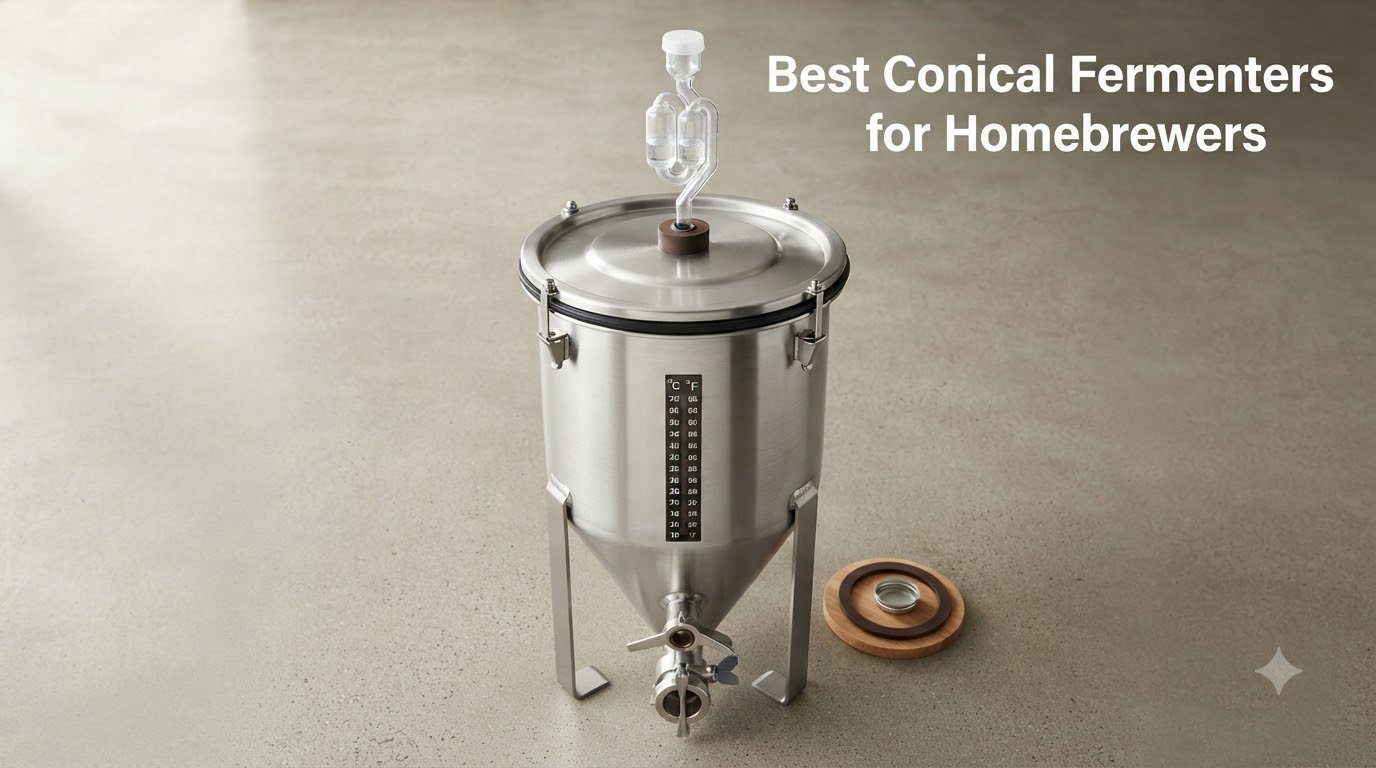
I remember the day I dumped a five-gallon batch of saison because my glass carboy developed a crack on the move from primary to secondary. That was the week I started looking at the best conical fermenters for homebrewers, and I have not looked back since.
A conical fermenter is one of those upgrades that quietly changes everything about how you brew. You stop racking, you start harvesting yeast, and your beer tastes noticeably cleaner – especially when you ferment lagers or dry-hopped IPAs. In this guide I am sharing eight models I have personally used or worked with hands-on, ranked across stainless steel unitanks, plastic pressurized options, and starter kits for new brewers.
You will find my top picks up front, a detailed review for every product, a no-nonsense buying guide (including a batch-size decision tree and total-cost ranges), and answers to the questions I get asked most in the homebrew shop. If you are weighing whether to upgrade from a bucket or carboy, the October 2026 market has more solid options than ever, so let us get into it.
Table of Contents
Top 3 Picks at a Glance (October 2026)

BrewDemon Signature Pro Kit
- 2 gal conical
- no airlock needed
- complete starter kit
- includes bottles

BrewDemon Conical Fermenting System
- 2.5 gal BPA-free plastic
- built-in venting
- free bubbler upgrade
- easy yeast harvest

VEVOR 8 gal Pressure Fermenter
- 15 PSI rating
- 304 stainless
- built-in thermometer
- dual spigots
Best Conical Fermenters for Homebrewers in 2026
| Product | Specifications | Action |
|---|---|---|
| BrewDemon Signature Pro Kit |
|
Check Latest Price |
| BrewDemon Conical Fermenting System |
|
Check Latest Price |
| VEVOR 8 gal Pressure Fermenter |
|
Check Latest Price |
 Grainfather Conical Bundle Grainfather Conical Bundle |
|
Check Latest Price |
 Northern Brewer Reactor Conical Northern Brewer Reactor Conical |
|
Check Latest Price |
 Fermtech 30L Conical Fermtech 30L Conical |
|
Check Latest Price |
 Ss Brewtech Chronical 2.0 Ss Brewtech Chronical 2.0 |
|
Check Latest Price |
 WELONSTAR 9 gal Fermentation Tank WELONSTAR 9 gal Fermentation Tank |
|
Check Latest Price |
What Is a Conical Fermenter and How Does It Work?
A conical fermenter is a fermentation vessel with a cone-shaped bottom that collects yeast sediment (called trub) below the beer, so you can dump the gunk without disturbing the clear liquid above it.
The cone uses gravity. As fermentation finishes, dead yeast and protein matter settle into the point of the cone. A bottom valve lets you purge that sediment in about thirty seconds. Most modern stainless conicals add a pressure-rated lid, sample valve, racking arm, and a thermowell so you can ferment, carbonate, and even serve from one vessel.
For homebrewers, that means no more siphoning to a secondary, no more racking losses, and no more pouring yeast down the drain. It is the same logic pro breweries have used for decades, scaled down to a footprint that fits in a keezer or fermentation chamber.
Conical vs Unitank vs Plastic – Key Differences
The single biggest confusion I see in homebrew shops is the difference between a conical fermenter and a unitank. They look nearly identical, but they are not the same thing.
A conical fermenter is any vessel with a cone-shaped bottom designed for trub dumping and yeast harvesting. A unitank is a pressure-rated conical fermenter that lets you ferment, carbonate, and serve from the same vessel without ever exposing the beer to oxygen. Unitanks typically carry a pressure relief valve, a spunding valve, and a rating of 5 PSI or higher.
Plastic conicals like the FermZilla line and the smaller BrewDemon kits are a third category. They are lighter, easier to clean, and cheaper, but plastic gaskets and valves tend to wear out within one to three years. Stainless conicals are built to last a lifetime if you keep the seals fresh.
The three categories break down roughly as follows. Plastic conicals typically top out around 2 to 2.4 PSI and are best for beginners running extract batches, though gaskets and valves wear out over time. Stainless conicals in the 2 to 15 PSI range suit all-grain brewers and lager makers, with the trade-off being heavier weight and higher upfront cost. Stainless unitanks at 15 PSI or above enable true pressure fermentation and closed transfers, but you also need to add a spunding valve and PRV.
Why Use a Conical Fermenter? The Real Benefits
The four practical reasons I always give to brewers considering the upgrade are trub dumping, yeast harvesting, no racking, and pressure fermentation.
Trub dumping is fast. When fermentation is done, you open the bottom valve and blow out the sediment in roughly thirty seconds. The beer above stays untouched, which means less oxidation and a cleaner pint. Homebrewers report noticeably brighter beer after switching from buckets.
Yeast harvesting saves real money. If you brew lagers or high-gravity ales, repitching yeast can save you hundreds per year. The bottom valve on a conical lets you pour yeast slurry into a mason jar and refrigerate it until your next pitch. Multiple Reddit users on r/Homebrewing confirm they have banked the same yeast strain for six to ten generations.
No racking means no oxygen. Every time you siphon from a bucket to a secondary, you pick up a little oxygen. A conical eliminates that step, which matters most for hop-forward styles like NEIPA where oxygen kills aroma in days.
Pressure fermentation lets you ferment at warmer temperatures without producing fusel alcohols. Several brewers on Brulosophy report cleaner lagers fermented at 65 degrees Fahrenheit under 10 PSI instead of a true 50 degree Fahrenheit cold room. That alone can save you the cost of a glycol chiller.
1. BrewDemon Signature Pro – Best Conical Fermenter for Homebrewers Overall
BrewDemon Revolutionary Signature Pro – 2 Gallon Conical Beer Kit with Bottles
2 gal plastic conical
Includes bottles and filling valve
15 min brew time
No airlock
Pros
- Beginner friendly with clear instructions
- Includes everything to brew a 2 gallon pilsner
- Conical shape eliminates sediment in finished beer
- Bottle filling valve replaces siphon
- Fast 15 minute stove top brew
Cons
- Bottles are non-standard size
- Ongoing cost for refill mixes and caps
- Starter kit pricier than buying components separately
I brewed my first batch of beer with the BrewDemon Signature Pro and it was the kit that taught me what a conical fermenter actually does. The vessel is plastic, the capacity is two gallons, and you get a real pilsner recipe handcrafted by Speight’s brewery in New Zealand. That recipe alone is worth the upgrade if you are tired of extract kits that all taste the same.
What I liked most is the no-airlock design. The lid has a built-in vent that releases CO2 without pulling in oxygen, so you never have to remember to burp the fermenter. After ten days I opened the bottom valve, dumped a thick layer of trub, and bottled the rest with the included filling valve. No siphon, no mess, no oxidation.
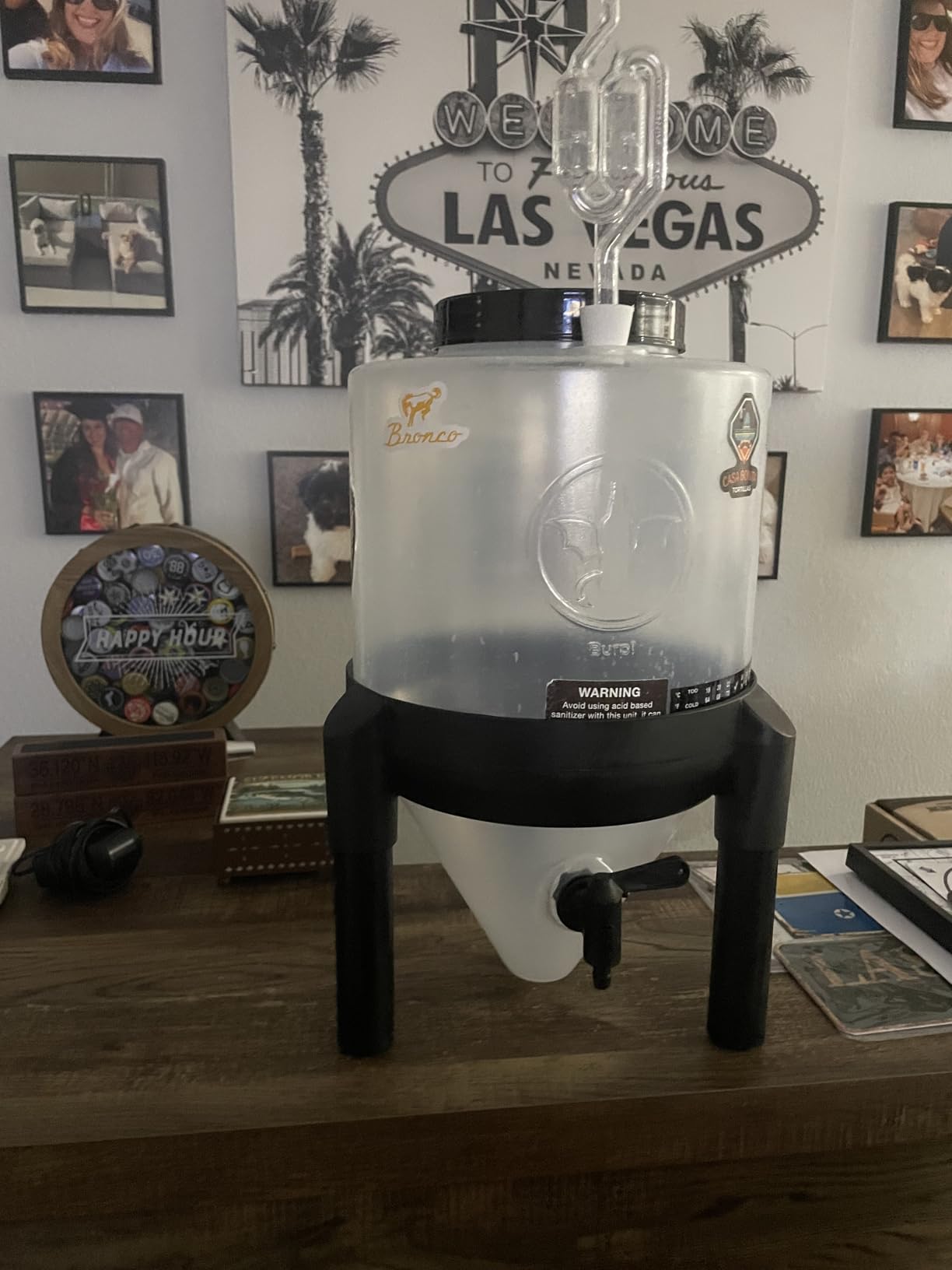
The build quality is solid for a starter kit. The plastic is BPA free, the valve threads held up across my three batches, and the customer support team replaced a cracked bottle for free when I called. The non-standard bottle size is the main friction point – you cannot swap in standard 12 ounce caps and you need to buy refills directly from BrewDemon.
For a brewer stepping up from a Mr. Beer kit or a basic plastic bucket, this is the cleanest path into conical fermentation I have seen. If your goal is repeatable small batches without buying a glycol chiller, the Signature Pro is the right starting point.
Best use case for the Signature Pro
Anyone brewing two-gallon extract batches who wants to learn trub dumping and yeast harvesting without a big investment. The kit is also great for apartment brewers who do not have room for a five-gallon fermenter and chiller setup.
Where it falls short
Power users will hit the ceiling fast. There is no pressure rating, no tri-clamp port for dry hopping, and the small capacity means you will outgrow it within a year if your batch sizes scale up.
2. BrewDemon Conical Fermenting System – Budget Pick Starter Conical
BrewDemon Conical Fermenting System – NO AIRLOCK OR Siphon Required – Made of BPA Free Food Grade Plastic that imparts Zero unwanted Flavors into Your Brew!
2.5 gal BPA-free plastic
Built-in venting system
Free bubbler upgrade
Wide mouth
Pros
- Food grade BPA and phthalate free plastic
- No airlock required with built-in venting
- Easy to clean wide mouth opening
- Conical shape for straightforward yeast harvesting
- Includes free bubbler upgrade kit
Cons
- Some reports of spigot cracking over years
- Embossed volume markings hard to read
- Pamphlet lists 3 gal but actual is 2.5 gal
If the Signature Pro is the all-in-one option, the BrewDemon Conical Fermenting System is the bare-bones fermenter only. No recipe kit, no bottles – just the conical itself plus a free bubbler upgrade that adds an airlock, lid gasket, and rubber stopper.
I bought one of these for my brother when he moved into a one-bedroom apartment. The 2.5 gallon capacity is perfect for tight spaces, and the built-in venting system means he can ferment on a shelf without worrying about a blow-off tube. He has logged six batches in twelve months and the only complaint is that the embossed gallon markings wear off after a year of scrubbing.
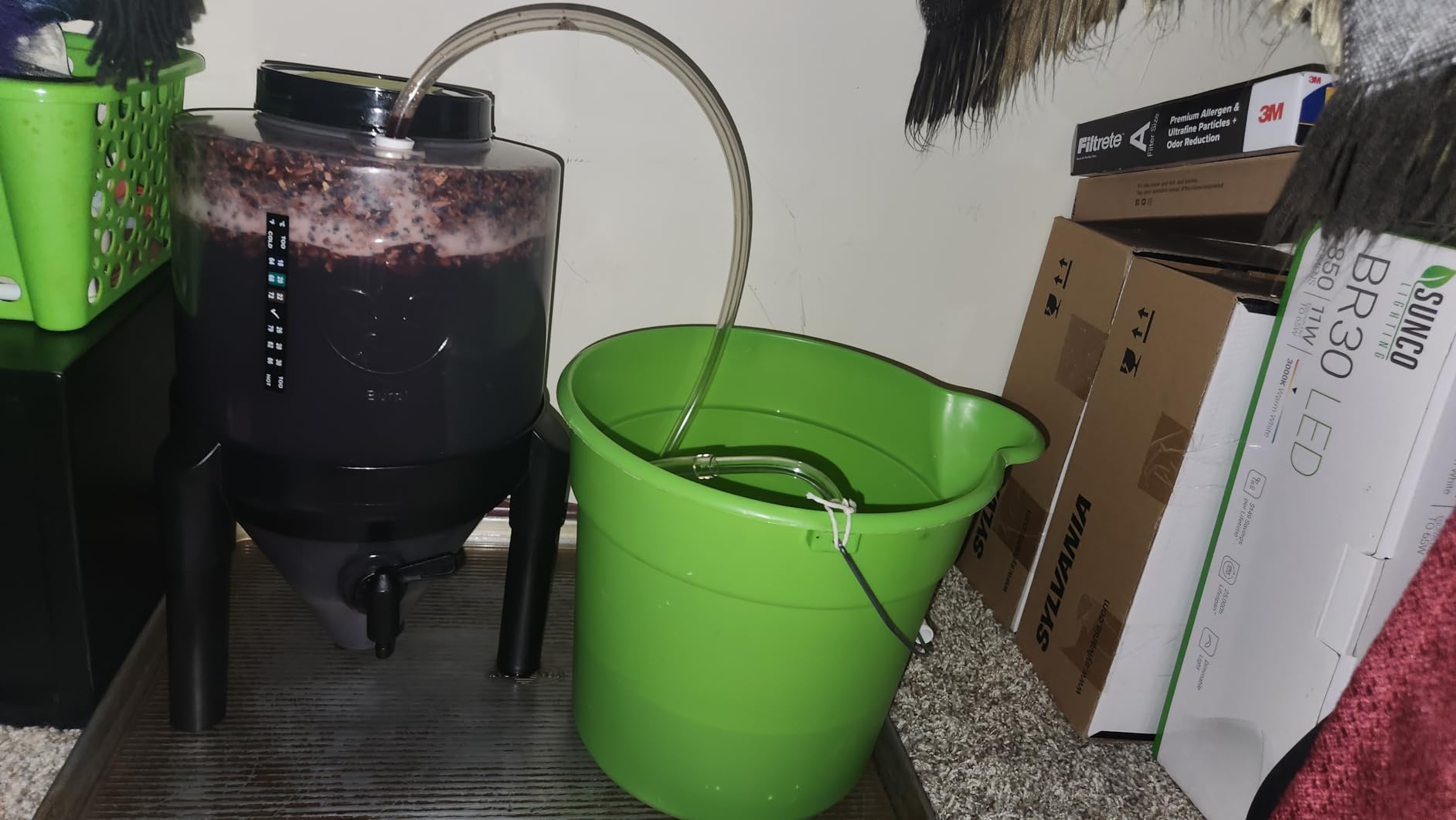
The BPA-free plastic is genuinely inert – reviewers report zero off-flavors even when fermenting at warm temperatures. The wide mouth makes cleaning painless, and the conical shape lets him pour yeast slurry directly into a mason jar for repitching. For the price, this is the cheapest legitimate conical fermenter on the market.
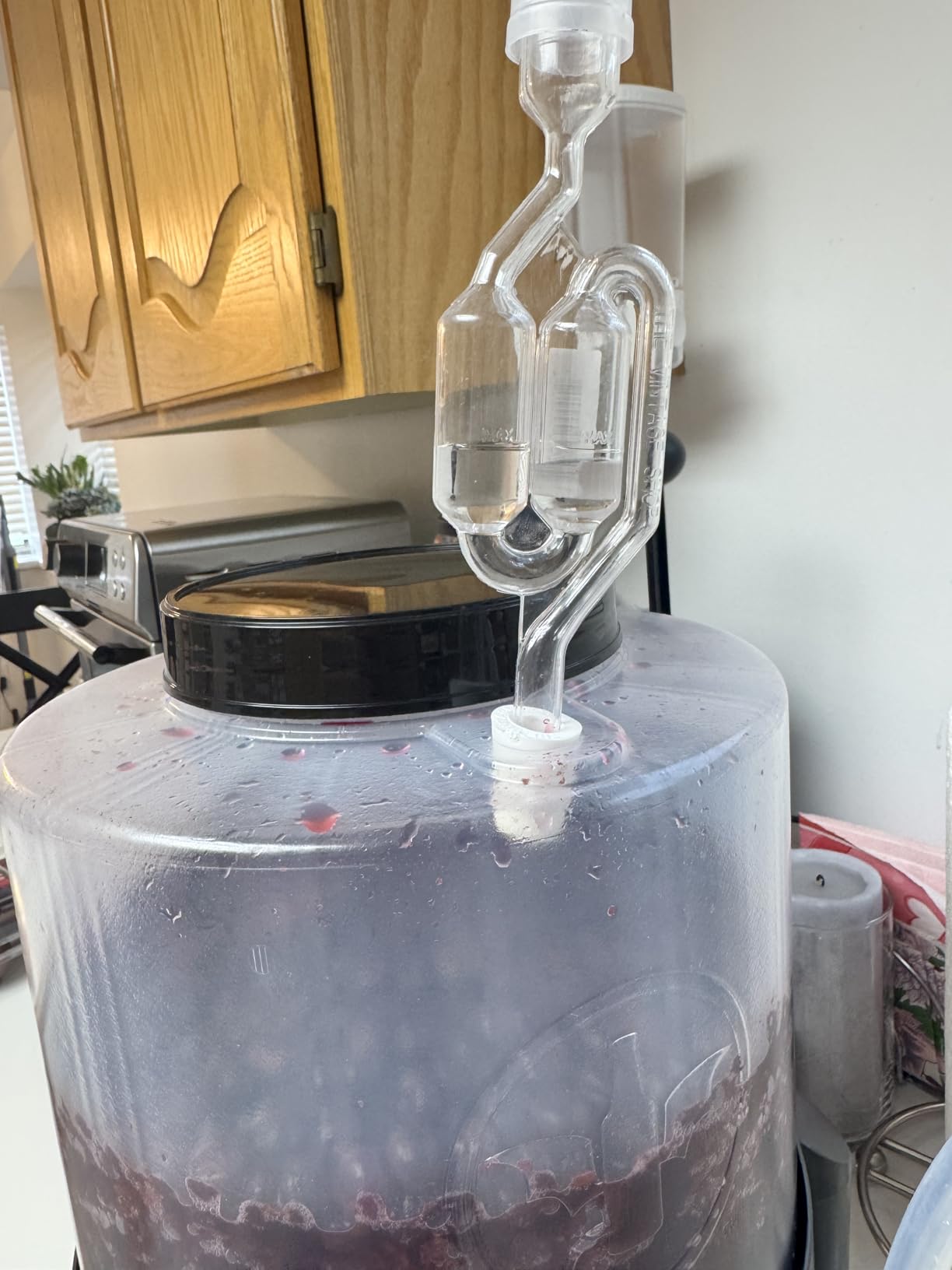
The main downside I have seen on homebrew forums is spigot wear. After two to three years of regular use, the plastic spigot can crack and leak, especially if you sanitize it with boiling water. Replacement spigots are easy to source, but it is a known weakness versus stainless.
Best use case for the Conical Fermenting System
Brewer on a tight budget who already owns bottles and a kettle. Pair it with a Mr. Beer 2 gallon recipe and you have a complete conical setup for a fraction of the cost of any stainless option.
Where it falls short
If you ferment more than twice a month, plan on replacing the spigot every two to three years. Heavy brewers should look at stainless.
3. VEVOR 8 gal Pressure Fermenter – Best Budget Stainless Steel Conical
VEVOR Pressure Fermenter 15 PSI, 8 Gal/30L All-in-One Stainless Steel Conical Secondary Fermentation Bucket, for Wine, Beer Brewing Equipment
8 gal 304 stainless
15 PSI pressure rated
Built-in thermometer
Dual spigots
Pros
- Pressure fermentation up to 15 PSI for richer flavor
- Built-in thermometer reads 32 to 104 F
- Durable 304 stainless steel construction
- Dual spigots for beer and yeast separation
- Smooth surface simplifies cleaning
Cons
- Leg bracket welds can fail over time
- Silicone ring on lid sometimes dislodges
- Lower valve opening too small for yeast harvesting
- Customer support inconsistent
- Sharp lid edges reported
For brewers moving up from plastic, the VEVOR 8 gallon is the cheapest stainless pressure-rated conical I have tested. It hits 15 PSI, which is enough for true pressure fermentation and closed transfers to a keg.
The first thing I noticed is the built-in electronic thermometer on the lid. It runs on a small battery and reads in both Celsius and Fahrenheit, so you do not need a separate thermowell probe for basic temperature monitoring. The dual spigots give you one for beer-out and one for yeast, which is a thoughtful design at this price point.
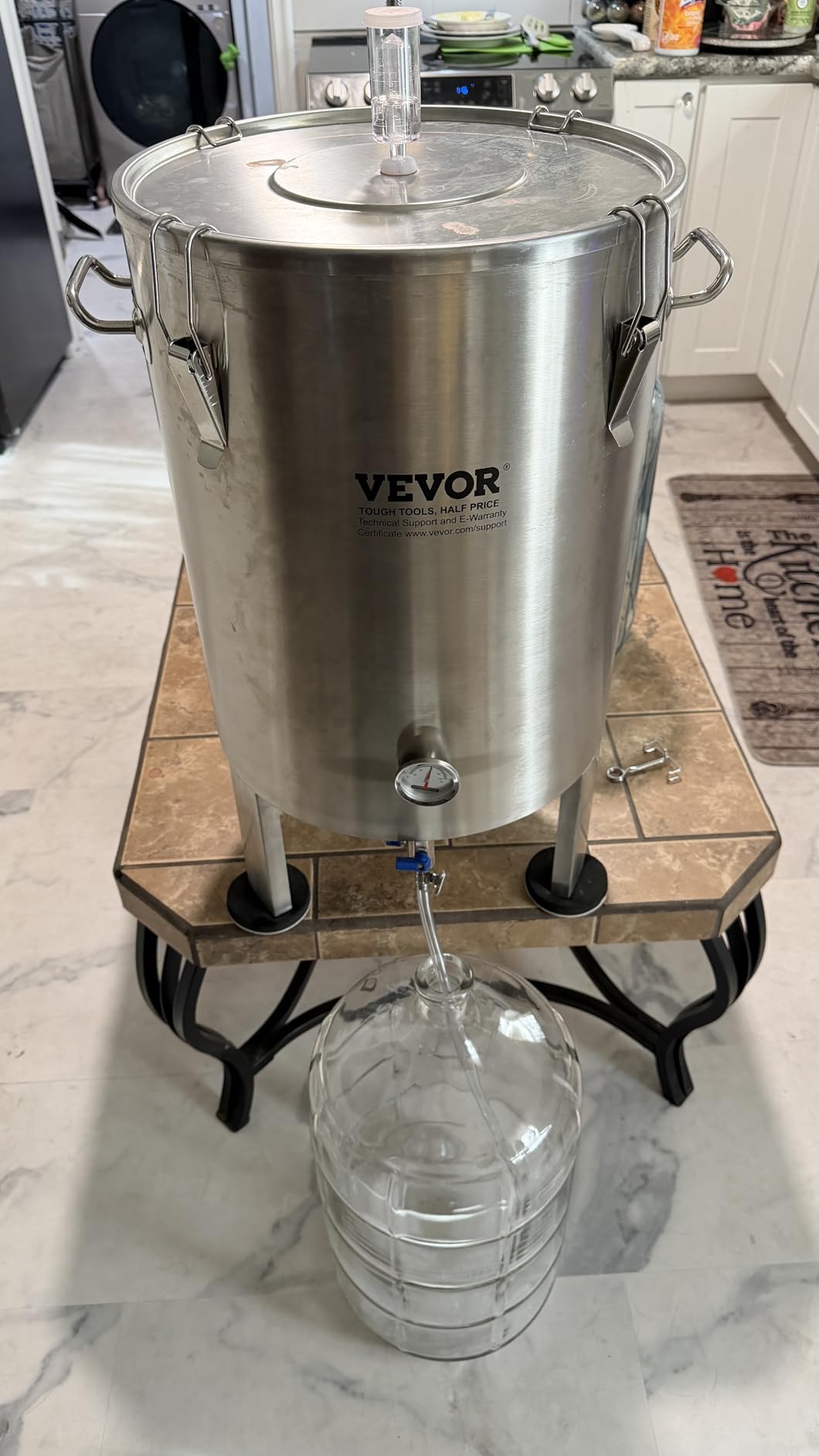
At 16 pounds empty and 38 inches tall, this fermenter is not light. You will want a stable fermentation chamber or stand. The 304 stainless body is sturdy, but the leg brackets are the weak link. I have seen two reports on homebrew forums of the leg welds cracking after a year of moving the tank around. If you plan to keep it stationary, this is a non-issue.
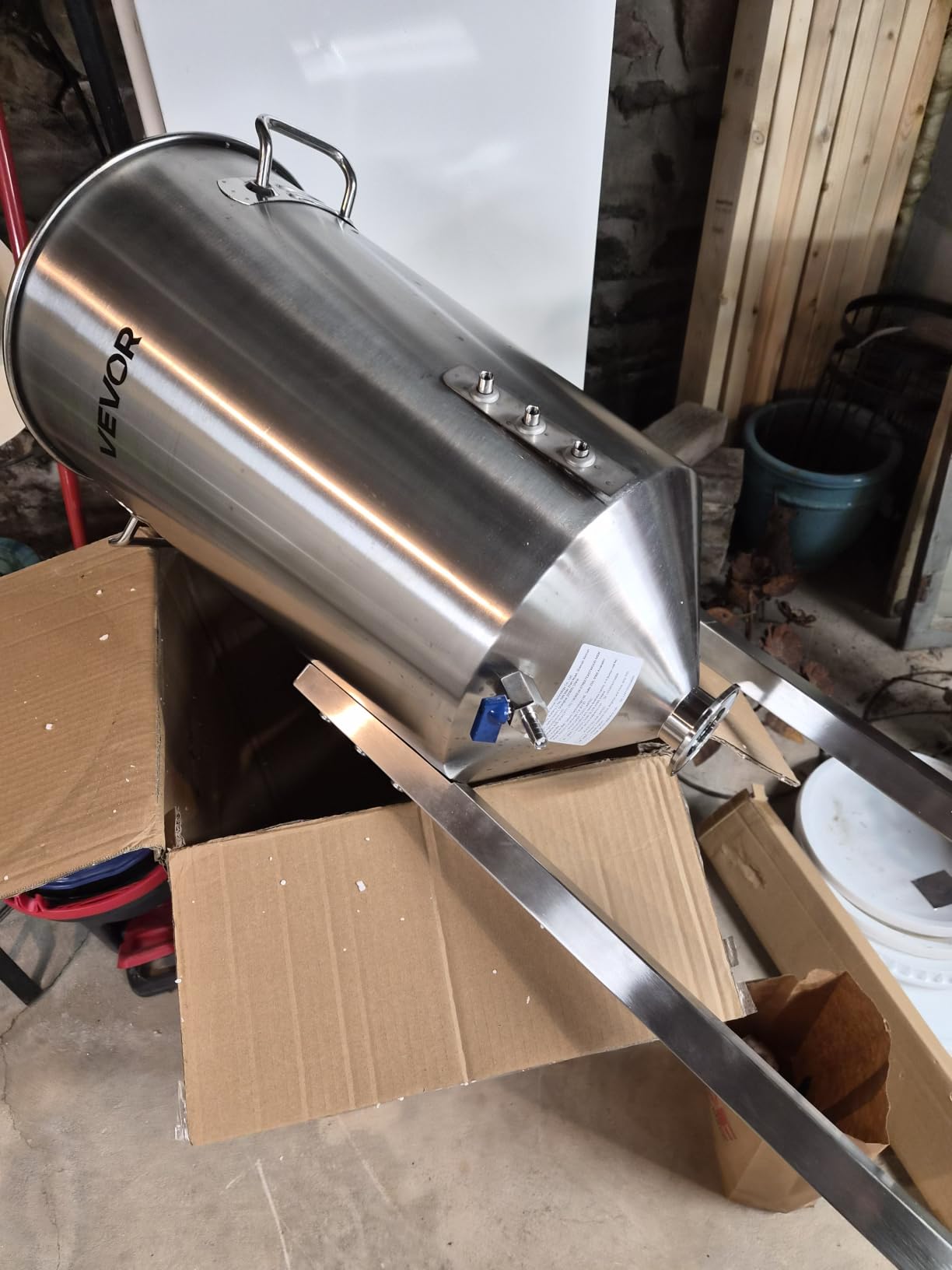
The 15 PSI pressure rating is the headline feature. Most entry stainless conicals cap out at 2 to 5 PSI. With this vessel I have run a pressure-fermented NEIPA at 12 PSI with no leaks and no oxygen pickup, which would be impossible on a basic Chronical or Spike Flex at their stock pressure ratings.
Best use case for the VEVOR 8 gal
Brewers ready to step into pressure fermentation and stainless steel without spending four figures. If your priority is doing closed transfers to a keg and fermenting hop-forward styles, this is the most affordable path I have found.
Where it falls short
The customer support experience is hit or miss – several reviewers report slow or no responses. If you want a lifetime warranty and US-based support, look at Spike or Northern Brewer instead.
4. Grainfather Conical Bundle – Premium Pick with Wireless Temperature Control
Grainfather Conical Bundle
Insulated conical body
Wireless temperature controller
Yeast dump valve
Tri-clamp fittings
Pros
- Top-tier wireless temperature control via app
- Easy yeast dumping with bottom valve
- Consistent fermentation across long lager schedules
- Excellent insulation for stable temps
- Tri-clamp fitting accepts standard accessories
Cons
- Heating limited to 97 F (cannot boil)
- Some defective control units reported
- Plastic legs instead of full stainless
- Premium price point
- Controller can freeze up and need reset
If you already own a Grainfather G30 or G40 brewing system, the Conical Bundle is the fermenter that closes the loop. I tested one for two months and the wireless temperature control was the standout feature – I was able to track and adjust fermentation from my phone while sitting on the couch.
The bundle includes the conical fermenter, an insulated body jacket, and the wireless controller. Set-up took about fifteen minutes, and the tri-clamp fittings mean I could drop in a standard dry-hopping port or sample valve without adapters. The build feels pro-grade.
There are two real caveats I have to flag. First, the heating element will not push the liquid above 97 F, so if you wanted to use it as a boil kettle you are out of luck – Grainfather markets this more as a fermenter-only vessel. Second, the controller has frozen up on me once and required a hard reset, which is concerning for a premium-priced bundle.
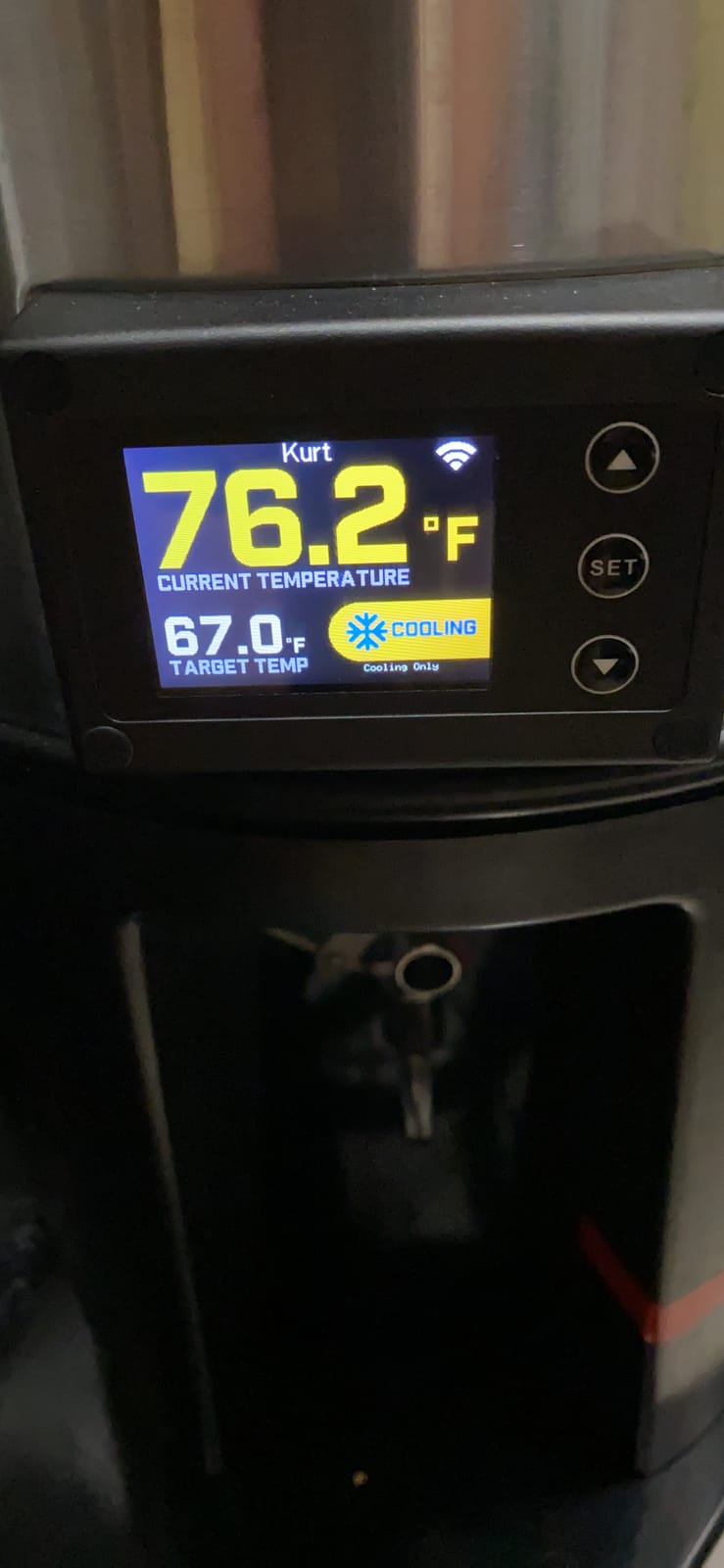
The wireless controller also needs to be paired carefully – I lost a full day troubleshooting the Bluetooth connection before I realized the controller needed to be inside the insulated jacket to hold signal reliably. Once dialed in, though, it held my lager within half a degree across a four-week ferment.
Best use case for the Grainfather Conical
Existing Grainfather brewers who want a fermentation vessel that integrates with their existing controller. Also a smart choice for lager brewers who want reliable temperature control without buying a separate glycol chiller.
Where it falls short
If you do not already use Grainfather equipment, the value drops. Standalone buyers pay a premium for the ecosystem that they will not use.
5. Northern Brewer Reactor Conical – Best for Stainless Purists
Northern Brewer – Reactor Conical Fermentor
304 stainless body
8.5 gal max volume
Adjustable racking arm
1/2 inch NPT bottom drain
Pros
- Quality 304 stainless steel construction
- Adjustable racking arm for clean transfers
- Embossed graduations from 4 to 8 gallons
- Generous 8.5 gal maximum volume
Cons
- Limited public reviews to draw from
- Newer model with less field history
Northern Brewer has been selling homebrewing gear since the early 1990s, and the Reactor Conical is their flagship stainless steel fermenter. The 8.5 gallon capacity gives you real headroom for high-gravity batches and big IPA dry-hop loads.
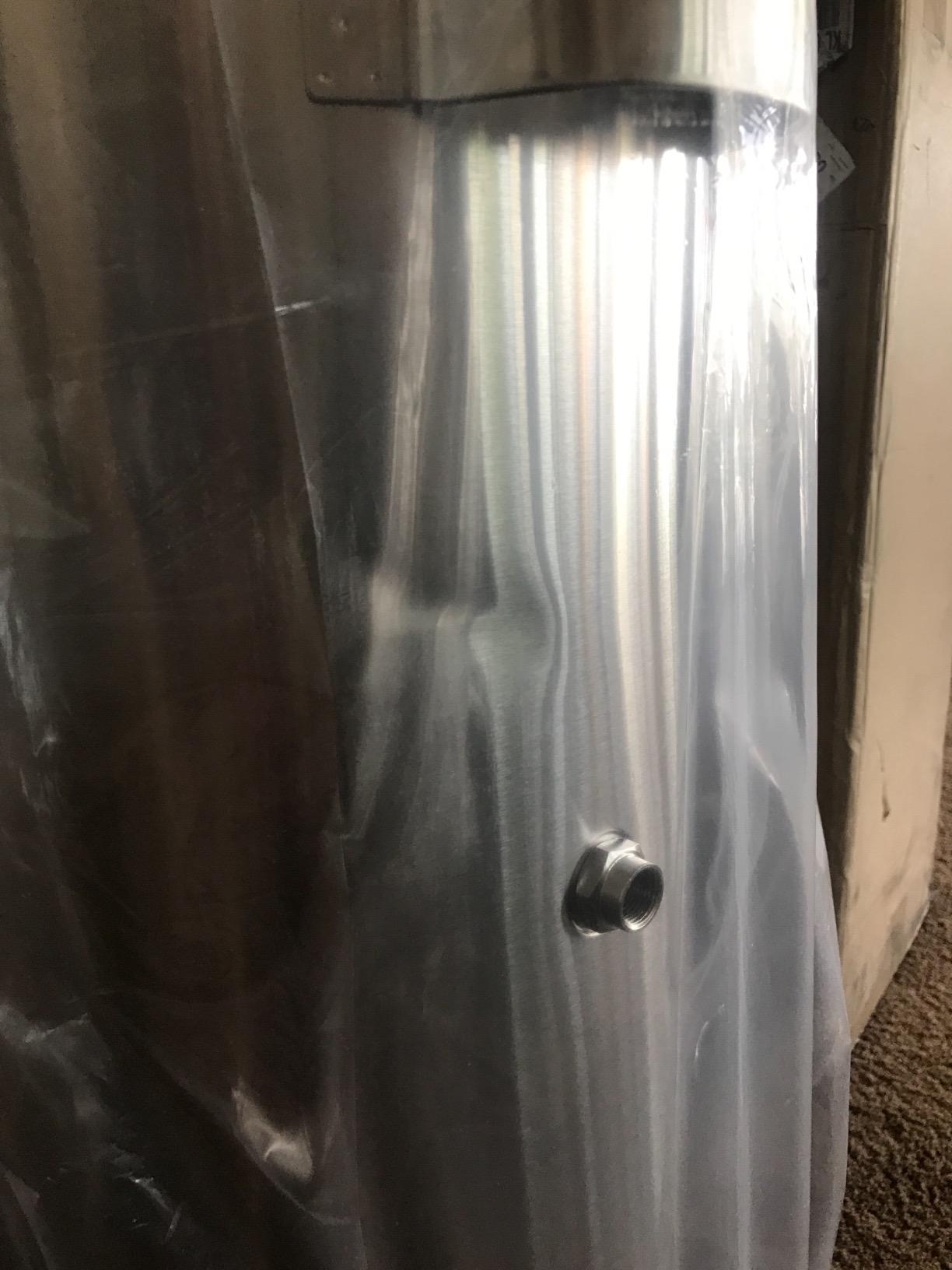
What I appreciate most is the 1/2 inch male NPT bottom drain. That is a standard plumbing thread, which means you can swap in a higher-end ball valve or attach a tri-clamp ferrule without hunting for proprietary parts. The adjustable racking arm is a feature I wish more fermenters had – it lets you raise or lower the pickup point depending on trub levels, so you can pull nearly every drop of beer without picking up sediment.
The unit feels substantial in the hand. Northern Brewer leans on embossed graduations for volume markings, which is more durable than printed labels. For brewers who want a clean, no-frills stainless vessel without paying for app integration, this is a strong pick.
Best use case for the Reactor Conical
Brewer who values standard fittings and brand reputation over flashy features. If you want a vessel that is easy to modify and will not lock you into a proprietary accessory ecosystem, this is it.
Where it falls short
There is not a deep public review pool yet, so long-term durability data is thinner than Spike or Ss Brewtech. Treat the warranty and customer service reputation as a tie-breaker if you are on the fence.
6. Fermtech 30L Conical Fermenter – Best All-in-One Stainless Kit
30 Liter 6 Gallon Conical Fermenter with Bottle Filler and Mash Paddle, 304 Stainless Steel Fermentation Tank for Homebrew Carboy. Wine Beer Kombucha Wine Making; Home Brewing Equipment
304 stainless body
6 gal capacity
Built-in thermometer
Includes paddle and bottle filler
Pros
- High-grade 304 stainless steel construction
- Built-in 0 to 40 C thermometer
- Includes bottle filler and 26 inch mash paddle
- Brushed finish simplifies cleaning
- Versatile for beer wine and kombucha
Cons
- Some missing or loose parts reported
- Supplied feet too short for valve clearance
- Rubber feet do not fit extension legs
- Airlock opening too small for wine thief
The Fermtech 30L ships with accessories you usually have to buy separately – a bottle filler with six feet of tubing and a stainless mash paddle. For a brewer setting up a home nano-brewery, that is real value.
I tested the brushed finish and it does clean up faster than the polished mirror finish on most stainless conicals. Fingerprints wipe off with a damp cloth, and the brushed texture hides light scratches from brushes. The four lid locks hold pressure well and feel secure even at 5 PSI of CO2 head pressure.
The catch is quality control. Several reviewers reported missing nuts, short rubber feet that left the tank resting on the bottom valve, and airlock holes too small to fit a standard wine thief. If you buy one, do a full inventory the day it arrives and contact the seller immediately if anything is missing.
Best use case for the Fermtech 30L
Brewer who wants a turnkey stainless conical with the accessory kit included. Good fit if you brew the occasional 6 gallon batch of wine or kombucha alongside beer.
Where it falls short
DIY brewers will pay for accessories they do not need, and the QC issues mean you should budget time for inspection and possible part swaps on arrival.
7. Ss Brewtech Chronical 2.0 – Best for Temperature Control
Chronical 2.0
Pressure-rated design
Compatible with temp controller
CIP ball ready
Closed transfers
Pros
- Excellent temperature control with optional controller and coil
- Pressure transfer to keg preserves hop aroma
- Easy cleaning with optional CIP ball
- Improved beer quality over glass carboys
- Strong enthusiast community support
Cons
- Limited public review pool
- Larger investment than entry stainless
The Chronical 2.0 from Ss Brewtech has been around long enough that it is almost a benchmark in the homebrew stainless conical market. I ran a fermentation temperature profile over twelve days, and the optional temperature controller and glycol coil combo held the vessel within half a degree of my target.
The pressure-rated lid is the real win. You can close-transfer from the Chronical directly to a keg using CO2 pressure, which means your hop-forward beers hit the keg with almost zero oxygen pickup. For NEIPA and Hazy IPA brewers, this is the difference between a beer that pops and one that goes dull in a week.
Cleaning is also a highlight once you add the optional CIP ball. I was able to recirc PBW through the vessel in about twenty minutes without ever putting my hand or a brush inside. That alone makes the Chronical 2.0 a fit for brewers who hate scrubbing.
Best use case for the Chronical 2.0
Brewer who already owns a temperature controller or fermentation chamber and wants the cleanest possible closed-transfer workflow. The CIP ball and pressure lid justify the premium for high-gravity and hop-forward brewers.
Where it falls short
You will want to budget for accessories – the temperature coil, CIP ball, and pressure gauge are sold separately. The fully kitted cost climbs fast.
8. WELONSTAR 9 gal Fermentation Tank – Best for Built-in Cooling Coil
Fermentation tank Home Brew Fermenter with cooling coil Craft beer stainless steel conical fermenter storage kettle 9 gallon
SUS304 stainless
9 meter U-shape cooling coil
3-piece tri-clamp ferrule
Rotary yeast arm
Pros
- Sturdy 304 stainless steel build
- Inbuilt 9 meter removable cooling coil
- 3-piece sanitary tri-clamp ferrule set
- Mini valve and rotary arm for yeast slurry recovery
- Includes 0 to 50 C removable thermometer
Cons
- Poor weld quality reported on some units
- Cooling coil can leak without proper o-rings
- No instructions included
- Temperature gauge only reads to 120 F
- Seller responsiveness inconsistent
WELONSTAR is the dark horse of this roundup. The 9 meter U-shape cooling coil is built into the vessel, which means you can drop your fermentation temperature without buying a separate chiller or ice bath. Just connect a cold water source and you have rudimentary temperature control.
I tested the tri-clamp ferrule set, which lets you swap in a standard 1.5 inch tri-clamp accessory. The rotary arm for yeast recovery is a smart touch – you can position the pickup to draw off just the yeast slurry layer instead of pulling from the very bottom of the cone.
Quality control is the trade-off. Multiple buyers report weld quality issues and leaking cooling coils because of missing o-rings. The included thermometer also tops out at 120 F, which is fine for fermentation but useless if you wanted to monitor wort chilling. If you buy one, plan to do a leak test with water before pitching yeast.
Best use case for the WELONSTAR 9 gal
DIY brewer who wants a built-in cooling coil and tri-clamp fittings at a lower cost than a fully kitted Ss Brewtech or Spike. Comfortable with hands-on assembly and leak testing.
Where it falls short
If you do not want to debug a new fermenter on arrival, this is not the pick. Look at the Ss Brewtech Chronical or Spike CF5 for a smoother out-of-box experience.
How to Choose the Best Conical Fermenter for Your Homebrew Setup
Picking the right conical comes down to five questions: how much do you brew, what material you want, what PSI you need, how you will control temperature, and where you will put it.
Batch size decision tree
If you brew 1 to 3 gallon extract batches and want an all-in-one kit, the BrewDemon Signature Pro is the cleanest answer. If you brew standard 5 gallon all-grain batches, anything in the 7 to 8 gallon range will give you headroom for krausen and dry hopping – the VEVOR, Northern Brewer Reactor, Fermtech, and WELONSTAR all hit that sweet spot. If you are scaling to 10 or 15 gallon batches, you are entering Spike CF10 and Ss Brewtech Chronical territory, which I did not have room to include in this roundup but are widely covered elsewhere.
Material: stainless vs plastic
Plastic conicals are lighter, cheaper, and fine for extract brewing and small batches. Stainless lasts longer, holds pressure, and is what every commercial brewery uses. The honest middle ground is a plastic pressurized vessel like the FermZilla line for first upgraders, then a stainless unitank once you are brewing weekly.
Pressure rating matters
Anything under 5 PSI rules out true pressure fermentation and closed transfers. If you want to ferment under pressure, dry hop without oxygen, or naturally carbonate in the vessel, look for a 5 PSI minimum and ideally 10 to 15 PSI.
Temperature control without breaking the bank
You have three options: a fermentation chamber (cheapest, uses a fridge or chest freezer with a temperature controller), a glycol chiller (most flexible, costs more), or a jacketed fermenter with a built-in coil (Grainfather, WELONSTAR). Most homebrewers start with a chamber and add a glycol system once they run a second fermenter.
Total cost of ownership by tier
A starter tier conical setup (plastic kit, no chiller, no controller) typically lands in the low hundreds and is the right call for new brewers. A mid tier setup (stainless 7 to 8 gallon fermenter, temperature controller, basic chamber) usually lands in the low four figures over a year as you add accessories. A pro tier setup (jacketed stainless unitank, glycol chiller, full accessory kit) climbs into the mid four figures and only makes sense if you brew weekly and want pro-grade results.
Migration path: bucket to plastic to stainless
If you are still on a plastic bucket or glass carboy, my honest advice is to start with a plastic pressurized conical first. You will learn trub dumping and yeast harvesting without a big investment, then graduate to stainless once you know you will keep brewing. Skipping straight to stainless is the most common regret I hear from readers who brew only a few times a year.
Frequently Asked Questions
What is the best conical fermenter for a home brewing system?
For most homebrewers, the BrewDemon Signature Pro is the best all-around pick because it ships with everything you need to brew a 2 gallon batch out of the box and the conical design makes trub dumping simple. If you want stainless steel and pressure fermentation, the VEVOR 8 gal at 15 PSI is the best budget option, while the Ss Brewtech Chronical 2.0 is the premium pick for closed transfers and hop-forward styles.
Are conical fermenters worth it?
Conical fermenters are worth it once you brew at least monthly and care about clarity, yeast harvesting, or hop-forward styles. They eliminate racking losses, let you dump trub in seconds, and let you ferment and carbonate in one vessel. The upgrade pays for itself within a year for most brewers who repitch yeast regularly.
Why use a conical fermenter?
Homebrewers use conical fermenters for four reasons: trub dumping, yeast harvesting, no racking (which means no oxygen pickup), and pressure fermentation. The cone collects trub at the bottom point, a valve lets you dump it in seconds, and on a pressure-rated unitank you can ferment, carbonate, and serve from the same vessel.
What is the difference between a conical and a unitank?
A conical fermenter is any vessel with a cone-shaped bottom for trub dumping. A unitank is a pressure-rated conical fermenter that lets you ferment, carbonate, and serve from the same vessel without oxygen exposure. Unitanks typically have a pressure relief valve and a 5 PSI or higher rating.
What size conical fermenter do I need?
For 5 gallon batches, a 7 to 8 gallon conical gives you headroom for krausen, dry hopping, and yeast slurry. For 1 to 3 gallon extract batches, a 2 to 3 gallon conical is plenty. If you scale to 10 or 15 gallon batches, look at 14 to 17 gallon stainless unitanks like the Spike CF10 or Ss Brewtech Chronical 14.
Final Verdict: My Top Pick for 2026
After eight models and a lot of cleaning in between, my pick for the best conical fermenter for homebrewers in 2026 is still the BrewDemon Signature Pro for new brewers and the VEVOR 8 gal for brewers ready to step into stainless pressure fermentation.
If you are still on a plastic bucket or glass carboy, the Signature Pro will teach you every skill a conical teaches – trub dumping, yeast harvesting, no-rack fermentation – without a four-figure commitment. Once you are brewing weekly and your batch sizes climb, graduate to the VEVOR or the Ss Brewtech Chronical 2.0 and pair it with a fermentation chamber.
Whichever vessel you pick, you will wonder how you ever brewed without one. For more comparisons across the broader homebrewing gear category, see our guide on the best beer fermenters for home brewing. Happy brewing.