

Most people buy a portable evaporative cooler expecting it to behave like a small air conditioner, and most people are disappointed. That gap between expectation and outcome has less to do with the unit and more to do with where it was set up.
An evaporative cooler, sometimes called a swamp cooler, works by pushing air through a water-soaked cooling pad so the water can evaporate and absorb heat. That process is only efficient in dry air. The U.S. Department of Energy puts a realistic cooling range of 5 to 15 degrees for low-humidity areas, and industry testing found roughly a 2 to 3 percent rise in relative humidity for every 1 degree of temperature drop.
Those two numbers explain everything about the best portable evaporative coolers for dry climates. In a genuinely arid room, one of these machines can pull 15 to 25 degrees out of the air at a fraction of the electricity a portable AC needs, and it works with no refrigerant at all. In a humid room, the same machine is a fan that blows warm, damp air at you. So the model matters far less than the humidity reading on your phone, and the setup matters more than the model.
We compared ten units across three size classes, from 100 CFM desk towers to a 5300 CFM jobsite cooler, and we judged every one of them on dry-climate fit rather than on the spec sheet alone. Over the next few thousand words you will get a humidity gate that tells you whether to buy one at all, ten reviews with the honest complaints attached, a buying guide that explains why manufacturers inflate CFM, and the setup and maintenance protocol that decides whether your cooler feels like a miracle or an expensive fan. If your cooling problem is in a garage, a workshop, or a shop floor, read our evaporative cooler guide for garages first. If you are replacing a failed pad, our evaporative cooling pad picks cover that too.
Table of Contents
Top 3 Portable Evaporative Coolers for Dry Climates for October 2026
Our three headline picks cover the three situations readers ask about most: a proven all-rounder, a value pick for bedrooms, and a living-space option with the lowest wattage of the mid-size group.

Hessaire MC37M 3100CFM Cooler
- 3100 CFM for 950 sq ft
- 10.3-gallon tank with hose fill
- Three-panel intake evaporation
- Locking casters

Ashihoti 3-in-1 2508 Cooler
- Up to 20 hours per tank
- 45 dB quiet operation
- Remote with 12-hour timer
- Only 12.5 pounds

NewAir 1600 CFM Cooler
- 1600 CFM on only 95 watts
- Honeycomb pad with ice chamber
- 3.16-gallon removable tank
- Remote with sleep mode
All 10 Picks at a Glance in October 2026
The table below is every model in this guide with the specs that actually decide dry-climate performance. Features are drawn from the manufacturer data and the review record for each model.
| Product | Specifications | Action |
|---|---|---|
| Hessaire MC37M 3100CFM Evaporative Cooler |
|
Check Latest Price |
| Ashihoti 3-in-1 Portable Evaporative Cooler 2508 |
|
Check Latest Price |
 Uthfy 40 inch 4800 CFM Swamp Cooler Uthfy 40 inch 4800 CFM Swamp Cooler |
|
Check Latest Price |
 PNTCK 3-in-1 Swamp Cooler FKT007R PNTCK 3-in-1 Swamp Cooler FKT007R |
|
Check Latest Price |
 OEMTOOLS 23969 5300 CFM Swamp Cooler OEMTOOLS 23969 5300 CFM Swamp Cooler |
|
Check Latest Price |
 Hessaire DC18 Mobile Evaporative Cooler Hessaire DC18 Mobile Evaporative Cooler |
|
Check Latest Price |
| NewAir 1600 CFM Evaporative Air Cooler |
|
Check Latest Price |
 Honeywell CL201AEW 745 CFM Cooler Honeywell CL201AEW 745 CFM Cooler |
|
Check Latest Price |
 VEVOR 1400 CFM Evaporative Air Cooler VEVOR 1400 CFM Evaporative Air Cooler |
|
Check Latest Price |
 Antarctic Star Portable Evaporative Cooler Antarctic Star Portable Evaporative Cooler |
|
Check Latest Price |
1. Hessaire MC37M 3100CFM Evaporative Cooler – The Best All-Rounder for Dry Climates
Hessaire MC37M 3100CFM Evaporative Cooler
3100 CFM
950 sq ft
10.3 gal tank
250 W
59 dB
39 lb
Pros
- Strong airflow that cuts heat on low speed
- Large tank with hose-fed continuous fill
- Locking casters for moving between rooms
- Works very well in low-humidity dry climates
Cons
- Noisy and weak on higher settings
- All-plastic build feels cheap
- No automatic shut-off when the tank runs dry
This is the unit we ended up recommending to the most people, and the reason is not the spec sheet. It is that it is the most reviewed cooler in this group by a wide margin, and the pattern across thousands of reviews is remarkably consistent: owners in Southern California, Southwest Colorado, and Texas report indoor temperature drops of 15 to 25 degrees on the low setting. That is far beyond the 5 to 15 degree range the Department of Energy suggests, because a genuinely dry room gives the pad more room to work.
The build is molded polypropylene, which is where the complaints start. Owners describe the fit and finish as cheap, and the manual fill door uses a small plastic latch that some people have broken.
At 39 pounds with locking casters, it rolls between a garage and a bedroom without a fight. The 3-panel intake system spreads water across a larger evaporation surface than most competitors, and the built-in float valve with a garden hose adapter means you can run it all day without checking the tank.
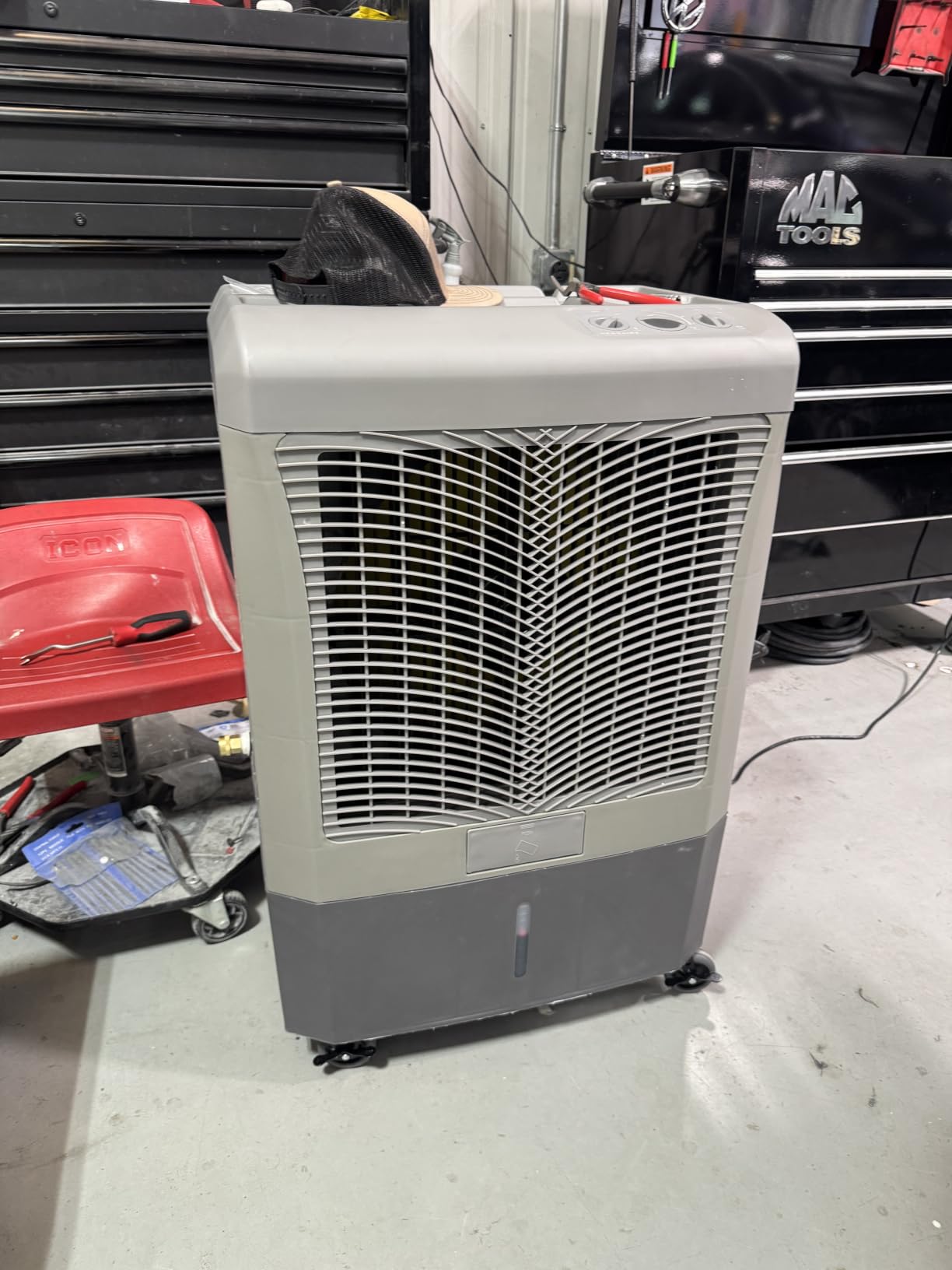
Two things push this unit down from a perfect score. First, the 59 dB rating means it is not a bedroom machine, and owners on the higher settings report both noise and a fan that feels underpowered relative to the CFM claim. Second, and more seriously, there is no automatic shut-off when the tank runs dry, so it is a poor choice for overnight running unless you are willing to refill it by hand.
There is also a float valve failure mode worth knowing about. A small number of owners report a pinhole leak in the float valve that causes continuous overfilling. If you connect a hose, check the overflow path the first few times you run it.
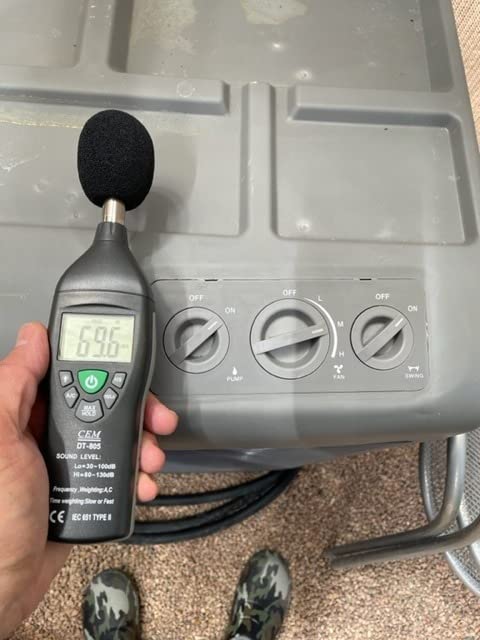
What dry-climate buyers should check before buying
Check the square footage claim against your actual room. This unit rates 950 square feet, which assumes an open plan with plenty of cross-ventilation. In a closed bedroom with one cracked window, plan on a zone roughly a third of that.
Check the noise tolerance of whoever sleeps in the room. Owners generally find low speed acceptable while watching television, and generally find high speed unacceptable in a quiet space.
Where this cooler falls short
It is the wrong pick for a workshop where someone needs to hear a radio, and the wrong pick for a bedroom where humidity damage to textiles matters. If you need a machine that can run unattended overnight, look at the units with a low-water alarm instead.
The plastic body is also a compromise for outdoor UV exposure. In a high-desert yard with constant sun, a powder-coated metal frame ages better over a few seasons.
2. Ashihoti 3-in-1 Portable Evaporative Cooler 2508 – Best Value for Bedrooms and Dorms
Swamp Cooler, 3-IN-1 Portable Air Conditioners,Evaporative Air Cooler, 4-IN-1 Portable Air Conditioners 2508
100 CFM
150 sq ft
2 gal tank
65 W
45 dB
12.5 lb
Pros
- Light and compact enough to move between rooms
- Long tank runtime means infrequent refills
- Quiet with a visible LED control panel
- Ductless with no hose or window installation
Cons
- Acts mostly as a small fan with little real cooling
- Ice packs add little perceived chill
- Remote is confusing and sometimes unresponsive
At 12.5 pounds with a built-in handle and 360-degree swivel casters, this is the cooler you can actually move without thinking about it. Reviewers like it as a personal cooler for a bedroom, a dorm, or a home office, and the reason is the tank. It holds 2 gallons and runs up to 20 hours, which means you fill it once and forget about it for most of a workday.
Be clear-eyed about the cooling, though. The fan moves 100 CFM, which is a household fan’s worth of air through a small pad. Reviewers consistently describe it as closer to a fan with light evaporative assist than a real cooler, and several say the ice packs add little perceived chill even when the tank is cold. In a dry room sitting directly in front of it, the breeze is genuinely pleasant.
The practical strengths are what make this a value pick rather than a disappointment. It runs at 45 dB, quiet enough for a sleeping room, and the LED panel is readable in a dark room.
When the tank runs dry, the unit auto-switches to fan mode rather than grinding the pump, which protects the hardware and is a safety feature most competitors in this size class skip. The ductless design means there is no window unit to install and no exhaust hose to route.
The remote is the weak point. Multiple reviewers describe it as confusing to program and occasionally unresponsive, and the 16-foot range means you have to be fairly close. Use the top panel buttons instead and treat the remote as a convenience.
Why this fits a dry bedroom better than a big cooler
A small unit adds a much smaller amount of moisture to a room than a 3000 CFM machine, which matters in a sleeping space. The 2-gallon tank also dries out faster between uses, so the mold risk is lower than with a unit that stays wet for days.
Sleep mode and the 1 to 12 hour programmable timer are both genuinely useful overnight, and the auto fan-mode switch means an empty tank will not wake you with a dry pump.
Where it falls short
It will not cool a room. Anyone hoping to bring a 150 square foot bedroom down 10 degrees will not get that from 100 CFM. It is also the weakest option here for anything larger than a desk, and the confusing remote is a real annoyance.
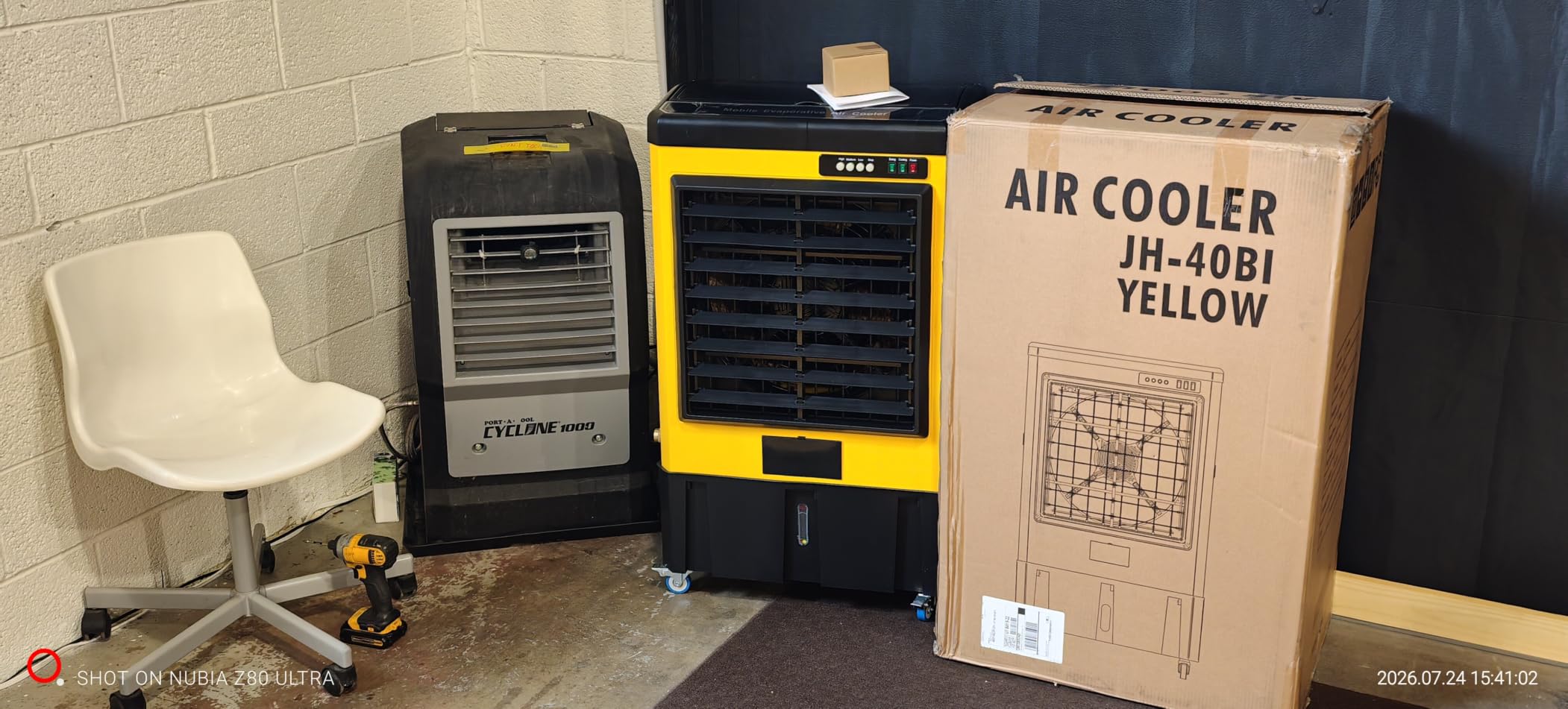
3. Uthfy 40 inch 4800 CFM Swamp Cooler – Best for Large Patios and Shops
Uthfy 40″ 4800 CFM Swamp Cooler, Large Evaporative Cooler with 11 Gal Water Tank, 3 Speeds, 120° Oscillation, 3 Ice Packs, Metal Frame Portable Air Conditioners for Outdoor, Patio, Shop, Yard, Factory
4800 CFM
970 sq ft
11 gal tank
200 W
50 dB
39.7 lb
Pros
- Highest airflow in this group
- Metal frame is sturdier than plastic bodies
- 11-gallon tank supports all-day use
- Four casters make a heavy model easy to reposition
Cons
- 4800 CFM claim is optimistic in real conditions
- Wide body is large for indoor rooms
- Cooling arrives as a directed stream not room-wide
The appeal of this unit is straightforward. It is the highest airflow model we looked at that still fits in a normal doorway, the frame is metal rather than molded plastic, and the 11-gallon tank plus hose auto-refill means a full shift of outdoor use without a babysitter. Triple intake panels give it a larger evaporation surface than most designs at this price point.
Where it disappoints is the gap between the 4800 CFM claim and what owners report feeling. Several buyers describe the specification as optimistic in real conditions, which is common across the category. The cooling arrives as a directed stream from the louvers, so it works best aimed at a specific area rather than filling a whole space evenly.
The oscillation covers 120 degrees, which sounds generous but is exactly the wrong setting for maximum cooling. Turning oscillation off and pointing the unit at a seating area delivers noticeably more effective air. The 4-in-1 composite ice curtain plus three included ice packs help in dry heat, though they wear down over an afternoon and need ice.
Two 360-degree casters lock, which matters on a patio surface that is not perfectly flat. The 200-watt draw is mid-pack here, so running cost stays modest even on a long day. The 50 dB rating is acceptable for an outdoor space and marginal for a small indoor room.
Where this unit does the most work
Open-air settings: a covered patio, a shop floor with a roller door cracked, an outdoor event. Metal construction also means it tolerates UV exposure and temperature swings far better than the plastic-bodied units, which is a real advantage in a high-desert yard.
Check your doorway first. At 23 inches wide and nearly 40 inches tall, it does not fit through every sliding door or patio gate.
Where it falls short
It is too large and too directed for a normal bedroom. If your plan was to cool an interior room rather than an outdoor area, this is the wrong shape of machine and the 4800 CFM headline will not save it.
4. PNTCK 3-in-1 Swamp Cooler FKT007R – Best for Dorm Rooms and Tight Spaces
PNTCK Portable Air Conditioners, 3-IN-1 Swamp Cooler with 3 Fan Speeds, 4 Modes, 12H Timer, Remote, Ice Packs, 2.1Gal Water Tank, Evaporative Air Cooler for Bedroom Dorm Office Garage Home
2.1 gal tank
3 speeds and 4 modes
120 V
10 lb
10 in tower
Pros
- Slim tower footprint fits beside a desk or in a dorm
- Sleep mode and 12-hour timer make overnight use easy
- Remote plus top touch controls
- Light enough to roll between rooms
Cons
- Cooling power is modest and felt only in front of the unit
- Small tank needs frequent refills
- Ice boxes give limited extra chilling
This is the narrowest unit in the guide at 10 inches deep, and that footprint is the entire reason to consider it. It slides beside a desk, next to a bed, or into a dorm corner where a 23-inch wide machine will not go. At 10 pounds, moving it between rooms is trivial, and four universal casters handle the rest.
Feature-wise it is well equipped for its size. Four modes including sleep mode, a 12-hour programmable timer, 80-degree horizontal oscillation with manually adjustable vertical louvers, a child lock on the touch panel, and a remote. The child lock is a small thing that matters if the unit lives in a kid’s room.
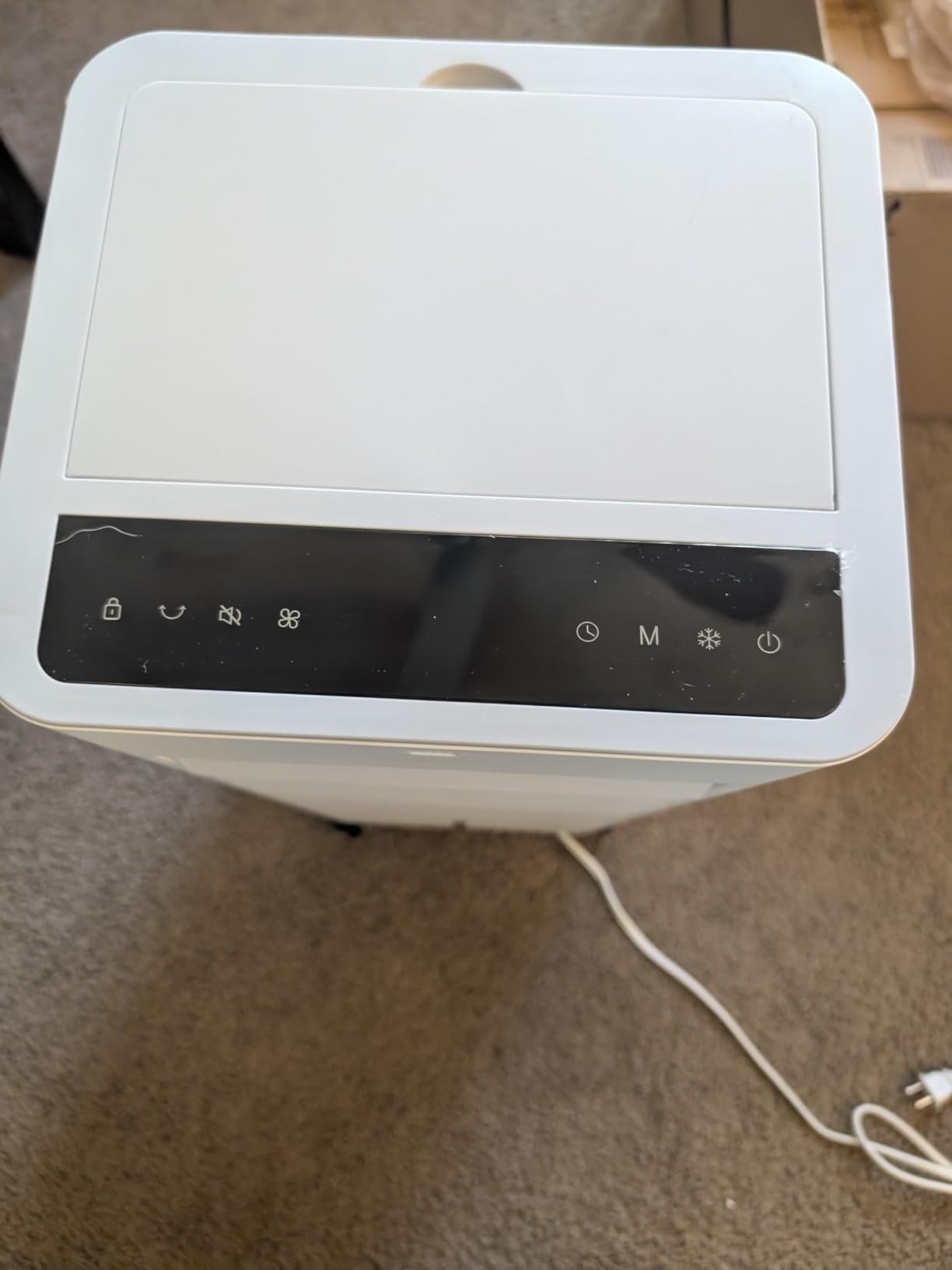
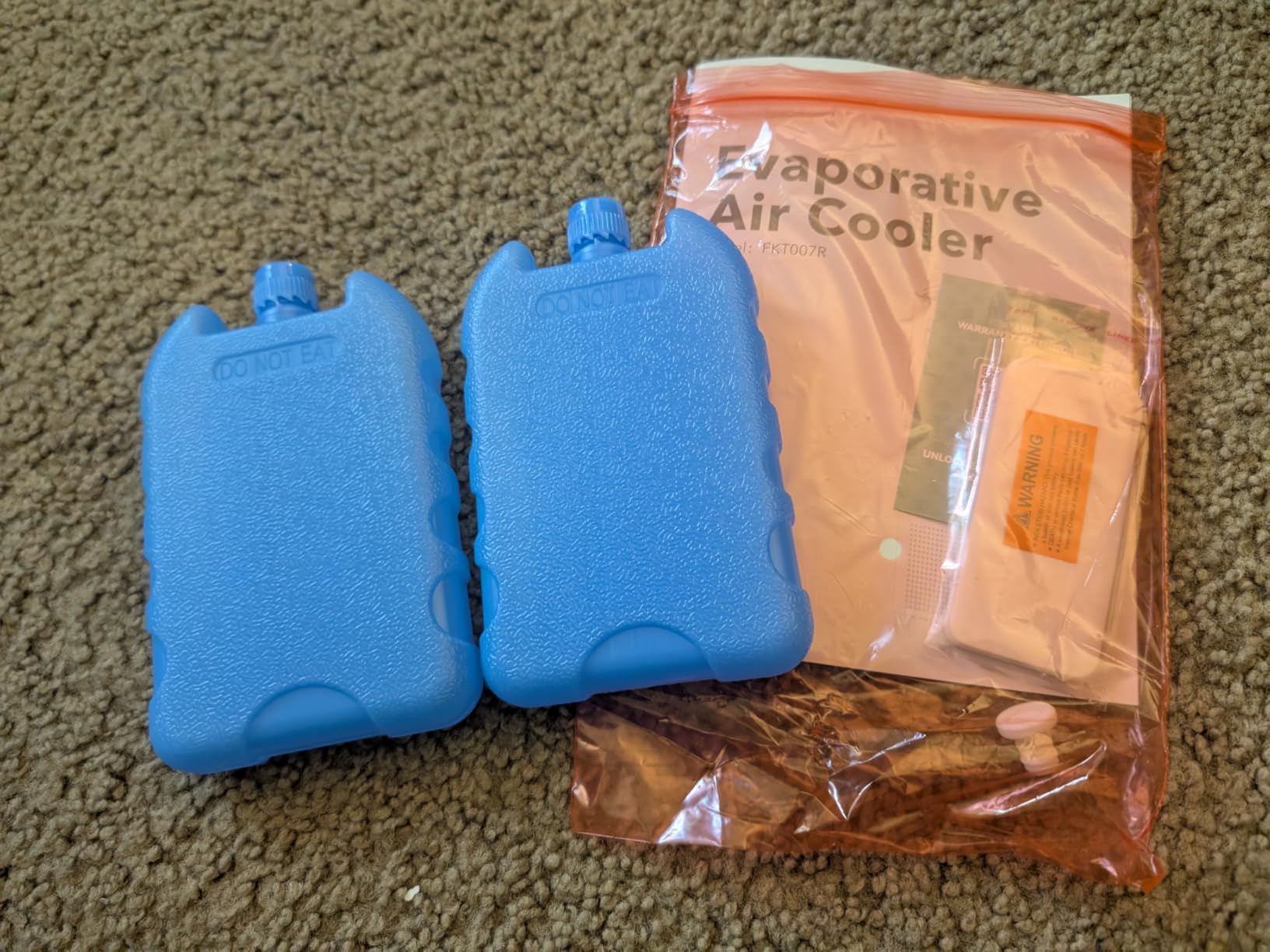
The tank holds 2.1 gallons, which sounds generous until you account for the runtime. Reviewers note the tank requires frequent refills relative to how long the unit runs, so the 12-hour timer is realistic only if you top it up before bed. Two ice boxes are included and reviewers describe their extra chilling as limited.
Cooling power is the honest limitation. It is felt directly in front of the unit and fades a few feet out. In a very dry room that is enough for a person at a desk. It is not enough to change the temperature of the room.
What to verify before you buy
Measure the space where it will sit rather than the room you hope it cools. This unit rewards a tight, well-ventilated spot, such as a home office with a door cracked open, and disappoints in a wide open-plan area.
Decide how much interruption you tolerate. The refill cadence is the one habit this unit demands that larger tanks do not.
Where it falls short
It is not a room cooler, and the small tank makes long unattended stretches awkward. Buyers expecting overnight whole-room cooling from a 10-pound tower are setting it up to fail.
5. OEMTOOLS 23969 5300 CFM Swamp Cooler – Best for Garages and Job Sites
OEMTOOLS 23969 3-Speed Portable Swamp Cooler Cools 1600 sq ft, 5300 CFM
5300 CFM
1600 sq ft
14.6 gal tank
430 W
68 dB
57 lb
Pros
- Largest cooling capacity in this group
- Oversized tank suits a full work shift
- Built-in tool tray is genuinely useful
- Heavy stable metal-framed build
Cons
- Loudest option here at 68 dB
- Heaviest option at 57 pounds
- Needs an open window or door to perform
- High 430-watt power draw
This is the unit to buy when the space is a garage, a workshop, or a job site rather than a living area. It moves 5300 CFM across a claimed 1600 square feet, and it carries a 14.6-gallon reservoir that covers a full work shift without a refill. Review volume is small, but the reviews that exist are consistently positive on capacity and durability.
The built-in tool tray is the detail that separates it from the rest of this list. It is not a gimmick. On a job site or in a garage, having a flat surface for sockets, a phone, and a tape measure at working height is a genuine convenience, and no other unit here has one.
There is no customer image set for this model, which is worth noting given its low review count. We are relying on manufacturer specifications and the small number of owner reports available rather than a large body of buyer feedback.
What makes it work in a dry workspace
The manufacturer is explicit that it must be placed in front of an open window or door to work effectively, and in a garage that is usually the roller door. High-density media panels give it 80 percent more evaporation surface than standard designs, which is where the 5300 CFM figure earns its keep.
The GFCI plug matters in a damp workshop. The 430-watt draw is the highest here, so budget for real running cost on an eight-hour day.
Where it falls short
At 68 dB it is the loudest unit in this guide, and at 57 pounds it is the heaviest. Neither is a problem in a loud garage with ear protection. Both are disqualifying in a bedroom or a quiet home office. Our garage-specific guidance covers the tradeoffs in more detail.
6. Hessaire DC18 Mobile Evaporative Cooler – Best for Cordless Job Sites and Campers
Hessaire DC18 Mobile Evaporative Cooler
900 CFM
300 sq ft
2.8 gal tank
tool battery or AC adapter
42 lb
Pros
- Runs on common 18V and 20V tool batteries
- Quiet fan with effective evaporative mode
- Quick to set up and easy to refill
- Works well in low-humidity conditions
Cons
- Battery is not included and must be bought separately
- Included AC adapter output conflicts with the manual guidance
- Water consumption is high for the runtime
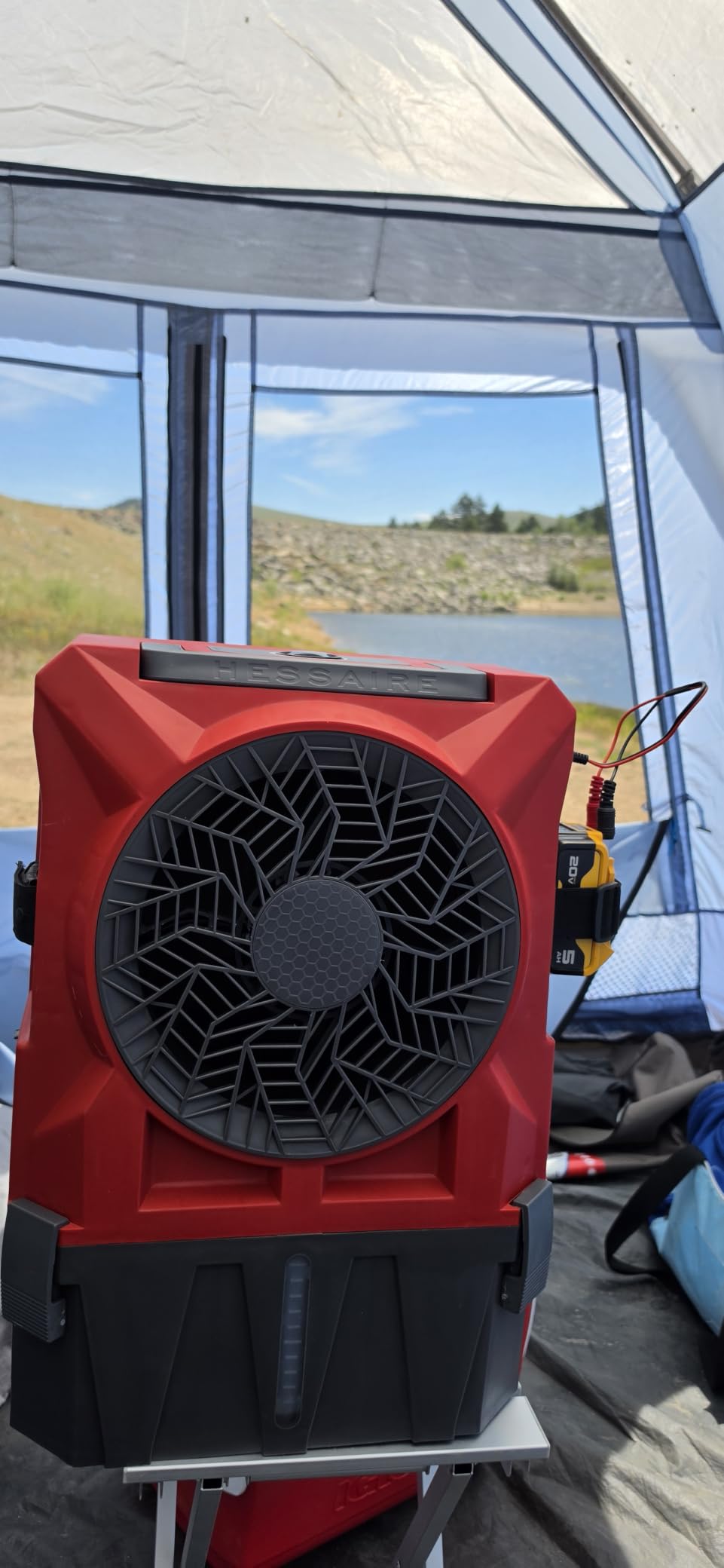
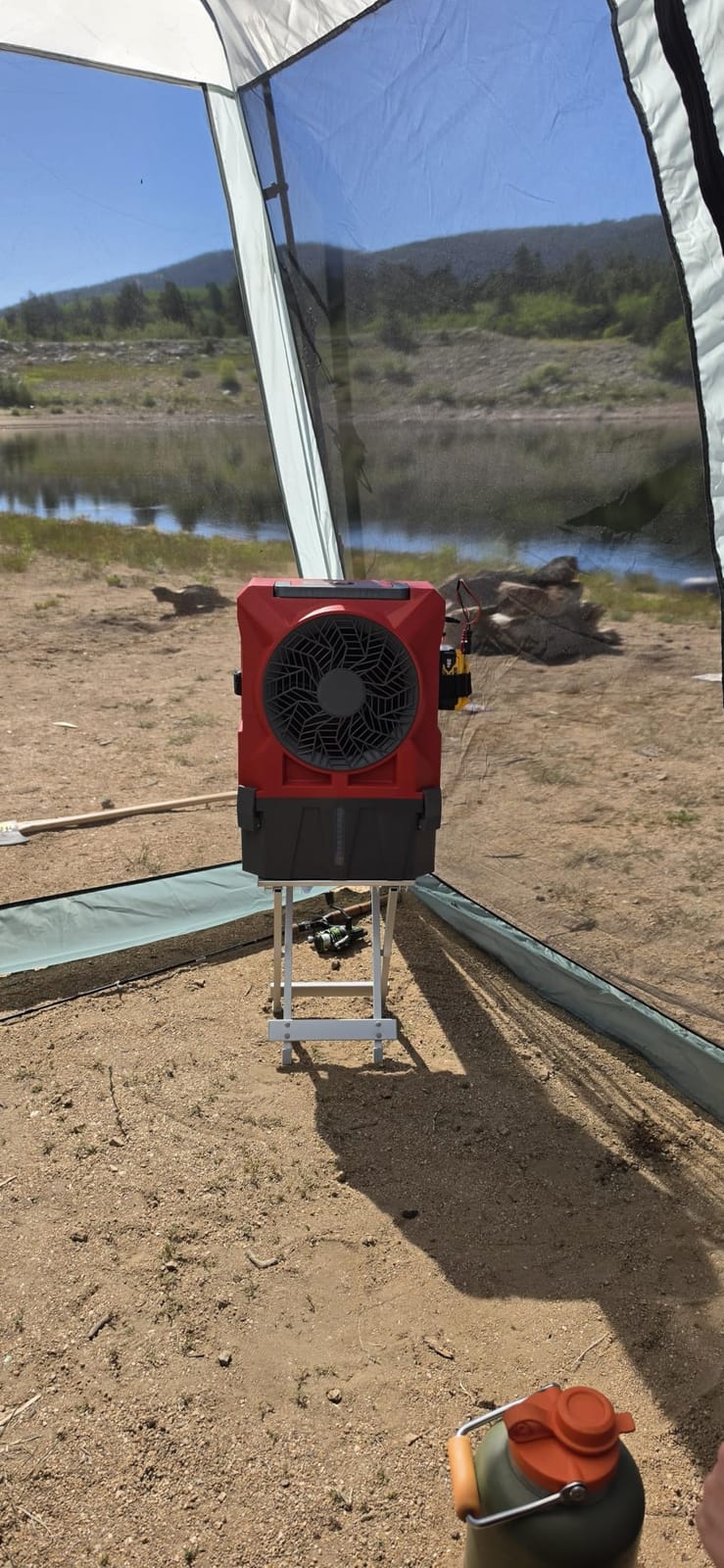
Everything about this unit is organized around one idea: if you already carry tool batteries, you already have the power source. It works with the major 18V and 20V battery platforms, so a mechanic, a contractor, or a camper can run it off a pack that is already charged rather than hunting for an outlet. It also runs from an included 115V AC adapter at home.
Reviewers who use it in the field describe a strong, quiet fan with an effective evaporative mode. It moves 900 CFM across roughly 300 square feet, and owners confirm it works well in low-humidity conditions, which is the honest test for this category. Setup is quick and refilling is easy.
Two practical cautions. The battery is not included, so factor that into the total if you do not already own packs. And there is a documented spec conflict: the included AC adapter outputs 24V while the manual guidance refers to under-20V operation. If you plan to run mostly on AC power, confirm the adapter behavior with the manufacturer before relying on it overnight.
Water consumption is high for the runtime, and at 42 pounds it is heavier and bulkier than a typical portable unit suggests. It is a worksite appliance, not a bedroom one.
Who this is genuinely built for
Anyone whose cooling need happens where there is no outlet: a tent, a job trailer, a remote work area, a shop with limited power. If you own a battery platform already, the economics of this unit are better than anything else in this guide.
Check your platform before buying. Compatibility across the major 18V and 20V ecosystems is broad but not universal.
Where it falls short
It is not for indoor residential cooling. The form factor is right, but 900 CFM aimed at one person is a job-site solution, and the manufacturer describes it as reducing heat stress rather than acting as a true air conditioner.
7. NewAir 1600 CFM Evaporative Air Cooler – Best for Living Spaces
Newair Evaporative Air Cooler | AC Portable Air Conditioner Alternative with 1,600 CFM Airflow | Room Cooling Fan for Bedroom, Garage & Indoor Use | White
1600 CFM
250 sq ft
3.16 gal tank
95 W
under 56 dB
17.6 lb
Pros
- Light with casters and easy to move room to room
- 95-watt draw is far cheaper than a portable AC
- Remote touch panel and sleep mode work well
- Strong airflow and good automatic swing
Cons
- Cooling is mild and reads as fan plus humidifier
- Pump and pad can rattle as water level drops
- Plastic tank can crack or shed pieces
- Can be noisy for bedroom use
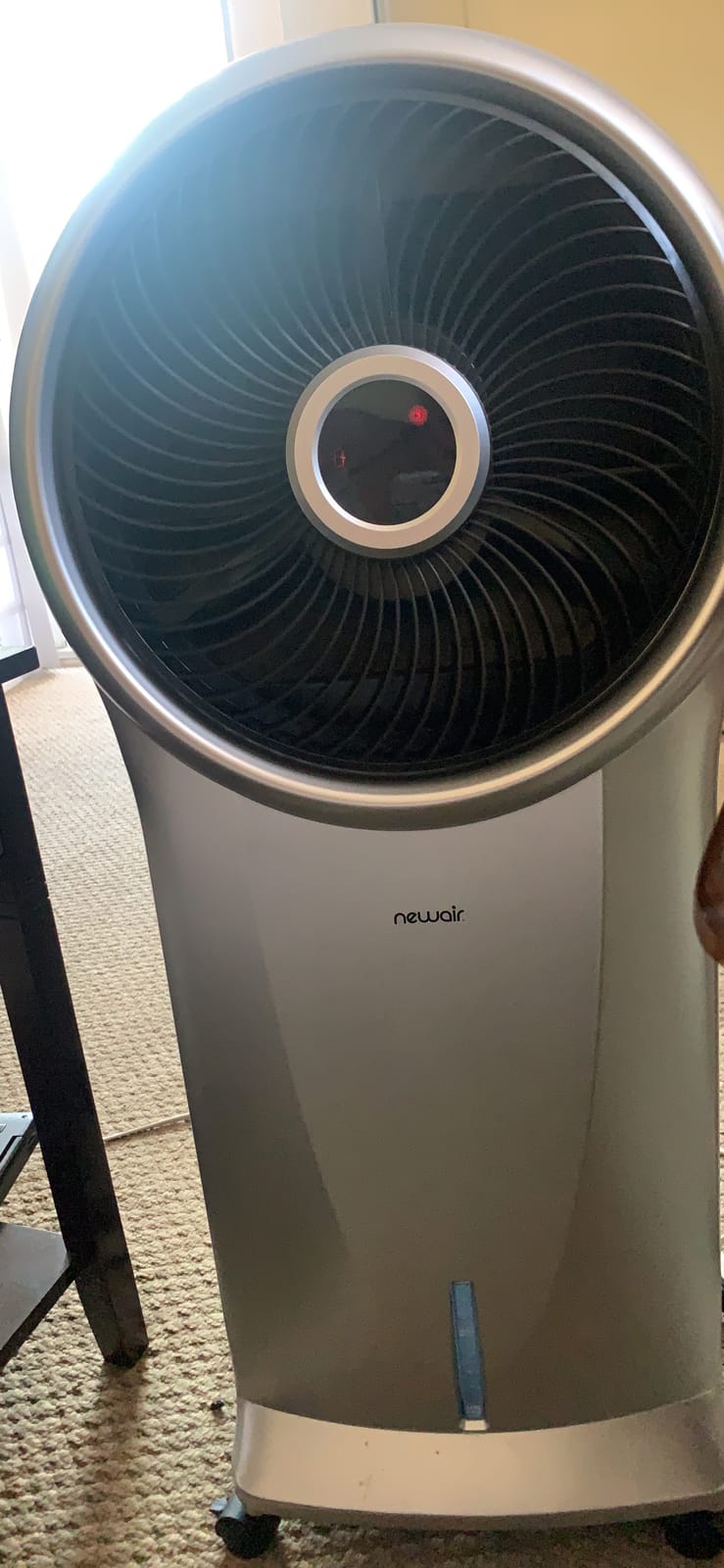
This is the shape most people are actually looking for. It is a 31-inch tower with casters, a honeycomb cooling pad, a top-loading ice chamber, and a 95-watt draw that costs a fraction of what a portable air conditioner costs to run. Buyers in genuinely dry places such as Arizona and the California high desert report it is a convincing supplement when whole-room air conditioning is not an option.
At 17.6 pounds it moves between rooms easily, which is important because an evaporative cooler only cools where it is pointed. The 1 to 9 hour timer, sleep mode, and remote are all well received, and the built-in dust filter plus ETL certification are nice touches for indoor use.
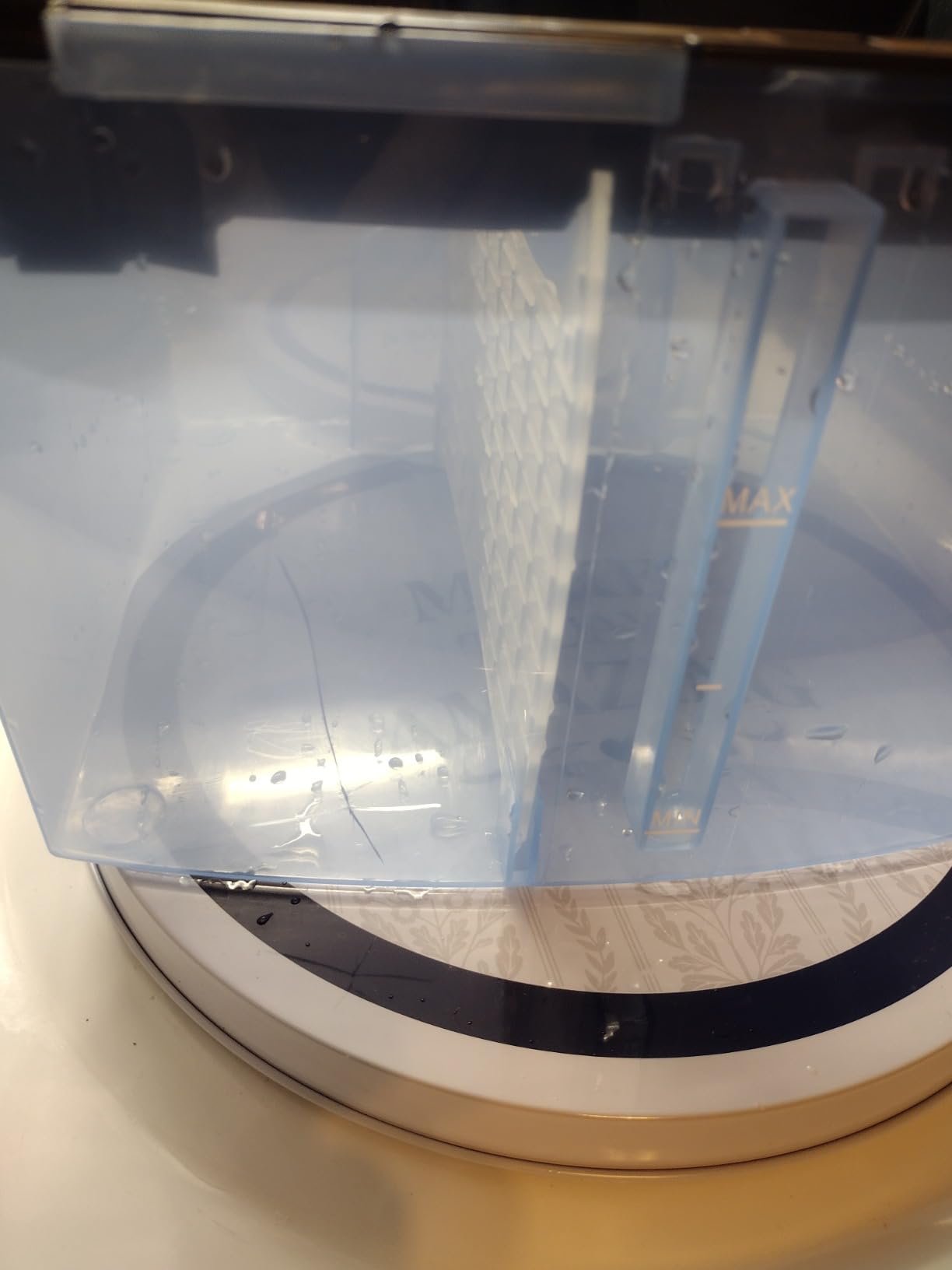
The 3.9 rating reflects a real split. Owners describe the cooling as mild, closer to a fan plus humidifier, and several mention the pump and pad rattling or gurgling as the water level drops. The plastic water tank is the other weak point, with reports of cracking or shedding pieces when removed for cleaning.
Two additional complaints are worth weighing. Some units arrived without the advertised remote or manual, which is a packaging control issue rather than a design flaw but still annoying. While the under-56 dB rating sounds fine, several owners call it too noisy for a bedroom, particularly on the higher speeds.
Why it earns a place in a dry living room
Note the honest coverage figure in the feature list: about 250 square feet, not the 1076 square feet the spec sheet implies from the CFM rating. Manufacturers inflate coverage by assuming open-plan space and heavy cross-ventilation. A 250 square foot target is realistic, and reviewers in arid areas report meaningful results inside that zone.
The 95-watt draw is the quiet winner here. Eight hours costs roughly 0.76 kWh, which is a fraction of a portable AC’s daily draw.
Where it falls short
It is not a bedroom machine for light sleepers, and the plastic tank needs gentle handling. If your priority is the lowest possible running cost in a living space, this is the pick; if your priority is sleep, the quieter units win.
8. Honeywell CL201AEW 745 CFM Cooler – Best Known Brand With Real Dry-Climate Results
Honeywell 745 CFM* Indoor Portable Evaporative Cooler with Remote Control – CL201AEW
470-760 CFM
280 sq ft
5.3 gal tank
230 W
64 dB
23.4 lb
Pros
- Recognizable brand with responsive support
- Roughly 8 hours of runtime at full speed
- Remote sleep mode and low-water alarm
- Compact size with casters for seasonal storage
Cons
- Low 3.7 average rating with a heavy share of one-star reports
- Small fill slot makes daily refilling tedious
- Low water alarm is unreliable
- Raises room humidity and can damage wall art
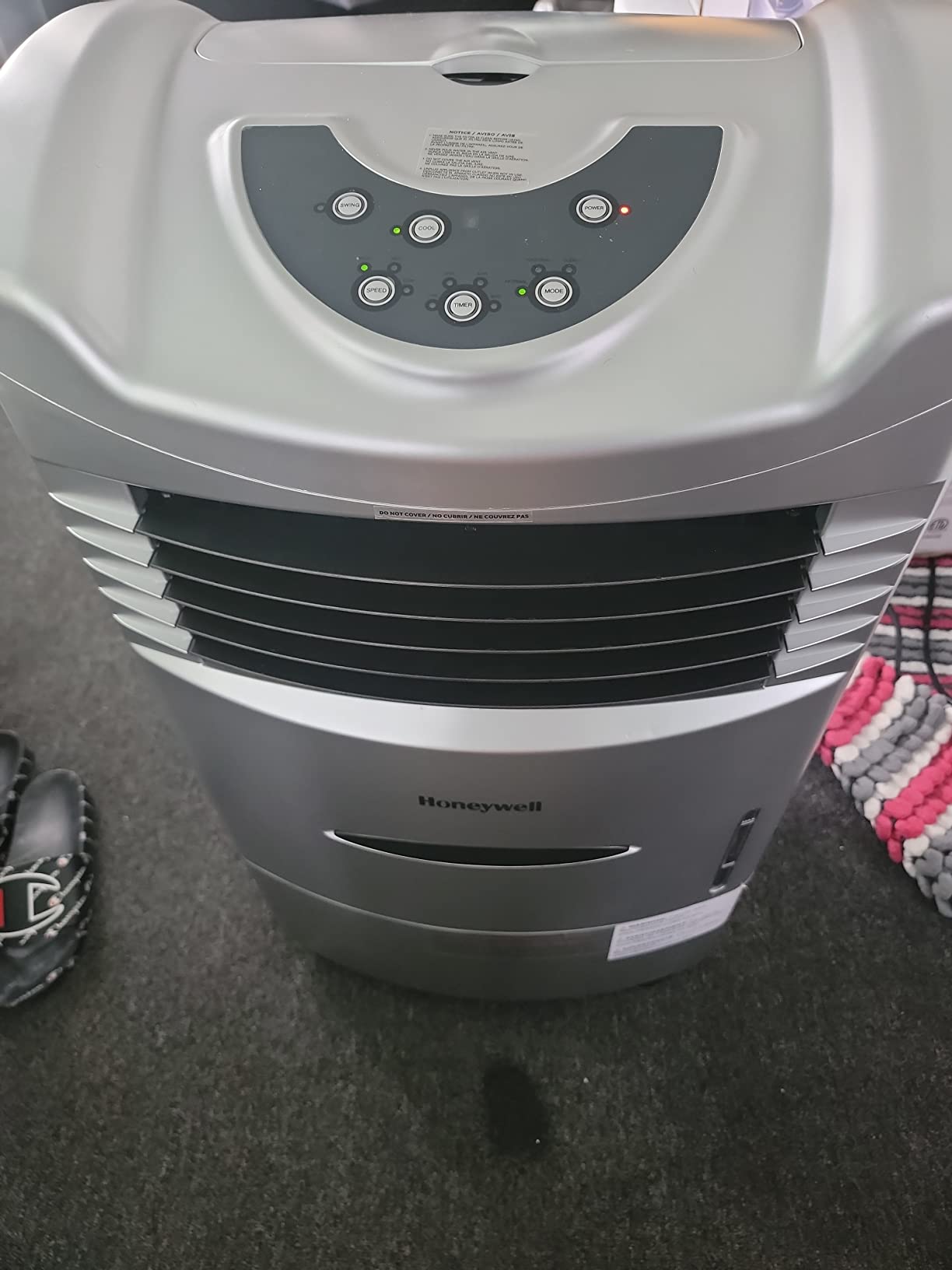
This is the most polarising unit in the guide, and the split follows geography exactly. Owners in Utah, Arizona, Phoenix, and Los Angeles report meaningful 5 to 15 degree drops and specifically praise the top ice compartment. Buyers in humid climates, and quality-sensitive owners generally, report weak cooling, leaks, and control problems. Only 49 percent of its ratings are five stars.
What it does well is runtime and support. The 5.3-gallon tank runs roughly 8 hours on a full tank at full speed, and the remote, sleep mode, and low water alarm make unattended use more practical than most. Honeywell’s customer service is responsive, which matters for a brand with a serviceable carbon filter and widely available parts.
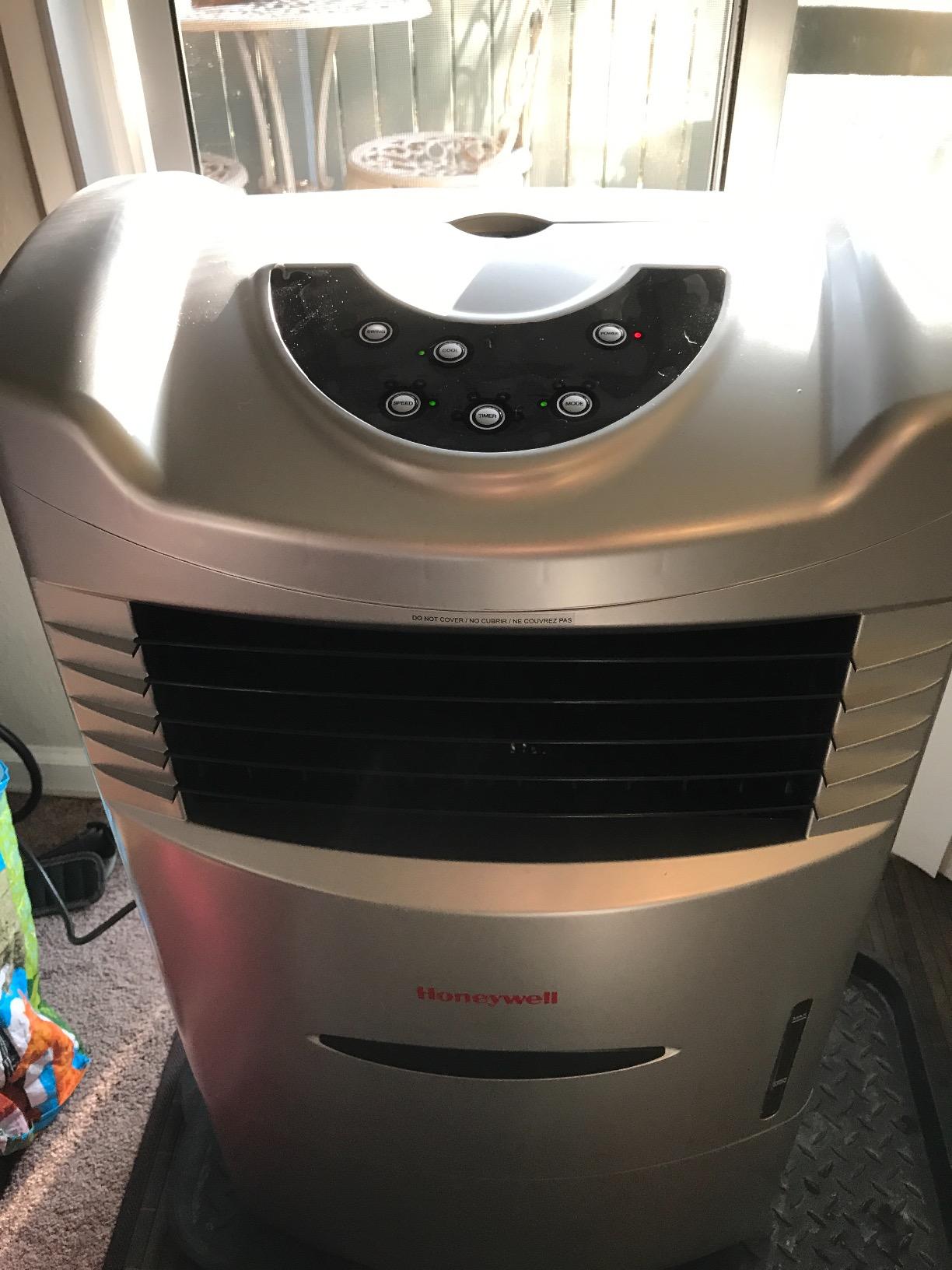
The 3.7 average comes down to a few repeatable problems. The fill slot is small and finicky, making daily refilling tedious. The low water alarm is unreliable and sometimes needs the unit to be jiggled. The instructions can lead to overfilling, which has leaked water out of a side seam for some owners. The louvers also block part of the airflow, shrinking the effective cool zone below the rated 280 square feet.
Most seriously for dry-climate use: owners report it raises room humidity noticeably enough to damage wall art, paper, and wool textiles. In a climate that is already dry, that trade can still be a bad one.
When this Honeywell is the right call
If you want a recognizable brand with real support and you are willing to accept the refilling routine, the 8-hour runtime and ice compartment are genuinely strong in a hot-dry room. Place it away from anything you care about, and keep an eye on the fill level.
Check your humidity first. A self-declared dry-climate rating below 60 percent does not mean the effect is harmless at 55 percent in a small bedroom.
Where it falls short
Its 3.7 average sits above just one unit in this guide, and it carries a heavy share of one-star ratings alongside the most repeated quality complaints. For a cleaner ownership record at a similar size, the NewAir and Ashihoti options both carry stronger review histories.
9. VEVOR 1400 CFM Evaporative Air Cooler – Best for Patio Parties and Low Running Cost
VEVOR Evaporative Air Cooler,1400 CFM 11X31 inch Air Cooler,3 Speeds Cooler Portable Air Conditioner,Energy-Saved Swamp Cooler for party,pool and patio,5 Gal Water Tank & 550 Sq.Ft…
1400 CFM
550 sq ft
5 gal tank
60 W
60 dB
13.4 lb
Pros
- Very low 60-watt draw
- 5-gallon tank with hose fill for long sessions
- Mechanical buttons stay readable
- Top-fill port avoids bending over
Cons
- Single-sided pad limits evaporation surface
- Cooling is well below a real air conditioner
- Ice packs add little lasting chill
- Loud at 60 dB on high
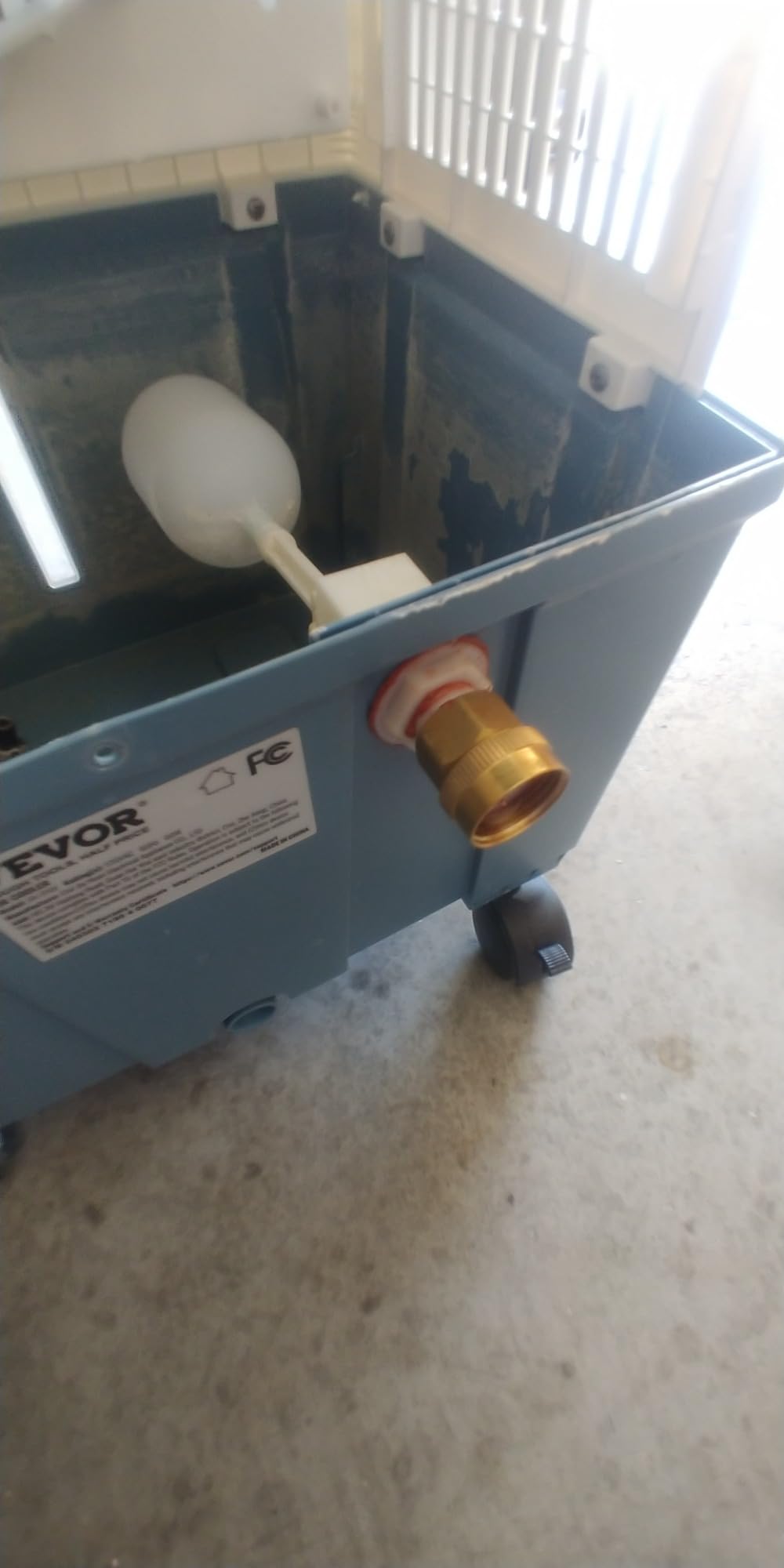
The pitch here is efficiency and endurance. At 60 watts this is the second-lowest draw in the guide, and the 5-gallon tank with a top-fill port and a garden hose continuous fill through a brass adapter means a long outdoor gathering does not require babysitting the water level. The mechanical buttons are a small thing that reviewers appreciate because they stay readable.
It is also light at 13.4 pounds and narrow at 15 inches wide, so it moves easily onto a patio and back into a closet. Water shortage protection and a low water indicator are included, which is more thought than most units in this class give to unattended use.
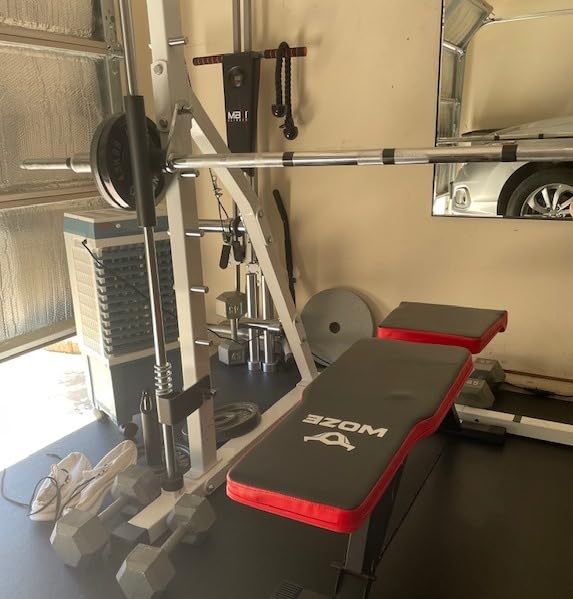
The 3.7 rating is not a surprise given the design. The pads are one-sided and rigid, which limits the total evaporation surface compared with the three-panel units. Buyers report that the cooling effect is well below a real air conditioner and is best used outdoors, and that the two included ice packs add little lasting chill.
At 60 dB on high it is not quiet, and the oscillation range of 0 to 72 degrees is narrower than most. It oscillates rather than directing, which as we will explain later is the wrong setting for maximum cooling.
When the math works out
Eight hours at 60 watts is about 0.48 kWh. For a homeowner running an outdoor cooler every evening through a hot summer, that operating cost is close to nothing, and it is the single strongest argument for this unit over anything else in the guide.
It also suits people who want cooling without adding humidity to a furnished interior, because it is designed to be run outdoors where extra moisture does no damage.
Where it falls short
Do not put it in a bedroom expecting air conditioning. The single-sided pad is the limiting factor, and no amount of ice compensates for it. Its outdoor orientation is a deliberate design position, not a flaw.
10. Antarctic Star Portable Evaporative Air Cooler – The Quietest Pick for Sleepers
Antarctic Star Portable Evaporative Air Cooler
1.5 gal tank
30 dB
3 modes and 3 speeds
13.5 lb
26.8 in tower
Pros
- Very quiet at 30 dB
- the lowest noise figure here
- Cools and humidifies dry air well
- Compact tower styling with wheels
- Remote control with three modes
Cons
- Lowest rating in this group at 3.6
- Feels like an ordinary fan rather than a cooler
- Cooling only felt seated directly in front
- Frequent water and ice replenishment
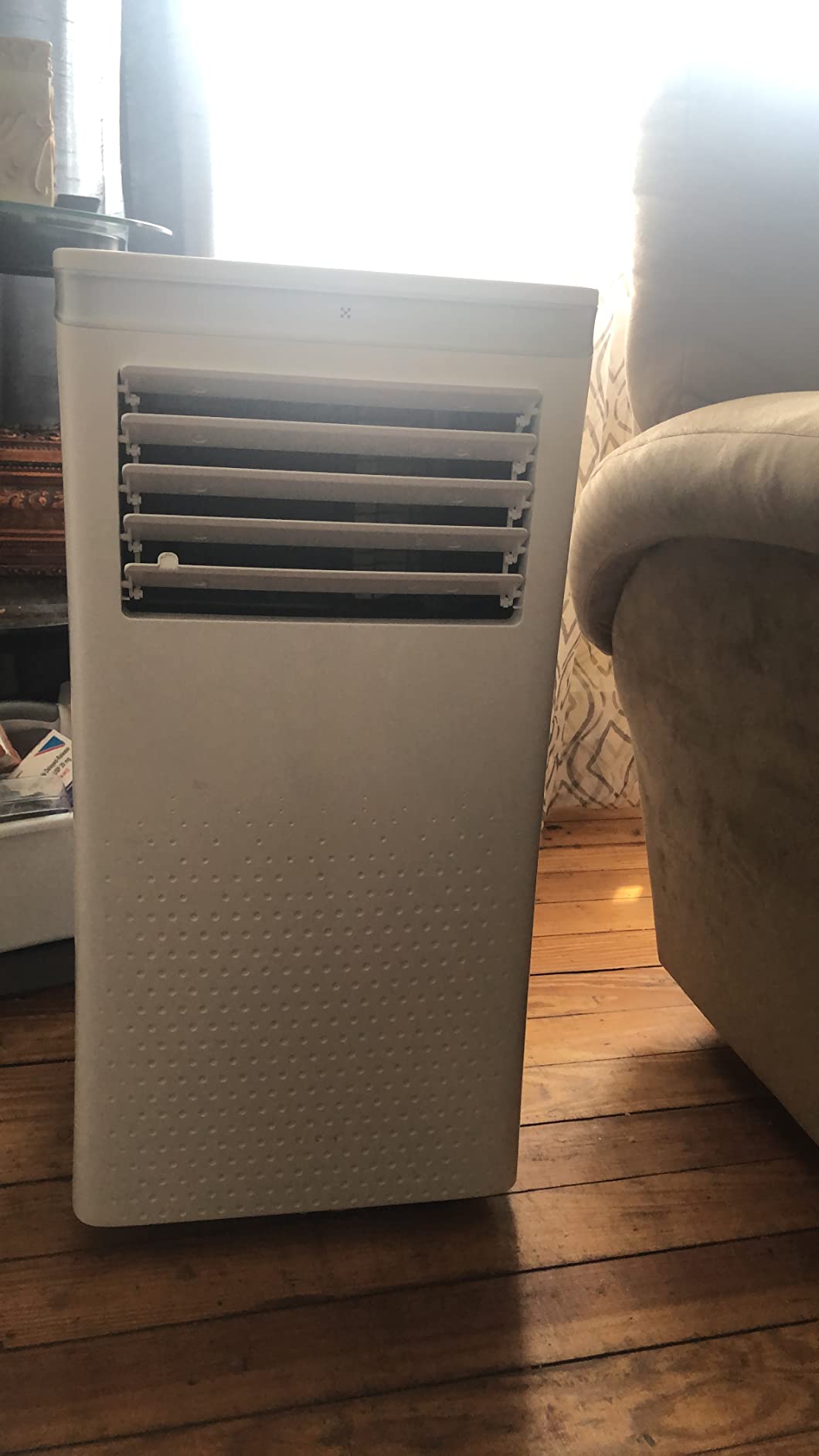
At 30 dB this is by a wide margin the quietest unit in the guide, and that single number puts it in a category of its own. If you are a light sleeper in a hot, dry room, none of the other nine models will compete. It also has genuinely attractive tower styling, three fan modes with three speed settings, 140-degree oscillation, and a 16.4-foot remote.
Owners in very dry air also like the humidifying side of it. Four ice crystal boxes are included, which helps keep the output air cooler for a couple of hours, and the 1.5-gallon tank runs up to 15 hours on the light settings.
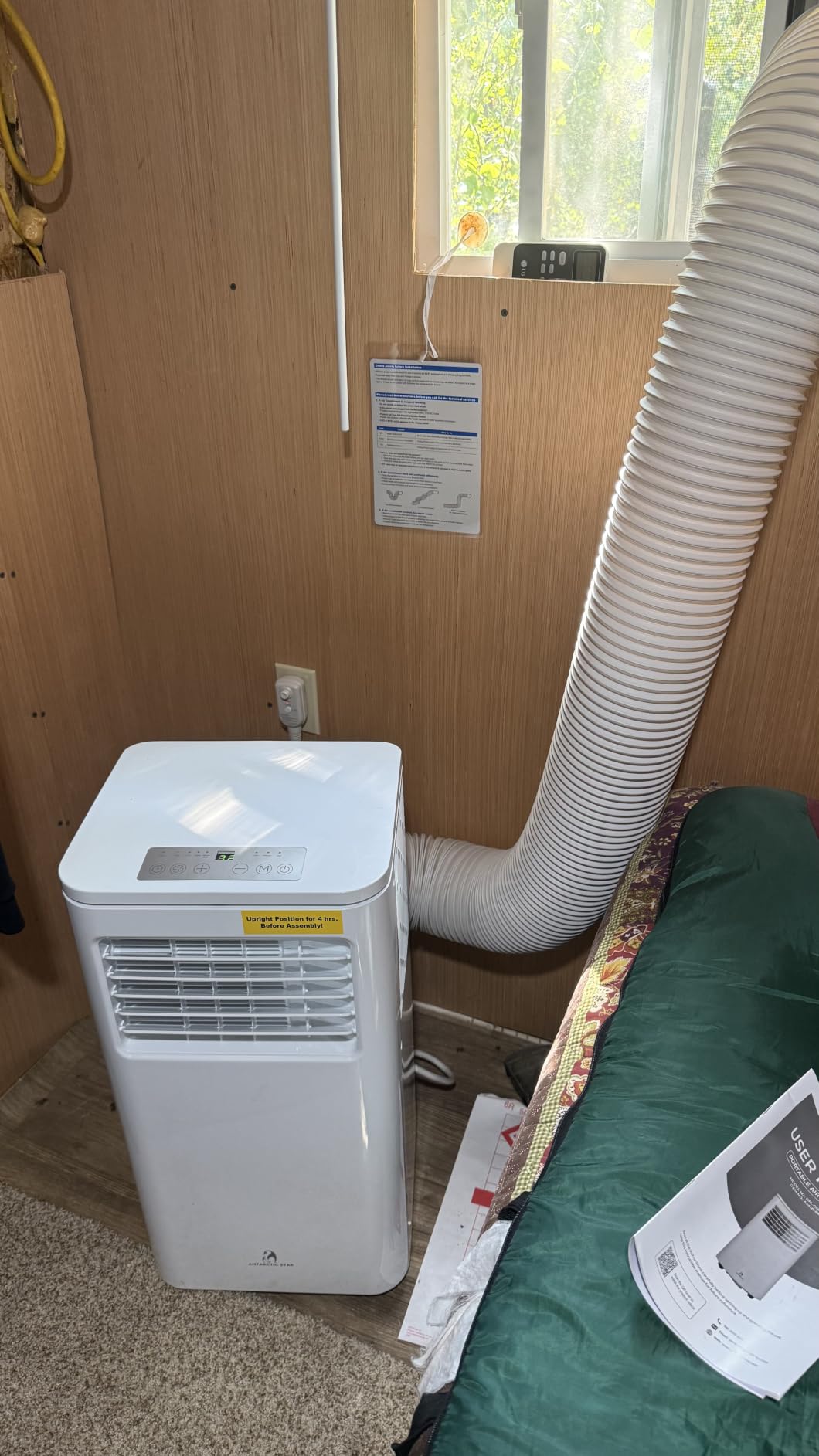
The 3.6 rating is the lowest here, with 21 percent one-star reviews, and the reason is consistent: many owners say it feels like an ordinary fan rather than a cooler. The cooling is only felt when you are seated directly in front of it, and it fades within a few feet. That expectation gap, more than any defect, drives the one-star share.
The other recurring complaints are practical. You need to replenish water and ice often, and you have to unplug it to service it, which interrupts a nap. The 11.8-inch-wide tower is bulkier than it looks in a small apartment.
Who should buy this one
Buy it if silence is your first requirement and you will sit within a few feet of it. A home office, a reading chair, or a bedside position in a dry bedroom is exactly the use case that suits a 30 dB tower with humidifying output.
Buy it if you also want slightly more moisture in a very dry winter room. That secondary function is real, and it is a genuine benefit in arid climates.
Where it falls short
Do not expect it to cool a room. The 1.5-gallon tank, the modest pad area, and the direct-in-front-only effect all point the same way. If you want ambient cooling, look at the Hessaire MC37M or the NewAir instead.
How to Choose a Portable Evaporative Cooler for a Dry Climate
Start with the humidity reading, not the product page. Every other decision on this page only matters once you know you are in the range where evaporative cooling actually works.
Next, size by CFM against the space you actually want to affect, not the square footage on the box. Coverage claims assume open plans and heavy cross-ventilation. As a working rule, treat a unit’s realistic zone as roughly a third of its published coverage, and remember the goal is a person-sized area rather than a whole floor.
Then pick a tank that matches your refill discipline. Big tanks with hose auto-fill suit long outdoor sessions. Small tanks suit rooms where you will top up daily. A tank size you will actually keep filled beats a larger one you will ignore.
Look at the pad design next. Three-sided intake panels give a larger evaporation surface and perform noticeably better than one-sided rigid pads, which is the main reason the single-sided VEVOR and the compact towers feel like fans. Honeycomb pads add a slightly larger surface area again in a slim tower shape.
Consider the body material for where it will live. Molded polypropylene and ABS are fine indoors. A powder-coated metal frame is the better choice for a patio, a job site, or a high-desert yard with constant UV exposure, and both metal-frame units in this guide are built for outdoor duty.
Finally, check noise against the room’s purpose. Below 50 dB is sleepable. 55 to 65 dB is fine in a living space or garage. Anything above 65 dB belongs in a workshop, never a bedroom.
Expected temperature drop: what to realistically expect
Set your expectation at 5 to 15 degrees of ambient reduction in a dry climate, per the U.S. Department of Energy, and understand that a 2 to 3 percent relative humidity increase accompanies every degree. Ice packs add roughly another 3 to 5 degrees near the outlet and fade over one to two hours, and their effect is local rather than ambient.
Owners of the larger units in this guide frequently report 15 to 25 degree drops on low settings in genuinely dry rooms. That is not marketing exaggeration in those conditions. It is the wet-bulb ceiling being reached because there was room in the air to absorb moisture.
Evaporative cooler vs portable AC vs window AC
Power draw is the strongest financial argument here. The VEVOR runs 60 watts and the NewAir runs 95 watts, while the OEMTOOLS at 430 watts is the outlier in this group. A typical 6,000 BTU window air conditioner pulls roughly 600 watts and a 10,000 BTU portable unit closer to 1,000 watts, so an evaporative cooler costs a small fraction to run for the same eight hours.
Where the evaporative cooler loses is temperature. Below about 60 percent relative humidity it wins on cost and comfort. Above it, the humidity penalty removes the advantage and a compressor unit wins outright. There is also no refrigerant, which means no leak risk and no regulatory exposure, though it also means no dehumidification, which is the one thing an evaporative cooler fundamentally cannot do.
One more consideration for bedrooms: our mesh chair picks for hot climates solve the same sweat problem with airflow rather than moisture if you would rather not add humidity to a sleeping space at all.
How to Set Up and Maintain Your Cooler Without Mold or Scale
This is the section that decides whether your cooler feels like a miracle or a disappointment, and it takes about ten minutes the first time.
Ventilation is not optional. Open a window on the shaded side of the building, and if the outdoor air is cooler than the indoor air, open it as far as practical. If outside is hotter, close up and run the cooler in shorter bursts instead. A sealed room starves the pad of the dry air it needs, and this is the single most common reason owners post negative reviews.
Aim at people, not rooms. Turn oscillation off and point the airstream directly at a person or a seating area. Maximum cooling comes from a directed blast, which is the opposite of what the oscillation setting is for. We have covered similar airflow strategy in our attic fan guide for hot climates.
Pre-wet the pad before you start. Running the pump for a few minutes with the fan off saturates the media evenly and avoids the first twenty minutes of weak output while water works through the fibers.
Then maintain it. Drain and empty the tank weekly if you use it daily, and always dry the pad before storing. Do not store the unit with water sitting in the tank over a dry season.
A wet pad left in a closed closet is exactly how mold starts, and mold is the honest answer to the question of whether evaporative coolers cause mold: the unit does not, neglected maintenance does.
Hard water accelerates scale. If your supply is very hard, descale the pad and tank monthly with a mild vinegar solution and a soft brush. Keeping the replacement pads fresh matters too, and our evaporative cooling pad reviews cover the media options.
Frequently Asked Questions
Do evaporative coolers actually work?
They work well in dry air and poorly in humid air. A fan and pump push room air through a water-soaked cooling pad, and evaporation removes heat as it passes through. Expect a 5 to 15 degree drop below 60 percent relative humidity, with the best results below 30 to 40 percent, and open a window or two so the pad has dry air to work with.
Do evaporative coolers cause mold?
Not by design, but they can if you neglect them. The pad and tank stay wet continuously, and mold grows on damp cellulose media that is never dried. Drain the tank weekly, run the fan for an hour after use to dry the pad, and never store the unit with water in the tank over a dry season.
Can a swamp cooler work in 100 degree weather?
Yes, provided the air is dry. Outdoor temperature matters less to an evaporative cooler than relative humidity does. In a genuinely arid climate, owners of the larger units in this guide report 15 to 25 degree indoor drops on low settings during extreme heat. The trade is humidity, which rises about 2 to 3 percent for every degree of cooling.
Is an evaporative cooler better than a portable air conditioner?
For running cost in a dry climate, yes. The units in this guide draw 60 to 250 watts for most models, against roughly 600 watts for a 6,000 BTU window unit and about 1,000 watts for a 10,000 BTU portable AC. Above 60 percent relative humidity, a compressor unit wins, because an evaporative cooler cannot dehumidify.
Which brand of evaporative cooler is best?
There is no single best brand, and the honest answer depends on your room. Hessaire covers the proven all-rounder and the cordless niche, NewAir covers mid-size living spaces at low wattage, and Honeywell covers the recognized-name end with the longest tank runtime. Judge on CFM against your actual space, noise level, and pad surface area rather than brand alone.
Final Verdict: The Best Portable Evaporative Coolers for Dry Climates in 2026
The Hessaire MC37M 3100CFM is our top pick for the best portable evaporative coolers for dry climates. It has the deepest review history in the group, a 10.3-gallon tank that can be hose-fed for continuous fill, three intake panels for a large evaporation surface, and owners across the desert Southwest reporting 15 to 25 degree drops on low. Its all-plastic build and lack of a dry-tank shut-off are the tradeoffs you accept.
For a bedroom on a budget, the Ashihoti 3-in-1 2508 runs 20 hours per tank at 45 dB and weighs 12.5 pounds. For a living space, the NewAir 1600 CFM does the most at 95 watts. For a garage or shop, the OEMTOOLS 23969 has the capacity and the tool tray, at the cost of 68 dB. For a patio, the VEVOR at 60 watts is the cheapest to run, and the Uthfy 4800 CFM is the strongest outdoor air mover.
Before any of them, check your humidity. If it regularly reads above 60 percent, buy an air conditioner instead and save yourself the disappointment. If it reads below 30 percent, open a window, aim the airstream at your chair, and pick from the list above.