
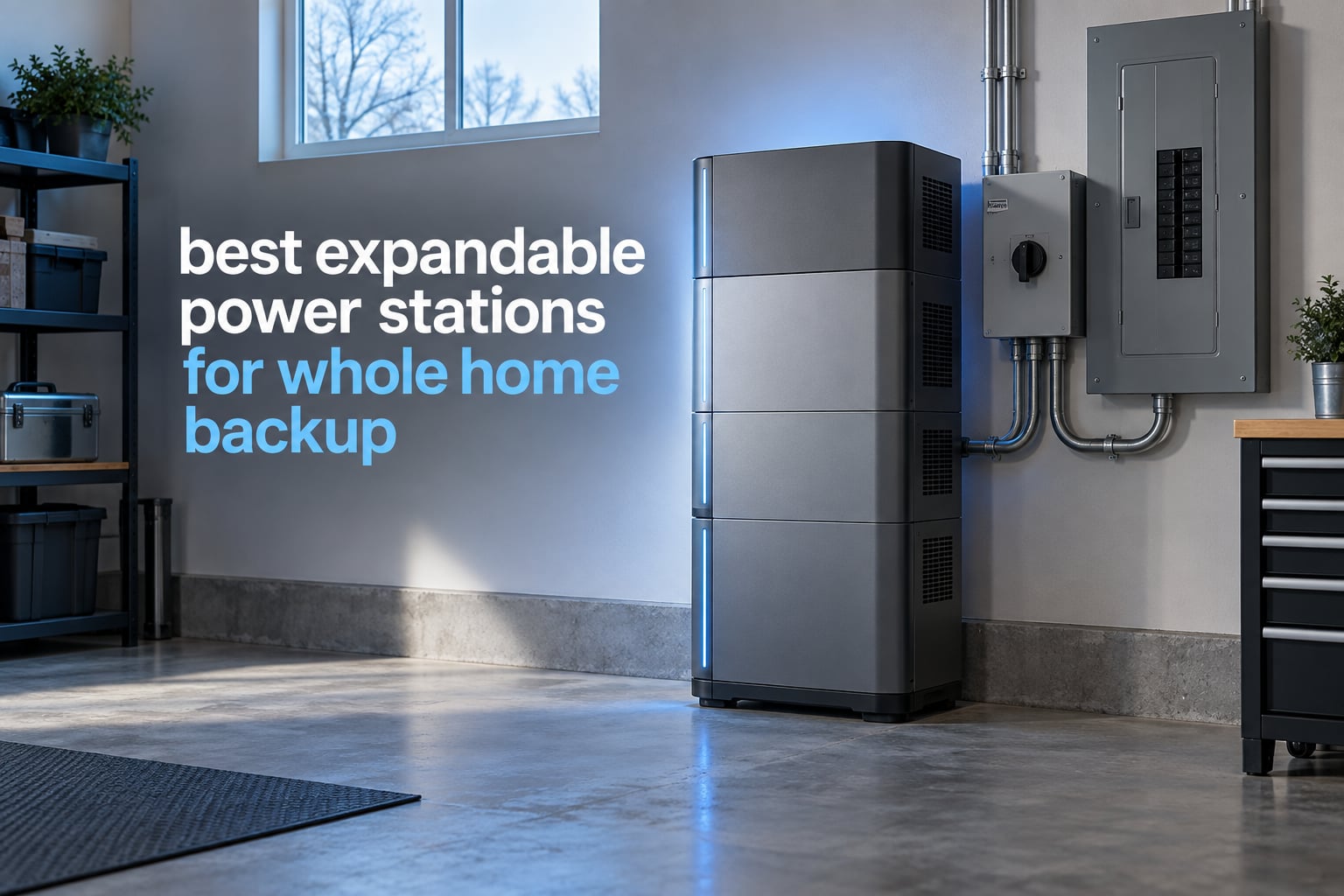
The short answer: the Anker SOLIX F3800 bundle is the best expandable power station for whole home backup for most households, because it pairs a 3.84kWh base with an expansion battery for 7,680Wh total, delivers 6,000W of dual 120V/240V output, and carries the deepest review base in this group. If you need far more headroom, the EcoFlow DELTA Pro Ultra X scales from 12kWh to 180kWh.
Picking a home backup battery is harder than picking a camping power station. A camping unit needs to fit in a trunk, a home backup system needs to sit in a garage and quietly carry a refrigerator, a sump pump, a Wi-Fi router and a CPAP machine for two or three days without anyone hearing it. The same category of hardware has to handle 240V split-phase circuits, pass-through charging, and a transfer switch or smart panel handover when the grid drops.
We spent several weeks comparing 12 expandable power stations on capacity, expansion ceiling, continuous and surge output, 120V/240V capability, UPS switchover time, solar input limits, cold weather behavior and warranty length. Every spec below comes from the manufacturer listing and owner reviews, not from marketing copy alone. Our goal with this guide to the best whole home battery systems is to show which of these actually earns a permanent place in a garage.
If you are still deciding between a battery system and a combustion engine, our standby generator comparison covers the noise, fuel storage and maintenance trade-offs in more detail. For smaller-scale outages, the home battery backup roundup goes deeper on sub-2kWh options.
Table of Contents
Top 3 Picks for Whole Home Backup in October 2026
The three systems below cover the most common household situations. The Anker SOLIX F3800 is the strongest all-rounder, the EcoFlow DELTA Pro Ultra X is the choice when capacity growth matters more than moving the hardware, and the Jackery HomePower 3600 Plus balances both for the typical family.

Anker SOLIX F3800 Bundle
- 7680Wh with expansion battery
- 6000W dual 120V/240V output
- Expands to 26.9kWh
- 322 owner reviews

EcoFlow DELTA Pro Ultra X
- 12288Wh base capacity
- 12000W output
- Expands to 180kWh
- Under 20ms transfer
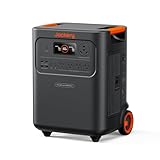
Jackery HomePower 3600 Plus
- 3584Wh base capacity
- 3600W output
- Expands to 21kWh
- 6000 rated cycles
All 12 Expandable Power Stations Compared in October 2026
This table lists every model in the roundup with the specs that separate them. Capacity is the usable base figure, not the expanded maximum.
| Product | Specifications | Action |
|---|---|---|
| Anker SOLIX F3800 |
|
Check Latest Price |
 EcoFlow DELTA Pro 3 Bundle EcoFlow DELTA Pro 3 Bundle |
|
Check Latest Price |
| EcoFlow DELTA Pro Ultra X |
|
Check Latest Price |
 BLUETTI Apex 300 with B500K BLUETTI Apex 300 with B500K |
|
Check Latest Price |
| Jackery HomePower 3600 Plus |
|
Check Latest Price |
 GROWATT HELIOS 3600 GROWATT HELIOS 3600 |
|
Check Latest Price |
 AFERIY 3840Wh Power Station AFERIY 3840Wh Power Station |
|
Check Latest Price |
 ABOK Ark3600 ABOK Ark3600 |
|
Check Latest Price |
 BLUETTI Elite 300 BLUETTI Elite 300 |
|
Check Latest Price |
 PECRON F3000LFP PECRON F3000LFP |
|
Check Latest Price |
 ALLWEI 2048Wh ALLWEI 2048Wh |
|
Check Latest Price |
 GROWATT INFINITY 2000 Pro GROWATT INFINITY 2000 Pro |
|
Check Latest Price |
1. Anker SOLIX F3800 — 7,680Wh Bundle With Dual 120V/240V Output
Anker SOLIX F3800 Portable Power Station and Expansion Battery, 7,680Wh
7680Wh with expansion battery
6000W continuous output
Dual 120V and 240V
Expands to 26.9kWh
132.3 pounds
Pros
- 6000W of continuous output covers pumps
- dust collectors and small compressors
- 120V and 240V split output suits transfer switch installs
- Owners report roughly three days of backup with two expansion batteries
- Quiet operation and an easy to read display
- NEMA 14-50 port works as an EV charger
Cons
- Built-in BMS throttles charging below roughly 50F
- 60V solar ceiling limits array configuration
- XT60 connectors are not included for solar hookup
The bundle pairs the F3800 with one expansion battery, giving 7,680Wh of usable capacity and 6,000W of continuous AC output. A second F3800 doubles output to 12,000W, and up to six expansion batteries take the total to 26.9kWh. That headroom is what makes it a whole home option rather than a weekend unit.
Owners use this unit the way they would have used a gas generator. Reviews describe running pumps, well pumps, table saws, dust collectors and small compressors off grid without trouble. The NEMA 14-50 port handles EV charging directly, and the L14-30 outlet feeds an RV inlet.
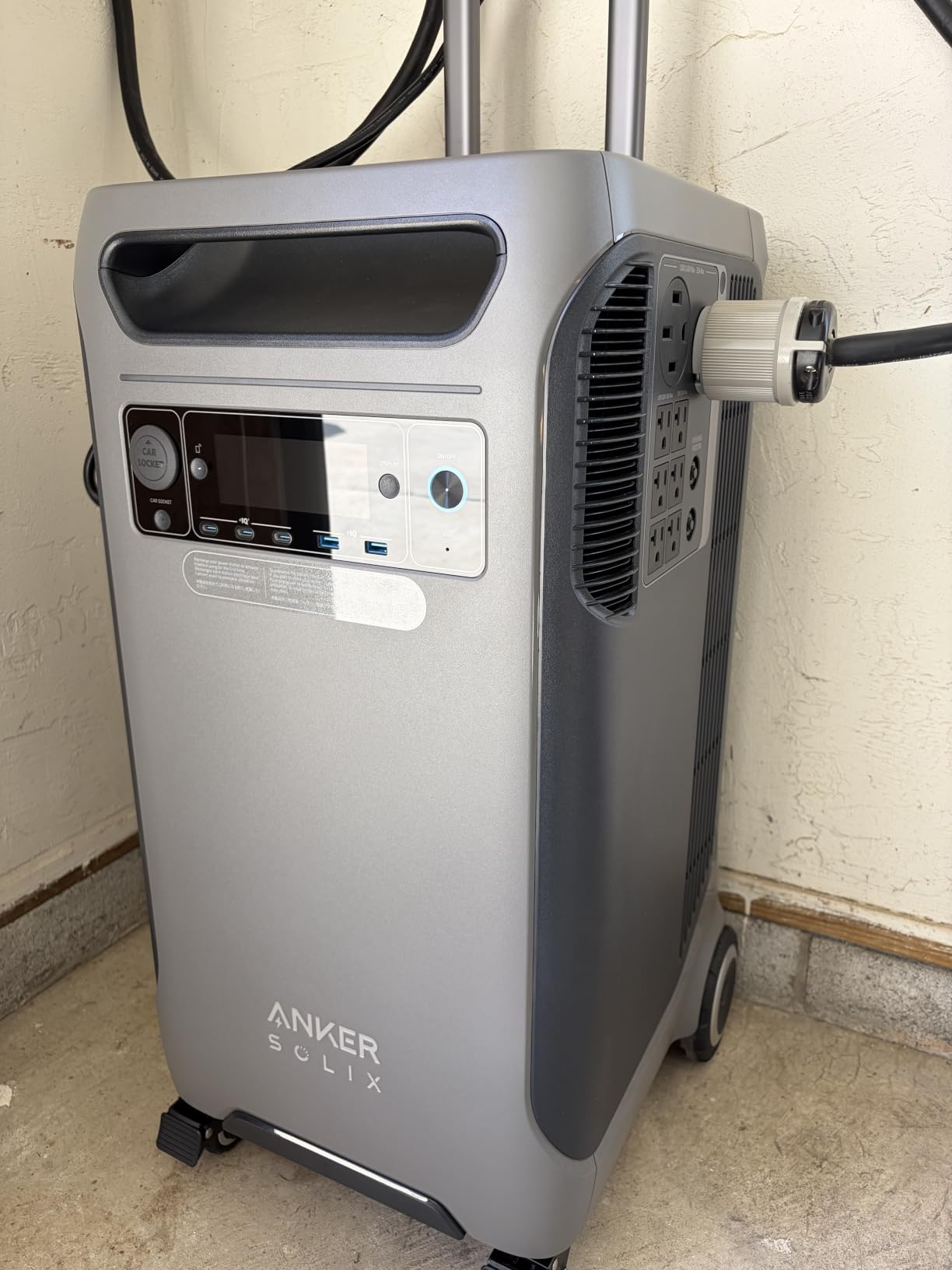
Two engineering limits deserve attention before you commit. The 60V maximum PV input caps the solar array configuration and makes reaching the full 2,400W solar ceiling harder than the headline number suggests. Separately, the internal battery management system throttles charging when the pack temperature drops below roughly 50F, which matters in northern states.
Homeowners posting on Reddit’s r/Portable_PowerStation forum describe pairing the F3800 with a smart home power kit and treating it as a fixed installation rather than a portable device. The Wi-Fi connection occasionally drops and needs a manual reset, and one owner reported a ground fault error when plugging in a 24A EV charger. Anker support is described as responsive with detailed technical replies.
What the F3800 handles that smaller stations cannot
Instantaneous surge matters more than most buyers expect. Starting wattage is rated at 10,200W, which is why compressors and pump motors that trip smaller inverters start without trouble here. The InfiniPower EV-class LFP cells are rated for a 10-year design life, and the listing carries a 5-year manufacturer warranty.
Where it falls short for a typical family
At 132.3 pounds in a 34-inch cube, this is a stationary unit that needs a planned spot on a floor or a shelf. Solar hookup requires buying your own XT60 cables, and the app does not graph historical generation or consumption, which some owners miss when tracking monthly output.
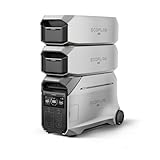
2. EcoFlow DELTA Pro 3 With Two Extra Batteries — 12kWh Bundle, 48kWh Ceiling
EF ECOFLOW 12kWh Portable Power Station: DELTA Pro 3 with 2 Extra Batteries
4096Wh base battery in a 12kWh bundle
4000W with 6000W X-Boost
Expands to 48kWh
10ms UPS switchover
260 pounds
Pros
- Supports 120V and 240V at 4000W with 6000W via X-Boost
- 4096Wh base expands to 48kWh for multi-day outages
- 10ms switchover keeps NAS and servers running
- X-Quiet operation as low as 30 dB suits indoor placement
- IP65-rated battery pack with a 5-year warranty
Cons
- Very heavy at 260 pounds
- Only a single listed power outlet on the unit
This configuration arrives as the DELTA Pro 3 plus two extra batteries, giving roughly 12kWh out of the box and a ceiling of 48kWh with more batteries or smart generators. Output is 4,000W continuous, 6,000W with X-Boost, and scalable to 12,000W as more capacity is added. EcoFlow markets it for a 3-ton central air conditioner or a 1 HP water pump.
Setup is genuinely plug and play with no installation or maintenance, which is the main reason people buy into the EcoFlow line. The app handles monitoring and control. With only 16 ratings on record, the feedback is limited, but it skews positive on output power, expansion and quiet operation.
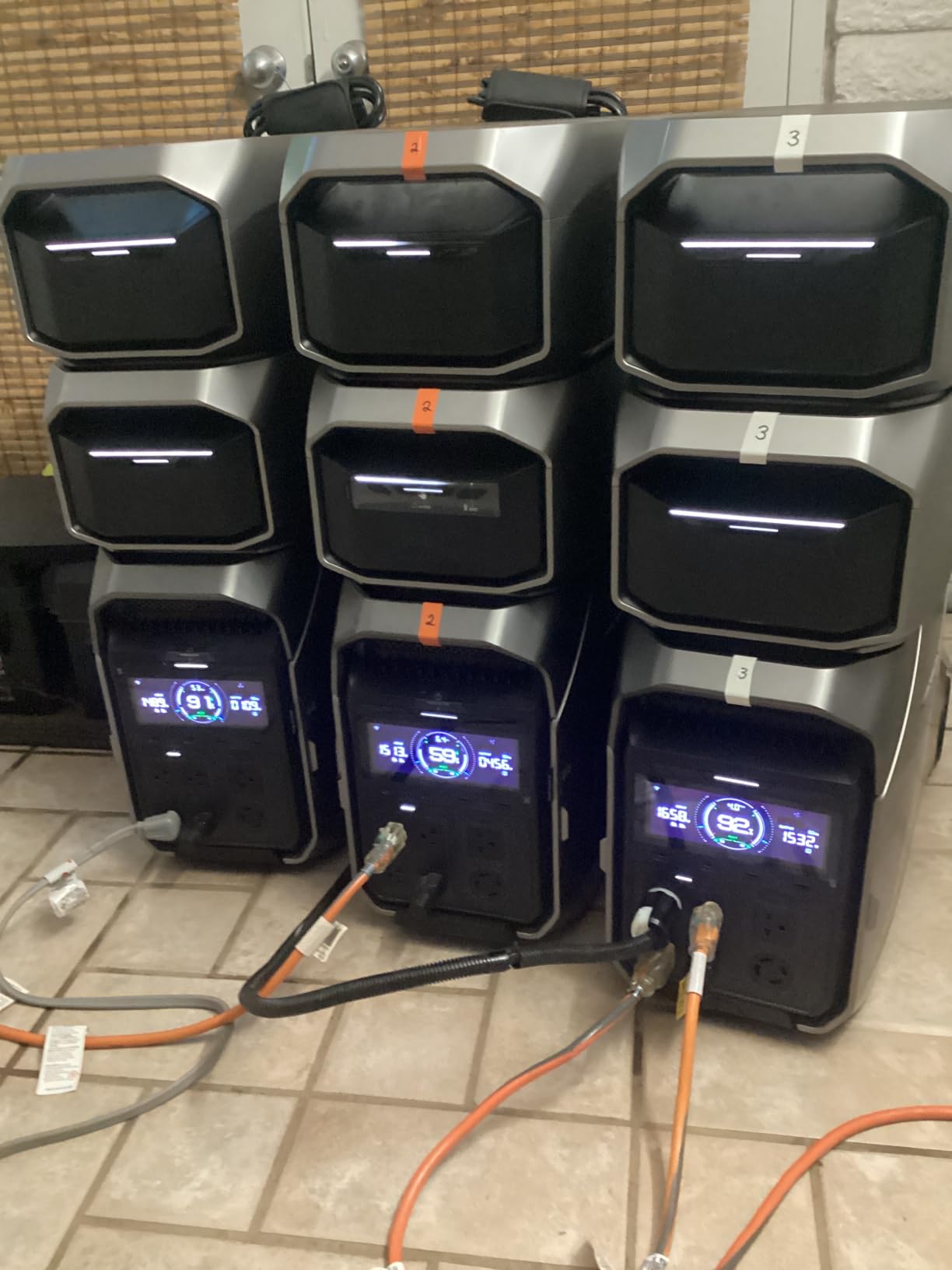
The 260-pound weight is the recurring caveat, and it pushes you toward a fixed indoor location such as a garage or utility room. The listing also shows a single total power outlet, so most owners will rely on the app and expansion accessories rather than plugging in many devices at once. X-Quiet operation is rated as low as 30 dB, which is one of the quietest figures in this roundup.
Why the 48kWh ceiling matters for long outages
Multi-day ice storms and multi-day grid failures are where most battery systems give up first. A 48kWh ceiling means a household can add capacity over several purchase cycles instead of replacing hardware, and the 10ms UPS switchover keeps NAS units, servers and entertainment devices running through a flicker. The IP65-rated CTC battery pack and automotive-grade LFP cells add confidence in an unheated garage.
Where buyers push back
The thin review base is the honest weakness here. Sixteen ratings is not enough history to judge long-term cycle degradation or warranty service, and the single listed outlet limits plug-and-play flexibility. Anyone who needs many simultaneous 120V loads should look at the Anker F3800 instead.
3. EcoFlow DELTA Pro Ultra X — 12kWh and 12kW for Full Panel Backup
EF ECOFLOW Power Station 12288Wh Delta Pro Ultra X with AC cable
12288Wh bundle capacity
12000W output
Works with a standard 10-circuit transfer switch
Expands to 180kWh
Pros
- Scales from 12kWh to 180kWh and 12kW to 36kW
- Under 20ms switchover keeps fridge and medical gear running
- Current Sense Transformer sends surplus rooftop solar to the home or EV
- Dual BMS with 100+ real-time safety checks
- Self-heating and cooling operation in freezing nights
Cons
- Battery state of charge display reported as inaccurate by some owners
- Inverter generates significant heat while charging
- Standby draw reported around 5-10% per day
This is the largest system in the roundup by a wide margin. The package contains one inverter and two extra batteries for 12,288Wh of capacity and 12,000W of output, scaling to 36kW and 180kWh. It works with a standard 10-circuit transfer switch, which makes it one of the few options here that a licensed electrician can wire into a normal residential panel without a custom build.
Power restores in under 20 milliseconds during a grid failure, and smart circuits automatically recharge and balance loads. The Current Sense Transformer measures surplus rooftop solar and routes it to the home or to an EV rather than wasting it, which turns the battery into a daily savings device instead of pure emergency equipment.
Owners of installed systems consistently report running an entire home off the unit with solar recharge cycles, and several describe replacing a gas generator for daily use. EV-grade LiFePO4 cells, a dual BMS and more than 100 real-time safety checks form the protection stack, and one documented support case ended with the manufacturer supplying a full new-unit replacement under warranty.
The complaints are real but manageable. Battery state of charge readings are reported as noticeably inaccurate by some owners, which matters when you are planning around remaining capacity during a long outage. The inverter also generates significant heat while charging, so it needs ventilation rather than a closed closet. Standby consumption of roughly 5-10% per day is a concern for anyone treating this as an off-grid vehicle system.
Users on Reddit’s r/Ecoflow_community community prefer this model over the DELTA Pro 3 for cleaner expansion, pointing to the single-stack architecture and high solar input. Solar input measured from an EV charger topped out around 6,100W rather than the advertised 7,200W, and some operating modes reportedly fail when paired with newer Smart Gateway hardware. The battery and inverter also arrive in separate packages.
What changes at this size
At 350 pounds and 26.6 by 18.7 by 9.06 inches, this is floor-mounted hardware that stays where you put it. That is a reasonable trade for a home that wants central air, a water heater and kitchen circuits on the same system. Because it accepts a standard 10-circuit transfer switch, the install path is familiar to most electricians.
Where it is the wrong purchase
If your goal is a refrigerator and a router for a weekend, this is far more hardware than you need and the gauge inaccuracy is harder to live with on a smaller system. It also runs warmer than anything else in this list, which adds a ventilation requirement that outdoor-rated competitors avoid.
4. BLUETTI Apex 300 With B500K — 7,884.8Wh at 83.8 Pounds
BLUETTI Apex 300 Portable Power Station & B500K Expansion Battery 7884.8Wh
7884.8Wh with the B500K expansion
3840W continuous and 7680W surge
Simultaneous 120V and 240V
2400W solar input built in
Pros
- Simultaneous 120V and 240V output feeds both legs of a home panel
- 120V AC pass-through charging allows 240V output at the same time
- 2400W built-in solar input with dual MPPT chargers
- Weather alerts and output wake after deep discharge
- Second-gen LFP rated 6000+ cycles
Cons
- 60Voc limit on the integrated PV input restricts array configurations
- Around 85 pounds makes moving it difficult without help
- Inductive loads can trip on startup surge above the 3840W rating
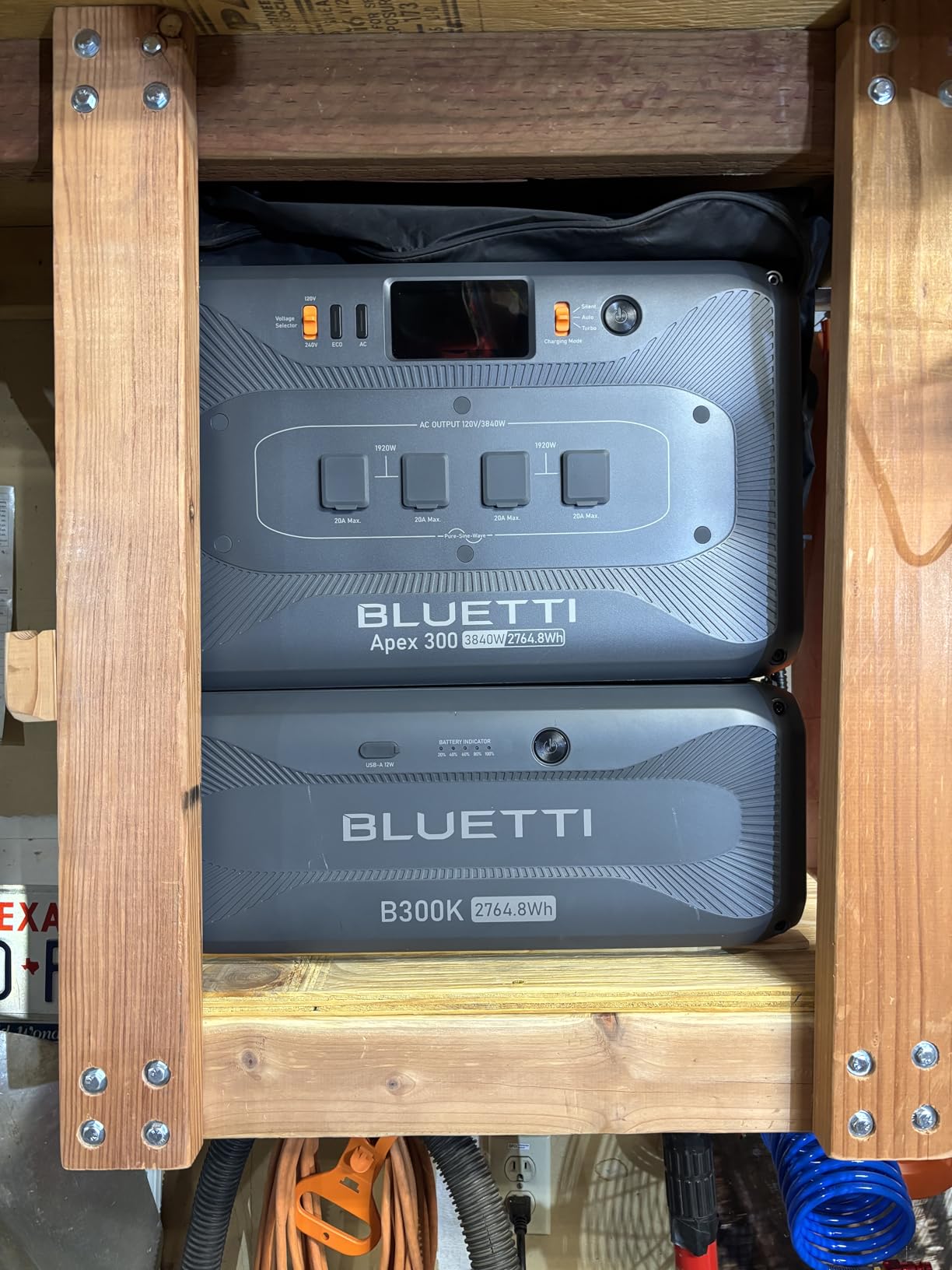
This bundle pairs the Apex 300 inverter with a B500K expansion battery for 7,884.8Wh total at 3,840W continuous and 7,680W surge. Six AC outlets come standard, and the unit is rated for simultaneous 120V and 240V output, which is the combination a transfer switch needs to feed both legs of a residential panel.
Pass-through charging is the underrated feature. With 120V AC pass-through, the battery can charge while still delivering 240V output to the home, so you do not have to choose between recharging and keeping the well pump fed. Built-in solar input handles 2,400W and expands to 6,400W, with AC charging reaching 80% in 45 minutes.

Reviews concentrate on the dual 120V/240V output and pass-through charging as the decisive features for panel and transfer-switch installs. Owners report running hybrid mini-splits, Starlink, travel trailers and EV charging off grid, and one reviewer notes the weather alerts plus the ability to wake and re-power AC outlets after a deep discharge.
The most frequently cited limitation is the 60Voc ceiling on the integrated PV input, which restricts how you wire panel arrays. Inductive loads such as compressors and motors can trip on startup surge above the 3,840W rating, so motor-heavy homes should think about surge headroom. One detailed review describes difficulty with the automated support workflow after receiving a unit that was not in new condition.
Why owners on forums keep recommending it
Members of Reddit’s r/diySolar community single out the Apex 300 for expandability with B300 and B500 batteries, and describe the earlier AC300 with B300 combination as incredible expansion for any situation after more than a year of ownership. Second-generation LiFePO4 cells are rated for 6,000+ cycles to 80% capacity and a 17-year lifespan.
Where it is not the answer
At 83.8 pounds it is heavy but far more manageable than the EcoFlow bundles, and the 22 dB silent operation suits an indoor or near-indoor spot. The warranty description is not stated on the listing, which is worth confirming before a large purchase, and the PV voltage ceiling caps your long-term solar plans.
5. Jackery HomePower 3600 Plus — 3,584Wh That Scales to 21kWh
Jackery HomePower 3600 Plus Power Station, 3584Wh, 3600W AC Output
3584Wh capacity
3600W output with 7200W parallel
Dual 120V and 240V
6000 rated cycles
Pros
- Runs refrigerators
- freezers
- water heaters and window AC units reliably
- Dual 120V and 240V output with 7200W parallel capability
- Recharges in 2 hours on hybrid AC and DC input
- Built-in wheels and a telescoping handle at 77.2 pounds
- Cells tested at 302F with a 10-year lifespan
Cons
- Still a heavy unit even with wheels and a handle
- Base capacity runs down quickly under heavy 240V loads
The HomePower 3600 Plus is the most approachable of the large units. It carries 3,584Wh and 3,600W of output, doubling to 7,200W in parallel, and it expands to 21kWh per unit or 43kWh across multiple units. Dual 120V and 240V output in parallel means it can handle a dryer-type load rather than only small circuits.
Charging speed is a genuine advantage. A full recharge takes 2 hours on hybrid AC and DC input, 2.5 hours on AC alone, 4 hours on solar and 2.5 hours from a generator. That gives you multiple ways to refill after an outage, including running the unit as a pass-through source while a generator charges it.
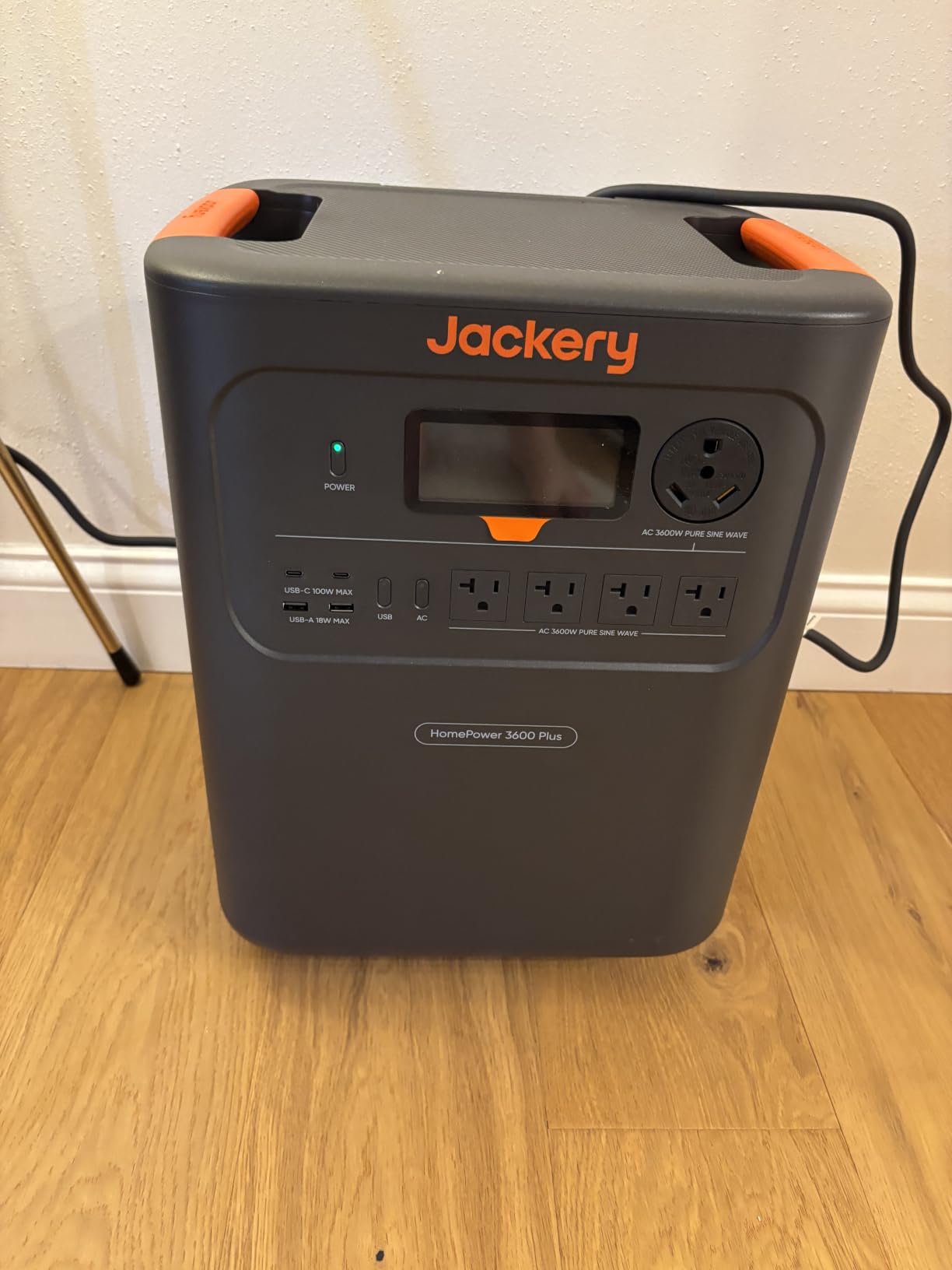
Owner satisfaction runs high across multiple Jackery models in the reviews. People describe it as a quiet, easy-to-use replacement for a gas generator during outages, hurricanes and winter storms, and the luggage-style design with wheels and a telescoping handle makes the 77.2 pounds workable indoors.
The caveats are modest. It is still a heavy unit even with the handle, and 3,584Wh of base capacity is starter-sized for a household that expects heavy 240V loads from the first hour of an outage. High-temp resistant ceramic membrane cells are tested at 302F, rated for 6,000 cycles and a 10-year lifespan, and the unit operates down to -4F, which is a narrower cold rating than the GROWATT models below.

Why this is the easiest install to plan around
Paired with the Jackery transfer switch, the unit powers a home with no complex installation: plug it in and press the power button. That simplicity is why it appears in so many hurricane and winter storm write-ups. Reviewers who own several Jackery power stations describe charging between them as a practical top-up strategy during multi-day events.
Where it is not enough
3,584Wh is a starter capacity. A refrigerator, a router and a few lights will run comfortably, but central air or a well pump will drain it quickly without expansion packs. If your outage profile includes heavy 240V loads from day one, budget for expansion batteries from the start.
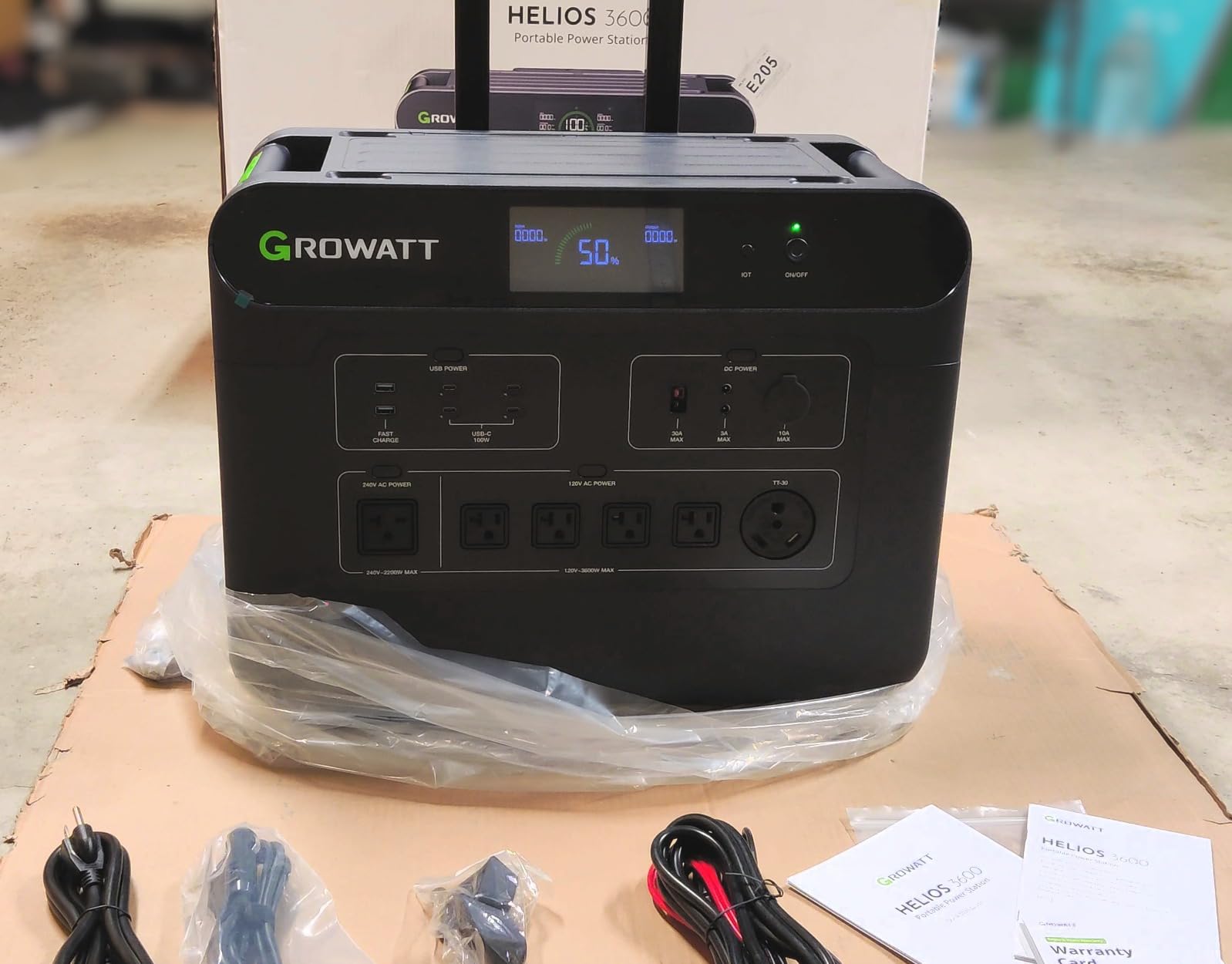
6. GROWATT HELIOS 3600 — 3,600Wh That Starts at -22F
GROWATT HELIOS 3600 Portable Power Station, 3600Wh LFP Solar Generator
3600Wh LFP battery
3600W with 4500W surge
Expands to 18kWh or 36kWh
Sub 15ms EPS switchover
Pros
- Compact size for the output it delivers
- Hybrid AC-DC input fills it in under 1.5 hours
- Works without Wi-Fi or Bluetooth for basic functions
- Per-outlet enable and disable buttons with a manual in the app
- Retains 80% capacity after 4000 cycles with UL certification
Cons
- MyGro app frequently fails to complete Bluetooth pairing
- EPS mode is on or off and cannot be scheduled
- Noticeable humming above 1200W while charging
The HELIOS 3600 combines a 3,600Wh LFP battery with 3,600W of output and 4,500W of starting power. It expands to 18kWh with four expansion batteries, or 36kWh when two units run in split-phase parallel for 240V at 7,200W. That parallel path is what turns a mid-size station into a genuine whole home option.
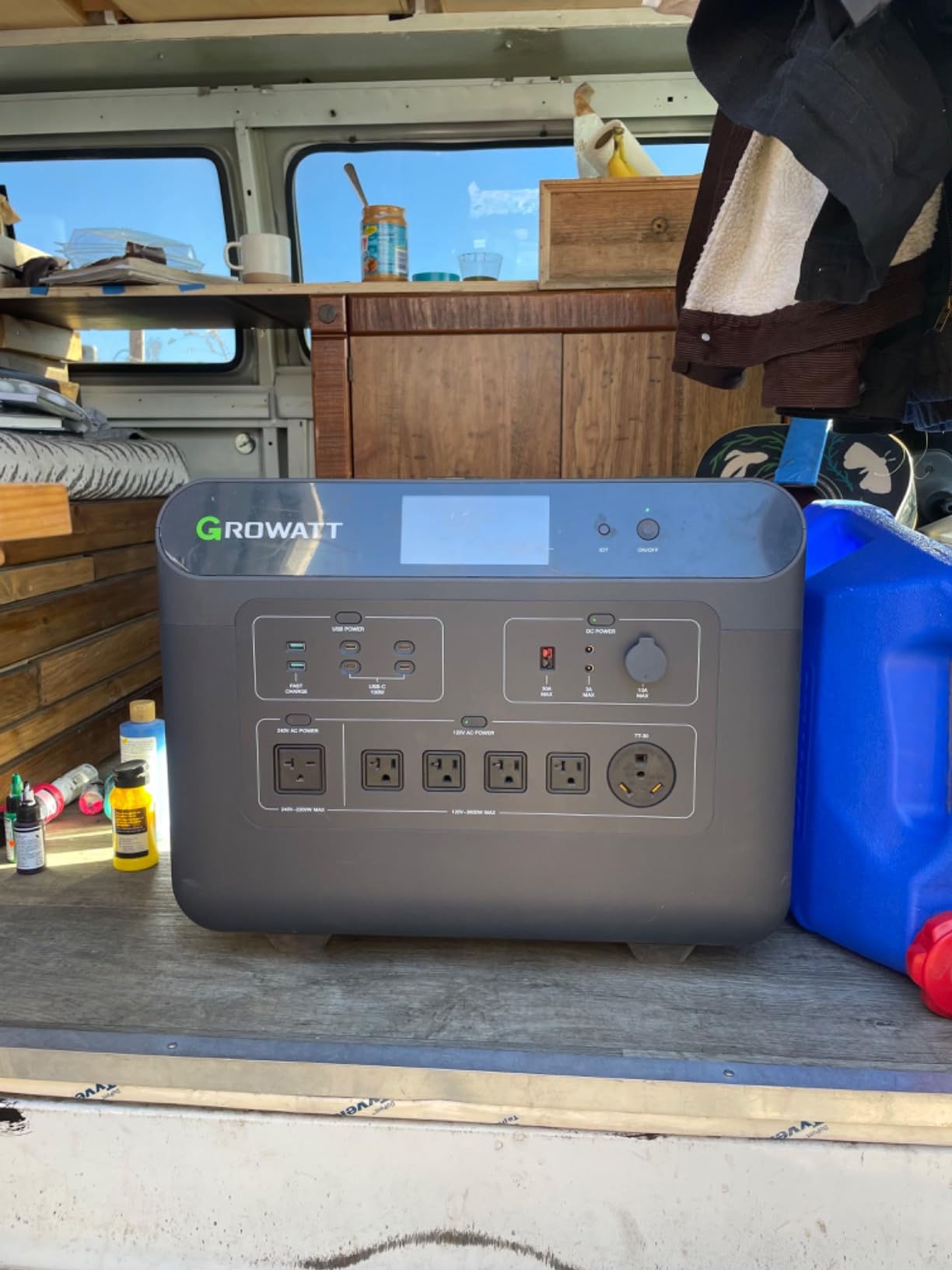
Cold start capability down to -22F is the standout for anyone in a northern climate, and switchover stays below 15ms for EPS use. Solar charging reaches a full 2,800W array in 2.8 hours, AC charging takes 3 hours at 120V or 1.5 hours at 240V, and hybrid AC-DC charging fills it in under 1.5 hours. NEMA TT-30 and Anderson connections serve RV and overlander setups.
Reviewers consistently rate the hardware highly while rating the app very poorly. The MyGro app frequently fails to complete Bluetooth pairing even when the unit shows wireless as active, and reviewers describe the permission requests as intrusive. Several owners cite exceptional warranty service, including fast replacement of a unit that arrived damaged.
Two smaller complaints: EPS mode is either on or off and cannot be scheduled or selected in the app, and there is a slight humming noise during charging above 1,200W. On the positive side, one owner ran a large window AC unit for more than 12 hours, and basic functions work without any wireless connection at all. The unit weighs 51 pounds with 16 plug-and-play ports.
What matters in a winter outage
Cold start temperature is the spec nobody advertises well. A unit that will not boot at -10F is useless in a northern ice storm, and this one is rated to -22F with cold start technology. Retaining 80% capacity after 4,000 cycles with a 5-year warranty and US-based service adds long-term confidence for seasonal use.
Where the app holds it back
Because EPS scheduling is missing and Bluetooth pairing is unreliable, plan to configure this unit with the physical buttons and the onboard manual rather than depending on the phone. Owners who want remote storm alerts should weigh that against models with better app behavior.
7. AFERIY 3840Wh — 11,520Wh Ceiling With 15 Output Ports
AFERIY 3840Wh Portable Power Station,Expandable Solar Generator to 11520Wh
3840Wh LiFePO4 battery
3600W with 7200W peak
15 output ports
Under 10ms UPS transfer
Pros
- 3840Wh expandable to 11520Wh for multi-day outages
- Under 10ms UPS keeps computers and medical freezers running
- Recharge from empty in as little as 1.5 hours
- UL Listed with a 7-year support period
- App control for scheduling and remote shutoff
Cons
- Heavy at 104.7 pounds
- 120V output only with no listed 240V split-phase capability
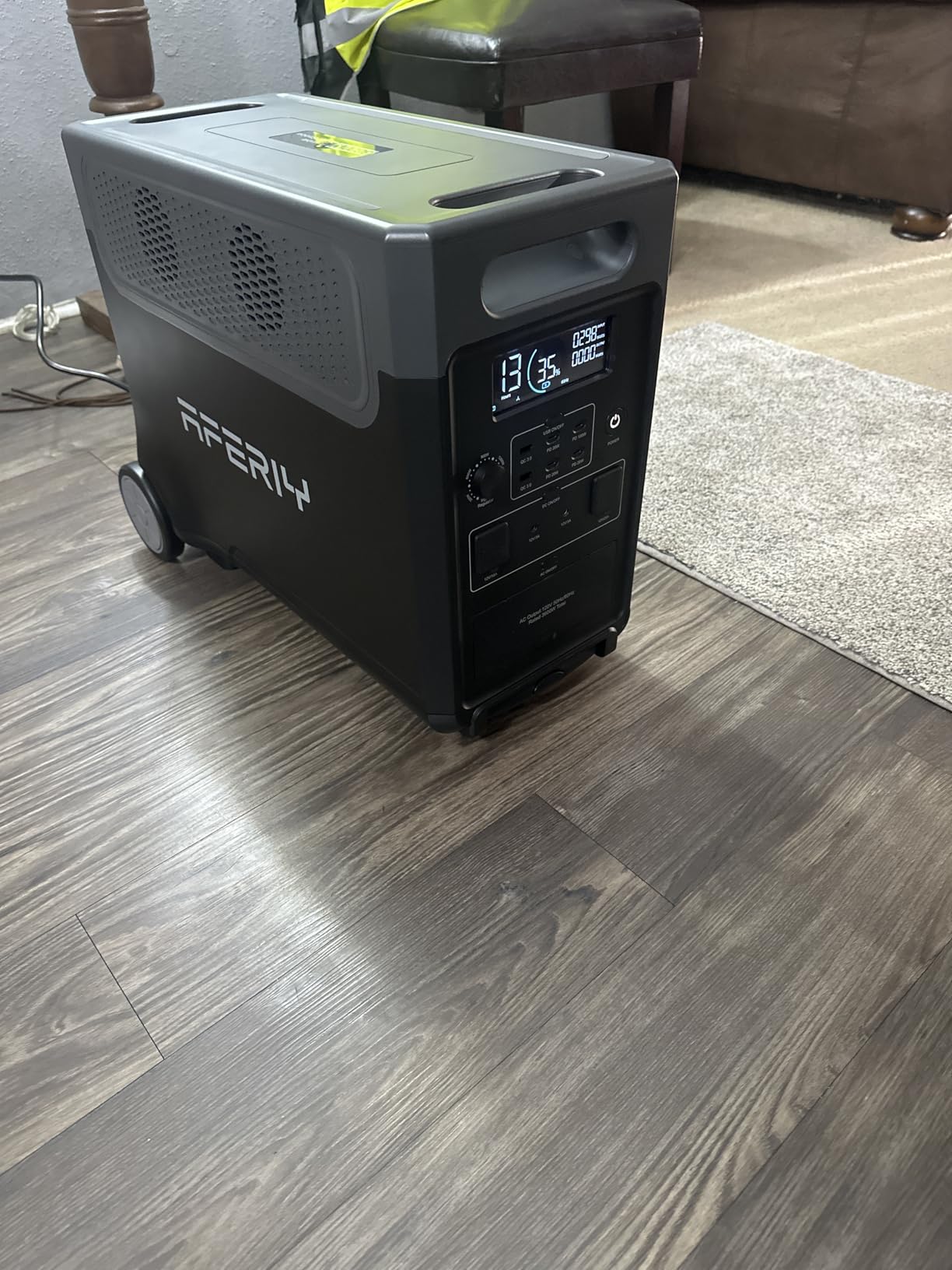
The AFERIY 3840Wh sits in the middle of the roundup on capacity and above most on port count. It delivers 3,600W continuous with 7,200W peak, 3,840Wh of LiFePO4 storage and an expansion ceiling of 11,520Wh. Fifteen output ports cover AC, USB-A, USB-C PD 3.0, DC5521, XT60 and a 12V car socket.
UPS transfer happens in under 10 milliseconds, and the listing rates roughly 17 hours of runtime on common household essentials with one to two days for a refrigerator depending on load. Recharging works through AC wall, solar, car or a combined AC plus solar input, reaching full in as little as 1.5 hours with adjustable charge levels.
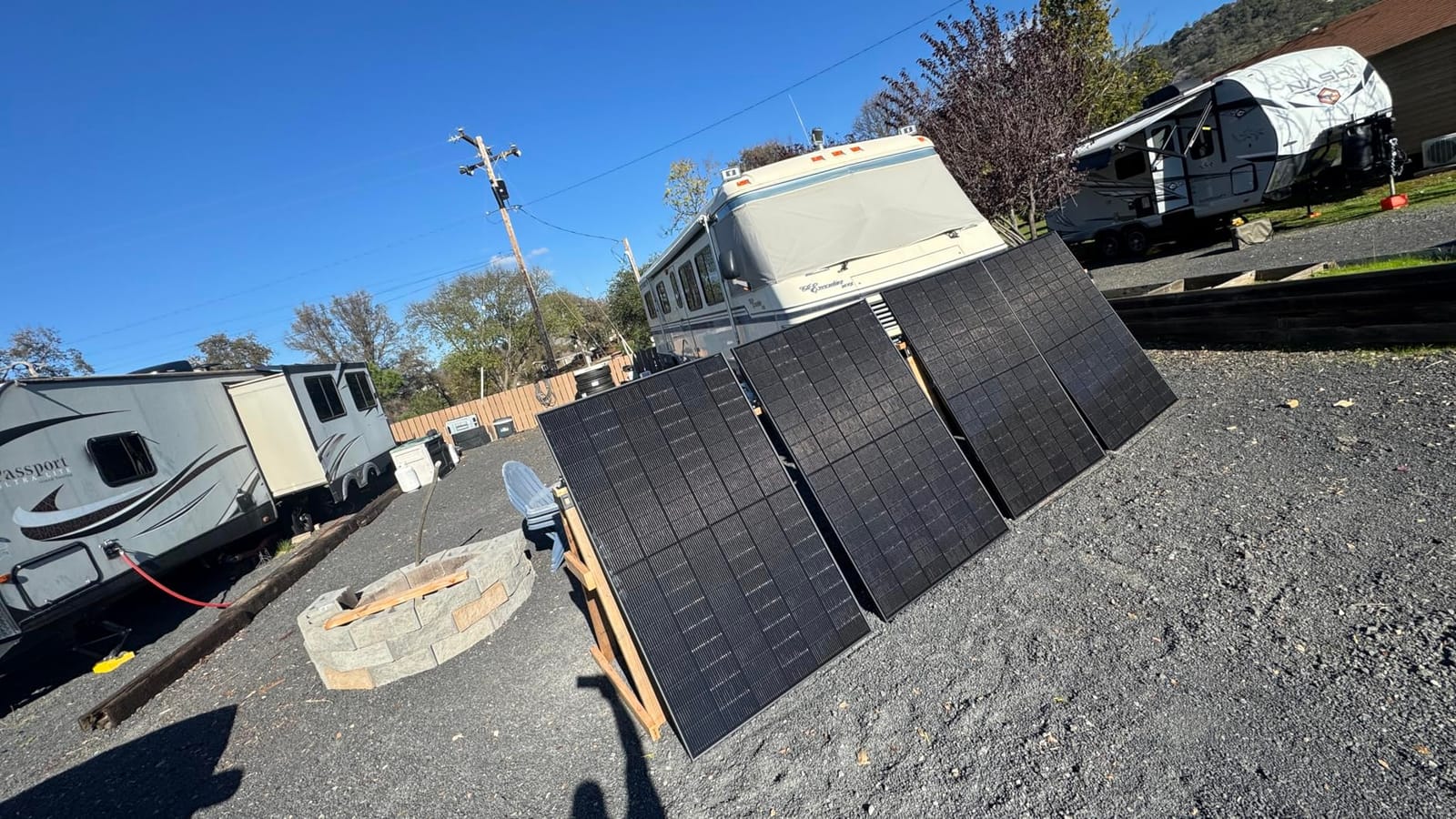
Reviewers highlight strong capacity for the money, with several citing multi-day refrigerator and freezer runtimes during outages. The under-10ms transfer is specifically valued for keeping computers, cameras and medical freezers running without interruption, and the UL Listing plus 7-year support period adds assurance for a device meant to sit through emergencies.
Two constraints shape who should buy it. At 104.7 pounds it is one of the heavier units in this group, and the output is 120V only with no listed 240V split-phase capability, which rules it out for well pumps, central air and dryer circuits. It is a strong essential-loads system rather than a whole panel system.
Where this capacity ceiling fits
Going from 3,840Wh to 11,520Wh covers a three-day outage on a refrigerator, freezer, router, lights and a medical device without touching the wall. Expansion uses the same plug-and-play approach as the base unit, and adjustable charging speed helps when you are pulling solar during a multi-day storm.
Why a homeowner might skip it
If your outage plan includes anything on the 240V side of the panel, this is the wrong tool. The 120V-only output also means an inexpensive sub-panel with extension cords, which is fine for a rental or a cabin but not for a permanent whole home install.
8. ABOK Ark3600 — 3,840Wh of 120V Backup for Ice Storm Country
ABOK Ark3600 Portable Power Station 3600W, 3840Wh LiFePO4 Battery
3840Wh LiFePO4 battery
3600W with 4500W peak
15 output ports
Expands to 11520Wh
Pros
- Silent operation with one-button start and no fuel line
- Runs a wet vac
- heat gun and SDS-Max hammer drill at once
- Usable indoors with no exhaust fumes
- Wheels and a telescoping handle manage the 92-pound weight
- Full charge in 1.29 hours on combined AC and solar
Cons
- 120V output only
- App documentation is thin with charge limits buried in menus
- Plug covers described as not the strongest
- Solar-only charging took about three days in cloudy conditions
The Ark3600 pairs 3,840Wh of expandable LiFePO4 capacity with 3,600W of rated output and 4,500W peak, expanding to 11,520Wh. Fifteen ports include a 30A AC outlet, four 20A AC outlets, USB-A QC3.0, three USB-C ports including one at 100W, two DC5521, an XT60 and a 12V car socket.
Charging is flexible: 1,500W AC, 2,000W PV and 120W car input, with a full charge in 1.29 hours on AC plus PV or 3 hours on AC alone. EV-grade LiFePO4 cells are rated for 4,000+ cycles and up to a 10-year lifespan, and the warranty is listed as 2+3 years.
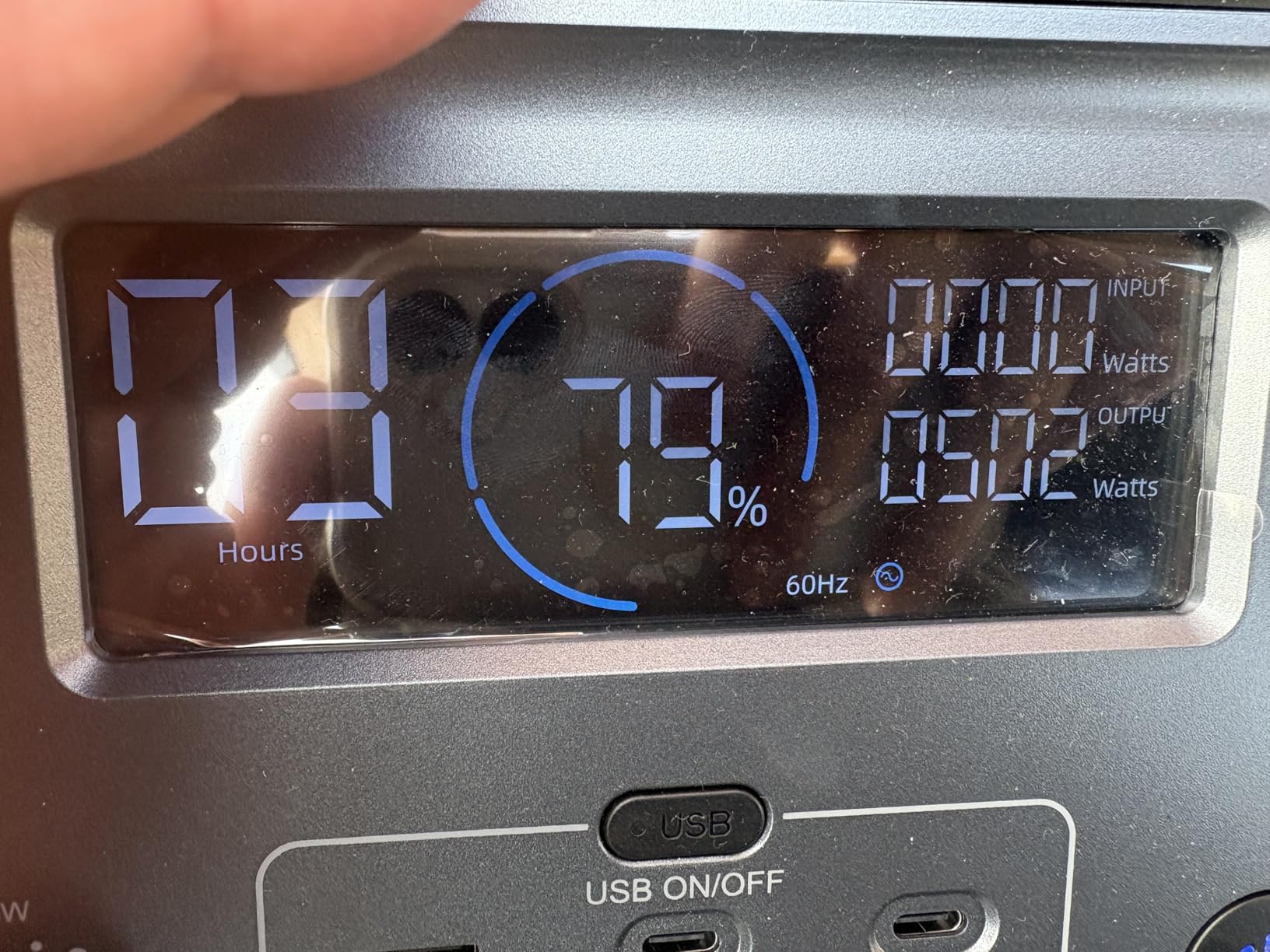
Owners consistently frame the Ark3600 as strong value for hurricane and ice storm backup, highlighting silence, indoor usability and low cost. One reviewer ran a wet vac, a heat gun and an SDS-Max hammer drill simultaneously without trouble, which is a meaningful load test for a residential battery.
Warranty service is a genuine strength here. Buyers who exceeded the solar input voltage got both units repaired under warranty, and that experience is cited as a point in the brand’s favor. Recurring cons are weight, 120V-only output and thin app documentation with charge limit settings buried in menus.
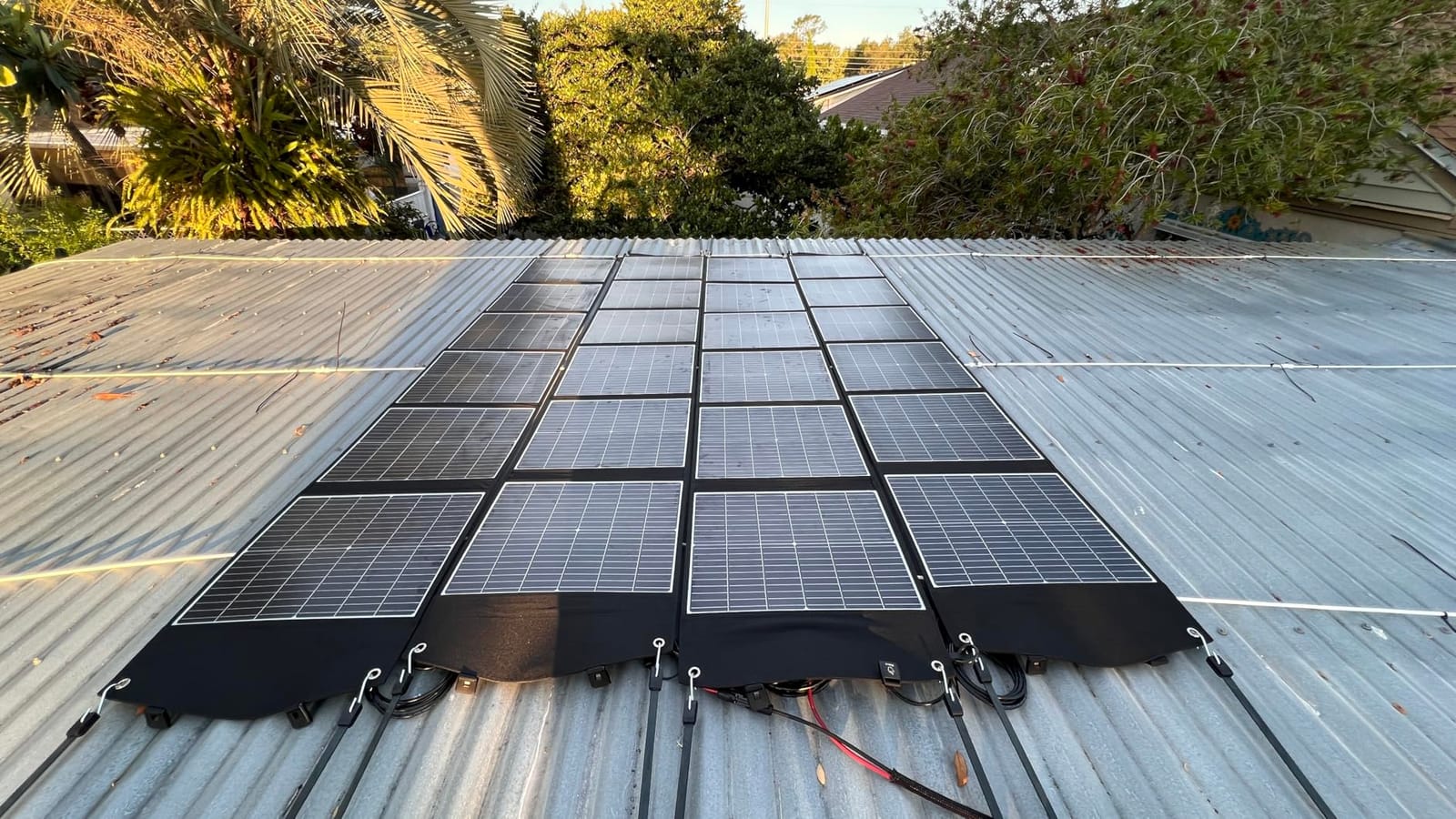
What a storm-ready setup looks like here
Run it indoors with no fuel, no exhaust and no pull cord, which is exactly the scenario forum users describe after ice storms and hurricanes. The telescoping handle and wheels make the 92-pound body manageable between rooms, and the 30A outlet can carry a heavier 120V tool than most outlets on smaller stations.
Where to be careful
Solar-only charging took about three days in cloudy weather for one owner, so treat solar as a top-up rather than a primary recovery method during a long storm. Plug covers are described as not the strongest, and the 2+3 year warranty is shorter than the 5-year terms offered by several competitors.
9. BLUETTI Elite 300 — 3,014Wh in a Case You Can Carry by Hand
BLUETTI Elite 300 Portable Power Station for RV & Home Backup 3014.4Wh
3014.4Wh LFP battery
2400W with 4800W surge
TT-30 RV outlet and 12V 30A DC
10ms UPS switchover
Pros
- Compact 3kWh capacity in a footprint you can move through doorways
- True 20A NEMA outlets and 30A 12V DC output
- Held a CPAP machine for four nights with over a week of charge remaining
- 2400W sustained across multiple appliances for about 30 minutes
- Powers a travel trailer for a full weekend
Cons
- No battery expansion options
- DC solar input capped at 60V and 20A
- Cannot start high inrush inductive loads on first switch-on
The Elite 300 is the best-rated unit in this roundup at 4.7 stars across 118 ratings. It packs 3,014Wh of LiFePO4 capacity with 6,000+ rated cycles into 14.4 by 12 by 11.7 inches at 58 pounds, roughly 59% smaller than traditional large power stations, a claim verified by Frost & Sullivan as the smallest 3kWh portable power station.
Output is 2,400W continuous with 4,800W surge, plus a TT-30 RV outlet and 12V/30A DC output for RV appliances, water pumps and diesel heaters. UPS switchover is 10ms and charging runs from 0 to 80% in as fast as 78 minutes. There is a 140W USB-C output and two AC outlets.
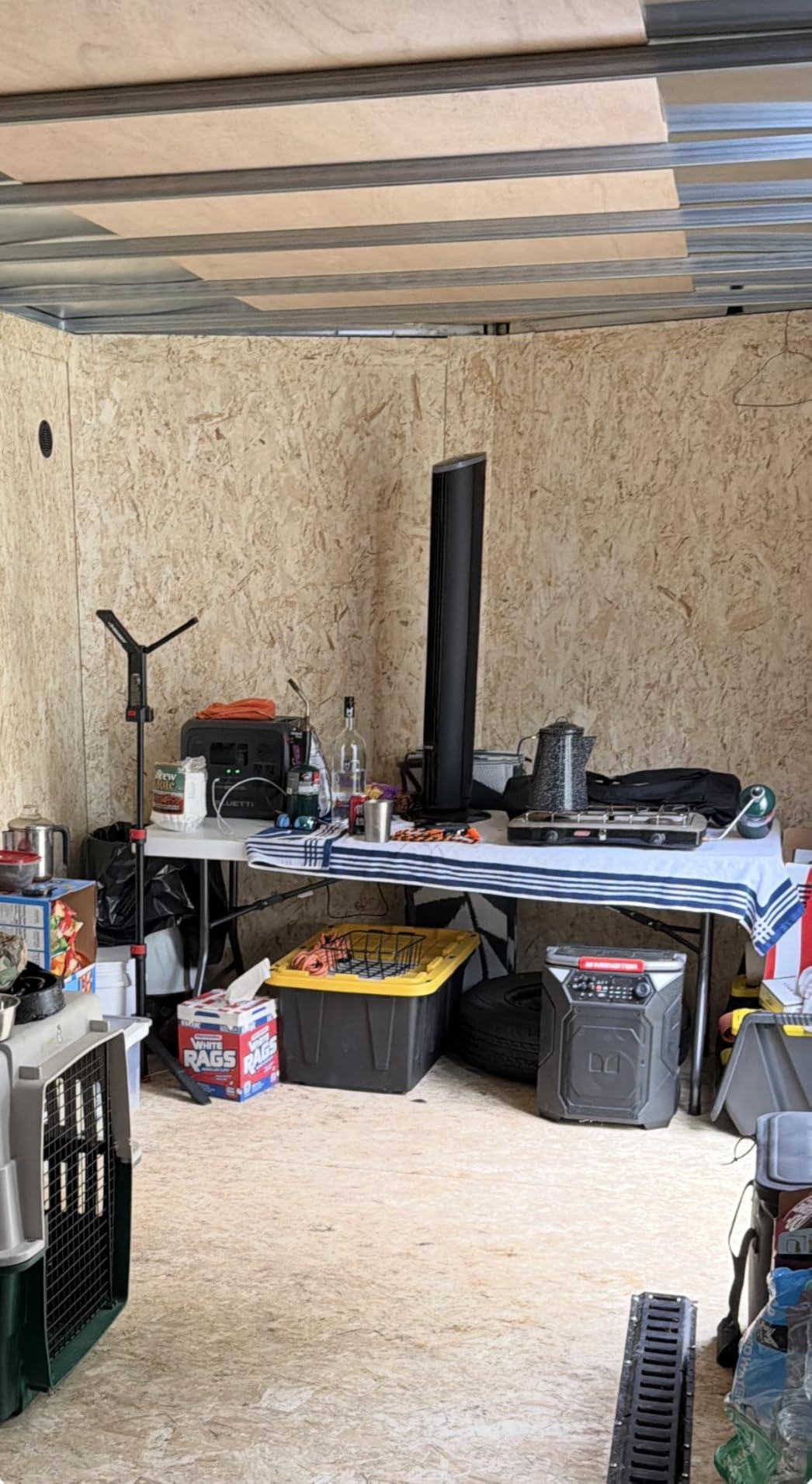
One owner reports holding a CPAP machine for four nights with more than a week of charge still remaining, which is the kind of real-world result that matters for medical device users. Another verified UPS function with a computer without interruption, and a tester measured roughly 77% round-trip efficiency. BLUETTI support is available 24/7 and resolved a panel-voltage compatibility issue for one customer.
The hard limit is that there are no battery expansion options, so capacity stays fixed near 3kWh. DC solar input is capped at 60V and 20A, below several competitors. A tester also documented a soft-start voltage ramp that prevented starting a floor dehumidifier, which matters if you plan to back up HVAC equipment.
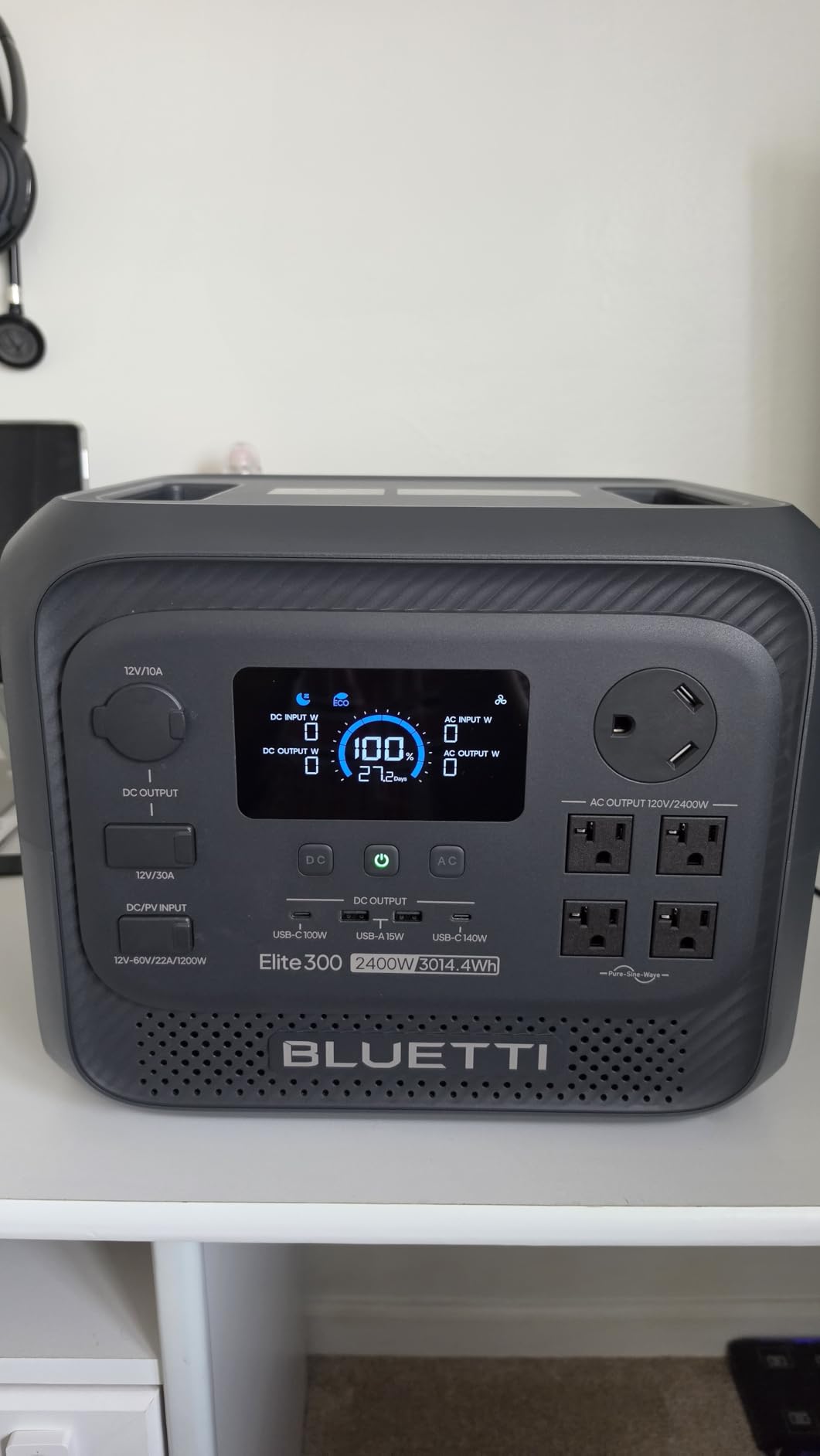
Why size is the selling point here
A 58-pound unit with a 3kWh battery changes the placement math. It moves through a doorway, fits beside a bed for medical device backup, and can live in an RV rather than a dedicated garage. The true 20A NEMA outlets and 30A 12V DC output are more useful than a pile of small USB ports when the load is a well pump or a trailer.
Where the ceiling bites
No expansion path means this is a weekend and medical-load device rather than a multi-day whole home system. Some features require the app with no full onboard control, firmware updates need Wi-Fi, and only an AC charging cable is included. The display can be hard to read in bright light.
10. PECRON F3000LFP — 3,072Wh With 3600W of Pure Sine Wave
PECRON Portable Power Station F3000LFP, 3072Wh Solar Generator, 3600W LiFePO4 Battery Home Backup, Fast Charging Power Station Expand Capacity to 10752Wh, Solar Generators for Home Use, Camping, RV
3072Wh LiFePO4 battery
3600W pure sine wave output
8-20ms UPS transfer
13 output ports
Pros
- 3600W pure sine wave covers refrigerators
- air conditioners and power tools
- Full recharge in 2 hours on 1800W AC input
- 13 ports including 100W USB-C PD for laptops
- UPS switchover of 8-20ms protects computers and medical devices
- App monitoring of real-time power usage
Cons
- Expansion requires a separately sold XT120-M cascade cable
- Weighs 63.3 pounds which limits portability
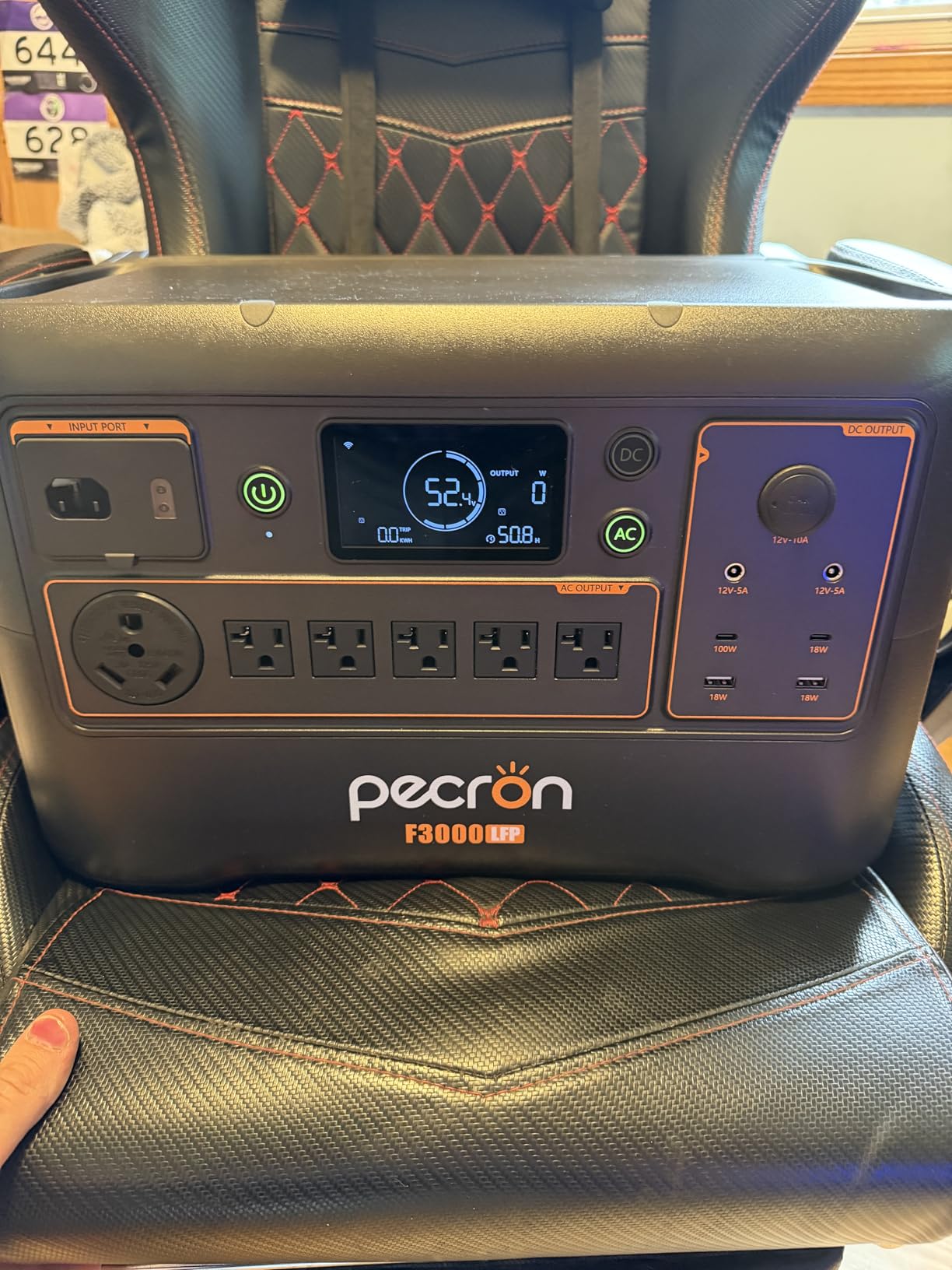
The F3000LFP delivers 3,072Wh of LiFePO4 capacity and 3,600W of pure sine wave output, expanding to 10,752Wh. Pure sine wave matters for sensitive electronics because it produces a cleaner waveform than modified sine wave units, and reviewers repeatedly mention computers and medical devices running through UPS mode without problems.
Charging is fast for the capacity: 1,800W maximum AC input takes the unit from zero to full in 2 hours, with solar input up to 1,600W across a 25-120V range. Thirteen ports include six AC outlets, two USB-C at 100W PD, two USB-A, a car port and two DC 5525 outputs.
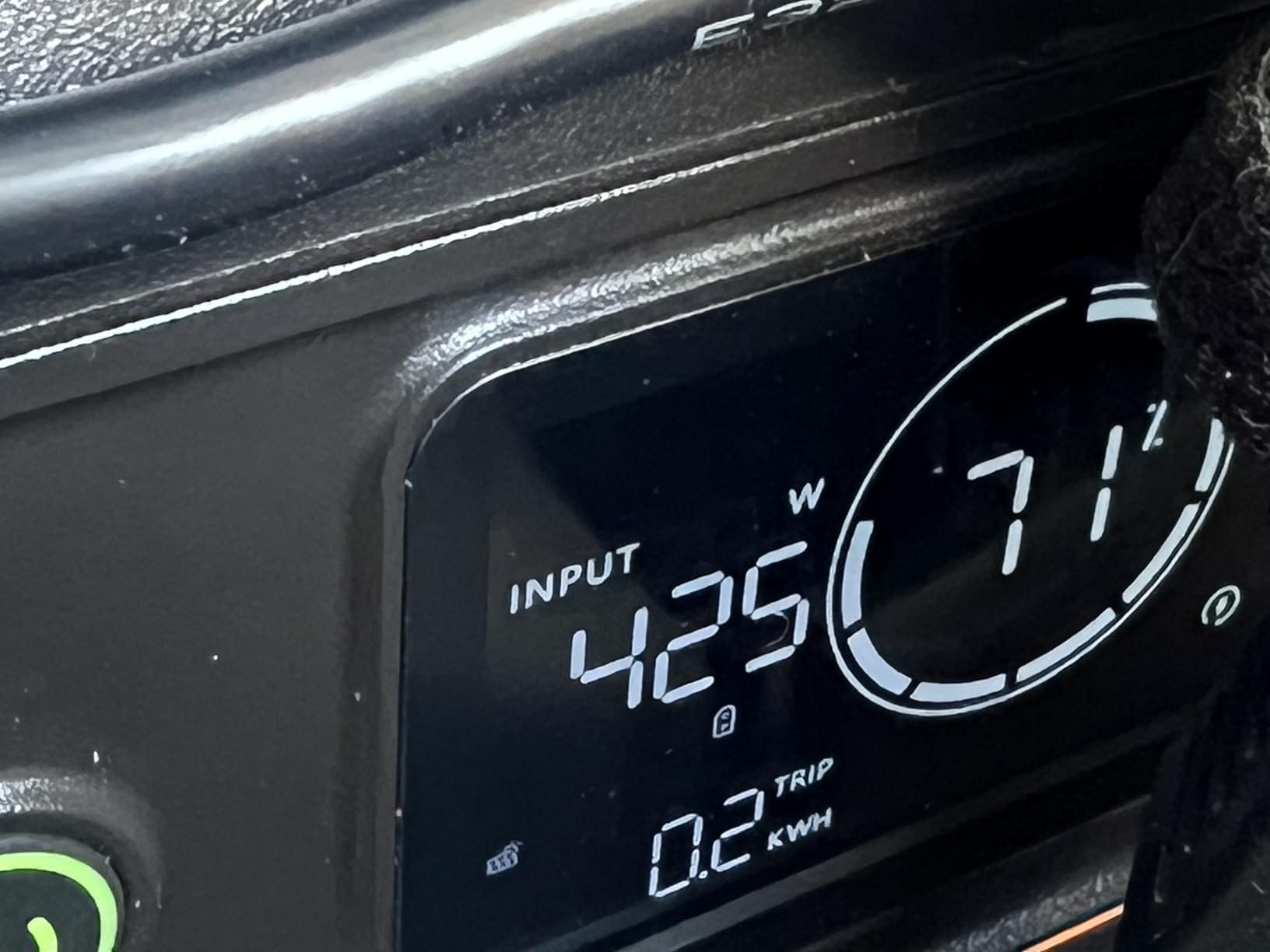
Runtime is quoted at up to 24 hours and 2-3 days of home essentials on backup, and several reviewers cite exactly that figure during real outages. The 2+3 year warranty with 24/7 customer service adds support that many cheaper competitors do not offer, and the app shows real-time power usage.
The practical gotcha is expansion. Connecting the EP3800-48V battery requires an XT120-M cascade cable sold separately, so the first expansion step costs more than the battery alone. At 63.3 pounds it is also one of the heavier units relative to its capacity, which limits true portability even though it can be moved between rooms.
Where the value sits
At this capacity and output, the F3000LFP undercuts larger-name units while keeping pure sine wave output and a sub-20ms UPS. Forum discussion of PECRON systems often involves pairing two units for 240V cabin backup, which is the natural next step for anyone outgrowing a single 120V box.
Who should look elsewhere
Buyers who know they will expand to full capacity on day one should budget for the cascade cable and the extra battery, since that changes the total. Anyone needing simultaneous 120V and 240V output from a single unit should look at the BLUETTI Apex 300 or the Anker F3800 instead.
11. ALLWEI 2048Wh — Smallest Footprint With Automatic ATS Recovery
ALLWEI 2400W LiFePO4 Power Station, 2048Wh Solar Generator with 1500W AC Charging &1200W Solar Charging, Expandable to 10.24kWh, with Pure Sine Wave AC Outlets for Home Backup, Power Outages & Camping
2048Wh expandable to 10240Wh
2400W with 3600W power lifting
1500W AC input
ATS UPS function
Pros
- ATS UPS automatically re-engages AC output after an outage
- 2400W pure sine wave inverter with 3600W power lifting
- 0-80% in 45 minutes on 1500W AC input
- LiFePO4 rated 3500+ cycles for a 10-year lifespan
- App control with remote switching and firmware updates
Cons
- Only a 2-year manufacturer warranty
- 2400W base output limits larger appliances
- Expansion battery is sold separately
The ALLWEI 2048Wh is compact at 18.3 by 10.2 by 11.6 inches and 51 pounds, with 2,048Wh of capacity that expands to 10,240Wh using SGR-B200 PRO packs. Output is 2,400W from a pure sine wave inverter, lifted to 3,600W for resistive loads through the power lifting mode.
Its standout feature is the ATS UPS function, which reactivates AC output automatically every time after a power outage without flipping a manual switch. That matters for unattended loads such as home security systems, aquariums and freezer circuits, where nobody is standing at the wall to press a button.
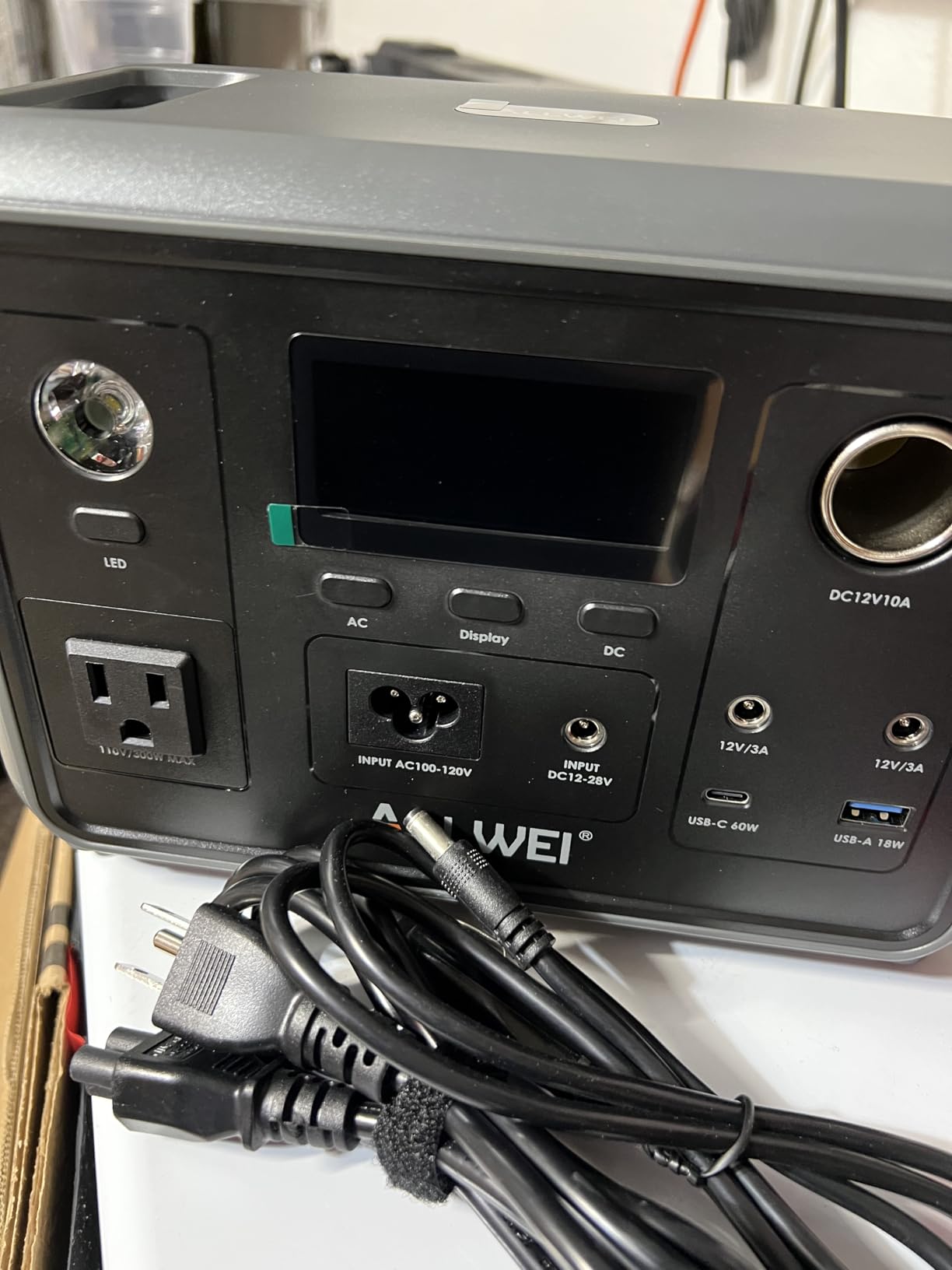
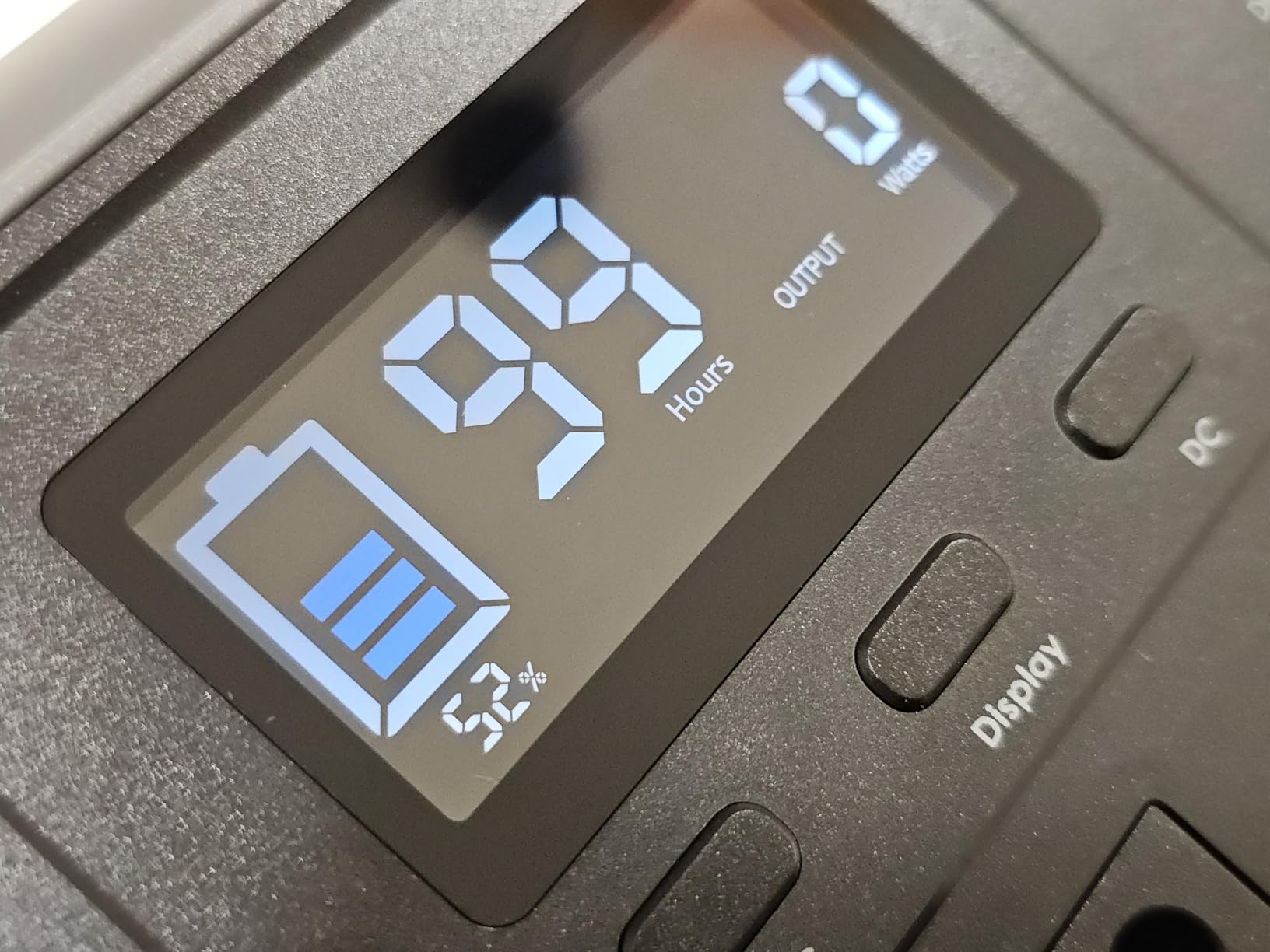
Reviewers consistently note fast charging, pure sine wave output and easy expandability as the strongest points for the money. A built-in BMS and MPPT sit alongside over-temperature, short-circuit and overload protection. Charging reaches 0-80% in 45 minutes on the 1,500W maximum AC input and completes in about 1.5 hours in Q mode, with 1,200W of solar input on top.
The most common stated drawback is the 2-year manufacturer warranty, which is the shortest in this roundup against a 3500+ cycle battery rating. Four AC outlets, a 2,400W base output and a separately sold expansion battery are the other limitations. Buyers who expect a decade of coverage should factor the shorter warranty into the ownership calculation.
Why automatic recovery changes the use case
Automatic ATS recovery means the unit returns to service on its own after the grid comes back and after an outage begins. For a sump pump, a network rack or a chest freezer, that removes the human step entirely. The app adds remote switching, charge mode control and remote firmware upgrades for owners who want visibility.
Where capacity runs short
2,048Wh is genuinely small for a house, and 2,400W will not start a large compressor without the power lifting mode. The path to 10,240Wh exists but requires buying the SGR-B200 PRO separately, so treat this as a starter unit that grows in steps.
12. GROWATT INFINITY 2000 Pro — 26 Pounds of 2,400W Backup
GROWATT INFINITY 2000 Pro Portable Power Station, 2048Wh Solar Generator
2048Wh LFP battery
2400W output
Cold start down to -22F
13 outlets including 30A Anderson
Pros
- Compact and light at 26 pounds
- fitting in a vehicle sub-trunk
- Ran a washer
- dryer
- coffee maker
- air fryer and two devices simultaneously
- App shows per-USB-port draw and expansion battery capacity
- Charges from about 30% to full in roughly an hour on AC
- Quiet fan during charging and operation
Cons
- PV input limited to 60V and 20A at 1200W
- Included XT60 solar cable is only 14AWG
- XT60i polarity is non-standard with positive on the third pin
- Listed inverter output of 2200W is actually 2400W
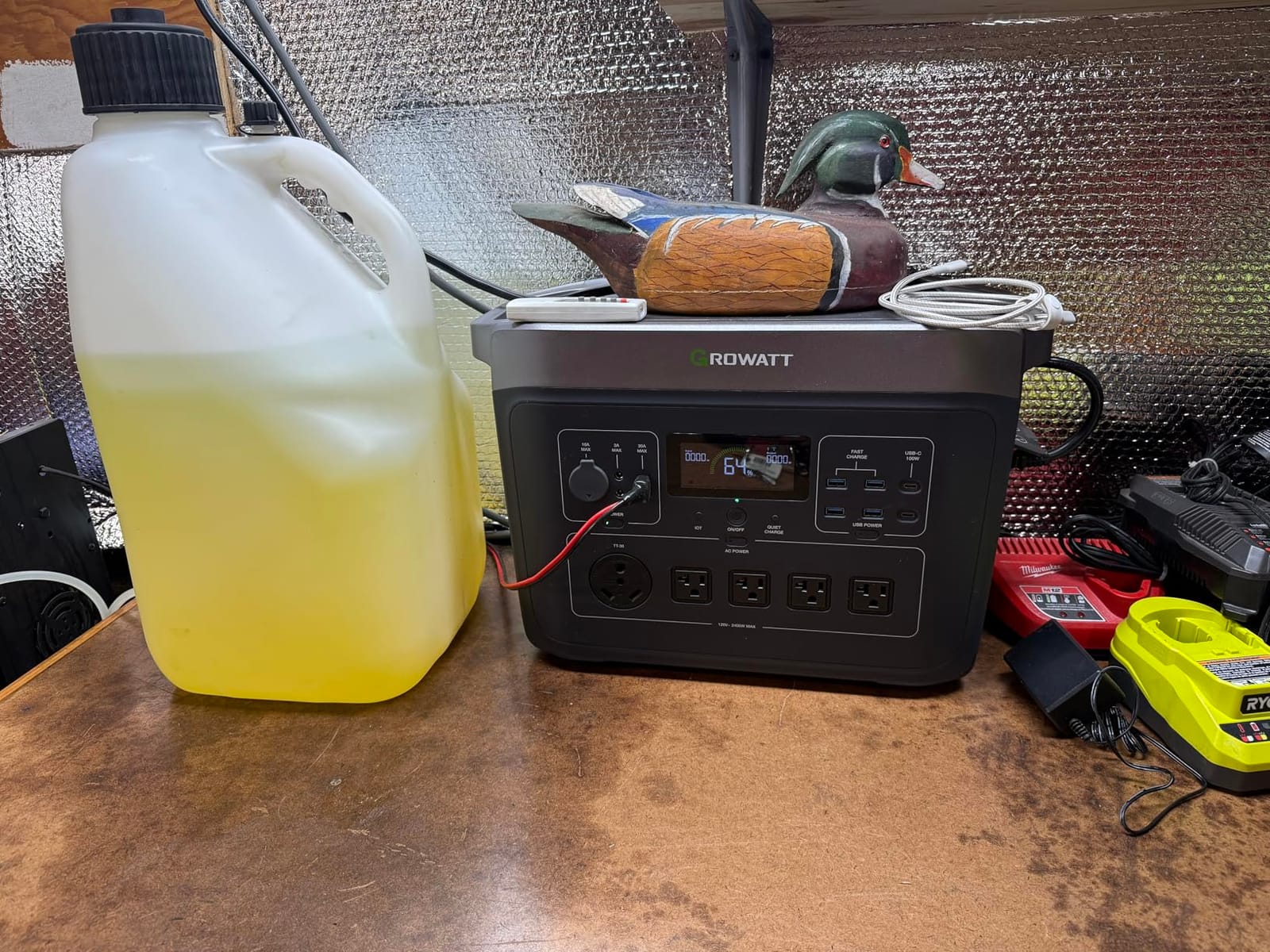
The INFINITY 2000 Pro is the lightest capable unit here at 26 pounds, with 2,048Wh of EV-grade LFP capacity expanding to 6,144Wh with two expansion batteries. Despite the name, the inverter output is 2,400W, and there are 13 outlets including a 30A Anderson DC output, four 20A AC outlets and one 30A AC outlet.
It also carries the cold start rating of -22F and a 15ms EPS switchover, plus 4,000+ cycle LFP cells with up to a 10-year lifespan, UL certification and a 5-year warranty. One reviewer verified that two panel strings in series deliver up to 1,044W through the PV input.
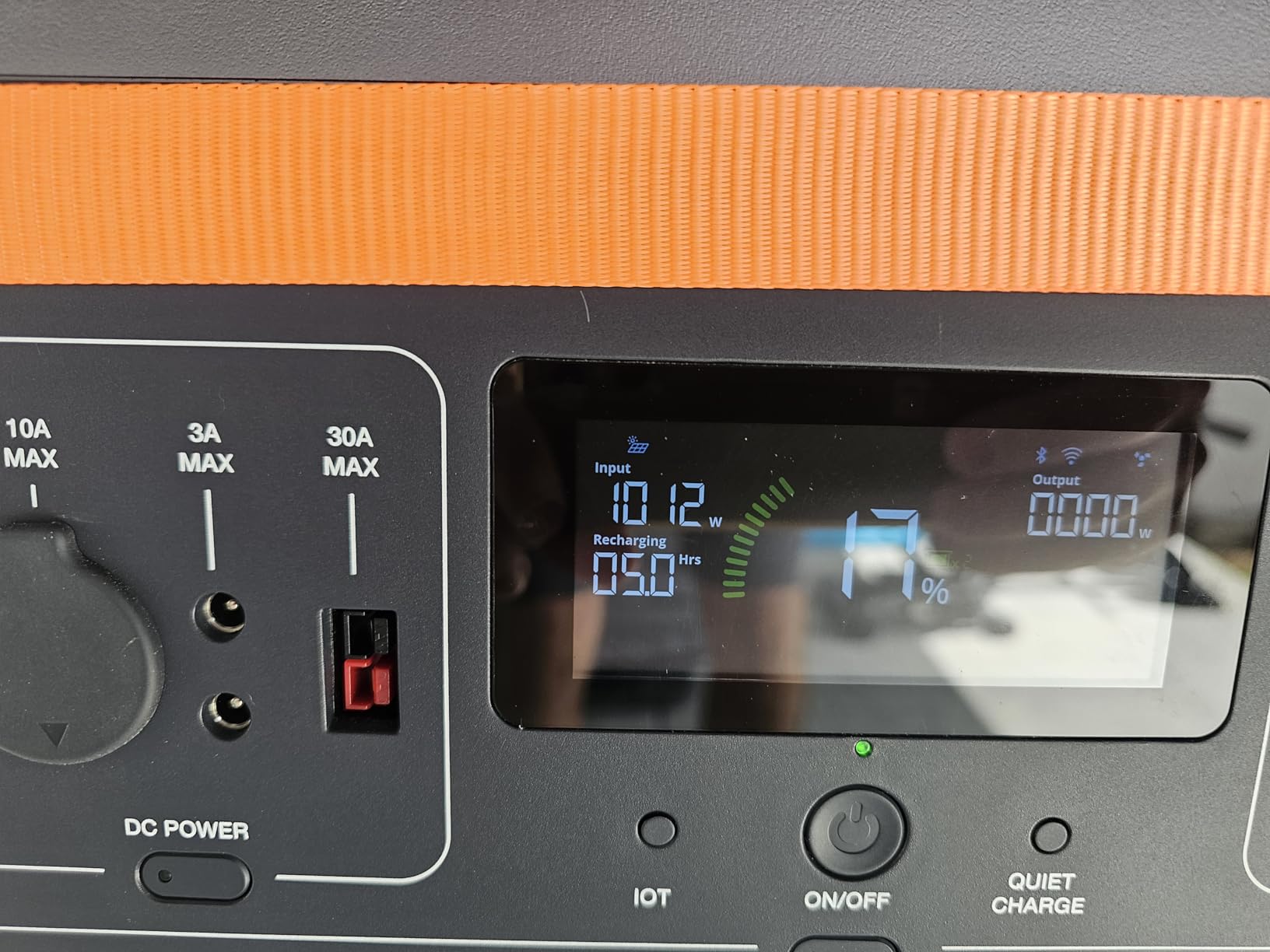
Owners praise the combination of portability and real 2,400W output, using it for off-grid work and daily home use. One ran a washer, dryer, coffee maker, air fryer and two devices at the same time. The app shows per-USB-port draw and the capacity of each attached expansion battery, and charging from about 30% to full takes roughly an hour on AC.
Detailed reviewers document two wiring gotchas. PV input is limited to 60V and 20A at 1,200W, and the included XT60 solar cable is only 14AWG, which limits current. The XT60i polarity is also non-standard, with the positive lead connecting to the third pin, a mistake that can damage a setup if you assume the usual convention.
Where a 26-pound unit earns its place
Nothing else in this roundup can move from a closet to a car sub-trunk to a job site in one trip. That portability makes it a genuine emergency kit for a household that rents, travels or wants a unit stored away rather than installed. The 6,144Wh expansion ceiling is modest but usable for a weekend.
Where the small details cost you
A few owners reported a DC charge port that pushed into the case and disabled solar charging, and one received a unit that would not power on and had difficulty obtaining a return. Support communication was described as poor by some buyers. Confirm the PV voltage ceiling and use a proper gauge wire before wiring panels.
How to Size a Whole Home Backup System in Four Steps
Start with what you actually lose when the power goes out, not with the size of your house. Most households do not need central air, a water heater and an EV charger on the same circuit. For a broader look at house-wide systems, our guide to the best natural gas generators for whole house backup covers what a combustion system handles that a battery cannot.
Step one: list the circuits. Write down every load you want on during an outage and note its running watts and surge requirement. A refrigerator averages far less than its nameplate rating once the compressor cycles, while a well pump or central air conditioner draws heavy startup current. Motors need surge headroom, and that requirement often eliminates a small station before capacity does.
Step two: convert to daily watt-hours. Multiply each load by the hours you expect it to run per day, then add roughly 15% for conversion losses. A household running a 150W refrigerator for 12 hours, 40W of networking and lighting for 16 hours, and a 60W well pump for four hours lands near 3,400 watt-hours per day. That figure tells you whether you need one base unit or a bundle.
Step three: pick a tier. Essentials-only households are comfortable with 2-3kWh. A family that also heats, cools or pumps water generally wants 7-10kWh on hand. Multi-day ice storm planning pushes toward 12kWh or more, which is where the EcoFlow DELTA Pro Ultra X and the DELTA Pro 3 bundle come into play.
Step four: plan the expansion path. Confirm the maximum capacity the unit reaches, which battery packs it takes, and whether connecting them needs a separate cable. Several units in this roundup expand to more than 10kWh, but the PECRON F3000LFP requires an additional XT120-M cascade cable and the BLUETTI Elite 300 does not expand at all. Check the 240V question last, because it rules out more options than capacity does.
Buying Guide: The Nine Specs That Decide Your Purchase
1. Continuous and surge output. Rated watts handle steady loads; starting watts handle motors. A 3,600W station with 7,200W peak covers far more household equipment than a 3,600W station that stalls on a compressor.
2. 120V and 240V capability. Well pumps, electric water heaters, dryers, central air and EV chargers need 240V split-phase output. The Anker F3800, the BLUETTI Apex 300, the Jackery HomePower 3600 Plus, the GROWATT HELIOS 3600 in parallel and the EcoFlow units all provide it. The AFERIY, ABOK, PECRON, ALLWEI and GROWATT INFINITY 2000 Pro are 120V only.
3. Expansion ceiling and ecosystem lock-in. Expansion batteries are brand-specific in every case we examined. Ceilings range from none on the BLUETTI Elite 300, to 6,144Wh on the GROWATT INFINITY 2000 Pro, to 48kWh on the EcoFlow DELTA Pro 3 and 180kWh on the DELTA Pro Ultra X. Budget the expansion packs, not just the base unit.
4. UPS switchover time. Anything under 20ms keeps computers, network gear and medical devices running through a flicker. The DELTA Pro Ultra X restores power in under 20ms, the Anker F3800, BLUETTI Apex 300, BLUETTI Elite 300, AFERIY and PECRON units all sit at or below 20ms, and the GROWATT models use 15ms EPS.
5. Cold weather performance. Two distinct numbers matter: cold start temperature and whether charging is throttled. The GROWATT HELIOS 3600 and INFINITY 2000 Pro start down to -22F, the Jackery HomePower 3600 Plus operates down to -4F, and the Anker F3800 throttles charging below roughly 50F. If your battery sits in an unheated garage in January, this decides the purchase.
6. Solar input limits. A 60V or 60Voc PV ceiling, common on the Anker F3800, the BLUETTI Apex 300, the BLUETTI Elite 300 and the GROWATT INFINITY 2000 Pro, restricts how many panels you can wire in series. Higher ceilings such as the BLUETTI’s 2,400W built-in input give you more room as the array grows.
7. Pass-through charging and ATS recovery. Pass-through lets the battery charge while still delivering output, and an ATS re-engages AC output automatically after an outage. The BLUETTI Apex 300 supports 120V pass-through with simultaneous 240V output, and the ALLWEI’s ATS UPS restores output without anyone touching a switch.
8. Warranty and cycle life. Cycle ratings range from 3,500+ on the ALLWEI to 6,000+ on the BLUETTI Apex 300 and Elite 300, with a claimed 17-year lifespan. Warranty terms range from 2 years on the ALLWEI to 5 years on most others, and the BLUETTI listings do not state a warranty figure, which is worth confirming directly.
9. App reliability. Monitoring software varies more than hardware does. The GROWATT HELIOS 3600 draws repeated complaints about Bluetooth pairing failures and intrusive permissions, the Anker F3800 app lacks historical graphs and drops Wi-Fi occasionally, and the BLUETTI Elite 300 requires the app for some functions with firmware updates tied to a connection. If you plan to monitor remotely, verify this before buying.
One more consideration worth weighing: for lighter outages and travel use, our roundup on the best portable power stations for camping covers smaller formats where runtime and weight matter more than panel integration.
Frequently Asked Questions
What is the best power station for home backup?
The Anker SOLIX F3800 bundle is the strongest all-round choice because it delivers 7,680Wh with the expansion battery, 6,000W of continuous dual 120V and 240V output, and an expansion path to 26.9kWh. For maximum capacity growth, the EcoFlow DELTA Pro Ultra X scales from 12kWh to 180kWh.
Is Jackery or EcoFlow better?
EcoFlow offers far more expansion headroom, with the DELTA Pro 3 reaching 48kWh and the DELTA Pro Ultra X reaching 180kWh, plus X-Boost for brief loads above rated output. Jackery wins on weight and reach: the HomePower 3600 Plus weighs 77.2 pounds, carries a telescoping handle and recharges fully in 2 hours on hybrid input.
What size power station do I need for whole home backup?
Most households need 3-7kWh for essentials, and 7-12kWh when you want refrigeration, lighting, networking, a water pump and medical devices through a multi-day outage. Central air, well pumps and electric water heaters push you toward 12kWh or more, or toward a system with 240V split-phase output.
Do I need a transfer switch for a power station?
You need one if you want the unit to take over your home’s circuits automatically rather than powering a few extension cords. The EcoFlow DELTA Pro Ultra X works with a standard 10-circuit transfer switch, the Jackery pairs with its own transfer switch, and the BLUETTI Apex 300 is built for simultaneous 120V and 240V output through a panel.
Can a power station run 240V appliances?
Only if the unit provides split-phase 240V output. The Anker SOLIX F3800, BLUETTI Apex 300, Jackery HomePower 3600 Plus and both EcoFlow systems in this roundup can do it. The AFERIY, ABOK Ark3600, PECRON F3000LFP, ALLWEI and GROWATT INFINITY 2000 Pro are 120V only, and two GROWATT HELIOS 3600 systems in parallel reach 240V at 7,200W.
How long does a power station last during an outage?
It depends on load and capacity. The GROWATT HELIOS 3600 is rated for up to 15 hours on daily home devices, the AFERIY about 17 hours on household essentials, and the PECRON F3000LFP 2-3 days of essentials. Reviewers running a refrigerator report multi-day runtimes on the 3,840Wh and 3,584Wh units, while a large window air conditioner drains a 3,600Wh battery much faster.
Conclusion: Which Expandable Power Station Fits Your Home
The Anker SOLIX F3800 is our pick for the best expandable power station for whole home backup, because 7,680Wh, 6,000W of dual 120V and 240V output and a path to 26.9kWh cover the circuits most households actually need, and it carries by far the deepest review base we analyzed.
Choose the EcoFlow DELTA Pro Ultra X when you want headroom well beyond a weekend, the BLUETTI Apex 300 when a well pump or dryer circuit is non-negotiable, and the Jackery HomePower 3600 Plus when weight and simple recharging options matter most. Pick the GROWATT HELIOS 3600 or INFINITY 2000 Pro if cold starts decide your winter, and the BLUETTI Elite 300 when a 3kWh battery has to fit through a doorway.
Check the transfer switch requirements with a licensed electrician before you buy, then start with the base unit and add expansion packs once you have measured your real runtime.