
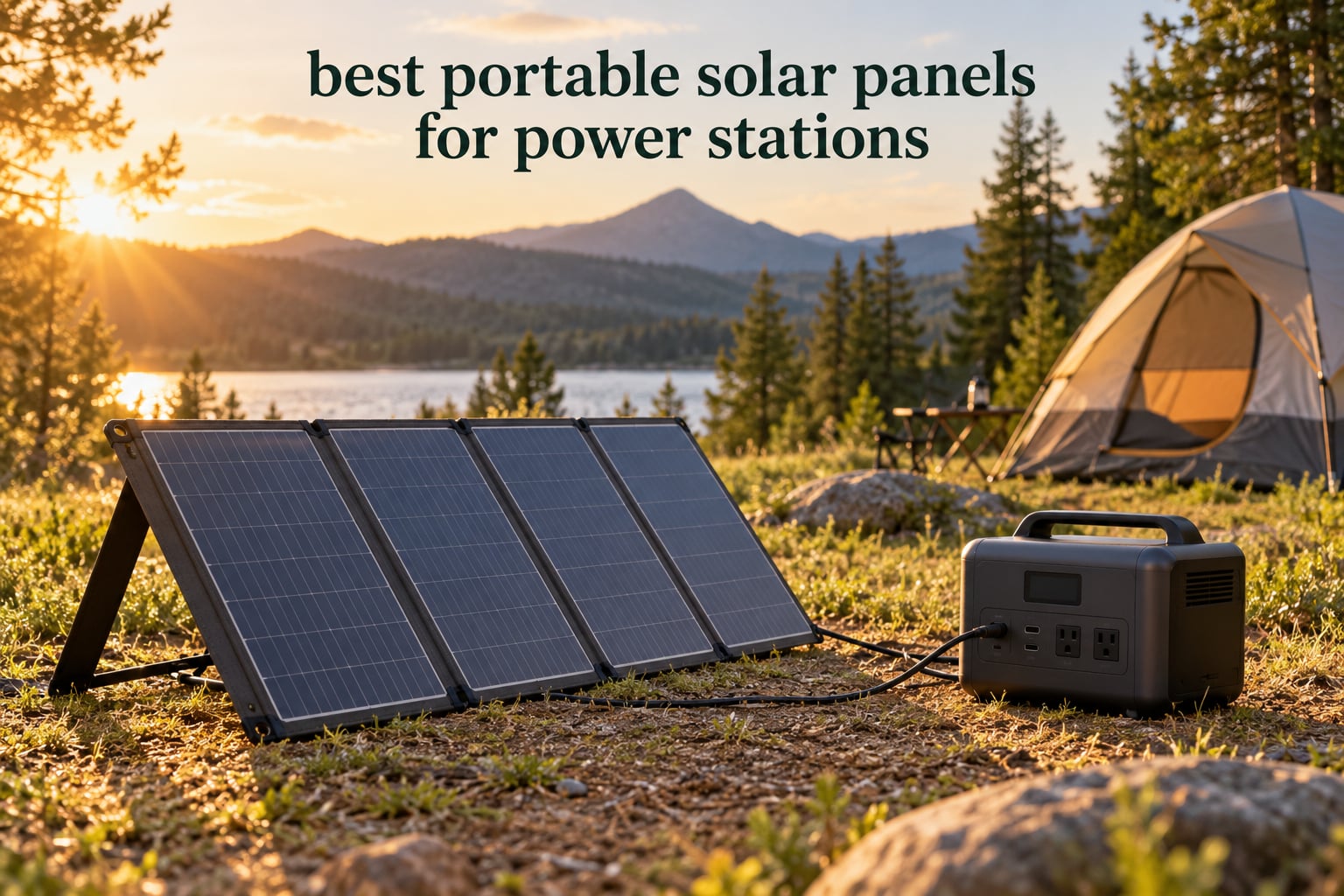
A portable solar panel for a power station is a foldable, lightweight photovoltaic module that converts sunlight into DC current to recharge a portable power station or a 12V battery bank off-grid. Almost every one of them uses monocrystalline or N-Type cells, comes with an MC4 output, and trades some durability for a packable size. That combination is what makes the best portable solar panels for power stations such a specific purchase rather than a generic solar buy.
Two numbers decide the outcome before you ever unbox anything. The first is the connector: Jackery uses DC8020, EcoFlow and Anker SOLIX use XT60, BLUETTI mixes MC4 with aviation plugs, DJI uses a proprietary SDC port, and Goal Zero uses 8mm. Buy the wrong end and the panel is a paperweight. The second is your power station’s own maximum solar input wattage, which quietly caps what a bigger panel can deliver no matter how good the cells are.
We read through the full review pool on all ten panels in this 2026 roundup, cross-checked every spec against the manufacturer listing, and sorted them by how well they handle those two constraints. What we found is that the gap between advertised wattage and delivered wattage is the single biggest source of buyer frustration, and that most of it comes down to sun angle, controller losses, and an input cap people never check.
If you have not picked a station yet, start with our portable power station guide first. If you already own one and want the broader panel picture, our camping solar panel roundup covers setups that never touch a battery bank.
Table of Contents
Top 3 Picks for the Best Portable Solar Panels for Power Stations for October 2026
Three panels stood out once we sorted the list by output, connector coverage, weight, and how much the reviews complain about the gap between the label and the real number. The HQST 200W leads on balance, the ZOUPW 100W leads on rating and connector range, and the Renogy 200W leads on proven high-output reliability.

All 10 Panels Compared Side by Side for October 2026
Every panel below has a different reason to exist. The table gives you the headline specs at a glance, and the lines under it explain who each one actually suits.
| Product | Specifications | Action |
|---|---|---|
 HQST 200W N-Type HQST 200W N-Type |
|
Check Latest Price |
 Renogy 100W Portable Renogy 100W Portable |
|
Check Latest Price |
 Powkey 40W Powkey 40W |
|
Check Latest Price |
 ZOUPW 100W ZOUPW 100W |
|
Check Latest Price |
 EBL 100W EBL 100W |
|
Check Latest Price |
 SOKIOVOLA 200W N-Type SOKIOVOLA 200W N-Type |
|
Check Latest Price |
 FlexSolar 100W FlexSolar 100W |
|
Check Latest Price |
 TWELSEAVAN 200W TWELSEAVAN 200W |
|
Check Latest Price |
| Renogy 200W Portable |
|
Check Latest Price |
 Renogy 400W Solar Blanket Renogy 400W Solar Blanket |
|
Check Latest Price |
The HQST 200W and the Renogy 200W are the two panels to shortlist if your station accepts 200W of solar input. The FlexSolar 100W and the Powkey 40W win on weight, and the Powkey is really a top-up device rather than a refill. The ZOUPW 100W is the one to buy if you swap between stations or borrow panels to friends.
The SOKIOVOLA 200W has the tightest sealing in the group at IP68, and the TWELSEAVAN 200W has the strongest direct USB-C port at 60W. The Renogy 400W blanket is the only panel here aimed at stations of 2000Wh and above. The EBL 100W earns its place because two of them wired in series are a simple way to push input voltage up into a station’s window.
1. HQST 200W N-Type – Best Overall for Most Setups
HQST 200W Portable Solar Panel, N-Type, 25% Efficiency, IP67 Waterproof
200W rated
25% N-Type cells
11 lb
IP67 sealed
3-in-1 cable
Pros
- 25% 16BB N-Type cells in a 200W frame
- 11 lb is light for the class
- IP67 fully laminated build
- 3-in-1 cable covers XT60 DC7909 and DC5521
- two kickstands adjust from 40 to 60 degrees
Cons
- Included 4.9 ft adapter cable limits reach
- needs a station input window wide enough for full output
- 12-month warranty is short for the money
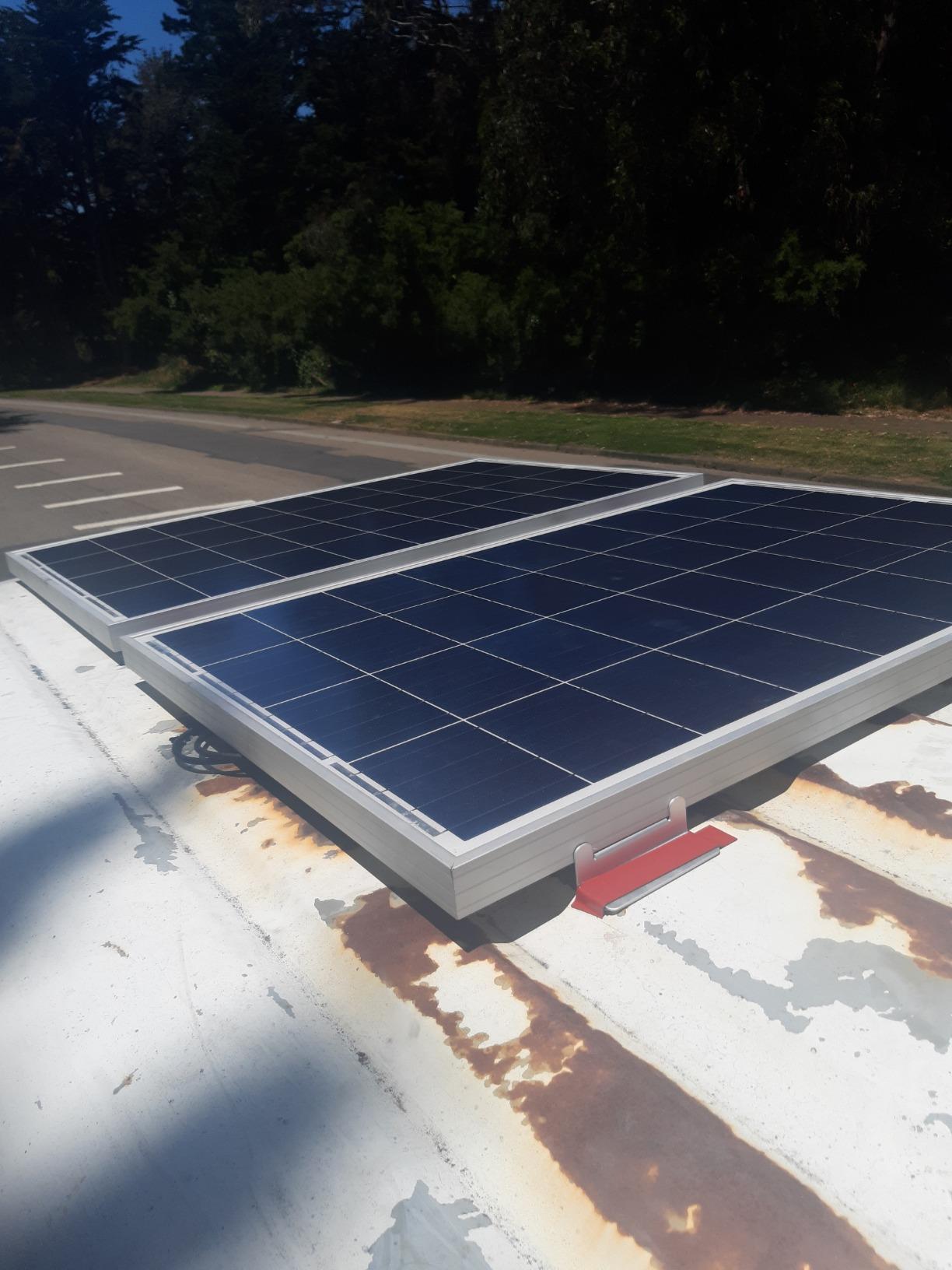
This is the panel we keep coming back to. The HQST 200W uses 16BB N-Type cells rated at up to 25 percent efficiency, sits in a fully laminated body with a PVDF-coated outer layer, and weighs 11 lb, which is light for a rigid 200W panel of this cell type. It folds to 1.97 inches thick and the two kickstands set anywhere from 40 to 60 degrees, so you can chase the sun without repacking it.
What makes it our top pick is the balance rather than any single headline number. A 100W panel leaves a 1000Wh station waiting more than two days for a meaningful refill, and a 400W panel is dead weight unless you own something very large. Two hundred watts is the sweet spot for the widest range of setups, and this one pairs that with a rigid frame and a 3-in-1 lead that covers the three most common station brands.
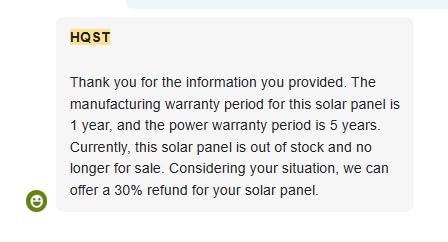
Owners consistently describe the rigid frame as a genuine upgrade over soft fabric foldables, which tend to wrinkle and lose contact. The buckles are integrated rather than loose, and the review summary notes that people like the broad power station compatibility the 3-in-1 cable gives them. Setup is described as starting in seconds, which matters more than it sounds when the weather window is short.
The recurring caution is wind. Because the panel is stiff and light, it behaves like a sail, and several reviews mention needing a stake or a guyline through the frame grommets in a gust. The same reviews stress the same thing we would: without proper sun angle the output drops well short of the 200W label, so the kickstand angle matters as much as the cells.
Check the input window on your station before you buy
The single most common reason a 200W panel disappoints is not the panel. Reviewers across this category report that a power station with a lower maximum solar input simply refuses the extra wattage, and this model’s own listing calls out that it needs a compatible input voltage to deliver full output. Read that spec on your station first.
The bundled lead is 4.9 ft, which is short enough that you will likely want a longer run. A longer low-voltage MC4 cable also introduces line loss, so buy 10 gauge rather than 16 gauge if you plan to set the panel more than a few feet from the station.
Where this panel is not the right call
If you carry everything on foot, 11 lb adds up fast, and the FlexSolar 100W at 4.1 lb is a far more sensible pack. If your station is a 300Wh or 500Wh unit with a low input ceiling, this panel will be throttled and a 100W unit is the smarter spend.
Buyers who need a longer warranty should also look past this one. The 12-month cover is half the two years carried by both Renogy models in this roundup.
2. Renogy 100W Portable – Best Value for 300Wh to 1000Wh Stations
Renogy 100W Portable Solar Panel for Power Stations, 25% High Efficiency
100W rated
25% N-Type
7.3 lb
USB-C PD 45W
UL 61730
Pros
- Deepest 100W review pool here at 941 ratings
- 7.3 lb
- USB-C PD 45W plus two USB-A ports
- four kickstands at 40 50 and 60 degrees
- UL 61730 certified
Cons
- No MC4 adapter in the box
- light frame acts as a sail in wind
- USB-C output caps near 40-45W
The Renogy 100W sits inside the deepest review pool in this roundup, and the reason is simple: it does almost everything right at a size most people can actually carry. At 7.3 lb it folds to roughly 23 by 22.5 by 1.6 inches, uses 16BB N-Type cells at 25 percent efficiency, and includes a magnetic closure handle that makes the whole pack feel considered rather than assembled.
Reported output in full sun lands between 85 and 93W for many owners, which is a much narrower gap between label and reality than most panels in this category manage. That consistency is why it has held its position in the category for years, and it is why our camping panel roundup leans on the same design philosophy.
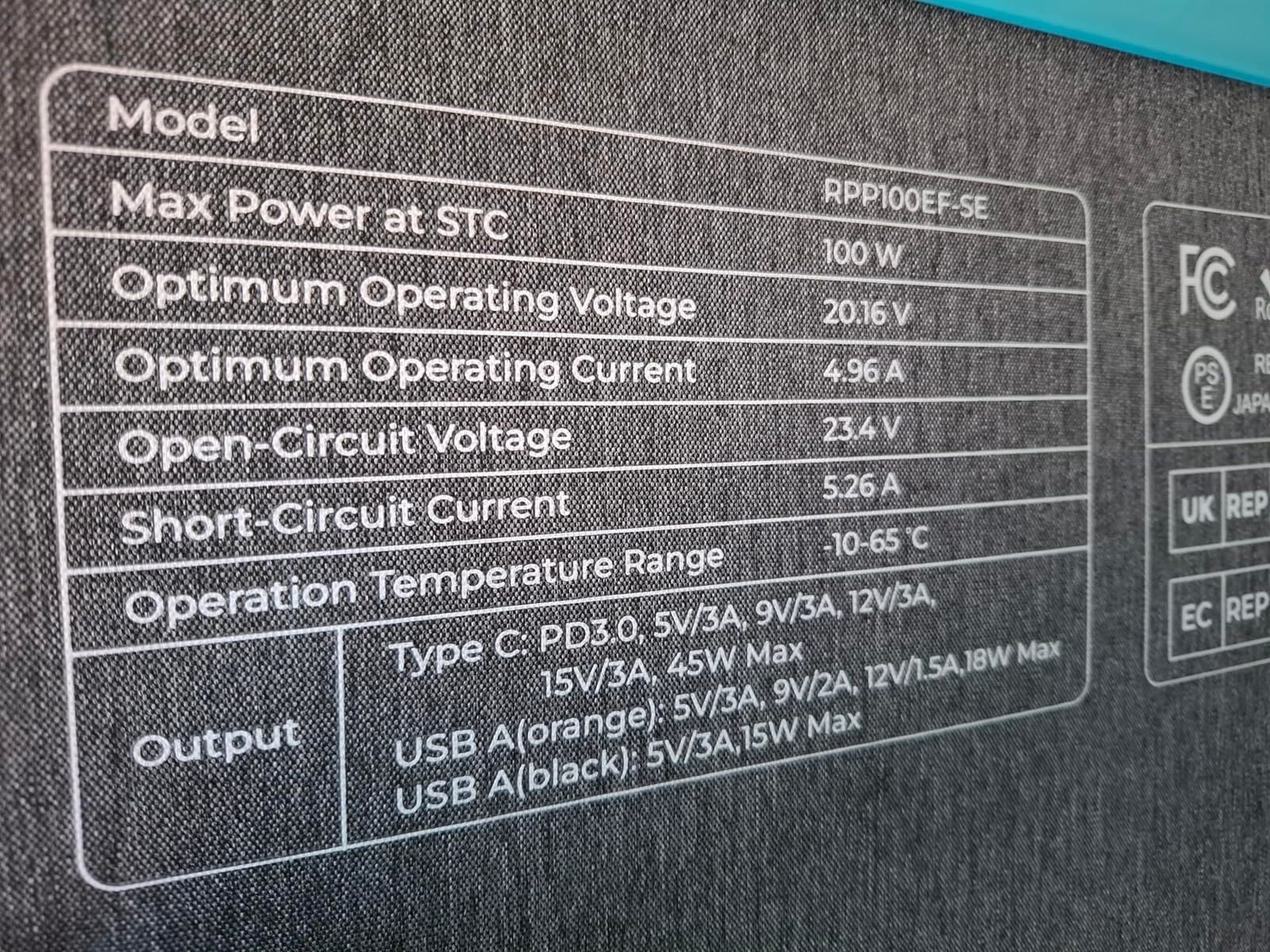
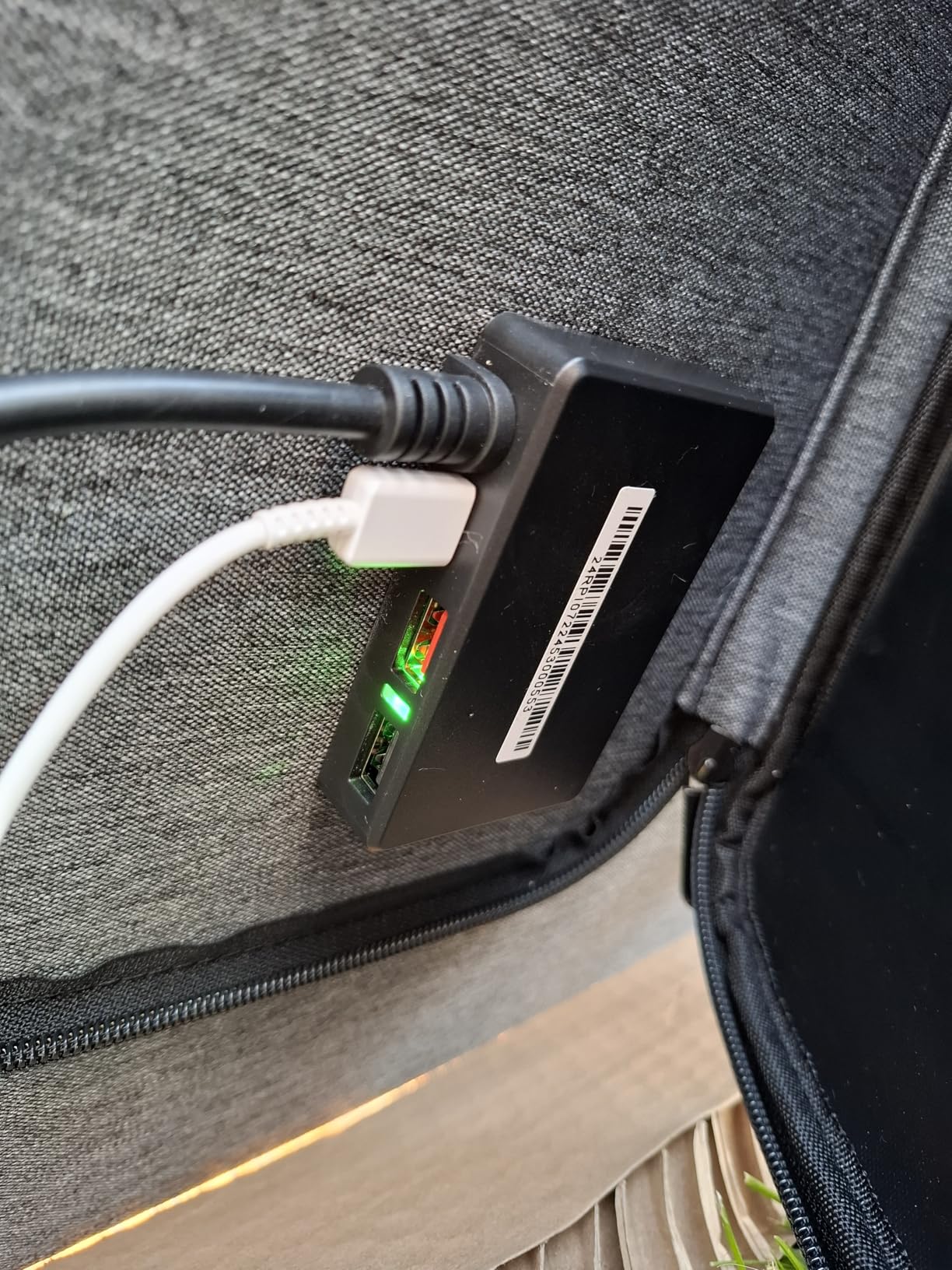
Beyond the station input, this panel does something most competitors skip: it charges devices directly. The USB-C PD output tops out at 45W alongside two USB-A ports at 18W and 15W, so phones, headlamps, and small tablets can top up while the station sits charging. Owners like the shade tolerance too, and note it works well in series for higher voltage and lower line loss.
The gaps are practical rather than fatal. The MC4 cable is short and no adapters are included, so a Jackery or EcoFlow owner needs to buy an adapter separately. The legs are described as flimsy on uneven ground, and because the panel is light it needs stakes in any real wind.
Why the USB-C port is worth having in a pinch
The 45W USB-C PD output is the feature that saves a trip when the station is flat and the sun is out. Several owners describe charging a laptop or camera battery directly from the panel, though the consensus is that 40-45W will not sustain a hungry workstation machine. Think top-ups, not replacements.
It also means the panel stays useful even when you leave the battery at home, which matters for maintenance charging of 12V AGM, LiFePO4, and deep cycle banks through the MC4 port.
What to watch out for
Owners report a small minority of panels that severely underperform with low short-circuit current, and warranty registration on the brand site is a common friction point. If you buy far from home, factor that into your support expectations.
Also keep the input ceiling in mind. On a station that accepts 100W of solar, this panel runs at its limit. Pairing two together is possible, but only if the station’s input window accepts the combined voltage and current.
3. Powkey 40W – Best Lightweight Top-Up Panel
Powkey 40W Portable Solar Panel for 100W~200W Portable Power Station
40W rated
22% mono cells
4.2 lb
IPX4
10-in-1 cable
Pros
- 4.2 lb and folds to 13.6 by 9.8 by 2.4 inches
- charge controller built into the zip panel
- 10-in-1 connector cable plus a DC-to-DC lead
- useful for power banks and phones
Cons
- 40W is a top-up
- not a station refill
- IPX4 splash rating only
- several owners report output well under the claim
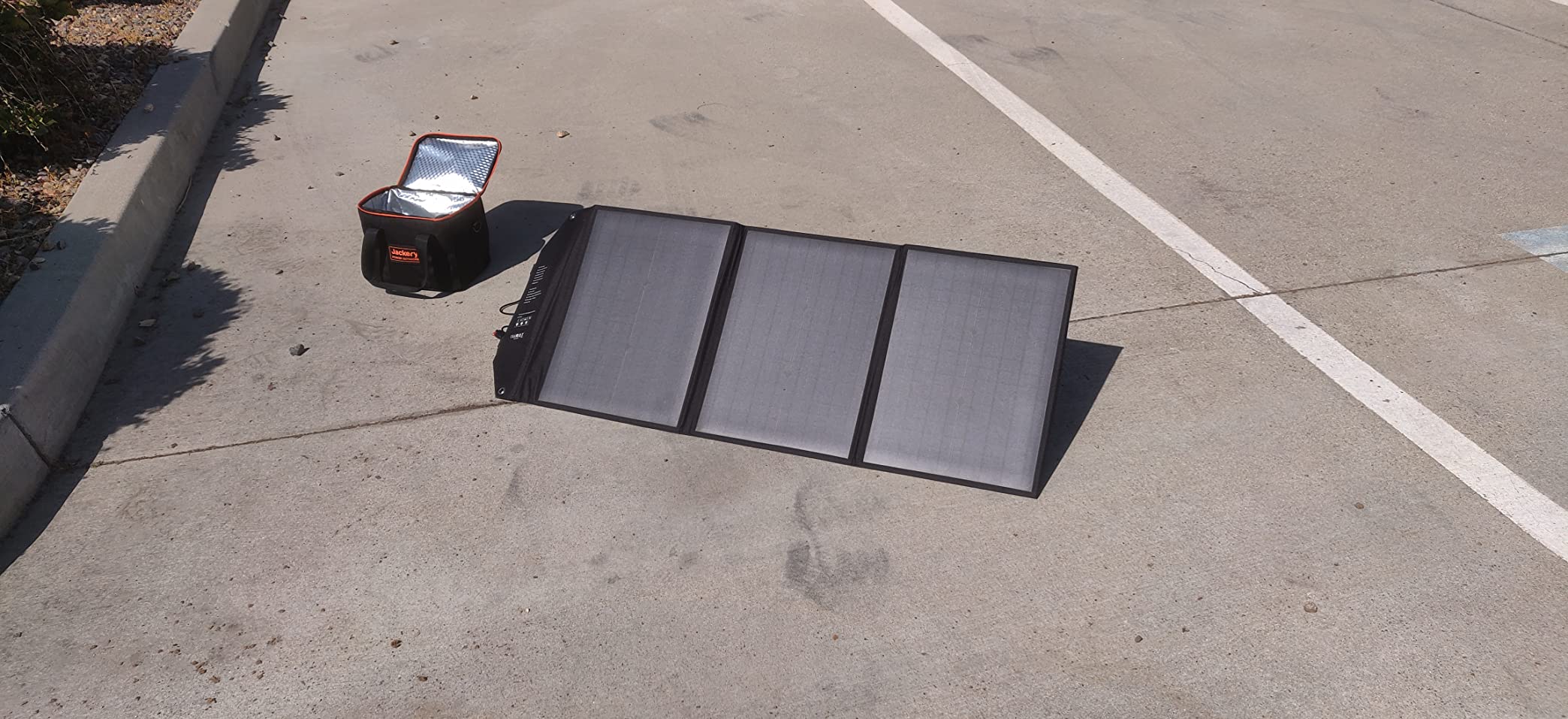
Be clear about what this panel is. The Powkey 40W is not going to refill a 1000Wh station in a weekend. It is a maintenance panel that keeps a small battery bank topped up on a long trip, charges a power bank on the dash, and gives you something to run directly in daylight when the station is reserved for bigger loads.
At 4.2 lb and folding to roughly 13.6 by 9.8 by 2.4 inches, it is one of the easiest panels here to pack, and the 22 percent monocrystalline cells are perfectly respectable for the job. The unusual detail is the built-in controller housed inside the zip-up storage panel, which keeps the wiring tidy and removes one box from your gear list.
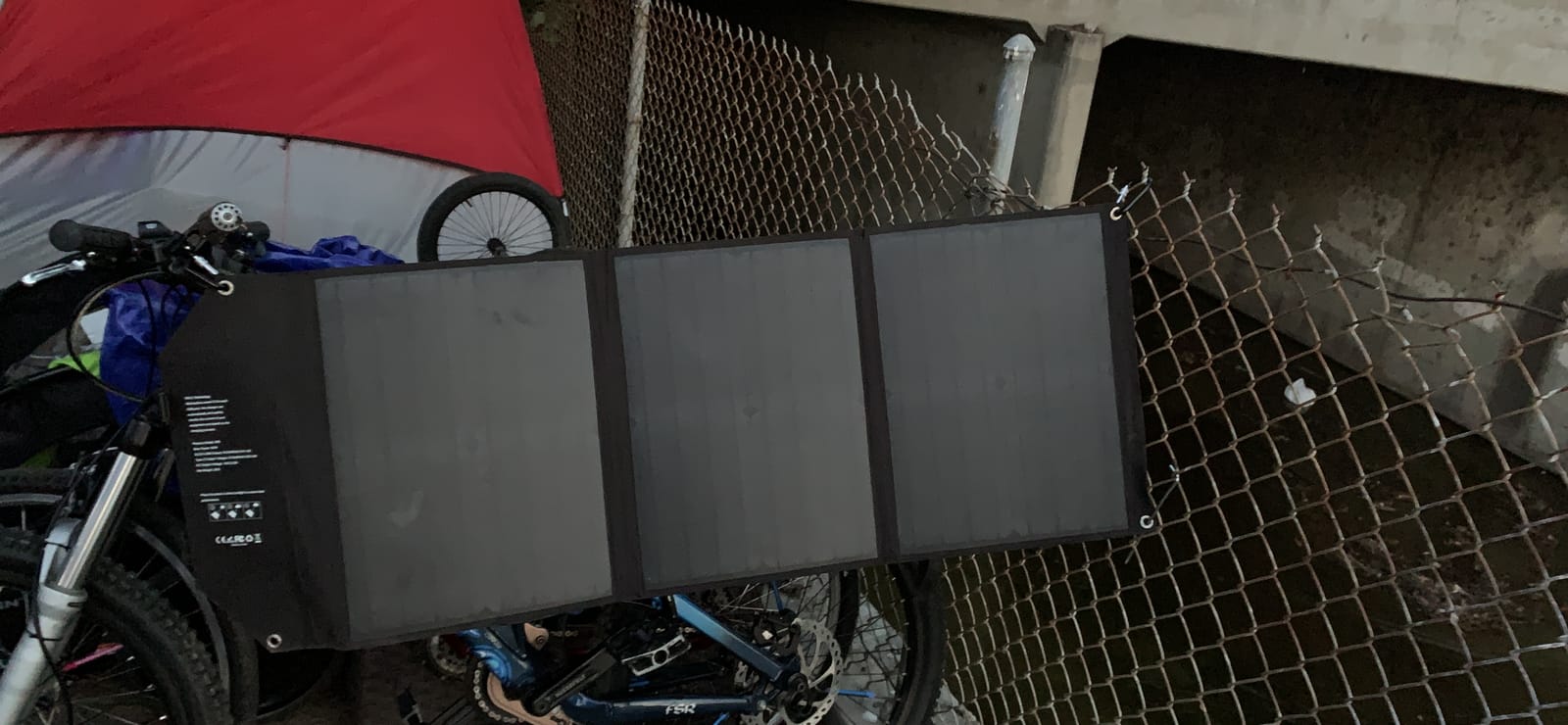
The full kit includes the panel, a 10-in-1 connector cable, a DC-to-DC lead, and a manual. The DC output runs at 15V and 2.6A, and the USB output covers 5V/3A, 9V/2A, and 12V/1.5A, so it will negotiate with most handheld devices using the included cable.
Reviews describe the honest version of this panel clearly. Buyers frame it as a lightweight backup and trickle charger rather than a serious power station input, and the dominant complaint is that delivered wattage often lands well below the advertised figure, with several owners moving up to a 100W unit for more headroom.
When a 40W panel is genuinely the right tool
There are real cases. Maintaining a small 12V lead-acid or lithium bank in a camper between trips, keeping a power bank alive over a multi-day hiking trip, or charging a phone and a camera battery directly while you walk is exactly what this size is for. The IPX4 rating also makes it a sensible choice for a panel that lives under a tarp or a picnic table rather than in the open.
Pair it with a 300Wh to 500Wh station and you have a system that stays topped up without the bulk of a folding suitcase panel.
What it cannot do
Do not buy this expecting station refills. Forty watts in good sun is a trickle next to a 1000Wh battery, and the review pool makes the output shortfall the most common complaint. The IPX4 rating also rules it out for sustained rain exposure, which rules it out of wet climates.
If your station accepts more than 60W of solar input, the gap between this and a 100W panel is the gap between never catching up and catching up overnight. That difference is worth paying for.
4. ZOUPW 100W – Top Rated for Connector Versatility
ZOUPW 100W Portable Solar Panel for Power Station,23.5% Efficiency Mono Foldable Solar Charger for Jackery 300/Ecoflow River/Anker/Bluetti,IP67 Waterproof for Camping RV Off-Grid Emergency Power
100W rated
23.5% cells
IP67 ETFE
5-in-1 cable
9.5 lb
Pros
- True 5-in-1 cable covering DC8020 XT60 Anderson DC7909 and DC5521
- IP67 ETFE lamination
- 10 ft extension cable included
- USB-C PD and two USB-A outputs
- 24.3V max output
Cons
- Heavier than the Renogy 100W and FlexSolar 100W
- a small station input ceiling caps delivered watts
- 12-month warranty
The ZOUPW 100W carries the highest average rating of the ten panels here at 4.6 stars, and the reason is not subtle: the box includes a genuine 5-in-1 connector cable. That single cable covers DC8020, XT60, Anderson, DC7909, and DC5521, which means it will reach a Jackery, an EcoFlow, a BLUETTI, an Anker, or a Goal Zero without an extra purchase.
Forum users treat a 5-in-1 panel as the go-to loaner for exactly this reason, and the ZOUPW is the panel that makes that trick repeatable. A 10 ft extension cable is included, which solves the short-cable problem that plagues several competitors on this list.
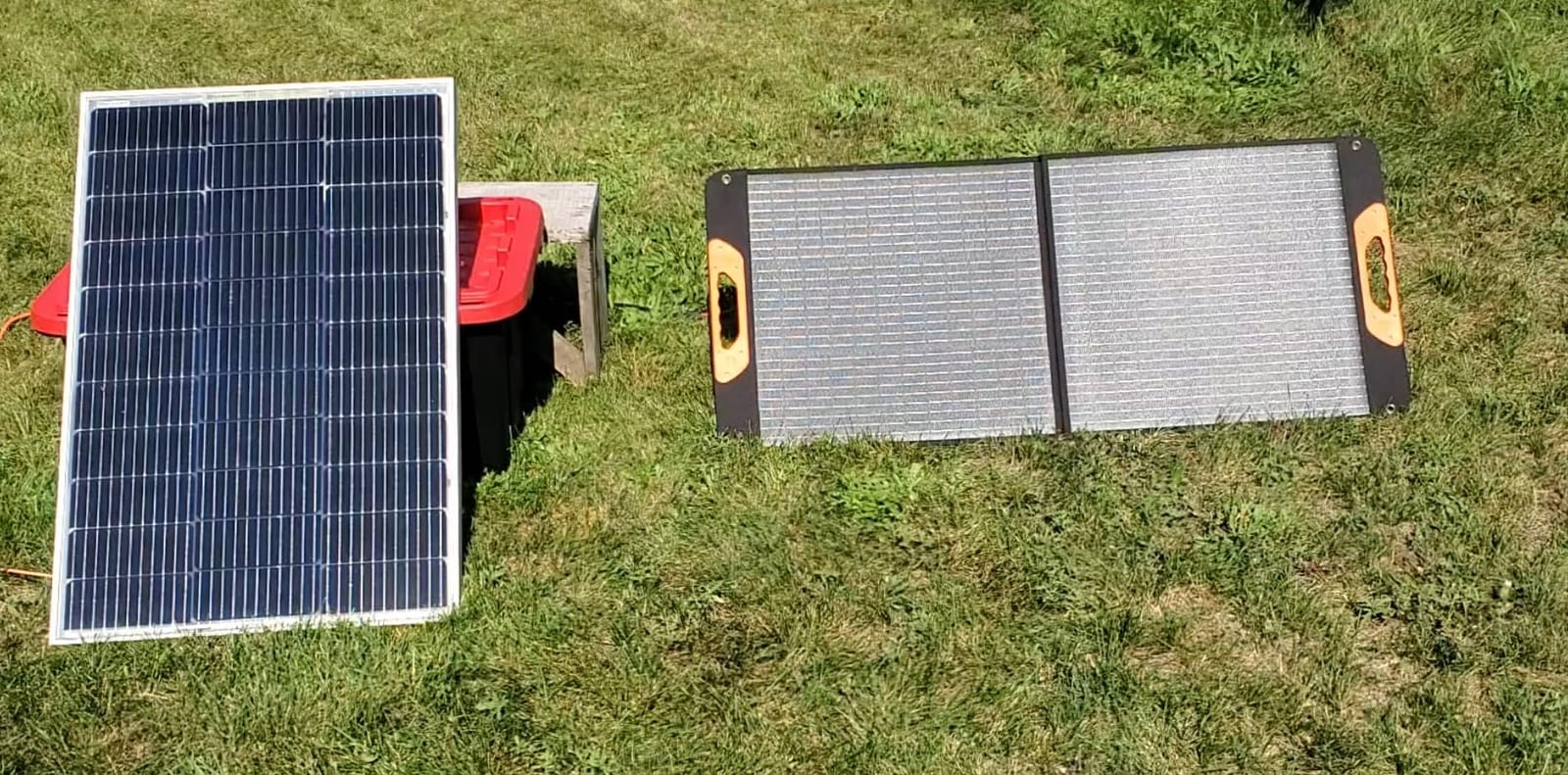
The build is better than the price band suggests. ETFE lamination and an IP67 rating put it ahead of the typical fabric foldable, and the zippered pocket protects the built-in intelligent controller from moisture. Maximum output voltage of 24.3V gives it more headroom to reach into wider MPPT input windows than a lot of 100W panels manage.
Two 45 degree kickstands are claimed to capture up to 25 percent more than laying flat, and a magnetic carry handle handles the 9.5 lb weight. Direct charging runs through USB-C PD at 15V/3A plus two USB-A ports including QC3.0.
Why the connector range matters more than the wattage
Connector mismatch is the single largest source of returns in this category, and a panel that fits everything removes that risk entirely. If you own more than one station, borrow panels, or plan to switch brands in a few years, this is the one that keeps working.
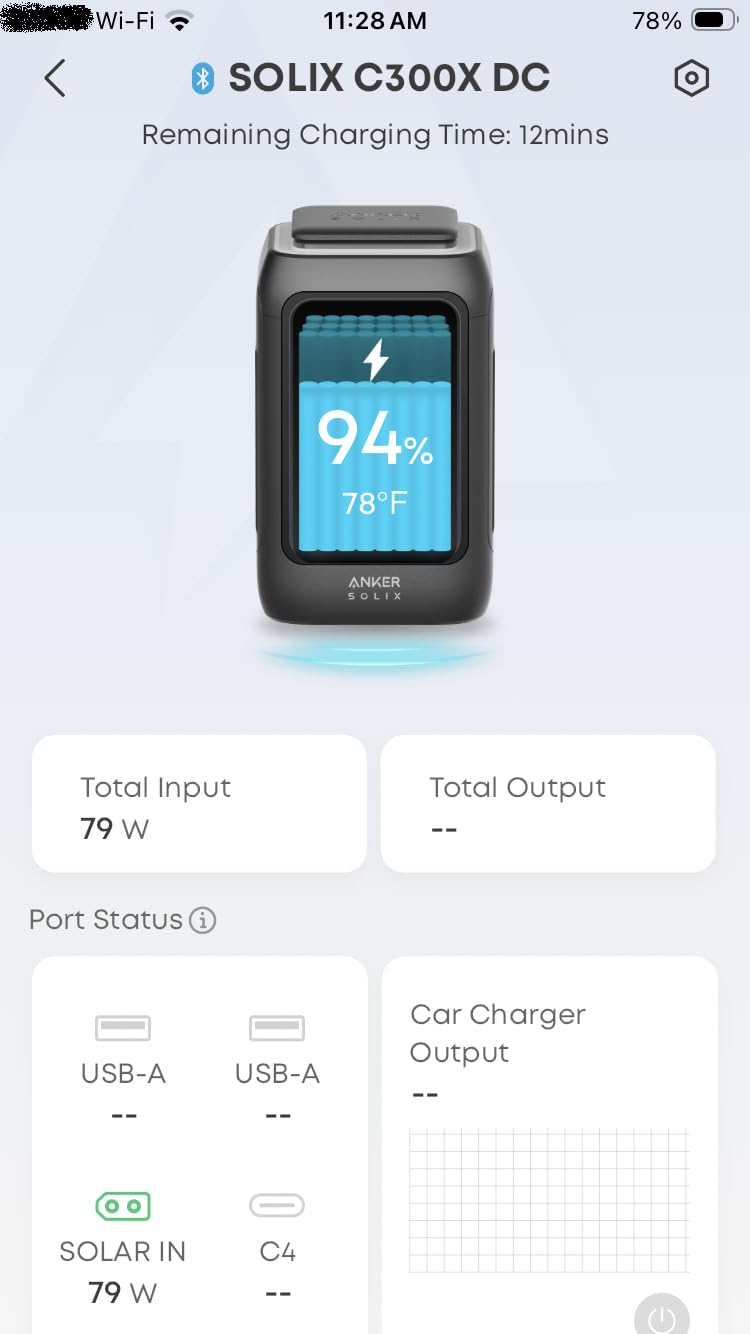
The 24.3V maximum output voltage is worth understanding too. Stations advertise a solar input wattage but also publish an acceptable voltage window, and a panel that sits below the low end of that window will be ignored by the MPPT even on a perfect day.
The weight and the input cap
At 9.5 lb this is one of the heavier 100W panels in the group, and the FlexSolar at 4.1 lb or the Renogy at 7.3 lb are easier on the shoulders. If you are hiking rather than driving, that difference decides the purchase.
As with every panel here, a small power station’s own input ceiling limits what you can pull. The reviews on this model say it plainly: the panel is fine, the station is the limit.
5. EBL 100W – Best for Pairing Two Panels in Series
EBL Solar Panel 100W Portable Solar Panel for 300/500/1000 Power Station
100W rated
23% claimed cells
IP65 ETFE
MC4 plus adapters
Pros
- MC4 to Anderson and MC4 to DC5521 cables plus three barrel adapters
- rigid frame holds its shape
- two in series reported around 158W
- magnetic handle and sealed accessory pouch
Cons
- Measured output often lands near 65W
- roughly 6 ft cable limits placement
- IP65 means bringing it in during rain
- weight not stated in the listing
The EBL 100W is a straightforward route to a 200W-class solar input, and the reason is the bundled accessory set. You get an MC4 to Anderson cable, an MC4 to DC5521 cable, and three barrel adapters in the box, which covers most of the smaller stations that do not accept a bare MC4 plug.
It is also the panel where series wiring is most commonly discussed. Owners report around 80-83W from one panel in clear sun and roughly 158W from two wired in series, which is the technique that gets a higher input voltage past a station’s minimum window.
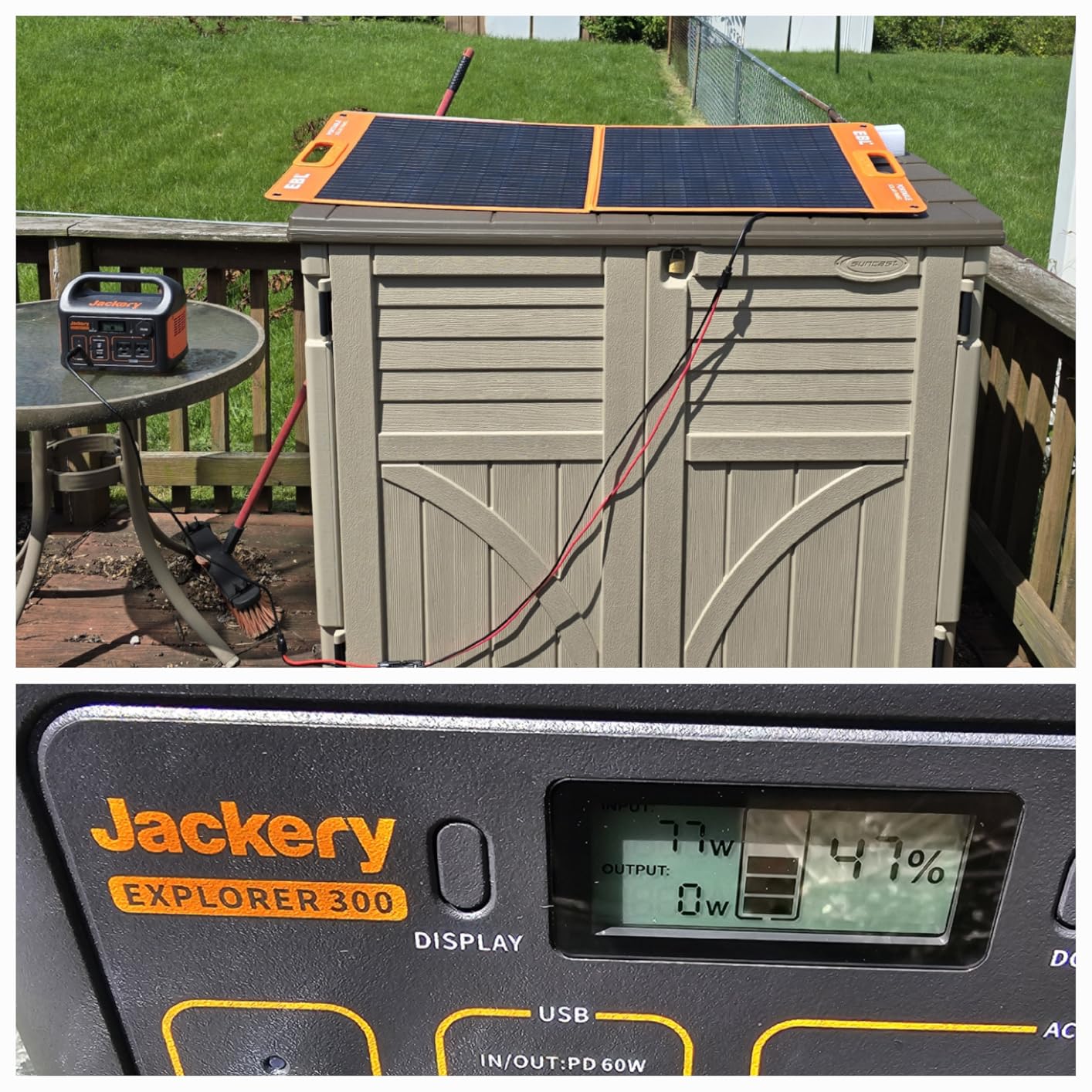
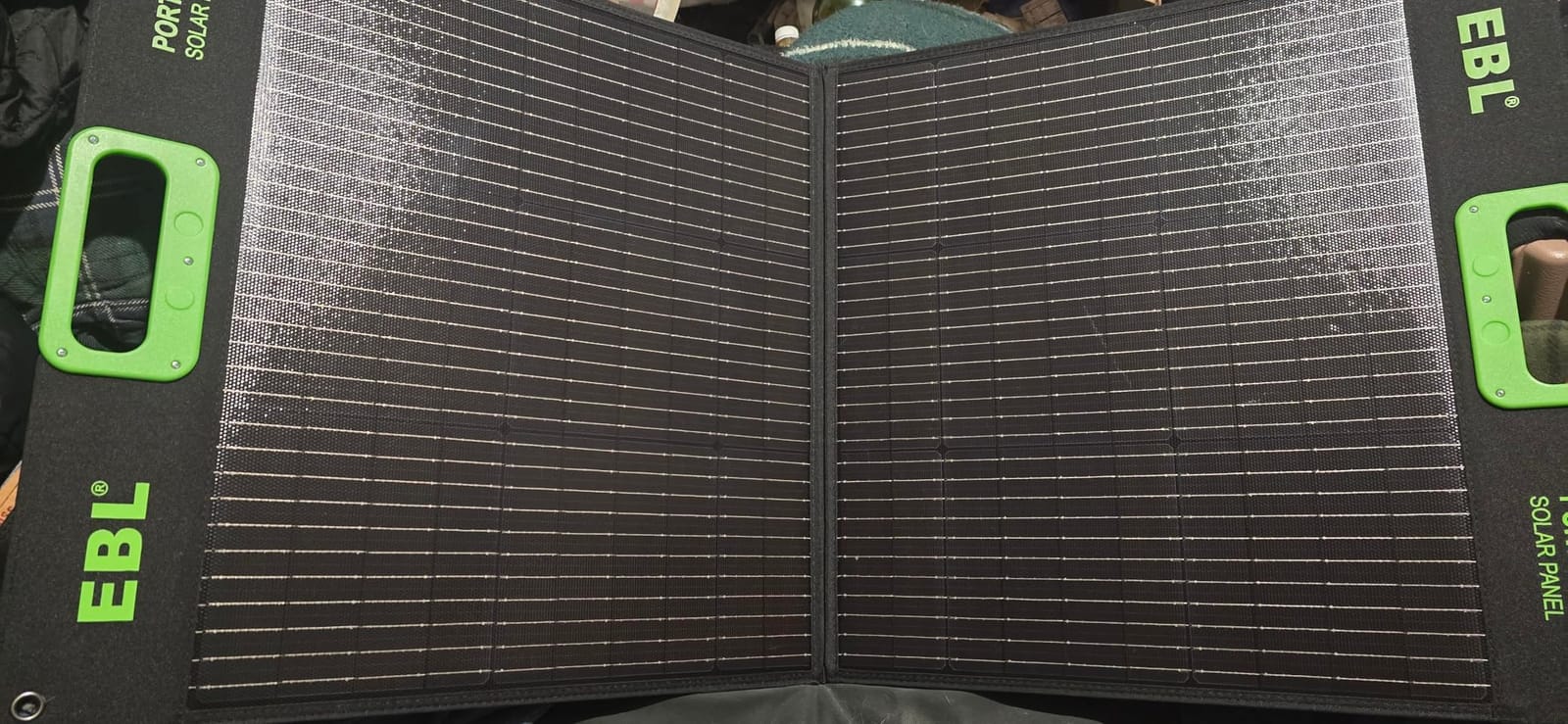
Build quality earns its keep. The rigid plastic frame does not collapse the way soft fabric panels do, the magnetic rubber handle doubles as the fold mechanism, and the two 45 degree kickstands are set to capture roughly 20 percent more than laying the panel flat. A Smart IC provides overcharge, overheat, and short-circuit protection.
The recurring complaint is a straightforward one: real-world output frequently falls well below the 100W rating, sometimes landing near 65W. Buyers also note the short cable and the fact that IP65 is not meant for leaving the panel in direct rain overnight.
How to get two panels to work as one
Wiring two panels in series doubles the voltage while keeping current the same, which is what most power stations need when a single panel’s output sits below the low end of their MPPT window. The trade-off is real, though: if one panel is shaded, series wiring drags the output of the whole string down toward the shaded panel’s level.
Parallel wiring does the opposite, keeping current high and voltage low, and it holds up far better under partial shade. Choose series for voltage, parallel for shade. Never combine the two in one string.
Where the value stops
If you care about the gap between rated and delivered wattage, this is not the panel. A 65W result from a 100W label is the sharpest rated-to-delivered gap we found, and it is the reason reviewers recommend it mainly as a budget first panel rather than a long-term install.
Two of them in series does fix a lot of that, but only if your station accepts the combined voltage. Check the input window before committing, and note the listing does not state a weight, which makes it hard to plan a pack around.
6. SOKIOVOLA 200W N-Type – Best for Rain and Long Deployments
SOKIOVOLA N-Type 16BB 200W Portable Solar Panel for EF/Jackery/Bluetti/Anker Power Station Foldable Solar Panel 25% High Efficiency IP68 Waterproof for Outdoor Trip RV Camping Blackout Off Grid
200W rated
25% cells
IP68 ETFE
16.3 lb
10.49 ft cable
Pros
- IP68 sealing
- the tightest in this roundup
- 10.49 ft MC4 to 5-in-1 cable
- snap legs hold firmly instead of Velcro
- carry bag and roomy accessory pouch included
- reported 155-180W on good days
Cons
- 16.3 lb is the heaviest panel here
- panel-side MC4 pigtails only about 4 inches
- weak performance in overcast light
- some reports of output drop within about 6 months
If your deployment is a fixed one, an RV roof, a work truck bed, or a campsite that gets rained on, sealing is the spec that matters, and this is the only panel here rated IP68. The ETFE coating handles both water and dust, and the A+ grade monocrystalline cells convert at up to 25 percent.
Owners defend this panel against its negative reviews, and their argument is physical rather than emotional. The body is noticeably stiffer than typical fabric foldables, the kickstands snap closed instead of relying on Velcro, and the folded size of 21 by 23 inches is compact for 200W.
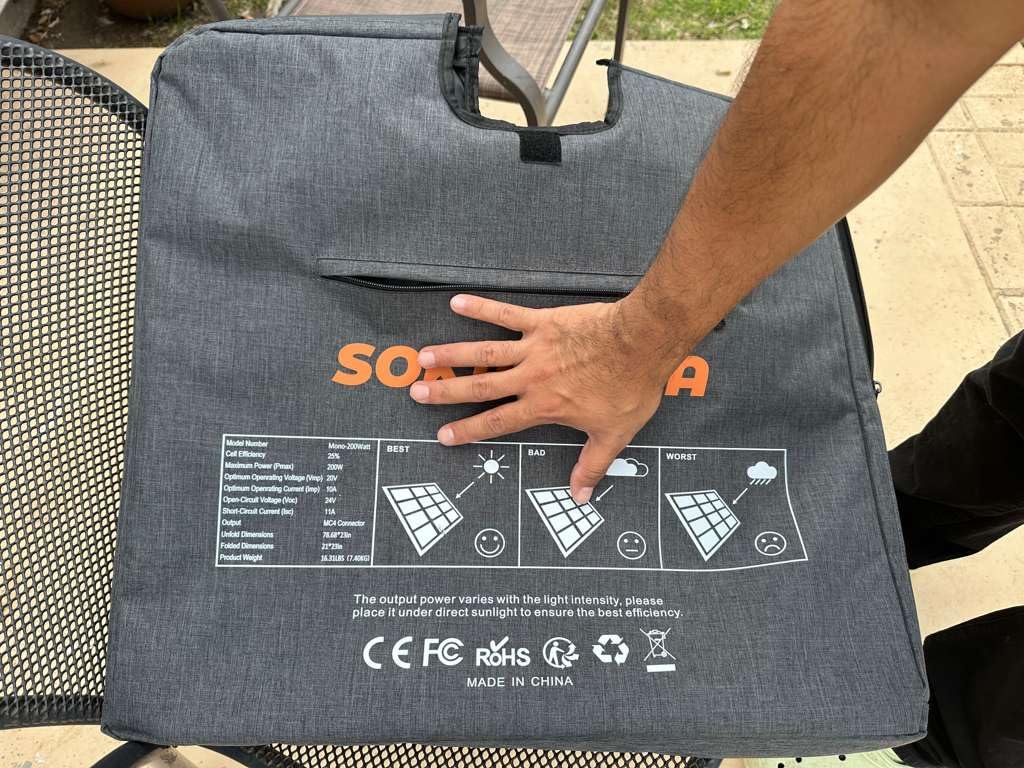
The cable package is the strongest on any 200W panel here. A 10.49 ft MC4 to 5-in-1 lead covers XT60, DC5521, Anderson, DC7909, and DC8020, so the station can sit in the shade while the panel sits in the sun. That single fact solves the heat and battery life problem that forum users complain about constantly.
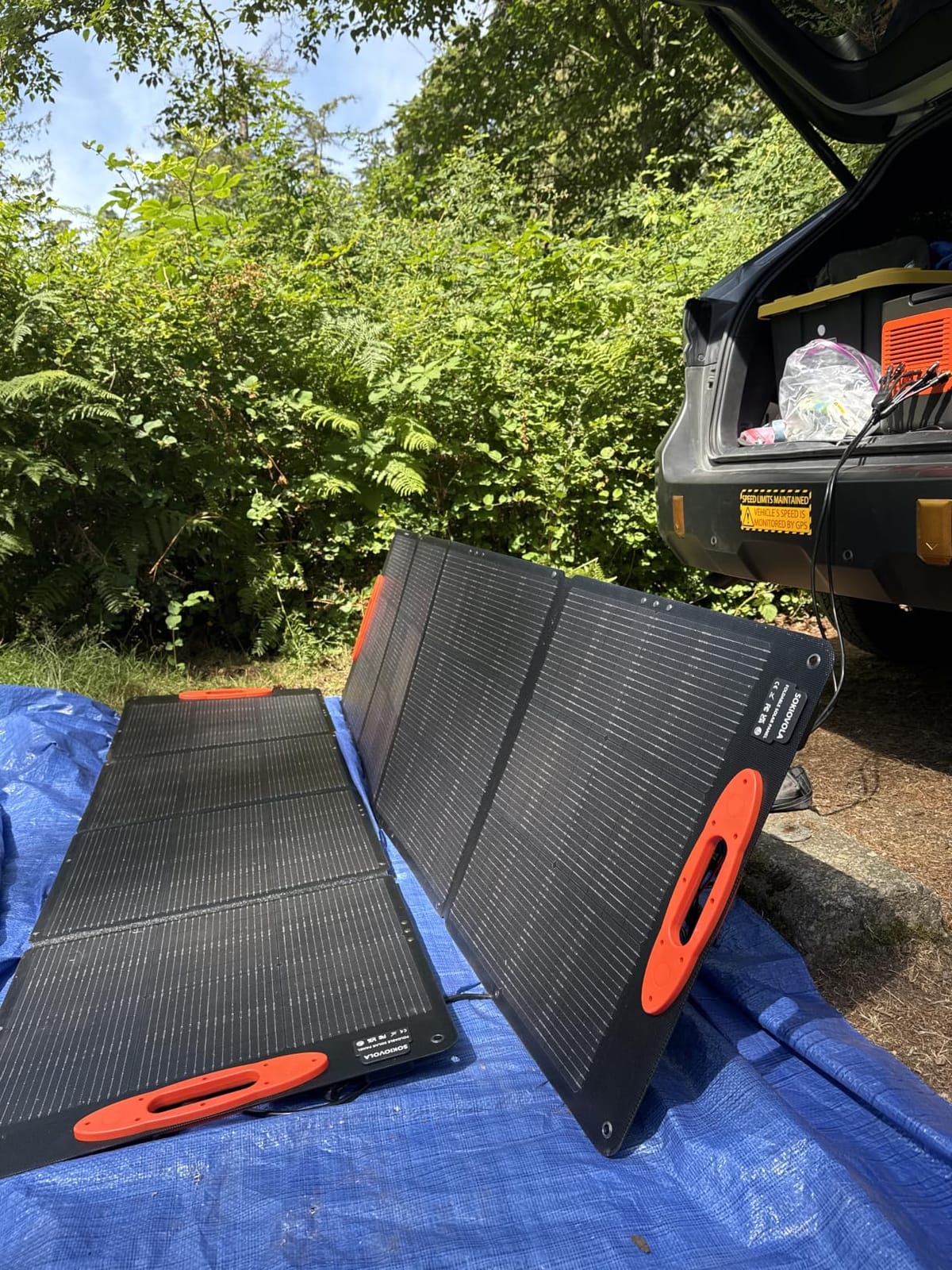
Measured output is reported at 155-180W on good days, and the review summary describes a figure closer to 165-180W in full sun. The gripes are physical: at 16.3 lb it is the heaviest panel on our list, and the MC4 pigtails on the panel body are only about 4 inches, so you depend entirely on the included cable.
What IP68 actually buys you
IP65 panels survive dust and splashes. IP68 panels survive immersion. In practice that means you can leave this one deployed through a night of rain without bringing it in, which is the difference between a panel you use daily and one you only use on dry weekends.
It is also rated for 158 degrees F, so a summer roof deployment is not the thermal problem it would be with a fabric panel. For a fixed RV or van installation, this is the one we would leave up.
Where it falls down
Weight and weather. At 16.3 lb this is the heaviest panel in the group, and the four mounting holes are useful but modest for permanent rooftop work. At 4.3 stars with 552 ratings it is one of the two lowest-rated panels here, and a few owners report output degrading substantially within about 6 months of daily use.
Performance in overcast conditions is also cited as weak. If your climate is cloudy more than it is sunny, a 25 percent efficiency cell does not compensate for missing photons, and a different panel may serve you better.
7. FlexSolar 100W – Best for Hand Carry and Air Travel
FlexSolar 100W Foldable Portable Solar Panel Charger IP67 Waterproof
100W rated
23% mono
4.1 lb
USB-C PD 45W
IP67
Pros
- 4.1 lb
- the lightest 100W panel here
- 0.59 inch slim profile
- USB-C PD 45W plus USB-A 18W and 100W DC
- premium padded carry bag and solid hinges
- 4-in-1 cable covers DC5521 DC7909 Anderson XT60
Cons
- No MC4 on the included cable
- multi-fold shape is hard to angle at the sun
- output housing runs hot above 60W
- USB port can corrode after rain
At 4.1 lb the FlexSolar 100W is the panel you can genuinely carry all day, and that changes who it is for. Owners describe packing it into a milspec duffel for air travel and comparing it favourably against the bulkier Renogy 100W they also own. The 0.59 inch folded profile is the reason it disappears into a pack.
It does not skimp on the electronics. Alongside the DC output it carries PD 3.0 at 45W on USB-C, 18W on USB-A, and a 100W DC output, all from a 4.1 lb package. The IP67 rating and dustproofing put it alongside the sealed panels in this roundup, and a premium padded carry bag is included.
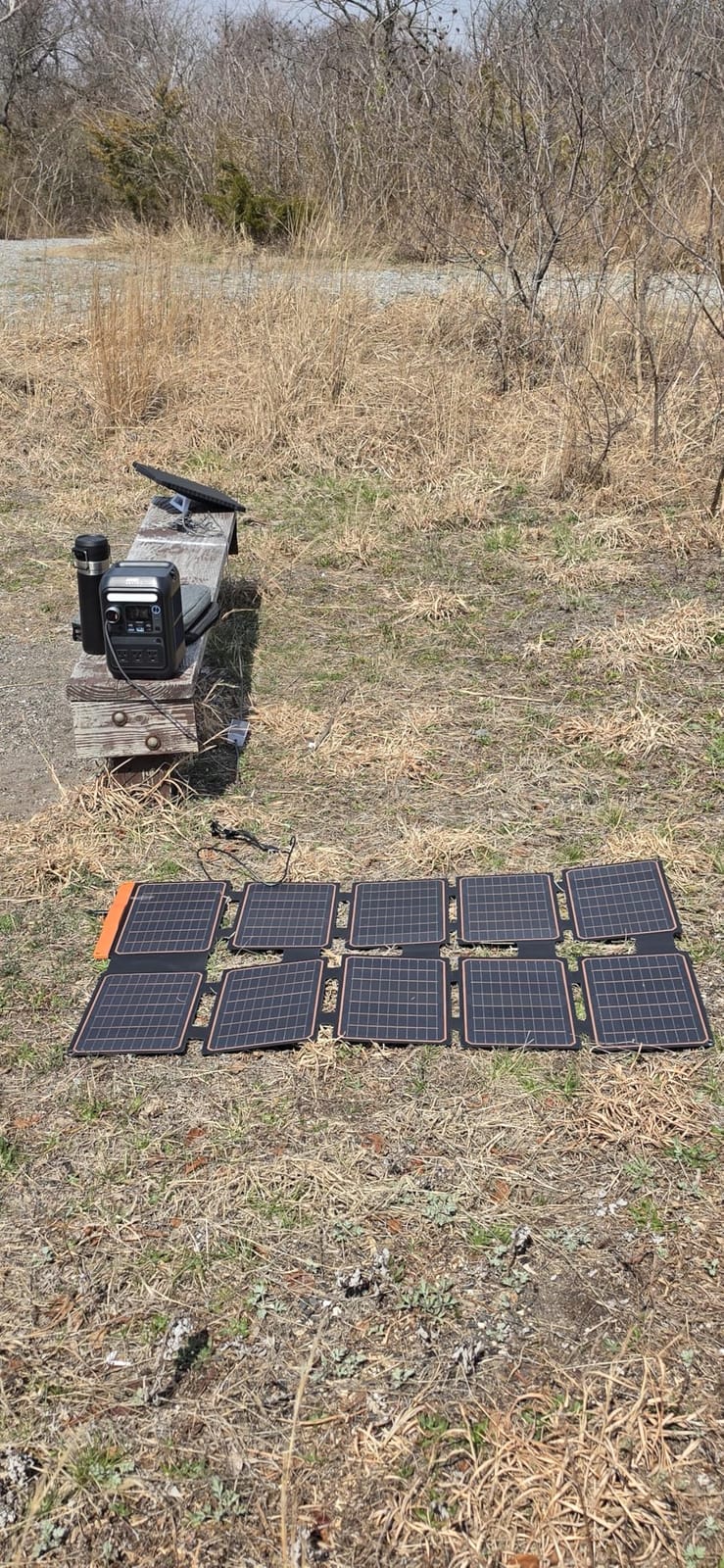
Reported output lands between 70 and 85W in good sun, with several owners mentioning usable output even on cloudy days. That cloudy performance is not universal across this list, and it comes from the E-Film lamination and the 23 percent plus monocrystalline cells.
Several buyers describe the panel as a lifesaver during storm outages, which is a real use case: a 100W panel that fits in a daypack can keep a small station and a router alive through a multi-day grid failure.
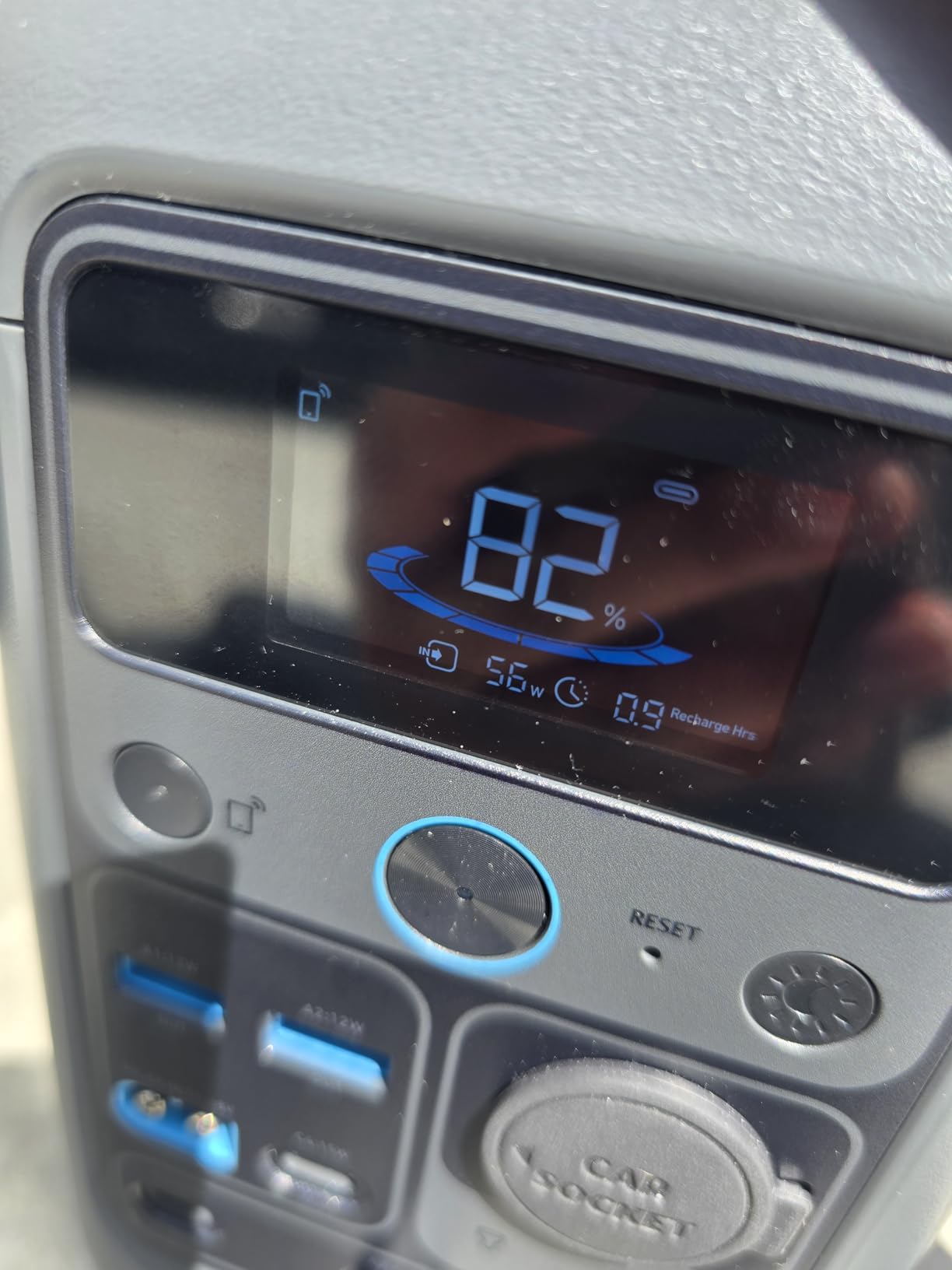
Why direct USB charging changes the use case
The 45W USB-C PD port is unusually capable for a panel this small. Most portable panels include USB ports as a novelty, and this one is specced high enough to charge a laptop, a drone battery pack, or a camera battery directly without involving the power station at all.
The 4-in-1 cable covers DC5521, DC7909, Anderson, and XT60. That is good coverage for the common brands, but it is the one gap that matters: there is no MC4 on the included cable, so plan on an adapter if your station uses the standard solar connector.
The compromises
The multi-fold design is the central weakness. Most owners end up laying it flat rather than angling each section, and a flat panel loses a meaningful share of its output. The output housing also runs hot above 60W, and one owner reported an internal failure after about a week of cold-weather camping with no support response.
So treat it as the travel panel, not the expedition panel. It is the easiest to move and the hardest to aim, and for carry-heavy use that trade is worth making.
8. TWELSEAVAN 200W – Best for USB-C Laptop and Drone Charging
200W Portable Solar Panel for Power Station, 24% High Efficiency ETFE Foldable Solar Panel Charger, QC3.0, Type-C 60W, MC4 Output, IP65 Waterproof, for Outdoor Camping, RV, Emergency Power Supply
200W rated
24% cells
USB-C PD 60W
24-month warranty
Pros
- 60W USB-C PD
- the highest direct-charging port in this roundup
- 8-in-1 connector package with 5-in-1 cable and 3 DC adapters
- 24-month warranty with 30-day money-back
- four kickstands for steadier positioning
Cons
- 15.7 lb is heavy for a 200W foldable
- 10 percent one-star share suggests early-unit problems
- only 269 ratings
- IP65 still needs shelter in heavy rain
The distinguishing feature here is the 60W USB-C PD port. No other panel in this roundup offers a direct-charging output that high, and that number is the difference between charging a laptop from the panel in an afternoon and watching the battery drain all day. It is the panel to pick if you work remotely off-grid or fly a drone between camps.
Underneath that, the core is a conventional and capable 200W design: A+ grade monocrystalline cells at 24 percent conversion, an ETFE laminated case passing over 95 percent light transmission, and a high-density polyester canvas backing. Four adjustable kickstands give steadier positioning than two-leg designs.
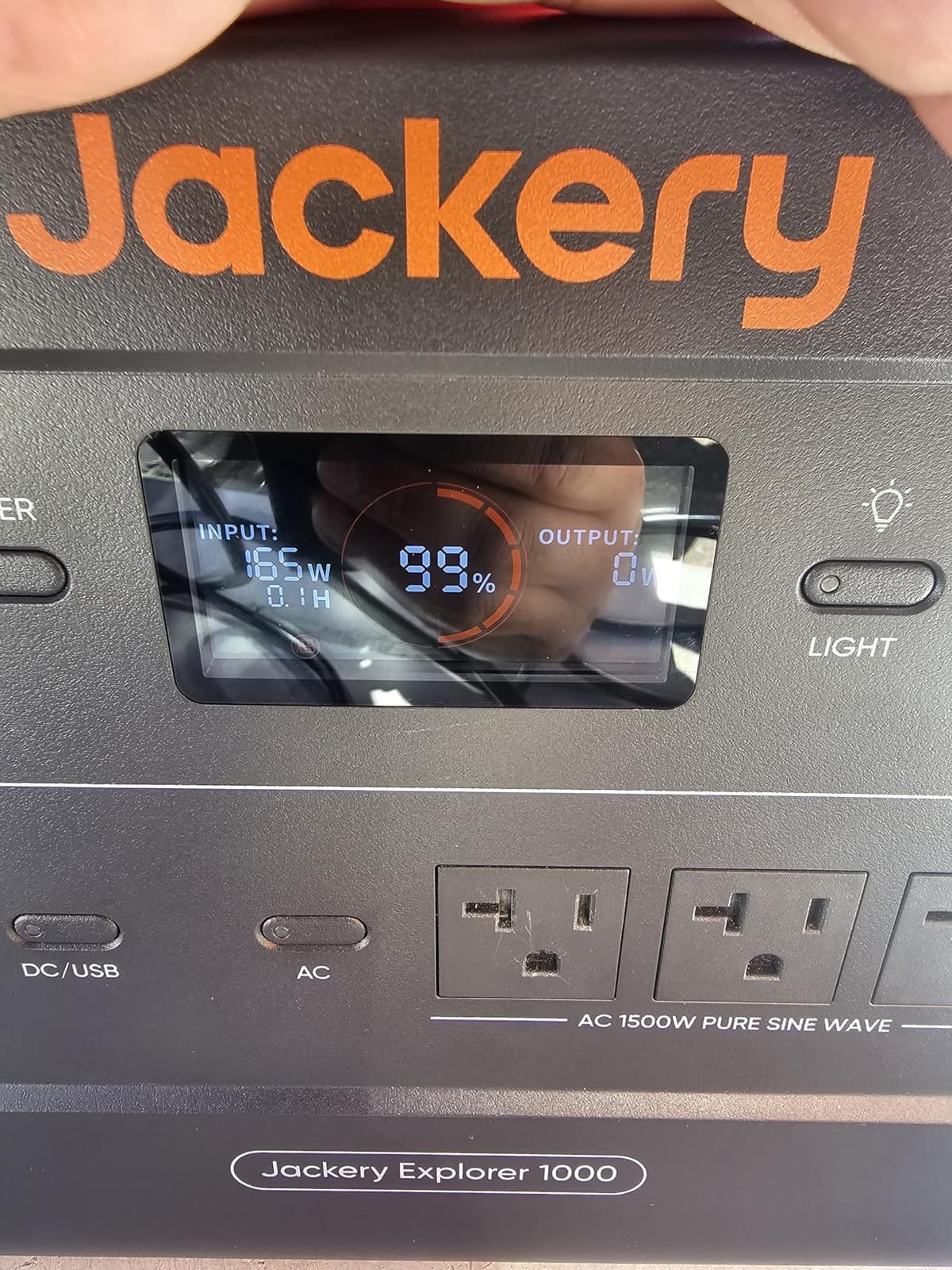
Connectivity is generous. You get a 5-in-1 MC4 cable plus 3 DC adapters, an 8-in-1 package the listing describes as covering Jackery, EcoFlow, BLUETTI, FlashFish, and Anker, and a 9.8 ft MC4 cable. That is enough coverage that the adapter hunt after dark is less likely.
The warranty stands out too. A 24-month cover with a 30-day money-back guarantee is longer than the 12-month norm for panels in this class, which matters when you are committing to a lesser-known brand.
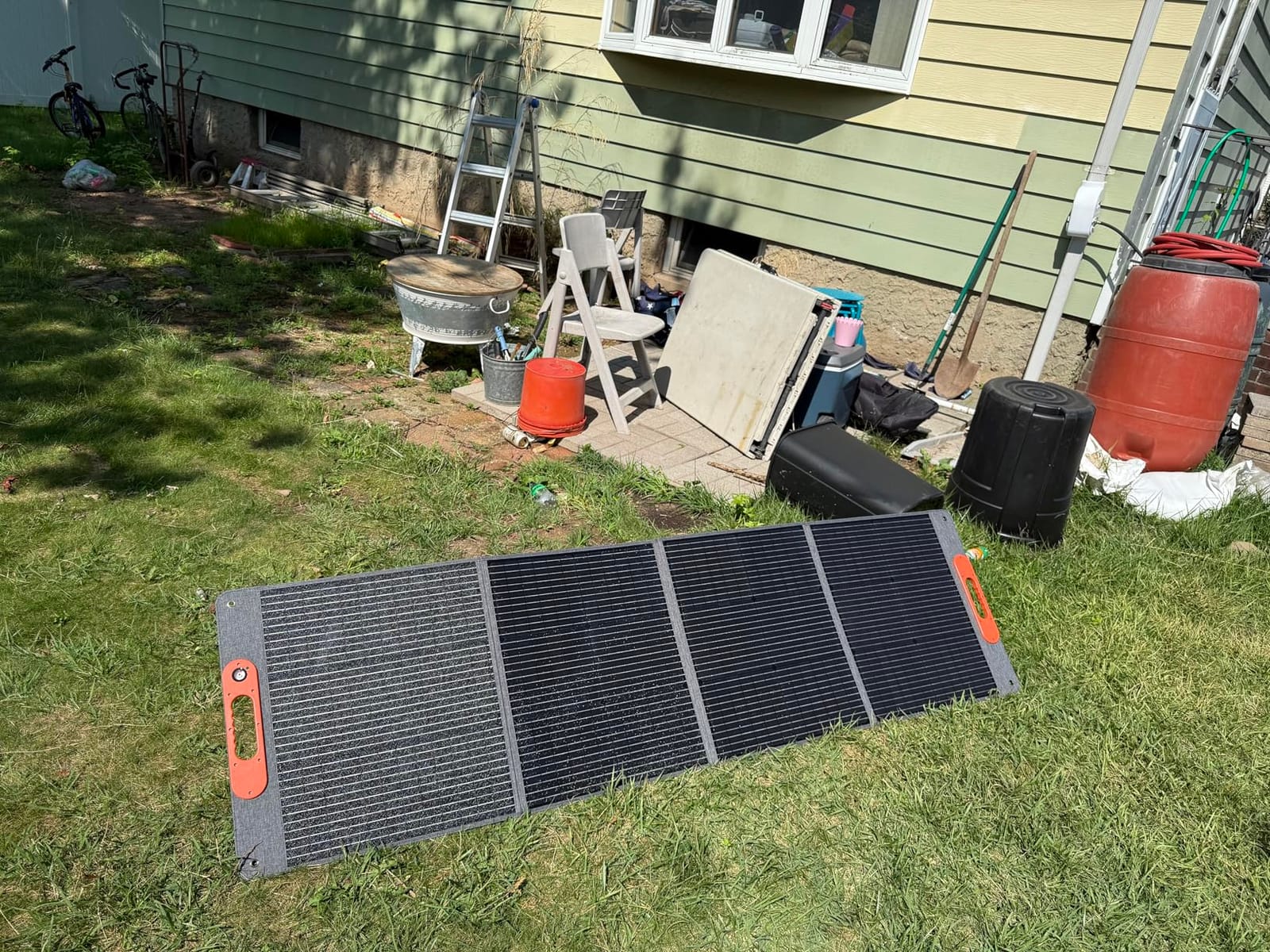
Is 60W enough to run a laptop?
For most thin and light laptops, yes, at least while the battery is not also driving a bright screen. The port is PD 3.0 at 60W alongside an 18W QC3.0 USB port and a 5V/3A USB port, so a phone, a router, and a laptop can all be served from the same panel without a battery in the loop.
It will not run a workstation with a discrete graphics card, and on a hot day with the panel partially shaded the delivered figure will fall short. Treat it as a viable primary or backup work supply, not a guarantee.
The trust question
There are 269 ratings here, the smallest review pool among the ten panels we cover, and roughly 10 percent of them are one-star, which usually signals early production problems rather than a design flaw. Long-term durability evidence simply does not exist yet, and that is a real cost of buying outside the big names.
At 15.7 lb it is also a heavy 200W panel, and the ETFE and polyester construction still wants sheltering during heavy rain. We rate it on what it does well, and the warranty is the reason we would take the risk.
9. Renogy 200W Portable – Most Versatile for 1000Wh to 2000Wh Stations
Renogy 200W Portable Solar Panel for Power Stations, 25% Efficiency
200W rated
25% N-Type
13.9 lb
UL 61730
IP65
Pros
- 939 ratings at 4.5 stars
- 150-180W real world
- about 75-89 percent of rated
- quad-fold body packs to under 2 inches thick
- shade tolerant with one owner losing only 10-15W
- UL 61730 certified
Cons
- MC4 cable short and adapters sold separately
- legs only reach about 35-40 degrees
- stations with a 10A input cap throttle output
- low voltage needs heavy-gauge cable on long runs
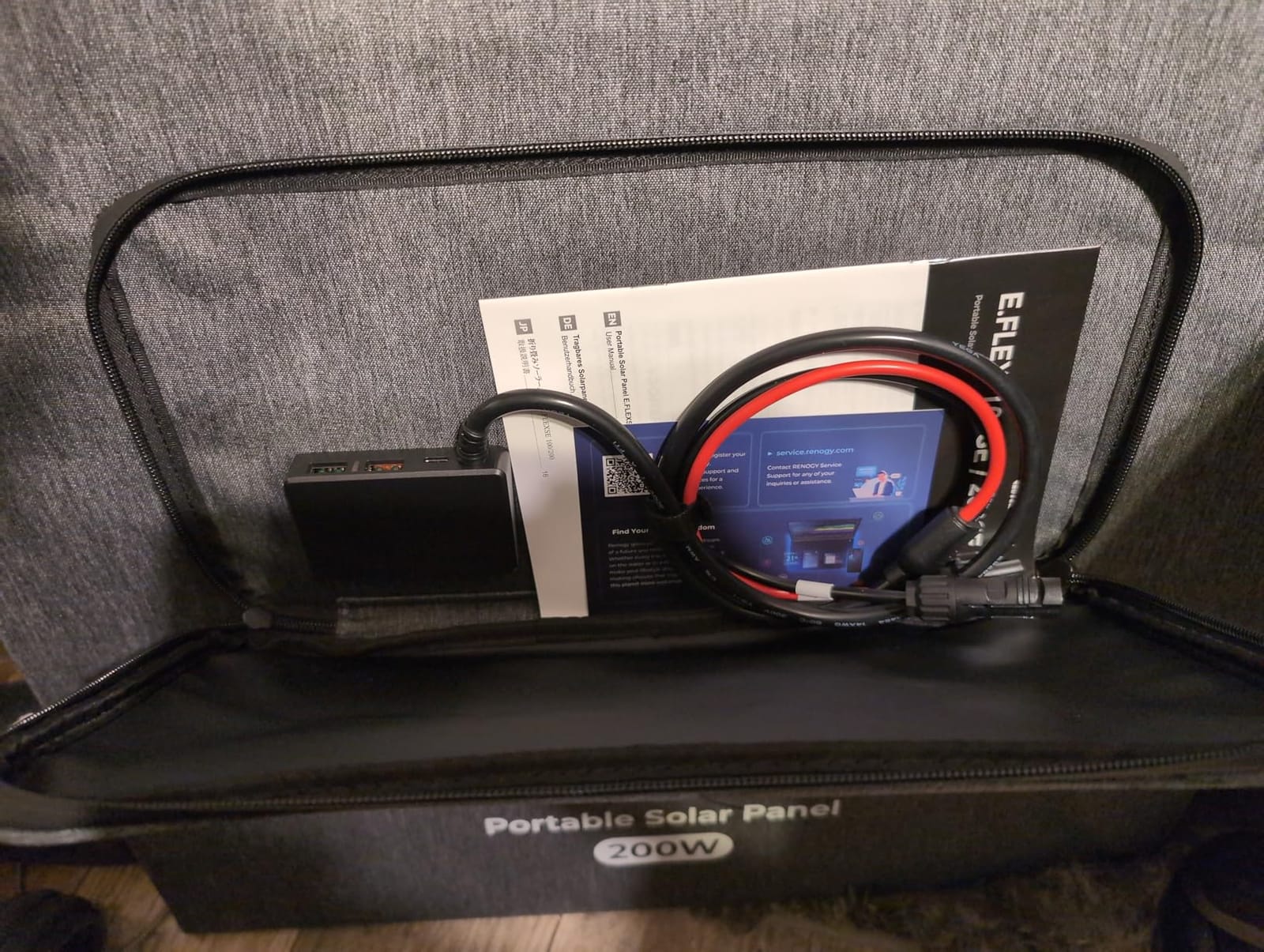
When a category has a default answer, it is usually because the default is genuinely solid. The Renogy 200W carries 939 ratings at 4.5 stars, uses 16BB N-Type cells at 25 percent efficiency, and weighs 13.9 lb, which is manageable for a 200W folding panel thanks to the quad-fold design and magnetic closure handles.
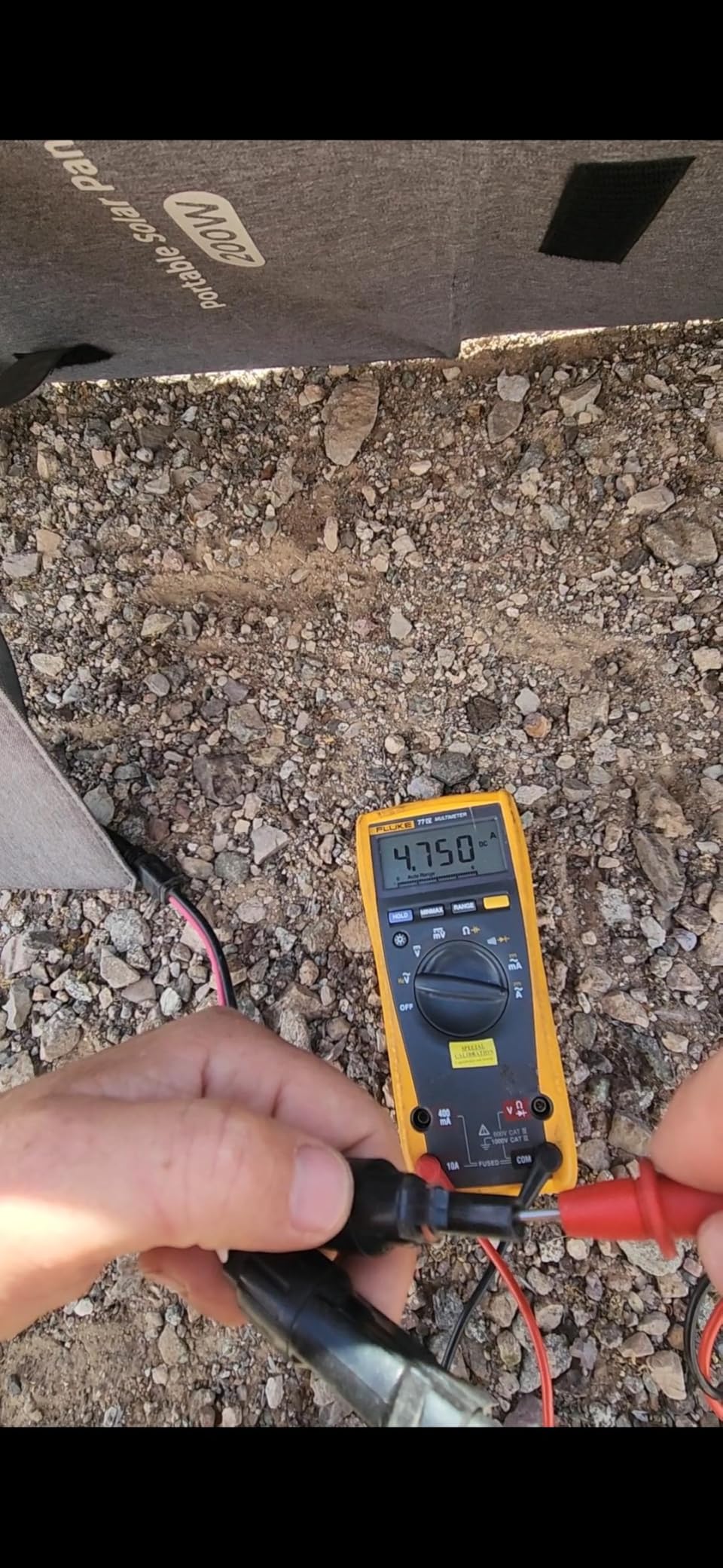
The real-world numbers are the reason it holds the premium slot. Owners report 150-180W, roughly 75-89 percent of rated power, even when the panel is laid flat behind an extension cable. That consistency across hundreds of users is rarer than it should be in this category.
It is also the shade-tolerant pick. One owner reported losing only 10-15W when the panel was partially covered, which is the kind of result that comes from parallel cell configuration and proper bypass diodes rather than luck. For campers under trees, that is a meaningful difference.
Safety paperwork is better than most too, with UL 61730 certification plus CE, RoHS, FCC, CA65, and PSE compliance, backed by a 2-year material and workmanship warranty. Reinforced grommets and ground studs allow RV or tent mounting.
Buy your own cable, and buy it heavy
The most repeated piece of advice in the reviews is to bring your own MC4 cable. The included lead is short, no adapters ship in the box, and because this is a low-voltage design, a long thin run bleeds watts. Heavy-gauge cable is the cheapest performance upgrade available.
It also solves a real placement problem. If the panel sits in full sun and the station sits beside it, the station is baking all day. A proper 10 ft run of 10 gauge cable lets the battery live in the shade and stay cooler.
Know your station’s current cap
This panel runs at 21.6V and 11.3A. Stations with a 10 amp input ceiling, such as the BLUETTI Elite 30V2, will throttle it, and the reviews call this out directly. Check the input current spec, not just the wattage, before you buy for a specific station.
The kickstands are the other soft spot. They only angle down to roughly 35-40 degrees, which costs output at midday in summer at lower latitudes, and they are described as the weak link in wind or on rough ground. Plan on a stake line.
10. Renogy 400W Solar Blanket – Best for 2000Wh and Larger Stations
Renogy 400W Portable Solar Panel for Power Stations, 25% High Efficiency
400W rated
25% N-Type
16.1 lb
10 ft cable
2-year warranty
Pros
- 16-fold design packs to 16.54 by 15.83 by 4.13 inches
- owners report just under 400W in direct sun
- 10 ft cable among the longest included
- shoulder straps included
- deploys flat on a windshield shade or ground or hung vertically
Cons
- No built-in stand so wind can lift it
- output drops sharply past about 11 degrees off axis
- USB ports sit in the pouch once deployed
- 10 percent one-star share
This is the only 400W panel in the roundup, and it exists because the gap between a 200W panel and a large station is where charging actually stops being viable. If you own a 2000Wh or bigger power station, this is the class you need, and a 16-fold design that packs to about 16.5 by 15.8 by 4.1 inches is a genuinely clever way to make 400W portable.
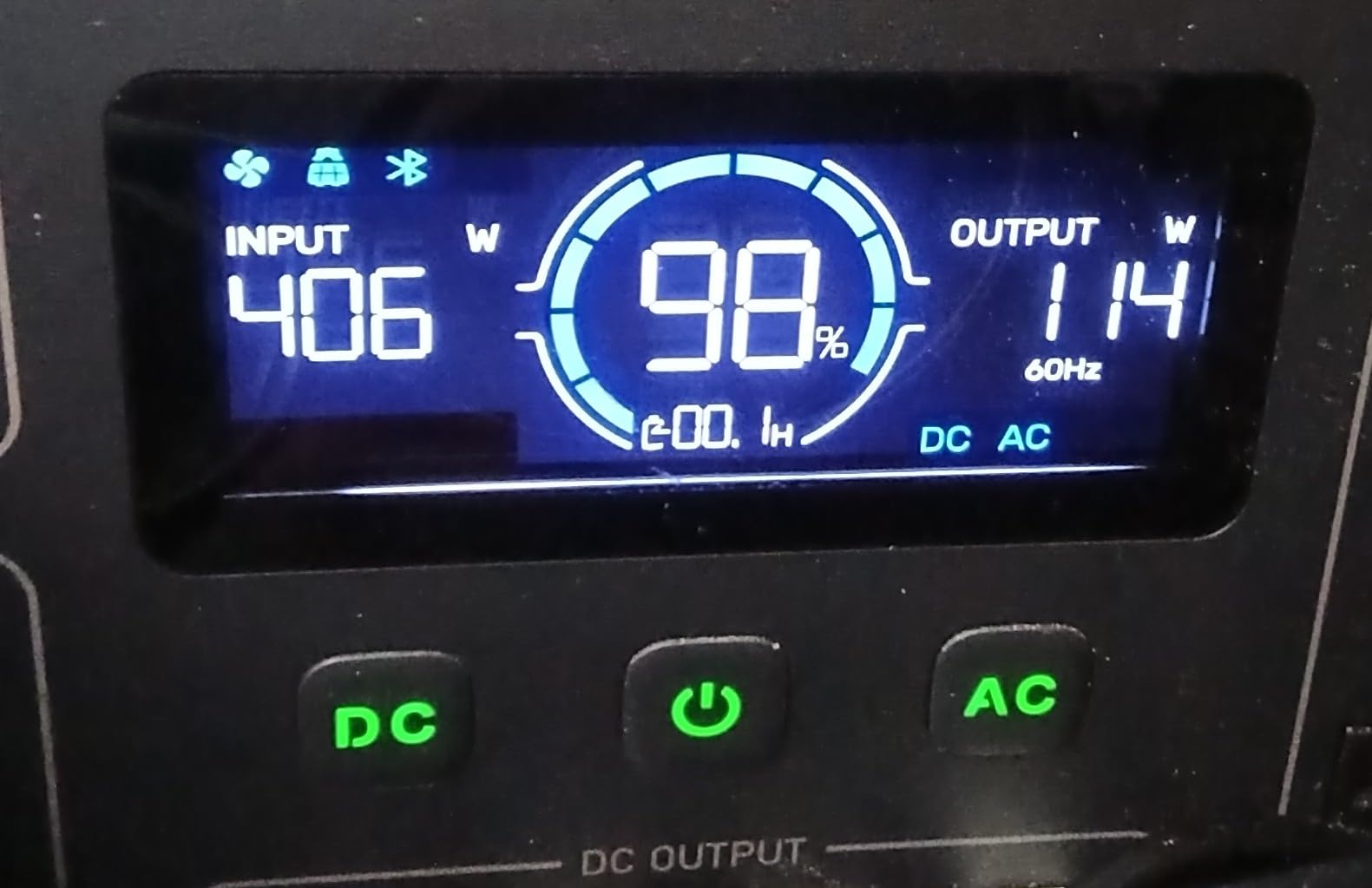
Reported performance sits closest to the label of anything we looked at. Owners report just under 400W in direct sun and about 300W on a cloudy day, which is a very small gap between claim and delivery for a portable panel. The 10 ft cable is among the longest included anywhere here.
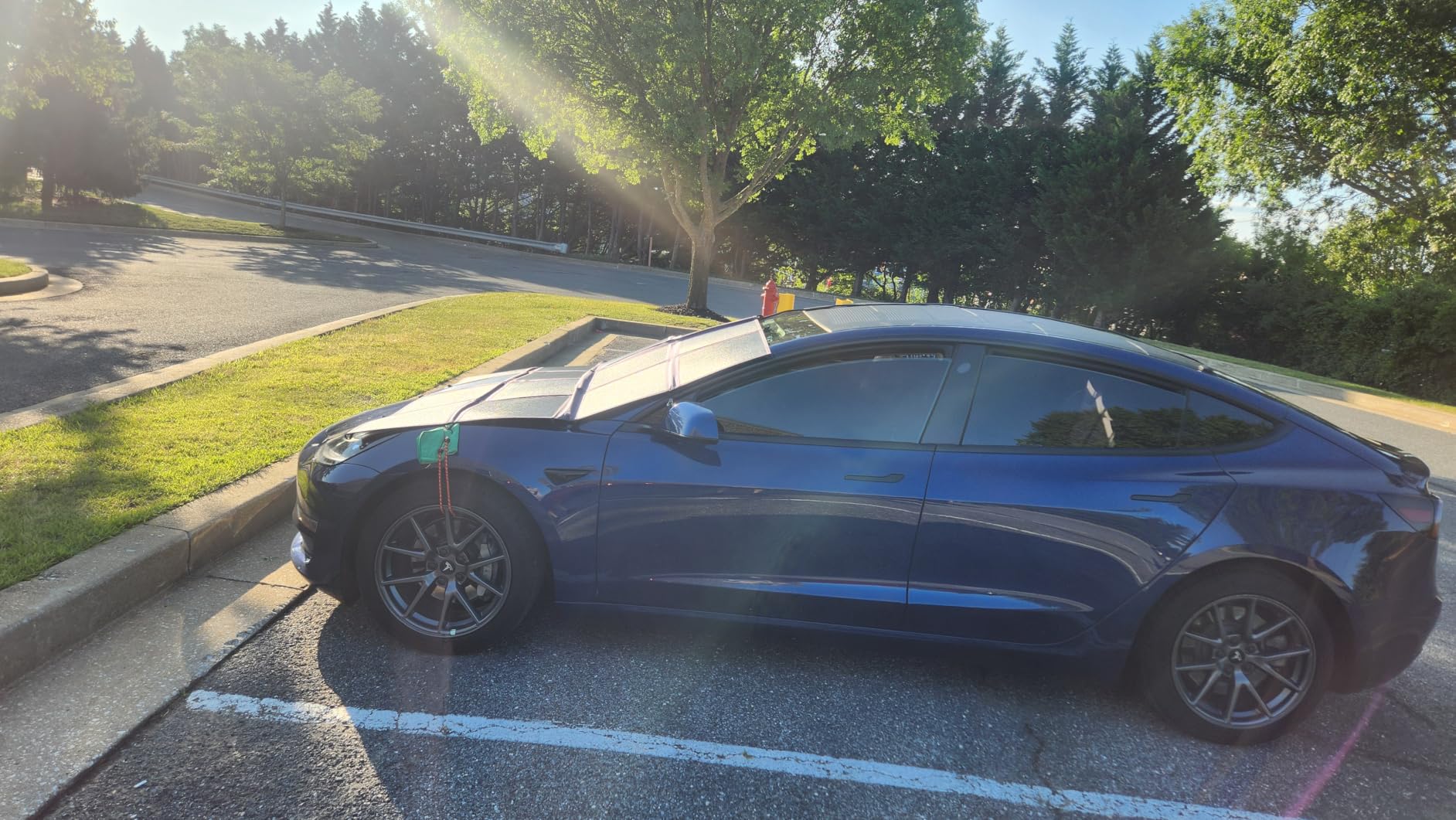
Deployment flexibility is the real feature. One owner used it as a windshield shade while charging, which kills two birds: the cabin stays cool and the panel works. Others lay it on the ground or hang it vertically between trees. Shoulder straps and a padded carry handle are included for moving it from the truck to the site.
It is rated IP65 for minus 10 to 65 degrees Celsius with military-grade ETFE lamination and reinforced stitching, and carries UL 61730 certification with a 2-year workmanship warranty.
The sun angle problem is real on this one
Unlike a folding panel with a kickstand, a blanket has no stand and no fixed angle. Off-axis performance is the weak point: output drops sharply more than about 11 degrees away from direct perpendicular sun, which is a tight tolerance if the sun moves during a long charge.
That makes placement the skill. Hang it vertically in the morning and afternoon and lay it flat at midday, and check it every hour or two. If you cannot re-aim it, a 200W panel with a stand may serve you better despite the lower rating.
Wind and the one-star share
There is no built-in stand, so suction cups or tie-downs are needed, and wind can tear a 400W sheet off a vehicle hood. Owners also report that the USB charging ports are buried in the cable pouch once the blanket is deployed, which is an awkward design choice on a panel this size.
At 4.3 stars with 258 ratings, this has the highest one-star share of the Renogy models here, and one detailed account of receiving a used or defective unit on a repeat order. Buy from a seller with an easy return path, and inspect on arrival.
Which Power Station Does Each Panel Fit?
Compatibility depends on the connector on the panel lead and the input on your station, not on the brand name. Every panel here ships with an MC4 output except the FlexSolar, and nearly all of them now bundle an adapter cable that terminates in the proprietary plugs people actually own.
Jackery uses DC8020, an 8mm round plug. Most Jackery owners of the 100W and 200W models also need a cable, and the ZOUPW, SOKIOVOLA, and TWELSEAVAN 5-in-1 leads all cover DC8020 directly.
EcoFlow and Anker SOLIX use XT60. The HQST 3-in-1 lead and the ZOUPW 5-in-1 lead both include XT60, which makes them the two easiest panels to pair with either brand.
BLUETTI is the awkward one because it mixes MC4 and aviation connectors depending on the model. Panels that include MC4 plus a 5-in-1 cable, such as the SOKIOVOLA and the TWELSEAVAN, tend to cover more BLUETTI inputs than a bare MC4 panel.
DJI uses a proprietary SDC port and is the hardest to reach. You will need a DJI-specific cable, so if your station is a DJI product, buy the panel and the cable together rather than assuming a universal lead will fit.
Goal Zero uses 8mm, which is DC7909 on the ZOUPW, FlexSolar, and SOKIOVOLA cables. One recurring complaint across forums is that some Goal Zero owners never receive the adapter they need, so verify what is actually in the box.
The short version: the ZOUPW 100W, the SOKIOVOLA 200W, and the TWELSEAVAN 200W cover the widest set of station inputs in this roundup, and the HQST 200W covers the three most common brands with its 3-in-1 lead.
How Many Solar Watts Do You Actually Need?
The formula is simple: panel watts multiplied by peak sun hours multiplied by 0.8 for real-world losses. A 200W panel with 4 peak sun hours yields roughly 640Wh in a day. A 1000Wh station then takes about 1.5 days from empty to full, and about 6 hours to go from 10 to 80 percent.
Peak sun hours depend on your latitude, season, and weather. Four is a fair average for much of the United States in summer, two is a realistic winter or cloudy-season figure, and five or more is achievable in high-desert locations in summer.
For a 300Wh to 500Wh station, a 100W panel is the right size. You refill it in about 6 hours of good sun, and the station is small enough that you will rarely wait more than a day.
For a 1000Wh station, 200W is the practical floor. A 100W panel works but feels slow, and 200W gets you from 10 to 80 percent in roughly 5 hours at 4 peak sun hours.
For a 2000Wh station or larger, 400W is where the numbers start to feel reasonable. That is the class the Renogy 400W blanket was built for, and it is why we would not recommend a 200W panel for that capacity even if it is cheaper.
One more thing to check before you buy anything. Most stations publish a maximum solar input wattage, and a panel above that number delivers nothing extra. A 400W panel on a station capped at 200W of input performs exactly like a 200W panel, and the reviews on the HQST, ZOUPW, and SOKIOVOLA all mention buyers learning this the expensive way.
Buying Guide: What to Check Before You Buy a Panel
Connector first, input ceiling second, everything else third. Get those two right and the rest is a preference between weight, durability, and convenience. Get either of them wrong and no amount of cell quality will save the purchase.
The 33 percent rule is the safety margin most buyers have never heard of, and it prevents a genuine hardware problem. A panel’s open-circuit voltage rises when it gets cold, roughly 0.3 to 0.5 percent per degree Celsius below 25. In deep winter at altitude, a panel rated 24V can push past 32V open-circuit. The 33 percent rule says the panel’s Voc should stay at or below 1.33 times your station’s maximum solar input voltage.
In practice, it means not oversizing your panel’s voltage for a small station. A 100W panel with 24.3V Voc going into a station with a 24V maximum input has no margin at all in freezing conditions. This is the reason we flagged the ZOUPW’s 24.3V maximum output voltage earlier: it needs a station with a wider window than a bare 24V limit.
MPPT versus PWM is the second lever, and almost nobody pulls it. Many folding panels include a basic PWM charge controller to regulate the output. Feeding the panel into the power station’s own MPPT input instead, bypassing the panel-side controller, recovers 10-20 percent in real use. The catch is that you lose the panel’s own overcharge protection, so do it only with a station that has a genuine MPPT.
Weather rating decides how portable your panel really is. IP65 handles dust and splashes, which means bringing it in during a downpour. IP67 survives immersion and can stay out through bad weather. IP68 goes further. If you plan to leave a panel deployed, IP67 or better is the floor, not the exception.
Kickstand angle is the spec that quietly costs you watts. Panels with legs that only reach 40 degrees cannot get flat enough for high summer midday sun at lower latitudes. Panels with 50 to 60 degree options, like the HQST, gain real output in exactly the conditions where you most need it.
Cell technology matters less than most marketing suggests, but busbar count is a real signal. 16BB N-Type cells, used on the HQST, the three Renogy models, and the SOKIOVOLA, are more shade tolerant and hold output better in heat than 9BB designs. Monocrystalline beats polycrystalline in every category here.
What to avoid is straightforward. Unbranded panels with spec sheets that do not survive a question get skipped, along with listings that quote a conversion efficiency without naming the cell technology. Review counts matter as a reliability proxy, which is why the Renogy 100W and 200W with around 940 ratings each carry more confidence than a 200W panel with 269. And in a category where review manipulation is openly discussed on solar forums, a large, long-established review pool is the closest thing to a signal you can verify.
Finally, buy the cable. A 10 ft run of 10 gauge MC4 costs very little and solves three problems at once: the station stays out of the sun, you stop losing voltage over a long thin lead, and you stop dragging the panel around. For permanent installations, our RV solar panel guide covers the mounting side, and larger fixed arrays are covered in our commercial solar panel roundup.
Frequently Asked Questions
What is the 33% rule in solar panels?
The 33% rule is a safety margin on open-circuit voltage. A panel’s Voc climbs in cold weather, so the rule says the panel’s Voc should stay at or below 1.33 times the power station’s maximum solar input voltage. That headroom keeps a cold panel from pushing the station’s MPPT beyond what it can safely accept.
What type of solar panel is best for charging a power station?
A foldable monocrystalline or N-Type panel with an MC4 output and a kickstand, sized so its wattage matches or slightly exceeds the station’s maximum solar input. For stations from 300Wh to 1000Wh a 100W to 200W panel is right, and 2000Wh stations need a 400W class panel.
Can you use any solar panel for a power station?
No, not without checking two things. The connector must match: Jackery uses DC8020, EcoFlow and Anker SOLIX use XT60, BLUETTI mixes MC4 and aviation, DJI uses SDC, and Goal Zero uses 8mm. The panel’s open-circuit voltage must also fall inside the station’s input window, especially in cold weather.
Is there a better brand than Jackery?
For panels specifically, no single brand wins every category. The HQST 200W offers the best balance of output, weight, and sealing, the ZOUPW 100W has the widest connector range and the highest rating, and the Renogy panels pair the largest review pools with UL 61730 certification. Match the panel to your station’s input spec rather than to a brand name.
Are solar generators worth it?
They are worth it when the panel matches the station and you get real sun. A 200W panel with 4 peak sun hours delivers roughly 640Wh a day, which refills a 1000Wh station in about 1.5 days and takes it from 10 to 80 percent in around 6 hours. Mismatched sizing or a low input cap is where value disappears.
How long does a 200W solar panel take to charge a 1000Wh power station?
About 1.5 days from empty to full at 4 peak sun hours, and roughly 5 to 6 hours to move from 10 to 80 percent, once you apply the 0.8 real-world factor. Expect 2 to 3 days in winter or under consistently cloudy skies, and expect less if your station caps solar input below 200W.
What will a 1000 watt solar panel run?
Nothing directly, since portable power stations max out far below 1000W of solar input. What 1000W of panels do is refill a large battery bank over a day or two, which then runs a fridge, a CPAP machine, a laptop, and lighting for days. The station, not the panel, is what runs devices.
Why are people getting rid of solar panels?
Usually for one of three reasons: the panel was oversized for the station and never delivered the extra wattage, it was deployed in partial shade where output collapsed, or the included controller throttled charging. Undersizing, shading, and controller losses explain most of the disappointment in this category.
Final Verdict: Which Portable Solar Panel Should You Buy?
The HQST 200W N-Type is our pick for the best portable solar panels for power stations in 2026 because 200W is the right size for the widest range of setups, and this panel delivers it with 25 percent N-Type cells, an IP67 sealed body, a 3-in-1 connector cable, and only 11 lb to carry.
Buy the ZOUPW 100W instead if connector range matters more than raw output, since its 5-in-1 cable and 10 ft lead reach almost any station without an extra purchase. Buy the Renogy 200W if you want the deepest review history and the strongest shade tolerance in the category, and buy the Renogy 400W blanket if your station is 2000Wh or larger.
For carrying weight, the FlexSolar 100W at 4.1 lb and the Renogy 100W at 7.3 lb are the two that fit a daypack without resentment. Whichever you choose, check the connector and your station’s solar input ceiling before you order, because those two specs decide whether the panel works at all.