
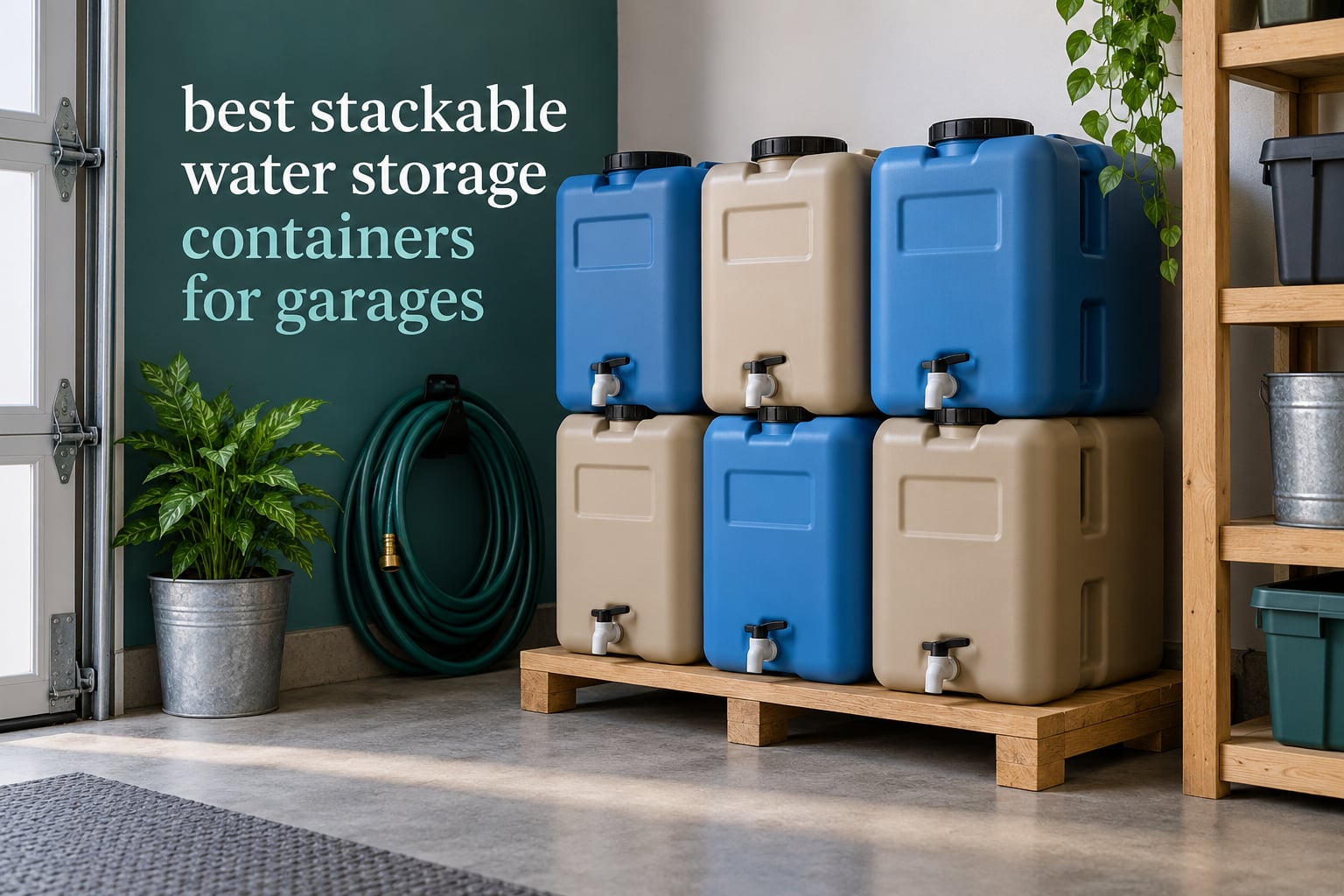
A stackable water storage container is a rigid, rectangular jug made from food-grade HDPE with a flat top and a recessed base, so one container locks onto the one below and a tall column of water fits into a small patch of garage floor. For most households the best stackable water storage containers for garages are the 5-gallon kits, because a filled jug weighs about 40 pounds, stacks three high without deforming, and can be carried to the kitchen by one person when the water is needed.
We spent weeks comparing twelve of them, and the differences turned out to matter more than the marketing suggests. Capacity alone tells you almost nothing. A 55-gallon drum holds eleven times the water of a 5-gallon jug in roughly four times the floor space, and at over 450 pounds filled it is a wall you can never move or rotate again.
That is the whole argument for stacking in a garage. Garage space is measured in square feet, not gallons, and a 5-gallon column stores three times the water of a single jug for almost the same footprint. Everything below covers the twelve picks we compared, the garage-specific details competitors skip, and how to size a setup for your household.
Table of Contents
Top 3 Picks for Stackable Water Storage in October 2026
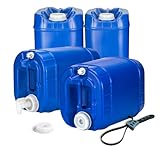
Legacy 5 Gallon 4 Pack
- Stackable ribs lock tanks in place
- Dark blue light-blocking body
- 40 lb per filled tank
- Includes treatment drops
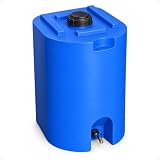
WaterPrepared 55 Gallon Tank
- Oval stackable footprint
- Bronze-style hose spigot
- UV-proof HDPE
- Pre-tested for leaks

WaterBrick 3.5 Gallon 8 Pack
- Cross-stacks two per row to 4 ft
- Light enough for one person to lift
- Also stores rice beans and pet food
- Food-grade HDPE made in USA
All 12 Containers Compared in October 2026
Every container below appears once in the table and once in a full review, in the same order. Capacity and full weight come straight from the manufacturer listing, and the best-for column reflects what owners actually use them for.
| Product | Specifications | Action |
|---|---|---|
| Legacy 5 Gallon 4 Pack |
|
Check Latest Price |
 Saratoga Farms 5 Gallon 4 Pack Saratoga Farms 5 Gallon 4 Pack |
|
Check Latest Price |
| WaterPrepared 55 Gallon Tank |
|
Check Latest Price |
 Saratoga Farms Spigot Kit Saratoga Farms Spigot Kit |
|
Check Latest Price |
| WaterBrick 3.5 Gallon 8 Pack |
|
Check Latest Price |
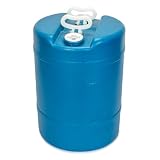 Legacy 15 Gallon Tank Legacy 15 Gallon Tank |
|
Check Latest Price |
 Aguaprep 5 Gallon 4 Pack Aguaprep 5 Gallon 4 Pack |
|
Check Latest Price |
 Emergency Water Tanks 55 Gallon Emergency Water Tanks 55 Gallon |
|
Check Latest Price |
 Rockwell Exodus 35 Gallon Rockwell Exodus 35 Gallon |
|
Check Latest Price |
 Bushman 55 Gallon HDPE Drum Bushman 55 Gallon HDPE Drum |
|
Check Latest Price |
 Consolidated Plastics 5 Gallon Carboy Consolidated Plastics 5 Gallon Carboy |
|
Check Latest Price |
 ePackageSupply 5 Gallon 4 Pack ePackageSupply 5 Gallon 4 Pack |
|
Check Latest Price |
1. Legacy Food Storage 5 Gallon 4 Pack – the Best Overall Stackable Water Container for Garages
5-Gallon Stackable Water Storage Containers, 4-Pack
Capacity: 5 gal each
Weight: 40 lb full
Size: 12 x 10 x 15 inch
Pack: 4 tanks, 20 gal total
Pros
- Stackable ribs lock tanks into each other
- Dark blue body blocks light
- 2.25 inch opening fills fast
- Includes treatment drops and strap wrench
- Built-in handle on every tank
Cons
- About 40 lb per filled tank
- Lifting a full stack takes two people
- Spigot sits low on the tank
This is the kit we kept coming back to. Each tank is molded with ribs on the top that register into the base of the tank above, so a three-high column in a garage corner stands square instead of leaning. At 4.7 stars across 1390 ratings it also has the deepest review history of anything we compared, which means the failure modes are well documented rather than surprising.
The dark blue body is the quiet advantage. Light drives algae growth in stored water, and a translucent or clear container in a garage with a window or a bare bulb loses that battle over a year. The 2 1/4 inch fill opening is wide enough to pour from a hose without a funnel, and the kit ships with 3/4 inch threaded sealed caps, a spigot with prepared caps, water treatment drops, and a strap wrench for the lids.
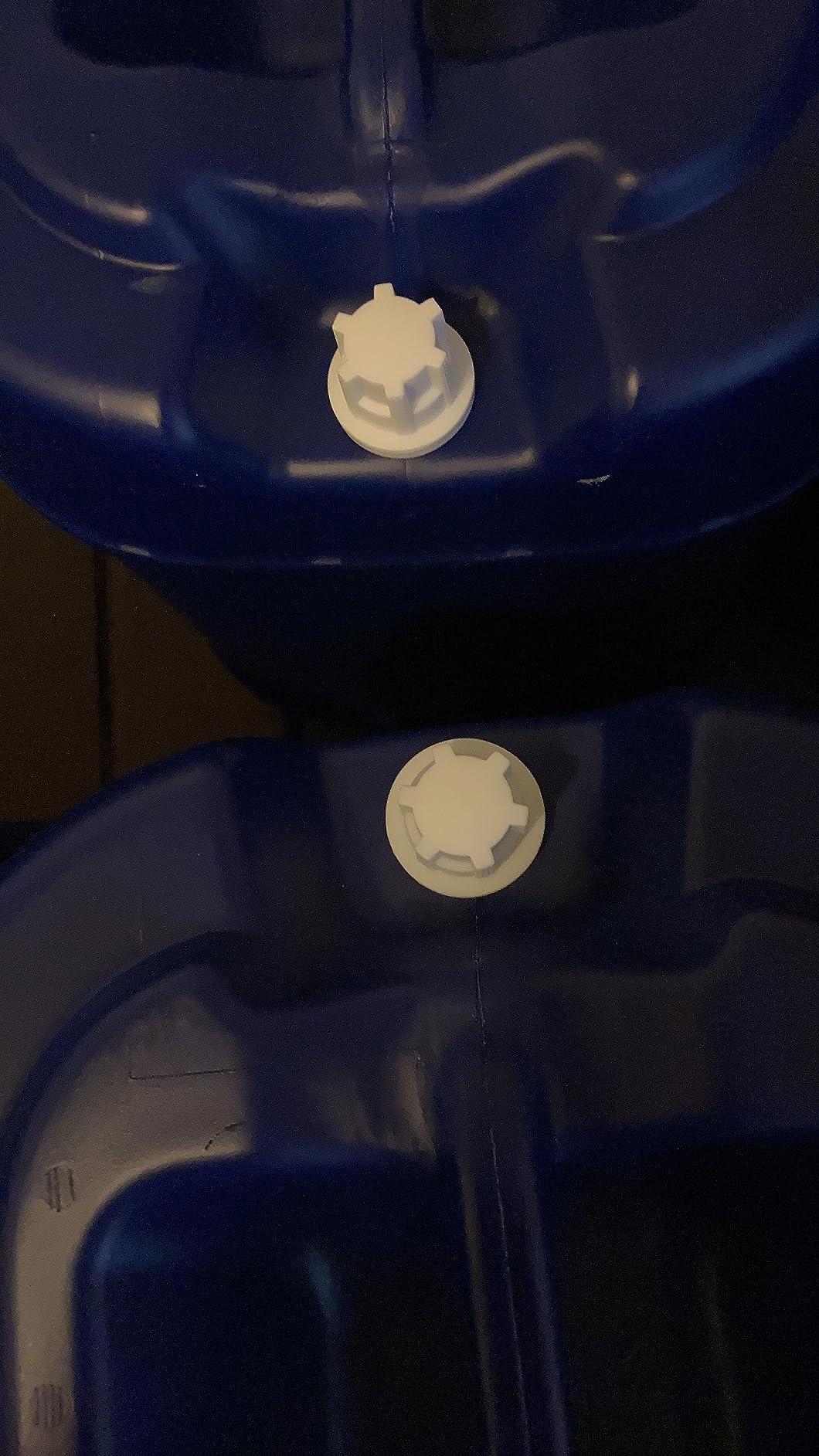
Stack three tanks high and you are looking at 60 pounds sitting on the top of a 120-pound column. That is stable in a corner but not something you want to slide across a slab, so plan the final position before you fill anything. The spigot mounts low on the tank, so a cinder block or low platform makes filling a jug much more comfortable than crouching to the floor.
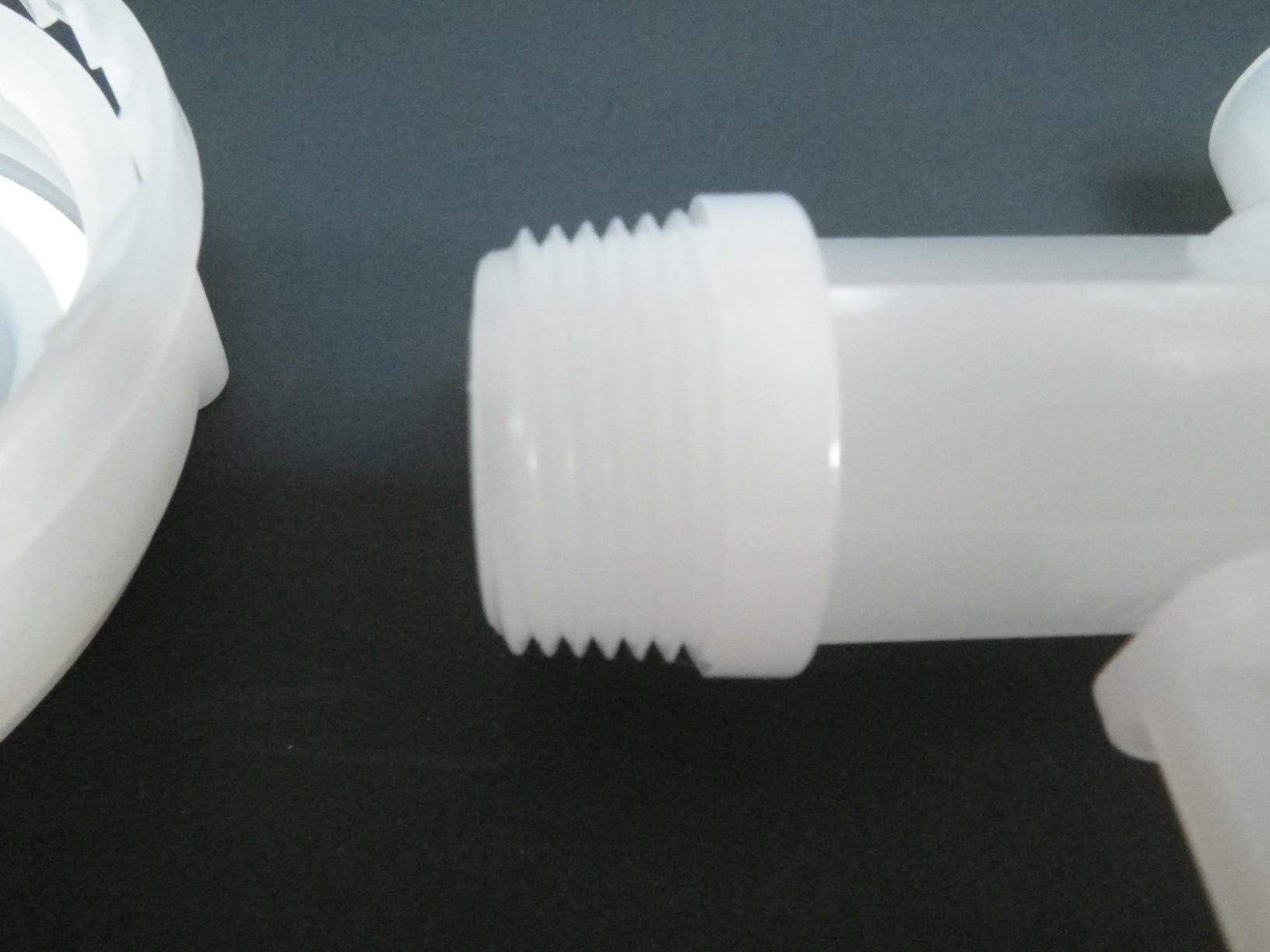
What You Get Right With the Legacy 4 Pack
Two independent reviews of this category reached the same conclusion we did: the ribs matter. Containers that merely sit on top of each other develop a visible wobble within months, and a wobbling column in a garage is how you end up with a cracked seam and a wet floor. These lock.
The included treatment drops are the other quiet win. Most kits sell the tank and make you find a preserver separately, and most people never do that step. When it arrives in the box with the straps, people actually use it.
Where the Legacy Kit Falls Short
The filled weight is the honest limitation. At roughly 40 pounds a tank, this is a two-hand carry across a garage floor, and anyone with back or shoulder problems should not plan to move a full stack alone. Rotating water on a schedule also means lifting each jug out, refilling it, and putting it back.
The second limitation is spigot height. Water flows fine, but you are pouring into a bucket at ankle level unless you build a small stand. That is a five-minute fix and worth doing before the first fill.
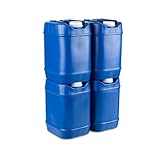
2. Saratoga Farms 5 Gallon 4 Pack – Best for Pouring Without Air Locking
Saratoga Farms 5-Gallon Stackable Water Storage Containers, Emergency Water Storage for Camping and Disaster Preparedness, 20 Gallons
Capacity: 5 gal each
Weight: 40 lb full
Size: 11 x 10 x 14 inch
Pack: 4 jugs, 20 gal total
Pros
- Flat tops and bottoms nest cleanly
- Twist breathing ports stop air locking
- Food-grade BPA-free HDPE
- Integrated handle per jug
- Kits scale from 20 to 100 gallons
Cons
- Threaded lids are very hard to open by hand
- A full stack is hard to move
- Tall jugs take more vertical space
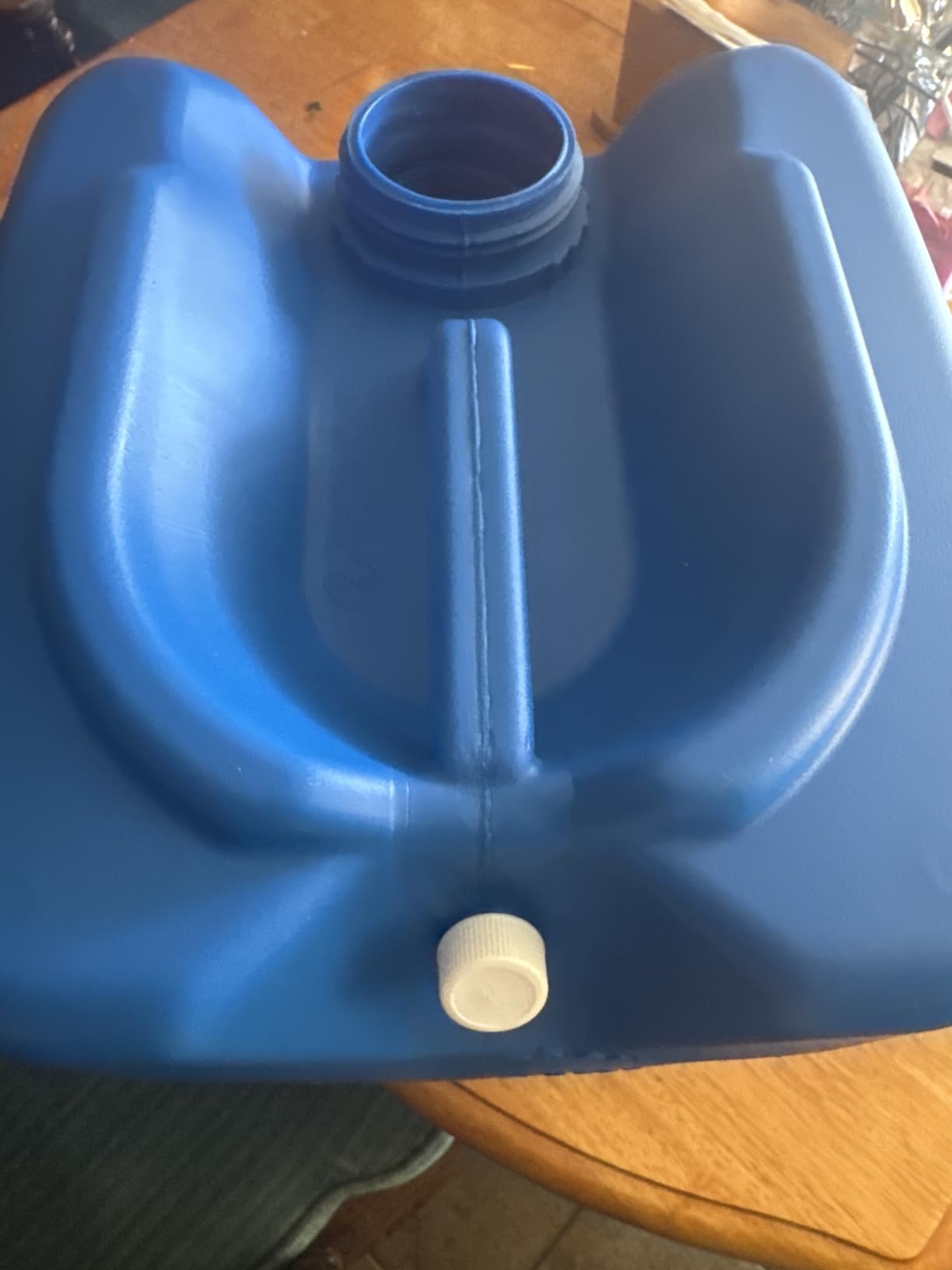
The Saratoga Farms jugs solve a problem most flat-sided containers share. Water will not pour out of a closed rigid container unless air can replace it, and these have built-in twist breathing ports that make draining predictable. When you need to move six gallons from a garage jug into a bucket or a water filter, that difference is immediate.
Nesting is cleaner here than on most competitors. The flat bottom sits flush on the flat top of the jug below with no locating ribs, which means a two-high or three-high column is a straight vertical stack with no wobble reported in the reviews. Capacity kits also run from 20 up to 100 gallons, so you can match the same platform to a larger reserve later.
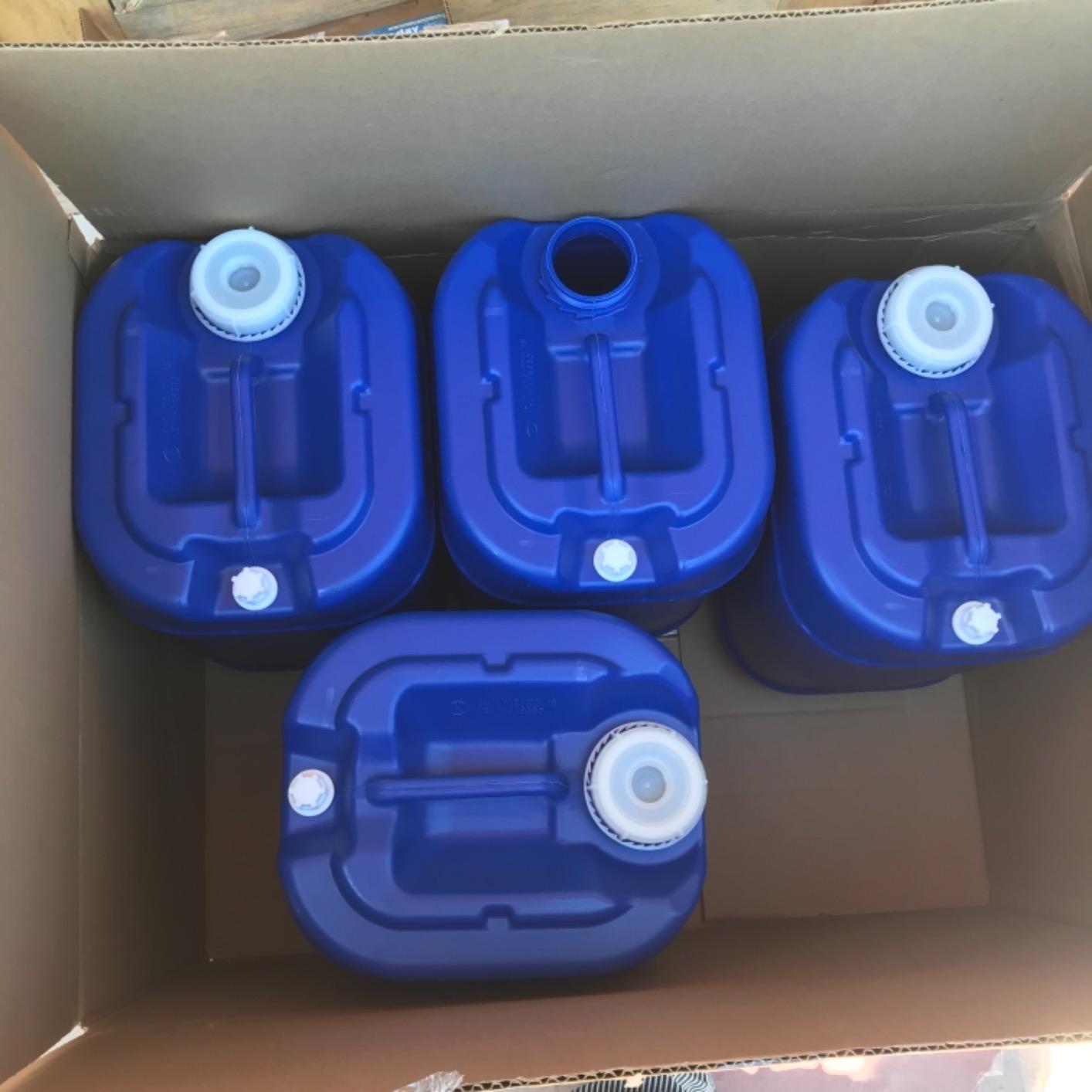
The one thing owners complain about repeatedly is the lids. They seal well and they stay sealed, which is exactly what you want for a year-long store, but the threads are tight enough that opening one by hand is genuinely difficult. A bung or strap wrench is not optional for this jug, it is a requirement.
Why the Breathing Ports Are Worth It
Any rigid jug without a vent will glug, stop, and resume as air bubbles through the opening. With four jugs to empty one at a time during rotation, that adds up. The twist ports on these are the reason owners describe the pour as smooth rather than intermittent.
They also make partial draws less messy, because you can stop mid-flow without the container going rigid and losing its shape.
Where the Tight Lids Cost You
Every container you fill is one you eventually need to open, and these ask for a wrench. If you are building a rotation habit around a calendar reminder, a wrench on hand makes the difference between a routine you keep and one you skip.
Because the jugs are 14 inches tall and stack three high, budget for 42 inches of vertical clearance. That rules out low shelves under a workbench unless you lift the stack twice per rotation.
3. WaterPrepared 55 Gallon Stackable Tank – Best High-Volume Container With a Small Footprint
WaterPrepared 55 Gallon Unique Stackable Utility Water Tank, Blue
Capacity: 55 gal
Size: 28 x 22 x 29.5 inch
Shape: oval
Empty weight not listed
Pros
- Oval shape uses far less floor space than a drum
- Stacks compactly for a garage corner
- Pre-tested leak-free before shipping
- Spigot connects to a standard garden hose
- UV-proof blended HDPE
Cons
- Very heavy and awkward when full
- Spigot sits low without a platform
- Some arrive with plastic shavings inside
- Needs clearance under the lower tank
A standard 55-gallon drum is a cylinder in a square box, which means most of the space it occupies is wasted. This tank is oval, and that single design change is the whole reason it fits a residential garage where a drum would not. It also stacks, which a standard drum does not reliably do once full.
The spigot is the practical stand-out. It connects directly to a standard garden hose, so you can fill a kiddie pool, run a hose to a washing machine during an outage, or siphon into smaller jugs without an adapter. Owners also report that the UV-proof plastic blend noticeably slows bacterial growth during extended storage.
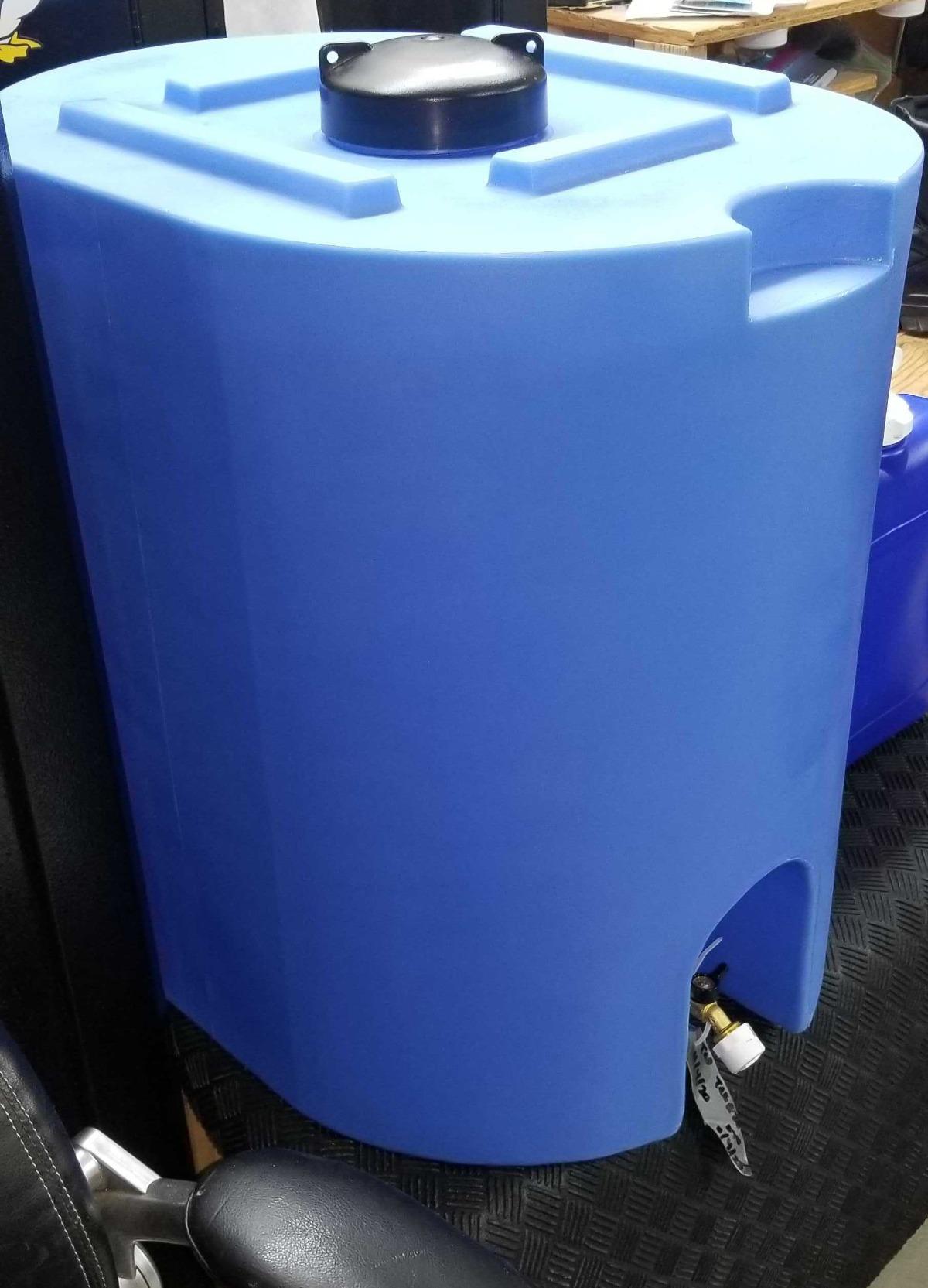
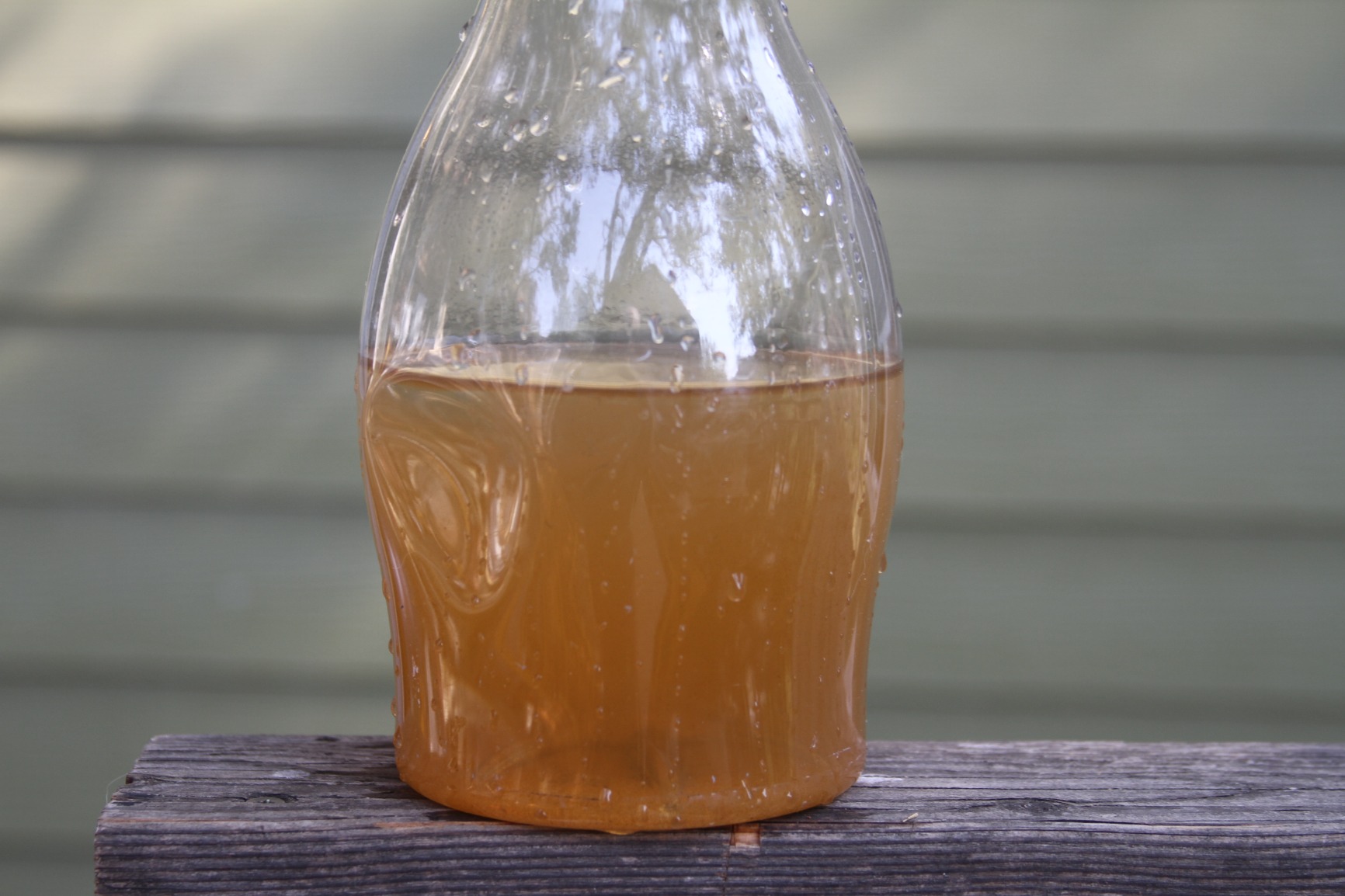
Two details catch people out. The manufacturer asks for about 4 inches of clearance beneath the lower tank when stacking, which is a pallet or a set of cinder blocks, and the spigot sits low enough that you will want the same platform for comfortable dispensing. A few owners also found small plastic shavings inside on arrival and rinsed or vacuumed them out before filling, so inspect it first.
When a 55 Gallon Tank Beats Five Gallon Jugs
Choose a tank like this when your goal is a large reserve you will draw from occasionally, not something you rotate often. A 55-gallon tank gives a family of four roughly two weeks of drinking and cooking water, and a hose connection makes dispensing from it far easier than from a stack of jugs.
The oval footprint also means two of these fit along a garage wall where two round drums would not. If your constraint is a narrow bay rather than total weight, this is the answer.
Where This Tank Becomes a Problem
Full, it is a two-person job by a wide margin, so you position it once and leave it. Water rotation is also harder: draining 55 gallons takes real time and a floor drain or a garden hose, and a partially drained tank is a growth risk.
If you want a reserve you can move, lift, and rotate, a smaller stack is a better tool than a bigger tank. We have written about water storage barrels for emergencies if you want the drum-style comparison.
4. Saratoga Farms Spigot Kit 5 Gallon – Best All-in-One Kit With Spigots and Preserver
Saratoga Farms 5-Gallon Stackable Water Storage Containers with Lids, Emergency Water Storage Kit Including Spigots, Wrench, and Water Preserver, 20 Gallons
Capacity: 5 gal each
Weight: 40 lb full
Size: 11 x 10 x 14 inch
Kit: 6 jugs, 2 spigots, wrench
Pros
- Stack stays square with no teetering
- Lids seal without extreme torque
- Build owners say outlasts cheap jugs
- Includes spigots wrench and preserver
- Portable size moves through a house
Cons
- Tamper ring makes lids awkward to open
- Occasional missing caps in multi-packs
- Slow to fill through the small opening
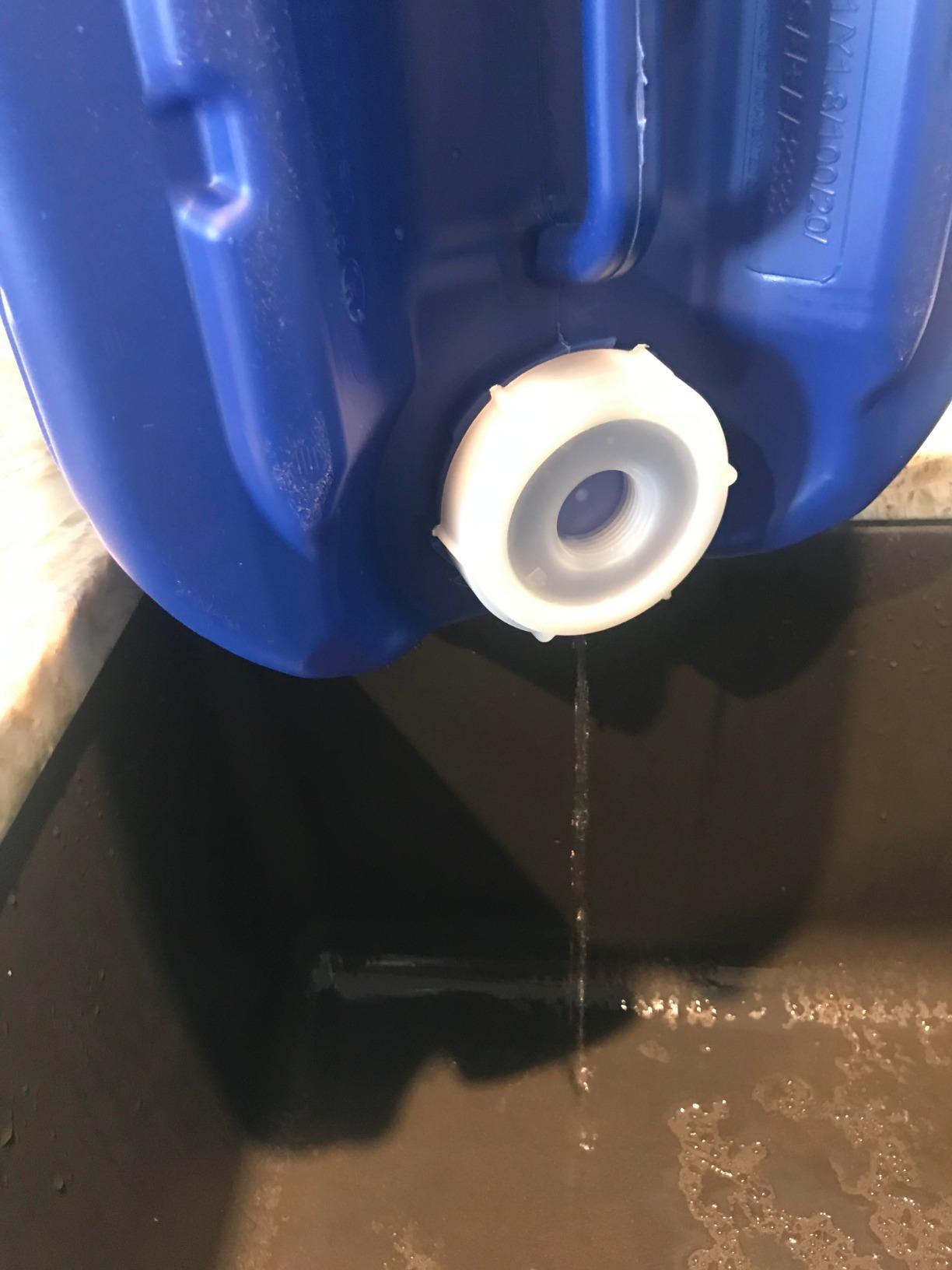
Everything about this kit is organized around the thing that trips people up most, which is hardware. You get no-drip spigots that thread directly onto the lids, a 70mm cap wrench, and a bottle of water preserver that treats a large volume. There is nothing to buy separately and nothing to forget before the first fill.
The lids are a step up from the plain Saratoga Farms jugs. Owners report they seal reliably once tightened with the supplied wrench, without needing serious torque, and that the stack does not teeter even after years of use. That is the configuration we want for a garage corner, where a leaning column eventually fails at the bottom seam.
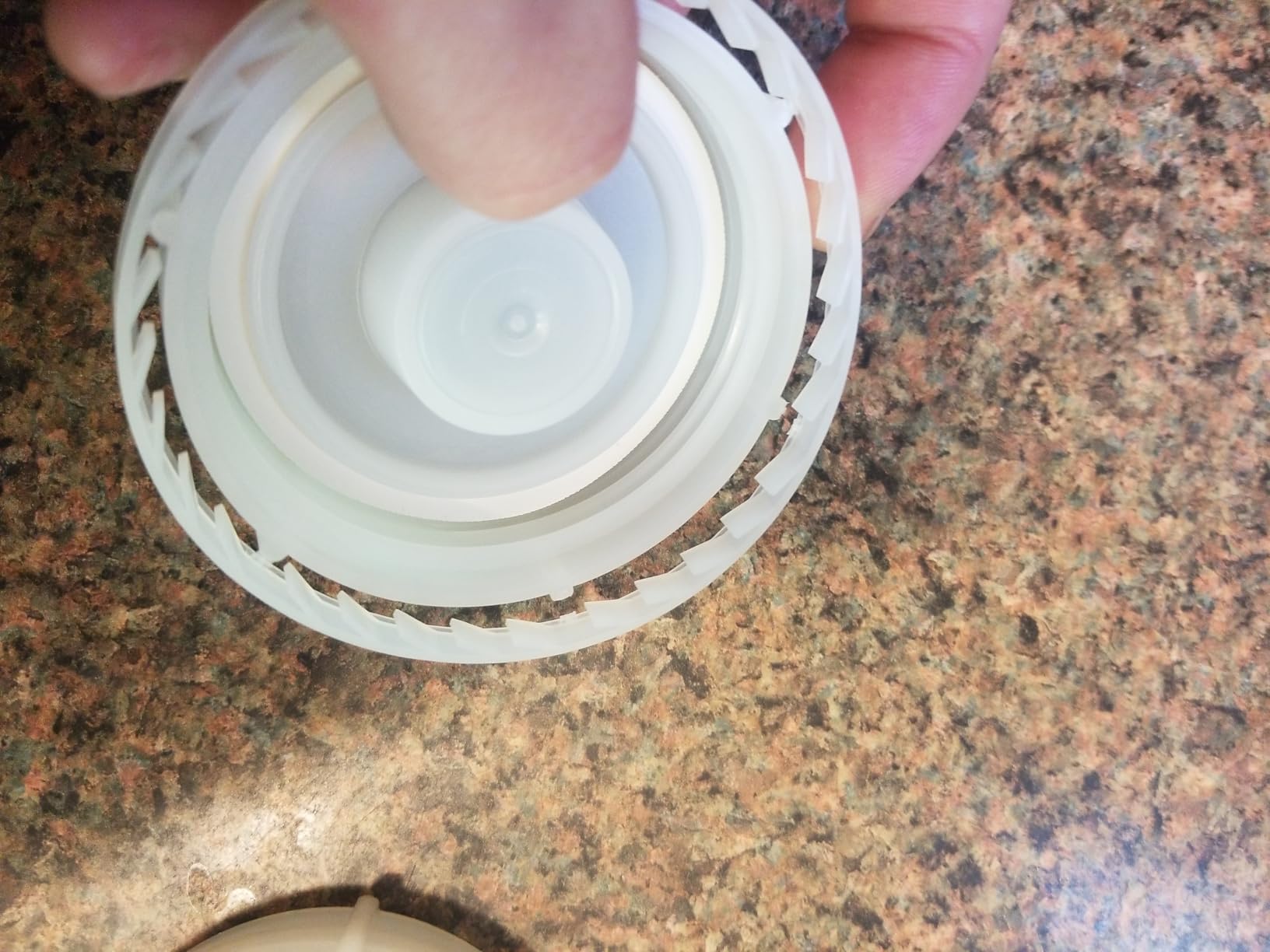
Two honest drawbacks. The tamper-proof ring on the caps makes lids harder to open and clean than they need to be, which matters more than it sounds during a twice-yearly rotation. And filling through the small opening is slow, slow enough that some owners drill an extra vent hole to speed it up.
Why the Included Preserver Matters
Water left untreated in a plastic jug for months picks up a plastic taste that makes people avoid drinking it, which defeats the purpose entirely. A preserver included in the box gets used. A preserver you have to remember to order usually does not.
That is the quiet reason this kit holds its 4.5 rating over more than 750 ratings rather than slipping. Owners use the water, so they keep evaluating it, so the reviews stay recent.
Where the Kit Falls Short
Multi-pack quality control is the main complaint. A small number of buyers received containers with bottom defects or missing caps and spigots, which is frustrating when you just bought the complete kit. Check the count of lids, spigots, and containers the moment the box opens.
The tamper ring is the other one. It adds nothing for a household container, and it makes the annual clean and refill slower than it needs to be.
5. WaterBrick 3.5 Gallon 8 Pack – Best Stackable Water Storage for Tight Garage Corners
WaterBrick International Water Storage Containers for Emergency Water Storage | 8-Pack of Stackable 3.5 Gallon Water Container Bricks | Food-Grade HDPE Plastic | BPA-Free | STD Tan
Capacity: 3.5 gal each
Size: 9 x 18 x 6 inch
Weight: 2.5 lb empty
Stack: 2 per row, 4 ft high
Pros
- Cross-stacks two per row into a solid block
- Light enough for one person to lift
- Doubles as dry goods storage
- Wide opening for hand cleaning
- Food-grade HDPE made in USA
Cons
- No spigot included
- Each of the eight must be filled separately
- Shallower rows take more floor area per gallon
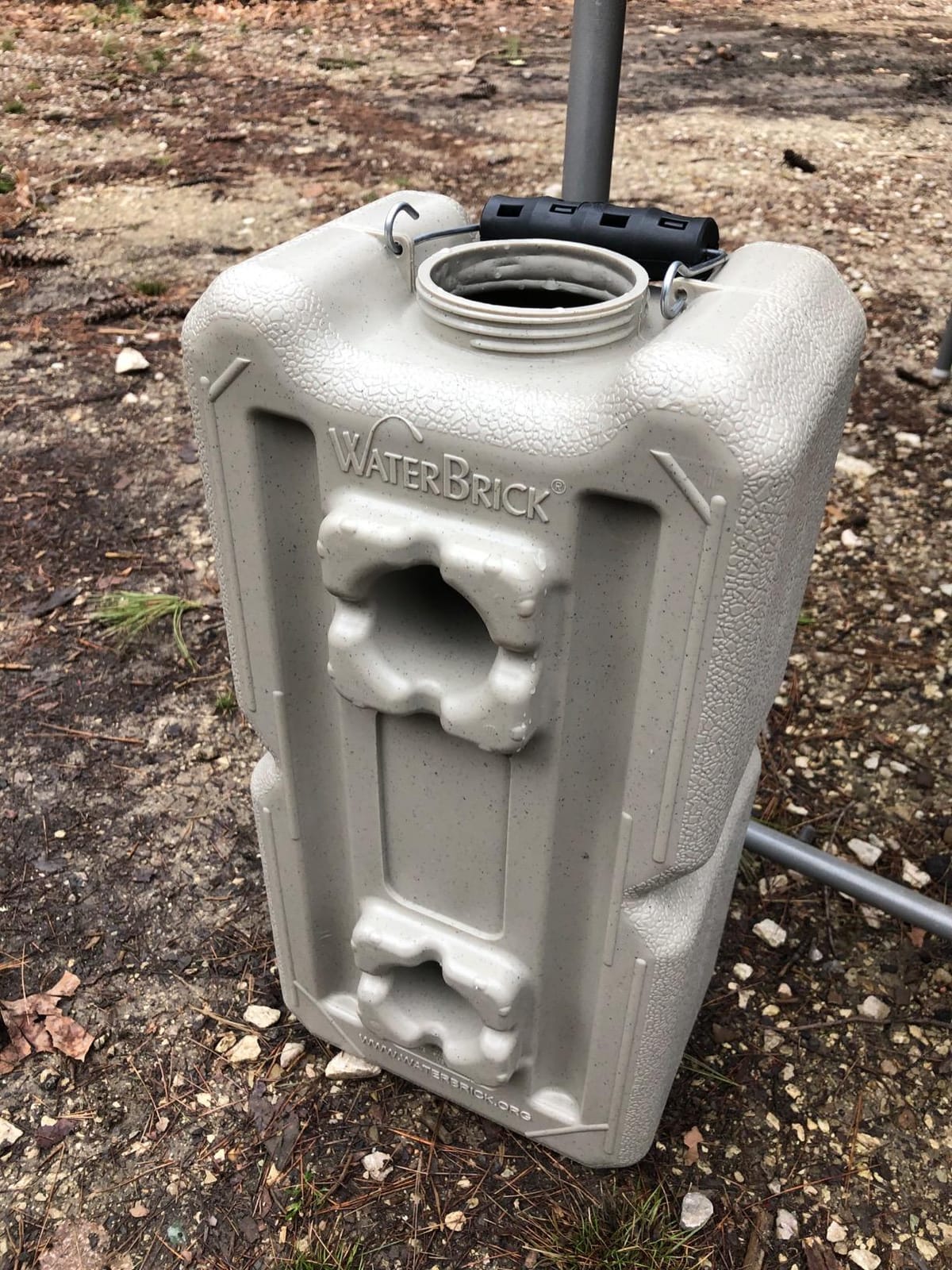
The WaterBrick is the most space-efficient container in this group and the only one you can build a wall out of. Two bricks per row, cross-stacked up to 4 feet high or 8 rows, gives you 28 gallons in a footprint roughly the size of a single 5-gallon jug lying flat. The interlocking shape is why people describe them as stacking like bricks.
At 2.5 pounds empty and about 40 pounds full, they are also the only containers here you can genuinely rotate by yourself. That single property is why forum users keep ten or more of them rather than a handful of larger tanks. If you will actually follow a rotation schedule, this is the container that lets you do it.
No spigot comes with the brick, so water comes out with a scoop, a siphon pump, or a transfer wand. For drinking water that is a nuisance, and it is the reason these sit next to a pump on many workbenches. The wide opening is a real compensation, though, because you can scrub a brick by hand in a sink.
Best Uses for WaterBrick Containers
They are not only water containers. Owners store rice, beans, sugar, pet food, and sand in them, and the shallow shape doubles as a shelf or step. In a garage that is genuinely useful, because the same footprint can hold a food reserve and a water reserve in different seasons.
For a van or a small utility space, the pairing of low weight and high stacking is hard to beat. We covered the best storage containers for moving separately, but the same logic applies to anything that has to be lifted rather than rolled.
Where WaterBricks Fall Short
Filling eight bricks one at a time is the honest cost of this format. If you are filling 28 gallons, you are making 28 separate trips with a hose or a pitcher, and you need to dry each one completely before capping or you trap moisture against the plastic.
And with no dispensing hardware, a brick is a storage object more than a serving object. If you want a glass of water without a pump, pick a jug with a spigot instead.
6. Legacy 15 Gallon Stackable Tank – Best Middle Ground Between Jugs and Drums
15-Gallon Stackable Water Storage Container with Siphon Hose
Capacity: 15 gal
Weight: 125 lb full
Size: 15.7 x 15.7 x 21.5 inch
Includes 6.5 ft siphon hose
Pros
- More capacity than a 5 gallon jug without drum bulk
- 6.5 ft food-safe siphon hose included
- Dual 2 inch bung openings with gasket seals
- Dark blue light-blocking body
- Two heavy-duty carry handles
Cons
- About 125 lb full is a two-person lift
- Stacking two full tanks makes the top one very heavy
- Round shape uses more floor space than a brick
Fifteen gallons sits exactly where you want it if a 5-gallon jug is too small and a drum is too big. At a 4.7 rating it matches the best score in the group, and the reason is the siphon hose: 6.5 feet of food-safe self-priming hose with a copper head, included, which makes filling and draining a completely different job than wrestling with a full drum.
Two 2 inch bung openings with rubber gasket seals give you a wide fill path and a genuine vent, so you are not pouring into a sealed vessel and waiting for it to glug. The two integrated handles make positioning far easier than the single-handle designs.
The weight is the deciding factor. Filled, this is about 125 pounds, which is a two-person lift for most people and a real problem if you are trying to drain and refill it solo. Owners generally plan around this: fill it in place, and use the siphon rather than moving it.
When 15 Gallons Is the Right Number
This tank makes sense when you want more than a week of reserve for two or three people and you have a floor area that can spare a 16-inch square. It is also the right size if you have a siphon pump and a nearby drain, because the bundled hose makes water transfer simple.
It pairs well with a smaller jug system. Keep 5-gallon jugs for drinking and rotation, and use a 15-gallon tank for the bulk of the reserve.
Where the 15 Gallon Tank Fights You
Stacking two full tanks means filling a 125-pound container that is already 21.5 inches off the ground, which is awkward and spill-prone. Plan to fill the lower position first and never need to fill the upper one after stacking.
The round footprint also means less efficient floor use than the oval tank or the brick. If floor area is your binding constraint, size matters more than the gallon count.
7. Aguaprep 5 Gallon 4 Pack – Best Stackable Set for RVs Boats and Small Spaces
Aguaprep 5-Gallon Stackable Water Storage Containers, 5 Lids + 1 Spigot, Easy Fill, Survial Supply Emergency Water Storage for Camping and Disaster Preparedness, RV, 20 Gallon (4 Tanks)
Capacity: 5 gal each
Weight: about 42 lb full
Size: 15 x 12 x 15 inch
Pack: 4 tanks, 20 gal
Pros
- Sturdy thick-wall construction
- Lids screw on tight and seal well
- Flat sides add stability when dispensing
- Compact enough for closets and RVs
- Tanks lids and spigot made in USA
Cons
- Very heavy once filled and stacked
- Spigot fitting instructions are unclear
- Stacking guidance exceeds what most owners trust
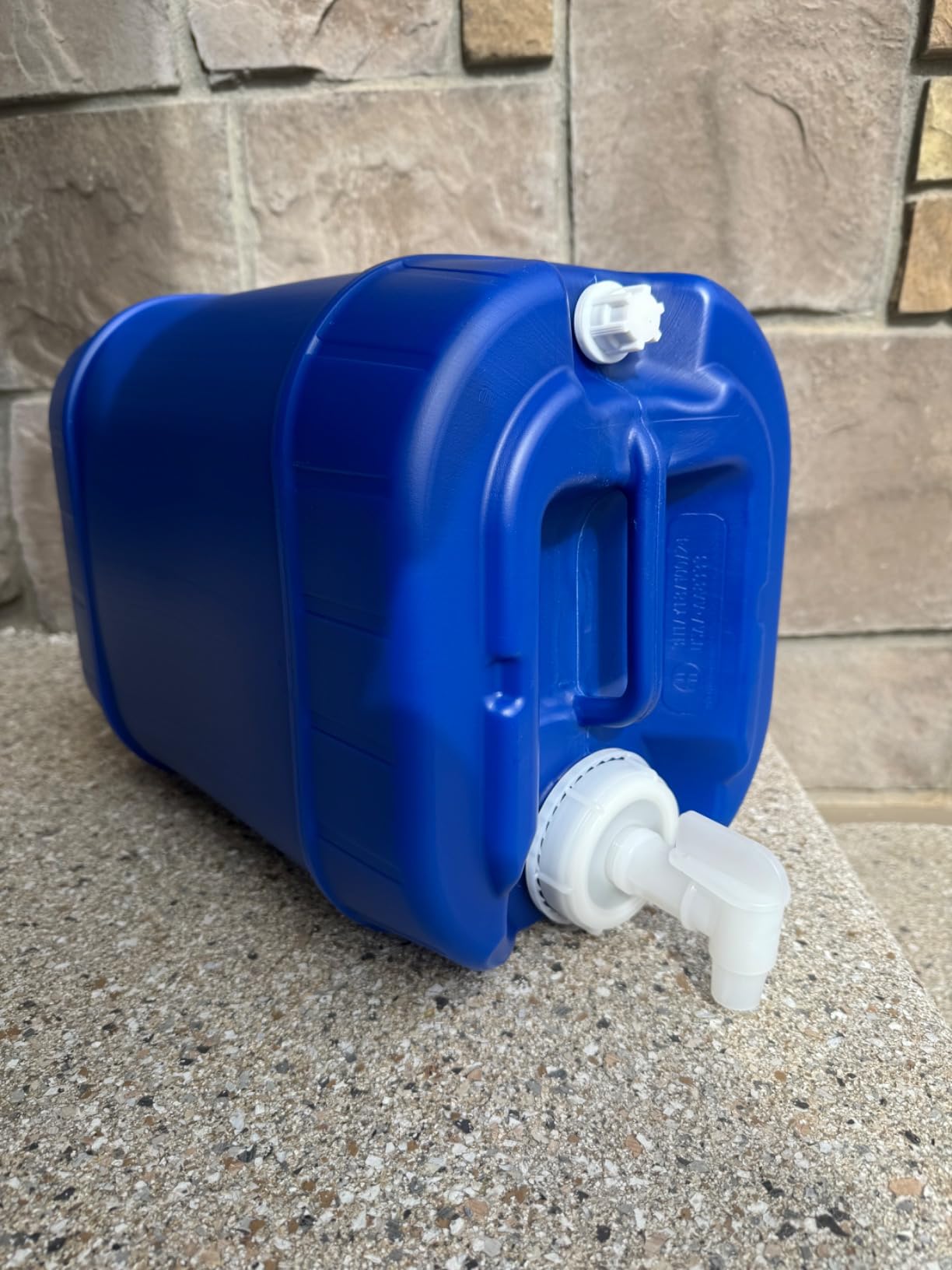
Aguaprep solves a specific problem: pouring from a spigot on a wobbly container. These tanks have flat sides, so when the weight of the water pulls to one side during a pour the tank stays planted instead of walking across the concrete. For a garage with a sloped floor or for a truck bed, that is a genuine advantage.
You get five lids for four tanks, which means both a screw-on lid for transport and a pour-through lid for filling, plus a spigot. The thick walls are the other thing owners mention first, describing the build as heavier and more durable than the price suggests.
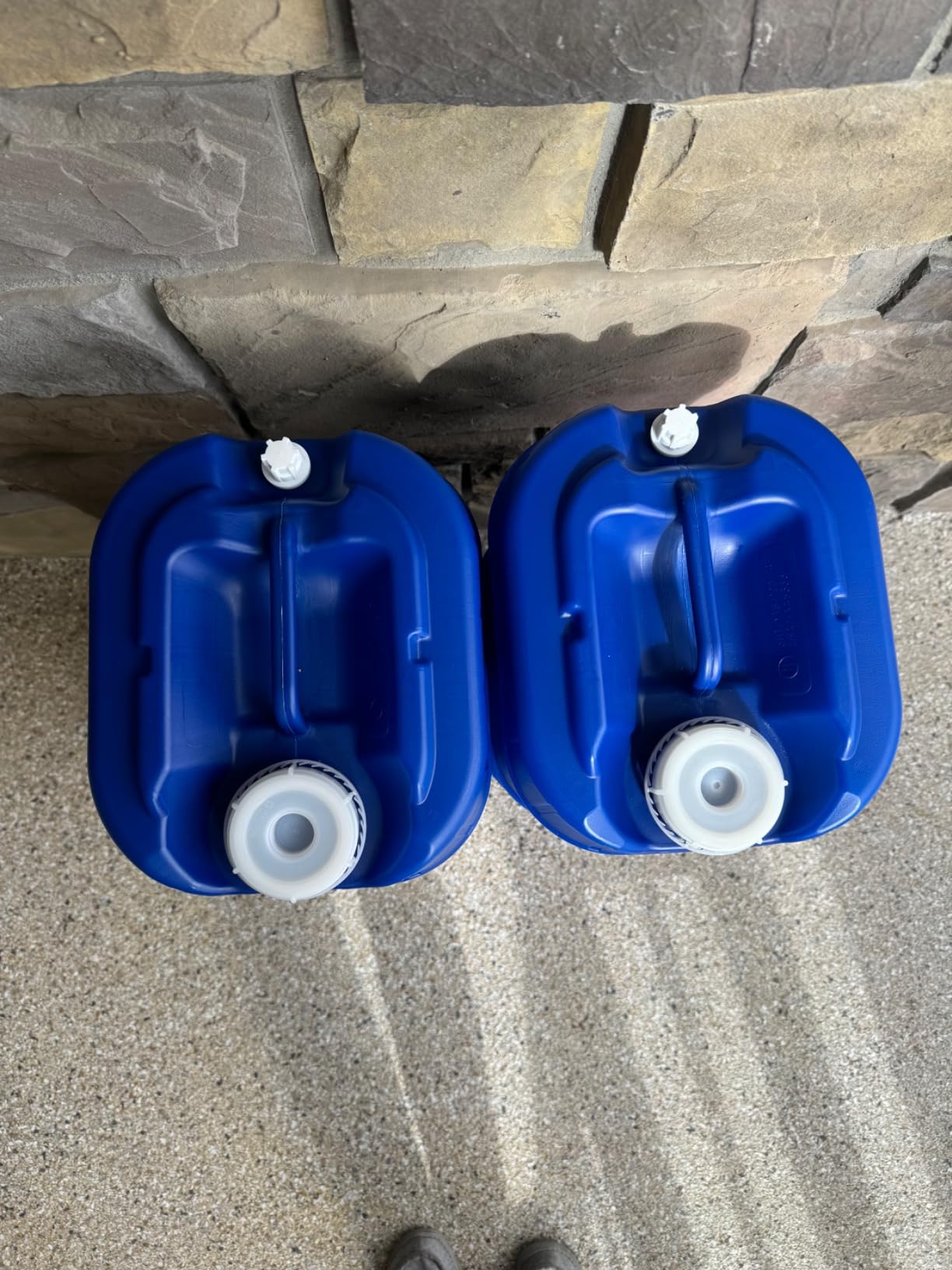
Two cautions. The spigot fitting instructions are unclear enough that several owners had to work out the assembly, so read them before you start. And the manufacturer stacking guidance goes up to five, which is well beyond what most buyers are comfortable putting 200 pounds through, so three is the sane ceiling.
Best For: Transport and Tight Corners
These are the ones to pick if the water is going into an RV, a boat, a closet, or a van rather than staying put. The footprint is compact, the lids seal well enough for transport, and the flat-sided stability helps when the surface is not level.
They also work well as backup jugs in a car, which is where a 5-gallon container belongs.
Where Aguaprep Falls Short
Filled weight is roughly 42 pounds per tank, so a four-tank stack is about 170 pounds and the top one is no longer a solo lift. Fill in position and do not plan to shuffle the column.
The clarity of the spigot assembly is a documentation problem more than a product one, but it costs you time on day one and it is avoidable with a quick read before assembly.
8. Emergency Water Tanks 55 Gallon Stackable – Best Wide Opening for Cleaning and Draining
55 Gallon Stackable Emergency Water Storage Tank – Food Grade BPA-Free Water Container for Long-Term Home Preparedness
Capacity: 55 gal
Weight: 22 lb empty
Size: 27.75 x 21.75 x 29.5 inch
5 inch twist lid
Pros
- Stacks securely for 55 gallon capacity
- 5 inch lid wide enough to scrub inside
- Brass spigot feels better than plastic
- 22 lb empty weight is easy to reposition
- Covers a family of four for up to two weeks
Cons
- Lowest average rating in this group
- Small review base of 63 ratings
- Filled weight makes moving it impractical
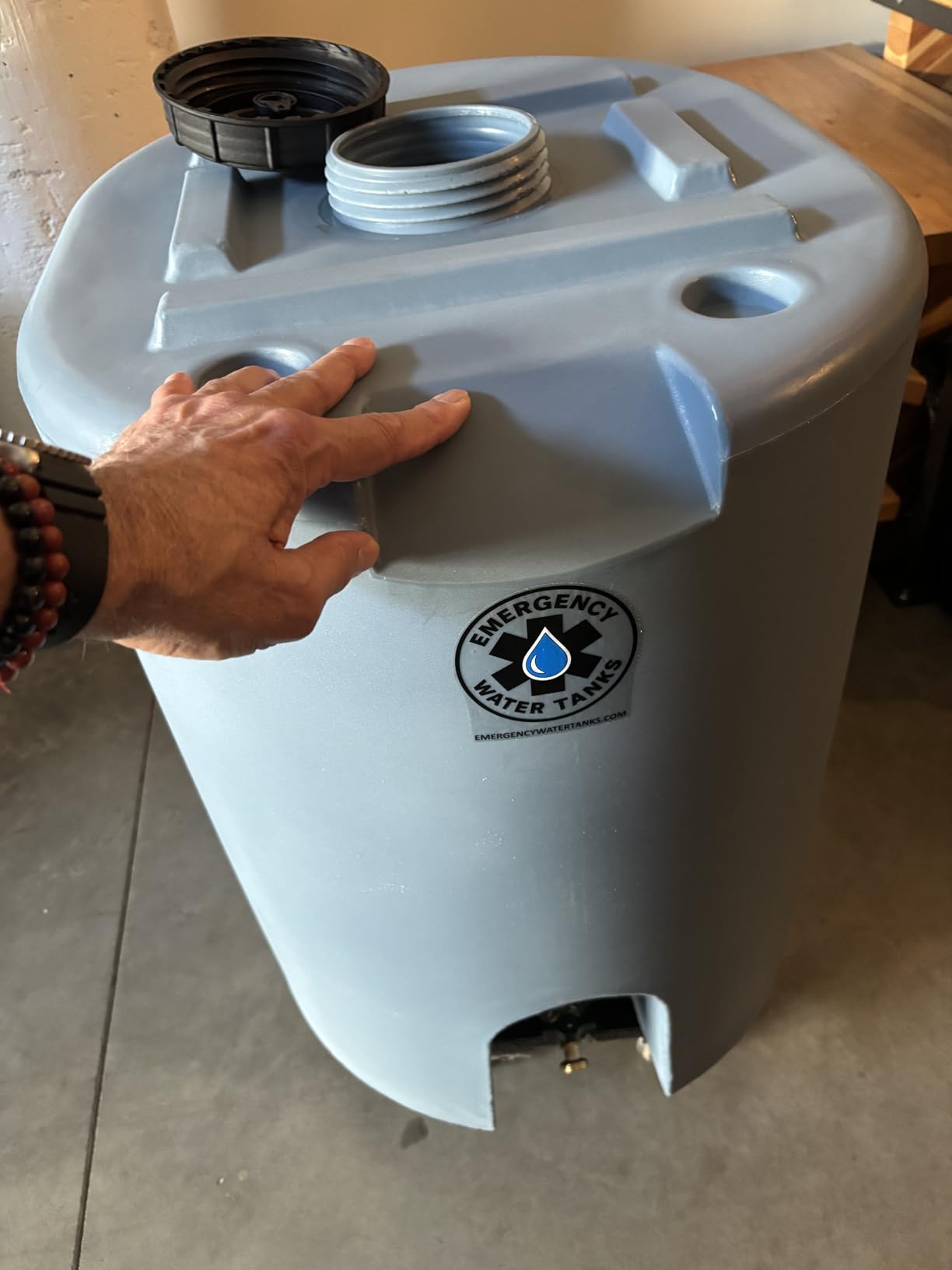
The 5 inch twist lid is the feature that separates this from other 55-gallon tanks. It is wide enough to get a hand or a brush inside, which is exactly what you need when you are draining and cleaning a container for a second year of storage. A tank you can scrub is a tank you will actually scrub.
Positioning is also easy in a way that drums are not. At 22 pounds empty, one person can walk it into a garage corner and set up the stack before any water goes in, and the built-in brass spigot is a step up in feel and durability over a plastic fitting.
We want to be straight about where this one stands. Its 4.2 average is the lowest of the twelve and its review base of 63 ratings is thin, which means the long-term record is not yet established. Some buyers reported fit-and-finish issues on arrival, so inspect the tank carefully before you commit.
Why the Wide Lid Matters More Than It Sounds
Sediment and biofilm collect at the bottom of any container, and a small opening means you are cleaning around the fitting with a cloth and hoping. A 5 inch opening means you can reach the floor, scrub it, and dry it before the next fill. That single feature is what makes long-term storage practical.
It also makes a full drain realistic, which matters because leftover water sitting in a tank is the worst possible starting point for a new fill.
Where This Tank Falls Short
The rating is the first thing to weigh. Two products in this group with far fewer reviews score higher, and a bigger established brand gives you more to fall back on if something arrives damaged.
The second is weight, and it is unavoidable at 55 gallons. Treat this as a permanent installation rather than something you rotate, and keep smaller jugs nearby for drinking.
9. Rockwell Exodus 35 Gallon – Best Certified Tank with Brass Hardware
Rockwell Exodus 35 Gallon Stackable Emergency Water Storage Tank, BPA-Free Water Container for Home Backup, Camping and RVs, Made in USA, Blue
Capacity: 35 gal
Weight: 20 lb empty
Size: 29.5 x 20 x 18.25 inch
Stacks: two high on molded tabs
Pros
- Molded tabs stack two high in a corner
- Thicker rotational-molded HDPE walls
- Lead-free brass valve and faucet
- Corner drain plug empties the tank
- Made in USA with 3 year warranty
Cons
- Most expensive per gallon here
- Drain plug sometimes missing from the box
- Vent hole in the top unsettles some buyers
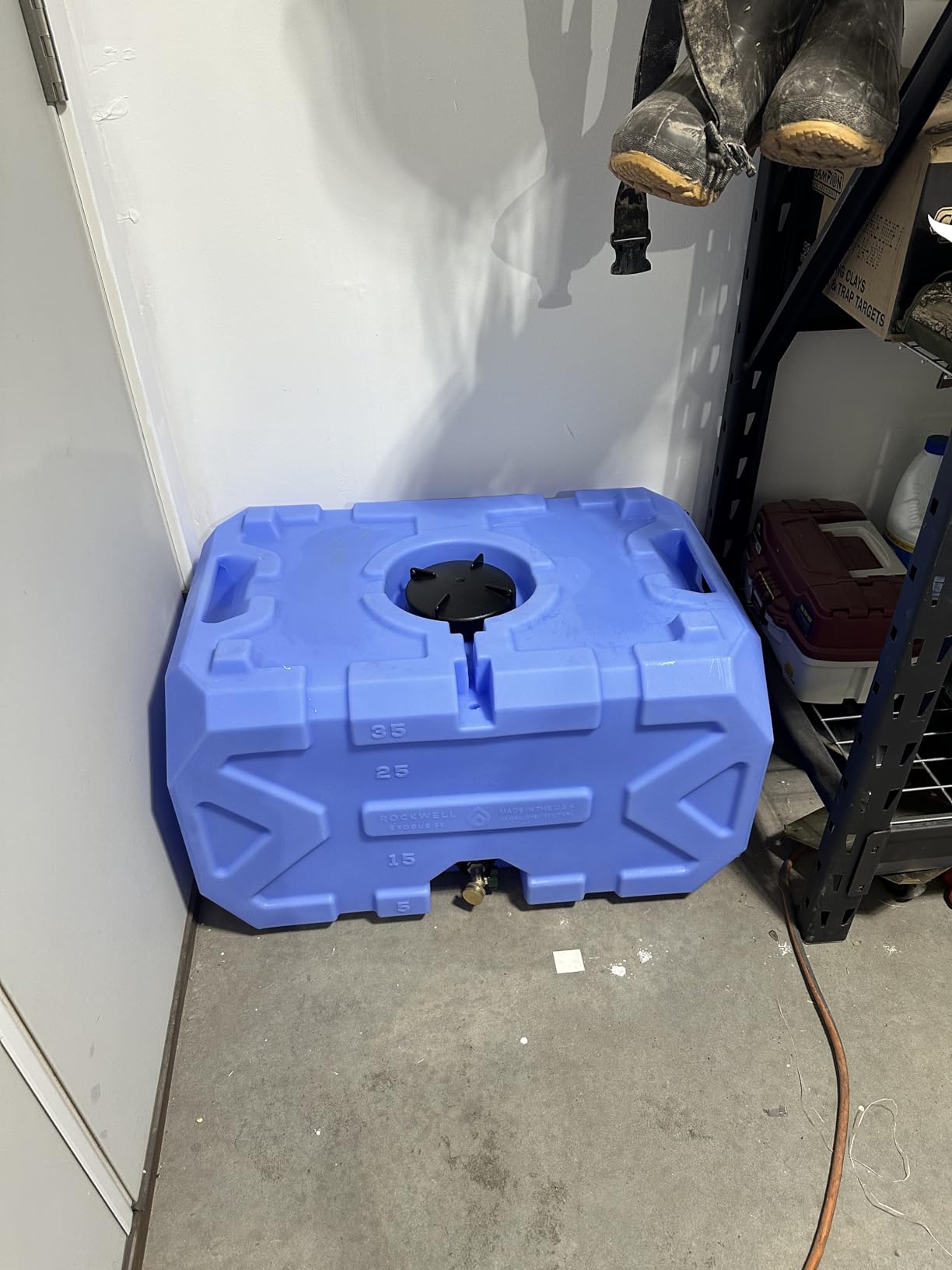
This is the only container here that lists compliance with National Sanitation Foundation 61, and it is the only one with a limited three-year warranty attached to the tank. For water you plan to keep for years rather than months, those two facts carry more weight than any feature list.
The hardware is genuinely different. A lead-free brass quick-turn valve and a brass faucet cap resist the corrosion and thread-stripping that ruins plastic spigots, and the 5 inch anti-airlock lid fills quickly. The corner drain plug is a small idea with a real payoff, because it gets the last drops out instead of leaving a puddle of stale water in the bottom.
Owners like that the stacking tabs are molded into the tank, so a two-high column locks rather than merely resting. At 29.5 by 20 inches and 18.25 inches tall, two of them form a compact block that fits a garage corner without eating a whole bay.
What NSF/ANSI 61 Actually Changes
It means the tank was independently tested for material safety, not simply labeled BPA-free. The distinction matters because BPA-free is a statement about one specific compound, while the standard covers the broader set of substances that can leach from plastic into drinking water.
If you can verify a certification number, you are not relying on a marketing claim. Only one of the twelve containers we compared publishes that standard on the listing.
Where the Exodus Falls Short
It costs the most per gallon in the group, and the review history is thin at 38 ratings, so the long-term picture is less certain than the warranty suggests. The most repeated issue is a corner drain plug arriving missing from the box, which the manufacturer is reported to resolve quickly.
Some buyers are also uneasy about the vent hole in the top. It is necessary for filling, but if it bothers you, that is a fair reason to pick a different tank.
10. Bushman 55 Gallon Stackable HDPE Drum – Best Transport-Rated Bulk Container
Bushman 55 Gallon Plastic Drum, Stackable Industrial Storage Barrel, Blue
Capacity: 55 gal
Weight: 19 lb empty
Size: 22.5 x 22.5 x 34.75 inch
Rating: 1H1/Y1.9/150
Pros
- Rated 1H1/Y1.9/150 for liquid transport
- Stacks securely when sealed
- 19 lb empty weight is easy to move
- Molded gallon and liter markings
- FDA and USDA food-grade compatible
Cons
- Lid is glued shut and not removable
- Bung openings need a special wrench
- Over 450 lb filled makes repositioning unrealistic
Most of the containers here are storage vessels. This one is a shipping drum, and it carries an UN rating of 1H1/Y1.9/150 for liquid contents, which means it is built and tested to a transport standard. For bulk rainwater collection, fermentation, or moving a serious reserve, that rating is the entire argument.
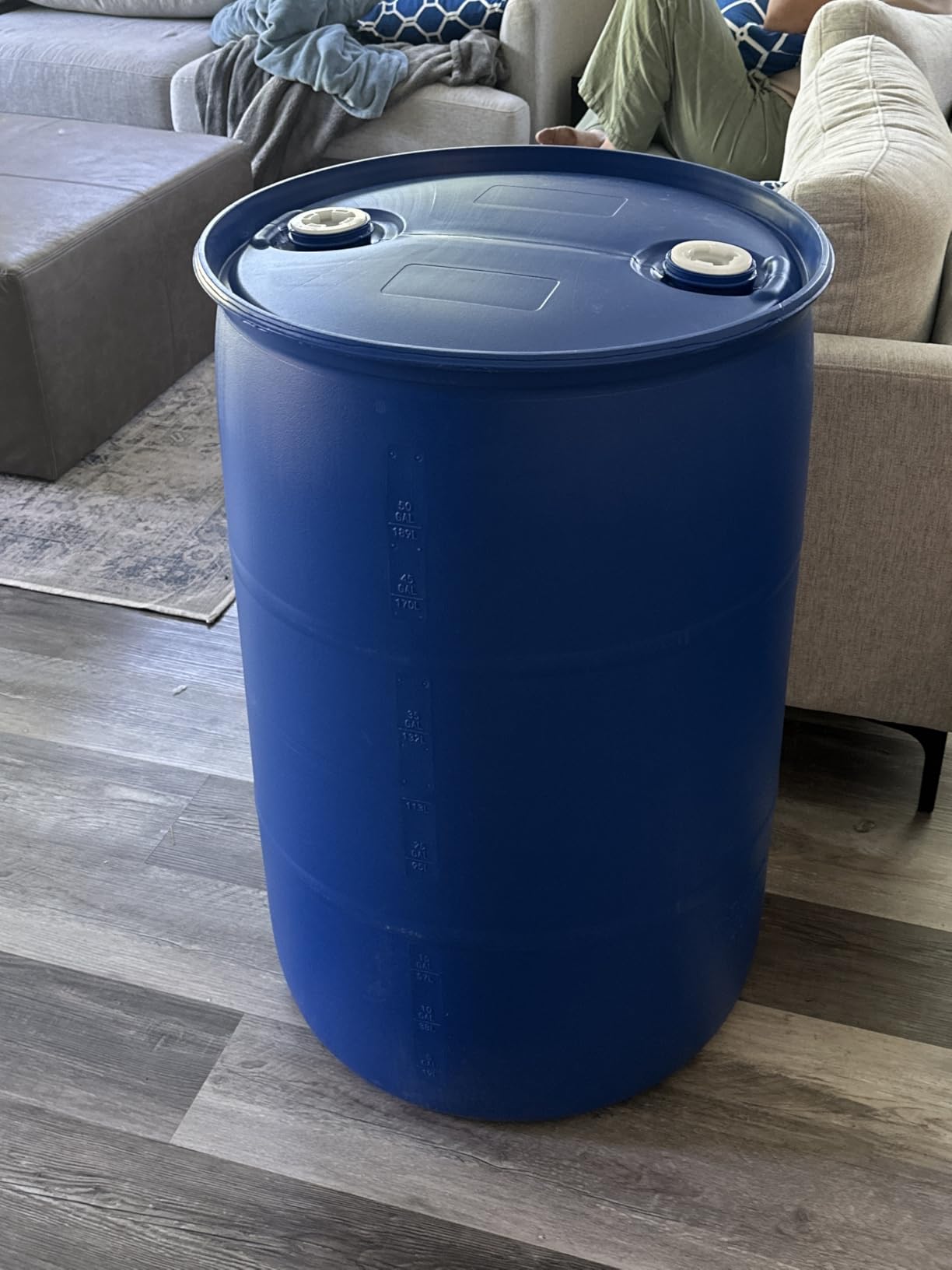
Ratings skew strongly positive, with 80 percent five-star in the distribution, and owners describe it as sturdy and clean on arrival. The molded gallon and liter markings on the side are a small touch that tells you the manufacturer thought about actually using it, and at 19 pounds empty one person can move it.
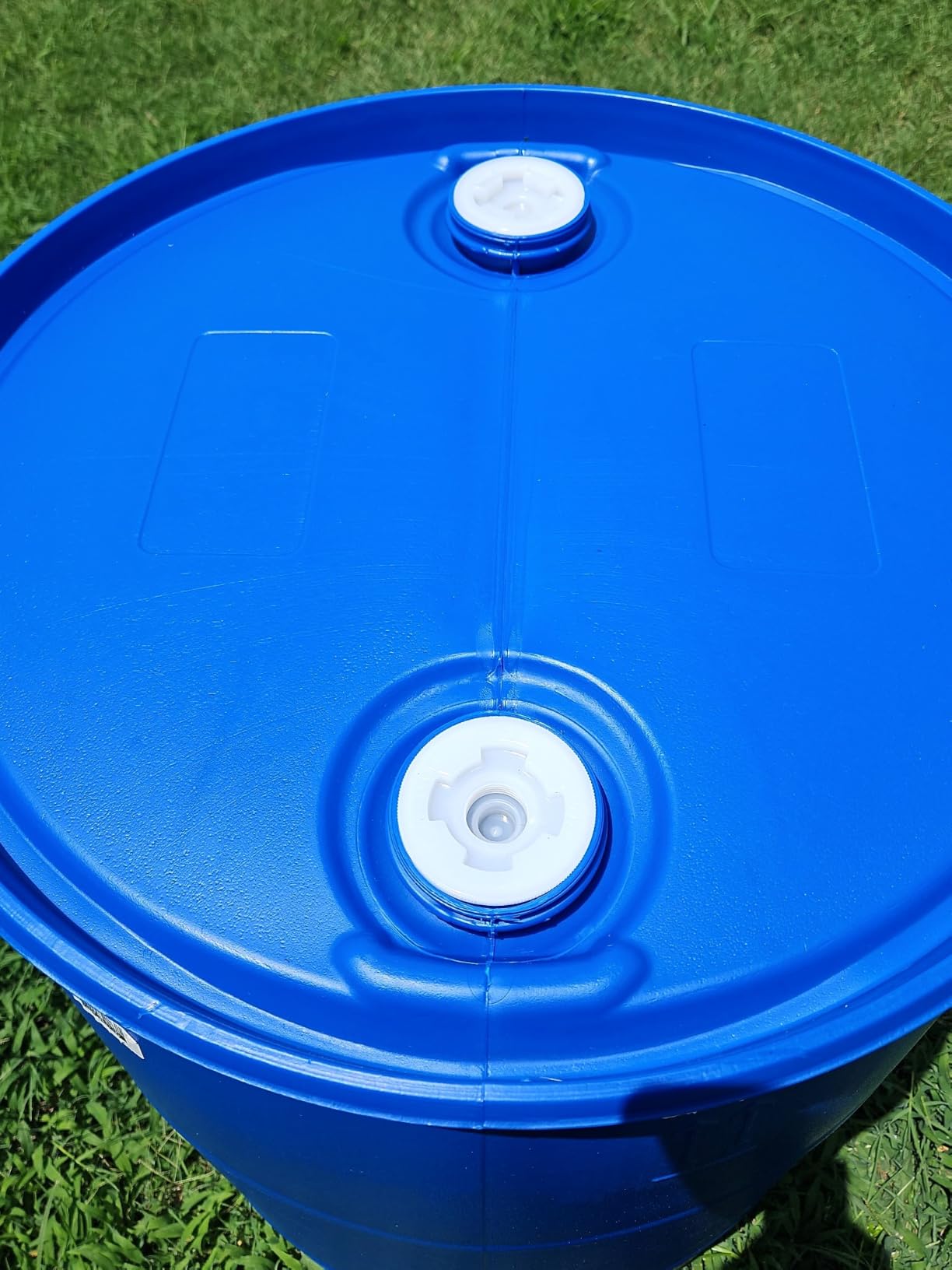
There is one significant limitation and it is a design choice, not a flaw. The lid is glued shut and not removable, so once sealed this drum is committed to whatever you put in it. If you are still deciding, fill it with something reversible, or buy your drinking water in containers you can open.
Best For: Bulk Volume and Non-Potable Use
A 55-gallon drum is a sensible way to hold a large reserve of non-drinking water, like irrigation or cleanup supply, without paying for potable-rated jugs. It also handles outdoor storage well, since the HDPE resists UV exposure and corrosion.
For rainwater collection, a stack of sealed drums in a garage corner is a genuinely long-term answer. Just treat the water as non-potable unless you treat it properly.
Where This Drum Falls Short
Filled, it is over 450 pounds. You will position it once, in an empty state, and then it stays there. That is fine for a fixed reserve and wrong for anything you plan to rotate.
The bung openings need a special bung wrench that is not included and is not a tool most people own. Buy one before you fill it, or you will be improvising with pliers on a full drum.
11. Consolidated Plastics 5 Gallon Carboy 4 Pack – Best Documented Four-High Stack
Consolidated Plastics 5 Gallon Stackable Carboy with Leakproof Cap and Handle, HDPE Food Grade, BPA Free, Made in USA (Natural, 4 Pack)
Capacity: 5 gal each
Size: 9.75 x 11 x 15 inch
Pack: 4 carboys
Stack: up to 4 full high
Pros
- Manufacturer states stack up to 4 full high
- Thick evenly molded walls with no flashing
- 60mm red gasketed cap fits very tight
- Meets UN specs and FDA requirements
- Low odor and made in USA
Cons
- Vent opening is not drilled by default
- Not compatible with some low-intake hand pumps
- Visible seam line and occasional imperfect cap seal
Consolidated Plastics publishes a stack limit, which almost nobody else in this group does. Their guidance is explicit: containers are stackable, and when full do not stack more than four high. Four full carboys in a single column is 20 gallons on a footprint of about 10 by 11 inches, which is hard to beat for vertical storage in a garage.
The molding quality gets consistent mention too. Thick, even walls with no flashing or seam lines means fewer weak points, and the 60mm red gasketed cap fits very tightly. The carboys meet UN specifications alongside applicable FDA requirements, and owners report using them for water, filtered cooking oil, and detergents.
Best For: Vertical Stacking and Non-Water Liquids
The gasketed cap and thick walls make these good general-purpose liquid containers, not just water storage. If you are storing filtered oil, diluted concentrate, or cleaning solution alongside your reserve, the same container handles both jobs.
They are also the least noticeable in a garage, since a stack of four natural carboys reads as shelving rather than as a pile of emergency gear.
Where the Carboy Falls Short
The vent opening is not drilled by default, and that single omission has knock-on effects. It limits use with some pump setups, and it does not work with hand pumps whose intake sits below the jug port. Plan your dispensing method before you buy, or drill the vent yourself.
At 36 ratings the review base is also the thinnest here, so there is less long-term history to lean on. Some owners also mention a visible seam line and occasional imperfect cap sealing.
12. ePackageSupply 5 Gallon 4 Pack – Best Built-In Spigots on Every Container
ePackage Supply Premium 5 Gallon Hedpak Water Container with Spigot, 4 Pack
Capacity: 5 gal each
Size: 9.75 x 9.75 x 14.5 inch
Pack: 4, one spigot each
Natural translucent HDPE
Pros
- Red spigot built into every container
- Vented handle steadies the pour
- 70 mm opening refills without a funnel
- Translucent body shows the level
- Heavy-duty BPA-free HDPE for reuse
Cons
- Spigot plastic can crack or strip over time
- Some slow dripping from the spigot seal
- Still glugs when poured from the main cap
- Not rated for corrosive liquids
Every container in this pack ships with its own red spigot, and the spigot is molded into the handle assembly rather than threaded into a lid. That means you can serve water from four separate containers without a single fitting to install, which is the fastest setup here if your goal is a functional drink station rather than long-term archive.
The 70 mm screw-cap opening is wide enough to refill without a funnel and easy to scrub. The vented handle also steadies the flow when you are drawing water, which solves the glugging problem that plagues rigid containers with a single opening.
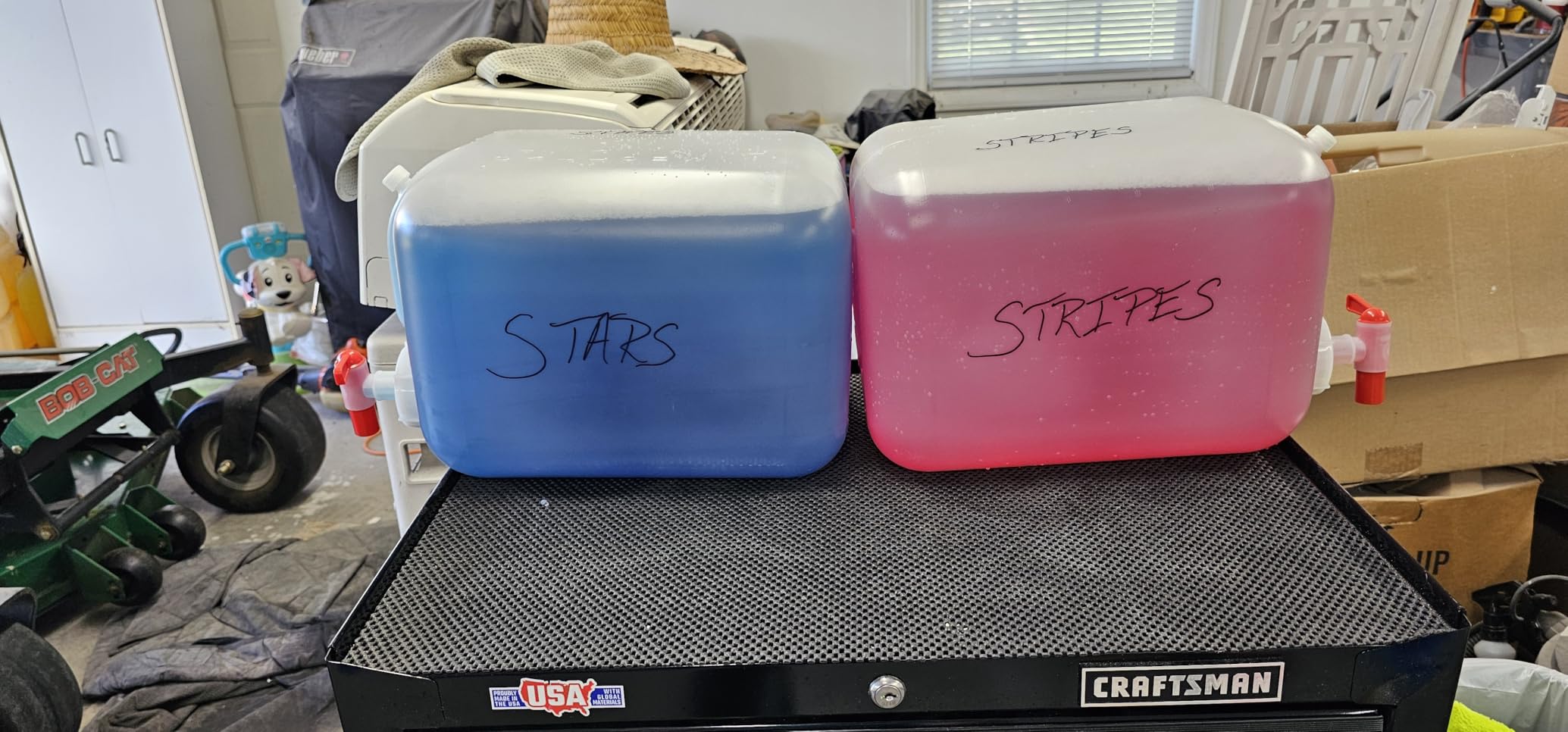
The weakness is the spigot itself. Because it is plastic and it is the part that gets handled, it is the component most likely to crack or strip its threads after years of use, and some buyers report slow dripping from the seal after filling. Budget for a replacement spigot, or keep a spare on hand.
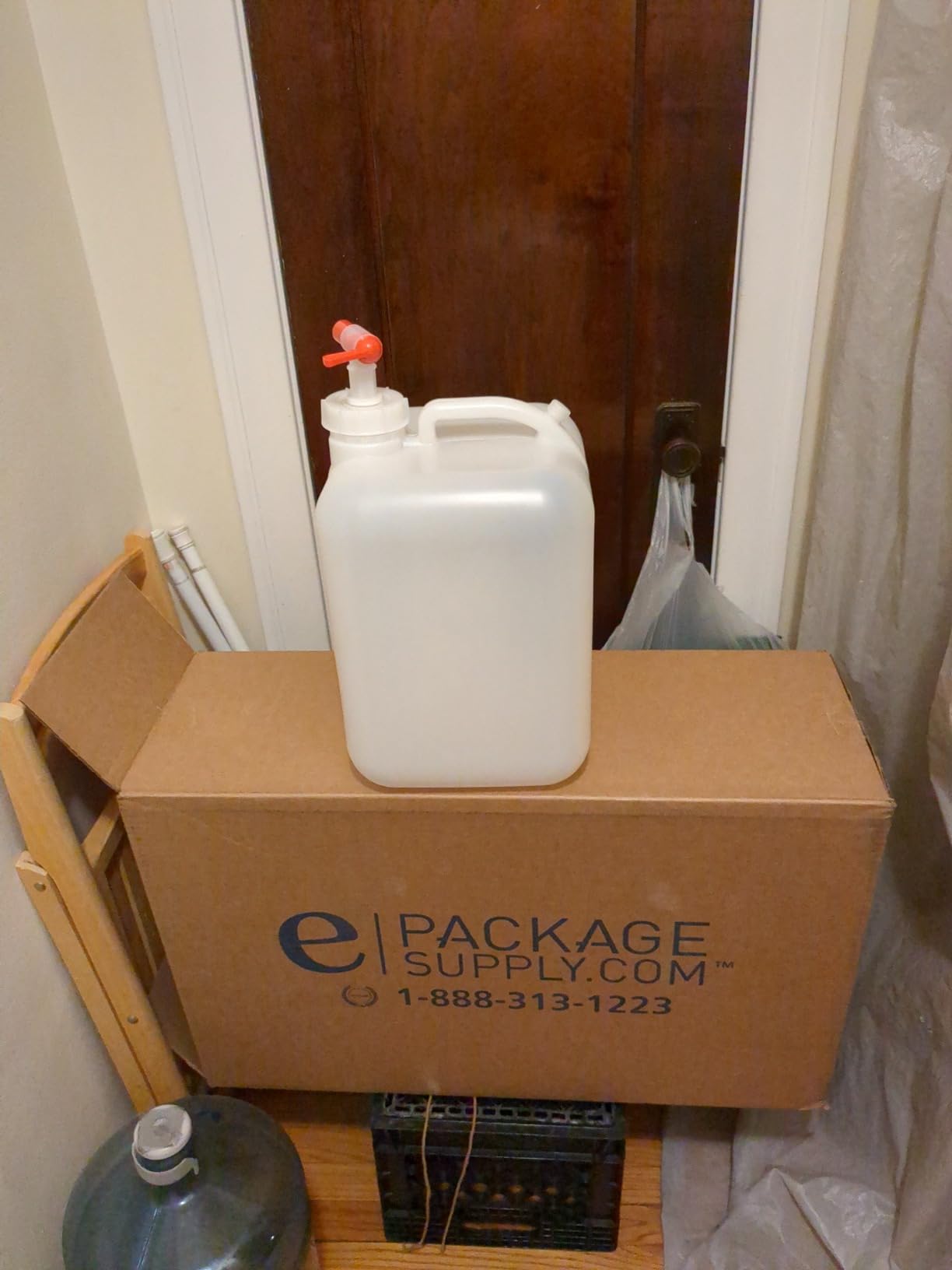
Best For: A Ready-to-Use Water Station
If you want containers you can fill and serve from the same day with no assembly, these are the shortest path. They also work beyond water, since owners use them for juice, beverages, liquid foods, and essential oils.
The translucent body is worth noting either way. You can see the level at a glance, which helps with rotation, but light reaches the water, so keep them out of direct light if you are storing for long periods.
Where the Spigots Fall Short
Spigot durability is the recurring theme in the reviews, and it is worth planning around. A cheap plastic spigot is the part that fails first, which is exactly why the containers with brass fittings rank higher for long-term storage.
They are also not rated for corrosive liquids, so keep solvents and strong cleaners away from them even though the plastic itself is durable.
How to Store Water Containers in a Garage
Store water containers up off the concrete, away from anything with an engine or a fuel line, and out of direct light. A residential garage slab handles a few hundred pounds per square foot easily, so floor storage is fine, but a pallet or a low platform protects the container from condensation and makes the spigot usable.
Set the stack where it will stay. Every one of these containers is built to be filled once in place, and a full 5-gallon jug at 40 pounds or a full 55-gallon tank at over 450 pounds is not a thing you slide around a garage floor.
Keep the column three high for 5-gallon jugs. The only manufacturer in this group that permits four is Consolidated Plastics, and only for its own carboys. Above three, the bottom container carries the weight of everything above it, and HDPE creeps slowly under constant load, which shows up as a bulging seam months later.
Run a hose to the fill location before you start, and check that you can drain back out again. A garden hose bib and a few feet of clearance save you from carrying jugs to the spigot one at a time.
For the vertical space, heavy-duty garage shelving rated well above the actual load does more for a reserve than an extra row of containers. We compared the options in our garage storage rack guide, and the same load rating logic applies to a water column.
Label every container with its fill date in marker on the side, and keep a paper list next to the stack. Rotating by memory is how water ends up sitting for two years.
How Much Water You Need and How to Calculate It
The baseline most preparedness guidance uses is one gallon of water per person per day for drinking and basic hygiene. For drinking, cooking, and washing, plan on two gallons per person per day, which is the figure most households find they actually use.
For a family of four at two gallons per person, that is 8 gallons a day. One week is 56 gallons, which is eleven 5-gallon jugs or about 24 WaterBricks. Thirty days is 240 gallons, which is 48 jugs, so most households cap the plan at two weeks and treat the rest as a gap to be covered by other means.
Count the containers you already need to fill. Eleven 5-gallon jugs is about eleven trips with a hose and eleven opportunities to get it slightly wrong, so consider a mix: a 35 or 55-gallon tank for the bulk, plus a handful of 5-gallon jugs for drinking and rotation.
What to Look For in a Garage Water Container
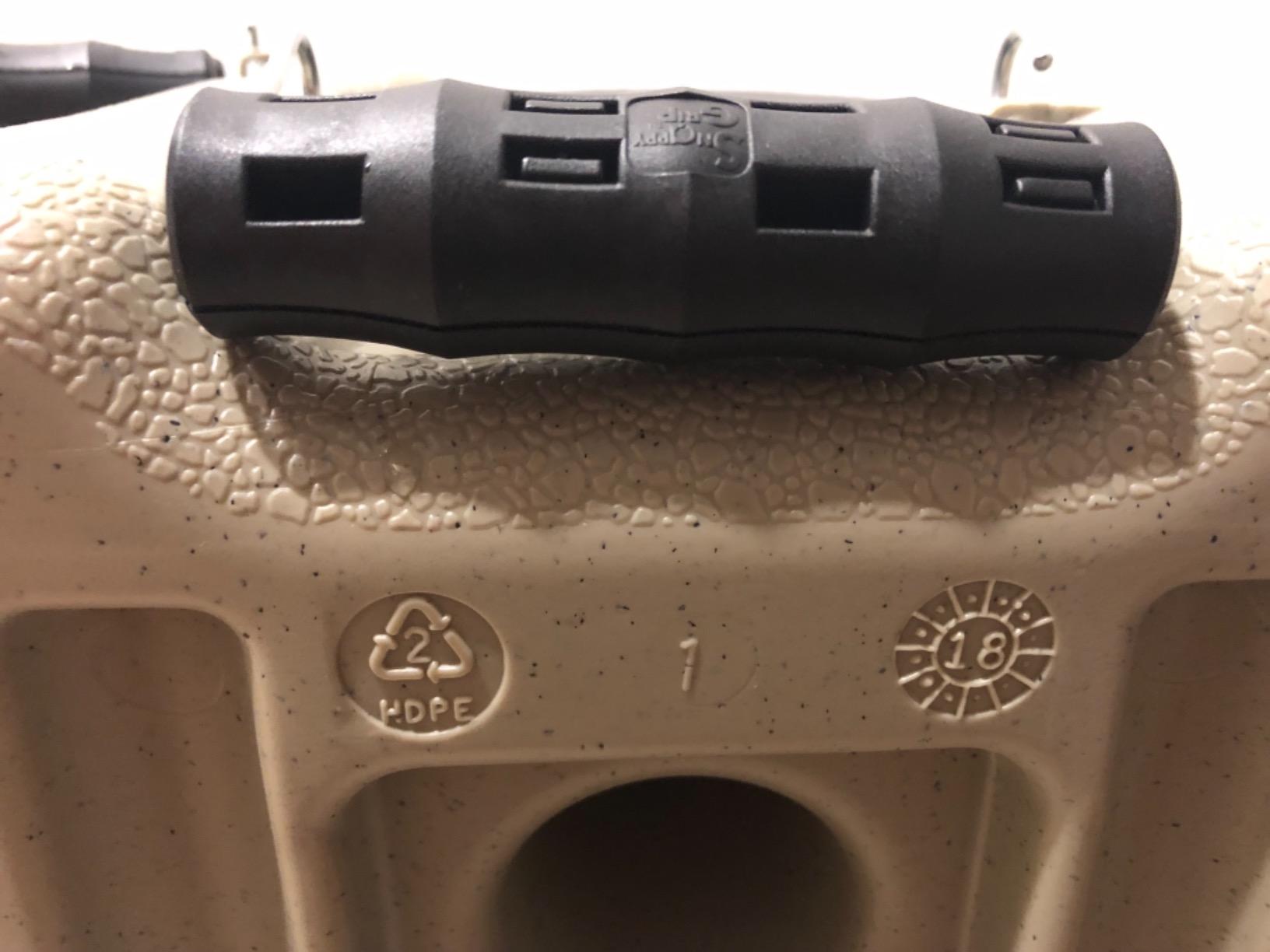
Look for food-grade HDPE, which carries the recycling symbol with a 2 in it. That is the resin used for water containers and food packaging, and it is what you want pressed against your drinking water for a year.
Check for an actual certification, not just a claim. BPA-free means one specific compound is absent; it is not a certification. NSF/ANSI 61 is an independent standard for materials in contact with drinking water, and only one container in our comparison lists it on the listing. Verify a certification number rather than trusting the word BPA-free on its own.
Prefer an opaque body in a garage. Light drives algae, and clear or translucent containers lose that fight under a bare bulb or a garage window. The dark blue and tan containers here all have this advantage.
Look for a documented stack height and locating features, not just the word stackable. Locating ribs or molded tabs are what keep a column from sheeting sideways over a year.
Check the full weight and decide honestly whether you can lift it. A 5-gallon jug at about 40 pounds is a reasonable solo carry, a 15-gallon tank at 125 pounds is not, and a 55-gallon drum at over 450 pounds is a two-person job or a permanent fixture.
Finally, check that replacement caps and spigots are sold separately for the model. The spigot is the first part to fail on a plastic container, and a model with no available replacement is a model with a shorter life.
Filling, Sanitizing and Rotating Your Water
Sanitize new containers before the first fill, including ones you have never filled. Wash them with hot water and unscented bleach, roughly a tablespoon per gallon, let them sit, then rinse thoroughly. Many owners also do a baking soda rinse to clear any plastic odor before water goes in.
Fill each container fully and label the fill date in marker. A partially filled container has air above the water, and both headspace and warmth encourage growth. If you must fill in stages, top off every container before you seal them.
Treat the water or add a preserver. Unscented bleach at about 8 drops per gallon keeps water safe longer, and a commercial water preserver is what the Saratoga Farms and Rockwell kits include.
Rotate on a fixed schedule, twice a year is the most common routine and it works because the trigger is obvious. Pick the two days a year you always remember, swap the outgoing water for fresh, and wash and dry the container before refilling it.
Never drink water you know froze and thawed repeatedly. If a garage goes below freezing regularly, a stored reserve is a backup supply that you rotate through rather than a container you leave in place for years.
Frequently Asked Questions
What are the best stackable water containers?
The best stackable water containers for a garage are food-grade HDPE jugs with flat tops and locating ribs, in the 5-gallon to 7-gallon range. That size fills fast, stacks three high in a small footprint, and stays under about 45 pounds filled so one person can carry it. Our top pick is the Legacy 5-gallon 4 pack, which locks rib to rib and includes water treatment drops.
How do I store water containers in a garage?
Store them off the concrete on a pallet or low platform, away from fuel, solvents, and motor oil, and out of direct light. Keep stacks to three high for 5-gallon jugs, set the column where it will stay because a filled jug is difficult to move, and label every container with its fill date. A hose bib near the fill point saves carrying jugs to the spigot.
Can I stack water storage containers four high?
Most 5-gallon jugs should be stacked no more than three high, because the bottom container carries the weight of everything above it and HDPE slowly deforms under constant load. The exception in this group is the Consolidated Plastics carboy, whose manufacturer explicitly states that up to four full carboys may be stacked. A lighter option is the WaterBrick, which is designed to cross-stack up to 4 feet high.
What is the best container to store water long-term?
For long-term storage, a rotational-molded HDPE tank with an independently certified material, a wide opening you can scrub, and hardware you can replace is the strongest choice. In this group the Rockwell Exodus 35 lists NSF/ANSI 61 compliance, carries a limited three-year warranty, and adds a corner drain plug that empties the tank completely. Smaller 5-gallon jugs are better if you intend to rotate frequently.
How long will 500 gallons of water last for one person?
At one gallon per person per day, 500 gallons covers 500 days for a single person. At the more realistic two gallons per person per day for drinking, cooking, and washing, it covers 250 days. For a family of four, the same 500 gallons is about 125 days at two gallons each. Most households store a few hundred gallons and treat the rest as a gap to be covered.
Final Verdict on Stackable Water Storage for Garages in 2026
For most garages in 2026, the Legacy 5-gallon 4 pack is the right starting point, because the locking ribs keep a column square and 1390 ratings make it the least surprising container here. Add a WaterBrick set if the corner is too tight for four jugs side by side, and consider the Rockwell Exodus 35 if you want a certified tank with brass hardware that you will leave in place for years.
Whatever you choose, size the stack where it will live, keep it three high, and label the fill date before the water goes in. Check the current listing for each pick and start building the column this week.