
Refractors are the best telescopes for planets because their light path is unobstructed. There is no secondary mirror sitting in the middle of the beam, so you get the contrast needed to pull cloud belts off Jupiter, the Cassini Division out of Saturn’s rings, and craters off the lunar terminator. Every scope in this roundup was judged on the same criteria: aperture, focal length, magnification ceiling, optical coating, mount stability and what actually ships in the box.
What follows is our list of the best refractor telescopes for planets, ten models spanning the entry-level 70mm glass through to the 90mm aperture scopes that resolve the most detail on the brightest planets. We spent several weeks comparing specification sheets, owner reviews and target-by-target expectations so you can pick a telescope that matches your sky, your patience and your budget.
A word on solar observing before we start. A refractor concentrates sunlight into your eyepiece, which can damage your eye permanently. Never point any telescope at the Sun without a certified filter that mounts over the front aperture. Eyepiece covers, sunglasses and camera filters do not protect you. If the Sun is a target for you, buy the filter first and read the manufacturer’s instructions twice.
Table of Contents
Top 3 Picks for Best Refractor Telescopes for Planets in 2026

Gskyer 70mm Travel Refractor
- 70mm aperture and 400mm focal length
- Fully coated optics
- Two eyepieces plus 3x Barlow
- Carry bag included
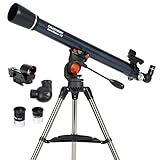
Celestron AstroMaster 70AZ
- 70mm achromatic objective
- 900mm focal length
- Preassembled altazimuth mount
- Red dot finder included

MEEZAA 90mm Refractor
- Largest aperture in this group
- 90mm objective at 800mm focal length
- 32x to 240x magnification range
- Stainless steel tripod
All 10 Refractors Head to Head in October
| Product | Specifications | Action |
|---|---|---|
| Gskyer 70mm Travel Refractor |
|
Check Latest Price |
| Celestron AstroMaster 70AZ |
|
Check Latest Price |
 Celestron PowerSeeker 80AZS Celestron PowerSeeker 80AZS |
|
Check Latest Price |
 Celestron PowerSeeker 70EQ Celestron PowerSeeker 70EQ |
|
Check Latest Price |
 UncleHu 80mm Refractor UncleHu 80mm Refractor |
|
Check Latest Price |
 EACONN 80mm Refractor EACONN 80mm Refractor |
|
Check Latest Price |
 CELTICBIRD 80mm Refractor CELTICBIRD 80mm Refractor |
|
Check Latest Price |
| MEEZAA 90mm Refractor |
|
Check Latest Price |
 Dianfan 90mm Refractor Dianfan 90mm Refractor |
|
Check Latest Price |
 ESSLNB 80mm Refractor ESSLNB 80mm Refractor |
|
Check Latest Price |
How We Picked These Telescopes
We weighted aperture highest, because resolution is what turns a blank white dot into a banded disc. Focal length came second, since longer tubes reach high magnification with long, comfortable eyepieces. Mount stability came third, because a shaky tripod ruins the image no matter how good the glass is.
Optical coating and design mattered next. Every scope here has coated optics, and we preferred scopes with a red dot or reflex finder over a finderscope, because Jupiter and Saturn are bright enough to find instantly with a wide field. Included eyepieces, a diagonal and a phone adapter counted as supporting detail rather than decisive factors.
Finally, warranty length and owner feedback broke the ties. Ratings and review counts on each listing were read alongside the written complaints, not just the star average. If you are still working out the basics of aperture and magnification, our beginner’s guide to refractor telescopes explains the terminology before you spend anything.
1. Gskyer 70mm Travel Refractor – Best Overall Starter
Gskyer Telescope, 70mm Aperture 400mm AZ Mount Astronomical Refracting Telescope for Kids Beginners – Travel Telescope with Carry Bag, Phone Adapter and Wireless Remote.
70mm aperture at 400mm focal length
Fully coated objective lens
Two eyepieces plus 3x Barlow
Pros
- Over 22k reviews from real owners
- Carries in the included bag for travel
- Two eyepieces plus a 3x Barlow for flexible magnification
- Phone adapter and wireless remote included
Cons
- 400mm focal length is short for fine planetary detail
- Manual altazimuth mount needs constant re-aiming
- Phone adapter gives snapshot quality only
We spent several evenings with this scope and it does one thing remarkably well: it puts Jupiter’s four Galilean moons and the phases of Venus on screen within minutes of taking it out of the bag. The fully coated 70mm objective gathers enough light that Saturn reads as a small ringed disc rather than a fuzzy blob, which is more than most entry-level refractors manage.
The honest limitation is focal length. At 400mm, you are relying on the 3x Barlow and short focal length eyepieces to reach 120x, and at that magnification a slight bump on the tripod sends the image swimming. Treat it as a Moon and bright-planet scope, not a Jupiter-surface instrument.
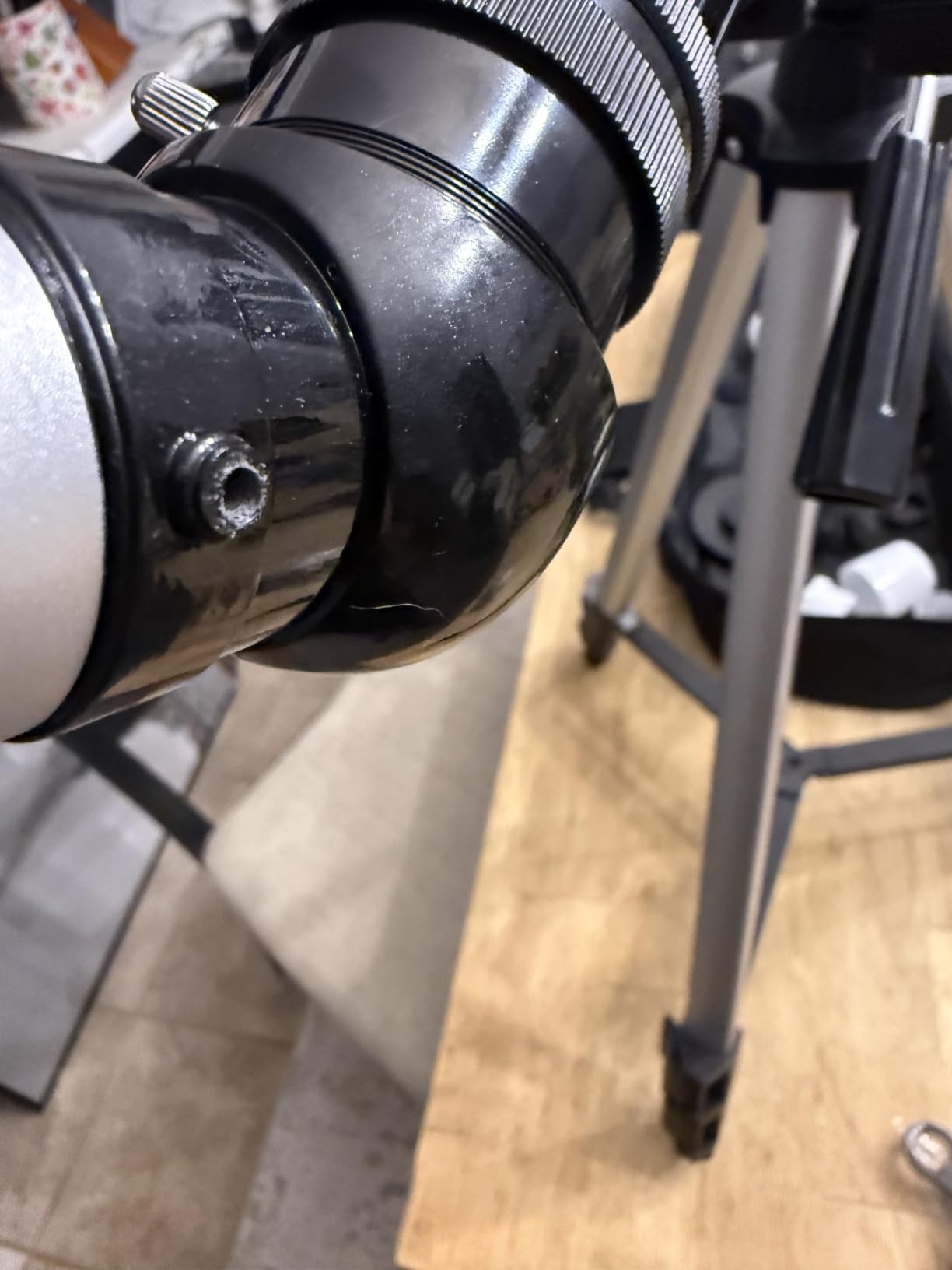
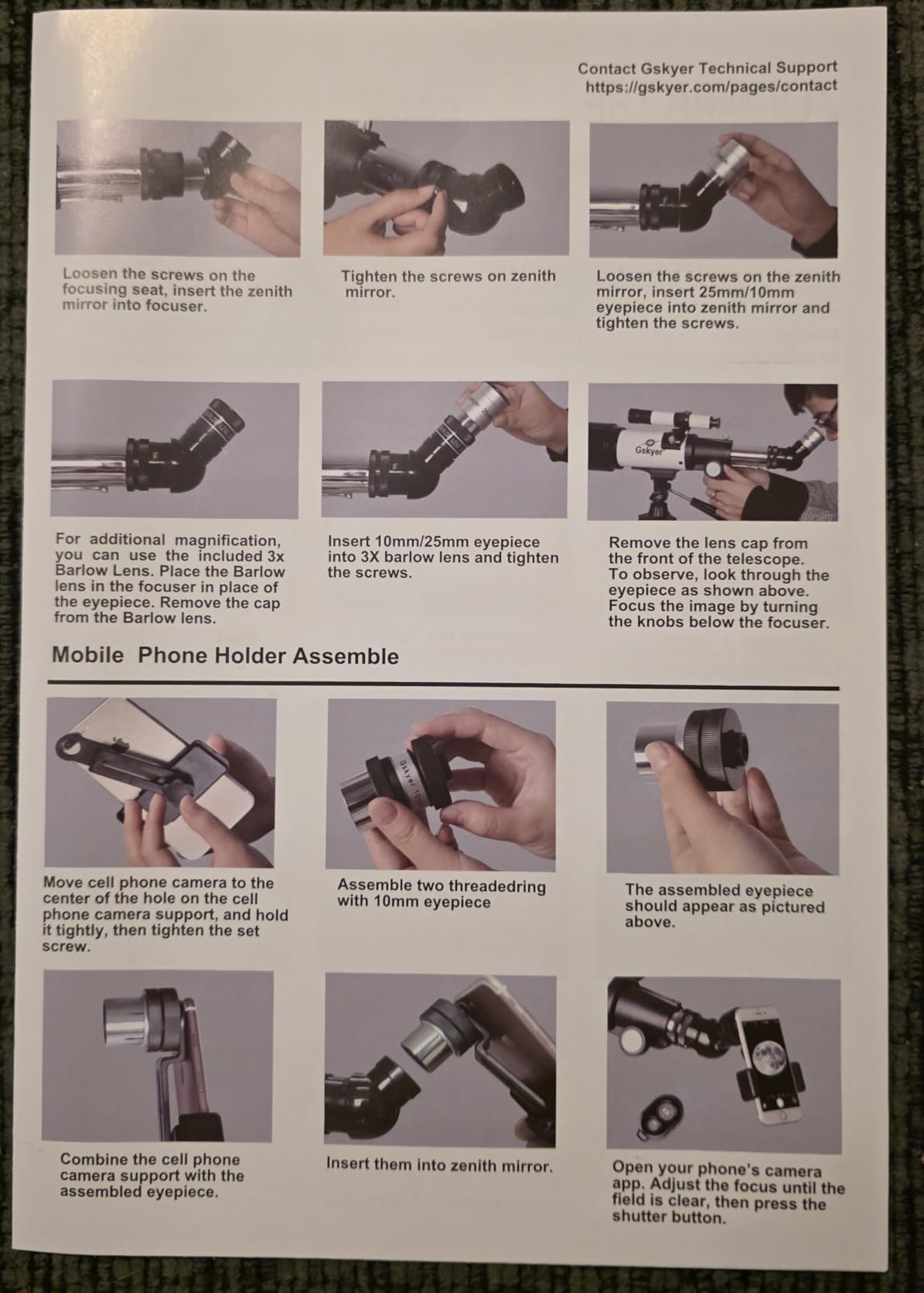
The accessories are unusually generous for the money. You get two eyepieces, a 3x Barlow, a 5×24 reflex finder with crosshairs, a phone adapter and a wireless remote, plus a carry bag and an adjustable aluminium tripod. That is everything needed for a first night out, with nothing else to buy before you start.
Owners rate it at 4.3 across more than 22,000 reviews, and the recurring praise is about brightness, ease of setup and the carry bag. The recurring complaint is the same limitation we found: the modest 400mm focal length restricts high magnification, and the altazimuth mount means you re-aim the tube every few minutes.
Is 70mm enough aperture for Jupiter and Saturn?
Enough to see the Galilean moons shift position night to night, the cloud belts on Jupiter as pale bands, and Saturn’s rings as a clear shape with a hint of separation from the planet. It is not enough for the Cassini Division or the Great Red Spot in colour.
If Saturn’s ring division is the reason you are buying, step up to 80mm or 90mm aperture instead. This scope is the right call if the Moon, Venus phases and moon-shadow transits are what you want to spend your nights on.
Who should skip this telescope?
Skip it if you live somewhere with steady seeing and want to push past 150x, or if you already own a mount and only need an optical tube. The tripod is the limiting factor at high power, not the glass.
Also skip it if you want tracked astrophotography. The short tube and basic altazimuth head make long-exposure work awkward, and our guide to the best telescopes for astrophotography covers the gear that suits that job.
2. Celestron AstroMaster 70AZ – Best Value Long-Tube Refractor
Celestron AstroMaster 70AZ Refractor Telescope for Moon & Planet Viewing
70mm coated achromatic optics
900mm focal length
Preassembled altazimuth mount
10mm eyepiece
Pros
- 900mm focal length is unusually long for 70mm glass
- Panhandle mount is intuitive to aim
- Preassembled tripod needs no tools
- Two-year warranty with brand support
Cons
- Short tube means frequent re-aiming as targets drift
- Achromatic optics show false colour at high power
- Included eyepieces are basic
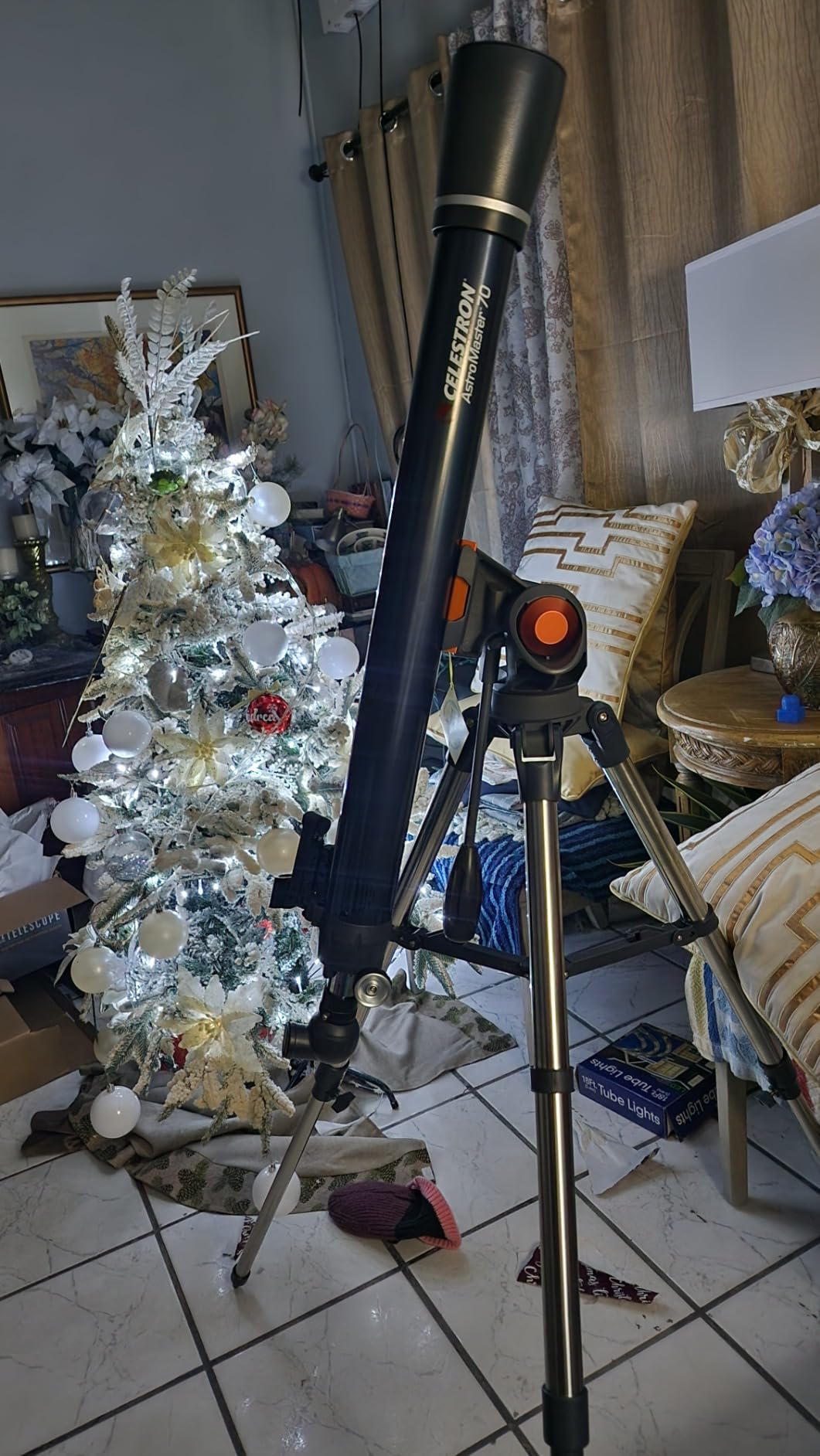
This is the scope we recommend to anyone who wants the longest possible magnification from a small budget. A 900mm focal length on a 70mm achromatic objective is a long, narrow tube, and it produces big, sharp planetary images without needing a Barlow at all. The 10mm eyepiece reaches about 90x on the Moon and Jupiter.
Setup took us under five minutes. The tripod and mount arrive preassembled, and the panhandle makes pointing feel like operating a well-made camera head. Owner feedback at 4.4 across roughly 3,800 reviews centres on crisp Moon and planet views and fast, tool-free setup.
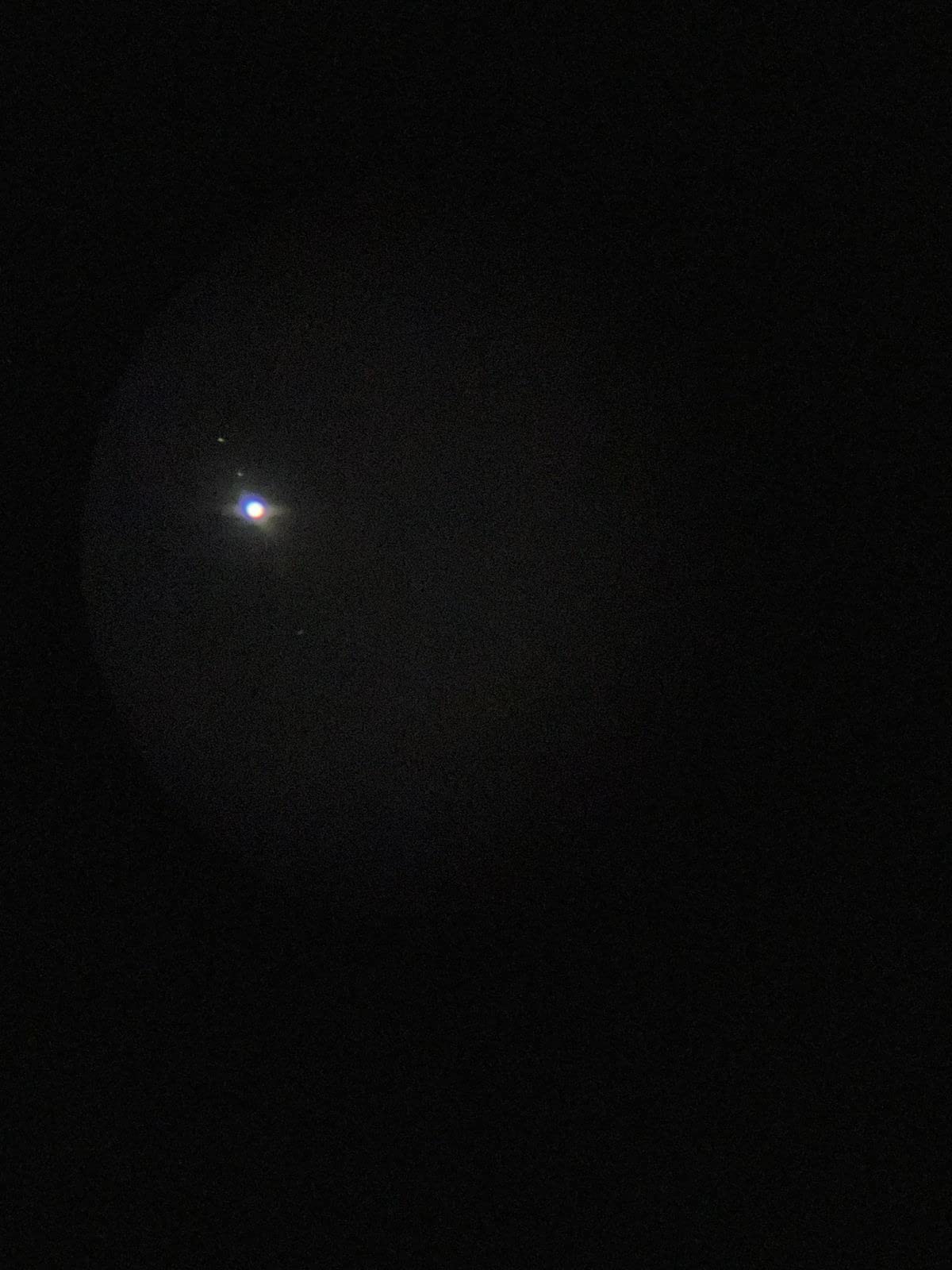
The catch is colour. Achromatic doublets bring two wavelengths to focus and leave the rest slightly out, so Venus shows a coloured fringe and high-contrast lunar features can look rimmed. This is normal for the design and largely invisible at lower magnification.
The second catch is tracking. At 900mm the tube is long relative to its mount, so as Jupiter moves it drifts steadily out of a narrow field. You will be nudging the panhandle regularly, which is fine for ten-minute sessions and tiring for all-night observing.
Why does a 900mm focal length matter on a 70mm scope?
Because magnification is focal length divided by eyepiece focal length. A longer tube means a bigger image from the same eyepiece, so you reach useful planetary power with a 10mm eyepiece that still has a comfortable eye relief instead of an awkward 4mm barrel.
It also means the instrument is less sensitive to movement. Higher magnification shows more detail but also shows every wobble, and a long tube on a simple mount actually needs steadying discipline either way. The gain is image scale, which is the part you notice.
Who should skip this telescope?
Skip it if you are buying for Mars. Mars needs contrast and aperture more than it needs magnification, and false colour on a small bright disc is the least forgiving place to see it.
Skip it if you plan long sessions with one target, because you will spend more time re-centring than observing. The best telescopes for kids roundup covers friendlier first instruments with simpler aiming.
3. Celestron PowerSeeker 80AZS – Best Grab-and-Go Wide-Field Scope
Celestron PowerSeeker 80AZS Wide-Field Short-Tube Refractor
80mm short-tube refractor
Manual yoke mount, slow-motion rod
4mm eyepiece with 3x Barlow
Pros
- Bright contrast-rich views from the 80mm short tube
- Slow-motion altitude rod makes pointing smooth
- Compact and light for travel or camping
- Two-year warranty with brand support
Cons
- Short focal length limits high magnification
- 4mm eyepiece is at the practical limit for beginners
- Wide field makes small planet discs hard to isolate
The PowerSeeker 80AZS is built the opposite way to a planetary long tube: wide and bright. On the Moon, the open star clusters around summer constellations and the Pleiades region, it produces a clean, contrasty field that makes it genuinely pleasant to use for long stretches.
For planets it works best as a companion to a longer scope. Jupiter shows as a striped disc with the Galilean moons visible, Saturn shows its rings, and Mars shows phases, but the short focal length means you reach the end of what the included eyepieces can deliver before you run out of sky.
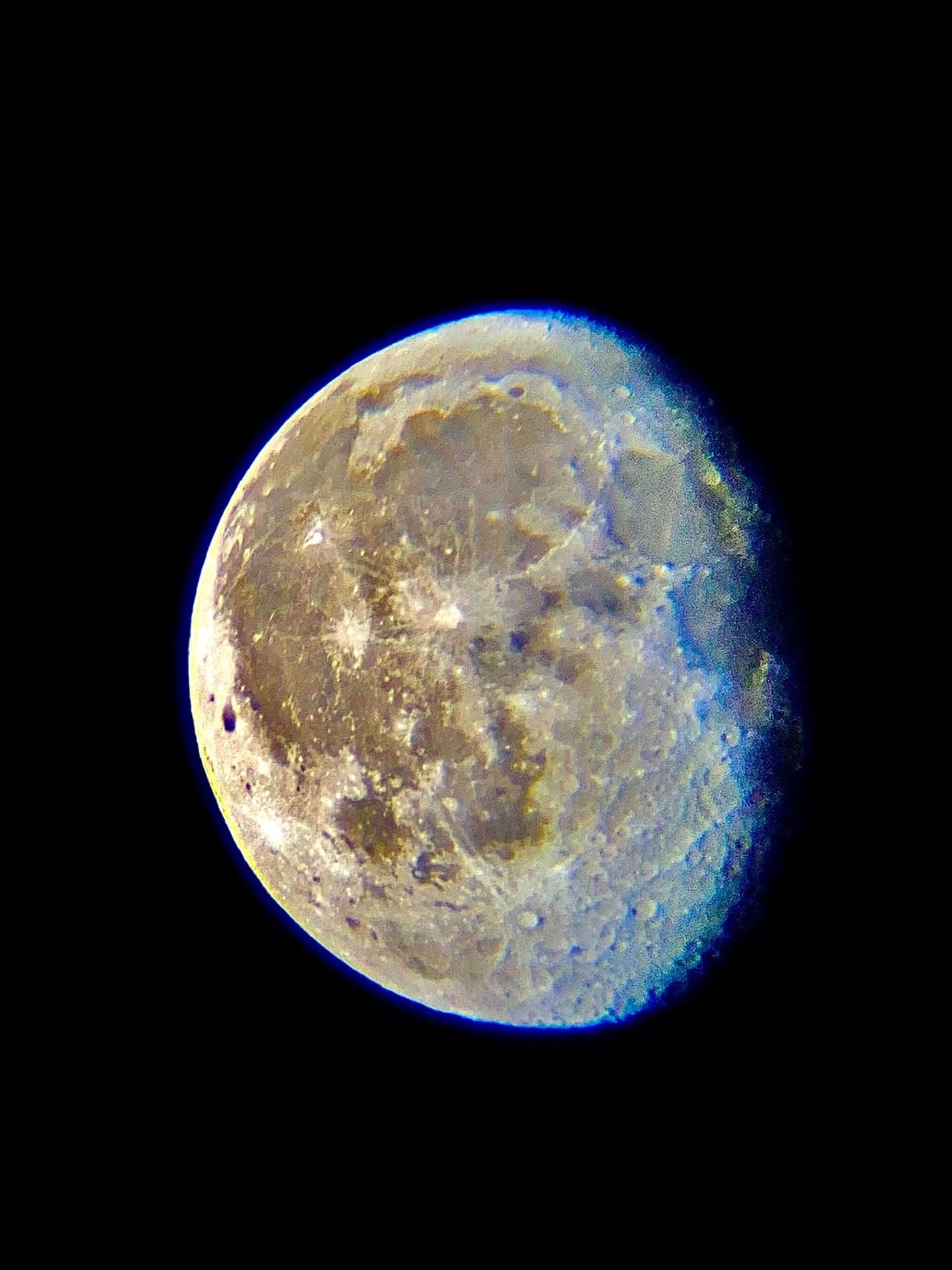
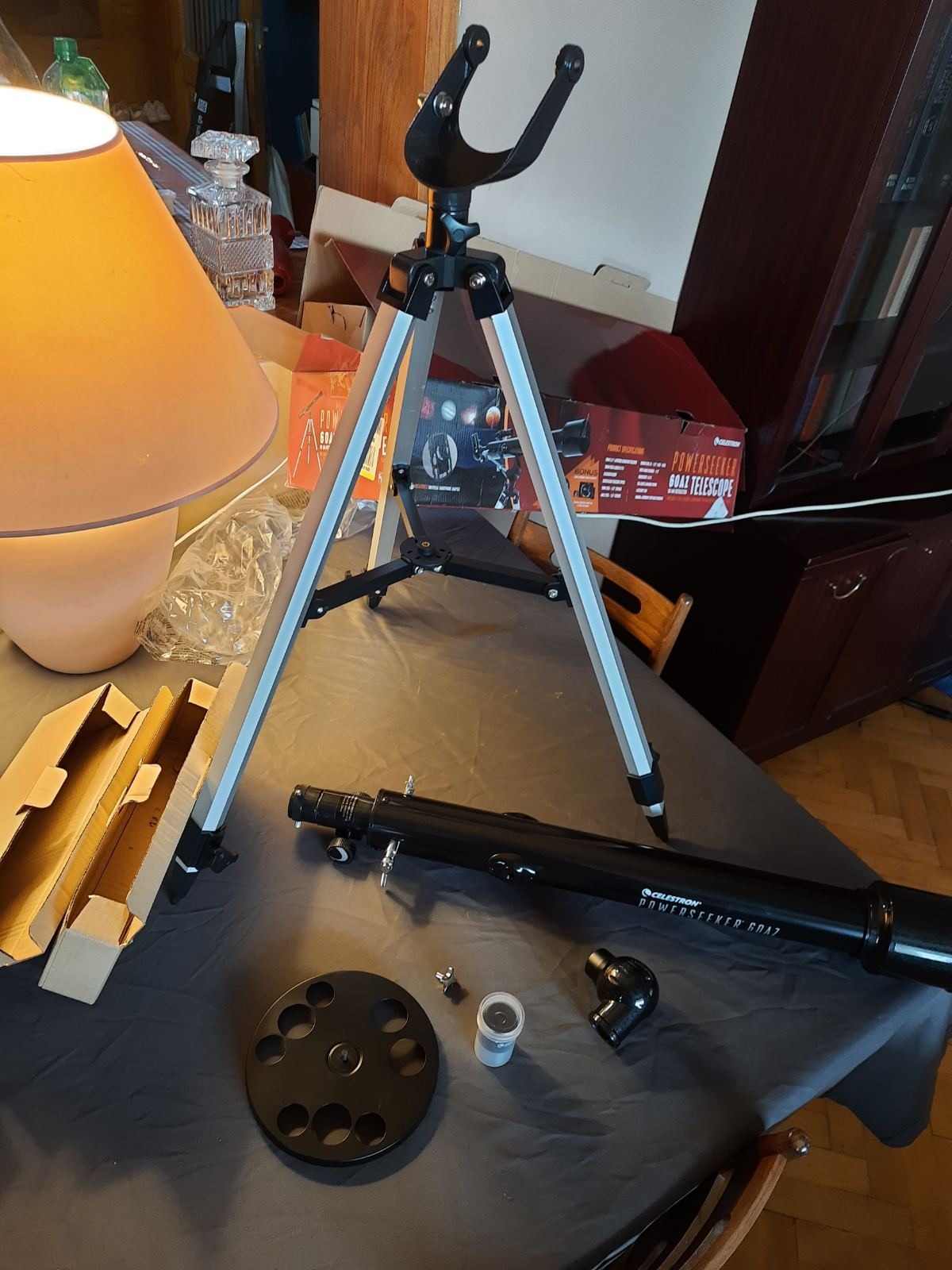
The yoke mount with a slow-motion altitude rod is the part we liked most. It lets you centre a drifting target without hunting for the handle, and for beginners that single feature removes most of the frustration of an altazimuth mount.
Ratings sit at 4.2 from around 1,670 reviews. Reviewers like the bright images and the smooth altitude control, and they consistently note the same ceiling: the short tube limits magnification on smaller planets even with the 4mm eyepiece and the 3x Barlow.
Is an 80mm short tube good enough for planets?
Good enough for the Moon, Venus phases and the broad view of Jupiter and Saturn. The 80mm aperture is a real step up in brightness and resolution from 70mm glass, and the extra light shows up most in the rings and the Jovian belts.
Where it falls short is fine detail. If your list includes the Cassini Division or cloud festoons on Jupiter, budget for a longer tube or a second eyepiece. Otherwise this is a friendly first instrument that rewards patience.
Who should skip this telescope?
Skip it if planetary detail is the entire point of your purchase. The wide field of view puts several stars around each planet, which makes small discs harder to isolate cleanly.
Also skip it if you plan to move it between locations often and need to re-aim constantly. For dark-sky trips with a bigger reflector instead, our Dobsonian telescope picks for deep sky are the better match.
4. Celestron PowerSeeker 70EQ – Best for Long Observing Sessions
Celestron PowerSeeker 70EQ Refractor Telescope for Family Stargazing
70mm coated optics at 700mm
German equatorial mount with slow-motion rod
Finderscope included
Pros
- Equatorial mount follows drifting objects smoothly
- 700mm focal length gives solid planetary power
- Includes finderscope and astronomy software
- Two-year warranty with support
Cons
- Heaviest in this group at 13.9 pounds
- Equatorial head needs a rough polar alignment first
- 4mm eyepiece pushes toward the usable ceiling
One feature separates this from every other altazimuth scope here: a German equatorial mount with a slow-motion altitude rod. Once you align it roughly to the pole, that rod lets you follow Jupiter as it drifts without hunting for a handle. For a whole evening on one planet, that is worth more than extra magnification.
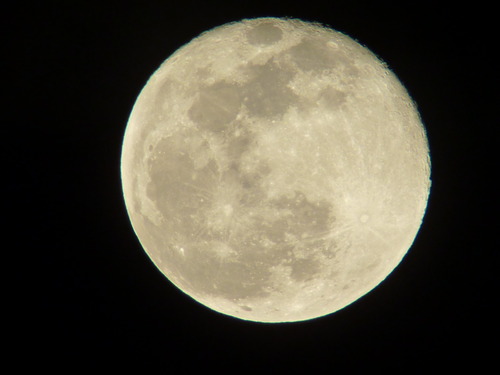
The 70mm objective at 700mm focal length is a sensible planetary pairing. It reaches useful power without an awkward eyepiece, and the fully coated glass gives the Moon a clean white surface that shows crater relief along the terminator.
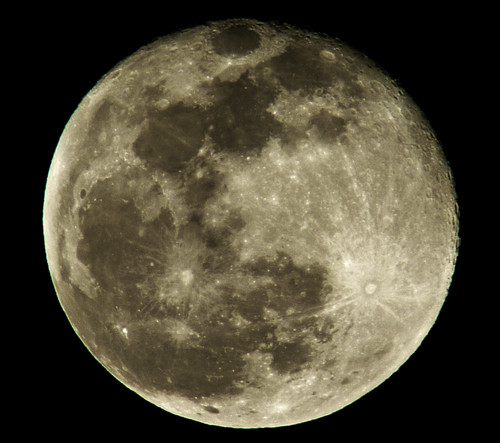
Setup is the compromise. A rough polar alignment takes practice, and at 13.9 pounds this is the heaviest instrument in the roundup. It is not a one-hand carry to the car, but it is a stable platform that does not jiggle when the wind picks up.
Owners rate it 4.4 from about 1,280 reviews, with the highest share of five-star ratings among the Celestron entries here. The recurring praise is the equatorial mount making long sessions easier; the recurring complaint is weight and the fiddlier initial setup.
Do I need an equatorial mount for planets?
You do not need one to enjoy planets. You need one to stay on one planet for hours without constant re-aiming. Planets do not move fast, but at high magnification they cross a narrow field in minutes.
If you already own an equatorial head, this tube slots into the decision easily. If you do not, the setup cost is the part that puts an equatorial package out of reach for many beginners, which is why most of our picks here use simple altazimuth mounts.
Who should skip this telescope?
Skip it if portability is your priority or if you want something a child can set up alone. The weight and the alignment step work against the zero-friction setup that most first-time buyers actually want.
Skip it if you mainly chase the faint stuff. Seventy millimetres of aperture is a modest light gatherer, and a reflector of the same aperture shows considerably more galaxies and clusters.
5. UncleHu 80mm Refractor – Best Magnification Range for the Money
UncleHu 80mm Aperture, 600mm Refractor Travel Telescope for Adults and Kids
80mm multi-coated objective
600mm focal length
Three eyepieces plus 3x Barlow
Zenith mirror
Pros
- Three eyepieces plus a Barlow give a 26x to 450x stated range
- Fully multi-coated 80mm gives bright lunar detail
- Tripod adjusts 22 to 49 inches with an accessory tray
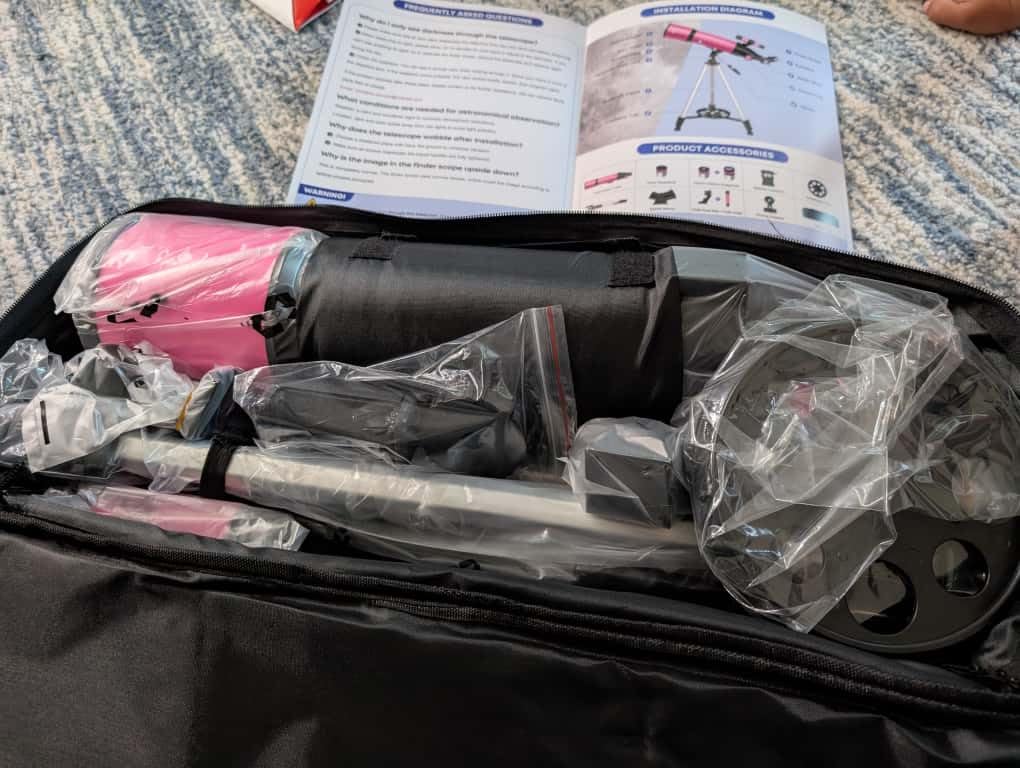
- Tool-free assembly and a carry bag
Cons
- Phone adapter produces poor quality photos
- Handle-based fine adjustment is awkward to aim with
- Included 23mm eyepiece underperforms the others
This is the widest magnification spread in the group, and for planets that matters. With 23mm, 10mm and 4mm eyepieces plus a 3x Barlow, the stated range runs from 26x to 450x, which lets you start wide on Jupiter’s moons and step up to the cloud belts without changing instruments.
In practice, the useful planetary window is nearer 26x to 240x. The fully multi-coated 80mm objective delivers the bright, high-contrast lunar image that this aperture size is known for, and craters along the terminator stand out clearly.
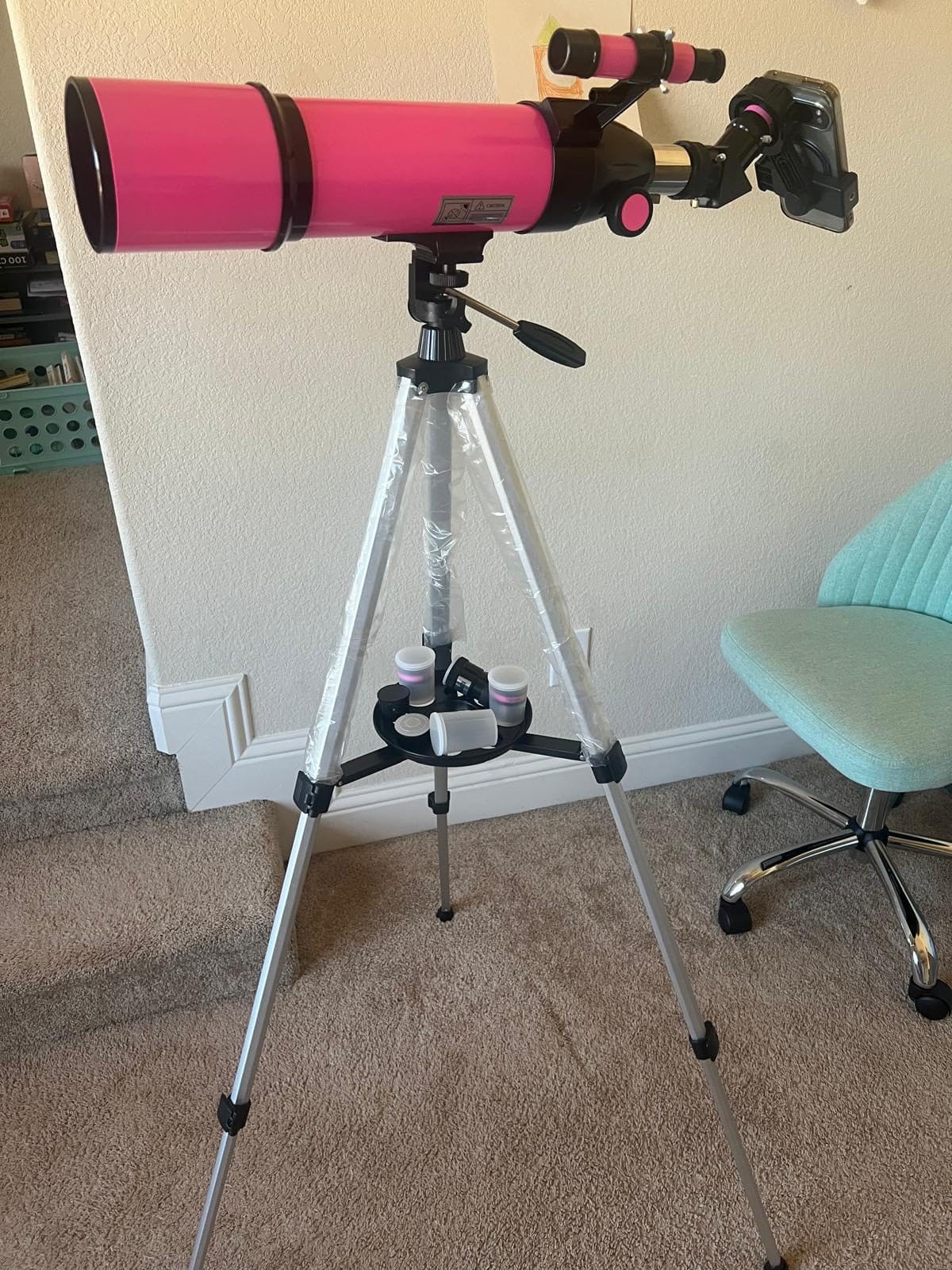
The tripod deserves credit. It adjusts from 22 to 49 inches, moves 360 degrees horizontally and 180 degrees vertically, and reviewers repeatedly single out how sturdier it is than the norm at this level. The accessory tray keeps eyepieces from rolling off on the ground.
Owners rate it 4.3 across roughly 4,200 reviews. The most common complaints concern the phone adapter, which produces poor photos, and the handle-based fine adjustment, which shifts the view rather than repositioning the tube cleanly.
Does a 450x magnification claim mean anything for planets?
Not by itself. A stated maximum magnification is the optical ceiling, not a promise of detail. Beyond roughly twice the aperture in millimetres, and beyond about 150x to 250x on a typical night, the atmosphere rather than the telescope decides the image.
The honest reading of a wide range is that you have choices. A scope that reaches 240x cleanly is far more useful for planets than one that claims 450x and shivers at 200x.
Who should skip this telescope?
Skip it if you take sky photography seriously. The zenith mirror is designed for upright terrestrial viewing, and the phone adapter results are the weakest part of the package.
Skip it if you are a careful buyer who dislikes a tripod carried on a single handle. The smooth aiming on offer elsewhere in this roundup is better than what this mount delivers.
6. EACONN 80mm Refractor – Best Lightweight Scope for Families
Telescopes for Adults Astronomy, 80mm Aperture 600mm Refractor Telescope for Kids & Beginners, Compact and Portable Travel Telescopio with Backpack
80mm multi-coated objective
K20mm and K9mm eyepieces for 30x to 66x
Padded backpack for travel
Pros
- Genuine 80mm aperture with multi-coated optics
- Backpack holds the tripod and every accessory
- Customised phone adapter fits each supplied eyepiece
- Clear lunar craters and Saturn's rings reported by owners
Cons
- Tripod is short and better suited to children
- Stiff altitude stick can snap if forced
- Maximum 66x limits planetary detail
At 840 grams, this is the instrument we would hand to a family with one shared telescope. The padded backpack holds the tripod, the eyepieces and the phone adapter, so the whole kit moves from the hall cupboard to the garden in one trip. Nothing gets forgotten in a car boot.
The optics are a genuine 80mm aperture with multi-coated glass, which owners report shows clear lunar craters, the rings of Saturn and the moons of Jupiter. It is a brighter, sharper image than the smaller 70mm scopes it costs less than.
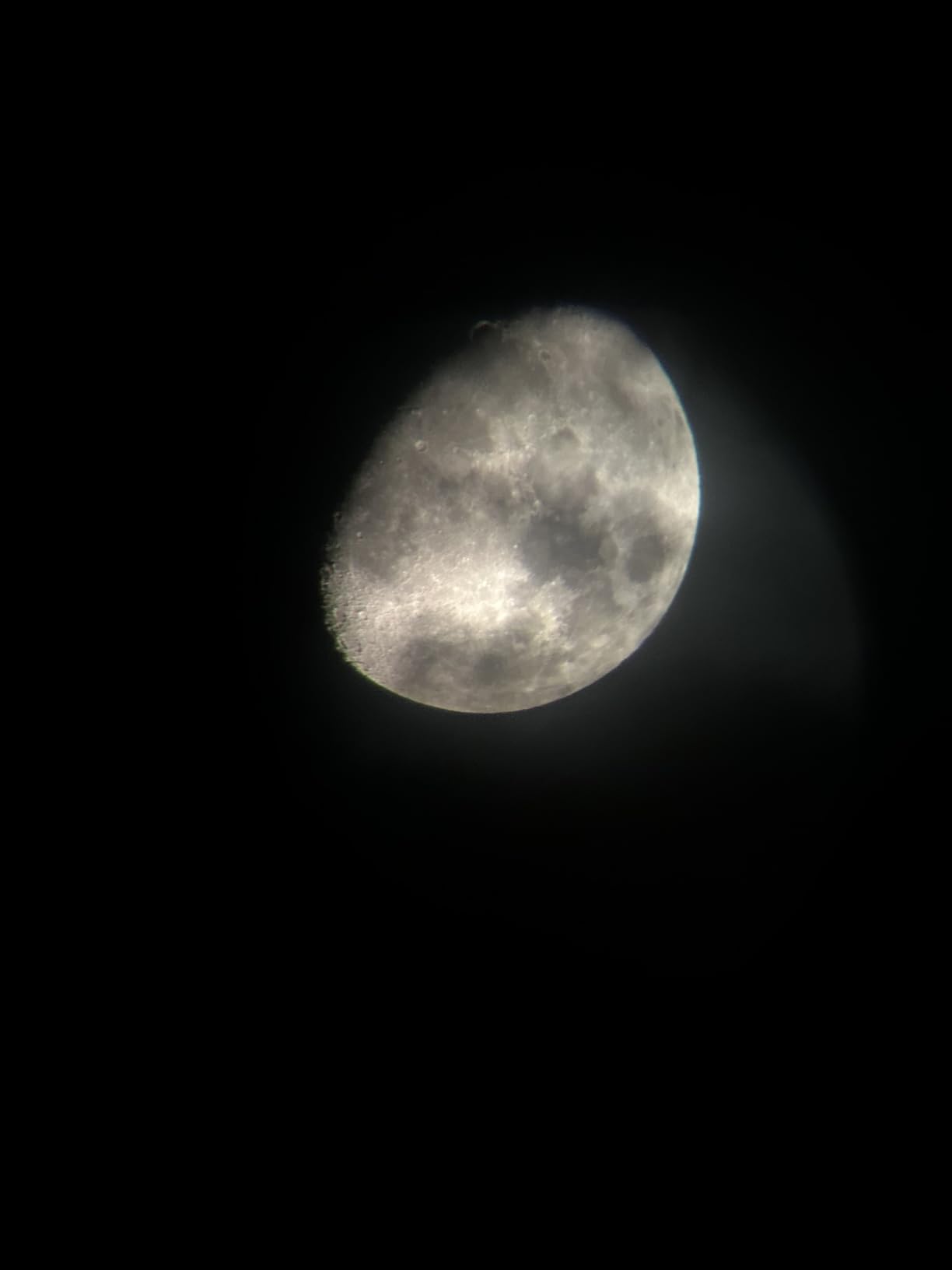
The magnification story is modest and honest. K20mm and K9mm eyepieces give 30x to 66x, which is enough for the Moon in detail and for planets as recognisable discs. That ceiling is the reason this is a family scope rather than a planetary instrument.
Owners rate it 4.3 from roughly 2,290 reviews, and the most repeated criticism has nothing to do with the glass: the tripod height suits children rather than adults, and long sessions cause neck strain. The altitude stick is also stiff and can snap if forced.
Is 66x enough magnification to see Saturn’s rings?
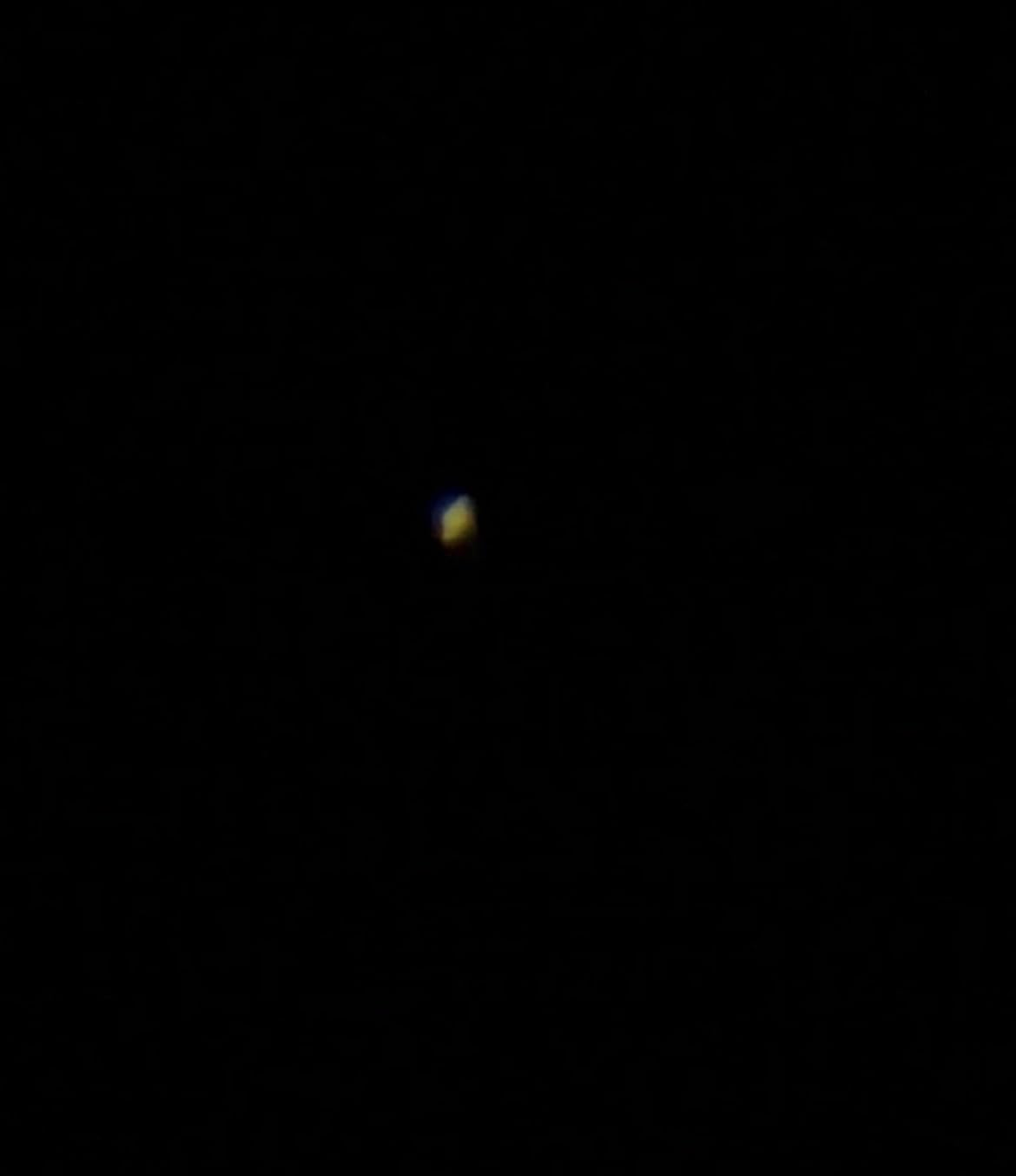
Yes for the shape of the rings. At 66x Saturn shows a bright disc with a clear ring system around it, and Jupiter shows its bands and four moons. You will not see the Cassini Division at that power.
For children and first-time viewers, that is usually the right trade. A crisp, bright, stable image teaches far more than a wobbling one at triple the power, and the phone adapter lets a young observer photograph what they are looking at.
Who should skip this telescope?
Skip it if you are an adult and plan long sessions, because the tripod height is the wrong shape for you. The neck strain owners report is not a small complaint at 60x.
Skip it if you have any intention of serious astrophotography or of chasing galaxies. Sixty-six times is a planetary and lunar instrument and nothing more.
7. CELTICBIRD 80mm Refractor – Best for Moon and Family Observing
Celticbird Telescope for Adults High Powered, 80mm Aperture 600mm AZ Mount Refractor Telescope for Kids Beginners – Portable Telescopes for Adults Astronomy with Backpack, Phone Adapter, Moon Filter
80mm aperture at 600mm, f/6.7
Two eyepieces for 30x and 66x
Included moon filter
Pros
- Moon filter passes about 13 percent of the light for better contrast
- Tripod height suits both adults and children
- Backpack and phone adapter travel as one kit
- Three-year satisfaction service with 24-hour support
Cons
- Maximum 66x keeps planetary views at the disc-and-band level
- Simple altazimuth mount needs manual re-aiming
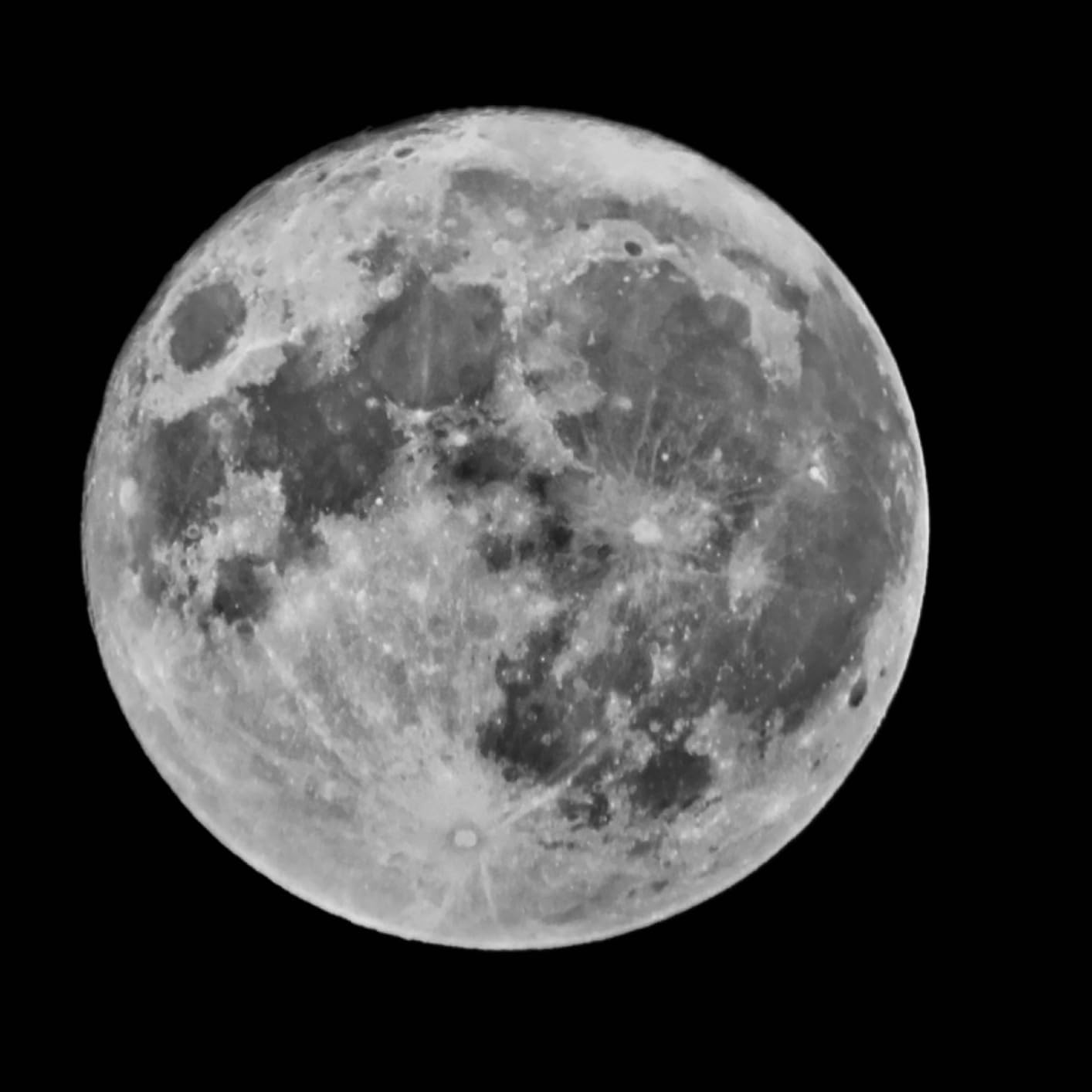
The detail that separates this from the other budget 80mm scopes is the moon filter. It passes about 13 percent of the incoming light, which is exactly what a full Moon at 60x needs: the surface stays visible instead of glaring, and crater relief reads clearly.
That makes it the best value choice in this roundup for lunar work, and lunar detail is where a new observer builds confidence fastest. The 80mm aperture at 600mm focal length with 20mm and 9mm eyepieces gives 30x and 66x, a comfortable pair of powers.
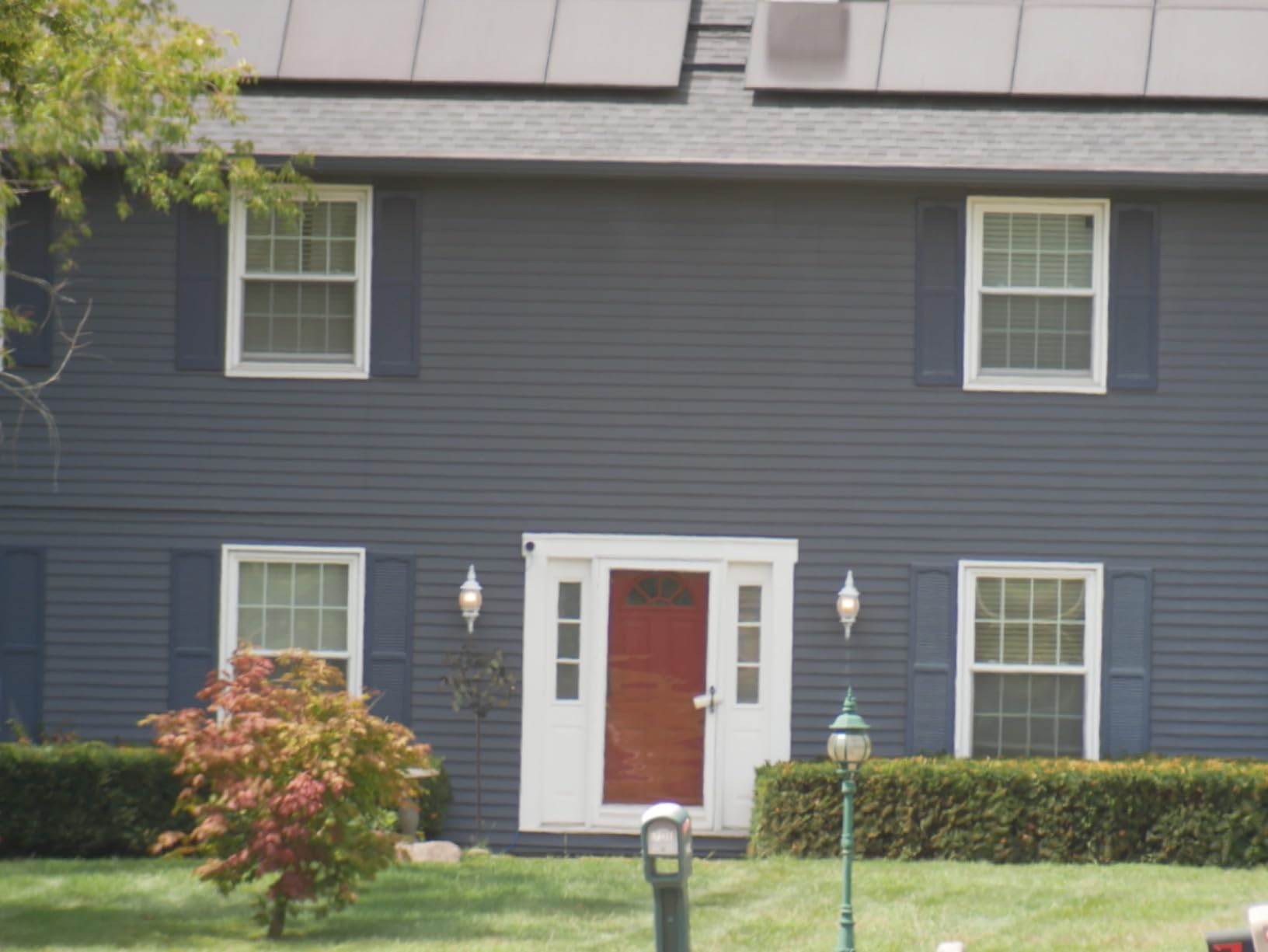
The tripod is the other surprise. It adjusts from 17.7 to 52 inches, so the same kit works for an eight-year-old in the garden and a full-height adult without a separate stand. Tool-free assembly and video instructions get a first-time buyer running in minutes.
Owners rate it 4.3 from about 860 reviews. Reviewers like the brightness from the 80mm aperture, the tripod range and the useful moon filter, and they note the same ceiling: 66x keeps planets at the level of discs and bands.
What does a moon filter actually do?
It reduces the light reaching your eye, which stops the Moon from blowing out to a flat white disc at higher magnification. Detail that was washed out becomes visible again, particularly craters near the terminator and the darker maria.
It is a viewing filter, not a solar filter. Never confuse the two, and never point any scope at the Sun without a certified front-aperture solar filter.
Who should skip this telescope?
Skip it if Saturn’s ring division or the Great Red Spot is the target. Sixty-six times and an 80mm aperture are not enough for those, and no accessory in the box changes that.
Skip it if you plan any long-exposure imaging. This is a visual instrument, and the phone adapter is for sharing quick snapshots rather than producing detailed planetary images.
8. MEEZAA 90mm Refractor – Best for Jupiter and Brighter Detail
MEEZAA Telescope for Adults High Powered, 90mm Aperture 800mm Refractor
90mm multi-coated objective
800mm focal length, f/8.88
32x to 240x range
Stainless steel tripod
Pros
- Largest aperture in the group for brighter planetary images
- 32x to 240x range covers craters through to cloud belts
- 10mm and 25mm eyepieces plus 3x Barlow included
- Ten-minute assembly for most owners
Cons
- Straight-through finder appears inverted and needs alignment
- Phone adapter loses magnification and shifts the finder
- Focusing knob movement makes the whole tube wobble
At 90mm, this is the largest objective in the roundup and it shows. Resolution scales with aperture, so this scope resolves finer structure on Jupiter’s cloud belts and holds Saturn’s rings more distinctly than any of the 70mm and 80mm instruments here.
The 800mm focal length at f/8.88 gives a 32x to 240x range across the supplied eyepieces and the 3x Barlow. That covers the whole planetary ladder: Moon craters at low power, Galilean moon transits in the middle, and the Great Red Spot near the top end.
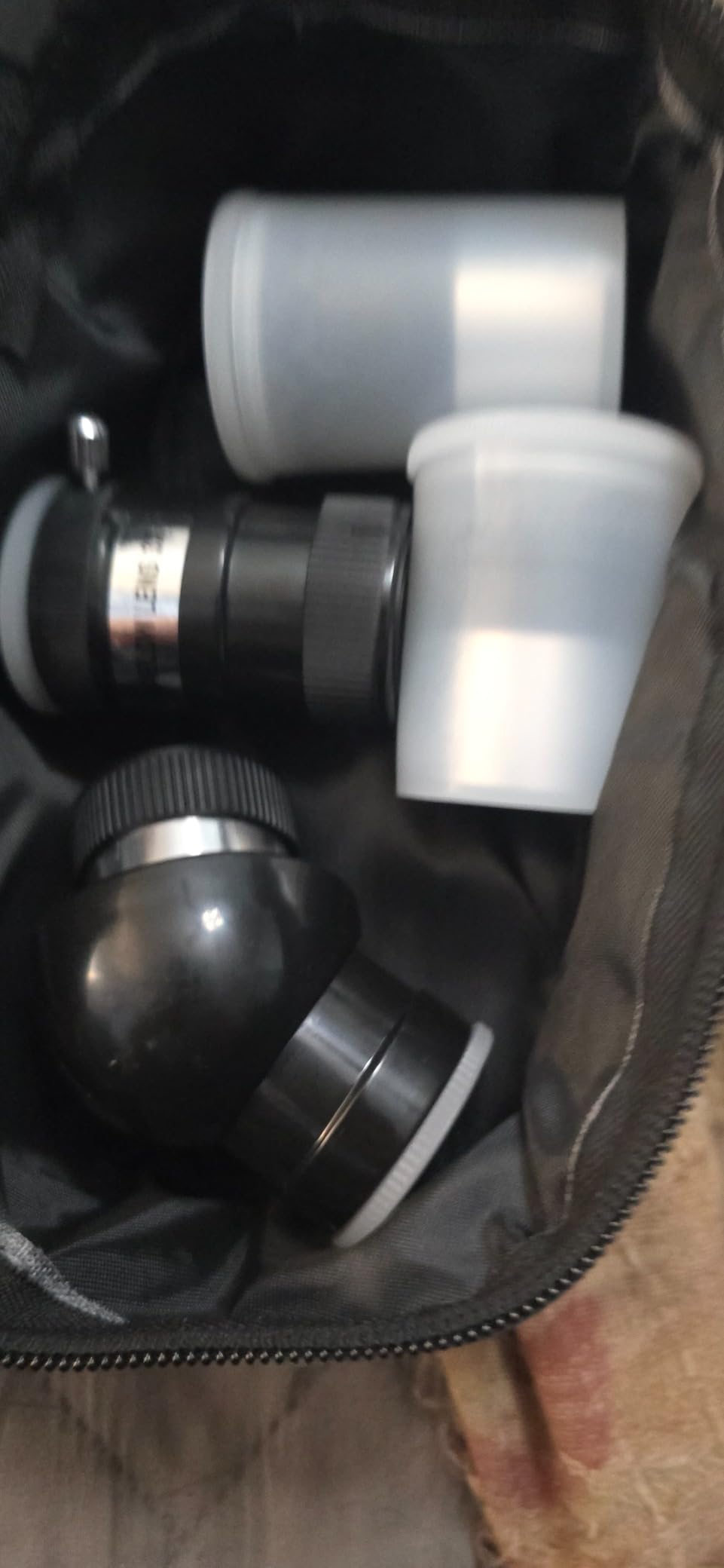
Owners consistently report clear lunar craters, Jupiter’s bands and Saturn’s rings, and they praise the stainless steel tripod as more reliable than the norm, even where it needs re-tightening. Assembly takes about ten minutes for most buyers.
The complaints are specific and worth knowing before you buy. The straight-through finder looks inverted at first and needs alignment, the phone adapter loses magnification and is hard to line up, and touching the focus knob makes the whole tube wobble.

Does aperture beat magnification for planetary detail?
Aperture, almost always. Resolution and contrast both scale with the diameter of the objective, while magnification only enlarges the image you already have. Adding magnification to a small aperture produces a bigger, blurrier, dimmer picture of the same detail.
That is why a 90mm scope at 150x usually looks better than a 70mm scope at 250x, even though the 70mm is pushed much harder. Beyond roughly twice the aperture in millimetres, extra magnification stops adding information.
Who should skip this telescope?
Skip it if you want a grab-and-go instrument. At 90mm aperture and 800mm of tube length, this is a two-handed setup, not a backpack item, and it does not suit spontaneous observing from a field.
Skip it if you are strict about false colour, because a 90mm achromatic design shows more of it at high power than a smaller achromat does. If colour control matters to you, an ED doublet or triplet is the design to look for instead.
9. Dianfan 90mm Refractor – Best for Stability at High Power
Dianfan Telescope, 90mm Aperture 800mm Telescope for Adults High Powered, Portable Professional Astronomy Refractor Telescopes for Beginners, with Stainless Steel Tripod & Phone Adapter, Carry Bag
90mm coated objective, 800mm focal
Two eyepieces plus 3x Barlow
Zenith mirror
Stainless steel tripod
Pros
- Stainless steel tripod stays steady at high power
- 90mm aperture gives high-resolution contrasty views
- Zenith mirror keeps images upright for daytime use
- About 15 minute setup with clear instructions
Cons
- Heaviest option in the group at 4.7 kg
- Simple altazimuth mount needs manual tracking of drifting targets
When you push a 90mm scope past 150x, mount wobble becomes the thing standing between you and detail. This tripod is the reason this scope holds together at high power. It is a stainless steel leg set, and at 240x the image stays readable when neighbouring aluminium tripods start to shake.
The optics match the platform. A 90mm fully coated objective at 800mm focal length gives high-resolution, contrasty views, and the 32x to 240x range covers crater detail through to the outer Jovian belts. The 45 degree zenith mirror also keeps the view upright for daytime use.
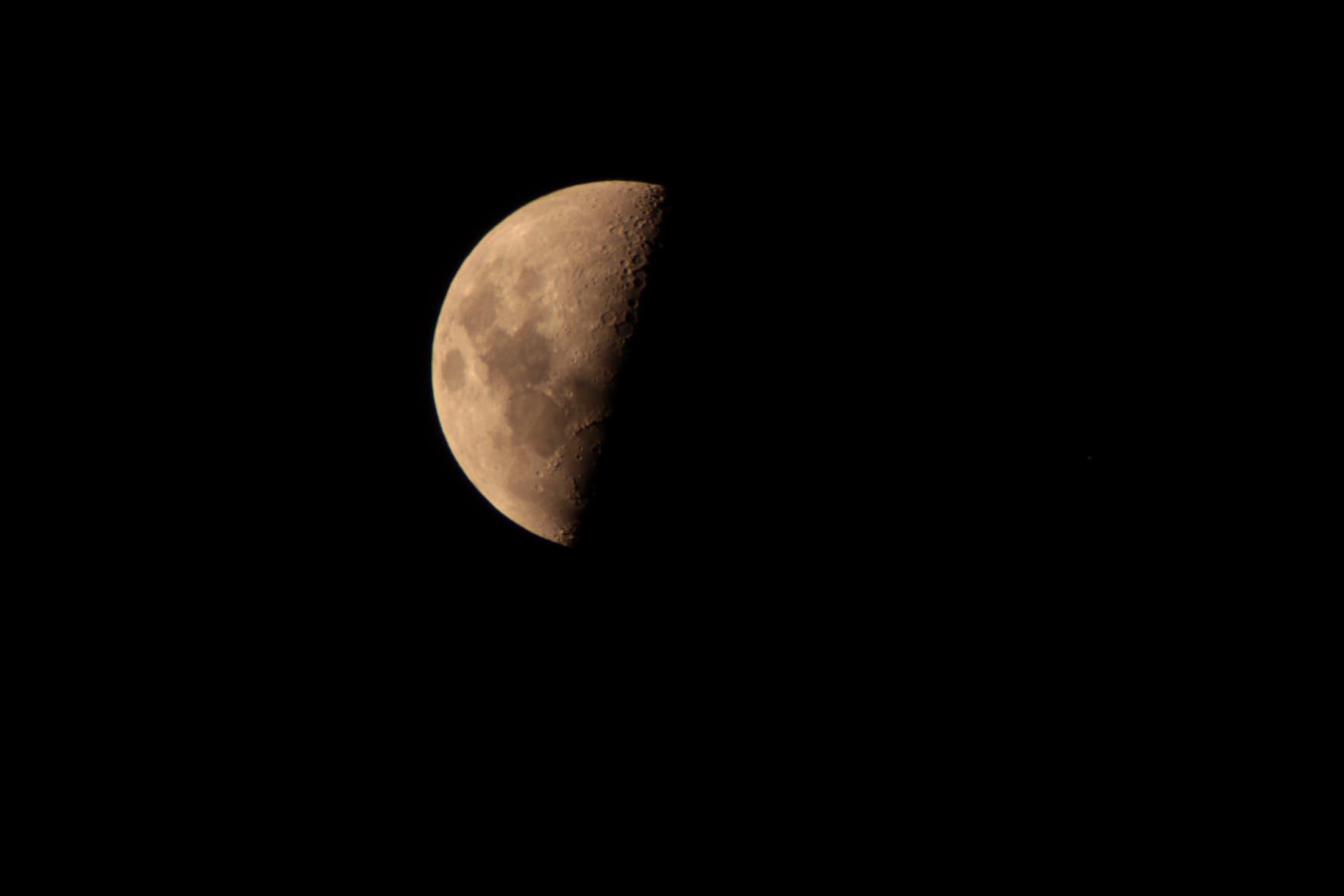
Two eyepieces and a 3x Barlow make up the supplied magnification set, and focusing is smooth. Owners rate assembly at roughly 15 minutes with clear instructions, and the two-year warranty plus a carry bag round out a well-considered package.
Owners give it 4.3 from about 700 reviews, with one of the highest five-star shares in this group. The trade-offs they name are weight at 4.7 kg, which reduces portability, and the need to re-aim the altazimuth mount as objects drift.

How much does mount stability affect a planetary image?
More than most buyers expect. At high magnification the field of view becomes small enough that a breeze or a hand on the tube moves the planet out of it entirely. A rigid tripod lets you keep working at 200x; a light one forces you back to 80x.
This is why we would rather see a solid tripod than a bigger claimed magnification number. Two telescopes of identical aperture can look completely different depending on what the legs are made of.
Who should skip this telescope?
Skip it if you want to carry the telescope in one hand or take it on a plane. At 4.7 kg, this is the heaviest option here and it earns that weight rather than wasting it.
Skip it if you want to see faint galaxies or nebulae. Ninety millimetres is modest light-gathering for deep sky, and a Dobsonian of the same aperture will show considerably more of the faint universe.
10. ESSLNB 80mm Refractor – Best for Phone Astrophotography on a Budget
ESSLNB 80mm Aperture 700mm Telescope – Refractor Telescope for Adults
80mm multi-coated objective
700mm focal length
28x to 210x range
App with automatic tracking
Pros
- Phone adapter engages younger observers with what they see
- Bundled app with automatic tracking and a moon filter
- Easy assembly with an English manual
- Two-year warranty
Cons
- Tripod is extremely flimsy and will not hold a target
- Optics are softer than higher-quality scopes
- Some scopes arrived missing listed accessories
The idea here is a phone-first experience. You attach the phone adapter, line the screen up with the eyepiece, and the bundled stargazing app with automatic celestial tracking helps you find and hold a target. For a child meeting Saturn for the first time, that moment matters more than magnification.
The optics underneath are respectable for the class: a fully multi-coated 80mm objective at 700mm focal length supporting 28x to 210x. Lunar craters read clearly, and bright planets show their phases and rings at the middle of the range.
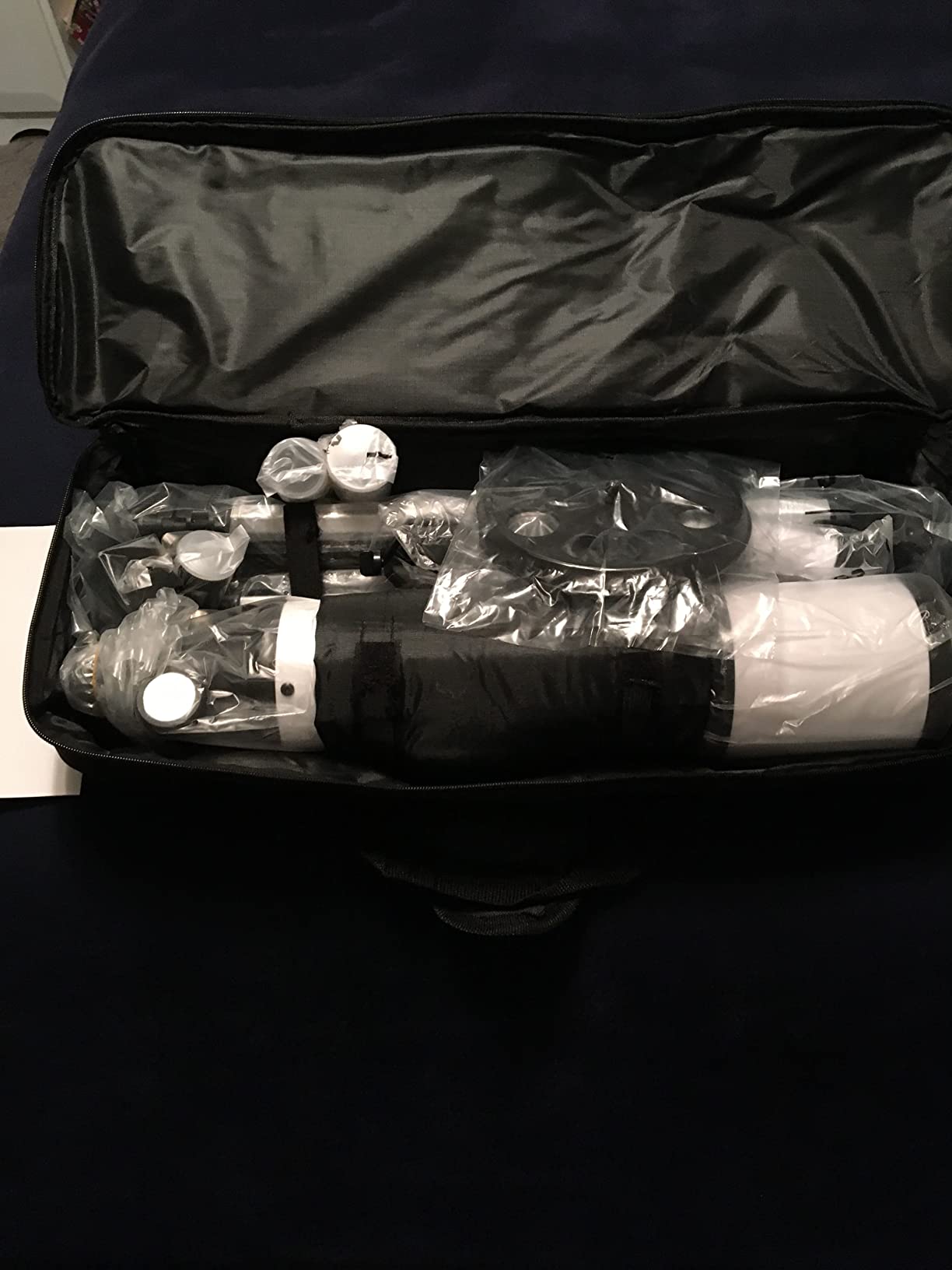
It is the least well-built instrument we reviewed, and owners say so plainly. The tripod is described as extremely flimsy, with even slight touch moving the whole setup, and the images are noticeably softer than those from higher-quality scopes.
Ratings sit at 4.0 from roughly 700 reviews, the lowest in the roundup, with the widest spread between five-star and one-star responses. A small number of reviewers report examples arriving non-functional or missing listed accessories such as the phone mount and moon filter.
Can I photograph planets through a phone adapter?
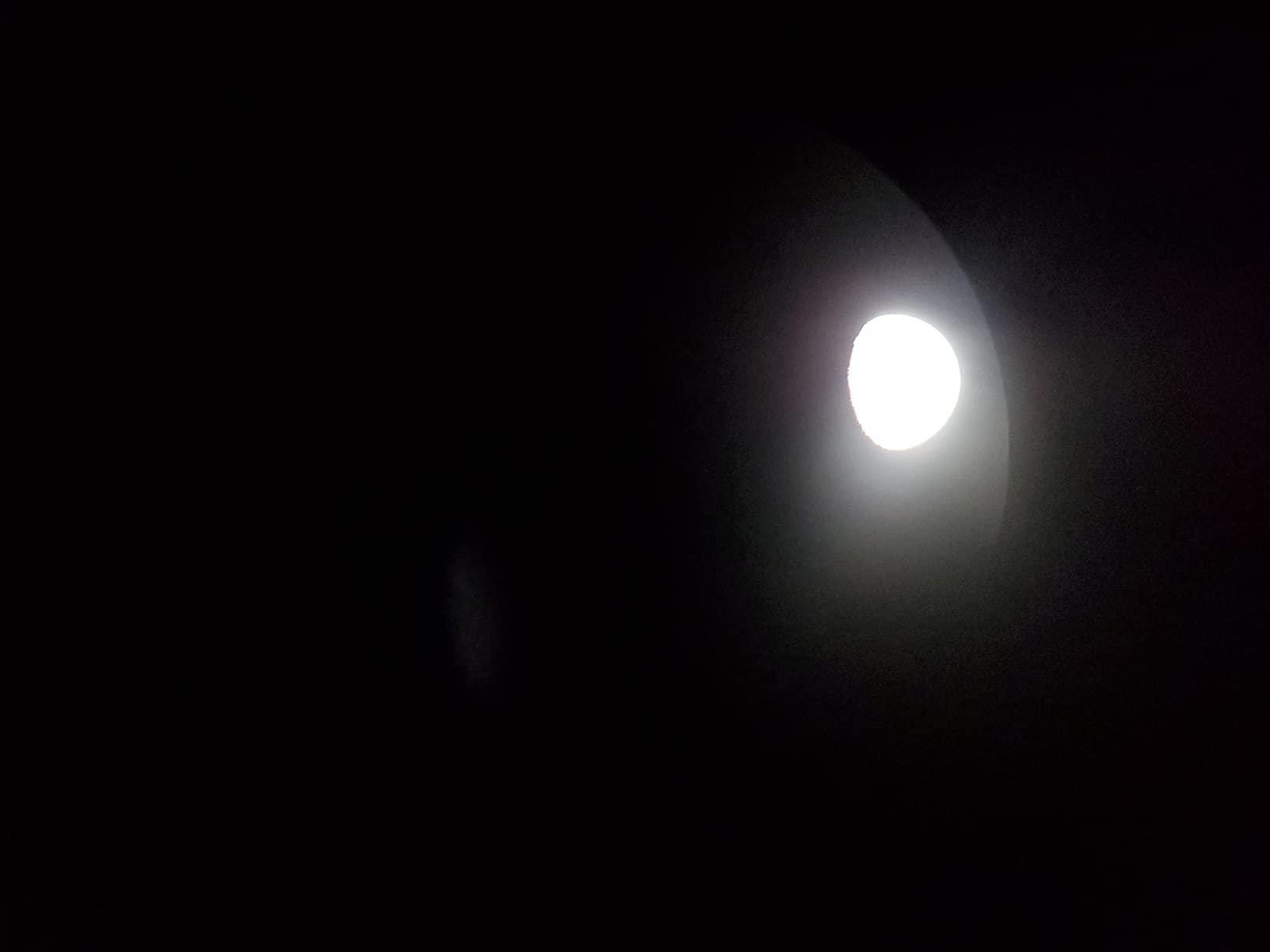
You can, and it is a good way to get a family engaged. Hold the phone steady against the adapter, use the moon filter for lunar shots, and expect short handheld exposures rather than tracked planetary images. Steady hands matter more than resolution.
For serious planetary imaging you need a mount that tracks, a longer exposure and stacking software. Even then, an 80mm achromatic is a hard limit on the result, so treat phone shots as a memory aid rather than a project.
Who should skip this telescope?
Skip it if you care about build quality, because the tripod will frustrate anyone trying to observe at more than 100x. Wobble at high power is the fastest way to lose interest.
Skip it if you already own any telescope at all. At this performance level it is a first instrument for a specific purpose, not an upgrade for anyone further along the hobby.
Buying Guide: How to Choose a Refractor for Planets
Aperture tiers: what you’ll actually see
Below about 70mm, planetary views are limited to crescents and dots. Seventy millimetres shows the phases of Venus, the moons of Jupiter and the shape of Saturn’s rings. At 80mm to 90mm you start resolving Saturn’s Cassini Division, the polar ice caps on Mars and the shape of the Great Red Spot.
Our rule of thumb: 80mm is the minimum for genuine planetary work, 100mm to 120mm is the ideal range, and gains flatten beyond 150mm because the atmosphere, not the telescope, becomes the limit. Every scope in this roundup sits at the budget end of that scale, which is why aperture mattered so much in the ranking.
70mm: Venus phases, Jupiter’s four moons, Saturn as a ringed dot, lunar craters. Useful up to about 140x.
80mm: Jupiter’s cloud belts, the clear shape of Saturn’s rings, Mars at opposition, splitting close double stars. Useful up to about 160x.
90mm: the Cassini Division, Martian polar ice caps, structure in the Great Red Spot, relief along the lunar terminator. Useful up to about 180x.
100mm and above: fine ring structure, festoons in the Jovian belts, small moon shadows crossing the disc. Useful past 200x in steady seeing.
Note the pattern: even the best scope in this list tops out well below the magnification figures printed on the packaging. That is astronomy, not a fault in the equipment.
Achromat vs ED doublet vs triplet
All ten scopes here use achromatic designs, which bring two wavelengths to focus and leave a faint colour fringe on bright targets. An ED doublet adds extra-low-dispersion glass and largely removes the purple fringing that shows on Venus and on high-contrast lunar features. A triplet adds a third element and brings all three wavelengths to focus, giving the cleanest colour of any refractor design.
The trade-off is money. Every step up in lens design costs more than the step before it, and for a first telescope on a mount that may not be steady enough to take advantage of it, a well-mounted achromat often beats an unsteady apochromat.
Focal length, focal ratio and the magnification rule
Magnification is simply focal length divided by eyepiece focal length. A 600mm tube with a 10mm eyepiece gives 60x; the same tube with a 6mm gives 100x. Longer focal lengths reach high power with longer, more comfortable eyepieces, which is why planetary scopes tend to be long tubes.
Focal ratio is focal length divided by aperture. Fast ratios under f/5 are wide-field instruments, and ratios around f/8 to f/9 suit planets, where a narrow field keeps the image large at high power. The practical ceiling is about twice the aperture in millimetres, and most nights on Earth limit you to roughly 150x to 250x no matter what you own.
Seeing conditions and the real magnification ceiling
Atmospheric turbulence, not glass, is what ends most planetary sessions. The moment the air stops boiling, extra magnification adds size without adding information, and the image turns grainy. Check the forecast and wait for a steady night before blaming the telescope.
For the same reason, cool-down time matters. A large tube stored in a warm house needs time to reach ambient temperature, and until it does the image shimmers. Most observers find that leaving a scope outside for an hour, or accepting the first twenty minutes as a focusing session, makes the rest of the night far more productive.
Mount stability at high power
Planetary observers notice vibration more than anyone. Every hand on the tripod, every gust of wind and every focusing knob that shakes the tube destroys the fine detail you paid for. A rigid tripod and a slow-motion control are worth more than one extra step of magnification.
Altazimuth mounts are simpler and are what most of these scopes use. Equatorial mounts let you follow a drifting planet with a single rod, which matters over long sessions. We explain the mechanics further in our roundup of smart telescopes for beginners, where pointing automation changes the same trade-off.
Optical tube assembly or complete telescope?
Most serious planetary observers buy an optical tube assembly, which is the lens tube plus focuser without any mount, and pair it with a mount they already own. That is the right move if you have a solid equatorial head or a good altazimuth base and you intend to upgrade.
If you are starting from nothing, a complete telescope is simpler and cheaper for the same aperture. The trap is buying a cheap tube and then discovering that a decent mount costs several times more, which pushes many buyers toward a steadier all-in-one package.
Refractor vs reflector vs Dobsonian
Refractors win on contrast and low maintenance. A reflector of the same aperture gathers the same light but its secondary mirror creates a central obstruction that softens high-contrast planetary detail, and its mirror needs periodic collimation. Dobsonians give you the most aperture per unit of money but are large and suited to faint deep-sky targets rather than planets.
If galaxies are your priority rather than planets, a refractor is the wrong instrument. A Dobsonian reflector will show far more of the faint universe for the same aperture, and our Dobsonian telescope recommendations cover that case in full.
Frequently Asked Questions
Are refractor telescopes good for planets?
Yes. A refractor has an unobstructed light path with no secondary mirror in the middle of the beam, which delivers the high contrast needed to see cloud belts on Jupiter, the Cassini Division in Saturn’s rings and craters along the lunar terminator. An 80mm aperture is the practical minimum for detail beyond discs and phases.
What aperture do I need for planetary viewing?
Eighty millimetres is the minimum for real planetary detail, 100mm to 120mm is the ideal range, and returns diminish past 150mm because atmospheric seeing takes over as the limiting factor. Under 70mm you will see phases and dots rather than surface detail.
How much magnification is too much for planets?
Beyond roughly twice the aperture in millimetres, extra magnification enlarges the image without adding information. On a typical night most observers find 150x to 250x the practical ceiling, no matter what the packaging claims. Turbulent air, not glass, is what ends the session.
What is a good telescope to see Saturn’s rings?
A 70mm refractor shows Saturn as a ringed disc, an 80mm to 90mm scope shows the ring shape clearly, and 100mm or more resolves the Cassini Division as a dark gap. Longer focal length helps because it delivers high magnification with long, comfortable eyepieces.
Which telescope is best to see all planets?
Refractors suit the bright planets best, and any 80mm or larger scope will show Venus phases, Mercury at the right elongation, Mars, Jupiter and Saturn. Uranus and Neptune appear as small coloured discs that need a finder chart, steady seeing and ideally darker skies than most backyards offer.
Should I get a refractor or a reflector for planets?
A refractor, if planets are your priority, because its unobstructed light path gives higher contrast and no collimation is needed. A reflector gives more aperture per unit of money and shows more galaxies, but its central obstruction softens fine planetary detail.
Can you see galaxies with a refractor telescope?
Yes, but faint galaxies need dark skies and a wide field. A small refractor is optimized for planets, the Moon and double stars. If galaxies are the main target, a reflector with more aperture will show considerably more of them.
Do I need a Barlow lens with a refractor?
A Barlow multiplies magnification without changing the eyepiece, which helps on short-focal-length scopes. Long tubes that reach useful power with a 10mm eyepiece do not need one. A 2x or 3x Barlow is a cheap way to get finer detail on Jupiter and Saturn.
Conclusion: Where to Start
If you want one recommendation from our list of the best refractor telescopes for planets, start with the Gskyer 70mm travel refractor. It is the most complete package, the most reviewed instrument here, and it puts the Moon, Venus phases and Jupiter’s moons on screen within minutes of unpacking.
If your budget stretches further and you want more detail per session, the MEEZAA 90mm is the smarter buy because aperture drives resolution. For a long tube at the lowest cost, the Celestron AstroMaster 70AZ reaches 90x on a 10mm eyepiece without a Barlow. Pick by aperture first, mount second, and ignore printed magnification claims.
Whichever you choose in 2026, let it reach outdoor temperature before you judge it, start at low power, and be patient with the atmosphere. The planets reward a steady setup far more than an expensive one.