
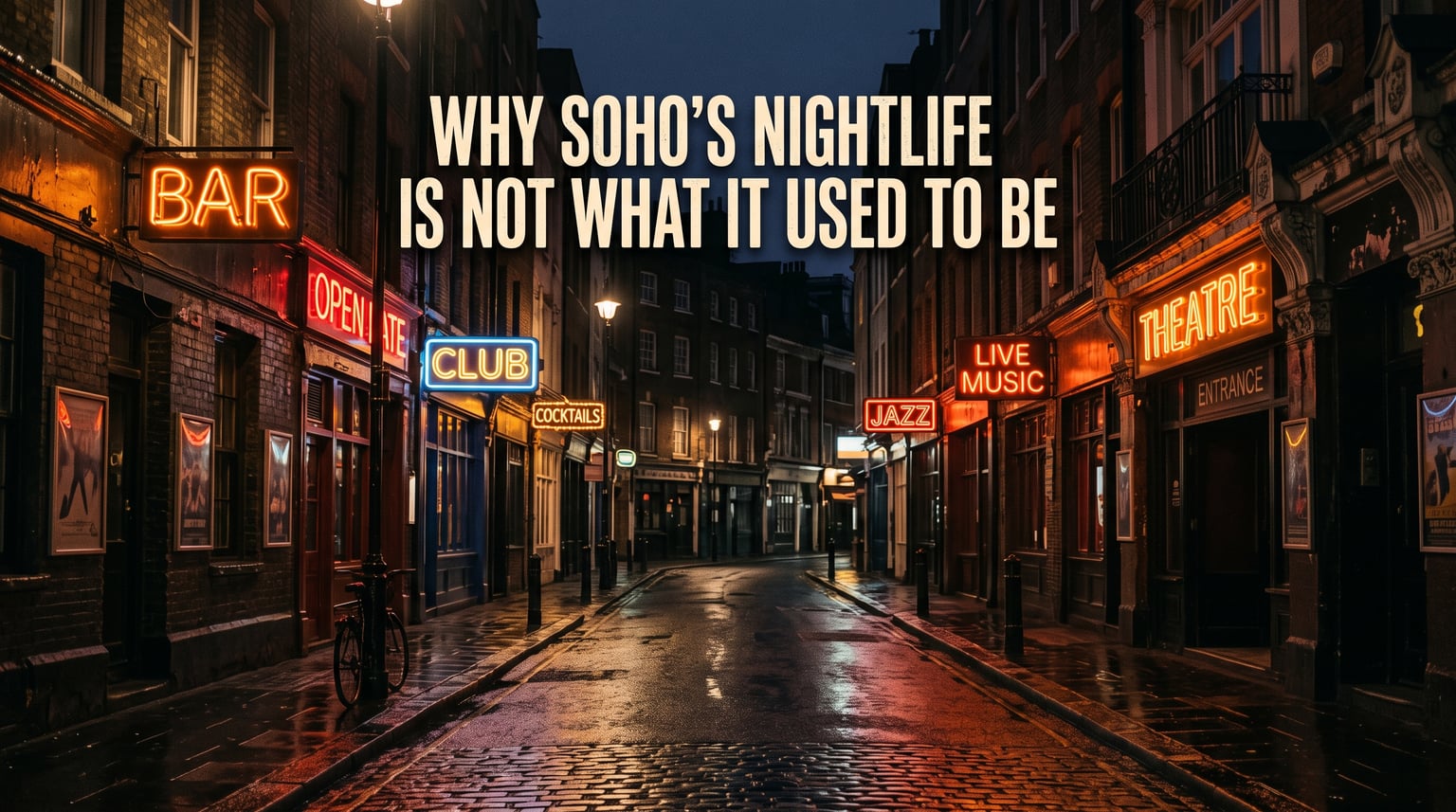
If you walked through Soho on a Friday night in the 1990s, you would have felt it. The bass from basement clubs vibrating through the pavement on Greek Street. Crowds spilling out of pubs onto Old Compton Street. Neon signs flashing above doorways that promised something a little dangerous, a little electric, a little alive. That Soho is still there in fragments, but most people who remember it will tell you the same thing: something fundamental has changed.
I have been visiting, researching, and writing about Soho’s nightlife scene for years. The story of why Soho’s nightlife is not what it used to be is not a simple tale of one bad decision or one bad year. It is a collision of licensing wars, spiralling rents, changing consumer habits, and a cultural identity crisis that has been building for decades.
Let me walk you through exactly what happened, what is happening right now, and whether there is any road back for the neighbourhood that once called itself the entertainment capital of London.
Table of Contents
The Golden Age of Soho Nightlife: A Brief History
To understand what Soho lost, you have to understand what it once was. Soho’s reputation as London’s most exciting nightlife district did not happen by accident. It was built over more than half a century of counterculture, music history, and a tolerance for the unconventional that set it apart from everywhere else in the city.
In the 1960s and 1970s, Soho was the beating heart of London’s music and club scene. The Rolling Stones recorded at Regent Sound Studios on Denmark Street. Ronnie Scott’s Jazz Club on Frith Street hosted the greatest musicians in the world. Strip clubs, dive bars, and all-night cafes created an atmosphere where anything felt possible after midnight.
The 1980s and 1990s turned Soho into something even more iconic. Old Compton Street became the centre of London’s LGBTQ+ community, with venues like G-A-Y, the Admiral Duncan, and Comptons creating a visible, proud, and vibrant scene. Soho was simultaneously the city’s red-light district, its gay capital, its media-industry watering hole, and its most thrilling place to go out on a Saturday night.
This mix was what made Soho special. You could find a hardcore techno night in a basement on Brewer Street, share a 3am coffee with strangers in a cafe on Old Compton Street, and stumble past the last of the strip joints on Walkers Court, all in one evening. It was messy, contradictory, and completely irreplaceable.
The Hippodrome on Cranbourn Street, now a casino, was once the core of Soho’s nightlife. As one Reddit user on r/london put it: “I remember when the Hippodrome was the core of Soho’s crazy, drug-fuelled, energetic and trashy yet vibrant nightlife.” That memory captures something the data alone cannot. Soho was not just busy. It was culturally distinctive in a way that drew people from across the world.
Why Soho’s Nightlife Is Not What It Used to Be: The Core Reasons
If you are looking for a single answer to why Soho’s nightlife declined, you will not find one. The reality is that several powerful forces hit the neighbourhood simultaneously, and each one made the others worse. Here are the key factors that changed Soho forever.
1. Aggressive licensing restrictions. Westminster Council’s cumulative impact zone policies and the Soho Society’s systematic opposition to new licensing applications have made it extraordinarily difficult for new venues to open or existing ones to extend their hours. Every new licence application now faces objections, legal challenges, and costly hearings.
2. Spiralling rents and business rates. Commercial rents in Soho have climbed to levels that make it nearly impossible for independent operators to survive. Small venues that defined the area’s character are being priced out, replaced by businesses that can afford the premiums, which usually means national chains.
3. Post-pandemic habit changes. The pandemic permanently altered how Londoners go out. Foot traffic during the week dropped sharply. As one venue owner explained in a forum discussion: “Saturday is busy, but that is one night a week. Our bills are based on seven nights a week.” Midweek trade that venues depended on has never fully returned.
4. Chain expansion and sanitisation. National restaurant chains, corporate cocktail bars, and lifestyle brands have moved into Soho at an accelerating pace. The streets look cleaner and more uniform, which sounds positive until you realise that uniformity is the enemy of the kind of unpredictable, edgy energy that made Soho famous.
5. Loss of late-night culture. Compared to cities like Berlin, Madrid, or even Paris, London’s closing times are famously early. Soho’s venues now face earlier last orders and stricter noise enforcement, making the all-night culture of the past functionally impossible.
The Soho Society and the Licensing Wars
Of all the forces reshaping Soho’s nightlife, the licensing battle is the most active and controversial. At the centre of it is the Soho Society, a residents’ group that has become one of the most powerful influences on the neighbourhood’s future.
The Soho Society is funded by Westminster Council. Its stated mission is to represent the interests of people who live in Soho, and in that capacity, it reviews and responds to licensing applications for bars, restaurants, clubs, and other entertainment venues. In practice, many venue owners say the group has adopted a policy of opposing virtually all new licensing applications.
This matters enormously. When the Soho Society objects to a licence, the applicant often faces expensive legal hearings, drawn-out appeals, and conditions that make operating a viable late-night business nearly impossible. For small operators without deep pockets, a single objection can be enough to kill a project entirely.
Rupert Power, a prominent venue owner in the area, has spoken publicly about the toll this takes on businesses. The Guardian reported that owners feel the Soho Society’s blanket opposition is “destroying Soho’s reputation” as an entertainment district. Philip Kolvin KC, a leading licensing lawyer and former chair of the cross-party night-time economy task force, has echoed these concerns, warning that the current approach is strangling small businesses.
The conflict reached the highest levels of London politics in 2026. Mayor Sir Sadiq Khan publicly described the Soho Society’s blanket opposition to licensing applications as “bad for London.” His intervention was significant because it signalled that the issue had moved beyond a neighbourhood dispute and into a question about the city’s entire cultural strategy.
Westminster Council, for its part, maintains that it must balance the needs of residents with those of businesses. That is a fair principle. But the practical result is a landscape where opening or running a nightlife venue in Soho has become an uphill battle that fewer and fewer people are willing to fight.
Gentrification, Rising Rents, and the Death of Independent Venues
Licensing restrictions are only half the story. The other half is economic, and it is arguably more devastating. Gentrification has transformed Soho from a neighbourhood of independent, idiosyncratic venues into one that increasingly resembles any other high street in central London.
Commercial rents in Soho have risen to extraordinary levels. Independent bar owners, club operators, and restaurateurs who have been in the area for decades are finding that their leases, when renewed, come with increases that are simply unsustainable. The businesses that can afford Soho rents now tend to be large chains with corporate backing.
The result is visible on every street. Walk down Wardour Street or Charing Cross Road and you will see the same restaurant brands you would find in any shopping centre. The independent record shops, family-run cafes, and one-of-a-kind bars that gave Soho its personality are disappearing one lease renewal at a time.
The LGBTQ+ community has been hit particularly hard. Old Compton Street, once the undisputed centre of gay London, has lost several landmark venues. The closure of G-A-Y’s Soho location sent shockwaves through the community, and it was not an isolated incident. Each venue that closes takes with it a piece of Soho’s identity as a safe, vibrant, and visible queer space.
The sentiment on the ground is overwhelmingly one of loss. A widely discussed Reddit thread titled “Soho has lost its character” captured the frustration of long-time visitors and residents. Comments focused on spiralling rents, expanding chains, and the feeling that the neighbourhood had been hollowed out. One user wrote about how every bar used to have long lines and a 30-minute wait just to get a drink. Now, many of those same bars are gone.
This is not nostalgia talking. The data supports what people are seeing. Fewer independent venues, more chain operators, higher rents, and a steadily diminishing diversity of what the neighbourhood offers after dark.
How Soho Compares to Other Global Nightlife Capitals
One of the most illuminating ways to understand Soho’s situation is to look at what other major cities have done with their nightlife districts. The comparison is not flattering for London.
Paris has invested heavily in its night-time economy in recent years. The city has appointed a night-time mayor, extended operating hours for venues, and actively protected independent nightlife spaces from being driven out by development. The result is a late-night culture that feels alive and accessible in a way London’s increasingly does not.
New York, despite its own challenges with gentrification, still operates with a 4am last call in many venues. Brooklyn and Manhattan neighbourhoods have fought to preserve their nightlife heritage through zoning protections and community-backed licensing support. The city treats nightlife as an industry worth protecting, not a nuisance to be managed.
Berlin is perhaps the gold standard. The city’s club culture is recognised as a vital part of its cultural heritage. Berlin’s clubs have even been granted the same cultural status as opera houses and theatres, which gives them protections against noise complaints and development pressure that London venues could only dream of.
London, by contrast, has some of the earliest closing times of any major global city. Most venues in Soho are required to stop serving alcohol by 11pm or midnight on weekdays, with slightly later extensions on weekends. For an area that built its reputation on all-night entertainment, this represents a fundamental shift in what is possible.
The contrast matters because it shows that decline is not inevitable. Other cities face the same pressures of gentrification, noise complaints, and resident concerns, yet they have found ways to protect their nightlife ecosystems. London’s approach, particularly in Westminster, has trended in the opposite direction.
The Human Cost: Jobs, Community, and Cultural Identity
When we talk about nightlife decline, it is easy to focus on venues and licensing policies and forget the people whose lives depend on this ecosystem. The human cost of Soho’s transformation is real and measurable.
The hospitality sector in central London employs tens of thousands of people, many of them young. When venues close or reduce their operating hours, those jobs disappear. The Guardian highlighted this connection, noting that the impact on young people and hospitality employment is one of the most under-discussed consequences of the licensing crackdown.
For nightlife workers, the problem is compounded by the cost of living in London. Bar staff, DJs, security personnel, sound engineers, and kitchen workers who once lived within commuting distance of Soho are increasingly priced out of the city entirely. The talent pool that made Soho’s nightlife world-class is being scattered across the suburbs and beyond.
The cultural impact goes beyond jobs. Soho’s nightlife was never just about drinking and dancing. It was a space where subcultures formed, where the LGBTQ+ community gathered freely, where musicians and artists found audiences, and where people from all walks of life mixed in ways that simply did not happen elsewhere. That mixing is what sociologists call a “third place,” a space that is neither home nor work but where community happens. As those spaces close, the community they supported weakens.
The business reality is stark. Venue owners are caught between rising fixed costs and shrinking revenue. A bar that used to generate income seven nights a week may now only be profitable on Friday and Saturday. The midweek trade that sustained independent operators has eroded, leaving businesses to cover the same rent and staffing costs with far fewer paying customers.
Is There Hope for Soho’s Nightlife Future?
The situation is serious, but it is not hopeless. There are developments that could shift the trajectory of Soho’s nightlife in the coming years.
The Mayor of London has been granted new licensing powers that could potentially override some of the most restrictive local decisions. If used effectively, these powers could create a more balanced approach that protects both residents’ quality of life and the survival of the entertainment district. Khan’s public stance against blanket licensing opposition suggests a political will to act.
Grassroots campaigns are also gaining momentum. Organisations like the Night Time Industries Association have been vocal about the need to protect London’s nightlife economy. Business owners are increasingly organising collectively rather than fighting licensing battles one by one.
Other cities offer proven models. Amsterdam, for instance, has experimented with designated nightlife zones where licensing is streamlined. Manchester has invested in its night-time economy through dedicated infrastructure and policy support. London could adopt similar approaches if the political will exists.
The question is whether change will come fast enough. Every month that passes without reform, another venue closes or another independent operator gives up. The window for reversal is not infinite.
FAQs
Why is Soho House no longer cool?
Soho House, the private members club that originated in London, has expanded globally to over 40 locations, which many feel has diluted its original exclusivity and cultural cachet. The brand that once felt like a secret society for creatives now operates more like a luxury chain, and the original Soho location has been affected by the same broader decline in the surrounding neighbourhood’s nightlife energy.
Why are nightclubs not popular anymore?
Nightclub attendance has declined across the UK due to a combination of factors including rising door fees and drink prices, the growth of home entertainment and streaming, earlier licensing enforcement, and generational shifts in socialising habits where younger people increasingly prefer bars, pubs, and experiential venues over traditional clubbing. Soho has been hit especially hard by these trends combined with aggressive licensing opposition.
Is Soho still seedy?
Soho is far less seedy than it once was. The neighbourhood’s historic red-light district elements, including the famous walk-up flats and adult entertainment venues, have been almost entirely removed through decades of redevelopment and enforcement. While some adult businesses remain on Walkers Court and surrounding streets, the area is now predominantly filled with mainstream restaurants, bars, and retail, which many feel has erased the edgy character that once defined it.
Why was Soho a red light district?
Soho became a red-light district through a combination of its location in central London, historically low property values in the 18th and 19th centuries, and a long tradition of bohemian and entertainment culture that attracted sex work and adult entertainment. By the mid-20th century, the area was famous for strip clubs, adult cinemas, and walk-up flats, which operated alongside its jazz clubs and music venues. The red-light identity persisted until aggressive redevelopment and enforcement in the 2000s and 2010s largely removed it.
The Bottom Line on Soho’s Nightlife
Why Soho’s nightlife is not what it used to be comes down to a convergence of forces: licensing restrictions driven by the Soho Society and Westminster Council, spiralling commercial rents that favour chains over independents, post-pandemic shifts in going-out habits, and a cultural sanitisation that has stripped away the neighbourhood’s distinctive edge.
The result is a Soho that is cleaner, quieter, and more expensive than the one that captivated generations of Londoners and visitors. It still has great restaurants, busy bars, and pockets of the old energy. But the question that keeps coming up in forums, news articles, and conversations on the street is whether enough remains to justify its reputation as the entertainment heart of London.
Change is not inherently bad, and cities must evolve. But when the evolution of a place erases the very qualities that made it worth visiting in the first place, something has gone wrong. Whether Soho’s nightlife can recover depends entirely on whether the people with the power to act decide that nightlife, culture, and independent enterprise are worth fighting for.