
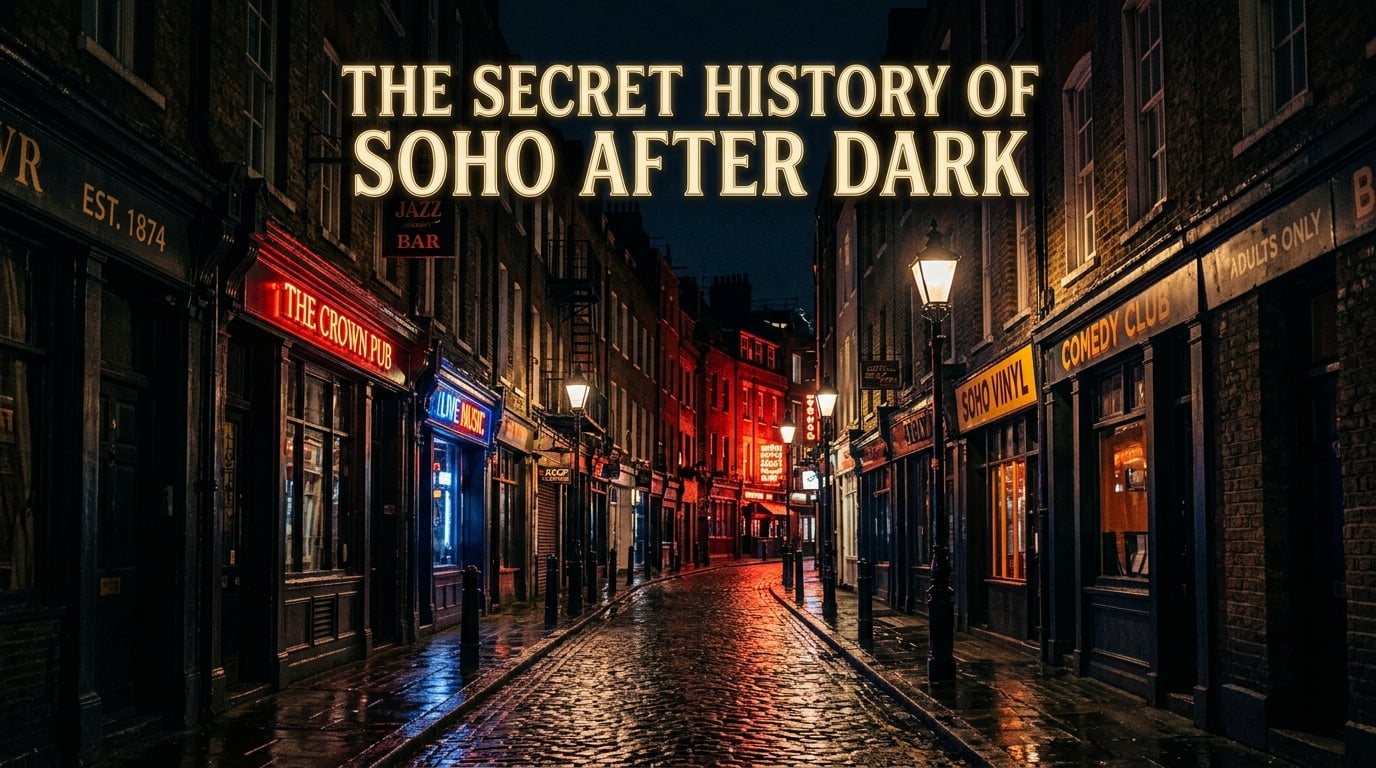
Walk through Soho after midnight and you are treading on four centuries of secrets. Beneath the neon signs and cocktail bars lies a buried city of opium dens, artists’ drinking clubs, notorious gangland empires, and shadowy literary haunts that shaped British culture in ways most people never realize. The streets between Oxford Street and Shaftesbury Avenue have worn more masks than any other square mile in London.
The phrase “Soho after dark” conjures images of neon-lit streets and hidden doorways, but the real story goes far deeper than stereotypes. This is a district that began as aristocratic hunting grounds, descended into Victorian slums, rose again as the beating heart of Bohemian London, and somehow absorbed every wave of counterculture that followed. Every brick has a story. Most of them have never been told.
The name itself is shrouded in mystery. Most historians trace it to a hunting cry used by aristocrats chasing game across the fields in the 1500s and 1600s. Others point to earlier roots. Either way, the cry of “Soho!” echoed across open countryside long before it became synonymous with London’s most provocative, creative, and controversial district.
What follows is a journey through that hidden history. From the opium haze of Greek Street to the razor gangs of the 1920s, from Francis Bacon’s paint-spattered drinking den to the phone boxes stuffed with handwritten cards, this is the secret history of Soho after dark.
Table of Contents
The Secret History of Soho After Dark: From Hunting Grounds to Underworld
Soho’s transformation from aristocratic farmland to London’s most notorious district happened gradually, then all at once. In the late 1500s, the land we now call Soho was open fields used for hunting by the wealthy elite who lived nearby. The cry of “So-ho!” rang across meadows where deer ran free.
Everything changed in the decades after the Great Fire of London in 1666. Wealthy families gradually moved westward, and developers saw opportunity. By the early 1700s, Soho had become a grid of new streets, attracting immigrants, tradespeople, and anyone who could not afford the more fashionable addresses nearby. The aristocratic character faded, replaced by something messier and more alive.
French Huguenots fleeing religious persecution settled here in large numbers, bringing their food, their language, and their independent spirit. They were the first wave of outsiders who would define Soho’s identity as a sanctuary for the displaced. Greek Street got its name from this era of immigration, and Dean Street became an address for people living between worlds.
By the Victorian era, Soho had transformed again. Overcrowded, poorly governed, and largely ignored by the authorities, it became a place where conventional rules did not apply. That lawlessness cut both ways. It bred poverty and crime, but it also created space for artists, writers, immigrants, and free thinkers who had nowhere else to go. The same streets that hid desperate poverty also nurtured some of the most creative minds in British history.
Opium Dens and Victorian Shadows
Thomas De Quincey literally put Soho’s dark side on the literary map. His 1821 memoir, Confessions of an English Opium-Eater, described his years living on Greek Street, where he purchased laudanum from a chemist and spiraled into addiction. De Quincey wrote about Soho’s underworld with a hallucinatory vividness that shocked Victorian readers and made the district synonymous with narcotics and vice.
De Quincey was not exaggerating. Greek Street and its surrounding alleys became known as a center for the opium trade throughout the 1800s. Chinese immigrants who settled in the nearby Limehouse area ran operations that extended into Soho, and the district’s lack of effective policing made it an ideal marketplace for substances that could not be sold openly elsewhere.
Charles Dickens knew these streets intimately and drew on them for his fiction. The slums of Soho appear throughout his work, portrayed with a mixture of revulsion and fascination. He understood that Soho’s darkness was not simply criminal. It was the shadow side of respectable London, the place where the city’s hidden appetites were fed.
Oscar Wilde moved through this Victorian Soho underworld with a different kind of daring. The cafes and clubs of the district offered something that polite society could not provide. A space where conventional morality could be questioned, where identities could be explored away from the judgmental gaze of the establishment. Wilde’s connection to Soho was part of a larger pattern. The district served as a refuge for anyone whose desires or ambitions did not fit within the narrow boundaries of Victorian respectability.
The Colony Room: Where Genius and Chaos Collided
If you had to choose one venue that captured the spirit of Soho after dark, the Colony Room Club would be it. Perched up a narrow staircase at 41 Dean Street, this private members’ drinking club operated from 1948 to 2008 and served as the unofficial headquarters of Bohemian London for sixty years.
The Colony Room was the creation of Muriel Belcher, a formidable woman with a sharp tongue and an uncanny eye for talent. She ran the club with a mixture of charm and intimidation, deciding who was worthy of membership and who was not. Her approval could make your reputation. Her dismissal could destroy it. Regulars paid for annual membership, and the privilege of being insulted by Muriel was considered part of the attraction.
Francis Bacon was the Colony Room’s most famous patron and its most destructive force. The painter would arrive in the early evening, having spent the day in his studio nearby, and drink until the small hours. Bacon’s relationship with the Colony Room was more than just a drinking habit. The club was his social universe, the place where he held court, picked fights, formed attachments, and found the human raw material that fueled his art.
The artistic circle around the Colony Room read like a who’s who of postwar British culture. Lucien Freud drank there before Bacon arrived and continued drinking there for decades. The painter Michael Andrews, the sculptor Eduardo Paolozzi, and the photographer John Deakin were all fixtures. So was Jeffrey Bernard, the journalist whose legendary column for The Spectator, “Low Life,” documented his drinking and his Soho existence with a self-deprecating honesty that made him a cult figure.
Keith Waterhouse, the novelist and columnist, described the Colony Room as the kind of place where you could find a duke, a dustman, and a drag queen sharing the same cramped banquette. That mix was not accidental. The club’s appeal lay precisely in the fact that status outside its walls meant nothing inside them. In a deeply class-ridden society, the Colony Room offered something rare and precious. A room where talent and personality mattered more than pedigree.
The Colony Room closed in 2008, a casualty of changing times, rising rents, and the gradual erosion of the drinking culture that had sustained it. But its legacy endures. Without that small room above Dean Street, postwar British art would have looked very different. The conversations, the arguments, the friendships, and the feuds that played out at the Colony Room shaped a generation of artists and writers who in turn shaped the culture of an entire nation.
Literary Pubs: Where Writers Found Their Voice
Soho’s pubs were not just places to drink. They were extensions of the creative process, unofficial offices where books were plotted, articles were written, and careers were launched over pints and whiskies. The literary pub culture of Soho was one of the great engines of British writing in the twentieth century.
The French House, on Dean Street, earned its name by serving as a hub for the French resistance during World War II. Charles de Gaulle supposedly drank there while planning the Free French movement. The pub maintained its continental atmosphere long after the war, serving only half-pints and attracting a clientele of writers, artists, and journalists who treated it as their second home. Dylan Thomas was a regular, as was the poet and critic Cyril Connolly.
The Coach and Horses, on Greek Street, achieved its own kind of fame under the management of Norman Balon, who proudly called himself “the rudest landlord in London.” Balon ran the pub from the 1950s into the 2000s and made curmudgeonly hostility into an art form. Regulars did not expect courtesy. They expected decent beer, conversation that could veer from the brilliant to the profane, and the company of people who valued substance over polish.
Jeffrey Bernard’s association with the Coach and Horses was so deep that the pub effectively became his office. When he was too drunk or too ill to make it to The Spectator, his column would sometimes appear with a note saying simply that it had been filed from the pub. The playwright Keith Waterhouse turned Bernard’s Soho drinking life into the play Jeffrey Bernard Is Unwell, which immortalized the scene and ensured that these pubs would be remembered long after the last regular had gone home.
George Orwell knew these streets too. He worked on Down and Out in Paris and London while living nearby, and his descriptions of the district’s cheap lodging houses and rough pubs drew directly on Soho’s grimmer realities. Orwell understood what many missed. The same conditions that made Soho dangerous also made it free, and that freedom was what drew writers and thinkers who needed room to breathe outside the suffocating conventions of middle-class England.
The Pillars of Hercules, on Greek Street, rounded out the literary circuit. It served as an unofficial meeting point for the publishing industry, where editors, agents, and authors could be found most evenings. Deals were struck, manuscripts were discussed, and the next generation of British literature took shape over glasses of wine and plates of pub food.
The Red Light District: From 1778 Onward
Soho’s reputation as a red light district was not an accident of geography. It was the product of specific historical conditions that made the area uniquely suited to the sex trade. The story begins in the late 1700s, when records document organized prostitution in the area dating back to at least 1778.
Several factors converged to create this reputation. Soho’s dense population of single men, its immigrant communities, its location between the wealthy West End and the working-class districts to the east, and its lack of effective policing all contributed. The district existed in a kind of regulatory blind spot where activities that were officially illegal were unofficially tolerated.
By the Victorian era, the trade was thoroughly established. Soho had bordellos, brothels disguised as boarding houses, and street workers operating openly in certain streets. The moral reform movements of the period periodically cracked down, but the trade simply moved, adapted, and returned.
In the postwar period, the sex industry in Soho evolved into its most recognizable form. Shopfronts displayed provocative magazines and videos. Telephone boxes lining the streets were stuffed with handwritten postcards offering services. The “clip joints” of the era, where unsuspecting tourists were lured in and charged extortionate prices for watered-down drinks, became a notorious part of the Soho experience.
The Street Offences Act of 1959 marked a turning point. The legislation drove street-based sex work indoors, pushing it into flats and massage parlours above shops. It did not eliminate the trade but changed its geography and its visibility. The telephone box cards became the new street corner, a distinctly Soho phenomenon that lasted into the internet age.
By the 1990s and 2000s, changing social attitudes, the rise of the internet, and aggressive police operations significantly reduced the visible sex industry in Soho. The shopfronts closed one by one. The phone boxes were removed. What had been a defining feature of the district for over two centuries gradually faded, replaced by cocktail bars, restaurants, and the steady march of gentrification.
Old Compton Street: The Heart of Soho’s LGBTQ+ History
Old Compton Street is the beating heart of London’s LGBTQ+ community today, but its history as a queer space stretches back well over a century. The connection between Soho and LGBTQ+ life is not a recent phenomenon. It is a deep, layered history that reflects the district’s role as a sanctuary for those who could not live openly elsewhere.
In the Victorian and Edwardian eras, when homosexuality was criminalized and exposure meant ruin, Soho offered relative anonymity. The district’s cafes, Turkish baths, and private clubs served as covert meeting spaces where men could find each other without attracting the attention of the authorities. The very qualities that made Soho a center for vice also made it a haven.
The partial decriminalization of homosexuality in England in 1967 opened new possibilities. Gay bars could operate more openly, and Old Compton Street began its transformation into a visible, proud center of queer life. Venues like the Admiral Duncan became landmarks, gathering places for a community that had spent generations in the shadows.
The bombing of the Admiral Duncan in 1999 by a neo-Nazi extremist was a devastating moment in Soho’s LGBTQ+ history. The attack killed three people and injured dozens more. But the community’s response was defiance. Thousands gathered on Old Compton Street in the days that followed, refusing to be driven back into hiding and cementing the street’s identity as a place of resilience as well as celebration.
Today, Old Compton Street remains the emotional center of Soho after dark for the LGBTQ+ community. The bars, clubs, and cafes that line it are direct descendants of those hidden Victorian meeting spaces, carrying forward a legacy of visibility and pride that the district has nurtured for well over a hundred years.
Gangsters, Razor Gangs, and the Kray Connection
Soho’s relationship with organized crime runs as deep as its artistic heritage. The same lack of policing and density of nightlife that attracted artists also attracted criminals, and for much of the twentieth century, the district was effectively controlled by gangland figures who operated behind legitimate front businesses.
The 1920s saw the rise of the so-called razor gangs, named for their weapon of choice. The straight razor was favored because it was intimidating, effective, and could be carried openly as a shaving implement if stopped by police. These gangs ran protection rackets targeting pub owners, club managers, and anyone with a business that needed looking after. Paying up was cheaper than refusing.
After World War II, the criminal landscape shifted. The Italian cafes and gambling clubs of Soho became power bases for organized crime families who operated on a scale the razor gangs could only imagine. Protection, gambling, nightclubs, and the sex trade were all interconnected, with different factions controlling different rackets and occasionally settling disputes with violence.
The Kray twins, Ronald and Reginald, cast the longest shadow over Soho’s criminal history. Operating from their base in the East End, the Krays expanded into the West End in the 1960s, establishing control over several Soho clubs and gambling dens. Their celebrity connections, including alleged links to prominent entertainers and politicians, gave them a mystique that masked the brutality of their operation. They were eventually imprisoned in 1968, but the legend of the Soho gangster endured long after their conviction.
The underworld economy of Soho was not separate from its legitimate nightlife. The two were deeply intertwined. The same clubs where Francis Bacon drank and where Peter Cook launched his comedy revolution were also, in some cases, venues with links to organized crime. This uncomfortable overlap is part of what made Soho after dark so electric and so dangerous. The creative and the criminal coexisted, sometimes in the same building.
The Gargoyle Club and the Intellectual Underworld
Before the Colony Room, there was the Gargoyle Club. Opened in 1925 on Meard Street, the Gargoyle was Soho’s first great private members’ club and set the template for everything that followed. It occupied the upper floors of a building and offered a sophistication that was rare in London between the wars.
The Gargoyle attracted an extraordinary mix of aristocrats, artists, writers, and intellectuals. The walls featured murals by the French painter Henri Matisse. The clientele ranged from members of the Bloomsbury Group to European aristocrats passing through London. It was, in many ways, a piece of Parisian nightlife transplanted into the heart of Soho.
In the 1950s, a new generation of clubs followed the Gargoyle’s model. The Establishment Club, opened by Peter Cook in 1961 on Greek Street, aimed to bring the satirical comedy of the “Beyond the Fringe” revue into a permanent Soho home. The club hosted performers who would define British comedy for decades, and its blend of political satire and late-night entertainment captured something essential about the Soho spirit. Intelligence, irreverence, and a refusal to take authority seriously.
The Comedy Store, which arrived later on Oxford Street at the edge of Soho, continued this tradition. The raw, improvisational style that emerged there in the 1980s launched careers and transformed British comedy once again. None of this would have happened without the ecosystem that Soho provided. A place where clubs could operate late, where audiences expected to be challenged, and where the boundaries between performer and spectator were deliberately blurred.
The Save Soho Campaign: Fighting for the Soul of a District
By the early 2000s, Soho was changing faster than at any point in its history. Rents were skyrocketing. Independent venues were closing. Chain stores and corporate restaurants were moving in, replacing the pubs, clubs, and cafes that had given the district its identity for generations. The sense that something irreplaceable was being lost galvanized a movement.
The Save Soho campaign emerged as a grassroots effort to preserve the character of the district before it was swallowed entirely by commercial homogenization. The campaign drew support from artists, musicians, writers, and ordinary Londoners who understood that Soho’s value lay not in any single venue but in the accumulated weight of its history. Every pub that closed erased stories. Every club that became a chain restaurant removed another layer of the district’s identity.
Figures like Stephen Fry, who has spoken publicly about what Soho means to him, and numerous artists and performers who built their careers in the district lent their voices to the cause. The argument was not that Soho should remain frozen in amber. The district has always evolved. The concern was that the particular kind of evolution taking place was erasing the very qualities that made Soho worth preserving.
The tension between preservation and development continues today. Soho in 2026 is a district caught between its past and its future, with each new closure met with grief and each new opening met with suspicion. The Save Soho campaign did not stop the changes, but it ensured that they would be contested. And in a district built on dissent, that contest is itself part of the tradition.
Conclusion: What Remains After Dark
The secret history of Soho after dark is not a single story. It is a thousand stories layered on top of each other, each one leaving a residue on the streets. The opium dens are gone. The Colony Room is closed. The telephone box cards have been replaced by apps. But the spirit of the place, that combination of creativity, lawlessness, freedom, and defiance, is not so easily erased.
Soho after dark still matters because it represents something that has become increasingly rare in modern cities. A place where different kinds of people are forced into proximity with each other, where the conventional and the unconventional share the same pavements, where the past is always visible if you know where to look. That visibility is worth fighting for. The stories collected here are not relics. They are reminders of what a neighborhood can be when it refuses to be ordinary.
FAQs
Why was Soho a red light district?
Soho became a red light district due to a combination of factors including its dense population of single men, its location between wealthy and working-class areas, its immigrant communities, and its historical lack of effective policing. Organized prostitution in the area dates back to at least 1778, and the district existed in a regulatory blind spot where activities that were officially illegal were unofficially tolerated for over two centuries.
Is Soho still seedy?
Modern Soho is significantly less seedy than it was in previous decades. Aggressive police operations, the rise of the internet, and rapid gentrification have dramatically reduced the visible sex industry. The telephone box cards and adult shops that once defined the area are largely gone. However, Soho retains an edge that distinguishes it from more sanitized London districts, and its nightlife remains among the most vibrant and diverse in the city.
What does Soho stand for?
The name Soho is generally believed to originate from a hunting cry used by aristocrats in the 1500s and 1600s when the area was open countryside used for hunting game. The cry of ‘So-ho!’ was similar to ‘Tally-ho!’ and echoed across the fields before the land was developed into streets in the late 1600s and early 1700s.
Why is Soho London so famous?
Soho is famous for its extraordinary cultural history spanning over 300 years. It has been a center of Bohemian and artistic life, home to legendary clubs like the Colony Room where Francis Bacon and Lucien Freud drank, the hub of London’s literary pub culture, the heart of the city’s LGBTQ+ community on Old Compton Street, a notorious red light district, and a battleground between organized crime and creative counterculture. No other square mile in London has played so many roles.
What is the history of Soho London?
Soho began as aristocratic hunting grounds in the 1500s and 1600s, transformed into a residential district for immigrants and tradespeople after the Great Fire of 1666, became overcrowded and notorious during the Victorian era, emerged as the center of Bohemian London in the mid-twentieth century with legendary clubs and literary pubs, and has evolved into a modern entertainment and nightlife district while struggling to preserve its historic character against gentrification.
What happened to Soho’s underworld?
Soho’s underworld was gradually diminished by a combination of changing social attitudes, aggressive law enforcement, the rise of the internet replacing physical red light activities, and gentrification driving up rents. The Kray twins were imprisoned in 1968, the Street Offences Act of 1959 drove street-based sex work indoors, and the sex shop frontages were steadily closed in the 2000s. While elements of the old underworld persist, the organized criminal empires that once controlled the district have largely been dismantled.