
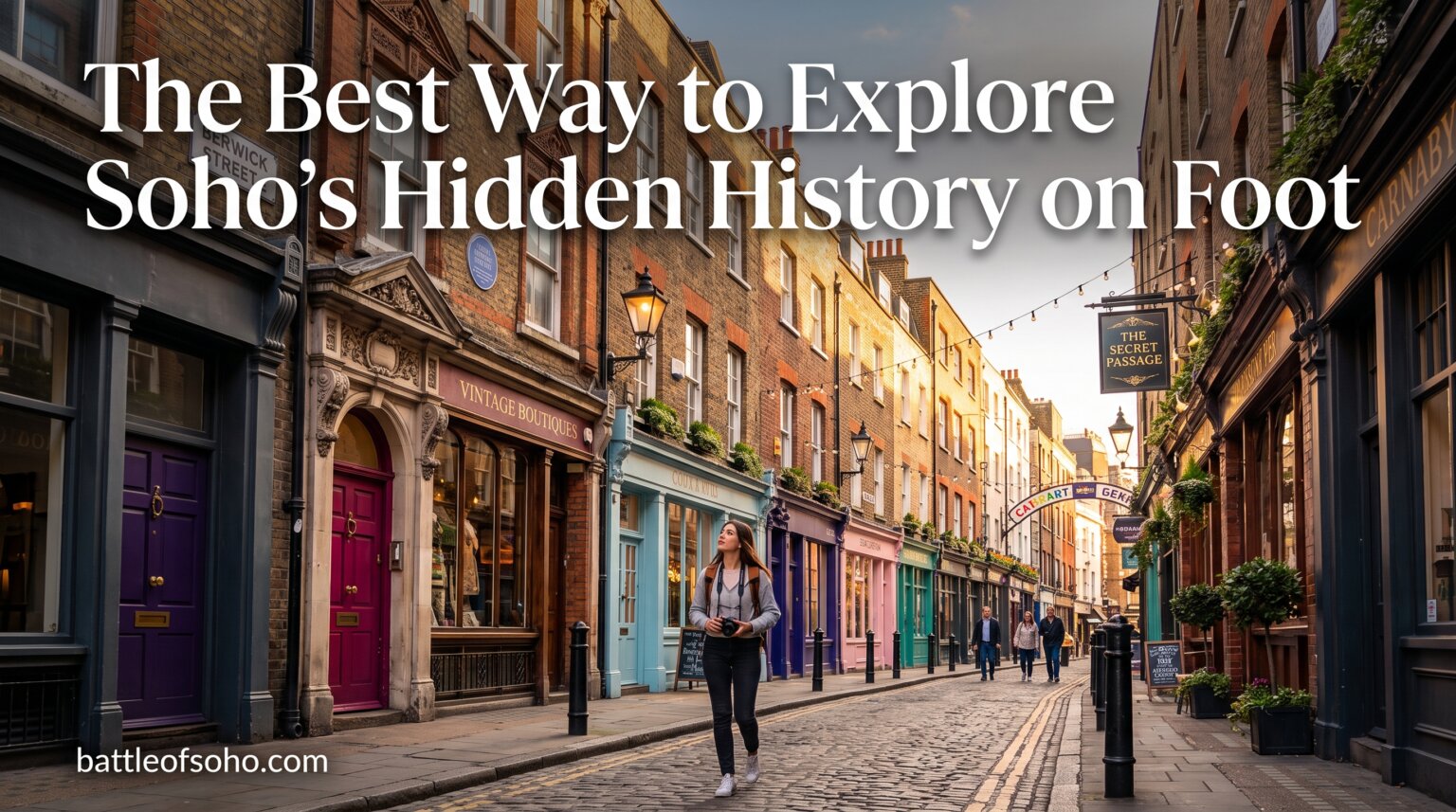
The best way to explore Soho’s hidden history on foot is a self-guided walking route through the side streets of Manhattan’s SoHo district, starting at the corner of Broadway and Houston Street and winding north through Greene Street, Wooster Street, and Spring Street. Along the way, you will pass 19th-century cast-iron buildings, secret art installations buried inside ordinary storefronts, cobblestone corners that most tourists walk right past, and the remnants of an artist colony that changed American art forever.
I have walked these blocks dozens of times over the years, and the neighborhood still surprises me. Every trip reveals something I missed before. A doorway I walked past a hundred times turns out to be a hidden gallery. A building I thought was just another loft has a cast-iron facade dating back to the 1860s. That is what makes SoHo different from every other Manhattan neighborhood. The history is not in a museum behind glass. It is in the streets, on the walls, and above your head in the fire escapes and iron columns that line every block.
SoHo stands for “South of Houston Street,” and the neighborhood runs roughly from Houston Street on the south to Canal Street on the north, between Lafayette Street and the Hudson River. What started as a genteel residential area in the early 1800s became a manufacturing and textile district after the Civil War, then fell into decline, then was reborn in the 1960s as an illegal artist colony when painters and sculptors moved into abandoned industrial lofts. Today it is one of the most expensive shopping districts in the world. But the layers are still there if you know where to look.
This guide is built for people who want more than the Broadway shopping experience. If you are the kind of traveler who prefers to look up at architecture rather than into shop windows, who likes to wander side streets, and who cares about the stories behind the buildings, this is your walking route. I will walk you through eight hidden landmarks, connect them with turn-by-turn walking directions, and share the practical tips I have learned from years of exploring this neighborhood on foot.
You can complete the full route in about two and a half hours at an unhurried pace, or stretch it into a half-day with stops for coffee, gallery visits, and photography. Every landmark on this route is free to view from the street except where noted. Let me show you what most people miss.
Table of Contents
Why Walking Is the Best Way to Explore Soho’s Hidden History on Foot
SoHo was built for walking. The blocks are short, the streets are narrow, and the scale of the architecture only makes sense from the sidewalk. When you walk, you can stop, look up, and notice the details that make this neighborhood unlike any other in New York City. From a car or a bus, SoHo looks like a shopping district. On foot, it reveals itself as an architectural museum.
The key insight is simple: the real SoHo is above eye level. Ground floors are now boutiques, restaurants, and chain stores, but the upper stories remain largely unchanged from the 1860s and 1870s. The cast-iron facades, the oversized windows, and the ornate cornices were designed for manufacturers who wanted their buildings to look like Italian palazzos. You only see them if you stop and look up.
Broadway is the main artery, and most visitors never leave it. That is a mistake. The hidden SoHo lives on the side streets. Greene Street, Wooster Street, Mercer Street, and Crosby Street hold the densest concentration of cast-iron architecture in the world. These are also the streets where the 1960s artist colony took root, where illegal loft studios hosted some of the most important art of the 20th century, and where hidden courtyards and passageways still connect buildings behind the main streets.
Walking also lets you control your pace. You can spend twenty minutes staring at a single building, or you can move quickly through a stretch of blocks. Group tours rush you. Self-guided walking lets you linger where the history grabs you. Reddit users on r/AskNYC consistently recommend walking Greene Street on your own rather than joining a group tour, and I agree. The neighborhood rewards curiosity over speed.
Finally, walking is the only way to find things you were not looking for. Half of the discoveries I describe in this guide came from wandering rather than following a checklist. So give yourself permission to detour, to peek down an alley, to push open a door and see what is inside. That is how the best SoHo exploration happens.
8 Hidden Landmarks That Reveal SoHo’s Secret History
Each of these eight landmarks tells a piece of SoHo’s story. I have arranged them in walking order so you can visit them sequentially, but each one stands on its own as a destination. Together, they trace the arc of this neighborhood from industrial powerhouse to artist haven to the cultural landmark it is today.
1. The Haughwout Building (488 Broadway)
The Haughwout Building is the crown jewel of SoHo’s cast-iron architecture, and it is the perfect place to start understanding what makes this neighborhood special. Built in 1857 for the E.V. Haughwout porcelain and glass company, this five-story building at the corner of Broadway and Broome Street features a stunning cast-iron facade that was manufactured in Daniel Badger’s Architectural Iron Works. The design, attributed to architect John P. Gaynor, was inspired by the Sansovino Library in Venice.
What makes the Haughwout extraordinary is its facade. The entire street-facing wall consists of prefabricated cast-iron panels bolted together on site, giving the appearance of carved stone at a fraction of the cost. The repeating arcades of windows with their Corinthian columns create a rhythm that draws your eye across the entire facade. Stand on the opposite sidewalk and count the arches. There are fifteen bays across the Broadway front, each one identical, each one cast from the same molds.
Here is the detail that most people miss. The Haughwout Building was home to the world’s first successful passenger elevator. Elisha Otis installed a steam-powered safety elevator here in 1857, four years before his famous demonstration at the P.T. Barnum hotel. This single installation proved that elevators were safe and practical, and it literally made skyscrapers possible. Without this building, the Manhattan skyline as we know it might not exist.
Did You Know? The Haughwout Building survived the urban renewal plans of the 1960s that would have demolished most of SoHo. The fight to save it and its neighbors was led by community activists and preservationists who organized what some called the “Battle of SoHo.” Their victory led to the creation of the SoHo-Cast Iron Historic District in 1973.
2. The New York Earth Room (141 Wooster Street)
Walk one block west from the Haughwout Building and you will find one of the most unexpected hidden gems in all of Manhattan. The New York Earth Room is an art installation consisting of 280,000 pounds of earth, twenty-two inches deep, spread across the entire floor of a second-story loft at 141 Wooster Street. It has been there since 1977.
The installation was created by Walter De Maria, a artist associated with the Minimalist and Land Art movements. There were originally three Earth Rooms (one in Germany, two in New York), but only the Wooster Street room and the one in Kassel, Germany survive. The Dia Art Foundation maintains it, and it is open to the public free of charge Wednesday through Sunday.
When you walk in, the first thing you notice is the smell. The earth is damp, rich, and organic. It smells like a forest floor in the middle of a concrete city. The room is silent except for the ambient noise of SoHo filtering through the windows. Visitors are not allowed to walk on the dirt, but you can stand at the threshold and take it in. The contrast between this primal material and the expensive gallery district surrounding it is the whole point.
I have brought friends here who are not art people, and every single one of them has been moved by it. There is something deeply affecting about standing in a room full of soil in the middle of Manhattan. It is quiet, strange, and completely unlike anything else you will experience on this walking route.
Did You Know? The Earth Room requires constant maintenance. A caretaker waters the dirt regularly to maintain the proper moisture level, and the installation has a faint aroma of healthy soil that has been described as one of the most unusual smells in New York City.
3. Judd Foundation at 101 Spring Street
Three blocks south on Wooster Street sits 101 Spring Street, the former home and studio of artist Donald Judd. Judd bought this five-story cast-iron building in 1968 for under $70,000, and it became one of the first examples of an artist living and working in a SoHo loft. At the time, the neighborhood was zoned for manufacturing, and living there was technically illegal.
Judd was one of the most important artists of the 20th century, known for his Minimalist sculptures and his writings on art and design. He restored 101 Spring Street carefully, installing his own work and pieces by contemporaries like Dan Flavin, John Chamberlain, and Claes Oldenburg on each floor. The building is now a museum run by the Judd Foundation, and it offers guided tours by appointment.
Even if you do not go inside, the building itself is worth studying. It was built in 1870 as a textile factory, and its cast-iron facade is one of the finest in SoHo. The large, open windows were designed to let natural light into the manufacturing floors, which is exactly what made these buildings so attractive to artists a century later. Judd understood this. He once wrote that the quality of the light in SoHo lofts was essential to the art made there.
The story of Judd and 101 Spring Street is also the story of how SoHo became an artist colony. In the 1960s and 1970s, hundreds of artists moved into these industrial spaces illegally. The city tried to evict them, and the artists fought back. Judd was one of the leaders of this resistance, helping to found the SoHo Artists Association and advocating for the loft living laws that eventually legalized artist residences in manufacturing buildings.
Did You Know? Donald Judd never installed a proper kitchen in 101 Spring Street. He believed that the building should be purely for art and living in the most minimal sense. His approach to the space influenced a generation of artists who saw their environments as extensions of their work.
4. The Broken Kilometer (375 West Broadway)
Walk two blocks north and west and you will reach another Walter De Maria installation hidden behind an unmarked door. The Broken Kilometer, located at 375 West Broadway, consists of 500 solid brass rods, each two meters long, arranged in parallel rows across the floor of a converted auto repair shop. The rods are spaced so that the distance between them increases by five millimeters with each row, creating an optical illusion of infinite depth.
The work was installed in 1979, and like the Earth Room, it is maintained by the Dia Art Foundation and open to the public free of charge. The title refers to the fact that if you laid all 500 rods end to end, they would stretch one kilometer. Instead, they are broken into rows and arranged in a single room, creating a meditative, almost overwhelming spatial experience.
What strikes me every time I visit is the silence. The room absorbs sound, and when the door closes behind you, the noise of Broadway disappears entirely. You are standing in a room full of gleaming brass rods in a space that was once a garage, in a building that was once a factory, in a neighborhood that was once an industrial zone. Every layer of SoHo’s history is compressed into this one room.
Visitors often skip The Broken Kilometer because there is no sign on the street and the entrance looks like a service door. But that is part of the experience. You are stepping off one of the busiest streets in Manhattan into a space that exists almost entirely outside of time. It is one of the most powerful hidden art experiences in New York City.
Did You Know? The Broken Kilometer is the companion piece to De Maria’s Vertical Earth Kilometer in Kassel, Germany, which consists of a solid brass rod one kilometer long sunk into the ground. While the German piece is invisible, the SoHo piece makes the same kilometer visible by breaking it apart.
5. Greene Street: The Cast-Iron Gallery Row
Of all the streets in SoHo, Greene Street is the one that tells the neighborhood’s story most completely. This single block, running between Canal and Houston, contains approximately fifty cast-iron buildings. It is the densest concentration of cast-iron architecture anywhere in the world. Walking its length is like flipping through a catalog of 19th-century architectural styles.
Cast-iron architecture was a mid-19th-century innovation that allowed builders to create ornate facades cheaply and quickly. Iron foundries would cast decorative elements like columns, cornices, and window frames from molten iron using reusable molds, then ship them to construction sites where they were bolted onto conventional brick or timber frames. The result looked like carved stone but cost a fraction as much and could be erected in weeks instead of months.
Start at the southern end of Greene Street and walk north. Pay attention to the building numbers. At 72-76 Greene Street, you will see the “King of Greene Street” building, also known as the Gunther Building, built in 1871 with a sweeping curved corner and one of the most elaborate cast-iron facades in the district. At 28-30 Greene Street, the Queen Anne style hits you with a different aesthetic entirely. At 8 Greene Street, the ornate cornices and Corinthian columns create a palazzo effect that was meant to signal wealth and prestige.
Reddit users on r/nycHistory consistently recommend Greene Street as the single best block in Manhattan for architectural walking. The key is to go slowly. Walk on one side of the street going north, cross over, and walk back on the other side. You will notice completely different buildings each way. The details are in the ironwork: the way leaves curl around column capitals, the way window lintels curve, the way cornices project above the roofline.
These buildings were textile factories and warehouses for most of their existence. In the 1960s, artists began moving in, attracted by the large open floors, the cheap rent, and the enormous windows that let in perfect north light. The artists who lived and worked on Greene Street in this era included some of the most important names in American art. Their presence is what saved these buildings from demolition.
Did You Know? Cast-iron facades can be restored by removing rust and repainting, but the process is extremely expensive. Many of SoHo’s cast-iron buildings were saved because the artist residents maintained them informally for decades before formal historic preservation funding became available.
6. Vesuvio Playground (Spring Street and Thompson Street)
Tucked into the southwest corner of SoHo at the intersection of Spring Street and Thompson Street, Vesuvio Playground is a small park that most tourists never find. It is named after the Vesuvio Bakery, a legendary Italian bakery that operated on Prince Street from 1920 until the early 2000s. The bakery’s original storefront, with its hand-painted tiles and faded awning, is still visible a block away and is one of the most photographed corners in SoHo.
The playground itself is a community gathering space with a basketball court, a playground, and benches where locals sit and eat lunch. But the real reason to visit is the mural. The park features a large outdoor mural by Tony Venta that depicts scenes from Italian-American life in SoHo, back when this was a working-class Italian neighborhood before the galleries and boutiques moved in. The mural is a window into a SoHo that has almost completely vanished.
In the mid-20th century, SoHo was known as “Hell’s Hundred Acres” and was largely an industrial zone with a small Italian-American community concentrated around Spring and Thompson Streets. The neighborhood had more than 700 manufacturing businesses, and the streets smelled of roasting coffee from the D’Agostino coffee roastery on Greenwich Street. Vesuvio Playground is one of the few places where you can still feel that earlier SoHo.
Walk around the block after visiting the playground. You will find the old Vesuvio Bakery storefront at 160 Prince Street. The tiles, the signage, and the awning are original. It is now a clothing store, but the exterior has been preserved as a landmark of the old neighborhood. Stand there for a minute and imagine this block a hundred years ago, when the smell of fresh bread filled the street.
Did You Know? The Vesuvio Bakery was famous for its lard bread, a traditional Italian loaf studded with salami and cheese. It was a neighborhood staple for over eighty years, and some older residents of Little Italy still talk about lining up for it on Sunday mornings.
7. Housing Works Bookstore (126 Crosby Street)
One block east of Broadway on Crosby Street, the Housing Works Bookstore sits inside a stunning 1920s former cocoa warehouse. The space retains its original cast-iron columns, brick walls, and soaring ceilings, and it has been converted into a two-level bookstore and cafe that feels like something out of a novel. Spiral staircases connect the main floor to a wraparound balcony of bookshelves, and events ranging from author readings to comedy shows happen regularly.
Housing Works is a nonprofit organization that provides services for people living with HIV and AIDS, and the bookstore is staffed largely by volunteers. Every purchase supports their mission, and the bookstore has become one of the most beloved independent bookstores in New York City. It is a great place to take a break during your walk, browse the shelves, and sit with a coffee.
The building itself is part of SoHo’s story. Like the cast-iron buildings on Greene Street, this warehouse was built for manufacturing and storage. The cocoa company that occupied it shipped chocolate and coffee beans through the port of New York, which was then centered on the piers along the Hudson River. When the manufacturing industry left SoHo in the mid-20th century, buildings like this sat empty until artists, nonprofits, and eventually retailers moved in.
The Crosby Street corridor is one of the quieter stretches of SoHo, and it rewards exploration. Between Spring and Houston Streets, Crosby passes through a canyon of old warehouses that have been converted into offices, galleries, and apartments. The street is narrower than Broadway, the foot traffic is lighter, and the architecture is easier to appreciate without crowds of shoppers blocking your view.
Did You Know? Housing Works Bookstore has been featured in numerous films and television shows, and its interior is considered one of the most beautiful bookstore spaces in America. The building was nearly demolished in the 1990s before being saved and converted into its current use.
8. The Hidden Courtyards and Passageways of SoHo
SoHo has its own version of the hidden mews and courtyards that make London’s Soho famous. They are harder to find, and most of them are not marked on any tourist map, but they exist if you know where to look. These passages between and behind buildings are remnants of the neighborhood’s industrial past, when goods were moved through alleyways and courtyards between factories and warehouses.
The most accessible hidden passage in SoHo is the alley behind 190 Mercer Street, where a narrow corridor cuts between two rows of cast-iron buildings and opens into a small courtyard. This passage was originally used by delivery wagons, and you can still see the iron hooks in the walls where chains were secured. Today, it is a quiet, almost private space that feels miles away from the shopping crowds on Broadway.
Another passage worth finding is the walkway between 29 and 35 Wooster Street. This gap between buildings was once a service entrance for a textile manufacturer, and it now serves as a shortcut that locals use to avoid the congestion of the main streets. The brick walls on either side are original to the 1870s, and the cobblestones underfoot are the same ones that were laid when the buildings were constructed.
My favorite hidden corner is the tiny courtyard at the end of Jersey Street, a one-block lane that runs between Mulberry Street and Lafayette Street just south of Houston. This is technically on the border of SoHo and NoLita, but it captures the feeling of old downtown Manhattan better than any other spot on this route. There is no sign, no plaque, and no crowds. Just a narrow street with old buildings on either side and a sense that you have stumbled onto something private.
Part of the joy of exploring SoHo on foot is finding these spaces yourself. I have given you a few starting points, but the best discoveries are the ones you make when you turn down a street just to see where it goes. The neighborhood is full of gaps, alleys, and courtyards that do not appear on any map. They are the reward for walking slowly and paying attention.
Did You Know? Many of SoHo’s hidden passageways were nearly sealed off during the redevelopment boom of the 1980s and 1990s. Community activists fought to preserve them as public rights of way, arguing that they were part of the neighborhood’s historic fabric. Their efforts saved several passages that would otherwise have been absorbed into private developments.
Self-Guided Walking Route: Turn-by-Turn Directions
Now that you know what to look for, here is the complete walking route that connects all eight landmarks. The route covers approximately 1.5 miles and takes about two and a half hours at a leisurely pace with stops. You can start at either end, but I recommend beginning at Houston Street and walking north so the architecture builds in grandeur as you go.
Getting there: Take the N, Q, R, or W train to the Prince Street station, or the 6 train to Spring Street. If you are coming from elsewhere in Manhattan, the A, C, E to Canal Street also works and lets you start from the north end of the route. I recommend starting around 9:00 AM on a weekday morning, when the streets are quiet and the light is perfect for photography.
Stop 1: Houston Street and Broadway (Starting Point)
Begin at the northwest corner of Houston Street and Broadway. This intersection marks the southern boundary of SoHo. Look north up Broadway and you will see the canyon of cast-iron buildings stretching toward Canal Street. This is your first view of the Cast Iron District.
Stop 2: The Haughwout Building
Walk north on Broadway for two blocks to the corner of Broadway and Broome Street. The Haughwout Building is on your right at 488 Broadway. Stand across the street and look up at the facade. Spend five minutes studying the cast-iron columns and arched windows before moving on.
Stop 3: The New York Earth Room
From the Haughwout Building, turn left (west) onto Broome Street and walk one block to Wooster Street. Turn right (north) onto Wooster Street and walk one block to Spring Street. The Earth Room entrance is at 141 Wooster Street, on the second floor. Look for the small Dia Art Foundation sign next to the door. Admission is free, and the room is open Wednesday through Sunday, noon to 3:00 PM (closed in August and on holidays).
Stop 4: Judd Foundation at 101 Spring Street
Exit the Earth Room and walk one block south on Wooster Street to Spring Street. Cross Spring Street and continue south on Wooster Street one more block to 101 Spring Street. The Judd Foundation is on the east side of the street. Tours require advance booking, so if you have not reserved, admire the facade and the cast-iron details from the sidewalk.
Stop 5: Greene Street Cast-Iron Row
From the Judd Foundation, walk west on Spring Street one block to Greene Street. Turn right (north) onto Greene Street. This is the heart of the Cast Iron District. Walk slowly north along Greene Street all the way to Canal Street, then cross to the other side of the street and walk back south. This round trip covers the most architecturally significant block in SoHo and takes about twenty minutes if you are studying the buildings carefully.
Stop 6: The Broken Kilometer
From the corner of Greene and Spring Streets, walk west on Spring Street one block to West Broadway. Turn left (south) onto West Broadway and walk two blocks to Broome Street. The Broken Kilometer is at 375 West Broadway, on the east side of the street. Look for the unmarked door between buildings. Admission is free, and it is open Wednesday through Sunday, noon to 6:00 PM.
Stop 7: Vesuvio Playground
From the Broken Kilometer, walk south on West Broadway one block to Grand Street. Turn right (west) onto Grand Street and walk two blocks to Thompson Street. Turn left (south) onto Thompson Street and walk one block to Spring Street. Vesuvio Playground is on the northwest corner of Spring and Thompson Streets. After exploring the playground, walk one block north on Thompson Street to Prince Street, then turn right to see the original Vesuvio Bakery storefront at 160 Prince Street.
Stop 8: Housing Works Bookstore and the Crosby Street Corridor
From the Vesuvio Bakery, walk east on Prince Street two blocks to Crosby Street. Turn right (south) onto Crosby Street. Housing Works Bookstore is at 126 Crosby Street, between Prince and Spring Streets. Go inside, browse the shelves, and take a break with a coffee. After your break, continue south on Crosby Street to explore the warehouse corridor, then loop back to Broadway via Spring Street or Grand Street to finish your walk.
Optional extension: If you have energy and time, continue south past Canal Street into Tribeca, or head east on Spring Street into NoLita and Little Italy. Both neighborhoods offer their own layers of history and are natural extensions of a SoHo walking tour.
Practical Tips for Your SoHo Walking Tour
A few practical considerations will make your walk much more enjoyable. These are the things I have learned from doing this route in every season and at every time of day.
Best Time to Walk
Weekday mornings are the best time to walk SoHo. I recommend starting between 8:00 and 9:00 AM on a Tuesday, Wednesday, or Thursday. The streets are quiet, the shops are not yet open, and the light raking across the cast-iron facades is ideal for photography. Saturday and Sunday afternoons are the worst times. Broadway turns into a wall of shoppers, and you will spend more time dodging people than looking at buildings.
If you can only go on a weekend, start early. By 10:00 AM on a Saturday, the foot traffic on Broadway and Spring Street becomes heavy. The side streets stay relatively calm, so plan to spend more time on Greene, Wooster, and Crosby Streets during peak hours.
What to Bring
Wear comfortable walking shoes with good cushioning. The cobblestone sections of SoHo can be hard on your feet, and you will be walking on a mix of concrete, Belgian block, and uneven sidewalks. Bring a water bottle, especially in summer when Manhattan can be brutally hot and humid. A small camera or phone with a good camera is worth carrying because the photo opportunities are constant.
I also recommend bringing a notebook or using your phone to jot down building numbers and street names that catch your eye. You will see things on this walk that you will want to look up later, and trust me, by the time you get home you will not remember whether that incredible cornice was on Greene Street or Wooster Street.
Photography Tips
For the best architectural photos, shoot in the morning when the light comes from the east and rakes across the facades. The cast-iron details pop when they have strong directional light creating shadows in the relief. Late afternoon also works, when the western light warms the brick and iron.
The best single street for photography is Greene Street between Broome and Spring Streets. Stand in the middle of the block and shoot straight up at the building facades on either side. The repeating columns and arched windows create a geometric pattern that is uniquely SoHo. Also look for reflections in the large loft windows, which often capture fragments of neighboring buildings and sky.
For street-level photography, the cobblestone stretch of Mercer Street between Broome and Spring Streets offers the best ground texture. The Belgian blocks are original to the 19th century, and they photograph beautifully when wet after a rain.
Safety and Neighborhood Context
SoHo is one of the safest neighborhoods in Manhattan. The streets are well-lit, well-trafficked, and heavily patrolled. The main concern is pickpocketing in the crowded shopping areas along Broadway, so keep your valuables secure and be aware of your surroundings in dense crowds.
At night, SoHo is generally safe but quieter on the side streets. Stick to Broadway, Spring Street, and Grand Street after dark, where restaurants and bars keep the foot traffic steady. The side streets can feel isolated in the evening, particularly on the blocks between West Broadway and Sixth Avenue.
The question of whether SoHo is “sketchy” comes up a lot. The answer depends on what era you are asking about. In the 1970s and 1980s, SoHo was a gritty, largely abandoned industrial zone where artists squatted in illegal lofts. Today, it is one of the most expensive real estate markets in the world. The “sketchy” reputation is historical, not current, but it is worth knowing because that gritty period is exactly what saved the architecture and created the artist colony that defined the neighborhood.
The Battle for SoHo: How Community Activism Saved This Neighborhood
The name of this site, Battle of Soho, comes from a very real history of conflict over this neighborhood’s future. In the 1960s, city planner Robert Moses proposed building a ten-lane elevated highway straight through SoHo and nearby Little Italy. The Lower Manhattan Expressway would have demolished hundreds of cast-iron buildings and displaced thousands of residents. It would have destroyed the neighborhood entirely.
A coalition of artists, residents, and preservationists fought back. The artist community organized under groups like the SoHo Artists Association and the Artist-Tenants Association. They filed lawsuits, lobbied politicians, and brought reporters to see the buildings that would be destroyed. Jane Jacobs, the legendary urbanist who lived nearby in Greenwich Village, was a vocal opponent. The fight lasted nearly a decade.
They won. The expressway was killed in 1969, and the SoHo-Cast Iron Historic District was designated in 1973. This is the reason those buildings still stand. This is the reason you can walk Greene Street and see the most extraordinary collection of cast-iron architecture in the world. It is because ordinary people refused to let a highway destroy their neighborhood.
That spirit of community activism continued through the decades. When gentrification threatened to push out the artists in the 1980s and 1990s, residents organized again. When developers tried to demolish historic buildings for luxury condos, preservationists fought to save them. The “battle” of SoHo is ongoing. Every era brings new pressures, and every era produces people willing to fight for what makes this neighborhood special.
Understanding this history changes how you see the buildings. When you walk past the Haughwout Building or stand inside the Earth Room, you are standing in spaces that exist because people fought for them. The cast-iron facades, the artist lofts, the hidden courtyards. They are all here because someone refused to let them disappear.
Extending Your Walk: Nearby Neighborhoods
One of the great things about SoHo is how connected it is to other historic downtown neighborhoods. If you finish the main walking route and want more, here are three natural extensions.
NoHo (North of Houston): Cross Houston Street to the north and you enter NoHo, a smaller but equally historic neighborhood. The blocks around Bond Street and the Bowery contain some of the best-preserved 19th-century row houses in Manhattan. NoHo is also home to the Public Theater, one of the most important theatrical venues in American history.
Greenwich Village: Walk west and south from SoHo and you enter Greenwich Village, the historic heart of bohemian New York. The streets here are narrower and more winding than the SoHo grid, and the neighborhood is full of jazz clubs, cafes, and historic sites connected to the civil rights and gay rights movements. The Stonewall Inn, site of the 1969 uprising that launched the modern LGBTQ+ rights movement, is about a fifteen-minute walk from the southern end of SoHo.
Chinatown and Little Italy: Walk south from SoHo across Canal Street and you enter Chinatown, one of the oldest and most vibrant Chinese communities in the United States. Just to the east is Little Italy, centered on Mulberry Street. While Little Italy has shrunk significantly over the decades, it retains historic character and several landmark restaurants and cafes.
FAQs
What are some hidden gems in SoHo NYC?
Some of the best hidden gems in SoHo include the New York Earth Room (280,000 pounds of dirt in a Wooster Street loft), the Broken Kilometer (500 brass rods in a former auto shop on West Broadway), the Judd Foundation at 101 Spring Street, the cast-iron facades of Greene Street, and the hidden courtyards and passageways between buildings on Mercer and Wooster Streets. The Vesuvio Bakery storefront on Prince Street is also a favorite.
Is SoHo still seedy?
No. SoHo today is one of the most upscale neighborhoods in Manhattan, packed with luxury boutiques, high-end restaurants, and expensive real estate. The area was gritty and industrial in the 1970s and 1980s when artists first moved into illegal loft spaces, but decades of gentrification have transformed it completely. The ‘seedy’ reputation is historical, not current.
What is the prettiest street in SoHo NYC?
Greene Street between Broome and Spring Streets is widely considered the prettiest street in SoHo. It contains the densest concentration of cast-iron architecture in the world, with approximately fifty buildings featuring ornate iron facades from the 1860s and 1870s. The repeating columns, arched windows, and cobblestone edges make it feel like an open-air architectural museum.
Is SoHo sketchy at night?
SoHo is generally safe at night. The main shopping streets like Broadway and Spring Street are well-lit and well-trafficked thanks to restaurants and bars. The side streets can be quieter after dark, so stick to the busier thoroughfares if you are walking alone at night. As with any urban neighborhood, stay aware of your surroundings and keep valuables secure in crowded areas.
How long does it take to walk around SoHo?
A thorough walking tour of SoHo takes about two to three hours at a leisurely pace. The neighborhood is compact, roughly twenty-six blocks from Houston to Canal Street, but the density of architecture and hidden landmarks means you will want to stop frequently. If you add gallery visits, coffee breaks, and shopping, plan for a half-day.
Why is SoHo called SoHo?
SoHo stands for ‘South of Houston Street.’ The name follows the pattern of other Manhattan neighborhood acronyms like NoHo (North of Houston) and TriBeCa (Triangle Below Canal Street). The name emerged in the 1960s when city planners and residents needed a way to refer to the area that was becoming an artist colony. It was coined by analogy with London’s Soho, though the two neighborhoods are unrelated.
Are there free walking tours in SoHo?
There are free walking tours of SoHo offered by companies that operate on a tip-based model, though quality varies significantly. A more reliable option for many visitors is a self-guided walking route like the one in this guide, which lets you explore at your own pace and costs nothing. Most of SoHo’s hidden landmarks, including the Earth Room, the Broken Kilometer, and the cast-iron buildings, are free to visit.
What is SoHo famous for?
SoHo is famous for three things: its cast-iron architecture (the largest collection in the world), its history as an artist colony in the 1960s and 1970s, and its current status as a luxury shopping and gallery district. The neighborhood contains the SoHo-Cast Iron Historic District, dozens of contemporary art galleries, flagship stores for major fashion brands, and hidden art installations like the Earth Room and the Broken Kilometer.
Wrapping Up Your SoHo History Walk
The best way to explore Soho’s hidden history on foot is to slow down, look up, and follow the side streets rather than the main arteries. SoHo is a neighborhood that hides its treasures in plain sight. The cast-iron facades are visible to anyone who bothers to tilt their head back. The Earth Room is open to anyone who knows which unmarked door to push. The courtyards and passageways are there for anyone willing to wander.
What makes SoHo special is not any single building or landmark. It is the layers. A textile factory becomes an artist loft becomes a luxury boutique, but the iron columns and arched windows remain. A neighborhood fights off a highway, fights off demolition, fights off forgetting, and emerges as one of the most architecturally significant districts in the world. Every block has a story, and the best way to hear those stories is to walk.
So lace up your shoes, grab a coffee, and hit the streets. Start at Houston and Broadway, wind your way through Greene Street and Wooster Street, push open the doors of the Earth Room and the Broken Kilometer, and let the neighborhood tell you its secrets. That is how you see the real SoHo. Not from a tour bus, not through a shop window, but one block at a time, on foot, looking up.