
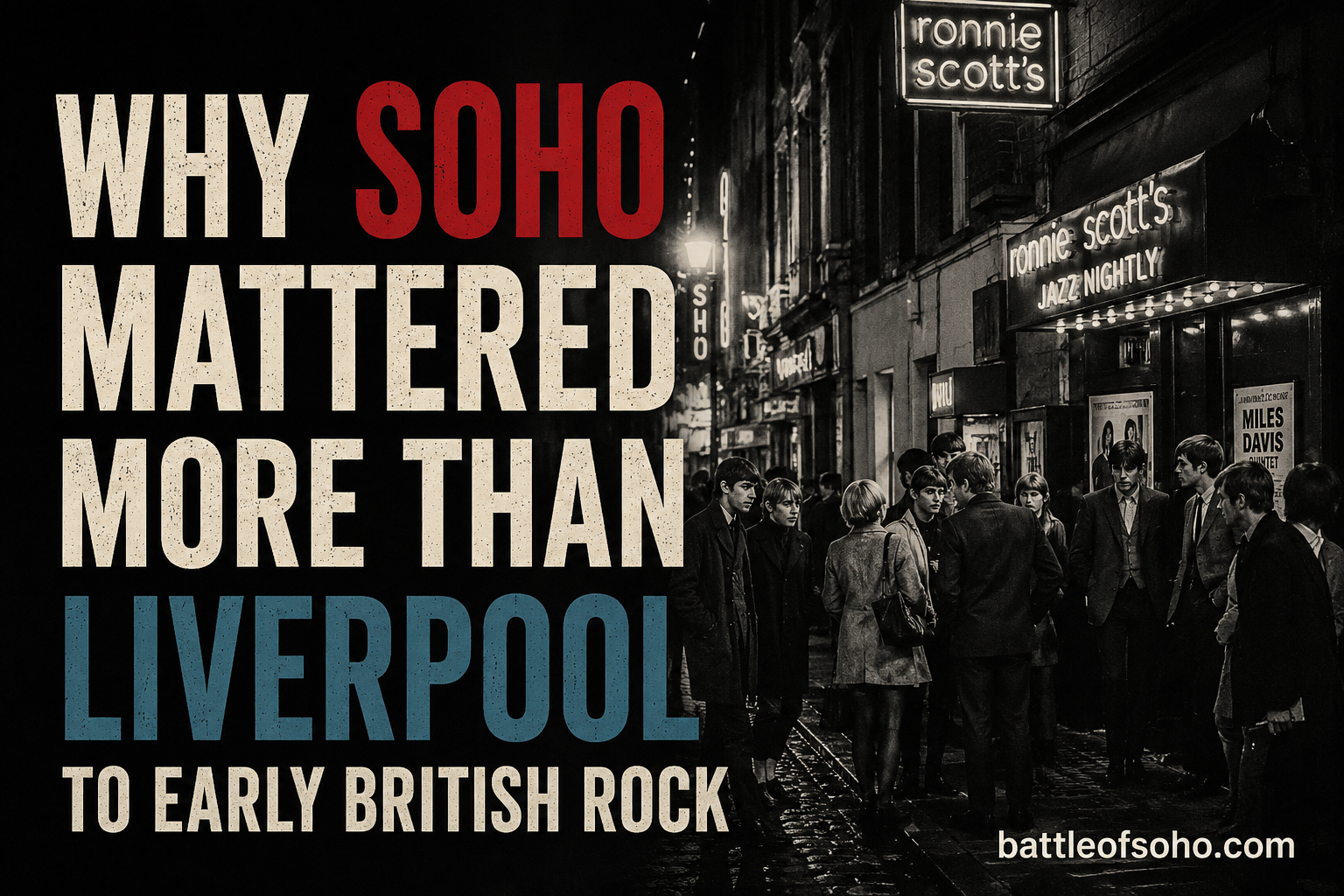
Ask anyone where British rock was born, and you will get one answer: Liverpool. The Beatles, the Cavern Club, Merseybeat, the ferry across the Mersey. It is the story every documentary tells, every textbook repeats, and every tour guide in Liverpool rightfully celebrates. But here is the problem with that narrative. It is only half true.
Our team spent months digging into the archives, venue records, studio logs, and industry directories from the late 1950s and early 1960s. What we found reshaped how we think about early British rock. Liverpool produced extraordinary talent. Soho built the industry that turned that talent into global domination. Without Soho, the British Invasion might never have crossed the Atlantic.
This article explains why Soho mattered more than Liverpool to early British rock. We are not dismissing Liverpool’s contribution. We are correcting a historical blind spot that undervalues the London district that provided the venues, studios, publishers, managers, and media infrastructure necessary to launch British rock onto the world stage.
Table of Contents
Post-War London and the Birth of Soho’s Music Scene
Soho’s music roots stretch back further than most people realize. The story starts not with rock and roll, but with jazz. In 1948, Club Eleven opened its doors on Great Marlborough Street, becoming what historians widely regard as the first venue in the UK where modern jazz, specifically bebop, was performed regularly.
This matters more than it might seem. Club Eleven created a template. It proved that a dedicated music venue could thrive in Soho’s dense, cosmopolitan streets. It attracted musicians, audiences, and entrepreneurs to the area. And it established Soho as London’s natural home for live music that pushed boundaries.
Post-war Britain was a grim place. Rationing persisted into the early 1950s. Cities still bore bomb damage. Young people craved excitement and escape. Soho, with its existing density of clubs, bars, restaurants, and a reputation for nightlife that stretched back centuries, offered exactly that. It was the one square mile of London where things stayed open late, where different cultures mixed, and where entertainment was the primary industry.
By the mid-1950s, skiffle and then rock and roll began filtering into Britain from the United States. Soho’s coffee bars, which had sprouted across the district to serve its bohemian clientele, became unexpected incubators for this new music. These small, cheap-to-enter spaces allowed teenagers to hear records, form bands, and perform live without the overhead of a traditional nightclub.
The transition was organic. Jazz fans became skiffle enthusiasts. Skiffle musicians discovered rhythm and blues. R&B bands evolved into rock acts. Soho’s existing entertainment infrastructure absorbed each new genre seamlessly because the venues, the audiences, and the industry professionals were already there. Liverpool had the musicians. Soho had the machine.
Soho’s Music Infrastructure: The Industry Ecosystem
Here is where the comparison between Soho and Liverpool becomes stark. Talent alone has never been enough to build a music industry. You need venues to perform in, studios to record in, publishers to handle songwriting royalties, managers to book tours, agents to negotiate deals, and media to cover it all. Soho had all of these within walking distance of each other.
Liverpool had the Cavern Club, the Jacaranda, and a handful of other venues. It had passionate fans and talented musicians. What it did not have was a complete industry ecosystem. Bands from Liverpool who wanted record deals, professional management, publishing contracts, or national press coverage had to come to London. And when they came to London, they came to Soho.
Denmark Street: Britain’s Tin Pan Alley
Denmark Street sits at the southern edge of Soho. In the 1950s and 1960s, it was Britain’s Tin Pan Alley, a single street lined with music publishers, songwriting offices, and rehearsal spaces. If you wanted a publishing deal in Britain, this is where you went. The Rolling Stones rehearsed in a basement on Denmark Street. Elton John worked as an office boy at a music publisher there, writing songs in the back room for other artists.
Music publishing is the invisible backbone of the record industry. Publishers connect songwriters with performers, collect royalties, and provide advances that allow artists to survive while they create. Without publishers, songs do not get placed. Without song placement, bands do not get discovered. Denmark Street concentrated this entire function in one walkable corridor, and it sat right next to Soho’s venues and studios.
Liverpool had nothing comparable. There were no major music publishers based in Liverpool in the early 1960s. No royalty collection infrastructure. No songwriting offices. A Liverpool band writing original material had to travel to London to get published, or rely on a London-based publisher to find them.
The Music Press: NME and Melody Maker
The New Musical Express (NME), founded in 1952, and Melody Maker, founded in 1926, were the two most important music publications in Britain. Both were London-based. Their journalists lived in and around Soho. Their offices were a short walk from the venues where bands performed. When a new act generated buzz at the 2i’s Coffee Bar or the Marquee Club, a music journalist could walk over that same evening and write a review for the next issue.
This proximity mattered enormously. National exposure came through these publications. A band that impressed a Soho audience on a Tuesday could be featured in the NME by the weekend. A band that impressed a Liverpool audience had to wait for a London journalist to notice, or hope that word of mouth eventually reached the capital. The geography of media gave Soho-based bands a massive advantage in building national profiles.
The music press also ran the charts. The NME chart, compiled from record shop sales reports, was the definitive British singles chart in the 1960s. Being visible to NME journalists meant being visible to the people who shaped public perception of what was popular. Soho bands were in the right postcode.
Managers, Agents, and Promoters
The entrepreneurial ecosystem of Soho extended beyond publishers and press. Talent managers, booking agents, concert promoters, and record company A&R representatives all operated from offices in and around Soho. Brian Epstein discovered the Beatles in Liverpool, but he managed them from London. His NEMS Enterprises office was in the capital, connected to the Soho industry network.
Kit Lambert and Chris Stamp discovered The Who at a venue in London and managed them from Soho-adjacent offices. Andrew Loog Oldham managed the Rolling Stones from London. Larry Parnes, the first major British rock and roll impresario, operated from London and discovered artists like Tommy Steele and Marty Wilde by attending Soho venues.
These men did not just find talent. They shaped it. They produced records, negotiated television appearances, arranged international tours, and built the public images that made British rock exportable. Every single one of them was based in London, connected to Soho’s industry web. Liverpool produced the raw material. Soho provided the manufacturing process.
Recording Studios: The Technical Advantage
London’s recording studios sat in or near Soho, giving artists access to professional recording facilities that simply did not exist in Liverpool during the critical early years. Abbey Road Studios in St John’s Wood was a short taxi ride away. But the studio that mattered most to early British rock was in Soho itself.
Trident Studios, located at 17 St Anne’s Court in the heart of Soho, opened in 1968 and quickly became one of the most technically advanced recording facilities in Britain. Trident used eight-track recording equipment when most British studios were still using four-track. This technical advantage allowed artists to create richer, more layered recordings. The Beatles recorded portions of “Hey Jude” and the White Album at Trident specifically because of its superior eight-track capability.
Even before Trident, Soho-adjacent studios like IBC Studios on Portland Place and Olympic Studios were where early British rock records were made. Liverpool had no comparable recording infrastructure in the early 1960s. The first Liverpool-based recording studio of any significance came later, long after the British Invasion was already underway.
The Venues That Launched British Rock
Soho’s venues were not just places to play music. They were discovery points where the industry’s key decision makers came to find the next big act. A gig at the Marquee Club was not just a performance. It was an audition in front of publishers, producers, journalists, and managers who could change a band’s career overnight.
Here is a closer look at the venues that made Soho the launchpad for British rock.
2i’s Coffee Bar: Europe’s First Rock Club
The 2i’s Coffee Bar opened in 1956 at 59 Old Compton Street in the heart of Soho. It is widely recognized as the first rock and roll venue in Europe. The story of the 2i’s is the story of how British rock actually began, not in a Liverpool cellar, but in a small Soho coffee bar where teenagers gathered to listen to imported American records.
The 2i’s had a tiny basement performance space that held perhaps 50 people. Skiffle groups played there first, followed by rock and roll acts. Tommy Steele, widely considered Britain’s first rock and roll star, was discovered at the 2i’s in 1956. Adam Faith followed. Cliff Richard’s first significant London performances were at the 2i’s.
The venue’s importance cannot be overstated. It created the template for the rock club as a space where young musicians could perform for young audiences in an informal, low-cost setting. Every coffee bar and cellar club that followed, including the Cavern in Liverpool, was modeled on what the 2i’s pioneered in Soho.
Paul McCartney played the 2i’s. So did members of what would become The Tornados, The Shadows, and numerous other acts. The venue functioned as an informal audition room for the entire British music industry. If you could get a gig at the 2i’s and impress the crowd, word would reach the right people within days.
The Marquee Club: The Legendary Wardour Street Venue
The Marquee Club opened in 1958 at 165 Oxford Street, before moving to 90 Wardour Street in Soho in 1964. The Wardour Street location became one of the most important rock venues in the world. If the 2i’s was where British rock was born, the Marquee was where it grew up.
The Rolling Stones played their first gig at the Marquee in 1962. The Who performed there regularly, developing their explosive live act in front of Soho audiences. David Bowie, The Yardbirds, Led Zeppelin, and literally hundreds of other acts considered the Marquee their home venue.
The Marquee mattered because of its location. Wardour Street was the spine of Soho’s entertainment district. Music publishers, recording studios, management offices, and the offices of music publications were all within a five-minute walk. A band that played the Marquee was performing in the center of the British music industry. Every important person could be in the audience without traveling more than a few blocks.
No venue in Liverpool had this advantage. The Cavern Club was brilliant, but it was 220 miles from the center of the British music industry. Industry professionals did not casually drop into the Cavern on a weeknight. They did drop into the Marquee.
Trident Studios: Where the Records Got Made
Trident Studios at 17 St Anne’s Court was technically a recording studio, not a live venue. But it deserves a place in this section because it was where the Soho music ecosystem produced its final output: the records themselves. Trident was to recording what the Marquee was to live performance, the center of gravity.
David Bowie recorded “Space Oddity,” “Ziggy Stardust,” and much of his early catalog at Trident. Queen recorded their first album there. The Beatles chose Trident for key sessions. Marc Bolan and T. Rex worked there. Elton John recorded there. The list of artists who made career-defining records at Trident reads like a who’s who of British rock.
Trident’s eight-track recording capability, which we mentioned earlier, was a genuine technical breakthrough. Most British studios in the late 1960s still used four-track machines, which limited how many separate instruments and vocals could be recorded independently. Eight-track allowed producers to layer sounds, experiment with arrangements, and create the rich sonic textures that defined late 1960s rock. This technical advantage came from Soho, not Liverpool.
Ronnie Scott’s, the Flamingo, and the Supporting Cast
Soho’s venue ecosystem extended well beyond the 2i’s and the Marquee. Ronnie Scott’s Jazz Club, which opened in 1959 in a basement on Gerrard Street before moving to Frith Street, brought international jazz artists to Soho and created a cross-pollination between jazz and rock musicians. Many early British rock players cut their teeth at jazz sessions in Soho before forming rock bands.
The Flamingo Club on Wardour Street was another essential venue. It hosted American R&B artists and gave British musicians direct exposure to the music they were trying to emulate. Georgie Fame and the Blue Flames held a legendary residency there, blending jazz, R&B, and rock into a distinctly British sound. The Flamingo was where many Soho musicians first heard authentic American rhythm and blues performed live by American artists.
The Studio 51 on Great Newport Street, the Bag O’ Nails on Kingly Street, and numerous other smaller venues completed the picture. Soho had dozens of performance spaces within a single square mile. A musician could play a different venue every night of the week without leaving the neighborhood. Liverpool simply could not match this density.
The Beatles’ Soho Connection
The Beatles are the elephant in the room whenever anyone discusses Liverpool’s role in British rock. They are Liverpool’s proudest musical export and the primary reason Liverpool gets credit as the birthplace of British rock. But the full story of The Beatles is deeply intertwined with Soho. Some historians have even argued that The Beatles were, in many meaningful ways, a Soho band.
Consider the timeline. The Beatles played the 2i’s Coffee Bar in Soho. They recorded at Trident Studios. Their manager, Brian Epstein, operated from London. Their producer, George Martin, worked at Abbey Road in London. Their publisher, Dick James Music, was based in London. The NME, which built their national profile, was based in London. The Ed Sullivan Show appearance that broke them in America was arranged through London-based industry connections.
Allan Williams, the Liverpool club owner often called the “man who gave the Beatles away,” managed their early bookings and sent them to Hamburg. But the Hamburg connection itself was part of the Soho ecosystem. The agent who arranged the Hamburg gigs, Larry Parnes, was a London-based impresario who operated through the Soho industry network.
When Brian Epstein took over management in 1961, he immediately began working the London music industry. He visited recording companies in London, pitched the band to producers based in the capital, and eventually secured the deal with George Martin at EMI. None of this happened in Liverpool. The industry machinery that transformed The Beatles from a popular Liverpool club band into the biggest act in the world was located in London, and much of it operated through Soho.
This is not to diminish Liverpool’s role. The Beatles developed their chops in Liverpool and Hamburg. Their sound was shaped by the Merseybeat scene. But the reason the world knows about The Beatles is that Soho’s industry infrastructure was there to discover, record, publish, promote, and export them. Without Soho, The Beatles might have been the best band in Liverpool that nobody outside Merseyside ever heard.
Beyond the Beatles: Artists Who Owed Their Start to Soho
If The Beatles are the band everyone associates with Liverpool, the list of bands associated with Soho is far longer and arguably just as impressive. The Rolling Stones, The Who, The Yardbirds, The Kinks, David Bowie, Queen, Marc Bolan, Elton John, and countless others all had direct, formative Soho connections.
The Rolling Stones were discovered at the Marquee Club. Their first gig was there. Their manager, Andrew Loog Oldham, was a London-based publicist who walked into Soho venues looking for talent. He found the Stones playing British R&B in a Soho club, signed them, and shaped them into the counter-cultural icons they became. The Stones are a Soho band in every meaningful sense.
The Who were similarly Soho-created. Kit Lambert and Chris Stamp, their managers, were film industry professionals working in London who decided to find a band to manage. They went to Soho venues, saw The Who perform, and the rest is history. Pete Townshend’s songwriting was connected to the publishing infrastructure that radiated from Denmark Street.
The Yardbirds, who launched the careers of three of the greatest guitarists in rock history (Eric Clapton, Jeff Beck, and Jimmy Page), were a Marquee Club house band. The Kinks recorded at Soho-area studios. David Bowie recorded at Trident. Queen recorded at Trident. Elton John wrote songs in a Denmark Street back room. The pattern is unmistakable.
Liverpool produced The Beatles, Gerry and the Pacemakers, The Searchers, Cilla Black, and a cluster of Merseybeat acts. This is an impressive list. But the sheer volume and lasting influence of artists who came through Soho is on another level entirely. The British Invasion was not a Liverpool phenomenon. It was a Soho-manufactured export that drew raw materials from Liverpool, London, and elsewhere.
Soho vs Liverpool: A Direct Comparison
Let us put the two head to head. This comparison has never been made explicitly in any existing article, which is exactly why it needs to be made now.
What Liverpool Had
Liverpool had extraordinary musical talent. The Merseybeat scene of the early 1960s produced dozens of bands with genuine ability. The city had a unique cultural position as a port city, which meant sailors brought imported American records back from the United States. Liverpool audiences heard Motown, soul, and R&B before most of the rest of Britain.
The Cavern Club, the Jacaranda, and other Liverpool venues gave bands places to perform and develop their craft. The city had a passionate, music-loving population. And Liverpool had that most intangible of qualities: a distinctive sound. The Merseybeat style, with its close harmonies, upbeat tempos, and guitar-driven arrangements, was genuinely new and exciting.
Liverpool dominated the charts in the early 1960s. An astonishing 32 songs by Liverpool musicians reached number one in the UK during that decade. No other British city outside London came close. The talent was real, the passion was real, and the music was genuinely groundbreaking.
What Liverpool Lacked
What Liverpool did not have was the industry infrastructure to convert local talent into international stardom on its own. There were no major record labels based in Liverpool. The major labels, EMI, Decca, Pye, and Philips, were all London-based. A Liverpool band needed a London record deal to get distributed nationally.
There were no major music publishers in Liverpool. Songwriting royalties, publishing deals, and international licensing all went through London. There were no national music publications based in Liverpool. The NME and Melody Maker, which shaped public taste and ran the charts, operated from the capital.
There was no recording studio infrastructure in Liverpool comparable to what London offered. Liverpool bands traveled to London to record. The producers, engineers, and session musicians who shaped British rock records were based in London. The managers who negotiated international tours and television appearances were based in London.
In short, Liverpool had the talent. London, specifically Soho, had everything else. Every step between “talented local band” and “international rock sensation” happened through Soho’s industry network.
What Soho Had That Liverpool Did Not
Soho had geographic concentration. Within a single square mile, a musician could find performance venues, recording studios, music publishers, management offices, record company A&R departments, and the offices of national music publications. This density created a network effect. Industry professionals talked to each other, shared recommendations, and collectively raised the quality of what they produced.
Soho had diversity. The district’s existing cosmopolitan culture meant that new musical influences, whether from the Caribbean, from American military bases, or from immigrant communities, mixed freely. This cross-pollination produced new sounds that a more culturally homogeneous city like Liverpool would have taken longer to develop.
Soho had entrepreneurial infrastructure. The district had been a center of entertainment for centuries. It had the real estate, the licensing infrastructure, the audience demographics, and the business culture to support music as a commercial enterprise. Liverpool was an industrial port city that happened to produce great musicians. Soho was an entertainment district that was purpose-built for exactly what British rock needed.
Why Talent Alone Was Not Enough
The fundamental insight is this: talent is necessary but not sufficient. Musical talent exists everywhere. There were great musicians in Manchester, Birmingham, Glasgow, and dozens of other British cities in the 1960s. The reason British rock came primarily from Liverpool and London is not that those cities had uniquely talented musicians. It is that those cities had, for different reasons, the infrastructure to amplify that talent.
Liverpool’s infrastructure was grassroots and community-based. The Cavern Club, the Jacaranda, and the Merseybeat scene created a local ecosystem that nurtured talent. But this ecosystem could not export talent on its own. It needed the London industry to do that.
Soho’s infrastructure was commercial and export-oriented. It was designed to discover talent, package it, promote it, and sell it to national and international audiences. This is why Soho mattered more. Liverpool’s scene was the soil. Soho was the factory that turned what grew from that soil into a product the world wanted to buy.
FAQs
What made Liverpool a hub for music in the 1960s?
Liverpool became a music hub in the 1960s because it was a major port city where sailors brought imported American records, giving local musicians early exposure to Motown, soul, and rhythm and blues. The city also had a dense network of small venues like the Cavern Club and the Jacaranda where bands could perform regularly, and a passionate working-class audience that embraced rock and roll enthusiastically.
What was the music scene in Liverpool in the 1960s?
The Liverpool music scene in the 1960s was dominated by the Merseybeat sound, characterized by close vocal harmonies, upbeat guitar-driven arrangements, and a blend of American Ru0026amp;B with British pop sensibilities. Key venues included the Cavern Club, the Jacaranda, and the Iron Door Club. The scene produced The Beatles, Gerry and the Pacemakers, The Searchers, Cilla Black, and dozens of other acts that collectively earned Liverpool 32 number-one hits during the decade.
How was Liverpool influential to 1960s music?
Liverpool influenced 1960s music by pioneering the Merseybeat sound that helped launch the British Invasion. The Beatles alone reshaped global popular music, but the broader Liverpool scene demonstrated that British cities outside London could produce commercially viable original rock music. Liverpool’s port-city exposure to American soul and Ru0026amp;B also gave its musicians a distinctive sound that differentiated British rock from its American influences.
What is the history of the music in Soho?
Soho’s music history began with Club Eleven in 1948, regarded as the first UK venue for modern jazz. In the 1950s, coffee bars like the 2i’s on Old Compton Street became incubators for skiffle and early rock and roll, with the 2i’s recognized as Europe’s first rock club. Through the 1960s, venues like the Marquee Club, Ronnie Scott’s, and the Flamingo Club made Soho the center of British live music. Trident Studios, opened in 1968, made Soho a recording hub. Denmark Street, on Soho’s edge, served as Britain’s Tin Pan Alley for music publishing.
What did Liverpool become famous for in the 1960s?
Liverpool became famous in the 1960s primarily for The Beatles and the Merseybeat sound. The city was internationally recognized as a birthplace of British rock, with the Cavern Club becoming a pilgrimage site for music fans. Liverpool also became famous for its distinctive take on American rhythm and blues, its dense local venue circuit, and for producing an unusually high concentration of chart-topping acts relative to its size.
Who were the famous British rock bands in the 60s?
The most famous British rock bands of the 1960s included The Beatles and Gerry and the Pacemakers from Liverpool, and The Rolling Stones, The Who, The Yardbirds, The Kinks, The Animals, and The Dave Clark Five from London and other cities. The Beatles, The Rolling Stones, and The Who achieved the greatest international fame and are widely regarded as the most influential bands of the era.
The Verdict: Why Soho Mattered More
The question at the heart of this article is not whether Liverpool mattered. It clearly did. Liverpool produced extraordinary musicians, a distinctive sound, and a grassroots scene that nurtured some of the greatest talent in rock history. The city deserves every accolade it receives.
But when we ask why Soho mattered more than Liverpool to early British rock, the answer comes down to infrastructure. Soho had the venues where talent was discovered. It had the studios where records were made. It had the publishers where songs were monetized. It had the managers who shaped careers. It had the press that built public profiles. And it had all of these things concentrated within a single square mile, creating a network effect that Liverpool could not replicate.
Talent is the raw material of music. Infrastructure is what turns that talent into a cultural movement. Liverpool supplied the talent. Soho built the industry. When we talk about why Soho mattered more than Liverpool to early British rock, we are really talking about the difference between having great musicians and having the machine that turns great musicians into global icons. Soho was that machine.
If this article has changed how you think about the geography of British rock, we encourage you to look deeper. Walk the streets of Soho the next time you are in London. Stand outside the old Marquee site on Wardour Street. Visit the 2i’s location on Old Compton Street. The physical spaces still tell the story of how British rock was really made, not just in a Liverpool cellar, but in the entertainment district that built the industry around it.