
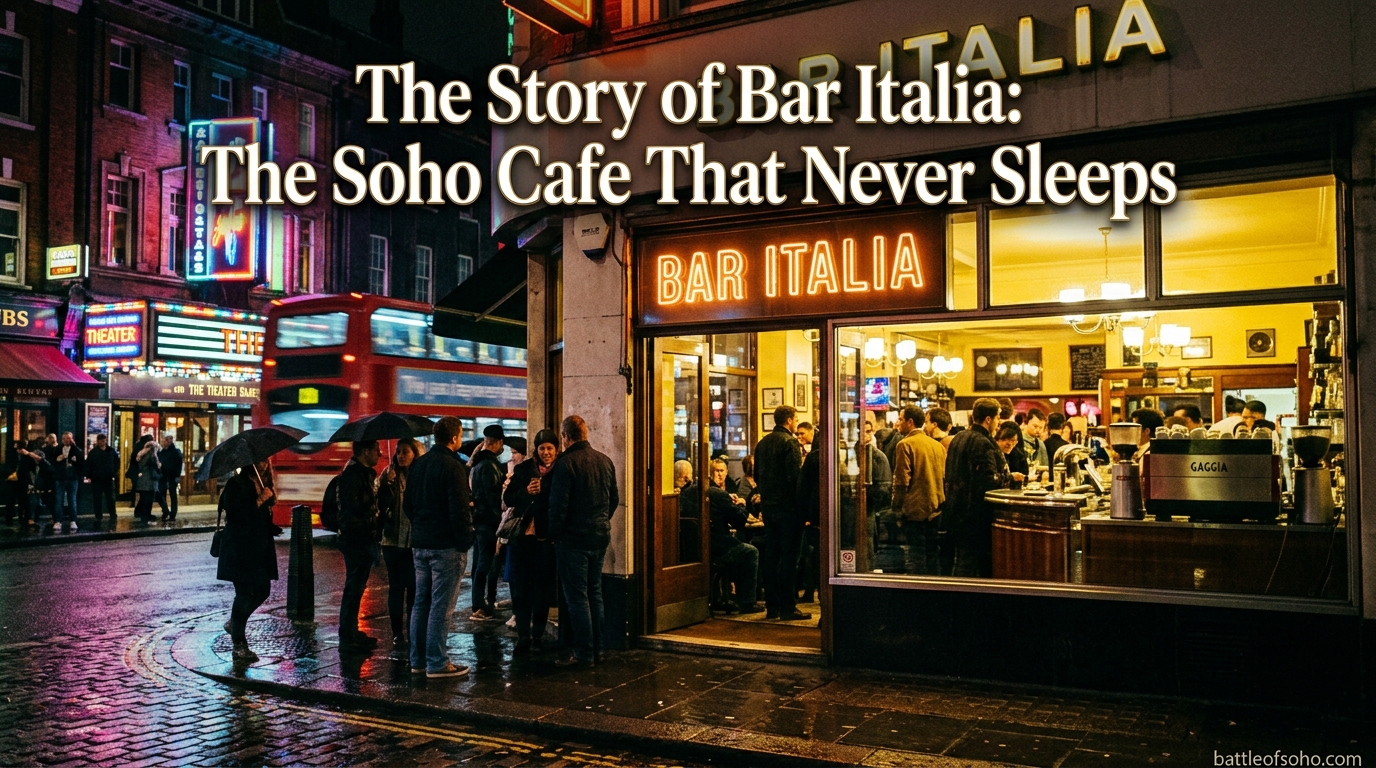
At the end of a long night in Soho, when the clubs have emptied and the streets have gone quiet, there is one place where the lights are still on. The neon sign glows green, white, and red. The Gaggia machine hisses. Someone is arguing about football in Italian. This is Bar Italia, and it has been here since 1949.
“Where all the broken people go,” Jarvis Cocker sang on the closing track of Pulp’s 1995 album Different Class. He was talking about this place. About a tiny Italian cafe on Frith Street that has somehow survived everything London has thrown at it for over seven decades. Gentrification, lockdowns, changing neighborhoods, rising rents. Bar Italia is still standing, still pouring espresso, still refusing to close.
The story of Bar Italia Soho is not just about coffee. It is about immigration, family, music, art, and the stubborn refusal to become something you are not. It is about a couple from northern Italy who walked into post-war London and built something that would outlast empires. It is about a building where television was first demonstrated, where Marlon Brando once sat, where the Rolling Stones drank cappuccinos before anyone knew their names.
Our team spent weeks digging through archives, forum threads, historical records, and firsthand accounts to piece together the full story. We wanted to understand why this particular cafe, out of hundreds in London, has become a cultural icon. What we found was a tale far richer and stranger than we expected. From John Logie Baird’s first television broadcast to a Nottingham indie band naming themselves after the place, Bar Italia has left fingerprints all over British culture.
This is the story of Bar Italia, the Soho cafe that never sleeps.
Table of Contents
Quick Overview: Why Bar Italia Is Famous
Bar Italia is famous because it is one of London’s oldest and most beloved Italian cafes, opened in 1949 by the Polledri family at 22 Frith Street in Soho, and it has been a cultural institution for over 77 years.
It earned its reputation through a combination of near-round-the-clock opening hours, exceptional espresso, deep roots in London’s Italian community, and an unlikely starring role in British pop culture. The Pulp song “Bar Italia” on the 1995 album Different Class cemented its legendary status, but the cafe was already iconic long before Jarvis Cocker put pen to paper.
Here are five reasons Bar Italia stands apart from every other cafe in London:
- Founded in 1949 by Lou and Caterina Polledri, Italian immigrants who built a family business now in its third generation
- The building itself made history as the site of John Logie Baird’s first television demonstration in 1926, marked by a blue plaque
- Open 22 hours a day (7am to 4am or 5am), earning it the nickname “the cafe that never sleeps”
- Immortalized in music and art by Pulp, Dave Stewart of the Eurythmics, painter Ed Gray, and portrait artist Carl Randall
- A magnet for legends including Marlon Brando, Francis Bacon, the Rolling Stones, Jimi Hendrix, and Rocky Marciano
By the numbers: 77 years of continuous operation, 1 family, 3 generations, 22 hours a day, 1 terrazzo floor, 1 iconic neon clock, and a permanent place in the story of Soho.
The Founding: Lou and Caterina Polledri and the Birth of a Soho Institution
From Northern Italy to Soho
The story begins in the rugged hills of northern Italy, near Turin, where Lou (Luigi) Polledri and his wife Caterina grew up surrounded by the coffee culture that defines Italian daily life. Like many Italians in the aftermath of World War II, they left their homeland in search of opportunity and stability. Britain was rebuilding. London was hungry for new energy. The Polledris brought theirs.
Before settling on Frith Street, the Polledris ran a business on Long Acre in Covent Garden. That area was already known for its market trade and growing Italian community. But Soho was where the real action was. By the late 1940s, Soho had become the gravitational center of London’s bohemian and immigrant life. French, Greek, Chinese, and Italian communities all overlapped in those narrow streets. Frith Street, in particular, had a pull that is hard to overstate.
The Polledris chose number 22 Frith Street for their new venture. They opened the doors in 1949, serving espresso, cappuccino, and simple Italian food in a space barely wider than a living room. The espresso came from a proper Gaggia machine, the same kind you would find in any self-respecting bar in Turin or Milan. The coffee was strong, authentic, and unlike anything else available in post-war London, where instant coffee was still the norm.
It was not a glamorous beginning. Post-war London was grey, rationed, and battered. But Bar Italia offered something that ration books could not provide: a taste of warmth, community, and continuity. For Italian immigrants who had recently arrived in a cold and unfamiliar city, the cafe became a second home. You could walk in, hear your own language, drink proper coffee, and feel, for a moment, that you were back in the village.
22 Frith Street: A Building With Two Histories
Here is where the story takes an extraordinary turn. Before Bar Italia ever poured its first espresso, 22 Frith Street had already changed the world. On January 26, 1926, a Scottish inventor named John Logie Baird demonstrated the first working television system in a laboratory on the upper floor of this very building.
Baird had rented the attic room and assembled a contraption built from scavenged parts, including a hatbox, scissors, darning needles, and an old electric motor. What he showed to a small audience that January evening was the first transmission of a moving image by electronic means. The implications were world-altering. Television, the medium that would define the twentieth century, was born above what would become an Italian coffee shop.
Today, a blue plaque on the exterior of the building commemorates Baird’s achievement. It sits right there on the facade, visible to anyone walking past. Most customers sipping their cappuccino inside have no idea they are sitting beneath the birthplace of television. This dual history, invention and espresso, science and community, is part of what makes 22 Frith Street one of the most culturally dense addresses in London.
Baird’s demonstration room has long since been converted. The building has been modified, renovated, and adapted over the decades. But the structure remains, and the blue plaque ensures that the connection between television’s birth and Bar Italia’s daily life is never entirely forgotten. Few buildings in London can claim to have hosted both a technological revolution and a culinary one.
The Italian Community in Post-War Soho
To understand why Bar Italia mattered so much, you have to understand Soho’s Italian community in the years after World War II. Soho had been a hub for Italian immigrants since the nineteenth century. The area around Clerkenwell was known as “Little Italy,” but Soho itself had a significant Italian population, with cafes, delicatessens, and social clubs serving as anchors for the community.
Bar Italia quickly became one of those anchors. Lou and Caterina did not just sell coffee. They created a social infrastructure. Newly arrived Italians could find information, connections, and a sense of belonging at the counter. Need a job? Someone at Bar Italia knew someone. Looking for a room? Ask around the cafe. Homesick? The conversations, the football scores, the food would remind you of home.
The Polledris understood something that many businesses never grasp: a cafe is not a building with a coffee machine. It is a gathering place, a social contract, a daily ritual. They built Bar Italia around relationships, not transactions. That philosophy, instilled in 1949, has been passed down through three generations and remains the core of the business today.
The Italian community in Soho has changed enormously over the decades. Many families moved out to the suburbs. New waves of immigration brought different communities to the area. But Bar Italia has remained a touchstone, a physical link to that earlier era when Soho was thick with Italian voices and the smell of fresh espresso hung over Frith Street like a weather system.
Why Bar Italia Never Sleeps: The 22-Hour Day
Open 22 Hours a Day
The nickname “the cafe that never sleeps” is not marketing spin. Bar Italia is open from 7am to 4am, seven days a week. That is 21 hours of operation. Some sources, including the Londonist, have historically cited hours running until 5am, making it 22 hours. Either way, the cafe closes for just two or three hours a night, long enough to clean the machines and sweep the terrazzo floor before the first early-morning customers arrive.
This schedule has been part of Bar Italia’s identity since the early days. Soho has always been a nocturnal neighborhood. The strip clubs, music venues, pubs, and later the nightclubs created a population of people who needed coffee, food, and a place to sit at hours when the rest of London was fast asleep. Bar Italia filled that gap and never stopped filling it.
Reddit users and longtime regulars frequently debate the exact closing time. Some swear it is 4am. Others insist it used to be 5am. The confusion itself is a testament to how deeply embedded the late-night schedule is in the Bar Italia mythos. The official This Is Soho directory currently lists the hours as 7am to 4am, seven days a week. Our team recommends checking the cafe’s website or Instagram for the most current schedule before planning a 3am visit.
The Post-Club Pilgrimage
If you want to understand Bar Italia’s cultural role, visit at 2am on a Friday night. The club crowds have started spilling out onto Old Compton Street and Greek Street. Some head home. Others make the pilgrimage to Frith Street. By 2:30am, Bar Italia is packed with an improbable mix of clubbers, cab drivers, off-duty chefs, Italian expats, tourists who read about the place in a guidebook, and people who have been coming here for thirty years.
The atmosphere at that hour is what regulars describe as electric. Nobody is in a hurry. The espresso machine works overtime. Conversations overlap in English, Italian, and a dozen other languages. Someone is always telling a story too loudly. The waistcoated staff move through the crowd with the practiced calm of people who have seen every possible version of 2am humanity and are not fazed by any of it.
Forum users on Reddit describe this experience vividly. One user wrote about discovering Bar Italia at 2am after a night out and finding “the best coffee in London.” Another described the particular pleasure of sitting at the counter in the small hours, watching Soho’s nocturnal population drift in and out. Pulp fans specifically reference the song lyric “where all the broken people go” as an almost perfect description of the post-club crowd at Bar Italia. Broken, perhaps. But also caffeinated, social, and very much alive.
Football Nights and Calcio Culture
When the Italian national team plays, Bar Italia transforms. The cafe becomes a miniature stadium, with fans crowding around screens, waving flags, and erupting at goals. Italian soccer, calcio, is woven into the fabric of the place. The Polledris’ loyalty to Italian football is part of the cafe’s DNA, and match nights during the World Cup or European Championship are legendary.
The Londonopia blog described these nights as “pure unfiltered chaos,” with Italian team loyalty on full display and the small space vibrating with noise and emotion. It is not a sanitized sports bar experience. It is raw, familial, and loud. If Italy wins, the celebration spills into the street. If they lose, the mourning is communal.
This calcio culture connects directly to the cafe’s role as an Italian community hub. The football matches are not just entertainment. They are a ritual of identity, a way of staying connected to the homeland even as the Italian community in Soho has evolved and dispersed over the decades. For newer Italian arrivals in London, discovering Bar Italia on a match night is like finding a piece of home in the middle of a foreign city.
Inside Bar Italia: The Decor and Atmosphere
The Terrazzo Floor
Look down when you walk into Bar Italia. The floor beneath your feet is a hand-laid terrazzo mosaic, a craft tradition that stretches back to ancient Rome. The floor was created by Torino Polledri, a family member whose craftsmanship turned an ordinary cafe floor into a piece of artisanal heritage. Terrazzo is made by embedding chips of marble, quartz, or glass into a cement or resin base, then polishing the surface to a smooth, speckled finish.
The Londonist noted the connection to the ancient Romans, pointing out that the same technique used to floor Bar Italia was used in villas two thousand years ago. It is a detail that most customers walk over without a second thought. But it is part of what makes Bar Italia feel different from every other cafe in the city. Nothing here is generic. Every surface, every fixture, every detail was chosen with intention by people who cared.
The terrazzo floor has survived decades of foot traffic, spilled espresso, and the occasional late-night mishap. It is as durable as the business itself. In a city where restaurant interiors are gutted and replaced every few years to chase trends, the Bar Italia floor stands as a quiet act of defiance. It was beautiful in 1949, and it is beautiful now.
Icons on the Walls
The walls of Bar Italia tell stories. The most famous wall artifact is a photograph of Rocky Marciano, the legendary heavyweight boxing champion. The Eater article recounted the anecdote: Marciano visited the cafe, and the photo has hung on the wall ever since, a silent celebrity endorsement from another era. It has become one of the cafe’s most recognizable features, a touchstone for regulars who have been coming for decades.
The ceiling is painted in the colors of the Italian flag: green, white, and red. It is a simple gesture, but an effective one. From the moment you step inside, there is no ambiguity about whose cafe this is. The Italian identity is not a theme or a branding exercise. It is the real thing, expressed in every detail from the ceiling paint to the Gaggia machine to the Italian-speaking staff.
Then there is the neon sign. The Bar Italia clock sign, glowing green and red, has become one of the most photographed details of the Soho streetscape. It appears on countless Instagram posts, travel blogs, and London photography collections. At night, it functions as a beacon, visible from down the street, signaling to the weary and the wired that coffee and shelter are close at hand.
The red leather stool at the counter is another touchstone. Eater’s Melanie Dunea described sitting on it during her first visit, jet-lagged and alone in London, finding unexpected comfort in the simple act of drinking a cappuccino at a tiny Italian cafe. That red stool has been sat on by thousands of people having a similar experience. It is one of those unremarkable objects that accumulates meaning through repetition.
Bar Italia in Popular Culture: From Pulp to Pop Art
Pulp and “Where All the Broken People Go”
In 1995, Sheffield band Pulp released Different Class, an album that would come to define the Britpop era. The closing track, simply titled “Bar Italia,” is a three-minute portrait of 4am London, of people stumbling out of clubs and into cafes, of the particular loneliness and camaraderie that exists in those small hours. “Where all the broken people go,” Jarvis Cocker murmured, and a cafe in Soho became immortal.
The song is not really about Bar Italia in a literal sense. It is about the feeling of Bar Italia. The exhaustion, the camaraderie, the strange intimacy of sharing a cramped space with strangers at an hour when everyone’s defenses are down. Cocker captured something essential about the place, and in doing so, he gave it a permanent place in the British cultural imagination.
Reddit users on the r/PulpBand subreddit frequently discuss the song and its real-world inspiration. Many Pulp fans have made the pilgrimage to 22 Frith Street specifically because of the song, arriving at 2am or 3am to experience the atmosphere Cocker described. For these visitors, Bar Italia is not just a cafe. It is a pop culture landmark, as significant as Abbey Road or the Cavern Club.
The song’s legacy endures. Nearly three decades after Different Class, new generations of music fans continue to discover “Bar Italia” and find their way to Frith Street. The cafe has embraced its musical heritage without exploiting it. There are no Pulp posters on the wall, no gift shop selling Jarvis Cocker mugs. The connection is deeper than merchandise. It lives in the atmosphere itself.
Famous Faces and Regulars
Bar Italia’s customer list reads like a Who’s Who of twentieth-century culture. Marlon Brando, the most influential actor of his generation, was a visitor. The story goes that he walked in, sat down, and drank coffee like anyone else. That is the thing about Bar Italia. Celebrity does not buy you special treatment. Everyone gets the same espresso served at the same counter by the same waistcoated staff.
Francis Bacon, the painter whose distorted, screaming figures defined post-war British art, was a Soho regular. He lived and worked in the neighborhood for decades, and the area’s pubs and cafes were extensions of his studio. Bar Italia was part of his ecosystem, a place where the creative energy of Soho concentrated and fermented.
The Rolling Stones drank here before they were the Rolling Stones, when they were just young musicians trying to make it in London. Jimi Hendrix passed through Soho during his explosive London period. Mick Jagger, Quentin Crisp, Rupert Everett, John Hurt, and producer Jeremy Thomas have all been associated with the cafe over the years. The proximity to Ronnie Scott’s Jazz Club, the Marquee Club, and the legendary 2i’s Coffee Bar meant that Bar Italia was embedded in the geography of Swinging London.
But the most devoted regulars are not celebrities. They are the people who have been coming for thirty or forty years, who know the staff by name, who have their usual spot at the counter. These are the regulars who, as one Reddit user put it, describe Bar Italia as a place where “everyone knows each other.” The celebrity visitors are part of the story, but they are not the story. The story is the community that has sustained this place for over seven decades.
Dave Stewart and the Musical
In 2010, Dave Stewart of the Eurythmics brought Bar Italia to the stage. He created a musical inspired by the cafe and its cast of characters, drawing on the rich tapestry of Soho life that the Polledris had cultivated. Stewart described Bar Italia in terms that capture its essence: “la famiglia.” The cafe, he suggested, was not a business. It was a family, an extended network of relationships built over decades.
The musical was a testament to how deeply Bar Italia had penetrated the creative consciousness of British artists. Stewart was not the first to be inspired by the place, and he would not be the last. Painter Ed Gray depicted the cafe in his London street art series, and portrait artist Carl Randall included it in his London Portraits project, which documented the people and places that defined the city.
The cafe’s cultural footprint extends beyond music and art. It won the London Lifestyle Award for Coffee Shop of the Year, beating out hundreds of newer, trendier, better-funded competitors. The award was a recognition not just of the coffee, but of what Bar Italia represents: authenticity, continuity, and community in a city that often seems determined to pave over its own history.
The Mod Scooter Club and 1960s Soho
One of the lesser-known chapters in Bar Italia’s history involves the mod scooter club tradition. In the 1960s, as mod culture swept through London, Bar Italia became a gathering point for scooter-riding Italian enthusiasts and their British counterparts. The Londonist is one of the few sources to document this tradition, noting that the cafe’s Italian identity made it a natural magnet for the mod subculture, which drew heavily on Italian fashion, music, and design.
Vespa and Lambretta scooters would line Frith Street on weekends, their riders crowding into the tiny cafe for espresso between rides. The mod connection is significant because it places Bar Italia at the intersection of Italian immigrant culture and British youth culture. The cafe was not just serving Italian expats. It was influencing the style and attitude of a generation of young Londoners.
The 1960s were arguably Bar Italia’s golden era. Soho was the epicenter of Swinging London, and Frith Street was at the heart of it. The Rolling Stones were recording down the road. Ronnie Scott’s had just opened around the corner. The Marquee Club, where Jimi Hendrix and David Bowie would perform, was walking distance. Bar Italia sat in the middle of all of this, pouring coffee for musicians, artists, mods, gangsters, journalists, and anyone else who found their way to Soho.
That proximity to the music scene is no small detail. The 2i’s Coffee Bar, located just a few streets away, was where the first British rock and roll stars were discovered. Tommy Hicks (later Tommy Steele) was discovered there in 1956. Bar Italia, while never a music venue itself, existed in the same ecosystem. The coffee that fueled Soho’s creative explosion was poured at 22 Frith Street.
The Bar Italia Band
Bar Italia’s cultural influence reached a new generation in 2019 when a Nottingham-based indie band named themselves after the cafe. The band, Bar Italia, has no direct connection to the Polledris or to Soho. They took the name from the Pulp song, creating a chain of influence that runs from the cafe to Jarvis Cocker to a group of young musicians in the East Midlands.
Wikipedia documents this connection, noting the band’s formation and their choice of name. It is a small detail, but a telling one. Bar Italia has become a cultural shorthand, a name that carries associations of authenticity, late nights, and a particular kind of urban cool. The fact that a band in Nottingham would reach for that name speaks to how deeply the cafe has embedded itself in the British cultural imagination.
The chain of inspiration is remarkable when you trace it. A couple from northern Italy opens a cafe in post-war London. Seventy years later, a band in Nottingham names itself after a song about that cafe. The Polledris could not have imagined any of this when they unlocked the door at 22 Frith Street for the first time in 1949. But that is how cultural institutions work. They outlive their founders and take on meanings their creators never intended.
The Polledri Family Legacy: Three Generations and Counting
Bar Italia remains a family business. Three generations of Polledris have now operated the cafe, with Veronica and Anthony Polledri, grandchildren of founders Lou and Caterina, currently at the helm. This continuity is the single most important factor in Bar Italia’s survival. In an industry where businesses change hands every few years, the Polledris have held on to 22 Frith Street for over seven decades.
The family’s commitment was visible in 2024, when Bar Italia celebrated its 75th anniversary. The milestone was marked with commemorative merchandise and a wave of media attention. Fans on Reddit discussed the anniversary with genuine emotion, sharing memories and expressing hope that the cafe would continue for another 75 years.
Those hopes are not unfounded, but they are not guaranteed either. Reddit users have periodically raised concerns about potential ownership changes. One post, titled “Please tell me it’s not true… Bar Italia,” captured the anxiety that many regulars feel about the future of the place. Soho’s property market is among the most expensive in the world, and the pressure on independent businesses is relentless. The fact that Bar Italia has survived this long is a tribute to the Polledris’ determination.
The family has navigated challenges that would have broken most small businesses. The Covid-19 lockdowns of 2020 and 2021 forced Bar Italia to adapt, like every other hospitality business in London. The My Soho Times blog reflected on the cafe’s outdoor dining setup during that period, when tables spilled onto Frith Street and the community rallied around one of its most cherished institutions. The lockdown era was a reminder of how much Soho’s identity is tied to places like Bar Italia, and how fragile that identity can be.
The 2010 London Lifestyle Award for Coffee Shop of the Year was a milestone that recognized not just the quality of the coffee but the endurance of the family’s vision. It was also a reminder that Bar Italia does not need to be the newest or the trendiest. It just needs to keep being itself.
Visiting Bar Italia Today: A Practical Guide
Address, Hours, and Contact
Bar Italia is located at 22 Frith Street, London, W1D 4RF, in the heart of Soho. The nearest Underground stations are Tottenham Court Road (Northern and Central lines) and Leicester Square (Northern and Piccadilly lines), both approximately a five-minute walk away. The cafe is also easily accessible from Piccadilly Circus station.
Current opening hours are 7am to 4am, seven days a week, though we recommend verifying the latest schedule on the cafe’s website or Instagram before visiting. Some sources still cite a 5am closing time, and hours may vary during holidays or special events. The important thing to know is this: if it is between early morning and very late night, Bar Italia is almost certainly open.
The cafe does not take reservations. Seating is first-come, first-served, and the space is small. At peak times (mid-morning, lunch, and the post-club rush around 1am to 3am), you may need to wait or stand at the counter. This is part of the Bar Italia experience. The crowd is not a bug. It is a feature.
For updates, follow Bar Italia on Instagram, where the cafe regularly posts about events, match screenings, and special offerings. The account is also the best source for confirming current opening hours and any temporary schedule changes.
What to Order
The coffee is the main event. Order an espresso if you want the pure Bar Italia experience: a small, intense shot pulled from the Gaggia machine, served in a ceramic cup, consumed standing at the counter like an Italian. A cappuccino is the more popular choice, especially for first-time visitors. The Americano is straightforward and reliable.
For food, Bar Italia serves a limited but satisfying menu of Italian items. Prosciutto is a highlight, served simply and authentically. The Eater review praised the cannelloni, and the tiramisu and cheesecake are reliable choices for something sweet. This is not a restaurant. It is a cafe, and the food is designed to complement the coffee, not compete with it.
If you are visiting for the first time, our team recommends going at an unconventional hour. Mid-afternoon on a weekday will give you space to take in the decor, study the terrazzo floor, read the blue plaque outside, and absorb the atmosphere without the crowds. Alternatively, arrive at 2am on a weekend for the full post-club Bar Italia experience that Pulp wrote about. Both are authentic. Both are unforgettable.
Conclusion: The Soul of Soho
Bar Italia is more than a cafe. It is one of the last surviving witnesses to the Soho that existed before the chain stores and luxury apartments, the Soho of immigrants and artists and all-night adventurers. The story of Bar Italia is the story of a family that refused to leave, a building that changed the world twice over, and a cup of coffee that somehow tasted like belonging.
What makes Bar Italia different from other London cafes is not the coffee, though the coffee is excellent. It is the continuity. Seventy-seven years, one family, one address, one terrazzo floor. In a city that reinvents itself every decade, Bar Italia has stayed exactly where it is, doing exactly what it has always done. It opens at dawn. It closes in the small hours. It pours espresso for anyone who walks through the door, from Marlon Brando to a jet-lagged tourist to a Pulp fan making a midnight pilgrimage.
If you have not been, go. Stand at the counter. Order an espresso. Look at the Rocky Marciano photo. Notice the Italian flag on the ceiling. Read the blue plaque outside. And understand that you are standing in a place where history, culture, and community have been brewing together since 1949. Bar Italia Soho, the cafe that never sleeps, is still wide awake. And as of 2026, it shows no signs of closing.
FAQs
Why is Bar Italia so famous?
Bar Italia is famous for being one of London’s oldest and most iconic Italian cafes, opened in 1949 by the Polledri family at 22 Frith Street in Soho. It earned its legendary status through near-round-the-clock opening hours (7am to 4am daily), exceptional espresso, deep roots in London’s Italian community, famous patrons including Marlon Brando and the Rolling Stones, and its immortalization in the Pulp song u0022Bar Italiau0022 from the 1995 album Different Class.
Who owns Bar Italia in Soho?
Bar Italia is owned and operated by the Polledri family, the same family that founded it in 1949. The cafe is currently run by the third generation of Polledris, specifically Veronica and Anthony Polledri, grandchildren of original founders Lou and Caterina Polledri.
Is Bar Italia still family owned?
Yes, Bar Italia is still family owned. The Polledri family has operated the cafe continuously since 1949, spanning three generations. Despite concerns on forums about potential ownership changes, the cafe remains in the hands of the Polledri family as of 2026.
When was Bar Italia opened?
Bar Italia was opened in 1949 by Lou (Luigi) and Caterina Polledri, Italian immigrants from northern Italy who had previously run a business on Long Acre in Covent Garden before moving to 22 Frith Street in Soho.
Why is Bar Italia called the cafe that never sleeps?
Bar Italia earned the nickname u0022the cafe that never sleepsu0022 because it operates almost 24 hours a day, opening at 7am and closing at 4am (or 5am according to some sources). That is 21 to 22 hours of daily operation, making it one of the few places in London where you can get coffee and food at almost any hour, including the post-club hours of 2am to 4am.
Does Bar Italia serve food?
Yes, Bar Italia serves a limited menu of Italian food alongside its coffee. Offerings include prosciutto, cannelloni, paninis, and desserts like tiramisu and cheesecake. The food menu is designed to complement the coffee rather than function as a full restaurant experience.
What celebrities go to Bar Italia?
Bar Italia has hosted numerous famous patrons over its 77-year history, including actor Marlon Brando, painter Francis Bacon, the Rolling Stones, Jimi Hendrix, Mick Jagger, Quentin Crisp, Rupert Everett, John Hurt, and boxer Rocky Marciano. Its proximity to Ronnie Scott’s and the Marquee Club made it a natural stop for musicians and artists in the 1960s.
What makes Bar Italia different from other London cafes?
Bar Italia stands apart due to its unbroken family ownership since 1949, its location in a building where John Logie Baird first demonstrated television in 1926, its near-24-hour opening schedule, its hand-laid terrazzo floor, its deep roots in London’s Italian community, and its status as a cultural icon immortalized by Pulp. Few cafes in London can match its combination of history, authenticity, and cultural significance.