
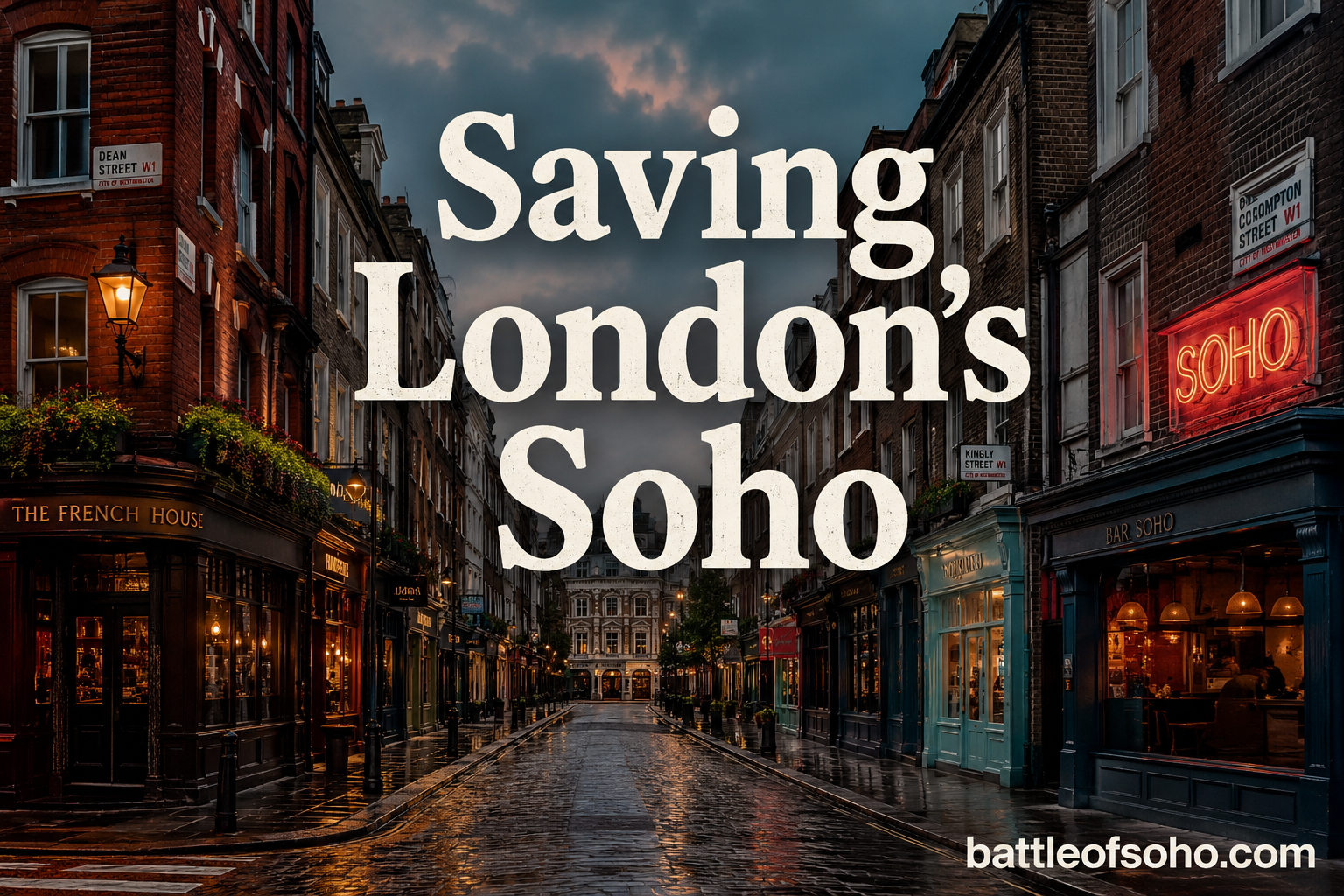
Walk down Old Compton Street on a Saturday night and you will still feel it. The neon, the noise, the crowds spilling out of pubs onto narrow pavements. But look closer and the cracks show. Where independent record shops once stood, chain coffee outlets now serve flat whites to tourists. Where queer venues hosted drag shows for decades, empty storefronts wait for premium office tenants. The people fighting to save London’s Soho have been watching this transformation for years. Some have been fighting for decades.
Soho has always been a neighborhood in flux. From its days as a hunting ground in the 1500s to its emergence as London’s entertainment district, change is baked into its identity. But the current wave of transformation feels different to those who live and work here. Independent businesses are being priced out at record speed. LGBTQ+ venues have closed at an alarming rate. Music heritage sites on Denmark Street, the legendary Tin Pan Alley, face demolition or conversion into luxury developments.
The people fighting to save London’s Soho are not a single organized movement. They are a patchwork of community groups, filmmakers, photographers, venue owners, residents, and celebrities. They use different tools, from legal challenges to documentary films to street protests. Some have won surprising victories. Others are still waiting for their first win. This article introduces you to the real people behind the fight, the battlegrounds where the future of Soho is being decided, and the strategies they use to push back against the tide of redevelopment.
Table of Contents
Who Is Fighting to Save London’s Soho?
The fight to preserve Soho’s character is led by a coalition of longtime residents, community organizers, venue owners, artists, and filmmakers. There is no single leader or headquarters. Instead, multiple individuals and groups have taken up different battles across the neighborhood, each bringing their own tools and perspectives to the fight.
Tim Lord and The Soho Society
If there is a central figure in the organized fight for Soho, it is Tim Lord. As chairman of The Soho Society, Lord has been one of the most persistent voices challenging development and advocating for community interests. The Soho Society was founded in 1970, making it one of London’s oldest community civic associations. For over 50 years, it has served as the primary organized voice for Soho residents and businesses.
Lord’s approach is pragmatic rather than ideological. He does not oppose all development. What he fights against is development that erases the community’s character without offering anything in return. Under his leadership, The Soho Society has objected to planning applications, lobbied Westminster Council, and championed the use of legal tools like Asset of Community Value designations.
The Society’s most notable recent victory came in 2024, when it successfully campaigned for a Tesco supermarket on Dean Street to be designated an Asset of Community Value. The irony was not lost on anyone. A chain supermarket, the very symbol of the clone-town homogenization that activists despise, became the community’s latest cause. Lord explained the logic clearly: the Tesco was an affordable food source that served a diverse community. If it closed and the site became another premium office development, ordinary people would lose access to basic necessities.
Lord has faced criticism. A recent article described The Soho Society as “curtain-twitchers” who have killed Soho’s spirit. Lord refused to apologize, saying members had bonded over the challenges facing the neighborhood. The tension between preservation and stagnation is a constant theme in his work.
Aro Korol and the Battle of Soho Documentary
While The Soho Society works through planning law and council meetings, filmmaker Aro Korol took a different approach. Korol directed “Battle of Soho,” a documentary film that has become one of the most comprehensive records of the fight to save the neighborhood. The film was inspired by the closure of Madame Jojo’s, the legendary Soho nightclub that shut its doors in 2014.
Korol’s documentary is remarkable for its scope. It features 58 interviews with community members, activists, developers, and cultural figures. Rather than presenting a one-sided argument, the film gives voice to multiple perspectives on Soho’s transformation. It places Soho’s fight in a global context, connecting it to gentrification battles in other major cities around the world.
The film has become a rallying point for the movement. It has screened at festivals, been featured on FilmFreeway, and continues to draw attention to the human cost of redevelopment. For many people outside London, the Battle of Soho documentary is their first introduction to the fight to preserve one of the world’s most famous neighborhoods.
Korol’s work fills a gap that traditional journalism often misses. Mainstream coverage tends to focus on individual venue closures or celebrity reactions. The documentary captures the systemic forces driving the change, making it clear that Madame Jojo’s was not an isolated loss but part of a pattern affecting the entire neighborhood.
Jeremy Joseph and the LGBTQ+ Venue Fight
Few people have fought harder for Soho’s queer spaces than Jeremy Joseph. As the owner of G-A-Y and G-A-Y Late, Joseph has been at the center of Soho’s LGBTQ+ nightlife for over two decades. When G-A-Y Late faced closure, Joseph became one of the most vocal advocates for preserving queer venues not just as businesses, but as essential community infrastructure.
Joseph’s argument is simple but powerful. LGBTQ+ venues are not just places to drink and dance. They are safe spaces where people can be themselves without fear. When those venues close, the community does not just lose a nightlife spot. It loses a gathering place, a support network, and a cultural anchor.
The fight to save Soho’s queer venues has become one of the most visible battles in the broader preservation movement. LGBTQ+ users on forums describe how Soho’s transformation from a gritty, authentic queer haven into a sanitized entertainment district has changed the character of the spaces. Formerly welcoming venues now cater increasingly to heteronormative clientele, making long-time patrons feel like strangers in their own community.
Joseph’s advocacy highlights a tension at the heart of the Soho debate. Development does not just change buildings. It changes who feels welcome, who can afford to be there, and who gets pushed out.
Carl Court: Documenting Old Soho Through Photography
Photojournalist Carl Court took a different approach to the fight. Rather than organizing campaigns or lobbying councils, he picked up his camera. In 2015, Court published a powerful photo essay for The Guardian titled “Saving Soho: the spirit of London captured for posterity.” The collection of 13 photographs documented the characters, venues, and streets that were disappearing under the weight of redevelopment.
Court’s photographs captured Denmark Street’s music shops, the 12 Bar Club’s intimate stage, Bar Italia’s enduring presence, and the everyday people who gave Soho its soul. His work serves as both documentation and advocacy. By showing what was being lost, he made the abstract concept of gentrification viscerally real.
The photo essay drew attention from major media outlets and helped galvanize public support for the Save Soho campaign. It also attracted celebrity backing. Stephen Fry and Benedict Cumberbatch both lent their voices to the cause, drawing national attention to what might otherwise have remained a local dispute.
Court’s project is a reminder that not all activism happens in council chambers or protest lines. Sometimes the most powerful tool is simply showing people what they are about to lose.
The Battlegrounds: Key Venues and Streets at Risk
The fight for Soho is not abstract. It plays out on specific streets, in specific buildings, around specific venues. Each battleground tells a different story about what is at stake and how the fight is being waged. Here are the key locations where the future of Soho is being decided.
The Tesco Dean Street Battle: An Unlikely Community Champion
Of all the fights to preserve Soho, the battle over a Tesco supermarket on Dean Street is perhaps the most revealing. The Tesco was not a beloved independent business. It was a chain store, the kind of generic retailer that activists normally campaign against. But when the site was threatened with conversion into premium office space, The Soho Society swung into action.
The campaign to save the Tesco was not really about Tesco. It was about what the Tesco represented: an affordable food source in an increasingly expensive neighborhood. The nearest alternative supermarket would be significantly farther away, making basic shopping harder for elderly residents, low-income workers, and anyone without the budget for premium delis.
In 2024, The Soho Society won. Westminster Council designated the Tesco site as an Asset of Community Value under the Localism Act 2011. This gave the community a six-month moratorium period to bid for the property if it was put up for sale. The designation sent a powerful message. Even a chain supermarket could qualify as community infrastructure if its loss would harm the neighborhood.
The Tesco battle highlights how far gentrification has gone. When saving a supermarket becomes a progressive cause, something has shifted. The Urban Activist, which covered the story in detail, framed it as a sign of how extreme Soho’s transformation has become. It is not that the Tesco is wonderful. It is that what would replace it would be worse for the community.
Madame Jojo’s and the Spark That Lit the Movement
Madame Jojo’s was not just a nightclub. For decades, it was one of Soho’s most iconic venues, known for its drag shows, cabaret nights, and diverse crowds. The venue occupied a historic building on Walker’s Court, a narrow alley that epitomized Soho’s gritty charm. When Madame Jojo’s closed in 2014 after a violent incident outside the club led to its license being revoked, it sent shockwaves through the community.
The closure of Madame Jojo’s was the spark that lit the modern Save Soho movement. It directly inspired Aro Korol’s Battle of Soho documentary. It galvanized celebrity supporters like Stephen Fry and Benedict Cumberbatch. It drew national media attention to the pattern of venue closures that had been quietly accelerating for years.
What happened to Madame Jojo’s site tells a familiar story. The building was acquired by Soho Estates, one of the neighborhood’s major landowners. Plans were drawn up for redevelopment that would preserve the facade but transform the interior. For activists, this is the standard playbook. Keep the shell, gut the soul, call it preservation.
The Madame Jojo’s closure became a symbol because it represented something larger than one venue. It showed how licensing changes, development pressure, and rising rents could combine to erase institutions that had defined Soho for generations.
The 12 Bar Club and Denmark Street’s Music Heritage
Denmark Street is known as London’s Tin Pan Alley. Since the early 1900s, it has been the center of Britain’s music publishing industry. The Rolling Stones recorded there. Elton John wrote songs there. David Bowie bought sheet music there. The 12 Bar Club, a tiny live music venue on Denmark Street, was part of that heritage. It hosted emerging artists in an intimate, no-frills setting that had launched countless careers.
When the 12 Bar Club faced closure as part of a redevelopment plan for Denmark Street, the response was fierce. Music heritage activists organized protests. A group of squatters occupied the building in a dramatic act of direct action that drew national headlines. Forum users described the squatters as some of the only people actually fighting back against the development.
The Denmark Street battle exposed the tension between preserving music heritage and accommodating modern development. The street’s historic buildings needed investment. But activists argued that development plans prioritized luxury flats and retail over the music culture that made the street famous. The Crossrail project, now the Elizabeth line, added further pressure by driving up land values across the area.
The 12 Bar Club was eventually forced out. But the protest and occupation drew attention to the erosion of London’s live music infrastructure that continues to resonate in preservation debates today.
The Disappearing LGBTQ+ Safe Haven
Soho’s identity as a queer safe haven is under sustained threat. The list of LGBTQ+ venues that have closed in the neighborhood reads like a roll call of London’s queer cultural history. Madame Jojo’s, the Ghetto, First Out, and most recently G-A-Y Late have all shut their doors. Each closure represents not just a business failure but a loss of community space.
Heaven Nightclub, one of the most famous gay venues in the world, has managed to survive. It was even granted special status as a historic gay venue, offering some protection against redevelopment. But surviving is not the same as thriving. LGBTQ+ community members report that the character of Soho’s queer spaces has changed as the surrounding neighborhood becomes more commercial and mainstream.
The impact extends beyond Soho’s borders. As venues close and the neighborhood’s character shifts, the queer community is dispersing. Former Soho regulars describe moving their social lives to Dalston, Vauxhall, and Clapham. Dalston Superstore and other east London venues have absorbed some of the displaced community. But the fragmentation of what was once a concentrated queer district represents a significant cultural loss.
The shift toward heteronormativity in Soho is not accidental. It is the predictable result of development patterns that prioritize high-rent tenants over community institutions. When queer venues cannot afford rising commercial rents, they are replaced by establishments that cater to a broader, more affluent, and more mainstream clientele. The result is what sociologists call the domestication of previously transgressive spaces.
The Weapons: How Activists Fight for Soho
The people fighting to save London’s Soho do not rely on a single strategy. They use a range of legal mechanisms, planning tools, media campaigns, and direct actions to push back against development. Understanding these tools is key to understanding both the successes and the limitations of the movement.
Asset of Community Value: A Rare Legal Win
The Asset of Community Value designation is one of the most powerful tools available to community activists in England. Created under the Localism Act 2011, the ACV mechanism allows communities to nominate buildings or land that are important to local social well-being. If the nomination is approved by the local council, the site gains protection.
The protection is not absolute. An ACV designation does not prevent a property from being sold or redeveloped. What it does is trigger a moratorium period. When the owner decides to sell, the community has six months to prepare a bid to purchase the asset. This gives activists time to organize, raise funds, and potentially take ownership of threatened sites.
The Tesco Dean Street victory in 2024 demonstrated the ACV mechanism in action. The Soho Society successfully argued that the supermarket served a community function by providing affordable food access. The designation gave the community a voice in the site’s future and forced developers to acknowledge the social impact of their plans.
ACV designations are rare wins in a system that generally favors development. Forum users describe them as a tool that buys time rather than solving the problem. But in a fight where time is often the difference between preservation and demolition, even a temporary delay can be significant.
Class E Building Use: The Planning Law Changing Soho
If you want to understand why Soho is changing so quickly, you need to understand Class E building use. This is the planning law change that has fundamentally altered how property owners can use their buildings in England. Introduced in 2020, Class E consolidated several previous use classes into a single category covering commercial, business, and service uses.
Before Class E, converting a shop into a restaurant, or a retail space into an office, often required planning permission. This gave local communities and councils the opportunity to object, review, and potentially block unwanted changes. Under Class E, many of these conversions can happen without planning permission at all.
The impact on Soho has been significant. Property owners can now convert independent shops into chain outlets, restaurants, or offices with minimal oversight. The community has almost no say in these changes. For activists, this is one of the root causes of Soho’s transformation. It removes the democratic process from neighborhood planning.
Tim Lord and The Soho Society have been vocal critics of Class E. They argue that it strips communities of their ability to shape their own neighborhoods. The Urban Activist, which has covered this issue in depth, notes that Class E makes it nearly impossible for residents to prevent the conversion of beloved local businesses into generic commercial spaces.
The connection between Class E and Soho’s character shift is direct. When independent businesses cannot compete with the rents that chain stores and premium offices can pay, they close. Class E makes it trivially easy for landlords to replace them. The result is the gradual homogenization of Soho’s commercial landscape.
Celebrity Advocacy and Media Attention
Celebrity support has been a double-edged sword in the fight for Soho. On one hand, figures like Stephen Fry and Benedict Cumberbatch have brought national and international attention to the cause. When a celebrity speaks, the media listens. Coverage that would never have appeared in national newspapers suddenly becomes front-page news.
The 2015 Save Soho campaign, backed by celebrities and cultural figures, was one of the most visible moments in the movement’s history. It drew attention to the closure of Madame Jojo’s, the threat to Denmark Street’s music heritage, and the broader pattern of cultural erasure. The campaign helped shift the public conversation about gentrification from a niche planning issue to a mainstream cultural debate.
But celebrity advocacy has its limits. Forum users have expressed frustration that grassroots organizers are often overshadowed when celebrities get involved. The everyday residents who attend council meetings, file planning objections, and organize community events rarely get the same media coverage as a famous actor speaking at a rally. The attention can also be fleeting. When the headlines move on, the slow grind of planning law and council politics continues.
Direct Action: Protests, Squats, and Occupations
Not everyone fighting for Soho works through official channels. Some take direct action. The 12 Bar Club occupation was the most dramatic example. When the venue faced demolition, a group of squatters occupied the building, barricading themselves inside and refusing to leave. The occupation drew national media attention and became a symbol of resistance.
Direct action in Soho has a long history. The neighborhood has been a site of protest and dissent for generations, from the Chartists in the 1800s to the queer rights activists of the 20th century. The tradition continues today. Street protests against redevelopment, public demonstrations at council meetings, and social media campaigns all play a role in keeping the pressure on developers and politicians.
Direct action is controversial. Critics argue that occupations and protests disrupt legitimate business and create confrontation. Supporters counter that conventional channels have largely failed to protect Soho’s character. When planning law favors developers and council decisions consistently side with redevelopment, direct action becomes one of the few remaining tools.
Why Soho Matters: Cultural Heritage at Stake
Soho is not just a neighborhood. It is a cultural institution. For centuries, it has been a place where outsiders, artists, performers, and marginalized communities found a home. Losing Soho would mean erasing one of the few remaining spaces in London where bohemian culture, queer identity, and independent commerce still coexist.
From Bohemian Haven to Clone Town
The concept of “clone towns” was coined to describe the growing uniformity of British high streets. When every town center has the same chain stores, the same coffee shops, and the same restaurants, local character disappears. Soho, with its independent venues, historic pubs, and diverse businesses, has always been the antithesis of a clone town.
But the forces transforming Soho are the same ones that have homogenized high streets across the country. The financialization of property means buildings are valued as investment assets rather than community spaces. The domestication by cappuccino, a term coined by urban sociologist Sharon Zukin, describes how gritty neighborhoods are gradually sanitized by upscale cafes and chain retailers that make them feel safe for affluent newcomers.
What makes Soho’s case particularly painful is the speed of the change. Neighborhoods usually gentrify over decades. Soho’s transformation has accelerated dramatically since 2010. The combination of Crossrail development, Class E planning changes, and aggressive property speculation has compressed what should have been a slow evolution into a rapid erasure.
The forum discussions capture the grief. Reddit users describe Soho’s transformation from gritty and authentic to sanitized and commercial. Long-time residents mourn the loss of independent shops like I Camisa and Son, the Italian deli that served the neighborhood for generations. Each closure removes another thread from the cultural fabric that made Soho unique.
Soho’s Fight Is Every City’s Fight
The battle for Soho is not unique. Cities around the world are fighting similar battles. In New York, the CBGB music club closed in 2006 as the Bowery gentrified. In Berlin, Kreuzberg’s alternative culture is under threat from rising rents and corporate development. In Hong Kong, historic neon signs are disappearing as buildings are redeveloped. The pattern repeats globally.
What makes Soho significant is its cultural weight. Few neighborhoods in the world carry the same historical and symbolic significance. Soho has been a center of London’s creative industries, its queer community, and its nightlife for over a century. When Berlin faced similar pressures, the German government intervened to protect nightlife as a cultural institution. No comparable framework exists in the UK.
The parallels between cities offer both hope and caution. Some communities have successfully resisted displacement. Brixton’s struggles against gentrification, while ongoing, have produced real victories through community organizing. The lesson from international experience is that preservation requires sustained, organized, and creative resistance over many years.
Soho’s fight matters beyond its borders because it sets a precedent. If one of the world’s most famous cultural districts can be erased by development pressure, no neighborhood is safe. The activists fighting for Soho are fighting for the principle that communities have a right to their own cultural heritage.
How You Can Help Preserve Soho
If you want to support the people fighting to save London’s Soho, there are concrete steps you can take. The movement needs more than celebrity endorsements and media coverage. It needs engaged citizens willing to show up, speak up, and contribute.
Join The Soho Society. Membership is open to residents, workers, and anyone with an interest in the area. The Society is the primary organized voice for Soho’s community, and its strength comes from its membership base. A larger membership means more legitimacy when lobbying Westminster Council.
Support independent businesses. Every pound spent at an independent Soho business is a vote for the neighborhood’s character. Chain stores have the financial backing to survive rising rents. Independent shops, cafes, and venues do not. Your spending choices directly affect which businesses survive.
Attend council meetings and planning consultations. Westminster Council holds public consultations on development proposals. Attending these meetings and submitting objections is one of the most effective ways to influence planning decisions. The council is required to consider public input, even if it does not always act on it.
Nominate threatened sites for Asset of Community Value designation. Any community group can nominate a building or space. If you know of a venue, shop, or public space that matters to the community, the ACV mechanism provides a legal tool for protection.
Spread the word. Share stories about Soho’s fight on social media. Watch and share the Battle of Soho documentary. Write to your local representatives. The more public attention the movement gets, the harder it becomes for developers and politicians to ignore.
Frequently Asked Questions About Saving Soho
Has Soho been gentrified?
Yes, Soho has experienced multiple waves of gentrification since the 1980s, with accelerating change since 2010. Independent businesses, LGBTQ+ venues, and music heritage sites have been displaced by premium offices, chain stores, and upscale developments. Westminster Council’s Class E planning law changes in 2020 further accelerated the transformation.
Is Soho in London still a red light district?
Soho’s red light district character has significantly diminished since the 2010s. Strip clubs and sex shops that once defined the area have almost entirely disappeared due to licensing changes, redevelopment pressure, and gentrification. Soho retains some of its risque character through nightlife and cultural venues, but it is no longer the red light district it once was.
What is The Soho Society?
The Soho Society is a community civic association founded in 1970 that serves as the primary organized voice for Soho residents and businesses. Now over 50 years old, the Society lobbies Westminster Council, objects to unwanted development, and campaigns for the preservation of Soho’s character. Tim Lord serves as its chairman.
What happened to Madame Jojo’s in Soho?
Madame Jojo’s, the legendary Soho nightclub known for its drag shows and cabaret, closed in 2014 after a violent incident outside the club led to its license being revoked. Its closure became the catalyst for the modern Save Soho movement, inspiring the Battle of Soho documentary and galvanizing celebrity support from figures like Stephen Fry and Benedict Cumberbatch.
How can I help preserve Soho?
You can help preserve Soho by joining The Soho Society, supporting independent businesses, attending Westminster Council planning meetings, nominating threatened sites for Asset of Community Value designation, and spreading awareness through social media and community engagement. The movement needs both organized advocacy and everyday community participation.
Conclusion: The Fight for Soho Continues
The people fighting to save London’s Soho are not waiting for someone else to act. Tim Lord lobbies councils and files planning objections. Aro Korol makes films that reach global audiences. Jeremy Joseph defends queer venues on national television. Carl Court photographs what is disappearing before it is gone forever. Everyday residents attend meetings, sign petitions, and support the independent businesses that give Soho its soul.
Their fight is far from over. Class E planning law continues to erode community control over development. Independent businesses face relentless rent pressure. LGBTQ+ venues keep closing. The forces driving Soho’s transformation are powerful and well-funded. But the resistance is real, organized, and growing.
What gives hope is the breadth of the movement. The fight for Soho is no longer a fringe concern. It involves filmmakers, photographers, celebrities, lawyers, residents, and activists from multiple communities. The 2024 Tesco Asset of Community Value victory proved that organized pressure can produce results, even against powerful development interests.
Soho has survived threats before. It survived the Blitz, it survived the moral panics of the 20th century, and it has survived previous waves of commercial pressure. Whether it survives the current era of financialized property development depends on whether enough people care enough to fight. The real people fighting to save London’s Soho are showing up every day. The question is whether the rest of us will join them.