
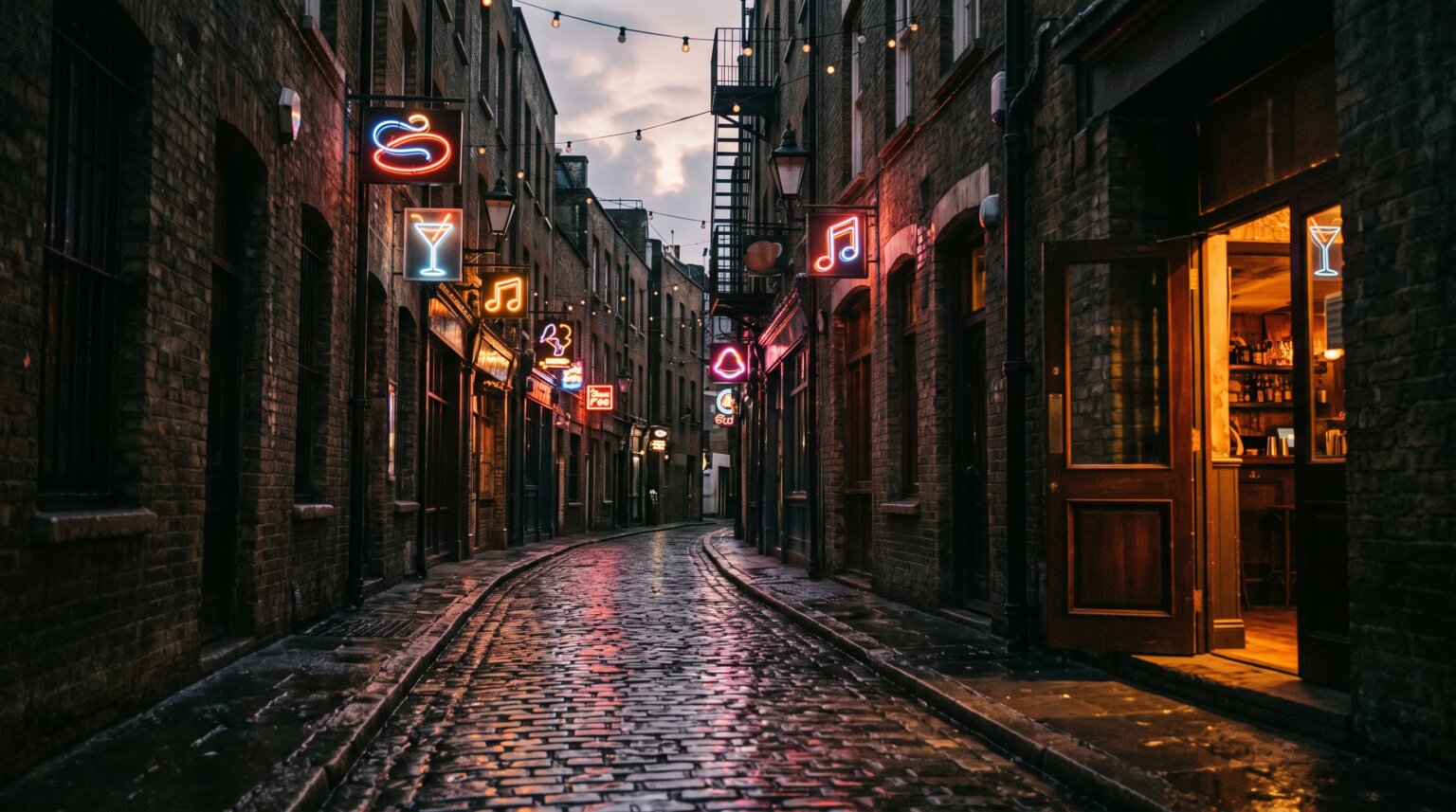
For over three centuries, a single square mile in the heart of London became the natural home for people who fit nowhere else. Understanding why Soho attracted the misfits and the outsiders means looking at a rare convergence of cheap rents, geographic accident, cultural tolerance, and a tradition of collective indifference to how anyone chose to live. From Huguenot refugees fleeing persecution in 1685 to Francis Bacon painting in a cramped Dean Street studio, from Karl Marx drafting Das Kapital in squalid rooms to drag queens performing on Old Compton Street, Soho absorbed wave after wave of people whom respectable society preferred to ignore.
The story is not accidental. Soho’s narrow streets, its location just outside the strict control of the City of London, its cheap rooming houses, and its decades-long reputation as a place where nobody asked questions created conditions that almost no other London district could match. What follows is an attempt to explain exactly how those conditions formed, why they endured, and what remains of them today.
This article traces the arc from royal hunting ground to bohemian utopia to gentrified entertainment district. It draws on the historical record, the accounts of people who lived and drank in Soho’s legendary pubs and clubs, and the broader question that residents and visitors on forums like Reddit still ask: where did the real Soho go, and does anything like it still exist?
Table of Contents
From Royal Hunting Ground to Outcast Quarter: Soho’s Earliest Origins
Soho did not begin as a refuge. In the 1530s, Henry VIII seized the land as part of his royal hunting grounds, and for decades it remained open fields where monarchs chased deer. The name itself likely comes from a hunting cry, “Soho!,” used by riders to rally the hunt. That origin matters because it established the area as something set apart, a liminal zone between the City of London to the east and the royal court at Westminster to the west.
By the late 1500s and early 1600s, the hunting grounds were parcelled off and sold. Developers laid out the grid of streets that still exists today: Dean Street, Wardour Street, Old Compton Street, Greek Street. These were narrow, oddly angled, and built quickly with little oversight. The street plan that resulted would prove accidentally perfect for anonymity and concealment centuries later.
Through the 1600s, Soho attracted a mix of aristocrats building grand houses and the servants, tradespeople, and tradesmen who served them. But the aristocracy gradually moved west toward Mayfair, abandoning Soho to the working class and to whoever could afford the cheap rents. That exodus of wealth left behind large houses that were subdivided into rooming houses, workshops, and small businesses. The architectural DNA of bohemia was already forming.
What made Soho different from neighbouring districts was its ambiguity. It sat in no man’s land between the jurisdictions of the City of London and the Westminster authorities. Law enforcement was patchy. Regulation was light. The area developed a reputation, almost from its earliest days, as a place where things happened that could not easily happen elsewhere.
The Huguenots: Soho’s First Wave of Outsiders
The pattern of Soho as a haven for outsiders began in earnest in 1685. That year, Louis XIV revoked the Edict of Nantes, stripping French Protestants, known as Huguenots, of their religious freedoms. Tens of thousands fled France, and a large number settled in Soho.
The Huguenots were Soho’s first true wave of refugees. They were artisans, weavers, goldsmiths, and clockmakers. They brought skills, established businesses, and built churches. They clustered around what became known as Soho Square and along Old Compton Street. The French Church on Soho Square served as their spiritual centre for generations.
What the Huguenot influx established was a template. Soho became associated, in the London imagination, with foreigners, with people who were different, with communities that lived by their own rules. The refugees were not universally welcomed. They faced resentment from local workers who saw them as competitors. But Soho’s cheap rents and its physical separation from the rest of the city meant that outsiders could establish themselves here in ways they could not in more tightly controlled districts.
The Huguenots assimilated within a few generations. Their descendants became English. But the memory of Soho as a place of refuge endured, and successive waves of immigrants, Italian, Greek, Jewish, Chinese, followed the same pattern. Each group added a layer to the district’s identity. By the 19th century, Soho was the most cosmopolitan square mile in Britain, a place where you could hear a dozen languages walking down a single street.
That cosmopolitanism mattered for what came later. When artists, writers, and sexual nonconformists looked for a place where they would not stand out, Soho was already conditioned to accept people who were different. The infrastructure of tolerance, built by centuries of immigrant settlement, was already in place.
Victorian Soho: Slums, Vice, and Intellectual Ferment
By the mid-19th century, Soho had become one of the most overcrowded and impoverished districts in London. The grand houses built for 17th-century gentry had been carved into tenements. Whole families lived in single rooms. Cholera swept through the area repeatedly, culminating in the infamous 1854 Broad Street outbreak that killed over 600 people in a matter of days.
Dr. John Snow traced that outbreak to a single contaminated water pump on Broad Street, now Broadwick Street. His work founded modern epidemiology. But the outbreak also cemented Soho’s reputation as a diseased, dangerous place. Respectable London treated the district with a mixture of fear and fascination.
That reputation was double-edged. It drove away the wealthy, keeping rents low. It attracted people who had nowhere else to go. Among them was Karl Marx, who lived in Dean Street in the 1850s in such poverty that three of his children died. He researched and wrote in the reading room of the British Museum nearby, and his time in Soho shaped his understanding of industrial capitalism’s effects on the urban poor.
Victorian Soho was also synonymous with vice. The area around Leicester Square and the lower end of Wardour Street was packed with brothels, gambling dens, and cheap music halls. The press labelled Soho a “square mile of sin.” For respectable Victorians, that was a warning. For anyone who lived outside Victorian moral norms, it was an advertisement.
This is where the connection between poverty, vice, and bohemianism becomes clear. Cheap rents attracted struggling artists and writers. The presence of vice attracted people who wanted to live beyond the moral surveillance of Victorian society. The density of people from different classes and nationalities created a street culture where anonymity was easy and where eccentric behaviour went unnoticed. Soho was becoming, by the late 1800s, the natural habitat for anyone whom mainstream society could not accommodate.
The Architecture of Anonymity: Why Soho Specifically Drew Misfits
The question that no competitor answers directly is the most important one: why Soho specifically? Why not neighbouring Covent Garden, or Whitechapel, or any other cheap district in Victorian and Edwardian London? The answer lies in a combination of physical geography, economic conditions, and a cultural tradition that developed over centuries.
First, the physical space. Soho’s streets are narrow, crooked, and densely built. Unlike the broad avenues of the West End or the planned estates of Bloomsbury, Soho’s street plan creates blind corners, hidden courtyards, and alleyways that connect without warning. You can walk through Soho and feel that you have stepped out of the open, surveilled city and into a maze. That physical layout provided exactly what outsiders needed: the ability to disappear.
Second, the building stock. The subdivided 17th-century houses created hundreds of small, cheap rooms above shops, pubs, and restaurants. An artist could rent a studio. A writer could afford a bedsit. A performer could find a rooming house that did not ask for references. The architecture of failed aristocratic ambition became the infrastructure of bohemian survival.
Third, the economic base. Soho’s economy was built on food, drink, entertainment, and sex work. These were night-time industries that attracted people who lived nocturnal lives. Pubs, clubs, and cafes stayed open late. If you were a painter who worked until 3am, a poet who slept until noon, or a drag performer who needed a bar that would serve you without comment, Soho was the only place in London where your schedule and your lifestyle were normal rather than aberrant.
Fourth, and perhaps most critically, the culture of “not asking questions.” Forum users on Reddit repeatedly identify this as Soho’s defining feature. In Soho, you did not ask what someone did for a living. You did not ask who they lived with. You did not ask where they came from or what name they were born with. This was not indifference born of cruelty. It was a survival mechanism. In a district populated by refugees, political radicals, sex workers, closeted LGBTQ+ people, and artists living on the margins, mutual discretion was the social contract. Everyone had something to hide, so everyone agreed to hide nothing.
That culture of tolerance through mutual silence was Soho’s unique competitive advantage. Greenwich Village in New York had cheap rents and artistic density. Montmartre in Paris had cabarets and nightlife. But Soho combined cheap rents, a night-time economy, physical anonymity, and a centuries-old tradition of not asking questions in a way that no other district in the Western world matched.
The Postwar Bohemian Explosion: Artists, Drinkers, and Dreamers
The years after the Second World War were when Soho’s bohemian reputation peaked. Postwar London was grey, bombed out, and economically devastated. Rationing continued until 1954. The city was suffocating under a fog of respectability, sexual repression, and austerity. Into that grey world, Soho offered colour.
The artists who gathered in Soho in the late 1940s and 1950s are sometimes called the School of London, though that label is debated. What is not debated is that Francis Bacon, Lucian Freud, Frank Auerbach, and Leon Kossoff all lived or worked in or around Soho during this period. Bacon’s studio at 7 Reece Mews was a short walk from his preferred drinking establishments. Freud lived on Dean Street for decades. These were not weekend visitors. They were residents, and their work was shaped by the district’s energy, its squalor, and its endless nights.
Francis Bacon was Soho’s defining figure. He painted in chaos, drank until closing time, gambled what he earned, and held court in a string of Soho drinking establishments from Wheeler’s restaurant to the Colony Room to the French House. His art, with its screaming popes and distorted bodies, drew directly on the imagery of violence, sex, and existential dread that Soho’s nightlife made visible. When people think of bohemian Soho, they are often thinking of Bacon’s Soho, even if they do not know it.
Lucian Freud, grandson of Sigmund, was equally embedded. He painted portraits of Soho characters, gamblers, criminals, and muses. His sitter Henrietta Moraes, a Soho fixture who was variously a model, a thief, and a memoirist, appeared in dozens of paintings by Bacon and Freud and became one of the district’s most recognised faces.
The bohemian explosion was not limited to painters. Writers like Dylan Thomas drank themselves to death in Soho pubs. The Welsh poet Brendan Behan was a regular fixture. Jeffrey Bernard, whose “Low Life” column in The Spectator documented his Soho drinking career, turned the district’s alcoholic culture into literature. William Burroughs visited from the American beat scene and recognised in Soho a kindred spirit to the Tangier and New York underworlds he inhabited.
What drew all these people was not just the cheap drink, though that mattered. It was the density of like-minded outsiders. In postwar Britain, where conformity was enforced by social pressure and where homosexuality was illegal until 1967, where divorce carried social ruin and abortion was criminalised, Soho was a pressure valve. You could be yourself there in a way you could not be in the suburbs, the Home Counties, or the respectable districts of north London.
The Colony Room Club: The Misfit Epicenter on Dean Street
No single venue captured Soho’s misfit culture more completely than the Colony Room Club. Founded in 1948 by Muriel Belcher at 41 Dean Street, this tiny first-floor drinking club became the most famous bohemian hangout in British history. It was a members-only club because Soho’s pubs closed at inconvenient hours and because licensing laws restricted who could be served. Membership at the Colony meant you could drink after hours, in private, among your own kind.
Muriel Belcher ran the Colony Room with absolute authority until her death in 1979. She was foul-mouthed, verbally abusive to her customers, and fiercely protective of the club’s atmosphere. She decided who was allowed in and who was not. Francis Bacon, who had a private arrangement with Belcher that gave him a cut for bringing in new members, was the club’s most famous patron. He held court there most evenings, drinking, gambling, and holding forth.
The membership roll read like a who’s who of postwar British counterculture. Lucian Freud. John Deakin, the photographer whose portraits of Soho lowlife are now in the National Portrait Gallery. Henrietta Moraes. The art critic David Sylvester. George Melly, the jazz singer and critic. Jeffrey Bernard. The Kray twins, who ran protection rackets across the East End and treated Soho as their West End territory. The Cambridge spies Guy Burgess and Donald Maclean, who were regulars. Christine Keeler, the model at the centre of the Profumo Affair. Stephen Ward, the osteopath and social fixer who introduced Keeler to government ministers. Ian Fleming, who reportedly took elements of Bond’s world from Soho’s spy-and-gangster milieu.
The Colony Room was famous for its interior, a vivid green room so small that everyone could see everyone else. It was famous for the volume of alcohol consumed. It was famous for the verbal cruelty, the fights, the affairs, and the gossip. But what made it the epicentre of misfit culture was simpler than all that: it was a place where people who did not fit anywhere else could fit together.
The club’s atmosphere was later described as a “colony of outsiders” by those who frequented it. The name was apt. The Colony Room was literally a colony, a small settlement of people who had colonised a room above a Soho street and made it their own country. Membership was not about class or money. It was about belonging to the community of people who did not belong.
Muriel Belcher’s death in 1979 began the club’s slow decline. It continued under various managers, including the comedian Suggs McPherson’s brief involvement, but the energy faded. The Colony Room finally closed its doors in 2008. Sophie Parkin, daughter of the artist Molly Parkin, wrote a definitive book about the club that brought its smoky, green-walled interior back to life for readers who never had the chance to visit.
The closure of the Colony Room is often cited as the moment when the last breath of bohemian Soho finally left. Forum users on Reddit lament its passing. First-hand accounts of visiting the club in its final years describe a place that was already a museum of a vanished culture, kept alive by a dwindling number of regulars who remembered what it had been.
Music and Counterculture: From the 2i’s Coffee Bar to Ronnie Scott’s
Soho’s contribution to British music is as significant as its contribution to art. The district was the birthplace of British rock and roll, the centre of the London jazz scene, and the location of some of the most important recording studios and music venues in the country.
The 2i’s Coffee Bar on Old Compton Street is where British rock and roll was effectively born. Opened in 1956, this basement coffee bar hosted impromptu performances by young musicians who had been influenced by American rockabilly and rhythm and blues. Tommy Hicks, who became Tommy Steele, Britain’s first rock and roll star, was discovered performing at the 2i’s in 1956. Adam Faith, Cliff Richard, and other early British rock performers all passed through its doors.
Coffee bars like the 2i’s were important because they were unlicensed. Teenagers could attend. Live music could be performed without the restrictions imposed on pubs and clubs. Soho’s density of cheap basement spaces, combined with its existing bohemian reputation, made it the natural incubator for a youth music scene that respectable London did not know what to do with.
Ronnie Scott’s Jazz Club, founded in 1959 in Gerrard Street before moving to its current location on Frith Street, became the centre of British jazz. Scott, a saxophonist, modelled the club on the jazz clubs he had visited in New York’s Greenwich Village. The club hosted American legends like Ella Fitzgerald, Count Basie, and Jimi Hendrix, who made his last public performance at Ronnie Scott’s in 1970. For decades, if you wanted to hear serious jazz in London, you went to Soho.
Wardour Street became the centre of the British music industry. The Marquee Club at 90 Wardour Street hosted the early performances of the Rolling Stones, the Who, David Bowie, and Jimi Hendrix. Recording studios dotted the area. The music press, including the NME, had offices nearby. Soho was not just where music was performed. It was where the music industry did business, and the presence of that industry reinforced the district’s bohemian credentials.
Old Compton Street: Soho as London’s LGBTQ+ Haven
Soho’s role as a haven for outsiders extended powerfully into LGBTQ+ history. From at least the interwar period, Soho was the centre of queer life in London. The reasons were the same as for every other group of outsiders: cheap rents, physical anonymity, a night-time economy, and the culture of not asking questions.
In the interwar years, Soho was ethnically and sexually diverse in ways that the rest of London was not. Queer Black artists and musicians made their mark on British culture in Soho’s bars and clubs. The Historic England LGBTQ+ heritage project has documented how interwar Soho’s bars were meeting places for a community that had no legal protection and faced criminal prosecution simply for existing. The area’s existing culture of discretion, born from its immigrant and bohemian populations, provided cover for queer life.
Old Compton Street became the symbolic heart of London’s gay community from the 1970s onward. Pubs like Comptons, the Admiral Duncan, and bars like Escape and Barcode created a visible gay presence that was unprecedented in Britain. The Admiral Duncan was the site of a horrific nail bomb attack in 1999 by a neo-Nazi, which killed three people and injured over 70. The community’s response, and the annual commemorations since, cemented Old Compton Street’s status as sacred ground in the history of LGBTQ+ resistance in Britain.
The connection between Soho’s bohemian culture and its LGBTQ+ identity is not coincidental. Both were communities of outsiders. Both relied on the district’s tolerance infrastructure. Both flourished in spaces, pubs, clubs, and rooming houses, that respectable society ignored. When people ask when Soho became London’s gay village, the answer is that it always was, in one form or another, from the interwar period if not earlier. What changed in the 1970s and 1980s was visibility. The community that had always been there became publicly present.
The French House on Dean Street, a pub that has served Soho since the early 20th century and was a haunt of the Free French during the Second World War, is one of the surviving institutions that connects these histories. It was a gathering point for artists, writers, queer people, and political exiles. Its rule of serving beer in half-pints only, its no-phones policy, and its refusal to install loud music preserved a fragment of old Soho into the present.
Soho vs. Greenwich Village vs. the Left Bank: How It Compared
To fully understand why Soho attracted the misfits and the outsiders, it helps to compare it with the other great bohemian districts of the Western world. Greenwich Village in New York and the Left Bank of Paris, particularly Montparnasse and Saint-Germain-des-Pres, served similar functions in their respective cities. But the comparison reveals what was unique about Soho.
Greenwich Village shared many characteristics with Soho. It had cheap rents in the 19th and early 20th centuries. It attracted writers, artists, and political radicals. Its street plan, with its angled intersections and maze-like layout inherited from old farm paths, provided the same kind of physical separation from the grid of Manhattan that Soho’s narrow streets provided from the planned avenues of the West End. The beat generation of the 1950s found their home in Greenwich Village just as Bacon and Freud found theirs in Soho.
The Left Bank of Paris, particularly around Montparnasse in the 1920s and Saint-Germain-des-Pres after the war, was the continental equivalent. Cheap cafes, cheap studios, and an existing intellectual culture drew Hemingway, Picasso, Sartre, and Beauvoir. The existentialists of Saint-Germain drank and debated in caves that served the same function as the Colony Room.
What made Soho different was its density and its refusal to specialise. Greenwich Village was primarily an artistic and intellectual quarter. The Left Bank was defined by literature and philosophy. Soho was all of these things plus vice, plus immigrant communities, plus the music industry, plus sex work, plus gangsters, plus spies. The sheer range of what coexisted in that single square mile was unmatched. You could eat French food at one in the morning, watch the birth of rock and roll in a basement, buy sex on a street corner, drink with a world-famous painter, and walk past the room where Karl Marx had written Das Kapital, all within a five-minute radius.
That density of overlapping outsider cultures was Soho’s signature. It was not just a bohemian quarter. It was the place where every kind of outsider in London, and many from beyond, converged. The competition for space was intense, but the competition itself created energy. Different subcultures bumped into each other in pubs and on pavements. Artists learned from criminals. Writers learned from refugees. Musicians learned from drag queens. The friction between communities produced creative heat.
Why Soho Lost Its Edge: Gentrification and the End of Cheap Rent
The question that comes up repeatedly on forums is simple and painful: what happened to bohemian Soho? The answer is gentrification, and the specific mechanism by which it operated was the destruction of the cheap rents that had made the district accessible to outsiders in the first place.
From the 1980s onward, central London property prices began their long climb. Soho, once cheap by virtue of its reputation and its decrepit building stock, became desirable precisely because of its bohemian history. The very characteristics that had attracted artists, cheap rooms, a vibrant night-time economy, cultural cachet, became the selling points that priced those artists out.
The rooming houses closed. The cheap studios were converted into offices for advertising agencies, PR firms, and eventually tech companies. The pubs that had served pints to painters and poets were refitted as cocktail bars charging prices that no struggling artist could afford. The Colony Room closed in 2008. The Marquee had already gone. Independent shops were replaced by chain stores. The sex industry that had given Soho its edge was regulated, licensed, and priced out of existence.
Reddit users who remember the old Soho describe a visceral sense of loss. They talk about the area feeling “alive at 2am” in a way it no longer does. They lament the closure of iconic venues. They note that the old tolerance, the culture of not asking questions, has been replaced by a commercial homogenisation where the same question is asked everywhere: can you afford to be here?
The artists and bohemians who were pushed out of Soho migrated east. Shoreditch, Hackney, and Dalston became the new cheap-rent districts where artists could find studio space and where a night-time culture could survive. But even those areas have since gentrified in turn. The forum question “where is the new Soho?” has no easy answer, because the conditions that made Soho possible, cheap central rents, a night-time economy, physical anonymity, a tradition of tolerance, are almost impossible to replicate in a 21st-century city where every square foot is monetised.
Some fragments of old Soho survive. The French House still serves half-pints and discourages phones. Bar Italia on Frith Street, open since 1949, still serves espresso through the night. Ronnie Scott’s still hosts jazz. Maison Bertaux, the French patisserie on Greek Street open since 1871, still bakes. The Groucho Club, founded in 1985 as a private members’ club for the media and arts world, carries a version of the Colony Room tradition forward. But these are islands in a sea of commercial redevelopment.
FAQs
What is the history of Soho London?
Soho began as a royal hunting ground in the 1530s, became a fashionable aristocratic district in the 1600s, and transformed into an immigrant quarter and entertainment district from the 18th century onward. Waves of Huguenot, Italian, Greek, Jewish, and Chinese refugees settled there. By the Victorian era it was known for overcrowding, vice, and radical politics. In the postwar period it became the centre of British bohemian culture, home to artists like Francis Bacon and Lucian Freud, the birthplace of British rock and roll, and London’s main LGBTQ+ district.
What does Soho in London stand for?
The name Soho likely comes from a hunting cry used during the Tudor period when the area was royal hunting ground. It is not an acronym. Over time the name came to represent not just a geographic district but a cultural identity associated with bohemianism, counterculture, nightlife, and a tradition of tolerance for outsiders that developed over centuries of immigrant settlement and artistic community.
Why did Soho attract misfits and outsiders?
Soho attracted misfits through a combination of cheap rents, narrow anonymous streets, a night-time economy of pubs and clubs, its location outside the strict jurisdiction of the City of London, and a centuries-old culture of not asking questions about how people lived. Successive waves of refugees from the Huguenots onward established a tradition of tolerance that made the district a natural home for anyone whom mainstream society excluded.
What was the Colony Room Club?
The Colony Room Club was a private members drinking club at 41 Dean Street, founded in 1948 by Muriel Belcher. It became the most famous bohemian hangout in British history, patronised by Francis Bacon, Lucian Freud, Dylan Thomas, Jeffrey Bernard, and many others. The tiny green-walled room was described as a colony of outsiders. The club closed in 2008.
Is Soho still seedy?
Soho is far less seedy than it was in its postwar or Victorian heyday. Gentrification from the 1980s onward replaced much of the vice economy, cheap rooming houses, and independent venues with chain stores, expensive bars, and corporate offices. Some fragments of the old character survive in places like the French House, Bar Italia, and Ronnie Scott’s, but the overall atmosphere is now more commercial entertainment district than bohemian underworld.
When did Soho become London’s gay village?
Soho has been a centre of queer life since at least the interwar period, but Old Compton Street became the visible symbolic heart of London’s gay community from the 1970s onward. Pubs like the Admiral Duncan and Comptons created a public gay presence. The 1999 nail bomb attack on the Admiral Duncan solidified the area’s status as a site of LGBTQ+ resistance and community.
The Enduring Question of Soho
Why Soho attracted the misfits and the outsiders is a question about more than geography. It is a question about what happens when cheap rents, physical anonymity, a night-time economy, and a culture of mutual tolerance converge in one small place for long enough that the convergence becomes self-sustaining. Soho was not planned as a bohemian quarter. It became one because the conditions were right and because each generation of outsiders reinforced the conditions for the next.
Those conditions are gone now. The cheap rents are gone, the rooming houses are gone, and the culture of not asking questions has been replaced by the commercial question of whether you can afford the cover charge. What remains is memory, a few surviving institutions, and the persistent human need for a place where you can be yourself without being asked to explain. The people who ask on forums where the new Soho is are asking a question that Soho itself, at its best, would have understood perfectly.