
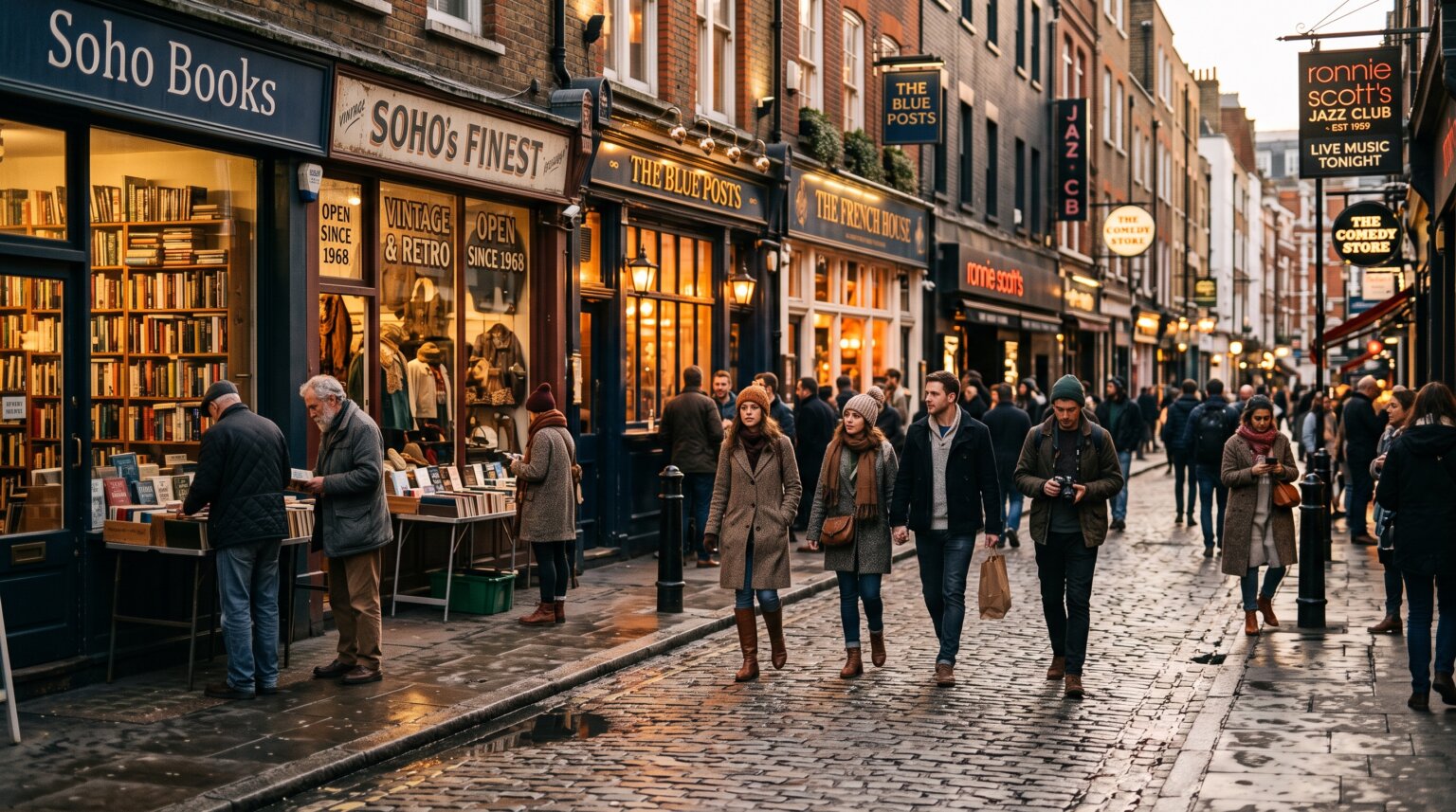
Virginia Woolf once described London’s Soho as a place “filled with fierce light” and “raw voices.” She wrote those words in the 1930s, when Soho was already pulsing with the energy of artists, immigrants, rebels, and dreamers who had nowhere else to go. That description still captures something essential about this square mile in the heart of the West End. Soho was never planned as a bohemian paradise. It became one through centuries of displacement, reinvention, and sheer refusal to conform.
If you walk through Soho today, you’ll find cocktail bars where jazz clubs once thundered, tech offices where artists once painted, and chain restaurants where immigrant families once ran coffee houses. But the ghosts are still there if you know where to look. To understand how Soho became London’s capital of bohemia, you have to trace a story that begins with a royal hunting park and ends with one of the most culturally significant neighborhoods in Europe.
Our team spent weeks digging through historical records, art archives, and firsthand accounts from people who lived in and loved Soho across the decades. What follows is the complete story of how a patch of farmland became the beating heart of London’s counterculture, and why that transformation still matters in 2026. This is how Soho became London’s capital of bohemia.
Table of Contents
From Royal Hunting Ground to London Neighborhood: The Origins of Soho
Soho’s story begins not with artists or rebels, but with a king. In 1536, Henry VIII confiscated farmland in central London and turned it into a royal hunting park. The land that would eventually become Soho was part of this royal chase, a playground for the Tudor court where deer roamed freely and common people were forbidden from entering.
The name “Soho” itself comes from a hunting cry. When hunters spotted game, they would shout “Soho!” to signal each other across the fields. The cry became associated with the area long after the hunting stopped. It is one of those strange historical accidents that a word shouted by Tudor huntsmen would eventually become synonymous with nightlife, art, and counterculture across the world.
After the royal park was broken up in the 17th century, the land gradually developed into a residential neighborhood. Soho became a parish in its own right during the late 1600s. The area attracted a mix of aristocrats, merchants, and tradespeople who built homes around what is now Soho Square. At this point, there was nothing bohemian about Soho. It was simply another growing London district, though its central location would soon set it on a very different path.
What made Soho different from other London neighborhoods was its position. Sitting just outside the old City of London walls, it occupied a liminal space. It was close enough to the centers of power to matter, but far enough to escape their tightest controls. That geographical in-betweenness would prove essential to everything that followed.
How Soho Became London’s Capital of Bohemia: The Huguenot Influence
The first real step in how Soho became London’s capital of bohemia came in the late 17th and 18th centuries with the arrival of French Huguenots. These Protestant refugees fled religious persecution in France after Louis XIV revoked the Edict of Nantes in 1685. Tens of thousands of Huguenots crossed the Channel seeking safety, and many settled in Soho.
The Huguenots transformed Soho almost overnight. They brought skills in silk weaving, watchmaking, and other crafts. They opened shops, established churches, and created a distinctly French atmosphere in the streets. Soho became known for its French churches, French restaurants, and French-speaking community. For the first time, the neighborhood had an identity that set it apart from the rest of London.
This immigrant wave established a pattern that would define Soho for centuries. Outsiders came to Soho because it offered something they could not find elsewhere: a community, relative tolerance, and affordable space to build new lives. The Huguenots were the first, but they would not be the last. Each wave of newcomers added another layer to Soho’s identity.
During the 18th century, Soho also rivaled Mayfair and St James’s as a fashionable London address. The area attracted the wealthy and the powerful. Greek Street and Old Compton Street were lined with elegant townhouses. But this period of aristocratic respectability would not last. By the 19th century, the wealthy had moved westward, and Soho began its transformation into something rougher, livelier, and far more interesting.
The 19th Century: Entertainment, Coffee Houses, and the Seeds of Counterculture
As the aristocracy departed, entertainment moved in. The 19th century saw Soho transform from a residential district into a hub of theatres, music halls, and drinking establishments. The nearby theatre district of the West End spilled over into Soho’s streets. Performers, writers, and stagehands needed affordable places to live and drink, and Soho provided both.
Coffee houses became central to Soho’s emerging identity. These were not the quiet, polite establishments you might imagine. Soho’s coffee houses were loud, smoky gathering places where ideas were exchanged, arguments were started, and reputations were made and destroyed. Writers, journalists, and political radicals gathered in these spaces to debate, scheme, and create. The coffee houses planted the intellectual seed that would eventually grow into full-blown bohemian culture.
The Italian community also established itself in Soho during this period, adding another layer of immigrant culture. Italian cafes, grocers, and restaurants opened along Old Compton Street and the surrounding lanes. This Italian influence would eventually give Soho its reputation as London’s center for continental food and drink.
By the end of the 19th century, Soho had become a neighborhood defined by its diversity and its refusal to be easily categorized. It was poor but vibrant, rough but creative, marginalized but central. The stage was set for the bohemian explosion that would follow in the 20th century.
The Cave of the Golden Calf and the Birth of Soho Nightlife
The true bohemian era of Soho began in 1912 with the opening of the Cave of the Golden Calf. Founded by Frida Strindberg, the estranged wife of playwright August Strindberg, this underground cabaret club on Heddon Street was unlike anything London had seen before. It was modeled on the cabarets of Paris and Munich, with avant-garde performances, modernist art on the walls, and a clientele that included some of the most daring creative minds of the era.
The Cave of the Golden Calf was short-lived, closing in 1914, but its impact was enormous. It introduced London to the concept of the nightclub as a space for artistic expression rather than mere drinking. It blurred the lines between art, performance, and social life in ways that would become central to Soho’s identity.
The club also marked the beginning of Soho’s LGBTQ+ heritage. The underground, anything-goes atmosphere attracted people who could not be open about their sexuality elsewhere. Soho was becoming a space where conventional rules did not apply, and that freedom attracted people from across the spectrum of society.
After the Golden Calf closed, the concept it pioneered spread. Bottle parties, essentially illegal after-hours drinking clubs, began operating in basements and back rooms across Soho. These were technically against the law, but enforcement was patchy. The bottle party culture of the 1920s and 1930s created the infrastructure for the nightlife boom that would define Soho for decades.
Jazz, Shim Sham, and Queer Black Artistic London
The 1930s and 1940s saw jazz transform Soho’s nightlife into something truly revolutionary. Jazz clubs opened along Dean Street, Greek Street, and Old Compton Street, bringing American and Caribbean musicians into the heart of London. These clubs were among the few spaces in Britain where Black and white people socialized as equals, at least inside the walls.
The Shim Sham Club, named after the popular tap dance routine, became a legendary gathering place for Black artists, musicians, and performers. American performers like Garland Wilson and Jimmie Daniels found in Soho an audience and a community that eluded them in more segregated spaces. The Shim Sham was more than a nightclub. It was a statement that Black artistic excellence deserved a home in London.
Queer artistic culture thrived alongside the jazz scene. Kenneth Macpherson, a writer and filmmaker associated with the modernist journal Close Up, was part of a network of queer artists who made Soho their creative base. These circles overlapped with the broader bohemian community, creating a culture where sexuality, race, and artistic ambition intersected in ways that challenged every convention of British society.
Police raids were a constant threat. Homosexuality was illegal, and venues that served mixed-race clientele attracted official attention. The community that formed in Soho’s jazz clubs and bottle parties was built on resilience as much as hedonism. Every raid, every closure, every arrest was met with quiet defiance. The clubs reopened. The musicians returned. Soho’s bohemian culture was not easily killed.
The Colony Room Club: Ground Zero of Bohemian Soho
If any single place represents how Soho became London’s capital of bohemia, it is the Colony Room Club. Founded in 1948 by Muriel Belcher at 41 Dean Street, this private drinking club became the epicenter of post-war British bohemian life. Belcher was a formidable figure who ran the club with sharp wit and absolute authority. She hand-picked her members, and getting through her door was a mark of artistic credibility.
Francis Bacon was the Colony Room’s most famous regular. The painter spent nearly every afternoon at the club, drinking, arguing, and holding court among the writers, artists, and eccentrics who gathered there. Bacon’s relationship with Soho was deep and enduring. He lived and worked in a chaotic studio above a shop on Reece Mews in South Kensington, but his spiritual home was the Colony Room. His paintings, with their raw violence and desperate beauty, seemed to capture something essential about Soho itself.
Nina Hamnett, known as the “Queen of Bohemia,” was another central figure. Hamnett was an artist and performer whose charisma and shamelessness made her a legend in Soho. She had studied art in Paris, sat for Modigliani, and brought the spirit of Montparnasse back to London. In Soho, she became a fixture, holding court in pubs and clubs with stories that stretched the boundaries of truth and fiction. Hamnett embodied the bohemian ideal: talent without compromise, freedom without apology.
Henrietta Moraes was the third member of what many consider the holy trinity of Colony Room bohemia. Moraes was a muse to Bacon and other artists, a writer, and one of the most vivid personalities in Soho. Her memoirs captured the chaos and brilliance of the scene with unflinching honesty. Together, Bacon, Hamnett, and Moraes created a mythology around the Colony Room that still colors how people think about Soho today.
The club was famously described as a place where “the walls sweated gin.” The décor was deliberately awful. The conversation was brutal. The drinking was heroic. But within those cramped walls, something genuinely important happened. Artists found validation for work that the mainstream dismissed. Outsiders found acceptance that society denied them. The Colony Room was, for nearly sixty years, the beating heart of bohemian Soho.
Post-War Soho: Sanctuary from Austerity
To understand why Soho became so important in the 1940s and 1950s, you have to understand the context of post-war Britain. The country was exhausted, impoverished, and subject to strict rationing that lasted until 1954. Food was scarce, clothes were rationed, and the dominant mood was one of grey conformity. The war had demanded sacrifice, and the peace that followed demanded more of the same.
Soho offered an alternative. In a city defined by austerity, Soho was a place of abundance, or at least the illusion of it. Italian restaurants served real espresso. French cafes offered wine. The jazz clubs played American records that the BBC would not touch. Soho was a window onto a wider, more colorful world at a time when Britain felt smaller than ever.
By the mid-twentieth century, Soho could legitimately claim to be one of the bohemian capitals of Europe, rivalled only by the Left Bank of Paris. The comparison was not casual. Both districts shared the same essential ingredients: cheap rents, immigrant communities, a tolerance for eccentricity, and a concentration of artists who reinforced each other’s refusal to conform. The Left Bank had Sartre and de Beauvoir. Soho had Bacon and Hamnett. The geography was different, but the spirit was the same.
For many who lived through that era, Soho was not just a neighborhood. It was a sanctuary. People who did not fit anywhere else, whether because of their sexuality, their politics, their art, or their personality, found in Soho a community that accepted them. That acceptance was not always gentle. Soho could be cruel, exploitative, and dangerous. But it was real in a way that the rest of respectable society was not.
The 1960s and Beyond: Counterculture, Music, and Changing Times
The 1960s brought a new wave of cultural energy to Soho. The decade’s explosion of music, fashion, and youth culture rippled through the neighborhood’s streets. The 2i’s Coffee Bar on Old Compton Street, which had been a skiffle hotspot in the 1950s, helped launch careers that would define British rock and roll. Soho’s music venues became proving grounds for bands that would soon fill stadiums.
The gay rights movement also found a home in Soho. As homosexuality moved slowly toward decriminalization, which finally arrived in England and Wales in 1967, Soho’s gay bars and clubs became increasingly visible. Old Compton Street emerged as the center of London’s LGBTQ+ community, a role it still plays today. The connection between bohemian culture and queer liberation was not coincidental. Both were rooted in the same fundamental demand: the right to be yourself.
Through the 1970s and 1980s, Soho maintained its reputation as a place where anything could happen. The sex industry that had been part of Soho’s landscape since the 19th century reached its peak visibility, with strip clubs and adult shops lining many streets. This was the era that gave Soho its “seedy” reputation, a reputation that was simultaneously accurate and incomplete. The sex industry coexisted with art galleries, independent publishers, music venues, and restaurants that were among the best in London.
The drug culture also left its mark. Soho’s reputation for heroin and other substances in the 1970s and 1980s was well-earned, and it destroyed lives. The bohemian ideal of freedom had a dark side that could not be ignored. But even this darkness was part of the same story. Soho attracted people who lived at the edge, and edges can be dangerous places.
Modern Soho: Gentrification, Loss, and Legacy
Walk through Soho today and you will hear a common complaint from longtime residents and visitors: Soho is becoming boring, clinical, and expensive. The concerns are real. Rising rents have forced out many of the independent venues, cafes, and clubs that gave Soho its character. Tech companies have moved into former nightspots. Chain restaurants have replaced family-run businesses that operated for generations.
The Colony Room Club closed in 2008, ending an era that had lasted sixty years. The Astoria, a legendary music venue, was demolished to make way for Crossrail construction. The 12 Bar Club, a tiny but beloved live music space on Denmark Place, closed its doors. Each closure felt like another piece of bohemian Soho slipping away.
But reports of Soho’s death have been greatly exaggerated. The neighborhood has always been in flux. The Huguenots gave way to the Italians, who gave way to the jazz crowd, who gave way to the counterculture generation. Each era mourned what came before while creating something new. The question is whether what is being created now matches the creative energy of what is being lost.
Old Compton Street remains the heart of London’s LGBTQ+ scene. Independent bookshops and record stores still cling on. Small galleries and pop-up venues continue to open. The Soho Theatre on Dean Street champions new comedy and performance. Walk down Greek Street at midnight and you will still find something unexpected. Soho is diminished, perhaps, but not dead. Its identity has always been about reinvention, and reinvention requires loss.
What remains of bohemian Soho is harder to measure than what has been lost. The spirit of the place, the willingness to be different, the refusal to conform, the acceptance of outsiders, does not show up in property listings. But it shows up in the people who still choose Soho as their home, their workplace, or their night out. They keep the flame alive, even if the flame burns smaller than it once did.
FAQs
Why do they call it Soho in London?
The name ‘Soho’ comes from a hunting cry used during the Tudor period. When King Henry VIII turned the area into a royal hunting park in 1536, hunters would shout ‘Soho!’ to signal that they had spotted game. The cry became permanently associated with the area long after hunting ended.
Is Soho still seedy?
Soho today is far less seedy than it was in the 1970s and 1980s. Gentrification has replaced many of the adult entertainment venues with cocktail bars, restaurants, and offices. However, Soho still retains an edge that sets it apart from other London neighborhoods. The sex industry has not entirely disappeared, but it is far less visible than it once was. Most visitors today experience Soho as a lively nightlife and dining district rather than anything particularly rough.
Why is Soho London so famous?
Soho is famous for its bohemian history, diverse immigrant communities, legendary nightlife, and LGBTQ+ culture. Over centuries, it has been home to French Huguenots, Italian immigrants, jazz musicians, painters like Francis Bacon, and writers like Virginia Woolf. It was the center of London’s counterculture from the 1940s through the 1960s, and it remains the heart of the city’s LGBTQ+ community along Old Compton Street.
Which Soho came first, London or NY?
London’s Soho came first by a wide margin. London’s Soho got its name in the 16th century from a Tudor hunting cry. New York’s SoHo, which stands for South of Houston Street, was coined in the 1960s as a real estate and planning designation. The two neighborhoods share a bohemian reputation, but London’s Soho has a cultural history that predates New York’s SoHo by roughly four centuries.
What did Soho used to be called?
Before it was called Soho, the area did not have a single distinct name because it was largely farmland and open fields on the edge of medieval London. It became known as Soho after King Henry VIII converted it into a royal hunting park in 1536. The name stuck from the hunting cry and has been used to describe the area ever since the 17th century, when it began developing into a residential neighborhood.
Is Soho in London still a red light district?
Soho no longer functions as a red light district in the way it once did. Walk-up flats still exist in certain alleys, but their numbers have dropped significantly due to gentrification, licensing changes, and police enforcement. The visible sex industry that defined Soho in the 1970s and 1980s has largely been replaced by mainstream nightlife, restaurants, and entertainment venues.
Conclusion: The Enduring Spirit of Soho
The story of how Soho became London’s capital of bohemia is really a story about what happens when a place becomes a refuge for people who do not fit anywhere else. From the Huguenot refugees of the 17th century to the jazz musicians of the 1940s to the LGBTQ+ community of today, each generation of outsiders has added a layer to Soho’s identity. No single group created bohemian Soho. It was built collectively, over centuries, by people who needed freedom more than respectability.
That spirit is under pressure now. Gentrification, rising rents, and cultural homogenization threaten to turn Soho into just another expensive neighborhood. But Soho has survived transformations before. The question for 2026 and beyond is whether the people who value Soho’s bohemian heritage can preserve enough of it to pass on to the next generation. The physical venues may disappear, but the idea of Soho, a square mile where you can be whoever you are, is harder to demolish than any building.
Soho’s bohemian story is not finished. It is simply waiting for its next chapter, and whoever writes it will be standing on the shoulders of every artist, immigrant, rebel, and dreamer who came before.