
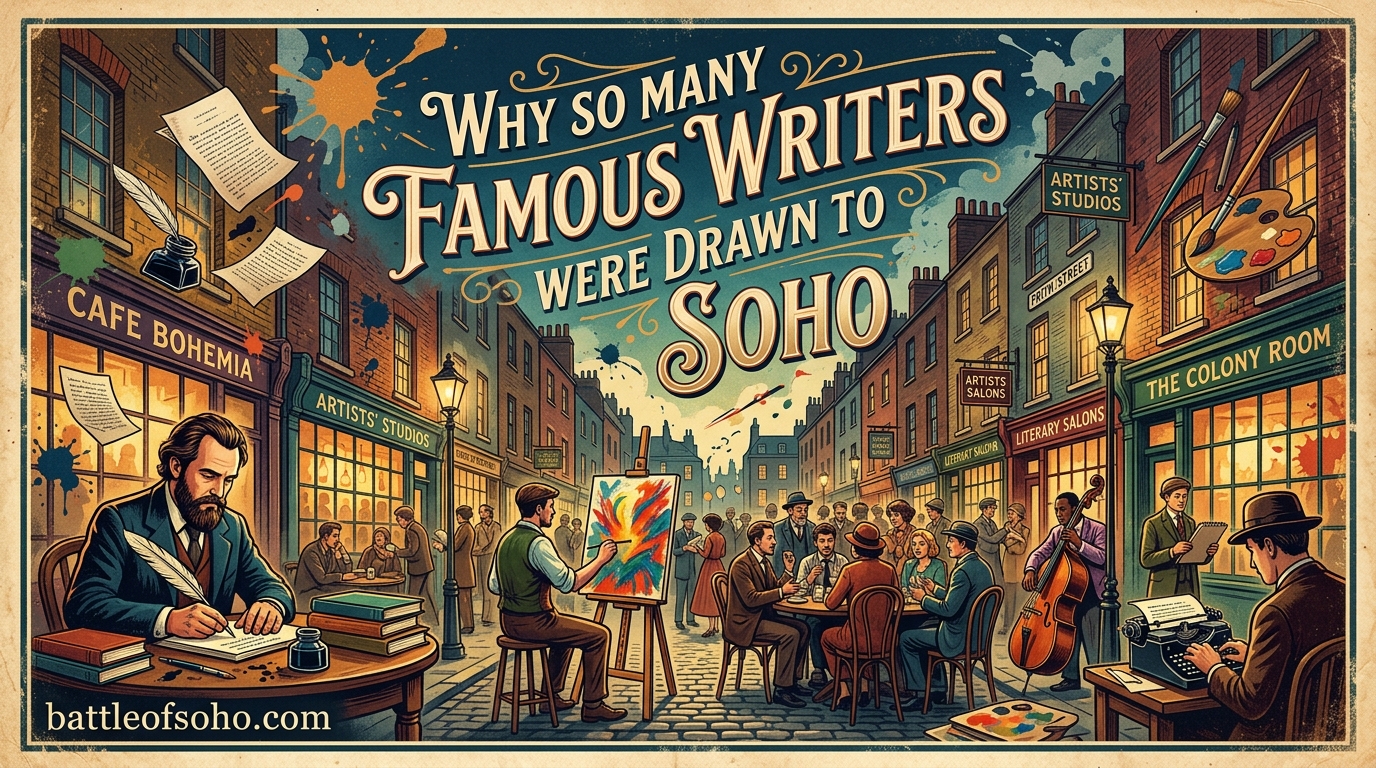
Walk down the cobblestone streets of SoHo today and you will find luxury boutiques, high-end galleries, and multimillion-dollar apartments. But beneath the polished surface lies a story of creative rebellion that changed urban culture forever. Understanding why so many famous writers and artists were drawn to Soho means looking past the designer storefronts to a time when this Manhattan neighborhood was something altogether different: cheap, empty, and full of possibility.
In the 1960s and 1970s, SoHo was an unlikely magnet for creative people. It had been abandoned by industry, ignored by city planners, and left to decay. Yet within a single generation, it transformed into one of the most important artist communities in the world. Painters, sculptors, writers, and performers flooded in, drawn by enormous loft spaces, affordable rent, and the freedom to work without interference.
This article traces the full arc of that transformation. We will explore the industrial roots that created SoHo’s iconic architecture, the loft-living revolution that pulled artists in, the famous names who called these blocks home, and the rezoning battle that legalized an entire way of life. We will also look at London’s Soho as a parallel creative hub and examine how gentrification ultimately displaced the very community that put these neighborhoods on the cultural map.
Table of Contents
From Factories to Canvas: SoHo’s Industrial Origins
Before it was an arts district, SoHo was a powerhouse of manufacturing. The neighborhood, whose name comes from its location “South of Houston Street,” was packed with textile factories, dry goods warehouses, and printing presses through the 19th and early 20th centuries. Merchants built grand commercial buildings with cast-iron facades that mimicked the look of carved stone at a fraction of the cost.
By the mid-1900s, though, industry was leaving. Factories shuttered, businesses moved elsewhere, and whole blocks of cast-iron buildings sat empty. The area became known informally as “Hell’s Hundred Acres,” a nickname that reflected its bleak, industrial wasteland feel. Property values cratered. The city government saw so little value in the area that Robert Moses proposed running the Lower Manhattan Expressway straight through it, which would have demolished dozens of historic buildings.
That very emptiness and neglect became the foundation for everything that followed. Vacant industrial floors meant cheap, abundant space. Nobody wanted to live there, which meant nobody was watching who did. For artists who needed room to paint, sculpt, or rehearse and had almost no money to spend, this abandoned corner of Manhattan was not a dead end. It was an open door.
The Loft Living Revolution: Why Artists Moved to SoHo in the 1960s
So why did artists move to SoHo specifically? The answer comes down to three things: space, light, and price. The former factory floors were enormous compared to typical New York apartments, often running 2,000 to 5,000 square feet with wide-open layouts. They had massive windows designed to let natural light flood in for factory workers, which turned out to be ideal for painters and photographers who needed consistent illumination.
Rent was absurdly cheap by Manhattan standards. In the early 1960s, an artist could lease an entire floor of a SoHo building for the price of a small studio apartment elsewhere in the city. For people making little or no money from their creative work, this was the difference between having a practice and giving up. The spaces were raw and unheated, with exposed pipes and freight elevators, but they offered something no traditional apartment could: room to actually make art.
There was a catch, though. Living in these spaces was technically illegal. The buildings were zoned for manufacturing, not residential use, which meant no one was supposed to sleep there. Artists moved in anyway, quietly converting lofts into live-work spaces. They installed makeshift kitchens, slept on sleeping bags, and lived with the constant risk of eviction or building inspectors showing up. This precarious existence forged a tight-knit community where neighbors looked out for each other and shared resources.
The creative energy was unlike anything else in New York. You could walk down a single block and pass the studios of a minimalist sculptor, an experimental filmmaker, a jazz composer, and a conceptual painter, all working within a few hundred feet of each other. That density of creative talent feeding off one another became a magnet in itself. Artists did not just come for the space. They came for each other.
Cast-Iron Architecture: The Visual Magnet
SoHo’s built environment was not just practical for artists. It was genuinely beautiful, in a way that no other Manhattan neighborhood could match. The district contains the largest collection of cast-iron architecture in the world, with over 250 cast-iron buildings concentrated in a roughly 26-block area. These structures, built primarily between 1840 and 1880, feature ornate facades mass-produced from iron components that could be assembled on-site.
The buildings offered a visual grandeur that belied their industrial origins. Facades were designed to mimic European palazzos, with Corinthian columns, arched windows, and elaborate cornices. The Haughwout Building at the corner of Broome Street, built in 1857, featured the world’s first successful passenger elevator and a stunning Venetian Renaissance facade. For artists arriving from cramped walk-ups and dreary studio spaces, these soaring, light-filled buildings felt like cathedrals of creative possibility.
The architecture also became a rallying point for preservation. When artists realized how special these buildings were, they became some of the earliest and most vocal advocates for historic preservation in New York. The SoHo Cast-Iron Historic District was designated in 1973, protecting a core collection of buildings from demolition. Without the artists who saw the beauty in these forgotten structures, much of this architectural heritage would likely have been destroyed.
Famous Artists Who Made SoHo Their Home
When we talk about why so many famous writers and artists were drawn to Soho, the names themselves tell the story. Donald Judd, one of the most important minimalist artists of the 20th century, moved into 101 Spring Street in 1968. He bought the entire five-story cast-iron building for around 68,000 dollars, a price that sounds impossible today. Judd installed his work across the floors and lived there until his death, permanently linking his name to SoHo’s artistic identity.
George Maciunas, the Lithuanian-born founder of the Fluxus movement, was arguably the single most important figure in turning SoHo into an artist community. Starting in the late 1960s, Maciunas created the Fluxhouse Cooperatives, a series of artist-owned cooperatives that purchased buildings in SoHo and converted them into live-work spaces. He was essentially building an artist colony one building at a time, and he sold shares to artists for practically nothing. His vision was utopian: a neighborhood where artists owned their spaces and controlled their own creative destinies.
Chuck Close, the renowned photorealist portrait painter, lived and worked in SoHo for decades. His enormous studio on Bond Street became legendary in the art world. Sol LeWitt, the pioneer of conceptual and minimalist art, maintained a studio in the neighborhood. Frank Stella, one of the most celebrated abstract painters alive, worked in SoHo as well. The concentration of major artistic talent in such a small area was unprecedented.
Beyond individual artists, SoHo became defined by its galleries. In the early 1970s, galleries began migrating from the traditional art district of 57th Street to SoHo’s cheaper, larger spaces. By the mid-1970s, West Broadway and Greene Street were lined with cutting-edge galleries showing minimalism, conceptual art, and new media. The Paula Cooper Gallery, the first gallery to open in SoHo, hosted landmark exhibitions. For a decade, SoHo was the center of the contemporary art world.
Why Writers Were Drawn to SoHo’s Creative Ecosystem
The visual artists get most of the attention in SoHo’s origin story, but writers were part of this ecosystem too. The question of what made SoHo attractive to writers specifically has a slightly different answer. Writers were drawn less by the loft spaces themselves and more by the creative community that had already taken root there. Being surrounded by painters, sculptors, musicians, and filmmakers provided a cross-pollination of ideas that you could not find in a traditional literary neighborhood.
Many writers found that proximity to the avant-garde art scene pushed their own work in new directions. The literary community that formed in and around SoHo was deeply connected to the art world. Poets collaborated with visual artists on limited-edition books. Novelists reviewed gallery shows. Essayists wrote about the transformation happening around them. The neighborhood itself became a subject and a stimulus.
The SoHo scene also overlapped with the broader downtown literary culture of the 1970s and 1980s. Writers associated with the Poetry Project at St. Mark’s Church, the New York School poets, and the emerging Language Poetry movement all circulated through SoHo’s galleries, bars, and performance spaces. The neighborhood functioned as a meeting point between the literary world and the art world, creating a fusion that defined a generation of New York intellectual life.
London’s Soho tells a parallel story on the literary side. London Soho has been associated with writers and bohemian culture for centuries. The Pillars of Hercules pub on Greek Street was a famous literary hangout where poets like Ian Hamilton gathered. Karl Marx lived in Dean Street in the 1850s. The area’s cheap rooms, cosmopolitan atmosphere, and concentration of newspapers and publishing houses made it a natural home for writers who lived on the margins of respectable society. The literary history of London Soho runs deep, from the coffee house culture of the 18th century to the Soho Reading Series that continues to draw literary crowds today.
London SoHo vs New York SoHo: Two Creative Legacies
People often confuse the two Sohos, and while they share a name and a creative legacy, their stories are distinct. London’s Soho developed as a cosmopolitan entertainment district as far back as the 17th century. It was known for its immigrant communities, its music halls, its nightclubs, and its tolerance for unconventional lifestyles. Writers and artists were drawn to that atmosphere of freedom and excess long before New York’s SoHo existed as a concept.
London Soho’s literary and artistic roster is staggering. Francis Bacon kept a studio at 7 Reece Mews for over thirty years, creating some of the most important paintings of the 20th century in a space so chaotic that it became a work of art itself. The Colony Room, a private members’ club on Dean Street, was the epicenter of Soho’s postwar artistic and literary scene. Its patrons included Bacon, Lucian Freud, and a rotating cast of writers, actors, and bohemians.
New York’s SoHo, by contrast, was a much more recent creation. It did not emerge as an artist community until the 1960s, and its appeal was rooted in physical space rather than entertainment culture. Where London Soho offered social freedom and nightlife, New York SoHo offered raw square footage and architectural grandeur. Both neighborhoods attracted creative people, but for very different reasons. Understanding both stories gives a fuller picture of how urban neighborhoods become creative hubs.
The 1971 Rezoning: When Artists Fought Back
The illegal status of loft living hung over SoHo’s artist community like a sword. Artists could be evicted at any time. Buildings could be condemned. The city could decide to enforce zoning codes and kick everyone out. This precarious situation came to a head in the late 1960s, when artists organized to demand legal recognition of their way of life.
The SoHo Artists Association formed in 1968 to advocate for the rights of artists living in the neighborhood. The group was led by figures like Shael Shapiro, an artist and architect who became one of the most effective advocates for the community. They faced powerful opposition from city planners who still wanted to build the Lower Manhattan Expressway and from building owners who saw an opportunity to cash in on the growing interest in the area.
The breakthrough came through a combination of grassroots organizing and smart political strategy. The artists enlisted the help of Chester Rapkin, a University of Pennsylvania planning professor who conducted a detailed study showing that artists living in SoHo were not a nuisance but a stabilizing presence. His report demonstrated that artist-occupied buildings were better maintained and safer than vacant ones. This data gave city officials the cover they needed to support a zoning change.
In 1971, the New York City Planning Commission approved the creation of a special zoning district that allowed certified artists to live legally in SoHo’s manufacturing buildings. This was the Joint Living Work Quarters for Artists, or JLWQA, provision. To qualify, residents had to be certified as artists by the city’s Department of Cultural Affairs. This rezoning was a landmark moment in urban planning. It was one of the first times a major American city officially recognized artist housing as a legitimate land use, and it became a model for other cities grappling with similar issues.
Gentrification: What Happened to the Artist Community?
The legalization of loft living solved one problem but created another. Once SoHo was an officially recognized residential area, it became attractive to people with much deeper pockets than working artists. The very qualities that artists had discovered and fought to preserve, the large spaces, the beautiful architecture, the cobblestone-street charm, became selling points for affluent professionals who wanted a piece of downtown cool.
The transformation accelerated through the 1980s and 1990s. Rents soared. Galleries were pushed out as retail rents exceeded what they could afford. Chain stores and luxury brands moved in, replacing the experimental spaces that had defined the neighborhood. Artists who had bought buildings in the 1960s for tens of thousands of dollars found themselves sitting on properties worth millions, but those who had only rented were steadily priced out.
When did SoHo become gentrified? The process was gradual but visible by the early 1980s and largely complete by the late 1990s. Today, SoHo is one of the most expensive neighborhoods in Manhattan. The median apartment price runs well into the millions. The artist community that created SoHo’s cultural identity has largely scattered to other boroughs and other cities, chasing the same combination of cheap space and creative community that SoHo once offered.
Yet the legacy persists. The cast-iron buildings that artists fought to preserve still stand, protected by landmark designation. The Fluxhouse Cooperatives that Maciunas created still function as artist-owned buildings. The 1971 rezoning provision remains on the books, still requiring that certain SoHo lofts be occupied by certified artists. The neighborhood’s artistic DNA is baked into its legal and physical infrastructure, even if the daily reality has changed beyond recognition.
Many of the people who lived through SoHo’s artist era see it as a cautionary tale about how creative communities gentrify themselves out of existence. Artists move into cheap, overlooked areas, make them culturally desirable, and then get priced out by the very desirability they created. This pattern has repeated in neighborhoods across New York and around the world, from the East Village to Williamsburg to Berlin’s Kreuzberg. SoHo was one of the first and most dramatic examples of this cycle.
FAQs
Why is SoHo so famous?
SoHo is famous for having the world’s largest collection of cast-iron architecture and for transforming from an abandoned industrial district into a groundbreaking artist community in the 1960s and 1970s. It became the center of the avant-garde art world and pioneered legal artist loft living through the landmark 1971 rezoning.
When did SoHo become a thing?
SoHo emerged as a distinct neighborhood name in the early 1960s, when city planner Chester Rapkin coined the term ‘SoHo’ (South of Houston) in a study. The area’s identity as an artist community solidified between 1968, when the SoHo Artists Association formed, and 1971, when the city legalized artist loft living through a special zoning provision.
Is SoHo a wealthy area?
Yes, SoHo is now one of the wealthiest and most expensive neighborhoods in Manhattan. Once known for cheap loft rents that attracted struggling artists, today the area is dominated by luxury boutiques, high-end galleries, and multi-million dollar apartments. The median property value ranks among the highest in New York City.
When did SoHo become gentrified?
SoHo’s gentrification began in the early 1980s as the neighborhood’s artistic reputation attracted wealthier residents and retail businesses. By the late 1990s, the transformation was largely complete, with luxury brands replacing galleries and rents soaring far beyond what working artists could afford. The artist community that built SoHo’s identity was largely displaced by the commercialization it unintentionally triggered.
What famous artists lived in SoHo?
Donald Judd, Chuck Close, Sol LeWitt, Frank Stella, and George Maciunas were among the most famous artists who lived and worked in SoHo. Maciunas was particularly influential as the founder of the Fluxhouse Cooperatives, which purchased buildings and converted them into artist-owned live-work spaces. Gallery owners like Paula Cooper also helped establish SoHo as the center of the contemporary art world in the 1970s.
Why were writers drawn to SoHo specifically?
Writers were drawn to SoHo because of its dense concentration of visual artists, musicians, and filmmakers who created a stimulating cross-disciplinary creative environment. The neighborhood offered proximity to cutting-edge galleries, performance spaces, and a bohemian culture that encouraged experimentation. London’s Soho offered a parallel attraction through its literary pubs, publishing houses, and centuries-old reputation as a cosmopolitan haven for unconventional thinkers.
The Enduring Legacy of SoHo’s Creative Spirit
The story of why so many famous writers and artists were drawn to Soho is really a story about what happens when creative people find space, community, and freedom at the same time. SoHo offered all three in a combination that no other neighborhood could match. The artists who arrived in the 1960s were not urban planners or real estate developers. They were people who needed affordable room to work and who found it in a forgotten corner of Manhattan that nobody else wanted.
What they built there changed art, architecture, and urban policy. The cast-iron buildings they preserved are now internationally recognized treasures. The loft-living model they pioneered has been copied in cities around the world. The 1971 rezoning they fought for remains a landmark in the legal recognition of artist housing. And the creative energy they generated during those few decades still defines how we think about the relationship between art and urban space.
If you want to understand the full scope of this transformation, walk the blocks between Houston and Canal Streets and look up at those cast-iron facades. Imagine them abandoned and dark, then imagine them lit by the studios of some of the most important artists of the 20th century. That is the story of SoHo, and it is still being written today, wherever artists find the space and the courage to build something new.