
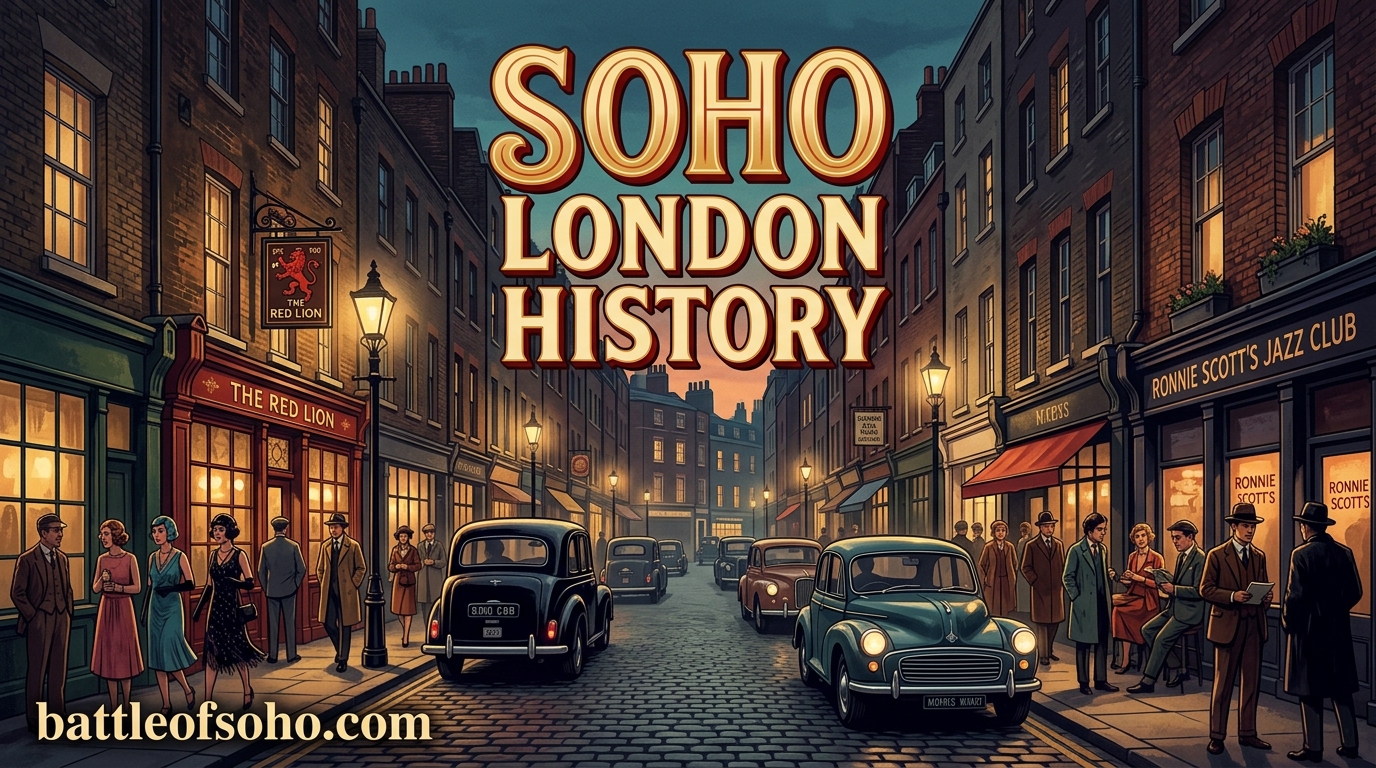
Picture London in 1921. The Great War has just ended, jazz is pouring out of basement clubs on Frith Street, and a woman named Kate Meyrick is building a nightclub empire that will land her in prison multiple times. Not far away, Brilliant Chang is running an empire of a different kind from a quiet Soho backstreet. The BBC recently dramatized this world in Dope Girls, but the real story is wilder than any television script.
This is the story of how Soho became the most notorious neighborhood in London. Not overnight, and not by accident. It took 400 years of waves crashing against the same square mile: refugees, artists, gangsters, musicians, sex workers, filmmakers, and dreamers who were not welcome anywhere else in the city.
Soho’s notoriety was not a single event or a single era. It was built in layers, each one settling on top of the last without ever quite erasing what came before. The Huguenot silk weavers of the 1680s left their streets and their French influence. The Victorian slums left their alleyways and their poverty. The razor gangs of the 1920s left their legends. The rock and roll explosion of the 1950s left its music. The red light district left its walk-ups and its neon glow.
Walk through Soho today and you can still feel every layer, if you know where to look. That is what makes this neighborhood unlike any other in London, or arguably anywhere in the world. Understanding how Soho earned its infamy means following a timeline that runs from royal hunting grounds to organized crime syndicates to the birthplace of British rock and roll, and finally to the gentrification battles that rage on in the present day.
Table of Contents
Before the Streets: A Royal Hunting Ground
Soho’s story begins not with vice but with royalty. In 1536, Henry VIII confiscated land from Westminster Abbey and turned it into a royal hunting park. The area we now call Soho was open fields and woodland, stocked with deer for the king’s sport.
The name itself likely comes from a hunting cry. When hunters spotted their prey, they would shout “Soho!” to signal the catch. The cry became attached to the land, and the land kept the name long after the deer were gone.
For over a century, the area remained rural. That changed in the 1660s, during the Restoration period under Charles II. The king granted parcels of land to aristocrats and developers, hoping to create an elegant new residential district to rival the West End’s growing prestige.
The Duke of Monmouth, Charles II’s illegitimate son, received a large tract and began laying out streets. Soho Square was built as the centerpiece of this new neighborhood, surrounded by grand houses meant for the wealthy elite. For a brief moment, it looked like Soho might become one of London’s most fashionable addresses.
It did not work out. The aristocrats who built homes in Soho soon discovered that the area was too close to the noise, smoke, and crowding of the expanding city. Worse, the land to the west, which would become Mayfair, was being developed with larger plots, wider streets, and better planning. One by one, the wealthy packed up and moved west.
What they left behind was a grid of streets and houses with no residents of means. Rents collapsed. The properties were subdivided, sublet, and filled with whoever was willing to pay. That is how Soho’s identity as a neighborhood of outsiders was born, not from a grand plan but from a real estate failure that opened the door to everyone polite society had rejected.
The Huguenot Wave: How Refugees Shaped Soho’s Identity
The first major group to flood into Soho’s empty houses was the Huguenots. These were French Protestants who faced violent persecution after Louis XIV revoked the Edict of Nantes in 1685. The edict had previously granted them religious freedom, and its revocation meant they had to convert to Catholicism, face imprisonment, or flee.
Thousands of Huguenots escaped to London, and many of them settled in Soho. They brought skills that the city desperately needed, particularly in silk weaving, goldsmithing, and watchmaking. The cheap rents and empty houses of Soho were perfect for setting up workshops and living above the trade.
Within a generation, Soho had become unmistakably French. The streets were filled with the sound of the language, the smell of French cooking, and the rhythm of a community that maintained its own churches, schools, and customs. Dean Street, Frith Street, and Old Compton Street all took on a distinctly Gallic character.
This French influence never fully left. During World War II, The French House on Dean Street became the unofficial headquarters of the Free French forces in London. General de Gaulle himself reportedly drank there, and the pub still serves its beer in half-pints today, a tradition that began when it was a favored meeting spot of the French resistance in exile.
The Huguenot settlement established a pattern that would define Soho for centuries. Each new wave of arrivals, whether Italians, Greeks, Germans, or Chinese, found the same welcome that the Huguenots had found. Cheap rents, a community of outsiders already in place, and a tolerance for anyone who did not fit into mainstream London society. Soho became the neighborhood where being different was the only thing everyone had in common.
That openness to strangers was the foundation of everything that followed. A neighborhood built by refugees was always going to attract people living on the margins. And people living on the margins were always going to attract the industries that served them, including some that operated outside the law.
Victorian Soho: Slums, Cholera, and the Making of a Slum Legend
By the mid-19th century, Soho had become one of London’s most crowded and impoverished districts. The grand houses built for aristocrats had been chopped into tenements. Entire families lived in single rooms. The population density was staggering even by Victorian standards.
The narrow streets and back alleys became notorious for crime. London Historians have described how each building could hide a thieves’ kitchen in the basement and a gambling den in the attic. The Berwick Street area was a maze of courts and passages where police were reluctant to venture after dark. This is where the concept of Soho as a dangerous, lawless place took firm root in the public imagination.
Prostitution was rampant and largely open. With so many people living in desperate poverty, sex work was one of the few economic options available to women who had no other means of support. The trade operated in plain sight, on street corners and in the cramped rooms above shops, and it attracted customers from across the rapidly growing city.
In 1854, Soho became ground zero for one of the most important moments in medical history. A devastating outbreak of cholera struck the Broad Street area, killing over 600 people in a matter of days. The conventional wisdom at the time blamed cholera on “bad air,” or miasma, rising from the filthy streets and overflowing cesspits.
A physician named John Snow refused to accept that explanation. He methodically mapped every cholera death and discovered that they clustered around a single public water pump on Broad Street. He convinced the local Board of Guardians to remove the pump handle, and the outbreak stopped. Snow’s investigation proved that cholera was waterborne, not airborne, and it founded the science of epidemiology.
Today, the John Snow pub on Broadwick Street, renamed from Broad Street, stands near the site of the original pump. It is one of the few places in London named after a scientist rather than a monarch or a military hero. A pink granite kerbstone outside marks the actual pump location.
During this same period, a bearded German exile was writing in the reading room of the British Museum and living in cramped rooms on Dean Street. Karl Marx resided at 28 Dean Street from 1851, and it was here, amid the poverty and chaos of Victorian Soho, that he developed the ideas that would become Das Kapital. The squalor he witnessed outside his door was not abstract theory. It was daily life.
The Victorian era cemented Soho’s reputation as London’s most desperate and dangerous neighborhood. But it also established something else: the idea that Soho was a place where ideas, both dangerous and brilliant, could take root. The same streets that bred disease and crime nurtured revolutionary philosophy and groundbreaking science.
Razor Gangs and the Roaring Twenties
The end of World War I transformed Soho. Soldiers returned from the trenches looking for pleasure, and Soho was ready to provide it. The neighborhood that had been a Victorian slum reinvented itself as London’s entertainment capital, with nightclubs, dance halls, and speakeasies springing up in every available basement and back room.
The 1920s also brought a new kind of criminal to Soho’s streets. The razor gangs were organized groups of young men who fought territorial battles using cutthroat razors as their weapon of choice. They controlled protection rackets, ran illegal drinking dens, and enforced the will of nightclub owners who paid for their services.
This is where the BBC’s Dope Girls finds its real-world inspiration. The show dramatizes the intersection of nightclubs, drugs, and organized crime in post-war Soho, and the historical reality is just as dramatic. Kate Meyrick, the so-called Queen of Soho Nightclubs, built an empire of venues including the famous 43 Club. She was raided repeatedly, imprisoned five times, and eventually died in prison in 1933.
Billy Brill, whose real name was Brilliant Chang, ran a restaurant on Regent Street that served as a front for a drug distribution network. His story became entangled with the death of actress Freda Kempton in 1922, and the resulting scandal fueled a moral panic about Chinese-run drug rings operating in Soho. The truth was more complicated than the headlines, but the legend of Soho as a place of exotic danger took hold and never really let go.
These were not small-time operators. The money flowing through Soho’s nightlife scene was enormous, and much of it was being laundered through legitimate businesses. Restaurants, bars, and shops provided cover for cash from drugs, gambling, and protection rackets. This established a financial infrastructure of organized crime that would persist in Soho for decades.
The 1920s also solidified Soho’s reputation as the place to go for illicit entertainment. Anyone in London who wanted to drink after hours, gamble, find drugs, or simply experience something forbidden knew that Soho was the destination. Respectable society condemned the neighborhood in public and frequented it in private, a double standard that became part of Soho’s enduring identity.
It is worth noting that women were not just passive figures in this world. Beyond Kate Meyrick, there were female gang members, club managers, and entrepreneurs who built lives of independence and power in a society that offered women few legal options. Soho’s lawlessness created space for people who existed outside conventional social structures, and that included women who refused to accept the limitations placed on them elsewhere.
The Birthplace of British Rock and Roll
After World War II, Soho entered its most creatively explosive period. The cheap rents and tolerant atmosphere that had attracted immigrants and criminals for centuries now attracted a new generation of musicians, artists, and writers. The result was nothing less than the birth of British popular music.
The 2i’s Coffee Bar on Old Compton Street is where it all started. Opened in 1956, this tiny basement cafe became the epicenter of the skiffle craze and then the rock and roll explosion. Tommy Hicks, who would become Tommy Steele, Britain’s first rock and roll star, was discovered playing at the 2i’s. So were Adam Faith, Cliff Richard, and countless others who would define British pop music for the next two decades.
The Marquee Club, originally on Oxford Street before moving to Wardour Street, became the most important venue in British rock history. The Rolling Stones played their first gig there in 1962. The Who, David Bowie, Jimi Hendrix, and Led Zeppelin all performed on its stage. The Marquee was not just a venue. It was the proving ground where British rock and roll was forged.
Ronnie Scott’s Jazz Club, opened in 1959 on Gerrard Street before moving to Frith Street, brought world-class jazz to London. Count Basie, Ella Fitzgerald, and Chet Baker all played there. Ronnie Scott’s gave Soho a musical credibility that went beyond pop hits, connecting the neighborhood to a global jazz tradition.
Wardour Street became the center of the British film industry. Production companies, editing suites, and post-production houses lined the street, making Soho the physical hub of UK cinema and television. The film industry and the music industry existed side by side with the vice trade, and there was a reason for that overlap.
The connection between Soho’s seediness and its creativity was not coincidental. Cheap rents allowed young artists to live and work there. The lack of respectability meant that no one was policing what kind of art got made. The all-night culture of clubs and bars provided places to perform, socialize, and find collaborators. And the constant presence of people living outside mainstream norms created an atmosphere where experimentation was not just tolerated but expected.
The Colony Room on Dean Street, a private members’ club run by Muriel Belcher from 1948, became the drinking den of choice for some of Britain’s greatest painters. Francis Bacon was a fixture there, as was Lucian Freud. The art they made was as raw and unapologetic as the neighborhood that nurtured it. Bacon’s studio at 7 Reece Mews was just a short walk from the Colony Room, and the two locations formed the axis of his creative life.
The Red Light District: Maltese Gangsters and the Vice Trade
While the music and art worlds flourished, Soho’s other industry was also reaching its peak. By the 1960s and 1970s, Soho had become London’s undisputed red light district, with an estimated 250 or more establishments dedicated to the sex trade at the height of the era.
Strip clubs, peep shows, massage parlors, and walk-up brothels operated openly across the neighborhood. The walk-ups, in particular, became a defining feature of Soho’s streetscape. These were small flats, usually on the first or second floor of a building, accessed by a narrow staircase from the street. A woman would sit in the window, and a card on the door would advertise her services. They were so common that certain streets in Soho became identified almost entirely with this trade.
Much of the vice trade was controlled by Maltese gangsters who had established themselves in Soho during the interwar period. Families like the Messinas built criminal empires that controlled brothels, protection rackets, and extortion networks across the neighborhood. Their operations were sophisticated, well-organized, and deeply embedded in the local economy. They owned properties, employed lawyers, and operated with a level of organization that made them difficult to prosecute.
The Street Offences Act of 1959 had an unintended but profound effect on Soho’s sex industry. The act criminalized persistent street prostitution, which had been a visible feature of London’s streets for centuries. Rather than eliminating the trade, the law simply pushed it indoors. Women who had worked on street corners moved into the walk-up flats and massage parlors of Soho, concentrating the industry further and making it more dependent on organized criminal networks.
Clip joints were another notorious feature of this era. These were bars and clubs that lured customers, usually tourists or visiting businessmen, with the promise of drinks and female company. Once inside, customers would be presented with exorbitant bills and threatened with violence if they refused to pay. The clip joint trade was essentially a form of organized extortion, and it relied on victims being too embarrassed or frightened to go to the police.
The economics of vice shaped Soho physically. Property ownership in the neighborhood became entangled with criminal interests. Buildings that housed legitimate businesses on the ground floor might have brothels on the upper floors. The line between legal and illegal commerce was deliberately blurred, and the resulting opacity made Soho a difficult place for law enforcement to clean up.
It is important to recognize the human cost of this era. The women working in Soho’s sex industry were often trapped by poverty, addiction, or coercion. The glamour attached to Soho’s nightlife scene in popular culture rarely acknowledged the exploitation happening behind the neon-lit windows. Understanding Soho’s notoriety means reckoning with both the cultural excitement and the genuine suffering that coexisted on the same streets.
LGBTQ+ History: From Underground to Visible
Soho has been central to London’s LGBTQ+ community for well over a century. Before the Sexual Offences Act of 1967 partially decriminalized homosexuality in England, Soho was one of the few places where gay men and women could find community, even if that community had to remain hidden.
Bars and clubs with a gay clientele operated in a legal gray area. The police could raid them at any time, and patrons risked arrest, public exposure, and ruin. Despite these dangers, Soho’s tolerance for outsiders made it the natural gathering point for a community that was criminalized everywhere else. The same quality that attracted refugees, artists, and sex workers also attracted people whose sexuality made them targets in the wider world.
Old Compton Street became the heart of what is now recognized as London’s most visible gay village. By the 1990s, the street was lined with gay bars, clubs, and businesses that operated openly. The Admiral Duncan pub, one of the most famous gay venues in London, has been a fixture on Old Compton Street for decades. The community’s presence transformed the street and gave it a character distinct from the rest of Soho.
The concept of the “Pink Pound” became economically significant as LGBTQ+ businesses and consumers demonstrated their spending power. Bars, shops, and venues that catered to the community proved that there was real money to be made from serving a demographic that had been historically marginalized. This economic visibility helped drive political acceptance.
Soho’s LGBTQ+ history is inseparable from its broader story of notoriety. The community’s presence was another layer in the neighborhood’s identity as a place for people who did not fit elsewhere. And like every other community that found refuge in Soho, the LGBTQ+ community faced the same tension between celebration and exploitation, between freedom and danger, that defined life in this square mile.
Gentrification: How the 1980s Changed Everything
The Soho that earned its notorious reputation began to change in the 1980s. The transformation was driven by property economics, cultural shifts, and deliberate redevelopment strategies that fundamentally altered the neighborhood’s character.
The turning point came when Soho Estates, the major property landowner in the area, bought the freehold of Carnaby Street. This acquisition signaled a shift from Soho as a neighborhood of individual, often marginal businesses to one managed by large property interests with a coherent commercial vision. Carnaby Street, which had been the epicenter of Swinging London fashion in the 1960s, was repositioned as a mainstream shopping destination.
Media companies began moving into Soho in significant numbers during the 1990s and 2000s. Advertising agencies, film production companies, and digital media firms were attracted by the central location and the creative atmosphere. But as corporate tenants moved in, rents rose sharply. Independent venues that had been the backbone of Soho’s cultural scene found themselves priced out.
The sex industry contracted dramatically. Changes in policing, shifts in public attitudes, and the rise of the internet all contributed to the decline of Soho’s red light district. Strip clubs and walk-ups that had operated for decades closed their doors. The concentration of vice establishments that once defined the neighborhood dwindled to a small cluster around the Brewer Street and Berwick Street junction.
Walkers Court, one of Soho’s most iconic passageways and a symbol of its red light past, was redeveloped in recent years. The narrow alley that once housed the Raymond Revuebar, one of Britain’s most famous strip clubs, has been transformed into a modern commercial space. For many, the loss of Walkers Court represented the erasure of Soho’s character. One Reddit user captured the sentiment bluntly: “400 years of fun and music killed in three years.”
Chain stores replaced independent businesses. Long-term residents were pushed out by rising costs. The edgy, unpredictable atmosphere that made Soho unique gave way to something cleaner, safer, and more homogenized. Visitors who remember the old Soho describe the contrast between its tacky, electric past and its current incarnation as a district of upmarket restaurants and media offices.
But gentrification has not been total. Soho still maintains a residue of its former self, particularly after dark. The tension between what Soho was and what it is becoming remains unresolved. The neighborhood is caught between the economic forces that want to sanitize it and the cultural memory of what made it worth visiting in the first place.
What Remains Today: Traces of the Notorious Past
Despite decades of gentrification, Soho has not been completely erased. Surviving institutions provide living connections to the neighborhood’s layered history. These places are not museums. They are working businesses that carry the spirit of old Soho into the present.
Ronnie Scott’s Jazz Club still operates on Frith Street, hosting world-class performances in an intimate setting. Maison Bertaux, London’s oldest French patisserie, has been serving eclairs and croissants on Greek Street since 1871, a direct link to the Huguenot era. Bar Italia on Frith Street, opened in 1949 by Italian immigrants, remains a 24-hour fixture and a gathering point for the Italian community.
The French House on Dean Street still pours half-pints, maintaining the tradition from its days as the Free French headquarters. The John Snow pub on Broadwick Street still stands near the site of the famous cholera pump, with a pink granite marker in the pavement outside. These physical markers anchor Soho’s history in a way that no amount of redevelopment can fully remove.
For anyone wanting to experience Soho’s layered past in a single walk, start at Soho Square, where the Duke of Monmouth’s failed aristocratic dream began. Head south down Dean Street, past the Marx residence and the Colony Room site. Turn onto Old Compton Street for the LGBTQ+ history and Italian cafe culture. Loop through Frith Street for jazz and coffee. End at Broadwick Street to find the cholera pump marker.
The concept of layered history is what makes Soho different from any other gentrified neighborhood in London. Walk down most streets in central London and you see the present. Walk down a Soho street and you see the present built on top of the 1990s, built on top of the 1960s, built on top of the 1920s, built on top of the Victorian era, built on top of the Huguenot settlement, built on top of a royal hunting ground. Every layer is still visible, if you know how to look.
Timeline: Soho’s Notorious Evolution
To understand how Soho became the most notorious neighborhood in London, it helps to see the full sweep of its history in one place. Here are the key moments that shaped this extraordinary square mile:
- 1536: Henry VIII confiscates land from Westminster Abbey and creates a royal hunting park. The name “Soho” likely derives from a hunting cry.
- 1660s: Charles II grants land to aristocrats. The Duke of Monmouth lays out Soho Square as the centerpiece of an elegant residential district.
- 1685: The revocation of the Edict of Nantes sends thousands of Huguenot refugees to London. Many settle in Soho, establishing its identity as a neighborhood of immigrants.
- 1700s: Aristocrats abandon Soho for Mayfair. Rents collapse, properties are subdivided, and the area fills with working-class immigrants and marginal industries.
- 1851: Karl Marx takes up residence at 28 Dean Street, writing the foundations of Das Kapital amid Victorian poverty.
- 1854: John Snow traces a cholera outbreak to the Broad Street water pump, founding modern epidemiology and proving the disease is waterborne.
- 1918-1930: Post-war Soho becomes London’s entertainment capital. Razor gangs control territory, Kate Meyrick builds her nightclub empire, and Brilliant Chang’s drug network fuels a moral panic.
- 1948: Muriel Belcher opens the Colony Room on Dean Street, which becomes the legendary drinking den of Francis Bacon, Lucian Freud, and the Soho art world.
- 1956: The 2i’s Coffee Bar opens on Old Compton Street. Tommy Steele is discovered there, launching the British rock and roll era.
- 1959: Ronnie Scott’s Jazz Club opens, bringing world-class jazz to Soho. The Street Offences Act pushes prostitution indoors, concentrating the sex trade.
- 1962: The Marquee Club on Wardour Street hosts the Rolling Stones’ first performance. British rock history is made in a Soho basement.
- 1960s-1970s: Soho’s red light district reaches its peak with 250 or more sex trade establishments. Maltese gangster families control much of the vice trade.
- 1980s: Gentrification begins. Soho Estates buys the Carnaby Street freehold. Media companies and corporate interests start moving in.
- 1990s-2000s: Independent venues close as rents rise. Old Compton Street becomes London’s most visible gay village. Chain stores replace independent businesses.
- 2010s-present: Walkers Court and other historic spaces are redeveloped. The sex industry contracts sharply. Soho becomes a district of upmarket restaurants and media offices, but traces of its notorious past survive in surviving institutions and physical markers.
FAQs
When did Soho become gentrified?
Soho’s gentrification began in the 1980s when Soho Estates bought the Carnaby Street freehold and started repositioning the area for mainstream commercial use. The process accelerated through the 1990s and 2000s as media companies and corporate tenants moved in, driving up rents and pushing out independent venues. The sex industry contracted sharply during this period, and chain stores replaced many long-standing businesses. However, gentrification in Soho remains an ongoing tension rather than a completed process, with surviving institutions and community resistance preserving elements of the neighborhood’s historic character.
Why is Soho London so famous?
Soho is famous for being London’s historic center of entertainment, vice, and counterculture. Over 300 years, it served as a refuge for Huguenot, Italian, Greek, and Chinese immigrants. It was the birthplace of British rock and roll at venues like the 2i’s Coffee Bar and the Marquee Club. It hosted legendary jazz at Ronnie Scott’s. It was London’s red light district for over two centuries. It became the heart of the city’s film and media industry on Wardour Street. And it has been a cornerstone of London’s LGBTQ+ community, centered on Old Compton Street. Few square miles anywhere have packed in as much cultural and social significance.
Is Soho still seedy?
Soho is far less seedy than it was at its peak in the 1960s and 1970s, when hundreds of sex trade establishments operated openly. The red light district has contracted to a small area around Brewer Street and Berwick Street. Today, Soho is predominantly filled with upmarket restaurants, media offices, and mainstream bars. However, some of the old atmosphere survives in late-night venues, historic pubs, and a handful of remaining adult establishments. The edgy reputation persists more in cultural memory than in current reality, though after dark, Soho still feels different from the polished streets of neighboring Mayfair.
Why was Soho a red light district?
Soho became a red light district because cheap rents attracted the sex trade after wealthy residents moved to Mayfair in the 18th century. The area’s reputation for lawlessness and its dense network of narrow streets and subdivided buildings provided ideal conditions for prostitution and brothels to operate. The trade peaked in the 1960s and 1970s, with an estimated 250 or more establishments. The Street Offences Act of 1959 pushed street prostitution indoors, concentrating it further in Soho’s walk-up flats. Maltese gangster families controlled much of the vice trade for decades, embedding it deeply in the neighborhood’s economy and physical fabric.
Is it safe to go to Soho London at night?
Yes, Soho is generally safe to visit at night. It is one of London’s most visited and heavily trafficked areas, with busy, well-lit streets and constant foot traffic well into the early hours. The gentrification of recent decades has made the area significantly more family-friendly than it was in its red light district heyday. Standard urban precautions apply, as with any major city nightlife district, but visitors do not need to be especially concerned. The large crowds, visible police presence, and active nighttime economy all contribute to making Soho one of central London’s safer evening destinations.
What was Soho like in the 1950s?
In the 1950s, Soho was the bohemian capital of London. Post-war cheap rents attracted artists, writers, and musicians who could not afford to live elsewhere. The 2i’s Coffee Bar on Old Compton Street launched the careers of Tommy Steele and other early British rock and roll stars. Jazz clubs flourished, including the newly opened Ronnie Scott’s. The Colony Room served as a drinking den for Francis Bacon and the Soho art world. At the same time, the seedier side of Soho, including gambling, clip joints, and the sex trade, coexisted with the creative explosion. The combination of artistic energy and criminal underworld made 1950s Soho an intoxicating and dangerous place in equal measure.
Conclusion: The Making of London’s Most Infamous Neighborhood
The story of how Soho became the most notorious neighborhood in London is not a simple tale of crime and vice. It is a story about what happens when a neighborhood opens its doors to everyone that respectable society turns away. Refugees, artists, musicians, sex workers, gangsters, and dreamers all found space in this single square mile, and each group left its mark on the streets.
Soho’s notoriety was never just about criminality. It was about the creative energy that emerges when people on the margins are given room to exist. The same streets that housed razor gangs and clip joints also launched the Rolling Stones and nurtured Francis Bacon. The red light district and the birthplace of British rock and roll were the same place, at the same time, and that is not a contradiction. It is the whole point.
The gentrification of recent decades has changed Soho profoundly. Chain stores have replaced independent venues. Corporate offices have taken over buildings that once housed brothels and jazz clubs. Walkers Court, the Raymond Revuebar, and countless other landmarks of the old Soho are gone. But the layered history remains, visible in the surviving institutions, the blue plaques, the narrow streets that still follow their original 17th-century layout, and the cultural memory of everyone who has ever walked through this neighborhood and felt something they could not quite name.
Soho’s story matters because it shows what cities gain when they make room for outsiders. It also shows what cities lose when they stop. The battle over Soho’s future is not just about property values and planning permissions. It is about whether the conditions that made this neighborhood extraordinary can survive into the next century, or whether the most notorious square mile in London will become just another address.