
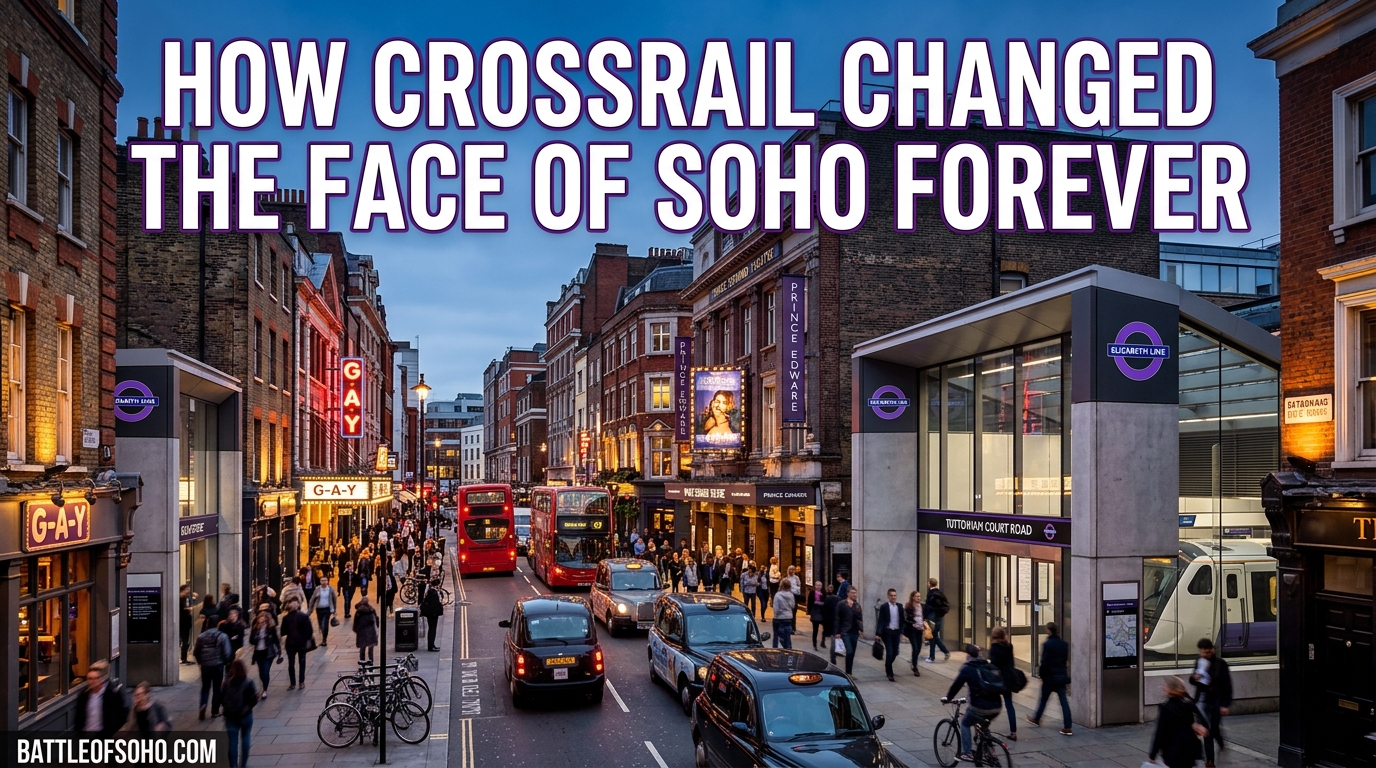
Crossrail, now known as the Elizabeth line, permanently transformed Soho by punching a massive new transport interchange into its edges, demolishing beloved cultural landmarks like the Astoria Theatre, triggering the construction of major mixed-use developments such as Soho Place, and accelerating property values and commercial rents that altered the character of one of London’s most storied neighbourhoods. The project brought 240-metre-long platforms, a dramatic new Dean Street station entrance designed to reflect Soho’s nightlife identity, and an east-west rail link carrying over 200 million passengers a year through the beating heart of the West End. Understanding how Crossrail changed the face of Soho forever means looking at what was built, what was lost, and what the neighbourhood became in the years that followed.
Soho has always been a district defined by reinvention. From its aristocratic 17th-century origins to its decades as the centre of London’s sex industry, from the postwar coffee bars that birthed British rock and roll to the advertising agencies and media companies that filled its Georgian townhouses in the 1980s and 1990s, Soho has absorbed wave after wave of change. But none of those waves came with tunnel boring machines, a budget that ballooned past £18 billion, or the institutional weight of Transport for London behind them.
When construction on Crossrail began in earnest in 2009, few could have predicted the sheer scale of disruption that would follow. Roads were torn up. Businesses were shuttered. The Astoria, a legendary music venue that had hosted everyone from Buddy Holly to the Sex Pistols, was reduced to rubble. For nearly a decade, the area around Tottenham Court Road and Dean Street resembled a vast building site more than the glittering entertainment district it had been for generations.
Then the Elizabeth line opened in May 2026, and everything changed again. The question is whether the Soho that emerged on the other side is the same Soho at all. This article traces that transformation in full, from the earliest proposals in the 1940s to the concrete and terrazzo reality of today, examining the buildings that vanished, the architecture that rose in their place, the property market that shifted beneath everyone’s feet, and the cultural identity that continues to be negotiated in the shadow of one of Europe’s largest infrastructure projects.
Table of Contents
What Is Crossrail? Understanding the Elizabeth Line
Crossrail is London’s newest railway, a 73-mile east-west line running from Reading and Heathrow Airport in the west to Shenfield and Abbey Wood in the east. The core of the project involved drilling 26 miles of new tunnels beneath central London and building ten brand-new underground stations at a cost of approximately £18.25 billion. It is the largest single infrastructure project ever undertaken in Europe, and its central section passes directly beneath Soho.
The idea itself was not new. Proposals for an east-west rail link across London date back to the 1940s, when planners first recognised that the city’s existing Underground network could not cope with projected growth. Various iterations of the concept surfaced over the following decades, including the 1974 London Rail Study and the 1989 Central London Rail Study, but none secured funding. It was not until 2007, when then-Chancellor Gordon Brown included Crossrail in a comprehensive spending announcement, that the project moved from aspiration to reality.
Construction began in 2009, with main tunneling starting in 2012. Eight massive tunnel boring machines, each weighing nearly 1,000 tonnes, chewed their way through the London clay beneath streets, foundations, and Tube lines. The project was originally budgeted at £14.8 billion and scheduled to open in December 2018. In the end, it opened in stages: the central section launched in May 2026, with full through-services beginning in November 2026.
In 2016, the project was officially rebranded as the Elizabeth line, named after Queen Elizabeth II, who had just become the longest-reigning British monarch. The royal naming was announced by then-Mayor Boris Johnson during a visit to the under-construction Bond Street station. Some Londoners still call it Crossrail. Transport for London and the wider media use both names, though the Elizabeth line branding appears on all signage, maps, and rolling stock.
The renaming prompted debate about whether naming infrastructure projects after monarchs was appropriate for a public transport system, but the brand has stuck. For Soho, the name matters less than the physical reality: a massive new station entrance on Dean Street and an entirely reconfigured Tottenham Court Road interchange that reshaped the entire western edge of the district.
How Crossrail Changed the Face of Soho Forever: Five Core Transformations
The impact of Crossrail on Soho can be understood through five interlocking changes that altered the physical, economic, and cultural fabric of the area.
1. A new transport mega-hub at Soho’s doorstep. The rebuilt Tottenham Court Road station, with its Dean Street entrance opening directly into Soho, created one of the best-connected points in London. The station now combines the Elizabeth line, the Central line, and the Northern line, giving Soho instant access to the City, Canary Wharf, Heathrow, and the broader southeast of England. Passenger numbers through the station jumped dramatically, with estimates suggesting throughput in excess of 200,000 people per day at full capacity.
2. The destruction of cultural landmarks. To make room for the new station and its associated structures, several buildings with deep cultural significance were demolished. The Astoria Theatre, a live music venue since 1976, was the most prominent loss. Grade II-listed 96 Dean Street, which housed the French Protestant Church, also disappeared. These demolitions represented not just a loss of buildings but a loss of the cultural texture that made Soho distinctive.
3. Soho Place and the new built environment. Rising above the station on the site of the former Astoria and neighbouring buildings, Soho Place became the first major new building in Soho in decades. This 10-storey mixed-use development, designed by Make Architects, brought new commercial space, a 600-seat theatre operated by Nimax Theatres, and a redesigned public realm to the very spot where gig-goers once moshed to punk bands.
4. Property market acceleration. Crossrail’s announcement, construction, and opening each triggered waves of property speculation. Commercial rents in Soho climbed as international businesses anticipated improved connectivity. Residential prices near Elizabeth line stations rose faster than the London average. For a neighbourhood already among the most expensive in the UK, Crossrail poured fuel on an already hot market.
5. Shifts in footfall and street life patterns. The Dean Street entrance redirected pedestrian flows, drawing commuters and visitors into the heart of Soho from a new angle. This altered which streets were busy and when, affecting everything from where businesses chose to locate to how the night-time economy functioned. The nocturnal design of the Dean Street entrance, with its dark terrazzo and deliberate reference to Soho’s after-hours character, was an architectural acknowledgment that this station serves a neighbourhood that comes alive after dark.
The Buildings That Disappeared: Astoria Theatre and Beyond
The most visible and painful cost of Crossrail in Soho was the demolition of buildings that mattered to the community. No loss was felt more acutely than the Astoria Theatre.
The Astoria opened in 1927 as a cinema, part of the chain built by film exhibitor Arthur Segal. Designed by Edward A. Stone, it was a grand picture palace with a Wurlitzer organ and seating for over 2,000 people. In 1976, it was converted into the Astoria music venue, and for the next three decades it hosted some of the most important live performances in British music history.
The Sex Pistols played there. So did the Rolling Stones, who filmed their “Still Life” tour at the venue. David Bowie performed on its stage. Nirvana, Oasis, Blur, Radiohead, and hundreds of other acts passed through its doors. For a generation of Londoners, the Astoria was the venue where you went to see bands before they became famous, or to see legends in a room that felt intimate despite its size. The adjacent Astoria 2, later known as the LA2 and the Mean Fiddler, served a similar role for smaller acts.
When the decision was made to demolish the Astoria to make way for the Tottenham Court Road Crossrail station, the reaction was immediate and passionate. A campaign called “Save the Astoria” gathered thousands of signatures. Musicians, promoters, and fans argued that destroying the venue was an act of cultural vandalism that no transport improvement could justify. The building was not listed, which meant there was no legal barrier to demolition, but its cultural significance was undeniable.
In January 2009, the Astoria closed its doors for the last time. The final show featured performances by Get Cape. Wear Cape. Fly, Fold, and other acts associated with the venue’s later years. Within months, the building was gone, reduced to a hole in the ground that would eventually become the western end of the new station complex.
But the Astoria was not the only loss. Grade II-listed 96 Dean Street, home to the French Protestant Church of London since the 19th century, was also demolished. The church had served the Huguenot community in Soho for generations, a reminder of the neighbourhood’s long history as a refuge for immigrants and religious minorities. Despite its listed status, the building was taken down and the church relocated to Soho Square in a move that preservationists found deeply controversial.
The Saint Giles area, long considered one of central London’s most unlovely corners, was also transformed. The distinctive 1970s tower at Centre Point was refurbished and converted to residential use, while the area around it was reconfigured with new pedestrian routes and public spaces. The result is that the entire western approach to Soho, from Charing Cross Road to Tottenham Court Road, looks fundamentally different than it did before Crossrail.
These losses are not abstract. They represent a permanent change to Soho’s cultural archaeology. A music venue that hosted the Sex Pistols cannot be rebuilt. A Huguenot church that stood for over a century cannot be reconstructed. The buildings that replaced them are impressive in their own right, but they serve different purposes and cater to different audiences. This is the trade-off that infrastructure projects always demand, and it is one that Soho paid in full.
Tottenham Court Road Station: Soho’s New Front Door
If Crossrail is the engine of Soho’s transformation, Tottenham Court Road station is the chassis. The rebuilt station is the physical point at which the Elizabeth line meets the neighbourhood, and its design choices shape how millions of people experience Soho every year.
The station was designed by Hawkins\Brown, one of the UK’s leading architecture firms, working as part of a wider design team that included Maynard for wayfinding and GIA Equation for accessibility. The brief was to create a station that could handle enormous passenger volumes while responding to its specific urban context: the bustling, commercial energy of Oxford Street at one end and the bohemian, after-dark character of Soho at the other.
The result is a station with two distinct identities. The Oxford Street entrance, facing the retail thoroughfare, was designed as a “daytime” entrance, bright and open, with wide steps and a canopy that filters daylight into the ticket hall below. The Dean Street entrance, by contrast, was designed as the “nocturnal” entrance, clad in dark terrazzo with a deliberately moody, nighttime character that acknowledges its location in the heart of Soho’s nightlife district.
This design duality is more than a stylistic flourish. It is one of the few examples in modern transport architecture where a station entrance has been deliberately designed to reflect the cultural character of the neighbourhood it serves. The architects have spoken about how the Dean Street entrance was intended to feel like a threshold between the ordered world of commuting and the liberated, anything-goes spirit of Soho after dark.
Below ground, the station is an engineering marvel. The Elizabeth line platforms are approximately 240 metres long, long enough to accommodate 200-metre trains carrying up to 1,500 passengers each. They sit nine to ten storeys below street level, connected to the surface by banks of escalators and, in a design innovation that drew admiration from accessibility advocates, sideways lifts that move horizontally as well as vertically.
The platform tunnels themselves are vast concrete vaults, part of the line-wide design language developed by a consortium including Grimshaw Architects, Weston Williamson, and WilkinsonEyre. This consistent design approach, with its curved concrete surfaces, integrated platform screen doors, and uniform lighting, gives every Elizabeth line station a recognizable identity while allowing individual stations to respond to their local context through entrance design and surface treatment.
The platforms also feature over-height ceilings and carefully considered lighting that makes the deep underground spaces feel less oppressive than traditional Tube platforms. At Tottenham Court Road, this is particularly important because the station sits so far below the existing Underground tunnels that transferring between lines requires navigating multiple levels of escalators and concourses.
For Soho, the significance of the station cannot be overstated. Before Crossrail, Tottenham Court Road was a busy but unremarkable Underground stop on the Central and Northern lines. After Crossrail, it became one of the most important interchange points in London, a gateway that channels Elizabeth line passengers from Heathrow, Canary Wharf, and the Home Counties directly into the streets of Soho.
Soho Place: The Building Above the Station
Sitting directly above the new Crossrail station, on the site where the Astoria once stood, is Soho Place, a development that no competitor writing about Crossrail has explored in depth. It is the first major new building constructed in Soho in decades, and it represents perhaps the clearest physical expression of post-Crossrail Soho.
Soho Place was developed by Derwent London, one of the largest office developers in the West End, and designed by Make Architects. The building spans 10 storeys above ground, with approximately 285,000 square feet of space split between commercial offices and a 600-seat theatre operated by Nimax Theatres. The theatre, which opened in 2026, was the first new theatre built in the West End in 50 years.
The inclusion of a theatre was not coincidental. When the Astoria was demolished, the loss of a performance space was one of the most common objections raised by local residents and cultural figures. The planning process for Soho Place required the developer to provide cultural and community amenities as part of the development agreement, and the theatre was the result. It is a partial restitution, not a replacement, but it does mean that the site continues to host live performance, albeit of a very different kind.
The commercial office space in Soho Place is aimed squarely at media, technology, and creative companies, the same sectors that have been migrating into Soho for decades. With floor-to-ceiling windows, rooftop terraces, and direct access to the Elizabeth line below, the building offers exactly the kind of workspace that premium tenants now expect in the post-pandemic office market.
Around the building, the public realm has been completely redesigned. New pedestrian routes connect Oxford Street, Charing Cross Road, and Soho Square, opening up an area that was previously dominated by the blank walls and service entrances of older buildings. There is new planting, new seating, and new public art, all intended to make the space above the station feel like a place to linger rather than just a place to pass through.
The creation of Soho Place illustrates the fundamental bargain of Crossrail in central London. In exchange for losing existing buildings and the cultural associations attached to them, the neighbourhood gains new construction, new amenities, and new economic activity. Whether that bargain is a good one depends entirely on what you value most about a place.
The Property Market Earthquake
Crossrail did not just change Soho physically. It changed the economics of who could afford to be there. Property prices and commercial rents near Elizabeth line stations rose sharply throughout the construction period and after opening, driven by anticipation of improved connectivity and the arrival of new development.
Research published by various estate agents and property consultancies in the years before and after the Elizabeth line opened consistently showed that property values near Crossrail stations outperformed the wider market. Studies by Knight Frank, Savills, and JLL all documented premium price growth in the so-called “Crossrail corridor,” with some areas seeing price increases of 15 to 30 percent above regional averages over the construction period.
Soho, sitting at the intersection of the Elizabeth line, the Central line, and the Northern line, benefited from this effect more than almost anywhere else. Commercial rents for prime office and retail space in Soho climbed steadily, reaching levels that priced out many of the independent businesses that had historically defined the area. The advertising agencies, film production companies, and design studios that moved into Soho in the 1980s and 1990s found themselves competing with global technology firms, financial services companies, and luxury brands for the same limited square footage.
For residential property, the effect was equally pronounced. Soho has always had limited residential stock, with most of its building stock devoted to commercial and entertainment uses. The residential units that do exist, mostly flats above shops or in converted townhouses, became even more sought-after. Rents rose, and the demographic profile of Soho residents shifted further toward high-income professionals who could afford to live in one of London’s most expensive postcodes.
The property market response to Crossrail was not uniform across all sectors. Retail faced a more complicated picture, because improved transport can bring more footfall but also more competition. Some established Soho retailers and restaurateurs reported increased business from the additional foot traffic generated by the station. Others found that rising rents outweighed any benefit from additional visitors.
There is also the question of gentrification, a word that surfaces repeatedly in any discussion of Crossrail’s impact on Soho. The neighbourhood has been gentrifying for decades, and Crossrail cannot be blamed for a process that was already well underway. But there is no question that the project accelerated existing trends, making Soho more expensive, more corporate, and more homogenised than it would otherwise have been.
Forum discussions on Reddit and SkyscraperCity reflect this tension. Users consistently praise the engineering quality and convenience of the Elizabeth line while simultaneously expressing concern about what improved connectivity does to neighbourhood character. One Reddit commenter on r/london described the Elizabeth line as “a game changer for living in London” in the same thread where another lamented that “every new transport link just means more chain restaurants and fewer places with actual personality.”
The Cultural Cost: Soho’s Nightlife and Creative Soul
The hardest question to answer about Crossrail’s impact on Soho is whether the neighbourhood’s cultural soul survived the transformation. This is a question that no major competitor has explored in depth, and it is arguably the most important one for anyone who cares about Soho’s future.
Soho’s identity has always been built on its night-time economy. The strip clubs, the late-night bars, the music venues, the restaurants open until 3am, the record shops, the specialist dealers in film memorabilia and vintage clothing, all of these businesses operated on the margins of respectability, tolerated by the city because they gave Soho its distinctive edge. When Crossrail came, with its corporate offices, its premium retail, and its gleaming new station entrances, it introduced a different kind of energy into the neighbourhood.
The loss of the Astoria was the most visible cultural casualty, but it was not the only one. The years of construction disruption around Tottenham Court Road and Dean Street forced many independent businesses to close. Pubs, restaurants, and shops that relied on foot traffic from the area found their premises surrounded by hoardings, their entrances obscured, and their customers redirected. Some received compensation from Transport for London and Crossrail Ltd, but many felt that the payments did not adequately reflect the damage done to their businesses.
The night-time economy faces a broader challenge from the changing demographic of Soho. As more corporate tenants move into buildings like Soho Place, the character of the streets shifts. Office workers who go home at 6pm are a different audience from the club-goers and bar-hoppers who used to dominate Soho after dark. Some venues have adapted by broadening their appeal, others have closed, and new openings tend to reflect the tastes of a wealthier, more conventional clientele.
Soho’s creative industries have been similarly affected. The neighbourhood has been a centre for film, advertising, music, and publishing for decades, with companies drawn to its central location, its character, and its relatively affordable commercial space. As rents have risen, many of these businesses have been pushed out to cheaper areas like Shoreditch, Camberwell, or beyond. The creative ecosystem that once thrived in Soho has fragmented, with individual companies and practitioners scattered across a wider area.
None of this is entirely Crossrail’s fault. Online streaming killed the DVD shops. Dating apps killed the pick-up bars. Working from home reduced the demand for central London office space, which in turn affected the businesses that served office workers. But Crossrail added a layer of physical transformation on top of these broader trends, making the changes more visible, more rapid, and more contested.
There are signs of resilience. Soho still has a vibrant nightlife scene, with new bars and restaurants opening regularly. The street performers on Berwick Street Market are still there. The independent record shops and comic book stores have mostly survived, adapting to changing tastes and business models. Theatreland continues to thrive, with the new venue at Soho Place adding capacity rather than replacing it. But the balance has shifted, and it is not clear whether it will shift back.
The nocturnal design of the Dean Street entrance offers a small but meaningful gesture toward acknowledging this tension. By designing the entrance to feel different from the daytime Oxford Street side, the architects created a physical reminder that Soho has a dual identity, one that is commercial and productive during the day and creative and transgressive after dark. Whether that architectural gesture is enough to preserve the after-dark culture it references is an open question.
Before and After: Soho Transformed
To understand the full scope of how Crossrail changed Soho, it helps to compare the neighbourhood directly, before and after the project.
Transport connectivity: Before Crossrail, Soho was served by the Central and Northern lines at Tottenham Court Road, with additional access via Oxford Circus and Piccadilly Circus stations. Journey times to Heathrow required multiple changes and took at least an hour. After Crossrail, Tottenham Court Road is on the Elizabeth line, offering direct services to Heathrow in under 35 minutes and to Canary Wharf in under 20 minutes. The station handles vastly more passengers and connects Soho to a completely different catchment area.
Streetscape and public realm: Before Crossrail, the western edge of Soho around the Astoria and Centre Point was congested, poorly laid out, and dominated by traffic. After Crossrail, the area has been redesigned with new pedestrian routes, public spaces, and planting. Soho Place has opened up ground that was previously inaccessible, creating a more walkable environment.
Commercial property: Before Crossrail, Soho’s commercial space was a mix of small offices, workshops, retail units, and entertainment venues. Rents were high by London standards but not prohibitive for independent businesses. After Crossrail, prime commercial space commands a significant premium, and the tenant mix has shifted toward larger corporate occupiers with deeper pockets.
Cultural venues: Before Crossrail, Soho had the Astoria and Astoria 2 as major live music venues, alongside a dense network of bars, clubs, and late-night venues. After Crossrail, the Astoria is gone, replaced by the @sohoplace theatre, which offers a very different kind of cultural programming. Other venues have opened and closed in the normal churn of the entertainment business, but the loss of the Astoria removed a specific kind of large-capacity live music space that has not been replaced.
Demographic profile: Before Crossrail, Soho’s residents and workers were a mix of creative industry professionals, hospitality workers, students, and long-term residents in social housing. After Crossrail, the residential population has become wealthier and more transient, with a higher proportion of high-earning professionals and international tenants.
International profile: Before Crossrail, Soho was known primarily within the UK as London’s entertainment district. After Crossrail, with direct links to Heathrow and the broader southeast, Soho is more accessible to international visitors than ever before. This has increased footfall and spending but has also contributed to the homogenisation of the high street, with international chains replacing some independent businesses.
The Decade of Disruption: Living Through Construction
For the people who lived and worked in Soho during the Crossrail construction years, the project was not an abstract piece of infrastructure. It was a daily reality of noise, dust, road closures, and uncertainty that lasted for the better part of a decade.
Construction on the Tottenham Court Road station site began in 2010, when the area around the old station was fenced off and demolition of existing buildings commenced. For the next eight years, the streets around Dean Street, Charing Cross Road, and Oxford Street were dominated by construction vehicles, temporary walkways, and the constant noise of tunneling and excavation below ground.
Businesses in the area reported significant declines in revenue during this period. Customers avoided the area because it was difficult to navigate, with pavements narrowed, roads closed, and familiar landmarks disappearing behind hoardings. A number of long-established businesses closed during the construction years, attributing their closure at least in part to the disruption caused by Crossrail works.
Transport for London and Crossrail Ltd established a compensation scheme for affected businesses, but the process was widely criticised as complex, slow, and inadequate. Many business owners reported spending months gathering evidence of lost revenue, only to receive payments that fell far short of their actual losses. The experience left a bitter taste for many in the Soho business community.
For residents, the disruption was different but equally challenging. Noise from construction worked continued late into the evening and started early in the morning. Lorry movements clogged narrow Soho streets that were never designed for heavy goods vehicles. The visual character of the neighbourhood was transformed by hoardings, scaffolding, and security fencing that made the area feel more like a construction site than a residential and entertainment district.
Forum discussions from the period capture the frustration vividly. On Reddit’s r/london, users described the Tottenham Court Road area as “a nightmare” and “an embarrassment.” On the SkyscraperCity forum, a thread tracking Crossrail construction progress ran to over 400 pages, with regular contributors documenting every visible change, debating design choices, and speculating about opening dates. The thread reflected a mix of excitement about the engineering achievement and frustration about the human cost.
Urban exploration communities also took an interest in the construction. Members of the 28dayslater forum documented construction sites across the Crossrail route between 2015 and 2018, photographing tunnel entrances, station boxes, and surface worksites. Their images provide a valuable record of the construction process from perspectives that official publicity materials never showed.
When the Elizabeth line finally opened in May 2026, the sense of relief in Soho was palpable. The hoardings came down, the new station entrances opened, and the streets began to return to something approaching normality. But the years of disruption had already done their damage. Businesses that had survived were changed, the streetscape was permanently altered, and the neighbourhood had been through something that left lasting marks on its character and its community.
The Archaeological Legacy: What Was Found Beneath Soho
One of the less discussed but genuinely fascinating aspects of Crossrail’s construction in the Soho area is the archaeological legacy. Before tunneling could begin, archaeologists from the Museum of London Archaeology service were given access to the sites to be excavated, and what they found painted a vivid picture of Soho’s deep history.
Across the broader Crossrail route, archaeologists uncovered remains spanning thousands of years of London’s history. These included prehistoric animal bones, including a woolly mammoth tusk and a bison skull found near Canary Wharf, Roman horseshoes, medieval skates made from animal bone, and Tudor bowling balls. Each station site produced its own discoveries, reflecting the different historical uses of the land above.
In the Soho area specifically, the archaeological work focused on the Tottenham Court Road station site and the surrounding streets. The excavation revealed evidence of the area’s 17th-century development, when Soho Fields was transformed from open agricultural land into a fashionable residential district. Foundations of early buildings, domestic artefacts, and evidence of the area’s industrial past all emerged from the soil.
Perhaps the most poignant discoveries were the remains associated with Soho’s later history as a densely populated and sometimes notorious neighbourhood. Clay pipe fragments, evidence of 18th-century industries, and domestic items from Victorian tenements all spoke to the lives of the ordinary Londoners who had occupied this ground long before Crossrail was conceived.
The archaeological discoveries were carefully documented and many are now held by the Museum of London. Some items were put on display, and the Crossrail project produced educational materials about the finds. This represents a positive legacy of the project: while buildings were destroyed, the history buried beneath them was at least partially recovered and preserved for future generations.
The Future: Crossrail 2 and What Comes Next
Even as Soho continues to absorb the impact of the first Crossrail, the prospect of a second looms on the horizon. Crossrail 2, a proposed north-south rail link running from Surrey and southwest London through central London to Hertfordshire, has been in planning since the 2010s and would include a station at Tottenham Court Road, directly intersecting with the Elizabeth line.
The prospect of Crossrail 2 has generated significant anxiety in Soho. The neighbourhood has only just emerged from a decade of Crossrail 1 construction, and the idea of repeating that experience is deeply unappealing to many residents and business owners. Estate agents and property analysts have debated whether Crossrail 2 would have a positive or negative effect on Soho, with some arguing that additional connectivity would further drive up prices and others suggesting that the construction disruption would damage the area’s fragile recovery.
As of 2026, Crossrail 2 has not been approved for construction. The project received government backing in principle and a safeguarding route was established to protect the proposed alignment from conflicting development, but funding has not been committed. The political and economic context has shifted since the project was first proposed, with Brexit, Covid-19, and broader economic pressures making large-scale infrastructure investment more difficult to justify.
For Soho, the delay may be a blessing. It gives the neighbourhood time to adjust to the Elizabeth line and to reach some kind of equilibrium before facing another round of transformation. The lessons of Crossrail 1, both positive and negative, should inform any future decisions about Crossrail 2, particularly around compensation for affected businesses, protection of cultural venues, and management of construction disruption.
Beyond Crossrail 2, the broader question for Soho is how to maintain its distinctive character in the face of continuous pressure for change. The Elizabeth line has made Soho more accessible, more valuable, and more visible on the global stage. It has also made the neighbourhood more vulnerable to the homogenising forces that improved connectivity tends to bring. The balance between connectivity and character is one that every great city neighbourhood must negotiate, and Soho’s negotiation is far from over.
FAQs
What is the Crossrail controversy?
The Crossrail controversy centres on the project’s massive budget overruns (from £14.8 billion to over £18.25 billion), years of delays (originally promised for 2018, opened in 2026), and the demolition of culturally significant buildings like the Astoria Theatre in Soho. Many local residents and business owners also felt that compensation for construction disruption was inadequate.
Why was Crossrail renamed Elizabeth line?
Crossrail was renamed the Elizabeth line in 2016, announced by then-Mayor Boris Johnson in honour of Queen Elizabeth II, who had become the longest-reigning British monarch. The royal naming was intended to reflect the significance of the project to the nation’s transport infrastructure.
Has Crossrail 2 been approved?
As of 2026, Crossrail 2 has not been approved for construction. The proposed north-south rail link has received government backing in principle and a safeguarding route has been established, but funding has not been committed due to changing economic and political circumstances.
What did Crossrail do to Soho?
Crossrail brought a major new transport interchange at Tottenham Court Road with a Dean Street entrance opening into Soho, triggered the demolition of the Astoria Theatre and other buildings, led to the construction of the Soho Place mixed-use development, accelerated property values and commercial rents, and shifted the neighbourhood’s cultural and demographic profile.
When did the Elizabeth line open?
The Elizabeth line opened in stages. The central section, including the rebuilt Tottenham Court Road station, opened on 24 May 2026. Full through-services across the entire route began on 6 November 2026.
What was demolished for Crossrail in Soho?
The most significant building demolished for Crossrail in Soho was the Astoria Theatre, a legendary music venue that had hosted acts like the Sex Pistols, David Bowie, and Nirvana. Grade II-listed 96 Dean Street, home to the French Protestant Church, was also demolished, along with several other buildings in the immediate vicinity of the new Tottenham Court Road station.
Conclusion
The story of how Crossrail changed the face of Soho forever is not a simple one of progress or loss. It is a story about trade-offs: connectivity versus character, investment versus displacement, engineering ambition versus cultural heritage. The Elizabeth line brought Soho a world-class transport link, a striking new station, and major new development. It also took away buildings that mattered, disrupted lives and businesses for a decade, and accelerated trends that continue to reshape the neighbourhood’s identity.
Soho endures because it has always been a place of reinvention. Whether the version of Soho that exists today, with its Crossrail station and Soho Place, its rising rents and changing tenant mix, retains enough of the old spirit to remain recognisably Soho is a question that only time can answer. What is certain is that the neighbourhood has been irrevocably altered, and that the effects of Crossrail will be felt in Soho for generations to come.