
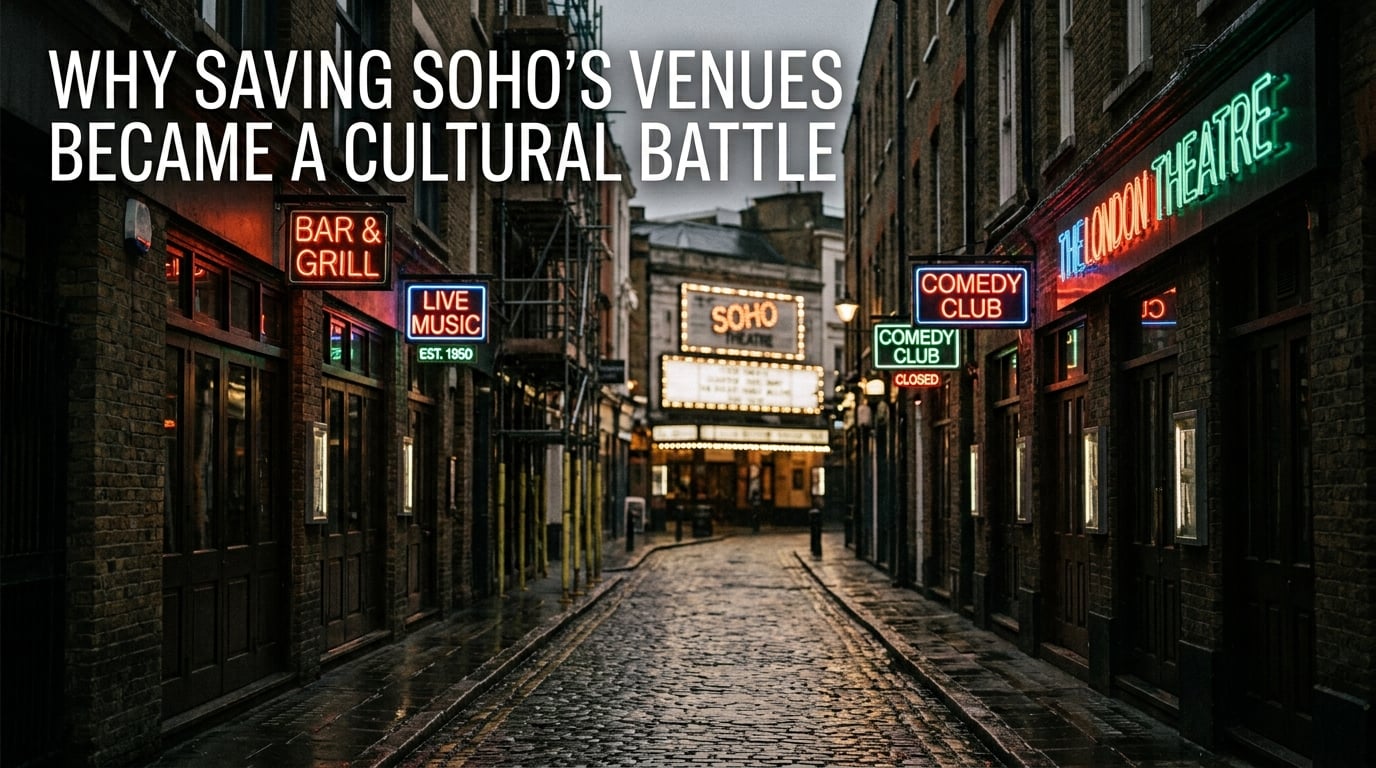
Saving Soho’s venues became a cultural battle because what is being lost is not just nightlife but centuries of bohemian, artistic, and countercultural identity that cannot be replaced by chain restaurants and luxury flats. The conflict pits grassroots campaigners, venue owners, musicians, and LGBTQ+ communities against property developers, Westminster City Council policies, and a residents’ group that receives council funding to oppose new licences. At its heart, this is a fight about who gets to define what Soho is and who it is for.
When Madame Jo Jo’s shut its doors in November 2014, something shifted. The legendary drag and cabaret venue on Walker’s Court had been a fixture of Soho’s LGBTQ+ scene for decades. Its licence was revoked by Westminster Council after a violent incident involving security staff, but for many, the punishment felt disproportionate. It was not just a venue closing. It was the symbolic moment when people realised that Soho’s cultural infrastructure was being dismantled piece by piece, and that nobody in power seemed to care.
The numbers tell a stark story. Soho’s resident population has fallen from approximately 30,000 after World War II to just 2,600 today, according to the BBC. The number of live music venues in Soho collapsed from a peak of 17 to just 6 by 2015, as documented by The Guardian. Across London, the Music Venue Trust recorded 430 grassroots venues operating between 2007 and 2015, but only 245 were still open by the end of that period. These are not just statistics. Each number represents a space where artists were nurtured, communities formed, and cultural history was made.
The Battle of Soho documentary, which began filming in 2015, captured this moment of crisis. It framed the closure of venues not as an inevitable consequence of market forces, but as a cultural catastrophe driven by specific political and economic decisions. That framing is exactly right. Saving Soho’s venues became a cultural battle because the losses were neither accidental nor inevitable. They were the result of deliberate policy choices, organised opposition, and a development agenda that treated Soho’s cultural heritage as an obstacle to profit rather than an asset to protect.
Table of Contents
What Made Soho Culturally Irreplaceable
Soho was never just a neighbourhood. For over 300 years, it has been London’s creative engine room, a place where counterculture, commerce, and art collided in ways that shaped the entire country. Understanding why saving Soho’s venues became a cultural battle requires understanding what made those venues worth fighting for in the first place.
The 2i’s Coffee Bar on Old Compton Street is widely credited as the birthplace of British rock and roll. In the late 1950s, Tommy Hicks (later Tommy Steele) performed there, becoming Britain’s first rock and roll star. The Marquee Club on Wardour Street hosted the Rolling Stones, the Who, David Bowie, and Jimi Hendrix in their early careers. These were not just music venues. They were the launch pads for entire cultural movements that defined post-war Britain. For a deeper look at Soho’s musical heritage, explore our database of Soho venues.
Soho’s record industry was equally significant. Between 1946 and 1996, over 170 record shops operated in Soho, making it the densest concentration of recorded music retail in the world. Shops like Dobell’s, HMV Oxford Street (just on the Soho border), and dozens of independent specialists served collectors, musicians, and producers from across the country. The area was also home to legendary recording studios, including Trident Studios where Bowie recorded “Ziggy Stardust” and Queen recorded their earliest albums.
The LGBTQ+ cultural significance of Soho cannot be overstated. Venues like Madame Jo Jo’s, the Rivoli Ballroom, and the Black Cap were not just places to drink and dance. They were sanctuaries at a time when homosexuality was criminalised, then marginalised, then slowly accepted. Drag culture in Britain was forged in Soho’s clubs. The area became the epicentre of British LGBTQ+ life, a place where people could exist freely in ways that were impossible elsewhere.
The Raymond Revuebar, opened in 1958 by Paul Raymond, became both a legitimate theatre venue and a symbol of Soho’s anything-goes reputation. It hosted the premiere of the musical “Oh! Calcutta!” and operated as a members-only strip club that pushed boundaries for decades. The Windmill Theatre, famous for its “we never closed” motto during the Blitz, represented Soho’s theatrical resilience. Even Karl Marx, Mozart, Casanova, and William Blake lived in or frequented Soho at various points, drawn to its energy and openness.
This concentration of cultural production is what made Soho unique in Europe. When these venues close, they do not relocate. The communities that formed around them scatter, and the institutional knowledge of how to run independent cultural spaces is lost. That is why people fight so hard to save them.
How Gentrification Reshaped Soho
Gentrification in Soho did not happen overnight. It arrived in waves, each one more destructive than the last, and each one pushing the area further from its bohemian roots. The process began in earnest in the 1980s, when property values in central London started their decades-long climb and developers began to see Soho’s relatively affordable commercial spaces as an opportunity.
The most striking measure of this transformation is population. After World War II, Soho was home to approximately 30,000 people. It was a densely populated, working-class neighbourhood with a large immigrant community, particularly Italian and Maltese families who ran cafes, restaurants, and small businesses. Today, the resident population stands at roughly 2,600. That is not a decline. It is a near-total replacement of the community that created Soho’s character.
The BBC spoke to long-term residents in 2023 who described returning to Soho after years away and finding it unrecognisable. One resident told the BBC: “I couldn’t find my way around and I knew Soho like the back of my hand. The landmark sandwich shops and Italian cafes had gone. I prefer the old Soho. It had its own character. Now it looks very generic.” That word, “generic,” appears again and again in conversations about what Soho has become.
Chain bars and restaurants have replaced independent venues at an alarming rate. Where once there were family-run Italian cafes, specialist record shops, and independent music venues, there are now branches of national and international chains that could exist in any city in the world. The businesses that gave Soho its identity are being replaced by businesses that have no connection to the area’s history or community.
The Crossrail project, now the Elizabeth Line, had a devastating impact on Soho’s venue landscape. The construction required the demolition of entire blocks, including the Astoria, one of London’s most significant live music venues. The Astoria, along with the adjacent Astoria 2 (formerly the LA2), hosted bands like Nirvana, Arctic Monkeys, and Radiohead before its demolition in 2009. The site sat empty for years during construction, and what has emerged is a transport interchange surrounded by commercial development that bears no relationship to what was destroyed. You can learn more about the specific venues lost at our archive of Soho’s closed venues.
Property development pressure continues unabated. Every independent venue that closes is a development opportunity. The economics are brutal: a live music venue that charges entry fees and sells modest amounts of alcohol cannot compete with a restaurant or retail space that can afford significantly higher rents. Without legal protection, cultural venues are always the most financially vulnerable occupants of any commercial space.
The Venues We Lost: A Timeline of Closure
The story of Soho’s cultural battle is written in the specific venues that have been lost. Each closure represents not just a business failure but a community displaced and a piece of cultural infrastructure removed. What follows is not an exhaustive list but a record of the most significant losses that shaped the battle.
2009: The Astoria and Astoria 2. Demolished to make way for the Crossrail development. These two connected venues on Charing Cross Road were among London’s most important mid-size live music spaces. Their loss removed a critical stepping stone in the career pipeline for British bands. A venue that could hold 2,000 people and served as the bridge between small club gigs and arena shows was simply erased.
2014: Madame Jo Jo’s. The venue’s licence was revoked by Westminster Council in November 2014 following a violent incident. For many, this was the tipping point. The closure prompted musician Tim Arnold to found the Save Soho Committee, which brought together artists, residents, and cultural figures to campaign for the protection of Soho’s venues. Madame Jo Jo’s became the rallying cry for a movement because it represented everything that was being lost: LGBTQ+ culture, drag performance, live music, and decades of history. Read our detailed analysis of the Soho Society’s 2026 licensing opposition to understand how this battle has evolved.
The broader collapse of live music in Soho. The Guardian reported in 2015 that Soho had gone from 17 live music venues at its peak to just 6. This was not a gradual decline but a rapid hollowing-out of cultural infrastructure. The venues that remained were smaller, more commercially oriented, and increasingly vulnerable to the same pressures that closed their predecessors.
Record shops and specialist retailers. The decline of physical music retail hit Soho’s record shop ecosystem hard. Of the 170-plus shops that operated between 1946 and 1996, only a handful remain today. Each closure removed not just a retail business but a social space where musicians, producers, and fans connected. The loss of these spaces weakened the informal networks that sustain independent music scenes.
LGBTQ+ venue losses. The LGBTQ+ venue closures in Soho are part of a wider London trend. Research has shown that London lost approximately 50% of its LGBTQ+ venues between 2006 and 2017. In Soho specifically, the closure of Madame Jo Jo’s, the Bedroom Bar, and others has thinned out what was once the densest concentration of queer venues in the country. These spaces served communities that often have no alternative gathering places.
The Music Venue Trust, founded in 2014 by Mark Davyd, has documented the national picture. Between 2007 and 2015, London had 430 grassroots music venues. By 2015, only 245 were still operating. That is a loss of 43% of the city’s small venue infrastructure in less than a decade. Soho, as the cultural heart of London’s nightlife, has been at the epicentre of this crisis.
What makes these losses particularly painful is that they are permanent. Once a venue is demolished or converted, it cannot be brought back. The acoustic properties, the spatial layout, the accumulated cultural memory embedded in the walls, all of it is destroyed. New venues can be built, but they start from zero. They have no history, no community, and no guarantee they will survive long enough to acquire one.
The Licensing War: Westminster Council and the Soho Society
If gentrification provided the economic pressure, licensing law provided the legal mechanism for closing venues. Understanding the licensing war is essential to understanding why saving Soho’s venues became a cultural battle rather than just a commercial dispute.
The Cumulative Impact Zone is one of the most powerful tools in this war. Designated under the Licensing Act 2003, a Cumulative Impact Zone (CIZ) creates a presumption against new licences or licence variations in a defined area. Westminster Council designated Soho as a CIZ, meaning that any new application for a late-night licence faces a significantly higher bar for approval. The intention is to limit the concentration of licensed premises, but the effect is to freeze the existing landscape while making it nearly impossible for new independent venues to open.
The Class E building use legislation, introduced in September 2020, compounded the problem. This planning reform merged several commercial use classes into a single Category E, allowing property owners to convert between uses, such as turning a venue into a restaurant or a retail space, without applying for planning permission. For Soho’s remaining independent venues, this meant that landlords could change the use of a building at will, removing any leverage that venue operators had to negotiate long-term security.
The BBC reported in 2023 that the Class E change had accelerated the conversion of performance spaces into restaurants and bars, which are seen as less disruptive and more profitable. The result is a homogenisation of Soho’s commercial landscape, where venues that hosted live music, drag shows, and cabaret are replaced by dining establishments that generate no cultural value beyond their food offering.
At the centre of the licensing battle is the Soho Society, a residents’ group that plays an outsized role in Soho’s planning and licensing decisions. The Soho Society was founded in the early 1970s to represent the interests of people who actually live in Soho, a laudable mission given how few residents remain. However, its methods and funding have become deeply controversial. Learn more about the Save Soho campaign’s demands and victories.
The Guardian revealed in May 2026 that the Soho Society is funded by Westminster Council. This funding relationship raises serious questions about independence and accountability. A residents’ group that is bankrolled by the same council that makes licensing decisions is in a structurally powerful position to influence outcomes. Venue owners have described the Soho Society’s opposition as “ferocious,” saying the group lobbies against virtually all new licensing applications on the grounds of “nightlife intensification.”
In 2026, the Soho Society voted to oppose all new licensing applications in Soho. This blanket opposition goes beyond case-by-case assessment and represents a categorical rejection of any new nightlife establishment. The decision drew immediate criticism. Sadiq Khan, the Mayor of London, publicly opposed the move, vowing to use his powers to overrule restrictions that would damage London’s night-time economy. Venue owners argued that the Soho Society’s stance was “destroying Soho’s reputation” as an entertainment district.
The conflict exposes a fundamental tension in how Soho is governed. Residents have legitimate concerns about noise, anti-social behaviour, and the impact of late-night venues on daily life. But the Soho Society’s position, funded by the council and opposed to all new licences, effectively treats Soho as a residential area with a nightlife problem rather than what it has been for centuries: an entertainment district where people also happen to live.
Tim Lord, the chair of the Soho Society, told the BBC: “People want to use Soho for profit. At the moment, residents are on their own.” That statement captures the residents’ perspective but also reveals the framing problem. Soho’s venues are not just profit-generating businesses. They are cultural institutions that serve communities far beyond the 2,600 people who live in the immediate area.
The Battle Lines: Save Soho, the Soho Society, and the Documentary
The cultural battle for Soho’s venues has produced organised movements on multiple sides. Understanding who is fighting, what they want, and how they operate is key to understanding the conflict.
The Save Soho Committee. Founded by musician Tim Arnold in the wake of the Madame Jo Jo’s closure, the Save Soho Committee brought together an extraordinary coalition of artists, performers, residents, and cultural figures. The committee’s mission was to protect Soho’s remaining independent venues and to campaign for policies that would preserve the area’s cultural character. Arnold, who grew up in Soho and has deep roots in the area’s music and arts scene, became one of the most visible advocates for venue preservation in London. Watch the Battle of Soho documentary to see the campaign’s origins on film.
The Save Soho Committee’s approach combined grassroots organising with high-profile advocacy. They organised public meetings, collected testimonials from venue owners and performers, and lobbied Westminster Council and the Greater London Authority. Their argument was straightforward: Soho’s cultural significance is not a local issue but a national one, and the venues that produce that culture deserve protection comparable to that given to historic buildings and protected landscapes.
The Soho Society. The Soho Society occupies a different position in the debate. As a residents’ group focused on the quality of life for the approximately 2,600 people who live in Soho, its primary concerns are noise, litter, public safety, and the preservation of residential amenities. These are legitimate concerns. Soho has extraordinarily high levels of foot traffic, late-night activity, and commercial density for a residential area.
The problem is not that the Soho Society exists or that it advocates for residents. The problem is the structural imbalance. A council-funded residents’ group with formal standing in licensing hearings has vastly more influence than a loose coalition of venue owners, artists, and customers. The playing field is not level, and the outcomes reflect that imbalance.
The Battle of Soho documentary. The Battle of Soho film, which began production in 2015, documented the cultural battle at the height of the Madame Jo Jo’s aftermath. The film featured interviews with venue owners, performers, residents, and campaigners, capturing the emotional and cultural weight of what was being lost. It framed the closure of venues as an “unprecedented cultural catastrophe” and connected the specific events in Soho to a wider global pattern of urban gentrification displacing cultural spaces.
The documentary served as both a record and a call to action. It brought national attention to a conflict that had been playing out in licensing hearings and council meetings, far from public view. By giving voice to the people most affected by venue closures, performers, venue staff, and longtime patrons, the film humanised what might otherwise have remained an abstract policy debate.
The Music Venue Trust. At the national level, the Music Venue Trust has been fighting for the protection of grassroots music venues across the UK. Founded in 2014 by Mark Davyd, the Trust has documented venue closures, lobbied for policy changes, and built a network of venue operators who share information and support. Their data on venue losses has been cited by The Guardian, the BBC, and Parliament, making them the authoritative source on the state of Britain’s grassroots music infrastructure.
The Trust’s advocacy for the “agent of change” principle, which places responsibility for noise mitigation on the party that moves into an area near an existing venue, rather than on the venue itself, has been adopted in national planning policy. This is one of the few concrete victories in the battle to protect music venues, and it demonstrates that policy change is possible when the case is made effectively.
Why This Is About More Than Nightlife
The fight to save Soho’s venues is often framed as a debate about nightlife, as if the only thing at stake is whether people can go drinking and dancing late at night. This framing fundamentally misunderstands what cultural venues do and why their loss matters.
Cultural venues are infrastructure. They are the places where artists develop their craft, where audiences discover new work, and where communities form around shared interests and identities. When a venue closes, the artist who was about to get their first break does not simply move to another venue. The audition does not happen. The performance does not take place. The audience that would have been there does not converge. The cultural output that would have been produced in that space is lost forever.
For LGBTQ+ communities, the loss is even more acute. Queer venues have always served functions beyond entertainment. They are places where people come out, find community, and experience safety in a world that is often hostile. The closure of LGBTQ+ venues in Soho and across London has removed safe spaces that took decades to establish. No amount of mainstream acceptance replaces the specific function of a dedicated queer venue where people can be fully themselves.
The comparison with other London districts is instructive. Hackney, particularly areas like Dalston and Shoreditch, has maintained a more resilient nightlife and venue culture despite facing similar gentrification pressures. The reasons are complex, but they include a different mix of land use, a more supportive local council, and a community that has organised effectively to protect cultural spaces. If Hackney can do it, the argument goes, why can Soho not do the same?
Internationally, there are policy models worth studying. Melbourne adopted the “agent of change” principle, which means that if a residential development is built near an existing music venue, the developer is responsible for soundproofing, not the venue. This simple but powerful principle has helped protect Melbourne’s music scene and has been adopted in UK planning guidance. Austin, Texas, has implemented cultural trust funds to purchase and protect music venues. Chicago has designated cultural districts with special protections for performance spaces.
Shain Shapiro, founder of the Music Cities movement, has argued that music venues are part of the urban ecosystem in the same way that parks, schools, and hospitals are. When a city loses its grassroots venues, it loses the foundation of its cultural life. The bands that play arenas started in small clubs. The festivals that generate millions for local economies depend on the pipeline of talent that small venues nurture. Protecting venues is not nostalgia. It is investment in cultural infrastructure.
What Winning the Battle Would Actually Look Like
One of the gaps in the public conversation about Soho’s venues is that the campaign is often better at describing what is being lost than what should be done. But the Save Soho Committee, the Music Venue Trust, and other advocates have put forward specific, achievable policy demands that would constitute victory.
Full adoption of the agent of change principle. While this principle exists in UK planning guidance, its application is inconsistent. A meaningful victory would see Westminster Council formally adopt agent of change as binding policy for all planning decisions in Soho, ensuring that no existing venue can be forced to close or reduce its operating hours because a new residential development has been built nearby.
Reform of the Cumulative Impact Zone. The CIZ in its current form creates a blanket presumption against new licences, which protects no existing venues while preventing new ones from opening. Reform could exempt cultural and music venues from the CIZ while maintaining restrictions on purely commercial late-night drinking establishments. This would shift the zone’s effect from suppressing cultural activity to managing it intelligently.
Repeal or amendment of Class E for cultural venues. The Class E building use change allows venue-to-restaurant conversions without planning permission. A targeted amendment could protect buildings that have been used as performance venues for a defined period, requiring planning permission for any change of use. This would give venue operators and communities a voice in decisions about culturally significant buildings.
A community-led Soho cultural plan. Rather than leaving the future of Soho’s cultural infrastructure to the licensing committee and the property market, a formal cultural plan could be developed through genuine community consultation. This plan would identify venues and cultural spaces that merit protection, establish criteria for new cultural developments, and create a framework for balancing residential and cultural interests.
Dedicated funding for venue protection. Following models from other cities, a cultural venue fund could provide grants for soundproofing, accessibility improvements, and rent support for independent venues. This funding could come from a levy on large commercial developments in the area, ensuring that the profits generated by Soho’s cultural reputation contribute to its preservation.
These are not radical demands. They are the same kinds of protections that historic buildings, green spaces, and conservation areas already receive. The only difference is that cultural venues have not yet been recognised as heritage assets deserving of the same legal protection. Winning the battle for Soho’s venues means changing that recognition.
FAQs
Is Soho in London still a red light district?
No, Soho is no longer a red light district in the traditional sense. While the area historically had a reputation for sex shops and strip clubs, most closed during the gentrification waves of the 2000s and 2010s. The 2020 Class E building use legislation further accelerated the conversion of adult venues into restaurants and bars. Today, Soho retains its reputation as London’s nightlife hub, but its character has shifted significantly toward mainstream dining and chain establishments.
Has Soho been gentrified?
Yes, extensively. Since the 1980s, Soho has undergone multiple waves of gentrification, transforming from a working-class, bohemian district into one of London’s most expensive neighborhoods. The resident population fell from approximately 30,000 after World War II to just 2,600 today. Independent venues, record shops, and sex shops have been replaced by upmarket restaurants, chain bars, and luxury developments.
Why is Soho London so famous?
Soho is famous as London’s cultural and nightlife heart, known for its theatres, jazz clubs, music venues, drag shows, and LGBTQ+ scene. Legendary venues include the Marquee Club, the 2i’s Coffee Bar, Madame Jo Jo’s, and the Raymond Revuebar. The area has nurtured artists from the Beatles to David Bowie and has been a center of counterculture for over 60 years.
What is the Soho Society and who funds it?
The Soho Society is a residents’ group that represents the approximately 2,600 people who live in Soho. It was founded in the early 1970s and plays a formal role in licensing and planning decisions. The Guardian reported in 2026 that the Soho Society is funded by Westminster Council, a relationship that has drawn criticism from venue owners who argue the group ferociously opposes virtually all new licensing applications.
When did Madame Jo Jo’s close?
Madame Jo Jo’s closed in November 2014 when Westminster Council revoked its licence following a violent incident involving security staff. The closure is widely seen as the symbolic turning point that sparked the modern campaign to save Soho’s venues, leading musician Tim Arnold to found the Save Soho Committee.
What is the Cumulative Impact Zone in Soho?
The Cumulative Impact Zone (CIZ) is a designation under the Licensing Act 2003 that creates a presumption against granting new late-night licences in a defined area. Westminster Council designated Soho as a CIZ, meaning new licence applications face a significantly higher bar. Critics argue the CIZ protects no existing venues while preventing new independent cultural spaces from opening.
The Fight Continues
The battle to save Soho’s venues is not over. The 2026 Soho Society decision to oppose all new licences, the ongoing pressure from property development, and the continued conversion of performance spaces into restaurants all signal that the threat has not receded. But the opposition has grown stronger, more organised, and more visible than ever before.
Saving Soho’s venues became a cultural battle because what is at stake is nothing less than the soul of one of the world’s most significant cultural neighborhoods. The venues that remain are not just businesses. They are the last living connections to a tradition of bohemian creativity, countercultural resistance, and artistic community that has defined Soho for over three centuries. Once they are gone, they are gone for good.
The fight now is to ensure that the remaining venues receive the protection they deserve, that new cultural spaces can still open, and that the people who care about Soho’s future have a real voice in shaping it. The cultural battle for Soho is not nostalgia for a lost past. It is a demand for a future in which creativity, community, and counterculture still have a home in the heart of London.