
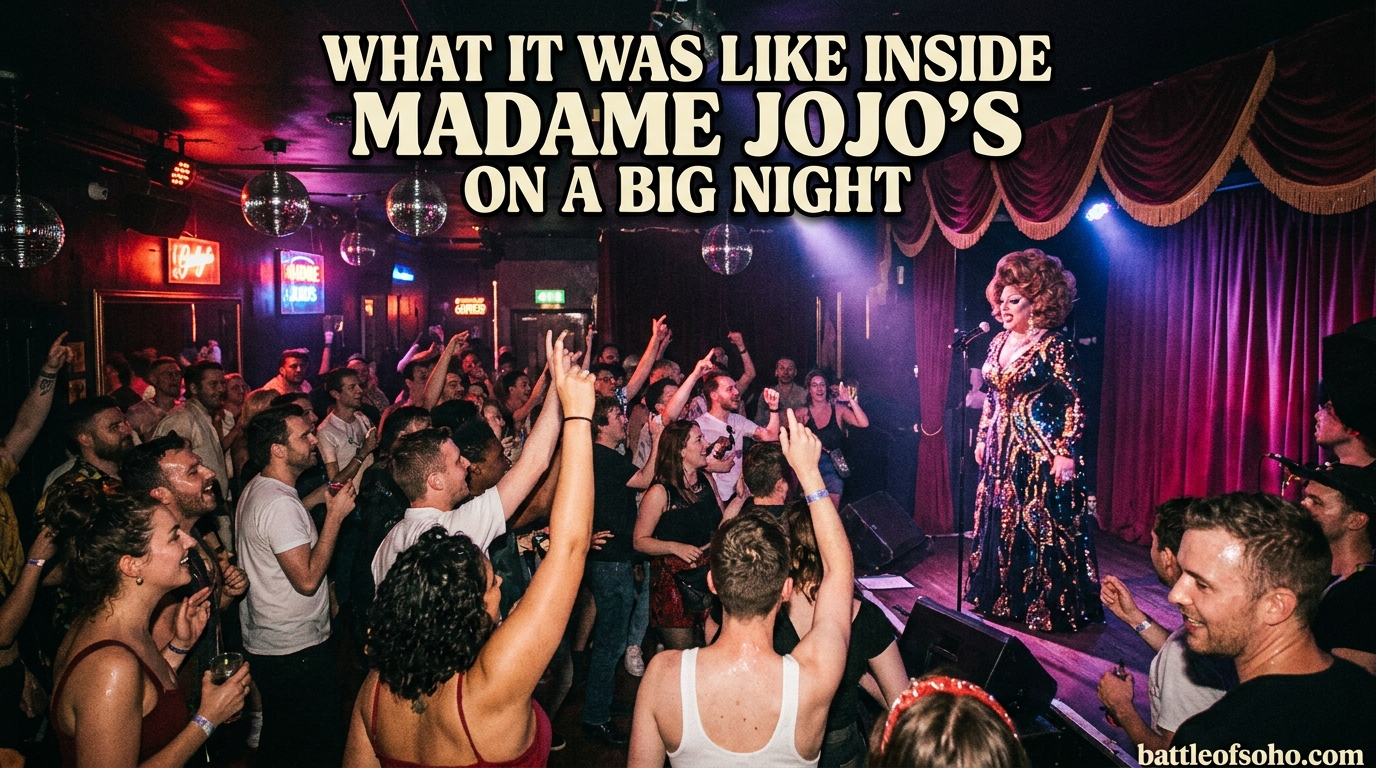
You could smell Madame Jojo’s before you saw it. A thick cocktail of stale beer, cheap perfume, cigarette smoke clinging to velvet, and the faintly sweet tang of theatrical makeup hit you the moment the heavy door swung open on Brewer Street. Inside, deep reds bounced off mirrored walls, gold trim caught the low light, and plush booths swallowed people whole. This was sleazy glamour in its purest form, a Soho nightclub legend that felt more like stepping into a film set than a night out.
On a big night, the place was heaving. You would literally fight your way through to the bar and then fight again to reach the toilets. Every color, every shape, every age crammed together in a room that should not have fit them but somehow always did. Drag queens in six-inch heels squeezed past indie kids in skinny jeans. Suited West End theatre-goers shared floor space with artists, musicians, and off-duty performers still in half their stage paint. Nobody cared who you were. That was the whole point.
This is what it was like inside Madame Jojo’s on a big night, a venue that defined Soho nightlife for nearly three decades before Westminster Council pulled its license in 2014. What follows is a walk through those doors, one last time.
Table of Contents
The History Behind the Doors
Madame Jojo’s occupied 8-10 Brewer Street, a Soho address with a chequered past long before the first drag queen ever lip-synced on its stage. The building originally housed the Casino de Paris, a cabaret venue in the heart of London’s red-light district. Soho in the 1950s and 60s was its own universe, strip clubs, peep shows, late-night cafes, and a community that looked after its own.
The man most responsible for shaping modern Soho was Paul Raymond, often called the King of Soho. Raymond built an empire of adult entertainment venues across the area, including the Raymond Revue Bar next door. When Raymond rebranded the Brewer Street venue in 1986, he gave it a name that would outlive his empire: Madame Jojo’s.
From the start, Jojo’s was designed as a cabaret and burlesque venue with a kitsch, theatrical interior. Deep red walls, gold detailing, mirrored panels, and velvet curtains created the feel of an old-world Parisian music hall crossed with a Soho knocking shop. It was deliberately over the top. It was deliberately a bit sleazy. And it was immediately loved for it.
Soho Estates, the property company that eventually controlled much of Raymond’s portfolio, managed the building through its various incarnations. But the soul of the venue belonged to the performers, the promoters, and the regulars who turned up week after week, year after year.
What It Was Like Inside Madame Jojo’s on a Big Night
Picture a Friday or Saturday around midnight. The queue snaked down Brewer Street, past the takeaway joints and the last remaining sex shop neon signs flickering in the cold. Bouncers in black worked the door with a calm authority that suggested they had seen everything and were surprised by nothing. Entry was never guaranteed. If you looked like trouble, or too sober, you were not getting in.
Once past the door, the first thing that struck you was the heat. Hundreds of bodies in a relatively compact space generated a wall of warmth that fogged the mirrors and made the velvet curtains feel damp to the touch. The air was thick. Someone had spilled a vodka cranberry on the stairs. A burst of laughter erupted from a booth you could not see into. Everything felt intimate and slightly claustrophobic in the best possible way.
The decor hit you in waves. Red wallpaper, almost burgundy, climbed every wall. Gold-framed mirrors reflected the crowd back at itself, multiplying bodies and lights until the room felt twice its actual size. Velvet curtains sectioned off corners and framed the small stage at the far end. Plush booths lined the walls, their leather cracked and soft from decades of use. It looked expensive and cheap at the same time, which is exactly the aesthetic the venue was going for.
The bar was the beating heart of the room on a big night. Three deep on a good evening, five deep on a wild one. You learned to order two drinks at once because you might not make it back for an hour. The bartenders moved with a practiced speed, slamming down spirits and mixing cocktails while keeping one eye on the crowd. Tips were good. Tempers were short. It was beautiful chaos.
And then the lights would drop. A spotlight hit the stage. The music shifted, sometimes a sultry jazz number, sometimes a full-throated disco anthem. A performer emerged in a cascade of sequins and feathers, and for the next twenty minutes, the entire room stopped what it was doing to watch. This was cabaret as Soho did it, raw, funny, occasionally shocking, and always deeply entertaining.
Between sets, the DJ took over and the room transformed again. Depending on the night, you might get classic soul, indie anthems, nu-rave bangers, or deep house. The crowd adapted. They always adapted. That flexibility was part of what made a big night at Jojo’s feel special. You never quite knew what you were going to get, but you knew it would be memorable.
The toilets deserve their own mention. Down a narrow staircase, cramped, perpetually wet, and decorated with graffiti that ranged from crude to genuinely artistic. The queues were legendary. Conversations started in those queues that lasted years. It was not glamorous, but it was part of the ritual.
The Barbettes – Stars of the Show
For the first two decades of Madame Jojo’s life, the venue’s signature attraction was a troupe of drag performers known as the Barbettes. These were not your average pub drag acts. The Barbettes were a tightly choreographed, professionally produced show that blended lip-sync, comedy, striptease, and spectacle. They were the reason hen parties, stag dos, and curious tourists packed the venue six nights a week.
Joining the Barbettes was not easy. Performers went through a genuine audition process, expected to demonstrate not just the ability to wear a wig and heels but to command a room, work a crowd, and hold a stage for an extended set. Many of the performers who passed through the Barbettes went on to become well-known figures in London’s drag and cabaret scene.
The show itself was a mix of classic cabaret tropes and Soho-specific humor. There was audience participation, usually at the expense of a nervous-looking man in the front row. There were costume changes that defied the laws of physics and the dimensions of the tiny backstage area. There was a warmth to it all, a sense that everyone was in on the joke together.
The Barbettes represented something broader about Soho’s cabaret tradition, a lineage of performance that stretched back to the music halls of the nineteenth century. Madame Jojo’s was one of the last venues in the area keeping that flame alive in a form that felt authentic rather than nostalgic. When the cabaret shows eventually gave way to club nights, something genuine was lost.
White Heat and the Indie Sleaze Era
By the mid-2000s, Madame Jojo’s had begun to shift. The cabaret shows still ran, but a new generation of promoters saw the venue’s potential as a club night space. The most famous of these was White Heat, a Tuesday night party that became the beating heart of London’s indie and alternative music scene for nearly a decade.
White Heat was the brainchild of a group of young promoters who wanted to create a night that reflected what they and their friends were actually listening to. Indie rock, electro, post-punk, and the nascent nu-rave movement all found a home on the Jojo’s sound system. The night attracted a devoted following of students, musicians, fashion kids, and anyone who wanted to dance to something that was not on commercial radio.
A big Tuesday at White Heat felt different from a Saturday cabaret night. The crowd skewed younger. The dress code tilted toward what would later be called indie sleaze, skinny jeans, neon accessories, vintage blazers, messy hair, and an air of studied carelessness. The DJ booth became the focal point rather than the stage. The mirrors still fogged up, but now it was from dancing rather than just body heat.
What made White Heat special was the sense that anything could happen. Unsigned bands would play impromptu sets. Famous DJs would turn up unannounced. You might hear a demo tape that would be topping the charts six months later. The night was a tastemaker, a place where the next wave of British music was being worked out in real time on a cramped dancefloor.
The White Heat era overlapped with a broader moment in London nightlife when Soho still felt like the center of everything. Venues like Trash at The End, Nag Nag Nag at The Grafton, and various warehouse parties in the East End were all part of the same ecosystem. But White Heat at Jojo’s had a character all its own, partly because of the venue’s history and partly because of the sheer diversity of the crowd it attracted.
The Crowd – A Soho Cross-Section
The thing people remember most about Madame Jojo’s, sometimes more than the decor or the music, was the crowd. It was genuinely mixed in a way that very few London venues ever achieve. All colors, all shapes, all ages, all backgrounds, crammed into one room and getting along.
On any given night you might find a group of city workers in suits sharing a booth with art students from Camberwell. You might see a well-known actor nursing a pint in the corner while a hen party from Essex danced on the tiny stage between acts. The venue did not have a door policy based on dress or status. It had a door policy based on vibe. If you were there to have a good time and not ruin anyone else’s, you were welcome.
Celebrity sightings were common but never felt like a big deal. Princess Diana reportedly visited. Joan Collins was a known face in the area. Peaches Geldof was a regular during the White Heat years. Benedict Cumberbatch and Stephen Fry later lent their names to the Save Soho campaign when the venue was under threat. The point was that at Jojo’s, fame did not buy you a better table. Everyone was in it together.
Regulars describe Soho in those years as its own little village where everyone looked after everybody else. Bar staff knew your order. Bouncers knew your face. Performers remembered your birthday. It was a community dressed up as a nightclub, and that sense of belonging is what people mourn the most.
Compared to Other Legendary Soho Venues
Soho has been home to dozens of iconic nightlife venues over the decades, but few combined the range of Madame Jojo’s. The Raymond Revue Bar next door was more explicitly an adult entertainment venue. The Hippodrome, a few minutes away on Charing Cross Road, was always bigger and more commercial. The Marquee, legendary for live music, never had the cabaret dimension.
Further afield, venues like Shoom in Southwark defined the acid house era, while Plastic People in Shoreditch became the spiritual home of underground electronic music. Fabric in Clerkenwell took clubbing to industrial scale. Each of these venues did one thing exceptionally well. Madame Jojo’s did several things well, cabaret, club nights, live music, and plain old drinking, all under one red-and-gold roof.
The Box, which opened on Walker’s Court in Soho in 2011, is sometimes described as Jojo’s spiritual successor. Both venues traded in the same currency of theatrical sleaze and performative excess. But where The Box cultivated exclusivity and a high price point, Jojo’s remained accessible. You could walk in off the street with a tenner in your pocket and have one of the best nights of your life.
That accessibility is what set Jojo’s apart. It was a legendary venue that did not act like one. It charged reasonable prices, booked unknown acts alongside established ones, and treated every customer the same whether they were famous or unknown. In a neighborhood increasingly dominated by chain restaurants and luxury flats, that attitude became rarer and more precious by the year.
The Lights Go Out – Closure and Aftermath
The end came in October 2014. Westminster City Council revoked Madame Jojo’s premises license following an incident outside the venue in which a doorman was attacked. The council’s decision was swift and, to many in the Soho community, disproportionate. The venue had operated for 28 years without a serious incident of this nature.
The closure was not just about one venue. It was part of a pattern of Soho gentrification that had been eroding the area’s alternative culture for years. Sex shops were closing. Independent venues were being bought up by developers. Late-night licenses were getting harder to obtain. Soho was being cleaned up, and a lot of people felt that what was being cleaned away was the very thing that made the neighborhood worth visiting.
The Save Soho campaign, backed by figures including Stephen Fry, Benedict Cumberbatch, and a broad coalition of performers, residents, and nightlife advocates, fought to preserve the area’s cultural venues. The campaign drew national attention to the loss of London’s nighttime economy and the erosion of spaces that supported LGBTQ+ communities, artists, and independent performers.
Despite the campaign, Madame Jojo’s never reopened. The building sat empty for years. Eventually, the interior was gutted. Plans for the site shifted multiple times, with various proposals floated for restaurants, bars, and mixed-use developments. The physical space that had hosted three decades of cabaret, club nights, and memories was gone for good.
What replaced it is indicative of broader changes in Soho. The street-level frontage is unrecognizable from the days when a neon sign promised entry into a world of sequins and basslines. The village feel that regulars describe, the sense of a community that looked after itself, has been steadily diluted. Many of the performers who worked at Jojo’s scattered to other venues across London, some successfully, others less so. The scene fragmented.
FAQs
What was the atmosphere like at Madame Jojo’s?
The atmosphere was a unique blend of sleazy glamour and warm inclusiveness. Deep red walls, gold-framed mirrors, velvet curtains, and plush booths created a theatrical, slightly claustrophobic intimacy. The crowd was famously diverse, all colors, shapes, and ages packed together. On a big night the room was hot, loud, and electric with a sense that anything could happen.
Was Madame Jojo’s a nightclub or a bar?
Madame Jojo’s functioned as both, plus a cabaret venue and live music space. It operated as a licensed nightclub on Brewer Street with a full bar, a small stage for drag and burlesque performances, and a dancefloor that hosted DJ nights like the influential White Heat. It held a nightclub premises license from its 1986 opening until its 2014 closure.
What is the history of Madame Jojo’s?
Madame Jojo’s opened in 1986 in a Brewer Street building previously home to the Casino de Paris cabaret. Paul Raymond, the so-called King of Soho, rebranded the venue. It ran cabaret shows featuring the drag troupe the Barbettes for roughly two decades, then evolved into a hub for indie and alternative club nights. Westminster Council revoked its license in 2014 after an incident outside the venue, and it never reopened.
What was Soho like in the 1950s?
Soho in the 1950s was the center of London’s entertainment and red-light district, filled with strip clubs, peep shows, late-night cafes, and a close-knit community of residents and business owners. It had a reputation for seediness but also for vibrancy, with a thriving cafe culture, an emerging music scene, and a sense that the area operated by its own rules. Many locals described it as a village within the city.
A Room That Is Gone
What it was like inside Madame Jojo’s on a big night was, ultimately, something that cannot be rebuilt. You can replicate the decor. You can book the same kind of acts. You can even find the same crowd. But the specific alchemy of that room, that address, that era of Soho, is gone.
The venue lasted 28 years and packed several lifetimes of nightlife into them. It was a cabaret house, a club, a community centre, and a tourist attraction all at once. It was sleazy and glamorous and cheap and inclusive and chaotic and wonderful. If you never made it through those doors, you missed something genuinely special.
If you did make it through those doors, you already know. And you probably still talk about it.