
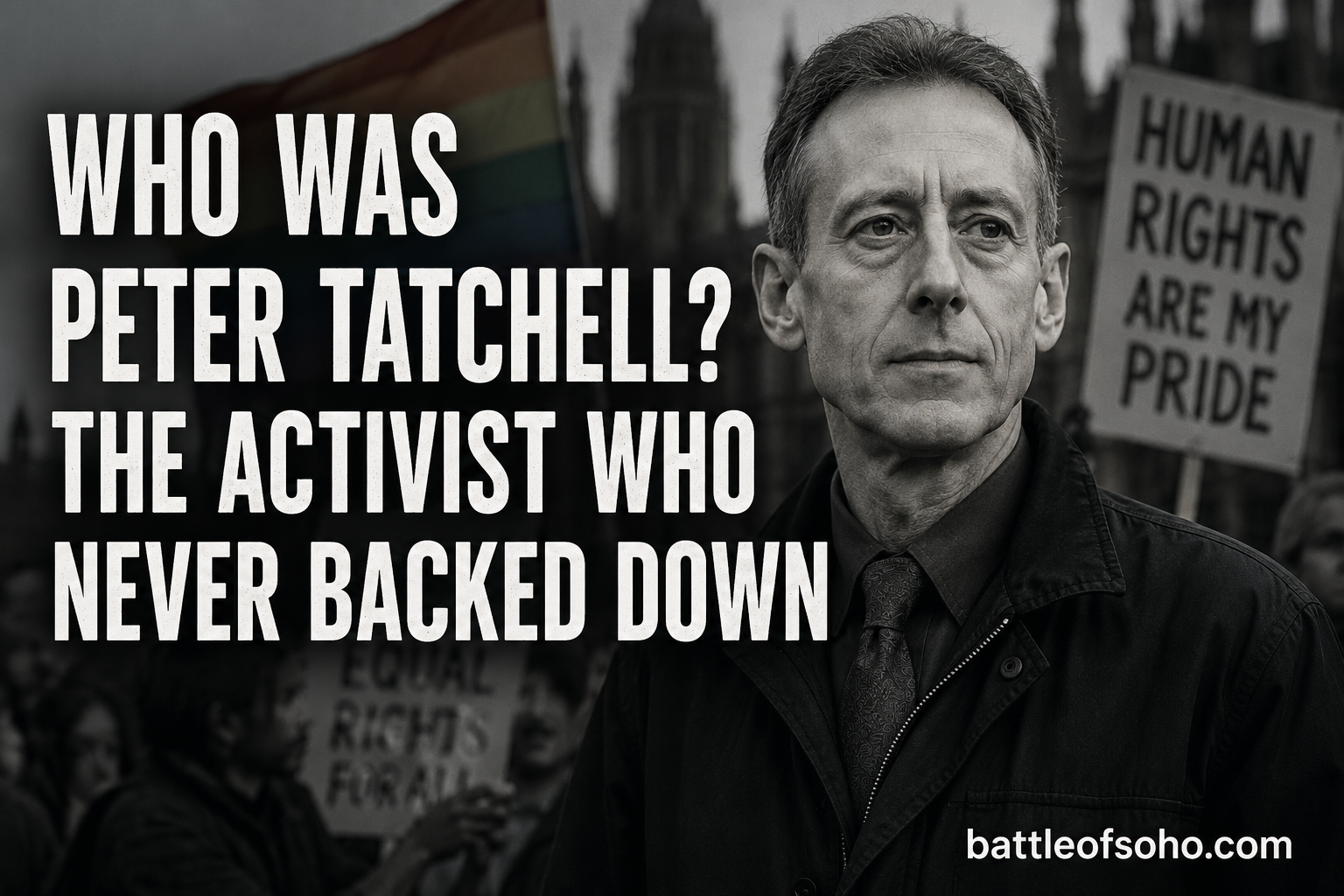
Imagine getting arrested over 300 times for what you believe in. Imagine being beaten by neo-Nazis on a London street, headbutted by a bodyguard, and pelted with eggs year after year. Then imagine getting up the next morning and doing it all over again. That is the story of Peter Tatchell, the activist who never backed down.
Peter Tatchell is an Australian-born British human rights campaigner who has spent more than five decades fighting for LGBTQ+ rights and broader social justice. Born on 25 January 1952, he is best known for co-founding the direct action group OutRage!, attempting a citizen’s arrest on Zimbabwe’s president Robert Mugabe, and campaigning relentlessly for queer liberation at a time when doing so could cost you your safety, your career, and your freedom.
In this article, we trace the life and career of Peter Tatchell, the activist who never backed down. From his working-class childhood in Melbourne to the streets of Soho and beyond, we examine how one person’s refusal to stay silent helped reshape British attitudes toward LGBTQ+ people. We also explore the tactical genius behind his protests, the controversies that divided even his own community, and the legacy that continues to influence activism in 2026.
Table of Contents
Early Life: From Melbourne to London
Peter Gary Tatchell was born on 25 January 1952 in Melbourne, Australia. His father was a fitter and turner who worked in factories, and his mother packed biscuits and raised the family on a tight budget. They were working class, plain speaking, and politically engaged in the way that ordinary people often are without calling it that.
Tatchell has described his early years as marked by an instinctive sense of fairness. He noticed early on that the world was not arranged equally and that those at the bottom got the roughest deal. That awareness was not abstract. It came from growing up in a household where money was scarce and where he saw how class shaped every opportunity available to his family.
His political awakening came at the age of 15 when he read a newspaper article about the death sentence handed to a Mexican student activist. The story ignited something in him. He began reading about civil rights movements, anti-colonial struggles, and the emerging gay liberation movement taking hold in the United States after the Stonewall riots of 1969.
Tatchell came to terms with his own sexuality during his late teens. Being gay in 1960s Australia was not easy. Homosexual acts remained criminalised in parts of the country, and the social climate was hostile. He faced bullying and isolation, but instead of retreating, he leaned into activism, joining campaigns against the Vietnam War and the death penalty while still in school.
In 1971, at the age of 19, Tatchell made a decision that would define the rest of his life. He moved to London, drawn by the energy of Britain’s growing gay liberation movement and the broader political ferment of the era. London in the early 1970s was a city in flux, with protests, squatting movements, and radical politics bubbling up across neighbourhoods including Soho, Brixton, and Notting Hill.
He did not arrive with a plan or a safety net. He arrived with convictions. Within days of landing in the capital, he sought out the Gay Liberation Front, a group that would become his political home and his training ground for decades of confrontational activism to come.
The Gay Liberation Front Years
The Gay Liberation Front (GLF) was the first organisation in Britain to demand queer liberation rather than mere tolerance. Founded in London in 1970, inspired by the American GLF that emerged after Stonewall, it rejected the polite, assimilationist approach of earlier homophile organisations. Tatchell found his people almost immediately.
Joining the GLF in 1971, Tatchell threw himself into organising. The GLF held meetings in churches, community halls, and student unions across London. Its members staged sit-ins at pubs that refused to serve gay people, organised the first Pride marches in Britain, and published radical manifestos that challenged everything from the nuclear family to capitalism itself.
Soho was central to this world. The bars, clubs, and back rooms of Soho had long been a gathering place for London’s LGBTQ+ community, even when homosexuality was criminalised. The GLF used Soho as both a venue and a battleground, staging visible protests in the heart of the West End to declare that queer people existed, mattered, and refused to hide.
Tatchell quickly became one of the GLF’s most visible and vocal members. He helped organise the first Pride march in London in 1972, a modest but groundbreaking event that drew approximately 2,000 people. Compare that to the hundreds of thousands who attend Pride in London today, and you get a sense of how far the movement has come and how much groundwork people like Tatchell laid.
The GLF was short-lived as a formal organisation, fracturing by 1973 due to internal disagreements over ideology and strategy. But its impact was enormous. It normalised the idea of public, visible queer protest in Britain and produced a generation of activists who carried its spirit into the decades that followed. Tatchell was perhaps the most prominent of them all.
The 1983 Bermondsey By-Election
In 1983, Peter Tatchell entered the political mainstream in the most brutal way possible. He was selected as the Labour Party candidate for the Bermondsey by-election, a working-class constituency in South London. He was 31 years old, openly gay, and running for Parliament at a time when homophobia was not just acceptable in public discourse but practically expected.
What followed was one of the dirtiest by-election campaigns in modern British history. Tatchell’s sexuality became the central issue. Opponents distributed leaflets attacking him for being gay. Tabloid newspapers ran hostile profiles. His own party’s internal divisions spilled into the open, with some Labour figures refusing to campaign for him.
The Liberal candidate, Simon Hughes, ran against him in a campaign that many later acknowledged was deeply homophobic. Tatchell received death threats. His flat was attacked. He was followed in the street. The level of vitriol directed at him was extraordinary even by the standards of 1980s British politics.
He lost. Badly. The Labour vote collapsed from a comfortable majority to third place. It was a crushing personal defeat that would have ended most people’s political careers. For Tatchell, it became fuel. The experience taught him that conventional politics alone would not deliver equality. Direct action, public confrontation, and relentless pressure from outside the system were needed to shift attitudes and force change.
The Bermondsey defeat hardened his resolve and sharpened his tactics. He walked away from electoral politics and returned to what he did best: grassroots activism, public protest, and refusing to be silenced.
Founding OutRage! and the Direct Action Era
In 1990, Peter Tatchell co-founded OutRage!, the direct action group that would become synonymous with his name and with a new, more militant phase of LGBTQ+ activism in Britain. OutRage! was born out of frustration with Section 28, the Thatcher-era law that prohibited local authorities from promoting homosexuality, and with the broader climate of anti-gay hostility that defined the late 1980s and early 1990s.
OutRage! was not a polite lobbying organisation. It was a street-level direct action group that used theatrical, confrontational, and often controversial tactics to expose hypocrisy and force public debate. Members dressed as bishops, crashed church services, chained themselves to fences, and snogged in public to challenge the invisibility of queer affection.
Tatchell’s tactical approach to protest was methodical even when it appeared spontaneous. Every action was designed to generate maximum media coverage, expose specific injustices, and put pressure on institutions that had escaped scrutiny. He understood something that many activists still struggle with today: that visibility itself is a form of power, and that forcing uncomfortable conversations into the open is often the first step toward change.
One of OutRage!’s most famous early campaigns targeted the unequal age of consent. While heterosexual sex was legal at 16, gay sex was criminalised until 21. OutRage! staged kiss-ins, invaded television studios, and confronted politicians to demand equal treatment under the law. The campaign ultimately contributed to the equalisation of the age of consent in stages between 1994 and 2001.
Another landmark action was the Stop the Slander campaign of 1994, which targeted media outlets that published homophobic content. OutRage! members occupied newspaper offices, disrupted press conferences, and publicly named journalists who wrote anti-gay columns. It was aggressive, polarising, and impossible to ignore.
The most controversial tactic associated with OutRage! was outing, the practice of publicly revealing the sexuality of closeted public figures who were either actively homophobic or who used their positions to oppose LGBTQ+ rights. Tatchell argued that outing was a legitimate response to hypocrisy. Critics, including many within the LGBTQ+ community, called it a violation of privacy and a dangerous escalation.
The outing debate split the community. Some argued that public figures who voted against gay rights while living closeted lives deserved exposure. Others feared that outing could lead to suicides, job losses, and violence against people who were not ready to come out. Tatchell never apologised for the tactic, but he acknowledged that it was a last resort used only against those who actively harmed the community.
Major Campaigns and Confrontations
Peter Tatchell’s activism has never been confined to LGBTQ+ rights alone. He has campaigned on a remarkably wide range of human rights issues, from Palestine to climate justice to the rights of indigenous peoples. This breadth is one of the things that sets him apart from many single-issue campaigners and reflects his belief that all forms of oppression are connected.
His most famous single action was the attempted citizen’s arrest of Zimbabwean president Robert Mugabe. In 1999, Tatchell approached Mugabe at a hotel in London, attempted to perform a citizen’s arrest for torture under international law, and was beaten unconscious by Mugabe’s bodyguards. He tried again in 2001 in Brussels, this time getting headbutted and repeatedly struck. The actions drew global attention to Mugabe’s human rights abuses and demonstrated Tatchell’s willingness to put his body on the line for people thousands of miles away.
In 1998, OutRage! staged a protest during the Easter sermon at Canterbury Cathedral, interrupting the Archbishop of Canterbury to protest the Church of England’s opposition to LGBTQ+ equality. The protest was widely condemned, including by some allies, but it forced a national conversation about the role of religious institutions in perpetuating discrimination.
Tatchell was also a tireless campaigner for same-sex marriage long before it became politically mainstream. He organised the Equal Love campaign in 2010, which challenged the ban on same-sex marriage and opposite-sex civil partnerships through the European Court of Human Rights. The campaign helped build the political momentum that led to the legalisation of same-sex marriage in England and Wales in 2013.
Beyond LGBTQ+ rights, Tatchell has been arrested at protests against the Iraq War, in solidarity with the West Papua independence movement, and in support of climate activists. He has campaigned against honour killings, forced marriages, and the persecution of Christians in countries where they face violence. His willingness to take on causes outside his immediate community has won him admirers and critics in equal measure.
The sheer number of arrests tells its own story. Tatchell has been arrested over 300 times. He has been physically attacked more times than he can count. He has received death threats from neo-Nazis, religious extremists, and foreign governments. And he has kept going.
Controversies and Criticism
No figure who has been in public life for five decades escapes criticism, and Peter Tatchell is no exception. He has faced significant opposition from within the LGBTQ+ community itself, as well as from broader political and academic circles.
The outing campaigns of the 1990s remain the most enduring source of controversy. Critics argued that no one has the right to make that decision for another person, regardless of their political positions. The practice was condemned by Stonewall, Britain’s largest LGBTQ+ rights organisation, and contributed to a long-standing rift between OutRage! and more mainstream advocacy groups.
In more recent years, Tatchell has faced criticism from some trans activists who have questioned his approach to trans issues and accused him of insensitivity. A 2016 open letter accused him of being a crybully and of using his platform in ways that marginalised trans voices. Tatchell rejected the accusations and pointed to his long record of supporting trans rights, but the incident highlighted generational and tactical fault lines within the LGBTQ+ movement.
He was also no-platformed by the National Union of Students in 2016, meaning student unions were discouraged from inviting him to speak. The decision provoked a national debate about free speech on campus and whether no-platforming was being used to silence progressive voices rather than protect marginalised ones. Tatchell, ever the free speech advocate, called the decision an act of political censorship and continued to speak publicly about the experience.
Some critics within the community have argued that Tatchell’s activism has historically focused too narrowly on the concerns of cisgender white gay men. They point to the early years of OutRage! as evidence that the priorities of people of colour, women, and trans people were not always centred. Tatchell has acknowledged that the movement has evolved and that his own approach has grown alongside it.
What is striking is how Tatchell has responded to criticism. He has rarely retreated. He has debated his critics in public, written detailed rebuttals, and continued to campaign on the issues that matter to him. Love him or loathe him, he has never backed down from a fight, whether the opponent was a hostile government or a fellow activist.
The Tatchell Playbook: Why He Never Backed Down
What makes someone keep going after 300 arrests, countless beatings, and decades of vilification? Understanding Peter Tatchell requires understanding his philosophy of direct action and the psychological resilience that underpins it.
At the core of Tatchell’s approach is a simple belief: that silence equals complicity. He has said repeatedly that when injustice is happening, the worst thing you can do is nothing. This is not a slogan for him. It is a lived principle that has governed every decision he has made since he was a teenager reading about a Mexican student sentenced to death.
His tactical approach to protest is more calculated than it appears. Every action is designed to achieve specific outcomes: generate media coverage, expose a specific injustice, disrupt business as usual, and force a public conversation. He has spoken about the importance of choosing targets carefully, timing actions for maximum impact, and using the moral power of nonviolent confrontation to expose the violence of the system being challenged.
Nonviolence is central to his philosophy, though his critics sometimes conflate disruption with violence. Tatchell has been physically attacked dozens of times but has rarely initiated physical confrontation. He believes in putting his body in the way of injustice and letting the system reveal its own brutality through its response. This is the same principle that guided Gandhi, Martin Luther King Jr., and the civil rights movements that inspired him as a young man.
His physical bravery is undeniable. Being beaten unconscious by Mugabe’s bodyguards is just one example. He has been punched by neo-Nazis at Pride marches, had eggs and projectiles thrown at him, and continued to attend protests into his seventies despite knowing he could be attacked at any moment. The Netflix documentary Hating Peter Tatchell captured this side of his story and introduced a new generation to the violence he faced and survived.
There is a connection here to the spirit of places like Soho, where defiance has always been a survival strategy. Soho’s history as a gathering place for marginalised communities, from queer people to sex workers to immigrants, is built on the same refusal to be invisible that drives Tatchell’s activism. The Battle of Soho, in all its forms, has always been about the right to exist openly in public space. Tatchell took that fight and amplified it on a national and international stage.
Legacy and the Peter Tatchell Foundation
In 2011, Tatchell established the Peter Tatchell Foundation to continue his human rights work in a more structured form. The foundation campaigns on LGBTQ+ rights, democratic rights, and global human rights issues, carrying forward the direct action ethos that has defined his career.
His contributions have been recognised by institutions that once would not have touched him. Goldsmiths, University of London awarded him an honorary degree. He has been profiled by The Guardian, interviewed on major television programmes, and featured in documentaries watched by millions around the world.
The 2021 Netflix documentary Hating Peter Tatchell, produced by Elton John and David Furnish, marked a significant shift in public perception. The film traced his life from Melbourne to London, documented the violence and hostility he faced, and presented him as a pioneer whose methods may have been controversial but whose courage was undeniable. For many viewers, it was the first time they understood the full extent of what he had endured.
Tatchell continues to be active in 2026, well into his seventies. He still attends protests, writes articles, and speaks at events. His physical presence at demonstrations, often in a high-visibility vest and carrying a megaphone, has become a familiar sight in London’s activist landscape. The consistency is remarkable. More than five decades after he arrived in Britain, he is still doing the work.
Conclusion: The Activist Who Never Backed Down
Peter Tatchell’s story is one of extraordinary persistence. From the streets of Melbourne to the pavements of Soho, from the GLF to OutRage! to the foundation that bears his name, he has spent more than fifty years refusing to be silent in the face of injustice.
He has been called a hero and a villain, a pioneer and a provocateur. He has been beaten, arrested, no-platformed, and vilified. And he has kept going, driven by a conviction that is as clear today as it was when he was a fifteen-year-old reading about a student activist on the other side of the world.
Whether you agree with every tactic he has used or not, the question posed by his life is one worth sitting with. Peter Tatchell, the activist who never backed down, forces us to ask: what would we be willing to risk for the things we believe in? His answer, given in actions rather than words across more than half a century, is everything.
FAQs
What is Peter Tatchell known for?
Peter Tatchell is known for over five decades of human rights activism, particularly his work promoting LGBTQ+ rights in Britain. He co-founded the direct action group OutRage! in 1990, campaigned for the equalisation of the age of consent and the legalisation of same-sex marriage, and attempted a citizen’s arrest on Zimbabwean president Robert Mugabe in 1999. He has been arrested over 300 times for his participation in protests.
What is Peter Tatchell’s religion?
Peter Tatchell is an atheist. He was raised in a Christian household in Australia but rejected religion as a teenager. His atheism has informed his willingness to challenge religious institutions, including the Church of England, over their opposition to LGBTQ+ equality.
Who pays Peter Tatchell?
Peter Tatchell’s work is primarily supported through the Peter Tatchell Foundation, which he established in 2011. The foundation is funded through donations from supporters and occasional grants. Tatchell has lived modestly throughout his career and has never drawn a large salary from his activism, choosing instead to reinvest resources into campaigns.
Where does Peter Tatchell live?
Peter Tatchell lives in a council flat in Elephant and Castle, South London. He has lived in London since moving from Australia in 1971 and has remained based in the capital throughout his activism career, maintaining close ties to the city’s LGBTQ+ community and protest scene.