
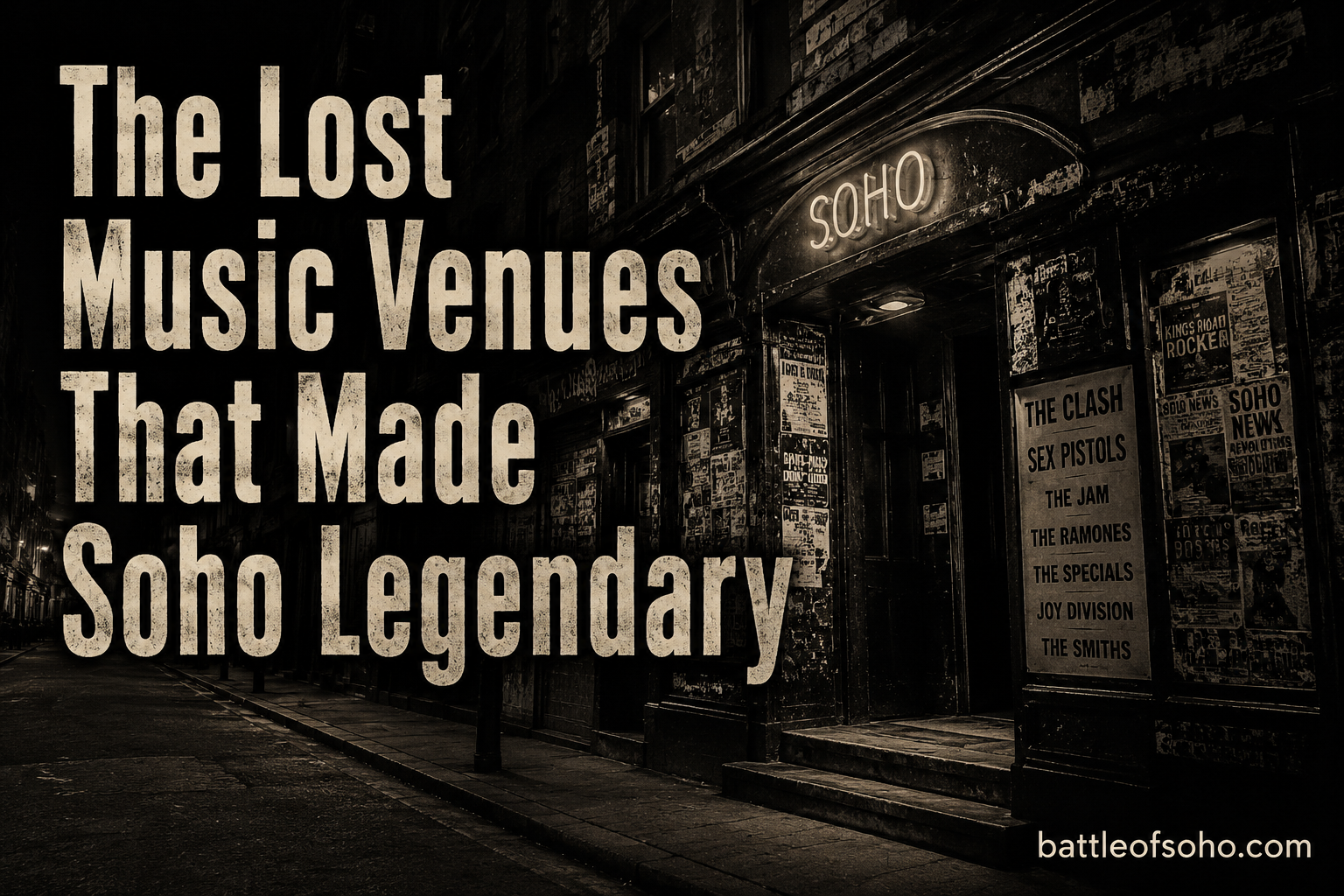
Walk down Wardour Street today and you will see cocktail bars, chain restaurants, and construction scaffolding. But if you close your eyes and listen carefully, you can almost hear it. The rumble of an overdriven amplifier from a basement. The clatter of a snare drum bouncing off brick walls. The chatter of a crowd spilling onto the pavement after midnight. These are the ghosts of the lost music venues that made Soho legendary.
For decades, this square mile in the heart of London was the beating center of British music. The Rolling Stones played their first gig here. Jimi Hendrix dazzled audiences in a room that held barely 500 people. Jazz musicians from New York flew across the Atlantic specifically to play Soho clubs. This was where careers were launched, scenes were born, and music history was written one sweaty night at a time.
In this guide, I want to take you through the venues that shaped Soho’s musical identity and explore why they disappeared. I will cover the famous names you might have heard of and the lesser-known rooms that deserve to be remembered. Whether you lived through this era or are discovering it for the first time, understanding Soho’s lost music venues means understanding the soul of London’s cultural history.
Table of Contents
The Lost Music Venues That Made Soho Legendary: A Musical Geography
Soho was never just a neighborhood. It was a music ecosystem packed into roughly one square mile. Wardour Street served as the main artery, with venues stacked side by side like a strip of amplifiers. Old Compton Street, Dean Street, and Berwick Street all contributed their own flavor to the mix.
What made this area special was its density. You could see three bands in one night without walking more than ten minutes between venues. A&R scouts from nearby record labels could stumble out of their offices and catch a raw, unsigned act over their lunch break. The proximity of recording studios, record shops, rehearsal spaces, and performance venues created something that no urban planning could ever replicate.
From the 1950s skiffle craze through the 1960s British Invasion, the 1970s pub rock and punk explosion, and into the 1980s and 1990s indie scene, Soho’s venues adapted and evolved. Each era left its mark on the buildings, the streets, and the cultural memory of everyone who passed through.
But Soho’s music heritage is not just about nostalgia. It is about understanding how creative communities form, how they thrive, and what happens when the conditions that created them begin to disappear. The story of Soho’s lost venues is a story that cities around the world are still grappling with today.
The Marquee Club: Where Rock History Was Born
If there is one venue that defines the lost music venues that made Soho legendary, it is The Marquee Club. Originally opened in 1958 at 165 Oxford Street as a jazz club, it moved to its most famous location at 90 Wardour Street in 1964. That basement room became ground zero for the British music explosion.
The Rolling Stones played their first-ever gig at The Marquee in 1962. The Who performed there so often in their early days that they became practically the house band. David Bowie, Jimi Hendrix, Led Zeppelin, and Pink Floyd all graced that tiny stage. When I say tiny, I mean it. The room held around 500 people, which means some of the most important performances in rock history happened in a space smaller than most modern pubs.
The Marquee was also a launching pad for the genres that defined the next several decades. It hosted early performances by bands that would shape progressive rock, heavy metal, and new wave. The venue’s booking policy was famously eclectic. One night you might catch a blues band, the next a proto-punk act, and the night after that a jazz fusion outfit.
The original Wardour Street location closed in 1988. The building was demolished to make way for office space. The Marquee name lived on in various relocated forms for years, but never recaptured the magic of that basement on Wardour Street. For anyone who experienced it, the loss of The Marquee at its original location felt like losing a cathedral.
What made The Marquee irreplaceable was not just the famous names. It was the room itself. The low ceilings, the cramped stage, the sound bouncing off the walls. Every inch of that space was soaked in musical history. When it was gone, no amount of naming rights or relocations could bring back what had been lost.
The 2i’s Coffee Bar: The Birthplace of British Rock and Roll
Long before the stadium tours and the record deals, British rock and roll started in a coffee bar. The 2i’s on Old Compton Street opened in 1956, and it became the unlikely epicenter of a musical revolution. This was where the skiffle craze took hold and where Britain’s first rock and roll star was discovered.
Tommy Steele, widely regarded as Britain’s first rock and roll idol, was discovered performing at The 2i’s in 1956. His discovery set off a gold rush. Music managers, record producers, and talent scouts began flocking to Old Compton Street looking for the next big thing. The venue became a proving ground where young musicians could test their material in front of a real audience.
The 2i’s was not a traditional music venue. It was a coffee bar with a small performance space in the basement. But that intimacy was exactly what made it powerful. Artists were close enough to see the reactions on people’s faces. The energy was immediate and personal in a way that large venues could never replicate.
The coffee bar closed in 1970, and the building eventually became a restaurant. But the legacy of The 2i’s lives on every time a British artist picks up a guitar. Without that tiny basement on Old Compton Street, the entire trajectory of British popular music might have been different.
The Flamingo Club: Jazz, Mod Culture, and Underground Sounds
The Flamingo Club, located at 33-37 Wardour Street, was where jazz met R&B and gave birth to the mod movement. Opening in 1952, it started as a traditional jazz club but quickly evolved as musical tastes shifted through the 1960s.
Georgie Fame and the Blue Flames held a legendary residency at The Flamingo that helped define the British rhythm and blues sound. The club was also one of the first major London venues to feature American R&B and soul artists. For many Londoners, The Flamingo was their first exposure to the sounds that would shape the next decade of popular music.
The Flamingo had a reputation that went beyond the music. It was one of the few West End venues that welcomed Black audiences and performers during a period when many London clubs operated unofficial color bars. This openness made it a cultural crossroads where different communities, musical traditions, and social movements intersected.
The club closed in the late 1960s as the mod scene faded and tastes shifted again. But during its heyday, The Flamingo was one of the most important cultural spaces in London. It proved that a venue could be more than just a place to hear music. It could be a place where social barriers broke down and new identities formed.
Ronnie Scott’s: The Jazz Institution That Refused to Die
Ronnie Scott’s deserves mention in any discussion of Soho’s music venues, but with an important distinction. It is one of the survivors. Opened in 1959 at 39 Gerrard Street before moving to its current location at 47 Frith Street in 1965, Ronnie Scott’s has weathered every storm that closed the venues around it.
Understanding Ronnie Scott’s survival is key to understanding what the lost venues were up against. The club adapted its programming, built a loyal international audience, and leveraged its brand recognition to endure rising rents and changing tastes. It also benefited from a location just outside the most expensive stretch of central Soho.
The venue has hosted everyone from Ella Fitzgerald and Miles Davis to modern jazz icons. Walking into Ronnie Scott’s today, you can feel the history in the walls. The stage, the layout, the atmosphere. It is a living museum of jazz culture that continues to present world-class music every night of the week.
Ronnie Scott’s stands as both an inspiration and a warning. It proves that legendary venues can survive with the right combination of adaptation and community support. But it is also one of the very few from Soho’s golden era that managed it, which makes its survival the exception rather than the rule.
The Golden Era of Wardour Street: Venue Row
To understand the lost music venues that made Soho legendary, you have to understand Wardour Street. This single thoroughfare was once lined with music venues the way other streets are lined with shops. You could walk from one end to the other and pass four or five live music establishments.
The Marquee sat at number 90. The Flamingo occupied a spot further up the street. The Wavelength, The Warehouse, and various short-lived basement spaces filled the gaps between. Wardour Street was not just a location for music venues. It was the music industry’s address, with record companies, management offices, and recording studios all within a few hundred yards.
This concentration created an ecosystem that fed itself. A band could rehearse in the afternoon, play a gig in the evening, network with industry people at the bar afterward, and walk to a late-night jam session. The infrastructure was so complete that a band could build an entire career without leaving the neighborhood.
The golden era of Wardour Street roughly spanned from the early 1960s through the late 1980s. As venues closed one by one, the ecosystem weakened. Each closure made the next closure more likely. Without the density of venues to draw music fans to the area, foot traffic dropped, and the remaining venues struggled even more.
Today, Wardour Street is a shadow of its musical self. The buildings are still there, but the basements that once thundered with amplifiers now house wine bars and corporate offices. The street remains, but the music that made it famous has moved elsewhere.
The Punk Years: Soho’s Basement Rebellion
One of the most underappreciated chapters in the story of Soho’s lost venues is the punk era. While the popular narrative of British punk centers on venues like The Roxy in Covent Garden, Soho’s basements played a critical role in the explosion of alternative music in the mid-to-late 1970s.
The Vortex Club on Wardour Street became a hub for the emerging punk and new wave scene. Small basement venues that had once hosted jazz and blues pivoted to accommodate raw, fast, confrontational music. These rooms were perfect for punk. They were small, cheap to rent, and had the kind of grime that matched the aesthetic of the movement.
What made the punk years in Soho distinctive was the collision of scenes. Established music industry people working on Wardour Street would wander into a basement and discover a completely new sound. Punk bands could play a gig and have an A&R representative in the audience that same night. This proximity between the underground and the establishment accelerated the speed at which punk went from subculture to commercial force.
These punk-era venues were some of the first to disappear. Many operated on informal arrangements, short leases, and handshake deals. As property values climbed and landlords sought more reliable tenants, these marginal spaces were the easiest to clear out. The punk venues of Soho vanished almost as quickly as they had appeared, leaving behind only recordings, photographs, and memories.
Why Soho Lost Its Music Venues: The Perfect Storm
There was no single cause behind the disappearance of Soho’s music venues. It was a perfect storm of economic, cultural, and regulatory pressures that hit simultaneously. Understanding these forces helps explain why this pattern has repeated in music districts around the world.
Rising rents were the most visible killer. As Soho became increasingly desirable for corporate offices, luxury apartments, and high-end retail, property values soared. Music venues, which operate on thin margins and need large floor spaces, simply could not compete with businesses that could pay substantially more per square foot. Landlords who had tolerated noise and late hours for decades found it financially irresistible to convert their buildings.
The Crossrail development, which brought massive infrastructure construction through central Soho, accelerated the displacement of independent businesses. Long-term construction disrupted foot traffic, blocked entrances, and made operating a nightlife business extremely difficult. Several venues that might have survived rising rents alone were pushed over the edge by the construction chaos.
Noise complaints became a growing problem as residential development encroached on what had been a commercial and entertainment district. New apartment buildings meant new residents who had not chosen to live in a nightlife area but who expected quiet evenings. Licensing authorities, caught between venue operators and residents, increasingly sided with the complainants. Late licenses were revoked, sound levels were restricted, and venues found their operating conditions becoming untenable.
The expansion of chain bars and restaurants also played a role. Corporate hospitality groups could afford the rising rents that independent venue operators could not. These chains brought standardized, predictable offerings that appealed to property owners seeking reliable tenants. The character of Soho’s streets changed as independent venues were replaced by identical establishments found on any high street in Britain.
Finally, there were broader cultural shifts. The way people consumed music was changing. Streaming, home entertainment systems, and shifting social habits reduced demand for the kind of nightly live music that had sustained Soho’s venues. The venues that survived were the ones that adapted to these changes or had built enough brand recognition to weather the storm.
The V&A Exhibition: Preserving the Memory of Lost Venues
In 2026, the conversation about lost music venues received fresh attention thanks to the V&A’s exhibition on the UK’s legendary lost performance spaces. Featuring around 50 lost venues from the 1980s through the 2010s, the exhibition brought together ephemera, photographs, and artifacts from spaces that no longer exist.
The exhibition was created in partnership with the Music Venue Trust, the organization that has been fighting to protect grassroots venues across the UK. Their work highlights a sobering statistic. The UK has lost approximately one-third of its grassroots music venues over the past two decades. Soho’s losses are part of a much larger national pattern.
What the V&A exhibition made clear is that these venues were not just commercial spaces. They were cultural infrastructure. They were the places where musicians learned their craft, where scenes formed, and where the next generation of artists was nurtured. When a venue closes, it is not just a business failure. It is the loss of a piece of cultural memory.
The exhibition also highlighted the growing grassroots crisis. Touring circuits depend on a network of small venues to develop artists before they are ready for arenas. As those venues disappear, the pipeline of new talent narrows. The loss of Soho’s venues was not just a local story. It had implications for the entire British music industry.
The Record Store Connection: Berwick Street’s Vinyl Legacy
You cannot talk about Soho’s music scene without talking about its record stores. Berwick Street, running parallel to Wardour Street, was once lined with independent record shops that formed the other half of Soho’s music ecosystem. Sister Ray, Reckless Records, and other shops created a destination for music fans that complemented the live venue scene.
The relationship between venues and record stores was symbiotic. You would see a band at a Soho club on a Friday night and then buy their record on Berwick Street on Saturday. In-store performances and signings at record shops created additional performance opportunities for touring artists. The shops themselves became informal gathering spaces where music fans exchanged recommendations and discovered new sounds.
While many record stores have also disappeared, a few survivors remain on Berwick Street. Sister Ray continues to operate, keeping the vinyl tradition alive. These shops are the last physical remnants of the retail infrastructure that once made Soho a complete music destination. They serve as a reminder of what the neighborhood was at its peak.
The connection between record stores and venues also highlights something important about music communities. They need physical spaces to thrive. Online streaming and social media have changed how we discover music, but they cannot fully replace the experience of browsing records, talking to knowledgeable staff, and stumbling into a live performance on a random evening.
What Remains: Soho’s Surviving Music Culture in 2026
Despite the losses, Soho has not completely surrendered its musical identity. A handful of venues continue to operate, carrying the torch for live music in the neighborhood. Understanding what survives helps us appreciate what was lost and what is still worth protecting.
Ronnie Scott’s remains the crown jewel of Soho’s surviving music venues, presenting world-class jazz every night. Ain’t Nothin But on Kingly Street continues to host blues nights, keeping that tradition alive with jam sessions and performances that honor the spirit of Soho’s musical past. These venues prove that live music can still work in Soho when conditions are right.
The surviving record shops on Berwick Street also contribute to the neighborhood’s musical identity. They attract visitors who come specifically for the music experience, creating the kind of cultural tourism that supports the remaining venues. The ecosystem is smaller than it was, but it still functions.
The question for 2026 and beyond is whether these survivors can hold on. The same pressures that closed The Marquee and The Flamingo are still at work. Rents continue to rise. Development pressure continues. The Music Venue Trust and other advocacy groups are fighting for protections, including the proposed ticket levy on arena concerts that would fund grassroots venues. The battle for Soho’s musical soul is not over.
FAQs
What is the most iconic music venue in Soho’s history?
The Marquee Club at 90 Wardour Street is widely considered the most iconic music venue in Soho’s history. It hosted the first performances by The Rolling Stones, regular early shows by The Who, and legendary appearances by Jimi Hendrix, David Bowie, Led Zeppelin, and Pink Floyd in a basement room that held roughly 500 people.
What is the most famous music venue in London?
Ronnie Scott’s Jazz Club on Frith Street in Soho is one of the most famous music venues in London. Opened in 1959, it has hosted jazz legends including Ella Fitzgerald, Miles Davis, and countless modern artists. It remains open today and is one of the few surviving venues from Soho’s golden era of live music.
Why did Soho lose so many of its music venues?
Soho lost its music venues due to a combination of rising commercial rents, the Crossrail construction disrupting local businesses, noise complaints from new residential developments, restrictive licensing changes, and the expansion of chain bars replacing independent venues. These pressures made it financially impossible for many grassroots venues to continue operating.
Which legendary venues has Soho lost over the years?
Soho has lost numerous legendary venues including The Marquee Club (closed 1988 at its Wardour Street location), The 2i’s Coffee Bar (closed 1970), The Flamingo Club (closed late 1960s), and various punk-era basement spaces including The Vortex. These venues hosted everyone from The Rolling Stones to Jimi Hendrix and were foundational to British music history.
What is the oldest surviving music venue in London?
Ronnie Scott’s Jazz Club, which opened in 1959 and moved to its current Frith Street location in Soho in 1965, is one of the oldest surviving dedicated music venues in London. It has operated continuously for over 60 years and remains a vital performance space for jazz and contemporary music.
Conclusion: The Echoes Remain
The lost music venues that made Soho legendary are gone, but they are not forgotten. The Marquee, The 2i’s, The Flamingo, and the dozens of basement rooms that once shook with amplifiers have left a permanent mark on music history. Every time a British band takes a stage anywhere in the world, they are standing on ground that was broken in those Soho basements.
What I find most striking about this story is how recent it is. The Marquee closed in 1988. That is well within living memory. Many of the people who attended gigs at these venues are still active music fans today. The loss of these spaces is not ancient history. It is an ongoing process that continues to reshape London’s cultural landscape right now.
The story of Soho’s lost venues is also a warning. When we let music venues disappear, we lose more than entertainment spaces. We lose the infrastructure that develops new talent, the physical locations where communities form, and the cultural memory that defines a neighborhood. The UK is still losing grassroots venues at an alarming rate, and Soho’s story shows what happens when that loss goes unchecked.
But there is also hope in this story. Ronnie Scott’s survives. Record shops on Berwick Street endure. The Music Venue Trust fights on. The V&A exhibition proves that people care about this history. And every person who reads about these lost venues and shares their story keeps the memory alive.
Soho’s music scene may never return to what it was at its peak. But by remembering what was lost and understanding why, we can fight to protect what remains. The ghosts of Wardour Street deserve nothing less.