
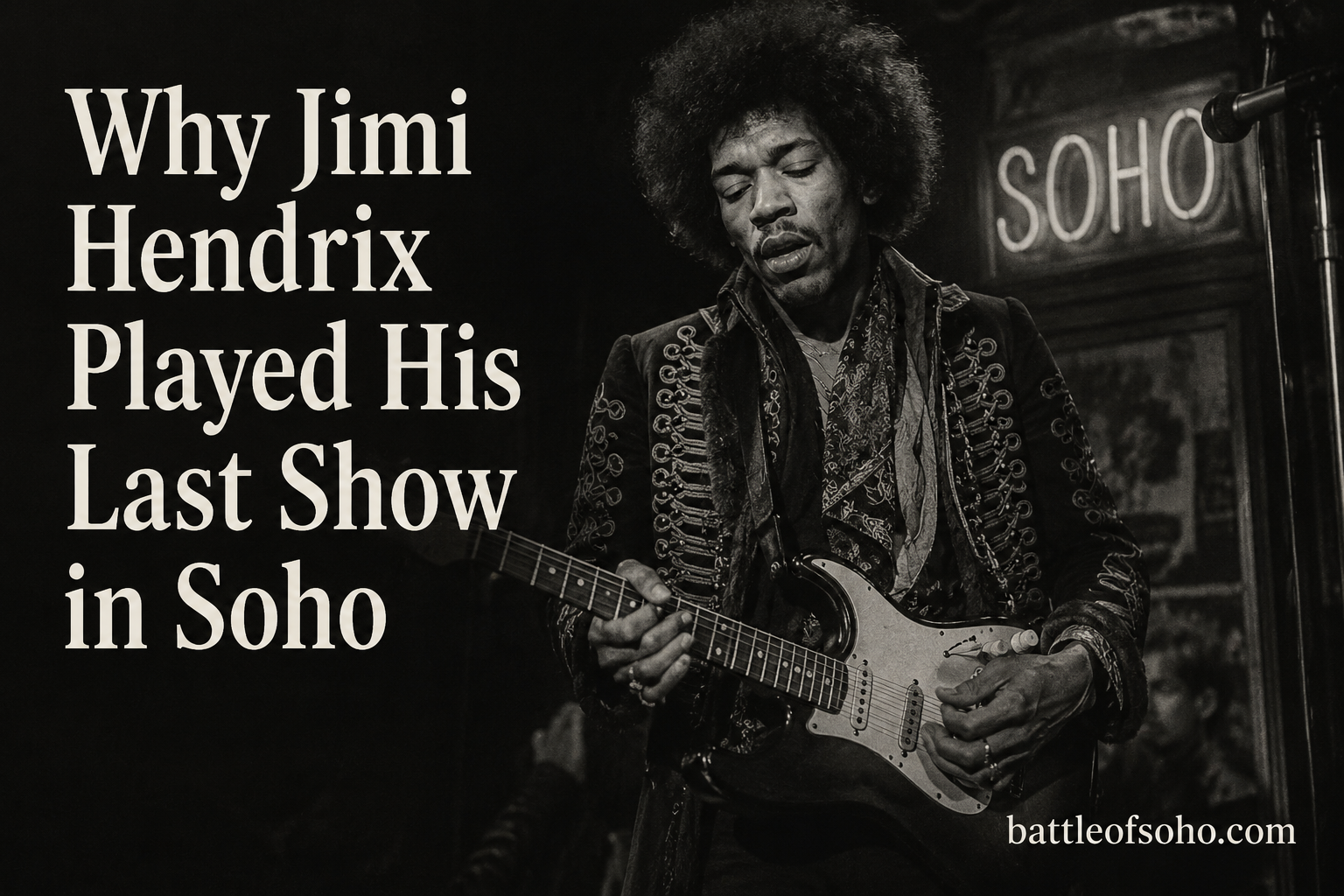
On the night of September 16, 1970, Jimi Hendrix walked into Ronnie Scott’s Jazz Club in the heart of Soho, London. He wasn’t booked to play. He wasn’t even supposed to be there as a performer. But before the night was over, he would take the stage one final time.
Two days later, he was gone.
The story of why Jimi Hendrix played his last show in Soho is one of friendship, timing, and a venue that meant something deeply personal to him. It is not the story of a grand farewell concert or a planned final appearance. It is the story of an impromptu jam session that became the last public performance of the greatest guitarist rock music has ever known.
Our team has dug through Eric Burdon’s memoirs, audience accounts, bootleg recording histories, and forum discussions from collectors who have spent decades tracking down every detail of that night. What follows is the most complete picture we can assemble of why Hendrix ended up on a tiny stage in Soho, playing blues standards with a band he barely knew, on the last night he would ever perform.
Table of Contents
Why Jimi Hendrix Played His Last Show in Soho: The Setting
Soho in 1970 was the beating heart of London’s music scene. This was not the sanitized entertainment district it has become today. Soho was gritty, loud, and alive with jazz clubs, blues dens, and all-night cafés where musicians gathered after gigs. It was the neighborhood where the Rolling Stones rehearsed, where David Bowie found his footing, and where legends were made in rooms that held fewer than 200 people.
Ronnie Scott’s Jazz Club sat at 47 Frith Street, right in the center of it all. Opened in 1959 by saxophonist Ronnie Scott and Pete King, the club had moved to its Soho location in 1965 and quickly became the premier jazz venue in Britain. Miles Davis played there. Duke Ellington played there. It was a serious musician’s room, not a rock venue.
So why would Jimi Hendrix, a man who had headlined Woodstock and played to half a million people at the Isle of Wight, choose a jazz club in Soho for his final appearance? The answer is simple: Ronnie Scott’s was not about spectacle. It was about music. And by September 1970, Hendrix was exhausted by spectacle.
He had spent the better part of four years being the biggest rock star on the planet. The pressure, the tours, the business disputes with manager Michael Jeffery, and the grind of constant recording had worn him down. What he wanted in those final weeks was something real. Something small. Something that reminded him why he picked up a guitar in the first place.
Soho gave him that. It always had. Since his first days in London in 1966, when he arrived as an unknown guitarist recommended to producer Chas Chandler, Soho was where Hendrix felt at home among musicians. The Scotch of St. James, the Marquee Club, the Bag O’ Nails, all within walking distance of Ronnie Scott’s. He had played his first London gig at the Scotch of St. James in Mason’s Yard. London, and Soho specifically, was where the Jimi Hendrix Experience was born.
Returning to Soho for his final performance was, in a sense, a homecoming.
How Hendrix Ended Up Back in London
To understand why Hendrix was in Soho that September, you have to trace his movements through the final weeks of his life. The summer of 1970 had been brutal.
On August 31, 1970, Hendrix headlined the Isle of Wight Festival before an estimated 600,000 people. It was one of the largest concerts of the era, and by many accounts, it was not a great night. Technical problems, a restless crowd, and a set that felt unfocused left Hendrix frustrated. He followed it with a brief European tour that included a chaotic performance at the Love and Peace Festival on the German island of Fehmarn on September 6, 1970. That show, played in front of a thin crowd on a rainy day, would be his last scheduled concert with a full band.
After Fehmarn, Hendrix flew back to London. He checked into the Samarkand Hotel at 22 Landsdowne Crescent in Notting Hill, a quiet residential area in West London. He was supposed to be resting, working on new material, and preparing for meetings about his next album. He had been talking about a new musical direction, something that moved beyond the power trio format of the Experience and even beyond the expanded Band of Gypsys. He was listening to Miles Davis, collaborating with jazz musicians, and thinking about music in a way that the rock press did not yet understand.
Friends who saw him during those days described a man who was tired but creatively restless. He was not in poor spirits, by most accounts, but he was overworked. He had been complaining of insomnia and had been prescribed sleeping pills. His relationship with his girlfriend, Monika Dannemann, was new and, by some accounts, strained by the pressures of his schedule.
He was also spending time with old friends. London in September 1970 was where his inner circle lived, and Hendrix, despite his fame, was someone who craved the company of fellow musicians. That craving, more than anything else, is what put him in Soho on the night of September 16.
The Eric Burdon Connection
The reason Jimi Hendrix played his last show in Soho comes down to one man: Eric Burdon.
Burdon was the former lead singer of the Animals, the British Invasion band behind “House of the Rising Sun.” By 1970, Burdon had formed a new group called War, a funk and rock ensemble that blended Latin rhythms, soul, and extended jams. In September 1970, Eric Burdon and War had a residency at Ronnie Scott’s Jazz Club. They were playing multiple nights at the club, bringing their sprawling, energetic sound into one of London’s most respected rooms.
Burdon and Hendrix went back years. They had been friends since the mid-1960s, bonded by a shared love of blues and a mutual respect that transcended the competitive nature of the music industry. Burdon had watched Hendrix transform from a shy American guitarist playing backup for Little Richard into the most electrifying performer in rock. Hendrix, in turn, respected Burdon’s deep knowledge of blues and R&B and his fearlessness as a vocalist.
When Hendrix arrived back in London after the European tour, Burdon reached out. The exact sequence of events has been debated for decades, with some sources placing Hendrix at Ronnie Scott’s on September 15 and others on September 16. Based on Eric Burdon’s own account in his autobiography, “Don’t Let Me Be Misunderstood,” and corroborated by club staff and audience members, here is what most likely happened.
On September 15, Hendrix visited Ronnie Scott’s during War’s soundcheck or early set. He was tired, possibly unwell, and reportedly in rough shape. Forum discussions among Hendrix collectors and researchers indicate that he may have been overwhelmed that first night, not yet ready to play. Some accounts suggest he sat in the audience, listened, and left without performing.
On September 16, he came back. This time, he was ready. Burdon invited him to join War on stage for a jam, and Hendrix accepted. It was not a formal set. There was no announcement, no promotion, no sense that this was anything more than two friends playing music together in a small club. That is exactly what Hendrix wanted.
Burdon later wrote about the evening with a mixture of warmth and sorrow. He described Hendrix as being in good spirits, happy to be playing in an intimate setting without the pressure of a headline slot. For Burdon, the memory of that night became something he carried for the rest of his life. He had no idea it would be the last time he would see Hendrix play.
The Final Performance: What Happened on Stage
What happened on the stage of Ronnie Scott’s on the night of September 16, 1970, was brief, raw, and entirely improvised. There was no setlist. There were no rehearsals. Hendrix simply plugged in and played.
He was playing his white Fender Stratocaster, the guitar most associated with his later period. The Stratocaster had been his instrument of choice since the early days of the Experience, and by 1970 he was closely identified with the model. In a small jazz club, the sound of his amplifiers must have been overwhelming. Ronnie Scott’s was designed for acoustic instruments and small combos. Hendrix’s electric guitar, pushed through his favored Marshall amplifiers, would have filled every corner of the room.
The songs he played that night were not his hits. There was no “Purple Haze,” no “Voodoo Child,” no “All Along the Watchtower.” Instead, Hendrix and War played blues standards and extended jams. The two songs most consistently identified from the recording are “Mother Earth” and “Tobacco Road.”
“Mother Earth” is a blues song written by Memphis Slim, a Chicago blues pianist and singer. It is a slow, earthy number about returning to the ground from which we came. The choice of this song, in retrospect, carries an almost unbearable weight. Hendrix, who had spent his career pushing the electric guitar into entirely new sonic territory, chose to spend his final hours on stage playing a simple, traditional blues.
“Tobacco Road” was a song that had been part of the British blues and rock repertoire for years. John D. Loudermilk wrote it, but it had been covered by the Nashville Teens, Edgar Winter, and many others. It was a vehicle for extended jamming, and that is exactly how Hendrix and War treated it. Howard Scott, War’s guitarist, traded licks with Hendrix as the band locked into a deep groove behind them.
Accounts of the performance vary in terms of how long it lasted. Some sources suggest a relatively short set, perhaps 20 to 30 minutes. Others indicate it may have stretched longer. What is clear from the surviving recording is that Hendrix was engaged, playing with feeling, and clearly enjoying the freedom of an informal jam in a room full of fellow musicians.
The audience at Ronnie Scott’s that night was small, perhaps 100 to 200 people. Many of them may not have realized, at first, that the guitarist who had just walked on stage was Jimi Hendrix. The club was dark, the mood was casual, and War was already in full flow. But once the first notes rang out, there would have been no mistaking that sound. That tone. That touch.
By all accounts, the performance was not technically perfect. Hendrix was not in peak form. But it was honest, and it was real, and it was exactly the kind of music he wanted to be making in that moment.
The Recording That Survived: Bill Baker’s Cassette
The only reason we know what Hendrix played that night is because one man in the audience had the foresight to bring a tape recorder.
Bill Baker was a music fan and regular on the London club circuit. On the night of September 16, 1970, he brought a Sony TC-100A portable cassette recorder to Ronnie Scott’s. This was not unusual for dedicated collectors in that era. Portable cassette recorders had become more accessible by the late 1960s, and many jazz and rock fans brought them to clubs to capture performances that would otherwise be lost.
Baker’s recording is the only known audio documentation of Hendrix’s final performance. Without it, we would have nothing but secondhand accounts and memories filtered through decades of hindsight. The cassette captured the room sound, the ambience, the crowd noise, and, beneath it all, the unmistakable sound of Hendrix’s guitar.
The recording circulated among collectors for years. It was transferred to vinyl as a bootleg LP, sometimes appearing under the title “Can You Please Crawl Out Your Window.” Bootleg vinyl from this era was notoriously variable in quality, and copies of copies degraded the already rough audience recording further. But for Hendrix collectors, it was sacred material. It was the last recording of the man playing live.
For decades, the recording existed only in the shadowy world of bootleg collectors. It was traded at record fairs, passed around on cassette tapes among friends, and discussed in hushed tones on forums like guitars101.com and stevehoffman.tv. Questions abounded: Was the recording complete? Were there other songs that had been lost? Was there a better quality source tape somewhere?
The recording gained wider recognition through a documentary about Ronnie Scott’s history, which featured remastered excerpts of the performance. For many fans, this was the first time they had heard the audio in any kind of cleaned-up form. The difference was striking. What had sounded like a muddy, distant murmur on old bootleg cassettes revealed itself as a genuine performance, with identifiable songs, recognizable playing, and the atmosphere of a small Soho jazz club on a Tuesday night in September 1970.
As of 2026, the recording has never been officially released as a standalone commercial product. It remains primarily a collector’s item, a piece of music history that exists in a gray area between bootleg and legitimate archival material. The Hendrix estate, controlled by Experience Hendrix LLC, has released a vast amount of previously unreleased material over the years, but the Ronnie Scott’s recording has not been part of those official releases.
Two Days Later: Hendrix’s Death
On the morning of September 18, 1970, roughly 36 hours after he played his final notes at Ronnie Scott’s, Jimi Hendrix died at the Samarkand Hotel in Notting Hill. He was 27 years old.
The official cause of death was asphyxia from aspiration of vomit, complicated by barbiturate use. He had taken sleeping pills prescribed by his doctor and, according to Monika Dannemann’s account, did not wake up. The details of that night have been debated, investigated, and re-examined for decades. What is not in dispute is the outcome: the world lost a musician who was only beginning to explore what was possible with the electric guitar.
In the immediate aftermath, those who had been at Ronnie Scott’s two nights earlier were left to process what they had witnessed. Eric Burdon, who had been on stage with Hendrix, was devastated. In later years, he would speak and write about the evening with a combination of gratitude and grief. He was grateful to have shared a stage with his friend one last time. He was haunted by the knowledge that neither of them knew what was coming.
The retrospective weight of the Ronnie Scott’s performance is immense. It was not planned as a farewell. It was not intended to be historic. It was just a jam. But that is what makes it so powerful. Hendrix’s final public act as a musician was not a grand spectacle. It was a man in a small club, playing the blues with his friends, doing what he loved most in the world.
There is something deeply fitting about that. And something unbearably sad.
Why This Performance Matters in Music History
The story of why Jimi Hendrix played his last show in Soho matters for several reasons, and not just because of the tragic timing.
First, it reveals something about who Hendrix was as a musician. At the height of his fame, with the resources to play any venue in the world, he chose a tiny jazz club. He chose to play blues standards instead of his hits. He chose collaboration over solo spotlight. This tells you more about Hendrix’s musical values than any stadium concert ever could. He was, at his core, a bluesman. A musician’s musician. Someone who would rather play “Mother Earth” in a room of 100 people than “Purple Haze” for 100,000.
Second, the performance connects two worlds that are often treated as separate: the rock tradition and the jazz tradition. Ronnie Scott’s was a jazz club. War was a funk-rock band with jazz inclinations. Hendrix, in his final months, was increasingly drawn toward jazz, collaborating with musicians like Miles Davis and exploring longer, more improvised forms. The Ronnie Scott’s performance is a snapshot of that transition, a moment where the boundaries between genres dissolved on a small stage in Soho.
Third, the survival of Bill Baker’s cassette recording highlights the role that ordinary fans play in preserving music history. The major labels did not record that night. The BBC was not there. No professional engineer captured the sound. It was one man with a portable cassette recorder who decided, for reasons known only to him, to press record. Without Bill Baker, Hendrix’s final performance would exist only in memory, fading a little more with each passing year. Every time a Hendrix collector listens to that bootleg, they are hearing something that exists because of one person’s decision to document a moment that no one else thought to preserve.
Finally, the Soho performance matters because it places Hendrix’s story in a specific place with a specific cultural context. Soho was not just a backdrop. It was an active participant in the history of rock music. The clubs of Soho nurtured the British blues boom that created the environment for Hendrix to flourish when he arrived in 1966. And it was in Soho that he chose to make his final stand as a performer. The neighborhood gave him a beginning and, in a sense, an ending.
FAQs
Where did Jimi Hendrix play his last show?
Jimi Hendrix played his last show at Ronnie Scott’s Jazz Club at 47 Frith Street in Soho, London, on September 16, 1970. He joined Eric Burdon and the band War on stage for an impromptu jam session, two days before his death on September 18, 1970.
How did Jimi Hendrix end up in London?
Hendrix first came to London in 1966 after being discovered by Animals bassist Chas Chandler in New York. Chandler brought him to London to form the Jimi Hendrix Experience and launch his solo career. By September 1970, Hendrix had returned to London after completing a European tour that included the Isle of Wight Festival on August 31 and a final concert at Fehmarn, Germany on September 6.
What songs did Jimi Hendrix play at his final performance?
Hendrix played blues standards during his final jam at Ronnie Scott’s, including Mother Earth (a Memphis Slim composition) and Tobacco Road (by John D. Loudermilk). He did not perform any of his major hits. The performance was an improvised jam with Eric Burdon and War, not a formal concert set.
Was Jimi Hendrix’s last performance on September 15 or 16, 1970?
The final performance took place on September 16, 1970. Hendrix visited Ronnie Scott’s on September 15 but reportedly did not perform that night. He returned the following evening, September 16, and joined Eric Burdon and War on stage for the jam session that became his last public performance. He died two days later on September 18.
Is there any film or photographs from Jimi Hendrix’s last show?
No film or professional photographs from the September 16, 1970 performance at Ronnie Scott’s are known to exist. The only documentation is an audience cassette recording made by Bill Baker using a Sony TC-100A portable recorder. The recording has circulated among collectors for decades as a bootleg but has never received an official commercial release.
Conclusion
Understanding why Jimi Hendrix played his last show in Soho means understanding the man behind the legend. He was not looking for a grand finale. He was looking for a place where music felt honest again. Ronnie Scott’s, in the heart of Soho, gave him that.
The invitation from Eric Burdon, the casual atmosphere of a jazz club residency, the presence of a band willing to jam on blues standards instead of rock hits, all of it came together on September 16, 1970, for reasons that were equal parts friendship and fate. Hendrix did not know it was his last performance. No one did.
What survives is a single audience recording, captured on a portable cassette player by a fan named Bill Baker. It is rough, imperfect, and incomplete. It is also the last sound we have of Jimi Hendrix playing guitar in front of a live audience. And for that alone, it belongs to the history of music.
Soho gave Hendrix his London beginning in 1966. It gave him his ending in 1970. Between those two moments, he changed what the electric guitar could do, what rock music could sound like, and what a performer could mean to a generation. The story of his last show in Soho is not just a footnote in a tragedy. It is a reminder that the most important moments in music history sometimes happen in the smallest rooms, on the quietest nights, when no one is expecting anything at all.