
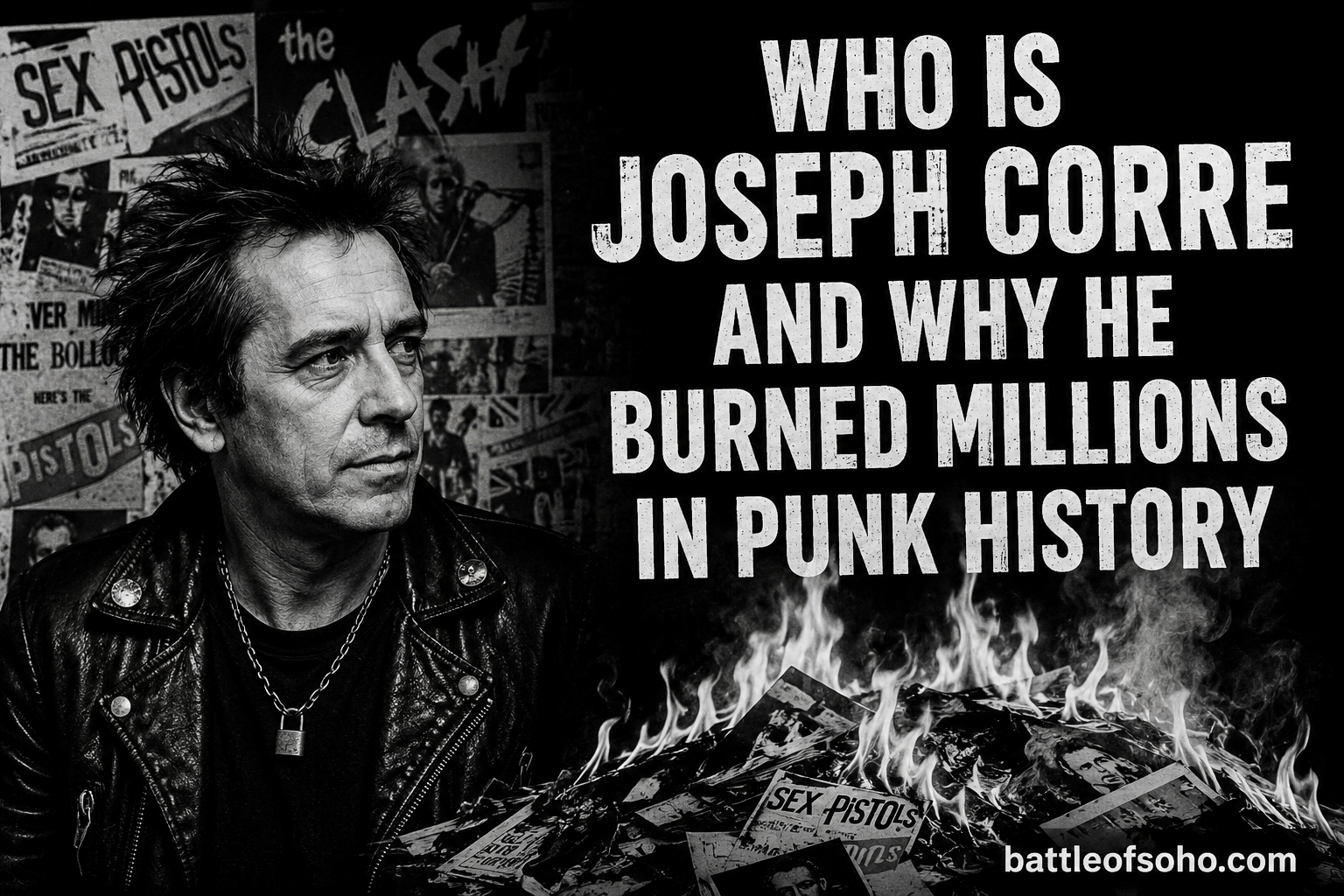
Joseph Corre is a British businessman and activist, born 30 November 1967, best known as the son of punk pioneers Malcolm McLaren and Vivienne Westwood. He co-founded the luxury lingerie brand Agent Provocateur in 1994 and, on 26 November 2016, burned his personal collection of punk memorabilia — valued at an estimated £5 million — on a barge on the River Thames as a protest against the establishment’s co-optation of punk culture through the Punk London celebration.
The bonfire was timed to coincide with the 40th anniversary of the Sex Pistols’ debut single “Anarchy in the UK.” Corre argued that the institutions celebrating punk — including the British Museum, the BFI, and the Museum of London, all backed by Heritage Lottery Fund money and endorsed by then-Mayor Boris Johnson — had turned a once-dangerous movement into a harmless museum piece.
In this article, we explore who Joseph Corre is, how he grew up surrounded by punk’s founding figures, why he decided to burn millions of pounds worth of irreplaceable memorabilia, and what happened after the flames died down on the Thames that November night.
Table of Contents
Who Is Joseph Corre?
Joseph Ferdinand Corre (sometimes spelled Corré with the accent) is a British activist, fashion entrepreneur, and self-described provocateur. He was born on 30 November 1967 in Clapham, south London, to two of the most influential figures in British counterculture.
His mother, Vivienne Westwood, would become one of the most celebrated fashion designers in history. His father, Malcolm McLaren, was the Situationist-inspired manager of the Sex Pistols and the creative force behind the punk aesthetic that exploded out of London in the mid-1970s. Together, McLaren and Westwood ran the Sex boutique at 430 King’s Road in Chelsea — the ground zero of British punk fashion.
Corre grew up immersed in this world. Punk was not a subculture he discovered as a teenager. It was the air he breathed from birth. He was surrounded by the Sex Pistols, the Bromley Contingent, and the cast of misfits who frequented his parents’ shop. This upbringing shaped everything that followed — his business ventures, his political convictions, and his eventual decision to set fire to millions of pounds worth of punk history.
Beyond his family lineage, Corre built his own reputation. He co-founded Agent Provocateur, a luxury lingerie brand that became a global name. He launched the fashion label A Child of the Jago and invested in the cosmetics company Illamasqua. He rejected an MBE from the Queen in 2007 in protest against the Iraq War. And he has been a vocal supporter of the Green Party, WikiLeaks founder Julian Assange, and anti-fracking movements across the UK.
But of all the things Joseph Corre has done in his life, one act defines him in the public imagination: the night he burned his punk memorabilia on the River Thames.
Born Into Punk Royalty: The McLaren-Westwood Legacy
To understand Joseph Corre, you have to understand the world he was born into. His parents did not just participate in punk — they invented its visual language.
Malcolm McLaren was a art school dropout turned cultural provocateur. Deeply influenced by Situationist theory and the French radical Guy Debord’s concept of “the spectacle,” McLaren believed in disruption as a creative force. He had already run a clothing shop called Let It Rock on King’s Road before rebranding it multiple times — first as Too Fast to Live, Too Young to Die, then as SEX, and finally as Seditionaries. Each iteration pushed further into the territory of provocation, fetish, and anti-establishment aesthetics.
Vivienne Westwood was the creative genius translating McLaren’s concepts into wearable art. She designed the clothes that defined punk: bondage trousers, ripped t-shirts, safety-pin accessories, and provocative slogans that landed the couple in court. Her designs were not just fashion — they were weaponized clothing designed to shock the British establishment.
The SEX boutique at 430 King’s Road became the epicenter of British punk. It was there that McLaren met a group of young misfits who would become the Sex Pistols. The band — Johnny Rotten, Steve Jones, Paul Cook, and later Sid Vicious — rehearsed in the shop’s back room and became walking advertisements for McLaren and Westwood’s designs.
Joseph Corre was born into this cauldron. He grew up watching his parents reshape British culture from a tiny shop in Chelsea. The Sex Pistols were practically family friends. The King’s Road scene was his childhood backdrop. Before he could walk, he was already part of punk mythology.
This matters because it explains why Corre felt he had the authority — and the pain — to burn punk memorabilia decades later. He was not an outsider who collected punk artifacts as a hobby. These were his parents’ creations. The memorabilia he burned was, in many ways, his inheritance.
From Sex Boutique to Agent Provocateur
While his parents built punk, Joseph Corre built his own empire. In 1994, he and his then-wife Serena Rees co-founded Agent Provocateur, a luxury lingerie brand that combined the subversive sexuality of his parents’ aesthetic with high-end fashion sensibilities.
Agent Provocateur was not a punk brand. It was a commercial venture that sold expensive underwear to wealthy customers. But it carried traces of the McLaren-Westwood DNA — the provocative window displays, the willingness to court controversy, the belief that sexuality was a tool for disruption. The brand grew rapidly, opening stores across London, including in Soho, and eventually expanding internationally.
In 2007, Corre and Rees sold a controlling stake in Agent Provocateur to the private equity firm 3i. The reported sale price was around £60 million, though Corre himself has cited figures ranging from £40 million to £60 million in various interviews. Either way, it made him a very wealthy man.
That same year, 2007, Corre made headlines for a different reason. He was offered an MBE — Member of the Order of the British Empire — in the Queen’s New Year Honours List. He turned it down flat.
His reasoning was blunt. Corre said he could not accept an honour from a state that had invaded Iraq and Afghanistan under Prime Minister Tony Blair’s leadership. He called Blair a war criminal and said that accepting the MBE would make him complicit in a system he despised. It was an early sign of the political conviction that would later drive the punk memorabilia burning.
After Agent Provocateur, Corre launched A Child of the Jago, a fashion label named after the Arthur Morrison novel about London slums. He also invested in Illamasqua, a cosmetics brand known for its theatrical, avant-garde approach to makeup. Both ventures carried traces of his parents’ belief that fashion could be a vehicle for provocation.
But it was the punk memorabilia burning that would cement his place in cultural history — and divide opinion like nothing else he had ever done.
The £5 Million Bonfire: What Happened on the Thames
On 26 November 2016, Joseph Corre set fire to an estimated £5 million worth of punk memorabilia on a barge moored on the River Thames near Albert Bridge in Chelsea, west London.
The date was no accident. It was the 40th anniversary of the release of the Sex Pistols’ debut single “Anarchy in the UK” — the record that many consider the starting gun of the British punk movement. Corre had announced the burning in March 2016, giving the media eight months to build anticipation, debate, and controversy.
The event was theatrical to its core. Corre arrived wearing a top hat and bandana, looking less like a businessman and more like a character from a Guy Fawkes pageant. His mother, Vivienne Westwood, stood atop a green double-decker bus parked on the embankment, delivering a speech about climate change and the extinction of species. The contrast between mother and son — one speaking from a bus, the other standing beside a burning barge — created the kind of visual spectacle that McLaren himself would have appreciated.
Corre had stuffed the bonfire with more than just memorabilia. He added effigies of Conservative politicians — David Cameron, Theresa May, and George Osborne — along with Grim Reaper figures holding an “Extinction! Your future” banner. The message was layered: punk was dead, but so might we all be if we did not take climate change seriously.
Photographers from Getty Images and the Press Association documented every moment. Flames consumed rare Sex Pistols test pressings, original Seditionaries clothing, concert posters, and personal items from the McLaren-Westwood archive. The smoke rose over the Thames as boats passed and onlookers gathered on the bridge.
The Guardian, reporting from the scene, described it as a “punk funeral.” Crack Magazine had already published a lengthy pre-event interview with Corre in which he laid out his reasoning in detail. The Observer would later call it “the least punk protest ever — and a hoax.” The global media covered it from Rolling Stone to Billboard to Artnet.
Whether you saw it as an act of principled defiance or an elaborate publicity stunt, one thing was undeniable: on that November night in 2016, Joseph Corre commanded the world’s attention.
What Was Burned: The Punk Archive Destroyed
The collection Joseph Corre set alight that night was not a random assortment of old t-shirts. It was a curated archive of punk history, much of it directly connected to his parents and the original 1976-77 punk explosion.
Among the items reportedly destroyed were:
Johnny Rotten’s trousers — the actual pair worn by the Sex Pistols frontman during the band’s most notorious period. These were not reproductions. They were the real thing, worn by one of the most iconic figures in rock history during the moment that changed British music forever.
A Sid Vicious doll — a macabre artifact commemorating the Sex Pistols bassist who died of a heroin overdose in 1979 at age 21. The doll was both a piece of memorabilia and a commentary on how punk had been reduced to a collectible commodity.
Sex Pistols test pressings and acetates — extremely rare vinyl records from the earliest stages of the band’s recording sessions. Test pressings are produced in tiny numbers, sometimes only a handful of copies, making them among the most sought-after items in music collecting.
Bondage trousers and Seditionaries clothing — original pieces from the SEX and Seditionaries shops on King’s Road. These garments were designed by Vivienne Westwood and Malcolm McLaren and worn by the first wave of British punks. They represent the physical origin of punk fashion.
Punk posters, flyers, and ephemera — promotional materials from gigs at the Roxy, the 100 Club, and other legendary punk venues. Many of these items were never produced in quantities beyond a few dozen copies.
Live recordings and unreleased material — bootlegs and rare recordings of punk performances that existed nowhere else.
The total value was estimated at £5 million, though some reports later cited figures as high as £6 million. Corre himself stood by the valuation, pointing out that individual items of Sex Pistols memorabilia had sold at auction for tens of thousands of pounds.
But not everyone believed the numbers. The Observer’s Tim Sommer wrote a scathing post-event analysis arguing that the actual value of the burned items was nowhere near £5 million. He estimated the realistic value at closer to £125,000 and accused Corre of inflating the figure for publicity. Sommer called the event a “con” and dubbed Corre “the Eric Trump of Punk Rock.”
This dispute over valuation became part of the story itself. Was the bonfire really worth £5 million, or was the number a piece of performance art — a McLaren-style provocation designed to make people pay attention to the message rather than the merchandise?
Why Did Joseph Corre Burn His Punk Collection?
The direct trigger for the bonfire was Punk London — a year-long celebration of punk’s 40th anniversary backed by the Heritage Lottery Fund, the Mayor of London’s office (then under Boris Johnson), and major cultural institutions including the British Library, the BFI, and the Museum of London.
To Corre, Punk London was everything punk was supposed to be against. Here was the establishment — the same establishment that had tried to censor the Sex Pistols, that had prosecuted his parents for obscenity, that had treated punk as a threat to civilisation — now embracing punk as a quaint piece of British heritage worth celebrating with lottery funding and museum exhibitions.
Corre called it the “commodification of rebellion.” He argued that Punk London was turning punk into a marketing tool, a nostalgia trip for middle-aged consumers who wanted to feel rebellious without actually challenging anything. He pointed out that Boris Johnson — a Conservative politician from a wealthy background, a former member of the notorious Bullingdon Club at Oxford — was now the official patron of punk’s anniversary. The irony was not lost on him.
But Corre’s motivation went deeper than one event. In his Crack Magazine interview, he laid out a broader critique: punk had been co-opted by capitalism at every level. Brands used punk imagery to sell beer, car insurance, and fast food. Fashion houses like Louis Vuitton ripped off the bondage aesthetic his mother had created and sold it for thousands of pounds to people who had never heard of the Sex Pistols. Punk had become a brand — and not even a particularly dangerous one.
Corre drew on Situationist theory to frame his argument. The Situationist International, a radical movement rooted in 1960s French philosophy, argued that modern capitalism neutralises dissent by turning it into spectacle. Guy Debord’s landmark text “The Society of the Spectacle” (1967) described how the establishment absorbs revolutionary ideas, strips them of their threat, and repackages them as entertainment. To Corre, Punk London was Debord’s theory playing out in real time.
There was also a personal dimension. Corre was burning his parents’ legacy — or at least the physical remnants of it. Some saw this as an act of filial defiance. Others saw it as a desperate attempt to prove his own punk credentials, separate from the enormous shadow cast by Malcolm McLaren and Vivienne Westwood. Was he destroying punk to save it, or was he destroying it because he could never quite escape it?
Corre himself has been clear on his answer. “Punk never had anything to do with music,” he told ITV in 2018. “It’s a way of life. It’s a modus operandi.” Burning the memorabilia was, in his view, the most punk thing he could do — destroying the relics of a dead movement to remind people what the movement actually stood for.
Reaction: Hero, Charlatan, or Something In Between?
The reaction to the bonfire was immediate, passionate, and deeply divided.
Henry Rollins — former frontman of Black Flag, one of the most respected figures in American punk — was scathing. Writing in LA Weekly, Rollins accused Corre and Westwood of egomania. “They might think they have taught everyone a lesson in what punk’s all about,” he wrote, “but all they did was show off their massive egos and how much they’ve lost the plot.” For Rollins, punk was about giving things to people, not destroying them in front of cameras.
John Lydon — aka Johnny Rotten, the Sex Pistols frontman whose own trousers were among the items burned — called Corre “selfish.” Lydon argued that Corre should have sold the memorabilia and donated the proceeds to charity. “Give it to some good causes,” Lydon said. “Make people benefit from it.” Coming from the man whose career was built on anti-establishment provocation, this was a pointed rebuke.
The Observer’s Tim Sommer went further than anyone. His article, published three days after the event, was titled “Joe Corre’s Bonfire Stunt Was the Least Punk Protest Ever — and a Hoax.” Sommer systematically challenged the £5 million valuation, argued that the burning was a publicity stunt masquerading as protest, and drew unfavourable comparisons to the KLF’s burning of £1 million in real cash. “Bill Drummond and Jimmy Cauty burned actual money,” Sommer wrote. “Corre burned old clothes and called it £5 million.”
The KLF comparison came up repeatedly. In August 1994, musicians Bill Drummond and Jimmy Cauty (formerly the KLF, then operating as the K Foundation) took £1 million in cash — their earnings from the KLF’s chart-topping music career — to the Scottish island of Jura and set fire to it. The act was filmed, witnessed, and remains one of the most controversial performance art events in history. Unlike Corre’s burning, the KLF destroyed actual money, not memorabilia. The comparison was both flattering and damning for Corre.
On Reddit’s r/punk forum, the debate raged for weeks. Many users accused Corre of “rich kid privilege” — burning items he had inherited rather than earned, destroying history he did not create. “He could have opened a youth centre for underprivileged kids forgotten by the state he is railing against with this moronic stunt,” one commenter wrote. Others questioned whether the burning had actually happened as described, noting that no independent journalist had been allowed to inspect the items before they were destroyed.
But Corre had defenders too. The Conversation, publishing an academic analysis from RMIT University music lecturer Catherine Strong, framed the burning as a legitimate artistic statement. Strong compared it to Chinese artist Ai Wei Wei’s deliberate destruction of valuable artifacts and argued that the act raised serious questions about whether culture should be preserved at all costs or whether destruction itself can carry meaning.
Crack Magazine’s interview with Corre gave him the space to address his critics directly. When asked why he did not sell the items for charity, he responded: “I fund loads of important things.” He pointed to his ongoing financial support for anti-fracking campaigns, renewable energy initiatives, and WikiLeaks. The implication was clear: he did not need to sell punk memorabilia to be generous. The burning was the point.
The debate exposed a fault line at the heart of punk itself. Is punk about preserving artifacts in museums, or is it about destroying them? Is the most punk thing you can do to protect the legacy, or to burn it down? A decade later, there is still no consensus.
The Aftermath: From Ashes to Art
The story did not end with the bonfire. In a twist that most of the media missed at the time, the ashes of the burned memorabilia were collected and turned into an art installation.
According to Far Out Magazine’s 2022 retrospective, Corre sold the art installation for the original £5 million value of the memorabilia. The proceeds were donated to anti-fracking charities — groups fighting against the controversial extraction method that Corre and his mother had long opposed. The narrative loop was complete: he had burned punk history, turned it into art, and used it to fund environmental activism.
Whether this was planned from the beginning or emerged as an afterthought is unclear. Corre has never fully explained the timeline. But it reframes the entire event. The burning was not an ending. It was a transformation — from commodity, to ash, to art, to activism.
In 2022, the documentary “Wake Up Punk” was released, revisiting the bonfire with several years of hindsight. The film, available on BFI Player, featured interviews with Corre, Westwood, and various punk figures reflecting on what the event meant and whether it achieved its goals. For most viewers, it was the first time they saw the full story — from announcement to aftermath — in a single narrative.
Corre’s activism has continued well beyond the bonfire. He has been a vocal supporter of the Green Party, endorsing Caroline Lucas and advocating for renewable energy. He has campaigned for Julian Assange and WikiLeaks. He has spoken at anti-fracking protests and climate rallies. In many ways, the bonfire was not a one-off stunt but the centrepiece of a broader political identity that has defined his post-business career.
His daughter, Cora Corre — Vivienne Westwood’s granddaughter — has begun carrying the family legacy into a new generation. Whether she will continue the family tradition of provocation and activism remains to be seen, but the McLaren-Westwood-Corre lineage is far from finished.
FAQs
Who is Joseph Corre?
Joseph Corre (born 30 November 1967) is a British businessman and activist, the son of Sex Pistols manager Malcolm McLaren and fashion designer Vivienne Westwood. He co-founded the luxury lingerie brand Agent Provocateur in 1994 and is best known for burning an estimated £5 million worth of punk memorabilia on the River Thames in November 2016.
Why did Joseph Corre burn his punk memorabilia?
Joseph Corre burned his punk memorabilia collection on 26 November 2016 to protest the establishment’s co-optation of punk through the Punk London celebration, which was backed by the Heritage Lottery Fund and endorsed by then-Mayor Boris Johnson. He argued that institutions like the British Museum and BFI were turning a dangerous movement into a harmless nostalgia trip.
How much was Joseph Corre’s punk collection worth?
Joseph Corre estimated his punk memorabilia collection at £5 million, though some reports cited figures up to £6 million. The Observer disputed this valuation, arguing the actual worth was closer to £125,000 and accusing Corre of inflating the number for publicity.
Was Joseph Corre’s punk memorabilia burning a hoax?
The Observer’s Tim Sommer called the event a hoax and disputed the £5 million valuation, dubbing Corre ‘the Eric Trump of Punk Rock.’ However, multiple independent news outlets including The Guardian, BBC, and Rolling Stone confirmed the event took place on a barge on the River Thames near Albert Bridge in Chelsea on 26 November 2016.
What did Vivienne Westwood say about the burning?
Vivienne Westwood supported her son’s protest and appeared at the event, delivering a speech about climate change from atop a green double-decker bus. She linked the destruction of punk memorabilia to her broader environmental activism, arguing that the extinction of species and climate crisis were more important than preserving artifacts.
What happened to the ashes of the punk memorabilia?
The ashes were collected and turned into an art installation, which was reportedly sold for the original £5 million value. The proceeds were donated to anti-fracking charities, completing the transformation from commodity to ash to art to activism.
Is Joseph Corre related to Malcolm McLaren?
Yes, Malcolm McLaren — the Sex Pistols manager and punk provocateur — was Joseph Corre’s father. Corre is McLaren’s only son with fashion designer Vivienne Westwood. After McLaren’s death in 2010, Corre was involved in a dispute over his father’s will with McLaren’s partner Young Kim.
Conclusion
Joseph Corre’s punk memorabilia bonfire remains one of the most polarising acts in recent cultural history. To his supporters, it was the ultimate act of Situationist defiance — destroying the relics of a co-opted movement to remind the world what rebellion actually looks like. To his critics, it was a millionaire’s tantrum, a publicity stunt dressed up as principle, carried out by a man who made his fortune selling luxury lingerie.
What is undeniable is that the burning forced a global conversation. It made people ask what punk means in 2026, whether culture can be authentically preserved, and who gets to decide what happens to our shared history. It drew lines between preservation and disruption, between heritage and rebellion, between the museum and the bonfire.
Corre himself has never wavered. “Punk never had anything to do with music,” he has said. “It’s a way of life.” Whether you believe him or not, that statement sits at the heart of everything he did on the Thames that November night. The question of who is Joseph Corre and why he burned millions in punk history is, in the end, a question about what we value — and what we are willing to destroy to prove it.