
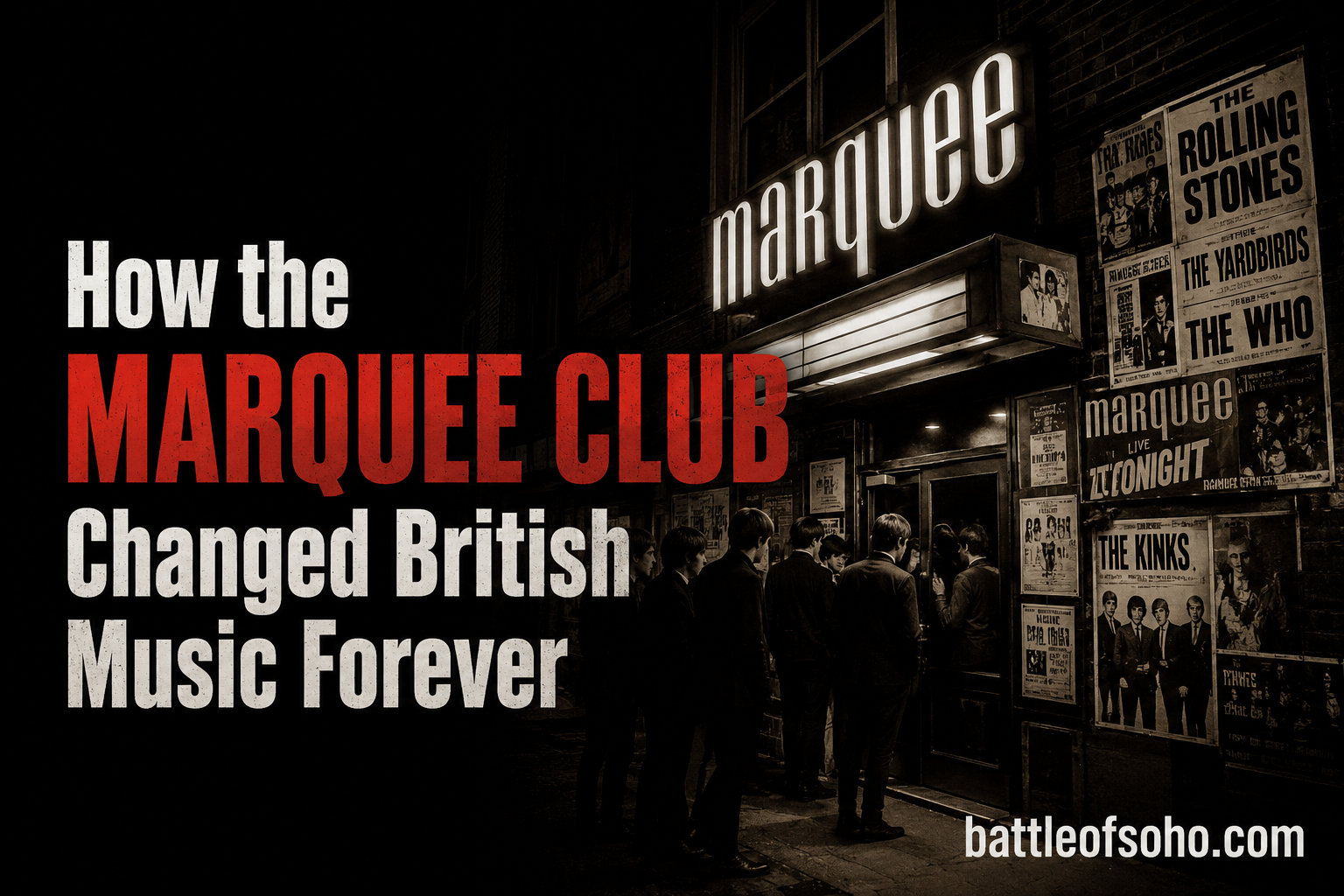
If you stood on the corner of Wardour Street on any given Tuesday night in the mid-1960s, you could feel the bass through the pavement before you even reached the door. The Marquee Club was not just another London music venue. It was the single most important small venue in the history of British music, a place where the Rolling Stones played their first gig, The Who honed their stage-smashing act, Jimi Hendrix stunned London’s music elite, and the Sex Pistols lit the fuse on punk rock. Across three locations between 1958 and 2008, the Marquee Club launched careers, broke genres, and turned a few sticky basement floors into hallowed ground.
The Marquee Club operated from three addresses over its lifetime: a basement jazz room at 165 Oxford Street (1958-1964), the legendary Wardour Street venue in the heart of Soho (1964-1988), and a final stop at 1 Charing Cross Road (1988-1996), with brief revivals in the 2000s. It was the Wardour Street years that cemented the club’s mythology. That cramped, airless, gloriously loud room became the beating heart of Soho nightlife and the gateway to the big time for hundreds of bands.
For a site called Battle of Soho, the Marquee Club story is personal. Soho earned its reputation as London’s music district largely because of what happened inside those walls. Every genre that defined British popular music from the late 1950s onward passed through the Marquee’s doors: jazz, skiffle, rhythm and blues, blues rock, psychedelia, progressive rock, glam, pub rock, punk, new wave, and the New Wave of British Heavy Metal. The club did not just host these movements. It accelerated them.
In this article, we trace the Marquee Club history from its jazz-club origins to its closure, profile the people who made it what it was, recount the legendary Marquee Club gigs that changed everything, and explain exactly how the Marquee Club changed British music forever. We also include a Soho walking tour guide so you can visit the sites where it all happened.
Table of Contents
Quick Facts: The Marquee Club at a Glance
Before diving into the full story, here are the essential facts about the Marquee Club that every British music fan should know. These details form the backbone of the club’s extraordinary legacy and help explain why this venue mattered more than any other in London’s music history.
Location 1: 165 Oxford Street (basement of the Academy Cinema), 1958 to 1964. Location 2: 90 Wardour Street, Soho, 1964 to 1988. Location 3: 1 Charing Cross Road, 1988 to 1996. Founder: Harold Pendleton. Key managers: John C. Gee and Jack Barrie. Capacity at Wardour Street: approximately 500 people. Notable firsts: The Rolling Stones’ debut (12 July 1962), Jimi Hendrix’s first London club shows (January 1967), and Led Zeppelin’s second-ever gig (18 October 1968).
The Marquee was where record label A&R representatives scouted talent nightly, where Melody Maker critics discovered the next big thing, and where a Tuesday night residency could transform an unknown band into a national name. The Melody Maker itself called it the most important venue in the history of pop music. That is not hyperbole. That is documented history.
The Origins: From Jazz Basement to Soho Institution (1958-1964)
The Marquee Club began not with electric guitars but with trumpet cases and upright basses. In 1958, Harold Pendleton opened the club in the basement of the Academy Cinema at 165 Oxford Street. Pendleton was not a rock and roll impresario. He was a jazz enthusiast who had been working with the National Jazz Federation, an organization he helped found to promote jazz in Britain. The original Marquee was a jazz club, pure and simple, and its early programming reflected that mission.
The basement room at the Academy Cinema was modest in every sense. It held roughly 200 people, had a low ceiling, and smelled of damp and old paint. But Pendleton booked the best jazz acts in the country. Johnny Dankworth, Chris Barber, and Tubby Hayes all played there. The club quickly earned a reputation among London’s jazz community as the place to hear serious music in an intimate setting. Alexis Korner, who would later become known as the founding father of British blues, was a regular performer and a key figure in bridging the gap between the Marquee’s jazz roots and the rhythm and blues revolution that was coming.
A crucial but often overlooked part of the Marquee Club story involves the National Jazz Festival. Harold Pendleton and the National Jazz Federation organized a festival at the Richmond Jazz Fair in 1961, which evolved into the National Jazz Festival. This event would eventually become the Reading Festival, one of Britain’s longest-running music festivals. The Marquee Club was therefore not just a venue. It was the administrative and spiritual headquarters of an entire ecosystem of British live music promotion that extended far beyond its own walls.
By the early 1960s, the musical landscape was shifting. Skiffle, the DIY folk-blues craze launched by Lonnie Donegan, had introduced a generation of teenagers to the idea that anyone could play music. American rhythm and blues records were arriving in London through port workers and record importers. A young generation of British musicians, many of them originally jazz fans, started picking up electric guitars. The Marquee, with its open-minded booking policy and its connection to the broader jazz and blues community, was perfectly positioned to ride this wave.
The year 1962 was a turning point. On 12 July 1962, a group of young musicians who had been playing around London’s blues scene walked into the Marquee Club and played their first-ever gig. They called themselves the Rollin’ Stones. Alexis Korner had recommended them. Brian Jones, who had placed an advertisement in Jazz News seeking musicians for a blues band, assembled the group. Mick Jagger sang. Keith Richards and Brian Jones played guitars. Ian Stewart played piano. Dick Taylor played bass. Mick Avory sat behind the drums. Nobody in the room that night, including the band members themselves, could have predicted what would happen next.
The Rolling Stones’ Marquee Club debut was not a polished affair. They were raw, under-rehearsed, and playing music that most of Britain had never heard. But something clicked. The audience, accustomed to jazz and traditional blues, responded to the energy and authenticity of what the Stones were doing. The Marquee had just hosted its first historic night, and there would be many more to come. By 1964, the club had outgrown its Oxford Street basement. The demand for rhythm and blues, rock, and the new wave of British beat music was exploding. Pendleton needed a bigger space, and he found one at 90 Wardour Street, in the heart of Soho.
The move to Wardour Street was the most consequential relocation in British music venue history. Oxford Street was a respectable commercial thoroughfare. Wardour Street was the center of Soho nightlife, surrounded by music publishers, record shops, clubs, bars, and restaurants. The new venue was bigger, louder, and more ambitious. It had a proper stage, better sound, and room for the crowds that the British music boom was generating. When the Marquee Club opened its doors at 90 Wardour Street in February 1964, it entered its golden age.
The Wardour Street Golden Era (1964-1988)
If the Oxford Street basement was the Marquee Club’s childhood, the Wardour Street years were its roaring prime. From 1964 to 1988, the Marquee Club at 90 Wardour Street was the most important music venue in Britain, and arguably the world. The room itself was not impressive by any conventional measure. It held about 500 people. The ceiling was low enough that taller audience members had to stoop. The ventilation was notoriously terrible, and fans regularly described passing out from the heat during packed shows. The floors were permanently sticky from spilled beer.
None of that mattered. In fact, it all contributed to the legend.
What made the Wardour Street Marquee Club extraordinary was not its physical space but its cultural function. It operated as a talent incubator, an A&R scouting ground, a music press headquarters, and a social club for the British music industry, all at the same time. On any given night, you might find a record label executive in the corner nursing a drink, a Melody Maker journalist taking notes near the stage, and three teenage musicians from the suburbs standing at the back, watching and learning. The Marquee was the gateway to the big time, and everyone in the industry knew it.
A typical evening at the Marquee Club started at the door, where Jack Barrie, the club’s front-of-house manager, would greet regulars by name. Barrie was a former jazz drummer who became the face of the venue. He knew everyone, remembered everyone, and could tell you which bands were worth watching and which were not. If Jack Barrie liked your band, you were in. If he did not, you had work to do.
Inside, the room would fill quickly. Admission on Friday blues nights in the mid-1960s was about five shillings, roughly 25 pence in modern money. That was remarkably affordable, and it meant the audience was genuinely diverse. You had office workers from the West End, art students from Central Saint Martins, musicians from other bands on their night off, and American servicemen on leave who had heard about this incredible blues club in Soho. The atmosphere was electric in the most literal sense. The sound system was loud for its size, and the low ceiling trapped the noise, creating an overwhelming sonic experience that people never forgot.
The Who’s famous Tuesday night residency became the stuff of legend. Starting in late 1964, The Who played a regular Tuesday slot that established them as one of the most exciting live bands in Britain. Pete Townshend’s windmill guitar strums, his instrument-smashing finales, Keith Moon’s explosive drumming, and Roger Daltrey’s microphone-swinging stage presence all developed on that tiny Marquee stage. Fans described those Tuesday nights as setting the template for angry young bands with guitars. The Who were not just performing. They were inventing a new vocabulary for rock and roll stagecraft, and the Marquee was their laboratory.
The club’s social ecosystem extended beyond its own walls. Next door and around the corner, The Ship pub on Wardour Street served as the unofficial green room and post-gig gathering spot. Musicians, fans, journalists, and industry figures would pile into The Ship after shows, and many deals and connections were made over pints there. Even more important was the La Chasse Club, a small members’ club nearby that became the VIP bar for the Marquee scene. Record executives, band managers, and music journalists congregated at La Chasse. If you wanted to understand what was happening in British music, you needed to spend time at La Chasse. Multiple fans and industry insiders have confirmed that it was where the real business of the music industry happened, away from the noise of the club floor.
The Marquee Club also functioned as the epicenter of music journalism in London. The Melody Maker, Britain’s most influential music paper, maintained a close relationship with the venue. Critics attended shows regularly, and their reviews could make or break a band. The Melody Maker also organized band contests at the Marquee, events where unsigned groups competed for attention and, sometimes, record deals. The paper ran classified advertisements in its back pages where musicians could find bands and bands could find gigs. Many of the groups that defined British progressive rock, blues rock, and later punk got their first Marquee bookings through Melody Maker classifieds.
John C. Gee, the club’s manager during its most fertile period, played a critical role in shaping the venue’s identity. Gee was responsible for booking acts, and he had an extraordinary ear for talent. He gave residencies to bands that other venues would not touch. He created themed nights that attracted specific audiences. His signature was his stage introduction. Rather than hyping the crowd, Gee would walk to the microphone and deliver a deadpan, almost professorial welcome before each set. The audience loved it. John Gee’s introductions became a beloved ritual, a signal that you were about to see something special.
The A&R scouting function of the Marquee cannot be overstated. Every major record label in Britain had representatives who attended Marquee shows regularly. When a band built a following through a residency, label executives noticed. When a new genre started gaining traction on a particular night of the week, the industry followed. The Marquee was the place where talent was spotted, signed, and launched. It was the common denominator in virtually every major British music success story from the mid-1960s through the mid-1980s. The record industry did not discover bands by accident. It discovered them at the Marquee Club.
Genre by Genre: How the Marquee Club Shaped British Music
The Marquee Club did not just witness British music history. It actively shaped it, genre by genre. Almost every major movement in British popular music between 1958 and 1988 either originated, flourished, or broke through at the Marquee. Understanding this venue means understanding the evolution of British music itself.
Jazz and Skiffle: The Foundation (1958-1962)
The Marquee Club opened as a jazz venue, and its first years were defined by traditional jazz, modern jazz, and the fading echoes of the skiffle craze. British jazz in the late 1950s was a serious, committed scene. Musicians like Johnny Dankworth, Chris Barber, and Tubby Hayes treated jazz as an art form, not entertainment. The Marquee gave them a dedicated space to perform for attentive audiences.
Skiffle, the homemade music movement that had swept Britain in the mid-1950s, was beginning to fade by the time the Marquee opened. But its influence lingered. The DIY ethos of skiffle, the idea that anyone with a guitar, a washboard, and a tea-chest bass could make music, had planted a seed. Many of the musicians who would later play the Marquee as rock and blues artists started in skiffle bands. The Marquee’s openness to this evolving musical landscape set the tone for everything that followed.
The British Blues Explosion (1962-1966)
Alexis Korner and Cyril Davies are the two names most associated with launching the British blues movement, and both were deeply connected to the Marquee. Korner’s band, Blues Incorporated, was effectively the house band of the early British blues scene, and it served as a training ground for dozens of musicians who went on to form their own groups. Mick Jagger, Charlie Watts, Jack Bruce, and Graham Bond all passed through Blues Incorporated.
The Marquee became the spiritual home of British blues. The Rolling Stones made their debut there. The Yardbirds, John Mayall’s Bluesbreakers (featuring Eric Clapton), and early Fleetwood Mac with Peter Green all played the venue. The Friday rhythm and blues nights, branded as Maximum R&B nights, became legendary. Fans packed the room to hear raw, electric blues played with an intensity that matched anything coming out of Chicago. This was the British blues explosion, and the Marquee Club was ground zero.
What made the British blues scene different from its American counterpart was the energy and aggression the British musicians brought to the music. They were not trying to replicate Muddy Waters or Howlin’ Wolf. They were amplifying the music, speeding it up, and injecting it with the urgency of post-war British youth culture. The Marquee’s small, loud room was the perfect environment for this sound. The British blues explosion that started at the Marquee would eventually conquer America in the form of the blues rock invasion of the late 1960s.
Psychedelia and Progressive Rock (1966-1972)
As the 1960s progressed, the blues influence at the Marquee evolved into something more ambitious. Pink Floyd played their early shows at the Marquee in 1966, complete with Syd Barrett’s experimental guitar work and the band’s pioneering use of light shows. The underground music scene was born, and the Marquee hosted the Spontaneous Underground events, psychedelic happenings that attracted London’s counterculture crowd.
Progressive rock took root at the Marquee in the late 1960s and early 1970s. Yes, King Crimson, Genesis, Jethro Tull, and Emerson, Lake and Palmer all played the venue during their formative periods. These bands took the blues foundation that the Marquee had helped build and stretched it in every possible direction: longer songs, complex time signatures, classical influences, and theatrical stage presentations. The Marquee was where progressive rock went from an experiment to a movement.
Jethro Tull’s Marquee Club debut is particularly noteworthy. The band, fronted by Ian Anderson and his trademark one-legged flute stance, played some of their earliest shows at the venue and built a devoted following through regular appearances. The Marquee residencies system was essential to how progressive rock developed. Bands needed multiple nights in the same room to work out their complex material, and the Marquee provided that opportunity.
Pub Rock and Glam (1972-1976)
By the early 1970s, rock music had become increasingly polished and professional. A reaction was brewing. The pub rock movement, which emphasized stripped-down, high-energy performances in small venues, found a home at the Marquee. Bands like Dr. Feelgood, Brinsley Schwarz, and Ducks Deluxe played the venue, bringing a back-to-basics approach that stood in stark contrast to the elaborate productions of the progressive rock era.
Glam rock also passed through the Marquee’s doors. David Bowie played the venue during his Ziggy Stardust era, and the androgynous, theatrical energy of glam found a receptive audience among the Soho crowd. The Marquee’s willingness to book acts across the full spectrum of popular music, from the rawest pub rock to the most theatrical glam, was a defining characteristic of the venue’s booking philosophy.
Punk Rock (1976-1979)
The Sex Pistols played the Marquee Club on 12 February 1976, and it was a watershed moment. This was one of the band’s first performances outside the London art college circuit, and it brought punk rock into the heart of the established music industry. The Marquee audience, accustomed to rock virtuosity and polished performances, was confronted with something completely different: short, fast, aggressive songs played with minimal technical skill but maximum attitude.
The Clash, The Jam, Siouxsie and the Banshees, and Generation X all followed. The Marquee became a key venue for the first wave of British punk. What is remarkable is that the club did not resist the punk takeover. Unlike many established venues that refused to book punk bands, the Marquee embraced the new movement. This willingness to evolve, to constantly refresh its programming with whatever was genuinely exciting and new, was the secret to the club’s longevity and influence.
The New Wave of British Heavy Metal (1979-1983)
Motörhead played the Marquee on 1 April 1977, and Lemmy’s wrecking-ball approach to rock and roll set the stage for the New Wave of British Heavy Metal, commonly known as NWOBHM. Iron Maiden built their early following through Marquee appearances. Def Leppard, Saxon, Diamond Head, and Angel Witch all played the venue. The NWOBHM movement, which would eventually influence everyone from Metallica to the entire global heavy metal scene, was nurtured in small venues like the Marquee.
The significance of the Marquee Club’s role in heavy metal history cannot be overstated. The venue’s small size and loud sound system created an intensely physical listening experience that suited heavy music perfectly. The Tuesday night residencies that had worked for The Who in the 1960s worked equally well for Iron Maiden in 1979. Bands could build a loyal following, refine their sound, and attract label attention through repeated Marquee appearances.
New Wave, Indie, and the Final Era (1983-1988)
As the 1980s progressed, the Marquee continued to adapt. The Cure, Joy Division, and other post-punk acts played the venue. New wave bands and the emerging indie scene found a home there. Wham! played a secret gig at the Marquee in 1985, demonstrating the venue’s enduring appeal to pop acts who wanted credibility. In 1987, a young American band called Guns N’ Roses played the Marquee, bringing the spirit of the Sunset Strip to Soho.
The Wardour Street era came to an end in 1988. Rising rents, changing nightlife economics, and the physical deterioration of the building all contributed to the decision to leave the site. The final nights at 90 Wardour Street were emotional affairs, with fans and musicians alike mourning the end of an era. The Marquee Club’s time on Wardour Street had lasted 24 years, and in that period it had done more to shape British music than any other venue in the country.
The Nights That Made History: Legendary Marquee Club Gigs
Certain nights at the Marquee Club achieved mythological status in British music history. These were the performances that changed careers, shifted genres, and created moments so powerful that audience members still talk about them decades later. Here are the most significant legendary Marquee Club gigs, arranged chronologically.
The Rolling Stones: 12 July 1962
The Rolling Stones made their live debut at the Marquee Club on 12 July 1962, and it is arguably the single most important night in the venue’s history. Brian Jones had assembled the band through a classified advertisement, and the group was raw, unrehearsed, and playing Chicago blues to a jazz crowd. The lineup on that first night included Mick Jagger on vocals, Keith Richards and Brian Jones on guitars, Ian Stewart on piano, Dick Taylor on bass, and Mick Avory on drums. The audience was initially bewildered but quickly won over. Within months, the Stones would be the most talked-about band in London.
The Who: November 1964
The Who’s Tuesday night residency at the Marquee Club, beginning in late 1964, transformed them from a mod band called The High Numbers into one of the most explosive live acts in rock history. Pete Townshend’s guitar-smashing routine began at the Marquee. Keith Moon’s drum kit destruction followed. The band used the venue as a testing ground for their maximum R&B sound, and the tight, intense atmosphere of the room pushed them to increasingly extreme performances. Those Tuesday nights set the template for everything that followed in live rock music.
Pink Floyd: 13 March 1966
Pink Floyd played some of their earliest London shows at the Marquee Club in 1966, and the performances were unlike anything the venue had hosted before. Syd Barrett’s spacey guitar explorations, combined with the band’s pioneering light shows, transformed the Marquee into a psychedelic happening. These performances helped establish the underground music scene in London and positioned the Marquee as a venue that was willing to push boundaries. The Marquee was where Pink Floyd went from being an experimental Cambridge band to being the future of British rock.
Jimi Hendrix: 24 January 1967
Jimi Hendrix’s appearance at the Marquee Club on 24 January 1967 is one of the most celebrated nights in the venue’s history. Hendrix, who had only recently arrived in London, was already generating buzz among musicians and music press. His Marquee performance confirmed everything the rumors had promised. He played guitar with his teeth, behind his back, and over the amplifier. He set the instrument on a feedback howl that filled the low-ceilinged room. The audience included members of The Beatles, The Rolling Stones, The Who, and virtually every other major British band. Everyone who was anyone in British music was there that night. Hendrix’s Marquee performance was the moment the British rock establishment collectively realized they were in the presence of genius.
Led Zeppelin: 18 October 1968
Led Zeppelin played only their second-ever gig at the Marquee Club on 18 October 1968. The band, recently formed by Jimmy Page after the dissolution of The Yardbirds, was still finding its identity. Their Marquee performance showcased the raw power that would soon redefine hard rock. Robert Plant’s wailing vocals, Jimmy Page’s innovative guitar work, John Paul Jones’s thunderous bass, and John Bonham’s devastating drumming filled the small room with a sound that was bigger than the space could contain. The audience that night witnessed the birth of a band that would become one of the biggest in the world.
David Bowie: October 1973
David Bowie played a three-night residency at the Marquee Club on 18-20 October 1973, during the height of his Ziggy Stardust era. These were not just concerts. They were theatrical events, with Bowie’s elaborate costumes, striking makeup, and otherworldly stage presence transforming the Marquee into a spaceship, a theater, and a rock club all at once. The shows demonstrated the venue’s versatility and its willingness to host acts that defied easy categorization. Bowie at the Marquee was glam rock at its most transcendent.
Sex Pistols: 12 February 1976
The Sex Pistols’ Marquee Club appearance on 12 February 1976 was a detonation. This was one of the band’s first gigs outside the art school circuit, and it brought punk rock directly to the London music establishment. The crowd that night saw something they had never seen before: a band that could barely play their instruments but radiated an authenticity and aggression that made every other band seem obsolete. The Marquee gig was a critical step in punk’s journey from underground curiosity to national phenomenon. Within months, the Sex Pistols would be the most feared and talked-about band in Britain.
Motörhead: 1 April 1977
Motörhead’s Marquee Club appearance on 1 April 1977 was a wall of sound that rattled the building’s foundations. Lemmy Kilmister, recently fired from Hawkwind, had assembled a power trio that played rock and roll faster and louder than anyone thought possible. The Marquee’s cramped space amplified the band’s overwhelming volume, creating an almost physical assault on the audience. This performance and others like it at the Marquee helped lay the groundwork for the New Wave of British Heavy Metal, a movement that would reshape global heavy metal within a few years.
The Police as The Aces: 12 December 1981
The Police played the Marquee Club under the alias The Aces on 12 December 1981, part of a tradition of secret gigs at the venue. By this point, The Police were already international stars, but playing the Marquee under a fake name allowed them to return to the intimate club environment where they had honed their craft. The show was packed with industry insiders and dedicated fans who knew the secret. It was a reminder that even the biggest bands in the world remembered and valued their roots in small venues.
Guns N’ Roses: 19 June 1987
Guns N’ Roses played the Marquee Club on 19 June 1987, during their first trip to London. The band, still months away from releasing Appetite for Destruction, was virtually unknown in Britain. Their Marquee performance was a raw, chaotic display of hard rock attitude that immediately won over the crowd. Axl Rose’s feral vocals and Slash’s blues-drenched guitar work filled the small room with the sound of the Sunset Strip transplanted into Soho. The Marquee had discovered another future giant, one last time.
The People Behind the Marquee Club
The Marquee Club was a building, but it was also a group of remarkable individuals whose vision and dedication made it what it was. Without these people, the club would have been just another London venue. Because of them, it became a cultural institution.
Harold Pendleton: The Founder
Harold Pendleton was the visionary who created the Marquee Club in 1958. A jazz enthusiast and administrator, Pendleton came from a background in the National Jazz Federation. He understood that music needed dedicated spaces to flourish, and he built the Marquee to serve that purpose. Pendleton’s genius was not in booking individual acts but in creating an ecosystem. He established the venue, hired the right people to run it, and gave them the freedom to pursue their instincts. He also maintained the club’s connection to the broader music industry through his work with the National Jazz Festival, which eventually became the Reading Festival. Pendleton’s influence extended far beyond the Marquee’s walls.
John C. Gee: The Manager Who Built the Roster
John C. Gee was the club’s manager during its most creative and commercially successful period. Gee was responsible for booking acts, and he had an extraordinary ability to identify talent before anyone else did. He gave residencies to unknown bands, created themed nights that attracted specific audiences, and maintained relationships with managers, record labels, and music journalists. Gee’s most famous contribution was his stage introduction. Rather than hyping the crowd, he would deliver a calm, slightly humorous welcome that became a beloved Marquee tradition. John Gee’s introductions told the audience that something special was about to happen, and it usually did.
Jack Barrie: The Face of the Club
Jack Barrie was the Marquee Club’s front-of-house manager, and for many regulars, he was the club. A former jazz drummer, Barrie knew every musician, every manager, and every regular attendee by name. He stood at the door, welcomed people in, and created an atmosphere of community and belonging that kept people coming back. Barrie was also a talent spotter. If he thought a band was good, word spread quickly through the music industry. His endorsement carried weight because he had seen virtually every important British band pass through the Marquee’s doors. Jack Barrie was the human bridge between the audience, the bands, and the industry.
Marquee Studios: The Recording Legacy
The Marquee Club’s influence extended into the recording studio. Marquee Studios, established in connection with the club, became an important recording facility in London. The Moody Blues recorded their number-one hit “Go Now” at Marquee Studios. Numerous other artists used the facility, drawn by its connection to the club and its central Soho location. The studios represented another dimension of the Marquee ecosystem: bands could play live at the club, build a following, and then record their music in a studio with direct ties to the venue and its industry connections. This vertical integration of live performance and recording was ahead of its time.
The Marquee Club and the Birth of Soho’s Music District
Soho was already known for nightlife before the Marquee Club arrived. But the Marquee transformed Soho into a music district. When the club moved to Wardour Street in 1964, it brought with it an ecosystem of musicians, industry professionals, journalists, and fans. Other venues, pubs, record shops, and music-related businesses clustered around it. The Ship pub became the unofficial backstage area. La Chasse Club became the industry boardroom. Richmond Mews, a narrow alley behind the club, became a shortcut and a meeting point.
The Marquee Club’s presence on Wardour Street anchored a cluster of music venues in Soho. The 100 Club on Oxford Street was a short walk away. The Flamingo Club, known for its rhythm and blues nights, was nearby. Music publishers and record companies had offices in the surrounding streets. Melody Maker and other music papers maintained Soho presences. The result was a dense, interconnected music district where you could see a band at the Marquee, talk to a record producer at The Ship, read a review of the show in next week’s Melody Maker, and see the same band signed to a major label within months.
This ecosystem did not exist by accident. It grew around the Marquee Club because the club attracted the right mix of people every single night. When we talk about Soho as a music district, we are really talking about the gravitational pull of the Marquee. The venue was the sun, and everything else orbited around it.
The comparison with other London venues illustrates the Marquee Club’s unique position. The 100 Club, still operating today, was a peer venue with its own legendary history, particularly in jazz and punk. But the 100 Club never achieved the same concentration of industry attention and career-launching power. The Ealing Jazz Club, where Alexis Korner and Cyril Davies established the first regular R&B night in Britain, was the true birthplace of British blues. But Ealing was a beginning, not a sustained platform. The Marquee Club was both. It was where movements started and where they matured. It was the venue that connected the underground to the mainstream.
Closure, Aftermath, and Lasting Legacy
The Marquee Club’s departure from Wardour Street in 1988 marked the end of an era. The reasons were practical: rising rents in Soho, the physical deterioration of the building, and the changing economics of live music venues. But the cultural significance of the departure was enormous. The room that had hosted the Rolling Stones, The Who, Jimi Hendrix, Led Zeppelin, Pink Floyd, David Bowie, the Sex Pistols, and hundreds of other legendary acts was shutting its doors.
The club attempted to continue at 1 Charing Cross Road, a larger venue near Leicester Square. The Charing Cross Road location operated from 1988 to 1996 and hosted notable acts, but it never captured the magic of Wardour Street. The room was bigger, the atmosphere was different, and the Soho ecosystem of pubs, clubs, and industry connections was gone. Multiple fans and musicians have noted that the Charing Cross Road venue lacked the intimacy and intensity that made the Wardour Street original so special.
After the Charing Cross Road location closed in 1996, there were several attempts to revive the Marquee name. A version of the club opened in Islington in 2001 and operated until 2003. Another attempt was made in the Leicester Square area in 2004-2006. None of these revivals succeeded in recapturing what the original venue had been. The Marquee Club was not just a name and a brand. It was a specific room at a specific address during a specific period of cultural history. That combination of factors could not be replicated.
Today, 90 Wardour Street is home to a restaurant and bar complex. The building has been extensively renovated, and little physical evidence of the Marquee Club remains. But a blue plaque commemorating Keith Moon and the Marquee’s legacy marks the location. Music fans from around the world still visit the site, stand on the pavement, and try to imagine what it would have been like on a Tuesday night in 1965 with The Who on stage and the walls shaking.
The lasting cultural legacy of the Marquee Club is immeasurable. Virtually every major British music movement from 1960 to 1988 passed through its doors. The club helped establish the model for what a small live music venue could be: a talent incubator, a community gathering point, and a cultural engine. Every independent venue that exists today, from small pub back rooms to 200-capacity club spaces, owes something to the template the Marquee Club established. The venue proved that a small room with the right programming and the right people could change the world.
Visit the Marquee Club Sites Today: A Soho Walking Tour
One of the best things about the Marquee Club story is that you can still walk in its footsteps. All three Marquee Club locations are within a 15-minute walk of each other in central London. For visitors interested in British music history, this Soho walking tour is an essential pilgrimage.
Stop 1: 165 Oxford Street (Original Location, 1958-1964). The Academy Cinema building that housed the original Marquee Club no longer exists in its original form. The site is now occupied by a retail building near the junction of Oxford Street and Dean Street. Stand on the pavement and imagine a basement room below, where Johnny Dankworth and Chris Barber played jazz to 200 people while the Rolling Stones waited in the wings.
Stop 2: 90 Wardour Street (The Golden Era, 1964-1988). This is the big one. The Marquee Club’s most famous address is now a modern bar and restaurant complex, but the street layout and the building proportions remain recognizable. Look for the blue plaque commemorating the venue’s history. Wardour Street itself remains the spine of Soho’s entertainment district, and walking from Oxford Street down to the site gives you a sense of the neighborhood the Marquee called home.
Stop 3: The Ship Pub, Wardour Street. Just steps from the Marquee site, The Ship is still operating as a pub. This was the unofficial green room and post-gim gathering spot for Marquee musicians, fans, and industry figures. Step inside, order a drink, and sit where Pete Townshend, John Peel, and countless other music legends once stood. The Ship is a living piece of Marquee Club history.
Stop 4: Richmond Mews. This narrow alley behind Wardour Street was a shortcut used by Marquee regulars. Walk through it to experience the geography of Soho’s music district. The mews connects to the network of streets that made up the Marquee’s social ecosystem.
Stop 5: 1 Charing Cross Road (Final Marquee Location, 1988-1996). The third and final Marquee Club location is near Cambridge Circus, at the edge of Soho. The building is now a Wetherspoon’s pub called The Montague Pyke. While it bears no resemblance to the legendary venue, it is worth visiting to complete the three-location tour and reflect on the club’s final chapter.
Stop 6: La Chasse Club Site. The La Chasse Club, the Marquee’s legendary VIP haunt, was located near Richmond Mews. While the club itself is long gone, the surrounding streets still carry the atmosphere of Soho’s entertainment district. Walk the area and imagine the record deals, arguments, and friendships that were forged in that small members’ club.
FAQs
What happened to the Marquee Club in London?
The Marquee Club closed its iconic Wardour Street location in 1988, moved to 1 Charing Cross Road until 1996, and then saw two failed revival attempts in the 2000s. The original Wardour Street site is now a restaurant and bar, with a blue plaque marking its musical significance.
Which famous bands performed at the Marquee Club?
The Rolling Stones, The Who, Pink Floyd, Jimi Hendrix, Led Zeppelin, David Bowie, Sex Pistols, The Clash, The Jam, Queen, Joy Division, The Cure, Motörhead, Iron Maiden, U2, The Police, Guns N’ Roses, Fleetwood Mac, Yes, King Crimson, Genesis, and Jethro Tull all performed at the Marquee Club.
When did the Marquee Club open and close?
The Marquee Club opened in 1958 at 165 Oxford Street and moved to 90 Wardour Street in 1964. The Wardour Street era ended in 1988, followed by a Charing Cross Road location from 1988 to 1996. Brief revivals occurred in the early 2000s. The original venue operated continuously from 1958 to 1996.
Why was the Marquee Club so influential?
The Marquee Club was the most important small music venue in British history because it launched the careers of the Rolling Stones, The Who, Led Zeppelin, Pink Floyd, and dozens of other major acts. It served as a talent incubator where Au0026amp;R representatives scouted new bands, music journalists discovered the next big thing, and Tuesday night residencies transformed unknown groups into stars.
Where was the Marquee Club in London?
The Marquee Club had three locations: 165 Oxford Street (1958-1964) in the Academy Cinema basement, 90 Wardour Street in Soho (1964-1988) which was the most famous location, and 1 Charing Cross Road (1988-1996) near Cambridge Circus.
How did the Marquee Club change British music?
The Marquee Club changed British music by providing a single venue where jazz evolved into blues, blues evolved into rock, rock evolved into progressive music, punk was born, and heavy metal was nurtured. It connected the underground music scene to the record industry, making it the common thread linking every major British music movement from 1960 to 1988.
The Marquee Club: Soho’s Enduring Musical Heartbeat
The Marquee Club changed British music forever by doing something deceptively simple: it gave talented musicians a room to play in, surrounded them with the right audience, and let the magic happen. From its jazz-club origins in 1958 to the final nights on Charing Cross Road, the Marquee Club was the common thread running through every major British music movement of its era. The Rolling Stones, The Who, Jimi Hendrix, Led Zeppelin, David Bowie, the Sex Pistols, Iron Maiden, and Guns N’ Roses all passed through its doors. The British blues explosion, progressive rock, punk, and the New Wave of British Heavy Metal all found their footing on that tiny stage.
What made the Marquee Club special was not just the bands. It was the ecosystem. Harold Pendleton built it. John Gee booked it. Jack Barrie ran it. The Ship pub and La Chasse Club extended it. Melody Maker documented it. Record labels mined it for talent. And the fans, packed into that hot, sticky, gloriously loud room on Wardour Street, made it matter. Soho became London’s music district because the Marquee Club made it one.
The physical venue may be gone, but its influence is everywhere. Every time a young band plays a Tuesday night residency at a small club, every time an A&R executive ducks into a 200-capacity room to check out a buzz act, every time a music fan discovers their new favorite band in a cramped, sweaty venue, they are participating in the legacy of the Marquee Club. The room may have closed, but the idea it represented, that a small venue with the right programming and the right people can change the course of music history, is eternal. That is how the Marquee Club changed British music forever. And that is why, here at Battle of Soho, we will never stop telling its story.