
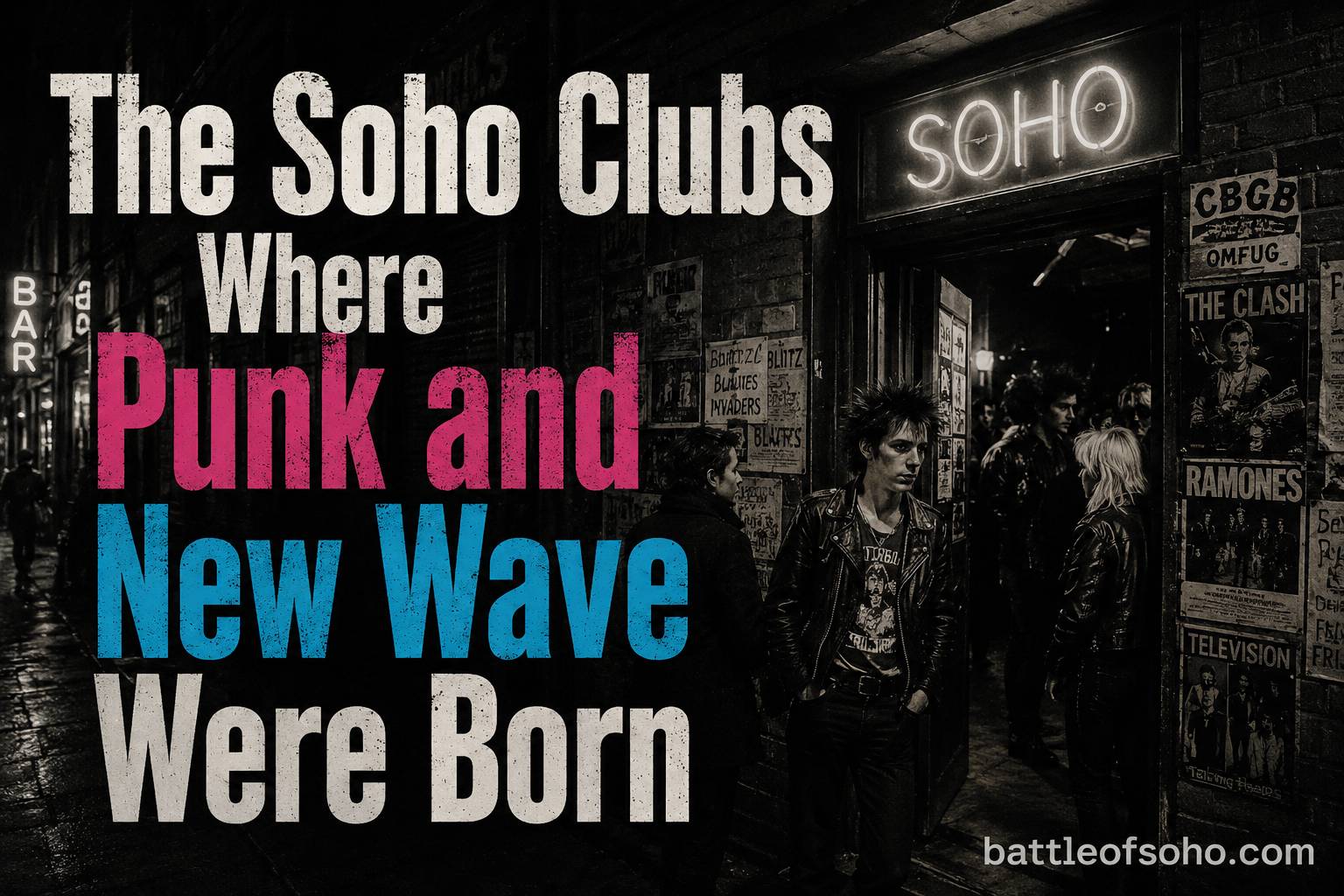
Walk down Wardour Street today and you will find coffee chains, boutique offices, and tourists photographing the architecture. But underneath that polite surface lies a different history entirely. This was the patch of London where British punk rock detonated, where new wave found its first audiences, and where a handful of small rooms changed popular music forever.
The Soho clubs where punk and new wave were born were not glamorous arenas. They were cramped basements, repurposed jazz rooms, and former discotheques that stank of sweat and cheap beer. Between 1976 and 1979, these venues became the testing ground for bands that would define an entire generation of music.
I have spent years tracing these stories, reading attendee accounts, and walking the streets where it all happened. What follows is a venue-by-venue breakdown of the five clubs that mattered most, the bands that played them, and what you can still find at each location today. Whether you are a punk historian, a London visitor chasing music heritage, or just curious about how a few streets in Soho rewired the sound of the 1970s, this guide covers everything you need to know.
Table of Contents
Why Soho Became the Heart of Punk Rock
Soho was not chosen by accident. By the mid-1970s, this square mile of central London had a reputation that kept ordinary tourists away and drew in exactly the kind of people who would create punk. Sex workers worked the alleys off Old Compton Street. Strip clubs, betting shops, and cheap cafés lined the pavements. Rent was low in the side streets, and empty basements sat waiting for anyone willing to fill them.
The area also had a music pedigree stretching back decades. The 2i’s Coffee Bar on Old Compton Street had launched the skiffle craze in the 1950s. The Marquee had hosted London’s first proper jazz and blues nights. Ronnie Scott’s was already a world-famous jazz club. Soho understood live music the way other districts understood theatre or finance. When punk arrived, it simply plugged into an existing infrastructure of small rooms, willing landlords, and audiences hungry for something new.
Then there was the King’s Road connection. Just a short walk through Chelsea brought you to Malcolm McLaren and Vivienne Westwood’s SEX boutique at 430 King’s Road. That shop dressed the Sex Pistols, sold fetish gear to teenagers, and functioned as a recruitment centre for the punk scene. Soho sat right between the King’s Road fashion explosion and the media power of Fleet Street. It was the perfect staging ground.
People often compare London’s punk scene to New York’s CBGB. Both cities had small rooms, willing misfits, and a hunger for raw, fast music. But Soho’s advantage was density. CBGB was one club on the Bowery. Soho had five major venues within a fifteen-minute walk of each other, plus dozens of pubs and back rooms hosting gigs on quiet nights. The scene could cross-pollinate, compete, and grow faster than any single venue would allow.
The Marquee Club (90 Wardour Street): The Foundation
If you had to pick one building that made British rock possible, the Marquee Club at 90 Wardour Street would be it. The Marquee was not born as a punk venue. It opened in 1958 as a jazz club founded by Harold Pendleton and Brian Howard, initially located at 165 Oxford Street before moving to the now-legendary Wardour Street address in 1964.
By the time the 1960s swung into gear, the Marquee had become the most important small venue in Britain. The Rolling Stones played their first gig there in 1962. David Bowie, The Who, Jimi Hendrix, and Led Zeppelin all graced its tiny stage. The club operated six nights a week, and bands fought for the chance to play a residency there because a Marquee booking meant industry attention.
When punk arrived in 1976, the Marquee was already a fortress of rock history. The Sex Pistols were actually banned from the venue after a chaotic early appearance, which only added to their myth. But other punk and new wave bands made the Marquee their home. The Damned played blistering sets there. Siouxsie and the Banshees performed regularly. Generation X, featuring a young Billy Idol, tore through the room on multiple occasions. Wire, the art-punk pioneers, played some of their most important early shows at the Marquee.
Regulars nicknamed the club the “Soho Sauna,” and for good reason. The room sat roughly 600 people in a basement with low ceilings and minimal ventilation. Attendees from the era describe sweat literally dripping off the walls during packed gigs. One commenter on a punk history forum recalled that staff would open the fire doors between bands just to let fresh air circulate before the next set pushed the temperature back up.
The venue’s infrastructure was frankly dangerous. Fire safety was minimal, the wiring was old, and the building had not been designed for the crowds it was pulling. These problems eventually caught up with the club. In 1988, the Marquee closed its Wardour Street home and relocated to Charing Cross Road. That version lasted until 1996. The original building was demolished and redeveloped, though the address 90 Wardour Street remains a landmark in music history. Today a plaque marks where the Marquee once stood, and fans still leave flowers and photographs at the site.
The Vortex Club (203 Wardour Street): Punk’s Nerve Centre
The Vortex occupies a special place in punk mythology because it was, for a brief and incandescent period, the single most important venue in the movement. The building at 203 Wardour Street had previously housed Crackers, a club that played reggae and soul to a mixed crowd. When punk exploded, the venue was rebranded as The Vortex in late 1976, and it became ground zero for the scene.
Andrew Czezowski, who would later open the Roxy, was involved in the Vortex’s punk programming. The room was small, holding perhaps 300 people at absolute capacity. That intimacy made every gig feel like a private riot. There was no barrier between the crowd and the stage. Pogo dancing and gobbing were not just tolerated but expected.
The Sex Pistols played the Vortex. So did Generation X, Siouxsie and the Banshees, X-Ray Spex, and The Adverts. The Damned performed there on nights when the energy level was so high that the crowd seemed to be part of the band. Siouxsie Sioux used the Vortex as a rehearsal space of sorts, honing the dark theatrical sound that would define her career.
One of the most vivid first-hand accounts comes from a woman named KAREN Riggs, who attended the Vortex in August 1977 at the age of 15. She recalled seeing X-Ray Spex play a blistering set while Sid Vicious wandered through the crowd. She was handed flyers to distribute outside the Marquee down the street, a reminder of how interconnected these venues were. The scene was not a series of isolated events but a network of rooms, bands, and fans all feeding each other.
Howard Trower, another attendee from the era, remembered the Vortex’s predecessor Crackers as a Friday night ritual in the late 1970s. He befriended the DJ Karen Doyle and described the room as a place where punk fans, reggae lovers, and art students mixed freely before the venue went fully punk. That diversity of audience fed directly into the open-minded sound of British punk and new wave, which drew on dub, reggae, and experimental music in ways the American scene never quite matched.
The Vortex’s reign was short. The club operated as a punk venue for roughly a year before financial pressures, licensing issues, and the sheer intensity of running a punk room forced changes. The building later hosted the new wave of British heavy metal, with bands like Iron Maiden and Angel Witch playing there. Eventually the club closed entirely.
Today, 203 Wardour Street is a Barclays Bank branch. A blue plaque on the exterior wall marks the site’s significance, though you will not find a museum inside. The contrast between the building’s current life as a high-street bank and its former life as the sweaty epicentre of British punk is jarring. But that plaque ensures the history is not entirely erased.
Paul Weller of The Jam immortalised the street itself in his song “A Bomb in Wardour Street,” a track from 1978 that captured the violence and energy of the scene. The song namechecked the area and its capacity for trouble, confirming what attendees already knew: Wardour Street in 1977 was one of the most exciting and dangerous stretches of pavement in Britain.
The Roxy Club (41-43 Neal Street): The First Pure Punk Venue
If the Marquee was the foundation and the Vortex was the nerve centre, the Roxy was punk’s true headquarters. What set the Roxy apart was that it was the first venue in London designed specifically as a punk club. Every other room had a history as a jazz club, a disco, or a general rock venue. The Roxy was punk from day one.
The club opened in January 1977 at 41-43 Neal Street in Covent Garden, just a short walk from Soho proper. Andy Czezowski, who had been involved with the Vortex, took over a former gay disco called Chaguaramas and transformed it into the Roxy. The location was a former coconut warehouse in a neighbourhood that was still rough around the edges. Seven Dials was not yet the tourist destination it is today.
The Roxy’s programming was relentless. Within its first month of operation, the club hosted The Clash, The Damned, The Heartbreakers, Buzzcocks, Siouxsie and the Banshees, and Generation X. Wire played some of their earliest gigs there. Sham 69, the purveyors of “street punk” from Hersham, made the Roxy a regular stop. Foreign acts including the Dead Boys and Cherry Vanilla crossed the Atlantic specifically to play the room.
The atmosphere was legendarily intense. The room held approximately 300 people, which meant that a sold-out Roxy show was a sweltering, claustrophobic experience. Fans who attended recall the smell of beer, cigarettes, and cheap hairspray. Pogo dancing regularly knocked out light fittings. The stage was so low that performers and crowd occupied essentially the same physical space.
The Roxy also produced one of the most important documents of the early punk scene. The Roxy London WC2 (Jan-Apr 77) was a live compilation album released on Harvest Records in 1977. It captured performances by Wire, Buzzcocks, The Outcasts, Sham 69, and others. The album remains a vital time capsule of what those gigs actually sounded like, raw and unpolished and thrillingly alive.
The Roxy’s existence was brief but seismic. By late 1977, financial pressures and internal disputes led to the club’s closure in early 1978. The building later became other venues under different names before eventually being converted into retail and restaurant space. A commemorative plaque at the Neal Street address now marks where the club stood, though the building itself looks nothing like it did in 1977.
Despite its short run, the Roxy’s cultural impact was enormous. It proved that punk could sustain a dedicated venue, that there were enough bands and fans to fill a room night after night. The Roxy gave punk a home that was unambiguously its own, and for thirteen months, it was the most important small room in the world.
The 100 Club (Oxford Street): The Punk Festival That Started It All
The 100 Club holds a distinction none of the other venues on this list can claim: it is still open. Located at 100 Oxford Street, on the border of Soho and Fitzrovia, the club has been hosting live music since 1942, making it one of the oldest continuously operating music venues in the world.
The venue began life as the Feldman Swing Club during the Second World War, hosting jazz and swing bands for Londoners seeking escape from the Blitz. Over the decades it evolved into the 100 Club, presenting jazz, blues, and eventually rock and roll. By the 1970s, it was a respected mid-sized venue with a capacity of around 330 people and a reputation for booking interesting acts.
The 100 Club’s claim to punk fame is singular. In September 1976, the venue hosted the two-day 100 Club Punk Festival, organised by Sex Pistols manager Malcolm McLaren. This event is widely regarded as the moment the British punk scene crystallised into a recognisable movement. The lineup included the Sex Pistols, The Clash, The Damned, Siouxsie and the Banshees, Buzzcocks, Subway Sect, and the Stinky Toys. Every major first-wave British punk band was in one room over two nights.
During the Sex Pistols’ set at the festival, a young woman named Sid Vicious (then still known as John Ritchie and not yet a Pistol) allegedly threw a glass that shattered and blinded a girl in one eye. The incident became part of punk mythology and was frequently cited by the press as evidence that punk was a genuine threat to public safety. The moral panic that followed only increased attendance at punk gigs across London.
What makes the 100 Club remarkable in the context of this story is its survival. While the Vortex became a bank, the Roxy became a restaurant, and the Marquee was demolished, the 100 Club kept going. It adapted with the times, hosting mod revivals, indie bands, and tribute nights. In the 2000s, the venue faced closure due to rising rents but was saved by a public campaign and a new commercial arrangement with a clothing brand.
Today, the 100 Club remains the last living connection to the 1976 punk explosion. You can walk in, order a drink, and stand in the same room where the Sex Pistols and The Clash played their first joint billing. For anyone tracing the physical history of British punk, this is the one essential pilgrimage.
The Blitz Club (Great Queen Street): Birth of the New Romantics
Punk’s energy eventually burned itself out, but the Soho and West End club scene did not go quiet. It evolved. The most important evolution was the New Romantic movement, and its headquarters was the Blitz Club on Great Queen Street in Covent Garden.
The Blitz story begins with Steve Strange, a Welsh-born singer and club promoter who had been a regular on the punk scene. In 1978, Strange and his collaborator Rusty Egan started a club night called “Bowie Night” at the Wine Bar in Soho. When that proved too small for their ambitions, they moved to the Blitz, a wine bar on Great Queen Street, in 1979.
The Blitz was not a punk venue in the traditional sense. It was a nightclub, not a live music room. But it was the direct cultural descendant of the punk explosion, and it gave birth to the new wave and synth-pop movements that dominated the early 1980s. Strange ran the door personally and maintained an infamously strict door policy. If your outfit was not interesting enough, you did not get in, regardless of who you were. Mick Jagger was reportedly turned away.
The regulars at the Blitz were a who’s-who of the coming decade. Spandau Ballet, then called The Makers, were essentially the Blitz’s house band and used the club to develop their sound and image before signing a record deal. Boy George was a regular, years before Culture Club. Visage, the synth-pop supergroup featuring Strange and Egan alongside members of Ultravox and Magazine, was born out of the Blitz’s musical aesthetic. Martin Kemp and Gary Kemp of Spandau Ballet credit the Blitz with teaching them how to be performers.
The music at the Blitz was a revelation. Egan, the resident DJ, played a mix of Kraftwerk, David Bowie, synth pioneers like Giorgio Moroder, and early European electronic music. This was not guitar rock. It was cold, glamorous, and futuristic. The sound directly influenced the bands that came out of the scene, who traded punk’s three-chord aggression for synthesisers, drum machines, and eyeliner.
The Blitz’s cultural impact extended far beyond music. The club’s dress code, a theatrical mix of pirates, highwaymen, geisha makeup, and French aristocratic fashion, defined a visual aesthetic that spread across Britain and then the world. Music magazines photographed Blitz regulars for fashion spreads. The look became so influential that it was eventually watered down and sold back to the mainstream by record labels and clothing brands.
The Blitz closed in 1980 when Strange and Egan moved on to the Club for Heroes in Leicester Square. But by then, the damage was done. The New Romantic movement was fully launched, and bands like Duran Duran, Spandau Ballet, Adam and the Ants, and Visage would dominate the charts for the next five years. The Blitz was the bridge between punk’s nihilism and the glossy, synthesised pop that defined the 1980s.
The Bands That Defined the Soho Punk Scene
Understanding the clubs means understanding the bands that played them. The Soho punk scene was not driven by a single group but by a constellation of acts that used these venues as their laboratory and launchpad.
The Sex Pistols were the scene’s most visible force. Managed by Malcolm McLaren from the SEX shop on King’s Road, the Pistols played the Vortex, the Marquee (before being banned), the 100 Club Punk Festival, and numerous other rooms across the West End. Their appearance on the Bill Grundy show in December 1976, when guitarist Steve Jones swore on live television, turned punk from a niche curiosity into a national scandal overnight. After that, every venue in London either wanted them or was terrified of them.
The Clash were the intellectual heavyweights of the scene. Joe Strummer and Mick Jones brought reggae, dub, and political consciousness to punk. They played the Roxy, the Vortex, and the Marquee, and their residency-style performances at these venues helped them develop the tight, explosive live sound that made their debut album a landmark recording. The Clash used the Soho circuit to grow from a rough pub band into one of the most important rock acts of the era.
Siouxsie and the Banshees hold a special place in this story because they used the Soho venues more than almost any other band. Their first-ever gig was a famously improvised set at the 100 Club Punk Festival in September 1976. They played the Vortex so often that the venue functioned as a second home. Siouxsie Sioux’s theatrical, gothic-inflected performance style was honed in these small rooms, and the dark, experimental sound that would make the Banshees new wave icons was developed on the same stages that hosted the rawest punk.
Generation X, featuring Billy Idol on guitar before he became a solo star, were regulars at the Vortex and the Roxy. Idol’s bleach-blonde spiked hair and sneering charisma made him one of the scene’s most photogenic figures. The band’s blend of punk energy and pop hooks was a direct precursor to the new wave sound that would dominate the early 1980s.
The Damned hold the distinction of being the first British punk band to release a single (“New Rose” in October 1976) and the first to release an album (“Damned Damned Damned” in February 1977). They played every venue on the Soho circuit and were known for their chaotic, high-energy live shows. Guitarist Captain Sensible would perform in a nurse’s uniform or a tutu, and the band’s willingness to be both funny and ferocious set them apart from the more self-serious acts on the scene.
Other bands that passed through the Soho venues include X-Ray Spex, fronted by the teenage Poly Styrene and her brilliant deconstructions of consumer culture; The Adverts, who scored a hit with “Gary Gilmore’s Eyes”; Wire, whose art-school minimalism predicted post-punk; and Buzzcocks, who travelled down from Manchester to play the Roxy and the 100 Club. The sheer density of talent in these rooms, night after night, is staggering in retrospect.
What Remains Today: A Walking Tour of Punk’s Ghosts
One of the most common questions from people interested in this history is simple: what can you actually visit today? The answer is a mix of plaques, redevelopment, and one remarkable survivor.
Start at 90 Wardour Street, the site of the original Marquee Club. The building was demolished and rebuilt, but a plaque on the exterior commemorates the venue. Music fans regularly stop to take photographs. The area around it is now packed with bars and restaurants, but standing there and looking at the address, you can imagine 600 people packed into a basement watching the future of rock unfold.
Walk a few minutes south to 203 Wardour Street, the Vortex. Today this is a Barclays Bank. A blue plaque marks the building’s punk history. You cannot go inside and experience anything resembling 1977, but the plaque is a tangible reminder of what once happened there. The contrast between a bank and a punk club is worth reflecting on. These buildings outlive their tenants.
Head over to 41-43 Neal Street in Covent Garden for the Roxy. The building has been extensively renovated and now contains retail and restaurant space. A commemorative plaque marks where the club operated. Neal Street itself is one of the busiest shopping streets in Covent Garden, and the crowd of tourists passing by has no idea that they are walking over one of the most important small rooms in music history.
The 100 Club at 100 Oxford Street is the one genuine survivor. It is still a live music venue, still hosting bands, still open to the public. You can walk in, see a show, and stand in the same room where the Sex Pistols and The Clash played the 1976 Punk Festival. For anyone serious about tracing the physical history of British punk, this is the single most important stop on the tour.
The Blitz Club on Great Queen Street is now the site of a restaurant under a different name. There is no plaque marking the New Romantic birthplace, which is a shame given the cultural impact of the movement that started there. The building looks unremarkable from the street, and most passersby would never know its significance.
For those wanting a deeper dive, the area around Soho Square is worth exploring. Kirsty MacColl, the singer and songwriter, lived near here, and the square itself was a gathering point for the music community in the late 1970s and early 1980s. The pubs surrounding the square were where musicians, promoters, and journalists mingled after gigs.
The sad reality, as forum contributors frequently note, is that most original venues have closed or been redeveloped. The buildings that survive have been gutted and repurposed. But the plaques, the addresses, and the 100 Club ensure that the physical history is not entirely erased. A walking tour of these five addresses takes about ninety minutes and covers less than a mile of ground. In that mile, the entire story of British punk and new wave unfolds.
FAQs
Where did the punks hang out in London?
Punks in the late 1970s gathered primarily in the Soho and Covent Garden areas of central London. The main venues were the Vortex at 203 Wardour Street, the Roxy at 41-43 Neal Street, the Marquee at 90 Wardour Street, and the 100 Club on Oxford Street. Pubs like the Ship on Wardour Street served as pre-gig meeting spots, and Soho Square was a common hangout between shows.
What was the first punk club in London?
The Roxy Club at 41-43 Neal Street, which opened in January 1977, is widely considered the first venue in London created specifically as a dedicated punk club. Before the Roxy, punk bands played at existing rock and jazz venues like the Marquee and the 100 Club. Andy Czezowski opened the Roxy to give the scene a permanent home.
What were the popular punk bands in the 1970s?
The major punk bands of the 1970s included the Sex Pistols, The Clash, The Damned, Siouxsie and the Banshees, Generation X, Buzzcocks, X-Ray Spex, The Adverts, and Wire. These bands played the Soho punk circuit between 1976 and 1979, and many went on to achieve commercial success in the new wave era.
What was the famous nightclub in London in the 1980s?
The Blitz Club on Great Queen Street was one of the most influential nightclubs of the early 1980s. Run by Steve Strange and Rusty Egan from 1979, the Blitz was the birthplace of the New Romantic movement and launched bands like Spandau Ballet and Visage. It was known for its strict dress code and synth-heavy DJ sets.
What happened to London’s punk venues?
Most of London’s original punk venues have closed or been redeveloped. The Vortex at 203 Wardour Street is now a Barclays Bank. The Roxy at 41-43 Neal Street is retail and restaurant space. The original Marquee at 90 Wardour Street was demolished and rebuilt. Only the 100 Club on Oxford Street remains open as a live music venue today.
Can you still visit the historic punk clubs in Soho?
You can visit the locations of all the major punk venues, though only the 100 Club is still operational as a music venue. The Vortex, Marquee, and Roxy locations have commemorative plaques marking their historical significance. A walking tour of these sites takes roughly 90 minutes and covers less than a mile through Soho and Covent Garden.
The Soho Clubs Where Punk and New Wave Were Born: A Lasting Legacy
Five clubs in one square mile changed the direction of popular music. The Marquee gave the scene a foundation built on two decades of rock history. The Vortex served as punk’s detonation point. The Roxy proved the movement could sustain its own dedicated venue. The 100 Club hosted the festival that announced punk to the world. And the Blitz carried that energy forward into the New Romantic and new wave explosion that dominated the 1980s.
The Soho clubs where punk and new wave were born were not built to last. They were temporary spaces, repurposed basements, and borrowed rooms. Most are gone now, replaced by banks, restaurants, and shops. But the music that came out of them, from “Anarchy in the U.K.” to “Gold,” continues to shape what we listen to. If you want to understand how British punk and new wave happened, you have to walk these streets. The buildings may be gone, but the story is still written into every corner of Wardour Street and Neal Street. Stand at those plaques, look at those addresses, and listen. The echo is still there.