
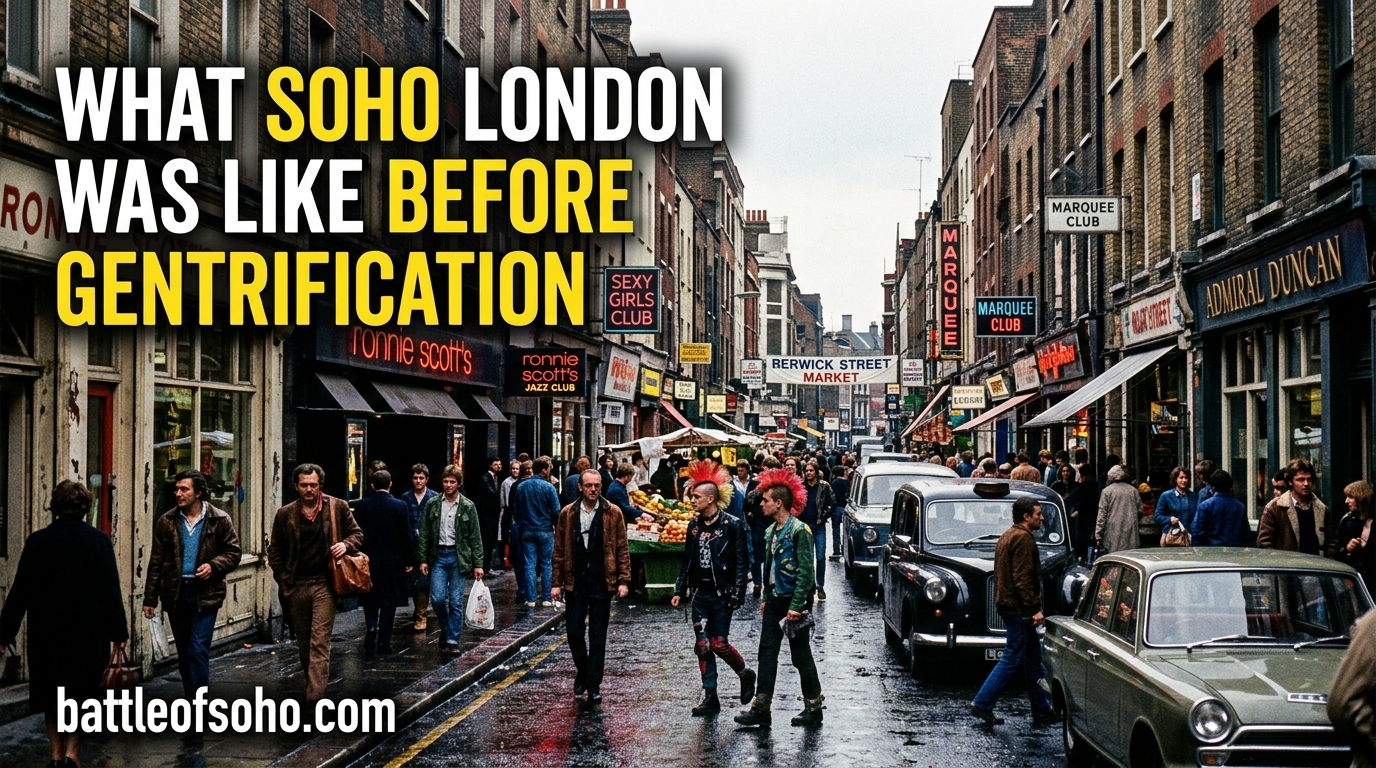
If you walked through Soho on a Friday night in 1975, the first thing that hit you was the smell. Cigarette smoke poured from every doorway, mixing with stale beer, cheap perfume, and the greasy fog from late-night chip shops. Neon signs buzzed in pink and red, advertising girls, girls, girls. Men in dirty raincoats muttered from doorways on Walker’s Court, and a drunk journalist staggered out of the Coach and Horses onto Greek Street, blinking in the sodium light.
That was old Soho. Not the sanitized playground of media agencies and artisan coffee shops that exists today. The real Soho. The one-square-mile heart of London that for centuries served as the city’s escape valve, its naughty place, its secret self.
Understanding what Soho London was like before gentrification means stepping into a world that feels almost impossible to imagine now. It was a place where a world-famous painter could get into a fistfight with a gangster at 3 AM. Where schoolboys sneaked into strip clubs on a dare. Where the most dangerous criminals in Britain drank alongside celebrities, and nobody blinked.
Soho before gentrification was dirty, dangerous, thrilling, creative, and utterly unlike anywhere else in the world. It smelled of sex, beer, and ambition. It sounded like electric guitars, jazz horns, and raucous laughter spilling onto wet cobblestones. And over the course of about thirty years, from the 1980s through the 2010s, almost all of it was erased.
This is the story of that lost world. The music venues that launched global movements. The strip clubs and sex shops that made Soho infamous. The bohemian bars where geniuses drank themselves into legend. And the slow, grinding process of gentrification that replaced all of it with something cleaner, safer, and immeasurably duller.
Table of Contents
From Hunting Ground to Vice District: The Early History of Soho
Before Soho was anything, it was a hunting ground. The name itself comes from a hunting cry. “So ho!” was shouted by hunters as they chased game across the open fields that sat outside the walls of old London in the 1500s. That origin is worth remembering, because Soho never stopped being a place where people hunted something.
The transformation began in the late 1600s, when development crept westward from the City of London. Soho Square was laid out in the 1670s and quickly attracted aristocratic residents. For a brief period, this was one of the most fashionable addresses in the country. Grand houses lined the square, and the gentry strolled through formal gardens.
But fashion is fickle, and by the 1700s the aristocracy had moved further west to Mayfair and Belgravia. Soho was left behind. The grand houses were subdivided into cramped lodgings. The gardens went to seed. Waves of immigrants flooded in, drawn by cheap rents and central location.
French Huguenots arrived first, fleeing religious persecution in the 1680s. They gave Soho its French character, establishing the cafes and patisseries that lingered for centuries. The French Protestant Church on Soho Square stood as a monument to this community for over 250 years.
The Italian community followed, settling around Clerkenwell but spilling into Soho with cafes, ice cream parlors, and restaurants. Old Compton Street took on its cosmopolitan flavor. Then came the Jewish community, establishing synagogues and businesses that made Soho a hub of Eastern European Jewish life in Victorian London.
By the mid-1800s, Soho had become one of the most densely populated and impoverished districts in London. The 1854 cholera outbreak, centered on the Broad Street pump (now Broadwick Street), killed over 600 people in the neighborhood. Victorian reformers wrote about Soho as a sink of depravity, packed with slums, sweatshops, and poverty.
But this dense, diverse, slightly desperate community created something the wealthier districts of London could never match. Soho was alive. It had energy. Its streets hummed with commerce, conversation, and constant activity at all hours. And into this teeming, chaotic neighborhood came something that would define it for the next 150 years: entertainment.
The music halls arrived first. Theatres and pubs began offering live entertainment, drawing workers from across the West End. By the early 1900s, Soho had established its identity as London’s entertainment district, a place where you could find anything at any hour, and where the normal rules of respectable society were quietly suspended.
The Chinese community established roots in the area around Gerrard Street in the early 1900s, creating what would become London’s Chinatown. After the Second World War, returning servicemen who had developed a taste for Chinese food helped the area flourish into the vibrant restaurant district that still exists today.
By the time the Second World War ended, old Soho London was fully formed. It was a neighborhood of immigrants, artists, workers, drinkers, and night owls. It was rough around the edges and proud of it. And it was about to enter its most legendary era.
The Sound of Soho: Music Venues That Changed the World
If you wanted to understand what was happening in popular music at any point between 1950 and 2000, you went to Soho. The square mile between Oxford Street and Shaftesbury Avenue contained more influential music venues per foot than anywhere on Earth. Soho music venues history is essentially the history of British popular music itself.
The Marquee Club: Where Rock and Roll Was Born
The Marquee Club opened at 165 Oxford Street in 1958 before moving to 90 Wardour Street in 1964, and that address became the most important musical postcode in Britain. If you played the Marquee, you had arrived. If you went to the Marquee, you saw the future before anyone else.
The Rolling Stones played their first gig at the Marquee in 1962. The Who, then called The Detours, were regulars. David Bowie, Jimi Hendrix, Led Zeppelin, Pink Floyd, and virtually every band that mattered in the 1960s and 1970s walked through those doors. The Marquee was small, hot, cramped, and loud. The PA system was rudimentary. The bar was basic. None of that mattered.
What mattered was the atmosphere. The Marquee was where musicians came to prove themselves. It was where blues purists and rock enthusiasts gathered to worship at the altar of electric guitar. The sweat dripped from the ceiling. The crowd pressed against the tiny stage. And out of that pressure cooker came the British blues boom, the roots of heavy metal, and the foundations of punk.
When the Marquee closed its Wardour Street location in 1988, it was like a church being demolished. Music fans mourned. The building was eventually torn down. A plaque marks the spot now, but it is a poor substitute for the roar that used to shake those walls six nights a week.
The Flamingo Club and the Birth of British R&B
If the Marquee was the cathedral of Soho rock and roll, the Flamingo Club was its rival church. Located in the basement of the Mapstone Restaurant on Hampstead Road (and later associated with Wardour Street venues), the Flamingo opened in 1952 and became the beating heart of British rhythm and blues.
The Flamingo was where British musicians first discovered American R&B and soul. It hosted the legendary Tuesday “Rhythm and Blues Night” sessions where bands jammed until dawn. Georgie Fame, John Mayall, and the early Rolling Stones were all Flamingo regulars. The club was also one of the first integrated nightlife venues in London, drawing West Indian and African American audiences alongside white British fans.
The Flamingo was also notoriously violent. Gangs frequented the club, and fights were common. The Kray twins were known to visit. But beneath the tension, something extraordinary was happening. British musicians were absorbing the sounds of Black American music and fusing them with something distinctly their own. The British Invasion that conquered America in the 1960s was conceived in the smoky basements of clubs like the Flamingo.
The Flamingo closed in 1967, but its DNA ran through every R&B and soul act Britain produced for decades afterward. It proved that Soho’s music scene was not just entertainment. It was cultural alchemy.
Ronnie Scott’s and the Jazz Underground
Ronnie Scott opened his jazz club at 39 Gerrard Street in 1959 before moving to 47 Frith Street in 1965, where it still stands today. Ronnie Scott’s is one of the few old Soho venues that survived the gentrification wave, and it remains a world-class jazz destination.
In the 1960s, Ronnie Scott’s was the place to hear jazz in Britain. American legends like Count Basie, Stan Getz, and Ella Fitzgerald played there when they visited London. But it was also a fiercely independent venue that championed British jazz musicians and experimental sounds that bigger venues would not touch.
The club had a famously strict door policy. Ronnie Scott himself was known for his biting wit, heckling performers and audience members alike. The atmosphere was sophisticated but never stuffy. You could sit with a drink, listen to extraordinary musicianship, and know you were in one of the great jazz rooms in the world.
That Ronnie Scott’s survived when so many other venues died is partly a testament to its reputation and partly to its business model. It charged real money for tickets. It served proper food. It adapted without losing its soul. But the surrounding neighborhood that gave it context, that made Soho a destination for nightlife, that has largely vanished.
The Punk Explosion: The Vortex, The Roxy, and the 100 Club
The 100 Club at 100 Oxford Street has been operating since 1942 and is the longest-running live music venue in the world. But it was during the punk era of 1976-77 that it entered legend. The 100 Club Punk Festival in September 1976 featured the Sex Pistols, The Clash, The Damned, The Buzzcocks, and Siouxsie and the Banshees on the same bill. That single night is often cited as the moment British punk was born.
The Roxy Club opened in December 1976 on Neal Street in Covent Garden, just at the edge of Soho. It was the first venue dedicated entirely to punk rock. The Vortex Club on Wardour Street followed, hosting the likes of Joy Division, The Police, and Siouxsie Sioux. These were not comfortable venues. They were tiny, loud, and often violent. Beer was cheap, volume was deafening, and spit was the preferred form of audience appreciation.
Punk fit Soho perfectly. The neighborhood’s existing grime and danger provided the perfect backdrop for a movement built on anti-establishment rage and raw noise. Punk clubs Soho became the center of a youth culture rebellion that would reshape fashion, music, and attitudes across the country.
The punk era was brief but explosive. By 1979, the original wave had largely burned out. But it had opened the door for a new wave of alternative music that kept Soho relevant through the 1980s. Post-punk, new wave, and eventually the New Romantics all passed through the neighborhood’s venues, each leaving a mark before gentrification swept them aside.
Neon Lights and Velvet Curtains: The Adult Entertainment Era
Soho’s sex industry was not a sideshow. For decades, it was the main event. The adult entertainment era defined old Soho London more than any other aspect of its character. Understanding Soho red light district history means understanding how one neighborhood became synonymous with pleasure, lust, and commerce of the flesh.
Paul Raymond and the Empire of Flesh
Paul Raymond, born Geoffrey Anthony Quinn in 1925, was the man who built the modern Soho sex industry. He opened Raymond’s Revuebar in 1958 on Walker’s Court, a narrow alley that ran between Brewer Street and Berwick Street. The Revuebar featured nude tableaux vivants, capitalizing on a legal loophole that allowed nudity on stage as long as the performers did not move.
Ronald Holly, a fellow entrepreneur, had been running similar shows elsewhere, but Raymond took the concept to a new level of sophistication and profitability. He charged admission, sold drinks, and raked in cash. The shows were tame by modern standards, but in 1950s Britain, they were sensational. Men lined up around the block.
Rhodes Raymond, as he was sometimes called, used the Revuebar as a springboard to build an empire. He bought property throughout Soho, acquiring freeholds on dozens of buildings. He opened strip clubs, sex shops, and adult cinemas. He published softcore magazines including Men Only and Club International. At his peak in the 1990s, Paul Raymond was reportedly the richest man in Britain, worth an estimated 1.5 billion pounds, and he owned more property in Soho than anyone else.
Ramond’s business model was simple but brutal. He controlled the venues, the properties, and the publications. Performers and tenants were disposable. The real money was in the freeholds. When Soho property values began climbing in the 1990s and 2000s, Raymond’s property portfolio became more valuable than his entertainment empire. The irony was that gentrification, which killed the sex industry, made Raymond even richer.
The Windmill Theatre: “We Never Closed”
The Windmill Theatre on Great Windmill Street was Soho’s entertainment institution. It opened in 1931 and gained its legendary reputation during the Blitz. While bombs fell on London, the Windmill stayed open. Its motto, “We Never Closed,” became part of British theatrical folklore.
The Windmill pioneered the non-stop nude revue format that Paul Raymond later copied and monetized. Its shows featured elaborately staged tableaux in which nude women posed in classical art scenes, frozen motionless to satisfy the censors. The Revudeville format, as it was called, ran continuously from 1932 until the theatre’s closure as an adult venue in 1964.
Polly Perkins, who performed at the Windmill in its later years, recalled the atmosphere with affection. It was hard work. The shows ran multiple times a day, every day. Performers had to maintain their poses through long scenes without moving a muscle. The audiences were a mix of regulars, tourists, and soldiers on leave. There was a professionalism and dignity to it that later strip clubs lacked.
The Windmill became a comedy venue after its nude revue era ended and has since been reinvented several times. But its golden age, when it was the most famous adult entertainment venue in Britain, belongs firmly to the era before gentrification.
Clip Joints, Sex Shops, and Walker’s Court
Not everything in Soho’s sex industry was as classy as the Windmill or as professional as Raymond’s operations. The streets were lined with clip joints, those notorious establishments that lured men in with the promise of female company, then extorted them with inflated drink prices and threats of violence.
The clip joint racket worked like this. A woman would stand in a doorway, calling out to men passing on the street. If a man accepted the invitation, he would be led upstairs to a small room where drinks would be served. The bill would arrive, often running into hundreds of pounds. If the customer refused to pay, large men would appear to “encourage” payment. Tourists and out-of-towners were favorite targets.
Walker’s Court was the epicenter of this world. The narrow alley was lined with sex shops selling magazines, videos, and paraphernalia. Neon signs buzzed overhead. Doormen stood in doorways. The atmosphere was part sinister, part exciting, entirely unlike anything else in London.
The sex shops on Old Compton Street and Brewer Street were landmarks in their own names. Their windows displayed garish merchandise under the cover of drawn blinds and beaded curtains. In the 1960s and 1970s, simply walking down these streets felt transgressive. You were entering a different world, one where respectable society’s rules did not apply.
Bent coppers were part of the ecosystem. Corruption among officers policing Soho was an open secret. Club owners paid protection money not just to gangsters but to police officers who looked the other way. This symbiosis between crime, vice, and law enforcement kept the whole system running for decades.
Madame Jojo’s and the Last Days of the Strip Club
Madame Jojo’s opened in the 1960s as a high-end cabaret and strip club on Walker’s Court. Named after its founder, Madame Jojo, the venue became a Soho institution. It survived longer than most, evolving from a traditional strip club into a celebrated drag and cabaret venue that hosted legendary nights like Trannyshack and Kashpoint.
By the 2000s, Madame Jojo’s was one of the last surviving links to old Soho. Its walls were black, its stage was tiny, and its atmosphere was electric. Drag queens, performance artists, musicians, and club kids packed the dance floor until the early hours. The venue bridged the gap between old Soho’s sex industry and the neighborhood’s LGBTQ+ community, serving as a defiantly queer space in a district that was slowly being sanitized.
When Madame Jojo’s had its license revoked in 2014 after a violent incident involving bouncers, the closure felt like the final nail in the coffin of old Soho. The Guardian wrote about it as the death of London’s sleazy heartland. Fans mourned not just a club but an entire era. The building sat empty for years before being converted into yet another generic restaurant space.
Drink, Art, and Chaos: The Bohemian Bars of Old Soho
The music venues and strip clubs were only half the story. The real soul of old Soho lived in its pubs and drinking clubs. These were the places where artists, writers, musicians, drunks, and dreamers gathered to argue, create, and destroy themselves with style. Bohemian London had no capital more glorious than Soho’s bar stools.
The Colony Room: Where Francis Bacon Held Court
The Colony Room was a private drinking club at 41 Dean Street, opened in 1948 by Muriel Belcher. It was members only, which meant it could serve alcohol outside normal licensing hours. And it became the most famous bohemian bar in British history.
Muriel Belcher was the presiding genius of the Colony Room. She was sharp-tongued, witty, and utterly intolerant of mediocrity. She hand-picked her members, and if she did not like you, you were not getting in. Francis Bacon, the greatest British painter of the 20th century, was her most famous patron. Bacon was given free drinks in exchange for bringing in customers, and the Colony Room became his headquarters.
Bacon would arrive in the afternoon and drink until he could not stand. He surrounded himself with a court of artists, writers, criminals, and aristocrats. Lucian Freud, John Deakin, Michael Andrews, and Henrietta Moraes were regulars. The conversation was brilliant and savage. Arguments were frequent. Fights occasionally broke out.
The Colony Room was painted bright green, which earned it the nickname “The Club.” It was tiny, with room for only about fifty people at a time. The walls were covered in art given by grateful patrons who had run up bar tabs they could not pay. It was intimate, claustrophobic, and utterly unlike any other drinking establishment in the world.
The club closed in 2008, and its closure was treated as a cultural catastrophe. Muriel Belcher had died in 1979, and subsequent owners tried to maintain her spirit, but the world had changed. The type of heavy daytime drinking that defined the Colony Room was no longer socially acceptable. The artists who had made it famous were aging or dead. The room that had incubated some of the greatest British art of the 20th century was converted into offices.
The Coach and Horses: Soho’s Living Room
The Coach and Horses on Greek Street has been operating since the 1850s and is one of the few old Soho pubs that still survives. It was Soho’s living room, a place where everyone was welcome and everyone was equal. Regulars included journalists from the nearby offices of Private Eye, The Spectator, and national newspapers.
The pub’s most famous regular was Jeffrey Bernard, the Spectator columnist who wrote the Low Life column. Bernard was a spectacular alcoholic who wrote brilliantly about his drinking, his gambling, and his chaotic Soho existence. His columns were collected into books that captured the atmosphere of old Soho better than any history book could. He was eventually banned from more pubs than he was allowed into, but the Coach and Horses remained his spiritual home.
The Coach and Horses was also famous for its longtime barman, Norman Balon, who served drinks for over sixty years and was reputedly the rudest barman in London. He insulted customers as a matter of principle. If Norman was nice to you, something was wrong. His gruff demeanor was part of the pub’s charm, a filter against the tourists and interlopers who did not belong.
The pub became a legend through Private Eye’s presence. The satirical magazine’s editors and writers held court at the bar, gossiping and planning the next issue. If you wanted to know what was happening in British media and politics, you sat at the Coach and Horses and listened.
The French House: A Parisian Refuge on Dean Street
The French House at 49 Dean Street got its name from its role as a gathering place for the French resistance during the Second World War. Charles de Gaulle was reputedly a patron. The pub served only half-pints of beer, a tradition that dates back to the French customers who preferred wine and found English pint glasses vulgar.
The French House was the daytime counterpart to the Colony Room’s nighttime revelry. Artists and writers drank here in the afternoon before moving on to louder venues. Francis Bacon, Lucian Freud, and Brendan Behan were all regulars. Dylan Thomas was said to have left the manuscript of Under Milk Wood in the pub, though the story may be apocryphal.
The pub’s atmosphere was quieter and more contemplative than the Colony Room or the Coach and Horses. Conversations happened in whispers. The decor was sparse. It felt like stepping into a Parisian cafe in the middle of London. Margot Henderson, writing about the pub in the 1990s, described it as a place where time seemed to stop, where the same people sat at the same tables year after year, and where the outside world barely existed.
The French House still operates today, one of the few old Soho institutions to survive. But even it has changed. The regulars who gave it character are mostly gone. The pub relies increasingly on tourists who come for the history rather than the atmosphere. The spirit of the place lingers, but it is fading.
Jeffrey Bernard, Lucian Freud, and the Low Life
No discussion of Soho bohemian culture would be complete without Jeffrey Bernard and Lucian Freud. Bernard was the bard of Soho lowlife. His Low Life column in The Spectator ran from 1975 until his death in 1997, documenting his adventures in Soho’s pubs, gambling dens, and hospital wards with brutal honesty and dark humor.
Bernard drank at the Coach and Horses, the Colony Room, and anywhere else that would have him. He was thrown out of more pubs than he could count. He contracted pancreatitis from his drinking and spent stretches in hospital, writing about the experience with the same dark wit he brought to his Soho adventures. His columns painted a portrait of a vanishing world, even as he was writing it.
Lucian Freud, the painter, was Bernard’s contemporary and fellow Soho denizen. Freud’s studio was nearby, and he was a fixture in the neighborhood’s pubs and clubs. His paintings captured the same raw, unvarnished humanity that Bernard’s columns described. Both men were part of a bohemian Soho culture that valued authenticity over respectability, honesty over politeness, and experience over comfort.
That culture is gone now. The writers and artists who defined it are dead. The pubs and clubs where they drank have closed or changed beyond recognition. What remains is their work, preserving fragments of a world that gentrification has otherwise erased completely.
The Kray Twins and the Soho Underworld
Soho’s underworld was as much a part of its character as its music venues and bohemian bars. And no figures loomed larger over Soho crime history than the Kray twins. Ronald and Reginald Kray ruled London’s East End gangland in the 1950s and 1960s, but their influence extended deep into Soho.
The Krays operated protection rackets across the West End. Club owners who refused to pay found their premises vandalized, their staff intimidated, or worse. The twins used Soho’s nightlife district as a hunting ground, extorting money from venue owners who had no recourse to legitimate protection. If you ran a club in Soho in the 1960s, the Krays were part of your overhead.
Ronald Kray, the more volatile of the twins, was a familiar figure in Soho’s nightlife. He was openly gay at a time when homosexuality was illegal, and he moved freely through Soho’s underground LGBTQ+ scene. The Krays’ clubs, including Esmeralda’s Barn in Knightsbridge, attracted celebrities and aristocrats alongside criminals. The intersection of high society and organized crime was one of Soho’s defining features.
The Krays cultivated celebrity connections that insulated them from prosecution for years. They were photographed with film stars, politicians, and musicians. Judy Garland, George Raft, and Sophia Loren were among the famous names associated with the twins. This celebrity halo made them difficult to prosecute and helped them operate with impunity throughout the 1960s.
But the Krays were eventually brought down. In 1968, they were arrested and charged with murder. Ronald Kray had shot George Cornell in the Blind Beggar pub in Whitechapel in 1966. Reginald Kray had murdered Jack “The Hat” McVitie. Both brothers were sentenced to life imprisonment in 1969.
Their conviction did not end organized crime in Soho, but it marked a turning point. The era of the celebrity gangster who operated openly in the West End was fading. New forms of criminal enterprise took root, but they were less colorful and less visible. The bent coppers and backhand deals continued, but the larger-than-life figures who had given Soho’s underworld its dangerous glamour were gone.
What remained was an atmosphere. Walking through Soho at night in the 1970s and 1980s, you could feel the weight of that criminal history. Certain pubs were known gangland hangouts. Certain doorways were best avoided. The danger was part of the thrill. People came to Soho precisely because it was edgy, because you might see something shocking, because the normal rules did not apply.
The Long Goodbye: How Gentrification Changed Soho Forever
The question of when did Soho become gentrified does not have a single answer. The process was gradual, spanning three decades. But most observers point to the mid-1980s as the turning point, when Westminster Council launched a systematic crackdown on the sex trade and property values began their inexorable climb.
In 1985, Westminster Council, under the leadership of Shirley Porter, began aggressively enforcing licensing laws against Soho’s adult entertainment venues. Sex shops were raided. Strip clubs had their licenses revoked. The council’s stated goal was to clean up the area, but the effect was to drive out businesses that had operated for decades and to open the door for more “respectable” commercial tenants.
Rising property values did the rest. As central London real estate became increasingly expensive in the 1990s and 2000s, Soho’s old businesses simply could not afford to stay. Strip clubs and sex shops generated revenue, but not enough to compete with media agencies, advertising firms, and tech companies that were willing to pay premium rents for Soho addresses.
The music venues went first. The Marquee closed in 1988. The Astoria was demolished in 2009 to make way for the Crossrail project. The 100 Club survived but struggled, relying on benefit gigs and crowdfunding to stay afloat. Each closure removed another layer of Soho’s musical heritage.
The bohemian bars followed. The Colony Room closed in 2008. Norman Balon retired from the Coach and Horses. The French House became more tourist attraction than local haunt. The writers and artists who had given these places their character were aging out, and no new generation emerged to replace them.
The Crossrail project, which involved constructing the massive Elizabeth Line underneath central London, dealt another blow. Construction work disrupted Soho’s streets for years. Long-established businesses closed due to construction noise, dust, and reduced foot traffic. Dean Street, once the beating heart of bohemian Soho, became a construction zone.
The Save Soho campaign, launched by musician Tim Arnold in 2014, tried to rally public opinion against the destruction of Soho’s cultural heritage. The campaign drew support from celebrities including Stephen Fry, Benedict Cumberbatch, and Roger Daltrey. But against the economic forces of gentrification, sentiment was not enough.
By 2026, Soho is still worth visiting. It still has character. Old Compton Street remains the center of London’s LGBTQ+ community, though in a more mainstream form. Chinatown still draws crowds. Ronnie Scott’s still hosts world-class jazz. But the old Soho, the one that smelled of cheap perfume and stale beer and buzzed with neon and possibility, is gone.
Walk down Walker’s Court today and you will find restaurants and bars where sex shops once operated. Walk down Wardour Street and media workers eat lunch where rock and roll was born. The neon signs are mostly gone. The clip joints are gone. The bohemian bars are gone. What remains is a sanitized, corporate version of a neighborhood that was once the most exciting square mile in the world.
FAQs
When did Soho become gentrified?
Soho’s gentrification began in the mid-1980s when Westminster Council launched systematic crackdowns on the sex trade. The process accelerated through the 1990s and 2000s as rising property values forced out independent venues and adult entertainment businesses. Key milestones include the closure of the Marquee Club in 1988, the Colony Room in 2008, and Madame Jojo’s in 2014. The Crossrail construction project from 2009 onward caused further disruption and closures.
Is Soho in London still a red light district?
No, Soho is no longer a functioning red light district. While Walker’s Court retains some architectural echoes of its past, the sex shops, strip clubs, and clip joints that defined the area for decades have almost entirely closed. Westminster Council’s licensing crackdowns, combined with rising rents and the influx of media companies and corporate restaurants, have transformed Soho into a fashionable entertainment and dining quarter.
Is Soho still seedy?
Soho has been extensively sanitized compared to its pre-gentrification era. The gritty, dangerous edge that defined it for centuries has been largely replaced by upmarket restaurants, cocktail bars, and media offices. Old Compton Street retains some of its LGBTQ+ nightlife character, and you can still find late-night drinking spots, but the neighborhood no longer carries the sense of transgression and danger that made it famous. Some argue traces of its old spirit survive after dark, but it is a shadow of what it was.
What was Soho like in the 1970s?
1970s Soho was gritty, dangerous, and exhilarating. The strip club era was in decline but still visible, with neon-lit sex shops and clip joints lining Walker’s Court and Brewer Street. Punk venues like the Vortex and the Roxy emerged, hosting the Sex Pistols, The Clash, and Joy Division. The Colony Room and Coach and Horses remained packed with artists, writers, and journalists. It was a place where the famous and notorious freely mixed with ordinary people, all drawn by the thrill of the forbidden.
The Ghosts of Old Soho
What was Soho London before gentrification? It was a place that defied easy description and resisted every attempt to tame it. It was a square mile of vice, art, music, crime, and humanity compressed into a space too small to contain it all. It was dirty and magnificent and irreplaceable.
The old Soho that existed before gentrification was not perfect. It was dangerous. It was exploitative. It was riddled with corruption and organized crime. The clip joints cheated people. The working conditions in the sex industry were often brutal. The drinking culture destroyed lives. Romanticizing it without acknowledging these truths would be dishonest.
But old Soho London was also something extraordinary. It was a place where different worlds collided. Where a world-famous painter drank alongside a cab driver. Where a teenager discovering punk could stand three feet from a band that would change music forever. Where immigrants from a dozen countries built communities and businesses. Where people who did not fit anywhere else could find a home.
Gentrification did not just change Soho. It hollowed it out and filled the shell with something more profitable. The old Soho lives on in photographs, in books, in the memories of those who were there, and in the music and art that were created in its pubs and clubs. But as a living, breathing place, it is gone.
Walk through Soho today and you can still find traces if you look hard enough. A plaque marking where the Marquee Club once stood. The surviving facade of the Windmill Theatre. The French House, still serving half-pints. A few old pubs where the ghost of Jeffrey Bernard still seems to linger at the bar. These fragments are all that remain of a world that shaped British culture for three centuries.
Soho London before gentrification was a place that will never exist again. That is what was lost. And that is why it is worth remembering.