
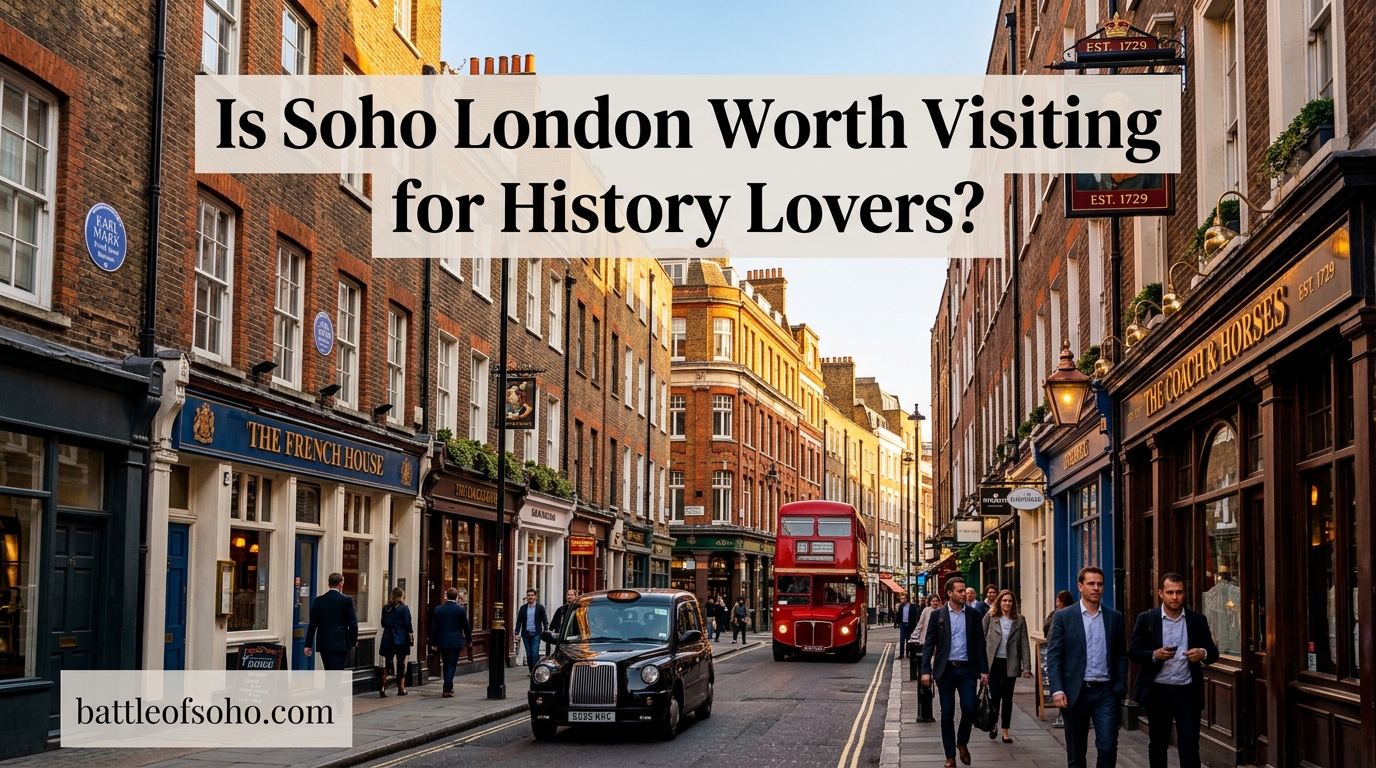
Yes, Soho London is absolutely worth visiting for history lovers. Behind the neon signs, cocktail bars, and bustling restaurants lies 400 years of extraordinary social and cultural history that most London guides completely overlook. Our team has walked these streets dozens of times, and every visit reveals another layer of the past that you simply will not find at the Tower of London or Westminster Abbey.
Most travel articles treat Soho as a nightlife district. They mention the restaurants, the pubs, and the West End theatres. But they miss the real story. Soho is where French Huguenot refugees rebuilt their lives in the 1680s. It is where jazz first took root in London during the 1920s. It is where Karl Marx plotted revolution, where the Kray twins ran their empire, and where the 1960s counterculture was born on Carnaby Street.
If you are asking whether Soho London is worth visiting for history lovers, the answer comes down to what kind of history excites you. If you want royal palaces and medieval towers, head to the Tower of London. But if you want to walk the same streets where immigrants, artists, musicians, writers, and revolutionaries shaped modern London over four centuries, Soho is one of the most rewarding neighborhoods in the entire city.
This guide covers everything a history enthusiast needs: Soho’s full historical timeline, the key historical sites you should not miss, a self-guided walking route with specific waypoints, how Soho compares to other London neighborhoods for history, and practical tips for getting the most out of your visit in 2026.
Table of Contents
The Quick Answer: Is Soho London Worth Visiting for History Lovers?
Yes, Soho is worth visiting for history lovers because it offers 400 years of social, cultural, and political history packed into less than one square mile. You can visit St. Anne’s Church (founded 1677), walk Frith Street where Mozart performed as a child, stand outside the clubs where jazz was born in London, and explore the streets where the 1960s counterculture exploded. No other London neighborhood packs this much layered history into such a walkable area.
Soho delivers a type of history that royal palaces and grand museums cannot: the history of ordinary people, immigrants, artists, and outsiders who changed the culture of an entire nation. That alone makes it essential for any serious history lover visiting London.
A Brief History of Soho: From Royal Hunting Ground to Cultural Icon
Soho’s history stretches back further than most visitors realize. Understanding this timeline transforms a casual stroll through the neighborhood into a journey through centuries of London’s social evolution.
The 17th Century: Hunting Grounds to Fashionable Square
Soho began as farmland and royal hunting grounds in the 16th century. The name “Soho” reportedly comes from a hunting cry used when chasing game across the open fields west of the City of London. King Henry VIII used the area as a royal park attached to the Palace of Whitehall.
Everything changed in the 1670s and 1680s. Landowners began developing the fields into a fashionable residential square, and Soho Square was laid out around 1681. Wealthy aristocrats built elegant townhouses around the square, attracted by the clean air and proximity to the royal court at Whitehall. For a brief period, Soho was one of the most desirable addresses in London.
French Huguenot Refugees Transform Soho
The turning point in Soho’s history came with the arrival of French Huguenot refugees. After Louis XIV revoked the Edict of Nantes in 1685, Protestant Huguenots fled France in massive numbers. Tens of thousands settled in London, and a large concentration chose Soho because of its proximity to the royal court and its relatively affordable housing.
The Huguenots brought their skills as silk weavers, watchmakers, goldsmiths, and merchants. They also brought their language, their food, and their culture. Soho became London’s first truly cosmopolitan neighborhood. French churches, schools, and businesses sprang up across the district. This immigrant foundation shaped everything that followed. Soho would always be a neighborhood for outsiders, newcomers, and people who did not fit in elsewhere.
The Enlightenment: Science and Ideas in Soho
By the 18th century, Soho had become a center of intellectual life. The area attracted scientists, philosophers, and thinkers associated with the Enlightenment. The most famous example is William Hogarth, the painter and social satirist, who lived in Soho and used its streets as inspiration for his devastating critiques of London life.
Soho was also home to scientific instrument makers and publishers who fed the growing appetite for knowledge in Georgian London. The neighborhood’s mix of immigrant energy, intellectual curiosity, and relative freedom from the social constraints of the City made it a natural home for new ideas.
Victorian and Edwardian Soho: Entertainment and Grit
The 19th century transformed Soho again. As the wealthy moved westward to Mayfair and Belgravia, Soho became a working-class and immigrant neighborhood. Italian, Greek, and Jewish communities joined the established French population. The streets filled with restaurants, cafes, music halls, and small theatres.
This was the era when Soho became synonymous with entertainment. The music halls of Soho offered cheap entertainment to working-class Londoners. The area also developed a reputation for vice. Sex work, gambling, and drinking dens flourished in the narrow backstreets. Charles Dickens knew these streets well and featured Soho locations in several of his novels, including the home of Dr. Manette in “A Tale of Two Cities.”
The 1920s: Jazz, Speakeasies, and Razor Gangs
The 1920s were one of the most dramatic periods in Soho’s history. American jazz arrived in London after World War I, and Soho became its natural home. Nightclubs and speakeasies proliferated, serving a generation desperate for escapism after the horrors of the trenches. The BBC series “Dope Girls” dramatized this era, focusing on the women who ran Soho’s nightlife underworld.
But the 1920s also brought violence. Rival razor gangs fought for control of Soho’s nightlife, protection rackets, and illegal gambling operations. The streets were genuinely dangerous after dark. This was the beginning of Soho’s organized crime era, which would continue for decades.
World War II and the Post-War Years
The Blitz devastated parts of Soho, but the neighborhood endured. During World War II, the Windmill Theatre on Great Windmill Street famously stayed open throughout the bombing, earning the motto “We Never Closed.” The theatre became a symbol of London’s resilience and defiance.
After the war, Soho entered its most notorious period. The 1950s and 1960s saw the rise of organized crime families who controlled clubs, protection rackets, and the sex industry. The Kray twins, Ronald and Reginald, became the most famous gangsters in British history, and their influence extended deep into Soho’s nightlife economy.
Swinging London: The 1960s Counterculture
The same decade that saw gangland violence also saw Soho become the epicenter of the most famous cultural revolution in British history. Carnaby Street became the fashion capital of the world. Mod culture, rock and roll, and a new spirit of youthful rebellion transformed Soho into the beating heart of “Swinging London.”
Bands, artists, fashion designers, and photographers made Soho their base. The Marquee Club on Oxford Street hosted the Rolling Stones, the Who, and David Bowie. Soho was no longer just a neighborhood. It was a global cultural brand.
From the 1980s to 2026: Regeneration and Preservation
The late 20th century brought waves of police crackdowns, regeneration projects, and changing economics. The sex industry shrank dramatically. Tech companies, advertising agencies, and media businesses moved in. Property prices soared. Many feared Soho would lose its character entirely.
But Soho has proven remarkably resilient. Independent restaurants, historic pubs, and long-standing music venues continue to operate alongside the new businesses. Preservation groups have fought successfully to protect listed buildings and maintain the neighborhood’s architectural heritage. In 2026, Soho remains a living, breathing piece of London history rather than a museum piece.
Key Historical Sites Every History Lover Should See in Soho
Soho packs an extraordinary density of historical sites into a tiny area. Here are the specific locations that every history lover should visit, with the historical context that brings each one to life.
1. St. Anne’s Church (Church of St. Anne, Soho)
St. Anne’s Church on Dean Street is the oldest religious foundation in Soho, dating back to 1677. The church was built to serve the growing residential population of the newly developed Soho Square area. It survived the Blitz despite suffering bomb damage, and its distinctive tower remains a landmark visible across the neighborhood.
St. Anne’s is the spiritual heart of historical Soho. Its parish registers record centuries of baptisms, marriages, and burials that tell the story of the neighborhood’s immigrant communities. The churchyard was once a burial ground for Soho’s residents, including many Huguenot families. Today, the church continues to serve the community and stands as a physical link to Soho’s 17th-century origins.
2. Soho Square
Soho Square is where the neighborhood began. Laid out in the 1680s, it was originally called King Square (after Charles II, whose statue once stood at its center). The square was designed as an elegant residential garden surrounded by aristocratic townhouses, similar to other fashionable squares being built in the West End.
Today, the square is a public garden where office workers eat lunch and tourists rest their feet. But look closely at the surrounding buildings and you can still see echoes of the 17th and 18th centuries. The square has witnessed every chapter of Soho’s history, from aristocratic parties to political meetings to music industry deal-making. In the center of the garden, a half-timbered gardener’s hut (actually a mock-Tudor structure) adds a touch of Victorian charm.
3. Greek Street
Greek Street takes its name from the Greek immigrants who settled here in the 18th and 19th centuries. But the street’s historical significance goes far beyond one community. Greek Street has been home to artists, writers, political exiles, and bohemians for over 200 years.
The House of St. Barnabas, a Georgian building on Greek Street, served as the inspiration for Dr. Manette’s lodgings in Dickens’s “A Tale of Two Cities.” Karl Marx was a regular visitor to the street’s radical bookshops and meeting rooms. The street’s pubs and cafes have hosted everyone from 18th-century satirists to 20th-century rock stars. Walking Greek Street is like traveling through a compressed history of London’s intellectual and cultural underground.
4. Frith Street: The Birthplace of London Jazz
Frith Street is arguably the most historically significant street in Soho for music lovers. In 1764, an eight-year-old Wolfgang Amadeus Mozart performed at a house on this street during his famous childhood tour of Europe. A blue plaque marks the approximate location.
But Frith Street’s musical legacy extends far beyond Mozart. In the 1920s and 1930s, the street became the center of London’s emerging jazz scene. The famous Ronnie Scott’s Jazz Club opened at 39 Frith Street in 1959 and has hosted virtually every major jazz musician of the past 65 years. From Miles Davis to Ella Fitzgerald to modern performers, the walls of Ronnie Scott’s are saturated with music history. For anyone interested in the history of jazz in Britain, Frith Street is essential.
5. Carnaby Street and Swinging London
Carnaby Street is ground zero for 1960s fashion and counterculture. In the mid-1960s, this modest shopping street became the fashion capital of the world. Boutiques like Lord John, His Clothes, and Lady Jane attracted international attention and made London the center of the youth fashion revolution.
The history here is cultural rather than architectural. Most of the original 1960s boutiques have been replaced, but the street retains its status as a symbol of Swinging London. For history lovers, Carnaby Street represents a specific moment when fashion, music, and youth culture converged to reshape British society. The nearby Kingly Court and surrounding streets still echo with the energy of that era.
6. The Windmill Theatre (Now the Windmill International)
The Windmill Theatre on Great Windmill Street is one of the most historically significant entertainment venues in London. During World War II, the Windmill famously stayed open throughout the Blitz, earning the proud motto “We Never Closed.” While bombs fell on London, the show went on inside.
The theatre was also revolutionary in its own way. Owner Laura Henderson pioneered the “Revudeville” format, combining revue entertainment with nude tableaux that exploited a legal loophole. The story was dramatized in the 2005 film “Mrs. Henderson Presents” starring Judi Dench. The building stands as a monument to London’s wartime resilience and its long tradition of pushing boundaries in entertainment.
7. Freemasons’ Hall
Located on Great Queen Street at the eastern edge of the Soho area, Freemasons’ Hall is the headquarters of the United Grand Lodge of England. The current building dates from 1933 and is a stunning example of Art Deco architecture. It serves as a memorial to the 3,225 Freemasons who died in World War I.
The Hall is open to the public and offers guided tours that reveal the extraordinary craftsmanship and symbolism throughout the building. For history lovers interested in the role of Freemasonry in British political, social, and cultural life, this is one of the most important sites in London. The building has also served as a filming location for numerous films and television shows.
8. Dean Street: Writers, Revolutionaries, and Rock Stars
Dean Street has hosted an remarkable procession of historical figures. Karl Marx lived in squalor at 28 Dean Street in the 1850s, where he wrote and researched while his family suffered in poverty. A blue plaque marks the building. Casanova reportedly visited the street during his time in London. William Hogarth lived nearby and depicted the street’s excesses in his satirical prints.
In the 20th century, Dean Street became a center of Soho’s nightlife and music scene. The famous 2i’s Coffee Bar on Old Compton Street (just off Dean Street) is often credited as the birthplace of British rock and roll, where Tommy Hicks (later Tommy Steele) was discovered in 1956. The Groucho Club, founded in 1985, continued the tradition of Dean Street as a gathering place for writers, artists, and media figures.
Soho’s Role in Major Historical Movements
Beyond individual sites, Soho played a central role in several major historical movements that shaped modern Britain. Understanding these broader themes adds depth to any historical visit.
The Jazz Age and Music Revolution
Soho was the gateway through which American jazz entered Britain. After World War I, musicians returning from abroad brought new sounds that transformed London’s nightlife. Soho’s underground clubs and speakeasies became testing grounds for this new music. The tradition continued through the decades, with Soho clubs hosting the British debut of bebop, the rise of British rhythm and blues, and the emergence of punk and new wave.
The Razor Gangs and Organized Crime
The 1920s and 1930s saw vicious turf wars between rival gangs in Soho. The “razor gangs” used cutthroat razors as their weapon of choice, leaving distinctive scars on their victims. These gangs fought for control of protection rackets, illegal betting operations, and nightclub territories. The era inspired countless books, films, and television dramas.
Organized crime in Soho reached its peak in the 1950s and 1960s with the Kray twins. Ronald and Reginald Kray built a criminal empire that controlled clubs, gambling, and protection rackets across the West End. Their celebrity status and connections to entertainers and politicians made them legendary figures. They were finally imprisoned in 1969, but their shadow still looms over Soho’s history.
Counterculture and Social Revolution
Soho was the physical center of the 1960s counterculture that reshaped British society. The Mod movement, with its sharp fashion, soul music, and Italian scooters, was born in the clubs and cafes of Soho. The anti-establishment spirit of the era found expression in Soho’s underground press, its music venues, and its fashion boutiques.
Literary Bohemia
For centuries, Soho has been home to writers, poets, and publishers who lived outside the mainstream. Karl Marx, Charles Dickens, William Hazlitt, and Dylan Thomas all had deep connections to the area. The neighborhood’s cheap rents (in earlier centuries), cosmopolitan atmosphere, and tolerance for unconventional lifestyles made it a natural haven for literary bohemians.
A Self-Guided Historical Walking Route Through Soho
One of the best things about Soho for history lovers is its walkability. The entire neighborhood can be explored on foot in about two hours. Here is a self-guided walking route that takes you through Soho’s most historically significant locations, arranged in a logical geographic order.
Starting point: Tottenham Court Road Underground Station (Northern and Central Lines)
Ending point: Oxford Circus Underground Station (Bakerloo, Central, and Victoria Lines)
Distance: Approximately 1.5 miles
Duration: 2 to 3 hours (including stops)
Stop 1: St. Anne’s Church, Dean Street
Begin your walk at St. Anne’s Church. Take a moment to appreciate the tower, which has watched over Soho since the late 17th century. The church is the spiritual anchor of the neighborhood and a tangible link to its founding era.
Stop 2: Karl Marx’s Residence, 28 Dean Street
Walk south along Dean Street and look for the blue plaque at number 28. Karl Marx lived here from 1851 to 1856, during some of the most productive and most difficult years of his life. He was writing “Das Kapital” and contributing to radical newspapers while his family struggled with poverty and illness.
Stop 3: Soho Square
Continue to Soho Square and spend a few minutes in the garden. This is the geographical and historical heart of the neighborhood. Imagine the aristocratic townhouses that once surrounded the square and the Huguenot families who walked these same paths in the 1680s.
Stop 4: Greek Street
Head south to Greek Street. Walk slowly and note the mix of architectural styles that reveal centuries of change. Stop at the House of St. Barnabas (when open) and look for historic pub facades that date back generations. This street encapsulates Soho’s history as a home for immigrants, intellectuals, and bohemians.
Stop 5: Frith Street and Ronnie Scott’s
Turn onto Frith Street and look for the blue plaque marking Mozart’s 1764 performance. Continue to number 39, the home of Ronnie Scott’s Jazz Club. Even if you do not go inside, standing outside this venue connects you to 65 years of jazz history. The club has hosted some of the greatest musicians of the 20th century.
Stop 6: Old Compton Street
Walk along Old Compton Street, the main artery of modern Soho. This street has been at the center of Soho’s identity for centuries, from Italian coffee houses in the 19th century to its current role as the heart of London’s LGBTQ+ community. The history here is social and cultural rather than architectural.
Stop 7: The Windmill Theatre, Great Windmill Street
Head to Great Windmill Street to see the Windmill Theatre. Remember the motto “We Never Closed” and think about what it meant for Londoners to have a place of entertainment that stayed open through the Blitz. This building is a monument to wartime resilience.
Stop 8: Carnaby Street
Finish your walk at Carnaby Street, the epicenter of Swinging London. Walk the full length of the street and imagine the crowds of young mods and rockers who flocked here in the 1960s. The street is a living monument to the moment when London became the fashion capital of the world. From here, Oxford Circus station is just a short walk to the north.
Soho vs Other London Neighborhoods for History Lovers
One of the most common questions we hear is how Soho compares to other central London neighborhoods for history. Each area offers something different, and understanding these differences helps you plan your time effectively.
Soho vs Covent Garden
Covent Garden and Soho sit side by side, but they offer very different historical experiences. Covent Garden is dominated by the grand architecture of the former fruit and vegetable market (dating from the 1830s), the Royal Opera House, and the church of St. Paul’s (where the first Punch and Judy show was performed in 1662). Covent Garden’s history is more visible and more immediately impressive architecturally.
Soho, by contrast, offers a deeper, more layered social history. Its buildings are less grand, but its stories are richer. If you have time for only one, choose Covent Garden if you prefer classical architecture and market history. Choose Soho if you want jazz, literature, counterculture, and the history of London’s immigrant and bohemian communities.
Soho vs Mayfair
Mayfair, immediately to the west of Soho, is London’s most exclusive neighborhood. Its history is one of aristocratic wealth, grand Georgian squares, and luxury hotels. Mayfair is fascinating for history lovers interested in the British class system, the history of London’s wealthiest families, and high-end architectural heritage.
Soho is the counterpoint to Mayfair. Where Mayfair represents wealth and power, Soho represents energy and rebellion. The two neighborhoods developed side by side but took radically different paths. Visiting both in the same day gives you a powerful sense of the contrasts that defined Georgian and Victorian London.
Soho vs South Bank
The South Bank offers a different kind of history entirely. Here you will find Shakespeare’s Globe (a reconstruction of the original 1599 theatre), the Tate Modern (housed in the former Bankside Power Station), and the Golden Hinde (a replica of Sir Francis Drake’s ship). The South Bank is more overtly tourist-focused and offers bigger, more dramatic historical attractions.
Soho wins on authenticity and density. The South Bank has been heavily redeveloped and many of its historical attractions are reconstructions. Soho’s history is embedded in its original streets and buildings, many of which have been in continuous use for centuries.
The Verdict
For history lovers, Soho is best understood as a complement to rather than a replacement for London’s major historical sites. Visit the Tower of London for medieval history. Visit Westminster Abbey for royal history. Visit the British Museum for world history. Then visit Soho for the social and cultural history that ties all of these together.
Tips for Visiting Soho as a History Lover
Making the most of a historical visit to Soho requires some planning. Here are our top tips based on years of exploring this neighborhood.
Best Time to Visit
Weekday mornings are ideal for a history-focused visit to Soho. The streets are quieter, you can actually see building facades without crowds blocking your view, and the pace allows for proper observation. Avoid Friday and Saturday evenings, when the area is packed with nightlife crowds that completely change the atmosphere.
Getting There
Soho is served by several Underground stations. Tottenham Court Road (Northern and Central Lines) is perfect for starting a walking tour from the north. Leicester Square (Northern and Piccadilly Lines) is ideal for approaching from the south. Oxford Circus (Bakerloo, Central, and Victoria Lines) provides access from the west. Piccadilly Circus (Bakerloo and Piccadilly Lines) sits at the southern edge.
Historical Pubs Worth Visiting
Soho’s pubs are living historical sites. The French House on Dean Street has been a drinking establishment since the early 1900s and was the wartime favorite of Charles de Gaulle, who used it as a meeting place while leading the Free French forces. The Coach and Horses on Greek Street has been a Soho institution since the 1850s and retains its original Victorian character. The John Snow on Broadwick Street is named after the doctor who traced an 1854 cholera outbreak to a nearby water pump, a landmark moment in the history of public health.
Hidden Gems Off the Beaten Path
Beyond the main historical sites, look for these lesser-known historical details. The John Snow cholera pump replica on Broadwick Street marks one of the most important moments in epidemiological history. Berwick Street Market has been a street market since the 18th century. The backstreets around Wardour Street contain former film industry offices from the golden age of British cinema. These small details reward the curious walker.
Combine with Nearby Historical Areas
Soho works best as part of a larger historical tour of the West End. You can easily combine a morning in Soho with an afternoon in Covent Garden, Bloomsbury (home of the British Museum), or Mayfair. The entire area is walkable, and moving between neighborhoods reveals how London’s different districts developed in relation to each other.
Resources for Deeper Research
If you want to go deeper before your visit, several resources are excellent. Dan Snow’s History Hit podcast produced a compelling episode on Soho’s notorious past, covering the razor gangs, speakeasies, and organized crime history in vivid detail. The Soho Society publishes historical materials and advocates for the preservation of the neighborhood’s heritage. Westminster City Archives holds extensive historical records about Soho’s buildings, residents, and businesses.
Frequently Asked Questions
Is Soho London worth visiting for history lovers?
Yes, Soho is absolutely worth visiting for history lovers. The neighborhood offers 400 years of social, cultural, and political history, including its 17th-century origins, French Huguenot settlement, Enlightenment-era intellectual life, 1920s jazz and crime history, and 1960s counterculture. It provides a type of history that royal palaces and major museums simply cannot offer.
What historical sites should I see in Soho?
The must-see historical sites in Soho include St. Anne’s Church (1677), Soho Square (1680s), Frith Street (where Mozart performed in 1764 and where Ronnie Scott’s Jazz Club opened in 1959), the Windmill Theatre (famous for staying open during the Blitz), Greek Street, Carnaby Street, and Dean Street (where Karl Marx lived).
Is Soho still a red light district?
No, Soho is no longer a red light district in the way it once was. Intensive police crackdowns and regeneration efforts from the 1980s onward have dramatically changed the area. Today, Soho is a vibrant neighborhood of restaurants, bars, theatres, and shops, though some remnants of its bohemian and adult entertainment past survive in a few backstreets.
Is Soho or Covent Garden better for history lovers?
Both offer excellent but different historical experiences. Covent Garden is better for grand architecture, the former market, and the Royal Opera House. Soho is better for social and cultural history, including jazz heritage, literary connections, and counterculture history. For the fullest historical experience, visit both since they are adjacent and walkable.
What is Soho London famous for historically?
Soho is historically famous as a cosmopolitan neighborhood that served as a refuge for French Huguenot refugees in the 1680s, a center of jazz and nightlife in the 1920s, the birthplace of British rock and roll in the 1950s, the epicenter of Swinging London fashion in the 1960s, and a longtime home of London’s bohemian and counterculture communities.
When was Soho London founded?
Soho was developed as a residential neighborhood in the 1670s and 1680s, with Soho Square laid out around 1681. Before that, the area was farmland and royal hunting grounds dating back to the 16th century. The arrival of French Huguenot refugees in the 1680s established Soho as a cosmopolitan immigrant neighborhood.
What are the best historical pubs in Soho?
The best historical pubs in Soho include The French House on Dean Street (a wartime meeting place for Charles de Gaulle), The Coach and Horses on Greek Street (a Soho institution since the 1850s), and The John Snow on Broadwick Street (named after the doctor who solved the 1854 cholera outbreak). Each pub is a living piece of Soho history.
How long should I spend exploring Soho for history?
A dedicated history lover should plan for 2 to 3 hours to walk through Soho’s key historical sites at a leisurely pace. A self-guided walking route covering St. Anne’s Church, Soho Square, Greek Street, Frith Street, the Windmill Theatre, and Carnaby Street covers approximately 1.5 miles and can be completed in a half-day visit.
What did the Kray twins have to do with Soho?
The Kray twins, Ronald and Reginald, controlled much of Soho’s organized crime in the 1950s and 1960s. Their empire included nightclub protection rackets, gambling operations, and control over parts of Soho’s nightlife economy. They were imprisoned in 1969, but their association with Soho’s gangland history remains one of the neighborhood’s most famous and dramatic chapters.
Final Thoughts: Is Soho London Worth Visiting for History Lovers?
After walking these streets dozens of times, our answer is an emphatic yes. Soho London is worth visiting for history lovers because it offers something no other London neighborhood can match: 400 years of social and cultural history compressed into one square mile of walkable streets. From the French Huguenot refugees of the 1680s to the jazz pioneers of the 1920s to the counterculture revolutionaries of the 1960s, Soho tells the story of the people who actually shaped modern London.
The major tourist sites like the Tower of London and Westminster Abbey are essential. But they tell the story of kings, queens, and empires. Soho tells the story of immigrants, artists, musicians, writers, and rebels. That story is just as important, and in many ways, it is more relevant to understanding the London of 2026.
Take the self-guided walking route we have outlined. Visit the historical pubs. Look for the blue plaques. Read the history behind the buildings you pass. Soho rewards curiosity and attention like few other places in London. For any history lover planning a trip to this city, skipping Soho would mean missing one of the richest historical experiences London has to offer.