
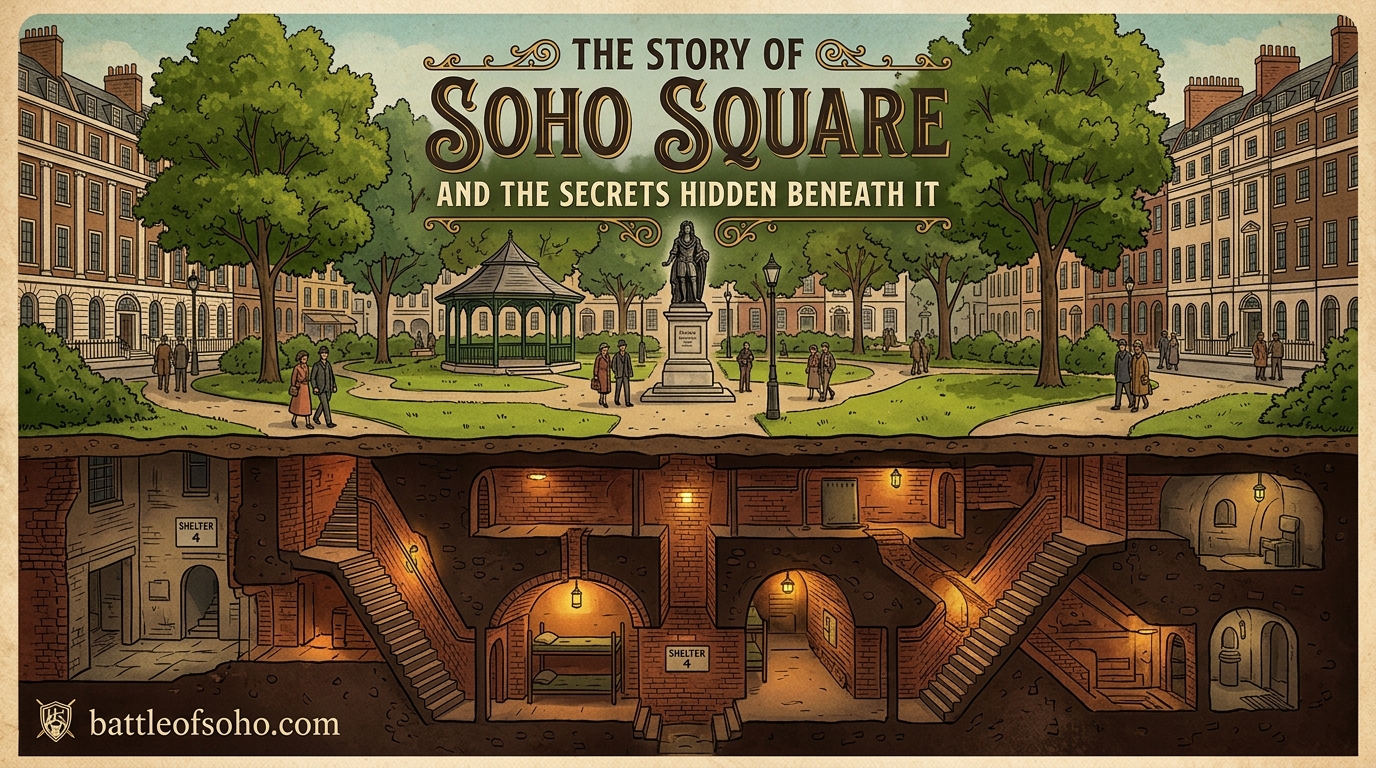
Walk through Soho Square on any given afternoon and you will see office workers eating lunch on benches, tourists photographing the quaint half-timbered hut at its centre, and locals cutting through on their way to Oxford Street. What almost nobody realises is that they are standing on top of centuries of buried history. Soho Square London history secrets hidden beneath the surface reveal a forgotten Victorian street, an underground electricity substation, a wartime bomb shelter, and a mock-Tudor hut that has been fooling passersby for a century.
The story of Soho Square is really the story of London itself, layered one era on top of another. Each generation built over the last, leaving fragments behind in the dark spaces below ground. From aristocratic garden square to Blitz shelter to modern utility hub, this small patch of central London has served more purposes than most neighbourhoods ten times its size.
What is under Soho Square? Beneath the square lies a 3,200-square-foot underground space originally built in 1925 as an electricity substation by the Charing Cross Electricity Company. During World War II, this cavernous room was converted into an air raid shelter that held up to 200 people during the Blitz. It is accessed through the mock-Tudor hut at the square’s centre.
Our team has spent months researching the layered history of this remarkable square, drawing on forum reports from urban explorer communities, archival records from Westminster Council, and the eyewitness testimony of Soho Society members who experienced the underground spaces firsthand. What follows is the most complete account of Soho Square and the secrets hidden beneath it that you will find anywhere online.
We will trace the full story from the square’s 1680s origins as a fashionable residential development through to its modern function as one of the most archaeologically complex public spaces in central London. We will also address the urban legends that refuse to die, including the persistent myth of a secret tunnel connecting Soho Square to Buckingham Palace.
Table of Contents
The Origins of Soho Square: From Hunting Grounds to Garden Square
Before Soho Square existed, the area was known as Soho Fields, an open tract of farmland and pasture lying just north of the built-up City of London. The name “Soho” itself comes from an old hunting cry, used by huntsmen when they spotted their prey during the Tudor period. When a hunter shouted “Soho!” it meant the game was in sight, and the chase was on. The land formed part of the Crown estate and was used for hunting and agriculture through the 1500s and early 1600s.
This was not the empty wasteland that the word “fields” might suggest to modern readers. Soho Fields were actively farmed, with smallholdings, market gardens, and scattered rural cottages dotting the landscape. The area was crossed by lanes and footpaths connecting the villages of Marylebone to the north with the expanding city to the south. It was recognisably rural but already feeling the pressure of London’s relentless growth.
By the 1670s, London was expanding rapidly westward. The Great Fire of 1666 had displaced thousands, and the aristocracy increasingly wanted grand homes away from the crowded, unsanitary City. The open fields of Soho presented a perfect opportunity for ambitious developers. The Crown held the freehold, and parcels of land were leased to wealthy individuals willing to invest in residential construction.
The development of the square also reflected broader changes in how wealthy Londoners wanted to live. The old pattern of living above your shop or warehouse in a narrow city street was giving way to something new: the residential square, with a private garden at its centre and substantial houses arranged around its perimeter. Covent Garden Piazza, laid out by Inigo Jones in the 1630s, had proved that the concept worked. Soho was to be the next fashionable district.
Soho Square was laid out in 1681, originally called King Square in honour of Charles II. The square was developed on land leased from the Crown, with Sir William Pulteney playing a central role in its early development. Pulteney, a wealthy landowner and MP who represented Westminster in Parliament, saw the potential for a fashionable residential square modelled on the grand squares already emerging in Covent Garden and Bloomsbury.
The plan was ambitious for its time. A large central garden was laid out, surrounded by substantial townhouses designed for the wealthy elite. The garden square concept, imported from Italian urban design, gave residents access to private green space in the heart of the city. This was a radical idea in 1680s London, where most people lived in cramped conditions without access to gardens or parks.
The early residents of Soho Square included some of the most prominent figures of the age. Ambassadors, senior clergy, government officials, and aristocrats filled the houses around the square. The addresses carried enormous social prestige, and being seen at a function or gathering in Soho Square was a mark of belonging to the highest levels of London society.
Through the late 1600s and into the Georgian era, Soho Square attracted a mix of aristocrats, politicians, and professionals. The houses were among the most desirable addresses in London. But as the 18th century progressed, the character of the neighbourhood began to shift. Wealthier residents started migrating further west to Mayfair and Belgravia, drawn by newer, grander developments. Soho gradually became a more mixed, commercial, and eventually bohemian district.
The square itself remained a constant through these changes. The central garden was maintained, the statue of Charles II presided over the space, and the surrounding buildings evolved from townhouses to offices, cultural institutions, and businesses. By the Victorian era, Soho Square had become a quiet green refuge in one of the most densely populated and culturally vibrant neighbourhoods in London. The same square that had once housed dukes and diplomats was now surrounded by music halls, immigrant businesses, and the bustling energy of a working neighbourhood.
What Is Under Soho Square? The Layers Beneath
The question of what lies beneath Soho Square has fascinated Londoners for decades. The answer involves multiple layers of hidden infrastructure spanning different eras and purposes. At the centre of it all sits the building that most people assume is simply a decorative garden shed.
Understanding what is hidden below requires thinking about the square in layers. At street level, there is the garden, the benches, and the hut. Below that, at the level of the foundations of the surrounding buildings, there are utility tunnels carrying pipes and cables. Deeper still, there is the large chamber built by the Charing Cross Electricity Company. And within that chamber, the remains of wartime fittings that tell the story of the Blitz.
The Mock-Tudor Hut: A Victorian Illusion
The mock-Tudor hut in the middle of Soho Square is one of the most photographed features in the neighbourhood. With its half-timbered black-and-white facade, leaded windows, and picturesque proportions, it looks for all the world like a genuine Tudor or medieval garden structure. It is neither.
The hut was built in 1925 by the Charing Cross Electricity Company. Its mock-Tudor design was chosen specifically to blend with the historic character of the square and to avoid drawing attention to its real purpose. The company needed an above-ground entrance to the underground substation it was building, and a plain industrial door or ventilation shaft would have been an eyesore in a garden square already surrounded by historic buildings.
Instead, they commissioned a structure in the Tudorbethan style, a pastiche of Tudor architecture that was enormously popular in the 1920s. The half-timbering, the jettying, and the decorative bargeboards were all cosmetic flourishes designed to make the building look centuries older than it actually was. The real function of the building was to provide a staircase down to the 3,200 square feet of underground space below.
The Tudorbethan style, sometimes called mock Tudor or Tudor revival, was one of the defining architectural trends of the interwar period in Britain. It drew on the visual language of 16th-century timber-framed buildings but used modern construction techniques underneath. The Soho Square hut is a miniature example of the style, packing all the visual cues of a Tudor manor house into a structure the size of a large garden shed.
The deception was remarkably successful. For decades, visitors and even many locals assumed the hut was a genuine historic structure, perhaps a surviving Tudor market cross or a medieval gardener’s lodge. Some sources from the mid-20th century describe it as a Victorian gardener’s hut, dating it to the 1800s rather than the 1920s. The confusion is understandable given how convincing the Tudor styling is.
In 1992, the hut itself received a Grade II listing from Westminster Council, recognised not for its age but for its architectural charm and its status as a quirky example of 1920s design. The listing protects the exterior from alteration, meaning the illusion that the Charing Cross Electricity Company created over a century ago is now preserved by law. Historic England’s listing describes the hut as a half-timbered building of considerable character, noting its role as a disguised access point.
The hut is not open to the public. Westminster Council and UK Power Networks, the current operators, maintain it as a functional access point. But its locked door and darkened windows only add to the sense of mystery that surrounds it. Every day, hundreds of people photograph a building whose true purpose almost none of them understand. The hut is one of London’s most successful architectural lies, and it has been keeping its secret for a hundred years.
The Electricity Substation: 3,200 Square Feet of Hidden Engineering
Beneath the mock-Tudor hut lies a chamber far larger than anyone standing above would guess. The underground space measures approximately 3,200 square feet, a cavernous room with a concrete roof, brick-lined walls up to 12 inches thick, and enough headroom to stand comfortably. It was built by the Charing Cross Electricity Company in 1925 to house electrical transformers and switching equipment for London’s growing power grid.
To put that size into perspective, 3,200 square feet is roughly the floor area of a substantial detached family house. The underground chamber is not a cramped tunnel or a narrow passage but a wide, open room that could hold dozens of people standing. When the space was used as a bomb shelter during the Blitz, it could accommodate between 150 and 200 people at a time, a figure that gives a clear sense of the chamber’s dimensions.
In the 1920s, London’s electricity supply was being rapidly expanded and consolidated. Multiple private electricity companies operated across the city, each building their own substations to step down high-voltage power from generating stations to levels suitable for homes and businesses. Soho was a dense commercial and residential district with enormous power demand from theatres, restaurants, shops, and homes, making the square an ideal location for a major substation.
The Charing Cross Electricity Company was one of several private utility companies operating in central London before the nationalisation of the electricity supply industry. The company served the area around Charing Cross, the Strand, and Soho, districts that were among the most electricity-hungry in the capital. Building a substation directly beneath a public square allowed the company to position its infrastructure right at the heart of its service area without taking up valuable street-level space.
The space was designed to be functional, not beautiful. Industrial equipment filled the room, generating heat and a low hum that would have been audible to anyone descending the staircase inside the hut. The thick brick walls and concrete roof served both structural and safety purposes, containing any potential electrical fires and supporting the weight of the garden above. Ventilation was provided through the hut above, allowing heat from the transformers to escape.
The substation operated continuously from 1925 through the formation of the Central Electricity Board in 1927, the nationalisation of the industry in 1948, the privatisation of the 1990s, and into the modern era. Today, the underground space is owned and managed by UK Power Networks, successor to the Charing Cross Electricity Company through decades of industry reorganisation. The company has produced social media content acknowledging the hut’s unusual history, making it one of the more charming footnotes in Britain’s utility infrastructure.
The fact that the substation is still operational is a key reason why the underground space is not open to visitors. The equipment inside carries high-voltage electricity and requires professional maintenance by qualified engineers. Converting the space to any other use would require removing or relocating the substation equipment, a logistically complex and enormously expensive undertaking that no one has yet been willing to pursue.
The WWII Air Raid Shelter: Survival Beneath the Square
When the Blitz began in September 1940, London needed every shelter it could find. The existing underground substation space beneath Soho Square offered something rare in central London: a large, already-excavated chamber with solid walls and a reinforced roof. It was pressed into service as a public air raid shelter almost immediately.
The shelter was not purpose-built but adapted from the existing substation chamber. The electrical equipment remained in place, but the space around it was opened up for civilian use. The 12-inch brick walls and concrete roof that had been designed to contain electrical fires now provided protection against bomb blast and falling debris. For the residents of Soho, this underground room offered a chance of survival that their own homes could not match.
Leslie Hardcastle, president of the Soho Society, provided one of the most detailed firsthand accounts of what the shelter was like. In an interview with the Evening Standard, Hardcastle recalled that the space initially accommodated between 150 and 200 people during air raids. When tiered bunk beds were installed to let people sleep through the night, the capacity was reduced but conditions improved for those sheltering.
Hardcastle’s account was vivid and unglamorous. “The only facility was a toilet,” he said, “and it could get quite smelly with all the people down there.” This was not a comfortable place. It was a survival measure, a concrete-lined cave where Soho’s residents waited out the falling bombs night after night. People brought blankets, thermoses of tea, and whatever food they could carry. Children slept on the bunks while adults sat on the floor or leaned against the warm brick walls.
The shelter was used throughout the Blitz and the later V-1 flying bomb and V-2 rocket campaigns of 1944 and 1945. The thick brick walls that had been designed to contain electrical fires now served a more urgent purpose, protecting the people below from the destruction raining down on the streets above. When the all-clear sounded, shelterers would emerge to find buildings damaged, streets cratered, and neighbours sometimes gone. The substation hummed on throughout, its equipment continuing to supply electricity to a district that needed power for searchlights, hospitals, and fire stations.
The dual function of the space during the war is worth emphasising. The chamber was simultaneously an active electricity substation keeping the lights on in war-torn Soho, and a civilian shelter keeping the people of Soho alive. The same room that hummed with electrical transformers also echoed with the voices of frightened children and the drone of approaching bombers. Few spaces in London served such a double purpose with so little recognition.
After the war, the space reverted to its original purpose as an electricity substation. The shelter fittings were removed, the bunks were taken down, and the wartime function of the underground chamber faded from public memory. By the time most people rediscovered the space decades later, few realised it had ever been anything other than a utility installation.
In 2015, the underground space briefly made headlines when it was put up for sale at £175,000. The listing attracted interest from restaurant groups and developers who imagined converting the cavernous room into an underground dining or entertainment venue. The Evening Standard covered the story, and for a few weeks, the shelter’s wartime history was discussed in national newspapers. The sale ultimately fell through, reportedly due to the logistical challenges of converting a space that still contained live electrical equipment. The chamber remains in the hands of the utility companies, still serving its original 1925 purpose.
Urban explorer communities have documented the shelter space in detail. Forums such as 28 Days Later and Derelict Places feature reports from individuals who entered the underground chamber, complete with photographs showing the brick-lined walls, the concrete roof, and the remnants of its dual life as substation and shelter. These reports were published around 2015 when the space was briefly accessible during the sale process. They provide a rare glimpse of a space that almost no member of the public will ever see in person, showing the scale of the chamber and the thickness of the walls that once protected Blitz-era Londoners.
Little Compton Street: The Buried Road Beneath Soho
The secrets beneath Soho Square are not limited to the substation and shelter. Just a short walk away, at the corner of Charing Cross Road and Old Compton Street, lies another buried fragment of Victorian London that most people walk past without ever noticing.
Little Compton Street was once a real, functioning street in the Soho district. It ran between Old Compton Street and what was then Crown Street, forming part of the dense network of narrow lanes that characterised this part of London in the 18th and 19th centuries. The street was home to a mix of working-class residents, small shops, and the kind of lively street life that made Victorian Soho both vibrant and notorious. It was the sort of place where costermongers sold fruit from barrows, children played in the gutters, and the air was thick with coal smoke and cooking smells.
The street was not a grand boulevard. It was narrow, cramped, and typical of the pre-Victorian street pattern that had grown up organically over centuries. But it was a real place where real people lived, worked, and raised families. When it was destroyed, an entire micro-community was dispersed.
In 1886, the Metropolitan Board of Works demolished Little Compton Street as part of a major road-widening scheme. Charing Cross Road was being cut through the existing street grid to create a major new thoroughfare linking Oxford Street with Trafalgar Square. Several older streets were swept away in the process, and Little Compton Street was one of them. The demolition was part of the great wave of Victorian urban improvement that reshaped large parts of central London, sweeping away old buildings and streets in the name of progress and sanitation.
But the street was not entirely destroyed. A fragment of it survived underground, buried beneath the new road surface. When Charing Cross Road was built above the level of the old street, the lower portions of Little Compton Street’s buildings were simply covered over rather than demolished. The basement walls, foundations, and street signs remained in place, sealed in a void beneath the new road.
Today, if you look through a ventilation grate on Charing Cross Road, near the junction with Old Compton Street, you can see the old Victorian street signs for Little Compton Street still mounted on the subterranean walls below. The grate is set into the pavement, and looking through it reveals a drop of several feet to the buried street level. The signs are mounted on brick walls that are recognisably the same walls that once formed part of the buildings flanking the street.
The signs are faded but legible. They read “Little Compton Street” in the raised ceramic lettering typical of Victorian street signage. The space they occupy is now a utility tunnel, used for carrying pipes and cables beneath one of London’s busiest roads. But the street names remain, a ghostly reminder of the neighbourhood that existed before Charing Cross Road was built. Seeing them for the first time is an unsettling experience, like looking through a window into a version of London that was supposed to have been erased.
Finding the grate requires a bit of patience. It is set into the pavement on the western side of Charing Cross Road, just south of the Old Compton Street junction. You need to get close to the grate and look directly down to spot the signs, and they are easier to see on a sunny day when light reaches the underground walls. Urban explorers and London history enthusiasts have documented the signs extensively on Instagram, TikTok, and YouTube, but many locals walk past the spot daily without realising what lies beneath their feet.
William Blake, the poet and visionary who lived in Soho and saw angels in the streets, is among the historical figures associated with the old Soho streets that were lost to 19th-century redevelopment. The buried fragment of Little Compton Street represents the physical remains of the world he knew, preserved by accident beneath a road that was built to sweep that world away. Other cultural figures connected to this lost Soho include the writer William Godwin and the composer Richard Wagner, both of whom knew the neighbourhood before its Victorian transformation.
The preservation of the Little Compton Street signs is entirely accidental. Nobody planned to keep them as historical artefacts. They survived because they happened to be below the level of the new road and because the space they occupied proved useful as a utility tunnel. The fact that they are still there, still legible, still marking a street that has not existed for 140 years, is one of the most poignant and peculiar features of subterranean London.
The Statue of Charles II: A Monument That Refused to Stay Standing
Standing in the centre of Soho Square, watching over the mock-Tudor hut and the lunching office workers, is a statue of Charles II. The statue is one of the oldest features of the square, and like everything else in this corner of London, it has a story that is more complicated than it first appears.
The statue was erected in the early 1680s, around the same time the square itself was laid out. It was installed to honour the monarch whose name the square originally bore, King Square. The figure is cast in gilded lead, standing on a marble pedestal, depicting Charles II in Roman imperial dress. This was a common style for royal statues of the period, drawing on classical imagery to associate the monarch with the power and prestige of ancient Rome. The Caesar-like robes and laurel wreath would have been immediately recognisable to any educated 17th-century viewer as symbols of imperial authority.
The choice of gilded lead as a material was typical of the period but ultimately problematic. Lead is relatively easy to cast and can be gilded to produce a brilliant gold finish, but it is soft, heavy, and vulnerable to weathering. The gilding would have made the statue blaze in the sunlight when it was new, a glittering centrepiece for the new square. Over the decades, however, the elements took their toll on both the gold finish and the lead beneath.
The statue’s history has been anything but stable. In the turbulent politics of the late 17th and early 18th centuries, monuments to monarchs could become targets. The statue was toppled at one point during its early history, a casualty of the shifting political allegiances that followed the Glorious Revolution of 1688 when James II was deposed and replaced by William and Mary. Statues of Stuart monarchs were not universally popular in the decades that followed, and the Soho Square Charles II did not escape the political turbulence of the age. It was repaired and re-erected, but the damage was a reminder that even statues in quiet garden squares were not immune to the political upheavals of the period.
In 1753, the statue underwent further restoration. The gilded lead had deteriorated over the decades, exposed to London’s weather and the growing pollution of an industrialising city. The restoration work repaired the damage and returned the figure to something approaching its original appearance. But the statue’s troubles were not over.
By the late 19th century, the original statue had deteriorated badly again. Victorian pollution, far worse than anything the 18th century had produced, ate into the lead and destroyed what remained of the gilding. The figure that stands in the square today is a later replacement rather than the original 1680s casting. The marble pedestal has also been repaired and restored multiple times over the centuries. The statue now holds a Grade II listed status, protecting it alongside the Tudor hut as part of the historic fabric of the square.
What you see today, then, is not exactly what 17th-century Londoners would have seen. The figure is a replacement, the pedestal has been rebuilt, and the gilding has been renewed and faded and renewed again. But the figure of Charles II still stands in the same spot, in the same pose, presiding over a square that has changed almost beyond recognition around him. The statue is a reminder that even monuments have histories of destruction, repair, and survival, much like the neighbourhood it occupies.
Soho Square Through the Centuries: A Complete Timeline
One of the things that makes Soho Square so fascinating is that its story spans more than three centuries of continuous use and reinvention. No single source has ever published a complete chronological timeline of the square, so here is one assembled from the available historical record, including Westminster Council listings, archival research, and the findings of multiple London history publications.
Pre-1600s: The area is open farmland and pasture known as Soho Fields, part of the Crown estate. The name “Soho” derives from a hunting cry used in the Tudor period when the land was used for royal hunting parties.
1670s: London begins expanding westward after the Great Fire of 1666. The Crown prepares to lease Soho Fields land for residential development as the city’s wealthy elite seek new homes away from the crowded City.
1681: Soho Square is laid out as King Square, named after Charles II. Sir William Pulteney, MP for Westminster, is among the key developers leasing Crown land for the project. The statue of Charles II in Roman dress is installed around this time.
Late 1600s to 1700s: The square becomes a fashionable address. Wealthy aristocrats, ambassadors, and government officials build townhouses around the central garden, making it one of the most prestigious residential addresses in London.
1688 onwards: The statue of Charles II is toppled during the political upheavals following the Glorious Revolution. It is subsequently repaired and re-erected, a quiet casualty of regime change.
1753: The statue of Charles II undergoes restoration after decades of weathering and earlier political damage. The gilded lead figure is repaired to something approaching its original appearance.
1800s: Soho transitions from a fashionable residential district to a more mixed, commercial, and immigrant neighbourhood. Wealthy residents migrate west to Mayfair and Belgravia, and the square’s houses are gradually converted to offices and businesses.
1886: The Metropolitan Board of Works demolishes Little Compton Street to make way for the new Charing Cross Road. A fragment of the street survives underground with its Victorian street signs intact, still visible through a pavement grate today.
1925: The Charing Cross Electricity Company builds an underground electricity substation measuring 3,200 square feet beneath the square. The mock-Tudor hut is constructed above as a disguised entrance point, designed in Tudorbethan style to blend with the historic character of the square.
1940 to 1945: During the Blitz and subsequent bombing campaigns, the underground substation space is used as a public air raid shelter, housing 150 to 200 Soho residents at a time. Leslie Hardcastle, later president of the Soho Society, is among those who shelter there.
1947: The electricity industry is nationalised. The substation beneath Soho Square becomes part of the nationalised electricity supply infrastructure.
1990s: The electricity industry is privatised. Ownership of the substation transfers to successor companies in the newly privatised power network.
1992: The mock-Tudor hut receives Grade II listed status from Westminster Council. Historic England recognises it as an architecturally significant example of 1920s Tudorbethan design, despite its true age and industrial purpose.
1997: Artist Rick Buckley affixes sculpted noses to buildings across Soho in protest at the spread of CCTV cameras. The Seven Noses of Soho become a local legend and a popular feature of Soho walking tours.
2015: The underground shelter and substation space is listed for sale at £175,000. Interest from restaurant groups and developers is reported, but the sale does not complete. Urban explorer communities document the interior in detailed photographic reports.
2026: The square remains an active public garden surrounded by offices, media companies, and cultural institutions. The substation beneath it continues to serve London’s power grid, operated by UK Power Networks. The mock-Tudor hut stands as it has for a century, keeping its secret from the crowds who pass by daily.
Soho’s Hidden Cultural Heritage: The Square and Its Famous Neighbours
Soho Square’s story is inseparable from the cultural history of the surrounding neighbourhood. Soho has been home to some of the most influential figures in British and European culture, and several of them lived, worked, or performed within steps of the square.
Mozart is one of the most celebrated Soho residents. In 1764, a young Wolfgang Amadeus Mozart composed his First Symphony at 20 Frith Street, just around the corner from the square. The Mozart family had come to London as part of a European tour, and the eight-year-old prodigy’s time in Soho produced some of his earliest important compositions. A plaque on Frith Street marks the spot today, and it remains a place of pilgrimage for classical music enthusiasts visiting London.
Mary Seacole, the Jamaican-born nurse who became famous for her work caring for wounded soldiers during the Crimean War, also has connections to the Soho area. Her story represents the diverse, immigrant communities that have shaped Soho’s character for centuries. The neighbourhood has been a landing point for French Huguenots fleeing religious persecution, Italian immigrants bringing their food and coffee culture, Chinese settlers establishing what would become London’s Chinatown, and waves of arrivals from across the world. Each group left its mark on the streets, buildings, and cultural life around the square.
The Seven Noses of Soho is another hidden feature of the neighbourhood that captures its eccentric spirit. In 1997, an artist named Rick Buckley affixed sculpted noses to buildings across Soho as a protest against the spread of CCTV surveillance cameras, which he saw as an erosion of privacy and civil liberties. The noses were installed secretly, and it took years for the public to discover how many there were and who was responsible. The noses became a local legend, and visitors still try to find all seven as part of Soho walking tours. Some say that finding all seven brings infinite wealth, though this has never been independently verified.
William Blake, Karl Marx, Oscar Wilde, and numerous other cultural and political figures have walked the streets surrounding Soho Square. Blake was born in Soho and lived in the neighbourhood for much of his life, seeing angels in the streets and drawing inspiration from the bustling, chaotic world around him. Marx spent years in the British Library researching Das Kapital and was a familiar figure in the cafes and pubs of the district. Wilde lived and socialised in Soho during the height of his fame.
Maison Bertaux, one of London’s oldest patisseries, has been serving the neighbourhood since 1871 and has counted Karl Marx among its customers. The shop on Greek Street remains a beloved institution, its windows filled with eclairs and tarts, its walls covered in photographs and memorabilia from a century and a half of Soho life. Bar Italia on Frith Street has been a Soho institution since 1949, a gathering point for the Italian community and anyone who appreciates good coffee, open late and always busy.
Algerian Coffee Stores, established in 1887 on Old Compton Street, is another Soho institution that has witnessed the neighbourhood’s many transformations. It has been selling coffee, tea, and spices to Londoners for nearly 140 years, surviving two world wars, the decline of Soho’s bohemian era, and the modern wave of chain-store development. These businesses are the cultural equivalents of the buried features beneath the square, old layers of Soho life that have somehow survived into the present.
These cultural layers add another dimension to the story of Soho Square. The buried streets, hidden substations, and mock-Tudor illusions below ground are matched above by centuries of artistic, political, and social history. The square sits at the heart of a neighbourhood that has been reinventing itself continuously for over 300 years, each generation adding its own stories to the accumulated record.
Separating Fact From Fiction: The Buckingham Palace Tunnel Myth
One of the most persistent stories about the spaces beneath Soho Square is the rumour of a secret tunnel connecting the square to Buckingham Palace. This claim surfaces regularly on forums, in walking tour anecdotes, and in online discussions of hidden London. Visitors often ask about it, and some tour guides have been known to reference it as a tantalising possibility.
There is no evidence that any such tunnel exists. The distance between Soho Square and Buckingham Palace is roughly one and a half miles through some of the most densely built-up ground in central London. Constructing a tunnel of that length without it appearing on utility maps, planning records, or engineering surveys would have been virtually impossible. No credible source, including Westminster Council, UK Power Networks, or the London Underground infrastructure records, has ever confirmed the existence of such a passage.
The myth likely derives from a broader tradition of secret tunnel stories associated with royal and government buildings in London. There are genuine underground passages beneath Whitehall connecting government departments, and there are documented utility tunnels running beneath central London. These real tunnels, combined with the genuine underground features of Soho Square itself, create a fertile environment for speculation about additional, secret connections.
The irony is that the real features beneath Soho Square are far more interesting than the fictional tunnel. A mock-Tudor hut concealing a 1920s electricity substation that doubled as a wartime bomb shelter, plus a buried Victorian street with its original signs still in place, is a more compelling story than any imaginary royal escape route. Sometimes the truth beneath the surface is stranger than the fiction.
Can You Visit the Secrets Beneath Soho Square?
One of the most common questions on forums and in search results is whether the underground spaces beneath Soho Square are accessible to the public. The short answer is no, but there is still plenty to see and explore above ground.
The mock-Tudor hut is visible from anywhere in the square. You can walk right up to it, examine its half-timbered facade, and appreciate the skill that went into making an industrial access point look like a medieval garden structure. The hut is locked, and there is no public access to the staircase that descends to the substation below. UK Power Networks operates the underground space as an active part of London’s electricity infrastructure, and the equipment inside requires professional maintenance by qualified engineers.
The Little Compton Street signs are more accessible. You can view them by looking through the ventilation grate on Charing Cross Road, near the junction with Old Compton Street. The signs are easiest to spot on a bright day when sunlight reaches the underground walls. Bring a phone with a flashlight if you visit on an overcast day or in the evening, and be prepared to kneel down to get the best angle. The grate is set into the pavement on the western side of the road, and you may need to wait for a break in pedestrian traffic to get a clear look.
The statue of Charles II stands openly in the centre of the square and can be examined up close. Look for signs of the repairs and restorations that have been carried out over the centuries, and compare the gilded lead figure to other royal statues of the period. The Roman imperial dress and laurel wreath imagery are typical of late Stuart royal iconography, and the statue is one of the few surviving elements of the original 1680s square.
Several London walking tour companies cover Soho’s hidden history, including Secret London, London Guided Walks, and various independent guides operating in the West End. These tours often include stops at the Tudor hut, the Little Compton Street grate, and other hidden features of the neighbourhood. They are a good option for visitors who want context and storytelling alongside the physical sites, and many guides share insights from years of research that would be hard to find in any single published source.
For those interested in the underground shelter specifically, the urban explorer reports on 28 Days Later and Derelict Places forums provide detailed photographic documentation of the space. These reports were published in 2015 when the shelter briefly became accessible during the sale process. The photographs show the brick-lined walls, the concrete roof, the industrial equipment, and the remaining features that date from the wartime shelter period. The space is now sealed and actively monitored, and entering it without authorisation would be both dangerous and illegal. The electrical equipment inside carries high-voltage current and poses a serious risk to anyone without proper training and protective equipment.
The square itself is a public park maintained by Westminster Council. It is open during daylight hours, with benches, mature trees, and a small garden area that provides a quiet escape from the traffic and noise of the surrounding streets. It is one of the quieter green spaces in the West End, and sitting on a bench looking at the Tudor hut, it is easy to forget the three centuries of history stacked beneath your feet. The contrast between the peaceful garden above and the industrial infrastructure below is part of what makes Soho Square such a compelling place to visit.
FAQs
What is under Soho Square?
Beneath Soho Square lies a 3,200-square-foot underground space built in 1925 by the Charing Cross Electricity Company as an electricity substation. During World War II, this space was converted into an air raid shelter that housed 150 to 200 people during the Blitz. It is accessed through the mock-Tudor hut at the centre of the square.
What is the building in the middle of Soho Square?
The building in the middle of Soho Square is a mock-Tudor hut built in 1925. Despite its medieval appearance, it was constructed by the Charing Cross Electricity Company as a disguised entrance to the underground electricity substation beneath. It received a Grade II listing from Westminster Council in 1992.
What is the history of Soho Square?
Soho Square was laid out in 1681 as King Square, named after Charles II, on former Crown land known as Soho Fields. Developed with aristocratic townhouses around a central garden, it evolved through the Georgian and Victorian eras into a commercial and cultural hub. The square gained its underground substation in 1925, which served as a bomb shelter during WWII.
Why is it called Soho Square?
The name Soho comes from an old hunting cry used during the Tudor period, when the area was open farmland known as Soho Fields used for hunting. The square was originally called King Square after Charles II but gradually became known by the neighbourhood name, Soho Square. This London etymology is distinct from the Manhattan neighbourhood called SoHo, which stands for South of Houston.
Can you go inside the Tudor hut in Soho Square?
No, the Tudor hut in Soho Square is not open to the public. It serves as a functional access point for UK Power Networks to reach the underground electricity substation. The building is locked and monitored, though you can view and photograph its exterior from the square.
Is the Soho Square bomb shelter still accessible?
The WWII bomb shelter beneath Soho Square is not accessible to the public. The underground space was briefly listed for sale in 2015 at £175,000, and urban explorer communities documented the interior during that period. Today it is sealed, actively used as a substation, and entering without authorisation is both dangerous and illegal.
What is the hidden city beneath London?
London sits on top of a vast network of underground spaces including forgotten streets like Little Compton Street, disused Underground stations, government bunker complexes, river tunnels, and utility chambers. Soho Square alone contains a buried substation, a wartime shelter, and a mock-Tudor access hut. Across the city, hundreds of subterranean spaces form a hidden layer of London that most people never see.
Is Soho still seedy?
Soho has changed significantly from its mid-20th-century reputation for strip clubs and adult entertainment. Today it is a mix of media offices, restaurants, bars, independent shops, and cultural venues. The sex industry presence has been heavily reduced through licensing changes and redevelopment. Soho retains its bohemian, nightlife-driven character, but it is far cleaner and more commercial than its seedy heyday.
The Enduring Mystery of Soho Square
The story of Soho Square and the secrets hidden beneath it spans more than 340 years of London history. From hunting fields to aristocratic garden square, from Victorian road demolitions to wartime shelter, and from 1920s electricity substation to modern power grid, this small patch of central London carries the accumulated weight of everything that has happened above and below it.
What makes Soho Square London history secrets hidden beneath the pavement so compelling is that they are not abstract. They are physical, tangible, and still present. The Tudor hut still stands. The substation still hums. The shelter walls still hold the air that Blitz-era Londoners breathed. And the street signs of Little Compton Street still mark a road that was officially destroyed nearly 150 years ago.
The next time you walk through Soho Square, take a moment to look at the half-timbered hut and remember that it is a door, not a decoration. Then walk down to Charing Cross Road and kneel by the grate to glimpse a Victorian street that should not exist anymore. London’s greatest stories are often the ones you have to look down to find, and few places in the city pack as many of those stories into such a small space as Soho Square.