
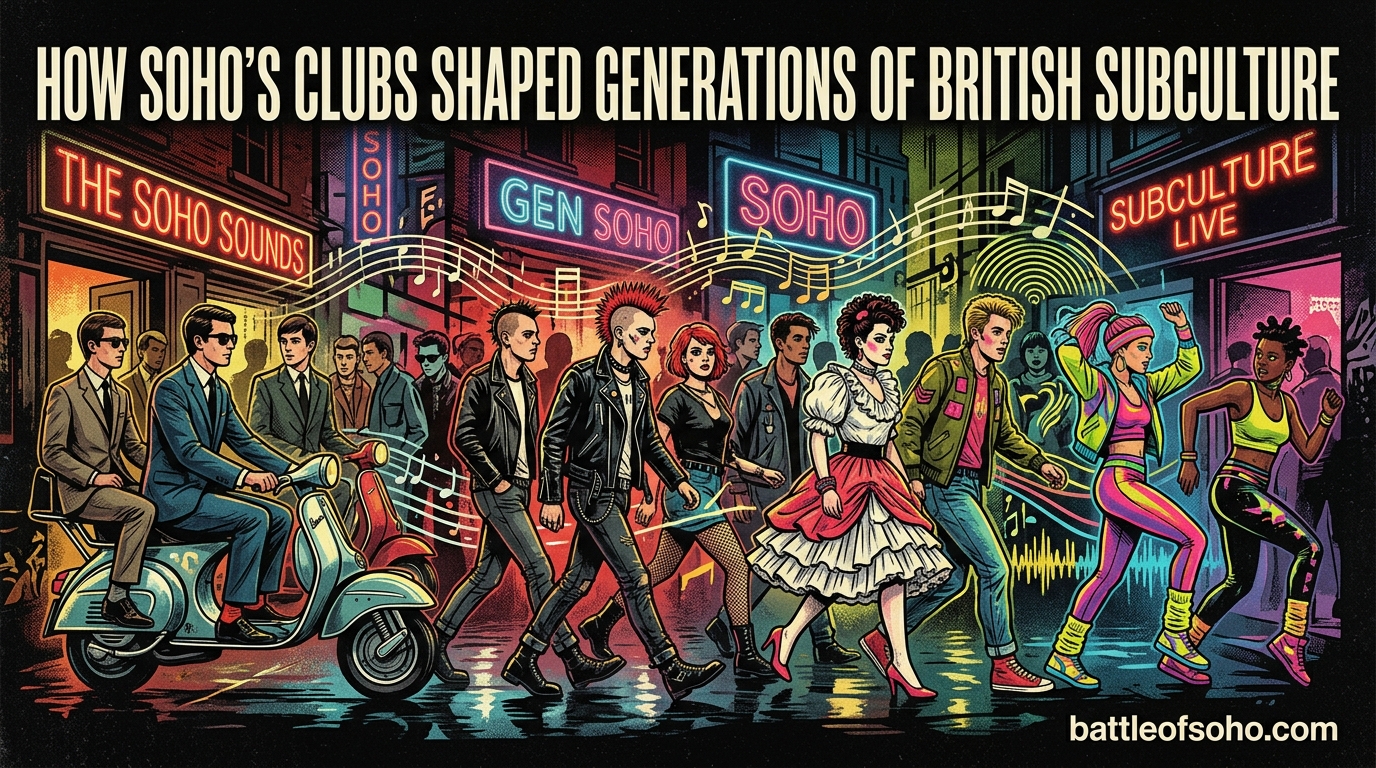
Walk through Soho today and you will find cocktail bars, media offices, and chain restaurants. But beneath that polished surface lies eight decades of rebellion, music, and youth movements that changed Britain forever. Soho’s clubs shaped generations of British subculture by giving misfits, dreamers, and outsiders a place to gather, create, and define themselves against the mainstream.
British subculture refers to groups within British society that develop distinct identities, styles, and values separate from mainstream culture, often centered around music, fashion, and art movements. From the Teddy Boys of the 1950s through the New Romantics of the 1980s and beyond, these youth tribes found their spiritual home in the narrow streets of Soho.
In this article, we trace how Soho’s clubs shaped British subculture across every major decade. We cover the bohemian coffee bars of post-war London, the jazz cellars that birthed a musical revolution, the mod and rocker clashes that horrified the nation, the punk uprising that burned everything down, and the glamorous Blitz Club era that turned rebellion into high fashion. Understanding how Soho’s clubs shaped generations of British subculture means understanding modern British identity itself.
Table of Contents
Post-War Bohemia: Soho as London’s Countercultural Furnace (1940s-1950s)
After the Second World War ended in 1945, Soho emerged as a neighborhood unlike anywhere else in Britain. The area had survived the Blitz with much of its character intact, and its cheap rents, existing nightlife infrastructure, and central location made it a magnet for people who did not fit into post-war respectability.
The first youth subculture to take root here was the Teddy Boy movement. Emerging in the early 1950s, Teddy Boys adopted Edwardian-inspired drape jackets, velvet collars, narrow trousers, and brothel creeper shoes. They were Britain’s first true youth tribe, and Soho’s coffee bars and clubs gave them a place to display their look and hear the American rock and roll records that defined their sound.
But Teddy Boys were just the beginning. Soho’s post-war scene also attracted genuine bohemians: artists, writers, criminals, jazz musicians, and political radicals who created an atmosphere of permissive chaos. The French House on Dean Street became the unofficial headquarters for this crowd, serving cheap drinks to everyone from Francis Bacon to Dylan Thomas. This pub set the tone for everything that followed, establishing Soho as a place where social rules could be bent or broken entirely.
The bebop scene also took root in Soho during this period. American jazz musicians visiting London found welcoming audiences in Soho’s basement clubs, and British players absorbed the new style. Academic research has identified this bebop scene as post-war Britain’s first genuine youth subculture, predating even the Teddy Boys. Young fans gathered in clubs like the Full Moon, absorbing a musical language that prized improvisation, individuality, and cool detachment from convention.
Jazz Clubs and the Beatnik Invasion
By the late 1950s, Soho had become the undisputed capital of British jazz. The neighborhood’s basement venues offered something mainstream entertainment could not: intimacy, experimentation, and a sense of belonging for people who felt alienated from post-war conformity.
The most significant venue to emerge was Ronnie Scott’s Jazz Club, which opened in 1959 in a former tea room on Gerrard Street before moving to its permanent home on Frith Street in 1965. Founded by saxophonists Ronnie Scott and Pete King, the club brought world-class American jazz artists to London and gave British musicians a dedicated platform. Scott’s sharp wit between sets became legendary, and the club’s policy of booking serious jazz rather than commercial pop established a standard that influenced every venue that followed.
The 100 Club, originally called the Feldman Jazz Club when it opened in 1942 at 100 Oxford Street on the edge of Soho, served as another critical venue. It hosted trad jazz, skiffle, and eventually blues and rock, making it one of the longest-running live music venues in the world. The club’s willingness to book unknown acts gave countless musicians their first break.
Running parallel to the jazz scene was the skiffle craze, a DIY music movement built on washboards, tea chest basses, and acoustic guitars. Lonnie Donegan’s hit Rock Island Line inspired thousands of British teenagers to form skiffle groups, and many of them played their first gigs in Soho’s coffee bars. A young John Lennon and Paul McCartney both passed through this skiffle tradition, connecting Soho’s grassroots music culture directly to the Beatles and the British Invasion that followed.
The beatnik influence added another layer. Inspired by the American Beat Generation, British beatniks gathered in Soho’s coffee bars wearing black turtlenecks and reading poetry. They were small in number but outsized in cultural impact, normalizing the idea that young people could choose to live outside conventional expectations. The Coffee Pot on Old Compton Street and Le Mac on Wardour Street were among the spots where beatnik culture mixed with jazz fandom, creating the social chemistry from which later movements would grow.
Swinging London: Mods, Rockers, and the 1960s Explosion
The 1960s transformed Soho from a bohemian backwater into the epicenter of a global cultural phenomenon. Swinging London, as the international press dubbed it, put Soho’s clubs and streets at the heart of youth culture worldwide, and the neighborhood’s venues became laboratories where fashion, music, and attitude evolved at breakneck speed.
The mod movement was the defining subculture of early 1960s Soho. Mods were obsessive about fashion, music, and modernity. They wore tailored suits, parkas, and narrow ties, rode Italian scooters, and danced all night to American soul, Jamaican ska, and modern jazz. Soho clubs like the Scene on Ham Yard and the Flamingo on Wardour Street hosted all-night mod dances where these sharp-dressed teenagers could hear the latest imported records.
The rockers were the mods’ great rivals. Leather-jacketed, motorcycle-riding, and devoted to rockabilly and early rock and roll, rockers represented a rougher, more overtly masculine subculture. The mods and rockers were known for their violent clashes at British seaside resorts like Brighton and Margate in 1964, disturbances sensationalized by the press and memorialized in the 1979 film Quadrophenia. But the real energy of both movements pulsed back in the clubs of Soho, where mods in particular created a sophisticated nightlife culture that influenced fashion for decades.
Carnaby Street, just south of Soho proper, became the shopping artery connecting mod culture to commercial fashion. Boutiques like John Stephen’s His Clothes dressed the mod generation, and by the mid-1960s the street was an international tourist attraction. This proximity between Soho’s nightlife and retail fashion was no accident: the clubs generated trends, and the shops within walking distance turned those trends into purchasable identities.
The Marquee Club, located at 90 Wardour Street from 1964 to 1988, was arguably the most important venue of the entire decade. The Rolling Stones played their first gig there in 1963. The Who, David Bowie, Jimi Hendrix, and Led Zeppelin all performed on its stage. The Marquee connected the mod scene to the blues boom and then to psychedelic rock, serving as a bridge between underground subculture and mainstream success. A band that could pack the Marquee had arrived.
For young women, the 1960s Soho scene offered new freedoms. The model Jean Shrimpton, designer Mary Quant, and singer Marianne Faithfull all moved through Soho’s orbit, embodying a new kind of femininity that was youthful, sexually confident, and fashion-forward. While male-dominated narratives dominate most subculture histories, these women were central to Swinging London’s visual identity and cultural power.
Punk Rock Revolution: The 1970s Uprising
By the mid-1970s, the optimism of Swinging London had curdled into economic decline, unemployment, and social unrest. Into this vacuum came punk rock, the most confrontational British subculture yet, and Soho stood at its explosive center.
The punk movement rejected everything the previous decade had represented. Where mods prized sharp tailoring, punks embraced ripped clothing, safety pins, and DIY aesthetics. Where 1960s rock had grown bloated and self-important, punk stripped music back to three chords and two-minute songs. The ethos was simple: anyone could form a band, anyone could make clothes, anyone could create a fanzine. This DIY ethics approach democratized culture in a way that still influences independent music today.
The central figures were Malcolm McLaren and Vivienne Westwood, who ran a clothing shop at 430 King’s Road in Chelsea called SEX. Though technically outside Soho, the shop’s creations defined punk’s visual language, and McLaren’s management of the Sex Pistols turned that visual language into a national scandal. Westwood’s designs, including provocative t-shirts and bondage-inspired gear, gave punk its signature look and established her as one of the most influential fashion designers of the twentieth century.
The 100 Club Punk Special, held over two days in September 1976, was the movement’s foundational event. Organized by McLaren and featuring the Sex Pistols, The Clash, The Damned, The Buzzcocks, and Siouxsie and the Banshees, this festival crystallized the British punk scene. The gig drew national media attention, including tabloid outrage that only amplified punk’s appeal to disaffected youth. Soho’s 100 Club thus cemented its place in music history as the venue where punk went public.
The Roxy Club, which opened in December 1976 on Neal Street in nearby Covent Garden but served the greater Soho nightlife ecosystem, became the first venue dedicated entirely to punk. Originally a gay nightclub called Chaguaramas, it was converted into a punk club and hosted early performances by Generation X, Wire, and The Adverts. The Roxy gave punk a permanent home when most mainstream venues refused to book punk bands.
Siouxsie Sioux stands out as a crucial female pioneer of this era. Before forming Siouxsie and the Banshees, she was part of the Bromley Contingent, a group of young punks who followed the Sex Pistols and helped define the movement’s visual style. Her presence in the 100 Club Punk Special lineup signaled that punk, despite its macho posturing, created space for women to perform, create, and lead in ways previous subcultures had not allowed.
Punk’s impact extended far beyond music. The fanzine culture it spawned, with hand-stapled publications like Sniffin’ Glue, taught a generation that media could be created by anyone. Independent record labels like Rough Trade and Stiff Records, both deeply connected to the Soho scene, built distribution networks that bypassed the major labels entirely. This infrastructure would support every subsequent wave of British alternative music.
The Blitz Club and the New Romantics: 1980s Style Rebellion
As punk’s first wave burned out in the late 1970s, a new subculture emerged that took punk’s DIY spirit and redirected it toward glamour, theatricality, and fashion excess. The New Romantic movement, born in Soho’s clubs, would define the visual identity of the 1980s and launch careers that shaped global pop culture.
The Blitz Club was ground zero for this revolution. Operating Tuesday nights at Billy’s nightclub in Soho’s Meard Street from 1978, then moving to the Blitz wine bar in Great Queen Street, the night was run by Steve Strange and DJ Rusty Egan. Strange, a Welsh-born former punk, served as the gatekeeper, famously turning away Mick Jagger for not making enough effort with his outfit. The door policy was simple: if you looked extraordinary, you got in.
Inside the Blitz, the crowd danced to a mix of European electronic music, Kraftwerk, David Bowie, and Roxy Music. The aesthetic was deliberately glamorous and androgynous: pirate shirts, kilts, makeup for men, elaborate hair, and historical costume references. This was the New Romantic look, and it spread from the Blitz to the pages of fashion magazines within months.
The club’s impact on British music was staggering. Spandau Ballet, who practically lived at the Blitz, became the house band and used their club following to launch a career that included multiple number one hits. Boy George, then a Blitz regular working as a cloakroom attendant, would go on to international fame with Culture Club. Visage, formed by Strange and Egan specifically to make the electronic music they wanted to dance to, scored a massive hit with Fade to Grey. Marilyn, another Blitz fixture, achieved chart success in the early 1980s.
The Design Museum in London ran a major exhibition called Blitz: The Club That Shaped the 80s from September 2025 through March 2026, a testament to the club’s enduring cultural significance. The exhibition explored how a single Tuesday night in Soho launched a fashion revolution, transformed the British music industry, and influenced design and visual culture worldwide.
What made the Blitz different from punk was its relationship with commerce. Where punk rejected the mainstream, the New Romantics embraced ambition. Blitz kids wanted record deals, magazine covers, and global fame. This pragmatic approach to subculture, treating the underground as a launchpad rather than an end in itself, would become the template for decades of club culture to follow.
The Camden Palace, which opened on Camden High Street in 1982 but drew its crowd from the Soho nightlife scene, continued the Blitz legacy on a larger scale. It became one of the most important clubs of the 1980s, hosting live performances and themed nights that extended the New Romantic aesthetic into the mainstream. The genre-crossing nature of these clubs, where you might hear punk, electronic, soul, and pop in a single night, reflected a new openness in British youth culture.
Women played prominent roles in the New Romantic scene. Journalist and writer Robert Elms documented the era, but the visual identity was also shaped by designers like Stephen Jones, whose hat designs defined the look, and photographers like Graham Smith, who captured the scene. Female performers like Siobhan Fahey of Bananarama, who got their start in the club scene, proved that the post-punk landscape offered genuine opportunities for women in music.
Key Clubs That Defined Each Era
No single article can capture every venue that contributed to Soho’s subcultural history, but certain clubs stand out as genuinely transformative. Understanding how Soho’s clubs shaped generations of British subculture requires knowing these venues by name and understanding what happened inside their walls.
The French House (49 Dean Street) has served as a bohemian gathering point since the 1940s. Its no-mobile-phones policy and tiny interior preserve something of the old Soho spirit. Francis Bacon drank here regularly, and it remains one of the few historic venues still operating in something like its original form.
Ronnie Scott’s Jazz Club (47 Frith Street) opened in 1959 and has hosted virtually every major jazz artist of the past six decades. From Count Basie to Ella Fitzgerald to modern contemporary artists, the club remains a working venue and a living monument to Soho’s musical heritage.
The Marquee Club (90 Wardour Street, 1964-1988) was the most important rock venue in Britain during its heyday. The Rolling Stones, The Who, David Bowie, Jimi Hendrix, and hundreds of others played its small stage. The original building no longer exists, and the club’s closure symbolized the changing face of Soho nightlife.
The 100 Club (100 Oxford Street) opened in 1942 and still operates today. It hosted the 1976 Punk Special and has survived waves of musical change by booking genuinely diverse acts. Its survival makes it a rare physical link to Soho’s subcultural past.
The Roxy Club (Neal Street, 1976-1978) existed for barely eighteen months but played a foundational role in British punk. It hosted early gigs by Generation X, Wire, and hundreds of other bands during punk’s initial explosion.
The Blitz Club sessions ran at Billy’s and then the Blitz wine bar from 1978 through the early 1980s. The venues themselves were modest, but the cultural impact was enormous, launching the New Romantic movement and reshaping 1980s fashion and music.
The Vortex on Wardour Street, though less famous than the venues above, served as a key jazz and experimental music venue in the 1980s and beyond, extending Soho’s tradition of booking challenging, non-commercial music into the modern era.
Gentrification and the Transformation of Soho
The Soho that nurtured these subcultures is largely gone. Rising rents, corporate development, and the Crossrail construction project have transformed the neighborhood from a grubby creative haven into an increasingly commercial district. Long-time residents and nightlife veterans mourn the loss of character that made Soho a magnet for outsiders in the first place.
Venue closures tell the story starkly. The Marquee Club was demolished. The Astoria, which hosted gigs from the 1970s onward, was demolished in 2009 to make way for Crossrail. The 12 Bar Club on Denmark Place closed in 2015. Each closure removed another piece of the physical infrastructure that allowed subcultures to form.
Rent increases have driven out the independent record shops, vintage clothing stores, and small bars that fed into Soho’s creative ecosystem. The young musicians, artists, and designers who once flocked to Soho can no longer afford to live or work nearby. Forum discussions on Reddit and Facebook regularly feature users mourning this loss, sharing memories of venues that no longer exist and a scene that feels irrevocably changed.
The sex industry that once defined part of Soho’s identity has also contracted, with many of the area’s historic adult entertainment venues closing under pressure from developers and licensing changes. While some view this as urban improvement, others see it as the erasure of the very edge and permissiveness that made Soho a safe space for countercultural expression.
Why Soho’s Subcultural Legacy Still Matters in 2026
Despite the changes, understanding how Soho’s clubs shaped generations of British subculture remains essential for understanding modern Britain. The fashion, music, and attitudes that emerged from Soho’s clubs continue to influence global culture in ways both obvious and subtle.
The DIY punk ethos that took shape in Soho venues is visible in today’s independent music scene, from bedroom-produced electronic music to self-released albums on Bandcamp. The New Romantic emphasis on visual presentation and personal branding feels almost prophetic in an age of social media, where everyone curates their own image. The mod obsession with style and detail lives on in contemporary British fashion design.
Museum exhibitions like the Design Museum’s Blitz show and the London Museum’s subcultures collection demonstrate that institutions now recognize the cultural significance of these movements. What was once dismissed as youthful rebellion is now studied, archived, and celebrated as part of Britain’s national heritage.
For working-class communities, Soho’s subcultural history holds particular significance. Many of the musicians, designers, and fans who defined these movements came from ordinary backgrounds and used Soho’s nightlife as a route to creative careers that would otherwise have been inaccessible. The clubs were not just entertainment venues but engines of social mobility and self-expression for people the mainstream economy had little use for.
The question of whether Soho can still generate new subcultures remains open. Some argue that online communities have replaced physical gathering spaces, while others insist that subculture still requires the friction and energy of real-world encounters. What is certain is that without understanding the past, we cannot shape the future of British cultural life.
FAQs
What is British subculture?
British subculture refers to groups within British society that develop distinct identities, styles, and values separate from mainstream culture. These movements are typically centered around music, fashion, and art, with examples including Teddy Boys, mods, rockers, punks, and New Romantics. Soho’s clubs served as the primary incubator for many of these groups from the 1940s onward.
When did Soho become seedy?
Soho developed its reputation for seediness during the post-war period of the 1940s and 1950s, when cheap rents and lax licensing attracted burlesque venues, strip clubs, and underground bars. This reputation persisted through the 1960s and 1970s, though the same permissive atmosphere also made Soho a haven for artists, musicians, and countercultural movements.
What club shaped the 80s?
The Blitz Club, run by Steve Strange and Rusty Egan from 1978 in Soho, shaped the 1980s by launching the New Romantic movement. Regulars included Spandau Ballet, Boy George, and Visage, and the club’s emphasis on theatrical fashion and electronic music influenced design, music, and visual culture throughout the decade. The Design Museum held a major exhibition about the Blitz Club from 2025 to 2026.
What were the mods and rockers known for?
Mods were known for their sharp tailored suits, Italian scooters, and love of soul, jazz, and ska music. Rockers were known for leather jackets, motorcycles, and devotion to rockabilly and rock and roll. The two groups clashed violently at British seaside resorts like Brighton and Margate in 1964, generating national headlines and becoming one of the most famous youth culture conflicts in British history.
Is Soho still relevant for subculture today?
Soho has changed dramatically due to gentrification, rising rents, and venue closures, making it less of a subcultural hub than it was from the 1940s through the 1980s. However, venues like the 100 Club and Ronnie Scott’s still operate, and the area’s history continues to inspire new generations of musicians, designers, and artists who draw on its legacy of rebellion and creativity.
What were the key punk venues in Soho?
The 100 Club on Oxford Street hosted the legendary 1976 Punk Special featuring the Sex Pistols, The Clash, The Damned, and The Buzzcocks. The Roxy Club on Neal Street, which operated from 1976 to 1978, was the first venue dedicated entirely to punk music. The Marquee Club on Wardour Street also hosted early punk and post-punk performances alongside its broader rock programming.
Conclusion: The Enduring Power of Soho’s Underground
From the bebop cellars of the 1940s to the Blitz Club’s glamour in the 1980s, how Soho’s clubs shaped generations of British subculture is a story of physical spaces making cultural transformation possible. Each venue, from the French House to the Marquee to the 100 Club, gave a generation of outsiders a place to become themselves.
The Teddy Boys, mods, rockers, punks, and New Romantics who passed through Soho’s doors did not just consume culture. They created it, wearing their identities on their sleeves and their rebellion in their music. The fashion revolutions, musical innovations, and social freedoms that emerged from these clubs rippled outward to influence Britain and the world.
Soho itself has changed beyond recognition, and many of the venues that made this history are gone. But the legacy endures in every independent band that self-releases an album, every designer who challenges convention, and every young person who refuses to accept the identity the mainstream hands them. The next chapter of British subculture may not be born in Soho, but it will be standing on the shoulders of those who were.