
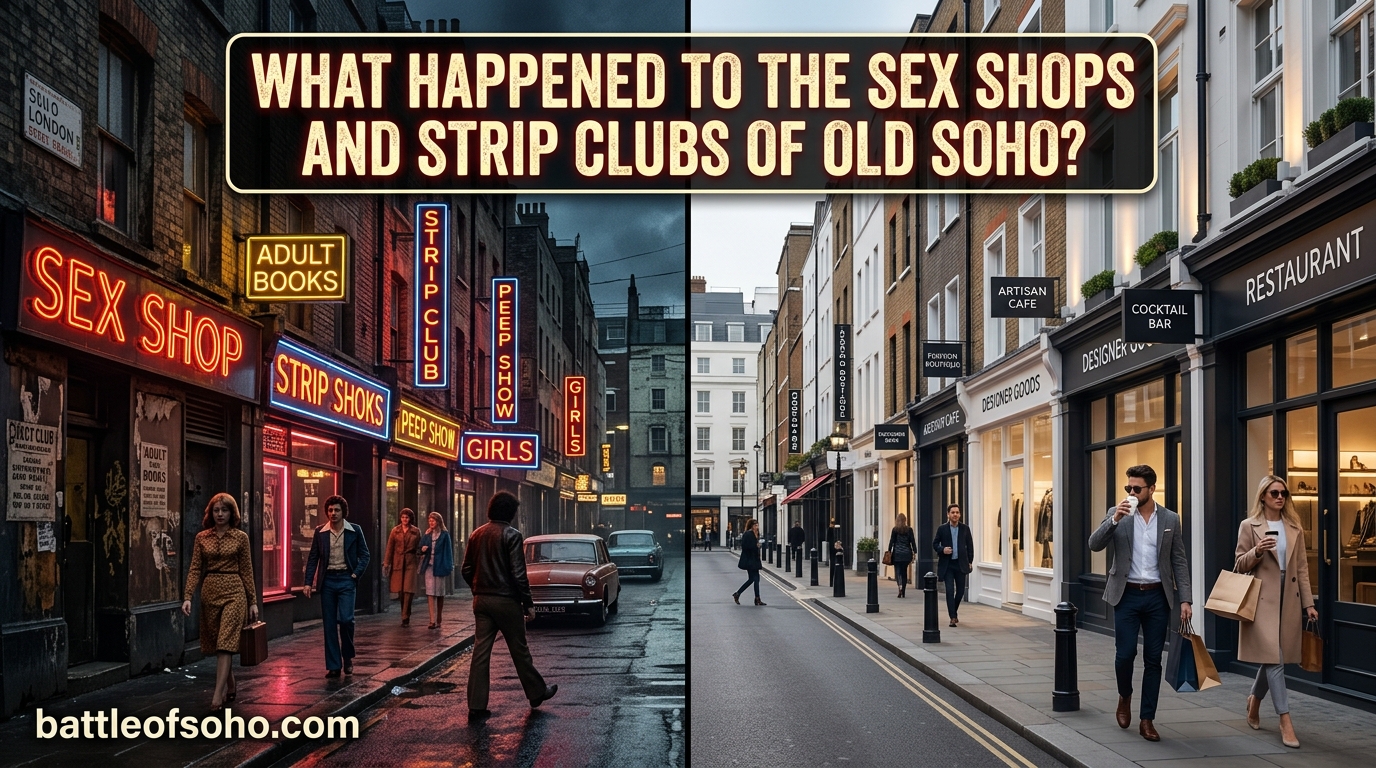
If you walked through Soho in the early 1980s, you would have found 54 sex shops, 39 sex cinemas and cinema clubs, 16 strip and peep shows, 11 sex-oriented clubs, and 12 licensed massage parlours all packed into roughly one square mile. Today, almost none of that survives. What happened to the sex shops and strip clubs of old Soho is a story of licensing crackdowns, police corruption purges, the rise of the internet, and a wave of gentrification that turned London’s most infamous red light district into one of the most expensive postcodes in the world.
Between 1976 and 1982, Soho had the densest concentration of adult entertainment venues in Europe. By 1991, that number had collapsed from roughly 185 premises to around 30. And by 2026, the Windmill Theatre, the last great survivor of the era, had shut its doors for good after a failed ten-million-pound refurbishment and a bitter dispute with its landlord.
Our team has spent months tracing the decline decade by decade, talking to people who lived and worked in old Soho, and mapping exactly what stood where, what replaced it, and what is left. The answer is not simple. It involves corrupt police officers, a property tycoon nicknamed the King of Soho, a 14-year-old runner carrying knickers for a stripper, and a community that many say was actually safer and more tightly knit when the vice trade was at its peak.
This article lays out the full timeline, street by street, statistic by statistic. Whether you are a Londoner who remembers the neon glow of Walker’s Court or a newcomer curious about what your flat cost used to be, here is the complete story of how Soho lost its seedy soul.
Table of Contents
What Happened to the Sex Shops and Strip Clubs of Old Soho
The Golden Age of Soho’s Adult Trade: 1960s Through the 1980s
Soho’s reputation as the centre of London’s sex trade did not happen overnight. It built up over centuries, but the era most people remember, the one with neon signs blazing on every corner, reached its peak between the late 1960s and early 1980s.
The foundation was laid much earlier. The Street Offences Act of 1959 pushed street prostitution indoors, concentrating sex work into Soho’s warren of walk-up flats above shops and restaurants. A walk-up flat was a first-floor or second-floor apartment, accessed by a street-level door and a staircase, where a sex worker could operate behind a locked door rather than on the pavement. By the mid-1960s, hundreds of these flats dotted the narrow streets between Shaftesbury Avenue and Oxford Street.
Simultaneously, the legal loophole that allowed the Windmill Theatre to stage nude tableaux vivants, motionless nude performers in artistic poses, had created a culture where adult entertainment was tolerated as long as it stayed within certain boundaries. The Windmill, opened by Laura Henderson in 1931, had famously stayed open throughout the Blitz with the motto “We Never Closed.” Its Windmill Girls became London icons.
By the 1970s, the floodgates were open. Sex shops with blacked-out windows lined Berwick Street, Brewer Street, and Walker’s Court. Peep shows offered private viewing booths for a few pounds. Hardcore film cinemas played loops on grimy screens. Clip joints, bars that lured tourists with the promise of female company and then threatened them into paying exorbitant bills, operated openly on side streets.
The statistics from the peak years tell the story starkly. From 1976 to 1982, Westminster had 54 sex shops, 39 sex cinemas and cinema clubs, 16 strip and peep shows, 11 sex-oriented clubs, and 12 licensed massage parlours, all concentrated in Soho. That is over 130 dedicated adult venues in a neighbourhood you can walk across in ten minutes.
What was Soho like in the 1970s? It was loud, sleazy, and chaotic by day, then transformed at night into something that felt almost like its own city. Neon signs buzzed above doorways. Market traders on Berwick Street sold fruit and vegetables alongside newspapers and, according to some accounts, items that fell off the back of lorries. Pornography was available on almost every street. And yet, according to people who lived there, it was also a genuine community where neighbours looked out for each other.
The Kings and Queens of Soho’s Night Time Economy
You cannot tell the story of Soho’s sex trade without talking about the people who built it, policed it, profited from it, and eventually lost it.
Paul Raymond: The King of Soho
No single figure looms larger over Soho’s adult entertainment history than Paul Raymond. Born Geoffrey Anthony Quinn in 1925, Raymond opened the Raymond Revuebar on Walker’s Court in 1958, transforming it from a small theatre into Britain’s most famous strip club. By the 1970s, he owned a significant chunk of Soho’s property, including the Windmill Theatre, which he purchased in 1974.
Raymond’s business empire was vast. He owned sex shops, peep shows, adult cinemas, and crucially, the buildings that housed them. When the sex trade declined, Raymond the property magnate survived even as Raymond the club king faded. His daughter Debbie took over management of several venues, and the family’s property portfolio made them some of the richest landlords in the West End. The 2013 biopic The Look of Love, starring Steve Coogan, brought his story to a new generation.
Laura Henderson and the Windmill Girls
Before Paul Raymond, there was Laura Henderson. A widow with a fortune and a taste for the unconventional, Henderson bought the Palais de Luxe cinema on Great Windmill Street in 1930 and transformed it into the Windmill Theatre. Her innovation was the tableau vivant, a legal workaround that allowed nude performers on stage as long as they did not move.
During the Blitz, the Windmill was the only London theatre to stay open throughout the bombing. Performers slept in the dressing rooms. The motto “We Never Closed” became legendary. The Windmill Girls, the dancers who performed there, went on to become celebrities in their own right. Polly Perkins, who joined as a Windmill Girl in the 1950s, later recalled the theatre as a place of discipline and glamour, far removed from the sleaze that would later define the surrounding streets.
The Runner and the Stripper: Life at Street Level
Not everyone in old Soho was a tycoon. One of the most vivid first-hand accounts comes from a man who, in 1973, worked as a runner for a stripper at the age of 14. His job was to carry her knickers, rescue outfits from overenthusiastic punters, and collect tips. He was paid two pounds a night.
In the 1970s, a single stripper might perform at 15 to 20 clubs per night on a rotation along one Soho street. The pace was relentless. The clubs were packed. And the money, for performers and runners alike, was better than almost anything else available to a teenager with no qualifications in London at the time.
John Lindsay: The Porn King
Another figure who surfaces repeatedly in accounts of the era is John Lindsay, sometimes called the porn king of Soho. Lindsay ran a string of sex shops and was known for pushing the boundaries of what could legally be sold. He was one of the operators who exploited licensing loopholes that the Aberdeen Express, a trade paper for the sex industry, openly discussed in print. Lindsay’s ability to stay one step ahead of the law was typical of Soho’s operators in the 1970s and early 1980s, before the landscape shifted dramatically.
Walker’s Court to Berwick Street: A Street-Level Tour of Old Soho
No competitor has mapped Soho’s former venues street by street. We think that is a mistake, because the story of what happened to the sex shops and strip clubs of old Soho is fundamentally a story about specific buildings on specific corners. So here is a neighbourhood walkthrough, as it existed at the peak and as it stands now.
Walker’s Court
Walker’s Court was the beating heart of Soho’s adult trade. This narrow alley running between Brewer Street and Peter Street was lined on both sides with sex shops, peep shows, and the entrance to the Raymond Revuebar. Neon signs advertised live girls, nude shows, and private booths. At night, the alley was so crowded that you could barely walk through.
Today, Walker’s Court is one of the most photographed streets in Soho, but for very different reasons. The neon signs have been replaced by boutique cocktail bars and design studios. The Raymond Revuebar building was converted into an art gallery and event space. The transformation is so complete that a visitor who knew the street in 1980 would struggle to recognise it now.
Berwick Street
Berwick Street was home to the famous Berwick Street Market, where traders sold everything from fresh produce to items of more questionable origin. It was also lined with sex shops and adult bookstores. Market traders recall stalls selling “anything and everything,” not the artisanal lunches and flat whites that dominate today.
The sex shops are long gone, replaced by independent record shops, coffee houses, and clothing boutiques. The market survived, but in a much sanitised form. Berwick Street’s transformation is a microcosm of Soho’s broader shift from vice to retail to lifestyle.
Brewer Street
Brewer Street was the main artery of Soho’s adult entertainment zone. It hosted sex cinemas, strip clubs, and massage parlours along with cheap cafes and late-night bars. The street never slept, and it was where many of the clip joints operated, targeting drunk tourists and businessmen who wandered over from the West End theatres.
By 2026, Brewer Street is dominated by restaurants, offices, and upmarket bars. A hardware store owner on the street was once told their rent would double or triple after a new hotel was constructed above their shop, a story repeated across Soho as property values soared.
Old Compton Street
Old Compton Street took a different path. Rather than being cleaned up and gentrified in the same way as Walker’s Court, it became the centre of London’s gay scene from the 1990s onward. The pink pound, the economic power of the gay community, transformed Old Compton Street into a strip of gay bars, clubs, and cafes that gave it a new identity while still keeping it distinctly Soho.
That identity has softened somewhat in recent years as rents have risen and mainstream chains have moved in, but Old Compton Street remains the closest thing in modern Soho to a street with a genuine subculture.
Great Windmill Street
Great Windmill Street was, of course, home to the Windmill Theatre itself. For decades, the theatre was the anchor of the entire adult entertainment district. Even as the sex shops around it closed and the peep shows disappeared, the Windmill kept going, reinventing itself as a table-dancing club under Paul Raymond’s ownership, then under new management after the Raymond era ended.
The Windmill’s final chapter is perhaps the most symbolic. In 2018, its sexual entertainment venue licence was revoked. A ten-million-pound refurbishment attempted to rebrand it as Windmill Soho, a cabaret and burlesque venue. The relaunch failed. By 2026, the company running it had gone into liquidation, and the building that had survived the Blitz could not survive the new Soho.
The Westminster Crackdown and the Fall of the Porn Squad
The decline of Soho’s sex trade was not a natural market process. It was driven, in the first instance, by a deliberate campaign from Westminster City Council and the Metropolitan Police.
The Licensing Crackdown of 1986
The turning point came in the mid-1980s. Westminster City Council, under pressure from residents’ groups and clean-up campaigners, began enforcing sex establishment licensing laws with a ferocity that Soho had never seen. Under the Licensing Act and related legislation, the council could refuse to grant or renew licences for sex shops, sex cinemas, and sexual entertainment venues.
Operators who had run their businesses unmolested for years suddenly found themselves facing licence reviews, compliance inspections, and outright closures. The Aberdeen Express, the trade paper that had once openly discussed loopholes in the law, found those loopholes being systematically closed. Between 1982 and 1991, the number of sex industry premises in Soho plummeted from approximately 185 to around 30.
The Porn Squad and Police Corruption
The licensing crackdown coincided with a major corruption scandal within the Metropolitan Police. The Obscene Publications Squad, colloquially known as the porn squad, had for years operated a system in which Soho sex shop owners paid regular bribes in exchange for being left alone. The arrangement was an open secret in the trade.
In the late 1980s and early 1990s, anti-corruption investigators within the Met moved against the porn squad. Several officers were convicted. The purge dismantled the informal protection network that had allowed the sex trade to operate with impunity. Without corrupt officers looking the other way, sex shop owners faced the full force of the law for the first time.
The impact was devastating for the trade. Venues that had survived on bribery and tolerance now faced genuine enforcement. Many closed rather than fight. Others were refused licences and could not legally reopen. The combination of council licensing pressure and the removal of police corruption protection was a one-two punch that the old Soho sex trade could not withstand.
The 2003 Sexual Entertainment Venue Licence
The legal framework tightened further in the 2000s. The introduction of sexual entertainment venue licences gave local authorities even greater control over strip clubs and table-dancing bars. Westminster used these powers aggressively, capping the number of licensed sexual entertainment venues in its borough and making it virtually impossible for new operators to open.
For remaining venues like the Windmill, this meant operating under constant threat of licence review. Proximity to schools, complaints from residents, and changing community standards all became grounds for closure. The legislative net tightened with each passing year.
By the Numbers: How Fast Soho’s Sex Trade Collapsed
The statistics tell the story of decline more powerfully than any narrative. Here is what happened, decade by decade.
At the peak, from 1976 to 1982, Soho had 54 sex shops, 39 sex cinemas and cinema clubs, 16 strip and peep shows, 11 sex-oriented clubs, and 12 licensed massage parlours. That is a total of roughly 132 dedicated adult entertainment premises, with additional walk-up flats bringing the overall count to approximately 185 sex industry premises.
By 1991, after the licensing crackdown and the porn squad corruption purge, that number had fallen to around 30 premises. That is an 84 percent decline in less than a decade.
By the 2000s, the rise of the internet delivered the next blow. Free online pornography destroyed the business model for sex cinemas and adult video shops. Why pay to enter a grimy cinema on Brewer Street when the same content was available at home for nothing? The commercial logic of the sex shop evaporated almost overnight.
By the 2010s, the remaining venues were strip clubs and table-dancing bars, not sex shops. The number of these venues continued to shrink under licensing pressure. The 2013 police raids on Soho walk-up flats, which sex worker advocacy groups condemned as heavy-handed, were widely seen as coordinated with council votes on demolition and redevelopment in the area.
By 2026, only a handful of adult entertainment venues remain in Soho. The sex shops are gone. The peep shows are gone. The sex cinemas are gone. Even the Windmill, the last great symbol of the era, has closed. What happened to the sex shops and strip clubs of old Soho is, in statistical terms, one of the most rapid disappearances of an established urban industry in modern British history.
Gentrification, Crossrail, and the Save Soho Campaign
The final chapter of Soho’s transformation is about property. Once the sex trade was pushed out through licensing and enforcement, the buildings it had occupied became available for something else entirely. And in central London, something else always means money.
The Property Boom
Soho’s location, sandwiched between Oxford Street and Shaftesbury Avenue in the heart of the West End, makes it some of the most valuable real estate on the planet. As the sex shops closed, their premises were snapped up by property developers and converted into luxury flats, boutique hotels, restaurants, and offices. Rents doubled, then tripled, then doubled again.
The hardware store owner told that their rent would double or triple is a story repeated across every street in Soho. Small businesses that had survived for decades, cafes, pubs, print shops, tailors, were priced out as the area upmarketed. The community that old Soho residents describe, the one where a pimp would help you get back into your flat, was replaced by a transient population of office workers, tourists, and short-term tenants.
Crossrail and the Future
The Crossrail project, which involved tunneling directly beneath Soho and constructing a massive new station at Tottenham Court Road on the neighbourhood’s doorstep, accelerated the property boom. Construction disrupted businesses for years. But the promise of a new Crossrail station within walking distance pushed land values even higher.
The ongoing discussion about Crossrail 2, a proposed further line that could also affect the area, has added another layer of speculative pressure. Property investors buy Soho buildings not for what they are worth now, but for what they will be worth when the infrastructure is complete.
The Save Soho Campaign
Not everyone accepted the transformation quietly. The Save Soho campaign, co-founded by musician Tim Arnold and supported by figures including Benedict Cumberbatch and Stephen Fry, fought to preserve the cultural institutions that gave Soho its identity. The campaign argued that Soho’s unique character, its mix of bohemian, artistic, and adult entertainment history, was being erased in favour of generic corporate blandness.
Save Soho scored some victories, drawing attention to threatened venues and galvanising public opposition to the most destructive redevelopment plans. But the underlying economic forces were too powerful. Madame Jojo’s, the legendary cabaret and drag venue on Walker’s Court, was shut down in 2014 after a violent incident outside and the subsequent revocation of its licence. For many, that closure was the final nail in the coffin for old Soho.
What Remains of Old Soho Today
So what is actually left? If you go to Soho in 2026 looking for the sex shops and strip clubs of old, what will you find?
The honest answer is: almost nothing. The sex shops are gone. The peep shows are gone. The sex cinemas are gone. The clip joints that once preyed on drunk tourists have been shut down by successive licensing and enforcement campaigns. The walk-up flats, where sex workers operated behind anonymous street-level doors, have largely been converted into ordinary apartments or commercial spaces.
A tiny number of adult entertainment venues survive, but they operate under strict licensing conditions and face constant pressure. The proposed new full-nudity strip club that made headlines in 2026, drawing objections from Soho residents, demonstrated how controversial any attempt to revive the area’s adult entertainment past has become. The residents who objected were not the old-school Soho community that had coexisted with the vice trade. They were the new Soho, the professionals and families who moved in after the cleanup.
Is Soho still a red light area? No, not in any meaningful sense. The red light district that existed from the 1950s through the 1980s has been comprehensively dismantled. What remains of the sex trade in Soho is a fraction of its former scale, operating underground or on the margins rather than in the neon-lit storefronts that once defined the neighbourhood.
What does survive is Soho’s broader cultural identity, though even that is under pressure. The area remains a centre for London’s film and media industry, with production companies and post-production houses occupying the old buildings. The gay scene on Old Compton Street persists, though diminished. Berwick Street Market still operates. The French House, the Colony Room’s old building, and a handful of historic pubs keep a thread of old Soho alive.
But the neon is gone. The buzz of Walker’s Court at midnight, the queues outside the Windmill, the runner with his two pounds a night, the King of Soho surveying his empire from the Revuebar, all of that belongs to history now. What happened to the sex shops and strip clubs of old Soho is, in the end, a story about how a city decides what it wants to be, and what it is willing to lose in order to become it.
Is Soho still seedy?
No, Soho is no longer seedy in the way it was from the 1950s through the 1980s. The sex shops, peep shows, and clip joints have been almost entirely removed through licensing crackdowns, police enforcement, and gentrification. Modern Soho is dominated by restaurants, bars, offices, and luxury flats. A few licensed adult venues remain, but the neon-lit red light district of old is gone.
What was Soho like in the 1970s?
In the 1970s, Soho was the densest concentration of adult entertainment in Europe, with 54 sex shops, 39 sex cinemas, 16 strip and peep shows, 11 sex-oriented clubs, and 12 licensed massage parlours at its peak. Walker’s Court was lined with neon-lit sex shops, Berwick Street Market sold everything from fruit to pornography, and the area operated almost as its own city within London. Despite the vice trade, residents describe a close-knit community where neighbours looked out for each other.
Is Soho, London still a red light area?
No, Soho is no longer a red light area in any meaningful sense. The walk-up flats where sex workers operated have been largely converted into residential and commercial properties. The sex shops and cinemas are gone. What remains of the adult trade is a tiny fraction of its former scale and operates under strict licensing conditions rather than in open storefronts.
Are there still clip joints in Soho?
No, the clip joints that once lured tourists with promises of female company and then intimidated them into paying extortionate bills have been shut down through successive licensing enforcement and police crackdowns. Westminster City Council’s aggressive use of licensing powers made it effectively impossible for these scam venues to operate in modern Soho.
Why is Soho House not cool anymore?
Soho House, the members-only club that took its name from the area, has expanded globally into a chain of dozens of locations, which some argue has diluted its original exclusivity and cachet. Meanwhile, the Soho neighbourhood itself has gentrified so thoroughly that the bohemian, edgy character that made a Soho-adjacent brand feel cool has largely disappeared, replaced by corporate offices and chain restaurants.
Conclusion
What happened to the sex shops and strip clubs of old Soho is a question with a clear answer: they were closed, cleaned out, and replaced. A combination of Westminster City Council licensing crackdowns, the destruction of corrupt police protection networks, the rise of free internet pornography, and a property boom that made Soho real estate among the most expensive in the world all contributed to the disappearance.
From 185 sex industry premises in 1982 to roughly 30 in 1991, and then to near zero today, the decline was swift and comprehensive. The Windmill Theatre, which survived the Blitz, did not survive the new Soho. Walker’s Court, once the neon heart of London’s adult trade, is now a corridor of cocktail bars. The community that old residents describe with such affection, imperfect and gritty as it was, has been priced out.
Whether this transformation was a clean-up success story or a cultural loss depends on who you ask. The new Soho is safer, cleaner, and more expensive. The old Soho was rougher, more dangerous in some ways, and possessed of a character and community that many argue has never been replaced. What happened to the sex shops and strip clubs of old Soho is not just a story about vice. It is a story about how cities reinvent themselves, what gets lost in the process, and what, if anything, can ever take its place.